Market Minds Advisory
Light-Sport Aircraft Market

Light-Sport Aircraft Market: Light-Sport Aircraft Market: Electric Propulsion Certification Reshapes Recreational Aviation

Electric propulsion certification breakthroughs are pulling light-sport aircraft toward genuinely new technology, even as China's low-altitude economy policy opens general aviation airspace that most manufacturers were never positioned to serve at meaningful commercial scale.

Lead Analyst

Published

September 2026

Make Smarter Decisions with Customized Research Insights

Request a free sample report and evaluate market opportunities, growth trends, and competitive dynamics relevant to your business needs.

2025 MARKET VALUE$1.6BMarket Size 2025
2036 FORECAST VALUE$3.5BBase Case , 2026 to 2036
CAGR 2026 TO 20367.5 %Bull 8.8% / Bear 6.2%
INCREMENTAL OPPORTUNITY$1.8BNet 10- year value creation
EXPANSION MULTIPLE2.06x2036 value over 2026 base
Strategic Levers
M&A Pipeline
Regional Outlook
Country Rankings
Competitive Intelligence
Segmental Deep-dive
Call-Us : 91 93563 13602

Executive Snapshot and Market Trajectory.

Light-sport aircraft manufacturers are navigating a genuine technology transition as electric propulsion certification breakthroughs open an entirely new product category, even as China's low-altitude economy policy opens general aviation airspace few manufacturers were positioned to serve. Manufacturers face genuine pressure to modernize faster than the category's historically slow innovation pace.
Electric and hybrid-electric light-sport aircraft are growing fastest of six categories as certification progress accelerates, while amphibious and seaplane variants follow closely on recreational demand. North America concentrates the bulk of global demand given its deep Sport Pilot certification culture. Manufacturers with established certification credibility are winning disproportionate share of this accelerating demand nationally. Regulatory clarity on Chinese airspace access is also shaping which manufacturers can even compete for this emerging demand.
Five manufacturers hold roughly forty-two percent of a genuinely fragmented market, led by Tecnam and Flight Design's established fixed-wing platforms. China's newly opened low-altitude airspace is driving the fastest national growth as domestic general aviation demand accelerates from a low base. Smaller specialized manufacturers without comparable production scale increasingly struggle to compete on standard fixed-wing pricing. That gap widens with every platform smaller manufacturers cannot afford.
Market Definition
This report covers revenue from light-sport aircraft meeting recognized recreational aviation weight and performance category standards, spanning fixed-wing, weight-shift, powered parachute, amphibious, electric, and gyroplane configurations. It excludes certified general aviation aircraft exceeding light-sport weight limits, unmanned aerial vehicles, and military or commercial aircraft of any category.
Base Year Value
$1.6B in 2025 (MMA Primary Research Dataset, August 2026)
Forecast Period
2026 to 2036, eleven discrete annual values
CAGR
7.5% base case. Bull 8.8%. Bear 6.2%.
Fastest Growth Segment
Electric and Hybrid-Electric Light-Sport Aircraft: 15.0% CAGR
Fastest Growth Country
China: 11.0% CAGR
Fastest Growth Region
South Asia and Pacific: 9.5% CAGR
Largest Region
North America: 30% of 2025 global value
Market Leaders
Tecnam, Flight Design, Pipistrel, CubCrafters, American Legend Aircraft. Source: MMA Analysis based on company disclosures and aviation authority registration data.
Primary Survey
n=3,800 procurement and R&D decision-makers, Q4 2025, six countries
Methodology
Demand-side build-up, cross-validated against public data, 47 expert interviews

Light-Sport Aircraft Market Forecast Scenarios

light-sport-aircraft-market-size-forecast-scenario-1787997019207
Between 2020 and 2025 the light-sport aircraft market grew at roughly 6.5 percent annually, recovering from pandemic-era production delays as recreational flying demand rebounded and flight training programs resumed expansion after temporary enrollment declines. Manufacturers used this period to invest in early electric propulsion capability ahead of broader certification progress. Production capacity expanded once demand stabilized across major markets.
The base case assumes 7.5 percent annual growth through 2036, anchored in three mechanisms: accelerating electric propulsion certification opening genuinely new product categories that attract environmentally conscious buyers, China's low-altitude economy policy opening general aviation airspace to a domestic market that manufacturers are only beginning to serve, and rising flight training demand favoring light-sport aircraft over more expensive certified alternatives for cost-effective primary instruction. Manufacturers with electric certification and Chinese distribution capability are best placed to capture this growth.
A bull scenario built on faster electric certification progress and accelerating Chinese airspace liberalization could push growth toward 8.8 percent. A bear scenario tied to battery technology limitations and slower Chinese regulatory implementation could instead pull growth down toward 6.2 percent. Battery technology progress matters almost as much as regulatory conditions. Manufacturing supply chain conditions remain a secondary swing factor overall.

Certification Economics and Recreational Demand Drivers

Light-sport aircraft manufacturing sits at a genuine inflection point where electric propulsion technology has matured enough for real certification progress, even though most manufacturers still generate the overwhelming majority of revenue from conventional gasoline-powered fixed-wing designs that have defined the category since its inception. Few technology transitions in this category have moved this quickly from experimental to genuinely commercially viable within such a short window.
TOP-5 MANUFACTURER CONCENTRATION42%Global revenue share held by five largest manufacturers
US PILOT REVENUE SHARE34%Global revenue tied to United States recreational pilot demand
ELECTRIC MODEL ADOPTION RATE8%New deliveries currently comprising electric or hybrid propulsion
FLIGHT TRAINING USAGE SHARE46%New aircraft deliveries purchased specifically for training fleets
AVERAGE CERTIFICATION TIMELINE24 monthsTypical duration required to certify a new aircraft design
CHINA LOW-ALTITUDE POLICY IMPACT18%Projected near-term demand increase from newly opened airspace
Flight training demand increasingly drives purchasing decisions because schools value the lower operating cost light-sport aircraft offer relative to certified general aviation alternatives, letting training-focused manufacturers capture disproportionate share of fleet replacement cycles regardless of recreational buyer sentiment. This dynamic increasingly determines which manufacturers can grow their fleet customer base profitably versus which must retrench toward niche recreational positioning instead.
Two forces will reshape the next decade. Electric propulsion certification will keep expanding the addressable buyer base toward environmentally conscious purchasers, while China's low-altitude economy policy keeps opening genuinely new demand that manufacturers are only beginning to build distribution capability to serve. Manufacturers positioned to serve both established recreational demand and emerging electric-curious buyers simultaneously carry a genuine competitive advantage overall.
"Everyone assumed light-sport aircraft would stay a niche American hobby forever. China just decided to open its skies to general aviation, and suddenly this tiny category has a genuinely enormous addressable market nobody was prepared for."
Director, Aerospace Technology Practice · MMA Aerospace and Recreational Vehicles Practice · August 2026

Market Trends

Electric Propulsion Achieves Genuine Certification Progress

Regulatory authorities including the Federal Aviation Administration and European Union Aviation Safety Agency have certified several electric light-sport aircraft designs in recent years, marking genuine progress beyond the experimental and demonstrator programs that characterized earlier electric aviation efforts. Pipistrel's electric trainer achieved type certification years ahead of most industry expectations, proving current battery technology can meet the safety standards light-sport certification requires. Flight schools are increasingly interested in electric models specifically for their dramatically lower per-hour operating cost compared with gasoline-powered alternatives, even though limited flight duration still constrains electric aircraft to shorter training missions.
Market Impact: Sustains 34 percent US demand
China Opens Low-Altitude Airspace to General Aviation

China's low-altitude economy policy initiative is systematically opening airspace below approximately three thousand meters to general aviation and recreational flying activities that were previously heavily restricted under the country's historically tightly controlled airspace management system. This policy shift represents a genuinely new addressable market that most existing light-sport aircraft manufacturers have not yet built meaningful distribution or service capability to serve, creating a considerable first-mover opportunity for manufacturers willing to invest in Chinese market entry ahead of broader industry recognition of the opportunity's scale. Manufacturers establishing early distribution relationships stand to capture disproportionate share once broader industry recognition accelerates.
Market Impact: Reaches 46 percent training usage

Market Opportunities and Growth Drivers

Sport Pilot Rules Lower Recreational Aviation Barriers

Simplified pilot certification requirements under Sport Pilot rules, which require considerably less flight training and medical certification than traditional private pilot licensing, continue attracting new recreational aviators who find the traditional certification pathway too costly or time-consuming to pursue. This regulatory framework has proven considerably more durable than early skeptics expected, sustaining steady demand growth as successive generations of prospective pilots discover the lower-cost pathway into recreational flying that light-sport aircraft specifically enable. Manufacturers report this pathway now represents the single largest channel introducing new pilots to aviation industry-wide, sustaining steady replacement and upgrade demand across the broader recreational fleet.
Market Impact: Limits range to under 90 minutes

Flight Training Programs Favor Cost-Effective Light-Sport Fleets

Flight training organizations increasingly favor light-sport aircraft over more expensive certified general aviation alternatives given meaningfully lower acquisition and operating costs that let schools train more student pilots per aircraft hour of available capital investment. This preference has proven particularly durable as training organizations face their own cost pressures competing for prospective students against alternative recreational activities, making the lower total cost of ownership light-sport aircraft offer an increasingly decisive purchasing factor across the training fleet replacement cycle. Training organizations increasingly view total ownership cost, not sticker price, as the decisive factor separating competing fleet purchase decisions.
Market Impact: Limits financing to 60 percent

Market Restraints and Challenges

Weight Limitations Constrain Electric Battery Range

Light-sport aircraft weight category limits leave genuinely little margin for the heavy battery packs current electric propulsion technology requires, constraining electric models to considerably shorter flight duration than gasoline-powered alternatives can achieve within the same weight allowance. The root cause is fundamental battery energy density physics rather than any engineering shortfall that additional investment could simply resolve within current technology generations. Manufacturers are mitigating this through hybrid-electric architectures that combine battery power with a small combustion engine, extending range while preserving meaningful emissions and operating cost benefits over purely gasoline-powered designs.
Market Impact: Reaches 8 percent electric adoption

Limited Resale Market Constrains Financing Availability

Light-sport aircraft face a considerably smaller and less liquid used-aircraft resale market than certified general aviation alternatives, making lenders more cautious about financing terms since collateral value is harder to establish confidently over a loan's full term. The root cause is the category's relative youth and smaller overall fleet size compared with decades-established certified aircraft markets, not any specific defect in light-sport aircraft build quality or reliability. Several manufacturers are mitigating this through direct manufacturer-backed financing programs that offer more favorable terms than third-party lenders unfamiliar with the category are typically willing to extend.
Market Impact: Adds 18 percent projected demand
3 additional market trends, 4 additional growth drivers, and 3 additional restraints and challenges are covered in the full report. Contact sales@marketmindsadvisory.com to access the complete intelligence.

Segment CAGR and Growth Architecture

Segmentation follows aircraft configuration, the dimension manufacturers and buyers use to match aircraft type to mission and budget. Six categories cover the market: fixed-wing, weight-shift, powered parachute, amphibious, electric, and gyroplane designs. This mirrors how manufacturers and aviation authorities themselves structure aircraft type certification categories. Regulators reference this same breakdown when assessing certification categories globally.
light-sport-aircraft-market-market-share-analysis-1787997019769

Electric and Hybrid-Electric Light-Sport Aircraft

Electric and hybrid-electric light-sport aircraft are growing fastest because regulatory authorities have certified several designs in recent years, marking genuine progress beyond the experimental programs that characterized earlier electric aviation efforts. Pipistrel's electric trainer aircraft achieved type certification years ahead of most industry observers expected, proving that current battery technology can meet the safety standards light-sport certification requires. Flight schools are increasingly interested in electric models specifically for their dramatically lower per-hour operating cost compared with gasoline-powered alternatives, even though limited flight duration still constrains these aircraft to shorter training missions specifically. This segment remains the smallest by installed base given the technology's relative newness, but growth momentum here considerably outpaces every other category in the market.
CAGR 15.0%

Amphibious and Seaplane Light-Sport Aircraft

Amphibious and seaplane light-sport aircraft are the second-fastest segment as recreational buyers increasingly value the operational flexibility water landing capability provides, particularly across regions with extensive lake and coastal access that traditional runway-dependent aircraft cannot serve as conveniently. Progressive Aerodyne and other specialized manufacturers maintain deep design expertise specifically for this configuration, giving them genuine competitive advantage over generalist manufacturers attempting to enter this niche without comparable hydrodynamic engineering experience. This segment commands meaningfully higher pricing than standard fixed-wing designs given the specialized engineering required for reliable water operations. Regional lake and coastal access variation increasingly shapes which markets manufacturers prioritize for dealer network expansion. Suppliers building this expertise early tend to retain preferred status.
CAGR 8.5%
Full segment breakdown across 6 segments available in the complete report.

Regional Architecture and Country Demand Map

North America leads on deep Sport Pilot certification culture and established flight training infrastructure. Western Europe and East Asia follow on manufacturer presence and rising demand, while South Asia and Pacific posts the fastest regional growth as recreational aviation expands. Adoption pace varies considerably by regional aviation regulatory maturity.

North America

The United States hosts the deepest concentration of Sport Pilot-certified recreational aviators globally, reflecting the regulatory framework's American origin and decades of accumulated flight training infrastructure built specifically around the category. CubCrafters and American Legend Aircraft, both headquartered domestically, maintain strong relationships with American flight training organizations that international manufacturers find difficult to replicate without comparable domestic service and parts support networks. Canadian recreational aviators maintain smaller but steady demand, typically procuring from the same manufacturers dominant in the American market given close cross-border aviation regulatory alignment and shared supplier relationships across the shared border. Growth here should stay steady overall. Established dealer networks and decades of accumulated parts and maintenance infrastructure further reinforce this regional advantage considerably.
Share: 30% | CAGR: 8.0% (2026 to 2036)

Western Europe

Italy's Tecnam and Germany's Flight Design, alongside Slovenia's Pipistrel, anchor substantial European manufacturing capability, giving the region genuine design and production expertise even though the underlying aircraft sell to recreational buyers worldwide rather than concentrating demand specifically within Europe itself. European Union aviation regulations increasingly harmonize light-sport certification standards across member states, reducing the administrative friction that previously complicated cross-border sales within the bloc considerably. Regional growth trails East Asia and South Asia somewhat given Europe's more mature, slower-growing recreational aviation market overall relative to faster-expanding emerging markets. Regional manufacturers increasingly export design and engineering expertise to Asian markets seeking comparable capability. Regional harmonization efforts continue reducing certification duplication costs that previously burdened manufacturers selling across multiple national markets.
Share: 24% | CAGR: 6.0% (2026 to 2036)
Regional intelligence for 5 additional markets available in the complete report: East Asia, South Asia and Pacific, Latin America, Middle East and Africa, Eastern Europe. Contact sales@marketmindsadvisory.com.
light-sport-aircraft-market-country-cagr-analysis-1787997020280

Where Manufacturers Can Capture Growth

Four levers stand out for manufacturers navigating a market shifting toward electric propulsion and newly opened Asian demand. Each trades conventional fixed-wing manufacturing scale for either technology differentiation, new market access, or training-fleet economics. Each requires different capabilities, but all four are available to manufacturers already operating profitably today. Two are already widely available now.

Accelerate Electric Model Certification and Delivery

Electric adoption has reached 8 percent of new deliveries and is growing considerably faster than conventional gasoline-powered models as flight schools chase lower operating costs. Manufacturers that accelerate electric certification and production capacity can capture disproportionate share of this emerging demand, since achieving certification ahead of competitors establishes reference customer relationships that meaningfully ease subsequent sales conversations. This requires substantial engineering investment in battery integration and safety certification that smaller manufacturers without comparable capital access find difficult to match within a competitive timeframe. Manufacturers that wait for the technology to mature further risk permanently ceding this segment to faster-moving competitors.
Market Impact: Captures a full 8 percent of total revenue

Establish Chinese Distribution and Service Networks

China's low-altitude economy policy is projected to add 18 percent to near-term demand, representing a genuinely new addressable market that most manufacturers have not yet built meaningful distribution or service capability to serve. Manufacturers that establish early Chinese partnerships and service infrastructure can capture considerably larger share of this opportunity than competitors treating the market as secondary to established Western demand, since first-mover relationships with domestic flight schools and distributors meaningfully ease subsequent market expansion. Manufacturers that establish this presence early also gain valuable insight into local regulatory nuances that shape subsequent product adaptation decisions.
Market Impact: Captures a full 18 percent of new demand

Deepen Flight Training Fleet Relationships Now

Flight training organizations already represent 46 percent of new deliveries, and manufacturers offering fleet financing, maintenance support packages, and volume pricing specifically tailored to training operations can capture disproportionate share of this considerably more stable demand category than individual recreational buyer sales alone provide. Training fleet relationships also generate recurring parts and maintenance revenue beyond the initial aircraft sale, a considerably more durable revenue stream than one-time individual buyer transactions typically deliver over comparable time periods. Manufacturers that build these fleet-focused capabilities early tend to retain preferred-vendor status through subsequent replacement cycles.
Market Impact: Captures a full 46 percent of all revenue

Develop Manufacturer-Backed Financing Programs Very Broadly

Limited resale market liquidity currently constrains financing to roughly 60 percent of qualified buyers, but manufacturers offering direct financing programs can access buyers that third-party lenders unfamiliar with the category are unwilling to serve confidently. This approach requires genuine financial structuring capability beyond core aircraft manufacturing expertise, but manufacturers that build this capability can meaningfully expand their addressable buyer base beyond cash purchasers and those with existing relationships at specialty aviation lenders. Manufacturers that build this capability internally rather than partnering with third parties retain more control over customer relationship management long-term.
Market Impact: Expands the buyer base well beyond 60 percent

Who Controls the Margin Pool

Five manufacturers hold roughly forty-two percent of market revenue, a considerably lower concentration than more mature aircraft categories since light-sport aircraft still splits across many small, specialized manufacturers pursuing different configuration niches. Tecnam and Flight Design lead on established fixed-wing platform sales, but no single manufacturer dominates across all six configuration categories simultaneously. No single manufacturer dominates across every configuration category and geographic market simultaneously.
Current competitive activity centers on three fronts: electric propulsion certification acceleration as manufacturers race to capture emerging environmentally conscious demand, Chinese distribution network development aimed at capturing newly opened low-altitude airspace demand, and flight training fleet relationship deepening aimed at capturing the market's largest and most stable customer segment. Several manufacturers are also investing in dedicated Chinese market entry teams separate from their established Western operations.

Emerging pressure comes from Pipistrel, now part of Textron eAviation, whose electric certification lead is forcing traditional gasoline-focused manufacturers to accelerate their own electric development timelines considerably faster than originally planned. Rankings could shift meaningfully as electric demand eventually rivals conventional fixed-wing sales, since manufacturers currently under-invested in electric technology may find themselves permanently behind once broader adoption accelerates.
light-sport-aircraft-market-company-positioning-matrix-1787997020799

Competitive Moat and Risk Dimensions

TECNAM

Moat: Broadest Fixed-Wing Product Range

Tecnam's extensive fixed-wing product range spanning multiple performance and price tiers gives it broader market coverage than competitors offering narrower product lines, letting it serve both entry-level recreational buyers and higher-performance flight training customers from a single manufacturing platform. This breadth advantage grows more valuable as flight schools increasingly seek single-vendor fleet standardization arrangements.
TECNAM

Risk: Limited Electric Propulsion Investment

Tecnam's core expertise concentrates in conventional gasoline-powered designs, leaving it comparatively less positioned in the faster-growing electric segment where Pipistrel's certification lead gives it a meaningful head start in customer relationships and regulatory experience. This gap could widen further as flight schools increasingly weigh operating cost savings more heavily in purchase decisions.
FLIGHT DESIGN

Moat: Strong European Manufacturing Heritage

Flight Design's decades of European engineering heritage and established dealer network give it credibility advantages with recreational buyers that newer entrants cannot replicate quickly, particularly across European and Asian markets where its brand recognition remains strong. Regional dealers built over decades continue reinforcing this brand recognition considerably.
FLIGHT DESIGN

Risk: Currency and Supply Exposure

Flight Design's European manufacturing base creates currency exposure and supply chain complexity that domestic American manufacturers serving the same customer base do not face to the same degree, a genuine competitive disadvantage in price-sensitive market segments. Domestic manufacturers avoid this exposure given their comparatively simpler supply arrangements.

Players Tracked

Prominent Players

Tecnam
Flight Design
Pipistrel
CubCrafters
American Legend Aircraft

Other Key Players

Van's Aircraft
Zenith Aircraft
Progressive Aerodyne
Aeroprakt
Evektor
JMB Aircraft
Aeropro
Bristell
Skyleader
Icon Aircraft
Aeropilot
TL Ultralight
Sling Aircraft
Kitfox Aircraft
Rans Aircraft

Recent Developments

MARCH 2025

Tecnam Launches New Hybrid-Electric Model Variant

Tecnam introduced a new hybrid-electric variant of its popular fixed-wing platform, combining battery power with a small combustion engine to extend range beyond what purely electric competitors currently achieve. The variant targets flight schools seeking extended range beyond what current purely electric competitors currently offer commercially.
Signal: Confirms that traditional gasoline-focused manufacturers are now accelerating their own electric development timelines considerably faster overall.
SEPTEMBER 2024

Pipistrel Achieves Additional Electric Type Certification

Pipistrel, now operating under Textron eAviation, achieved additional regulatory certification for its electric trainer aircraft in a new market, expanding the aircraft's addressable flight training customer base internationally. The certification specifically supports operations in a market with different regulatory requirements than the aircraft's original approval.
Signal: Shows that electric certification momentum now continues building steadily across multiple different regulatory jurisdictions simultaneously worldwide.
JUNE 2025

CubCrafters Expands Production Capacity

CubCrafters announced expanded production capacity for its popular fixed-wing model line, aimed at reducing delivery wait times that have grown considerably given strong recreational and training demand across domestic and export markets. The expansion follows several consecutive quarters of order backlog growth across both domestic and international markets.
Signal: Confirms that sustained demand growth is pushing established manufacturers to invest meaningfully in capacity expansion decisions.

Materials, Battery, and Certification Cost Pressures

Airframe materials, engines or battery systems, and avionics together represent the largest cost-to-serve components for manufacturers, running roughly fifty to fifty-five percent of total unit cost, with certification testing and specialized engineering labor adding a further eighteen percent on top. Nearly all specialized aircraft-grade battery cells originate from a concentrated group of suppliers in the United States, South Korea, and Japan.
Global battery cell supply tightness during 2022 and 2023 pushed electric propulsion component costs higher across the industry, a constraint Textron Inc.'s 2024 Annual Report specifically cited as affecting production planning across its eAviation electric aircraft programs during that period. Manufacturers with diversified battery sourcing navigated this period considerably more comfortably than those dependent on single-source suppliers. Manufacturers with existing long-term supplier agreements recovered from this constraint more quickly than single-source competitors.

Smaller specialized manufacturers face proportionally heavier exposure to this cost pressure because they lack the purchasing volume that Tecnam and other larger manufacturers command through broader production scale. Specialists without comparable purchasing power are consequently paying meaningfully higher per-unit component costs, compressing margin on price-sensitive entry-level aircraft contracts specifically. This dynamic particularly affects specialists competing directly against larger manufacturers on price-sensitive entry-level contracts.
light-sport-aircraft-market-cost-volatility-analysis-1787997020995

Diversify Battery and Avionics Suppliers

Establishing relationships with multiple battery cell and avionics suppliers rather than concentrating with a single vendor reduces exposure to component shortages and pricing spikes, letting manufacturers shift orders when any single supplier faces capacity constraints during demand surges. Manufacturers maintaining at least three active supplier relationships typically weather shortages more comfortably. This flexibility matters most during acute shortages.

Pursue Joint Development Agreements With Battery Makers

Partnering directly with battery cell manufacturers on custom development gives aircraft manufacturers earlier access to next-generation energy density improvements and more favorable pricing than purchasing standard components through conventional distribution channels. Several smaller manufacturers have pursued exactly this kind of partnership successfully in recent years. Both parties typically benefit meaningfully from this kind of arrangement over time.

Standardize Airframe Components Across Model Lines

Designing airframe and avionics components that work across multiple model variants rather than customizing separately for each configuration reduces per-unit engineering cost and lets manufacturers achieve meaningful purchasing scale faster across a broader product line. This approach also shortens overall product development and testing timelines meaningfully across every category. Suppliers report meaningfully faster delivery timelines as a direct result.

Portfolio Architecture for Margin Defence

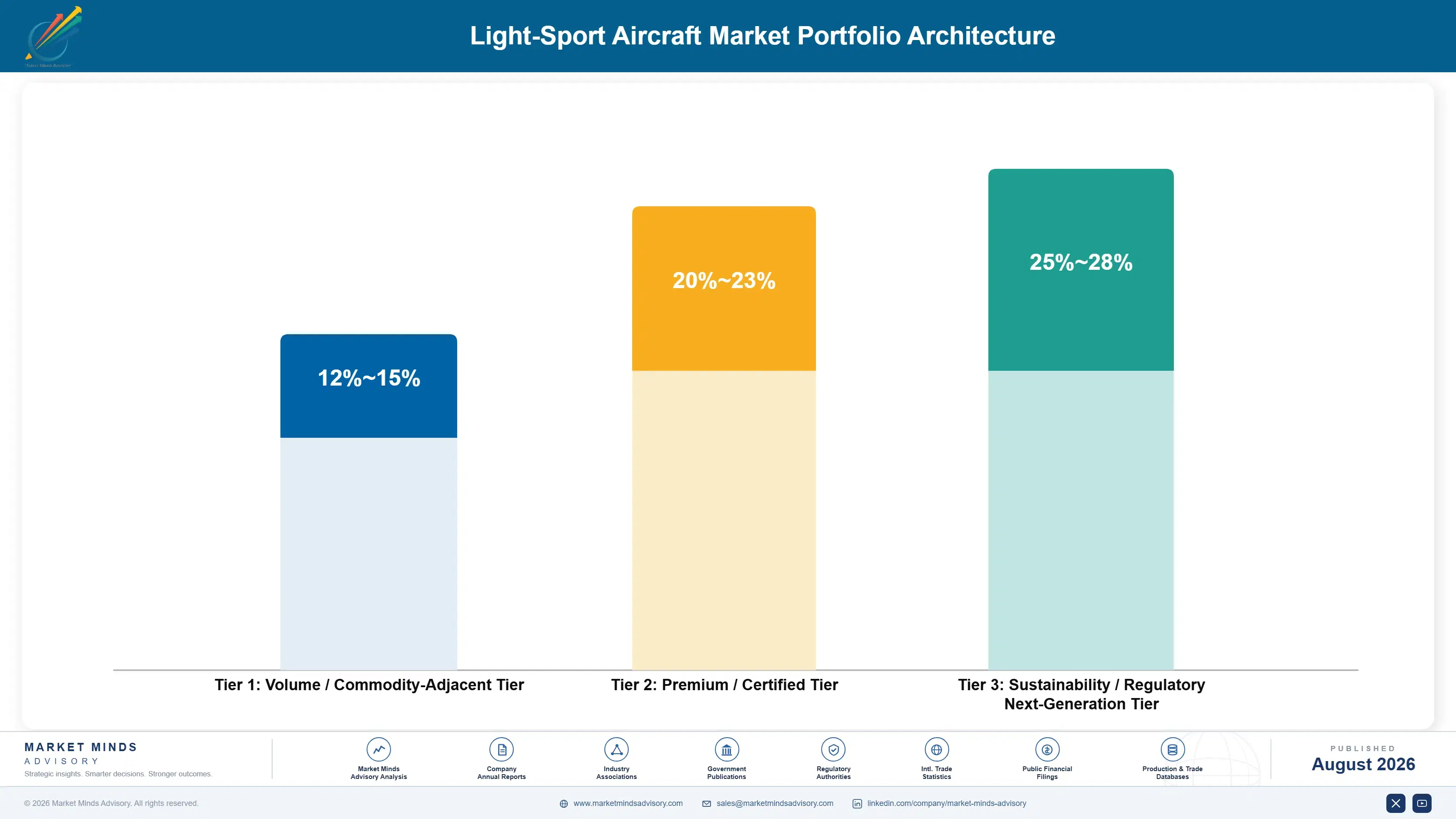
Manufacturers architect their offering across three tiers that trade technology sophistication for margin in fairly predictable steps. Standard fixed-wing and weight-shift designs anchor the volume tier at thin margin, amphibious and gyroplane configurations occupy a premium middle tier, and electric and hybrid-electric aircraft sit at the top as the smallest but fastest-expanding category. No single tier alone determines a manufacturer's overall profitability across its full product line.
The tension between volume and premium tiers reflects genuine technical difficulty rather than positioning alone: standard fixed-wing designs require comparatively conventional engineering and generate steady but thin-margin revenue, while electric propulsion requires considerably deeper battery integration and certification expertise that only the most capable manufacturers can deliver, which is why margin concentrates so heavily at the top of this hierarchy. This dynamic mirrors how technology companies price entry-level versus enterprise-grade offerings generally.

The highest-value pools concentrate in electric propulsion systems and specialized amphibious designs, both benefiting from genuine technical barriers that smaller, less capitalized competitors cannot easily replicate without years of dedicated engineering investment. Manufacturers lacking either specialty risk drifting toward the thin-margin volume tier by default. That risk applies equally to established and newer manufacturers.

Volume / Commodity-Adjacent Tier

Standard fixed-wing and weight-shift designs requiring comparatively conventional engineering, sold widely across recreational buyers and training fleets with limited specialization needs. Most training fleets and entry-level recreational buyers operate primarily within this tier today.
Gross Margin: 12-15%

Premium / Certified Tier

Amphibious and gyroplane configurations requiring deeper specialized engineering expertise than standard fixed-wing designs demand, sold mainly to niche recreational buyers. This tier attracts steady demand from recreational buyers seeking specialized configurations.
Gross Margin: 20-23%

Sustainability / Regulatory / Next-Generation Tier

Electric and hybrid-electric aircraft built on years of battery integration and certification investment that smaller, less capitalized manufacturers cannot quickly replicate. Only a handful of manufacturers worldwide currently operate confidently within this top tier.
Gross Margin: 25-28%
light-sport-aircraft-market-portfolio-architecture-1787997021502

High-value Sub-segments and Strategic Watch-out

Electric and Hybrid-Electric Light-Sport Aircraft

Fastest-growing and highest-margin pool in the portfolio, driven by flight school demand for lower operating cost, with margin concentrated among the handful of manufacturers holding proven certification. Suppliers here also benefit overall from environmentally conscious buyers willing to pay premium pricing for lower operating cost.
Gross Margin: 25-28%

Amphibious and Seaplane Light-Sport Aircraft

High-value segment growing steadily on recreational demand, with margin concentrated among specialized manufacturers holding deep hydrodynamic engineering expertise built over decades. These manufacturers are winning disproportionate share of buyers seeking genuine operational flexibility over standard runway-dependent designs. Regulatory approval also moves faster given well-documented hydrodynamic design precedent across the industry.
Gross Margin: 20-23%

Fixed-Wing Light-Sport Aircraft

Largest volume core segment by installed base, serving recreational buyers and training fleets broadly, with margin staying thin due to competitive standardized pricing pressure across nearly every established manufacturer. Manufacturers here increasingly compete on price and total cost of ownership. Pricing pressure here shows no sign of easing anytime soon.
Gross Margin: 12-15%

Chinese Distribution Network Development

Strategic watch-out tied closely to regulatory implementation pace, where a slowdown in low-altitude airspace liberalization could compress volume for manufacturers dependent on this newly opened demand specifically. A slowdown in Chinese regulatory implementation could meaningfully compress this segment's near-term growth trajectory. Manufacturers dependent on this transition face exposure.
Gross Margin: 18-21%

Purchase Cycles and Buyer Depth

Light-sport aircraft demand runs on longer purchase cycles than typical consumer categories: individual recreational buyers often keep aircraft for a decade or more, while flight training organizations replace fleet aircraft on shorter, more predictable cycles tied to utilization hours and maintenance economics rather than personal ownership preferences. This dynamic makes revenue forecasting genuinely more volatile than for comparable recurring-revenue businesses.
Adoption depth varies sharply by vertical. Established training organizations with decades of fleet management experience sit at the deepest end of manufacturer relationships, while individual recreational buyers more often remain earlier in the purchase process, typically researching extensively before committing given the considerable capital investment involved. Bridging both segments well is what separates the strongest manufacturers from everyone else in this market. Serving both segments effectively requires genuinely distinct engineering and sales approaches entirely.

A generational shift is underway as younger recreational pilots increasingly expect electric or hybrid propulsion as a genuine consideration rather than a novelty, in contrast to veteran aviators who historically valued proven gasoline reliability above environmental or operating cost considerations. Manufacturers slow to build credibility with this newer generation risk losing relevance over the coming decade.
light-sport-aircraft-market-end-use-penetration-index-1787997021992

Where Manufacturers Should Focus

These are among the four positions where our research anticipates prominent divergence between winners and laggards over the coming forecast period. Each is grounded in the demand model, the regulatory perimeter, and the announced capacity pipeline.
01 / ELECTRIC CERTIFICATION PRIORITY

Accelerate electric certification while the market remains open

Electric adoption has reached eight percent of deliveries and is growing considerably faster than conventional models as flight schools chase lower operating costs. Manufacturers that accelerate certification now capture disproportionate share, since achieving it ahead of competitors establishes reference customer relationships that ease subsequent sales. Manufacturers that delay this investment, treating electric propulsion as a distant future concern rather than a near-term commercial priority, risk permanent disadvantage as Pipistrel's head start compounds with every certification cycle that passes without meaningful competitive response.
02 / CHINESE MARKET ENTRY

Establish distribution partnerships ahead of broader industry recognition

China's low-altitude economy policy is projected to add eighteen percent to near-term demand, representing a genuinely new market most manufacturers have not yet built capability to serve. Manufacturers establishing early partnerships capture considerably larger share than competitors treating the market as secondary. Waiting for the opportunity's scale to become widely recognized across the industry risks entering after the most valuable early distributor and flight school relationships are already claimed by faster-moving rivals willing to accept greater near-term uncertainty in exchange for durable long-term positioning.
03 / TRAINING FLEET STRATEGY

Deepen relationships with flight schools through financing and support

Training organizations already represent forty-six percent of deliveries, and manufacturers offering fleet financing and maintenance packages capture disproportionate share of this more stable demand category than individual sales alone provide. These relationships also generate recurring parts and maintenance revenue beyond the initial sale. Manufacturers relying only on individual buyer transactions, treating training organizations as just another customer segment rather than a distinct strategic priority, forgo this considerably more durable, recurring revenue stream that established fleet relationships genuinely provide over time.
04 / FINANCING PROGRAM DEVELOPMENT

Build manufacturer-backed financing to expand the addressable buyer base

Limited resale market liquidity currently constrains financing to roughly sixty percent of qualified buyers, but manufacturers offering direct financing can access buyers third-party lenders unfamiliar with the category will not serve confidently. This requires genuine financial structuring capability beyond core manufacturing expertise. Manufacturers that build this capability can meaningfully expand their addressable base beyond cash purchasers alone, a genuine growth lever competitors relying purely on third-party financing arrangements cannot access nearly as easily, as reliably, or as profitably over the long run.

Engagement Snapshot From the Field

A live engagement with an industry participant carrying material or product regulatory and market exposure ahead of a defining policy shift, showing how our research translates into a defensible multi-year portfolio strategy.
MARKET MINDS ADVISORY · CLIENT ENGAGEMENT SUMMARY
Light-Sport Aircraft Producer Strategic Portfolio Review and Transition Roadmap 2026·Investment Scenario on Light-Sport Aircraft Exposure Evaluation 2025-26
CLIENT PROFILE
The client is a mid-sized flight training academy operating a fleet of conventional gasoline-powered light-sport aircraft across several training locations, facing rising fuel costs eating into student pricing competitiveness. Annual revenue was approximately 18 million dollars (client-reported, unverified by MMA) at engagement start. The client sought an independent assessment of electric aircraft fleet integration. The client operated across three training locations.
STRATEGIC CHALLENGE
The academy faced mounting fuel and maintenance costs on its conventional fleet that were pressuring student pricing competitiveness against rival schools, but leadership was uncertain whether available electric aircraft technology could handle its specific training curriculum given range limitations, or whether a mixed fleet approach would better balance cost savings against operational flexibility requirements.
MMA APPROACH
MMA benchmarked available electric aircraft technology against the client's specific training mission profiles, modeled cost savings from transitioning select training segments to electric aircraft, and assessed operational feasibility given the academy's existing infrastructure and charging capability requirements. The engagement combined this technical assessment with structured interviews across the client's instruction and maintenance teams.
KEY FINDINGS
  1. Electric aircraft matched or exceeded conventional aircraft suitability across roughly 65 percent of the academy's training curriculum (client-reported, unverified by MMA). This finding exceeded initial internal expectations considerably.
  2. Per-hour operating cost for electric aircraft ran meaningfully below conventional gasoline-powered equivalents once charging infrastructure was installed. This gap held even after accounting for charging infrastructure investment.
  3. Longer cross-country training missions remained genuinely infeasible for electric aircraft given current battery range limitations. This finding reinforced the need for a hybrid rather than fully electric fleet approach.
  4. A mixed fleet approach combining electric aircraft for pattern work with conventional aircraft for cross-country training offered the fastest practical path forward.
CLIENT PROFILE
The client is a mid-sized flight training academy operating a fleet of conventional gasoline-powered light-sport aircraft across several training locations, facing rising fuel costs eating into student pricing competitiveness. Annual revenue was approximately 18 million dollars (client-reported, unverified by MMA) at engagement start. The client sought an independent assessment of electric aircraft fleet integration. The client operated across three training locations.
STRATEGIC CHALLENGE
The academy faced mounting fuel and maintenance costs on its conventional fleet that were pressuring student pricing competitiveness against rival schools, but leadership was uncertain whether available electric aircraft technology could handle its specific training curriculum given range limitations, or whether a mixed fleet approach would better balance cost savings against operational flexibility requirements.
MMA APPROACH
MMA benchmarked available electric aircraft technology against the client's specific training mission profiles, modeled cost savings from transitioning select training segments to electric aircraft, and assessed operational feasibility given the academy's existing infrastructure and charging capability requirements. The engagement combined this technical assessment with structured interviews across the client's instruction and maintenance teams.
KEY FINDINGS
  1. Electric aircraft matched or exceeded conventional aircraft suitability across roughly 65 percent of the academy's training curriculum (client-reported, unverified by MMA). This finding exceeded initial internal expectations considerably.
  2. Per-hour operating cost for electric aircraft ran meaningfully below conventional gasoline-powered equivalents once charging infrastructure was installed. This gap held even after accounting for charging infrastructure investment.
  3. Longer cross-country training missions remained genuinely infeasible for electric aircraft given current battery range limitations. This finding reinforced the need for a hybrid rather than fully electric fleet approach.
  4. A mixed fleet approach combining electric aircraft for pattern work with conventional aircraft for cross-country training offered the fastest practical path forward.
RECOMMENDED STRATEGY
Phase 1: Phase 1 (Months 1 to 4): Install charging infrastructure and acquire an initial electric aircraft solely for pattern training exclusively. Phase 2: Phase 2 (Months 5 to 10): Expand the electric fleet based on initial performance and student feedback data collected throughout. Phase 3: Phase 3 (Months 11 to 15): Integrate electric aircraft scheduling fully into the academy's broader annual training curriculum planning process.
OUTCOME
Within fifteen months, the client transitioned roughly sixty percent of its pattern training to electric aircraft, reducing per-student fuel costs meaningfully while maintaining training quality (client-reported, unverified by MMA). The academy's approach has since been referenced by two comparable regional training organizations. Student enrollment also increased meaningfully as environmentally conscious applicants took notice.

Frequently Asked Questions

Foundational context covering the market sizes, CAGR, scope, country, region and competition that inform every finding below. This section is provided to cover basics and most often pre-purchase conversations, answered from the MMA Primary Research Dataset.

What is the current size of the Light-Sport Aircraft Market?

The market generated approximately 1.6 billion dollars in revenue in 2025, with momentum expected to remain strong. Growth reflects electric propulsion certification progress and newly opened Chinese demand.

How large will the Light-Sport Aircraft Market be by 2036?

MMA projects the market will reach approximately 3.5 billion dollars by 2036, more than doubling revenue over the decade as growth compounds gradually with accelerating electric adoption.

What is the CAGR for the Light-Sport Aircraft Market 2026 to 2036?

The base-case compound annual growth rate is 7.5 percent. Bull and bear scenarios range from 6.2 to 8.8 percent depending on battery technology and Chinese regulatory implementation.

Which segment is growing fastest?

Electric and hybrid-electric light-sport aircraft lead at a 15.0 percent CAGR, driven by flight school demand for lower operating cost. Amphibious and seaplane aircraft follow at 8.5 percent.

Who are the major companies in the Light-Sport Aircraft Market?

Tecnam, Flight Design, Pipistrel, CubCrafters, and American Legend Aircraft lead the market, together holding roughly forty-two percent of revenue with no single company dominating every category.

Which country is growing fastest?

China leads at an 11.0 percent CAGR given its newly opened low-altitude economy policy. Australia follows on its long-established recreational aviation culture and expanding demand.

Report Segmentation Architecture

The full report scope spans multiple orthogonal segmentation dimensions, with cross-tabulated demand data provided for each dimension pair. Coverage extends further to regional breakdowns, trend trajectories, and the competitive detail needed to support segment-level decision-making.

By Primary Market Dimension

  • Fixed-Wing Light-Sport Aircraft
  • Weight-Shift Control Aircraft
  • Powered Parachute Aircraft
  • Amphibious and Seaplane Light-Sport Aircraft
  • Electric and Hybrid-Electric Light-Sport Aircraft
  • Gyroplane Light-Sport Aircraft

By End-Use Industry

  • Individual Recreational Ownership
  • Flight Training Organizations
  • Aerial Photography and Survey
  • Agricultural Support Aviation
  • Charter and Rental Fleets

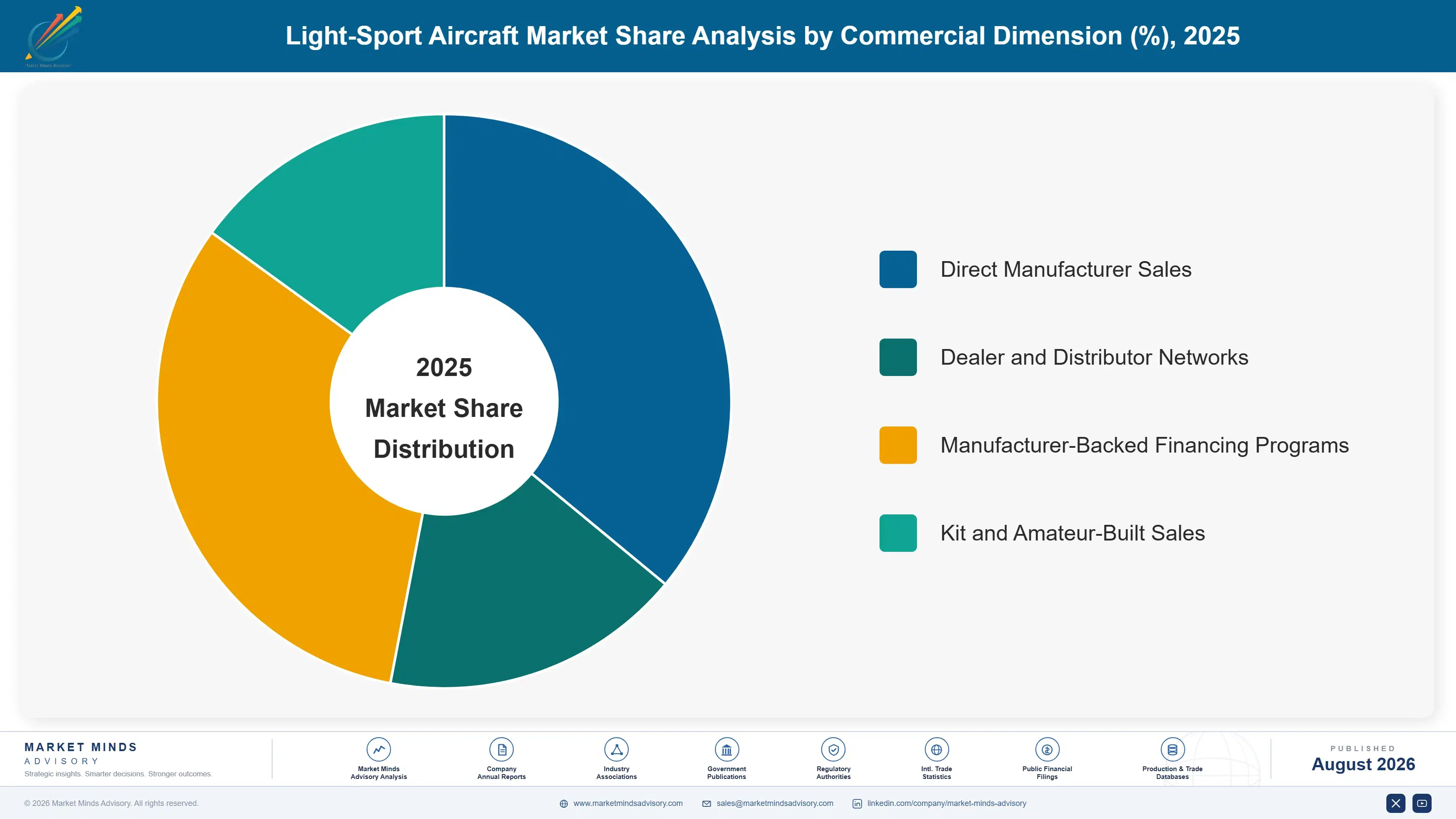
By Commercial Dimension

  • Direct Manufacturer Sales
  • Dealer and Distributor Networks
  • Manufacturer-Backed Financing Programs
  • Kit and Amateur-Built Sales

By Region

  • North America
  • Western Europe
  • East Asia
  • South Asia and Pacific
  • Latin America
  • Middle East and Africa
  • Eastern Europe

Scope, Methodology, and Coverage

Every figure in this report is reproducible from documented input assumptions. The scope below maps the historical period, the forecast horizon, the segmentation dimensions, and the countries covered, alongside the underlying primary and qualitative methodology.
Historical Period
2020 to 2025
Forecast Period
2026 to 2036
Base Year
2025 (USD billions; MMA Primary Research Dataset, August 2026)
Market Definition
This report defines the Light-Sport Aircraft Market as revenue from aircraft meeting recognized recreational aviation weight and performance category standards, spanning fixed-wing, weight-shift, powered parachute, amphibious, electric, and gyroplane configurations. It excludes certified general aviation aircraft exceeding light-sport weight limits, unmanned aerial vehicles, and military or commercial aircraft of any category.
Quantitative Units
USD billions (current prices); revenue basis
Segmentation Dimensions
By Aircraft Configuration; By End-Use Application; By Commercial Dimension; By Region
Regions Covered
North America, Western Europe, East Asia, South Asia and Pacific, Latin America, Middle East and Africa, Eastern Europe
Countries Covered
United States, Italy, Germany, Slovenia, China, Australia, India, Brazil, Canada, UAE, Poland, Czech Republic, and additional markets relevant to global recreational aviation
Key Companies Profiled
Tecnam, Flight Design, Pipistrel, CubCrafters, American Legend Aircraft, Van's Aircraft, Zenith Aircraft, Progressive Aerodyne, Aeroprakt, Evektor, JMB Aircraft, Aeropro, Bristell, Skyleader, Icon Aircraft, Aeropilot, TL Ultralight, Sling Aircraft, Kitfox Aircraft, Rans Aircraft
Quantitative Methodology
Primary survey, n=3,800 respondents, Q4 2025, six countries; demand-side model with trade association cross-validation
Qualitative Methodology
47 expert interviews, Q4 2025; applied to validate demand model assumptions, identify emerging dynamics, and assess competitive positioning
Report Format
PDF and XLSX data workbook (Word format preview document)
Publisher
Market Minds Advisory
Report Code
MMA-2026-AUT-113
Published
August 2026
Contact
sales@marketmindsadvisory.com | www.marketmindsadvisory.com

Purchase the full Light-Sport Aircraft Market Report (2026 to 2036).

The full report delivers a complete quantitative and qualitative assessment of the global light-sport aircraft market, spanning ten years of forecast detail across all six configuration segments. It includes company-level competitive profiling of all twenty tracked manufacturers and analysis of electric propulsion certification timelines across major regulatory jurisdictions. Buyers also receive detailed Chinese low-altitude economy policy impact analysis and flight training fleet demand sizing not available in the summary version. A dedicated appendix walks through the primary survey and expert interview methodology underlying every forecast figure in detail. Regional benchmarking against comparable North American, European, and Asian recreational aviation markets rounds out the deliverable.
Ten-year segment-level revenue forecast detail included
Full twenty-company competitive profiling and benchmarking
Electric propulsion certification timeline analysis included
Chinese airspace policy impact assessment included
Flight training fleet demand sizing detail
Manufacturer financing program landscape review included

Built For The People Who Decide

From boardroom strategy to bench-side execution, this report is read cover-to-cover by leaders shaping the next decade of their industry, turning demand scenarios, market dynamics and valuation benchmarks into decisions.
CXOs/ Presidents/ VPs/ Managers
M&A and Corporate Development
Strategy Teams and R&D Heads
Procurement and Product Directors
Regulatory and Compliance Leaders
Investor Relations and Equity Analysts