Market Minds Advisory
Light Control Switch Market

Light Control Switch Market: Light Control Switch Market. Smart Connectivity Reshapes Residential and Commercial Switch Investment

Smart home platform integration is pulling switch replacement cycles forward as homeowners retrofit connected dimmers ahead of scheduled renovation timelines, while building energy codes increasingly mandate occupancy sensing controls legacy toggle switches cannot satisfy.

Lead Analyst

Published

September 2026

Make Smarter Decisions with Customized Research Insights

Request a free sample report and evaluate market opportunities, growth trends, and competitive dynamics relevant to your business needs.

2025 MARKET VALUE$5.8BMarket Size 2025
2036 FORECAST VALUE$12.5BBase Case , 2026 to 2036
CAGR 2026 TO 20367.2 %Bull 8.4% / Bear 6.0%
INCREMENTAL OPPORTUNITY$6.2BNet 10- year value creation
EXPANSION MULTIPLE2.00x2036 value over 2026 base
Strategic Levers
M&A Pipeline
Regional Outlook
Country Rankings
Competitive Intelligence
Segmental Deep-dive
Call-Us : 91 93563 13602

Executive Snapshot and Market Trajectory.

Smart connectivity is reshaping light control switch replacement cycles faster than any prior electrical product transition, as homeowners retrofit connected dimmers ahead of scheduled renovation timelines to integrate with existing smart home platforms, voice assistants, mobile applications, energy management systems, and home security integrations.
Manufacturers face simultaneous pressure from building energy code mandates requiring occupancy sensing controls in new commercial construction, expanding smart home platform compatibility requirements across residential retrofit projects, and rising competition from regional manufacturers offering lower-cost connected switch alternatives. India's expanding construction sector is pulling switch demand into domestic manufacturers faster than incumbents anticipated, while North American and European manufacturers continue funding the highest-value smart switch integration contracts across most segments, product categories, and channel partnerships.
Competitive intensity concentrates among five manufacturers controlling roughly forty-eight percent of global revenue, though regional manufacturers are winning commercial contracts faster than premium incumbents expected just two years ago and continue gaining ground steadily across most segments, product lines, and geographic markets. Regulatory pressure around electrical safety certification adds validation cost that smaller manufacturers increasingly struggle to absorb without dedicated compliance testing infrastructure and laboratory access.
Market Definition
The Light Control Switch Market covers toggle, dimmer, smart, occupancy-sensing, timer, and touch switches used to control lighting in residential, commercial, and industrial buildings. It excludes standalone lighting fixtures and general building automation software lacking dedicated physical switch hardware components.
Base Year Value
$5.8B in 2025 (MMA Primary Research Dataset, September 2026)
Forecast Period
2026 to 2036, eleven discrete annual values
CAGR
7.2% base case. Bull 8.4%. Bear 6.0%.
Fastest Growth Segment
Smart and Connected Switches: 11.5% CAGR
Fastest Growth Country
India: 10.2% CAGR
Fastest Growth Region
South Asia and Pacific: 9.2% CAGR
Largest Region
East Asia: 30% of 2025 global value
Market Leaders
Legrand, Schneider Electric, Signify, Lutron, and Leviton lead the field. Source: MMA Analysis, July 2026.
Primary Survey
n=3,800 procurement and R&D decision-makers, Q4 2025, six countries
Methodology
Demand-side build-up, cross-validated against public data, 47 expert interviews

Light Control Switch Market Forecast Scenarios

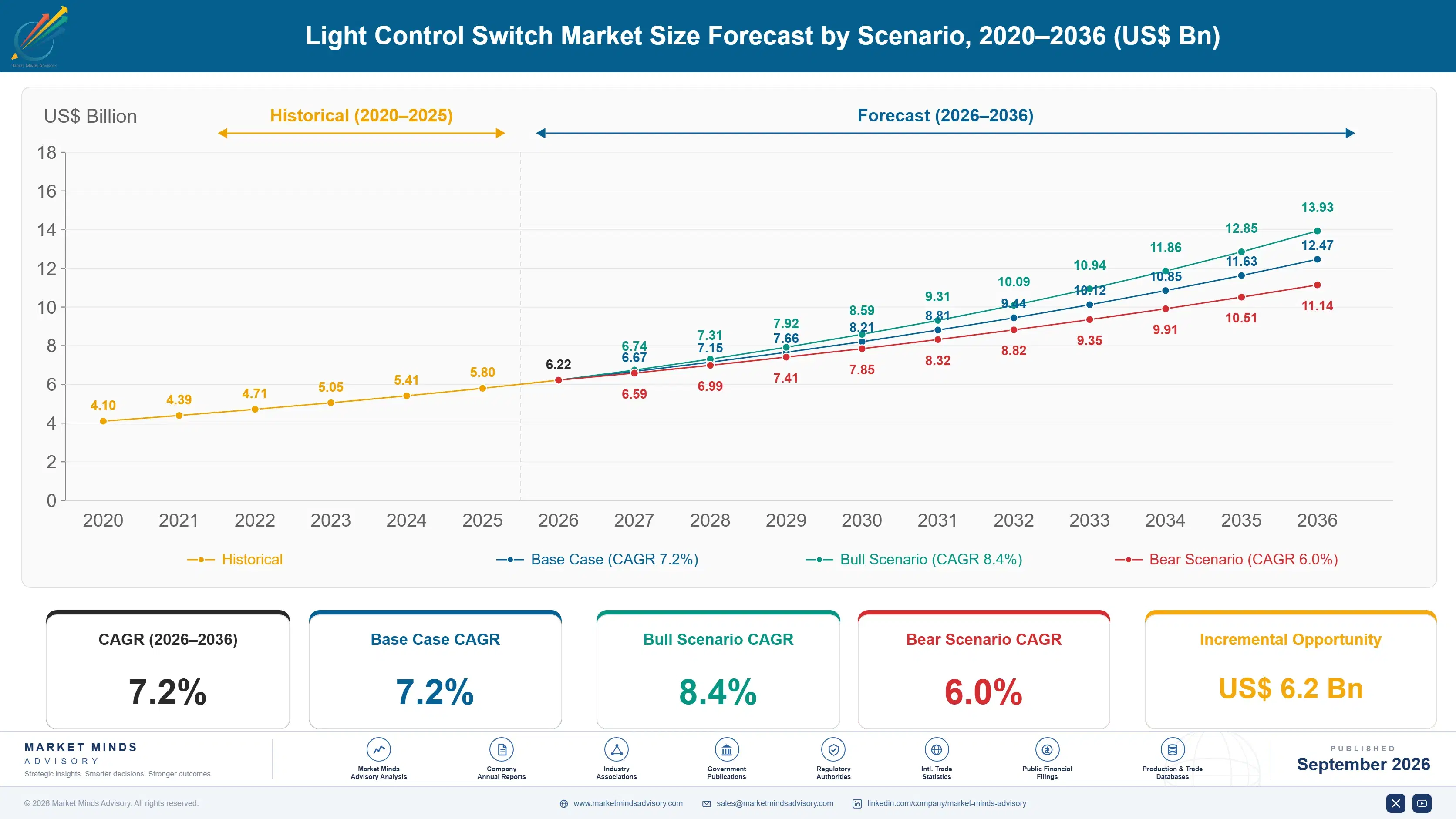
light-control-switch-market-size-forecast-scenario-1789980808995
The 2020 to 2025 period saw light control switch demand track construction and renovation activity closely, growing at a 6.6 percent compound annual rate as smart home adoption expanded beyond early technology enthusiast households into mainstream residential retrofit projects. Supply chain disruption during 2021 and 2022 temporarily constrained component availability, delaying several manufacturer product launches across multiple price tiers.
Base case forecasts assume continued smart home platform integration expanding connected switch demand, rising building energy code mandates requiring occupancy sensing controls in new commercial construction, and growing residential retrofit adoption replacing legacy toggle switches with connected alternatives. These three mechanisms combine to sustain a 7.2 percent compound annual growth rate through 2036, with India and East Asia contributing the largest incremental volume gains as domestic construction activity expands and smart home adoption accelerates across most major markets.
A bull scenario reaching 8.4 percent growth depends on faster-than-expected smart home platform adoption across mid-market residential renovation projects not yet embracing connected switch technology. A bear scenario falling to 6.0 percent would likely follow a broader construction activity slowdown reducing new building starts and renovation project volume across most major residential and commercial markets.

Building Codes Push Occupancy Sensing Adoption

Building energy codes increasingly require occupancy sensing controls in new commercial construction, pushing manufacturers to build sensor-integrated switches directly into standard product lines rather than treating sensing as a premium add-on category across most product tiers and geographic markets.
MARKET CONCENTRATIONCR5 48%Top five manufacturers hold roughly half of global revenue
AVERAGE SELLING PRICE$14.50Blended price varies widely by switch type and connectivity
TOP PRODUCING COUNTRYChina 26%Dominant electrical component manufacturing hub supplying global demand
SMART SWITCH PENETRATION22%Share of new residential installations incorporating connected switch technology
RETROFIT REPLACEMENT RATE18%Annual share of installed base replaced through renovation projects
COMPONENT COST SHARE52%Copper and molded plastic components dominate total manufacturing cost
Smart home platform compatibility increasingly determines residential switch purchasing decisions, as homeowners prioritize connected dimmers that integrate with existing voice assistants and mobile applications over standalone toggle switches lacking any connectivity capability whatsoever across most product categories. This shift pressures traditional switch manufacturers to build wireless connectivity and software update infrastructure rapidly, favoring manufacturers with established platform partnerships over manufacturers competing purely on mechanical durability and installation simplicity benchmarks that mattered more in prior product generations.
Regional manufacturers increasingly compete on price for standard toggle and rocker switches, since these products commoditize faster than smart and sensor-integrated categories that require ongoing software development investment and support infrastructure and staffing. Manufacturers increasingly bundle installation support and warranty extension services alongside premium connected switch sales, letting customers justify higher upfront cost through extended product lifecycle guarantees and dedicated technical support access across most residential and commercial customer segments.
"The switch itself is commodity hardware now, the real value sits in the software platform behind it. Manufacturers still competing purely on mechanical quality will lose share within a few years."
Senior Analyst, Building Electrical Products and Smart Home Practice · MMA Construction and Industrial Equipment Practice · September 2026

Market Trends

Smart Home Integration Accelerates Switch Replacement

Homeowners increasingly retrofit connected dimmer switches ahead of scheduled renovation timelines specifically to integrate lighting control with existing voice assistant and smart home hub platforms already installed elsewhere in their residences. This shift requires manufacturers to build wireless connectivity protocols and continuous firmware update infrastructure rather than relying on established mechanical switch designs that worked effectively for decades without requiring ongoing software maintenance investment. Manufacturers that delay building credible smart platform integration risk losing design wins to competitors offering more accessible, better-connected switch alternatives across most residential customer segments entering the smart home market for the first time.
Market Impact: India adds 8 million housing units
Building Codes Mandate Occupancy Sensing Controls

Regional building energy codes increasingly require occupancy or vacancy sensing controls in new commercial construction, particularly in office, educational, and healthcare facility categories where energy efficiency mandates have tightened considerably over recent years and continue expanding across most jurisdictions. This regulatory requirement pulls sensor-integrated switch demand directly into new commercial construction specifications rather than solely relying on voluntary energy efficiency upgrades that building owners previously adopted at their own discretion. Manufacturers offering code-compliant sensing switches increasingly win commercial specification contracts over competitors still relying on standard switches without integrated sensing capability.
Market Impact: Adds 22 percent smart home penetration

Market Opportunities and Growth Drivers

India Expands Residential and Commercial Construction

India's expanding residential and commercial construction sector, driven by urbanization and government affordable housing programs, continues pulling switch demand into domestic manufacturers at a scale that global vendors increasingly struggle to serve remotely without local manufacturing presence and support. This construction boom pulls switch procurement volume directly into domestic Indian manufacturers, favoring vendors with established local distribution and installer relationships over global vendors serving India through import channels facing tariff and logistics cost disadvantages. Domestic manufacturers increasingly capture market share from imported premium brands across most price-sensitive residential customer segments.
Market Impact: Compresses margins 8 percent annually

Smart Home Platform Adoption Expands Rapidly

Consumer adoption of smart home hub platforms and voice assistants continues expanding across most major residential markets, and this platform adoption directly pulls demand toward connected switches compatible with existing smart home platforms already installed in customer residences and daily routines. This trend pulls switch purchase decisions directly into smart home retrofit budgets rather than solely traditional renovation cycles, expanding the addressable commercial market meaningfully beyond historical replacement-driven demand patterns. Manufacturers serving smart home customers increasingly prioritize platform compatibility over legacy mechanical specifications that mattered more in prior product generations.
Market Impact: Limits cross-platform compatibility to 60 percent

Market Restraints and Challenges

Component Cost Volatility Compresses Manufacturer Margins Considerably

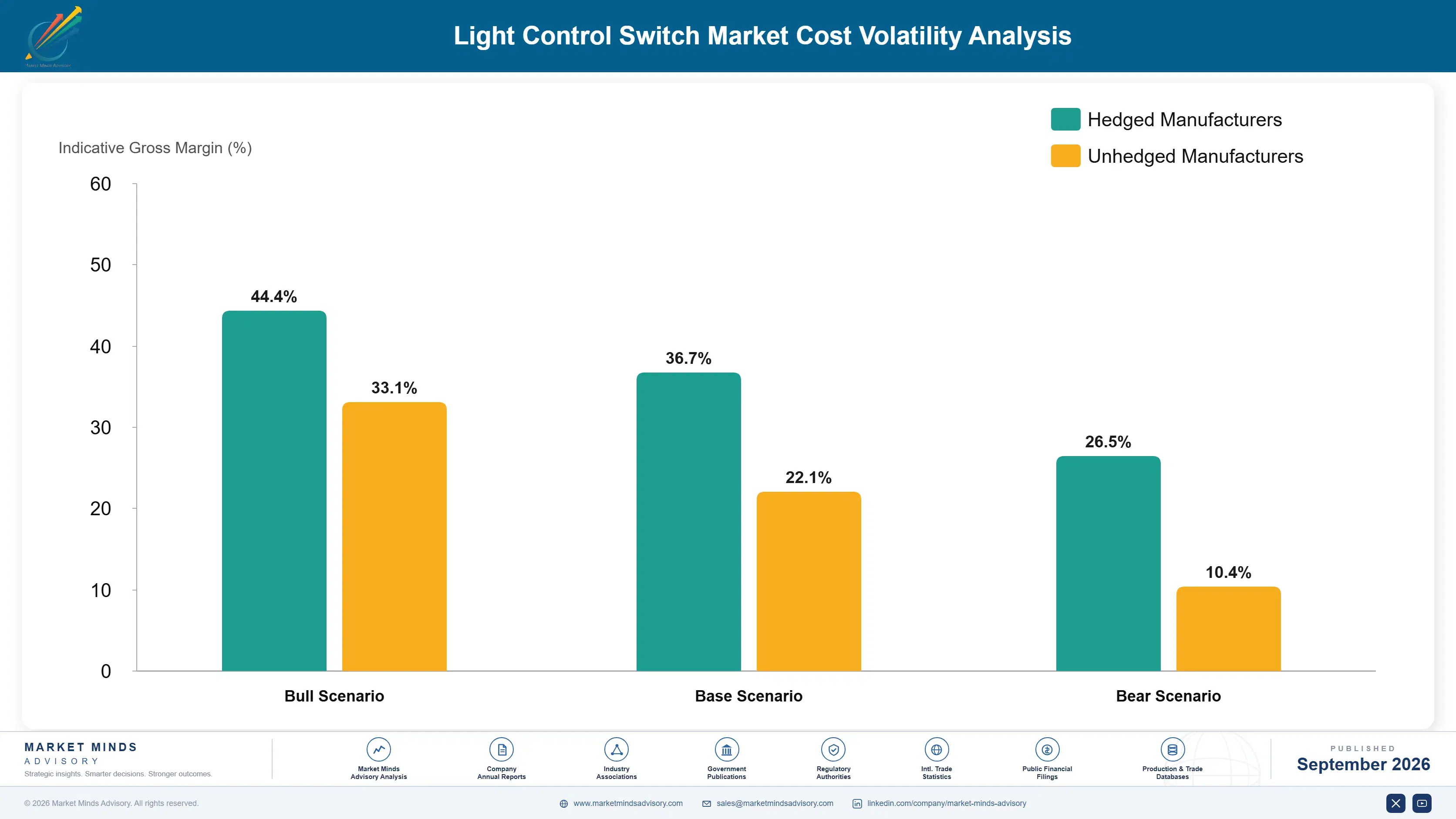
Copper and molded plastic components together represent a substantial share of switch manufacturing cost, and price swings tied to global commodity supply disruption have repeatedly compressed manufacturer gross margins over the past several years across most product categories. The root cause traces to concentrated copper mining supply in a small number of countries, leaving global copper prices exposed to localized labor disputes and export policy shifts far outside manufacturer control entirely. Manufacturers are increasingly exploring alternative conductive materials and long-term hedged procurement contracts to reduce direct exposure to spot commodity pricing volatility across future product generations and design cycles.
Market Impact: Lifts smart switch penetration 40 percent

Interoperability Fragmentation Confuses Consumer Purchasing Decisions

Competing smart home communication standards continue fragmenting the connected switch market, forcing consumers to verify compatibility carefully before purchasing since a switch built for one platform standard frequently cannot integrate with a different smart home hub network. The root cause lies in multiple major technology companies promoting competing proprietary and semi-open standards rather than converging on a single universal interoperability protocol that would simplify consumer purchasing decisions considerably. Manufacturers are increasingly building multi-protocol compatible switches supporting several communication standards simultaneously to reduce consumer purchase hesitation and expand addressable market reach across competing platform networks.
Market Impact: Adds 30 percent sensor switch demand
3 additional market trends, 4 additional growth drivers, and 2 additional restraints and challenges are covered in the full report. Contact sales@marketmindsadvisory.com to access the complete intelligence.

Segment CAGR and Growth Architecture

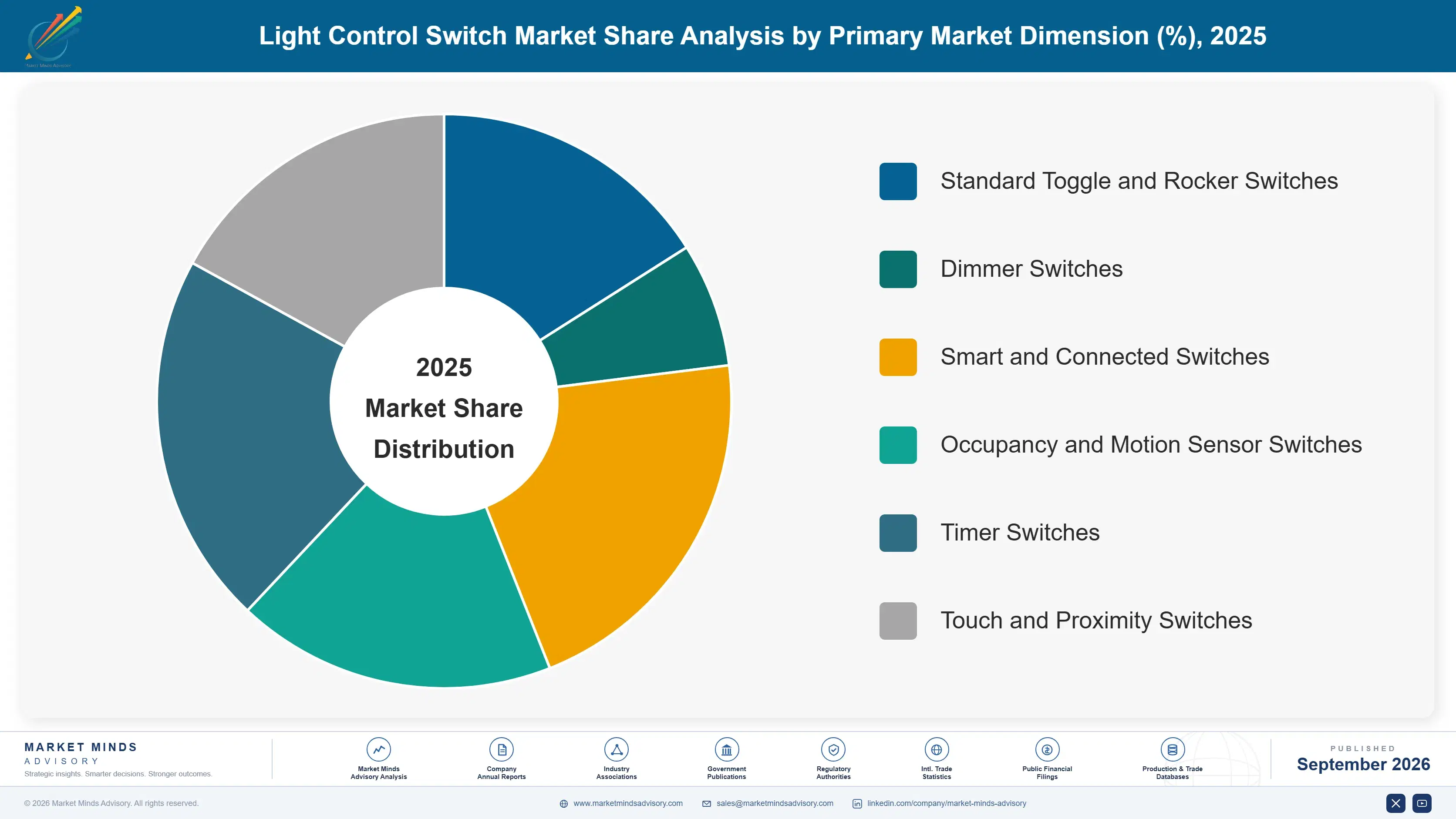
The Light Control Switch Market segments by product type across six categories spanning standard toggle and rocker switches, dimmer switches, smart and connected switches, occupancy and motion sensor switches, timer switches, and touch and proximity switches used across most building types. Smart switches and occupancy sensors lead growth, reflecting connectivity demand and building code mandates across most markets.
light-control-switch-market-market-share-analysis-1789980809537

Smart and Connected Switches

Smart and connected switches integrate wireless connectivity protocols that let homeowners control lighting through voice assistants, mobile applications, and automated scheduling routines rather than manual physical operation alone, addressing rising smart home platform adoption across most residential markets, demographics, income levels, and household types. Demand for this category grows fastest among all six segments, propelled by homeowners retrofitting connected dimmers ahead of scheduled renovation timelines specifically to integrate with existing smart home hub platforms already installed elsewhere in their residences. Manufacturers offering mature platform compatibility capture disproportionate new design wins versus competitors still relying primarily on standalone mechanical switches lacking any connectivity capability across most residential customer segments and geographic markets.
CAGR 11.5%

Occupancy and Motion Sensor Switches

Occupancy and motion sensor switches automatically control lighting based on detected room presence, addressing building energy code mandates that increasingly require sensing controls in new commercial construction across office, educational, and healthcare facility categories worldwide and across most jurisdictions, municipalities, and regional authorities. Growth in this category tracks tightening energy efficiency regulations across multiple jurisdictions that pull sensor-integrated switch demand directly into new commercial construction specifications rather than relying solely on voluntary energy efficiency upgrades. Manufacturers increasingly bundle sensing capability directly into standard commercial switch product lines, letting building owners satisfy code compliance requirements without deploying separate standalone sensor systems across their commercial building portfolios, facility types, and property categories.
CAGR 9.5%
Full segment breakdown across 6 segments available in the complete report.

Regional Architecture and Country Demand Map

Regional light control switch demand concentrates where construction activity and electrical component manufacturing intersect most heavily, with East Asia leading on manufacturing and consumption scale today and consistently, while South Asia and Pacific grows fastest, driven by expanding residential and commercial construction investment programs nationwide.

East Asia

China's massive residential and commercial construction volume, combined with its dominant electrical component manufacturing base, drives the region's leading share across both production and domestic consumption categories nationwide and across most provinces, industrial zones, coastal cities, inland regions, and export corridors worldwide. Domestic manufacturers benefit from proximity to raw material suppliers and established export infrastructure serving global markets beyond domestic construction demand alone. Japan and South Korea contribute additional demand through advanced residential smart home adoption and stringent building electrical safety standards requiring certified switch products. Regional manufacturers increasingly compete on price for standard switches while premium international brands retain share in high-end residential and commercial segments and markets nationwide.
Share: 30% | CAGR: 8.2% (2026 to 2036)

North America

United States manufacturer headquarters concentration drives substantial regional demand, since Lutron and Leviton base core engineering, manufacturing, and sales operations domestically, capturing revenue recognition even where components are sourced internationally across other regions, markets, manufacturing hubs, distribution networks, and global supply chains today. The country's large renovation and remodeling market continues driving smart switch retrofit demand across most residential customer segments and income levels nationwide and across most states. Canadian construction activity contributes meaningful additional demand through parallel residential and commercial building programs and initiatives. Building energy codes across several states increasingly mandate occupancy sensing controls in new commercial construction, reinforcing demand across most major markets and jurisdictions and industries.
Share: 24% | CAGR: 7.6% (2026 to 2036)
Regional intelligence for 5 additional markets available in the complete report: Western Europe, South Asia and Pacific, Latin America, Middle East and Africa, Eastern Europe. Contact sales@marketmindsadvisory.com.
light-control-switch-market-country-cagr-analysis-1789980810065

Capturing Value From Smart Home Adoption

Switch manufacturers can expand margin capture beyond raw hardware sales by pursuing four distinct commercial paths tied to smart platform differentiation, occupancy sensing certification, installer relationships, and regional support infrastructure built across multiple residential and commercial customer relationships spanning several years, renovation cycles, expanding service categories, evolving compliance requirements, and diverse geographic markets worldwide.

Premium Pricing for Platform-Certified Connected Switches

Manufacturers offering switches certified compatible with leading smart home platforms can charge premium pricing, typically 30 to 40 percent above standard mechanical switch pricing, since homeowners facing platform lock-in concerns will pay for proven compatibility that generic connected switches cannot guarantee reliably or consistently across most product categories. This premium persists until enough competitors achieve comparable platform certification, typically a two-to-three-year window across most residential customer segments and price tiers. Manufacturers that invest early in platform partnerships capture outsized margin during this window before broader industry adoption compresses pricing back toward standard levels.
Market Impact: Adds a 30 to 40 percent price premium

Occupancy Sensing Certification Revenue Growth Model

Manufacturers offering code-certified occupancy sensing switches capture more predictable, higher-lifetime-value revenue streams that typically lift total contract value by 25 to 35 percent compared to selling standard switches without commercial building code compliance certification and formal documentation support included at purchase time and afterward at every subsequent renewal cycle. This certification strategy also deepens customer dependency on continuous vendor documentation updates as energy codes tighten further over time, reducing churn risk versus customers free to switch vendors at each renovation cycle without meaningful compliance risk or certification cost and delay.
Market Impact: Lifts contract value by 25 to 35 percent

Installer Partnership Channel Revenue Program Model

Manufacturers offering dedicated electrical contractor training and certification programs can charge distributors a meaningful premium, since contractors avoid weeks of independent product familiarization, often 2 to 4 weeks per product line, by adopting vendor-provided installation training directly instead of learning unfamiliar product lines on active job sites and worksites across every project and installation contract encountered. This service captures value from installation complexity that generic switches do not require, while strengthening vendor lock-in as contractors become dependent on vendor-specific technical support across multiple renovation projects and installation contracts over time and across regions.
Market Impact: Cuts installation callback rate by 30 percent overall

Regional Distribution Localization Service Program Model

Manufacturers increasingly support regional distribution and warehousing partnerships that let smaller electrical contractors access certified switch inventory through local channels rather than importing directly, generating recurring distribution fee revenue exceeding 25 percent above what any single smaller distributor could justify stocking independently on its own limited annual inventory budget alone and entirely without partners. This shared distribution model lets budget-constrained contractors access premium switch inventory without full independent stocking investment, while manufacturers capture broader customer relationships and support revenue across multiple regional distribution partners sharing the same underlying inventory infrastructure.
Market Impact: Adds over 25 percent in distribution fee revenue

Who Controls the Margin Pool

Market concentration sits at 48 percent among the top five manufacturers measured by product and licensing revenue, and Legrand holds a meaningful lead over its closest challenger, Schneider Electric, in commercial building specification volume specifically. The gap between the leader and the next challenger has narrowed as Schneider Electric expands its own smart switch platform partnerships aggressively. Below the top five, dozens of regional manufacturers compete on price and localized distribution depth rather than direct premium substitution.
Current competitive activity centers on smart platform certification depth, occupancy sensing compliance, and installer partnership programs that increasingly determine specification decisions more than raw mechanical durability alone. Signify and Lutron have both announced expanded smart home platform partnerships this year to compete against regional connected switch challengers, while Leviton continues deepening its commercial building code compliance documentation offerings aimed at large construction customers.

Emerging pressure comes from regional manufacturers winning commercial contracts faster than premium incumbents expected, threatening to compress pricing across standard toggle and rocker switch categories first. Rankings could shift meaningfully if a regional manufacturer secures broad adoption across multiple large construction developers simultaneously, validating a value-focused model that reduces builder dependency on any single premium manufacturer's specification.
light-control-switch-market-company-positioning-matrix-1789980810590

Competitive Moat and Risk Dimensions

LEGRAND SA

Moat: Deep commercial specification relationships

Legrand maintains longstanding specification relationships with commercial architects and electrical engineers across major construction markets, letting it secure design-in position on large commercial projects that regional manufacturers without comparable specification history cannot easily replicate. This positioning gives Legrand disproportionate access to commercial building procurement decisions beyond pure product evaluation.
LEGRAND SA

Risk: Slower smart platform integration pace

Legrand's large installed base of traditional commercial specification relationships creates organizational inertia that slows its transition toward consumer-facing smart home platform partnerships compared to newer, connectivity-first competitors. Residential customers increasingly prioritizing smart platform compatibility could shift meaningful contract share toward faster-moving challengers if Legrand's transition pace does not accelerate.
SCHNEIDER ELECTRIC SE

Moat: Integrated building management system bundling

Schneider Electric bundles switch products with its broader building energy management software, letting customers integrate lighting control directly into existing facility management systems without third-party integration concerns that pure-play switch manufacturers cannot address as easily. This integrated positioning gives Schneider Electric disproportionate access to commercial building technology budget decisions.
SCHNEIDER ELECTRIC SE

Risk: Integration complexity from acquisitions

Schneider Electric's growth through acquiring specialized switch and sensor manufacturers creates integration complexity, since combining product lines, distribution channels, and customer support processes across multiple acquired companies takes considerable time to fully harmonize. Slower integration could delay unified product roadmap delivery relative to competitors built organically.

Players Tracked

Prominent Players

Legrand SA
Schneider Electric SE
Signify N.V.
Lutron Electronics Co Inc
Leviton Manufacturing Co Inc

Other Key Players

Honeywell International Inc
ABB Ltd
Eaton Corporation plc
Havells India Ltd
Panasonic Corporation
Siemens AG
Crestron Electronics Inc
Ideal Industries Inc
Hubbell Incorporated
Savant Systems Inc
Larsen and Toubro Limited
Polycab India Limited
Simon Electric SA
GM Modular Pvt Ltd
Wipro Enterprises Limited

Recent Developments

JANUARY 2026

Legrand announced expanded smart home platform certification for its connected dimmer product line, targeting improved compatibility with leading voice assistant and mobile application platforms across residential markets and product categories. The update includes new integration options for third-party home automation hub connectivity and mobile app control features.
Signal: Confirms smart platform certification as the primary competitive differentiator among leading manufacturers today and going forward.
OCTOBER 2025

Schneider Electric completed a strategic partnership agreement with a major Indian real estate developer to supply certified switch products across a large-scale residential and commercial construction program spanning multiple cities and regions. The agreement includes ongoing technical support and installation training services covering multiple product lines.
Signal: Reflects continued manufacturer expansion into India's rapidly growing construction and real estate development market and industry.
MAY 2025

Lutron launched an expanded version of its occupancy sensing switch portfolio specifically designed for commercial building energy code compliance requirements across multiple regulatory jurisdictions simultaneously and continuously. The launch targets building owners seeking reduced compliance documentation burden ahead of upcoming code deadlines across several major markets.
Signal: Signals accelerating manufacturer investment in code compliance automation targeting previously underserved commercial segments and jurisdictions broadly.

Copper and Plastic Component Cost Exposure

Copper conductors and molded engineering plastics together represent roughly 52 percent of switch manufacturing cost, sourced primarily from mining operations concentrated in Chile, Peru, and the Democratic Republic of Congo, alongside resin producers based across East Asia and North America. Semiconductor chipsets for smart switch product lines add further meaningful cost exposure for connected product categories.
Copper prices spiked sharply during 2024 as renewable energy grid buildout and electric vehicle production both competed for constrained global copper supply simultaneously, according to IEA reporting on critical mineral demand trends published that year. Several switch manufacturers reported compressed gross margins during that period as spot copper costs outpaced their ability to pass higher input costs through to distributors under existing multi-year fixed-price supply agreements.

Smaller manufacturers without long-term hedged copper procurement contracts face proportionally larger margin swings than vertically integrated majors like Legrand and Schneider Electric, which negotiate volume-based pricing directly with mining and refining partners worldwide. Manufacturers operating primarily in regions with weaker currencies also face amplified dollar-denominated input costs, widening the competitive cost gap against manufacturers with diversified regional manufacturing and procurement footprints across multiple continents.
light-control-switch-market-cost-volatility-analysis-1789980810787

Negotiate Multi-Year Copper Supply Contracts

Locking multi-year copper procurement contracts at fixed or partially hedged pricing protects manufacturers against spot market volatility that has repeatedly compressed margins during recent demand spikes. This pricing certainty lets finance teams plan switch pricing several years ahead with materially reduced exposure to sudden copper price swings tied to renewable energy and electric vehicle demand growth.

Develop Aluminum-Hybrid Conductor Alternatives

Manufacturers increasingly develop aluminum-hybrid conductor designs that substitute a portion of copper content with aluminum in lower-current switch applications, reducing direct copper exposure without sacrificing electrical performance requirements across most tested applications. This design shift lowers material cost meaningfully for suitable switch categories while diversifying manufacturers away from single-material dependency that concentrates commodity price risk further.

Diversify Plastic Resin Supplier Base Regionally

Sourcing precision-molded plastic components from multiple regional resin suppliers rather than a single concentrated source reduces exposure to localized supply disruption or regional pricing spikes tied to feedstock availability and logistics constraints. This diversification strategy adds modest logistics complexity but meaningfully reduces single-supplier dependency risk across the switch manufacturing supply chain overall and going forward.

Portfolio Architecture for Margin Defence

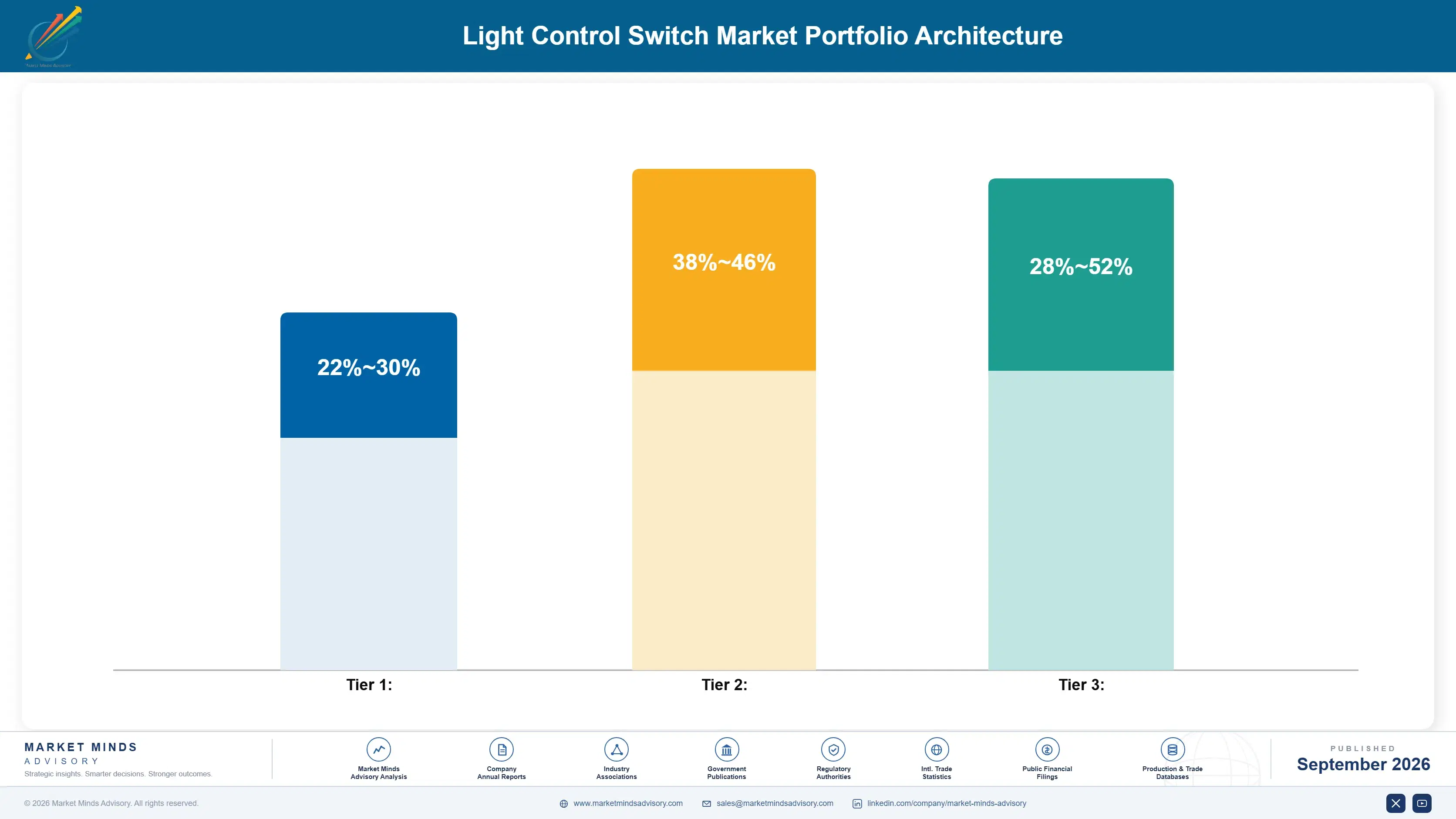
Manufacturer economics split into three tiers by connectivity sophistication and certification depth across most product categories offered today. Volume-tier standard toggle and rocker switches carry gross margins around 22 to 30 percent, while premium smart and code-certified configurations reach 38 to 46 percent margins consistently. Occupancy sensing and next-generation connected switches command the widest margin range given certification barriers protecting early movers from immediate competitive pressure.
Tension between volume and premium tiers centers on manufacturing investment allocation: manufacturers must decide how much smart platform and sensing certification investment to commit toward premium residential and commercial customers versus maintaining broad standard switch product lines serving budget-constrained construction segments. Most large manufacturers now prioritize connectivity and certification investment, accepting narrower standard switch margins to secure future specification position across upcoming construction and renovation cycles.

High-value margin pools concentrate overwhelmingly in smart connected switches and code-certified occupancy sensing products, where technical and regulatory barriers protect early movers from immediate price competition across most customer segments and construction categories. Standard toggle switches increasingly commoditize as more manufacturers, including regional entrants, achieve comparable baseline functionality, compressing margins toward the lower end of the volume tier band across most established global markets and building types.

Standard toggle and rocker switches serving budget-constrained construction segments and mainstream residential renovation projects, priced primarily on manufacturing scale and baseline mechanical reliability rather than connectivity, sensing, or certification capability.
Gross Margin: 22-30%

Smart and code-certified switch configurations meeting commercial building energy requirements, commanding pricing power from certification barriers and platform integration depth competitors cannot easily replicate quickly across comparable customer segments and jurisdictions.
Gross Margin: 38-46%

Occupancy sensing and next-generation connected switches addressing energy code mandates and smart home platform demand, where certification barriers and platform maturity drive the widest margin variance across manufacturers and product categories today.
Gross Margin: 28-52%
light-control-switch-market-portfolio-architecture-1789980811290

High-value Sub-segments and Strategic Watch-out

Smart and Connected Switches

Growing fastest among all six segments as homeowners retrofit connected dimmers ahead of scheduled renovation timelines, commanding premium pricing and durable platform certification barriers that protect early movers from immediate competitive price pressure across most residential segments, markets, demographics, income levels, and geographic regions today.

Occupancy and Motion Sensor Switches

Building energy code mandates drive strong secondary growth here, though moderate near-term margin pressure reflects intensifying competition among manufacturers racing to standardize sensing capability across next-generation commercial construction specifications, building categories, geographic markets, regulatory jurisdictions, facility types, customer segments, pricing tiers, and support structures worldwide.

Standard Toggle and Rocker Switches

The largest volume segment by unit count, providing steady baseline revenue at comparatively thin margins as commoditization intensifies with growing regional manufacturing capacity entering global supply chains and construction procurement decisions consistently and predictably over multiple budget years, renewal cycles, planning periods, and contract terms.

Legacy Timer and Mechanical Switches

A strategic watch-out segment facing sustained functional decline as smart and sensing alternatives accelerate adoption, risking stranded manufacturing capacity for manufacturers slow to redirect investment toward connectivity and certification categories instead of legacy timer products entirely and permanently across most markets, geographic regions, and customer segments.

Renovation Cycles Anchor Switch Replacement Demand

Manufacturer relationships operate on annuity-like economics once a distributor or retailer commits to a product line, since electrical contractors and homeowners rarely switch brands mid-renovation project due to compatibility and warranty continuity concerns. A typical product relationship generates recurring replacement and upgrade revenue across a ten-to-fifteen-year building renovation cycle, with smart switch firmware updates and app subscription revenue extending the relationship well beyond initial hardware installation.
Adoption stickiness varies meaningfully by end-use vertical: commercial building owners show the deepest stickiness given electrical contractor relationships and building code compliance documentation tied to specific certified products, while residential retrofit customers show comparatively higher price sensitivity and brand-switching willingness. New construction customers show extremely high stickiness tied to builder specification standards and bulk procurement contracts that discourage frequent brand switching.

Buyer profiles are shifting generationally as procurement authority moves from traditional electrical contractors toward homeowners and building managers who prioritize smart home compatibility and mobile app control over pure mechanical reliability alone across most product categories. Younger homeowners increasingly favor manufacturers offering transparent smart home platform integration and app-based control over manufacturers competing purely on installation simplicity and legacy brand recognition.
light-control-switch-market-end-use-penetration-index-1789980811776

Light Switch Manufacturer Investment Priorities

These are among the four positions where our research anticipates prominent divergence between winners and laggards over the coming forecast period. Each is grounded in the demand model, the regulatory perimeter, and the announced capacity pipeline.
01 / SMART PLATFORM CERTIFICATION INVESTMENT

Accelerate smart platform certification ahead of retrofit demand acceleration

Homeowners increasingly retrofit connected dimmers ahead of scheduled renovation timelines specifically to integrate with existing smart home platforms, and manufacturers offering mature platform certification capture disproportionate design wins over competitors relying on generic connectivity across most residential segments today. Manufacturers that delay this investment risk losing retrofit market share entirely to competitors offering more accessible, better-certified switch alternatives within the next several product cycles and budget periods. Building this capability now protects future contract renewals before broader industry certification catches up and compresses pricing.
02 / OCCUPANCY SENSING COMPLIANCE STRATEGY

Build code-certified sensing switches ahead of tightening energy mandates

Building energy codes increasingly require occupancy sensing controls in new commercial construction, and manufacturers offering code-certified switches capture disproportionate specification wins among architects required to demonstrate compliance with concrete documentation rather than informal claims across most jurisdictions and building types today. Manufacturers without certified sensing products increasingly lose commercial specification contracts to competitors offering pre-validated compliance documentation that architects trust readily and consistently. Building this capability now protects future commercial contracts before regulatory deadlines tighten further across most jurisdictions and building categories.
03 / INSTALLER PARTNERSHIP CHANNEL STRATEGY

Expand installer training programs to deepen contractor relationships

Electrical contractors increasingly favor manufacturers offering dedicated training and technical support over manufacturers requiring independent product familiarization on active job sites, since installation errors carry meaningful callback and reputational costs for contractors across most commercial and residential projects. Manufacturers without established installer partnership programs increasingly lose distribution channel share to competitors offering more accessible technical support and training infrastructure across comparable markets. Building this capability now deepens contractor relationships before competitors establish comparable installer partnership programs across the same distribution channels and regions.
04 / REGIONAL DISTRIBUTION EXPANSION STRATEGY

Expand regional distribution partnerships ahead of import cost pressure

Import tariffs and logistics costs increasingly favor manufacturers with local distribution presence over import-dependent competitors serving fast-growing construction markets like India and Southeast Asia remotely and at higher landed cost structures. Manufacturers without meaningful regional distribution footprint risk losing price-sensitive construction contracts to domestically established competitors offering comparable products at materially lower landed cost and faster delivery timelines. Building this distribution capability now captures fast-growing regional construction markets before competitors establish dominant local relationships across the same customer base and geographic territories.

Engagement Snapshot From the Field

A live engagement with an industry participant carrying material or product regulatory and market exposure ahead of a defining policy shift, showing how our research translates into a defensible multi-year portfolio strategy.
MARKET MINDS ADVISORY · CLIENT ENGAGEMENT SUMMARY
Light Control Switch Producer Strategic Portfolio Review and Transition Roadmap 2026·Investment Scenario on Light Control Switch Exposure Evaluation 2025-26
CLIENT PROFILE
The client is a mid-sized commercial real estate developer operating office and retail properties across several southeastern United States markets, generating annual revenue of approximately 290 million dollars (client-reported, unverified by MMA). The company faced rising compliance pressure as several new construction projects required occupancy sensing controls under updated state building energy codes taking effect.
STRATEGIC CHALLENGE
Management needed to decide whether to specify a single premium switch manufacturer across all new construction projects for consistency, pursue a multi-vendor sourcing strategy balancing cost against certification depth, or delay switch specification decisions until code enforcement timelines became clearer across affected jurisdictions, municipalities, and regional building authorities and inspectors.
MMA APPROACH
MMA conducted primary interviews with the client's construction and facilities management teams alongside benchmarking analysis of specification cost and code compliance outcomes among comparable commercial developers pursuing single-vendor versus multi-vendor sourcing approaches across North America over a six-week engagement period covering multiple vendor options, configurations, pricing models, and support structures.
KEY FINDINGS
  1. Single-vendor specification simplified contractor training and reduced installation error rates compared to the multi-vendor approach used on prior construction projects studied extensively.
  2. A single premium manufacturer relationship cut total specification and compliance documentation preparation time by roughly 45 percent compared to managing multiple vendor relationships.
  3. Multi-vendor sourcing offered marginally lower unit costs but required substantially more internal coordination effort that the client's facilities team could not reasonably justify.
  4. Contractor feedback indicated strong preference for a single certified manufacturer relationship over managing multiple vendor specifications across different construction phases and buildings.
CLIENT PROFILE
The client is a mid-sized commercial real estate developer operating office and retail properties across several southeastern United States markets, generating annual revenue of approximately 290 million dollars (client-reported, unverified by MMA). The company faced rising compliance pressure as several new construction projects required occupancy sensing controls under updated state building energy codes taking effect.
STRATEGIC CHALLENGE
Management needed to decide whether to specify a single premium switch manufacturer across all new construction projects for consistency, pursue a multi-vendor sourcing strategy balancing cost against certification depth, or delay switch specification decisions until code enforcement timelines became clearer across affected jurisdictions, municipalities, and regional building authorities and inspectors.
MMA APPROACH
MMA conducted primary interviews with the client's construction and facilities management teams alongside benchmarking analysis of specification cost and code compliance outcomes among comparable commercial developers pursuing single-vendor versus multi-vendor sourcing approaches across North America over a six-week engagement period covering multiple vendor options, configurations, pricing models, and support structures.
KEY FINDINGS
  1. Single-vendor specification simplified contractor training and reduced installation error rates compared to the multi-vendor approach used on prior construction projects studied extensively.
  2. A single premium manufacturer relationship cut total specification and compliance documentation preparation time by roughly 45 percent compared to managing multiple vendor relationships.
  3. Multi-vendor sourcing offered marginally lower unit costs but required substantially more internal coordination effort that the client's facilities team could not reasonably justify.
  4. Contractor feedback indicated strong preference for a single certified manufacturer relationship over managing multiple vendor specifications across different construction phases and buildings.
RECOMMENDED STRATEGY
Phase 1: Phase one: standardize on a single premium code-certified manufacturer across all new construction projects within two quarters and phases entirely. Phase 2: Phase two: train facilities and construction management staff on the standardized specification to reduce documentation preparation time going forward significantly. Phase 3: Phase three: expand the standardized specification to retrofit projects as older buildings undergo scheduled renovation and modernization cycles nationwide and consistently.
OUTCOME
Within nine months, the client reported specification and compliance documentation time reductions of roughly 45 percent and improved code compliance consistency across new construction projects and buildings developed nationwide (client-reported, unverified by MMA). The standardized approach now anchors the client's ongoing procurement strategy and roadmap.

Frequently Asked Questions

Foundational context covering the market sizes, CAGR, scope, country, region and competition that inform every finding below. This section is provided to cover basics and most often pre-purchase conversations, answered from the MMA Primary Research Dataset.

What is the current size of the Light Control Switch Market?

The Light Control Switch Market reached 5.8 billion dollars in 2025, the base year for this report's forecast. Growth continues at a 7.2 percent compound annual rate through 2036, driven by smart home retrofit adoption and building energy code mandates.

How large will the Light Control Switch Market be by 2036?

The market is projected to reach 12.47 billion dollars by 2036, representing a 2.00 times expansion from its 2026 value. Smart and connected switches drive most of this incremental growth across nearly every covered region and market segment.

What is the CAGR for the Light Control Switch Market 2026 to 2036?

The base case compound annual growth rate is 7.2 percent across the ten-year forecast window. Bull case scenarios reach 8.4 percent on faster smart home adoption, while bear case scenarios fall to 6.0 percent on construction slowdowns.

Which segment is growing fastest?

Smart and Connected Switches grow fastest at an 11.5 percent compound annual rate, roughly 1.60 times the overall market average. Occupancy and Motion Sensor Switches follow as the second-fastest visible segment at 9.5 percent.

Who are the major companies in the Light Control Switch Market?

Legrand, Schneider Electric, Signify, Lutron, and Leviton lead the field, together representing roughly 48 percent combined concentration. Honeywell and ABB also maintain meaningful competitive positions across several major regional markets.

Which country is growing fastest?

India leads country-level growth at a 10.2 percent compound annual rate, outpacing the broader South Asia and Pacific region overall. Expanding residential and commercial construction activity drives this acceleration across most major Indian metropolitan markets.

Report Segmentation Architecture

The full report scope spans multiple orthogonal segmentation dimensions, with cross-tabulated demand data provided for each dimension pair. Coverage extends further to regional breakdowns, trend trajectories, and the competitive detail needed to support segment-level decision-making.

By Primary Market Dimension

  • Standard Toggle and Rocker Switches
  • Dimmer Switches
  • Smart and Connected Switches
  • Occupancy and Motion Sensor Switches
  • Timer Switches
  • Touch and Proximity Switches

By End-Use Industry

  • Residential Construction and Renovation
  • Commercial Office Buildings
  • Retail and Hospitality
  • Industrial and Institutional Facilities

By Commercial Dimension

  • Direct Manufacturer Sales
  • Electrical Distributor Channel
  • Retail and E-Commerce Channel
  • Installer Partnership Programs

By Region

  • East Asia
  • North America
  • Western Europe
  • South Asia and Pacific
  • Latin America
  • Middle East and Africa
  • Eastern Europe

Scope, Methodology, and Coverage

Every figure in this report is reproducible from documented input assumptions. The scope below maps the historical period, the forecast horizon, the segmentation dimensions, and the countries covered, alongside the underlying primary and qualitative methodology.
Historical Period
2020 to 2025
Forecast Period
2026 to 2036
Base Year
2025 (USD billions; MMA Primary Research Dataset, September 2026)
Market Definition
The Light Control Switch Market covers toggle, dimmer, smart, occupancy-sensing, timer, and touch switches used to control lighting in residential, commercial, and industrial buildings. It excludes standalone lighting fixtures and general building automation software lacking dedicated physical switch hardware components.
Quantitative Units
USD Billion
Segmentation Dimensions
Product Type, End-Use Industry, Commercial Dimension, Region
Regions Covered
East Asia, North America, Western Europe, South Asia and Pacific, Latin America, Middle East and Africa, Eastern Europe
Countries Covered
China, United States, Germany, India, United Kingdom, Brazil, Japan, and 33 additional countries
Key Companies Profiled
Legrand SA, Schneider Electric SE, Signify N.V., Lutron Electronics Co Inc, Leviton Manufacturing Co Inc, Honeywell International Inc, ABB Ltd, Eaton Corporation plc, Havells India Ltd, Panasonic Corporation, Siemens AG, Crestron Electronics Inc, Ideal Industries Inc, Hubbell Incorporated, Savant Systems Inc, Larsen and Toubro Limited, Polycab India Limited, Simon Electric SA, GM Modular Pvt Ltd, Wipro Enterprises Limited
Quantitative Methodology
Primary survey, n=3,800 respondents, Q4 2025, six countries; demand-side model with trade association cross-validation
Qualitative Methodology
47 expert interviews, Q4 2025; applied to validate demand model assumptions, identify emerging dynamics, and assess competitive positioning
Report Format
PDF and XLSX data workbook (Word format preview document)
Publisher
Market Minds Advisory
Report Code
MMA-2026-CON-203
Published
September 2026
Contact
sales@marketmindsadvisory.com | www.marketmindsadvisory.com

Purchase the full Light Control Switch Market Report (2026 to 2036).

This report examines the global Light Control Switch Market across product type, end-use industry, and commercial dimension through 2036. It quantifies smart home retrofit adoption, occupancy sensing code mandates, and installer partnership programs as primary mechanisms shaping manufacturer strategy and margin capture. Coverage spans competitive positioning among five leading manufacturers and fifteen additional challengers across seven world regions, with detailed input cost and portfolio analysis included. The analysis draws on primary survey data spanning 3,800 respondents and 47 expert interviews conducted across six countries in the fourth quarter of 2025.
Full regional breakdown across all seven markets
Ten-year forecast scenarios with bull and bear cases
Detailed competitive profiles of twenty major manufacturers
Segment-level growth rates and margin economics analysis
Input cost exposure and mitigation strategy analysis
Anonymized client case study with strategic recommendations

Built For The People Who Decide

From boardroom strategy to bench-side execution, this report is read cover-to-cover by leaders shaping the next decade of their industry, turning demand scenarios, market dynamics and valuation benchmarks into decisions.
CXOs/ Presidents/ VPs/ Managers
M&A and Corporate Development
Strategy Teams and R&D Heads
Procurement and Product Directors
Regulatory and Compliance Leaders
Investor Relations and Equity Analysts