Market Minds Advisory
Uruguay Life and Non-Life Insurance Market

Uruguay Life and Non-Life Insurance Market: Bancassurance Consolidation Meets Digital Underwriting Entry

Uruguay's small but stable insurance base is consolidating around bancassurance distribution even as digital-first underwriters and parametric agricultural products chip away at legacy agent networks across the country's dollarized, investment-grade economy.

Lead Analyst

Published

September 2026

Make Smarter Decisions with Customized Research Insights

Request a free sample report and evaluate market opportunities, growth trends, and competitive dynamics relevant to your business needs.

2025 MARKET VALUE$2.1BMarket Size 2025
2036 FORECAST VALUE$4.2BBase Case , 2026 to 2036
CAGR 2026 TO 20366.5 %Bull 7.8% / Bear 5.2%
INCREMENTAL OPPORTUNITY$2.0BNet 10- year value creation
EXPANSION MULTIPLE1.88x2036 value over 2026 base
Strategic Levers
M&A Pipeline
Regional Outlook
Country Rankings
Competitive Intelligence
Segmental Deep-dive
Call-Us : 91 93563 13602

Executive Snapshot and Market Trajectory

Uruguay's insurance market keeps steadily consolidating around a small group of composite underwriters even as digital-first distribution chips away at traditional agent networks, with bancassurance partnerships increasingly deciding which insurer captures new premium growth across motor, life, health, and agricultural lines alike this decade.
Bancassurance now channels roughly a third of new policy volume, and agricultural parametric products are growing fastest as soy and cattle exporters seek weather-indexed protection against increasingly erratic rainfall tied to recurring regional climate cycles. Montevideo concentrates the vast bulk of underwriting, actuarial, and claims administration activity nationally, reflecting the capital's dual role as domestic hub and aspiring Mercosur cross-border underwriting base. Bank branch staff now routinely quote coverage directly alongside loan paperwork.
Five underwriters hold roughly seventy percent of premium, led by the state-backed Banco de Seguros del Estado alongside Spanish and Argentine composite insurance groups operating through established local subsidiaries. Regulatory modernization at the central bank is pushing risk-based capital standards modeled on European frameworks, opening genuine new space for digital entrants bundling coverage directly into lending platforms. Smaller domestically owned insurers face a harder path meeting the new thresholds.
Market Definition
This report covers gross written premium from life, savings-linked, and non-life insurance policies underwritten and sold within Uruguay, spanning motor, property, health, agricultural, and surety lines. It excludes reinsurance premium ceded abroad, social security pension contributions administered by Banco de Previsión Social, and standalone health maintenance organization membership fees.
Base Year Value
$2.1B in 2025 (MMA Primary Research Dataset, August 2026)
Forecast Period
2026 to 2036, eleven discrete annual values
CAGR
6.5% base case. Bull 7.8%. Bear 5.2%.
Fastest Growth Segment
Agricultural and Crop Insurance: 9.0% CAGR
Fastest Growth Country
Uruguay: 6.5% CAGR
Fastest Growth Region
South Asia and Pacific: 8.5% CAGR
Largest Region
Western Europe: 26% of 2025 global value
Market Leaders
Banco de Seguros del Estado, Mapfre Uruguay, Sancor Seguros Uruguay, Porto Seguro Uruguay, SURA Seguros Uruguay. Source: MMA Analysis based on company annual reports and regulatory filings.
Primary Survey
n=3,800 procurement and R&D decision-makers, Q4 2025, six countries
Methodology
Demand-side build-up, cross-validated against public data, 47 expert interviews

Uruguay Life and Non-Life Insurance Market Forecast Scenarios

life-non-life-insurance-market-in-uruguay-size-forecast-scenario-1787938726951
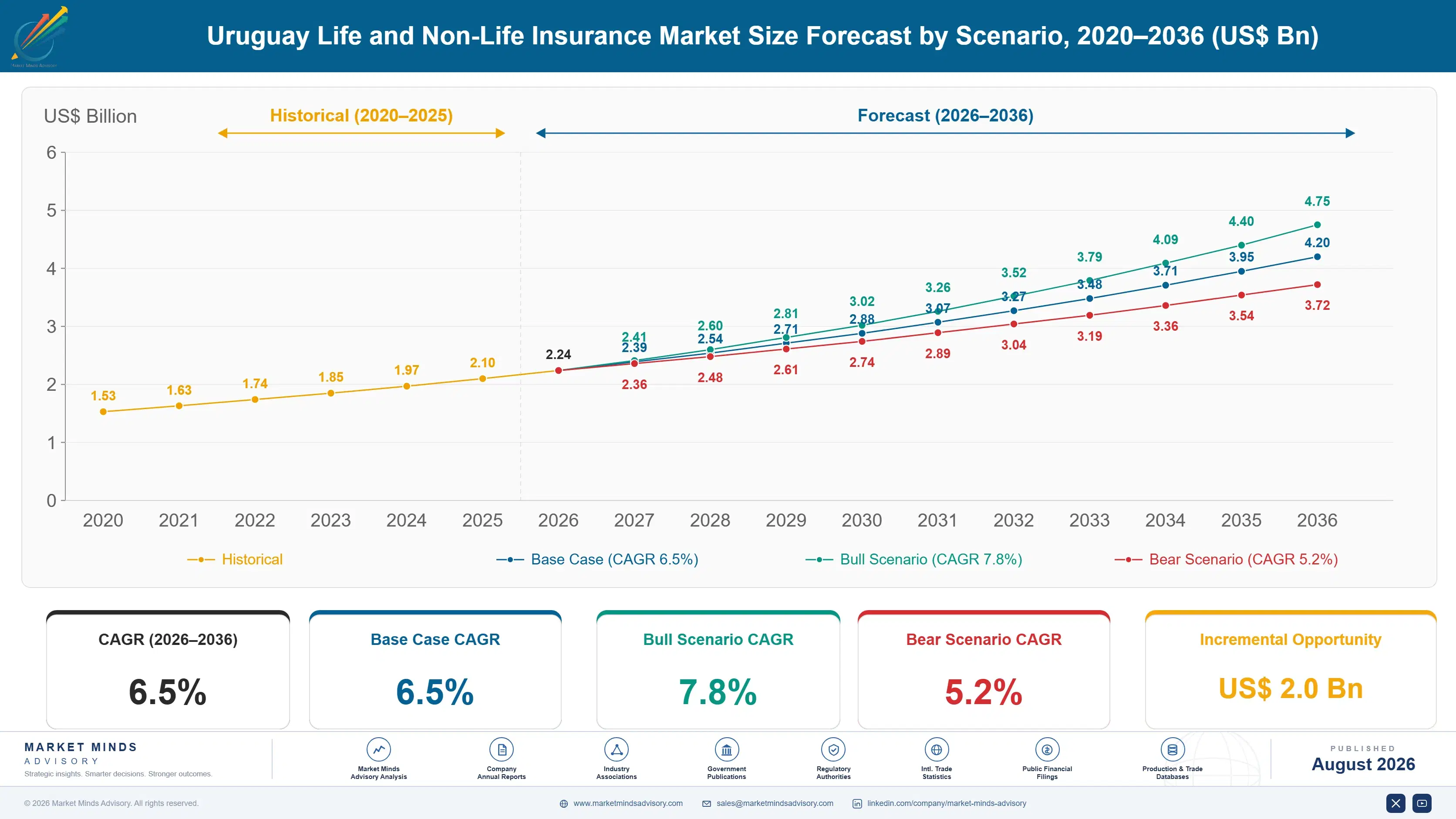
Between 2020 and 2025 Uruguay's insurance premium base grew at roughly 5.5 percent annually, recovering from pandemic-era policy lapses as bancassurance penetration deepened and the central bank tightened solvency oversight. Motor and property lines led the rebound while life savings products lagged amid low real interest rates domestically. Non-life claims frequency stayed broadly stable across the period overall.
The base case assumes 6.5 percent annual growth through 2036, anchored in three mechanisms: continued bancassurance channel expansion tying insurance sales directly to mortgage and auto loan origination, mandatory third-party motor liability enforcement widening compulsory coverage across the registered vehicle fleet nationwide, and rising middle-class demand for privately funded retirement savings products that meaningfully supplement the strained state pension system administered through Banco de Prevision Social. This combination favors insurers with established bancassurance agreements already in place.
A bull scenario built on faster embedded-insurance scaling through agricultural lending platforms and consumer fintech wallets could push growth toward 7.8 percent by the decade's end. A bear scenario tied to renewed peso volatility and a hardening global reinsurance cycle that squeezes catastrophe treaty capacity could instead pull growth down toward 5.2 percent. Reinsurance treaty renewal terms remain the single largest swing factor either way.

Underwriting Concentration and Digital Distribution Economics

Uruguay's insurance market sits at the intersection of unusual macro stability and genuine demographic smallness. Investment-grade sovereign credit, a fully dollarized savings culture, and a population under three and a half million together produce a market that grows steadily but never explosively, rewarding underwriters who can defend margin rather than chase volume. A population under three and a half million reinforces this dynamic further, keeping total addressable premium inherently modest by regional standards.
TOP-5 INSURER CONCENTRATION72%Premium share held by the five largest underwriters nationally
NON-LIFE COMBINED RATIO97%Claims and expense ratio measured against earned premium collected
INSURANCE PENETRATION RATE2.8% of GDPTotal premium volume relative to national economic output
BANCASSURANCE DISTRIBUTION SHARE34%New policies sold through partner bank branch networks
COMPULSORY MOTOR COVERAGE RATE81%Registered vehicles carrying legally mandated liability insurance coverage
REINSURANCE CEDED SHARE18%Premium volume transferred to international reinsurance capacity providers
Composite insurers dominate because scale advantages compound across motor, property, and life lines simultaneously, letting the largest five players spread fixed actuarial and reinsurance-negotiation costs across a broader premium base than single-line specialists can match. Bancassurance intensifies this advantage by tying policy issuance directly to loan origination. Reinsurance treaty relationships with global partners further reinforce this scale advantage across catastrophe-exposed lines specifically.
Two forces will reshape the next decade. Central bank solvency modernization will raise capital requirements and squeeze thinly capitalized niche insurers, while embedded and parametric products sold through lending platforms will pull volume away from traditional agents faster than most incumbents currently expect. Insurers slow to adapt on either front risk ceding meaningful share to faster-moving rivals over the coming decade.
"Everyone assumes a market this small has to be boring, but Uruguay is actually where several Latin American insurers are testing embedded and parametric products before rolling them out regionally, precisely because the regulator moves fast and the risk is contained."
Director, Financial Services Practice · MMA Financial Services Practice · August 2026

Market Trends

Risk-Based Capital Rules Tighten Underwriting Discipline

Uruguay's central bank has been phasing in risk-based solvency capital requirements modeled loosely on European Solvency II principles, replacing the older fixed minimum-capital regime that applied uniformly regardless of underwriting risk profile. Insurers now must hold capital calibrated to their actual line-of-business exposure, catastrophe concentration, and reinsurance counterparty quality. The transition is being phased across multiple reporting cycles, giving smaller composite insurers time to raise capital or consolidate rather than face immediate breach. Larger, better-capitalized players are using the transition window to price out thinly capitalized competitors in commercial property and surety lines specifically.
Market Impact: Adds 81 percent fleet coverage rate
Embedded and Parametric Products Enter Lending Channels

Agricultural lenders and fintech consumer platforms are increasingly bundling insurance directly into loan origination rather than leaving purchase decisions to a separate agent conversation. Parametric weather-indexed crop coverage tied to rainfall or temperature triggers is growing fastest, since it settles claims automatically without the lengthy loss-adjustment process that traditional indemnity crop insurance requires. Digital consumer lenders are similarly embedding credit life and device protection coverage into checkout flows. Traditional agents still control the bulk of complex commercial and life underwriting, but embedded volume is growing from a low base at a materially faster clip than the overall market.
Market Impact: Grows life premium 7 percent yearly

Market Opportunities and Growth Drivers

Compulsory Motor Liability Enforcement Widens the Insured Fleet

Uruguay's traffic authority has stepped up enforcement of the compulsory motor liability requirement, linking vehicle registration renewal directly to proof of active coverage rather than relying on periodic checkpoint spot-checks alone. Roughly four in five registered vehicles now carry active compulsory coverage, up from a meaningfully lower base earlier in the decade, and the remaining uninsured fleet is concentrated among older vehicles and rural registrations where enforcement remains inconsistent. Insurers are responding with lower-cost basic liability-only products aimed at this uninsured segment, since closing the gap is one of the more reliable volume sources in an otherwise mature motor line.
Market Impact: Limits domestic pool to 2.1 billion

Private Retirement Savings Complement a Strained Public Pension System

Uruguay's public pay-as-you-go pension system, administered through Banco de Previsión Social, faces well-documented demographic funding pressure as the country's population ages faster than most Latin American peers. Middle-class households are responding by directing a growing share of discretionary savings into privately underwritten life and annuity products that supplement expected public benefits, a trend regulators have actively encouraged through tax-advantaged treatment of qualifying long-term savings policies. Insurers with established life and annuity books are capturing this flow ahead of newer entrants that lack the multi-decade actuarial track record clients expect for retirement products.
Market Impact: Adds 9 percent to treaty pricing

Market Restraints and Challenges

Small Domestic Population Caps the Organic Growth Ceiling

With fewer than three and a half million people, Uruguay simply cannot generate the organic premium growth available in larger Latin American markets like Brazil or Mexico, regardless of how efficiently insurers operate domestically. The root cause is straightforward demographic scale rather than any addressable commercial failure, meaning no amount of distribution innovation alone closes the gap. Insurers are responding by pursuing Montevideo's free-trade-zone status to underwrite cross-border commercial and marine risk for Mercosur clients from a Uruguayan base, effectively exporting underwriting capacity rather than waiting for domestic population growth that is not coming.
Market Impact: Raises capital needs 20 percent

Reinsurance Cost Exposure to Climate-Linked Agricultural Risk

Increasingly erratic rainfall patterns linked to recurring La Niña and El Niño cycles have pushed catastrophe reinsurance treaty pricing higher for Uruguayan agricultural and property books, with international reinsurers demanding tighter terms after several costly regional drought and flood years. The root cause is genuine climate volatility rather than mispricing, and it falls hardest on smaller insurers who cannot diversify catastrophe exposure across other geographies. Several underwriters are mitigating the exposure through parametric reinsurance structures that settle against independently verified weather indices, reducing the disputes and payout delays that plague traditional indemnity-based catastrophe reinsurance.
Market Impact: Embedded volume up 22 percent yearly
3 additional market trends, 4 additional growth drivers, and 3 additional restraints and challenges are covered in the full report. Contact sales@marketmindsadvisory.com to access the complete intelligence.

Segment CAGR and Growth Architecture

Segmentation follows product line, the dimension underwriters, regulators, and reinsurers all use to price and reserve risk. Six lines cover the market: life and annuities, motor, property and casualty, health and personal accident, agricultural and crop, and surety and credit insurance. This dimension aligns cleanly with how the central bank itself supervises capital adequacy and reserving by line.
life-non-life-insurance-market-in-uruguay-market-share-analysis-1787938727482

Agricultural and Crop Insurance

Agricultural and crop insurance is growing fastest because Uruguay's soy, cattle, and dairy exporters face increasingly erratic rainfall and need bankable protection to secure input financing each planting season. Parametric weather-indexed products, which settle automatically against verified rainfall or temperature triggers rather than lengthy field-loss assessment, are displacing indemnity crop insurance because they pay out faster and avoid adjuster disputes that have frustrated farmers after drought years. Lenders increasingly require this coverage as a condition of agricultural credit, embedding it directly into loan origination rather than leaving purchase to a separate agent conversation. International reinsurers are expanding treaty capacity for this line faster than any other, viewing Uruguay's land registry and weather-station network as well-suited to parametric structuring.
CAGR 9.0%

Health and Personal Accident Insurance

Health and personal accident insurance is the second-fastest line as middle-class households increasingly purchase private supplemental coverage to reduce wait times and access private clinics alongside Uruguay's public and mutual healthcare system. Employer-sponsored group policies are expanding as companies compete for skilled talent in a tight labor market, while personal accident riders attached to bancassurance life products are becoming a standard cross-sell rather than a standalone purchase decision. Growth is concentrated among insurers with existing mutual healthcare provider network relationships, since building a comparable private clinic network from scratch is capital-intensive and slow. Digital-first entrants instead partner with existing mutual providers to offer supplemental coverage rather than compete on network breadth, a faster route to scale here.
CAGR 8.5%
Full segment breakdown across 6 segments available in the complete report.

Regional Architecture and Country Demand Map

Western Europe leads on Spanish and German reinsurance capital plus Mapfre's direct Uruguayan operations. Latin America sits at the top of its own band given domestic and Mercosur-linked demand, while North America and East Asia supply meaningful reinsurance and investment capacity to this market as well.

North America

US and Bermuda-domiciled reinsurers supply a meaningful share of the catastrophe and specialty treaty capacity backing Uruguayan agricultural and property books, since global reinsurance underwriting concentrates heavily in these two hubs regardless of where the underlying risk sits. American insurtech platforms are also licensing parametric weather-index technology to local partners rather than entering Uruguay directly, a lower-cost route to participate in a market too small to justify a standalone subsidiary. US institutional investors additionally hold Uruguayan sovereign and quasi-sovereign debt that indirectly backs the state insurer's investment portfolio, linking American capital markets to domestic underwriting capacity in a way few observers appreciate. This channel deepens whenever US Treasury yields make Uruguayan dollar paper more attractive to yield-seeking American portfolios.
Share: 24% | CAGR: 7.5% (2026 to 2036)

Western Europe

Spain's Mapfre operates one of Uruguay's largest composite insurance subsidiaries directly, giving Western Europe the largest regional share through genuine operating presence rather than passive capital exposure alone. German and Swiss reinsurers, chiefly Munich Re and Swiss Re, provide a substantial share of the catastrophe and life reinsurance treaty capacity that domestic insurers rely on to write agricultural and large commercial risk beyond their own balance sheet capacity. The Uruguayan central bank has also modeled its risk-based solvency capital reforms loosely on European Solvency II principles, importing European regulatory thinking wholesale into domestic supervisory practice. This regulatory borrowing gives European reinsurers additional comfort underwriting Uruguayan risk, since capital adequacy is assessed on increasingly familiar terms.
Share: 26% | CAGR: 5.0% (2026 to 2036)
Regional intelligence for 5 additional markets available in the complete report: East Asia, South Asia and Pacific, Latin America, Middle East and Africa, Eastern Europe. Contact sales@marketmindsadvisory.com.
life-non-life-insurance-market-in-uruguay-country-cagr-analysis-1787938727992

Where Uruguayan Insurers Can Capture Margin

Four levers stand out for underwriters operating in a market too small for pure volume strategies to work alone. Each trades scale limitations for either deeper channel penetration, better risk selection, or cross-border reach that a domestic-only book cannot achieve on its own. Each requires different capabilities, but all four are available to insurers operating profitably here today.

Deepen Bank Insurance Product Attachment Rates

Banks currently attach insurance to roughly 34 percent of qualifying loan originations, leaving meaningful room to lift attachment through better point-of-sale integration and simplified underwriting for standard mortgage and auto-linked policies. Insurers that invest in application programming interfaces letting bank staff quote and bind coverage within the loan workflow itself, rather than routing customers to a separate conversation days later, typically see materially higher attachment than partners relying on manual referral. Raising attachment from 34 percent toward 45 percent would add a meaningfully larger base of recurring premium without requiring new branch investment, since the distribution infrastructure already exists.
Market Impact: Lifts attachment by fully 10 full percentage points

Scale Parametric Agricultural Product Lines Fast

Parametric weather-indexed crop insurance is growing faster than any other line but still represents under 15 percent of total agricultural coverage, leaving room for insurers with early parametric capability to capture disproportionate share as lenders increasingly require this coverage as a financing condition. Building the weather-station data partnerships and payout-trigger methodology takes real upfront investment, but the technology transfers cleanly across crop types once established. Early movers are already licensing their trigger methodology to smaller regional insurers rather than competing head-on, turning a technology investment into a secondary revenue stream beyond Uruguay's own 3.4 million person agricultural ceiling.
Market Impact: Captures 9 percent CAGR line, plus licensing revenue

Build New Telematics-Based Motor Pricing Capability

Usage-based motor insurance pricing that draws on telematics data to differentiate premium by actual driving behavior remains largely absent from the Uruguayan market, even as compulsory liability coverage approaches the 81 percent adoption mark across the registered fleet. Insurers that introduce telematics-based pricing can selectively retain the safest drivers within their book at lower loss ratios while ceding higher-risk policies to competitors pricing on demographic factors alone. The technology requires partnership with a device or smartphone-app provider rather than in-house development, keeping cost manageable relative to the 5 to 8 point loss-ratio gain among safer drivers.
Market Impact: Cuts motor loss ratio 5 to 8 points

Underwrite Cross-Border Mercosur Commercial Risk Now

Montevideo's free-trade-zone status and stable regulatory environment let Uruguayan-domiciled insurers underwrite commercial and marine risk for clients based elsewhere in Mercosur, effectively exporting underwriting capacity rather than depending solely on domestic population growth that fundamentally cannot expand the addressable pool much further beyond 3.4 million people. This requires securing reciprocal regulatory recognition in target markets like Argentina, Paraguay, and Brazil, a slower process than pure product development but one that several composite groups active in Uruguay already have parent-company relationships to accelerate. Success here effectively decouples growth from Uruguay's fixed population ceiling.
Market Impact: Expands the addressable base well beyond 3.4 million

Who Controls the Margin Pool

Five underwriters control roughly seventy-two percent of Uruguayan premium, a concentration level typical of small, mature insurance markets where scale advantages compound quickly. Banco de Seguros del Estado leads through legacy compulsory-line distribution and state backing, while Mapfre and Sancor trail as the largest privately owned challengers. The gap between the leading state insurer and the next-largest private competitor remains wide enough that no single private player currently threatens outright leadership.
Current competitive activity centers on three fronts: bancassurance agreement renewals that lock in distribution exclusivity for three to five year terms, technology modernization investment aimed at digital claims processing and core policy administration replacement, and early parametric agricultural product launches aimed at capturing fast-growing crop insurance demand before smaller rivals build comparable weather-data infrastructure.

Emerging pressure comes less from new entrants building full local licenses, since Uruguay's small size makes that a difficult economic case, and more from digital platforms embedding insurance products into lending and agricultural input channels that bypass traditional agent relationships entirely. Rankings among the top five are unlikely to shift dramatically, but share within fast-growing agricultural and health lines specifically could move toward whichever insurer builds the strongest embedded-distribution partnerships first.
life-non-life-insurance-market-in-uruguay-company-positioning-matrix-1787938728512

Competitive Moat and Risk Dimensions

BANCO DE SEGUROS DEL ESTADO

Moat: State-Backed Compulsory Lines

BSE's historical role as Uruguay's compulsory-insurance provider, combined with sovereign backing, gives it a trust advantage and distribution reach that private competitors cannot easily replicate, particularly in rural areas where its branch network remains the most extensive of any insurer. This heritage position continues generating stable, low-cost policy volume even as competitors invest more aggressively in digital acquisition channels.
BANCO DE SEGUROS DEL ESTADO

Risk: Legacy Technology Cost Drag

BSE's core policy administration systems predate the current wave of digital underwriting platforms, forcing higher relative technology modernization spending to meet the central bank's new risk-based capital reporting requirements. Slower digital claims processing also leaves it exposed to customer attrition toward faster private-sector competitors in voluntary, non-compulsory lines specifically.
MAPFRE URUGUAY

Moat: Parent-Group Reinsurance Backing

Mapfre's Spanish parent provides deep reinsurance treaty capacity and shared actuarial expertise that a standalone Uruguayan insurer of comparable size could not negotiate independently, letting the subsidiary underwrite larger commercial and catastrophe risk than its domestic premium base alone would support. Group-wide bancassurance relationships also transfer relatively easily into the Uruguayan market.
MAPFRE URUGUAY

Risk: Peso-Dollar Currency Mismatch

Mapfre Uruguay prices many policies in local pesos while its parent reports consolidated results in euros, creating currency translation exposure that can compress reported margin during periods of peso weakness even when underlying local underwriting performance stays healthy. This mismatch complicates capital allocation decisions from group headquarters.

Players Tracked

Prominent Players

Banco de Seguros del Estado
Mapfre Uruguay
Sancor Seguros Uruguay
Porto Seguro Uruguay
SURA Seguros Uruguay

Other Key Players

HDI Seguros Uruguay
San Cristobal Seguros
ARM Seguros
La Mercantil Andina Uruguay
BNP Paribas Cardif Uruguay
Zurich Santander Seguros Uruguay
Compania Charrua de Seguros
Integrity Seguros
Surco Compania de Seguros
Aseguradora del Este
Rio Uruguay Seguros
La Uruguaya Compania de Seguros
Prever Seguros
Nacion Seguros Uruguay
Metropolitana Compania de Seguros

Recent Developments

MARCH 2025

SURA Uruguay Launches Digital Micro-Insurance Product

SURA Seguros Uruguay introduced a digital-first micro-insurance product aimed at gig-economy workers, sold entirely through a mobile application without agent involvement. The product bundles basic personal accident and health coverage into a low-cost monthly subscription, targeting a segment traditional agent-based distribution has historically underserved due to low per-policy commission economics.
Signal: Signals insurers are building direct digital channels for underserved gig-worker segments outside standard agent commission economics entirely.
SEPTEMBER 2024

Mapfre Renews Exclusive Bancassurance Agreement

Mapfre Uruguay renewed its exclusive bancassurance distribution agreement with a major domestic retail bank for a further five-year term, securing continued preferential access to the bank's mortgage and auto-loan origination flow nationwide. The renewed terms reportedly include tighter joint product-development commitments than the prior agreement carried.
Signal: Confirms bancassurance exclusivity remains the primary competitive battleground for future recurring premium growth across the sector.
JUNE 2025

BSE Announces Core System Modernization Investment

Banco de Seguros del Estado announced a multi-year investment program to replace its legacy core policy administration system, aimed at supporting faster digital claims processing and meeting the central bank's new risk-based capital reporting requirements ahead of the final compliance deadline next year. Rollout begins in the current fiscal year.
Signal: Shows even the dominant state insurer feels real competitive pressure to modernize legacy infrastructure quickly now.

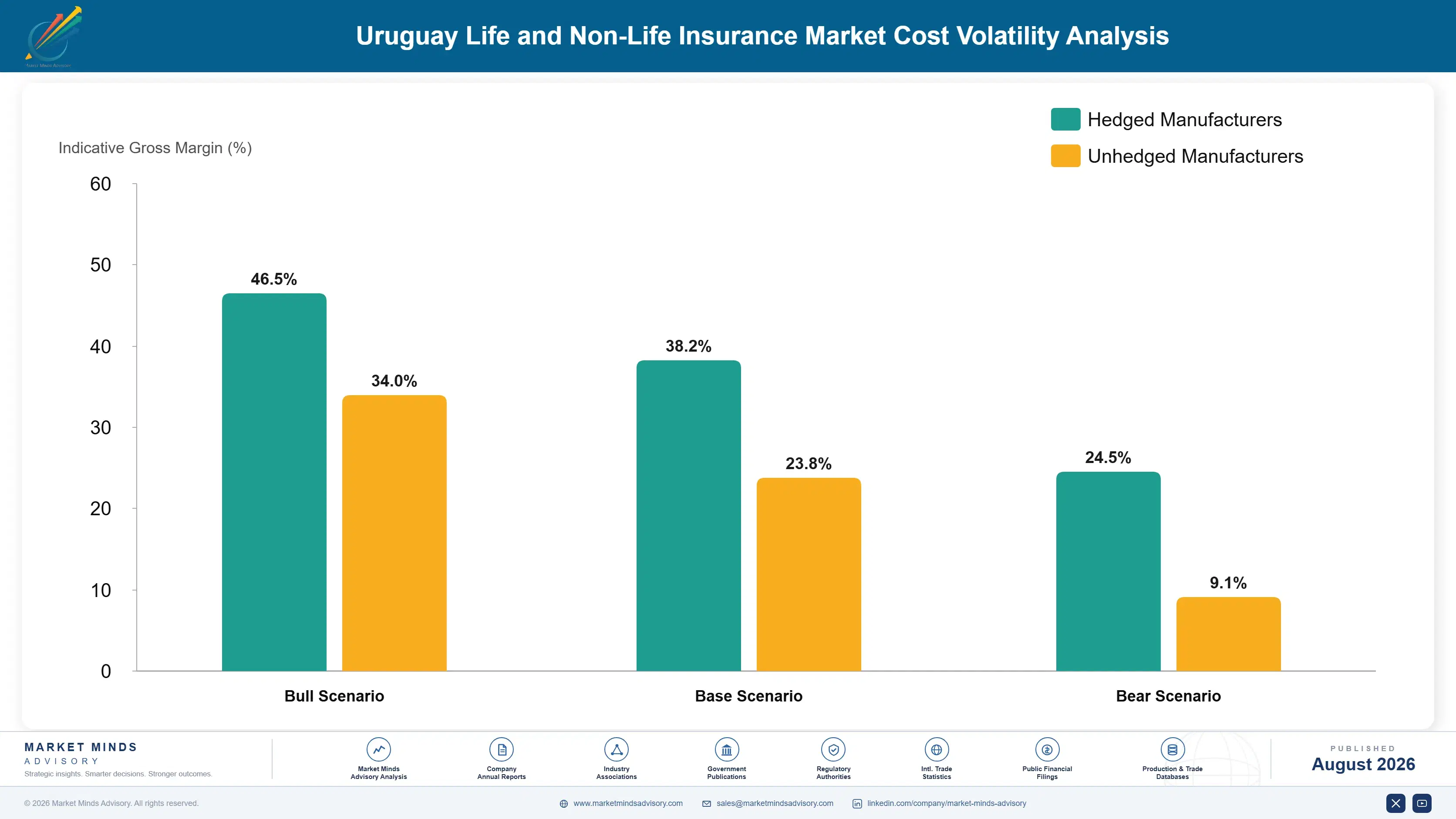
Claims and Reinsurance Cost Pressures

Claims payouts and loss-adjustment expense together represent the largest cost-to-serve component for Uruguayan insurers, running roughly sixty to sixty-five percent of earned premium across non-life lines, with reinsurance treaty premium adding a further 15 to 20 percent. Nearly all catastrophe and large-commercial reinsurance capacity originates from international treaty markets in Europe, the United States, and Bermuda.
Global reinsurance treaty pricing hardened notably following several consecutive years of elevated catastrophe losses worldwide, a cycle Munich Re's 2024 Annual Report described as the firm's most disciplined pricing environment in over a decade. Uruguayan insurers renewing agricultural and property catastrophe treaties absorbed meaningfully higher reinsurance costs during this period, a pressure that compounded further given the country's own increasingly erratic rainfall patterns affecting agricultural loss experience specifically.

Smaller insurers face proportionally heavier exposure to this cost pressure because they lack the premium volume to negotiate favorable multi-year treaty terms that larger composite groups with global parent-company relationships secure more easily. Insurers without an international parent are consequently ceding a larger share of premium to reinsurers relative to their revenue base than subsidiaries of Mapfre or Sancor, compressing retained underwriting margin correspondingly.
life-non-life-insurance-market-in-uruguay-cost-volatility-analysis-1787938728707

Diversify Reinsurance Panel Across Multiple Treaty Partners

Spreading catastrophe and large-commercial risk across several reinsurers rather than concentrating with one or two partners reduces the negotiating leverage lost when any single reinsurer hardens terms, and creates competitive tension among panel members at each renewal cycle. Insurers maintaining at least four active treaty relationships typically retain stronger pricing leverage than those relying on one dominant reinsurer.

Automate Claims Processing to Cut Loss-Adjustment Expense

Digital claims intake and automated document review reduce the manual loss-adjustment labor cost that currently makes up a meaningful share of non-catastrophe claims expense, particularly for high-volume, low-severity motor and personal accident claims that rarely require detailed investigation. Several mid-sized insurers report meaningful reductions in average claim-processing turnaround time after completing this kind of automation investment.

Adopt Parametric Structures for Catastrophe-Exposed Lines

Parametric reinsurance that settles against verified weather indices rather than assessed physical loss avoids the lengthy disputes and adjustment costs that drive up claims-handling expense on traditional indemnity catastrophe treaties, while also settling faster for end policyholders specifically. Early adopters among Uruguayan agricultural insurers report materially fewer claim disputes and faster farmer payouts than under prior indemnity-based arrangements.

Portfolio Architecture for Margin Defence

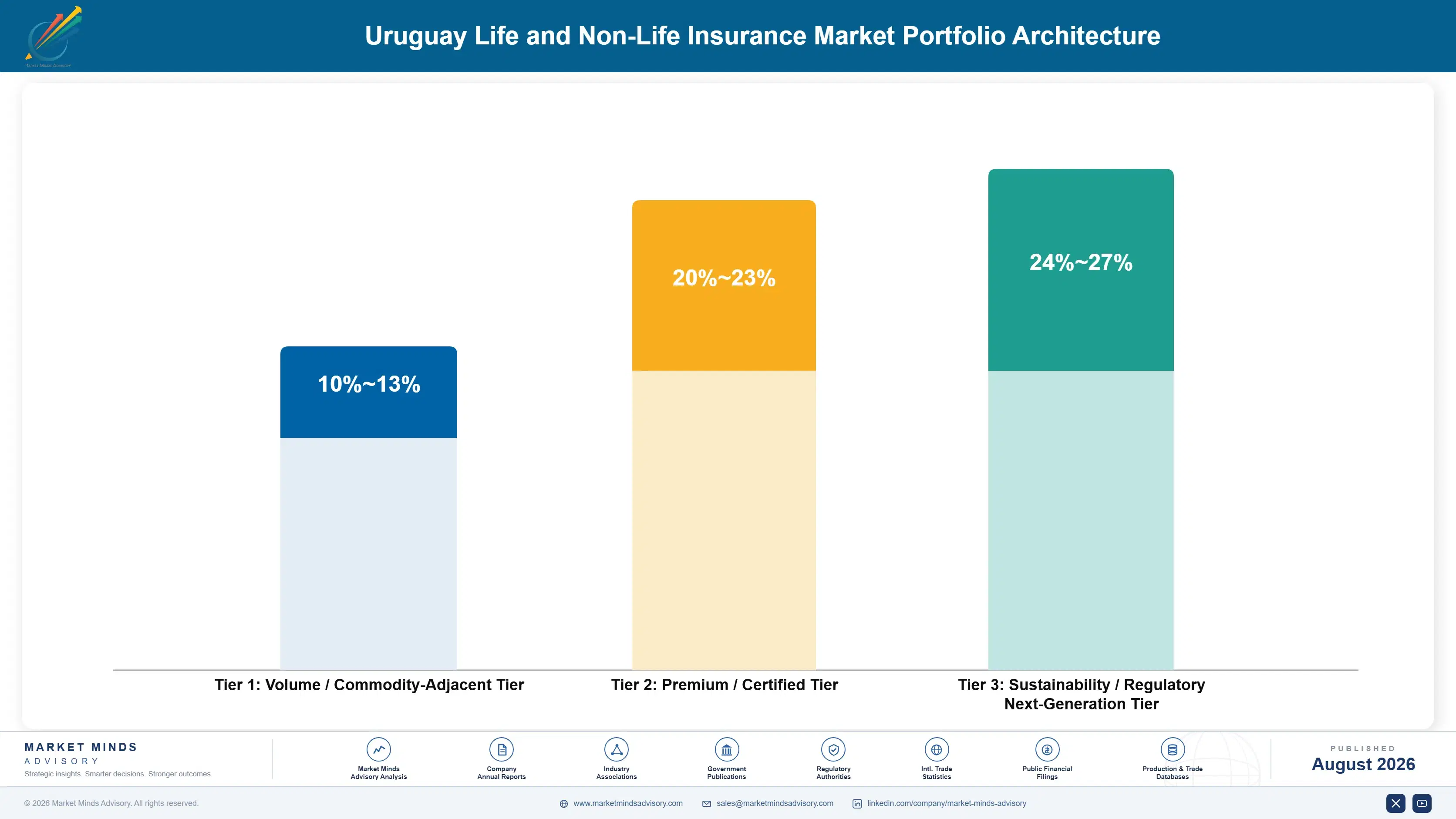
Uruguayan insurers architect their book across three tiers that trade volume for margin in fairly predictable steps. Compulsory motor and basic property coverage anchor the volume tier at thin margin, life, savings, and specialized commercial lines occupy a premium middle tier, and parametric agricultural and wellness-linked products sit at the top as the smallest but fastest-expanding category. No single tier alone determines overall profitability.
The tension between volume and premium tiers is built into the tier architecture rather than incidental: compulsory motor coverage generates the steadiest cash flow and the deepest distribution reach through bancassurance and mandatory-purchase enforcement, but underwriting margin stays thin because pricing is heavily commoditized and price-comparison behavior among policyholders is high. Premium-tier life and specialized commercial lines require deeper actuarial expertise and longer client relationships to underwrite profitably, which is why the five largest composite insurers dominate this tier.

The highest-value pools concentrate in agricultural parametric and health and personal accident products, both benefiting from genuine pricing power tied to specialized underwriting capability that smaller, thinly capitalized competitors cannot easily replicate without significant upfront investment in weather-data infrastructure or provider network relationships respectively. Insurers lacking either capability risk drifting toward the thin-margin volume tier by default.

Volume / Commodity-Adjacent Tier

Compulsory third-party motor liability and basic homeowner property coverage, priced competitively and distributed heavily through bancassurance and mandatory-purchase enforcement at the vehicle registration point nationwide, where price comparison among buyers runs high.
Gross Margin: 10-13%

Premium / Certified Tier

Life and annuity savings products, specialized commercial property, and surety lines requiring deeper actuarial underwriting and longer client relationships than commoditized motor coverage, typically sold through dedicated advisor and bancassurance relationships built over years.
Gross Margin: 20-23%

Sustainability / Regulatory / Next-Generation Tier

Parametric weather-indexed agricultural coverage and wellness-linked health products built on specialized data infrastructure and provider network relationships that competitors cannot quickly replicate without years of dedicated technology investment and reinsurer trust building.
Gross Margin: 24-27%
life-non-life-insurance-market-in-uruguay-portfolio-architecture-1787938729211

High-value Sub-segments and Strategic Watch-out

Agricultural Parametric Insurance

Fastest-growing and highest-margin pool in the portfolio, driven by lender-mandated coverage requirements and genuine technology differentiation among the handful of insurers with established weather-data trigger infrastructure and reinsurer trust in their proprietary methodology built over several seasons. Reinsurers increasingly favor this line when allocating fresh catastrophe treaty capacity.
Gross Margin: 24-27%

Health and Personal Accident Insurance

High-value line growing at a steady moderate pace as middle-class households purchase supplemental private coverage, with margin concentrated among insurers holding established mutual healthcare provider network relationships built over many years of steady clinical partnership investment. Digital-first challengers are partnering rather than competing directly on network depth.
Gross Margin: 20-23%

Compulsory Motor Liability

Largest volume core segment by policy count, nearing saturation as enforcement closes the remaining uninsured fleet gap, with margin staying thin due to heavy price comparison and commoditized underwriting across nearly every competitor active in the market currently. Insurers here compete almost entirely on service speed and renewal price alone.
Gross Margin: 10-13%

Surety and Credit Insurance

Strategic watch-out tied closely to the construction and public infrastructure investment cycle, where a slowdown in government tender activity could compress volume quickly for insurers that have built meaningful underwriting capacity in this narrower specialty line. Underwriters with diversified commercial books are better positioned to absorb any downturn.
Gross Margin: 18-21%

Renewal Economics and Channel Loyalty

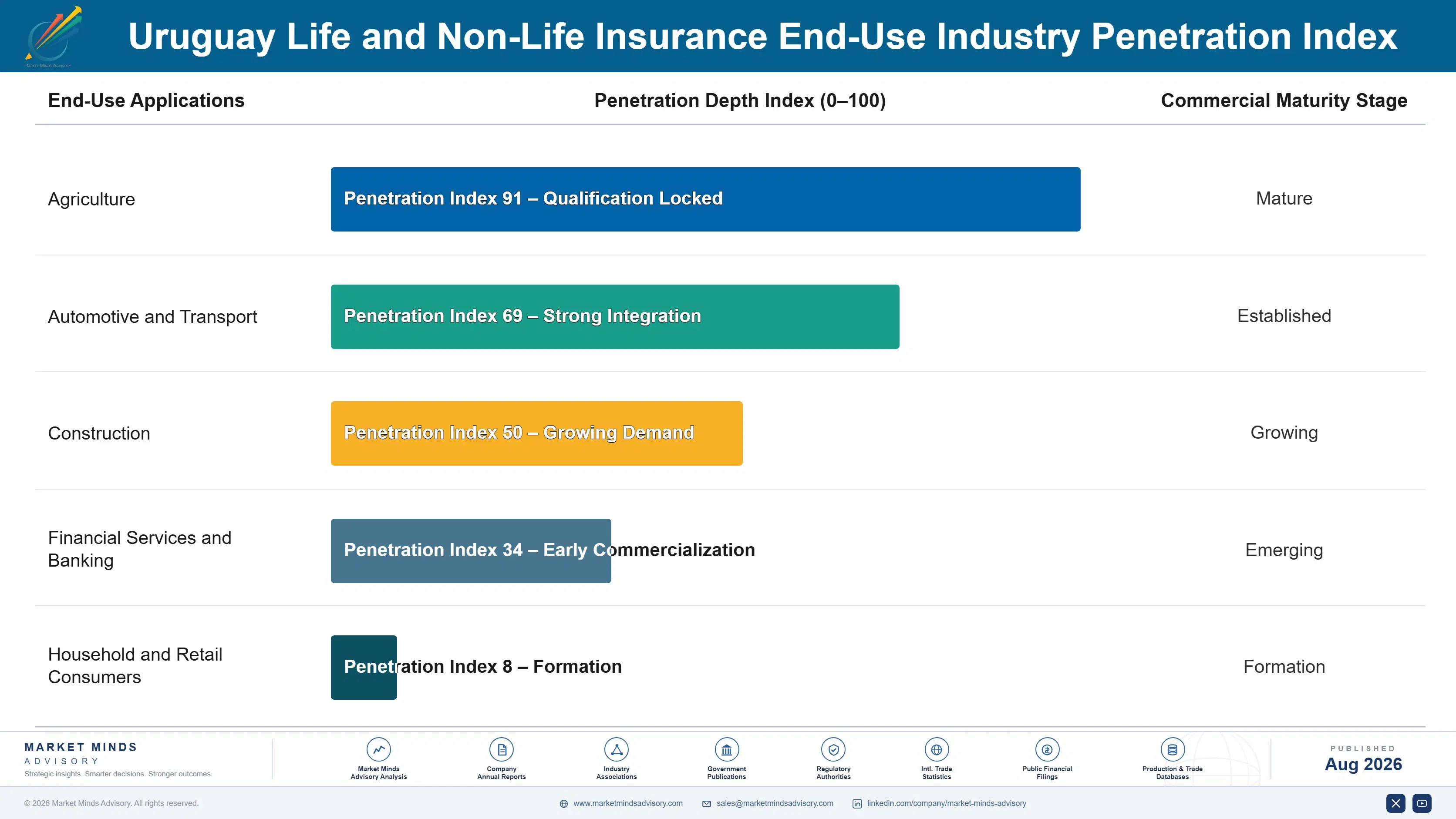
Insurance in Uruguay runs on genuine annuity economics: once a policyholder binds compulsory motor or bancassurance-linked coverage, renewal happens close to automatically each year unless price or service quality shifts meaningfully, generating a predictable recurring premium stream that underwrites most of the sector's steady, unspectacular growth profile. Lapse rates stay remarkably low outside periods of acute household financial stress.
Adoption depth varies sharply by vertical. Motor and compulsory lines sit near saturation with deep, almost reflexive renewal habits tied to registration enforcement, while agricultural parametric and health supplemental products remain earlier in their adoption curve, with renewal behavior still forming as customers experience their first claim cycle and decide whether the coverage genuinely delivered value relative to cost. Insurers underwriting both ends need different servicing models.

A generational shift is underway among younger, urban buyers who increasingly expect to research, quote, and bind coverage entirely through a mobile application rather than visiting a bank branch or calling an agent, in contrast to older bancassurance-loyal cohorts who still prefer an in-person relationship. Insurers serving both cohorts well increasingly need parallel digital and branch-based channels rather than a single unified distribution model.
life-non-life-insurance-market-in-uruguay-end-use-penetration-index-1787938729700

Where Uruguayan Insurers Should Focus

These are among the four positions where our research anticipates prominent divergence between winners and laggards over the coming forecast period. Each is grounded in the demand model, the regulatory perimeter, and the announced capacity pipeline.
01 / DISTRIBUTION CHANNEL STRATEGY

Deepen bancassurance integration before digital entrants erode the channel

Bancassurance still delivers the highest-quality, lowest-acquisition-cost premium flow available in this market, but attachment rates sit well below what deeper application programming interface integration into loan origination could achieve. Insurers that wait for digital entrants to prove out embedded distribution before responding risk ceding the fastest-growing customer touchpoints permanently. Acting now, while incumbent bank relationships remain exclusive and before digital challengers prove out comparable embedded distribution at scale, preserves a genuine competitive advantage that erodes a little further with every renewal cycle that passes without meaningful investment.
02 / UNDERWRITING DISCIPLINE FOCUS

Prioritize risk-based pricing ahead of the solvency capital compliance deadline

Central bank risk-based capital reforms will reward insurers that already price risk granularly and penalize those still relying on broad demographic rating factors alone. Building telematics and parametric pricing capability now, well ahead of the final compliance deadline, positions insurers to meet capital requirements with genuinely lower risk-weighted exposure rather than through raising expensive new capital alone. Insurers that delay this work, choosing instead to wait for the deadline to force their hand, will likely face a far more expensive scramble once the compliance window narrows considerably.
03 / REGIONAL EXPANSION POSITIONING

Use Montevideo's free-trade status to underwrite cross-border Mercosur risk

Uruguay's population ceiling fundamentally limits how large any purely domestic underwriting book can realistically grow, regardless of how well an insurer executes locally. Composite groups with existing Mercosur parent relationships, particularly those already operating subsidiaries across Argentina and Brazil, hold a meaningful head start establishing reciprocal regulatory recognition, and should prioritize this work over incremental domestic market-share gains that offer far less long-run upside. Insurers that succeed here effectively decouple their growth trajectory from Uruguay's fixed, slow-growing population base entirely.
04 / DIGITAL CLAIMS INVESTMENT

Automate claims handling to protect margin against rising reinsurance costs

Reinsurance treaty costs are climbing faster than premium in several catastrophe-exposed lines, leaving claims-handling efficiency as one of the few remaining margin levers fully within an insurer's own control. Automated intake and document review for high-volume, low-severity claims free up skilled adjusters to focus on the complex commercial and catastrophe claims where expertise genuinely changes outcomes. Insurers that invest here first, rather than waiting until margin compression becomes unavoidable, will absorb further reinsurance hardening more comfortably than competitors still running largely manual claims operations.

Engagement Snapshot From the Field

A live engagement with an industry participant carrying material or product regulatory and market exposure ahead of a defining policy shift, showing how our research translates into a defensible multi-year portfolio strategy.
MARKET MINDS ADVISORY · CLIENT ENGAGEMENT SUMMARY
Uruguay Life and Non-Life Insurance Producer Strategic Portfolio Review and Transition Roadmap 2026·Investment Scenario on Uruguay Life and Non-Life Insurance Exposure Evaluation 2025-26
CLIENT PROFILE
The client is a mid-sized composite insurer operating across Uruguay and two neighboring Mercosur markets, offering motor, property, and life lines through a mixed agent and bancassurance distribution model. Annual gross written premium was approximately 180 million dollars (client-reported, unverified by MMA) at engagement start, with the Uruguayan operation contributing roughly a third of that total. The client sought help lifting bancassurance attachment ahead of a planned partner bank renewal.
STRATEGIC CHALLENGE
Bancassurance attachment sat meaningfully below regional peer benchmarks despite an exclusive distribution agreement, and the client suspected manual referral friction at the point of loan origination was the primary cause rather than product pricing or coverage design. Leadership needed an independent diagnostic before entering renewal negotiations with the partner bank, since internal sales data alone could not distinguish channel friction from genuine customer disinterest.
MMA APPROACH
MMA conducted structured interviews with branch staff across a representative sample of partner bank locations, mapped the existing loan-to-insurance referral workflow step by step, and benchmarked attachment economics against comparable bancassurance arrangements elsewhere in the region. The engagement combined this fieldwork with a quantitative review of conversion data broken out by branch, loan type, and staff tenure to isolate where prospective customers were being lost.
KEY FINDINGS
  1. Manual referral to a separate insurance desk caused roughly forty percent of qualifying loan customers to never receive a quote at all (client-reported, unverified by MMA).
  2. Branches with tenured staff who had completed insurance product training showed nearly double the attachment rate of newer branches. This gap held even after controlling for branch size and customer income level.
  3. Customers offered a quote within the same loan-signing appointment converted at a substantially higher rate than those referred to a follow-up call.
  4. Standard motor and property products required no meaningful redesign; the friction was entirely procedural rather than product-related. No pricing or coverage-design changes were needed to fix the underlying problem.
CLIENT PROFILE
The client is a mid-sized composite insurer operating across Uruguay and two neighboring Mercosur markets, offering motor, property, and life lines through a mixed agent and bancassurance distribution model. Annual gross written premium was approximately 180 million dollars (client-reported, unverified by MMA) at engagement start, with the Uruguayan operation contributing roughly a third of that total. The client sought help lifting bancassurance attachment ahead of a planned partner bank renewal.
STRATEGIC CHALLENGE
Bancassurance attachment sat meaningfully below regional peer benchmarks despite an exclusive distribution agreement, and the client suspected manual referral friction at the point of loan origination was the primary cause rather than product pricing or coverage design. Leadership needed an independent diagnostic before entering renewal negotiations with the partner bank, since internal sales data alone could not distinguish channel friction from genuine customer disinterest.
MMA APPROACH
MMA conducted structured interviews with branch staff across a representative sample of partner bank locations, mapped the existing loan-to-insurance referral workflow step by step, and benchmarked attachment economics against comparable bancassurance arrangements elsewhere in the region. The engagement combined this fieldwork with a quantitative review of conversion data broken out by branch, loan type, and staff tenure to isolate where prospective customers were being lost.
KEY FINDINGS
  1. Manual referral to a separate insurance desk caused roughly forty percent of qualifying loan customers to never receive a quote at all (client-reported, unverified by MMA).
  2. Branches with tenured staff who had completed insurance product training showed nearly double the attachment rate of newer branches. This gap held even after controlling for branch size and customer income level.
  3. Customers offered a quote within the same loan-signing appointment converted at a substantially higher rate than those referred to a follow-up call.
  4. Standard motor and property products required no meaningful redesign; the friction was entirely procedural rather than product-related. No pricing or coverage-design changes were needed to fix the underlying problem.
RECOMMENDED STRATEGY
Phase 1: Phase 1 (Months 1 to 3): Redesign the loan origination workflow to embed an in-appointment insurance quote step for all qualifying products. Phase 2: Phase 2 (Months 4 to 6): Roll out structured product training and simple digital quoting tools to underperforming branch staff. Phase 3: Phase 3 (Months 7 to 12): Renegotiate the bancassurance agreement using the improved attachment data to justify longer exclusivity terms and better commission rates.
OUTCOME
Within twelve months of implementation, bancassurance attachment rose from the high twenties to the low forties as a percentage of qualifying loan originations (client-reported, unverified by MMA). The client used the improved trajectory to secure a renewed five-year exclusivity agreement with the partner bank on more favorable commission terms than the prior contract.

Frequently Asked Questions

Foundational context covering the market sizes, CAGR, scope, country, region and competition that inform every finding below. This section is provided to cover basics and most often pre-purchase conversations, answered from the MMA Primary Research Dataset.

What is the current size of the Uruguay Life and Non-Life Insurance Market?

The market generated approximately 2.1 billion dollars in gross written premium in 2025. Growth is steady rather than explosive, reflecting Uruguay's small but stable, dollarized economy.

How large will the Uruguay Life and Non-Life Insurance Market be by 2036?

MMA projects the market will reach approximately 4.2 billion dollars by 2036. That represents nearly a doubling of premium volume over the forecast decade, with most of that gain compounding gradually rather than arriving in any single year.

What is the CAGR for the Uruguay Life and Non-Life Insurance Market 2026 to 2036?

The base-case compound annual growth rate is 6.5 percent. Bull and bear scenarios range from 5.2 to 7.8 percent depending on reinsurance cycle and macro conditions.

Which segment is growing fastest?

Agricultural and crop insurance leads at a 9.0 percent CAGR, driven by parametric weather-indexed products tied to lender financing requirements. Health and personal accident insurance follows closely at 8.5 percent.

Who are the major companies in the Uruguay Life and Non-Life Insurance Market?

Banco de Seguros del Estado, Mapfre Uruguay, Sancor Seguros Uruguay, Porto Seguro Uruguay, and SURA Seguros Uruguay lead the market. Together these five hold roughly seventy-two percent of total premium.

Which country is growing fastest?

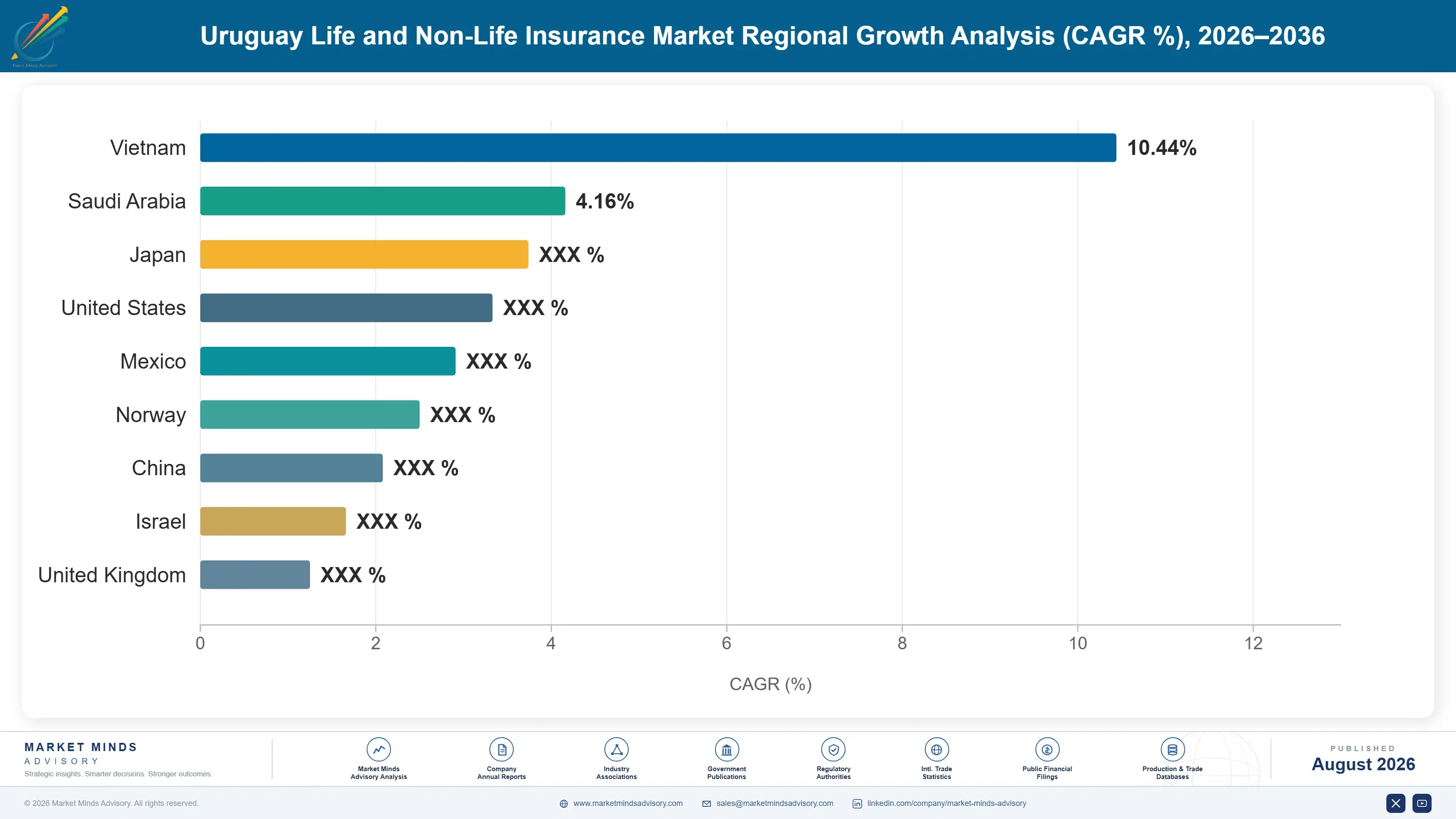
Within this Uruguay-focused market, domestic growth itself is the tracked metric, at a 6.5 percent base case. Regional capital and reinsurance flows into this market grow fastest from South Asia and Pacific sources.

Report Segmentation Architecture

The full report scope spans multiple orthogonal segmentation dimensions, with cross-tabulated demand data provided for each dimension pair. Coverage extends further to regional breakdowns, trend trajectories, and the competitive detail needed to support segment-level decision-making.

By Primary Market Dimension

  • Life Insurance and Annuities
  • Motor Insurance
  • Property and Casualty Insurance
  • Health and Personal Accident Insurance
  • Agricultural and Crop Insurance
  • Surety and Credit Insurance

By End-Use Industry

  • Agriculture
  • Automotive and Transport
  • Construction
  • Financial Services and Banking
  • Household and Retail Consumers

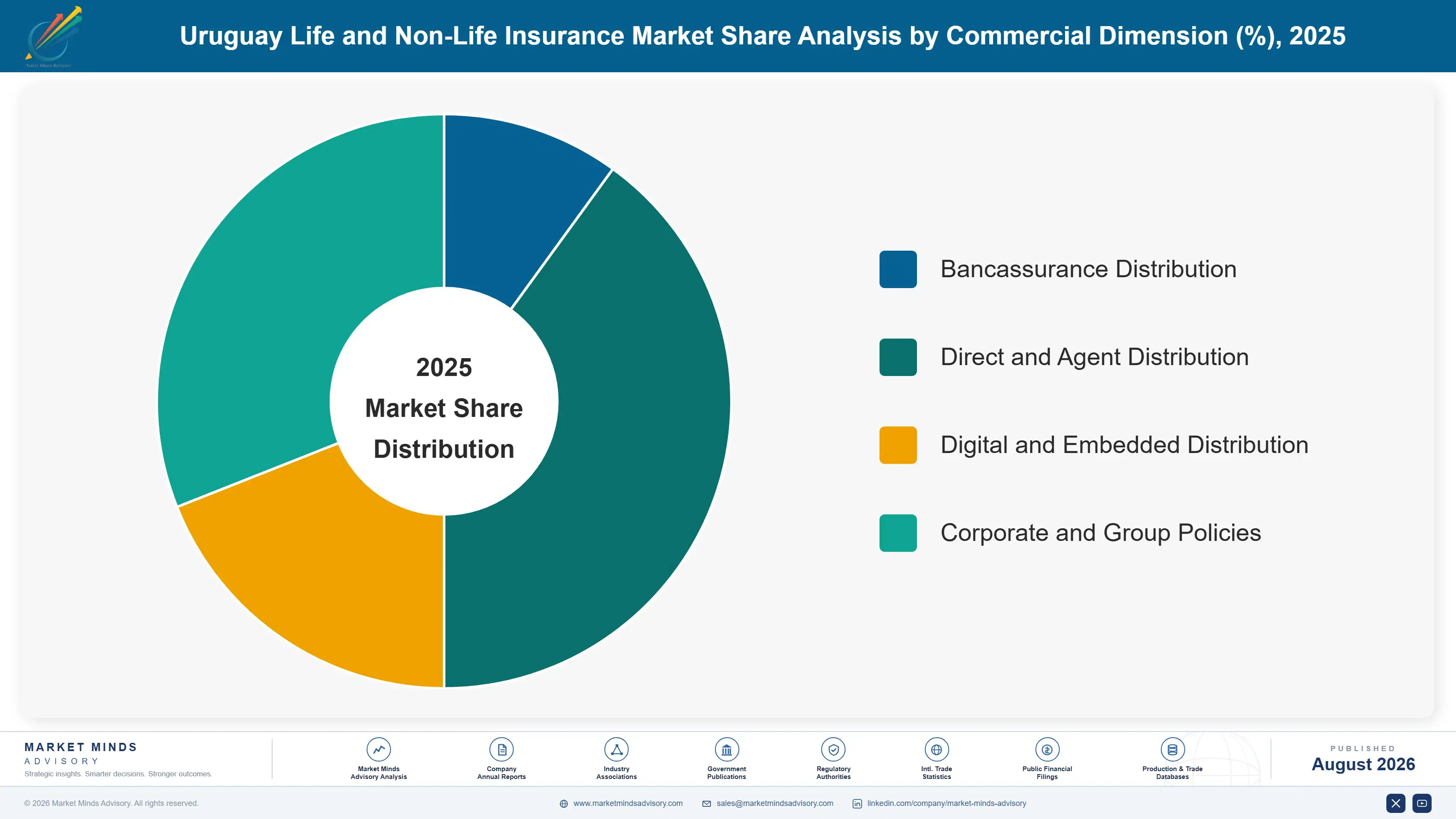
By Commercial Dimension

  • Bancassurance Distribution
  • Direct and Agent Distribution
  • Digital and Embedded Distribution
  • Corporate and Group Policies

By Region

  • North America
  • Western Europe
  • East Asia
  • South Asia and Pacific
  • Latin America
  • Middle East and Africa
  • Eastern Europe

Scope, Methodology, and Coverage

Every figure in this report is reproducible from documented input assumptions. The scope below maps the historical period, the forecast horizon, the segmentation dimensions, and the countries covered, alongside the underlying primary and qualitative methodology.
Historical Period
2020 to 2025
Forecast Period
2026 to 2036
Base Year
2025 (USD billions; MMA Primary Research Dataset, August 2026)
Market Definition
This report defines the Uruguay Life and Non-Life Insurance Market as gross written premium from life, savings-linked, and non-life insurance policies underwritten and sold within Uruguay across motor, property, health, agricultural, and surety lines. It excludes reinsurance premium ceded abroad, public pension contributions administered by Banco de Previsión Social, and standalone health maintenance organization membership fees.
Quantitative Units
USD billions (current prices); gross written premium basis
Segmentation Dimensions
By Product Line; By Distribution Channel; By Customer Type; By Region
Regions Covered
North America, Western Europe, East Asia, South Asia and Pacific, Latin America, Middle East and Africa, Eastern Europe
Countries Covered
Uruguay, Argentina, Brazil, Paraguay, Chile, Spain, Germany, Switzerland, United States, and additional markets relevant to reinsurance capacity and cross-border underwriting flows
Key Companies Profiled
Banco de Seguros del Estado, Mapfre Uruguay, Sancor Seguros Uruguay, Porto Seguro Uruguay, SURA Seguros Uruguay, HDI Seguros Uruguay, San Cristobal Seguros, ARM Seguros, La Mercantil Andina Uruguay, BNP Paribas Cardif Uruguay, Zurich Santander Seguros Uruguay, Compania Charrua de Seguros, Integrity Seguros, Surco Compania de Seguros, Aseguradora del Este, Rio Uruguay Seguros, La Uruguaya Compania de Seguros, Prever Seguros, Nacion Seguros Uruguay, Metropolitana Compania de Seguros
Quantitative Methodology
Primary survey, n=3,800 respondents, Q4 2025, six countries; demand-side model with trade association cross-validation
Qualitative Methodology
47 expert interviews, Q4 2025; applied to validate demand model assumptions, identify emerging dynamics, and assess competitive positioning
Report Format
PDF and XLSX data workbook (Word format preview document)
Publisher
Market Minds Advisory
Report Code
MMA-2026-TEC-103
Published
August 2026
Contact
sales@marketmindsadvisory.com | www.marketmindsadvisory.com

Purchase the full Uruguay Life and Non-Life Insurance Market Report (2026 to 2036).

The full report delivers a complete quantitative and qualitative assessment of Uruguay's life and non-life insurance market, spanning ten years of forecast detail across all six product-line segments. It includes company-level competitive profiling of all twenty tracked insurers and regulatory analysis of the central bank's risk-based solvency capital transition. Buyers also receive detailed reinsurance cost-structure analysis and cross-border Mercosur expansion positioning guidance not available in the summary version. A dedicated appendix walks through the primary survey and expert interview methodology underlying every forecast figure in detail.
Ten-year segment-level premium forecast detail included
Full twenty-company competitive profiling and benchmarking
Regulatory transition impact analysis and timeline
Reinsurance cost-structure breakdown by treaty type
Detailed bancassurance channel economics cost breakdown
Cross-border Mercosur expansion positioning guidance included

Built For The People Who Decide

From boardroom strategy to bench-side execution, this report is read cover-to-cover by leaders shaping the next decade of their industry, turning demand scenarios, market dynamics and valuation benchmarks into decisions.
CXOs/ Presidents/ VPs/ Managers
M&A and Corporate Development
Strategy Teams and R&D Heads
Procurement and Product Directors
Regulatory and Compliance Leaders
Investor Relations and Equity Analysts