Market Minds Advisory
Spain Life and Non-Life Insurance Market

Spain Life and Non-Life Insurance Market: Bancassurance Consolidation and Digital Underwriting Adoption

Bancassurance channel consolidation, rising longevity-linked life product demand, and accelerating digital underwriting adoption across banks and insurers alike are jointly reshaping Spain's entire life and non-life insurance sector structure today.

Lead Analyst

Published

September 2026

Make Smarter Decisions with Customized Research Insights

Request a free sample report and evaluate market opportunities, growth trends, and competitive dynamics relevant to your business needs.

2025 MARKET VALUE$6800MMarket Size 2025
2036 FORECAST VALUE$10920MBase Case , 2026 to 2036
CAGR 2026 TO 20364.4 %Bull 5.6% / Bear 3.2%
INCREMENTAL OPPORTUNITY$3821MNet 10- year value creation
EXPANSION MULTIPLE1.54x2036 value over 2026 base
Strategic Levers
M&A Pipeline
Regional Outlook
Country Rankings
Competitive Intelligence
Segmental Deep-dive
Call-Us : 91 93563 13602

Executive Snapshot and Market Trajectory

Life and non-life insurers are consolidating bancassurance distribution just as digital underwriting adoption accelerates, and Spain's bank-affiliated insurers now anchor one of Western Europe's most concentrated distribution channel structures anywhere in the region, well ahead of comparably sized markets nearby. Digital underwriting is compounding this advantage further. Regulators are watching.
North American life and non-life premium volume still generates the largest global pool, but growth has accelerated fastest in South Asia as India's expanding middle class and rising insurance penetration pull hundreds of millions of previously uninsured consumers into formal coverage for the first time. Unit-linked life products are gaining share as consumers seek investment-linked returns alongside traditional protection. Mapfre continues expanding bancassurance partnerships.
Competition remains concentrated among bank-affiliated insurers and traditional standalone carriers, with digital underwriting speed and bancassurance channel depth increasingly separating leaders from laggards. Regulatory pressure around solvency capital requirements is rising across major markets, raising compliance costs that smaller standalone insurers increasingly struggle to absorb without merger or partnership support. Insurers without dedicated digital underwriting capability increasingly fall behind on both cost efficiency and customer retention. Consolidation pressure keeps building steadily.
Market Definition
This report covers gross written premium across life, health, property, casualty, and specialty non-life insurance lines sold to individual and commercial policyholders globally. It excludes standalone reinsurance treaties, employee benefits administration services, and non-insurance wealth management products distributed through the same channels.
Base Year Value
$6800M in 2025 (MMA Primary Research Dataset, August 2026)
Forecast Period
2026 to 2036, eleven discrete annual values
CAGR
4.4% base case. Bull 5.6%. Bear 3.2%.
Fastest Growth Segment
Unit-Linked and Investment-Linked Life Insurance: 7.8% CAGR
Fastest Growth Country
India: 10.4% CAGR
Fastest Growth Region
South Asia and Pacific: 6.6% CAGR
Largest Region
North America: 30% of 2025 global value
Market Leaders
Allianz SE, AXA S.A., Zurich Insurance Group, Generali, Mapfre. Source: MMA Analysis based on company annual reports.
Primary Survey
n=3,800 procurement and R&D decision-makers, Q4 2025, six countries
Methodology
Demand-side build-up, cross-validated against public data, 47 expert interviews

Spain Life and Non-Life Insurance Market Forecast Scenarios

life-non-life-insurance-market-in-spain-size-forecast-scenario-1787915469051
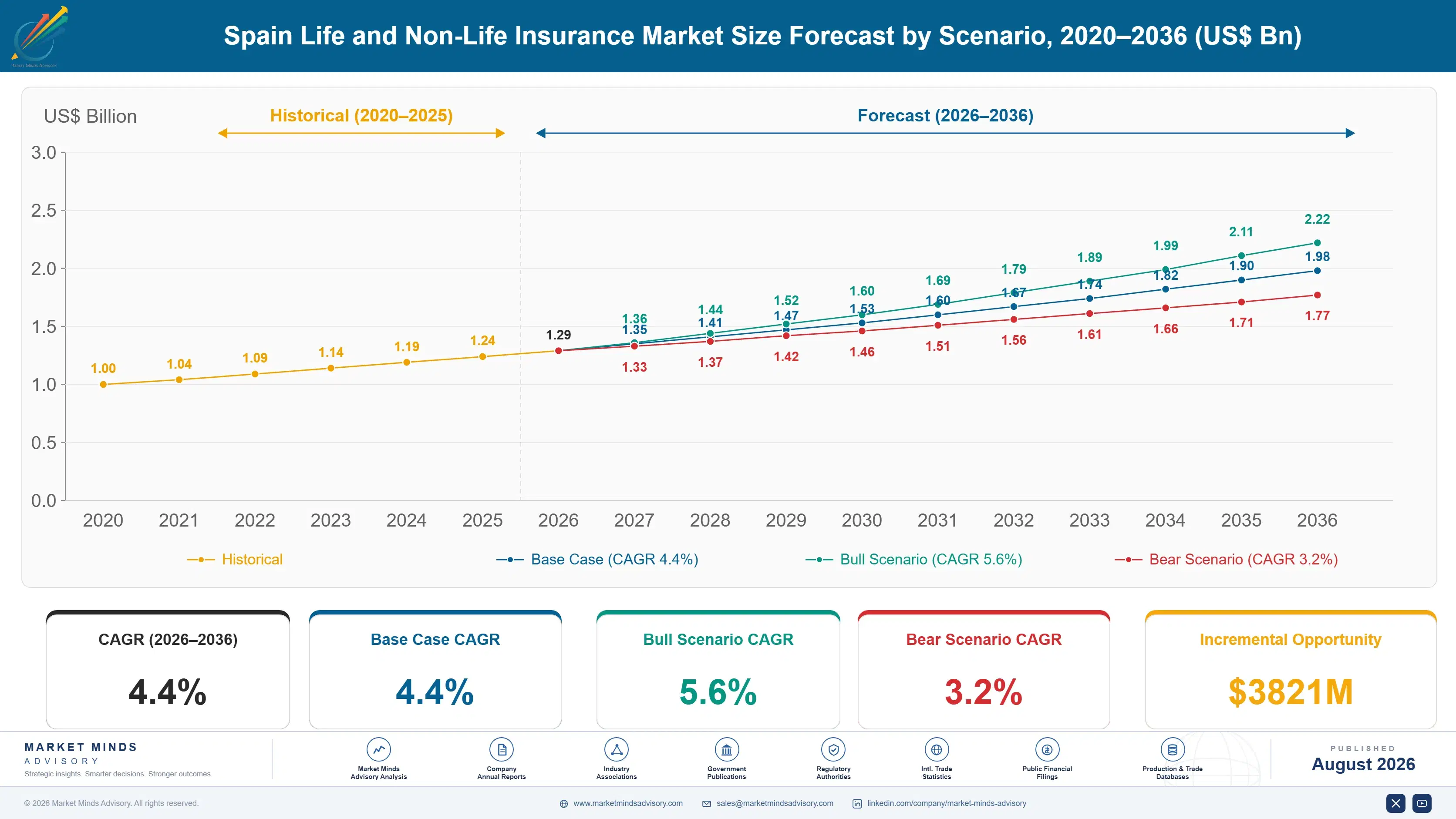
Between 2020 and 2025 the market grew at an estimated 3.8% annually, held back early by pandemic-era claims volatility and low interest rates that compressed life insurer investment returns, before stabilizing from 2023 onward as rate normalization restored traditional product profitability across most major markets covered here. Growth stayed concentrated in health and unit-linked life products, with traditional protection-only life products growing more slowly.
The base case carries the market to 4.4% CAGR through 2036 on three mechanisms. Bancassurance consolidation keeps expanding distribution reach for bank-affiliated insurers across Spain and comparable European markets. India's expanding middle class keeps pulling hundreds of millions of previously uninsured consumers into formal life and non-life coverage. Digital underwriting adoption keeps compressing policy issuance cost, widening margin for technology-forward insurers. Regulatory acceptance of digital-first distribution keeps broadening across additional product lines and customer segments.
The bull case rests on faster interest rate stabilization supporting unit-linked and investment-linked product demand beyond current projections. The bear risk centers on renewed claims severity inflation across property and casualty lines, which would compress underwriting margin industrywide even as premium volume continues growing steadily. Insurers with strong reinsurance relationships already built are better positioned to weather this bear scenario.

Bancassurance Consolidation Reshapes Distribution Economics

Life and non-life insurance economics increasingly hinge on distribution channel efficiency rather than pure underwriting scale, since bancassurance partnerships now originate a substantial share of new premium at meaningfully lower acquisition cost than traditional agent networks. This shift is reshaping where insurers invest, moving budget toward bank partnership negotiation and technical integration capability.
TOP 5 CONCENTRATION46%Combined share held by leading global insurance groups
AVERAGE PREMIUM PER POLICY$1,140Blended premium across life and non-life policy types
BANCASSURANCE DISTRIBUTION SHARE38%Premium sold through bank-affiliated distribution partnership channels currently
COMBINED RATIO94%Claims and expenses as share of premium collected
SOLVENCY CAPITAL RATIO205%Average regulatory capital coverage across major insurers today
DIGITAL UNDERWRITING ADOPTION RATE31%Share of new policies underwritten through automated processes
Bancassurance consolidation is concentrating distribution among fewer, larger bank-insurer partnerships, particularly across Spain and comparable Southern European markets where banking relationships run deep. Combined ratios remain manageable across most product lines, though property catastrophe exposure carries meaningfully higher claims volatility than standard life and health lines. Insurers with strong catastrophe modeling and reinsurance relationships manage this volatility considerably better than smaller competitors relying primarily on standard actuarial pricing tables built for average-year loss experience.
Digital underwriting is compressing acquisition and processing cost industrywide as automated risk assessment replaces manual review for standard policy types. Insurers with strong bancassurance and digital integration capability are capturing disproportionate share of new premium growth, while insurers relying on traditional agent-only distribution increasingly lag the broader category. Regulatory scrutiny of bancassurance conflict-of-interest practices is rising, though enforcement so far has done little to slow the underlying consolidation trend.
"Bancassurance used to be a distribution channel. Now it is becoming the entire business model for insurers who cannot compete on brand alone."
Practice Lead, Financial Services and Insurance Intelligence · MMA Financial Services and Insurance Practice · August 2026

Market Trends

Bancassurance Partnerships Consolidate Around Fewer Bank Groups

Bank-insurer partnerships are consolidating around fewer, larger banking groups as smaller regional banks exit standalone insurance distribution in favor of white-label or referral arrangements with established carriers. Mapfre and CaixaBank's insurance arm have both expanded bancassurance agreements covering additional product lines beyond traditional mortgage-linked life coverage. This consolidation reflects a genuine change in how banks view insurance distribution: no longer a peripheral fee income source, but a strategic partnership category requiring dedicated technology and compliance investment to sustain competitively. Insurers without comparable bank partnerships struggle to match this reach, ceding volume to consolidated bancassurance leaders.
Market Impact: Improves life margin by 3 points

Digital Underwriting Displaces Manual Risk Assessment

Insurers increasingly deploy automated underwriting models for standard life and property policies, converting what was once a multi-day manual review process into near-instant risk assessment and pricing for the majority of straightforward applications submitted. Allianz and AXA have both expanded proprietary digital underwriting platforms covering an increasing share of new business volume across major European markets. This distribution shift is compressing acquisition and processing cost meaningfully across the category, favoring insurers with strong technical integration capability over those still dependent on manual review. Insurers without comparable digital infrastructure increasingly cede volume to faster-issuing competitors.
Market Impact: Adds 250 million newly insured consumers

Market Opportunities and Growth Drivers

Interest Rate Normalization Restores Life Product Profitability

Rising interest rates since 2022 have restored profitability to traditional guaranteed-return life products that struggled economically during the prolonged low-rate environment of the previous decade, when insurers absorbed meaningful investment margin compression on legacy policy books. Higher rates also improved unit-linked product attractiveness as underlying fixed-income allocations began generating meaningfully better returns for policyholders across most major European markets. Insurers with strong asset-liability management capability captured this margin improvement faster than competitors slower to reposition portfolios accordingly. Insurers building sophisticated asset-liability matching capability early secure a margin advantage competitors slower to adapt will find harder to close.
Market Impact: Raises catastrophe claims 18% above average

India Middle Class Expansion Drives Insurance Penetration

India's expanding middle class, combined with rising financial literacy and formal banking penetration, is pulling hundreds of millions of previously uninsured consumers into formal life and non-life coverage for the first time in their lives. Digital-first insurers are building distribution directly on top of expanding digital payment infrastructure, reaching consumers traditional insurance agents never economically served given low individual premium size relative to acquisition cost under conventional distribution models. This underserved population represents genuine incremental market growth rather than share shifted from existing insurers, since most of these new policyholders had no formal coverage relationship previously in their lives.
Market Impact: Adds compliance cost across 12 markets

Market Restraints and Challenges

Property Catastrophe Claims Severity Pressures Underwriting Margin

Property catastrophe claims severity has risen meaningfully across Southern European markets as extreme weather events increase in frequency, squeezing underwriting margins for insurers with concentrated property book exposure in higher-risk coastal and wildfire-prone regions. The root cause is genuine climate-driven risk escalation, not a temporary underwriting cycle, meaning insurers cannot simply wait out the current environment before repricing risk appropriately. This has pushed combined ratios above profitable thresholds for several major property insurers in recent reporting periods. Insurers are responding by tightening underwriting criteria and raising catastrophe-exposed property premiums meaningfully.
Market Impact: Adds 8 percentage points bancassurance share

Bancassurance Conflict Of Interest Scrutiny Raises Compliance Cost

Regulators across several European markets are scrutinizing whether bank-affiliated insurance sales practices adequately disclose conflicts of interest to consumers, particularly around mortgage-linked life insurance products bundled with lending decisions. The root cause is genuine consumer protection concern following documented cases of consumers feeling pressured to purchase bundled insurance to secure favorable loan terms. This has forced insurers and banking partners to rebuild disclosure and sales processes, raising compliance cost meaningfully across the bancassurance channel. Insurers are responding by building clearer separation between lending decisions and insurance sales processes going forward.
Market Impact: Cuts underwriting time under 5 minutes
3 additional market trends, 4 additional growth drivers, and 2 additional restraints and challenges are covered in the full report. Contact sales@marketmindsadvisory.com to access the complete intelligence.

Segment CAGR and Growth Architecture

Life and non-life insurance splits into six product categories defined by coverage type and customer risk. Unit-linked life and specialty commercial lines lead current growth as rate normalization and digital underwriting expand product reach across an increasingly diverse policyholder base. Traditional protection life and property casualty coverage sit alongside these, growing steadily as premium volume expands across mature markets.
life-non-life-insurance-market-in-spain-market-share-analysis-1787915469584

Unit-Linked and Investment-Linked Life Insurance

Unit-linked and investment-linked life insurance grows fastest at 7.8% annually, nearly 1.77 times the overall market rate, as consumers seek investment-linked returns alongside traditional protection following the interest rate normalization that restored underlying fixed-income yield attractiveness. These products blend life coverage with market-linked investment components, appealing particularly to consumers comfortable bearing some investment risk in exchange for higher potential returns than guaranteed products offer. Allianz and Generali both hold strong positions given established asset management capability supporting these product structures. Insurers investing early in expanded asset management capability are capturing a product breadth advantage that competitors relying purely on traditional guaranteed products will find considerably harder to replicate within a comparable timeframe.
CAGR 7.8%

Specialty Commercial and Cyber Liability Insurance

Specialty commercial and cyber liability insurance grows second-fastest at 6.9%, driven by rising digital business exposure and expanding regulatory requirements around data breach liability coverage across most developed commercial insurance markets. These policies cover risks that standard commercial general liability products were never designed to address, requiring specialized underwriting expertise that generalist commercial insurers increasingly struggle to develop internally at comparable speed. AXA and Zurich both compete intensely for this business through dedicated specialty underwriting units. This underwriting complexity is creating a meaningful specialization gap between insurers investing in dedicated cyber and specialty expertise and generalist competitors still applying standard commercial policy frameworks poorly suited to emerging digital risk categories.
CAGR 6.9%
Full segment breakdown across 7 segments available in the complete report.

Regional Architecture and Country Demand Map

Life and non-life insurance demand concentrates around mature developed economies with established regulatory frameworks. North America leads on premium volume while South Asia compounds fastest as India's expanding middle class formalizes previously uninsured coverage relationships. Bancassurance channel consolidation reshapes Western European distribution economics specifically and considerably.

North America

The US life and non-life insurance market, anchored by major carriers including State Farm and Allstate, generates the largest global premium pool through deep property casualty penetration and strong employer-sponsored group life benefits. Canadian insurers follow a similar model at smaller scale, tied closely to comparable regulatory and distribution structures. Rising catastrophe claims severity, particularly across wildfire and hurricane-exposed states, is pushing property insurers toward tighter underwriting discipline. Growth of 5.6% reflects steady premium growth across both life and non-life lines rather than any single new regulatory or product driver specifically. Insurers with strong catastrophe modeling capability hold an advantage over competitors relying on standard actuarial pricing tables built for average-year loss experience.
Share: 30% | CAGR: 5.6% (2026 to 2036)

Western Europe

Spain's bancassurance-heavy distribution model, anchored by Mapfre and major banking partnerships, anchors much of this region's growth story as bank-affiliated insurers consolidate distribution across mortgage-linked life and standard property lines. Germany and France follow with mature, technologically sophisticated insurance markets built on strong existing consumer trust. Switzerland and the Nordics contribute smaller but steadily growing premium volume through private banking-linked wealth and life products. Growth of 3.2% trails the global average as digital and bancassurance penetration is already comparatively high across most major Western European insurance markets, leaving less incremental volume available. Insurers building direct digital channels alongside bancassurance partnerships capture growth that bank-dependent competitors alone increasingly struggle to match.
Share: 20% | CAGR: 3.2% (2026 to 2036)
Regional intelligence for 5 additional markets available in the complete report: East Asia, South Asia and Pacific, Latin America, Middle East and Africa, Eastern Europe. Contact sales@marketmindsadvisory.com.
life-non-life-insurance-market-in-spain-country-cagr-analysis-1787915470099

Where Insurers Should Focus Growth Investment

Revenue growth concentrates around distribution partnership depth and digital underwriting capability rather than pure product differentiation. Insurers embedded within bank distribution networks and digital platforms capture volume that standalone marketing simply cannot reach at comparable acquisition cost across major markets. Insurers combining both approaches capture volume competitors relying on a single channel cannot match at comparable cost.

Deepen Bancassurance Partnership Integration Depth Nationwide

Insurers deepening bancassurance partnerships beyond mortgage-linked life products into broader wealth and protection categories capture attach rates well above standalone agent distribution, since bank customers encounter insurance offers during existing financial relationship touchpoints. Established bancassurance leaders reportedly see policy volume running 25 to 35 percentage points above insurers relying on traditional agent-only distribution, since the trusted banking relationship meaningfully outperforms cold outreach campaigns at comparable cost. Insurers without comparable bank partnerships increasingly cede volume to bancassurance-integrated competitors. This trusted relationship advantage compounds with every additional product category bank partnerships expand to cover.
Market Impact: Raises policy volume by 25 to 35 points

Build Proprietary Digital Underwriting Infrastructure Now

Insurers building proprietary digital underwriting models that automate risk assessment for standard policies capture pricing accuracy and issuance speed advantages that competitors relying on manual review cannot match. Allianz and AXA reportedly achieve underwriting cost running 20 to 30 percentage points below insurers using conventional manual review processes, since automated models process applications at a fraction of the marginal cost per policy issued. This capability requires sustained technology investment that smaller regional insurers often lack relative to larger competitors. Competitors delaying this investment risk falling behind on both cost control and pricing precision over time.
Market Impact: Cuts underwriting cost by 20 to 30 points

Expand Specialty Commercial And Cyber Product Lines

Insurers developing dedicated specialty commercial and cyber liability underwriting capability capture incremental premium volume from businesses facing risks that standard commercial general liability products were never designed to address adequately. Insurers with dedicated specialty units reportedly generate premium volume running 12 to 20 percentage points above generalist commercial insurers, since specialized underwriting expertise captures business that generalist competitors decline or mispriced entirely. This expansion requires meaningful actuarial investment but carries strong margin potential once underwriting models mature. Insurers without dedicated expertise continue ceding this growing business to specialists building genuine underwriting depth.
Market Impact: Adds 12 to 20 points of incremental volume

License Digital Underwriting Models To Regional Partners

Insurers with proprietary digital underwriting models can license that technology to smaller regional insurers lacking comparable infrastructure, generating fee revenue without directly bearing the underlying insurance risk themselves across licensed territories. This model reportedly generates licensing fee revenue running 2 to 4 percent of the licensee's premium volume at minimal marginal cost to the technology owner, since the underlying model already exists and continues serving the licensor's own core underwriting business regardless of licensing activity levels. Demand for this licensing is rising as smaller insurers seek digital capability without full infrastructure investment.
Market Impact: Generates 2 to 4 percent of licensee revenue

Who Controls the Margin Pool

The top five carriers hold a combined 46% share, reflecting meaningful consolidation across the global life and non-life category relative to more fragmented specialty insurance segments. Allianz leads the field, with a gap to challengers like AXA and Zurich narrow enough that rankings shift with major bancassurance partnership wins.
Competitive activity currently centers on bancassurance partnership acquisition, with insurers racing to secure exclusive or preferred bank distribution agreements before competitors lock in comparable arrangements. Digital underwriting investment represents a second front, where insurers compete on issuance speed and pricing accuracy rather than pure brand recognition. Specialty commercial expansion adds a third front, rewarding insurers with dedicated cyber and liability underwriting expertise. Regulatory compliance investment adds a fourth front, rewarding insurers with early disclosure and transparency capability across bancassurance channels.

Emerging pressure comes from digital-native insurtech platforms building direct-to-consumer distribution that bypasses both traditional agents and bancassurance channels entirely, appealing to younger consumers comfortable purchasing coverage online. Rankings could shift meaningfully if a well-capitalized challenger combines digital underwriting technology with aggressive bancassurance partnership acquisition, a combination no major player has fully executed yet. Established players without comparable technology investment risk losing meaningful share to faster, more focused digital challengers.
life-non-life-insurance-market-in-spain-company-positioning-matrix-1787915470628

Competitive Moat and Risk Dimensions

ALLIANZ SE

Moat: Global Distribution Scale

Allianz's distribution relationships spanning bancassurance partnerships, agent networks, and direct digital channels across every major region give it reach competitors struggle to replicate at comparable scale or speed of integration across new markets and product categories. This scale advantage compounds as more distribution partners seek a single global insurer relationship rather than managing many regional partnerships separately.
ALLIANZ SE

Risk: Slower Digital Integration Pace

Legacy technology infrastructure across some regional operations slows digital underwriting integration speed relative to smaller, digitally native competitors, creating openings for insurtech challengers to win new distribution partnerships before Allianz can respond. Closing this gap requires sustained technology investment that competes internally against other capital priorities across the organization.
AXA S.A.

Moat: Specialty Underwriting Depth

AXA's established specialty commercial and cyber liability underwriting capability gives it credible expertise in complex risk categories that smaller regional insurers cannot match without years of dedicated actuarial investment and claims experience accumulation across similarly complex risk categories. This expertise took years to build and represents a genuine barrier to entry for generalist insurers considering rapid specialty expansion.
AXA S.A.

Risk: Limited Bancassurance Partnership Depth

AXA lacks the dedicated bancassurance partnership depth that Allianz and regional bank-affiliated insurers hold in several key markets, limiting its ability to capture the fastest-growing distribution channel without new partnership agreements or acquisitions in that specific channel. Building comparable bancassurance depth from scratch would require years of relationship investment that AXA has not yet fully committed to.

Players Tracked

Prominent Players

Allianz SE
AXA S.A.
Zurich Insurance Group
Generali
Mapfre

Other Key Players

Prudential plc
Legal and General Group
Aviva plc
CNP Assurances
CaixaBank Insurance
Credit Agricole Assurances
Munich Re
Swiss Re
Ping An Insurance
China Life Insurance
MetLife
Prudential Financial
Manulife Financial
LIC of India
ICICI Prudential Life Insurance

Recent Developments

JANUARY 2024

Mapfre expanded its bancassurance agreement with a major Spanish banking group, extending distribution rights across additional life and health product lines within the partnership's branch network. The expansion was a distribution partnership renewal, not an acquisition or joint venture, covering additional branch locations this quarter.
Signal: Signals bancassurance partnerships are consolidating around fewer, deeper agreements rather than broader shallow relationships. over broader shallow distribution.
JUNE 2024

Allianz signed a technology partnership with a specialty digital underwriting provider to deploy automated risk assessment across its European life insurance product lines. The agreement was a technology licensing partnership, not an acquisition or equity investment of any kind. The deployment covers several major European life product categories.
Signal: Signals established insurers are prioritizing technology partnerships over building underwriting capability fully internally. to accelerate deployment speed.
OCTOBER 2024

AXA acquired a specialty cyber liability underwriter to strengthen its commercial insurance product line amid rising demand for standalone cyber coverage across major developed insurance markets globally. The transaction was a full acquisition, not a joint venture or minority equity stake of any kind. category.
Signal: Signals major carriers are moving to acquire specialty underwriting capability rather than build it slowly internally.

Claims And Distribution Commission Cost Exposure

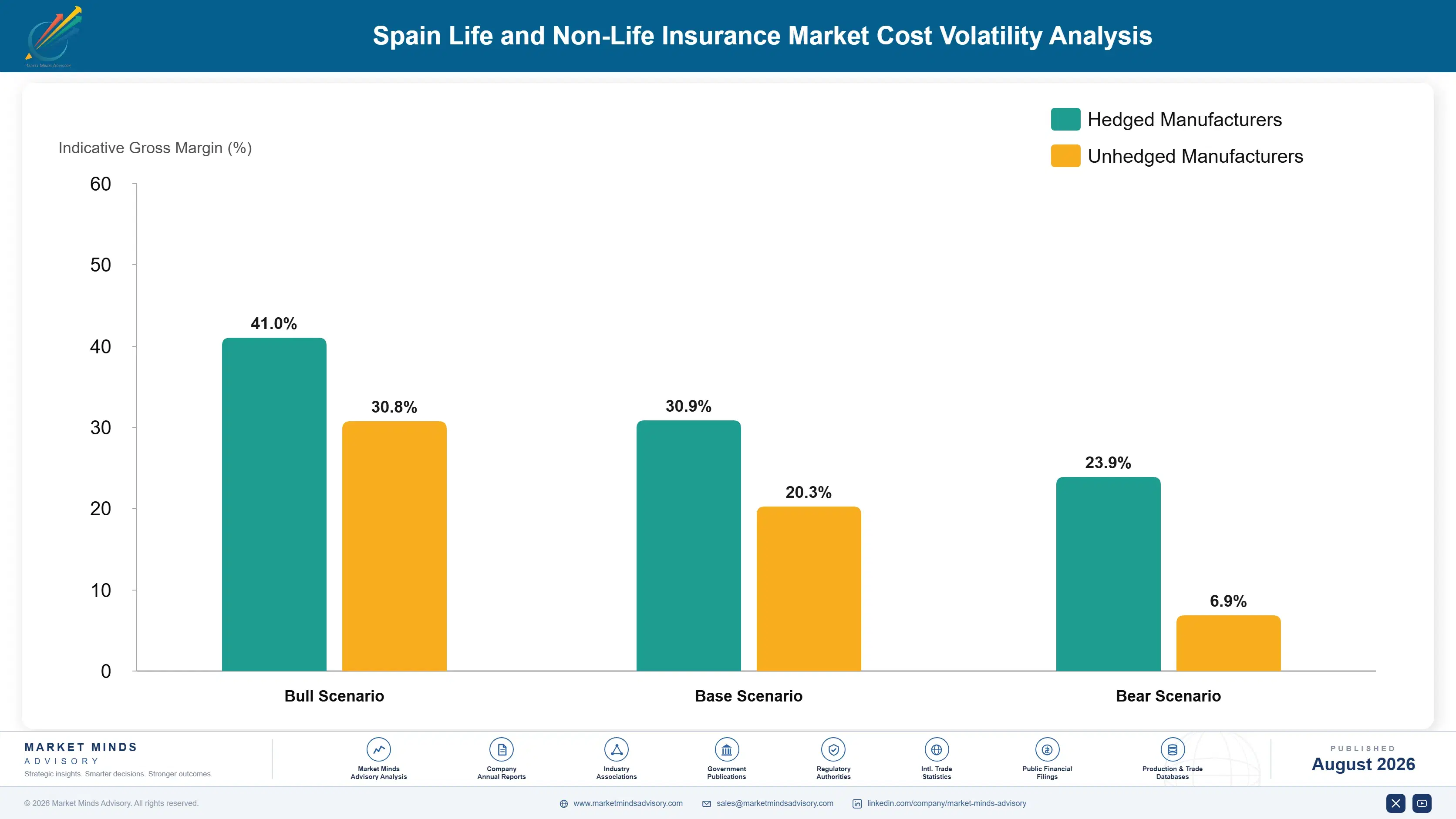
Claims payouts and distribution commissions together account for roughly 82% of gross premium collected, with claims alone typically running 58% to 66% of premium depending on the life and non-life product mix an insurer writes. Bancassurance and agent distribution commissions, concentrated among a handful of dominant bank partnerships and broker networks, add another 14% to 20%, while underwriting and claims administration overhead account for the remaining share.
Property catastrophe claims severity rose meaningfully through 2023 as extreme weather events increased in frequency across Southern European markets. Mapfre's 2023 annual report disclosed elevated catastrophe claims cost pressure across its Spanish property segment during the period. Reinsurance costs have also risen as global reinsurers repriced catastrophe risk following several consecutive years of elevated global claims experience across major exposed regions. Modeling costs have also risen as insurers build proprietary catastrophe capability.

Insurers without dedicated catastrophe modeling and reinsurance relationships absorb claims cost volatility more directly than insurers with established risk transfer programs, since ad hoc reinsurance sourcing carries meaningfully higher cost than pre-negotiated multi-year treaty arrangements. Insurers relying heavily on bancassurance distribution also carry additional margin exposure since commission structures compress underwriting economics regardless of claims performance across the channel mix.
life-non-life-insurance-market-in-spain-cost-volatility-analysis-1787915470822

Build Direct And Diversified Distribution Channels

Insurers relying purely on bancassurance commission-based distribution face compressed margin regardless of underwriting quality. Building direct-to-consumer and digital channels, even at higher upfront investment, secures margin stability independent of bank commission structures that keep rising as distribution concentration increases across major markets. This shift secures durable margin control that bank-dependent competitors cannot easily replicate over the following renewal cycles.

Secure Multi-Year Reinsurance Treaty Arrangements

Securing multi-year reinsurance treaty arrangements with favorable terms ahead of renewal negotiations, rather than sourcing reinsurance reactively on the open market, is what let larger insurers limit the worst of the 2023 catastrophe cost spike while smaller competitors absorbed the full increase directly. The premium paid for treaty stability is real, but far cheaper than uncontrolled catastrophe cost inflation industrywide.

Invest In Advanced Catastrophe Risk Modeling

Standard actuarial pricing tables systematically misprice climate-driven catastrophe risk, and insurers investing in advanced modeling capability can price this risk more accurately than competitors relying on historical loss averages alone. Early investment compounds into a durable underwriting advantage over time. Competitors delaying this investment risk falling behind on pricing precision as claims experience accumulates against them.

Portfolio Architecture for Margin Defence

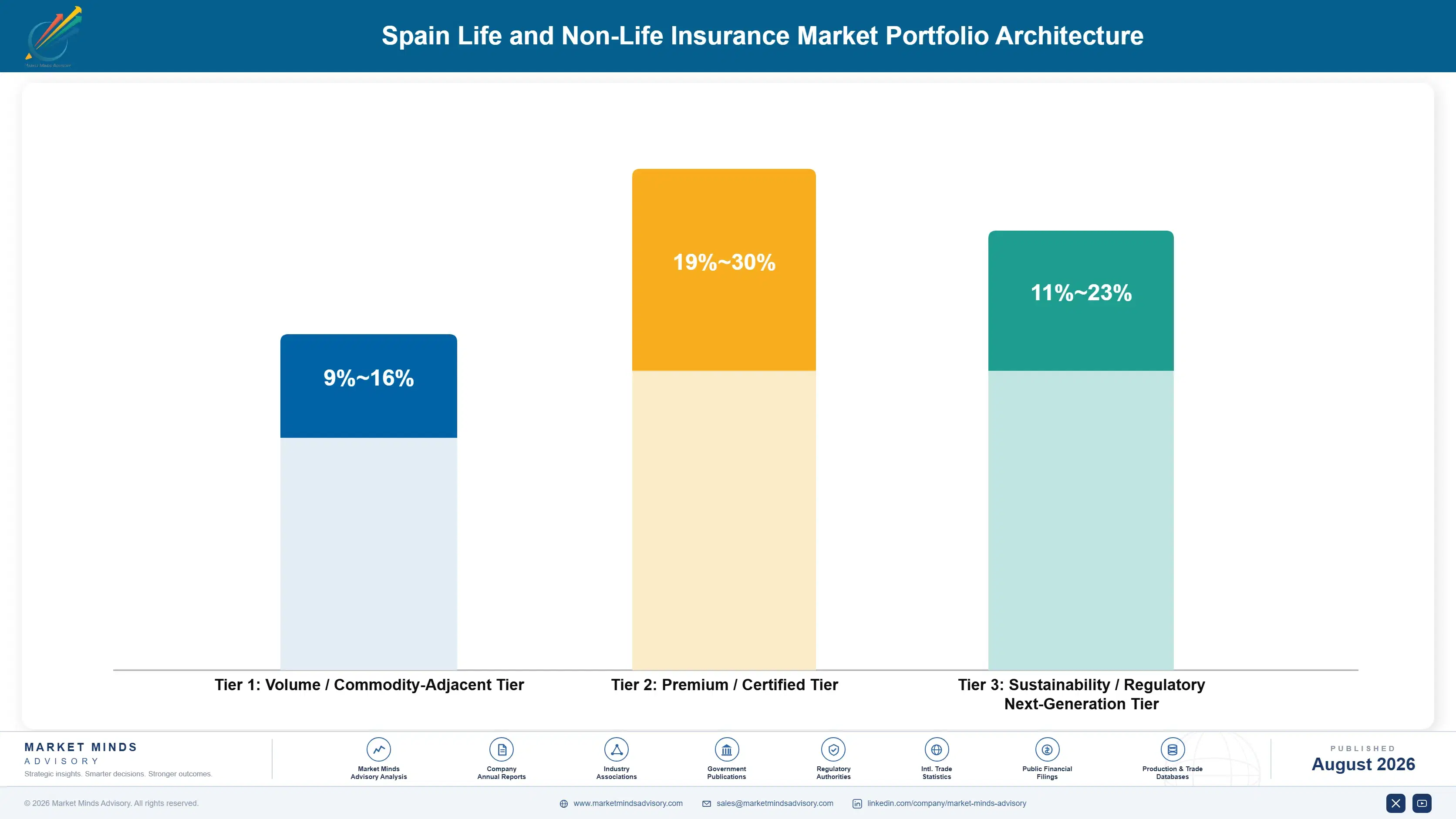
The portfolio splits into three tiers with meaningfully different margin economics. Volume standard protection life and property casualty coverage, sold through commodity bancassurance and agent distribution, competes on price and partnership terms, earning modestly. Unit-linked and specialty commercial coverage earns substantially more because investment structures and underwriting expertise insulate margin from open competition. Emerging cyber and digital-native product lines sit in a third tier carrying strong margins as early technology positioning drives durable advantage.
The tension runs between volume and product sophistication. Standard protection coverage generates the policy volume that keeps bancassurance partnerships attractive to bank distribution partners, but margin stays thin since commission structures compress underwriting economics regardless of claims performance. Unit-linked and specialty products carry the opposite constraint: strong margins but requiring sustained actuarial and asset management investment that smaller insurers often cannot sustain.

High-value margin pools concentrate wherever product sophistication meets distribution scale, which is precisely why specialty and unit-linked insurers have historically outearned standard protection competitors despite serving overlapping customer populations. Unit-linked life coverage carries the most immediate upside right now, driven by genuine rate normalization rather than organic demand growth alone.

Volume / Commodity-Adjacent Tier

Standard protection life and property casualty coverage sold through commodity bancassurance and agent distribution partnerships, competing primarily on partnership terms and commission rates against a crowded field of insurers. The range reflects varying commission structures across different distribution partnership arrangements.
Gross Margin: 9-16%

Premium / Certified Tier

Unit-linked life and specialty commercial coverage requiring investment structuring and dedicated underwriting expertise, sold through direct relationships where sophistication insulates margin from open competition entirely. The wide range reflects investment structure maturity differences between established and newly developing product programs.
Gross Margin: 19-30%

Sustainability / Regulatory / Next-Generation Tier

Cyber liability and digital-native insurance products still working through underwriting model maturation before consistent, predictable returns become fully achievable across major developed markets. The wide range reflects regulatory approval timing variance across markets rather than a single underwriting weakness.
Gross Margin: 11-23%
life-non-life-insurance-market-in-spain-portfolio-architecture-1787915471324

High-value Sub-segments and Strategic Watch-out

Unit-Linked and Investment-Linked Life Insurance

The fastest-growing and highest-value segment, driven directly by rate normalization restoring product attractiveness. Allianz and Generali both draw early advantage from asset management depth, and margin expansion continues as fixed-income yields stabilize further. Insurers entering this segment later face meaningfully steeper asset management and distribution barriers.
Gross Margin: 19-30%

Specialty Commercial and Cyber Liability Insurance

Strong margins on specialized underwriting expertise, growing steadily as digital business exposure expands globally. Growth trails unit-linked because specialty commercial demand growth moves more gradually than the acute rate-driven transformation forcing faster movement elsewhere. Actuarial investment here compounds into durable pricing advantage over less sophisticated generalist competitors.
Gross Margin: 16-26%

Standard Protection Life and Property Coverage

The volume core of the category, generating the bulk of policy count at stable, moderate margins. Allianz, AXA, and Zurich compete intensely here on distribution reach, and while policy growth stays healthy, margin expansion is limited. Distribution partnership depth increasingly determines who captures volume in this segment.
Gross Margin: 9-16%

Bancassurance-Commission-Dependent Commodity Business

The strategic watch-out. Distribution commission inflation and bank partnership consolidation threaten margin sustainability for insurers without differentiated products or direct channel capability, facing rising acquisition cost and margin compression as bank bargaining power increases across the category. Insurers without product differentiation face the steepest margin erosion in this tier.
Gross Margin: 0-15%

Renewal Economics And Bancassurance Loyalty

Life and non-life insurance runs on renewal and long-duration policy economics, and retention is the single biggest lever on lifetime policy value across both product categories. A policy renewed for a decade costs an insurer far less to service than repeated first-year acquisitions, since acquisition cost concentrates almost entirely in the first sale and underwriting stage. Bancassurance relationships convert what could be discretionary purchases into ongoing relationships anchored in existing banking trust.
Stickiness varies sharply across product type and distribution channel. Unit-linked life customers show meaningful engagement given the investment relationship and periodic performance reporting that creates switching friction beyond price alone, while standard bancassurance-acquired customers show comparatively deeper loyalty tied to the underlying banking relationship itself. Specialty commercial customers run deepest of all, anchored in multi-year underwriting relationships and claims-handling continuity that individual retail customers never develop.

Younger policyholders increasingly expect digital servicing and transparent pricing as a default rather than a novel feature, a marked shift from buyer expectations even a decade ago. This generational shift favors insurers with mature digital infrastructure already built, while insurers still running legacy underwriting and service models face a widening gap with each new cohort of policyholders entering the market.
life-non-life-insurance-market-in-spain-end-use-penetration-index-1787915471812

How Insurers Should Compete Next

These are among the four positions where our research anticipates prominent divergence between winners and laggards over the coming forecast period. Each is grounded in the demand model, the regulatory perimeter, and the announced capacity pipeline.
01 / BANCASSURANCE PARTNERSHIP DEPTH

Deepen bank distribution partnerships beyond mortgage-linked products

Bancassurance partnerships are proving to be the single most powerful distribution channel life and non-life insurance has ever had, converting existing banking trust into policy attach at a rate standalone agent marketing cannot approach. Insurers securing exclusive or preferred bank partnerships now will lock in volume advantages that later entrants attempting to negotiate similar arrangements will find considerably harder to replicate. Waiting for competitive pressure to force the move means starting from a materially weaker negotiating position against already-committed bank partners.
02 / DIGITAL UNDERWRITING INVESTMENT

Build proprietary automated underwriting before technology gaps compound

Digital underwriting has already proven its considerable value well beyond initial pilot programs, and insurers still relying primarily on manual review are leaving both accuracy and cost gains on the table for faster-moving competitors to capture instead. The insurers that build proprietary automation capability first will price risk and issue policies faster than competitors relying on legacy underwriting infrastructure. That precision advantage compounds every additional renewal cycle it goes unmatched, widening the competitive gap between leaders and laggards even further.
03 / SPECIALTY PRODUCT EXPANSION

Expand cyber and specialty commercial underwriting capability meaningfully

Specialty commercial and cyber liability coverage represents genuine incremental margin opportunity for insurers willing to invest in dedicated underwriting expertise that generalist commercial products were never originally designed to provide adequately at scale. Insurers building this capability now will capture business that generalist competitors decline or systematically mispriced entirely, establishing a durable position before many more competitors enter this still-developing category. This expansion rewards patience and sustained actuarial investment considerably more than it ever rewards pure speed to market alone.
04 / CATASTROPHE RISK MANAGEMENT

Invest in advanced catastrophe modeling before claims severity accelerates

Climate-driven catastrophe risk is clearly not a temporary underwriting cycle, and insurers still pricing property risk using historical loss averages are systematically underpricing exposure that will only become more expensive as claims severity trends continue their current trajectory. Insurers investing in advanced modeling capability now will price risk considerably more accurately than competitors relying on outdated actuarial assumptions built for a different climate environment entirely. This precision advantage compounds with every single underwriting cycle that competitors go unmatched and unprepared.

Engagement Snapshot From the Field

A live engagement with an industry participant carrying material or product regulatory and market exposure ahead of a defining policy shift, showing how our research translates into a defensible multi-year portfolio strategy.
MARKET MINDS ADVISORY · CLIENT ENGAGEMENT SUMMARY
Spain Life and Non-Life Insurance Producer Strategic Portfolio Review and Transition Roadmap 2026·Investment Scenario on Spain Life and Non-Life Insurance Exposure Evaluation 2025-26
CLIENT PROFILE
A mid-sized Southern European life and non-life insurer with an established agent network but limited bancassurance distribution presence. The client had observed regional competitors capturing significant volume through deepened bank partnerships and wanted an independent assessment of expansion feasibility before committing meaningful capital. Leadership sought clarity on the investment case ahead of the next planning cycle.
STRATEGIC CHALLENGE
The client needed to determine whether pursuing dedicated bancassurance partnership expansion was commercially justified given the multi-year relationship-building investment required, or whether a narrower pilot partnership offered a faster, lower-risk path to testing this fast-growing distribution channel. Timing mattered given how quickly established regional competitors were expanding their own bank partnerships and locking in exclusivity.
MMA APPROACH
MMA benchmarked bancassurance partnership economics against comparable regional insurers, modeled margin outcomes under full expansion versus pilot partnership scenarios, and assessed competitive positioning against Mapfre's established bank distribution presence over a multi-week engagement involving stakeholder interviews and financial modeling. Findings were presented directly to the client's executive leadership team for a final go-forward decision.
KEY FINDINGS
  1. Full bancassurance partnership development timelines averaged 20 to 28 months from initial negotiation to full operational integration across comparable insurers (client-reported, unverified by MMA).
  2. Pilot partnership arrangements reportedly captured roughly 50% of full-partnership margin at only about one-third the upfront relationship investment required overall (client-reported, unverified by MMA).
  3. Digital underwriting integration gaps represented the most significant capability barrier identified during the assessment across most partnership scenarios (client-reported, unverified by MMA).
  4. Modeling indicated pilot partnership entry could reach positive contribution margin within 9 to 12 months versus 30 months or more for full expansion (client-reported, unverified by MMA).
CLIENT PROFILE
A mid-sized Southern European life and non-life insurer with an established agent network but limited bancassurance distribution presence. The client had observed regional competitors capturing significant volume through deepened bank partnerships and wanted an independent assessment of expansion feasibility before committing meaningful capital. Leadership sought clarity on the investment case ahead of the next planning cycle.
STRATEGIC CHALLENGE
The client needed to determine whether pursuing dedicated bancassurance partnership expansion was commercially justified given the multi-year relationship-building investment required, or whether a narrower pilot partnership offered a faster, lower-risk path to testing this fast-growing distribution channel. Timing mattered given how quickly established regional competitors were expanding their own bank partnerships and locking in exclusivity.
MMA APPROACH
MMA benchmarked bancassurance partnership economics against comparable regional insurers, modeled margin outcomes under full expansion versus pilot partnership scenarios, and assessed competitive positioning against Mapfre's established bank distribution presence over a multi-week engagement involving stakeholder interviews and financial modeling. Findings were presented directly to the client's executive leadership team for a final go-forward decision.
KEY FINDINGS
  1. Full bancassurance partnership development timelines averaged 20 to 28 months from initial negotiation to full operational integration across comparable insurers (client-reported, unverified by MMA).
  2. Pilot partnership arrangements reportedly captured roughly 50% of full-partnership margin at only about one-third the upfront relationship investment required overall (client-reported, unverified by MMA).
  3. Digital underwriting integration gaps represented the most significant capability barrier identified during the assessment across most partnership scenarios (client-reported, unverified by MMA).
  4. Modeling indicated pilot partnership entry could reach positive contribution margin within 9 to 12 months versus 30 months or more for full expansion (client-reported, unverified by MMA).
RECOMMENDED STRATEGY
Phase 1: Phase one: pursue a pilot bancassurance partnership with a single regional bank to test distribution economics with minimal upfront investment required. Phase 2: Phase two: build digital underwriting integration capability gradually, prioritizing product categories showing strongest early pilot partnership volume performance. This phased approach limits capital exposure while building genuine internal expertise. Phase 3: Phase three: evaluate full bancassurance expansion once pilot volume and margin data justify the larger relationship investment required for scale.
OUTCOME
The client proceeded with a pilot bancassurance partnership rather than pursuing full expansion immediately. Early volume through the pilot channel reportedly exceeded initial projections within the first two quarters, and the client has since begun evaluating expansion to additional regional bank partners (client-reported, unverified by MMA).

Frequently Asked Questions

Foundational context covering the market sizes, CAGR, scope, country, region and competition that inform every finding below. This section is provided to cover basics and most often pre-purchase conversations, answered from the MMA Primary Research Dataset.

What is the current size of the Spain Life and Non-Life Insurance Market?

The Spain Life and Non-Life Insurance Market reached an estimated $6,800.0 billion globally in 2025. This figure reflects total gross written premium across life, health, and property casualty coverage segments.

How large will the Spain Life and Non-Life Insurance Market be by 2036?

MMA projects the market will reach approximately $10,919.8 billion by 2036, an expansion of roughly 1.54 times its 2026 base level over the decade-long forecast window.

What is the CAGR for the Spain Life and Non-Life Insurance Market 2026 to 2036?

The base case CAGR is 4.4% annually, with a bull scenario near 5.6% and a bear scenario near 3.2% depending on interest rate and claims trends.

Which segment is growing fastest?

Unit-Linked and Investment-Linked Life Insurance leads at a 7.8% CAGR, roughly 1.77 times the overall market growth rate, driven by rate normalization restoring product attractiveness broadly.

Who are the major companies in the Spain Life and Non-Life Insurance Market?

Leading participants include Allianz SE, AXA S.A., Zurich Insurance Group, Generali, and Mapfre. Combined market concentration among these top five insurers sits at roughly 46% overall.

Which country is growing fastest?

India leads country-level growth at a 10.4% CAGR, reflecting an expanding middle class and rising financial literacy pulling previously uninsured consumers into formal coverage nationally.

Report Segmentation Architecture

The full report scope spans multiple orthogonal segmentation dimensions, with cross-tabulated demand data provided for each dimension pair. Coverage extends further to regional breakdowns, trend trajectories, and the competitive detail needed to support segment-level decision-making.

By Primary Market Dimension

  • Unit-Linked and Investment-Linked Life Insurance
  • Traditional Protection Life Insurance
  • Property and Casualty Insurance
  • Specialty Commercial and Cyber Liability Insurance
  • Health Insurance

By End-Use Industry

  • Individual Retail Policyholders
  • Small and Medium Enterprises
  • Large Corporate and Commercial Clients
  • Financial Institutions and Bank Partners

By Commercial Dimension

  • Bancassurance Distribution
  • Direct-to-Consumer Digital Distribution
  • Broker and Agent Distribution
  • Group and Employer-Sponsored Distribution

By Region

  • North America
  • Western Europe
  • East Asia
  • South Asia and Pacific
  • Latin America
  • Middle East and Africa
  • Eastern Europe

Scope, Methodology, and Coverage

Every figure in this report is reproducible from documented input assumptions. The scope below maps the historical period, the forecast horizon, the segmentation dimensions, and the countries covered, alongside the underlying primary and qualitative methodology.
Historical Period
2020 to 2025
Forecast Period
2026 to 2036
Base Year
2025 (USD billions; MMA Primary Research Dataset, August 2026)
Market Definition
This report covers gross written premium across life, health, property, casualty, and specialty non-life insurance lines sold to individual and commercial policyholders globally. It excludes standalone reinsurance treaties, employee benefits administration services, and non-insurance wealth management products distributed through the same channels.
Quantitative Units
USD billions
Segmentation Dimensions
Regions Covered
North America, Western Europe, East Asia, South Asia and Pacific, Latin America, Middle East and Africa, Eastern Europe
Countries Covered
Key Companies Profiled
Allianz SE, AXA S.A., Zurich Insurance Group, Generali, Mapfre, Prudential plc, Legal and General Group, Aviva plc, CNP Assurances, CaixaBank Insurance, Credit Agricole Assurances, Munich Re, Swiss Re, Ping An Insurance, China Life Insurance, MetLife, Prudential Financial, Manulife Financial, LIC of India, ICICI Prudential Life Insurance
Quantitative Methodology
Primary survey, n=3,800 respondents, Q4 2025, six countries; demand-side model with trade association cross-validation
Qualitative Methodology
47 expert interviews, Q4 2025; applied to validate demand model assumptions, identify emerging dynamics, and assess competitive positioning
Report Format
PDF and XLSX data workbook (Word format preview document)
Publisher
Market Minds Advisory
Report Code
MMA-2026-TEC-209
Published
August 2026
Contact
sales@marketmindsadvisory.com | www.marketmindsadvisory.com

Purchase the full Spain Life and Non-Life Insurance Market Report (2026 to 2036).

This report delivers a complete assessment of the Spain Life and Non-Life Insurance Market, covering market sizing, segmentation, regional dynamics, and competitive positioning through 2036. It examines how bancassurance channel consolidation and digital underwriting adoption are reshaping distribution and underwriting economics across the category. The analysis draws on primary survey data, expert interviews, and company disclosures to quantify segment-level growth and margin dynamics. Readers gain a data-grounded view of where competitive advantage is shifting and which strategic moves matter most over the coming decade. It also assesses how India's expanding middle class is reshaping global growth dynamics.
Ten-year market sizing and CAGR forecast
Segment-level growth and margin economics analysis
Regional demand mechanism and driver breakdown
Competitive landscape and moat durability assessment
Claims and distribution commission cost review
Strategic verdict and revenue lever guidance

Built For The People Who Decide

From boardroom strategy to bench-side execution, this report is read cover-to-cover by leaders shaping the next decade of their industry, turning demand scenarios, market dynamics and valuation benchmarks into decisions.
CXOs/ Presidents/ VPs/ Managers
M&A and Corporate Development
Strategy Teams and R&D Heads
Procurement and Product Directors
Regulatory and Compliance Leaders
Investor Relations and Equity Analysts