

Market Minds Advisory
Lidding Film Market in United States

Lidding Film Market in United States: Seal Integrity, Peel Force and the Recyclability Problem Nobody Has Solved

A lidding film has to seal hermetically at 140 degrees and then peel open cleanly in a consumer's hand, and every attempt to make it recyclable has so far compromised one of those two things.

Lead Analyst

Bilal Shaikh

Published

September 2026

Make Smarter Decisions with Customized Research Insights

Request a free sample report and evaluate market opportunities, growth trends, and competitive dynamics relevant to your business needs.

2025 MARKET VALUE$2.4BMarket Size 2025
2036 FORECAST VALUE$4.7BBase Case , 2026 to 2036
CAGR 2026 TO 20366.4 %Bull 7.6% / Bear 5.2%
INCREMENTAL OPPORTUNITY$2.1BNet 10- year value creation
EXPANSION MULTIPLE1.86x2036 value over 2026 base
Strategic Levers
M&A Pipeline
Regional Outlook
Country Rankings
Competitive Intelligence
Segmental Deep-dive
Call-Us : 91 93563 13602

Executive Snapshot and Market Trajectory

A lidding film does two contradictory things. It must fuse to a tray rim tightly enough to hold a modified atmosphere for weeks, then release under a consumer's thumb without tearing, delaminating or leaving fibre behind on the flange. Those two demands pull in opposite directions.
Mono-material recyclable lidding films compound at 9.6%, exactly 1.50 times the market, on state packaging rules rather than on any performance advantage. They generally seal and peel worse than the multilayer structures they replace. Fresh protein and prepared meals dominate volume, and resin runs near 58% of converter cost, so polymer pricing drives everything downstream. Requalification takes fourteen weeks, which is why conversions run slowly.
Five converters hold 52% of the United States market. Seal performance qualification with tray suppliers and food processors is what holds those positions, since changing lidding film means requalifying the whole pack on equipment nobody wants to stop. Mono-material penetration sits at 19%, so most of the redesign still lies ahead, and state fee schedules set the timetable. Coated fibre is taking the short shelf life applications, which brands prefer for the recycling message.
Market Definition
The market covers flexible films sealed to rigid or semi-rigid trays, cups and containers as a closure, spanning peelable multilayer barrier lidding, weld-seal non-peelable lidding, mono-material recyclable lidding, paper-based and fibre lidding, anti-fog and specialty functional lidding, and thermoformable die-cut lid stock. Rigid injection-moulded lids, induction seal liners, flexible pouch films, and the trays and containers themselves are excluded.
Base Year Value
$2.4B in 2025 (MMA Primary Research Dataset, August 2026)
Forecast Period
2026 to 2036, eleven discrete annual values
CAGR
6.4% base case. Bull 7.6%. Bear 5.2%.
Fastest Growth Segment
Mono-Material Recyclable Lidding Films: 9.6% CAGR
Fastest Growth Country
United States: 6.4% CAGR
Fastest Growth Region
South Asia and Pacific: 8.4% CAGR
Largest Region
North America: 68% of 2025 global value
Market Leaders
Amcor, Sealed Air, Berry Global, ProAmpac, Winpak. Source: MMA Analysis based on company annual reports.
Primary Survey
n=3,800 procurement and R&D decision-makers, Q4 2025, six countries
Methodology
Demand-side build-up, cross-validated against public data, 47 expert interviews

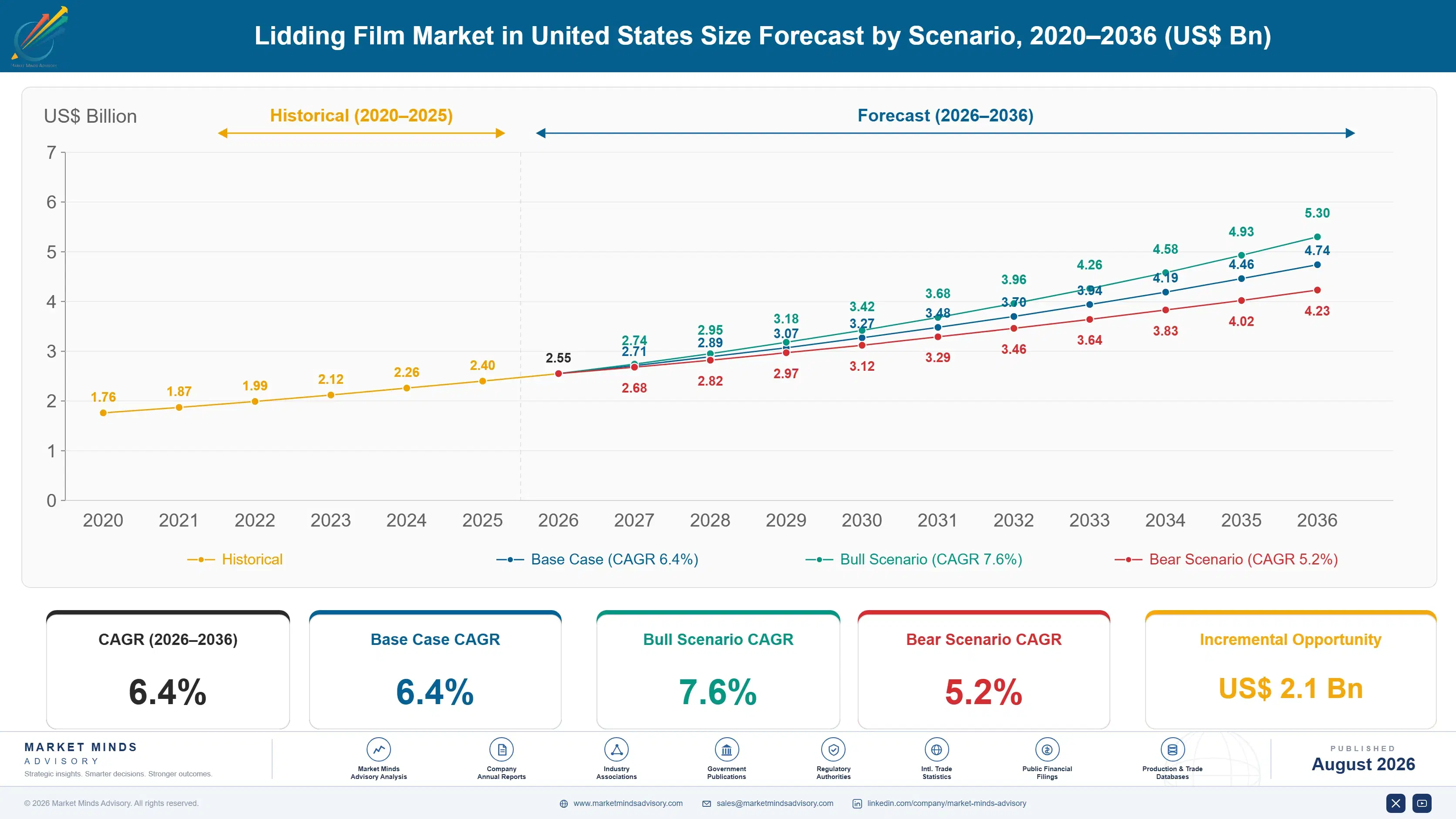
Lidding Film Market Forecast Scenarios

lidding-film-market-in-united-states-size-forecast-scenario-1787308549839
Growth ran at an implied 5.2% across 2020 to 2025 and prepared meals carried most of it. Retail meal solutions expanded rapidly through the pandemic period and did not retreat afterwards, while fresh protein case-ready conversion continued steadily. Resin pricing swung hard through 2021 and 2022, and converters passed it through late and incompletely. Mono-material adoption began late in the period and remains small.
The base case at 6.4% rests on three mechanisms. Prepared meal and fresh protein volumes keep growing as retail shifts further toward ready-to-heat formats. State extended producer responsibility rules keep pushing structures toward recyclable mono-material designs. And case-ready protein conversion continues to displace in-store butchery across grocery chains that have already committed to the change. Mono-material structures compound at 9.6% against a market at 6.4%, and coated fibre takes further share in short shelf life applications.
The bull case at 7.6% assumes mono-material seal performance closes the gap with multilayer and adoption accelerates ahead of regulatory deadlines rather than trailing them. The bear case at 5.2% follows from prepared meal category growth slowing as consumers return to scratch cooking, combined with recyclability rules being deferred repeatedly in the states currently setting the pace.

Sealing Tight and Peeling Clean

Lidding film has to satisfy two requirements that pull against each other. The seal must be hermetic enough to hold a modified atmosphere for a stated shelf life, surviving distribution, stacking and temperature change. Then it must peel open at around 4.5 newtons, cleanly, in the hand of somebody who may be 80 years old and standing at a kitchen counter.
TOP FIVE CONCENTRATION52%Combined share held by the five largest United States converters
TARGET PEEL FORCE4.5 newtonsOpening resistance balancing seal security against consumer accessibility
RESIN COST SHARE58% of COGSPolymer as a proportion of the converter cost base
SEAL TEMPERATURE140 degrees CelsiusTypical sealing condition on high-speed tray sealing equipment
REQUALIFICATION DURATION14 weeksTime to validate a film change across pack and line
MONO-MATERIAL PENETRATION19%Share of volume currently in recyclable single-polymer structures
Multilayer structures solved that decades ago by giving each function its own layer: a sealant tuned to the tray resin, a barrier layer, and a print and strength web above. The layers are different polymers, which is precisely why the film is not recyclable, and which is why the whole category is now being asked to redesign around a constraint it was built to avoid.
Mono-material structures compound at 9.6% and currently hold 19% of volume. Honest assessment is that most of them seal in a narrower process window and peel less cleanly than what they replace, particularly on filled lines running at speed. Converters who have closed that gap on specific tray resins hold positions competitors cannot price against, since requalification takes around 14 weeks nobody wants to spend.
"The recyclable film works beautifully in the lab and then you put grease on the flange at line speed and it doesn't. Every processor who has switched has a story about the first three weeks."
Director, Flexible Packaging and Barrier Films Practice · MMA Flexible Packaging

Market Trends

State Packaging Rules Force Mono-Material Redesign

Extended producer responsibility legislation in California, Colorado, Maine, Oregon and Minnesota puts fee structures and recyclability requirements onto packaging that multilayer lidding cannot satisfy, and national brands will not run separate structures by state. That makes the strictest state the effective national specification. Mono-material polyethylene and polypropylene lidding compounds at 9.6% against a market at 6.4% as a direct result, and adoption is running ahead of what seal performance alone would justify. Penetration sits at 19% today, so most of the conversion work is still ahead of the processors facing it.
Market Impact: Peel force targeted at 4.5 newtons

Case-Ready Protein Conversion Continues Across Grocery

Grocery chains keep moving protein from in-store butchery to centrally packed case-ready trays, which converts a service counter operation into a lidding film requirement. The packs demand high barrier performance and reliable seal integrity because shelf life claims depend on the modified atmosphere holding through distribution. Beef and poultry account for the largest volumes. This conversion is a decade old and still incomplete, which gives it several more years of demand growth independent of any change in protein consumption. Barrier requirements here are the hardest to satisfy with any recyclable structure currently available.
Market Impact: Requalification consuming 14 weeks

Market Opportunities and Growth Drivers

Prepared Meal Formats Keep Displacing Scratch Cooking

Retail prepared meals, ready-to-heat trays and refrigerated meal kits have grown steadily as households buy preparation rather than performing it, and almost every one of those formats uses a sealed tray with a peelable lidding film. The pack has to survive microwave or oven heating in many cases, which adds thermal performance requirements on top of barrier and peel. Prepared meals now represent the largest single application by area, ahead of fresh protein, and the category shows no sign of retreating. Microwaveable trays add a constraint, since the film must survive heating without shrinking away from the flange.
Market Impact: Rejects rising 3 percentage points

Requalification Cost Locks In Incumbent Converters

Changing lidding film requires revalidating seal integrity, shelf life, peel performance and line speed across the whole pack, which takes around 14 weeks and occupies production time nobody has spare. Processors therefore change film reluctantly and only for a clear reason. That protects incumbents strongly, and it means the moment a structure changes for regulatory reasons is the only realistic window for a competitor to enter. Converters who understand that timing win accounts that price alone would never move. State compliance deadlines are the only reliable trigger. Nothing else opens the account.
Market Impact: Resin at 58% of COGS

Market Restraints and Challenges

Mono-Material Structures Seal in a Narrower Window

Recyclable single-polymer lidding generally tolerates less variation in seal temperature, pressure and dwell than the multilayer structures it replaces, and contamination on the tray flange defeats it faster. The root cause is that one polymer must now serve sealant, barrier and strength functions that were previously separated. Commercially it means more rejects and slower lines. Converters mitigate with modified sealant layers, peelable coatings and tray resin matching, and processors mitigate by upgrading flange cleaning before the film change rather than after it. Waste rates run above multilayer throughout qualification. The learning curve is real and costed.
Market Impact: Penetration rising past 19% share

Resin Volatility Passes Through Late and Incompletely

Polymer accounts for around 58% of converter cost of goods and moves faster than lidding film contracts allow, so converters absorb the difference through the lag. The root cause is that food processors negotiate annually while resin repricies monthly. Converters mitigate with index-linked contracts tied to published resin references, with clauses that reset quarterly rather than annually, and by holding structures that can switch between polymer grades without triggering the full requalification cycle. Quarterly resets cut exposure from twelve months to three. Processors resist the mechanism until a supplier withdraws mid-term.
Market Impact: Shelf life claims spanning 21 days
3 additional market trends, 4 additional growth drivers, and 2 additional restraints and challenges are covered in the full report. Contact sales@marketmindsadvisory.com to access the complete intelligence.

Segment CAGR and Growth Architecture

Segmentation follows film structure and seal behaviour, because those two attributes decide the barrier available, the peel characteristic delivered and whether the pack can claim recyclability at all. A processor choosing between multilayer and mono-material is trading proven process latitude against a regulatory position. Six structure classes sit here, separated by how the film is built and how it releases.
lidding-film-market-in-united-states-market-share-analysis-1787308550428

Mono-Material Recyclable Lidding Films

Mono-material lidding compounds at 9.6%, exactly 1.50 times the market, on state extended producer responsibility rules rather than on performance. Single-polymer polyethylene and polypropylene structures enter existing recycling streams where multilayer laminates cannot, which is the entire commercial argument. What they give up is process latitude: one polymer must serve sealant, barrier and strength functions that were previously separated by layer, so the seal window narrows and flange contamination causes failures that multilayer film tolerated. Barrier performance generally requires coating or a high-barrier grade that adds cost. Converters who have solved seal reliability against specific tray resins at production line speeds hold positions that competitors cannot displace on price, because requalification costs the processor 14 weeks.
CAGR 9.6%

Paper-Based and Fibre Lidding

Paper-based lidding grows at 8.2% where the recyclability argument favours fibre and where barrier requirements are modest enough to permit it. Coated paper with a thin sealant layer satisfies kerbside fibre recycling in most United States municipalities, which is a cleaner consumer message than mono-material plastic delivers, and brands use it accordingly. The limits are real: barrier performance is well below film, moisture resistance is a genuine problem with wet products, and the material tears rather than peeling cleanly on some tray geometries. Dry goods, produce and short shelf life prepared items are where it works. Attempts to push it into fresh protein have mostly failed on barrier. Barrier is where those attempts stop.
CAGR 8.2%
Full segment breakdown across 6 segments available in the complete report.

Regional Architecture and Country Demand Map

Although the market is defined as the United States, regional shares below describe where the packed food is produced and consumed domestically, split across the seven standard regions by the geography of that food production and its export destinations. Domestic consumption dominates by a wide margin.

North America

North America accounts for 68% of the demand described here. Note: this is far outside the standard band because the market is defined as United States lidding film, and the great majority of that film seals food produced, packed and consumed domestically rather than exported anywhere. Case-ready protein conversion across grocery chains and prepared meal growth in retail are the two largest applications. State extended producer responsibility rules in California, Oregon, Colorado, Maine and Minnesota set the effective national structure specification, since national brands will not run different films by state. Canadian and Mexican packed food moving into United States retail adds the remainder of the regional figure. Domestic volume dwarfs every export route combined.
Share: 68% | CAGR: 6.4% (2026 to 2036)

East Asia

East Asia represents 9% of the demand described. Note: this reflects United States lidding film sealing food destined for Asian export markets, principally protein and prepared products, rather than any film consumed in the region itself. Japanese and Korean import specifications for United States beef and pork are stringent on barrier and shelf life, since transit adds substantially to the required claim duration. Chinese import volumes fluctuate with trade conditions and with domestic protein supply. Export packs typically require higher barrier construction than domestic retail equivalents, which shifts the mix toward multilayer structures the recyclability rules have not yet reached. Recyclability requirements have not yet reached these export routes, which leaves multilayer construction dominant there.
Share: 9% | CAGR: 7.2% (2026 to 2036)
Regional intelligence for 5 additional markets available in the complete report: Western Europe, South Asia and Pacific, Latin America, Middle East and Africa, Eastern Europe. Contact sales@marketmindsadvisory.com.
lidding-film-market-in-united-states-country-cagr-analysis-1787308550950

Winning Inside the Requalification Window

Lidding film accounts change hands rarely because requalification costs a processor fourteen weeks of validation work. Every position worth holding here is about being present when that window opens, or about making it open. Four qualify, and none of them is a pricing move. Two are technical and two turn on timing and contract structure.

Solve Mono-Material Sealing Against Specific Tray Resins

Recyclable lidding fails on process latitude rather than on barrier, and the failure is specific to the tray resin, flange geometry and contamination present on a given line. Converters who characterise seal performance against a processor's actual trays at production speed, rather than in a laboratory, solve the problem competitors describe. Mono-material compounds at 9.6% and penetration is only 19%, so most of the conversions have not happened yet. Those solved early become the reference structure for every subsequent line at that processor. Nobody displaces a reference structure on price.
Market Impact: Mono-material penetration still at

Time Approaches to Regulatory Structure Changes

Requalification takes roughly 14 weeks and processors avoid it, which locks incumbents in place until something forces a change. State extended producer responsibility deadlines force exactly that, and they are published years in advance. Converters who map which processors face which deadlines, and approach twelve months ahead with a qualified structure, enter accounts that no price argument could open. Everyone else arrives after the incumbent has already run the trials and secured the position for another decade. Deadlines are published years ahead and almost nobody maps them. The window closes as soon as the incumbent qualifies.
Market Impact: Requalification consuming 14 full w

Index Resin Pass-Through to Quarterly Reset Clauses

Polymer runs near 58% of converter cost and reprices monthly while lidding contracts are negotiated annually, which means converters fund the difference through every upward cycle. Index-linked pricing tied to published resin references with quarterly resets moves that exposure to the party better able to carry it. Processors resist until a supplier fails or withdraws mid-contract, and the argument becomes considerably easier afterward. Converters who hold the mechanism through a full cycle protect margin their competitors simply lose. Resin moves monthly and contracts move annually. That mismatch is the whole problem in one sentence.
Market Impact: Resin sitting at 58% of total conve

Build Fibre Lidding Capability for Modest Barrier Applications

Paper-based lidding grows at 8.2% and delivers a cleaner recyclability message than mono-material plastic, which brands value for reasons unrelated to actual recovery rates. It works only where barrier requirements are modest, which covers dry goods, produce and short shelf life prepared items rather than fresh protein. Converters holding both coated fibre and film capability can answer a brand's recyclability question with the right material rather than the only one they make, and that conversation reaches marketing budgets. It also protects credibility when a brand asks for something the material cannot do.
Market Impact: Fibre lidding now compounding at 8.

Who Controls the Margin Pool

Five converters hold 52% of the United States market measured on lidding film revenue, the basis applied throughout this section. Amcor and Sealed Air lead on structure development capability and on qualification depth with the largest food processors, and the gap to the challenger group is narrow on standard multilayer work and considerably wider on mono-material seal engineering.
Competition runs on three dimensions. Seal performance qualification against specific tray resins and line conditions decides who can actually deliver a recyclable structure that runs. Barrier capability decides participation in fresh protein and export work. And resin procurement scale decides who survives a volatile polymer cycle with margin intact. Equipment relationships with tray sealing suppliers cut across all three.

Two pressures are moving position. State recyclability deadlines are opening requalification windows that have been closed for a decade, which is the first real opportunity for challengers in years. Meanwhile fibre lidding brings paper converters into a category they never served. Rankings will shift toward converters holding both film and coated fibre capability. Converters arriving at a requalification window with a validated structure rather than a proposal will take positions that have not moved in a decade.
lidding-film-market-in-united-states-company-positioning-matrix-1787308551471

Competitive Moat and Risk Dimensions

AMCOR

Moat: Mono-material structure development

Amcor has invested heavily in recyclable film structure development and holds qualified mono-material lidding across a wider range of tray resins and seal conditions than most competitors can demonstrate. As state rules force conversions, the converter with an already-validated structure enters the requalification window with an answer while others arrive with a development proposal.
AMCOR

Risk: Coated fibre lidding capability

Paper-based lidding grows at 8.2% and delivers a recyclability message brands prefer, but it requires coated fibre converting rather than film extrusion and lamination. Paper converters entering the category hold that capability natively, and a film-centred producer must acquire or build it against competitors for whom it is core.
SEALED AIR

Moat: Protein barrier and equipment

Sealed Air combines high barrier film capability with tray sealing equipment supply into fresh protein processors, which puts the company inside the line where seal performance is decided rather than outside it quoting film. In case-ready protein, where barrier and seal integrity carry shelf life claims, that combined position is difficult for a film-only supplier to attack.
SEALED AIR

Risk: Recyclable structure conversion pace

High barrier protein applications are the hardest to convert to mono-material, because single-polymer structures struggle to deliver the barrier those shelf life claims require. A position concentrated in exactly the segment where recyclable conversion is slowest looks secure now and becomes exposed if barrier grades close that gap faster than expected.

Players Tracked

Prominent Players

Amcor
Sealed Air
Berry Global
ProAmpac
Winpak

Other Key Players

Sonoco Products
Constantia Flexibles
Coveris
Mondi
Toray Plastics America
Bemis Healthcare Packaging
Printpack
TC Transcontinental Packaging
Glenroy
Charter Next Generation
American Packaging Corporation
Placon
Clondalkin Group
Uflex Americas
Bryce Corporation

Recent Developments

FEBRUARY 2025

State producer responsibility fee schedules published for flexible packaging

Extended producer responsibility programmes in several states published fee schedules that penalise non-recyclable flexible structures directly. These were regulatory implementation steps rather than commercial developments among converters, and they set the timetable that determines when processors must requalify. National brands responded by treating the strictest state as the effective specification.
Signal: A published fee schedule converts recyclab
JUNE 2025

Mono-material seal failures reported on high-speed protein lines

Food processors converting to recyclable lidding reported elevated seal failures on high-speed case-ready protein lines, traced to narrower process windows and flange contamination sensitivity. This reflects production experience across the processing base rather than any transaction between film suppliers. Several processors abandoned conversion projects on that evidence alone.
Signal: Laboratory seal performance and live line
OCTOBER 2025

Coated fibre lidding qualified for refrigerated prepared meal trays

Paper-based lidding with thin sealant coating passed qualification for short shelf life refrigerated prepared meals at several retail brands, entering applications previously served by film. This was a material qualification outcome rather than a corporate development between packaging companies. Barrier limits kept it out of protein applications entirely.
Signal: Fibre lidding takes the applications where

Polymer, Adhesive and Extrusion Energy

Polymer resin accounts for roughly 58% of converter cost of goods, dominated by polyethylene and polypropylene grades with barrier resins adding disproportionate cost in protein applications. Adhesives, inks and coatings contribute around 12%. Extrusion and lamination energy, converting labour and film waste make up the remainder, with waste rates on mono-material structures running above multilayer during the qualification period.
United States polyethylene and polypropylene pricing swung sharply through 2021 and 2022 on feedstock and production disruption, and lidding converters absorbed much of it because processor contracts reprice annually while resin moves monthly. Company annual reports across the flexible packaging groups disclose the resulting margin compression. Energy Information Administration data on natural gas and feedstock pricing documents the underlying movement through the same period. Barrier resins moved independently of commodity grades.

Exposure divides by contract structure rather than by scale. Converters holding index-linked agreements with quarterly resets pass movement through with a manageable lag. Those on annual fixed pricing fund the entire increase until renewal, which in a sharp cycle exceeds a year of segment profit. Barrier-heavy protein work carries additional exposure, since specialty barrier resins move independently of commodity polyethylene.
lidding-film-market-in-united-states-cost-volatility-analysis-1787308551666

Move processor contracts to quarterly index resets

Annual fixed pricing against monthly resin movement is the mechanism that removes converter margin in every upward cycle. Quarterly reset clauses tied to published resin references shorten the exposure from twelve months to three. Processors resist the change until a supplier withdraws mid-contract, after which the commercial conversation becomes considerably more straightforward to conduct.

Qualify structures across substitutable polymer grades

A structure tied to one specific resin grade leaves a converter exposed whenever that grade tightens or reprices independently. Qualifying two grades per structure during initial validation, rather than after a supply problem appears, avoids triggering the full fourteen week requalification cycle when a switch becomes necessary later on. Doing it later costs a full validation cycle.

Budget qualification waste into mono-material conversion pricing

Waste rates on recyclable structures run above multilayer through the qualification period as seal windows are characterised on live lines. Converters who price that learning curve into conversion projects rather than absorbing it protect margin on exactly the work that is growing fastest, and processors accept it once the reason is explained plainly. Absorbing it silently trains customers badly.

Portfolio Architecture for Margin Defence

The portfolio separates on barrier requirement and on recyclability claim. Weld-seal non-peelable lidding is straightforward converting sold on price. Peelable multilayer barrier film is the established core, carrying protein and prepared meals on proven performance. Mono-material recyclable structures add seal engineering difficulty. Coated fibre adds a different substrate discipline entirely, with its own converting equipment and its own limits. Anti-fog and specialty functional films sit alon
The tension runs between what performs and what complies. Multilayer film outperforms mono-material on seal window, barrier and line speed, and it is precisely what state fee schedules penalise. Converters cannot simply defend the better product, and they cannot abandon it either, since protein barrier requirements have no recyclable answer yet. Running both, and knowing honestly which applications can move, is the position that works.

High-value pools concentrate where the conversion is hard. Mono-material structures qualified against specific tray resins, high barrier protein film, and fibre lidding for modest barrier applications all qualify, and none is won on price per square metre. What they share is a customer who cannot switch quickly, which is why margin survives here at all.

Volume / Commodity-Adjacent Tier

Weld-seal non-peelable lidding and standard low-barrier peelable film for short shelf life applications. Sold on price per square metre against straightforward specifications that most flexible converters can meet without difficulty.
Gross Margin: 16-24%

Premium / Certified Tier

High barrier peelable multilayer lidding for case-ready protein and extended shelf life prepared meals. Barrier performance and seal reliability under line conditions qualify the supplier, and shelf life claims depend on both holding.
Gross Margin: 26-36%

Sustainability / Regulatory / Next-Generation Tier

Mono-material recyclable structures and coated fibre lidding responding to state producer responsibility rules. The wide margin range reflects the gap between qualified structures and development work still absorbing its own learning curve.
Gross Margin: 22-48%
lidding-film-market-in-united-states-portfolio-architecture-1787308552168

Locked In Until Something Forces Change

Demand here is annuity revenue in the strictest sense. A qualified lidding film runs on a processor line continuously against production volume, and reorders follow the food production schedule without any commercial process at all. The incumbent converter holds seal validation data, tray resin matching and line speed characterisation that a competitor would need fourteen weeks to reproduce, which makes the position unusually durable. Volumes are predictable to within a few percent.
Depth varies by barrier requirement and shelf life claim. Case-ready protein processors buy deepest and specify hardest, since a seal failure means a recall rather than a complaint. Prepared meal producers buy heavily with thermal performance requirements layered on. Produce and dry goods packers buy on cost with modest barrier demands. Export packers buy the highest barrier construction of any group.

The deciding population is shifting from operations toward sustainability and regulatory affairs. Lidding film was specified by packaging engineering against seal and shelf life performance. State fee schedules have brought compliance functions into the decision, and they weigh recyclability claims that engineering would rank behind process reliability every time. That shift is widening rather than settling, and it changes who a converter has to convince.
lidding-film-market-in-united-states-end-use-penetration-index-1787308552655

Where Lidding Converters Win

These are among the four positions where our research anticipates prominent divergence between winners and laggards over the coming forecast period. Each is grounded in the demand model, the regulatory perimeter, and the announced capacity pipeline.
01 / TRAY RESIN SEAL MATCHING

Laboratory seal data does not survive a greasy flange

Mono-material lidding fails on process latitude rather than barrier, and the failure is specific to tray resin, flange geometry and whatever contamination a live line produces. Converters who characterise seal performance on a processor's actual trays at production speed solve the problem competitors merely describe. Penetration sits at 19%, so most conversions have not happened, and whoever solves the first line becomes the reference structure for every line after it, and holds it for as long as that processor runs the line.
02 / REQUALIFICATION WINDOW TIMING

Accounts open once a decade and the date is published

Changing lidding film costs a processor roughly fourteen weeks of validation, which locks incumbents in place until a regulation forces the change. State producer responsibility deadlines force exactly that, and they are published years ahead of when they bite. Converters mapping which processors face which deadlines and arriving twelve months early with a qualified structure enter accounts that no pricing argument would ever open, because the incumbent has usually already run its trials by the time everyone else notices the date.
03 / RESIN PASS-THROUGH DISCIPLINE

Annual contracts against monthly resin is a losing structure

Polymer runs near 58% of converter cost and reprices monthly while processor contracts are negotiated annually, so converters fund every upward cycle out of their own margin. Quarterly index reset clauses cut that exposure from twelve months to three and move it to the party better able to hedge. Processors resist until a supplier withdraws mid-contract, and the discussion gets markedly easier after that happens once, which is a poor way to learn a lesson the contract could have prevented.
04 / SUBSTRATE PORTFOLIO HONESTY

Answer the recyclability question with the right material

Coated fibre lidding grows at 8.2% and carries a cleaner recovery message than mono-material plastic, but it fails on barrier and moisture in exactly the protein applications carrying the biggest volumes. Converters holding both film and coated fibre capability can tell a brand which applications can honestly move and which simply cannot be converted yet. That conversation reaches marketing and compliance budgets that packaging engineering never controlled, and honesty about the limits is what makes the recommendation credible at all.

Engagement Snapshot From the Field

A live engagement with an industry participant carrying material or product regulatory and market exposure ahead of a defining policy shift, showing how our research translates into a defensible multi-year portfolio strategy.
MARKET MINDS ADVISORY · CLIENT ENGAGEMENT SUMMARY
Lidding Film in United States Producer Strategic Portfolio Review and Transition Roadmap 2026·Investment Scenario on Lidding Film in United States Exposure Evaluation 2025-26
CLIENT PROFILE
A refrigerated prepared meals producer operating nine tray sealing lines across two plants and supplying four national grocery chains, with roughly USD 680 million in annual revenue (client-reported, unverified by MMA). All nine lines ran peelable multilayer barrier lidding qualified between 2016 and 2019, with no recyclable structure evaluated anywhere in the portfolio. Two retail customers had recyclability commitments with published dates.
STRATEGIC CHALLENGE
Two retail customers had committed to recyclable packaging targets with dates attached, and published state fee schedules made the existing structure progressively expensive. An initial mono-material trial on one line had produced seal failures at production speed and had been abandoned, which left the organisation believing conversion was not feasible.
MMA APPROACH
MMA characterised seal performance across all four tray resins in use, at production line speeds, with deliberately contaminated flanges representing realistic conditions. Candidate mono-material structures were tested against each resin, and the abandoned trial was reconstructed to identify why it had failed. Coated fibre alternatives were assessed against shelf life requirements for the shorter-dated products in the range.
KEY FINDINGS
  1. The abandoned trial had used one candidate structure across all four tray resins, sealing acceptably on two and failing consistently on the others, which had been read as general failure.
  2. Flange contamination during filling was the dominant failure mode, and the two failing tray resins had flange geometries that retained product residue where the other two shed it.
  3. Seal window width on the best candidate structure was 38% narrower than the incumbent multilayer, which was workable but required tighter temperature control than two of the nine lines could hold.
  4. Coated fibre lidding qualified acceptably on the three shortest shelf life products, covering roughly 22% of volume with a stronger recycling claim than any plastic option available.
CLIENT PROFILE
A refrigerated prepared meals producer operating nine tray sealing lines across two plants and supplying four national grocery chains, with roughly USD 680 million in annual revenue (client-reported, unverified by MMA). All nine lines ran peelable multilayer barrier lidding qualified between 2016 and 2019, with no recyclable structure evaluated anywhere in the portfolio. Two retail customers had recyclability commitments with published dates.
STRATEGIC CHALLENGE
Two retail customers had committed to recyclable packaging targets with dates attached, and published state fee schedules made the existing structure progressively expensive. An initial mono-material trial on one line had produced seal failures at production speed and had been abandoned, which left the organisation believing conversion was not feasible.
MMA APPROACH
MMA characterised seal performance across all four tray resins in use, at production line speeds, with deliberately contaminated flanges representing realistic conditions. Candidate mono-material structures were tested against each resin, and the abandoned trial was reconstructed to identify why it had failed. Coated fibre alternatives were assessed against shelf life requirements for the shorter-dated products in the range.
KEY FINDINGS
  1. The abandoned trial had used one candidate structure across all four tray resins, sealing acceptably on two and failing consistently on the others, which had been read as general failure.
  2. Flange contamination during filling was the dominant failure mode, and the two failing tray resins had flange geometries that retained product residue where the other two shed it.
  3. Seal window width on the best candidate structure was 38% narrower than the incumbent multilayer, which was workable but required tighter temperature control than two of the nine lines could hold.
  4. Coated fibre lidding qualified acceptably on the three shortest shelf life products, covering roughly 22% of volume with a stronger recycling claim than any plastic option available.
RECOMMENDED STRATEGY
Phase 1: Phase 1 (months 1 to 5): Convert the four lines running compatible tray resins to the qualified mono-material structure and confirm seal performance in production. Phase 2: Phase 2 (months 5 to 13): Move short shelf life products to coated fibre lidding and upgrade temperature control on the two limiting lines. Phase 3: Phase 3 (months 13 to 22): Redesign the two problematic tray flange geometries with the tray supplier and convert the remaining lines.
OUTCOME
Six of nine lines were running recyclable structures within eleven months, covering approximately 71% of volume (client-reported, unverified by MMA). Seal rejects on converted lines settled at 1.2% against a 0.7% baseline on multilayer, which the business accepted against the fee reduction achieved (client-reported, unverified by MMA). Both retail customers extended supply agreements on the strength of the transition plan.

Frequently Asked Questions

Foundational context covering the market sizes, CAGR, scope, country, region and competition that inform every finding below. This section is provided to cover basics and most often pre-purchase conversations, answered from the MMA Primary Research Dataset.

What is the current size of the Lidding Film Market in United States?

The United States market was worth USD 2.35 billion in 2025, reaching USD 2.5 billion in 2026. Domestic food production and consumption account for 68% of that demand.

How large will the Lidding Film Market in United States be by 2036?

MMA forecasts USD 4.65 billion by 2036, an expansion multiple of 1.86 times the 2026 base. That represents roughly USD 2.15 billion of incremental value.

What is the CAGR for the Lidding Film Market in United States 2026 to 2036?

The base case compounds at 6.4% annually, with a bull case of 7.6% and a bear case of 5.2%. Historical growth from 2020 to 2025 ran at 5.2%.

Which segment is growing fastest?

Mono-material recyclable lidding films compound at 9.6%, exactly 1.50 times the market rate. State producer responsibility fee schedules rather than seal performance drive that growth.

Who are the major companies in the Lidding Film Market in United States?

Amcor, Sealed Air, Berry Global, ProAmpac and Winpak hold a combined 52% of the market. Seal qualification depth with food processors sustains those positions strongly.

Which country is growing fastest?

The United States is the defined market and compounds at 6.4% overall. Prepared meals and case-ready protein conversion together carry most of that growth forward.

Report Segmentation Architecture

The full report scope spans multiple orthogonal segmentation dimensions, with cross-tabulated demand data provided for each dimension pair. Coverage extends further to regional breakdowns, trend trajectories, and the competitive detail needed to support segment-level decision-making.

By Film Structure and Seal Behaviour

  • Peelable Multilayer Barrier Lidding
  • Mono-Material Recyclable Lidding Films
  • Weld-Seal Non-Peelable Lidding
  • Paper-Based and Fibre Lidding
  • Anti-Fog and Specialty Functional Lidding
  • Thermoformable Die-Cut Lid Stock

By End-Use Industry

  • Case-Ready Fresh Protein
  • Refrigerated Prepared Meals
  • Dairy and Chilled Desserts
  • Produce and Fresh Cut
  • Pharmaceutical and Medical Device Packaging

By Commercial Dimension

  • Direct Supply to Food Processors
  • Co-Packer and Contract Packing Channel
  • Tray and Equipment Supplier Partnerships
  • Private Label Retail Programmes

By Region

  • North America
  • Western Europe
  • East Asia
  • South Asia and Pacific
  • Latin America
  • Middle East and Africa
  • Eastern Europe

Scope, Methodology, and Coverage

Every figure in this report is reproducible from documented input assumptions. The scope below maps the historical period, the forecast horizon, the segmentation dimensions, and the countries covered, alongside the underlying primary and qualitative methodology.
Historical Period
2020 to 2025
Forecast Period
2026 to 2036
Base Year
2025 (USD billions; MMA Primary Research Dataset, August 2026)
Market Definition
The market covers flexible films sealed to rigid or semi-rigid trays, cups and containers as a closure within the United States, spanning peelable multilayer barrier lidding, weld-seal non-peelable lidding, mono-material recyclable lidding, paper-based and fibre lidding, anti-fog and specialty functional lidding, and thermoformable die-cut lid stock. Rigid injection-moulded and thermoformed lids, induction seal liners and cap liners, flexible pouch and bag films, shrink films, and the trays and containers themselves are excluded. Sizing is measured at converter revenue in current prices.
Quantitative Units
USD billions (current prices); film area in square metres and peel force in newtons where applicable
Segmentation Dimensions
By Film Structure and Seal Behaviour; By End-Use Industry; By Commercial Dimension; By Region
Regions Covered
North America, Western Europe, East Asia, South Asia and Pacific, Latin America, Middle East and Africa, Eastern Europe
Countries Covered
USA (primary market), with export destination coverage across Canada, Mexico, Japan, South Korea, China, Taiwan, Australia, India, Vietnam, Thailand, Indonesia, Philippines, Brazil, Colombia, Chile, Guatemala, Dominican Republic, UAE, Saudi Arabia, Qatar, Egypt, South Africa, UK, Germany, France, Netherlands, Italy, Spain, Poland, Czech Republic, and additional markets relevant to this sector
Key Companies Profiled
Amcor, Sealed Air, Berry Global, ProAmpac, Winpak, Sonoco Products, Constantia Flexibles, Coveris, Mondi, Toray Plastics America, Bemis Healthcare Packaging, Printpack, TC Transcontinental Packaging, Glenroy, Charter Next Generation, American Packaging Corporation, Placon, Clondalkin Group, Uflex Americas, Bryce Corporation
Quantitative Methodology
Primary survey, n=3,800 respondents, Q4 2025, six countries; demand-side model with trade association cross-validation
Qualitative Methodology
47 expert interviews, Q4 2025; applied to validate demand model assumptions, identify emerging dynamics, and assess competitive positioning
Report Format
PDF and XLSX data workbook (Word format preview document)
Publisher
Market Minds Advisory
Report Code
MMA-2026-PAC-843
Published
August 2026
Contact
sales@marketmindsadvisory.com | www.marketmindsadvisory.com

Purchase the full Lidding Film Market in United States Report (2026 to 2036).

The full report sizes United States lidding film across six structure classes, three commercial dimensions and seven destination regions, with annual forecasts to 2036 under base, bull and bear scenarios. Seal window performance is compared between mono-material and multilayer structures across the tray resins actually in production use, which is where recyclable conversions succeed or fail. State producer responsibility fee schedules are mapped against processor requalification timing. Resin pass-through outcomes are assessed across contract structures through recent volatility. Twenty converters are profiled on a consistent lidding film revenue basis.
Seal window performance compared across tray resins in production
State producer responsibility fee schedules mapped to requalification timing
Resin pass-through outcomes assessed across contract structures
Coated fibre barrier limits tested by application and shelf life
Case-ready protein conversion tracked across grocery chains
Peel force targets benchmarked against consumer accessibility requirements

Built For The People Who Decide

From boardroom strategy to bench-side execution, this report is read cover-to-cover by leaders shaping the next decade of their industry, turning demand scenarios, market dynamics and valuation benchmarks into decisions.
CXOs/ Presidents/ VPs/ Managers
M&A and Corporate Development
Strategy Teams and R&D Heads
Procurement and Product Directors
Regulatory and Compliance Leaders
Investor Relations and Equity Analysts