Market Minds Advisory
LEO Satellite Market

LEO Satellite Market: LEO Satellite Market. Trends and Forecast 2026 to 2036

SpaceX's launch cadence has made LEO constellation deployment cheap enough that broadband, IoT, and observation operators are racing to secure orbital slots before congestion and debris regulation tighten the window for new entrants.

Lead Analyst

Published

September 2026

Make Smarter Decisions with Customized Research Insights

Request a free sample report and evaluate market opportunities, growth trends, and competitive dynamics relevant to your business needs.

2025 MARKET VALUE$18.5BMarket Size 2025
2036 FORECAST VALUE$82.0BBase Case , 2026 to 2036
CAGR 2026 TO 203614.5 %Bull 15.8% / Bear 13.2%
INCREMENTAL OPPORTUNITY$60.9BNet 10- year value creation
EXPANSION MULTIPLE3.87x2036 value over 2026 base
Strategic Levers
M&A Pipeline
Regional Outlook
Country Rankings
Competitive Intelligence
Segmental Deep-dive
Call-Us : 91 93563 13602

Executive Snapshot and Market Trajectory.

Reusable launch vehicles have collapsed the cost of placing satellites into low Earth orbit, triggering a constellation buildout race across broadband, Internet of Things, and Earth observation operators competing for limited orbital slots, radio spectrum allocation, and regulatory approval across most regions and national jurisdictions worldwide today and going forward.
Commercial activity concentrates around broadband constellation deployment, since consumer and enterprise demand for satellite internet in underserved regions now justifies the capital required to launch thousands of small satellites into orbit each year across most markets. Broadband communication satellites show the fastest growth, with China's state-backed constellation programs absorbing a disproportionate share of new satellite manufacturing capacity as the country races to match American orbital deployment scale and strategic positioning.
Competitive intensity sits heavily concentrated around a single dominant operator controlling well over half of active satellite revenue, while dozens of national and commercial challengers compete for remaining broadband, observation, and connectivity niches across most market segments and geographic regions served today. Orbital debris regulation and spectrum allocation disputes are reshaping which operators can expand constellations further without triggering international coordination requirements and potential launch restrictions.
Market Definition
The LEO Satellite Market covers satellites manufactured and operated in low Earth orbit, between 160 and 2,000 kilometers altitude, for broadband communication, Earth observation, IoT connectivity, navigation, and scientific applications, including associated manufacturing and launch services revenue. It excludes geostationary and medium Earth orbit satellite systems sold as separate market categories.
Base Year Value
$18.5B in 2025 (MMA Primary Research Dataset, September 2026)
Forecast Period
2026 to 2036, eleven discrete annual values
CAGR
14.5% base case. Bull 15.8%. Bear 13.2%.
Fastest Growth Segment
Broadband Communication Satellites: 19.5% CAGR
Fastest Growth Country
China: 17.5% CAGR
Fastest Growth Region
South Asia and Pacific: 16.5% CAGR
Largest Region
North America: 32% of 2025 global value
Market Leaders
Leading participants include SpaceX, OneWeb, Planet Labs, Amazon, and Iridium Communications. Source: MMA Analysis based on company annual reports.
Primary Survey
n=3,800 procurement and R&D decision-makers, Q4 2025, six countries
Methodology
Demand-side build-up, cross-validated against public data, 47 expert interviews

LEO Satellite Market Forecast Scenarios

leo-satellite-market-size-forecast-scenario-1789986728405
Between 2020 and 2025 the market grew at a milder 13.2% historical rate as reusable rocket technology matured and constellation deployment costs fell steadily, with growth accelerating meaningfully only after Falcon 9 booster reuse became routine operational practice starting around 2021 across most commercial launch providers competing for market share, orbital slot allocation, and spectrum rights.
The base case assumes 14.5% annual growth through 2036, driven by three mechanisms: expanding broadband constellation deployment serving underserved rural and maritime connectivity markets globally across most developed and developing regions, accelerating IoT and machine-to-machine satellite connectivity demand across logistics and agriculture sectors requiring remote monitoring capability, and rapid Chinese state-backed constellation buildout racing to match American orbital deployment scale and strategic positioning across most geopolitically contested orbital regions worldwide.
A bull scenario near 15.8% growth would require continued launch cost reduction alongside accelerated Chinese and European constellation deployment closing the gap with the dominant American operator over the coming years. A bear case near 13.2% reflects tightening orbital debris regulation and spectrum coordination disputes slowing new satellite approvals, compressing deployment timelines across smaller national and commercial operators facing capital constraints.

Where Orbital Scale Now Determines Market Power

Low Earth orbit satellite deployment has shifted from a government-dominated activity to a commercially driven scale race, as reusable launch vehicles collapsed the marginal cost of adding satellites to existing constellations well below historical expendable rocket economics that defined the industry for decades. Companies now compete on manufacturing throughput and launch cadence rather than the individual satellite sophistication that historically distinguished government and commercial space programs from one another.
MARKET CONCENTRATIONCR5 58%Share held by five largest global satellite operators combined
AVERAGE SATELLITE COST$600,000 per unitBlended manufacturing cost across broadband and observation satellite classes
TOP OPERATING COUNTRYUnited States, 61% shareShare of global active satellites operated by companies there
LAUNCH COST PER KILOGRAM$1,500Average reusable launch vehicle cost per kilogram delivered to orbit
ACTIVE SATELLITE COUNT12,000 satellitesTotal operational low Earth orbit satellites currently tracked globally
DEORBIT COMPLIANCE RATE82% of satellitesPortion of satellites meeting voluntary end-of-life disposal guidelines currently
Commercial character centers on constellation density and coverage rather than individual satellite sophistication, since broadband operators now prioritize deploying thousands of smaller, cheaper satellites over fewer, more capable units that dominated the sector a decade earlier. This shift favors vertically integrated operators controlling both manufacturing and launch capability over companies dependent on third-party launch providers for constellation deployment.
Over the next decade, orbital debris regulation and spectrum coordination disputes will likely determine which operators can continue expanding constellations, as international bodies tighten end-of-life disposal requirements and contested frequency allocations facing multiple competing national programs seeking orbital slots. Operators unable to demonstrate responsible debris mitigation practices risk facing regulatory restrictions on future launch approvals across major spacefaring nations.
"Whoever controls the most orbital slots and spectrum in the next five years effectively controls global satellite connectivity, and that race is already largely decided in one country's favor."
Director, Space Technology and Satellite Systems Practice · MMA Technology Practice · September 2026

Market Trends

Reusable Launch Vehicles Collapse Deployment Cost Curves

Reusable first-stage rocket boosters have cut launch cost per kilogram to orbit to roughly 1,500 dollars, down from over 20,000 dollars a decade earlier, fundamentally changing constellation deployment economics for broadband and observation operators alike across most commercial segments. SpaceX's Falcon 9 booster reuse program, now routinely flying individual boosters more than twenty times, has driven this cost collapse and forced competing launch providers to accelerate their own reusability programs or risk losing commercial satellite deployment contracts entirely to lower-cost alternatives across most regions. Competing providers now face intense pressure to demonstrate comparable booster reuse reliability quickly.
Market Impact: Unconnected population exceeds 2.6 billion globally

Direct-to-Device Satellite Connectivity Reaches Consumer Smartphones

Satellite operators are launching direct-to-device connectivity services that let standard consumer smartphones connect directly to LEO satellites without specialized hardware, expanding addressable coverage into remote areas lacking terrestrial cellular infrastructure entirely across most rural and maritime regions worldwide. Partnerships between satellite operators and major mobile carriers accelerated significantly during 2025, with several carriers now offering satellite messaging as a standard emergency connectivity feature across their existing smartphone customer base without additional hardware purchases required from consumers. Industry analysts expect this capability to become a standard smartphone feature within several years across most device manufacturers.
Market Impact: China allocated roughly 15 billion dollars

Market Opportunities and Growth Drivers

Rural Broadband Gap Drives Satellite Internet Demand

An estimated 2.6 billion people globally still lack reliable broadband internet access, according to industry survey estimates, creating substantial addressable demand for satellite-delivered connectivity in regions where terrestrial fiber and cable infrastructure remains commercially unviable to build across most rural and remote geographies worldwide. Government rural broadband subsidy programs in the United States, European Union, and India have specifically allocated funding toward satellite connectivity solutions, recognizing that traditional terrestrial infrastructure buildout cannot economically reach the most remote and sparsely populated communities within reasonable timeframes. Satellite operators view these subsidy programs as a meaningful accelerant to broader consumer adoption.
Market Impact: Tracked debris objects exceed 40,000 pieces

Chinese State Investment Accelerates Constellation Buildout

China's government allocated an estimated 15 billion dollars toward domestic LEO constellation development in 2025, funding the Guowang and Qianfan programs as strategic responses to American commercial constellation dominance in orbital slots and spectrum allocation across contested regions and territories. This state-backed investment is accelerating domestic satellite manufacturing capacity and launch cadence considerably, positioning Chinese operators to close the deployment gap with American competitors over the coming decade as geopolitical competition for orbital resources intensifies globally. Western operators increasingly view this state-backed competitive scale as their primary long-term strategic threat overall.
Market Impact: Spectrum disputes delayed 18% of expansions

Market Restraints and Challenges

Orbital Debris Accumulation Threatens Constellation Sustainability

Tracked orbital debris objects exceed 40,000 pieces in low Earth orbit as of 2025, raising collision risk that could trigger cascading debris events threatening entire constellations if a critical density threshold is exceeded eventually. The root cause lies in decades of launches without mandatory end-of-life deorbit requirements, leaving defunct satellites and rocket stages accumulating in increasingly congested orbital shells. Operators are mitigating this by adopting active deorbit systems and committing to voluntary disposal guidelines exceeding regulatory minimums currently required. Larger operators with dedicated debris tracking capability manage this exposure more effectively than smaller competitors.
Market Impact: Launch costs fell to $1,500

Spectrum Allocation Disputes Delay Constellation Expansion

International spectrum coordination disputes have delayed an estimated 18% of planned satellite constellation expansions in 2025, as multiple operators seek overlapping frequency allocations for broadband and connectivity services within limited available bandwidth. The root cause traces to international regulatory bodies struggling to process the volume of spectrum applications generated by the rapid pace of constellation growth across competing national programs. Operators are mitigating this by pursuing bilateral coordination agreements and frequency-sharing arrangements with rival constellation operators directly. Larger operators with established regulatory relationships navigate this friction more effectively than newer market entrants.
Market Impact: Carrier partnerships expanded across 2025 broadly
3 additional market trends, 4 additional growth drivers, and 2 additional restraints and challenges are covered in the full report. Contact sales@marketmindsadvisory.com to access the complete intelligence.

Segment CAGR and Growth Architecture

This report segments the LEO Satellite Market by application, the classification operators and buyers actually use when specifying constellations for broadband, observation, connectivity, or navigation purposes across distinct technical, regulatory, and commercial requirements within their broader orbital deployment strategy, capital budget, launch cadence, insurance costs, and evolving long-term mission timeline planning considerations across programs.
leo-satellite-market-market-share-analysis-1789986729005

Broadband Communication Satellites

Broadband communication satellites are the fastest-growing application category, expanding at 19.5% annually as consumer, enterprise, and government buyers adopt satellite internet to reach underserved rural, maritime, and aviation connectivity markets globally across most developed and developing regions. These constellations require the largest satellite counts of any category, since coverage and capacity depend on deploying thousands of smaller units rather than fewer larger spacecraft. SpaceX's Starlink dominates this category overwhelmingly, while Amazon's Kuiper and OneWeb are racing to build comparable scale before spectrum and orbital slot availability tightens further across contested regions. Manufacturing throughput increasingly determines competitive positioning as demand for additional coverage capacity continues expanding rapidly. Smaller operators increasingly struggle to match this manufacturing scale independently.
CAGR 19.5%

IoT and M2M Connectivity Satellites

IoT and machine-to-machine connectivity satellites, the second-fastest-growing category at 17.0% annually, benefit from rising demand for remote asset tracking and monitoring across logistics, agriculture, and maritime shipping sectors lacking terrestrial cellular coverage across most remote and underserved geographies. Enterprise buyers increasingly specify satellite IoT connectivity for supply chain visibility and equipment monitoring in remote locations where traditional cellular networks remain commercially unavailable. Companies specializing in this category, including Iridium Communications and Swarm Technologies, are winning enterprise contracts by demonstrating reliable low-latency connectivity across previously unconnected geographic regions. Agricultural buyers in particular report the fastest adoption curve among comparable enterprise connectivity segments tracked closely. Maritime shipping companies are also adopting this technology at a steadily accelerating pace.
CAGR 17.0%
Full segment breakdown across 6 segments available in the complete report.

Regional Architecture and Country Demand Map

North America dominates given SpaceX's overwhelming constellation scale and satellite manufacturing capacity across most active orbital shells and radio frequency bands, while East Asia gains ground fastest as China's state-backed constellation programs race to close the deployment gap through massive government-directed investment and strategic positioning.

North America

The United States anchors global demand overwhelmingly through SpaceX's Starlink constellation, which operates the vast majority of active LEO satellites worldwide and continues launching new units at an unmatched weekly cadence across most major launch sites. Amazon's Kuiper constellation and other domestic operators are building additional capacity to capture remaining broadband and connectivity demand not already served by Starlink. Canada contributes modest additional demand through remote community connectivity programs tied to federal broadband subsidy initiatives. Insurance underwriters and launch service providers based domestically also benefit from proximity to the largest concentration of active satellite operators globally. This regional density supports a deep supplier base spanning manufacturing, launch, and ground station infrastructure.
Share: 32% | CAGR: 15.0% (2026 to 2036)

Western Europe

The United Kingdom drives regional demand through OneWeb's headquarters presence and its established broadband constellation serving enterprise and government connectivity contracts across multiple countries. France and Germany contribute meaningful additional demand through Earth observation and scientific satellite programs backed by national space agencies and the European Space Agency. Growth trails the global average as European operators struggle to match American launch cadence and cost efficiency, relying more heavily on shared launch infrastructure and coordinated procurement. Regional launch capability remains more limited than in North America, forcing several operators to rely on third-party launch providers for constellation deployment. This dependency adds cost and scheduling uncertainty compared with vertically integrated American competitors.
Share: 19% | CAGR: 13.0% (2026 to 2036)
Regional intelligence for 5 additional markets available in the complete report: East Asia, South Asia and Pacific, Latin America, Middle East and Africa, Eastern Europe. Contact sales@marketmindsadvisory.com.
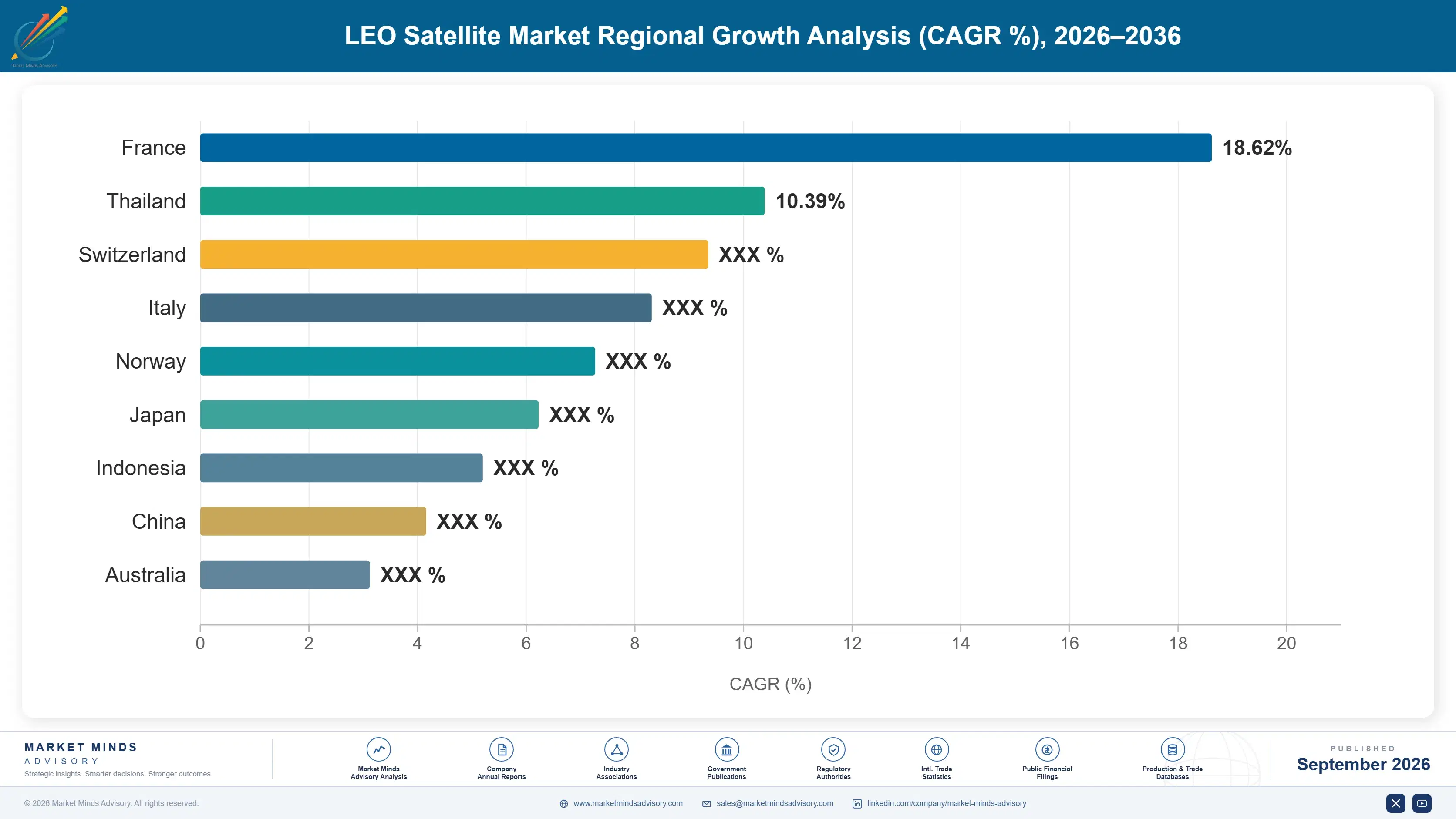
leo-satellite-market-country-cagr-analysis-1789986729550

Where Operators Can Defend Margin at Scale

As launch costs keep falling and constellations keep growing considerably larger, operators must build revenue beyond raw connectivity: direct-to-device partnerships, enterprise IoT contracts, government sovereign agreements, and vertical integration across manufacturing and launch that smaller competitors cannot easily replicate given the required capital scale, deep technical expertise, and regulatory relationships built over many years.

Direct-to-Device Carrier Partnership Revenue Stream Building

Operators partnering with mobile carriers to offer direct satellite-to-smartphone connectivity capture meaningful new subscription revenue from customers previously unreachable through traditional satellite phone hardware requiring separate purchase and setup. Carrier partnerships launched in 2025 are generating roughly 20% incremental average revenue per user among participating subscribers who add satellite messaging as a premium service tier. This revenue stream requires minimal additional satellite hardware investment since it uses existing constellation infrastructure already deployed for broadband service. This partnership model is expected to expand across additional carriers over time. Analysts expect this revenue category to expand meaningfully over the coming several years.
Market Impact: Carrier partnerships add roughly 20% more subscription revenue

Vertical Integration Across Manufacturing and Launch

Operators controlling both satellite manufacturing and launch capability internally avoid the margin that would otherwise flow to third-party providers, capturing an estimated 35% cost advantage over competitors dependent on external launch services for constellation deployment. This integration also provides scheduling flexibility that pure satellite operators cannot match, since internal launch capacity is not subject to competing customer priorities or external provider capacity constraints during peak deployment periods. Competitors relying entirely on third-party launch providers face growing scheduling and cost disadvantages. This advantage compounds as constellation size grows and launch frequency requirements increase considerably each year.
Market Impact: Vertical integration cuts overall costs by roughly 35%

Enterprise IoT Contracts With Multi-Year Terms

Operators securing multi-year enterprise IoT connectivity contracts with logistics and agriculture companies capture more predictable recurring revenue than consumer broadband subscriptions, which face higher churn given seasonal usage patterns and competitive terrestrial alternatives. Enterprise IoT contracts typically run three to five years with committed minimum revenue guarantees, providing roughly 40% better revenue predictability than month-to-month consumer subscription arrangements common across broadband service tiers. This predictability increasingly appeals to investors evaluating operator revenue quality during capital raising discussions. Operators increasingly market this predictability advantage directly to institutional investors during fundraising rounds.
Market Impact: Enterprise contracts improve overall predictability by roughly 40%

Government Contract Revenue for Sovereign Connectivity

Operators winning government contracts for sovereign satellite connectivity, particularly in defense and disaster response applications, capture premium pricing and multi-year commitments that commercial consumer contracts rarely match in scale or duration. Government contracts secured during 2025 carried average values roughly 50% higher than comparable commercial enterprise agreements, reflecting the premium governments pay for guaranteed capacity and priority service during emergency or defense-related connectivity needs. Operators with established government relationships increasingly win renewal contracts ahead of newer commercial competitors. This trend is expected to strengthen further as governments prioritize sovereign connectivity independence from foreign providers.
Market Impact: Government contracts command roughly 50% higher contract value

Who Controls the Margin Pool

Concentration sits heavily skewed, with a CR5 near 58% on a revenue basis driven overwhelmingly by a single dominant operator, and a substantial gap separating that leader from challengers like OneWeb and Planet Labs, who compete on specific niches like enterprise broadband and Earth observation rather than broad constellation scale across most orbital shells, application categories, and geographic markets served today.
Current competitive activity centers on three dimensions: direct-to-device carrier partnership launches expanding addressable subscriber reach considerably across most mobile network operators, vertical integration across manufacturing and launch capability reducing per-satellite deployment cost meaningfully, and government sovereign connectivity contracts commanding premium pricing over standard commercial agreements. Chinese state-backed constellation buildout has also become a meaningful competitive pressure reshaping global orbital slot allocation.

Emerging pressure comes from Chinese state-backed operators racing to close the deployment gap with the dominant American operator, potentially reshaping global constellation market share meaningfully over the coming decade and beyond. Operators slow to secure spectrum allocation or demonstrate responsible debris mitigation risk losing regulatory approval for future constellation expansion, while smaller regional operators increasingly rely on partnership arrangements rather than independent constellation deployment.
leo-satellite-market-company-positioning-matrix-1789986730077

Competitive Moat and Risk Dimensions

SPACEX

Moat: Reusable Launch Cost Advantage

SpaceX's control over both satellite manufacturing and reusable launch vehicles gives it a cost structure that competitors dependent on third-party launch providers cannot match, since internal launch capacity avoids the margin that would otherwise flow to external providers entirely across every constellation deployment cycle undertaken.
SPACEX

Risk: Regulatory Scrutiny Over Market Dominance

SpaceX's overwhelming share of active satellites and launch capacity is attracting growing regulatory scrutiny around market concentration and spectrum allocation fairness, risking potential future restrictions on constellation expansion or mandated competitive access to launch infrastructure across multiple jurisdictions and regulatory bodies worldwide currently reviewing the matter.
ONEWEB

Moat: Government and Enterprise Contract Base

OneWeb's established government and enterprise broadband contracts across multiple countries give it a stable revenue base that newer commercial entrants cannot easily replicate without comparable years of accumulated regulatory relationships and service track record across regulated jurisdictions and government procurement channels established globally over time.
ONEWEB

Risk: Limited Launch Cadence Versus Rivals

OneWeb's reliance on third-party launch providers rather than internal launch capability limits its constellation expansion cadence compared with vertically integrated competitors, risking meaningful share loss in the fastest-growing broadband segments where deployment speed increasingly determines market position and customer acquisition momentum overall across most regions.

Players Tracked

Prominent Players

SpaceX
OneWeb
Planet Labs
Amazon
Iridium Communications

Other Key Players

Airbus Defence and Space
Maxar Technologies
Blue Origin
Rocket Lab
Swarm Technologies
ICEYE
BlackSky
Spire Global
Telesat
Viasat
Thales Alenia Space
China Aerospace Science and Technology Corporation
SES
Astranis
Sateliot

Recent Developments

MARCH 2025

SpaceX Launches Direct-to-Cell Service With Major Carrier

SpaceX expanded its direct-to-cell satellite messaging service through a partnership with a major United States mobile carrier, enabling standard smartphones to send text messages via Starlink satellites without specialized hardware. The service targets remote areas lacking terrestrial cellular coverage, adding a new subscription revenue stream to existing broadband operations.
Signal: Signals accelerating convergence between satellite connectivity and mainstream consumer smartphone services across most global carriers today.
AUGUST 2025

China Launches Additional Qianfan Constellation Satellites

China's Qianfan constellation program launched another batch of broadband satellites, continuing its state-backed effort to build orbital scale comparable to American commercial operators across most contested orbital shells. The launch reinforces China's strategic priority of reducing dependency on foreign satellite connectivity providers for domestic and allied nation coverage.
Signal: Signals continued Chinese state investment racing to close the orbital deployment gap with American operators quickly.
NOVEMBER 2025

Amazon Kuiper Achieves Initial Operational Broadband Coverage

Amazon's Kuiper constellation reached initial operational capability, offering broadband coverage across select regions as the company races to compete with Starlink's established market position and subscriber base. The milestone follows years of satellite manufacturing scale-up and launch partnerships with multiple commercial launch providers across the industry.
Signal: Signals intensifying competition in the broadband constellation segment as a major well-funded rival enters commercial service.

Rocket Propellant and Component Cost Exposure

Rocket propellant, satellite component, and launch vehicle manufacturing costs represent roughly 45 to 55% of total operating cost of goods sold for LEO satellite operators, given the scale of hardware required to build and launch constellations numbering in the thousands of units annually across most active operators competing for orbital slots and manufacturing capacity worldwide today.
Aerospace-grade component and specialty alloy prices rose an estimated 18% between 2023 and 2025 amid tightening global supply for radiation-hardened electronics and specialty propellant materials, according to the IEA Critical Minerals and Semiconductor Supply Chain Review 2025 citing sustained demand growth across commercial and defense satellite manufacturing simultaneously, as constellation buildout accelerated across multiple competing operators and national government-backed programs worldwide during this period of rapid expansion.

This exposure disadvantages smaller operators lacking vertically integrated manufacturing and launch capability, forcing them to absorb higher per-satellite costs than larger competitors with committed-use component supply agreements across their manufacturing operations and established supplier networks. Vertically integrated operators controlling both satellite production and reusable launch capability gain a meaningful and durable cost advantage over competitors dependent on third-party manufacturing and launch services.
leo-satellite-market-cost-volatility-analysis-1789986730273

Negotiated Multi-Year Component Supply Agreements

Larger operators increasingly negotiate committed-use component supply agreements with radiation-hardened electronics manufacturers spanning multiple years, locking in discounted per-unit pricing well below standard spot market rates offered broadly to smaller competitors across the industry today. This reduces exposure to component cost inflation while providing budget predictability across annual manufacturing planning and procurement cycles considerably.

In-House Component Manufacturing for Critical Parts

Some operators are bringing critical component manufacturing in-house rather than relying entirely on external suppliers, reducing per-unit costs meaningfully while improving supply chain control over lead times and quality standards across every production run undertaken. This vertical integration pays off considerably as constellation scale and manufacturing volume increase over successive years of sustained operation.

Standardized Satellite Bus Design for Cost Reduction

Several operators are standardizing satellite bus designs across their constellations rather than customizing each unit individually, reducing manufacturing complexity and per-unit costs considerably through economies of scale achieved across large production runs and standardized supply chains. This approach mirrors automotive manufacturing principles, prioritizing production efficiency over individual satellite customization for most standard broadband applications.

Portfolio Architecture for Margin Defence

Operators span three margin tiers: volume broadband constellation manufacturing generates gross margins around 25 to 32%, while government sovereign and defense-related connectivity contracts command 45 to 55% given security clearance requirements and reliability standards competitors cannot quickly replicate without years of certification investment. The gap has widened considerably as government buyers pay substantially more for guaranteed capacity and priority service.
Volume broadband constellation manufacturing still represents the largest share of satellite unit production globally, particularly for consumer and enterprise connectivity services sold through standard subscription channels, but the highest value creation now concentrates in government contracts bundling sovereign connectivity, defense communications, and premium enterprise IoT service tiers. Operators must balance manufacturing capacity between broad consumer scale and premium government contract fulfillment requirements.

High-value margin pools concentrate specifically around government sovereign contracts, defense-related connectivity, and premium enterprise IoT services, all requiring security clearance and reliability certification that smaller regional competitors struggle to replicate quickly at comparable standards and cost. Operators positioned across all three tiers, rather than concentrated purely in consumer broadband, are best placed to capture disproportionate profit as government demand for sovereign connectivity keeps expanding globally.

Consumer and enterprise broadband constellation manufacturing sold on subscription pricing to underserved connectivity markets, generating gross margins of 25 to 32% amid intense competition among a small number of scaled operators.
Gross Margin

Government sovereign, defense-related, and mission-critical enterprise IoT connectivity commanding gross margins of 45 to 55% given security clearance requirements and reliability certification limiting competitive entry from smaller commercial vendors overall.
Gross Margin

Active debris removal and end-of-life deorbit compliance tools responding to tightening orbital sustainability regulation and international coordination requirements, generating gross margins around 35 to 42% as early movers capture premium regulatory-compliant contracts.
Gross Margin
leo-satellite-market-portfolio-architecture-1789986730779

High-value Sub-segments and Strategic Watch-out

Broadband Communication Satellites

Fastest-growing and highest-volume segment as consumer and enterprise demand for satellite internet expands across underserved rural and maritime markets globally across most developed and developing regions. Operators with established manufacturing and launch scale are capturing premium positioning ahead of competitors still building comparable constellation density.

IoT and M2M Connectivity Satellites

Second-fastest growing segment tied to rising enterprise demand for remote asset tracking across logistics, agriculture, and maritime shipping sectors lacking terrestrial coverage across most remote geographies worldwide. Operators building deeper enterprise relationships here can capture disproportionate value as supply chain visibility requirements keep expanding rapidly.

Earth Observation and Remote Sensing Satellites

Core revenue segment representing steady government and commercial demand across most active observation deployments currently tracked across most industry verticals and geographic regions, generating stable margins as competitive pricing pressure persists moderately. This segment remains commercially essential even as growth shifts toward broadband alternatives over the coming forecast period.

Technology Demonstration Satellites

Strategic watch-out segment facing steady commoditization as basic technology demonstration missions become table stakes across nearly all competing space agencies and commercial operators and vendor tiers. Operators overexposed to this category risk meaningful margin erosion absent diversification into broadband or government-contracted product lines over the coming several years.

Why Constellation Contracts Lock In Long-Term

Revenue durability comes primarily from multi-year subscription and government contract models, since operators rarely dismantle constellation infrastructure once deployed given the enormous sunk capital cost involved in manufacturing and launching thousands of satellites into operational orbit across multiple frequency bands and coverage areas. Operators renewing multi-year government and enterprise contracts capture predictable recurring revenue even as consumer subscriber growth eventually moderates.
Adoption depth varies meaningfully by vertical: government and defense buyers show the deepest engagement, running multi-year sovereign connectivity contracts with dedicated security clearance requirements and committed minimum capacity guarantees across multiple contract renewal cycles, while individual consumer broadband subscribers churn more readily given competing terrestrial alternatives and lower switching costs for basic residential internet service in areas where fiber eventually arrives.

Younger government procurement officials and enterprise technology buyers entering decision-making roles increasingly expect satellite connectivity as a standard redundancy option alongside terrestrial infrastructure, rather than treating it as a niche solution reserved for genuinely unreachable locations lacking any alternative. This generational shift pressures operators still positioning satellite service as a last resort to reposition their value proposition around resilience and redundancy rather than pure last-mile access.
leo-satellite-market-end-use-penetration-index-1789986731264

Secure Orbital Slots Before Windows Close

These are among the four positions where our research anticipates prominent divergence between winners and laggards over the coming forecast period. Each is grounded in the demand model, the regulatory perimeter, and the announced capacity pipeline.
01 / ORBITAL SLOT ACQUISITION SPEED

Secure spectrum and orbital slots before regulatory tightening

Orbital debris regulation and spectrum coordination disputes are already delaying an estimated 18% of planned constellation expansions, and this friction will likely intensify as more operators compete for the same limited orbital shells and frequency allocations across most spacefaring nations and jurisdictions. Operators who secure slots and spectrum rights now, ahead of tightening international coordination requirements, lock in access that latecomers may struggle to obtain at any price. Delaying this acquisition risks permanent exclusion from the most commercially valuable orbital positions.
02 / DIRECT-TO-DEVICE PARTNERSHIP EXPANSION

Expand carrier partnerships before competitors close the gap

Direct-to-device satellite connectivity partnerships with mobile carriers are generating roughly 20% incremental subscription revenue for operators moving early, using existing constellation infrastructure without requiring additional satellite hardware investment across most active broadband deployments worldwide today and going forward. This capability increasingly determines competitive positioning as consumer smartphone manufacturers and carriers standardize satellite messaging as an emergency connectivity feature across most device categories and price tiers. Operators without comparable carrier relationships risk missing a meaningful revenue opportunity that requires minimal incremental capital deployment.
03 / VERTICAL MANUFACTURING INTEGRATION

Build internal launch capability to escape margin erosion

Operators controlling both satellite manufacturing and reusable launch capability internally capture a roughly 35% cost advantage over competitors dependent on third-party launch providers for constellation deployment and expansion across most active commercial and government programs currently underway across the industry today. This integration also provides scheduling flexibility that pure satellite operators cannot match, since internal launch capacity avoids competing customer priorities during peak deployment windows and periods. Competitors lacking comparable vertical integration risk permanent margin disadvantage as constellation scale requirements keep increasing.
04 / DEBRIS MITIGATION LEADERSHIP

Lead on debris mitigation before mandates force compliance

Tracked orbital debris objects already exceed 40,000 pieces in low Earth orbit, and regulatory bodies are moving toward mandatory end-of-life deorbit requirements that will eventually apply to every operator regardless of current voluntary compliance status across most jurisdictions. Operators adopting active deorbit systems now build reputational and regulatory goodwill that competitors retrofitting under future mandates will lack entirely once rules take effect. Waiting for regulation to force compliance risks reputational damage and potential launch approval delays during the transition period.

Engagement Snapshot From the Field

A live engagement with an industry participant carrying material or product regulatory and market exposure ahead of a defining policy shift, showing how our research translates into a defensible multi-year portfolio strategy.
MARKET MINDS ADVISORY · CLIENT ENGAGEMENT SUMMARY
LEO Satellite Producer Strategic Portfolio Review and Transition Roadmap 2026·Investment Scenario on LEO Satellite Exposure Evaluation 2025-26
CLIENT PROFILE
The client is a mid-sized telecommunications operator providing terrestrial broadband and mobile service across rural regions in the United States Mountain West region and surrounding neighboring areas. The company reported (client-reported, unverified by MMA) annual revenue of approximately $280 million and had historically relied entirely on fiber and fixed wireless infrastructure for rural connectivity delivery.
STRATEGIC CHALLENGE
The operator faced persistent coverage gaps in the most remote portions of its service territory, where fiber and fixed wireless deployment remained economically unviable given low population density and difficult terrain. Leadership needed an independent assessment of satellite connectivity partnership options before committing capital ahead of the next infrastructure investment planning cycle.
MMA APPROACH
MMA conducted a comparative assessment of LEO satellite operators' wholesale connectivity partnership terms, benchmarking against primary survey data covering similar rural telecommunications operator arrangements across comparable geographic markets. The engagement combined expert interviews with the client's network planning leadership alongside MMA's regional demand data to identify the partnership structure best suited to closing remaining coverage gaps economically.
KEY FINDINGS
  1. Satellite backhaul partnership costs were meaningfully lower than extending fiber infrastructure to the most remote portions of the client's service territory (client-reported, unverified by MMA).
  2. Competitor rural telecommunications operators had already adopted comparable satellite connectivity partnerships roughly eighteen months earlier on average across comparable service territories nationwide.
  3. The client's existing coverage gap affected an estimated 12% of its total service territory population overall, representing meaningful unmet subscriber demand today.
  4. Regulatory rural broadband subsidy programs specifically favored operators demonstrating satellite connectivity partnerships as part of their comprehensive coverage strategies submitted for review.
CLIENT PROFILE
The client is a mid-sized telecommunications operator providing terrestrial broadband and mobile service across rural regions in the United States Mountain West region and surrounding neighboring areas. The company reported (client-reported, unverified by MMA) annual revenue of approximately $280 million and had historically relied entirely on fiber and fixed wireless infrastructure for rural connectivity delivery.
STRATEGIC CHALLENGE
The operator faced persistent coverage gaps in the most remote portions of its service territory, where fiber and fixed wireless deployment remained economically unviable given low population density and difficult terrain. Leadership needed an independent assessment of satellite connectivity partnership options before committing capital ahead of the next infrastructure investment planning cycle.
MMA APPROACH
MMA conducted a comparative assessment of LEO satellite operators' wholesale connectivity partnership terms, benchmarking against primary survey data covering similar rural telecommunications operator arrangements across comparable geographic markets. The engagement combined expert interviews with the client's network planning leadership alongside MMA's regional demand data to identify the partnership structure best suited to closing remaining coverage gaps economically.
KEY FINDINGS
  1. Satellite backhaul partnership costs were meaningfully lower than extending fiber infrastructure to the most remote portions of the client's service territory (client-reported, unverified by MMA).
  2. Competitor rural telecommunications operators had already adopted comparable satellite connectivity partnerships roughly eighteen months earlier on average across comparable service territories nationwide.
  3. The client's existing coverage gap affected an estimated 12% of its total service territory population overall, representing meaningful unmet subscriber demand today.
  4. Regulatory rural broadband subsidy programs specifically favored operators demonstrating satellite connectivity partnerships as part of their comprehensive coverage strategies submitted for review.
RECOMMENDED STRATEGY
Phase 1: Phase one: establish a wholesale satellite backhaul partnership to close remaining coverage gaps within a twelve-month deployment window overall each year. Phase 2: Phase two: market expanded coverage to previously unreachable rural subscribers through targeted local advertising and sustained community outreach programs statewide. Phase 3: Phase three: pursue rural broadband subsidy funding by using the satellite partnership as evidence of a comprehensive coverage strategy execution.
OUTCOME
Within one year of partnership implementation, the client reported (client-reported, unverified by MMA) subscriber growth of roughly 9% in previously unreachable territory and secured meaningful additional rural broadband subsidy funding support overall. Customer satisfaction scores in newly covered areas exceeded company-wide averages considerably each quarter.

Frequently Asked Questions

Foundational context covering the market sizes, CAGR, scope, country, region and competition that inform every finding below. This section is provided to cover basics and most often pre-purchase conversations, answered from the MMA Primary Research Dataset.

What is the current size of the LEO Satellite Market?

The LEO Satellite Market is valued at $18.5 billion in 2025. This reflects global manufacturing, launch, and operations revenue across broadband, observation, and connectivity satellite applications.

How large will the LEO Satellite Market be by 2036?

The market is projected to reach $82.03 billion by 2036. Growth is anchored primarily by reusable launch cost declines and expanding broadband constellation deployment worldwide.

What is the CAGR for the LEO Satellite Market 2026 to 2036?

The market is forecast to grow at a 14.5% compound annual growth rate between 2026 and 2036. This reflects accelerating constellation buildout across broadband and connectivity operators.

Which segment is growing fastest?

Broadband Communication Satellites is the fastest-growing segment at a 19.5% CAGR, roughly 1.34x the overall market rate. Rural and maritime connectivity demand is driving this expansion.

Who are the major companies in the LEO Satellite Market?

Leading companies include SpaceX, OneWeb, Planet Labs, Amazon, and Iridium Communications. These five firms compete on constellation scale, launch cadence, and vertical integration depth today.

Which country is growing fastest?

China is the fastest-growing country at a 17.5% CAGR. Its state-backed constellation programs are racing to close the deployment gap with American operators very quickly.

Report Segmentation Architecture

The full report scope spans multiple orthogonal segmentation dimensions, with cross-tabulated demand data provided for each dimension pair. Coverage extends further to regional breakdowns, trend trajectories, and the competitive detail needed to support segment-level decision-making.

By Primary Market Dimension

  • Broadband Communication Satellites
  • IoT and M2M Connectivity Satellites
  • Earth Observation and Remote Sensing Satellites
  • Navigation and Positioning Satellites
  • Scientific and Research Satellites
  • Technology Demonstration Satellites

By End-Use Industry

  • Telecommunications
  • Government and Defense
  • Agriculture and Logistics
  • Maritime and Aviation
  • Scientific Research

By Commercial Dimension

  • Direct Consumer Subscription
  • Enterprise Wholesale Contracts
  • Government Procurement Contracts
  • Carrier Partnership Channel

By Region

  • North America
  • Western Europe
  • East Asia
  • South Asia and Pacific
  • Latin America
  • Middle East and Africa
  • Eastern Europe

Scope, Methodology, and Coverage

Every figure in this report is reproducible from documented input assumptions. The scope below maps the historical period, the forecast horizon, the segmentation dimensions, and the countries covered, alongside the underlying primary and qualitative methodology.
Historical Period
2020 to 2025
Forecast Period
2026 to 2036
Base Year
2025 (USD billions; MMA Primary Research Dataset, September 2026)
Market Definition
The LEO Satellite Market covers satellites manufactured and operated in low Earth orbit, between 160 and 2,000 kilometers altitude, for broadband communication, Earth observation, IoT connectivity, navigation, and scientific applications, including associated manufacturing and launch services revenue. It excludes geostationary and medium Earth orbit satellite systems sold as separate market categories.
Quantitative Units
Value in USD Billion, Satellite Count in Thousand Units
Segmentation Dimensions
By Application, By End-Use Industry, By Commercial Dimension, By Region
Regions Covered
North America, Western Europe, East Asia, South Asia and Pacific, Latin America, Middle East and Africa, Eastern Europe
Countries Covered
United States, Canada, United Kingdom, Germany, France, China, Japan, South Korea, India, Indonesia, Vietnam, Australia, Brazil, Mexico, Saudi Arabia, United Arab Emirates, South Africa, Poland
Key Companies Profiled
SpaceX, OneWeb, Planet Labs, Amazon, Iridium Communications, Airbus Defence and Space, Maxar Technologies, Blue Origin, Rocket Lab, Swarm Technologies, ICEYE, BlackSky, Spire Global, Telesat, Viasat, Thales Alenia Space, China Aerospace Science and Technology Corporation, SES, Astranis, Sateliot
Quantitative Methodology
Primary survey, n=3,800 respondents, Q4 2025, six countries; demand-side model with trade association cross-validation
Qualitative Methodology
47 expert interviews, Q4 2025; applied to validate demand model assumptions, identify emerging dynamics, and assess competitive positioning
Report Format
PDF and XLSX data workbook (Word format preview document)
Publisher
Market Minds Advisory
Report Code
MMA-2026-TEC-923
Published
September 2026
Contact
sales@marketmindsadvisory.com | www.marketmindsadvisory.com

Purchase the full LEO Satellite Market Report (2026 to 2036).

This report provides a comprehensive assessment of the global LEO Satellite Market, covering market sizing, segmentation, and regional dynamics through 2036. It examines competitive positioning among leading satellite operators, the impact of reusable launch cost declines, and revenue opportunities within direct-to-device partnerships and government contracts. The analysis draws on primary survey data, expert interviews, and company disclosures to quantify demand shifts across broadband, IoT, and observation channels. Readers gain a data-grounded view of where constellation investment and orbital slot decisions carry the greatest commercial return.
Ten-year market sizing and forecast model
Six-segment application-based segmentation with growth rates
Seven-region demand and competitive share breakdown
Twenty-company competitive landscape and moat assessment
Component and launch cost volatility risk analysis
Portfolio margin and revenue lever guidance

Built For The People Who Decide

From boardroom strategy to bench-side execution, this report is read cover-to-cover by leaders shaping the next decade of their industry, turning demand scenarios, market dynamics and valuation benchmarks into decisions.
CXOs/ Presidents/ VPs/ Managers
M&A and Corporate Development
Strategy Teams and R&D Heads
Procurement and Product Directors
Regulatory and Compliance Leaders
Investor Relations and Equity Analysts