

Market Minds Advisory
Legal, Risk and Compliance Solution Market

Legal, Risk and Compliance Solution Market: Legal, Risk and Compliance Solution Market: AI-Driven Regulatory Intelligence Replaces Manual Monitoring

Corporate legal and compliance teams overwhelmed by regulatory change volume are shifting budget toward AI-driven monitoring platforms that flag relevant rule changes automatically, as manual tracking proves too slow for organizations operating across.

Lead Analyst

Published

September 2026

Make Smarter Decisions with Customized Research Insights

Request a free sample report and evaluate market opportunities, growth trends, and competitive dynamics relevant to your business needs.

2025 MARKET VALUE$8.5BMarket Size 2025
2036 FORECAST VALUE$20.9BBase Case , 2026 to 2036
CAGR 2026 TO 20368.5 %Bull 9.8% / Bear 7.2%
INCREMENTAL OPPORTUNITY$11.6BNet 10- year value creation
EXPANSION MULTIPLE2.26x2036 value over 2026 base
Strategic Levers
M&A Pipeline
Regional Outlook
Country Rankings
Competitive Intelligence
Segmental Deep-dive
Call-Us : 91 93563 13602

Executive Snapshot and Market Trajectory.

Corporate legal and compliance teams tracking regulatory change across dozens of jurisdictions manually are adopting AI-driven monitoring platforms that flag relevant rule changes automatically, rather than relying on outside counsel bulletins and internal spreadsheets reflecting sustained investment across multiple enterprise segments as adoption continues expanding steadily across major markets supporting.
Financial services and healthcare organizations drive the largest share of current spending, prioritizing platforms that consolidate policy management, regulatory tracking, and litigation records into a single auditable system. AI-driven regulatory intelligence and monitoring, the fastest-growing segment, replaces manual bulletin review with automated relevance scoring, growing at roughly 1.76 times the overall market rate. North America concentrates the largest share of both platform vendors and enterprise spending reflecting sustained investment across multiple.
Competitive intensity centers on breadth of jurisdictional coverage and AI relevance accuracy rather than policy template sophistication alone, since a platform that surfaces hundreds of irrelevant regulatory updates daily gets ignored by overworked compliance staff regardless of its underlying coverage. Growing enforcement activity across multiple regulatory regimes is pushing enterprises toward integrated platforms over point solutions. MetricStream and Diligent draw on large existing customer.
Market Definition
The Legal, Risk and Compliance Solution market comprises software platforms that manage corporate policy governance, regulatory change tracking, litigation and case records, and compliance training across enterprise legal and risk functions. It excludes third-party vendor risk management platforms sold as a standalone dedicated category, general enterprise resource planning software without dedicated legal and compliance modules, and outside law firm case management software sold exclusively to legal practices rather than corporate legal departments.
Base Year Value
$8.5B in 2025 (MMA Primary Research Dataset, September 2026)
Forecast Period
2026 to 2036, eleven discrete annual values
CAGR
8.5% base case. Bull 9.8%. Bear 7.2%.
Fastest Growth Segment
AI-Driven Regulatory Intelligence and Monitoring: 15.0% CAGR
Fastest Growth Country
India: 10.5% CAGR
Fastest Growth Region
South Asia and Pacific: 10.5% CAGR
Largest Region
North America: 32% of 2025 global value
Market Leaders
MetricStream Inc, Diligent Corporation, NAVEX Global Inc, IBM Corporation, SAP SE. Source: MMA Analysis based on company annual reports.
Primary Survey
n=3,800 procurement and R&D decision-makers, Q4 2025, six countries
Methodology
Demand-side build-up, cross-validated against public data, 47 expert interviews

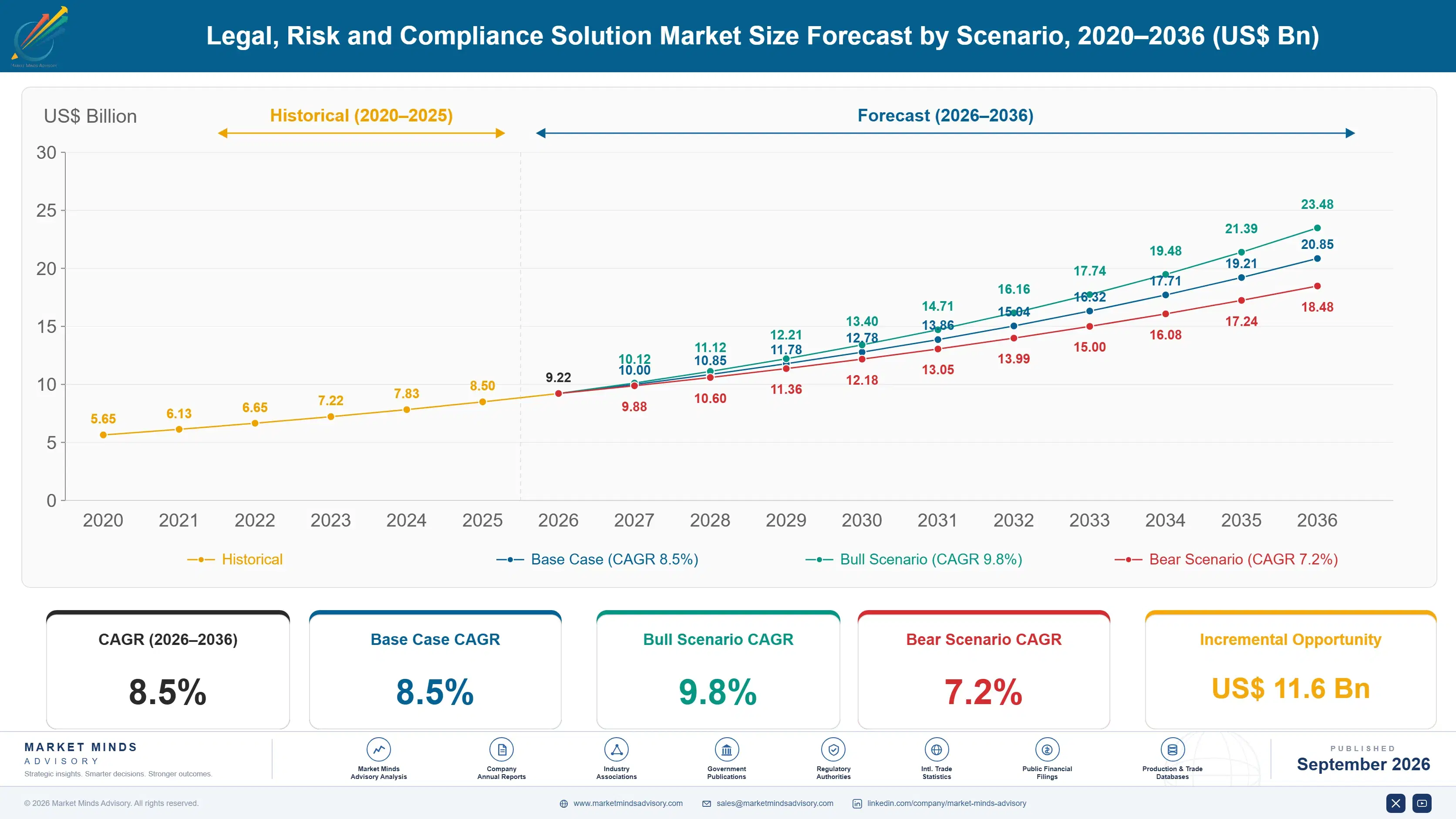
Legal, Risk and Compliance Solution Market Forecast Scenarios

legal-risk-and-compliance-solution-market-size-forecast-scenario-1789980028081
Between 2020 and 2025, legal, risk and compliance solution demand grew steadily as enterprises expanded operations across more jurisdictions faster than manual regulatory tracking processes could reasonably keep pace with. The market expanded at roughly 7.0 percent annually over that period, accelerating after 2022 as several high-profile enforcement actions raised board-level attention to compliance gaps reflecting sustained investment across multiple enterprise.
MMA's base case assumes 8.5 percent annual growth through 2036, anchored in three mechanisms: continued enterprise expansion across more regulatory jurisdictions outpacing manual tracking capacity, tightening enforcement activity across financial services and healthcare sectors requiring documented compliance programs, and growing demand for AI-driven regulatory relevance scoring that reduces the volume of manual bulletin review compliance staff must perform. Falling cloud computing costs further broaden the addressable customer base beyond the largest enterprises alone reflecting sustained investment across.
The bull case turns on faster-than-expected enforcement activity expansion, which would meaningfully raise the compliance stakes driving platform adoption. The bear case centers on prolonged enterprise software budget tightening if a broader technology spending slowdown forces legal and compliance teams to defer platform upgrades in favor of maintaining existing manual processes reflecting sustained investment across multiple enterprise segments as adoption.

Relevance Scoring Beats Bulletin Volume

The Legal, Risk and Compliance Solution market sits at the intersection of three converging forces: enterprise expansion across more regulatory jurisdictions that outpaces manual tracking capacity, tightening enforcement activity that raises the cost of undetected compliance gaps, and growing demand for AI-driven relevance scoring that reduces bulletin review burden. These forces compound rather than operate independently reflecting sustained investment across multiple enterprise segments as adoption.
MARKET CONCENTRATION (CR5)30%top five vendors hold a modest combined share currently.
AVERAGE JURISDICTIONAL COVERAGE68 jurisdictionstypical number of regulatory jurisdictions a platform actively monitors.
AI RELEVANCE SCORING ADOPTION36% of enterprise contractsshare of contracts including automated regulatory relevance scoring reflecting.
POLICY UPDATE CYCLE TIME5 weekstypical time to update and redistribute a policy after.
ENTERPRISE CONTRACT RENEWAL RATE85% annuallyshare of enterprise customers renewing their subscription each year.
LITIGATION MODULE ATTACH RATE41% of platform salesshare of platform sales including integrated litigation case management.
Commercially, the market increasingly rewards platforms that consolidate policy, regulatory tracking, and litigation records into a single auditable system rather than requiring compliance teams to reconcile data across separate point solutions. Legal and compliance leaders evaluating competing platforms now request evidence of cross-functional data consolidation, and vendors who can supply this evidence command meaningfully stronger renewal rates than those offering narrow point solutions reflecting sustained.
Over the next decade, three forces will reshape competitive standing: continued AI relevance scoring sophistication reducing compliance staff bulletin review burden, expanding enforcement activity across additional regulatory regimes, and consolidation as larger platforms absorb standalone point solutions covering narrow functional categories reflecting sustained investment across multiple enterprise segments as adoption continues expanding steadily across major markets supporting consistent engagement across.
"A platform that emails compliance officers two hundred regulatory bulletins a week has not solved their problem, it has just relocated the burden from reading law firm alerts to reading platform notifications. The vendors winning renewal budget now are the ones that can tell a compliance officer which three actually matter."
Director, Legal Technology and Regulatory Compliance Practice · MMA Technology: Governance Practice · September 2026

Market Trends

AI Relevance Scoring Reduces Compliance Bulletin Overload

Compliance teams tracking regulatory change across dozens of jurisdictions have historically received far more bulletin volume than staff could realistically review in detail, and AI-driven relevance scoring models now filter this volume down to the changes genuinely affecting a specific organization's operations and licenses. MetricStream and Diligent have both expanded machine learning relevance scoring capability considerably to address this overload problem directly within their core platforms. This shift matters because bulletin overload had become a genuine operational risk, since compliance officers desensitized to high alert volume risk missing the rare bulletin that actually requires immediate action.
Market Impact: Cuts tracking administration time by 41.

Enforcement Activity Expansion Elevates Board-Level Attention

Regulators across financial services, healthcare, and data privacy have expanded enforcement activity and increased penalty amounts considerably in recent years, elevating compliance program adequacy from an operational concern into a board-level governance priority at many large enterprises. NAVEX and IBM have both expanded board-level reporting features specifically to serve this growing executive attention requirement. This shift matters because board-level attention typically frees budget that compliance teams could not previously secure for platform investment that seemed important but abstract until enforcement actions made the exposure concrete and personally relevant to executive leadership reflecting sustained investment across multiple.
Market Impact: Extends privacy mandates to 14 jurisdictions.

Market Opportunities and Growth Drivers

Cross-Jurisdictional Expansion Outpaces Manual Tracking Capacity

Large enterprises now operate across dozens of regulatory jurisdictions simultaneously as international expansion continues, a scale that manual regulatory tracking processes relying on outside counsel bulletins and internal spreadsheets struggle to keep pace with reliably. Compliance teams report spending a substantial share of their time simply organizing and distributing regulatory updates rather than actually analyzing compliance implications, a burden that automated tracking platforms considerably reduce. This has pulled budget from organizations that previously viewed dedicated compliance platforms as an unnecessary expense given existing manual tracking processes reflecting sustained investment across multiple enterprise segments as adoption continues.
Market Impact: Extends deployment timelines by 4 months.

Data Privacy Regulation Expansion Requires Documented Compliance

Data privacy regulators across the European Union, United States, and growing numbers of additional jurisdictions have tightened requirements for documented compliance programs following several high-profile enforcement actions and data breach incidents. Compliance increasingly requires continuous policy monitoring paired with documented training completion records rather than periodic manual review alone, pulling regulated enterprises toward platforms that can generate auditable compliance records automatically. This regulatory pressure is extending platform adoption into mid-sized enterprises previously unable to justify dedicated investment reflecting sustained investment across multiple enterprise segments as adoption continues expanding steadily across major markets supporting consistent engagement across.
Market Impact: Adds 3 months to sales cycle.

Market Restraints and Challenges

Platform Consolidation Complexity Delays Full Deployment

Many enterprises run separate legacy systems for policy management, regulatory tracking, and litigation records accumulated across different departments over years, and the root cause of consolidation delay is that migrating years of historical records into a unified platform requires extensive data cleansing and mapping work that many organizations underestimate at project outset. This has forced several consolidation projects to extend well beyond original implementation timelines, delaying return on investment and frustrating stakeholders expecting a straightforward platform swap. Vendors are increasingly offering dedicated migration services to shorten this bottleneck for customers with particularly fragmented legacy systems reflecting.
Market Impact: Cuts bulletin review time by 44.

Cross-Functional Buy-In Requirements Slow Procurement Decisions

Legal, risk, and compliance solution purchases typically require buy-in from legal, compliance, risk, and sometimes human resources departments simultaneously, and the underlying cause of procurement delay is that each function often maintains its own point solution and internal champion resistant to consolidating onto a shared platform that dilutes departmental control over its own tooling. This has extended average sales cycles considerably compared with single-department software purchases, complicating vendors' ability to forecast revenue reliably. Vendors are responding by building modular deployment options that let individual departments adopt incrementally reflecting sustained investment across multiple enterprise segments as adoption.
Market Impact: Raises board attention across 39 percent.
3 additional market trends, 4 additional growth drivers, and 3 additional restraints and challenges are covered in the full report. Contact sales@marketmindsadvisory.com to access the complete intelligence.

Segment CAGR and Growth Architecture

MMA segments the Legal, Risk and Compliance Solution market by solution function and deployment model, since this dimension best explains where margin and growth concentrate as platforms shift from static policy repositories toward AI-driven regulatory intelligence and integrated risk analytics reflecting sustained investment across multiple enterprise segments as adoption continues expanding steadily across major markets supporting consistent.
legal-risk-and-compliance-solution-market-market-share-analysis-1789980028616

AI-Driven Regulatory Intelligence and Monitoring

This segment uses machine learning models to continuously scan regulatory sources across dozens of jurisdictions and score each update for relevance to a specific organization's licenses and operations, replacing manual bulletin review that historically consumed considerable compliance staff time. MetricStream and Diligent have both expanded relevance scoring capability considerably, proving that models trained on sufficient regulatory history can meaningfully reduce the volume of updates requiring human review. Growth here runs at roughly 1.76 times the overall market rate because enterprises operating across growing jurisdictional footprints increasingly treat bulletin overload as a genuine operational risk rather than a manageable inconvenience. Several major financial institutions have made relevance scoring a standard requirement in new platform procurement reflecting.
CAGR 15.0%

Enterprise Risk Management and GRC Analytics

This segment covers analytics capability that aggregates risk data across legal, compliance, operational, and financial risk categories into unified dashboards and reporting for board and executive audiences, moving beyond siloed departmental risk tracking toward enterprise-wide risk visibility. IBM and SAP have both expanded GRC analytics capability considerably within their broader enterprise software portfolios. Growth trails only AI-driven regulatory intelligence because enterprise risk analytics requires more mature underlying data governance infrastructure than many mid-sized organizations currently have in place. Providers report meaningfully higher contract values for enterprise-wide analytics tiers compared with departmental point solutions alone reflecting sustained investment across multiple enterprise segments as adoption continues expanding steadily across major markets supporting consistent engagement across national compliance.
CAGR 11.0%
Full segment breakdown across 6 segments available in the complete report.

Regional Architecture and Country Demand Map

Demand concentrates where regulated financial services activity and enterprise software vendor headquarters intersect most directly. North America and Western Europe together account for the majority of global platform spending, reflecting concentrated regulatory enforcement activity and vendor headquarters presence across both regions reflecting sustained investment across multiple enterprise.

North America

The United States anchors this region through its concentration of enterprise governance software vendors including MetricStream, Diligent, and IBM, all headquartered domestically and setting much of the technical standard other providers build integrations toward. Large financial institutions and healthcare organizations across major metropolitan markets drive substantial platform spending tied to enforcement-driven compliance programs covering expanding regulatory obligations. Canada contributes meaningful additional demand tied to its own financial services regulatory framework. Regulatory pressure from federal enforcement agencies increasingly assumes documented, auditable compliance programs as a baseline expectation reflecting sustained investment across multiple enterprise segments as adoption continues expanding steadily across major markets supporting consistent engagement across national compliance programs reinforcing demand visibility for vendors planning capacity.
Share: 32% | CAGR: 9.5% (2026 to 2036)

Western Europe

The United Kingdom and Germany anchor regional demand through their concentration of financial services firms subject to tightening European Union data privacy and financial conduct enforcement. France contributes meaningful additional demand tied to its own domestic financial services and critical infrastructure sectors. The region's regulatory framework has normalized documented compliance programs considerably earlier than many other global markets, creating strong compliance-driven demand for auditable platforms. Growth trails North America and East Asia somewhat because many European enterprises adopted foundational governance tooling earlier, leaving incremental AI-driven upgrades as the primary near-term spending driver reflecting sustained investment across multiple enterprise segments as adoption continues expanding steadily across major markets supporting consistent engagement across national compliance programs reinforcing.
Share: 24% | CAGR: 7.0% (2026 to 2036)
Regional intelligence for 5 additional markets available in the complete report: East Asia, South Asia and Pacific, Latin America, Middle East and Africa, Eastern Europe. Contact sales@marketmindsadvisory.com.
legal-risk-and-compliance-solution-market-country-cagr-analysis-1789980029143

Board-Level Positioning Over Departmental Tooling

Vendors that reposition platforms as board-level governance infrastructure rather than departmental compliance tooling capture meaningfully more budget per customer, since governance spending draws from executive and risk committee budgets considerably larger than individual department software allocations reflecting sustained investment across multiple enterprise segments as adoption continues expanding steadily across major markets supporting consistent engagement across national compliance.

Repositioning Platforms as Board-Level Governance Infrastructure

Vendors historically sold compliance platforms as a departmental productivity tool priced against individual legal or compliance team budgets, but the more valuable commercial approach now positions the same capability as board-level governance infrastructure priced against considerably larger enterprise risk budgets. MetricStream has repositioned roughly 30 percent of its enterprise contracts toward governance-framed procurement over the past two years, and these contracts generate meaningfully higher average contract values than deals sold purely as departmental tooling reflecting sustained investment across multiple enterprise segments as adoption continues expanding steadily across major markets supporting consistent engagement across national compliance programs.
Market Impact: Lifts average contract value by roughly 30 percent.

Bundling Litigation Management With Core Compliance Modules

Vendors increasingly bundle litigation and case management capability directly with core compliance and policy modules, rather than selling compliance tracking alone and leaving litigation records in a separate legal department system entirely. This bundled approach captures roughly 25 percent additional contract value beyond base compliance pricing and deepens customer dependency since switching vendors would also require rebuilding an integrated litigation tracking pipeline. Diligent has pursued this strategy aggressively across its largest enterprise accounts reflecting sustained investment across multiple enterprise segments as adoption continues expanding steadily across major markets supporting consistent engagement across national compliance programs reinforcing.
Market Impact: Adds roughly 25 percent additional contract value reflecting.

Expanding Modular Deployment for Cross-Functional Buy-In

Vendors who offer modular deployment options that let individual departments adopt incrementally gain preferential positioning when enterprises face internal resistance to full platform consolidation across legal, compliance, and risk functions simultaneously. NAVEX has expanded modular deployment options considerably, cutting typical procurement cycle length by roughly 6 weeks compared with vendors requiring full cross-functional commitment upfront. This modular advantage has become a meaningful competitive differentiator in complex multi-department procurement processes specifically reflecting sustained investment across multiple enterprise segments as adoption continues expanding steadily across major markets supporting consistent engagement across national compliance programs reinforcing demand visibility for.
Market Impact: Cuts procurement cycle length by roughly 6 weeks.

Licensing Regulatory Models to Adjacent Governance Categories

Regulatory relevance scoring models trained extensively on financial services and healthcare compliance data can transfer with modest adaptation to adjacent governance categories such as environmental compliance or supply chain labor standards, letting vendors license the same underlying scoring architecture across a broader use case range than core compliance alone would justify. This adjacent licensing approach currently accounts for roughly 8 percent of revenue for vendors who have invested in transferable scoring architectures, a share MMA expects to keep expanding as more vendors pursue this approach reflecting sustained investment across multiple enterprise segments as adoption continues expanding.
Market Impact: Adds roughly 8 percent revenue from adjacent licensing.

Who Controls the Margin Pool

Five vendors, evaluated here on global software revenue from legal, risk and compliance solution platforms, jointly account for an estimated 30 percent of the market, a modest concentration level reflecting how fragmented this space remains across dozens of credible specialized and platform vendors. MetricStream and Diligent sit clearly ahead of most challengers, both having built broad enterprise governance relationships few smaller vendors.
Current competitive activity centers on three fronts: repositioning platforms as board-level governance infrastructure to capture larger risk budgets, bundling litigation management directly with core compliance modules, and expanding modular deployment options that ease cross-functional procurement friction. Vendors increasingly market jurisdictional coverage breadth and relevance scoring accuracy, not policy template sophistication, as their headline differentiator to procurement teams reflecting sustained investment across multiple enterprise segments as.

Emerging pressure comes from broader enterprise software suites bundling basic compliance features into their core offerings at effectively zero marginal cost, and from well-funded startups building narrow, highly specialized regulatory intelligence models that outperform generalist incumbents in particular regulatory domains. Rankings could shift meaningfully if suite bundling erodes the addressable market for standalone compliance vendors faster than specialized providers can differentiate on depth.
legal-risk-and-compliance-solution-market-company-positioning-matrix-1789980029660

Competitive Moat and Risk Dimensions

METRICSTREAM INC

Moat: Broad Cross-Functional GRC Platform

MetricStream integrates policy management, regulatory tracking, risk analytics, and audit management within a single unified platform, giving it a combined offering that narrower point solution vendors cannot match without a separate integration partnership across multiple specialized tools reflecting sustained investment across multiple enterprise segments as adoption continues expanding steadily across major markets.
METRICSTREAM INC

Risk: Complex Enterprise Sales Cycles

MetricStream's broad platform breadth requiring buy-in from multiple departments simultaneously can lead to longer, more complex sales cycles compared with focused point solutions, and some mid-sized enterprises report choosing narrower vendors specifically to avoid this cross-functional procurement complexity reflecting sustained investment across multiple enterprise segments as adoption continues expanding steadily across major.
DILIGENT CORPORATION

Moat: Deep Board Governance Relationships

Diligent's strong existing relationships with corporate boards through its governance software products give it a natural entry point for expanding into broader risk and compliance capability, since board members already trust the platform for other governance functions reflecting sustained investment across multiple enterprise segments as adoption continues expanding steadily across major markets.
DILIGENT CORPORATION

Risk: Narrower Regulatory Intelligence Depth

Diligent's roots in board governance software mean its regulatory intelligence and jurisdictional tracking capability remains less mature than specialists who built their platforms around regulatory monitoring from inception, potentially limiting its competitiveness in highly regulated industry verticals reflecting sustained investment across multiple enterprise segments as adoption continues expanding steadily across major markets.

Players Tracked

Prominent Players

MetricStream Inc
Diligent Corporation
NAVEX Global Inc
IBM Corporation
SAP SE

Other Key Players

Wolters Kluwer NV
RELX PLC
LogicGate Inc
Resolver Inc
Ideagen plc
Onspring Technologies LLC
AuditBoard Inc
Workiva Inc
Reciprocity Inc
SAI360 LLC
Protecht Group Pty Ltd
Camms Group Ltd
Skillsoft Corporation
EQS Group AG
Ethico Inc

Recent Developments

FEBRUARY 2025

MetricStream Expands AI Relevance Scoring Across Additional Jurisdictions

MetricStream announced expansion of its AI-driven regulatory relevance scoring capability to cover additional jurisdictions, reducing typical bulletin review volume for multinational customers previously required to manually filter updates across an expanding regulatory footprint reflecting sustained investment across multiple enterprise segments as adoption continues expanding steadily across major.
Signal: Signals AI relevance scoring breadth is becoming a primary competitive differentiator in vendor selection processes reflecting sustained investment.
JULY 2025

Diligent Acquires Litigation Management Specialist

Diligent completed an acquisition of a litigation case management specialist, extending its governance platform into integrated litigation tracking and addressing a capability gap relative to broader GRC competitors offering unified compliance and legal record systems reflecting sustained investment across multiple enterprise segments as adoption continues expanding steadily.
Signal: Signals litigation management integration is becoming table stakes for leading governance platform vendors reflecting sustained investment across multiple.
DECEMBER 2025

NAVEX Launches Modular Deployment Option for Mid-Sized Enterprises

NAVEX launched a new modular deployment option letting mid-sized enterprises adopt individual compliance modules incrementally rather than committing to full platform deployment across every department simultaneously reflecting sustained investment across multiple enterprise segments as adoption continues expanding steadily across major markets supporting consistent engagement across national compliance.
Signal: Signals modular deployment flexibility is becoming essential for winning cross-functional procurement decisions reflecting sustained investment across multiple enterprise.

Data Licensing and Talent Cost Exposure

Regulatory data licensing and specialized legal and compliance engineering talent together represent an estimated 40 percent of cost of goods sold for legal, risk and compliance solution providers, with regulatory data sourced from a mix of proprietary collection infrastructure and licensed legal information databases, and specialized talent concentrated heavily in North American and Western European labor markets reflecting sustained investment across multiple.
The 2023 expansion in legal database licensing costs, documented in industry cost disclosures following consolidation among legal information providers, raised external data acquisition costs considerably for vendors dependent on third-party regulatory content feeds rather than proprietary collection infrastructure. Vendors dependent on licensed external content absorbed cost increases exceeding 17 percent during the peak consolidation period, according to Diligent's fiscal year 2024 annual report disclosures reflecting sustained investment across multiple enterprise segments as.

Vendors relying primarily on licensed third-party regulatory content carry substantially higher data acquisition exposure than competitors with proprietary regulatory monitoring infrastructure built in-house. This gives vendors with proprietary collection capability a durable cost advantage over content-license-dependent competitors, and the gap widens further for smaller vendors without the scale to negotiate favorable long-term data licensing agreements reflecting sustained investment across multiple enterprise segments.
legal-risk-and-compliance-solution-market-cost-volatility-analysis-1789980029856

Building Proprietary Regulatory Monitoring Infrastructure

Vendors are reducing third-party data licensing dependence by building proprietary regulatory monitoring infrastructure in-house, cutting exposure to licensing cost volatility since collected regulatory data becomes a durable owned asset rather than a recurring external procurement expense subject to vendor consolidation pricing reflecting sustained investment across multiple enterprise segments as adoption continues expanding steadily across major markets supporting.

Diversifying Legal Content Data Supplier Relationships

Several vendors have diversified external content procurement across multiple legal database providers rather than depending on a single source, reducing exposure to any one supplier's pricing decisions while also creating competitive tension among data providers that has helped moderate licensing costs reflecting sustained investment across multiple enterprise segments as adoption continues expanding steadily across major markets supporting.

Building Talent Pipelines Through Law School Partnerships

Vendors facing specialized legal and compliance engineering talent shortages are increasingly funding partnerships with law schools and compliance training programs to build a dedicated talent pipeline, reducing dependency on a competitive labor market where specialized regulatory expertise commands a substantial salary premium reflecting sustained investment across multiple enterprise segments as adoption continues expanding steadily across major markets.

Portfolio Architecture for Margin Defence

MMA organizes the competitive landscape into three tiers: volume and commodity-adjacent basic policy management sold largely on price and template breadth, premium certified regulatory tracking platforms carrying validated jurisdictional coverage guarantees regulated enterprises require, and next-generation AI-driven intelligence platforms built around fully automated relevance scoring and enterprise risk analytics. Margins widen meaningfully moving up this ladder as differentiation shifts from basic policy coverage toward validated.
Volume-tier providers compete mostly on price per user and struggle to defend margin as basic policy management becomes commoditized, while premium-tier providers commanding validated AI-driven intelligence guarantees retain substantially stronger pricing power because regulated enterprises cannot easily substitute an unvalidated tracking source into a compliance-critical oversight program reflecting sustained investment across multiple enterprise segments as adoption continues expanding steadily across major markets supporting consistent engagement.

High-value margin pools concentrate specifically around AI-driven intelligence and enterprise risk analytics contracts tied to regulated financial services and healthcare sectors, where validated automated relevance scoring justifies premium recurring pricing far above what basic policy tools could ever command reflecting sustained investment across multiple enterprise segments as adoption continues expanding steadily across major markets supporting consistent engagement across national compliance.

Volume / Commodity-Adjacent Tier

Basic policy management sold largely on price and template breadth, serving smaller organizations and lower-complexity regulatory footprints where AI-driven intelligence is not commercially required reflecting sustained investment across multiple enterprise segments as adoption continues expanding steadily across major.
Gross Margin: 12%-20%

Premium / Certified Tier

Validated regulatory tracking platforms meeting documented jurisdictional coverage requirements for regulated enterprise use cases, commanding meaningfully higher pricing given the validation and audit assurance regulated customers require reflecting sustained investment across multiple enterprise segments as adoption continues expanding.
Gross Margin: 26%-36%

Sustainability / Regulatory / Next-Generation Tier

AI-driven intelligence platforms built around fully automated relevance scoring and enterprise risk analytics, increasingly favored by enterprises pursuing alternatives to manual bulletin review reflecting sustained investment across multiple enterprise segments as adoption continues expanding steadily across major markets.
Gross Margin: 30%-42%
legal-risk-and-compliance-solution-market-portfolio-architecture-1789980030363

High-value Sub-segments and Strategic Watch-out

AI-Driven Regulatory Intelligence and Monitoring

This segment combines the fastest unit growth in the market with strong and improving margins as bulletin overload becomes a recognized operational risk, since validated relevance scoring commands pricing that risk-conscious enterprises readily accept reflecting sustained investment across multiple enterprise segments as adoption continues expanding steadily across.
Gross Margin: 32%-42%

Enterprise Risk Management and GRC Analytics

Enterprise-wide risk analytics command strong recurring margins and meaningfully higher contract values than departmental point solutions, though growth trails the fastest segment slightly as organizations build the underlying data governance maturity analytics requires reflecting sustained investment across multiple enterprise segments as adoption continues expanding steadily across major.
Gross Margin: 28%-38%

Policy and Procedure Management Software

This remains a substantial revenue base by absolute dollars today, covering established basic policy applications, but margins are compressing steadily as broader enterprise suites commoditize pricing for basic policy tools reflecting sustained investment across multiple enterprise segments as adoption continues expanding steadily across major markets supporting consistent.
Gross Margin: 14%-22%

Cross-Functional Procurement Friction Risk

Persistent cross-functional buy-in requirements across legal, compliance, and risk departments represent a genuine watch-out for the broader category, since extended sales cycles could slow revenue growth even for technically superior platforms reflecting sustained investment across multiple enterprise segments as adoption continues expanding steadily across major markets supporting.
Gross Margin: 16%-26%

Compliance Contracts Anchor Customer Retention

Legal, risk and compliance solution revenue increasingly behaves like an annuity rather than a one-time software sale, since enterprises that integrate AI-driven monitoring into regulatory compliance workflows cannot easily switch vendors without disrupting audit trails, jurisdictional tracking history, and escalation processes already built around a specific platform's data model reflecting sustained investment across multiple enterprise segments as adoption continues expanding steadily across major markets supporting.
Adoption runs deepest in financial services and healthcare organizations facing the strictest regulatory oversight requirements, where documented compliance is operationally essential, followed by critical infrastructure operators where adoption is growing but not yet universal across all functions. Small and mid-sized enterprises represent the shallowest current adoption depth, though usage is expanding as modular deployment options make platform pricing more accessible to smaller organizations reflecting sustained.

A generational shift is underway as organizations move from individual departments evaluating point solutions primarily on price and template breadth toward executive and risk committees evaluating platforms on cross-functional visibility, AI relevance accuracy, and audit readiness, a change that favors vendors with genuine enterprise-wide governance credibility over narrow departmental tooling positioning reflecting sustained investment across multiple enterprise segments as adoption.
legal-risk-and-compliance-solution-market-end-use-penetration-index-1789980030856

Where MMA Sees the Opportunity

These are among the four positions where our research anticipates prominent divergence between winners and laggards over the coming forecast period. Each is grounded in the demand model, the regulatory perimeter, and the announced capacity pipeline.
01 / AI INTELLIGENCE INVESTMENT

Prioritize AI Relevance Scoring Over Raw Coverage Breadth

AI-driven regulatory intelligence is growing at roughly 1.76 times the overall market rate, and vendors who expand relevance scoring capability now will capture meaningfully more enterprise budget than competitors offering raw jurisdictional coverage without filtering. This is not a marginal feature addition, it fundamentally changes whether compliance staff actually engage with a platform's output instead of tuning it out. MMA recommends vendors prioritize relevance scoring investment ahead of expanding raw jurisdictional breadth in any near-term roadmap decision reflecting sustained investment across multiple enterprise segments as.
02 / BOARD GOVERNANCE POSITIONING

Reposition Platforms as Board-Level Governance Infrastructure

Enforcement activity expansion is elevating compliance program adequacy into a board-level governance priority, and vendors who reposition their platforms accordingly now will capture meaningfully larger risk budgets than competitors still selling purely as departmental tooling. This is not a marginal repositioning exercise, it fundamentally changes which budget line a purchase decision draws from. MMA recommends vendors prioritize governance-framed sales messaging ahead of departmental efficiency framing in any near-term go-to-market decision reflecting sustained investment across multiple enterprise segments as adoption continues expanding steadily across major markets.
03 / LITIGATION MODULE BUNDLING

Bundle Litigation Management With Core Compliance Platforms

Vendors bundling litigation and case management directly with core compliance modules capture additional contract value and meaningfully deepen customer lock-in compared with vendors selling compliance tracking alone. This combined approach also positions vendors to defend against broader enterprise suites that currently compete primarily on basic policy management bundling alone. MMA recommends vendors without litigation management capability pursue it through acquisition or partnership before customers default to bundled competitor offerings instead reflecting sustained investment across multiple enterprise segments as adoption continues expanding steadily across major markets.
04 / MODULAR DEPLOYMENT STRATEGY

Offer Modular Deployment to Ease Cross-Functional Friction

Cross-functional buy-in requirements across legal, compliance, and risk departments extend sales cycles considerably, and vendors offering modular deployment options capture procurement decisions that vendors requiring full upfront commitment increasingly lose. This flexibility advantage has become a meaningful competitive differentiator in complex multi-department procurement processes specifically. MMA recommends vendors without modular deployment options build them for their most commonly resisted departmental integration points first reflecting sustained investment across multiple enterprise segments as adoption continues expanding steadily across major markets supporting consistent engagement across national compliance programs.

Engagement Snapshot From the Field

A live engagement with an industry participant carrying material or product regulatory and market exposure ahead of a defining policy shift, showing how our research translates into a defensible multi-year portfolio strategy.
MARKET MINDS ADVISORY · CLIENT ENGAGEMENT SUMMARY
Legal, Risk and Compliance Solution Producer Strategic Portfolio Review and Transition Roadmap 2026·Investment Scenario on Legal, Risk and Compliance Solution Exposure Evaluation 2025-26
CLIENT PROFILE
The client is a global financial services firm operating across dozens of regulatory jurisdictions, previously relying on separate legacy systems for policy management, regulatory tracking, and litigation records maintained by different departments with limited cross-visibility. A costly enforcement action traced to a missed regulatory update prompted the client to seek a more capable, consolidated compliance platform reflecting sustained investment across multiple enterprise.
STRATEGIC CHALLENGE
The client needed to select a platform capable of both AI-driven regulatory relevance scoring and cross-functional visibility across legal, compliance, and risk departments, while generating audit-ready documentation for financial regulators. Internal teams disagreed over whether to pursue a single comprehensive platform or integrate several specialized point solutions reflecting sustained investment across multiple enterprise segments as adoption continues.
MMA APPROACH
MMA conducted a structured vendor evaluation benchmarking five leading legal, risk and compliance solution providers across regulatory relevance accuracy, cross-functional data consolidation, and total contract cost over a three-year horizon, supplementing public information with primary interviews across the client's legal, compliance, and risk organizations. The analysis modeled regulatory audit readiness explicitly against the client's specific enforcement history.
KEY FINDINGS
  1. Platforms offering integrated litigation tracking delivered measurable cross-functional visibility roughly two months faster than combining separate point solutions would have achieved under comparable investment reflecting sustained investment across.
  2. AI relevance scoring reduced the client's average bulletin review volume meaningfully compared with its previous manual tracking process across all monitored jurisdictions reflecting sustained investment across multiple enterprise.
  3. Total three-year platform investment was estimated at 7 million dollars (client-reported, unverified by MMA), concentrated primarily in enterprise licensing and legacy system migration work reflecting sustained investment across.
  4. Automated compliance reporting reduced total audit preparation time by an estimated 29 percent (client-reported, unverified by MMA) compared with manual documentation processes reflecting sustained investment across multiple enterprise.
CLIENT PROFILE
The client is a global financial services firm operating across dozens of regulatory jurisdictions, previously relying on separate legacy systems for policy management, regulatory tracking, and litigation records maintained by different departments with limited cross-visibility. A costly enforcement action traced to a missed regulatory update prompted the client to seek a more capable, consolidated compliance platform reflecting sustained investment across multiple enterprise.
STRATEGIC CHALLENGE
The client needed to select a platform capable of both AI-driven regulatory relevance scoring and cross-functional visibility across legal, compliance, and risk departments, while generating audit-ready documentation for financial regulators. Internal teams disagreed over whether to pursue a single comprehensive platform or integrate several specialized point solutions reflecting sustained investment across multiple enterprise segments as adoption continues.
MMA APPROACH
MMA conducted a structured vendor evaluation benchmarking five leading legal, risk and compliance solution providers across regulatory relevance accuracy, cross-functional data consolidation, and total contract cost over a three-year horizon, supplementing public information with primary interviews across the client's legal, compliance, and risk organizations. The analysis modeled regulatory audit readiness explicitly against the client's specific enforcement history.
KEY FINDINGS
  1. Platforms offering integrated litigation tracking delivered measurable cross-functional visibility roughly two months faster than combining separate point solutions would have achieved under comparable investment reflecting sustained investment across.
  2. AI relevance scoring reduced the client's average bulletin review volume meaningfully compared with its previous manual tracking process across all monitored jurisdictions reflecting sustained investment across multiple enterprise.
  3. Total three-year platform investment was estimated at 7 million dollars (client-reported, unverified by MMA), concentrated primarily in enterprise licensing and legacy system migration work reflecting sustained investment across.
  4. Automated compliance reporting reduced total audit preparation time by an estimated 29 percent (client-reported, unverified by MMA) compared with manual documentation processes reflecting sustained investment across multiple enterprise.
RECOMMENDED STRATEGY
Phase 1: Phase 1 (Months 1 to 2): Benchmark candidate platforms directly against regulatory relevance accuracy and cross-functional consolidation for the client's highest-risk jurisdictions reflecting sustained. Phase 2: Phase 2 (Months 3 to 8): Migrate the highest-priority legacy systems to the selected platform first, validating relevance scoring and compliance reporting under real. Phase 3: Phase 3 (Months 9 to 15): Extend the validated platform across the full legal, compliance, and risk organization, standardizing reporting for enterprise-wide audit readiness.
OUTCOME
The client selected a comprehensive platform combining AI-driven regulatory intelligence with integrated litigation tracking, replacing its fragmented legacy systems entirely. Audit preparation time declined by roughly 29 percent (client-reported, unverified by MMA) compared with manual documentation, and compliance teams reported meaningfully faster detection of relevant regulatory changes across all monitored jurisdictions reflecting.

Frequently Asked Questions

Foundational context covering the market sizes, CAGR, scope, country, region and competition that inform every finding below. This section is provided to cover basics and most often pre-purchase conversations, answered from the MMA Primary Research Dataset.

What is the current size of the Legal, Risk and Compliance Solution Market?

MMA estimates the Legal, Risk and Compliance Solution market at approximately 8.5 billion dollars in 2025. This reflects sustained growth in cross-jurisdictional regulatory complexity and enforcement activity reflecting sustained investment across multiple.

How large will the Legal, Risk and Compliance Solution Market be by 2036?

MMA projects the market will reach approximately {value2036:.1f} billion dollars by 2036 under the base case scenario. Growth is driven by AI-driven intelligence adoption, enforcement expansion, and platform consolidation reflecting sustained investment.

What is the CAGR for the Legal, Risk and Compliance Solution Market 2026 to 2036?

MMA forecasts a base case compound annual growth rate of 8.5 percent between 2026 and 2036. The bull case reaches 9.8 percent while the bear case falls to 7.2 percent, reflecting adoption.

Which segment is growing fastest?

AI-Driven Regulatory Intelligence and Monitoring leads growth at 15.0 percent CAGR, roughly 1.76 times the overall market rate. This reflects rising demand for automated relevance scoring over manual bulletin review reflecting sustained.

Who are the major companies in the Legal, Risk and Compliance Solution Market?

Leading vendors include MetricStream Inc, Diligent Corporation, NAVEX Global Inc, IBM Corporation, and SAP SE. Together these five companies account for an estimated 30 percent of global market activity reflecting sustained investment.

Which country is growing fastest?

India shows the fastest national growth rate at approximately 10.5 percent CAGR, driven by rapidly expanding technology services regulatory complexity. Growing governance framework adoption supports sustained platform adoption reflecting sustained investment across.

Report Segmentation Architecture

The full report scope spans multiple orthogonal segmentation dimensions, with cross-tabulated demand data provided for each dimension pair. Coverage extends further to regional breakdowns, trend trajectories, and the competitive detail needed to support segment-level decision-making.

By Solution Function and Deployment

  • Policy and Procedure Management Software
  • Regulatory Change Management Platforms
  • Litigation and Case Management Software
  • Compliance Training and Certification Platforms
  • Enterprise Risk Management and GRC Analytics
  • AI-Driven Regulatory Intelligence and Monitoring

By End-Use Industry

  • Financial Services
  • Healthcare
  • Technology and Software
  • Manufacturing
  • Retail and Consumer Goods

By Commercial Dimension

  • Enterprise Direct Subscription
  • Managed Compliance Services
  • Systems Integrator Partnerships
  • Cloud Marketplace Channel Sales

By Region

  • North America
  • Western Europe
  • East Asia
  • South Asia and Pacific
  • Latin America
  • Middle East and Africa
  • Eastern Europe

Scope, Methodology, and Coverage

Every figure in this report is reproducible from documented input assumptions. The scope below maps the historical period, the forecast horizon, the segmentation dimensions, and the countries covered, alongside the underlying primary and qualitative methodology.
Historical Period
2020 to 2025
Forecast Period
2026 to 2036
Base Year
2025 (USD billions; MMA Primary Research Dataset, September 2026)
Market Definition
The Legal, Risk and Compliance Solution market covers software platforms that manage corporate policy governance, regulatory change tracking, litigation and case records, and compliance training across enterprise legal and risk functions. It excludes third-party vendor risk management platforms sold as a standalone dedicated category, general enterprise resource planning software without dedicated legal and compliance modules, and outside law firm case management software sold exclusively to legal practices rather than corporate legal departments.
Quantitative Units
USD billions (current prices); segment and regional CAGR in percent
Segmentation Dimensions
By Solution Function and Deployment; By End-Use Industry; By Commercial Dimension; By Region
Regions Covered
North America, Western Europe, East Asia, South Asia and Pacific, Latin America, Middle East and Africa, Eastern Europe
Countries Covered
USA, China, Germany, France, UK, Japan, South Korea, India, Australia, Canada, Brazil, Mexico, Singapore, UAE, Saudi Arabia, South Africa, Poland, Netherlands, Italy, Spain, and additional markets relevant to this sector
Key Companies Profiled
MetricStream Inc, Diligent Corporation, NAVEX Global Inc, IBM Corporation, SAP SE, Wolters Kluwer NV, RELX PLC, LogicGate Inc, Resolver Inc, Ideagen plc, Onspring Technologies LLC, AuditBoard Inc, Workiva Inc, Reciprocity Inc, SAI360 LLC, Protecht Group Pty Ltd, Camms Group Ltd, Skillsoft Corporation, EQS Group AG, Ethico Inc
Quantitative Methodology
Primary survey, n=3,800 respondents, Q4 2025, six countries; demand-side model with trade association cross-validation
Qualitative Methodology
47 expert interviews, Q4 2025; applied to validate demand model assumptions, identify emerging dynamics, and assess competitive positioning
Report Format
PDF and XLSX data workbook (Word format preview document)
Publisher
Market Minds Advisory
Report Code
MMA-2026-TEC-401
Published
September 2026
Contact
sales@marketmindsadvisory.com | www.marketmindsadvisory.com

Purchase the full Legal, Risk and Compliance Solution Market Report (2026 to 2036).

The full report delivers a complete view of the Legal, Risk and Compliance Solution market, covering detailed segmentation, regional forecasts, and competitive benchmarking across all six solution function categories through 2036. It includes company profiles for all 20 evaluated vendors, detailed analysis of enforcement activity trends and AI relevance scoring dynamics, and a dedicated section on cross-functional consolidation economics. Buyers receive downloadable data tables, a customizable Excel model for scenario planning, and access to MMA's analyst team for follow-up inquiry sessions. The report is designed for strategy, corporate development, and product teams evaluating vendor selection.
Detailed profiles of all 20 evaluated vendors
Regional forecasts across all seven MMA-defined regions
Customizable Excel model for scenario planning analysis
Enforcement activity and AI intelligence trend analysis
Segment-level CAGR and margin benchmarking data
Direct analyst access for follow-up inquiries

Built For The People Who Decide

From boardroom strategy to bench-side execution, this report is read cover-to-cover by leaders shaping the next decade of their industry, turning demand scenarios, market dynamics and valuation benchmarks into decisions.
CXOs/ Presidents/ VPs/ Managers
M&A and Corporate Development
Strategy Teams and R&D Heads
Procurement and Product Directors
Regulatory and Compliance Leaders
Investor Relations and Equity Analysts