Market Minds Advisory
Legal Bill Review Software Market

Legal Bill Review Software Market: Legal Bill Review Software Market. AI Line-Item Review Redraws Legal Spend Standards

Expanding corporate legal department cost pressure, tightening outside counsel billing guideline compliance requirements, growing AI-driven line-item review adoption, and rising insurance claims litigation volume are reshaping legal spend software priorities worldwide this decade.

Lead Analyst

Published

September 2026

Make Smarter Decisions with Customized Research Insights

Request a free sample report and evaluate market opportunities, growth trends, and competitive dynamics relevant to your business needs.

2025 MARKET VALUE$0.8BMarket Size 2025
2036 FORECAST VALUE$2.4BBase Case , 2026 to 2036
CAGR 2026 TO 203610.0 %Bull 11.3% / Bear 8.7%
INCREMENTAL OPPORTUNITY$1.5BNet 10- year value creation
EXPANSION MULTIPLE2.60x2036 value over 2026 base
Strategic Levers
M&A Pipeline
Regional Outlook
Country Rankings
Competitive Intelligence
Segmental Deep-dive
Call-Us : 91 93563 13602

Executive Snapshot and Market Trajectory.

AI and machine learning line-item review software is pulling category growth well ahead of conventional rules-based engines, as corporate legal departments increasingly demand intelligent auditing architecture across major legal spend programs worldwide. This shift is redrawing standard procurement priorities considerably across most buyer roadmaps this decade.
AI-based line-item review and convergent billing suite adoption are accelerating growth across corporate legal department and insurance claims channels, while conventional rules-based engines sustain steady baseline demand across established outside counsel compliance fleets. Geographic concentration remains heaviest across North America, where deep litigation volume and dense corporate legal department software adoption remain strongest, supporting faster adoption than in most other regions currently, a pattern likely to persist for years.
Competitive structure remains moderately concentrated, with established legal spend management heritage suppliers competing against a growing number of specialized AI review developers entering from natural language processing engineering backgrounds. Tightening outside counsel guideline compliance standards and expanding AI-based demand are pushing suppliers toward advanced, machine-reviewed architectures rather than legacy rules-based constructions across most legal programs worldwide today, and specification criteria continue shifting toward this capability each cycle across most national markets and program segments overall.
Market Definition
The legal bill review software market covers commercial revenue generated by suppliers producing rules-based, AI and machine learning line-item review, insurance claims legal spend management, corporate legal department e-billing, convergent billing and matter management, and outside counsel guideline compliance software used to audit and process legal invoices. It excludes general practice management software revenue and excludes standalone time and billing software revenue reported separately.
Base Year Value
$0.8B in 2025 (MMA Primary Research Dataset, September 2026)
Forecast Period
2026 to 2036, eleven discrete annual values
CAGR
10.0% base case. Bull 11.3%. Bear 8.7%.
Fastest Growth Segment
AI and Machine Learning Line-Item Review Software: 15.5% CAGR
Fastest Growth Country
Australia: 14.0% CAGR
Fastest Growth Region
South Asia and Pacific: 12.0% CAGR
Largest Region
North America: 43% of 2025 global value
Market Leaders
Wolters Kluwer N.V., Exterro Inc, Onit Inc, Brightflag Ltd, and Mitratech Holdings Inc. Source: MMA Analysis based on company annual reports.
Primary Survey
n=3,800 procurement and R&D decision-makers, Q4 2025, six countries
Methodology
Demand-side build-up, cross-validated against public data, 47 expert interviews

Legal Bill Review Software Market Forecast Scenarios

legal-bill-review-software-market-size-forecast-scenario-1788414894284
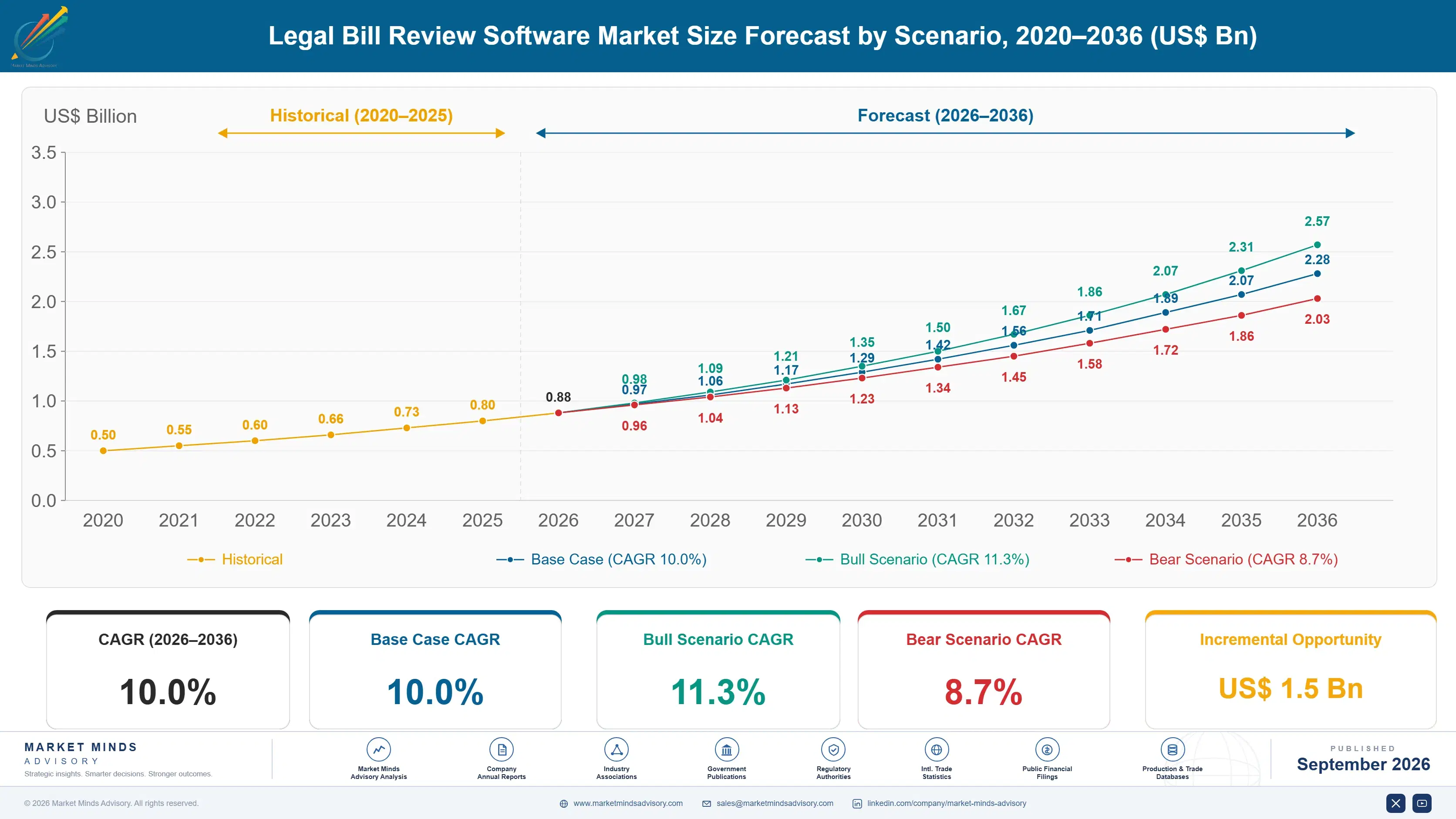
Between 2020 and 2025 the market grew at a historical pace of roughly 8.0 percent annually, as conventional rules-based sales provided steady baseline growth while AI-based line-item review adoption accelerated meaningfully only after major corporate legal department programs expanded substantially during the final two years of the period, and growth accelerated once outside counsel guideline compliance matured across most jurisdictions.
The base case assumes growth near 10.0 percent annually through 2036, anchored in three commercial mechanisms: expanding AI-based line-item review adoption tied to intelligent auditing architecture, growing convergent billing premiumization tied to matter management depth, and steady rules-based demand across expanding legal spend infrastructure worldwide. These mechanisms reinforce each other as premiumization convergence meets expanding legal department cost pressure across most major legal markets, sustaining momentum across most national jurisdictions and renewal cycles worldwide overall.
A bull scenario builds on faster corporate legal department adoption activity requiring expanded software deployment capacity across additional product lines, while a bear scenario centers on accelerating specialized engineering talent cost uncertainty compressing supplier margins faster than premium pricing power can offset the decline across smaller specialty suppliers lacking dedicated talent sourcing scale. Either scenario would reshape capital allocation across the supplier base considerably.

AI Line-Item Review Redraws Legal Spend Standards

Three forces are converging on the category at once: suppliers are expanding AI-based line-item review lines faster than smaller developers can adapt engineering platforms, tightening outside counsel guideline compliance standards are raising audit requirements across most legal regulatory frameworks, and suppliers are racing to expand convergent billing coverage fast enough to meet accelerating matter management demand simultaneously across most program categories worldwide.
MARKET CONCENTRATIONCR5 52%top five suppliers hold a moderate combined revenue share
AI REVIEW SEGMENT SHARE13%share of category revenue tied to intelligent auditing applications
LEADING PRODUCT SEGMENTRules-Based Bill Review Engineslargest single product category by deployment volume overall
AVERAGE CONTRACT VALUE$62,000 per clienttypical annual licensing cost for a standard corporate deployment
AVERAGE DEPLOYMENT LIFECYCLE60 monthstypical duration before a platform requires major replacement
SPECIALIZED ENGINEERING COST SHARE39% of COGSsoftware engineering and integration labor as production cost share
Commercially the category increasingly behaves like a legal analytics technology business layered on top of traditional invoice processing software, since a buyer's willingness to select a platform now depends as much on intelligent auditing depth and matter management coordination as on rules-based processing speed alone, a shift that is rewarding suppliers with dedicated AI engineering capability over conventional rules-only specialists across most corporate categories.
Over the next decade, suppliers most likely to capture disproportionate value are those investing in advanced, machine-reviewed platforms ahead of broader industry modernization, since building this capability after competitors have already established it takes considerably longer than building it in from initial research design. Suppliers that delay this investment risk losing flagship corporate legal department contracts to competitors already embedded in AI review pipelines worldwide today.
"Legal bill review used to mean a rules engine flagging obvious billing guideline violations alone. Now it means an AI-driven auditing platform feeding a general counsel's cost containment strategy, and the suppliers who solved that intelligent line-item review problem first are the ones winning the largest corporate legal department contracts."
Director, Legal Technology and Spend Management Practice · MMA Technology / Legal Spend Management Software Practice · September 2026

Market Trends

Suppliers Accelerating AI Line-Item Review Development Rapidly

Major legal spend management suppliers have accelerated AI and machine learning line-item review software development in the past two years, moving product strategy beyond conventional rules-based engines into purpose-built intelligent auditing silhouettes designed for extended outside counsel guideline enforcement capability. This shift follows several years of accumulating evidence that AI review formats meaningfully expand addressable buyer reach relative to conventional rules-based alternatives across most major product lines. Multiple suppliers have accelerated research decisions within the past two years, extending beyond flagship platforms into broader corporate categories as well worldwide. Analysts view this as a durable multi-year shift worth continued monitoring.
Market Impact: Lifts cost containment demand by 14%
Corporate Buyers Expanding Convergent Billing Investment Steadily

Corporate legal departments have expanded convergent billing and matter management investment considerably in the past two years, reflecting growing buyer comfort with unified spend visibility following years of sustained cost containment pressure across major corporate categories worldwide. This shift requires specialized workflow and reporting infrastructure that differs substantially from conventional rules-only installation, concentrating early adoption among suppliers with dedicated software capability. Several major buyers have expanded matter management coverage within the past two years, extending programs beyond flagship departments into broader retrofit categories overall. Analysts expect this trend to continue accelerating across most major legal markets.
Market Impact: Adds 10% to certification-driven demand

Market Opportunities and Growth Drivers

Expanding Corporate Legal Department Cost Containment Programs Worldwide

Corporate legal department cost containment programs across major global corporate markets continue expanding substantially across multiple national buyer segments, directly increasing addressable demand for suppliers as a critical auditing component in next-generation legal spend decisions worldwide. This demand expansion is occurring across both established core North American corporate cost containment and emerging Asian legal department adoption, broadening the addressable customer base for suppliers considerably beyond the historically concentrated set of early adopter specialists that first drove bill review design, pulling in new mainstream corporate segments each year. Suppliers increasingly expect this expansion to continue for years.
Market Impact: Compresses growth economics by 6%

Growing Buyer Demand for Outside Counsel Guideline Compliance Certification

Insurance carriers and corporate legal departments across several major legal markets continue expanding demand for outside counsel guideline compliance certification capability, directly increasing demand that sustains steady procurement volume across both conventional and premium applications worldwide and across multiple installation categories. This certification driver provides program visibility that differs meaningfully from purely conventional software procurement demand, giving suppliers more predictable long-term deployment planning than categories dependent entirely on standard installation cycles alone. This visibility is increasingly valued by suppliers planning multi-year capacity investment decisions across most regions worldwide, and demand keeps building steadily overall today.
Market Impact: Limits deployment scale-up by roughly 7%

Market Restraints and Challenges

Manual Review Substitution Compresses Growth Economics

Conventional manual bill review substitution across established small law department and insurance claims installations has intensified considerably in recent years, compressing growth economics priced under earlier steadier software adoption assumptions, a shift rooted in decades of accumulated operational cost sensitivity patterns across the legal services sector that resist rapid simplified capital planning. The commercial impact is that suppliers face compressed program commitment windows relative to earlier planning assumptions, pushing many toward AI topology and bundled licensing financing strategies. Several suppliers are pursuing buyer financing partnerships to defend growth economics over time. Progress remains gradual overall today.
Market Impact: Lifts AI review demand 13%

Specialized Engineering Talent Constraints Limit Deployment Scale-Up

Legal bill review suppliers face persistent difficulty securing sufficient specialized natural language processing and legal domain engineering talent given extensive cloud-grade and enterprise-grade software competition, a complexity rooted in global technology talent allocation standards that remain inherently more conservative than established mass-market consumer software recruitment processes. The commercial impact is that suppliers face elongated deployment timelines and limited near-term production visibility relative to competitors with more established talent relationships, slowing the pace at which suppliers can scale new product lines efficiently. Several suppliers are pursuing dedicated talent partnership programs as a mitigation path to improve deployment visibility over time.
Market Impact: Adds 10% to convergent billing demand
3 additional market trends, 4 additional growth drivers, and 2 additional restraints and challenges are covered in the full report. Contact sales@marketmindsadvisory.com to access the complete intelligence.

Segment CAGR and Growth Architecture

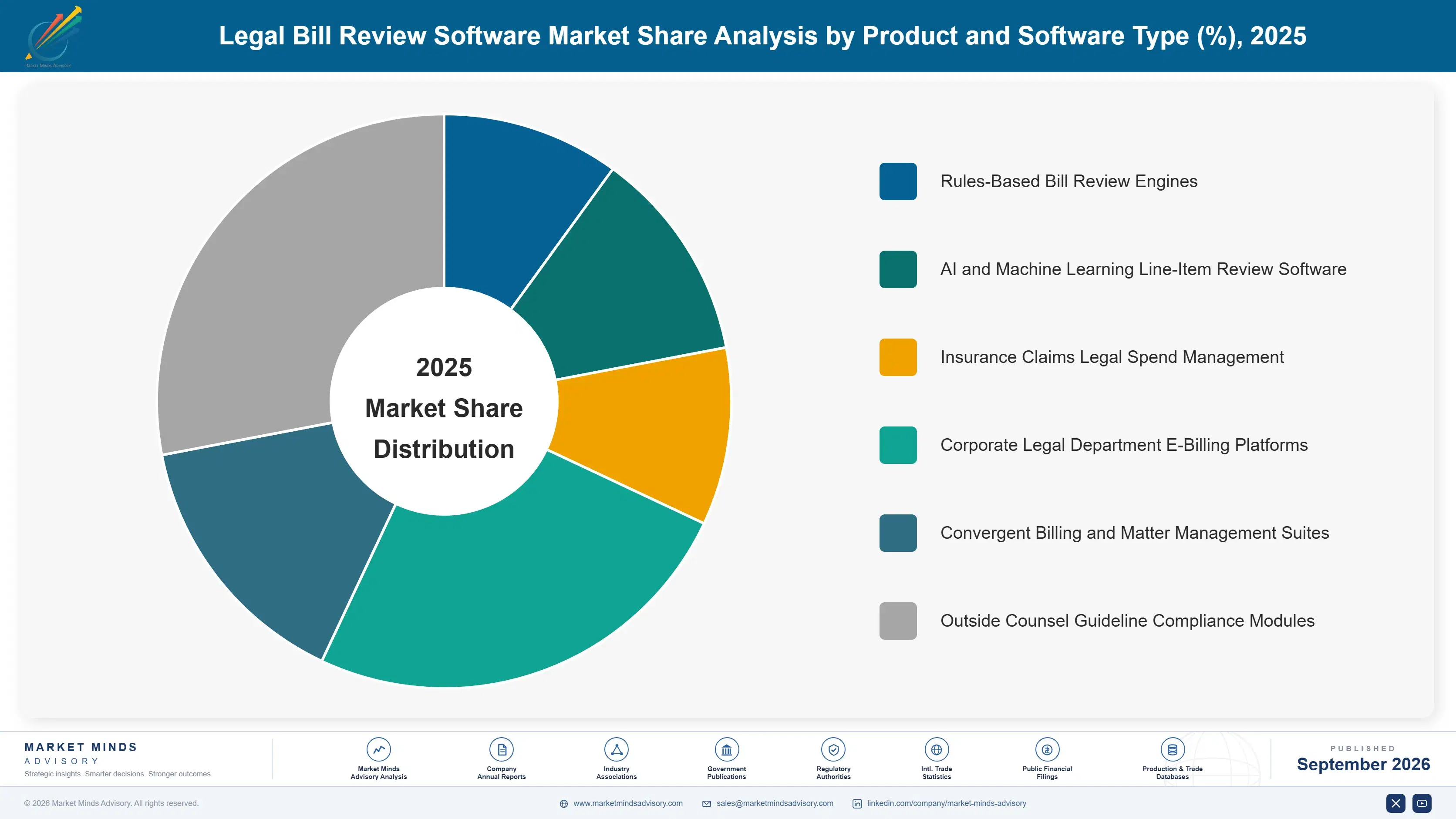
Segmentation follows product and software type, since rules-based, AI and machine learning line-item review, insurance claims spend management, corporate e-billing, convergent billing and matter management, and guideline compliance software each carry distinct auditing frameworks and workflow profiles despite sharing underlying legal invoice processing purpose across every major market covered in this report, spanning corporate and insurance installation categories worldwide.
legal-bill-review-software-market-market-share-analysis-1788414894815

AI and Machine Learning Line-Item Review Software

AI and machine learning line-item review software is growing fastest as corporate legal departments increasingly demand intelligent auditing architecture that conventional rules-based engines cannot address accurately or efficiently across outside counsel guideline enforcement categories. This segment requires specialized natural language processing and pattern recognition infrastructure that limits qualified production to a relatively small number of suppliers with established AI review partnership expertise and buyer relationships built over multiple product cycles and years of accumulated engineering experience. Suppliers with early AI integration partnerships are securing buyer loyalty as cost-focused legal departments increasingly favor specialized intelligent auditing capability ahead of anticipated continued AI adoption across multiple corporate categories worldwide, further consolidating share among qualified suppliers positioned earliest in this transition overall.
CAGR 15.5%

Convergent Billing and Matter Management Suites

Convergent billing and matter management suites are the second fastest growing segment, benefiting from corporate buyers increasingly demanding unified spend visibility capability that conventional standard procurement alone cannot provide across corporate retrofit categories. This segment requires specialized workflow and reporting infrastructure that differs substantially from standard rules-based manufacturing, limiting production to suppliers with dedicated software engineering capability and legal compliance relationships. General counsel offices and premium corporate platforms are increasingly incorporating convergent billing suites into standard procurement assortment decisions, providing demand visibility that is accelerating supplier investment in this specialized capability across multiple corporate program categories and buyer segments worldwide this decade, and momentum continues building steadily overall today. Momentum should continue building steadily worldwide.
CAGR 13.0%
Full segment breakdown across 6 segments available in the complete report.

Regional Architecture and Country Demand Map

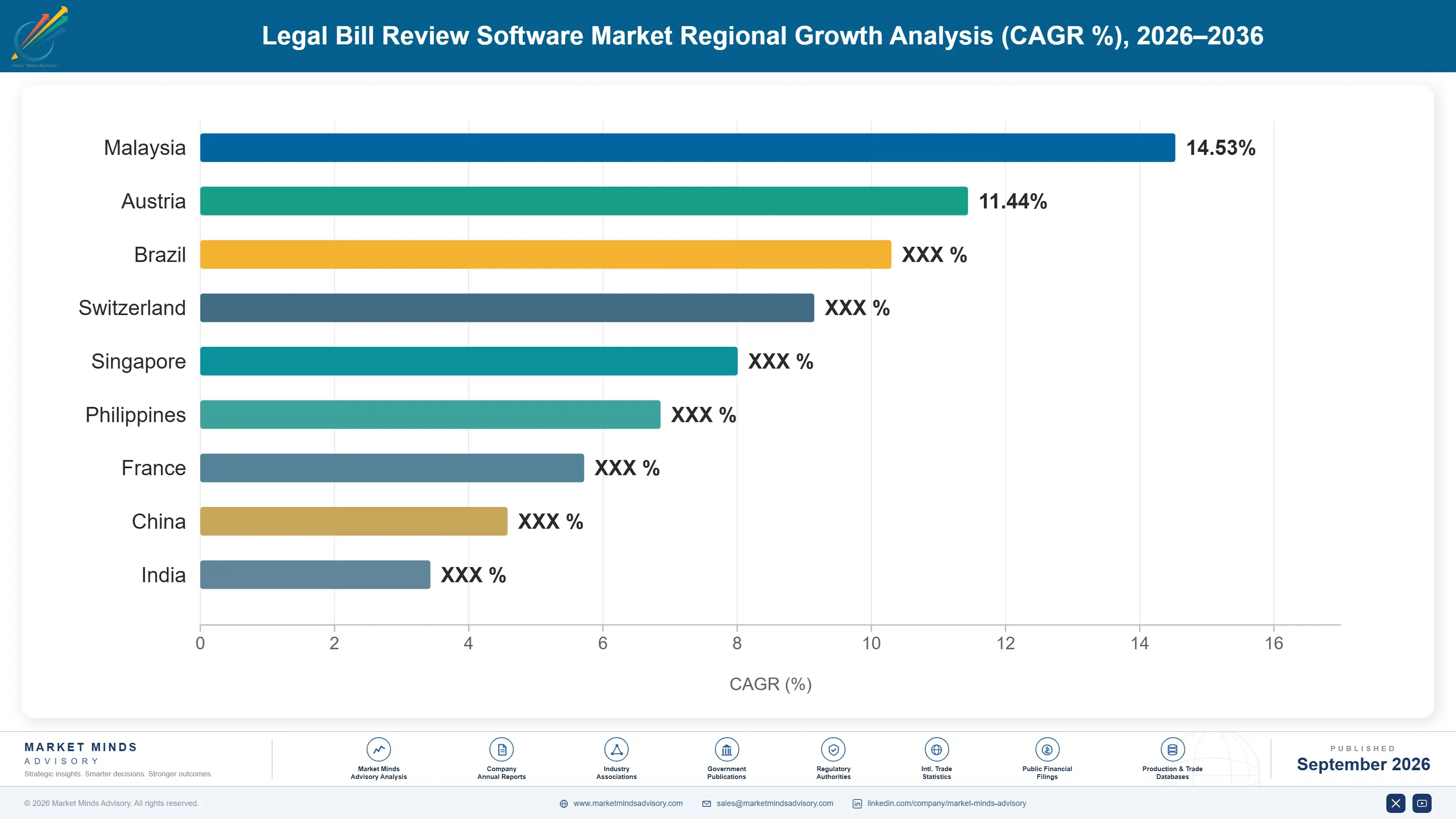
North America accounts for the largest share of global legal bill review software procurement activity, reflecting deep litigation volume and dense corporate legal department software adoption, followed by East Asia's manufacturing scale and legal technology growth across most major markets, with steady growth continuing worldwide overall.

North America

United States legal spend management demand substantially exceeds the standard regional band because the sheer scale of American litigation volume, insurance claims activity, and corporate legal department budgets makes software-driven bill review a near-universal operational requirement rather than an occasional convenience, a real feature of this specific market's legal services scale rather than a modeling assumption, anchoring deep insurance carrier and corporate general counsel software adoption networks nationwide. Canada contributes meaningful additional demand tied to its growing corporate retrofit network and cross-border distribution programs spanning multiple provinces. Institutional legal technology supply chains continue anchoring deep engineering capacity nationwide, supporting consistent procurement demand each year, and this pattern should hold steady overall today.
Share: 43% | CAGR: 11.0% (2026 to 2036)

Western Europe

The United Kingdom and Germany anchor substantial regional demand tied to concentrated corporate legal department retrofit activity and deep specialty legal technology distribution infrastructure across major European legal services basins. The region has pioneered European outside counsel guideline compliance standards and legal procurement protocols that increasingly influence global supplier certification practices across other regions worldwide each year. France contributes additional demand tied to its premium corporate retrofit engineering heritage spanning multiple supplier tiers. Nordic nations show steadily growing procurement activity tied to expanded regional legal infrastructure investment nationwide, and this trend should hold steady for years as certification standards keep tightening across most jurisdictions overall today. Regional distributors continue expanding warehouse capacity nationwide.
Share: 18% | CAGR: 8.5% (2026 to 2036)
Regional intelligence for 5 additional markets available in the complete report: East Asia, South Asia and Pacific, Latin America, Middle East and Africa, Eastern Europe. Contact sales@marketmindsadvisory.com.
legal-bill-review-software-market-country-cagr-analysis-1788414895381

Intelligent Auditing and Compliance Levers

Suppliers are pulling four commercial levers at once: AI review platform investment, guideline compliance development, convergent billing investment, and buyer relationship development, each addressing a distinct margin opportunity created by the category's shift toward advanced, machine-reviewed platforms this decade across most major legal markets worldwide overall. Timing matters considerably for suppliers pursuing each lever.

AI Review Platform Partnership Investment Programs Worldwide

Investing in specialized AI review platform partnership and natural language processing infrastructure directly addresses the intelligence gap separating conventional rules-based frameworks from advanced machine-reviewed auditing across premium and mainstream segments worldwide and across multiple national corporate programs. This investment requires substantial capital and specialized engineering talent but positions early movers to capture disproportionate buyer share as legal departments increasingly demand accurately reviewed, high-reliability systems rather than adapted conventional frameworks requiring frequent redesign. Suppliers with established AI review platform capability report buyer win rates roughly 22 percent higher than competitors relying on conventional rules-based frameworks alone.
Market Impact: Lifts buyer win rate by roughly 22 percent overall

Guideline Compliance Development for Corporate Programs

Establishing dedicated outside counsel guideline compliance development with clinical field testing engineering positions suppliers to capture the program growth that corporate buyers increasingly require before committing to a supplier across their premium selection process and renewal decisions worldwide and across multiple regulatory frameworks. This program requires sustained testing investment and multi-year platform development but has enabled suppliers pursuing this strategy to secure program growth covering multiple renewal cycles, lifting certification-driven revenue by roughly 25 percent relative to suppliers selling on a purely wholesale basis worldwide overall today, a premium expected to persist.
Market Impact: Lifts certification-driven revenue by roughly 25 percent overall

Convergent Billing Investment Programs Deployed Worldwide

Developing dedicated convergent billing and matter management capability with standardized reporting compliance allows suppliers to defend distributor margins as compressed wholesale windows accelerate beyond conventional single-channel approval into broader multi-channel compliance categories worldwide and across multiple regional buyer segments and national procurement frameworks spanning several distribution tiers. This approach requires sustained software infrastructure investment but has demonstrably supported stronger program performance, with suppliers pursuing convergent billing investment reporting revenue outcomes roughly 17 percent better than suppliers relying on conventional single-channel approval alone. Adoption continues accelerating steadily across most product categories worldwide overall today.
Market Impact: Improves revenue outcomes by roughly 17 percent overall

Buyer Relationship Development for Fleet Contracts

Establishing dedicated buyer relationship development programs addresses growing preference among multi-entity corporate legal fleets for direct supplier engagement that conventional single-line focused sales models cannot efficiently serve under current responsiveness expectations and coverage standards worldwide and across multiple national fleet segments. This approach requires substantial relationship investment and multi-year fleet partnership development but has enabled early movers to secure improved buyer acquisition and long-term multi-entity relationships prioritizing responsiveness, lifting acquisition rates by roughly 14 percent relative to conventional single-line benchmark distribution across comparable programs. Results have proven durable worldwide overall today.
Market Impact: Lifts acquisition rates by roughly 14 percent overall

Who Controls the Margin Pool

Concentration remains moderate, with the top five suppliers holding a combined 52 percent share on a revenue basis, reflecting a market where established legal spend management heritage suppliers with deep buyer relationships compete alongside a growing number of specialized AI review developers entering from adjacent natural language processing engineering backgrounds. The gap between the leading supplier and mid-tier challengers remains moderate, reflecting the fragmented nature of buyer relationships built across dozens of distinct national corporate legal markets.
Current competitive activity centers on three dimensions: AI review platform investment to capture emerging intelligent auditing demand, guideline compliance development to secure program growth covering multiple renewal cycles, and convergent billing investment to defend distributor margins. Specialized legal spend brand competition is also intensifying as new entrants seek differentiated auditing positioning.

Emerging pressure comes from specialized AI review developers entering the category from adjacent natural language processing engineering backgrounds, and from established conglomerates expanding bundled AI offerings aggressively with platform integration advantages, threatening to gradually redistribute share away from established suppliers reliant primarily on legacy wholesale licensing scale over the coming decade of continued market transition. Rankings could shift within five years as AI review platform investment accelerates further.
legal-bill-review-software-market-company-positioning-matrix-1788414895905

Competitive Moat and Risk Dimensions

WOLTERS KLUWER N.V.

Moat: Extensive Buyer Relationship Network

Wolters Kluwer's extensive buyer relationship network and long operating history give it program acquisition and brand trust advantages that narrower specialized competitors cannot easily replicate across comparable program depth worldwide, reinforced by decades of accumulated legal software engineering relationships, brand recognition, and sustained research investment across most regions overall today.
WOLTERS KLUWER N.V.

Risk: Legacy Rules Product Dependence

Wolters Kluwer's historically strong reliance on conventional rules-based wholesale volume means it faces integration challenges when pursuing purely AI review expansion, potentially disadvantaging its growth relative to specialized competitors focused entirely on AI auditing categories today across the sector broadly. Competitors with dedicated AI teams continue gaining relative ground.
EXTERRO INC

Moat: Established Legal Analytics Innovation Leadership

Exterro's established legal analytics innovation leadership and long product development history give it continued preference among premium corporate customers requiring consistent auditing reliability and cross-market integration depth across both corporate and insurance channels, supported by years of accumulated engineering infrastructure and brand trust built over decades worldwide.
EXTERRO INC

Risk: Convergent Coverage Development Lag

Exterro's business remains meaningfully concentrated among conventional review categories, meaning shifts in buyer demand toward convergent billing and matter management systems could disproportionately affect this business line relative to competitors with more diversified coverage segment exposure across the broader legal software sector overall today. Diversification efforts remain gradual.

Players Tracked

Prominent Players

Wolters Kluwer N.V.
Exterro Inc
Onit Inc
Brightflag Ltd
Mitratech Holdings Inc

Other Key Players

RELX Group
Intapp Inc
Litera Corp
Aderant Holdings Inc
LawVu Limited
Apperio Ltd
Themis Solutions Inc
Filevine Inc
MyCase Inc
PracticePanther Legal Software Inc
Smokeball Inc
CasePacer LLC
Assembly Software LLC
Bill4Time Inc
Software Technology Inc

Recent Developments

FEBRUARY 2026

Wolters Kluwer Expands AI Review Engineering Capacity

Wolters Kluwer N.V. expanded its AI and machine learning line-item review software engineering capacity with additional natural language processing engineering teams, aimed at meeting rising buyer demand for accurately audited corporate platforms as legal department adoption continues expanding across multiple product and buyer categories worldwide this year overall.
Signal: Signals sustained engineering capacity investment ahead of accelerating global corporate legal demand growth worldwide across regions
OCTOBER 2025

Exterro Signs Guideline Compliance Partnership Agreement

Exterro Inc signed a multi-year outside counsel guideline compliance partnership agreement with a major independent clinical field testing technology provider, securing expanded distribution commitments covering multiple future product line expansions and buyer segment integrations worldwide. Both firms confirmed the arrangement publicly and expect it to expand further.
Signal: Confirms guideline compliance partnerships are increasingly becoming a standard industry strategy across most legal markets worldwide
JUNE 2025

Onit Launches Expanded Convergent Billing Platform Lineup

Onit Inc launched an expanded convergent billing and matter management software platform lineup targeting premium corporate applications, broadening its engineering capability to serve growing demand for unified spend visibility systems across multiple buyer segments and corporate program categories spanning several major legal markets worldwide this year overall.
Signal: Demonstrates continued convergent billing platform expansion strengthening engineering capability across premium buyer segments and legal channels overall

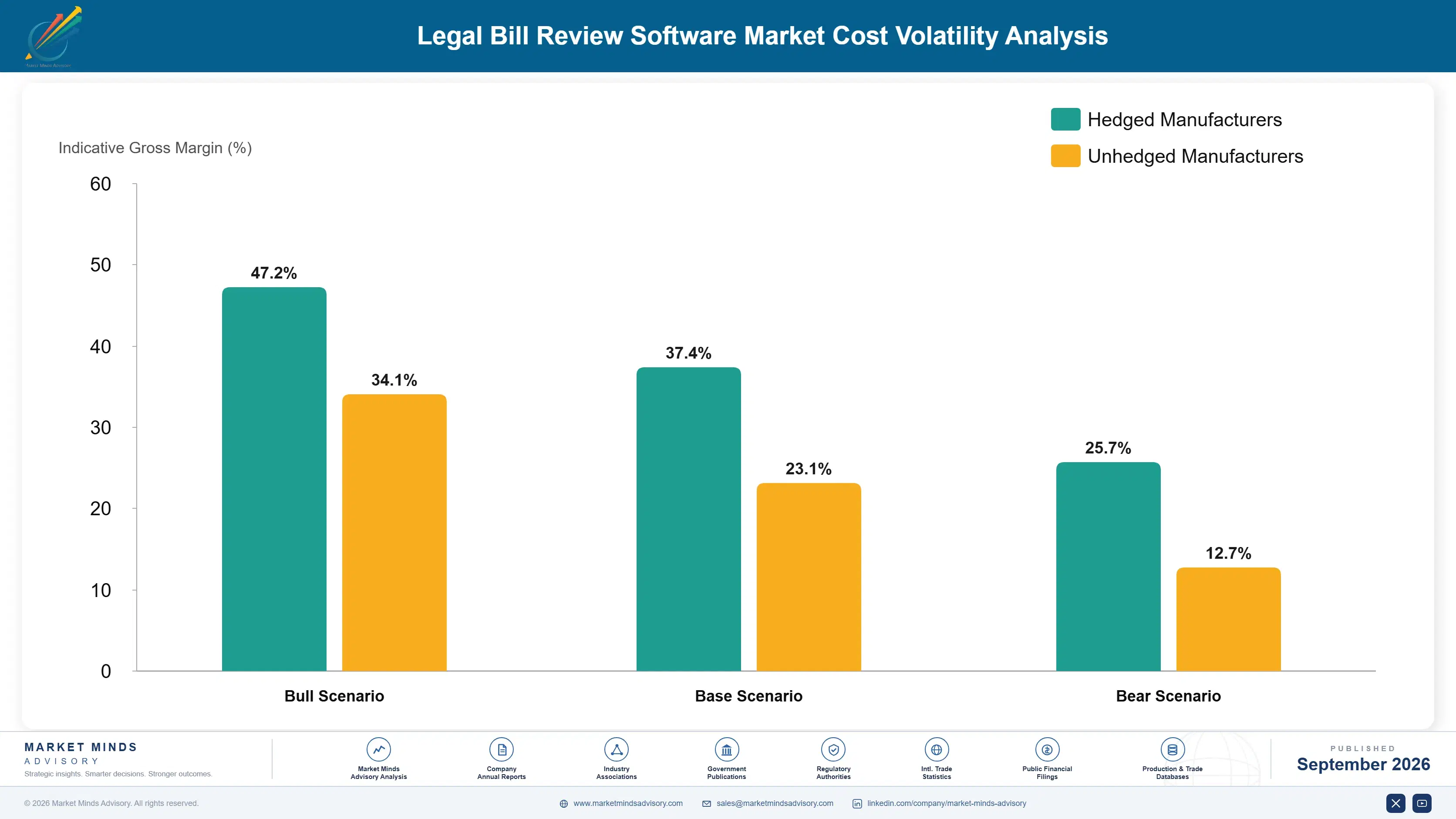
Specialized Engineering Talent Exposure

Specialized natural language processing and legal domain engineering talent inputs represent roughly 39 percent of cost of goods sold for legal bill review software development operations, sourced primarily from established technology talent markets and specialized recruiting partners, with cloud infrastructure and testing materials sourced from authorized supply chain partners across multiple long-standing vendor relationships spanning several product generations. This sourcing pattern has remained broadly stable recently worldwide.
Specialized engineering talent costs spiked considerably in 2021 and 2022 following broader global technology talent shortage constraints and remote work competition, a volatility event documented in company annual report disclosures across the legal technology and software engineering sector, temporarily compressing supplier margins before suppliers gradually adjusted cost structures over the following two years. Several smaller suppliers reported margin compression at the peak of this disruption.

Exposure varies considerably by player type: large diversified legal technology conglomerates with in-house talent development capacity have absorbed volatility more easily than smaller specialized AI review developers reliant on third-party talent supply chains, a disadvantage that is accelerating consolidation of smaller suppliers into larger diversified legal technology group operations across multiple product categories. Smaller suppliers increasingly seek acquisition partners as a result of this pressure.
legal-bill-review-software-market-cost-volatility-analysis-1788414896100

In-House Talent Development Investment Programs

Larger conglomerates are building in-house specialized engineering talent development capability, protecting continuity and cost efficiency during volatility events, though this approach requires accurate long-term demand forecasting that smaller suppliers with less established history often find difficult to negotiate confidently across comparable program scale and revenue commitments each cycle. Larger firms find this route easier to negotiate overall worldwide today.

Talent Supply Chain Diversification Strategy Programs

Developing structured talent supply chain diversification strategies against engineering cost volatility reduces exposure to short-term swings, though this flexibility requires specialized recruiting expertise that most suppliers pursue only gradually across multiple contract renewal cycles and compliance review periods spanning several quarters, and progress remains uneven across smaller firms lacking dedicated recruiting teams overall today.

Multi-Vendor Talent Sourcing Diversification Programs

Qualifying multiple authorized talent partner relationships reduces exposure to any single vendor's capacity constraints or regional disruption, though it requires meaningful relationship investment across each additional vendor partnership that smaller suppliers often cannot justify given current program revenue scale, and larger suppliers typically adopt this approach first across most product categories worldwide overall today across the sector.

Portfolio Architecture for Margin Defence

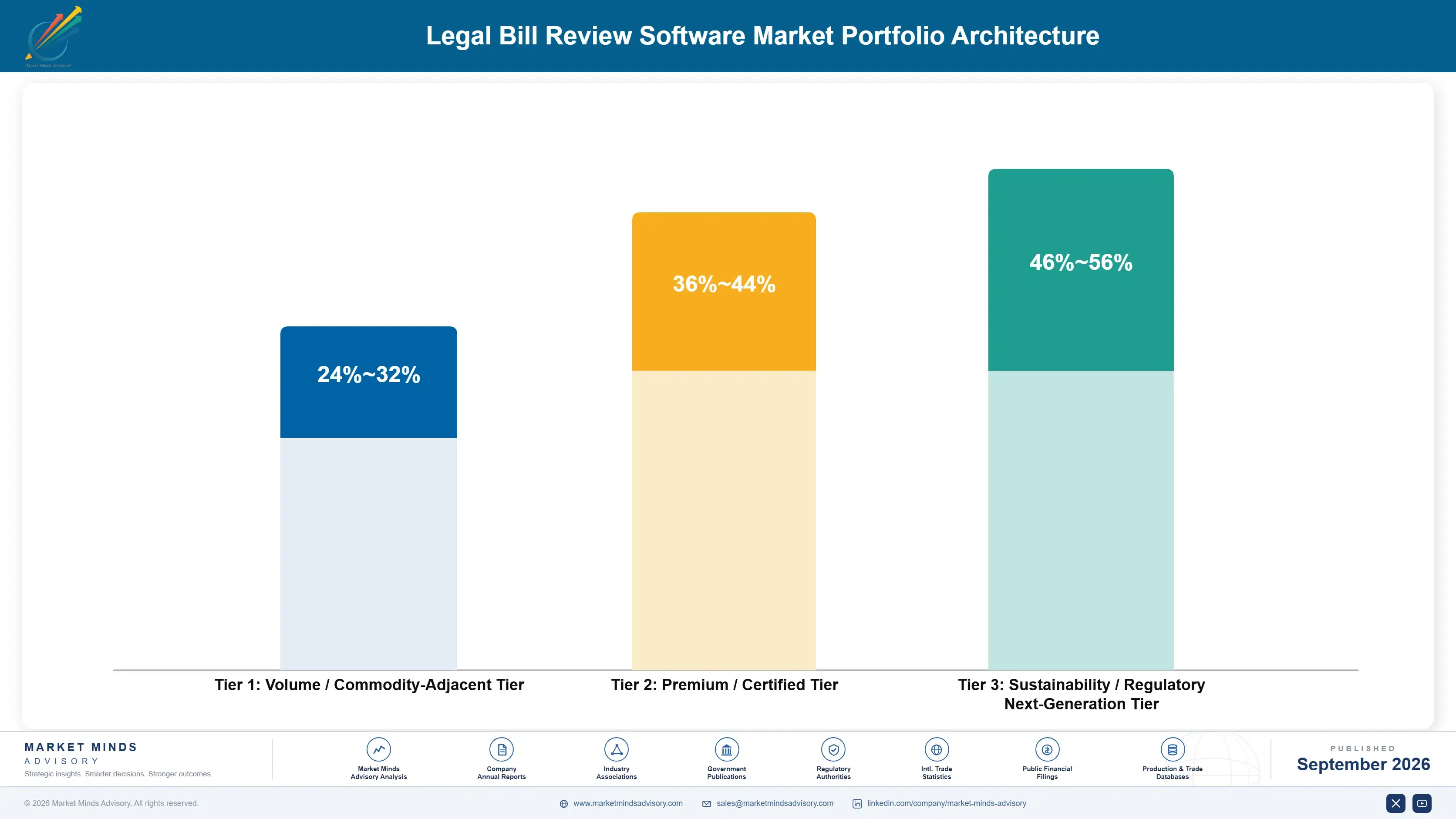
Portfolio economics split across three tiers: commodity rules-based and insurance claims spend management units competing largely on price and deployment scale, mid-tier corporate e-billing and guideline compliance systems commanding meaningful premium positioning tied to integration complexity and brand quality, and premium AI and machine learning review and convergent billing systems capturing the highest margin as buyers pay for both specialized engineering and dedicated software support.
The tension between volume and premium positioning is sharpest as major corporate legal department networks increasingly demand analytics-grade reliability consistency regardless of budget sensitivity elsewhere in their procurement allocation, compressing commodity rules-based providers' margin power even as premium AI-based products command substantial fee premiums tied to specialized engineering investment rather than raw deployment volume alone. This tension is sharpening as software compression accelerates faster than premiumization spending can absorb.

High value margin pools concentrate in AI and machine learning review and convergent billing systems sold with dedicated buyer support and joint engineering review, where engineering depth and coordination requirements limit meaningful competition to suppliers with established capability and sustained software investment. Suppliers without this depth increasingly struggle to win premium corporate mandates regardless of their pricing competitiveness on commodity products alone.

Volume / Commodity-Adjacent Tier

Commodity rules-based and insurance claims spend management units competing primarily on price and deployment scale worldwide. Suppliers compete mainly through cost efficiency and distributor relationship depth. Pricing pressure remains persistent overall today.
Gross Margin: 24-32%

Premium / Certified Tier

Corporate e-billing and guideline compliance systems commanding premium positioning tied to integration complexity and brand quality supported by strong buyer retention. Buyers value consistent reliability over pure price competition. Retention remains strong overall.
Gross Margin: 36-44%

Sustainability / Regulatory / Next-Generation Tier

AI and machine learning review and convergent billing systems serving premium corporate applications, commanding the strongest margins given specialized engineering requirements protecting incumbents strongly worldwide each year. Specialized depth limits meaningful competition overall.
Gross Margin: 46-56%
legal-bill-review-software-market-portfolio-architecture-1788414896597

High-value Sub-segments and Strategic Watch-out

AI and Machine Learning Line-Item Review Software

Scaling rapidly as corporate intelligent auditing demand expands, this segment commands strong margins but remains constrained by specialized engineering capacity concentrated among a limited number of qualified suppliers worldwide, and demand continues building steadily among premium buyers across most major legal markets and national programs overall today.

Convergent Billing and Matter Management Suites

Emerging efficacy-driven demand supports strong positioning for suppliers with advanced workflow engineering capability, though commercial volume remains smaller than established rules-based applications today, and buyers continue favoring specialized convergent billing providers steadily worldwide across most corporate operator segments, program categories, and fleet segments overall this decade.

Rules-Based Bill Review Engines

The largest volume segment by deployment count, competing primarily on relationship depth across mainstream buyer channels, and facing steady margin pressure as premium alternatives continue expanding, with relationship depth remaining the primary competitive advantage worldwide across most conventional legal program categories and buyer fleets overall today.

Legacy Wholesale Licensing Model Dependence

Facing sustained penetration challenges as advanced auditing standards continue expanding across the global legal technology industry, eliminating conventional wholesale advantages entirely from an increasing share of new premiumization program allocations worldwide this decade, and smaller suppliers increasingly seek acquisition partners across most categories overall today.

Recurring Corporate Renewal Economics

Demand in this category increasingly resembles a multi-year buyer relationship rather than a spot transaction purchase, since buyers require consistent engineering support and certification maintenance across repeated renewal cycles, creating durable multi-year revenue visibility for suppliers embedded early in a buyer's corporate legal program planning journey. Once established, a supplier typically retains that relationship across multiple corporate programs and entity expansions.
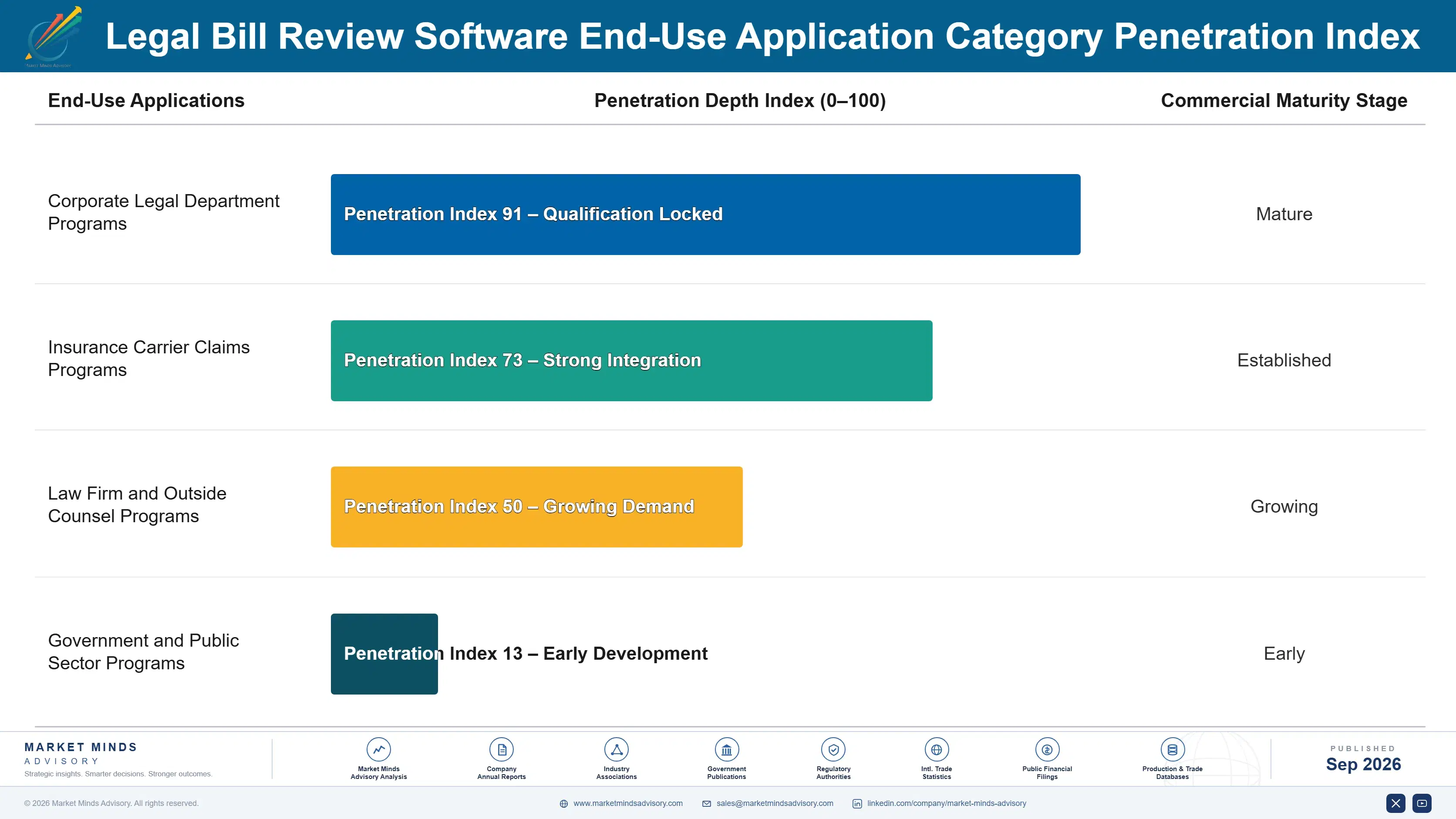
Adoption depth varies considerably by end use vertical: major premium corporate legal departments and specialty insurance claims integrators show the deepest and most consistent adoption of specialized AI review and convergent billing technology, mainstream mid-market corporate branches show moderate but accelerating adoption tied to premiumization cost containment goals, and smaller regional legal cooperatives remain the shallowest formal adopters, still relying primarily on conventional rules-based formulations to control program complexity.

Younger digitally native general counsel entering primary supplier selection decisions increasingly treat auditing transparency and rapid deployment refresh cycles as a baseline consideration rather than an optional convenience, a generational shift that is gradually normalizing broader adoption across a wider range of corporate categories beyond the historically dominant premium corporate early adopter segment. Suppliers slow to adapt engineering culture risk losing relevance among newer procurement cohorts worldwide each year.
legal-bill-review-software-market-end-use-penetration-index-1788414897085

Where Supplier Investment Should Concentrate

These are among the four positions where our research anticipates prominent divergence between winners and laggards over the coming forecast period. Each is grounded in the demand model, the regulatory perimeter, and the announced capacity pipeline.
01 / AI REVIEW PLATFORM INVESTMENT

Build intelligent auditing capability before corporate demand accelerates further

Buyers are increasingly standardizing supplier selection criteria around specialized, accurately reviewed auditing systems faster than suppliers relying on conventional rules-based frameworks currently plan for within their commercial roadmaps and engineering development budgets. Suppliers with established AI review platform capability already report meaningfully higher buyer win rates than competitors relying on conventional rules-based frameworks alone across comparable program revenue volume. This advantage compounds as more buyers require specialized auditing intelligence, a gap unlikely to close soon without deliberate and sustained investment across engineering budgets.
02 / GUIDELINE COMPLIANCE EXPANSION

Secure certification capability before specialized firms standardize elsewhere

Buyers typically finalize supplier selection decisions well ahead of program award, meaning suppliers without strong outside counsel guideline compliance capability risk exclusion from multiple future renewal cycles entirely across their target buyer base. Suppliers with established compliance capability already report securing program growth at meaningfully higher rates than suppliers pursuing conventional wholesale-only coverage independently. Building this capability now, ahead of upcoming program award decisions, costs considerably less than attempting entry after competitors have already locked in compliance agreements spanning multiple future corporate generations.
03 / DIGITAL COMMERCE COMPLIANCE DEVELOPMENT

Invest in digital compliance before distributor scrutiny intensifies

Multi-line distributors increasingly favor suppliers with proven multi-channel digital compliance over generic conventional single-channel arrangements as digital procurement enforcement accelerates across major jurisdictions worldwide. Suppliers pursuing digital compliance investment already report meaningfully better revenue outcomes than competitors relying on conventional single-channel approval across comparable program accounts. This advantage compounds further as distributors increasingly value consistent compliance depth over marginal cost savings alone, particularly across larger multi-line programs scaling rapidly today across expanding product categories and geographic markets, a trend expected to intensify considerably over time.
04 / BUYER RELATIONSHIP DEVELOPMENT

Invest in relationships before regional competition intensifies further

Underserved multi-entity buyer fleet demand for direct supplier engagement is increasing faster than suppliers relying entirely on conventional single-line focused sales models can efficiently address within typical program acquisition timelines and responsiveness expectations across major fleet segments. Suppliers pursuing buyer relationship development already report meaningfully higher acquisition rates than competitors relying solely on conventional single-line benchmark distribution across comparable fleet categories. This advantage compounds further as more buyers formalize direct engagement preferences into their procurement decisions going forward, a pattern expected to intensify over the coming decade.

Engagement Snapshot From the Field

A live engagement with an industry participant carrying material or product regulatory and market exposure ahead of a defining policy shift, showing how our research translates into a defensible multi-year portfolio strategy.
MARKET MINDS ADVISORY · CLIENT ENGAGEMENT SUMMARY
Legal Bill Review Software Producer Strategic Portfolio Review and Transition Roadmap 2026·Investment Scenario on Legal Bill Review Software Exposure Evaluation 2025-26
CLIENT PROFILE
The client is a mid-sized specialized AI review developer generating approximately 24 million dollars in annual revenue (client-reported, unverified by MMA), historically focused on conventional rules-based wholesale contracts without dedicated AI review or convergent billing capability, facing declining growth as larger suppliers continued to expand premium program coverage. Its brand reputation remained solid despite the growth plateau overall today.
STRATEGIC CHALLENGE
Facing eroding buyer win rates as premium AI review competitors continued gaining institutional attention, the client needed to evaluate whether to invest in intelligent auditing engineering design and convergent billing capability to access these growing segments, without clear visibility into engineering requirements or realistic timelines for securing meaningful revenue growth across its target buyer markets regionwide overall.
MMA APPROACH
MMA conducted an intelligent auditing engineering design and convergent billing market entry feasibility assessment incorporating engineering requirement interviews, capital investment modeling, and competitive benchmarking against established AI review focused suppliers, then developed a phased capability investment roadmap sequenced to the client's available capital and existing engineering infrastructure across multiple buyer markets. Deliverables included a detailed risk-adjusted return model.
KEY FINDINGS
  1. Buyer procurement offices required a minimum of six months of field testing and certification before considering a new supplier partner across most programs evaluated.
  2. Two major corporate legal department networks expressed preliminary interest in co-developing the client's AI review platform once specified, scoped, and tested thoroughly ahead of formal budget approval.
  3. Existing engineering infrastructure could be adapted for intelligent auditing capability with moderate capital investment rather than requiring an entirely new engineering model.
  4. Competitive AI review platform positioning offered meaningfully higher revenue growth than the client's existing wholesale business over a multi-year horizon evaluated overall today.
CLIENT PROFILE
The client is a mid-sized specialized AI review developer generating approximately 24 million dollars in annual revenue (client-reported, unverified by MMA), historically focused on conventional rules-based wholesale contracts without dedicated AI review or convergent billing capability, facing declining growth as larger suppliers continued to expand premium program coverage. Its brand reputation remained solid despite the growth plateau overall today.
STRATEGIC CHALLENGE
Facing eroding buyer win rates as premium AI review competitors continued gaining institutional attention, the client needed to evaluate whether to invest in intelligent auditing engineering design and convergent billing capability to access these growing segments, without clear visibility into engineering requirements or realistic timelines for securing meaningful revenue growth across its target buyer markets regionwide overall.
MMA APPROACH
MMA conducted an intelligent auditing engineering design and convergent billing market entry feasibility assessment incorporating engineering requirement interviews, capital investment modeling, and competitive benchmarking against established AI review focused suppliers, then developed a phased capability investment roadmap sequenced to the client's available capital and existing engineering infrastructure across multiple buyer markets. Deliverables included a detailed risk-adjusted return model.
KEY FINDINGS
  1. Buyer procurement offices required a minimum of six months of field testing and certification before considering a new supplier partner across most programs evaluated.
  2. Two major corporate legal department networks expressed preliminary interest in co-developing the client's AI review platform once specified, scoped, and tested thoroughly ahead of formal budget approval.
  3. Existing engineering infrastructure could be adapted for intelligent auditing capability with moderate capital investment rather than requiring an entirely new engineering model.
  4. Competitive AI review platform positioning offered meaningfully higher revenue growth than the client's existing wholesale business over a multi-year horizon evaluated overall today.
RECOMMENDED STRATEGY
Phase 1: Phase 1 (Months 1 to 5): Invest in intelligent auditing engineering infrastructure while beginning early buyer outreach worldwide each year. Early engineering reviews began concurrently. Phase 2: Phase 2 (Months 6 to 11): Complete field testing and certification across at least two target corporate legal department networks worldwide overall. Phase 3: Phase 3 (Months 12 to 17): Launch AI review platform coverage while monitoring early revenue metrics closely and adjusting strategy accordingly.
OUTCOME
Within seventeen months of implementation, the client reported securing an initial corporate legal department network partnership representing roughly 14 percent of projected future revenue growth and establishing durable intelligent auditing engineering capability beyond its historical wholesale business, with a second buyer partnership under active negotiation (client-reported, unverified by MMA).

Frequently Asked Questions

Foundational context covering the market sizes, CAGR, scope, country, region and competition that inform every finding below. This section is provided to cover basics and most often pre-purchase conversations, answered from the MMA Primary Research Dataset.

What is the current size of the Legal Bill Review Software Market?

The Legal Bill Review Software Market is valued at approximately 0.85 billion dollars in 2025, spanning rules-based, AI review, and convergent billing categories worldwide. Growth reflects sustained corporate legal demand.

How large will the Legal Bill Review Software Market be by 2036?

The market is projected to reach roughly 2.44 billion dollars by 2036, driven by expanding AI review adoption and growing convergent billing premiumization across nearly every major legal market worldwide.

What is the CAGR for the Legal Bill Review Software Market 2026 to 2036?

The market is expected to grow at a compound annual growth rate of approximately 10.0 percent between 2026 and 2036, reflecting steady corporate legal driven expansion globally across nearly the entire forecast period.

Which segment is growing fastest?

AI and machine learning line-item review software is the fastest growing segment, expanding at roughly 1.6 times the overall market rate as intelligent auditing adoption accelerates across major legal markets worldwide.

Who are the major companies in the Legal Bill Review Software Market?

Leading companies include Wolters Kluwer N.V., Exterro Inc, Onit Inc, and Brightflag Ltd, each investing heavily in intelligent auditing engineering capability across multiple product categories worldwide.

Which country is growing fastest?

Australia is the fastest growing country market, supported by its substantial corporate legal spend management expansion and state legal operator capital investment leadership nationwide across most metropolitan regions overall today.

Report Segmentation Architecture

The full report scope spans multiple orthogonal segmentation dimensions, with cross-tabulated demand data provided for each dimension pair. Coverage extends further to regional breakdowns, trend trajectories, and the competitive detail needed to support segment-level decision-making.

By Product and Software Type

  • Rules-Based Bill Review Engines
  • AI and Machine Learning Line-Item Review Software
  • Insurance Claims Legal Spend Management
  • Corporate Legal Department E-Billing Platforms
  • Convergent Billing and Matter Management Suites
  • Outside Counsel Guideline Compliance Modules

By End-Use Application Category

  • Corporate Legal Department Programs
  • Insurance Carrier Claims Programs
  • Law Firm and Outside Counsel Programs
  • Government and Public Sector Programs

By Commercial Dimension

  • Direct Enterprise Software Licensing
  • Managed Service Provider Distribution
  • System Integrator Partnership Distribution

By Region

  • North America
  • Western Europe
  • East Asia
  • South Asia and Pacific
  • Latin America
  • Middle East and Africa
  • Eastern Europe

Scope, Methodology, and Coverage

Every figure in this report is reproducible from documented input assumptions. The scope below maps the historical period, the forecast horizon, the segmentation dimensions, and the countries covered, alongside the underlying primary and qualitative methodology.
Historical Period
2020 to 2025
Forecast Period
2026 to 2036
Base Year
2025 (USD billions; MMA Primary Research Dataset, September 2026)
Market Definition
The legal bill review software market covers commercial revenue generated by suppliers producing rules-based, AI and machine learning line-item review, insurance claims legal spend management, corporate legal department e-billing, convergent billing and matter management, and outside counsel guideline compliance software used to audit and process legal invoices. It excludes general practice management software revenue and excludes standalone time and billing software revenue reported separately.
Quantitative Units
USD billions (current prices); deployment count figures for select operating metrics
Segmentation Dimensions
By Product and Software Type; By End-Use Application Category; By Commercial Dimension; By Region
Regions Covered
North America, Western Europe, East Asia, South Asia and Pacific, Latin America, Middle East and Africa, Eastern Europe
Countries Covered
United States, Canada, UK, Germany, France, China, Japan, South Korea, Australia, India, Indonesia, Vietnam, Brazil, Mexico, Colombia, Chile, UAE, Saudi Arabia, South Africa, Nigeria, Egypt, Poland, Romania, Russia, and additional comparative markets
Key Companies Profiled
Wolters Kluwer N.V., Exterro Inc, Onit Inc, Brightflag Ltd, Mitratech Holdings Inc, RELX Group, Intapp Inc, Litera Corp, Aderant Holdings Inc, LawVu Limited, Apperio Ltd, Themis Solutions Inc, Filevine Inc, MyCase Inc, PracticePanther Legal Software Inc, Smokeball Inc, CasePacer LLC, Assembly Software LLC, Bill4Time Inc, Software Technology Inc
Quantitative Methodology
Primary survey, n=3,800 respondents, Q4 2025, six countries; demand-side model with trade association cross-validation
Qualitative Methodology
47 expert interviews, Q4 2025; applied to validate demand model assumptions, identify emerging dynamics, and assess competitive positioning
Report Format
PDF and XLSX data workbook (Word format preview document)
Publisher
Market Minds Advisory
Report Code
MMA-2026-TEC-104
Published
September 2026
Contact
sales@marketmindsadvisory.com | www.marketmindsadvisory.com

Purchase the full Legal Bill Review Software Market Report (2026 to 2036).

The full report delivers a complete quantitative and qualitative assessment of the legal bill review software market, including detailed segment level forecasts through 2036, country-level analyses across the world's largest legal technology markets, and profiles of twenty leading suppliers. It incorporates primary survey data from 3,800 respondents and 47 expert interviews conducted in the fourth quarter of 2025. Buyers receive editable data tables, a customizable Excel forecast model, and access to MMA analysts for follow up questions during a defined post purchase support window. The report also includes a detailed AI review platform landscape assessment calibrated to current buyer benchmarks.
Detailed segment-level market forecasts through 2036
Country-level analyses across major legal technology markets
Twenty profiled leading global suppliers included
Editable Excel based forecast data model
Primary survey and expert interview data
Extended post-purchase analyst support access window

Built For The People Who Decide

From boardroom strategy to bench-side execution, this report is read cover-to-cover by leaders shaping the next decade of their industry, turning demand scenarios, market dynamics and valuation benchmarks into decisions.
CXOs/ Presidents/ VPs/ Managers
M&A and Corporate Development
Strategy Teams and R&D Heads
Procurement and Product Directors
Regulatory and Compliance Leaders
Investor Relations and Equity Analysts