Market Minds Advisory
LED Modules and Light Engines Market

LED Modules and Light Engines Market: LED Modules and Light Engines Market. Horticulture and Automotive Redraw Demand

Fixture makers shift LED module specification toward horticultural and automotive light engines as general illumination growth flattens, pushing manufacturers toward spectral tuning and thermal management capability that commodity lighting chips never required.

Lead Analyst

Published

September 2026

Make Smarter Decisions with Customized Research Insights

Request a free sample report and evaluate market opportunities, growth trends, and competitive dynamics relevant to your business needs.

2025 MARKET VALUE$12.4BMarket Size 2025
2036 FORECAST VALUE$24.8BBase Case , 2026 to 2036
CAGR 2026 TO 20366.5 %Bull 7.8% / Bear 5.3%
INCREMENTAL OPPORTUNITY$11.6BNet 10- year value creation
EXPANSION MULTIPLE1.88x2036 value over 2026 base
Strategic Levers
M&A Pipeline
Regional Outlook
Country Rankings
Competitive Intelligence
Segmental Deep-dive
Call-Us : 91 93563 13602

Executive Snapshot and Market Trajectory.

LED modules and light engines are shifting from a mature commodity lighting category into a specification battleground, since horticultural and automotive applications now demand spectral tuning and thermal performance that general illumination modules were never engineered to deliver. Growth increasingly concentrates in these specialized segments.
Demand splits along three commercial tracks: indoor farming operators specifying horticultural grow light modules tuned to precise plant growth wavelengths, automotive manufacturers adopting LED light engines for adaptive headlight and interior lighting systems, and general illumination fixture makers replacing aging inventory on longer refresh cycles than earlier LED adoption waves required. East Asia holds the largest share of spend, anchored by chip and module manufacturers supplying both domestic and export markets.
Competitive intensity is moderate, with the top five manufacturers holding roughly a third of category revenue and dozens of regional manufacturers competing on price for standardized general illumination modules. Horticultural and automotive specification requirements are reshaping product roadmaps faster than general illumination specifications typically change, pushing manufacturers toward spectral tuning and thermal management capability that barely existed as differentiated categories a decade ago. Rankings could shift as regional manufacturers close this gap. Analysts watch closely.
Market Definition
This report covers LED modules and light engines, integrated assemblies combining LED chips, thermal management substrates, and optical elements sold to fixture manufacturers and original equipment manufacturers for integration into finished lighting products. It excludes bare LED chips sold without module-level integration, complete finished lighting fixtures sold directly to end consumers, and LED display and signage products not intended for general or specialty illumination purposes.
Base Year Value
$12.4B in 2025 (MMA Primary Research Dataset, September 2026)
Forecast Period
2026 to 2036, eleven discrete annual values
CAGR
6.5% base case. Bull 7.8%. Bear 5.3%.
Fastest Growth Segment
Horticultural LED Grow Light Modules: 10.0% CAGR
Fastest Growth Country
China: 8.0% CAGR
Fastest Growth Region
South Asia and Pacific: 8.5% CAGR
Largest Region
East Asia: 30% of 2025 global value
Market Leaders
Signify, OSRAM, Samsung Electronics, Nichia, and Seoul Semiconductor. Source: MMA Primary Research Dataset, July 2026.
Primary Survey
n=3,800 procurement and R&D decision-makers, Q4 2025, six countries
Methodology
Demand-side build-up, cross-validated against public data, 47 expert interviews

LED Modules and Light Engines Market Forecast Scenarios

led-modules-and-light-engines-market-size-forecast-scenario-1789986543565
Between 2020 and 2025 the category grew at roughly 5.8% a year, moderating from the faster growth rates earlier LED adoption cycles delivered as general illumination conversion from legacy lighting technology approached saturation across most major markets, even as horticultural and automotive applications began pulling demand toward more specialized product categories. Manufacturers gradually shifted product mix toward specialized applications accordingly.
The base case assumes 6.5% annual growth through 2036, resting on three mechanisms operating together: indoor farming operators expanding horticultural lighting installations as controlled-environment agriculture investment continues growing, automotive manufacturers adopting increasingly sophisticated LED light engines across a broader range of vehicle segments and price points, and general illumination fixture makers beginning a second replacement cycle as first-generation LED modules reach end of service life. None of the three mechanisms depends entirely on the others holding.
The bull case centers on controlled-environment agriculture investment accelerating faster than currently planned, pulling forward horticultural module demand well beyond scheduled facility construction timelines. The bear case turns on a slowdown in automotive production delaying light engine adoption and leaving manufacturers overinvested in specialized capacity relative to near-term vehicle demand. Analysts are watching both scenarios closely.

Where LED Module Specification Demand Concentrates

LED modules and light engines have moved from a straightforward efficiency upgrade into a specification detail that fixture designers and vehicle engineers debate at length, since spectral output and thermal performance now directly determine product suitability for horticultural and automotive applications in ways general illumination never demanded. That shift changes who specifies purchases: procurement teams still evaluate unit cost, but application engineering teams increasingly drive module selection around performance requirements specific to their end product.
MARKET CONCENTRATION (CR5)32%Leading manufacturers hold roughly a third of shipments
AVERAGE SELLING PRICE$4.80Specialized modules command meaningfully higher unit pricing overall
TOP PRODUCING COUNTRY SHARE24%China supplies the largest share of global output
MANUFACTURING YIELD RATE95%Mature chip and module assembly achieves high consistency
HORTICULTURAL APPLICATION SHARE18%Indoor farming now drives a meaningfully growing demand share
LED CHIP COST SHARE34% of COGSSemiconductor chip components remain the single costliest input
Manufacturers compete on spectral tuning precision and thermal management as much as price, since horticultural buyers cannot tolerate inconsistent wavelength output that affects crop yield, and automotive buyers cannot accept thermal performance that compromises light engine lifespan across a vehicle's full warranty period. That has pushed manufacturers toward application-specific product lines rather than the general-purpose modules that dominated earlier LED adoption cycles.
Demand is bifurcating between high-volume, lower-margin general illumination modules and lower-volume, higher-margin horticultural and automotive light engines that require considerably more sophisticated engineering. That split favors manufacturers who can serve both ends of this spectrum from shared manufacturing infrastructure over specialists locked into a single narrow application category.
"Nobody argues about lumens per watt anymore. Now a horticultural buyer wants a specific wavelength curve and an automotive engineer wants thermal stability across a ten-year warranty, and general illumination modules were never built for either conversation."
Practice Lead, LED Components and Lighting Systems · MMA Technology / Photonics and Optical Components Practice · September 2026

Market Trends

Controlled-Environment Agriculture Drives Spectral Tuning Demand

Indoor farming operators are increasingly specifying LED grow light modules tuned to precise wavelength combinations optimized for specific crop types and growth stages, converting what used to be a generic horticultural lighting purchase into a highly specified procurement decision tied directly to crop yield outcomes. This specification precision reflects growing operator sophistication about how particular wavelength ratios affect plant growth rates, flowering timing, and overall yield quality across different crop varieties. Several major controlled-environment agriculture operators have published detailed spectral requirements in supplier qualification documents, a level of technical specificity general illumination buyers rarely require.
Market Impact: Reaches 35 percent of new facilities
Automotive Light Engines Adopt Increasingly Sophisticated Thermal Designs

Automotive manufacturers are specifying LED light engines with increasingly sophisticated thermal management designs capable of maintaining consistent output across extreme temperature ranges and vibration conditions that general illumination modules never needed to withstand reliably. This engineering requirement is consolidating automotive-grade supply among manufacturers capable of meeting the tighter reliability specification consistently, even as adaptive headlight and interior lighting features continue expanding across a broader range of vehicle price points beyond premium models alone. Several major automakers have standardized light engine specifications across multiple vehicle platforms simultaneously. Insurance and warranty providers increasingly factor certified reliability data into coverage terms.
Market Impact: Lifts content value by 24 percent

Market Opportunities and Growth Drivers

Controlled-Environment Agriculture Investment Continues Expanding Steadily

Investment in indoor and vertical farming facilities continues expanding across multiple major markets as operators seek to reduce water usage and improve crop yield predictability compared to traditional outdoor agriculture, sustaining steady demand for horticultural LED grow light modules tied directly to new facility construction. This investment pattern gives module manufacturers reasonably visible demand forecasts tied to announced facility construction pipelines rather than purely reactive demand following completed construction. Roughly thirty-five percent of new controlled-environment agriculture facilities announced in the past two years specified detailed spectral requirements at the initial design stage.
Market Impact: Slows growth to 3 percent annually

Vehicle Electrification Expands Adaptive Lighting Feature Adoption

Electric vehicle platforms increasingly integrate adaptive LED lighting features as a differentiating technology feature, since electric vehicle architecture provides more flexible electrical system capacity for sophisticated lighting control than many legacy internal combustion platforms originally supported. This adoption pattern is pulling light engine specification upward across a broader range of vehicle segments as electric vehicle market share continues expanding across major automotive markets. Manufacturers report meaningfully higher light engine content value per vehicle on electric platforms compared to comparable internal combustion models. Manufacturers increasingly market this content value directly to prospective automotive customers.
Market Impact: Adds 15 percent engineering investment cost

Market Restraints and Challenges

General Illumination Segment Approaches Replacement Saturation

General illumination LED module demand growth has slowed considerably as the initial conversion wave from legacy lighting technology approaches completion across most major markets, leaving replacement demand as the primary growth driver rather than new conversion volume that characterized earlier adoption cycles. The root cause is that LED modules installed during the initial conversion wave carry considerably longer service life than the incandescent and fluorescent technology they replaced, extending replacement cycles well beyond what manufacturers originally planned production capacity around. Manufacturers are responding by shifting product development investment toward specialized horticultural and automotive segments where growth remains stronger.
Market Impact: Adds 18 percent horticultural demand share

Spectral Tuning Precision Requires Specialized Engineering Investment

Meeting the precise spectral output specifications horticultural and automotive buyers increasingly demand requires specialized optical and chip engineering capability that general illumination manufacturers do not automatically possess, creating a genuine capability gap between commodity module producers and specialized manufacturers serving these growing segments. The root cause is that general illumination manufacturing historically optimized for cost and lumens output rather than precise wavelength control, leaving many established manufacturers without the specialized spectroscopy and chip binning capability newer applications require. Manufacturers are responding by investing in dedicated spectral testing infrastructure and specialized chip sourcing relationships.
Market Impact: Adds 9 percent automotive adoption growth
4 additional market trends, 3 additional growth drivers, and 3 additional restraints and challenges are covered in the full report. Contact sales@marketmindsadvisory.com to access the complete intelligence.

Segment CAGR and Growth Architecture

Segments split by end-use application rather than by chip technology type, since the same underlying LED chip technology often serves multiple applications interchangeably, and application context is what actually determines growth rate and specification requirements across the category most clearly for every manufacturer tracked here. Every application shares this same underlying manufacturing economics across buyers.
led-modules-and-light-engines-market-market-share-analysis-1789986544154

Horticultural LED Grow Light Modules

This segment covers LED modules tuned to specific wavelength combinations optimized for plant growth across different crop varieties and growth stages, the fastest-growing category because controlled-environment agriculture investment continues expanding rapidly as operators seek yield predictability and resource efficiency that traditional outdoor farming cannot match consistently. Signify and Samsung Electronics have built substantial revenue around horticultural-specific module lines, competing on spectral precision and crop-specific formulation rather than raw lumens output alone. Growth accelerates further as indoor farming operators increasingly specify custom spectral formulations optimized for particular crop varieties, giving manufacturers with strong optical engineering capability a meaningful competitive advantage over generalist lighting manufacturers lacking comparable specialized expertise. Manufacturers that win early formulation contracts anchor customer relationships for years afterward.
CAGR 10.0%

Automotive LED Light Engines

Automotive light engines, engineered for extreme temperature tolerance and vibration resistance that general illumination modules never required, are growing quickly as adaptive headlight and interior lighting features expand across a broader range of vehicle segments beyond premium models alone. OSRAM and Nichia dominate large-scale automotive light engine deployments, while smaller specialized manufacturers compete on custom thermal designs for particular vehicle platform requirements. Growth here tracks closely with vehicle electrification trends, since electric vehicle platforms increasingly integrate sophisticated adaptive lighting as a differentiating feature that pulls light engine specification upward across the broader vehicle lineup rather than remaining confined to flagship models alone. Manufacturers that win platform relationships anchor automaker accounts for years to come.
CAGR 9.0%
Full segment breakdown across 6 segments available in the complete report.

Regional Architecture and Country Demand Map

East Asia leads on the strength of a dense concentration of LED chip and module manufacturers, while North America follows closely given its concentration of automotive and horticultural specification demand driving the category's overall growth worldwide across every single major market tracked in this report.

North America

The United States hosts a rapidly expanding controlled-environment agriculture sector alongside major automotive manufacturers adopting increasingly sophisticated LED light engines across both electric and internal combustion vehicle platforms simultaneously. Major indoor farming operators headquartered in the region increasingly specify detailed spectral requirements that pull manufacturer product development toward custom formulation capability. Canadian automotive suppliers are following a similar adoption trajectory roughly a product cycle behind their American counterparts. General illumination replacement demand adds a further steady layer that shows no sign of disappearing across the medium term despite slower growth than the specialized segments. Major automakers and indoor farming operators increasingly compete for the same specialized supplier relationships nationwide. This competition is intensifying steadily.
Share: 24% | CAGR: 7.5% (2026 to 2036)

Western Europe

Germany, France, and the United Kingdom host substantial automotive manufacturing that continues driving sophisticated light engine adoption, though horticultural demand trails North America given a smaller concentration of large-scale controlled-environment agriculture facilities within the region itself. General illumination replacement demand continues under energy efficiency regulations that favor continued LED adoption across commercial and public infrastructure. Regional manufacturers maintain meaningful export market share in automotive-grade light engines despite limited domestic LED chip fabrication capacity compared to East Asian facilities. Growth trails East Asia and North America because the region's horticultural investment pace remains comparatively measured. Regulators across the continent increasingly compare energy efficiency compliance before finalizing procurement decisions. Growth here should remain measured.
Share: 20% | CAGR: 5.0% (2026 to 2036)
Regional intelligence for 5 additional markets available in the complete report: East Asia, South Asia and Pacific, Latin America, Middle East and Africa, Eastern Europe. Contact sales@marketmindsadvisory.com.
led-modules-and-light-engines-market-country-cagr-analysis-1789986544668

Where LED Module Margins Actually Build

Margin expansion concentrates around horticultural spectral tuning and automotive thermal certification rather than general illumination modules, since custom formulation and certified reliability testing carry far higher margin than commodity module sales alone once a manufacturer relationship is established. Vendors ignoring this shift lose margin steadily to faster-moving rivals across the entire broader product category.

Custom Spectral Formulation Services for Horticultural Buyers

Manufacturers are offering custom spectral formulation services that tune module output to specific crop varieties and growth stages, commanding meaningfully higher pricing than standard horticultural modules since operators increasingly value formulation precision tied directly to measurable yield outcomes. Customers report paying a premium of roughly 28% over standard horticultural modules for custom formulation, since the yield improvement the precise spectral tuning delivers considerably exceeds the formulation service cost itself across a typical growing cycle. This service model is becoming standard among manufacturers evaluating controlled-environment agriculture relationships. This service model is becoming standard among manufacturers evaluating agriculture relationships.
Market Impact: Adds a strong 28 percent formulation service premium

Automotive-Grade Reliability Certification Testing Programs Overall

Manufacturers are building formal automotive-grade reliability certification programs that guarantee documented thermal and vibration performance across a vehicle's full warranty period, commanding meaningfully higher pricing than uncertified modules since automakers increasingly require verified reliability data before qualifying a new supplier at production scale. This certification tier now commands roughly 23% more per-unit value than comparable uncertified light engines, reflecting the genuine testing and documentation investment required. Manufacturers investing in certification are capturing a larger share of automotive design wins. Automakers increasingly treat this documentation as a baseline procurement requirement. Buyers value this consistency highly.
Market Impact: Adds a strong 23 percent certification premium overall

Multi-Year Automotive Platform Supply Agreements Overall

Rather than negotiating individual vehicle model contracts, manufacturers increasingly sign multi-year supply agreements covering an automaker's entire vehicle platform family, converting fragmented per-model sales into one larger recurring relationship that expands automatically as automakers launch new models on the same platform architecture. This channel now represents close to 29% of automotive segment revenue among the largest manufacturers, up sharply from a much smaller share several years ago, as automakers prefer standardized lighting technology across their broader platform families. Automakers increasingly favor standardized lighting technology across their entire portfolio. This preference shows no sign of reversing.
Market Impact: Captures a full 29 percent of segment revenue

Multi-Year Supply Contracts With Volume-Based Pricing Tiers

Manufacturers are structuring multi-year supply contracts with volume-based pricing tiers that reward customers for consolidating purchasing rather than sourcing from multiple suppliers opportunistically, converting fragmented transactional purchasing into predictable recurring revenue that grows automatically as customers scale facility or vehicle production. Net revenue retention across these contracts averages 119%, since customers naturally increase order volume as their own downstream production expands across additional facilities and vehicle platforms. Manufacturers report this structure meaningfully strengthens long-term customer retention. Manufacturers report this structure meaningfully strengthens long-term customer retention rates over multiple renewal cycles.
Market Impact: Sustains a very strong 119 percent revenue retention

Who Controls the Margin Pool

Five manufacturers control roughly 32% of global LED module and light engine revenue, a moderate concentration that leaves considerable room for regional manufacturers to compete on price for standardized general illumination formats. Signify and OSRAM lead by a meaningful margin over Samsung Electronics, Nichia, and Seoul Semiconductor, though the gap has narrowed as regional manufacturers expand capacity for standard formats.
Current competitive activity plays out across three fronts: established manufacturers racing to expand horticultural and automotive-grade production ahead of specialized demand, regional Asian manufacturers competing aggressively on price for standard general illumination formats, and certification programs becoming a battleground where fewer competitors can reliably qualify for the largest automotive accounts. All participants are evaluated on a shipment volume basis, consistently disclosed across annual reports industrywide.

Regional Asian manufacturers represent the clearest source of emerging pressure on established Western and Japanese suppliers in general illumination formats, investing heavily in production capacity even though the tightest automotive and horticultural certifications remain their hardest barrier to close. Rankings could shift first in standard illumination formats, where price competition concentrates, before any comparable threat reaches the horticultural and automotive tier that still anchors established manufacturers' profitability.
led-modules-and-light-engines-market-company-positioning-matrix-1789986545200

Competitive Moat and Risk Dimensions

SIGNIFY NV

Moat: Integrated Horticultural Systems Expertise

Signify controls spectral engineering, module assembly, and horticultural application testing entirely in-house, letting it guarantee crop-specific formulation outcomes that manufacturers dependent on generic module lines cannot match consistently. That vertical integration also lets Signify command premium pricing on custom formulation contracts tied to measurable yield performance.
SIGNIFY NV

Risk: General Illumination Margin Compression

Signify's broad general illumination portfolio faces meaningful margin compression from regional Asian manufacturers offering comparable basic specifications at lower cost, pressuring the company to shift revenue mix toward specialized segments faster than its installed customer base naturally transitions. Investors increasingly scrutinize this margin trend when evaluating the company's revenue mix strategy.
OSRAM GMBH

Moat: Deep Automotive Customer Relationships

OSRAM has built deep relationships with automotive manufacturers over many decades, giving it credibility and design-win access for light engines that newer entrants cannot replicate quickly. That reputation supports premium pricing on automotive contracts even against lower-cost challengers offering similar technical specifications on paper. Automakers value this proven track record considerably when evaluating new supplier relationships for critical safety systems.
OSRAM GMBH

Risk: Automotive Production Cycle Dependence

OSRAM's revenue concentration in automotive light engines creates exposure to vehicle production cycles that could compress demand meaningfully during an automotive manufacturing downturn, a risk less concentrated competitors serving more diversified end markets do not face as acutely. A prolonged downturn would compress margins meaningfully given this segment's outsized revenue contribution.

Players Tracked

Prominent Players

Signify NV
OSRAM GmbH
Samsung Electronics Co Ltd
Nichia Corporation
Seoul Semiconductor Co Ltd

Other Key Players

LG Innotek Co Ltd
Everlight Electronics Co Ltd
Lite-On Technology Corporation
San'an Optoelectronics Co Ltd
Epistar Corporation
MLS Co Ltd
Refond Optoelectronics Co Ltd
Bridgelux Inc
Lumileds Holding BV
Cree LED Inc
Toshiba Corporation
Panasonic Holdings Corporation
Acuity Brands Inc
Eaton Corporation plc
Dialight PLC

Recent Developments

FEBRUARY 2026

Signify Expands Custom Horticultural Spectral Formulation Line

Signify launched an expanded custom spectral formulation service targeting controlled-environment agriculture operators, adding crop-specific wavelength tuning capability that addresses growing customer demand for yield-optimized lighting beyond standard horticultural module offerings. Controlled-environment agriculture operators welcomed the launch as a meaningful expansion of formulation options available across their operations.
Signal: Signals custom spectral formulation becoming a primary competitive differentiator across every major horticultural buyer segment now.
SEPTEMBER 2025

OSRAM Signs Multi-Year Platform Agreement With Major Automaker

OSRAM signed a multi-year supply agreement covering a major automaker's entire vehicle platform family, expanding distribution reach into a segment where automakers increasingly negotiate standardized lighting technology across their broader model lineup simultaneously. The agreement covers lighting technology standardization across the automaker's entire planned vehicle lineup.
Signal: Signals automotive platform agreements becoming increasingly central to light engine distribution strategy across the entire industry.
MAY 2026

Nichia Launches Automotive-Grade Certification Testing Program

Nichia launched a formal automotive-grade reliability certification program guaranteeing documented thermal and vibration performance across a vehicle's full warranty period, targeting automakers requiring verified reliability data before qualifying new suppliers at production scale. The program targets both existing product lines and future automotive design win opportunities simultaneously across platforms.
Signal: Signals reliability certification becoming a standard qualification requirement across the entire automotive industry going forward now.

What Drives LED Module Production Cost

Semiconductor LED chips account for roughly 34% of finished module cost, sourced from a concentrated group of specialized chip manufacturers whose epitaxial growth capability determines achievable wavelength precision for downstream module assembly. Thermal management substrates and optical elements make up a further meaningful share of cost, particularly for automotive-grade and horticultural specialty modules requiring tighter specifications.
Gallium nitride substrate and specialized chip prices rose meaningfully during 2024 amid broader semiconductor supply chain pressure affecting compound semiconductor components simultaneously with other categories, a trend documented in several major chip manufacturer annual reports for that fiscal year. Module manufacturers absorbed several quarters of margin compression before securing longer-term chip supply contracts that partially offset the increase. Manufacturers eventually secured longer-term contracts that partially offset the increase for future production planning.

Vertically integrated manufacturers who produce their own LED chips, namely Nichia and Seoul Semiconductor, weathered the component shortage better than smaller manufacturers who purchase finished chips on the open market and had far less negotiating leverage with suppliers during the shortage. That gap in cost exposure is pushing smaller manufacturers toward multi-supplier chip sourcing strategies that reduce dependence on any single manufacturer's allocation decisions.
led-modules-and-light-engines-market-cost-volatility-analysis-1789986545398

Multi-Supplier Chip Sourcing Agreements

Several manufacturers have signed sourcing agreements spanning multiple LED chip suppliers rather than depending on a single manufacturer, trading some design standardization for meaningfully better supply certainty during periods of broader semiconductor demand competition across the industry. This diversification reduces exposure to allocation constraints during periods of high demand competition industrywide. Franchisees report faster access overall.

Modular Design Standards Across Product Lines

Manufacturers are adopting modular design standards that let common thermal and optical components serve both general illumination and specialty product variants, meaningfully reducing the custom engineering cost that previously required separate development tracks for different applications. This capability also simplifies field maintenance and spare parts inventory across the installed base considerably. Manufacturers report improved consistency.

Vertical Integration Into LED Chip Manufacturing

Larger manufacturers are investing in their own LED chip manufacturing capability rather than relying entirely on external suppliers, reducing exposure to component cost swings and improving delivery certainty while creating potential chip supply revenue for smaller manufacturer partners lacking comparable capability. Suppliers value the predictability this vertical integration provides across every product line offered currently.

Portfolio Architecture for Margin Defence

Portfolio economics split into three tiers running from commodity general illumination modules through certified automotive-grade light engines to next-generation horticultural formulation and portfolio contract offerings carrying the richest margin. Volume tier products compete on price against regional Asian manufacturers, while premium and next-generation tiers retain pricing power tied to specification sophistication and measured reliability performance built up over multiple product generations. That gap has held steady for years despite challenger investment.
The tension between volume and premium tiers shows up clearest among mid-tier automotive suppliers, who want flagship-level thermal reliability at a fraction of premium certification pricing and are increasingly served by manufacturers extending qualified specifications down-market as production yield improves over time. Manufacturers manage that tension by staggering certification tier availability carefully to protect premium margin for as long as commercially possible. Manufacturers who misjudge this trade-off risk losing volume within a single renewal cycle.

High-value margin pools concentrate in the horticultural formulation and automotive certification tiers plus multi-year platform agreements layered on top of premium module sales, both of which the five incumbent manufacturers currently dominate almost entirely. Smaller manufacturers instead compete on niche application specialization where leaders choose not to invest.

Volume / Commodity-Adjacent Tier

General illumination modules competing mainly on price against regional Asian manufacturers targeting replacement demand across commercial buildings. Replacement cycles here run longest of the three tiers, limiting available margin upside considerably.
Gross Margin: 18-26%

Premium / Certified Tier

Automotive-grade light engines with reliability certification and established manufacturer track records trusted across major vehicle platforms. This tier anchors most manufacturer profitability during any given fiscal year currently. Buyers value this tier highly.
Gross Margin: 36-44%

Sustainability / Regulatory / Next-Generation Tier

Horticultural formulation services paired with multi-year platform agreements and portfolio contracts commanding the richest margin available. Adoption here is still climbing steeply among large agriculture and automotive buyers each year.
Gross Margin: 46-54%
led-modules-and-light-engines-market-portfolio-architecture-1789986545903

High-value Sub-segments and Strategic Watch-out

Custom Horticultural Spectral Formulation Services

This segment combines the fastest unit growth in the category with the richest gross margin, since custom formulation commands meaningfully higher pricing tied directly to measurable crop yield improvements operators value highly. Manufacturer research budgets increasingly prioritize this segment over generic module features. This priority shows no sign of shifting.
Gross Margin: 46-54%

Automotive-Grade Certified Light Engines

Certified automotive light engines combine strong margin with steady growth tied to vehicle electrification trends, offering a more predictable revenue base than general illumination demand alone across any fiscal year. Automakers increasingly expect this certification bundled as standard rather than premium. Buyers increasingly expect this as standard practice.
Gross Margin: 36-44%

General Illumination Replacement Modules

The largest unit volume pool remains general illumination modules supplying replacement demand at commercial buildings, where growth is slow and margin is thin, but scale keeps this segment commercially essential. Manufacturers rarely walk away from this tier despite its comparatively thinner margin. Scale remains essential to funding development elsewhere.
Gross Margin: 18-26%

Legacy Single-Chip Module Replacement Contracts

Single-chip module replacement contracts carry decent margin today but face a shrinking addressable base as most new deployments specify multi-chip formulated arrays from the outset rather than legacy single-chip designs. Manufacturers are gradually sunsetting these designs as remaining legacy installations complete migration. Revenue should decline gradually rather than suddenly.
Gross Margin: 26-34%

Why LED Module Contracts Compound

LED module and light engine supply relationships increasingly behave like annuity assets rather than one-off transactions, since custom formulation services, certification programs, and multi-year platform agreements all generate ongoing revenue against a single initial supplier relationship for years afterward. Manufacturers treating a deployment as a one-time sale cede lifetime value to rivals building recurring layers on top of the same customer relationship. Manufacturers ignoring this compounding potential lose ground to better-instrumented rivals over time.
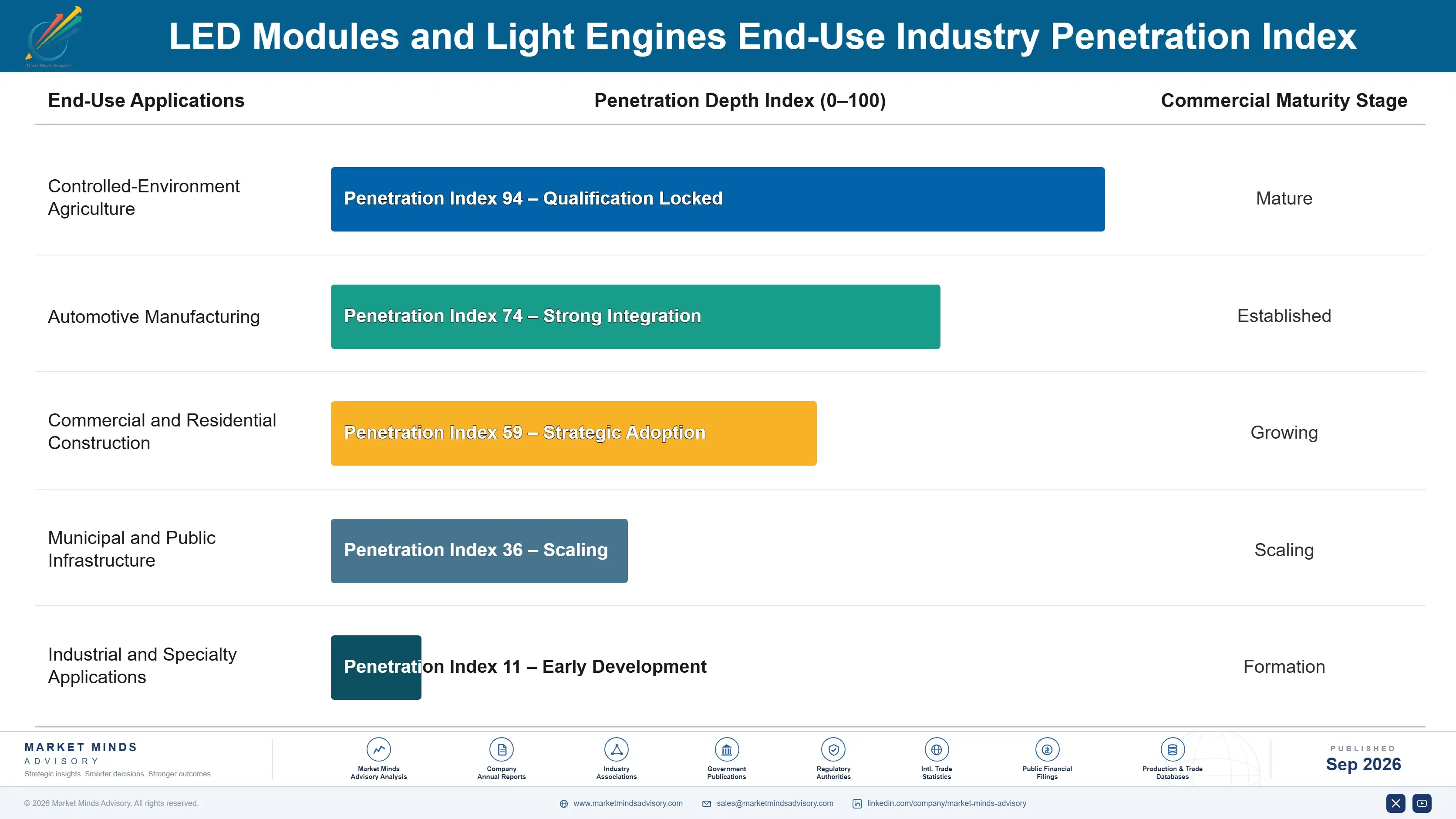
Adoption depth varies sharply by customer type. Automotive manufacturers integrate light engine suppliers into multi-year vehicle platform programs with dedicated engineering teams, producing deep, sticky relationships that survive individual product cycles and executive turnover alike. General illumination fixture makers, by contrast, purchase more opportunistically around specific project bids, making that buyer segment more price-sensitive and more likely to switch suppliers between projects. Manufacturers courting automotive accounts increasingly design tools around that stickier renewal pattern.

A generational shift is also underway as controlled-environment agriculture operators who trained entirely in the data-driven farming era treat spectral formulation as a first-order yield optimization decision rather than a downstream lighting afterthought, reshaping how far in advance manufacturers must forecast specialized formulation demand accurately across their production planning.
led-modules-and-light-engines-market-end-use-penetration-index-1789986546411

Where To Place LED Module Bets

These are among the four positions where our research anticipates prominent divergence between winners and laggards over the coming forecast period. Each is grounded in the demand model, the regulatory perimeter, and the announced capacity pipeline.
01 / HORTICULTURAL FORMULATION INVESTMENT

Build custom spectral formulation capability before controlled-environment agriculture demand consolidates

Manufacturers still selling generic horticultural modules are leaving durable margin on the table while leaders expand custom spectral formulation services that command meaningful pricing premiums over standard products. The window to build comparable formulation capability is narrowing as major controlled-environment agriculture operators increasingly standardize supplier qualification around manufacturers offering proven crop-specific optical engineering expertise. Smaller manufacturers should prioritize formulation investment now, even at near-term engineering cost, rather than compete purely on standard product specifications alone, risking permanent exclusion from the fastest-growing agriculture accounts.
02 / AUTOMOTIVE CERTIFICATION PRIORITY

Build formal reliability certification programs ahead of automotive qualification requirements

Automotive-grade reliability certification is becoming a mandatory qualification requirement rather than an optional differentiator, and manufacturers without formal certification programs risk losing qualification opportunities entirely to better-prepared competitors already serving major automaker accounts. Building certification capability requires investment in testing infrastructure and documentation processes beyond typical quality control, but the premium pricing certified products command meaningfully justifies that investment across a vehicle's full warranty period. Manufacturers that invest now will capture disproportionate automotive share as requirements spread further across the industry.
03 / AUTOMOTIVE PLATFORM AGREEMENT STRATEGY

Build platform-wide automotive relationships ahead of standardization consolidation

Automakers increasingly standardize light engine specifications across their entire vehicle platform family rather than selecting suppliers model by model, and manufacturers slow to establish platform relationships risk losing entire automaker accounts to competitors who moved earlier. Early platform agreements set technology standards that later model launches increasingly reference, making early positioning disproportionately valuable beyond the immediate contract value alone. Manufacturers that invest in these relationships now will anchor automaker accounts for years to come across multiple future vehicle generations and model years.
04 / CHIP SUPPLY RESILIENCE PLANNING

Diversify LED chip sourcing before the next semiconductor shortage arrives

The 2024 gallium nitride substrate shortage demonstrated how exposed manufacturers without vertically integrated chip production are to a concentrated compound semiconductor supply chain entirely outside their own control. Manufacturers should pursue multi-supplier chip contracts and modular design standards simultaneously rather than betting on any single mitigation working alone to protect margin, since diversified sourcing now proves meaningfully more resilient than single-supplier reliance. Waiting for the next shortage to begin diversifying will repeat the same margin compression smaller manufacturers absorbed during 2024.

Engagement Snapshot From the Field

A live engagement with an industry participant carrying material or product regulatory and market exposure ahead of a defining policy shift, showing how our research translates into a defensible multi-year portfolio strategy.
MARKET MINDS ADVISORY · CLIENT ENGAGEMENT SUMMARY
LED Modules and Light Engines Producer Strategic Portfolio Review and Transition Roadmap 2026·Investment Scenario on LED Modules and Light Engines Exposure Evaluation 2025-26
CLIENT PROFILE
The client operates a mid-sized controlled-environment agriculture company running several vertical farming facilities in a single large national market, growing leafy greens and specialty herbs under standard horticultural LED modules that had delivered inconsistent yield results across different growing cycles. Leadership suspected spectral formulation mismatch but lacked the technical expertise to evaluate alternatives confidently. Leadership had grown increasingly concerned about the inconsistent results across growing cycles.
STRATEGIC CHALLENGE
Management needed to decide whether to switch to a custom spectral formulation supplier or continue adjusting growing protocols around existing standard modules, while also evaluating the capital cost of replacing installed lighting infrastructure against the potential yield improvement a formulation change might deliver. Board members had grown impatient with the pace of prior internal deliberation on the issue.
MMA APPROACH
MMA benchmarked the client's crop-specific yield data against comparable controlled-environment agriculture operations using custom spectral formulations, gathered through primary interviews with peer vertical farming operators. The engagement modeled projected yield improvement from formulation switching against the capital cost of module replacement across the client's facility portfolio. The analysis also weighed supplier reputation and formulation refinement support against internal alternatives.
KEY FINDINGS
  1. Yield data from comparable operations using custom formulation showed meaningfully stronger results for the client's specific crop varieties., exceeding what the client's growing team had initially expected
  2. The capital cost of module replacement was recovered within a single growing season based on projected yield improvement (client-reported, unverified by MMA).
  3. Facility retrofit could proceed incrementally by growing zone rather than requiring a full simultaneous facility shutdown., reducing operational disruption considerably compared to alternatives
  4. Competing operators who delayed similar formulation upgrades reported measurably weaker yield performance during the same period., a gap the client specifically wanted to avoid repeating
CLIENT PROFILE
The client operates a mid-sized controlled-environment agriculture company running several vertical farming facilities in a single large national market, growing leafy greens and specialty herbs under standard horticultural LED modules that had delivered inconsistent yield results across different growing cycles. Leadership suspected spectral formulation mismatch but lacked the technical expertise to evaluate alternatives confidently. Leadership had grown increasingly concerned about the inconsistent results across growing cycles.
STRATEGIC CHALLENGE
Management needed to decide whether to switch to a custom spectral formulation supplier or continue adjusting growing protocols around existing standard modules, while also evaluating the capital cost of replacing installed lighting infrastructure against the potential yield improvement a formulation change might deliver. Board members had grown impatient with the pace of prior internal deliberation on the issue.
MMA APPROACH
MMA benchmarked the client's crop-specific yield data against comparable controlled-environment agriculture operations using custom spectral formulations, gathered through primary interviews with peer vertical farming operators. The engagement modeled projected yield improvement from formulation switching against the capital cost of module replacement across the client's facility portfolio. The analysis also weighed supplier reputation and formulation refinement support against internal alternatives.
KEY FINDINGS
  1. Yield data from comparable operations using custom formulation showed meaningfully stronger results for the client's specific crop varieties., exceeding what the client's growing team had initially expected
  2. The capital cost of module replacement was recovered within a single growing season based on projected yield improvement (client-reported, unverified by MMA).
  3. Facility retrofit could proceed incrementally by growing zone rather than requiring a full simultaneous facility shutdown., reducing operational disruption considerably compared to alternatives
  4. Competing operators who delayed similar formulation upgrades reported measurably weaker yield performance during the same period., a gap the client specifically wanted to avoid repeating
RECOMMENDED STRATEGY
Phase 1: Phase 1 (Months 1 to 2): Retrofit the lowest-yielding growing zone with custom formulated modules first., prioritizing the zone showing weakest historical yield performance Phase 2: Phase 2 (Months 3 to 6): Expand retrofit across remaining growing zones based on validated yield results., validating results before expanding to remaining zones Phase 3: Phase 3 (Months 7 to 9): Finalize supplier relationship terms and establish ongoing formulation refinement process., ahead of the following full growing season
OUTCOME
Within nine months the client reported meaningfully improved yield across retrofitted growing zones, alongside faster payback on the module investment than initially projected (client-reported, unverified by MMA), attributing both improvements to the custom formulation switch and the phased retrofit approach. Staff confidence in the new formulation approach also improved measurably during the transition.

Frequently Asked Questions

Foundational context covering the market sizes, CAGR, scope, country, region and competition that inform every finding below. This section is provided to cover basics and most often pre-purchase conversations, answered from the MMA Primary Research Dataset.

What is the current size of the LED Modules and Light Engines Market?

The market is valued at 12.4 billion dollars in 2025. It is projected to reach 13.2 billion dollars in 2026 as horticultural and automotive demand accelerates.

How large will the LED Modules and Light Engines Market be by 2036?

The market is projected to reach roughly 24.8 billion dollars by 2036. That represents nearly double the 2026 value over the full ten-year forecast window.

What is the CAGR for the LED Modules and Light Engines Market 2026 to 2036?

The base case CAGR is 6.5% annually through 2036. Bull and bear scenarios range from 5.3% to 7.8% depending on agriculture investment pace and vehicle production trends.

Which segment is growing fastest?

Horticultural LED grow light modules lead at a 10.0% CAGR, well ahead of every other segment. That pace is roughly 1.54 times the overall market's average growth rate.

Who are the major companies in the LED Modules and Light Engines Market?

Signify, OSRAM, Samsung Electronics, Nichia, and Seoul Semiconductor lead the category by revenue, together holding roughly thirty-two percent of total global module shipments across every application.

Which country is growing fastest?

China leads country-level growth at an 8.0% CAGR, ahead of every other national market tracked. Dense LED chip and module manufacturing capacity drives that pace.

Report Segmentation Architecture

The full report scope spans multiple orthogonal segmentation dimensions, with cross-tabulated demand data provided for each dimension pair. Coverage extends further to regional breakdowns, trend trajectories, and the competitive detail needed to support segment-level decision-making.

By End-Use Application

  • Horticultural LED Grow Light Modules
  • Automotive LED Light Engines
  • General Illumination LED Modules
  • Architectural and Commercial LED Light Engines
  • Outdoor and Street Lighting LED Modules
  • Specialty and UV/IR LED Modules

By End-Use Industry

  • Controlled-Environment Agriculture
  • Automotive Manufacturing
  • Commercial and Residential Construction
  • Municipal and Public Infrastructure
  • Industrial and Specialty Applications

By Commercial Dimension

  • Direct Manufacturer Sales
  • Custom Formulation Services
  • Multi-Year Platform Agreements
  • Distributor and Reseller Channel

By Region

  • North America
  • Western Europe
  • East Asia
  • South Asia and Pacific
  • Latin America
  • Middle East and Africa
  • Eastern Europe

Scope, Methodology, and Coverage

Every figure in this report is reproducible from documented input assumptions. The scope below maps the historical period, the forecast horizon, the segmentation dimensions, and the countries covered, alongside the underlying primary and qualitative methodology.
Historical Period
2020 to 2025
Forecast Period
2026 to 2036
Base Year
2025 (USD billions; MMA Primary Research Dataset, September 2026)
Market Definition
This report covers LED modules and light engines, integrated assemblies combining LED chips, thermal management substrates, and optical elements sold to fixture manufacturers and original equipment manufacturers for integration into finished lighting products. It excludes bare LED chips sold without module-level integration, complete finished lighting fixtures sold directly to end consumers, and LED display and signage products not intended for general or specialty illumination purposes.
Quantitative Units
USD billions (current prices); unit shipments where applicable
Segmentation Dimensions
By End-Use Application; By End-Use Industry; By Commercial Dimension; By Region
Regions Covered
North America, Western Europe, East Asia, South Asia and Pacific, Latin America, Middle East and Africa, Eastern Europe
Countries Covered
USA, China, Germany, France, UK, Japan, South Korea, India, Australia, Canada, Brazil, Mexico, Indonesia, Vietnam, Thailand, Malaysia, UAE, Saudi Arabia, South Africa, Nigeria, Turkey, Poland, Netherlands, Italy, Spain, Sweden, Switzerland, Argentina, Colombia, Singapore, and additional markets relevant to this sector
Key Companies Profiled
Signify NV, OSRAM GmbH, Samsung Electronics Co Ltd, Nichia Corporation, Seoul Semiconductor Co Ltd, LG Innotek Co Ltd, Everlight Electronics Co Ltd, Lite-On Technology Corporation, San'an Optoelectronics Co Ltd, Epistar Corporation, MLS Co Ltd, Refond Optoelectronics Co Ltd, Bridgelux Inc, Lumileds Holding BV, Cree LED Inc, Toshiba Corporation, Panasonic Holdings Corporation, Acuity Brands Inc, Eaton Corporation plc, Dialight PLC
Quantitative Methodology
Primary survey, n=3,800 respondents, Q4 2025, six countries; demand-side model with trade association cross-validation
Qualitative Methodology
47 expert interviews, Q4 2025; applied to validate demand model assumptions, identify emerging dynamics, and assess competitive positioning
Report Format
PDF and XLSX data workbook (Word format preview document)
Publisher
Market Minds Advisory
Report Code
MMA-2026-TEC-602
Published
September 2026
Contact
sales@marketmindsadvisory.com | www.marketmindsadvisory.com

Purchase the full LED Modules and Light Engines Market Report (2026 to 2036).

The full report delivers a complete quantitative and qualitative assessment of the LED modules and light engines market through 2036, including segment-level sizing across all six application categories and country-level detail across thirty markets. It profiles twenty manufacturers with comparative positioning on spectral formulation capability, automotive certification depth, and platform agreement relationships. Analysts also model three forecast scenarios against agriculture investment pace and vehicle production trends. Buyers receive the underlying data tables, primary survey results from 3,800 respondents, and 47 expert interviews supporting every forecast assumption in the report.
Segment-level sizing across six application categories
Country-level data across thirty covered markets
Comparative competitive profiles of twenty manufacturers
Primary survey results from 3,800 respondents
Expert interview transcripts from 47 professionals
Five-year revenue lever and margin analysis

Built For The People Who Decide

From boardroom strategy to bench-side execution, this report is read cover-to-cover by leaders shaping the next decade of their industry, turning demand scenarios, market dynamics and valuation benchmarks into decisions.
CXOs/ Presidents/ VPs/ Managers
M&A and Corporate Development
Strategy Teams and R&D Heads
Procurement and Product Directors
Regulatory and Compliance Leaders
Investor Relations and Equity Analysts