Market Minds Advisory
Lead-Acid Battery Market

Lead-Acid Battery Market: Established Storage Chemistry for Automotive and Industrial Power

Lithium-ion substitution is eroding lead-acid's premium automotive and stationary storage share even as e-bike electrification across Asia and telecom backup demand keep unit volumes climbing, forcing manufacturers to defend margin through recycling integration.

Lead Analyst

David Horsley

Published

September 2026

Make Smarter Decisions with Customized Research Insights

Request a free sample report and evaluate market opportunities, growth trends, and competitive dynamics relevant to your business needs.

2025 MARKET VALUE$54.0BMarket Size 2025
2036 FORECAST VALUE$84.0BBase Case , 2026 to 2036
CAGR 2026 TO 20364.1 %Bull 5.4% / Bear 2.8%
INCREMENTAL OPPORTUNITY$27.8BNet 10- year value creation
EXPANSION MULTIPLE1.49x2036 value over 2026 base
Strategic Levers
M&A Pipeline
Regional Outlook
Country Rankings
Competitive Intelligence
Segmental Deep-dive
Call-Us : 91 93563 13602

Executive Snapshot and Market Trajectory

Lithium-ion substitution is steadily narrowing lead-acid's role in premium electric vehicle and grid-scale storage applications, but cost, recyclability, and proven reliability keep it firmly entrenched across automotive starting, industrial motive power, and backup power applications worldwide, a durability edge few rival chemistries can match today.
E-bike and light electric vehicle batteries are the fastest-growing application as Asian two- and three-wheeler electrification scales heavily on lead-acid's lower upfront cost rather than pricier lithium-ion packs today. East Asia holds the largest share of global production and consumption, reflecting China's dominant manufacturing base, while South Asia is growing fastest on India's e-rickshaw adoption and rural backup power demand tied to persistent grid unreliability.
Competition splits between global automotive battery majors supplying original equipment manufacturers under long-term contracts and a large fragmented base of regional replacement and industrial battery makers, keeping the top five suppliers well short of dominant control over the wider global market. Tightening lead recycling regulation and rising secondary lead costs are pushing suppliers toward closed-loop recycling integration, with Chinese and Indian challengers gaining share in fast-growing e-bike and backup power segments specifically across emerging markets.
Market Definition
The lead-acid battery market covers flooded, valve-regulated, and enhanced flooded lead-acid batteries sold for automotive starting and ignition, industrial motive power, stationary standby power, and light electric vehicle applications. It excludes lithium-ion and other battery chemistries, and it excludes standalone battery recycling services sold independently of new battery manufacturing.
Base Year Value
$54.0B in 2025 (MMA Primary Research Dataset, August 2026)
Forecast Period
2026 to 2036, eleven discrete annual values
CAGR
4.1% base case. Bull 5.4%. Bear 2.8%.
Fastest Growth Segment
E-Bike and Light Electric Vehicle Batteries: 7.4% CAGR
Fastest Growth Country
India: 6.8% CAGR
Fastest Growth Region
South Asia and Pacific: 6.4% CAGR
Largest Region
East Asia: 29% of 2025 global value
Market Leaders
Clarios International Inc., GS Yuasa Corporation, Exide Technologies LLC, EnerSys, and Camel Group Co., Ltd. Source: MMA Analysis based on company annual reports.
Primary Survey
n=3,800 procurement and R&D decision-makers, Q4 2025, six countries
Methodology
Demand-side build-up, cross-validated against public data, 47 expert interviews

Lead-Acid Battery Market Forecast Scenarios

lead-acid-battery-market-size-forecast-scenario-1787301723188
Lead-acid battery volumes grew steadily between 2020 and 2025 as automotive production recovered from pandemic-era semiconductor shortages and e-bike adoption accelerated sharply across South and Southeast Asian export markets overall. Lithium-ion substitution in premium electric vehicles and grid storage offset some of this growth, pushing the historical CAGR to roughly 3.5 percent across the period overall.
The base case assumes 4.1 percent annual growth through 2036, anchored in three mechanisms: continued automotive starting-battery replacement demand from a global internal combustion and hybrid vehicle fleet that will remain large for many decades, rapid e-bike and light electric vehicle adoption across Asia favoring lead-acid's lower upfront cost over lithium-ion alternatives, and expanding telecom and data center backup power demand across grid-constrained emerging markets in South Asia and Africa.
A bull case near 5.4 percent CAGR assumes faster e-bike electrification and backup power deployment across South Asia and Africa outpaces lithium-ion cost declines in these price-sensitive segments specifically. A bear case near 2.8 percent reflects the risk that falling lithium-ion pack prices erode lead-acid's cost advantage in light electric vehicle and stationary storage applications faster than currently expected.

Replacement Demand Meets Chemistry Substitution

Two opposing forces define lead-acid battery demand simultaneously. Lithium-ion substitution is steadily displacing lead-acid from premium electric vehicle and grid-scale storage applications where energy density and cycle life matter more than upfront cost. At the same time, e-bike electrification, automotive replacement demand, and backup power needs in grid-constrained emerging markets are keeping unit volumes growing at a pace few industry analysts expected a decade ago when lithium-ion firs
CR5 CONCENTRATION35%Fragmented across global majors and regional replacement manufacturers worldwide
AVERAGE BATTERY UNIT PRICE$95Reflects chemistry, capacity rating, and original equipment specification
TOP REGION PRODUCTION SHAREEast Asia, 29%Concentrated where automotive and e-bike manufacturing scale peaks
RECYCLED LEAD CONTENT SHARE80%Share of input lead sourced from closed-loop recycling streams
REPLACEMENT CYCLE LENGTH3-5 yearsTypical interval before automotive starting batteries need replacement
SECONDARY LEAD COST SHARE48%Portion of unit cost from recycled and virgin lead inputs
Commercially, the market splits between original equipment supply contracts with automakers, tendered on multi-year price and quality terms, and a large aftermarket replacement business sold through independent distributors and retailers. Recycled secondary lead now supplies the majority of raw material input at scale manufacturers, giving vertically integrated recyclers a durable cost advantage over smaller producers dependent on virgin lead purchased at spot prices.
Over the next decade, expect closed-loop recycling integration and e-bike segment share to matter more than automotive original equipment volume for supplier profitability, even as automotive starting batteries remain the largest single application by unit volume worldwide, particularly across markets where internal combustion vehicle fleets continue expanding steadily despite electrification gains elsewhere.
"People keep waiting for lithium to kill this market. It hasn't, because nobody's built a rickshaw battery in Uttar Pradesh cheap enough yet. The chemistry that wins in a price-sensitive market isn't always the better one."
Director, Energy Storage and Power Systems Practice · MMA Energy Storage & Power

Market Trends

China's E-Bike Fleet Sustains Lead-Acid Demand

China's national e-bike fleet, numbering several hundred million units, remains predominantly lead-acid powered despite years of lithium-ion price declines, since replacement cost sensitivity among fleet owners and delivery riders favors lead-acid's lower upfront price even at a shorter cycle life. Municipal fire safety regulations targeting lithium-ion charging in residential buildings, introduced across several major Chinese cities following high-profile battery fires, have further reinforced lead-acid's position in dense urban delivery fleets nationwide. Battery swap networks serving delivery riders increasingly standardize on lead-acid packs for cost and safety reasons over faster-charging alternatives.
Market Impact: Sustains 420 million annual replace

Closed-Loop Recycling Integration Reshapes Manufacturer Economics

Lead-acid battery recycling rates exceed 95 percent in mature markets, the highest of any consumer battery chemistry, and manufacturers with vertically integrated smelting and refining operations increasingly capture the recycled lead value that previously flowed to independent scrap processors. Regulatory pressure on lead emissions from secondary smelters has raised compliance costs and pushed consolidation toward larger, better-capitalized recycling operators capable of meeting stricter environmental permitting requirements. Manufacturers without in-house recycling capacity face growing exposure to secondary lead price volatility and tightening scrap collection competition from vertically integrated rivals expanding their own closed-loop supply chains aggressively.
Market Impact: Adds 65 million backup units annual

Market Opportunities and Growth Drivers

Global Vehicle Fleet Sustains Starting Battery Replacement

More than one billion internal combustion and hybrid vehicles remain in operation globally, each requiring a starting-lighting-ignition battery with a typical service life of three to five years, generating large, recurring replacement demand independent of new vehicle sales trends. Even as electric vehicle sales grow, the installed combustion fleet will remain sizable for many decades given typical vehicle scrappage rates, sustaining aftermarket battery replacement volume well beyond what new vehicle production figures alone would suggest. Aftermarket replacement, sold through independent distributors, generates materially higher margins than original equipment supply contracts.
Market Impact: Cedes 12% of premium segment share

Grid-Constrained Emerging Markets Lift Backup Power Demand

Frequent grid outages across India, Nigeria, and other emerging markets with underinvested electricity infrastructure are driving sustained demand for lead-acid batteries in telecom tower backup, residential inverter systems, and small commercial standby power applications. Telecom operators expanding rural network coverage under national connectivity programs specify battery backup systems capable of bridging outages that can run several hours in areas without reliable grid supply, favoring lead-acid's lower upfront cost over lithium-ion alternatives for this less cycling-intensive application. Domestic Indian and Nigerian battery assemblers have scaled production to serve this demand, often under licensing arrangements with established global battery technology suppliers directly.
Market Impact: Adds 10% to compliant facility cape

Market Restraints and Challenges

Lithium-Ion Cost Declines Erode Premium Applications

Lithium-ion pack prices have fallen substantially over the past decade, and the root cause of lead-acid's retreat from premium applications is that energy density and cycle life advantages now outweigh lead-acid's cost edge once total cost of ownership is calculated for stationary storage and light electric vehicle fleets operated intensively. Grid-scale storage and premium electric two-wheeler segments have already shifted substantially toward lithium-ion where upfront capital is less constrained. Lead-acid manufacturers are responding by defending cost-sensitive segments, entry-level e-bikes, backup power, and automotive starting, where lithium-ion's price premium still outweighs its performance edge for most buyers.
Market Impact: Sustains 280 million lead-acid e-bi

Lead Exposure Regulation Raises Compliance Costs

Manufacturing and recycling lead-acid batteries involves handling a regulated heavy metal, and the root cause of rising compliance costs is that occupational and environmental lead exposure limits have tightened significantly across major markets, requiring costly facility upgrades to ventilation, worker monitoring, and emissions control systems. Smaller regional producers and recyclers often lack the capital to fund these upgrades, forcing consolidation or exit from the industry entirely in several developing markets with limited access to financing. Leading manufacturers are mitigating this by centralizing recycling operations in fewer, larger, better-capitalized facilities capable of meeting stricter permitting requirements economically at scale.
Market Impact: Cuts material cost by 18%
3 additional market trends, 3 additional growth drivers, and 3 additional restraints and challenges are covered in the full report. Contact sales@marketmindsadvisory.com to access the complete intelligence.

Segment CAGR and Growth Architecture

Segmentation follows application rather than battery construction technology, since buyer decision-makers, purchase cycles, and price sensitivity differ sharply by end use. Automotive starting, industrial motive power, stationary standby power, e-bike and light electric vehicle, and specialty battery applications each represent distinct commercial markets sharing one common underlying chemistry platform across very different customer segments.
lead-acid-battery-market-market-share-analysis-1787301723736

E-Bike and Light Electric Vehicle Batteries

E-bike and light electric vehicle batteries are the fastest-growing segment as two- and three-wheeler electrification scales rapidly across South and Southeast Asia on lead-acid's decisive upfront cost advantage over lithium-ion packs for cost-sensitive buyers. India's e-rickshaw fleet alone numbers in the millions of vehicles, nearly all powered by lead-acid batteries requiring replacement every twelve to eighteen months given intensive daily cycling. Chinese delivery and personal e-bike fleets add further volume, reinforced by municipal fire safety regulations that favor lead-acid over lithium-ion in dense residential charging environments specifically across major cities. Growth here significantly outpaces automotive and industrial applications, though unit prices remain considerably lower than premium industrial or stationary battery products overall.
CAGR 7.4%

Stationary Standby Power Batteries

Stationary standby power batteries form the second-fastest segment as telecom towers, data centers, and grid-constrained emerging market utilities expand backup power capacity to bridge increasingly frequent outages. Telecom operators building rural network coverage under national connectivity programs specify battery backup systems as a standard requirement rather than an optional addition, generating recurring replacement demand tied to installed tower count rather than new construction alone. Data center backup demand, though a smaller volume contributor, commands materially higher unit prices given stricter reliability and certification requirements than telecom or residential applications typically require, giving suppliers a meaningfully higher-margin adjacent market to pursue well alongside their larger core telecom and industrial customer base.
CAGR 6.5%
Full segment breakdown across 6 segments available in the complete report.

Regional Architecture and Country Demand Map

Lead-acid battery demand concentrates where automotive and e-bike manufacturing scale is largest. East Asia leads on production and consumption volume, North America and Western Europe generate the largest replacement aftermarket revenue, and South Asia is the fastest-growing region on e-rickshaw and rural backup power demand.

North America

North America's demand centers on automotive aftermarket replacement, since the region's large vehicle fleet and average vehicle age above twelve years generate steady, recurring battery turnover independent of new vehicle sales trends. Original equipment supply to domestic and transplant automakers remains a significant but lower-margin business relative to aftermarket sales through independent distributors and national retail chains nationwide. Industrial motive power demand from warehouse forklift fleets and data center backup power adds a smaller but meaningfully higher-margin revenue stream to supplier portfolios overall. Domestic recycling infrastructure is mature, giving established manufacturers reliable access to secondary lead without the import dependence smaller regional markets elsewhere often face, a durable cost advantage built over decades of steady investment.
Share: 24% | CAGR: 3.5% (2026 to 2036)

Western Europe

Western Europe combines mature automotive aftermarket demand with some of the world's strictest battery recycling and lead emissions regulation, requiring manufacturers to meet extended producer responsibility obligations that add meaningfully to compliance cost across the continent. Germany, France, and Italy lead regional replacement demand, reflecting their large vehicle fleets and well-established distribution networks built up over many decades of steady investment. Growth trails the global average because vehicle electrification is proceeding faster here than in most other regions, gradually reducing the long-run addressable automotive starting battery base across the continent. Stationary backup power demand from telecom and data center operators provides a partial offset to slowing automotive volume across the wider region overall.
Share: 19% | CAGR: 2.6% (2026 to 2036)
Regional intelligence for 5 additional markets available in the complete report: East Asia, South Asia and Pacific, Latin America, Middle East and Africa, Eastern Europe. Contact sales@marketmindsadvisory.com.
lead-acid-battery-market-country-cagr-analysis-1787301724252

Where Battery Makers Find Margin Upside

Suppliers capture the most durable margin not from standard replacement battery sales but from closed-loop recycling integration, industrial and telecom service contracts, and premium e-bike battery positioning layered on top of core hardware. The levers below describe where manufacturers are shifting commercial focus as commodity automotive battery pricing compresses under intensifying regional competition worldwide.

Vertically Integrated Recycling And Refining Operations

Manufacturers that own smelting and refining capacity rather than purchasing secondary lead on the open market capture the recycling margin that would otherwise flow to independent scrap processors, while also insulating themselves from secondary lead price volatility during tight scrap markets. This backward integration requires substantial upfront capital investment but pays back over multiple business cycles as scrap collection networks mature and smelter utilization rates climb toward capacity. Vertically integrated manufacturers report material cost per unit roughly 18 percent lower than peers dependent on open-market secondary lead purchases, a durable advantage that compounds as recycling regulation tightens further.
Market Impact: Cuts material cost per unit by 18 p

Telecom And Data Center Backup Service Contracts

Rather than selling stationary batteries as one-time hardware, several suppliers now offer multi-year backup power service contracts that bundle battery supply with preventive maintenance, remote monitoring, and guaranteed replacement timing for telecom towers and data centers. This converts a commodity hardware sale into a recurring service relationship, since operators increasingly prefer a single accountable vendor over managing battery procurement and maintenance separately across thousands of distributed sites. Suppliers offering bundled service contracts report recurring revenue per site roughly 30 percent higher than one-time hardware sales alone, reflecting added maintenance and monitoring value captured over the contract term.
Market Impact: Lifts recurring revenue per site by

Premium E-Bike Battery Positioning On Cycle Life

Standard e-bike lead-acid batteries typically offer 300 to 400 charge cycles, but leading manufacturers now offer enhanced flooded and deep-cycle formulations rated for 500 or more cycles, targeting delivery fleet operators and ride-hailing riders whose vehicles cycle daily and value total cost of ownership over upfront price. This addresses fleet operators' single biggest operating concern, frequent battery replacement, and lets suppliers differentiate on documented cycle life rather than competing on unit price against commodity batteries. Suppliers offering enhanced cycle-life batteries report winning fleet contracts at price points roughly 22 percent above standard batteries while delivering lower total cost per cycle.
Market Impact: Commands a 22 percent price premium

Licensed Local Manufacturing In Underserved Markets

Rather than exporting finished batteries into Africa and parts of South Asia, several global manufacturers are licensing local assembly to domestic partners who bring market access and distribution relationships the international brand alone could not build quickly. Licensing arrangements typically combine the international partner's cell chemistry and quality control standards with the domestic partner's local manufacturing and regulatory relationships, reducing landed cost meaningfully versus direct export. Suppliers with established licensing arrangements report winning telecom and automotive replacement contracts at price points roughly 20 percent below what direct export pricing could achieve, offsetting thinner royalty income with substantially higher addressable volume.
Market Impact: Cuts landed unit cost by roughly 20

Who Controls the Margin Pool

The lead-acid battery market carries a CR5 of roughly 35 percent on a shipment volume basis, reflecting a mix of global automotive battery majors and a large fragmented base of regional replacement and industrial manufacturers. The gap between leading suppliers and the next tier of challengers is narrower than in more concentrated capital equipment categories, since regional distribution networks matter as much as manufacturing scale.
Current competitive activity centers on three fronts: vertically integrated recycling capacity expansion aimed at securing cost-advantaged secondary lead, telecom and data center backup service contract launches designed to capture recurring revenue, and licensed local manufacturing announcements in African and South Asian growth markets. Suppliers without established recycling infrastructure increasingly partner with independent smelters rather than building capacity from scratch.

Emerging pressure is coming from Chinese and Indian manufacturers that combine large-scale production with aggressive e-bike and backup power pricing, undercutting established global majors on cost even where quality is broadly comparable. Rankings are most likely to shift in South Asian and African markets, where new backup power and e-bike demand is growing faster than in mature regions and where incumbents have not yet established the local manufacturing and distribution presence that anchors customer relationships elsewhere.
lead-acid-battery-market-company-positioning-matrix-1787301724787

Competitive Moat and Risk Dimensions

CLARIOS INTERNATIONAL INC.

Moat: Vertically integrated recycling network

Clarios operates the industry's largest vertically integrated recycling network in North America and Europe, giving the company reliable access to secondary lead at cost levels smaller competitors dependent on the open market cannot consistently match. That recycling depth anchors long-term original equipment supply relationships with major automakers, who increasingly favor suppliers able to document closed-loop sourcing for sustainability reporting purposes.
CLARIOS INTERNATIONAL INC.

Risk: Limited exposure to e-bike growth

Clarios's scale advantage is strongest in mature automotive markets, but the company has limited manufacturing presence in the fast-growing e-bike and backup power segments concentrated across Asia and Africa, ceding early positioning in these applications to domestic Chinese and Indian manufacturers building production scale quickly and aggressively.
GS YUASA CORPORATION

Moat: Premium original equipment relationships

GS Yuasa's decades-long original equipment relationships with Japanese and other Asian automakers give the company a durable position in premium automotive battery specification, where quality certification and long-term supply reliability matter more than unit price to original equipment buyers evaluating multi-year supplier contracts across the region.
GS YUASA CORPORATION

Risk: Cost disadvantage in price-sensitive segments

GS Yuasa's premium positioning carries higher production cost than commodity-focused Chinese and Indian rivals, a disadvantage on price-sensitive aftermarket and e-bike segments where buyers weigh upfront cost heavily and brand reputation matters comparatively less than it does in original equipment supply relationships with established automakers specifically.

Players Tracked

Prominent Players

Clarios International Inc.
GS Yuasa Corporation
Exide Technologies LLC
EnerSys
Camel Group Co., Ltd.

Other Key Players

Leoch International Technology Limited
Amara Raja Batteries Ltd
East Penn Manufacturing Company
CSB Battery Co., Ltd.
FIAMM Energy Technology S.p.A.
Banner Batterien GmbH
Hoppecke Batterien GmbH & Co. KG
Sebang Global Battery Co., Ltd.
Shuangdeng Group Co., Ltd.
Tianneng Battery Group Co., Ltd.
Chaowei Power Holdings Limited
C&D Technologies Inc.
Crown Battery Manufacturing Company
HBL Power Systems Limited
Exide Industries Ltd.

Recent Developments

MAY 2025

Clarios Expands Texas Secondary Lead Recycling Capacity

Clarios announced an expansion of its secondary lead recycling capacity in Texas in May 2025, adding processing capability aimed at reducing the company's dependence on open-market secondary lead purchases as recycling regulation tightens across North America, a move the company said would improve cost stability heading into 2026.
Signal: Signals leading manufacturers are racing t
NOVEMBER 2024

GS Yuasa Launches Extended Deep-Cycle E-Bike Battery Line

GS Yuasa launched an enhanced deep-cycle e-bike battery line rated for over 500 charge cycles in November 2024, targeting delivery fleet operators in Southeast Asia who prioritize total cost of ownership over upfront price for vehicles cycled daily under intensive commercial delivery use conditions nationwide.
Signal: Shows established automotive suppliers pus
MARCH 2025

Amara Raja Announces Nigerian Joint Venture Manufacturing

Amara Raja Batteries announced a joint venture manufacturing agreement with a Nigerian distribution partner in March 2025 to produce automotive and backup power batteries locally, avoiding import duties that had previously limited the company's price competitiveness in West African telecom and automotive replacement markets specifically.
Signal: Confirms local manufacturing partnerships

Secondary and Virgin Lead Price Exposure

Lead, both recycled secondary lead and virgin mined lead, accounts for roughly 48 percent of manufactured cost of goods sold in a typical lead-acid battery, making it by far the dominant input cost. Secondary lead is sourced domestically wherever recycling infrastructure exists, while virgin lead is sourced from a concentrated group of mining regions including China, Australia, and Peru.
Lead prices spiked sharply in 2022 amid supply disruptions and tight scrap availability, according to LME and EIA commodity market reporting, forcing manufacturers without vertically integrated recycling capacity to absorb margin compression or pass costs through to original equipment and aftermarket customers directly. Several manufacturers renegotiated long-term supply contracts mid-cycle to reflect the elevated price environment that persisted through much of that year across major producing regions.

Manufacturers without vertically integrated recycling capacity face the sharpest exposure, since they typically purchase secondary lead on the open market at prevailing spot prices that can move sharply during periods of tight scrap availability. Vertically integrated manufacturers with owned smelting and refining operations have generally passed through less cost volatility to customers, widening the competitive gap between top-tier and smaller regional manufacturers during periods of input tightness.
lead-acid-battery-market-cost-volatility-analysis-1787301724986

Vertically integrated smelting and refining capacity

Leading manufacturers have invested heavily in owned secondary lead smelting and refining capacity rather than relying entirely on open-market scrap purchases, insulating themselves from the sharpest price swings during periods of tight scrap availability even when doing so requires substantial upfront capital investment to build and permit new facilities across multiple regions and jurisdictions.

Long-term supply contracts with mining and scrap suppliers

Several manufacturers have locked in firm multi-year pricing agreements with both virgin lead mining operations and independent scrap collection networks rather than buying entirely on the spot market, smoothing input cost volatility even at a modest premium during periods when broader lead markets are otherwise soft and global industrial demand elsewhere weakens quite considerably.

Battery design optimization to reduce lead content per unit

Manufacturers are incrementally reducing lead content per battery through thinner grid plate design and improved paste formulation without compromising cycle life or reliability, a gradual engineering improvement that steadily reduces per-unit material cost exposure across the entire product line over successive design generations spanning many years of continued global research and development effort industry-wide.

Portfolio Architecture for Margin Defence

The market organizes into three commercial tiers separated by application criticality and margin profile rather than simple capacity rating. Volume tier products are standard flooded automotive and e-bike batteries sold largely on price. Premium tier systems carry enhanced cycle life and original equipment certification. The sustainability and next-generation tier layers in closed-loop recycled content and service-bundled backup power contracts on top of certified hardware.
Margin economics favor the premium and next-generation tiers heavily, since volume-tier automotive and e-bike batteries compete largely on unit price against a crowded field of regional manufacturers with limited differentiation. Suppliers that can move customers from a one-time hardware sale into telecom backup service contracts or premium fleet-grade e-bike batteries capture materially higher revenue per account, which is why most established players are actively pushing customers toward higher tiers.

High-value pools concentrate at telecom and data center backup service contracts bundling hardware with maintenance and monitoring, and at premium fleet-grade e-bike batteries sold on documented cycle life rather than price alone. Volume-tier automotive and commodity e-bike battery sales remain necessary for market presence but contribute comparatively little to overall supplier profitability across the wider portfolio.

Volume / Commodity-Adjacent Tier

Standard flooded automotive starting batteries and commodity e-bike batteries sold primarily on unit price for cost-sensitive replacement buyers, competing against a crowded field of regional manufacturers with limited technical differentiation or brand recognition.
Gross Margin: 12-18%

Premium / Certified Tier

Enhanced flooded and valve-regulated batteries carrying original equipment certification and extended cycle life ratings, sold to automakers and fleet operators requiring documented reliability and consistent performance across large deployed vehicle or backup power fleets.
Gross Margin: 22-28%

Sustainability / Regulatory / Next-Generation Tier

Closed-loop recycled content batteries bundled with telecom or data center backup service contracts, sold to buyers prioritizing sustainability reporting, guaranteed uptime, and vendor-managed maintenance over lowest upfront unit price alone.
Gross Margin: 30-38%
lead-acid-battery-market-portfolio-architecture-1787301725484

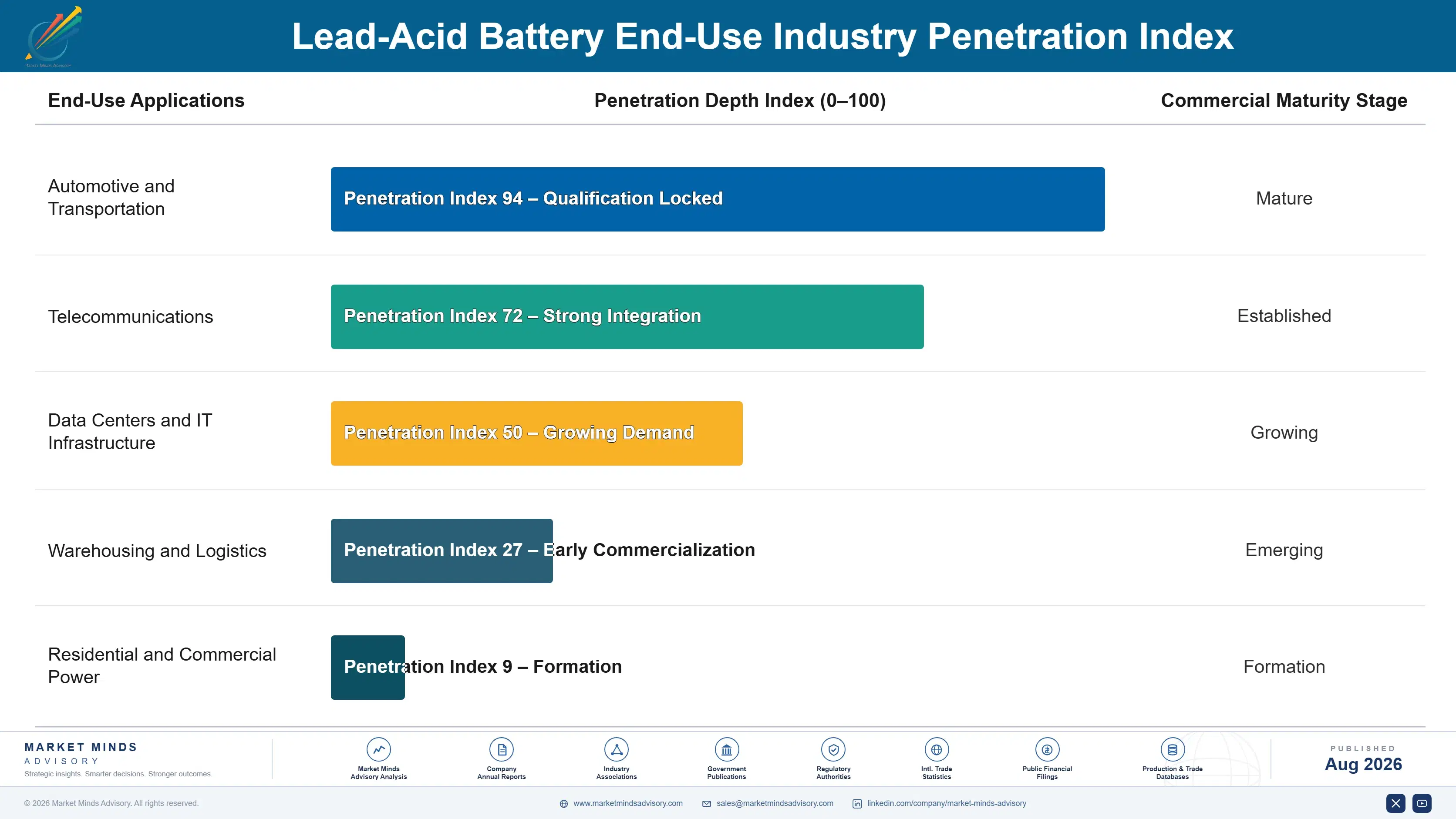
Replacement Cycles Anchor Recurring Revenue

Lead-acid batteries generate revenue well beyond the initial sale because both automotive starting and e-bike batteries carry a finite service life of typically three to five years and twelve to eighteen months respectively, creating a built-in replacement annuity that hardware-only competitors in adjacent chemistries cannot easily replicate. Suppliers who own the distribution and recycling relationship effectively capture the customer across multiple replacement cycles rather than a single tran
Adoption depth varies meaningfully by application. Telecom and data center backup accounts have moved into bundled service contracts, where switching suppliers means re-qualifying batteries across an entire distributed network of sites nationwide. Automotive aftermarket replacement remains firmly transactional, where price and distributor relationships matter more than supplier brand loyalty or bundled service offerings for most individual retail buyers.

A generational shift in fleet and facilities management is reinforcing service adoption. Younger telecom and logistics operations managers trained on digital asset tracking increasingly expect battery performance data delivered as continuous monitoring rather than periodic manual inspection, pushing procurement decisions toward suppliers offering integrated service contracts over those selling batteries alone, a preference reshaping vendor shortlists at operators now hiring their next generation of staff.
lead-acid-battery-market-end-use-penetration-index-1787301725977

Where MMA Sees Durable Advantage

These are among the four positions where our research anticipates prominent divergence between winners and laggards over the coming forecast period. Each is grounded in the demand model, the regulatory perimeter, and the announced capacity pipeline.
01 / RECYCLING INTEGRATION SCALE

Owned recycling capacity, not brand, decides who wins on cost

Manufacturers with vertically integrated smelting and refining capacity capture a meaningful cost advantage over rivals dependent on open-market secondary lead purchases, an advantage that compounds as recycling regulation tightens and independent scrap processors face rising compliance costs of their own. This capability is also difficult for challengers to build quickly, since permitting and constructing new smelting capacity takes several years in most jurisdictions. MMA views recycling integration as the single most predictive metric of manufacturer cost durability in this market.
02 / E-BIKE SEGMENT MOMENTUM

E-bike battery demand will outgrow automotive through the forecast period

Asian two- and three-wheeler electrification continues to scale on lead-acid's decisive cost advantage over lithium-ion for cost-sensitive buyers, and fire safety regulation in several Chinese cities has reinforced rather than eroded this position following high-profile lithium-ion incidents in residential buildings. Suppliers with established e-bike battery manufacturing capacity and distribution relationships in China and India will capture disproportionate share of this segment's growth as fleet electrification continues across the region. MMA expects e-bike battery suppliers to outgrow automotive-focused competitors meaningfully through the decade.
03 / LITHIUM SUBSTITUTION RISK

Premium segment erosion will accelerate faster than most suppliers expect

Lithium-ion pack prices continue falling faster than most industry forecasts anticipated even three years ago, and the segments most exposed, premium electric two-wheelers and grid-scale storage, are precisely where lead-acid suppliers have historically earned their highest margins on a per-unit basis. Suppliers overly dependent on these premium applications face a shrinking addressable market even as total lead-acid unit volume continues growing in cost-sensitive segments elsewhere. MMA expects the premium segment retreat to intensify meaningfully over the next five years specifically.
04 / BACKUP POWER SERVICE CONTRACTS

Bundled service contracts will separate winners from commodity hardware sellers

Telecom and data center operators are increasingly scoring vendor service capability alongside price in procurement decisions, reflecting a broader shift toward outsourced facilities management across grid-constrained emerging markets specifically. Suppliers offering bundled maintenance, monitoring, and guaranteed replacement timing are winning multi-year contracts that commodity hardware sellers competing purely on unit price cannot match, a pattern MMA expects to spread from telecom into broader industrial backup power procurement over the coming several years. Manufacturers unable to offer service bundling risk margin compression.

Engagement Snapshot From the Field

A live engagement with an industry participant carrying material or product regulatory and market exposure ahead of a defining policy shift, showing how our research translates into a defensible multi-year portfolio strategy.
MARKET MINDS ADVISORY · CLIENT ENGAGEMENT SUMMARY
Lead-Acid Battery Producer Strategic Portfolio Review and Transition Roadmap 2026·Investment Scenario on Lead-Acid Battery Exposure Evaluation 2025-26
CLIENT PROFILE
The client is a regional telecom operator across three West African countries operating roughly 4,200 cell towers (client-reported, unverified by MMA), a majority reliant on battery backup given frequent multi-hour grid outages across its coverage area. The operator's existing backup batteries were sourced through a mix of local distributors with inconsistent quality and delivery reliability.
STRATEGIC CHALLENGE
Management needed to standardize battery procurement across a fragmented supplier base while reducing the frequency of tower outages caused by premature battery failure, without a capital budget sufficient to replace the entire installed base simultaneously across all three countries within a single fiscal year, given tightly constrained annual capital allocation.
MMA APPROACH
MMA benchmarked the operator's existing supplier base against three international manufacturers offering local licensing arrangements, modeled total cost of ownership including failure-related outage costs across candidate suppliers, and evaluated bundled service contract terms covering maintenance, monitoring, and guaranteed replacement timing for the operator's full tower network across all three countries.
KEY FINDINGS
  1. Roughly 30 percent of tower outages over the prior year traced back to battery failure rather than grid issues (client-reported, unverified by MMA), suggesting battery quality was a bigger driver than grid reliability alone.
  2. One candidate supplier's locally licensed manufacturing facility offered delivery lead times roughly 60 percent shorter than the operator's existing import-dependent distributors, materially reducing replacement turnaround during outage events.
  3. Bundled service contracts covering remote battery monitoring reduced projected total cost of ownership compared with the operator's existing reactive replacement model, primarily by catching failing batteries before they caused a tower outage.
  4. The operator's technical staff lacked standardized battery specification criteria across its three-country footprint, creating inconsistent quality outcomes the selected supplier's engineering team was positioned to help standardize directly.
CLIENT PROFILE
The client is a regional telecom operator across three West African countries operating roughly 4,200 cell towers (client-reported, unverified by MMA), a majority reliant on battery backup given frequent multi-hour grid outages across its coverage area. The operator's existing backup batteries were sourced through a mix of local distributors with inconsistent quality and delivery reliability.
STRATEGIC CHALLENGE
Management needed to standardize battery procurement across a fragmented supplier base while reducing the frequency of tower outages caused by premature battery failure, without a capital budget sufficient to replace the entire installed base simultaneously across all three countries within a single fiscal year, given tightly constrained annual capital allocation.
MMA APPROACH
MMA benchmarked the operator's existing supplier base against three international manufacturers offering local licensing arrangements, modeled total cost of ownership including failure-related outage costs across candidate suppliers, and evaluated bundled service contract terms covering maintenance, monitoring, and guaranteed replacement timing for the operator's full tower network across all three countries.
KEY FINDINGS
  1. Roughly 30 percent of tower outages over the prior year traced back to battery failure rather than grid issues (client-reported, unverified by MMA), suggesting battery quality was a bigger driver than grid reliability alone.
  2. One candidate supplier's locally licensed manufacturing facility offered delivery lead times roughly 60 percent shorter than the operator's existing import-dependent distributors, materially reducing replacement turnaround during outage events.
  3. Bundled service contracts covering remote battery monitoring reduced projected total cost of ownership compared with the operator's existing reactive replacement model, primarily by catching failing batteries before they caused a tower outage.
  4. The operator's technical staff lacked standardized battery specification criteria across its three-country footprint, creating inconsistent quality outcomes the selected supplier's engineering team was positioned to help standardize directly.
RECOMMENDED STRATEGY
Phase 1: Phase 1 (Months 1-3): Standardize battery specification criteria across all three countries and finalize supplier selection based on licensing capacity and service terms. Phase 2: Phase 2 (Months 4-9): Deploy the selected supplier's batteries and remote monitoring system across the highest-outage-risk towers first, prioritizing coverage gaps. Phase 3: Phase 3 (Months 10-15): Extend deployment to the remaining tower network, incorporating monitoring data and lessons from the initial rollout phase.
OUTCOME
Following the standardized procurement and bundled monitoring rollout, the operator reported battery-related tower outages falling by roughly 45 percent within the first year and reducing average replacement turnaround time by half (client-reported, unverified by MMA). The operator has since extended the monitoring contract to two additional country markets.

Frequently Asked Questions

Foundational context covering the market sizes, CAGR, scope, country, region and competition that inform every finding below. This section is provided to cover basics and most often pre-purchase conversations, answered from the MMA Primary Research Dataset.

What is the current size of the Lead-Acid Battery Market?

The global lead-acid battery market was valued at approximately 54.0 billion dollars in 2025. Growth is anchored in automotive replacement demand and rapid e-bike electrification across Asia.

How large will the Lead-Acid Battery Market be by 2036?

MMA projects the market will reach approximately 84.0 billion dollars by 2036 under the base case scenario. That represents roughly a 49 percent increase over the 2026 market value.

What is the CAGR for the Lead-Acid Battery Market 2026 to 2036?

The base case CAGR is 4.1 percent annually across the forecast period, reflecting steady replacement and e-bike growth. Bull and bear scenarios range between roughly 2.8 and 5.4 percent.

Which segment is growing fastest?

E-bike and light electric vehicle batteries are the fastest-growing segment at a projected 7.4 percent CAGR through 2036. That is roughly 1.8 times the overall market growth rate.

Who are the major companies in the Lead-Acid Battery Market?

Leading suppliers include Clarios, GS Yuasa, Exide Technologies, EnerSys, and Camel Group. Together they hold an estimated 35 percent combined share on a shipment volume basis.

Which country is growing fastest?

India leads regional growth at an estimated 6.8 percent CAGR, driven by e-rickshaw adoption and rural backup power demand. Domestic manufacturing is scaling alongside this rising demand.

Report Segmentation Architecture

The full report scope spans multiple orthogonal segmentation dimensions, with cross-tabulated demand data provided for each dimension pair. Coverage extends further to regional breakdowns, trend trajectories, and the competitive detail needed to support segment-level decision-making.

By Application

  • Automotive Starting Batteries
  • Industrial Motive Power Batteries
  • Stationary Standby Power Batteries
  • E-Bike and Light Electric Vehicle Batteries
  • Specialty and Marine Batteries
  • Aviation and Backup Batteries

By End-Use Industry

  • Automotive and Transportation
  • Telecommunications
  • Data Centers and IT Infrastructure
  • Warehousing and Logistics
  • Residential and Commercial Power

By Commercial Dimension

  • Original Equipment Supply
  • Aftermarket Replacement
  • Bundled Backup Service Contracts
  • Licensed Local Manufacturing

By Region

  • North America
  • Western Europe
  • East Asia
  • South Asia and Pacific
  • Latin America
  • Middle East and Africa
  • Eastern Europe

Scope, Methodology, and Coverage

Every figure in this report is reproducible from documented input assumptions. The scope below maps the historical period, the forecast horizon, the segmentation dimensions, and the countries covered, alongside the underlying primary and qualitative methodology.
Historical Period
2020 to 2025
Forecast Period
2026 to 2036
Base Year
2025 (USD billions; MMA Primary Research Dataset, August 2026)
Market Definition
The lead-acid battery market covers flooded, valve-regulated, and enhanced flooded lead-acid batteries sold for automotive starting and ignition, industrial motive power, stationary standby power, and light electric vehicle applications. It excludes lithium-ion and other battery chemistries, and it excludes standalone battery recycling services sold independently of new battery manufacturing.
Quantitative Units
USD billions (current prices); unit shipment volume and recycled lead content share where applicable
Segmentation Dimensions
Application; End-Use Industry; Commercial Dimension; By Region
Regions Covered
North America, Western Europe, East Asia, South Asia and Pacific, Latin America, Middle East and Africa, Eastern Europe
Countries Covered
USA, China, Germany, France, UK, Japan, South Korea, India, Australia, Canada, Brazil, Mexico, Indonesia, Vietnam, Thailand, Malaysia, UAE, Saudi Arabia, South Africa, Nigeria, Turkey, Poland, Netherlands, Italy, Spain, Sweden, Switzerland, Argentina, Colombia, Singapore, and additional markets relevant to this sector
Key Companies Profiled
Clarios International Inc., GS Yuasa Corporation, Exide Technologies LLC, EnerSys, Camel Group Co., Ltd., Leoch International Technology Limited, Amara Raja Batteries Ltd, East Penn Manufacturing Company, CSB Battery Co., Ltd., FIAMM Energy Technology S.p.A., Banner Batterien GmbH, Hoppecke Batterien GmbH & Co. KG, Sebang Global Battery Co., Ltd., Shuangdeng Group Co., Ltd., Tianneng Battery Group Co., Ltd., Chaowei Power Holdings Limited, C&D Technologies Inc., Crown Battery Manufacturing Company, HBL Power Systems Limited, Exide Industries Ltd.
Quantitative Methodology
Primary survey, n=3,800 respondents, Q4 2025, six countries; demand-side model with trade association cross-validation
Qualitative Methodology
47 expert interviews, Q4 2025; applied to validate demand model assumptions, identify emerging dynamics, and assess competitive positioning
Report Format
PDF and XLSX data workbook (Word format preview document)
Publisher
Market Minds Advisory
Report Code
MMA-2026-ENE-115
Published
August 2026
Contact
sales@marketmindsadvisory.com | www.marketmindsadvisory.com

Purchase the full Lead-Acid Battery Market Report (2026 to 2036).

The full report provides detailed sizing and ten-year forecasts for the lead-acid battery market across all six application segments and every major region. It includes company-level competitive profiles for the top twenty suppliers, benchmarked on shipment volume, alongside detailed analysis of recycling integration and secondary lead cost exposure across major markets. Regional chapters cover automotive fleet dynamics, e-bike electrification programs, and grid reliability conditions shaping backup power demand through 2036. A dedicated chapter models revenue lever adoption, including recycling integration and service contract bundling, against supplier margin trajectories. Buyers receive a downloadable data workbook alongside the full narrative report.
Ten-year market sizing across six battery application segments
Company profiles benchmarked on shipment volume basis
Regional automotive, e-bike, and grid reliability analysis
Recycling integration and secondary lead cost benchmarking
Revenue lever modeling against supplier margin trajectories
Downloadable data workbook with full narrative report

Built For The People Who Decide

From boardroom strategy to bench-side execution, this report is read cover-to-cover by leaders shaping the next decade of their industry, turning demand scenarios, market dynamics and valuation benchmarks into decisions.
CXOs/ Presidents/ VPs/ Managers
M&A and Corporate Development
Strategy Teams and R&D Heads
Procurement and Product Directors
Regulatory and Compliance Leaders
Investor Relations and Equity Analysts