Market Minds Advisory
LC Fiber Optic Adapters Market

LC Fiber Optic Adapters Market: LC Fiber Optic Adapters Market. Density Wins the Patch Panel

Data center operators specify higher-density LC adapter formats as AI cluster interconnect density outpaces patch panel planning, pushing manufacturers toward breakout configurations legacy simplex adapters cannot support at comparable scale or cost.

Lead Analyst

Published

September 2026

Make Smarter Decisions with Customized Research Insights

Request a free sample report and evaluate market opportunities, growth trends, and competitive dynamics relevant to your business needs.

2025 MARKET VALUE$1.1BMarket Size 2025
2036 FORECAST VALUE$2.4BBase Case , 2026 to 2036
CAGR 2026 TO 20367.5 %Bull 8.8% / Bear 6.3%
INCREMENTAL OPPORTUNITY$1.3BNet 10- year value creation
EXPANSION MULTIPLE2.06x2036 value over 2026 base
Strategic Levers
M&A Pipeline
Regional Outlook
Country Rankings
Competitive Intelligence
Segmental Deep-dive
Call-Us : 91 93563 13602

Executive Snapshot and Market Trajectory.

LC fiber optic adapters remain a small line item on any single project budget, but AI data center interconnect density is forcing a wholesale rethink of patch panel architecture that simplex adapter formats cannot support. Breakout and quad-density configurations are becoming the default specification.
Demand splits along three commercial tracks: hyperscale data center operators specifying high-density breakout adapters to maximize port count per rack unit, telecom carriers extending fiber access networks into underserved areas with standard duplex adapters, and enterprise network operators upgrading legacy infrastructure to support growing internal bandwidth needs. East Asia holds the largest share of spend, anchored by a dense concentration of passive optical component manufacturers supplying both domestic and export markets.
Competitive intensity is moderate, with the top five manufacturers holding roughly a third of category revenue and dozens of regional component makers competing on price for standardized adapter formats. Data center density requirements are reshaping product roadmaps faster than component specifications typically change, pushing manufacturers toward breakout and quad-format adapters that barely existed as meaningful product categories just a few years ago. Rankings could shift as regional manufacturers close the precision certification gap over time.
Market Definition
This report covers LC fiber optic adapters, passive connectivity components that align and mate LC-style fiber optic connectors at patch panels, distribution frames, and network equipment interfaces. It excludes the LC connectors themselves sold as separate termination components, complete pre-terminated fiber patch cable assemblies, and fiber optic transceiver modules that house internal optical interfaces.
Base Year Value
$1.1B in 2025 (MMA Primary Research Dataset, September 2026)
Forecast Period
2026 to 2036, eleven discrete annual values
CAGR
7.5% base case. Bull 8.8%. Bear 6.3%.
Fastest Growth Segment
MPO-to-LC Breakout Adapters: 11.0% CAGR
Fastest Growth Country
China: 9.0% CAGR
Fastest Growth Region
South Asia and Pacific: 9.5% CAGR
Largest Region
East Asia: 30% of 2025 global value
Market Leaders
Corning, CommScope, Amphenol, Senko Advanced Components, and US Conec. Source: MMA Primary Research Dataset, July 2026.
Primary Survey
n=3,800 procurement and R&D decision-makers, Q4 2025, six countries
Methodology
Demand-side build-up, cross-validated against public data, 47 expert interviews

LC Fiber Optic Adapters Market Forecast Scenarios

lc-fiber-optic-adapters-market-size-forecast-scenario-1789986521189
Between 2020 and 2025 the category grew at roughly 6.7% a year, tracking broader fiber network expansion steadily even as demand mix shifted gradually toward higher-density formats that data center operators increasingly specified ahead of pure port-count growth alone. Standard duplex adapter volume remained the largest single format throughout the period despite this shift. Manufacturers gradually shifted product mix accordingly across the period.
The base case assumes 7.5% annual growth through 2036, resting on three mechanisms operating together: AI data center interconnect density requirements pulling demand toward breakout and quad-format adapters that command higher per-unit value than standard duplex formats, continued fiber broadband access network expansion in underserved markets sustaining steady standard-format volume, and enterprise network refresh cycles gradually replacing legacy copper and lower-density fiber infrastructure. None of the three mechanisms depends entirely on the others holding.
The bull case centers on AI infrastructure investment accelerating faster than currently planned, pulling forward high-density breakout adapter demand well beyond scheduled data center construction timelines. The bear case turns on a slowdown in data center capital spending delaying the format transition and leaving manufacturers overinvested in premium breakout capacity relative to near-term demand. Analysts are watching both scenarios closely.

Where LC Adapter Format Demand Concentrates

LC fiber optic adapters have moved from an interchangeable commodity component into a specification detail that data center architects debate at length, since port density per rack unit now directly affects how many optical connections a facility can support within fixed physical space constraints. That shift changes who specifies purchases: facilities teams still evaluate cost per port, but network architecture teams increasingly drive format selection around future density headroom requirements.
MARKET CONCENTRATION (CR5)34%Leading manufacturers hold roughly a third of shipments
AVERAGE SELLING PRICE$2.40High-density formats command meaningfully higher unit pricing overall
TOP PRODUCING COUNTRY SHARE22%China supplies the largest share of global output
MANUFACTURING YIELD RATE96%Mature molding and assembly processes achieve high consistency
DATA CENTER APPLICATION SHARE31%Hyperscale facilities now drive a growing demand share
FERRULE COST SHARE27% of COGSAlignment components remain a significant cost driver overall
Manufacturers compete on precision alignment tolerance and insertion loss consistency as much as price, since data center operators running dense optical interconnects cannot tolerate the signal degradation that poorly manufactured adapters introduce across thousands of connection points simultaneously. That has pushed manufacturers toward tighter ceramic ferrule tolerances and automated quality inspection that smaller regional competitors often cannot match consistently at comparable cost.
Format transition timelines vary by customer type, with hyperscale operators moving quickly to breakout and quad formats while smaller enterprise networks continue specifying standard duplex adapters for years longer given lower density requirements. Manufacturers who can serve both ends of this spectrum from shared manufacturing infrastructure are winning broader customer relationships than format specialists.
"Nobody used to argue about adapter formats. Now a data center architect will spend an afternoon debating quad versus breakout because the difference adds up to real rack space at hyperscale, and rack space is the actual constraint."
Practice Lead, Optical Connectivity Components · MMA Technology / Photonics and Optical Components Practice · September 2026

Market Trends

AI Data Center Density Requirements Drive Breakout Adapter Adoption

Hyperscale data center operators building AI training infrastructure are specifying breakout adapter configurations that split higher-fiber-count trunk cables into individual LC connections at the rack level, maximizing port density within fixed physical rack space that traditional simplex and duplex adapters cannot match. This format shift reflects a broader recognition that physical rack space, not just optical bandwidth, has become a binding constraint on data center capacity expansion. Several major hyperscale operators have standardized on breakout adapter specifications across new facility construction, a pattern smaller data center operators increasingly reference when planning their own infrastructure upgrades.
Market Impact: Reaches 40 percent of new specifications

Precision Manufacturing Tolerances Tighten Across the Category

Rising optical interconnect density means individual adapter connection quality now affects overall network reliability at a scale that was previously tolerable through redundancy alone, pushing manufacturers toward tighter ceramic ferrule alignment tolerances and more rigorous automated quality inspection processes across their production lines. This tightening is gradually consolidating supply among manufacturers capable of meeting the stricter specifications consistently, since inconsistent insertion loss performance across thousands of connection points can meaningfully degrade network performance in ways operators increasingly measure and hold suppliers accountable for during qualification testing. Buyers increasingly demand documented proof of this consistency before qualifying suppliers.
Market Impact: Sustains demand across 5 year cycles

Market Opportunities and Growth Drivers

Rack Space Constraints Make Port Density a Purchase Criterion

Data center operators facing genuine physical rack space limitations are increasingly evaluating adapter format specifically for port density per rack unit rather than treating adapter selection as an interchangeable commodity decision made purely on unit price. This shift reflects the reality that expanding data center footprint costs considerably more than upgrading to a higher-density connectivity format within existing space, making density a direct capital efficiency lever facilities teams now actively pursue. Roughly forty percent of new hyperscale facility specifications reviewed in the past two years wrote minimum port density requirements directly into procurement criteria, a pattern expected to broaden further.
Market Impact: Adds 15 percent inventory carrying cost

Fiber Broadband Access Network Expansion Sustains Standard Format Demand

Government-backed fiber broadband expansion programs across multiple major markets continue extending access network coverage into underserved rural and suburban areas, sustaining steady demand for standard duplex and simplex adapter formats even as attention increasingly focuses on data center density applications. These programs typically run on multi-year funding cycles that provide manufacturers demand visibility independent of more volatile data center capital spending patterns. Several major national broadband programs extended funding commitments in the past year specifically citing continued coverage gaps. Program officials view continued funding as essential to closing remaining coverage gaps nationwide.
Market Impact: Concentrates supply among 8 producers

Market Restraints and Challenges

Format Fragmentation Complicates Manufacturer Product Line Planning

The proliferation of adapter formats, from standard simplex and duplex through quad and breakout configurations, forces manufacturers to maintain broader product lines than the category required just a few years ago, raising inventory and tooling investment across a wider range of stock keeping units. The root cause is that different customer segments are transitioning to higher-density formats at different rates, leaving manufacturers unable to consolidate production around a single dominant format the way earlier generations of the category could. Manufacturers are responding by standardizing molding tooling platforms that can produce multiple format variants with minimal changeover cost between production runs.
Market Impact: Adds 31 percent demand

Precision Ceramic Ferrule Supply Remains Concentrated

Precision ceramic ferrules, the alignment components at the core of every LC adapter's optical performance, are manufactured by a relatively small number of specialized suppliers globally, creating a supply concentration risk that adapter manufacturers cannot easily diversify away from given the specialized tooling and material science ferrule production requires. The root cause is that ferrule manufacturing demands precision ceramic processing capability that few facilities worldwide have developed at production scale. Manufacturers are responding by qualifying multiple ferrule suppliers and building safety stock buffers specifically to reduce single-supplier dependency risk. Analysts expect further consolidation among qualified suppliers over time.
Market Impact: Tightens tolerance requirements by 20 percent
4 additional market trends, 3 additional growth drivers, and 3 additional restraints and challenges are covered in the full report. Contact sales@marketmindsadvisory.com to access the complete intelligence.

Segment CAGR and Growth Architecture

Segments split by density and configuration format rather than by fiber mode type, since the same underlying manufacturing process serves single-mode and multi-mode variants across every format, and configuration format is what actually separates growth rates and pricing tiers across the category most clearly for every buyer tracked here. Every format shares this same underlying manufacturing economics across buyers.
lc-fiber-optic-adapters-market-market-share-analysis-1789986522075

MPO-to-LC Breakout Adapters

This segment covers adapters that break out higher-fiber-count MPO trunk cables into individual LC connections at the rack level, the fastest-growing configuration because hyperscale data center operators increasingly route bulk fiber trunk capacity to a central point before distributing individual connections locally, maximizing physical rack space efficiency compared to running individual duplex cables to every connection point. Corning and CommScope dominate large-scale hyperscale deployments, while smaller specialized manufacturers compete on custom breakout configurations for particular rack layouts. Growth accelerates further as each new generation of AI accelerator hardware requires proportionally more optical interconnect density per rack, a scaling relationship that shows no sign of slowing as training cluster sizes continue growing.
CAGR 11.0%

Quad High-Density LC Adapters

Quad-format adapters, which pack four LC connections into a footprint traditionally occupied by fewer standard adapters, are growing quickly as data center operators seek incremental density improvements without the full architectural redesign that breakout configurations require. This format appeals particularly to enterprise and colocation operators who want improved density but lack the scale to justify a full breakout architecture transition across their facilities. Growth here tracks closely with general data center refresh cycles, since quad adapters typically get specified during planned infrastructure upgrades rather than driving standalone purchase decisions, giving this segment steadier but somewhat less explosive growth than the most aggressive breakout adoption curve among the largest hyperscale operators.
CAGR 9.5%
Full segment breakdown across 6 segments available in the complete report.

Regional Architecture and Country Demand Map

East Asia leads on the strength of a dense concentration of passive optical component manufacturers, while North America follows closely given its concentration of hyperscale data center demand driving the category's fastest-growing format segment across every major market tracked worldwide, with the gap narrowing gradually.

North America

The United States hosts the world's largest concentration of hyperscale data center construction, sustaining strong demand for high-density breakout and quad adapter formats tied directly to AI training cluster buildout that continues expanding faster than most earlier facility planning anticipated. Major cloud providers headquartered in the region increasingly specify density requirements directly into facility design standards years before construction begins. Canadian telecom carriers and enterprise network operators are following a similar format transition trajectory roughly a product cycle behind their American counterparts. Government-backed rural broadband expansion programs add a further steady layer of standard-format demand that shows no sign of slowing across the medium term. Major metropolitan technology hubs increasingly compete for the same specialized manufacturing talent.
Share: 28% | CAGR: 8.5% (2026 to 2036)

Western Europe

Germany, France, and the United Kingdom are upgrading enterprise and telecom fiber infrastructure steadily, though data center density demand trails North America given a smaller concentration of hyperscale AI training facilities located within the region compared to American cloud provider investment levels. Fiber broadband expansion continues under European Union digital infrastructure funding programs that provide manufacturers reasonably predictable multi-year demand visibility for standard adapter formats. Regional component manufacturers maintain meaningful export market share despite limited domestic hyperscale data center construction compared to American and Asian facilities. Growth trails East Asia and North America because the region's data center investment pace remains comparatively measured. Regulators across the continent increasingly compare supply chain resilience before finalizing procurement decisions.
Share: 20% | CAGR: 6.0% (2026 to 2036)
Regional intelligence for 5 additional markets available in the complete report: East Asia, South Asia and Pacific, Latin America, Middle East and Africa, Eastern Europe. Contact sales@marketmindsadvisory.com.
lc-fiber-optic-adapters-market-country-cagr-analysis-1789986522902

Where LC Adapter Margins Actually Build

Margin expansion concentrates around high-density breakout formats and precision-tolerance certification rather than standard duplex adapters, since density premium pricing and quality certification carry far higher margin than commodity format sales alone once a manufacturer relationship is already established. Vendors ignoring this shift lose margin steadily to faster-moving rivals across the entire broader product category.

Breakout Format Premium Pricing Over Standard Adapters

Manufacturers are pricing breakout and quad-density adapter formats at a meaningful premium over standard duplex equivalents, reflecting both the more complex manufacturing process these formats require and the genuine capital efficiency value they deliver to space-constrained data center operators. Customers report paying a premium of roughly 26% over standard formats for breakout configurations, since the alternative is expanding physical rack footprint at considerably higher cost than the format premium itself represents. This pricing structure is becoming standard among manufacturers evaluating hyperscale customer relationships. This pricing structure is becoming standard among manufacturers evaluating hyperscale relationships.
Market Impact: Adds a strong 26 percent breakout format premium

Precision Tolerance Certification Programs for Hyperscale Buyers

Manufacturers are building formal precision tolerance certification programs that guarantee insertion loss consistency across large production runs, commanding meaningfully higher pricing than uncertified product since hyperscale buyers increasingly require documented quality assurance before qualifying a new supplier at scale. This certification tier now commands roughly 19% more per-unit value than comparable uncertified adapters, reflecting the genuine testing and documentation investment required. Manufacturers investing in certification are capturing a larger share of hyperscale qualification wins. Manufacturers investing in certification are capturing a larger share of hyperscale qualification wins overall. Carriers value this consistency highly across their networks.
Market Impact: Adds a strong 19 percent certification premium overall

Custom Configuration Services for Hyperscale Rack Layouts

Rather than selling only standardized adapter configurations, manufacturers increasingly offer custom breakout and mounting configuration services tailored to specific hyperscale customer rack layouts, capturing engineering service revenue alongside the underlying component sale itself. This custom configuration channel now represents close to 24% of hyperscale segment revenue, up sharply from a much smaller share several years ago, as data center operators seek adapter configurations optimized for their particular facility designs rather than accepting generic standardized formats. Data center operators increasingly seek configurations optimized for their specific facility designs. This trend shows no sign of slowing across the industry.
Market Impact: Captures a full 24 percent of hyperscale revenue

Multi-Year Supply Contracts With Volume-Based Pricing Tiers

Manufacturers are structuring multi-year supply contracts with volume-based pricing tiers that reward customers for consolidating purchasing rather than sourcing from multiple suppliers opportunistically, converting fragmented transactional purchasing into predictable recurring revenue that grows automatically as customers scale facility construction. Net revenue retention across these contracts averages 118%, since customers naturally increase order volume as their own data center buildout programs expand across additional facilities and geographic markets. Manufacturers that invest in scalable contract structures capture disproportionate expansion revenue over time. Manufacturers report this structure strengthens customer retention meaningfully over multiple renewal cycles.
Market Impact: Sustains a strong 118 percent revenue retention rate

Who Controls the Margin Pool

Five manufacturers control roughly 34% of global LC fiber optic adapter revenue, a moderate concentration that leaves considerable room for regional component makers to compete on price for standardized formats. Corning and CommScope lead by a meaningful margin over Amphenol, Senko Advanced Components, and US Conec, though the gap has narrowed as regional manufacturers expand capacity for standard formats.
Current competitive activity plays out across three fronts: established manufacturers racing to expand breakout and quad-format production ahead of hyperscale demand, regional component makers competing aggressively on price for standard duplex and simplex formats, and precision tolerance certification becoming a battleground where fewer competitors can reliably qualify for the largest hyperscale accounts. All participants are evaluated on a shipment volume basis, consistently disclosed across annual reports industrywide.

Regional Asian manufacturers represent the clearest source of emerging pressure on established Western suppliers in standard formats, investing heavily in production capacity even though the tightest precision tolerance certifications remain their hardest barrier to close. Rankings could shift first in standard duplex and simplex formats, where price competition concentrates, before any comparable threat reaches the breakout and quad-format tier that still anchors established manufacturers' profitability.
lc-fiber-optic-adapters-market-company-positioning-matrix-1789986523818

Competitive Moat and Risk Dimensions

CORNING INCORPORATED

Moat: Integrated Glass and Ferrule Manufacturing

Corning controls precision ceramic ferrule production and adapter assembly entirely in-house across multiple facilities, letting it guarantee consistent insertion loss performance that manufacturers dependent on external ferrule suppliers cannot match as reliably. That vertical integration also protects margin during material cost swings by absorbing cost internally rather than renegotiating supplier contracts under pressure.
CORNING INCORPORATED

Risk: Premium Pricing Invites Regional Undercutting

Corning's premium pricing position on standard formats makes it a consistent target for aggressive undercutting from regional Asian manufacturers offering comparable basic specifications at lower cost. Price-sensitive enterprise and access network customers have shown willingness to accept less established brand reputation in exchange for meaningfully lower unit pricing on standard adapters.
COMMSCOPE HOLDING COMPANY INC

Moat: Deep Hyperscale Customer Relationships

CommScope has built deep relationships with hyperscale data center operators over many years, giving it credibility and design-win access for breakout and high-density formats that newer entrants cannot replicate quickly. That reputation supports premium pricing on hyperscale contracts even against lower-cost challengers offering similar technical specifications on paper.
COMMSCOPE HOLDING COMPANY INC

Risk: Broader Portfolio Distraction Risk

CommScope's much broader networking equipment portfolio beyond fiber connectivity components could dilute management focus and capital allocation attention away from the adapter category relative to more narrowly focused competitors who concentrate entirely on optical connectivity components. Investors occasionally cite this focus dilution as a competitive concern relative to specialized rivals.

Players Tracked

Prominent Players

Corning Incorporated
CommScope Holding Company Inc
Amphenol Corporation
Senko Advanced Components Inc
US Conec Ltd

Other Key Players

Belden Inc
Panduit Corp
Leviton Manufacturing Co Inc
Legrand SA
TE Connectivity Ltd
HUBER+SUHNER AG
Diamond SA
Optical Cable Corporation
FS.com Inc
Sumitomo Electric Industries Ltd
Yamaichi Electronics Co Ltd
Molex LLC
Prysmian Group
Nexans SA
AFL Telecommunications LLC

Recent Developments

FEBRUARY 2026

Corning Expands Precision Ferrule Production Capacity

Corning announced an organic capacity expansion at an existing facility specifically targeting precision ceramic ferrule production for breakout and high-density adapter formats, addressing extended delivery lead times that hyperscale customers had increasingly cited as a supply concern. Hyperscale customers welcomed the announcement as a reduction in delivery uncertainty industrywide.
Signal: Signals manufacturers prioritizing ferrule capacity expansion ahead of anticipated hyperscale demand growth across the entire industry.
SEPTEMBER 2025

CommScope Signs Multi-Year Supply Agreement With Major Cloud Provider

CommScope signed a multi-year direct supply agreement with a major cloud provider covering guaranteed breakout adapter allocation across planned facility construction, giving the cloud provider more direct influence over future product roadmap priorities and configuration standards. The agreement covers multiple facility deployments across the provider's planned construction schedule.
Signal: Signals hyperscale customers increasingly negotiating direct manufacturer relationships across the entire industry right now this year.
MAY 2026

Senko Advanced Components Launches Certified Precision Tolerance Program

Senko Advanced Components launched a formal precision tolerance certification program guaranteeing documented insertion loss consistency across production runs, targeting hyperscale customers requiring verified quality assurance before qualifying new suppliers at meaningful production scale. The program targets both existing product lines and future breakout format qualification simultaneously.
Signal: Signals precision certification becoming a standard qualification requirement across the entire industry this coming fiscal year.

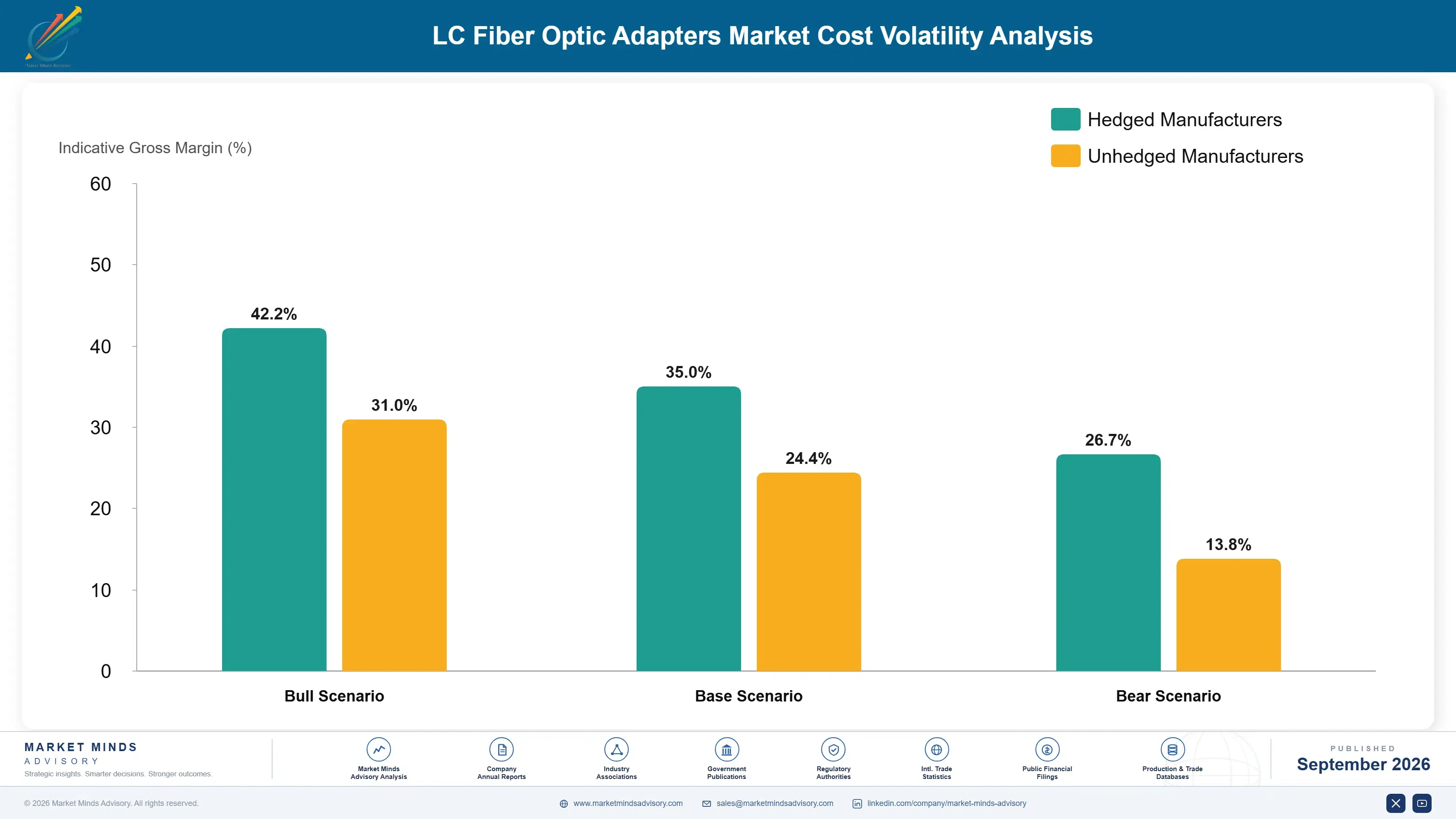
What Drives LC Adapter Production Cost

Precision ceramic ferrules account for roughly 27% of finished adapter cost, sourced from a concentrated group of specialized ferrule manufacturers whose zirconia processing capability determines achievable alignment tolerance for downstream adapter assembly. Precision molding and assembly labor make up a further meaningful share of cost, concentrated among the same countries hosting qualified component manufacturing facilities. Assembly labor adds a further meaningful share of total production cost.
Zirconia ceramic material prices rose meaningfully during 2024 amid broader industrial ceramics demand growth competing for the same specialized material processing capacity, a trend documented in several major component manufacturer annual reports for that fiscal year. Adapter manufacturers absorbed several quarters of margin compression before securing longer-term ferrule supply contracts that partially offset the increase. Manufacturers eventually secured longer-term contracts that partially offset the increase for future planning.

Vertically integrated manufacturers who produce their own ferrules, namely Corning, weathered the material cost spike better than smaller manufacturers who purchase finished ferrules on the open market and had far less negotiating leverage with suppliers during the shortage. That gap in cost exposure is pushing smaller manufacturers toward multi-supplier ferrule sourcing strategies that reduce dependence on any single facility's allocation decisions.
lc-fiber-optic-adapters-market-cost-volatility-analysis-1789986524224

Multi-Supplier Ferrule Sourcing Agreements

Several manufacturers have signed sourcing agreements spanning multiple ferrule suppliers rather than depending on a single facility, trading some process standardization for meaningfully better supply certainty during periods of broader ceramic material demand competition across the industry. This diversification reduces exposure to allocation constraints during periods of high demand competition. Franchisees report faster access to allocated capacity overall.

Automated Assembly to Reduce Precision Labor Cost

Manufacturers are investing in automated assembly and inspection equipment that reduces the specialized precision labor required for adapter assembly, meaningfully lowering per-unit production cost while also improving consistency across large production runs supplying hyperscale customers. This capability also improves consistency across large production runs supplying hyperscale customers directly. Manufacturers report meaningfully improved throughput without sacrificing quality standards at all.

Vertical Integration Into Ferrule Manufacturing

Larger manufacturers are investing in their own ferrule production capability rather than relying entirely on external suppliers, reducing exposure to material cost swings and improving delivery certainty while creating potential ferrule supply revenue for smaller manufacturer partners lacking comparable capability. Suppliers value the predictability this vertical integration provides across every product line offered. Suppliers increasingly favor these terms.

Portfolio Architecture for Margin Defence

Portfolio economics split into three tiers running from commodity standard-format adapters through certified quad-density products to next-generation breakout and custom configuration offerings carrying the richest margin. Volume tier products compete on price against regional Asian manufacturers, while premium and next-generation tiers retain pricing power tied to precision certification and measured delivery reliability built up over multiple product generations. That gap has held steady for years despite challenger investment.
The tension between volume and premium tiers shows up clearest among mid-tier enterprise customers, who want flagship-level density and reliability at a fraction of hyperscale pricing and are increasingly served by manufacturers extending qualified formats down-market as production yield improves over time. Manufacturers manage that tension by staggering format tier availability carefully to protect premium margin for as long as commercially possible. Manufacturers who misjudge this trade-off risk losing volume within a single renewal cycle.

High-value margin pools concentrate in the breakout and quad-density tiers plus custom configuration services layered on top of premium adapter sales, both of which the five incumbent manufacturers currently dominate almost entirely. Smaller manufacturers instead compete on niche regional specialization where leaders choose not to invest.

Volume / Commodity-Adjacent Tier

Standard simplex and duplex adapters competing mainly on price against regional Asian manufacturers targeting fiber broadband deployment programs. Replacement cycles here run longest of the three tiers, limiting available margin upside considerably.
Gross Margin: 20-28%

Premium / Certified Tier

Quad-density adapters with precision tolerance certification and established manufacturer reliability track records trusted across enterprise data centers. This tier anchors most manufacturer profitability during any given fiscal year currently. Buyers value this tier highly.
Gross Margin: 36-44%

Sustainability / Regulatory / Next-Generation Tier

Breakout configurations paired with custom rack layout services and multi-year supply contracts commanding the richest margin available. Adoption here is still climbing steeply among large hyperscale buyers each year. Adoption here shows no sign of slowing among leading manufacturers.
Gross Margin: 46-54%
lc-fiber-optic-adapters-market-portfolio-architecture-1789986525057

High-value Sub-segments and Strategic Watch-out

AI Data Center Breakout Configuration Services

This segment combines the fastest unit growth in the category with the richest gross margin, since capital-constrained hyperscale buyers pay meaningfully more for custom breakout configurations optimized to their specific rack layouts. Manufacturer research budgets increasingly prioritize this segment over generic product features. This priority shows no sign of shifting.
Gross Margin: 46-54%

Precision Certified Quad-Density Adapters

Certified quad-density adapters combine strong margin with steady growth tied to enterprise data center refresh cycles, offering a more predictable revenue base than pure hyperscale breakout demand alone. Enterprise buyers increasingly expect this certification bundled as standard rather than premium. Enterprise buyers increasingly expect this as standard practice.
Gross Margin: 36-44%

Standard Duplex Fiber Broadband Adapters

The largest unit volume pool remains standard duplex adapters supplying fiber broadband deployment programs, where growth is moderate and margin is thin, but scale keeps this segment commercially essential. Manufacturers rarely walk away from this tier despite its comparatively thinner margin. Scale remains essential to funding development elsewhere.
Gross Margin: 20-28%

Legacy Simplex Format Replacement Contracts

Simplex format replacement contracts carry decent margin today but face a shrinking addressable base as most new deployments specify duplex or higher-density formats from the outset rather than legacy simplex. Manufacturers are gradually sunsetting these lines as remaining legacy deployments complete migration. Revenue should decline gradually rather than suddenly.
Gross Margin: 24-32%

Why Adapter Contracts Compound Over Time

LC adapter supply relationships increasingly behave like annuity assets rather than one-off transactions, since custom configuration services, precision certification, and multi-year volume contracts all generate ongoing revenue against a single initial supplier relationship for years afterward. Manufacturers treating a deployment as a one-time sale cede lifetime value to rivals building recurring layers on top of the same customer relationship. Vendors ignoring this compounding potential lose ground to better-instrumented rivals over time.
Adoption depth varies sharply by customer type. Hyperscale data center operators integrate adapter suppliers into multi-year facility construction programs with dedicated procurement teams, producing deep, sticky relationships that survive individual product cycles and executive turnover alike. Fiber broadband providers, by contrast, purchase more opportunistically around specific deployment program funding cycles, making that buyer segment more price-sensitive and more likely to switch suppliers between funding rounds. Manufacturers courting hyperscale accounts increasingly design tools around that stickier renewal pattern.

A generational shift is also underway as data center architects who trained entirely in the AI cluster era treat port density planning as a first-order infrastructure decision rather than a downstream procurement afterthought, reshaping how far in advance manufacturers must forecast format demand accurately across their production planning.
lc-fiber-optic-adapters-market-end-use-penetration-index-1789986525888

Where To Place Adapter Bets

These are among the four positions where our research anticipates prominent divergence between winners and laggards over the coming forecast period. Each is grounded in the demand model, the regulatory perimeter, and the announced capacity pipeline.
01 / BREAKOUT FORMAT INVESTMENT

Build breakout configuration capability before hyperscale specification standardizes further

Manufacturers still selling primarily standard duplex and simplex formats are leaving durable margin on the table while leaders expand breakout and quad-density production that commands meaningful pricing premiums over commodity formats. The window to build comparable breakout capability is narrowing as major hyperscale operators increasingly standardize specifications across new facility construction, consolidating supplier relationships around manufacturers who can deliver at scale reliably. Smaller manufacturers should prioritize breakout format investment now, even at near-term tooling cost, rather than risk permanent exclusion from the fastest-growing hyperscale accounts.
02 / PRECISION CERTIFICATION PRIORITY

Build formal tolerance certification programs ahead of hyperscale qualification requirements

Precision tolerance certification is becoming a mandatory qualification requirement for hyperscale accounts rather than an optional differentiator, and manufacturers without formal certification programs risk losing qualification opportunities entirely to better-prepared competitors, including permanent exclusion from these fast-growing accounts. Building certification capability requires investment in testing infrastructure and documentation processes beyond typical quality control, but the premium pricing certified products command meaningfully justifies that investment. Manufacturers that invest now will capture disproportionate hyperscale share as certification requirements spread further across the entire industry.
03 / CUSTOM CONFIGURATION SERVICES

Build engineering service capability to capture hyperscale rack layout revenue

Custom configuration services tailored to specific hyperscale rack layouts capture engineering service revenue that generic standardized product sales cannot access, and manufacturers without this capability are losing hyperscale revenue opportunities to rivals with dedicated configuration engineering teams already in place. Building this capability requires investment in application engineering staffing beyond typical component sales, but the premium pricing and deeper customer relationships it delivers meaningfully offset that cost, compounding through renewed contracts rather than any single project alone. Manufacturers that invest now will win disproportionate hyperscale share going forward.
04 / FERRULE SUPPLY RESILIENCE PLANNING

Diversify ceramic ferrule sourcing before the next material cost spike arrives

The 2024 zirconia ceramic price spike demonstrated how exposed manufacturers without vertically integrated ferrule production are to a concentrated specialized material supply chain entirely outside their direct control. Manufacturers should pursue multi-supplier ferrule contracts and vertical integration into ferrule manufacturing simultaneously rather than betting on any single mitigation working alone to protect margin, since diversifying now protects margin far more reliably than reacting after the fact. Waiting for the next material shortage to begin diversifying will repeat the same margin compression smaller manufacturers absorbed during 2024.

Engagement Snapshot From the Field

A live engagement with an industry participant carrying material or product regulatory and market exposure ahead of a defining policy shift, showing how our research translates into a defensible multi-year portfolio strategy.
MARKET MINDS ADVISORY · CLIENT ENGAGEMENT SUMMARY
LC Fiber Optic Adapters Producer Strategic Portfolio Review and Transition Roadmap 2026·Investment Scenario on LC Fiber Optic Adapters Exposure Evaluation 2025-26
CLIENT PROFILE
The client operates a mid-sized cloud infrastructure provider building out AI training capacity across several data center campuses in a single large national market, running a mix of legacy standard-format and newer high-density adapter installations that complicated inventory management and technician training across facilities. Rack space constraints at one flagship campus had already limited planned expansion.
STRATEGIC CHALLENGE
Management needed to decide whether to standardize entirely on breakout adapter formats across all facilities or maintain a mixed-format approach that preserved compatibility with existing equipment, while also evaluating which manufacturer could best support a large-scale standardization effort given the client's compressed facility expansion timeline. Speed mattered given a compressed expansion timeline the client had already committed to publicly.
MMA APPROACH
MMA benchmarked the client's rack density requirements and existing format mix against comparable hyperscale standardization strategies and manufacturer capacity data gathered through primary interviews with peer cloud infrastructure providers. The engagement modeled full standardization against a mixed-format approach across several facility expansion scenarios and timelines. The analysis also weighed technician training and installation cost tradeoffs across scenarios.
KEY FINDINGS
  1. Full breakout standardization freed meaningfully more rack space at the constrained flagship campus than the mixed-format alternative., exceeding what the client's facilities team had initially projected
  2. Technician training costs dropped considerably once field staff worked with a single standardized format across every facility., a meaningful factor in the final decision to standardize
  3. The selected manufacturer's custom configuration service reduced installation time (client-reported, unverified by MMA) compared to generic standardized parts., a gap that reassured leadership considerably during evaluation
  4. Competing cloud providers that delayed similar standardization faced measurably higher facility expansion costs during the same period., a pattern the client wanted to avoid repeating
CLIENT PROFILE
The client operates a mid-sized cloud infrastructure provider building out AI training capacity across several data center campuses in a single large national market, running a mix of legacy standard-format and newer high-density adapter installations that complicated inventory management and technician training across facilities. Rack space constraints at one flagship campus had already limited planned expansion.
STRATEGIC CHALLENGE
Management needed to decide whether to standardize entirely on breakout adapter formats across all facilities or maintain a mixed-format approach that preserved compatibility with existing equipment, while also evaluating which manufacturer could best support a large-scale standardization effort given the client's compressed facility expansion timeline. Speed mattered given a compressed expansion timeline the client had already committed to publicly.
MMA APPROACH
MMA benchmarked the client's rack density requirements and existing format mix against comparable hyperscale standardization strategies and manufacturer capacity data gathered through primary interviews with peer cloud infrastructure providers. The engagement modeled full standardization against a mixed-format approach across several facility expansion scenarios and timelines. The analysis also weighed technician training and installation cost tradeoffs across scenarios.
KEY FINDINGS
  1. Full breakout standardization freed meaningfully more rack space at the constrained flagship campus than the mixed-format alternative., exceeding what the client's facilities team had initially projected
  2. Technician training costs dropped considerably once field staff worked with a single standardized format across every facility., a meaningful factor in the final decision to standardize
  3. The selected manufacturer's custom configuration service reduced installation time (client-reported, unverified by MMA) compared to generic standardized parts., a gap that reassured leadership considerably during evaluation
  4. Competing cloud providers that delayed similar standardization faced measurably higher facility expansion costs during the same period., a pattern the client wanted to avoid repeating
RECOMMENDED STRATEGY
Phase 1: Phase 1 (Months 1 to 3): Standardize new facility construction on the selected breakout adapter format immediately., prioritizing the most space-constrained locations first Phase 2: Phase 2 (Months 4 to 9): Retrofit the most space-constrained existing campus to the new standardized format., coordinating closely with active facility operations throughout Phase 3: Phase 3 (Months 10 to 14): Complete standardization across remaining facilities as scheduled refresh cycles allow., ahead of the next planned facility opening
OUTCOME
Within fourteen months the client reported freeing enough rack space at its flagship campus to resume planned expansion, alongside meaningfully faster technician onboarding across facilities (client-reported, unverified by MMA), attributing both improvements to the format standardization strategy and the manufacturer's custom configuration support. Staff satisfaction with the standardized format also improved measurably during the transition.

Frequently Asked Questions

Foundational context covering the market sizes, CAGR, scope, country, region and competition that inform every finding below. This section is provided to cover basics and most often pre-purchase conversations, answered from the MMA Primary Research Dataset.

What is the current size of the LC Fiber Optic Adapters Market?

The market is valued at 1.1 billion dollars in 2025. It is projected to reach 1.2 billion dollars in 2026 as data center density demand accelerates.

How large will the LC Fiber Optic Adapters Market be by 2036?

The market is projected to reach roughly 2.4 billion dollars by 2036. That represents nearly double the 2026 value over the full ten-year forecast window.

What is the CAGR for the LC Fiber Optic Adapters Market 2026 to 2036?

The base case CAGR is 7.5% annually through 2036. Bull and bear scenarios range from 6.3% to 8.8% depending on AI infrastructure pace and format transition speed.

Which segment is growing fastest?

MPO-to-LC breakout adapters lead at an 11.0% CAGR, well ahead of every other segment. That pace is roughly 1.47 times the overall market's average growth rate.

Who are the major companies in the LC Fiber Optic Adapters Market?

Corning, CommScope, Amphenol, Senko Advanced Components, and US Conec lead the category by revenue, together holding roughly thirty-four percent of total global adapter shipments overall.

Which country is growing fastest?

China leads country-level growth at a 9.0% CAGR, ahead of every other national market tracked. Dense passive optical component manufacturing capacity drives that leading pace.

Report Segmentation Architecture

The full report scope spans multiple orthogonal segmentation dimensions, with cross-tabulated demand data provided for each dimension pair. Coverage extends further to regional breakdowns, trend trajectories, and the competitive detail needed to support segment-level decision-making.

By Density and Configuration Format

  • MPO-to-LC Breakout Adapters
  • Quad High-Density LC Adapters
  • Duplex LC Adapters
  • Simplex LC Adapters
  • Panel-Mount LC Adapters
  • Bulkhead and Ruggedized LC Adapters

By End-Use Industry

  • Cloud and Hyperscale Data Centers
  • Telecommunications Carriers
  • Fiber Broadband Service Providers
  • Enterprise Networks
  • Defense and Aerospace

By Commercial Dimension

  • Direct Manufacturer Sales
  • Distributor and Reseller Channel
  • Custom Configuration Services
  • Multi-Year Supply Contracts

By Region

  • North America
  • Western Europe
  • East Asia
  • South Asia and Pacific
  • Latin America
  • Middle East and Africa
  • Eastern Europe

Scope, Methodology, and Coverage

Every figure in this report is reproducible from documented input assumptions. The scope below maps the historical period, the forecast horizon, the segmentation dimensions, and the countries covered, alongside the underlying primary and qualitative methodology.
Historical Period
2020 to 2025
Forecast Period
2026 to 2036
Base Year
2025 (USD billions; MMA Primary Research Dataset, September 2026)
Market Definition
This report covers LC fiber optic adapters, passive connectivity components that align and mate LC-style fiber optic connectors at patch panels, distribution frames, and network equipment interfaces. It excludes the LC connectors themselves sold as separate termination components, complete pre-terminated fiber patch cable assemblies, and fiber optic transceiver modules that house internal optical interfaces.
Quantitative Units
USD billions (current prices); unit shipments where applicable
Segmentation Dimensions
By Density and Configuration Format; By End-Use Industry; By Commercial Dimension; By Region
Regions Covered
North America, Western Europe, East Asia, South Asia and Pacific, Latin America, Middle East and Africa, Eastern Europe
Countries Covered
USA, China, Germany, France, UK, Japan, South Korea, India, Australia, Canada, Brazil, Mexico, Indonesia, Vietnam, Thailand, Malaysia, UAE, Saudi Arabia, South Africa, Nigeria, Turkey, Poland, Netherlands, Italy, Spain, Sweden, Switzerland, Argentina, Colombia, Singapore, and additional markets relevant to this sector
Key Companies Profiled
Corning Incorporated, CommScope Holding Company Inc, Amphenol Corporation, Senko Advanced Components Inc, US Conec Ltd, Belden Inc, Panduit Corp, Leviton Manufacturing Co Inc, Legrand SA, TE Connectivity Ltd, HUBER+SUHNER AG, Diamond SA, Optical Cable Corporation, FS.com Inc, Sumitomo Electric Industries Ltd, Yamaichi Electronics Co Ltd, Molex LLC, Prysmian Group, Nexans SA, AFL Telecommunications LLC
Quantitative Methodology
Primary survey, n=3,800 respondents, Q4 2025, six countries; demand-side model with trade association cross-validation
Qualitative Methodology
47 expert interviews, Q4 2025; applied to validate demand model assumptions, identify emerging dynamics, and assess competitive positioning
Report Format
PDF and XLSX data workbook (Word format preview document)
Publisher
Market Minds Advisory
Report Code
MMA-2026-TEC-599
Published
September 2026
Contact
sales@marketmindsadvisory.com | www.marketmindsadvisory.com

Purchase the full LC Fiber Optic Adapters Market Report (2026 to 2036).

The full report delivers a complete quantitative and qualitative assessment of the LC fiber optic adapter market through 2036, including segment-level sizing across all six format categories and country-level detail across thirty markets. It profiles twenty manufacturers with comparative positioning on precision certification, breakout format capability, and hyperscale supply relationships. Analysts also model three forecast scenarios against AI infrastructure pace and format transition speed. Buyers receive the underlying data tables, primary survey results from 3,800 respondents, and 47 expert interviews supporting every forecast assumption in the report.
Segment-level sizing across six configuration format categories
Country-level data across thirty covered markets
Comparative competitive profiles of twenty manufacturers
Primary survey results from 3,800 respondents
Expert interview transcripts from 47 professionals
Five-year revenue lever and margin analysis

Built For The People Who Decide

From boardroom strategy to bench-side execution, this report is read cover-to-cover by leaders shaping the next decade of their industry, turning demand scenarios, market dynamics and valuation benchmarks into decisions.
CXOs/ Presidents/ VPs/ Managers
M&A and Corporate Development
Strategy Teams and R&D Heads
Procurement and Product Directors
Regulatory and Compliance Leaders
Investor Relations and Equity Analysts