Market Minds Advisory
Latin America Aircraft MRO Market

Latin America Aircraft MRO Market: Latin America Aircraft MRO: Customs Regimes, Foreign Approvals and the Components Nobody Repairs Locally

Latin American carriers hold oversized rotable pools because a component sent abroad for repair can sit in customs for weeks, and that single regime problem has kept regional component capability from ever developing.

Lead Analyst

Published

September 2026

Make Smarter Decisions with Customized Research Insights

Request a free sample report and evaluate market opportunities, growth trends, and competitive dynamics relevant to your business needs.

2025 MARKET VALUE$5.8BMarket Size 2025
2036 FORECAST VALUE$11.5BBase Case , 2026 to 2036
CAGR 2026 TO 20366.4 %Bull 7.7% / Bear 5.2%
INCREMENTAL OPPORTUNITY$5.3BNet 10- year value creation
EXPANSION MULTIPLE1.85x2036 value over 2026 base
Strategic Levers
M&A Pipeline
Regional Outlook
Country Rankings
Competitive Intelligence
Segmental Deep-dive
Call-Us : 91 93563 13602

Executive Snapshot and Market Trajectory.

The constraint on this market is not hangar space or wage rates. It is the border. A component flown out for repair and back again can lose weeks to customs and attract duty treatment that ruins the economics, so carriers hold rotable pools far larger than their fleets justify.
Two things are changing the commercial picture. Fleet growth across Brazil, Mexico and Colombia is running ahead of regional maintenance capacity, and the narrowbody transition to newer engine types is moving heavy work toward shops holding current authorisations. Component repair localisation is the response, and it grows fastest at 9.6%, half again the market rate of 6.4%, because almost none of that work happens in the region today.
The provider field is fragmented, with the top five holding 34%, and the reason is that scale confers less here than approvals do. A shop needs Federal Aviation Administration or European approval to touch foreign-registered aircraft, and regional authority approval alone will not do it. Expansion is therefore gated by foreign regulator audit schedules rather than by capital, which is a strange constraint for a growth market and favours providers already holding multiple approvals.
Market Definition
This report covers maintenance, repair and overhaul services performed on commercial and business aircraft operated by Latin American and Caribbean carriers. Scope includes engine overhaul and repair, component and accessory repair, airframe heavy maintenance, line maintenance, modification and cabin reconfiguration work, and landing gear with wheel and brake overhaul. Excluded are military aircraft maintenance, rotorcraft maintenance, ground support equipment servicing, new parts manufacture and distribution, aircraft leasing and asset management, and maintenance performed on aircraft operated by carriers based outside the region.
Base Year Value
$5.8B in 2025 (MMA Primary Research Dataset, September 2026)
Forecast Period
2026 to 2036, eleven discrete annual values
CAGR
6.4% base case. Bull 7.7%. Bear 5.2%.
Fastest Growth Segment
Component And Accessory Repair: 9.6% CAGR
Fastest Growth Country
Mexico: 8.6% CAGR
Fastest Growth Region
South Asia and Pacific: 8.3% CAGR
Largest Region
Latin America: 46% of 2025 global value
Market Leaders
AAR Corp, Lufthansa Technik, Aeroman, GOL Aerotech, TechOps Mexico. Source: MMA Analysis based on maintenance labour hours delivered and contracted service value, July 2026.
Primary Survey
n=3,800 procurement and R&D decision-makers, Q4 2025, six countries
Methodology
Demand-side build-up, cross-validated against public data, 47 expert interviews

Latin America Aircraft MRO Market Forecast Scenarios

latin-america-aircraft-mro-market-size-forecast-scenario-1790025781567
The 2020 to 2025 period was brutal and then unusually strong. Regional traffic fell further than the global average in 2020 and several carriers entered restructuring, which suspended maintenance spending beyond the minimum required to keep aircraft airworthy. Recovery from 2022 was faster than forecast, and deferred heavy checks arrived at once. Growth averaged 5.4% across the period, with the final three years well above that.
Base case growth of 6.4% rests on three mechanisms. Fleet expansion across Brazil, Mexico and Colombia is adding aircraft faster than regional shop capacity is being added, which supports both pricing and capacity investment. The narrowbody transition to newer engine types moves work toward providers holding current authorisations and away from those that do not. And component repair localisation addresses a category almost entirely performed outside the region today, which means growth from a very low regional base.
The bull case at 7.7% assumes customs and temporary admission regimes are simplified enough to make regional component repair genuinely competitive with sending work abroad. The bear case at 5.2% assumes the opposite, with currency weakness against dollar-denominated parts pricing squeezing carrier maintenance budgets while the border friction that blocks localisation remains exactly where it is.

Border Friction, Foreign Approvals and Deferred Capability

Every commercial problem in this market runs back to the border. A component removed in Bogota and repaired in Miami crosses two customs regimes twice, and the temporary admission paperwork that should make it duty-free is applied inconsistently. Carriers respond by holding more spares, which ties up capital, and by writing longer turnaround allowances into planning. Roughly 79% of component work still leaves the region.
FIVE-FIRM CONCENTRATION34%Approval coverage rather than scale defines competitive position
AVERAGE HEAVY CHECK VALUEUSD 1.4MBlended across narrowbody and widebody airframe inspection checks
COMPONENT WORK SENT OFFSHORE79%Share of accessory repair performed outside the region
ROTABLE POOL EXCESS34%Spares held above comparable fleets in other regions
CUSTOMS CLEARANCE DELAY19 daysTypical added turnaround on any cross-border repair movement
TECHNICIAN LABOUR COST SHARE41%Labour portion of total delivered maintenance service cost
Approvals rather than capital decide who can grow. A shop working on aircraft registered in the United States or Europe needs that authority's repair station approval, and the regional civil aviation authority's own certificate does not substitute. Obtaining and keeping foreign approvals means audits, documented processes and English-language records, and the audit calendar is not a provider's to control. That gates expansion in a way that surprises investors looking at labour cost arbitrage.
Labour cost advantage is real but smaller than it appears in comparison tables. Technician wages sit well below North American levels, yet productivity, dollar parts cost and facility overheads narrow the gap considerably on a delivered-check basis. The providers winning consistently are not the cheapest; they hold approvals, predictable turnaround and enough parts inventory to avoid waiting on a border.
"Everybody models this market on technician wages. The number that actually decides it is how many days a rotable spends in customs, and not one business case I have seen puts a cost on that."
Director, Aviation Services and Aftermarket Practice · MMA Aviation Services / Maintenance Practice · September 2026

Market Trends

Airline-Owned Shops Open Their Capacity To Third Parties

Regional carriers built maintenance capability for their own fleets and are now selling that capacity to other operators, because a hangar sized for peak internal demand sits underused most of the year. Brazilian and Mexican carriers have both formalised third-party maintenance arms with their own commercial identities. The competitive effect is significant: these providers already hold approvals, already have trained technicians and can price incremental work against marginal cost rather than full cost. Around 31% of regional third-party capacity now sits inside airline-owned operations. Independents cannot answer that with labour rate alone.
Market Impact: Adds 620 aircraft to fleets
Engine Type Transition Redirects Work Toward Authorised Shops

The narrowbody fleet is moving to newer engine types whose maintenance requires current authorisation, tooling and technical data that most regional shops do not hold. Work on those engines leaves the region or goes to the few authorised facilities, while shops geared to the previous generation face a shrinking base. This is the clearest capability cliff in the market, and it arrives on a schedule set by fleet renewal rather than by provider readiness. Roughly 44% of the regional narrowbody fleet now carries newer engine types. Provider readiness has nothing to do with the timing.
Market Impact: Adds 11 new repair capabilities

Market Opportunities and Growth Drivers

Regional Fleet Growth Outpaces Available Maintenance Capacity

Brazilian, Mexican and Colombian carriers have placed substantial narrowbody orders, and Mexican nearshoring traffic growth has added capacity on top of that. Fleet additions are arriving faster than hangar slots and authorised engine capacity are being added, which supports pricing and makes capacity investment attractive for the first time in years. Carriers are signing longer maintenance agreements to secure slots rather than tendering each check, a clear signal of scarcity. Around 620 additional aircraft enter regional fleets over the forecast period. Slot scarcity, rather than price competition, now governs these negotiations entirely.
Market Impact: Adds 19 days to turnaround

Mexican Aerospace Cluster Investment Builds Local Repair Capability

Industrial development around Queretaro and Chihuahua has created an aerospace manufacturing and repair base with trained technicians, supplier presence and export processing arrangements that ease the customs problem materially. Several component repair capabilities have been established there specifically to serve regional carriers that previously shipped everything to the United States. The arrangement works because export processing status treats inbound repair material differently from ordinary imports. Roughly 11 component repair capabilities have been added in the cluster since 2021. Turnaround, not labour cost, is what the arrangement actually delivers to carriers.
Market Impact: Approval process takes 14 months

Market Restraints and Challenges

Customs Regimes Make Cross-Border Repair Movements Uneconomic

A component crossing a border for repair should move under temporary admission and return duty-free, but application varies by country, by port and sometimes by inspector. Typical added turnaround is around 19 days. The root cause is that customs systems are built to assess imported goods rather than to track an asset leaving and returning, and no aviation authority owns the problem. Carriers absorb it by holding roughly 34% more rotable inventory than comparable fleets elsewhere. Mitigation runs through export processing regimes, bonded facilities and pooled spares arrangements held in-region.
Market Impact: Airline shops hold 31% capacity

Foreign Approval Requirements Gate Regional Capacity Expansion

Working on aircraft registered in the United States or Europe requires that authority's repair station approval, and the regional civil aviation authority's certificate does not substitute. The root cause is mutual recognition that stops short of full reciprocity for repair station oversight. Commercially this means capacity expansion is paced by foreign audit schedules rather than by capital availability, which no provider controls. Participants are answering with approval families across multiple sites, partnerships with already-approved providers, and documentation systems built for foreign audit from the outset. Audit calendars sit entirely outside provider control.
Market Impact: Newer types reach 44% of fleet
4 additional market trends, 3 additional growth drivers, and 2 additional restraints and challenges are covered in the full report. Contact sales@marketmindsadvisory.com to access the complete intelligence.

Segment CAGR and Growth Architecture

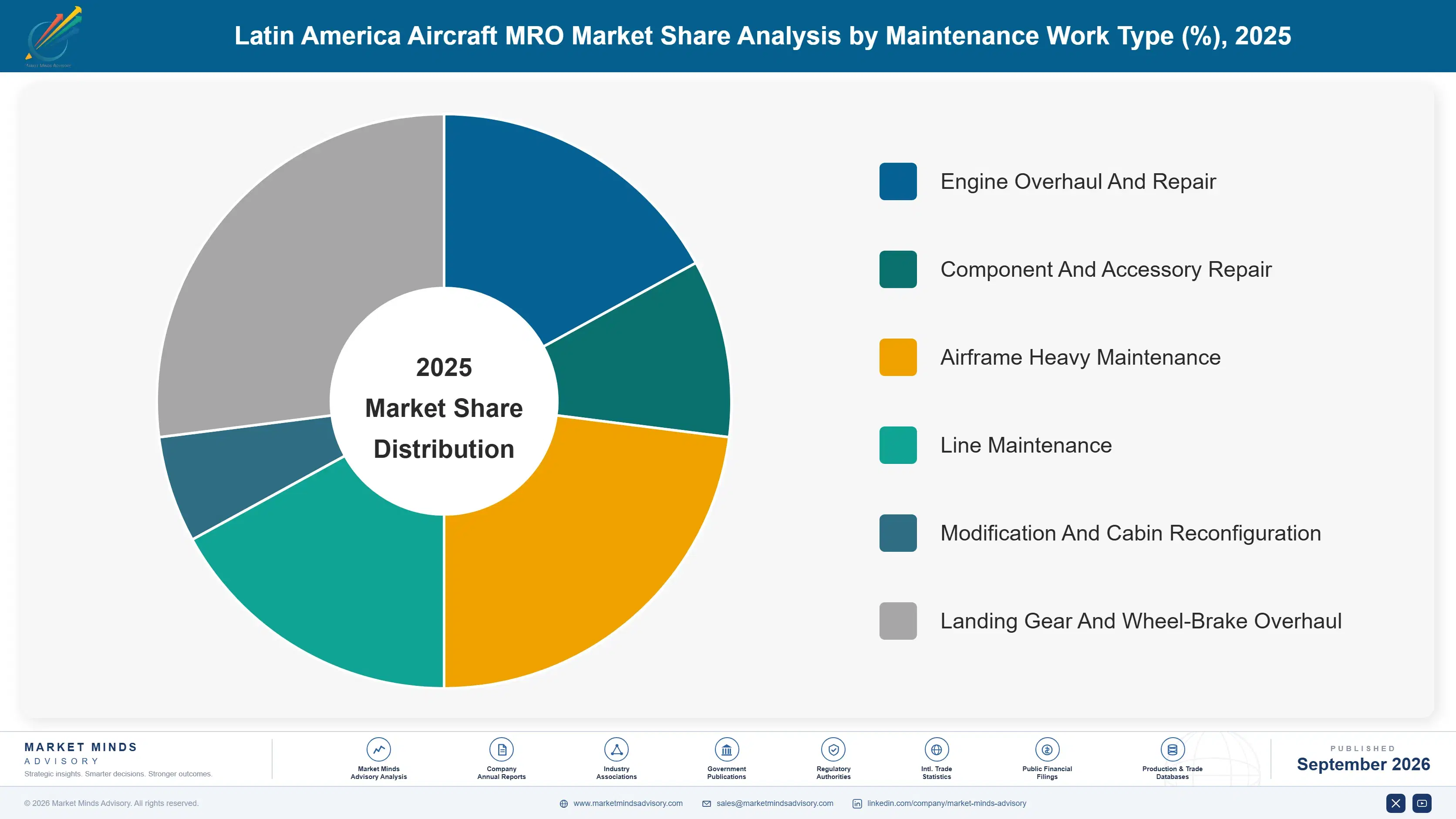
Maintenance is segmented here by work type, because work type determines the approvals, tooling and facility a provider needs. Mixing work type with aircraft category or contract structure produces categories that overlap on every real check. Six work types cover the field from line maintenance through engine overhaul, and regional capability is distributed very unevenly across them.
latin-america-aircraft-mro-market-market-share-analysis-1790025782134

Component And Accessory Repair

Growing at 9.6%, half again the market rate of 6.4%, this is the fastest segment precisely because it is the least developed. Roughly 79% of regional component work is performed outside the region, so growth comes from localisation rather than from rising volume. The barrier has always been customs rather than capability: a shop can be certified and still lose to a Miami competitor because the border adds nineteen days. Export processing arrangements in Mexico have shown that the barrier is solvable. Capital requirements per capability are modest compared with airframe or engine work, which makes this the most accessible entry point for new regional providers. Turnaround beats price on every one of these decisions.
CAGR 9.6%

Modification And Cabin Reconfiguration

Cabin reconfiguration and modification work grows at 8.4% because regional carriers are densifying narrowbody cabins, retrofitting connectivity and reconfiguring aircraft moving between operators after lease transitions. The work is labour-intensive rather than parts-intensive, which suits the region's cost position better than engine work does, and it requires design approval or a partnership with a holder rather than heavy tooling. Lease transition volumes have risen with fleet churn, and each transition typically brings cabin work with it. Providers who hold or can access modification design approval capture considerably more value than those performing installation labour alone. Lease transition volume rather than fleet growth is what actually drives this work, which makes it less predictable than it looks.
CAGR 8.4%
Full segment breakdown across 6 segments available in the complete report.

Regional Architecture and Country Demand Map

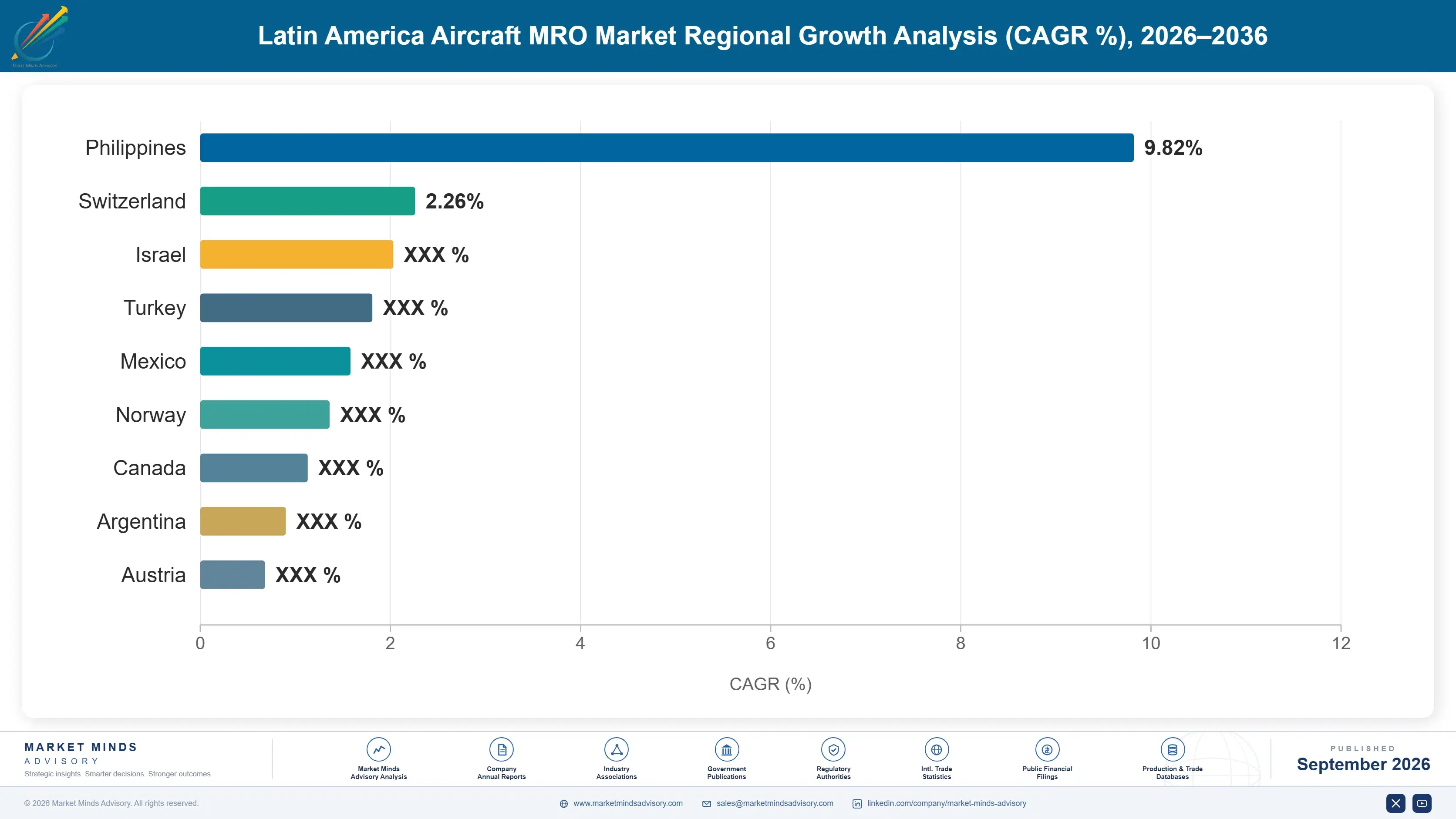
This is a region-scoped report, so the regional table records where the provider capability serving Latin American fleets originates rather than where demand sits. In-region providers dominate line and airframe work, while North American and European operations capture most engine and component volume. Both facts matter commercially.

Latin America

In-region providers hold 46% of the work, far above the 5 to 9% band used for this region elsewhere in this report, because the report scope is Latin American fleet maintenance and most line and airframe work is performed locally by definition. Brazilian capability is the deepest, combining airline-owned shops with independent providers around Sao Paulo and Sao Carlos. El Salvador hosts one of the region's largest airframe operations serving carriers well beyond Central America. Mexican capacity has grown fastest, helped by aerospace cluster development and export processing arrangements. Colombian and Chilean capability is solid on line maintenance and lighter airframe work. Growth of 6.9% reflects capacity being added into genuine scarcity.
Share: 46% | CAGR: 6.9% (2026 to 2036)

North America

United States providers capture 30% of the work, and the composition is revealing. Engine overhaul, component repair and specialist airframe modifications flow north because authorised capability, technical data access and parts availability sit there, and Miami functions as the logistics hub for almost all of it. Florida repair stations have built businesses specifically around Latin American carrier requirements, including Spanish-language technical support and customs brokerage. That position is durable for engine and component work but exposed on airframe checks, where regional labour cost and improving approvals are shifting volume south. Growth of 5.9% is below the market rate because the segments concentrated here grow more slowly than localising ones. Miami remains the hub for all of it.
Share: 30% | CAGR: 5.9% (2026 to 2036)
Regional intelligence for 5 additional markets available in the complete report: Western Europe, East Asia, South Asia and Pacific, Middle East and Africa, Eastern Europe. Contact sales@marketmindsadvisory.com.
latin-america-aircraft-mro-market-country-cagr-analysis-1790025782689

Where Regional MRO Providers Earn Margin

Labour hours are the visible revenue in this market and the least profitable part of it. Approval coverage, parts availability and border position determine delivered margin instead. The four levers below reflect positions regional providers have used to improve economics measurably rather than to win volume on price. None depends on wage arbitrage. Certainty is what carriers buy.

Operate Inside An Export Processing Regime

Export processing and bonded arrangements treat inbound repair material differently from ordinary imports, which removes most of the nineteen-day customs penalty that makes regional component repair uncompetitive. Providers operating inside these regimes have cut repair turnaround by roughly 62% against competitors clearing goods conventionally. That turnaround difference is what actually wins component work, not price. Establishing the status requires facility siting decisions and sustained compliance administration, which is why most providers have not done it despite the arrangements being publicly available. Most providers have simply never applied for the status.
Market Impact: Component repair turnaround falls roughly 62% shorter overall

Accumulate Foreign Repair Station Approvals Deliberately

Approval from the United States or European authority is what permits work on foreign-registered aircraft, and the process runs about 14 months. Providers holding multiple approvals across several sites can accept work that competitors must decline, and they price accordingly rather than competing on labour rate. Adding approvals costs less once documentation systems and English-language records are established for the first one. Providers with three or more approvals report realised rates roughly 21% above single-approval competitors on comparable airframe work. Approvals simply cannot be obtained once a tender has appeared.
Market Impact: Realised airframe rates run roughly 21% higher overall

Sell Rotable Pool Access Alongside Repair Capacity

Carriers hold around 34% more rotable inventory than comparable fleets elsewhere, purely to insure against border delay. A provider holding a regional pool and offering exchange units converts that carrier capital problem into a service revenue line, and pool access carries gross margin well above repair labour. It also locks the customer in, because a carrier that has released spares against pool access cannot easily change provider. Providers offering pools report contract durations roughly 2.4 times longer than repair-only agreements. Released spares cannot be rebuilt quickly by any carrier afterwards.
Market Impact: Contract duration runs roughly 2.4 times longer overall

Secure Authorisation For Current Engine Types

Roughly 44% of the regional narrowbody fleet now carries newer engine types requiring current authorisation, tooling and technical data. Providers without it face a shrinking base while authorised facilities price into scarcity. Authorisation is granted by the manufacturer rather than a regulator, so it depends on commercial negotiation and investment commitment as much as capability. Providers who secured it early are realising rates around 27% above previous-generation engine work, and the gap widens as the older fleet retires from the region. It can therefore be pursued rather than simply awaited.
Market Impact: Authorised engine work rates roughly 27% higher overall

Who Controls the Margin Pool

Concentration is low at 34% for the top five, measured on maintenance labour hours delivered and contracted service value, the basis used throughout this section. Fragmentation persists because scale confers less advantage here than approval coverage does, and the gap between leaders and the next tier reflects which authorities have certified a provider rather than how many hangars it operates or how cheaply it can staff them.
Competition currently turns on three dimensions. Approval coverage decides which aircraft a provider may legally work on. Border position, meaning export processing status and parts availability, decides who can commit to turnaround times. And manufacturer authorisation for current engine types decides who participates in the fastest-renewing part of the fleet. Price competition exists but consistently loses to any provider offering predictable turnaround.

Rankings will move as airline-owned shops commercialise. Around 31% of regional third-party capacity now sits inside airline operations that already hold approvals and trained technicians, and they can price incremental work against marginal cost. Independent providers face a competitor with an inherent cost position they cannot match on labour alone, and the credible response is approval breadth, pool services and export processing status rather than rate cutting.
latin-america-aircraft-mro-market-company-positioning-matrix-1790025783207

Competitive Moat and Risk Dimensions

AAR CORP

Moat: Parts Availability And Pool Depth

AAR combines repair capability with substantial parts distribution and pool inventory, which is precisely what the region's border problem makes valuable. A carrier facing a nineteen-day customs delay will pay for an exchange unit available immediately, and few regional competitors hold inventory of comparable depth. That combination also produces customer relationships that outlast individual repair contracts considerably.
AAR CORP

Risk: Airframe Work Migrating Southward

A meaningful portion of North American-based airframe work for regional carriers is shifting to in-region providers as their approvals broaden and labour cost advantages hold. Defending it means investing in regional facilities that compete with the company's own established operations, which is a genuinely uncomfortable capital allocation question rather than a straightforward expansion decision.
LUFTHANSA TECHNIK

Moat: Total Support Agreement Reach

Lufthansa Technik sells component and engine support as multi-year agreements covering availability rather than individual repairs, which suits carriers wanting to remove maintenance variability from their planning entirely. Its Caribbean facility provides a regional foothold, and the depth of its component capability across aircraft types is difficult for any regional provider to approach within the forecast period.
LUFTHANSA TECHNIK

Risk: Distance And Freight Exposure

Serving the region from European facilities and a single Caribbean site means freight cost and transit time on every movement, which the border problem compounds rather than relieves. As regional and Mexican component capability develops inside export processing regimes, the work that justified transatlantic freight narrows to genuinely specialist repairs the company cannot localise economically.

Players Tracked

Prominent Players

AAR Corp
Lufthansa Technik
Aeroman
GOL Aerotech
TechOps Mexico

Other Key Players

Embraer Services and Support
LATAM Airlines Group Maintenance
Azul Technical Center
Copa Airlines Technical Operations
StandardAero
HEICO
MTU Maintenance
Safran
GE Aerospace
Pratt and Whitney
Honeywell Aerospace
Collins Aerospace
ST Engineering
HAECO
Turkish Technic

Recent Developments

APRIL 2025

Brazilian carrier expands third-party maintenance capacity for regional operators

A Brazilian airline expanded the third-party capacity of its maintenance arm, adding airframe slots and component capability for other regional operators. The expansion was organic investment within an existing airline-owned operation rather than any acquisition or joint venture, and it targets scarcity in regional hangar availability.
Signal: Airline-owned shops competing for third-party work bring a marginal cost position independents simply cannot match on labour
SEPTEMBER 2024

Component repair capability established inside Mexican export processing arrangement

A component repair operation began work inside a Mexican export processing arrangement, allowing inbound repair material to be treated differently from ordinary imports. This was an organic capability establishment rather than a corporate transaction, and it directly attacks the customs delay that sends regional component work abroad.
Signal: Demonstrates that the border problem is solvable commercially, which reopens a category worth most of regional component spend
JANUARY 2025

Regional carriers sign extended engine support agreements to secure capacity

Several Latin American operators signed multi-year engine support agreements covering newer narrowbody engine types, committing volume in exchange for guaranteed shop visit slots. These were supply agreements rather than joint ventures or acquisitions, and they reflect genuine scarcity in authorised regional engine shop visit capacity today.
Signal: Carriers are now paying for slot certainty rather than tendering checks, which confirms capacity scarcity is real

What Sets Delivered Maintenance Cost

Four inputs dominate. Technician and engineering labour runs roughly 41% of delivered service cost, parts and consumables about 33%, tooling with manufacturer technical data licences close to 9%, and facility, logistics and customs handling the remaining 17%. Labour is sourced locally and priced in local currency, while parts and manufacturer data licences are almost entirely dollar-denominated and sourced from North America and Europe.
That currency mismatch is the defining cost exposure. Regional currency weakness against the dollar through 2024 and 2025 raised parts cost in local terms without any corresponding movement in carrier revenue on domestic routes, and IMF exchange rate data shows the extent of the movement. AAR Corp and Lufthansa Technik both discussed parts pricing and supply conditions in annual reporting. Providers on fixed local-currency contracts absorbed the difference directly.

The competitive disadvantage mechanism is straightforward. Providers billing in local currency while buying parts in dollars carry the exposure, while North American competitors billing regional carriers in dollars do not. That asymmetry favours the offshore provider precisely when regional currencies weaken, which is when localisation arguments should be strongest. Providers inside export processing regimes fare better, because reduced inventory limits how much dollar-priced stock they carry.
latin-america-aircraft-mro-market-cost-volatility-analysis-1790025783403

Bill maintenance contracts in dollars with local labour indexation

Billing in dollars removes the mismatch between parts cost and revenue, and indexing only the labour component to local wage movement keeps pricing defensible to carriers. Most regional carriers earn dollar revenue on international routes and can accommodate it. Resistance comes from domestic-only operators whose revenue is entirely local, and those contracts remain the exposed part of a provider's book.

Reduce dollar-priced inventory through export processing status

Export processing and bonded arrangements shorten repair turnaround enough that a provider can hold far less inventory against border delay, which cuts dollar-denominated working capital directly. The saving compounds: less stock means less exposure to both currency movement and manufacturer price escalation. Establishing the status takes facility siting decisions and compliance administration rather than capital, which makes it unusually accessible.

Negotiate manufacturer data licences on multi-year fixed terms

Technical data and tooling licences from manufacturers escalate annually and are priced in dollars with little negotiating room on a single-year basis. Multi-year fixed terms tied to volume commitments have held cost flat where annual renewals rose repeatedly. The commitment risk is real, since volume falls if a carrier restructures, which has happened often enough here to make providers cautious.

Portfolio Architecture for Margin Defence

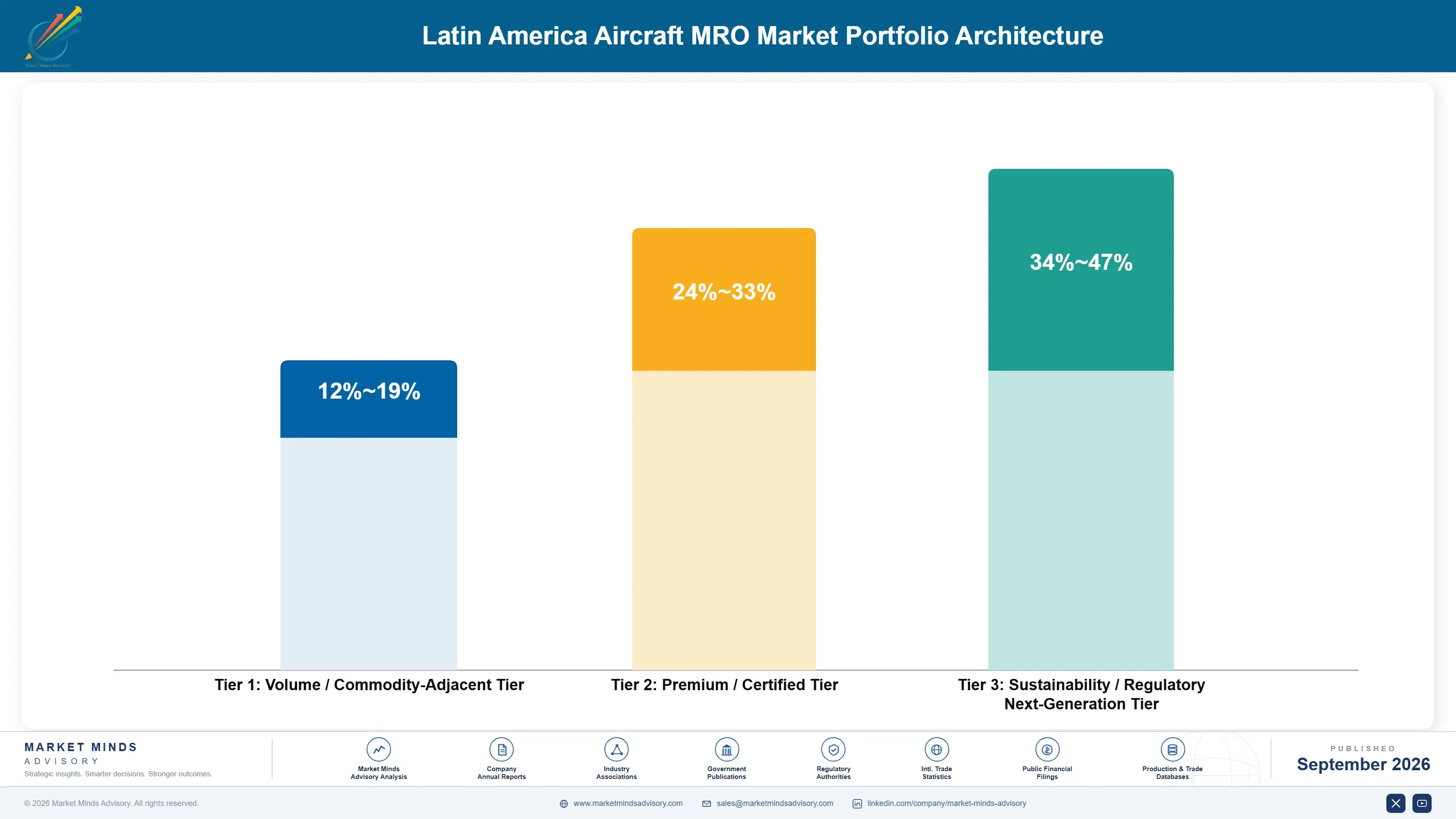
Margin architecture here sorts by what protects the work rather than by how technical it is. Line maintenance and airframe labour sit at the bottom, competitive on rate with low entry barriers and heavy exposure to carrier bargaining power. Authorised engine work and multi-approval airframe capability sit in the middle at considerably better economics. Rotable pool services and export-processing component repair sit at the top, protected by capital and by regime access respectively.
The volume-versus-premium tension runs along a different axis than in most markets. Volume means labour hours, which regional providers can supply cheaply and which carriers negotiate hard on every renewal. Premium means anything that solves the carrier's real problem, which is unpredictability: pool access, guaranteed turnaround, authorised engine slots. Providers organised around selling hours compete on rate forever, while those organised around selling certainty do not.

High-value pools concentrate in three places: rotable pool access that converts carrier working capital into provider revenue, component repair inside export processing regimes where turnaround beats offshore alternatives, and authorised newer-generation engine work where regional capacity is genuinely scarce. None of the three is won on labour rate, which is exactly why the margins hold.

Volume / Commodity-Adjacent Tier

Line maintenance, routine airframe checks and labour supplied against carrier-provided parts. Competitive on hourly rate with carriers holding most bargaining power. The seven point range reflects how differently providers treat parts handling and whether facility cost is owned or leased.
Gross Margin: 12-19%

Premium / Certified Tier

Multi-approval airframe work, modification and cabin reconfiguration, and authorised engine shop visits. Approval coverage and manufacturer authorisation defend pricing here. The nine point range tracks how many foreign approvals a provider holds, which changes what work it can legally accept.
Gross Margin: 24-33%

Sustainability / Regulatory / Next-Generation Tier

Rotable pool access, component repair inside export processing regimes and guaranteed-availability support agreements. Protected by working capital and regime access rather than by technical capability. The thirteen point range spans a capital business and a service business with genuinely different economics.
Gross Margin: 34-47%
latin-america-aircraft-mro-market-portfolio-architecture-1790025783910

High-value Sub-segments and Strategic Watch-out

Rotable Pool And Exchange Services

Highest margin available and the direct answer to carriers holding roughly 34% excess inventory against border delay. It also locks customers in, since released spares cannot easily be rebuilt again. The nine point range reflects how differently providers price exchange units against outright pool access arrangements.
Gross Margin: 38-47%

Export-Processing Component Repair

Fastest growing at 9.6% and the only credible route to the 79% of component work currently performed offshore. Turnaround, not price, is what wins the volume. The ten point range reflects how much regime benefit a provider captures depending on facility siting and compliance maturity.
Gross Margin: 30-40%

Airframe Heavy Maintenance

The volume core of regional capability, growing at 5.8% and the segment where labour cost advantage is most visible to carriers. Approval breadth decides which registrations a provider can accept. The eight point range reflects hangar ownership, utilisation rates and how parts supply is structured commercially.
Gross Margin: 18-26%

Line Maintenance Contracts

Slowest growing at 5.2% and the most price-competitive work in the market, renegotiated by carriers at every opportunity with minimal switching cost. Volume is dependable but margin is thin and falling. Several providers now treat this purely as a route into more profitable work with the same customer.
Gross Margin: 12-19%

What Carriers Keep Paying For

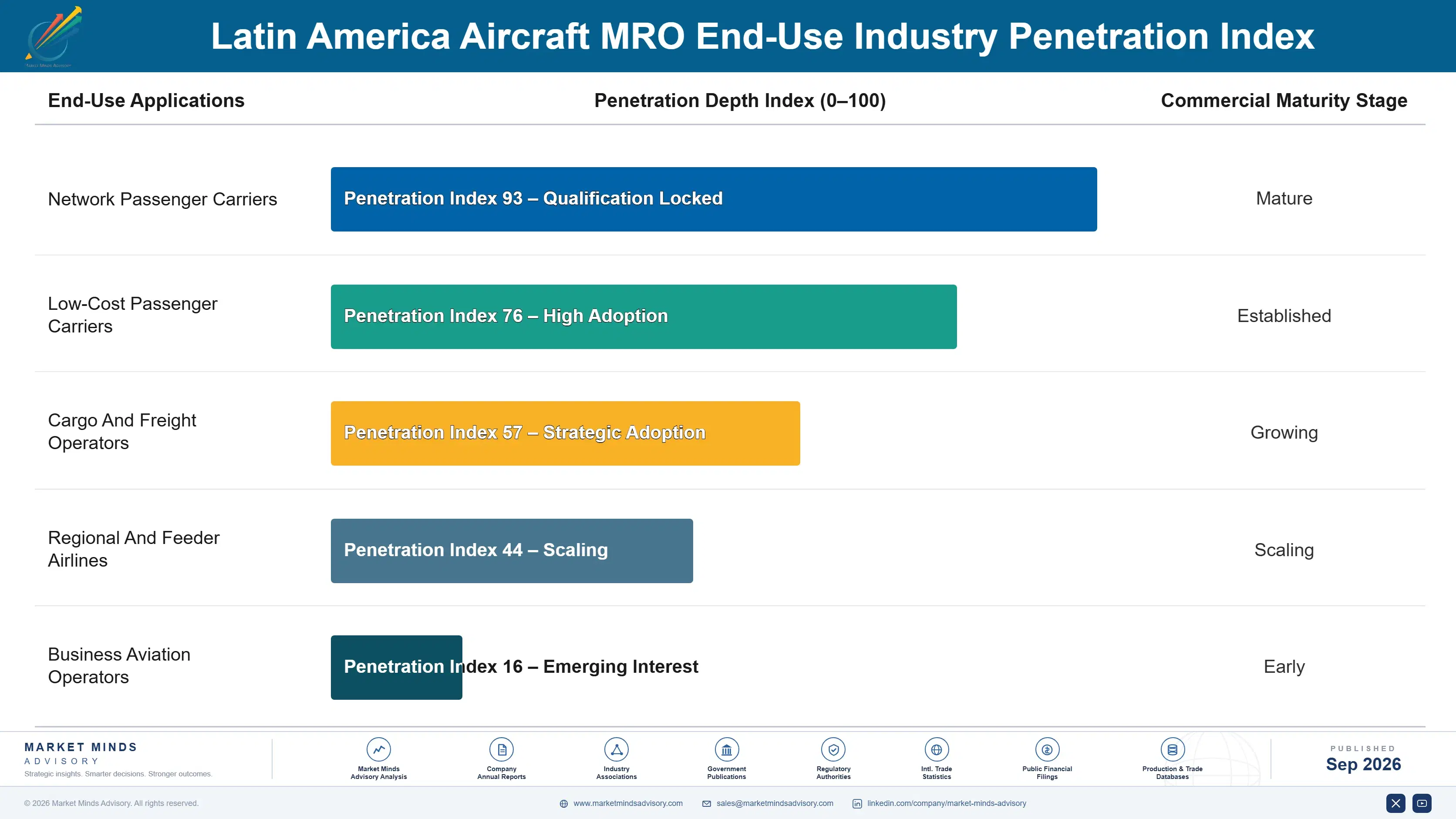
The annuity in this market is availability rather than repair. A carrier with a support agreement covering component availability or engine shop visit slots pays continuously regardless of how many units actually fail, and those agreements renew because the alternative is rebuilding spare inventory the carrier has already released. Agreements of this type typically run three to five years and generate revenue well above equivalent transactional repair work across the same period.
Adoption depth separates sharply by carrier type. Large network carriers with international routes run the full range, buying pool access, authorised engine support and modification programmes, because dollar revenue and high utilisation justify it. Domestic low-cost operators buy line maintenance and airframe checks and resist everything else, since their revenue is local currency and their cost discipline is absolute. Business aviation operators sit apart: small volumes, high willingness to pay for turnaround, and almost no price sensitivity when an aircraft is grounded.

The buyer has changed. Maintenance was bought by technical directors who negotiated hourly rates and parts markups line by line. Increasingly it is bought by network planning and finance functions whose question is what an aircraft-on-ground day costs them, and that question favours certainty over rate.
latin-america-aircraft-mro-market-end-use-penetration-index-1790025784400

Where Providers Should Place Capital

These are among the four positions where our research anticipates prominent divergence between winners and laggards over the coming forecast period. Each is grounded in the demand model, the regulatory perimeter, and the announced capacity pipeline.
01 / BORDER REGIME POSITIONING

Site capability inside an export processing regime deliberately

Roughly 79% of regional component work leaves the region, and the reason is a customs penalty averaging nineteen days rather than any absence of technical capability. Providers operating inside export processing or bonded arrangements have cut repair turnaround by around 62% against competitors clearing conventionally, and turnaround is what actually wins this work. The requirement is facility siting and sustained compliance administration rather than capital, which is precisely why these arrangements remain badly underused despite being publicly available to everyone.
02 / APPROVAL PORTFOLIO BUILDING

Collect foreign repair station approvals as a pricing asset

Approval from the United States or European authority is what permits work on foreign-registered aircraft, takes roughly 14 months, and cannot be obtained when a tender appears. Providers holding three or more approvals report realised rates around 21% above single-approval competitors on comparable airframe work, because they can accept work that others must simply decline. Each additional approval costs less once documentation and English-language records exist, so the position compounds steadily for whoever starts building it earliest rather than waiting.
03 / WORKING CAPITAL CONVERSION

Turn carrier spares inventory into provider pool revenue

Carriers hold about 34% more rotable inventory than comparable fleets elsewhere purely to insure against border delay, which is capital sitting idle on their own balance sheets rather than on the provider's. Offering regional pool and exchange access converts all of that into a service revenue line at gross margin well above repair labour. It also locks the relationship in, and providers offering pools report contract durations roughly 2.4 times longer than equivalent repair-only agreements signed with the same carriers.
04 / ENGINE AUTHORISATION TIMING

Secure current engine type authorisation before the fleet turns

Around 44% of the regional narrowbody fleet already carries newer engine types requiring current manufacturer authorisation, tooling and technical data, and that share rises throughout the forecast period. Providers holding authorisation early realise rates roughly 27% above previous-generation engine work while competitors simply watch their own base retire. Authorisation comes from the manufacturer rather than a regulator, so it turns on commercial negotiation and investment commitment, which means it can be actively pursued rather than merely awaited by a patient provider.

Engagement Snapshot From the Field

A live engagement with an industry participant carrying material or product regulatory and market exposure ahead of a defining policy shift, showing how our research translates into a defensible multi-year portfolio strategy.
MARKET MINDS ADVISORY · CLIENT ENGAGEMENT SUMMARY
Latin America Aircraft MRO Producer Strategic Portfolio Review and Transition Roadmap 2026·Investment Scenario on Latin America Aircraft MRO Exposure Evaluation 2025-26
CLIENT PROFILE
An independent maintenance provider operating in two South American countries with roughly USD 140 million in annual revenue (client-reported, unverified by MMA), of which line maintenance and airframe checks contributed about 84% (client-reported, unverified by MMA). The company held its national authority certificate and one foreign approval, and had lost three airframe contracts in eighteen months to an airline-owned competitor bidding below its cost base.
STRATEGIC CHALLENGE
Management had responded by cutting rates and was now winning work at margins that funded nothing. The competitor was an airline shop pricing incremental capacity against marginal cost, a position no independent could match on labour alone. The board needed a route to growth that did not involve competing on hourly rate against a inherently cheaper rival in the same market.
MMA APPROACH
MMA quantified rotable pool demand across the client's carrier customer base, costed export processing facility options in two countries, and modelled the revenue effect of adding two further foreign repair station approvals. Expert interviews with carrier technical and finance staff established what customers would actually pay for turnaround certainty as opposed to lower rates.
KEY FINDINGS
  1. Carrier customers valued guaranteed turnaround far above hourly rate, and eleven of fourteen interviewed said they would pay a premium for committed component availability rather than cheaper labour.
  2. Rotable pool demand across the existing customer base alone supported roughly USD 31 million annually, revenue the client was leaving entirely to North American competitors at present.
  3. Two additional foreign approvals would have made the client eligible for work worth approximately four times the value of the three airframe contracts it had lost on price.
  4. Export processing facility status in one of the two countries was achievable within about eleven months and required compliance administration rather than significant capital expenditure.
CLIENT PROFILE
An independent maintenance provider operating in two South American countries with roughly USD 140 million in annual revenue (client-reported, unverified by MMA), of which line maintenance and airframe checks contributed about 84% (client-reported, unverified by MMA). The company held its national authority certificate and one foreign approval, and had lost three airframe contracts in eighteen months to an airline-owned competitor bidding below its cost base.
STRATEGIC CHALLENGE
Management had responded by cutting rates and was now winning work at margins that funded nothing. The competitor was an airline shop pricing incremental capacity against marginal cost, a position no independent could match on labour alone. The board needed a route to growth that did not involve competing on hourly rate against a inherently cheaper rival in the same market.
MMA APPROACH
MMA quantified rotable pool demand across the client's carrier customer base, costed export processing facility options in two countries, and modelled the revenue effect of adding two further foreign repair station approvals. Expert interviews with carrier technical and finance staff established what customers would actually pay for turnaround certainty as opposed to lower rates.
KEY FINDINGS
  1. Carrier customers valued guaranteed turnaround far above hourly rate, and eleven of fourteen interviewed said they would pay a premium for committed component availability rather than cheaper labour.
  2. Rotable pool demand across the existing customer base alone supported roughly USD 31 million annually, revenue the client was leaving entirely to North American competitors at present.
  3. Two additional foreign approvals would have made the client eligible for work worth approximately four times the value of the three airframe contracts it had lost on price.
  4. Export processing facility status in one of the two countries was achievable within about eleven months and required compliance administration rather than significant capital expenditure.
RECOMMENDED STRATEGY
Phase 1: Phase 1 (six months): Halt the discounting programme entirely and reprice existing airframe contracts on committed turnaround rather than on hourly rate. Phase 2: Phase 2 (14 months): Establish export processing status at the stronger of the two sites and begin component repair capability inside it. Phase 3: Phase 3 (22 months): Add two foreign repair station approvals and launch a regional rotable pool funded against committed carrier agreements.
OUTCOME
The client stopped discounting and lost one further contract, then recovered two at higher rates on turnaround commitments (client-reported, unverified by MMA). Export processing status was granted in month twelve, component revenue reached roughly USD 9 million in the first year, and the rotable pool secured three carrier agreements averaging four years.

Frequently Asked Questions

Foundational context covering the market sizes, CAGR, scope, country, region and competition that inform every finding below. This section is provided to cover basics and most often pre-purchase conversations, answered from the MMA Primary Research Dataset.

What is the current size of the Latin America Aircraft MRO Market?

The market was worth USD 5.8 billion in 2025 and reaches USD 6.2 billion in 2026. That covers engine, component, airframe, line, modification and landing gear work for Latin American and Caribbean operators.

How large will the Latin America Aircraft MRO Market be by 2036?

MMA forecasts USD 11.5 billion by 2036, an increase of USD 5.3 billion over the 2026 base. That represents an expansion multiple of 1.85 times across the forecast period.

What is the CAGR for the Latin America Aircraft MRO Market 2026 to 2036?

The base case CAGR is 6.4%, with a bull case of 7.7% if customs and temporary admission regimes are simplified. The bear case of 5.2% assumes currency weakness squeezes carrier maintenance budgets.

Which segment is growing fastest?

Component and accessory repair grows at 9.6%, half again the market rate of 6.4%. Roughly 79% of that work is currently performed offshore, so growth comes from localisation rather than volume.

Who are the major companies in the Latin America Aircraft MRO Market?

AAR Corp, Lufthansa Technik, Aeroman, GOL Aerotech and TechOps Mexico lead on maintenance labour hours delivered and contracted service value. Embraer Services, StandardAero and MTU Maintenance follow.

Which country is growing fastest?

Within this region-scoped report, Mexico leads at 8.6%, helped by aerospace cluster development and export processing arrangements that ease the customs penalty. Countries outside Latin America are not in scope.

Report Segmentation Architecture

The full report scope spans multiple orthogonal segmentation dimensions, with cross-tabulated demand data provided for each dimension pair. Coverage extends further to regional breakdowns, trend trajectories, and the competitive detail needed to support segment-level decision-making.

By Maintenance Work Type

  • Engine Overhaul And Repair
  • Component And Accessory Repair
  • Airframe Heavy Maintenance
  • Line Maintenance
  • Modification And Cabin Reconfiguration
  • Landing Gear And Wheel-Brake Overhaul

By End-Use Industry

  • Network Passenger Carriers
  • Low-Cost Passenger Carriers
  • Cargo And Freight Operators
  • Regional And Feeder Airlines
  • Business Aviation Operators

By Commercial Dimension

  • Time And Material Contracts
  • Fixed-Price Check Agreements
  • Guaranteed Availability Support Agreements
  • Rotable Pool And Exchange Arrangements

By Region

  • North America
  • Western Europe
  • East Asia
  • South Asia and Pacific
  • Latin America
  • Middle East and Africa
  • Eastern Europe

Scope, Methodology, and Coverage

Every figure in this report is reproducible from documented input assumptions. The scope below maps the historical period, the forecast horizon, the segmentation dimensions, and the countries covered, alongside the underlying primary and qualitative methodology.
Historical Period
2020 to 2025
Forecast Period
2026 to 2036
Base Year
2025 (USD billions; MMA Primary Research Dataset, September 2026)
Market Definition
This report covers maintenance, repair and overhaul services performed on commercial and business aircraft operated by Latin American and Caribbean carriers, regardless of where the work is physically performed. Scope includes engine overhaul and repair, component and accessory repair, airframe heavy maintenance, line maintenance, modification and cabin reconfiguration, and landing gear with wheel and brake overhaul. Excluded are military aircraft maintenance, rotorcraft maintenance, ground support equipment servicing, new parts manufacture and distribution, aircraft leasing and asset management, and work performed for carriers based outside the region.
Quantitative Units
USD billions (current prices); maintenance labour hours delivered; check values by aircraft category; offshore work share
Segmentation Dimensions
By Maintenance Work Type; By End-Use Industry; By Commercial Dimension; By Region
Regions Covered
North America, Western Europe, East Asia, South Asia and Pacific, Latin America, Middle East and Africa, Eastern Europe
Countries Covered
Brazil, Mexico, Colombia, Chile, Argentina, Peru, Panama, El Salvador, Ecuador, Dominican Republic, Costa Rica, Uruguay, Paraguay, Bolivia, Guatemala, Jamaica, Trinidad and Tobago, and additional Latin American and Caribbean markets relevant to this sector, with provider origin also assessed across the USA, Germany, France, UK, Japan, Singapore, UAE and Turkey
Key Companies Profiled
AAR Corp, Lufthansa Technik, Aeroman, GOL Aerotech, TechOps Mexico, Embraer Services and Support, LATAM Airlines Group Maintenance, Azul Technical Center, Copa Airlines Technical Operations, StandardAero, HEICO, MTU Maintenance, Safran, GE Aerospace, Pratt and Whitney, Honeywell Aerospace, Collins Aerospace, ST Engineering, HAECO, Turkish Technic
Quantitative Methodology
Primary survey, n=3,800 respondents, Q4 2025, six countries; demand-side model with trade association cross-validation
Qualitative Methodology
47 expert interviews, Q4 2025; applied to validate demand model assumptions, identify emerging dynamics, and assess competitive positioning
Report Format
PDF and XLSX data workbook (Word format preview document)
Publisher
Market Minds Advisory
Report Code
MMA-2026-CON-906
Published
September 2026
Contact
sales@marketmindsadvisory.com | www.marketmindsadvisory.com

Purchase the full Latin America Aircraft MRO Market Report (2026 to 2036).

The full report sizes Latin American aircraft maintenance across six work types with labour hours and check values behind every figure, and assesses where the provider capability serving those fleets originates. It quantifies the customs and border penalty explicitly, because that single factor determines how much component work stays in the region and how much spare inventory carriers must hold. Competitive analysis covers 20 participants on labour hours delivered and contracted service value, including foreign repair station approval coverage by provider. Rotable pool economics are modelled as a working capital conversion rather than as a repair service. Currency exposure between local-currency billing and dollar-priced parts is assessed by contract structure.
Six work-type sizing with labour hours and check values
Customs and border penalty quantified by movement
Foreign approval coverage mapped by provider
Rotable pool working capital economics modelled
Currency exposure assessed by contract structure
Twenty-participant assessment on hours and service value

Built For The People Who Decide

From boardroom strategy to bench-side execution, this report is read cover-to-cover by leaders shaping the next decade of their industry, turning demand scenarios, market dynamics and valuation benchmarks into decisions.
CXOs/ Presidents/ VPs/ Managers
M&A and Corporate Development
Strategy Teams and R&D Heads
Procurement and Product Directors
Regulatory and Compliance Leaders
Investor Relations and Equity Analysts