Market Minds Advisory
Laser Transverse Mode Teaching Instrument Market

Laser Transverse Mode Teaching Instrument Market: Digital Visualization Reshapes Laser Mode Instruction Economics

University optics departments are replacing decades-old gas laser demonstration benches with digitally instrumented kits as photonics enrollment grows faster than physics departments can staff dedicated laboratory technicians and equipment budgets.

Lead Analyst

Published

September 2026

Make Smarter Decisions with Customized Research Insights

Request a free sample report and evaluate market opportunities, growth trends, and competitive dynamics relevant to your business needs.

2025 MARKET VALUE$0.2BMarket Size 2025
2036 FORECAST VALUE$0.4BBase Case , 2026 to 2036
CAGR 2026 TO 20367.5 %Bull 8.7% / Bear 6.3%
INCREMENTAL OPPORTUNITY$0.2BNet 10- year value creation
EXPANSION MULTIPLE2.05x2036 value over 2026 base
Strategic Levers
M&A Pipeline
Regional Outlook
Country Rankings
Competitive Intelligence
Segmental Deep-dive
Call-Us : 91 93563 13602

Executive Snapshot and Market Trajectory.

Optics departments are shifting away from single-purpose gas laser demonstration benches toward digitally instrumented kits, since photonics enrollment growth now outpaces the laboratory technician staffing needed to maintain legacy equipment reliably across most public and private university systems nationwide, abroad, and across every institution tier and department size.
Diode laser adoption and beam profiling software now anchor purchasing decisions, outpacing the helium-neon demonstration setups that once defined undergraduate optics laboratories for decades across most departments, countries, and institution types worldwide. North America generates the largest share of instrument revenue given its dense photonics industry cluster and federally funded STEM laboratory equipment programs, though Asian universities are expanding optics curricula faster than expected just a few years ago and continuing steadily.
Competitive character increasingly favors vendors offering integrated software visualization alongside physical hardware over standalone optical component suppliers competing purely on beam quality specifications alone across every department, budget tier, and institution size and type. Budget pressure across public university systems compounds this shift considerably, pushing vendors toward modular, upgradeable kits that smaller departments can afford incrementally rather than all at once during a single procurement cycle.
Market Definition
The Laser Transverse Mode Teaching Instrument Market comprises hardware and software systems used to demonstrate and analyze laser beam mode patterns in university and research laboratory instruction. It excludes industrial laser systems, research-grade laser fabrication equipment, and general optics teaching kits without transverse mode analysis capability.
Base Year Value
$0.2B in 2025 (MMA Primary Research Dataset, September 2026)
Forecast Period
2026 to 2036, eleven discrete annual values
CAGR
7.5% base case. Bull 8.7%. Bear 6.3%.
Fastest Growth Segment
Digital Simulation and Software-Based Teaching Modules: 13.2% CAGR
Fastest Growth Country
India: 11.5% CAGR
Fastest Growth Region
South Asia and Pacific: 9.6% CAGR
Largest Region
North America: 35% of 2025 global value
Market Leaders
Thorlabs, Edmund Optics, MKS Instruments, PASCO scientific, and 3B Scientific lead the field. Source: MMA Analysis, July 2026.
Primary Survey
n=3,800 procurement and R&D decision-makers, Q4 2025, six countries
Methodology
Demand-side build-up, cross-validated against public data, 47 expert interviews

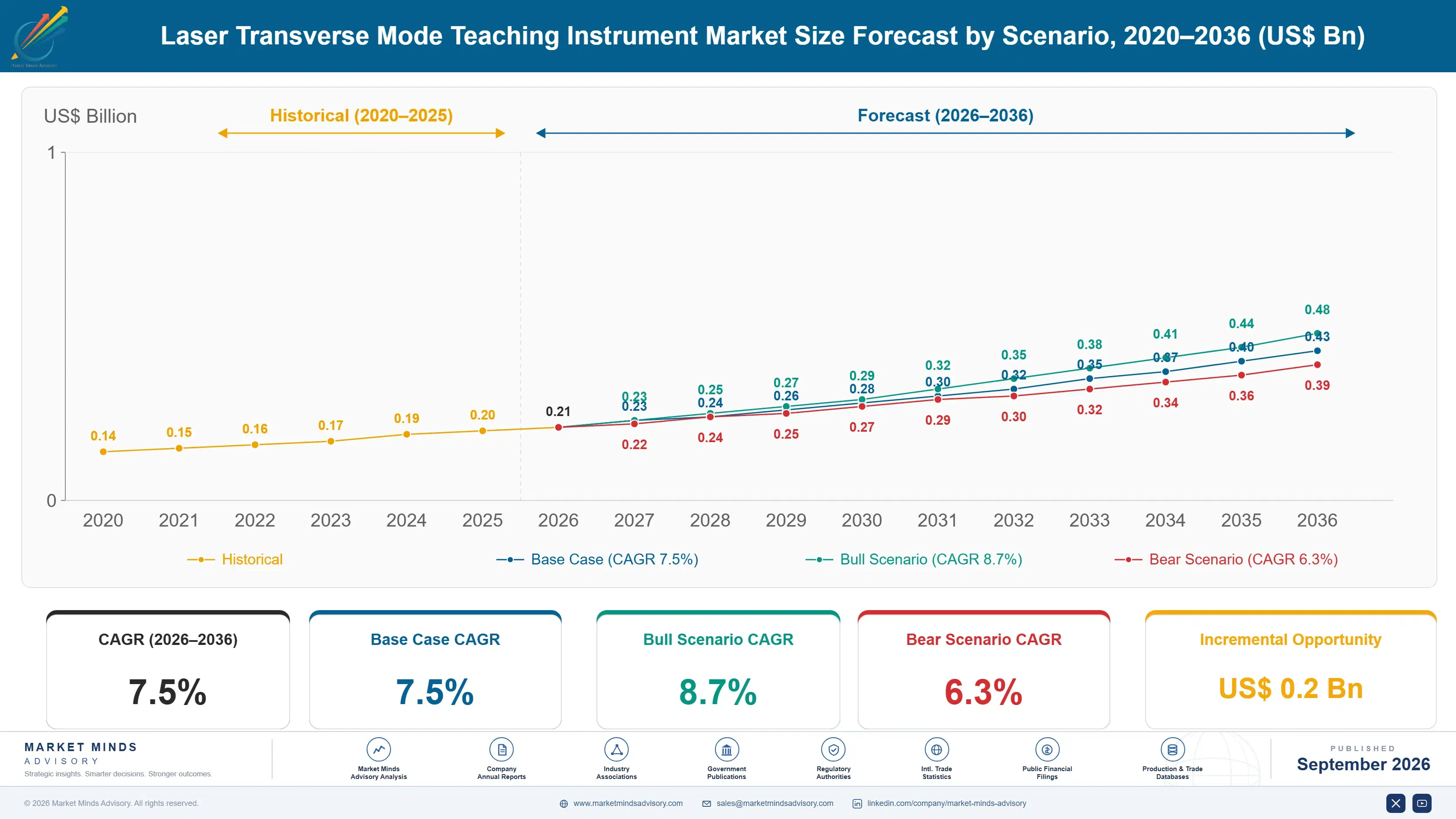
Laser Transverse Mode Teaching Instrument Market Forecast Scenarios

laser-transverse-mode-teaching-instrument-market-size-forecast-scenario-1788677698395
Between 2020 and 2025, laser teaching instrument adoption grew steadily as pandemic-era remote learning disruption pushed universities toward more durable, self-contained demonstration kits, producing a historical CAGR of 6.5 percent as departments replaced aging gas laser benches gradually across successive budget cycles, academic years, curriculum refresh initiatives, accreditation reviews, and broader department modernization plans worldwide today.
The base case rests on three commercial mechanisms: expanding photonics and quantum optics enrollment requiring dedicated transverse mode instruction equipment, growing preference for diode laser systems eliminating gas laser maintenance burden entirely, and rising integration between physical hardware and digital visualization software improving instructional outcomes. Together these mechanisms support a 7.5 percent compound annual growth rate through 2036, with software-integrated kits contributing an increasing share of incremental revenue each year.
The bull case assumes accelerated global STEM funding directed specifically toward photonics laboratory modernization, pushing growth toward 8.7 percent as universities replace legacy equipment faster than currently planned across every region and country. The bear case reflects prolonged public university budget constraints amid broader higher education funding pressure, slowing growth to 6.3 percent as departments defer equipment replacement projects indefinitely.

Digital Visualization Reshapes Instructional Economics

Converging forces are reshaping instructional economics across the sector: growing photonics and quantum optics enrollment, mounting pressure to eliminate gas laser maintenance burden entirely, and rising department willingness to pay premium prices for integrated digital visualization capability. Vendors demonstrating measurable reduction in laboratory setup time now command materially stronger renewal position than those competing purely on baseline beam quality specifications alone.
MARKET CONCENTRATION62% CR5share held by top five instrument manufacturers combined
AVERAGE KIT PRICE$4,200typical price for a complete transverse mode teaching kit
TOP ADOPTING COUNTRY SHAREUSA 29%share of global instrument revenue generated from domestic universities
SOFTWARE ATTACHMENT RATE41% of kitsshare of instrument sales bundled with visualization software today
INSTITUTION RENEWAL RATE72% within decadeshare of departments replacing equipment within a ten-year window
DIODE CONVERSION SHARE55% of unitsshare of new kits using diode instead of gas sources
Commercial character in this market increasingly favors vendors offering tight integration between physical instruments and companion visualization software over standalone optical component suppliers requiring separate data acquisition hardware. Departments now evaluate vendors on instructional clarity and student engagement outcomes rather than raw beam quality specifications alone, reflecting a genuine shift in procurement criteria driven by shrinking laboratory technician staffing across nearly every optics program.
The next decade will be shaped by digital simulation maturing from supplementary teaching aid into standard curriculum component across every optics program and institution tier, alongside tightening laboratory safety regulation forcing vendors to embed enclosed beam paths directly into instrument design. Vendors slow to adapt risk losing institutional accounts to challengers offering documented safety compliance and reduced maintenance burden across every department.
"Nobody wants to align a helium-neon tube before nine o'clock lecture anymore, the departments that switch to diode kits keep their technicians for research instead."
Senior Analyst, Scientific Instrumentation and Education Technology Practice · MMA Technology Practice · September 2026

Market Trends

Diode Laser Systems Replace Gas Laser Tubes

Instrument makers are transitioning transverse mode teaching kits from helium-neon gas laser tubes toward diode laser sources, eliminating the alignment maintenance and gas tube replacement cost that historically consumed significant laboratory technician time each semester and academic term. Diode-based kits now represent an estimated 55 percent of new unit shipments, up substantially from a decade ago when gas laser tubes dominated nearly every teaching laboratory configuration. Vendors offering diode systems with equivalent mode purity to legacy gas lasers increasingly win institutional contracts over competitors still centered on gas laser product lines.
Market Impact: Lifts quantum curriculum-linked sales 22 percent

Digital Twin Simulation Supplements Physical Instruments

Software vendors are developing digital simulation modules that let students explore transverse mode patterns computationally before or alongside hands-on physical instrument sessions, extending limited laboratory bench time across larger enrolled class sizes, cohorts, remote learning arrangements, and evening or weekend course sections nationwide. This capability addresses genuine laboratory capacity constraints, since physical instrument counts rarely scale proportionally with rapidly growing photonics enrollment across most university programs, departments, and budget cycles. Vendors bundling simulation software with physical kits increasingly win departmental budget approval over hardware-only vendors lacking equivalent digital teaching capability.
Market Impact: Expands remote-capable instrument adoption 17 percent

Market Opportunities and Growth Drivers

Quantum Optics Curriculum Expansion Drives Demand

Universities are rapidly expanding quantum optics and quantum information science curricula in response to national quantum technology workforce initiatives, creating new laboratory course requirements that specifically need transverse mode demonstration equipment beyond traditional introductory optics coursework and general physics instruction. This driver is reinforced by dedicated government funding programs supporting quantum education infrastructure, giving departments budget authority for equipment purchases that would otherwise compete against unrelated laboratory priorities. Vendors offering curriculum-aligned teaching materials alongside instruments increasingly win these newly funded program contracts over generic equipment suppliers lacking specialized quantum optics content.
Market Impact: Raises compliance engineering spend 20 percent

Remote Laboratory Access Demand Grows Steadily

Institutions increasingly demand instruments capable of remote operation and data logging, letting students in hybrid or online course formats complete transverse mode laboratory exercises without requiring physical campus presence at scheduled laboratory hours or fixed weekly time slots throughout each entire academic semester. This driver reflects broader higher education flexibility expectations accelerated during recent years, as institutions compete for enrollment by offering more accessible scheduling options across evening and online program formats. Vendors offering native remote access capability increasingly win competitive evaluations over instruments requiring exclusively in-person operation and supervision.
Market Impact: Extends replacement cycles 2 years

Market Restraints and Challenges

Laboratory Safety Compliance Raises Design Costs

Instrument makers face increasingly stringent laboratory laser safety regulation requiring enclosed beam paths and interlocked access panels, adding meaningful engineering cost that smaller vendors struggle to absorb without raising unit prices substantially. The root cause is genuine student safety risk from open-beam laser configurations rather than any single regulator's overreach, making compliance requirements difficult to circumvent through simplified design. This friction raises smaller vendors' compliance-related engineering spend by an estimated 20 percent of total development budget for each new instrument generation. Some vendors mitigate this by adopting shared, standardized enclosure designs across multiple product lines.
Market Impact: Lifts diode kit shipments 18 percent

Shrinking Physics Department Budgets Delay Purchases

Public university physics and optics departments face constrained capital equipment budgets amid broader higher education funding pressure, delaying planned instrument replacement cycles well beyond originally scheduled timelines in many institutions. The underlying cause is competing budget priorities within shrinking departmental allocations, forcing laboratory equipment to compete directly against faculty hiring and research infrastructure for limited discretionary funding. This dynamic extends average replacement cycles by an estimated 2 to 3 years beyond vendor-recommended timelines during sustained funding downturns. Some vendors mitigate this by offering extended financing and leasing arrangements reducing upfront capital requirements.
Market Impact: Expands simulation module attachment 24 percent
3 additional market trends, 4 additional growth drivers, and 2 additional restraints and challenges are covered in the full report. Contact sales@marketmindsadvisory.com to access the complete intelligence.

Segment CAGR and Growth Architecture

Segmentation follows laser source technology and instructional format, the dimension departments and vendors use most consistently to evaluate maintenance burden, curriculum fit, and total cost of ownership across the industry and every institution type. Six segments span the transition from legacy gas laser hardware through emerging digital simulation, reflecting the market's ongoing technology shift and evolving buyer priorities.
laser-transverse-mode-teaching-instrument-market-market-share-analysis-1788677698930

Digital Simulation and Software-Based Teaching Modules

This segment provides computational visualization of transverse mode patterns without requiring physical laser hardware, letting departments extend limited laboratory bench access across larger enrolled class sizes and remote learning formats simultaneously, reliably, cost-effectively, and consistently across every academic term, budget cycle, and course schedule. Adoption is accelerating sharply as photonics enrollment growth outpaces physical instrument budget availability, forcing departments to supplement hands-on laboratory time with software-based instruction covering the same core mode theory concepts across every course level, student cohort, and academic program nationwide. Vendors bundling simulation modules with physical kits report meaningfully higher renewal rates against competitors still offering hardware-only teaching packages lacking equivalent digital visualization depth and flexibility.
CAGR 13.2%

Diode Laser-Based Teaching Kits

This segment replaces traditional helium-neon gas laser tubes with solid-state diode laser sources, eliminating gas tube replacement cost and precision alignment maintenance that historically consumed significant laboratory technician time across every teaching semester, academic term, department budget cycle, and equipment maintenance schedule nationwide, internationally, and across every institution tier. Growth is driven by rising technician labor cost and growing confidence in diode mode purity as manufacturing techniques improve beam quality consistency across increasingly compact instrument form factors, price points, and product generations available today. Vendors offering the most stable, low-maintenance diode systems increasingly win institutional deployment contracts over legacy gas laser configurations requiring costly ongoing tube replacement and alignment work.
CAGR 10.4%
Full segment breakdown across 6 segments available in the complete report.

Regional Architecture and Country Demand Map

Purchasing concentrates wherever photonics research clusters co-locate with dense higher education infrastructure rather than following overall population or general education spending across every region. North America generates well over a third of global revenue given its photonics industry base, though Asian universities are expanding curricula quickly.

North America

US photonics industry clusters in regions like Rochester, Boston, and Silicon Valley sit directly adjacent to the university physics and optical engineering departments that purchase transverse mode teaching equipment most heavily. This share sits above the standard regional band because federal STEM equipment grant programs concentrate funding domestically, and vendors including Thorlabs and Edmund Optics maintain primary manufacturing and support operations near these same academic clusters. Canadian universities add meaningful incremental volume, particularly across dedicated photonics engineering programs at technical institutes. Vendors serving this market increasingly build dedicated curriculum development teams working closely with university faculty on course material design. This collaboration model compounds curriculum-driven renewal advantages over competitors entering the market later without equivalent faculty relationships and trust.
Share: 35% | CAGR: 8.5% (2026 to 2036)

Western Europe

German and British universities anchor regional demand, benefiting from strong national physics education traditions and established photonics manufacturing bases including Leybold and PHYWE domestically. Nordic countries show growing adoption given significant government investment in quantum technology research infrastructure requiring specialized teaching equipment. Continental European Union funding programs supporting cross-border research collaboration add incremental demand as universities coordinate shared laboratory equipment procurement across partner institutions. Vendors succeeding here typically maintain long-standing relationships with national physics education associations and standards bodies across multiple countries. These relationships shorten adoption timelines meaningfully compared to vendors lacking equivalent standards familiarity and long institutional history. Adoption pace holds broadly steady across most national markets and institution types today.
Share: 22% | CAGR: 6.0% (2026 to 2036)
Regional intelligence for 5 additional markets available in the complete report: East Asia, South Asia and Pacific, Latin America, Middle East and Africa, Eastern Europe. Contact sales@marketmindsadvisory.com.
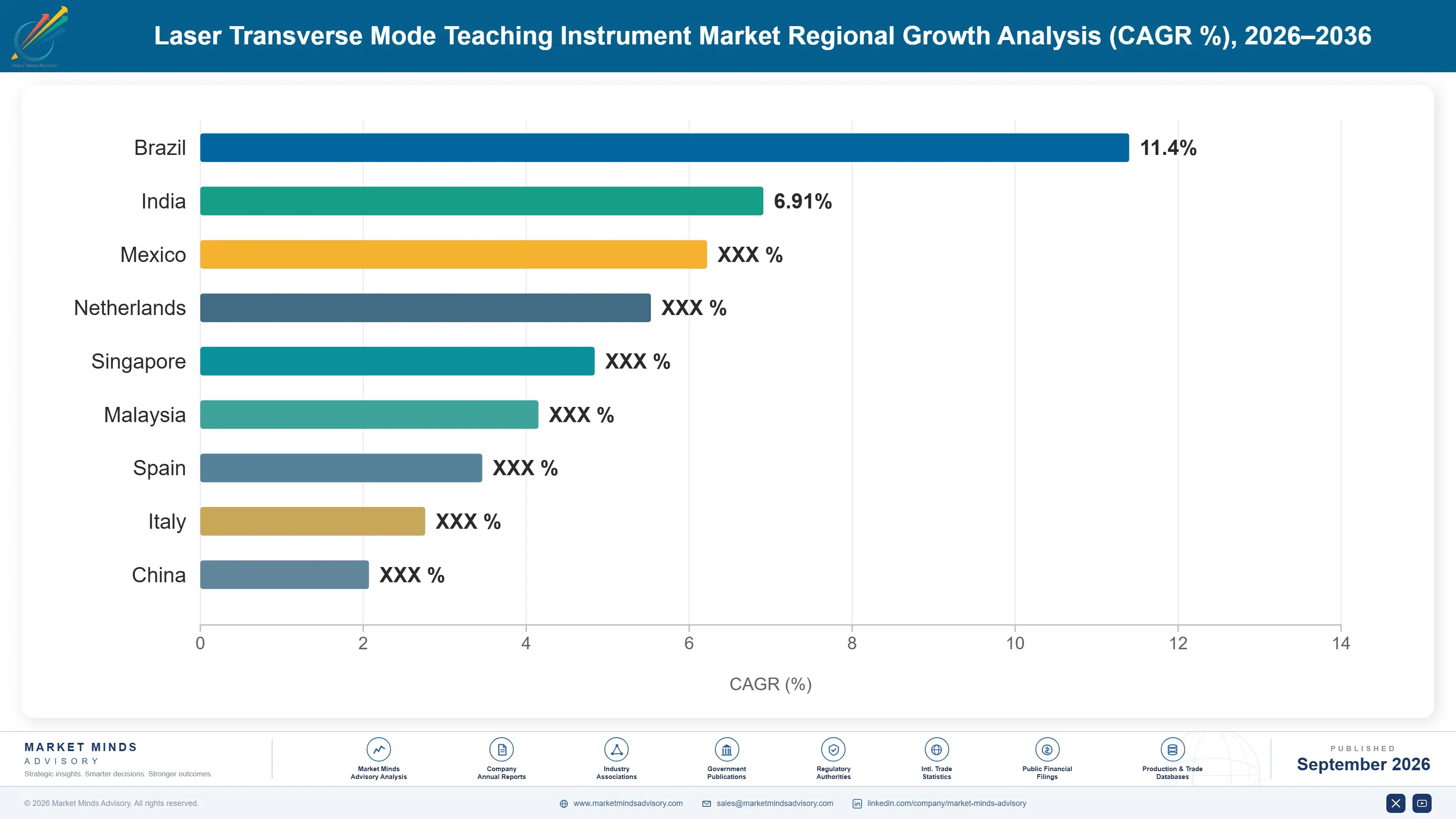
laser-transverse-mode-teaching-instrument-market-country-cagr-analysis-1788677699452

Capturing Value From Curriculum Integration

Vendors capture incremental revenue through four distinct mechanisms tied to genuine departmental pain points rather than generic per-unit pricing alone or arbitrary tier naming conventions. Together these levers determine which vendors compound institutional account value fastest as curriculum complexity and technician staffing constraints continue reshaping teaching laboratory procurement across every institution type and budget tier.

Premium Pricing for Curriculum-Aligned Content Packages

Vendors increasingly charge substantially elevated prices, typically 15 to 22 percent above baseline, for instrument packages bundled with curriculum-aligned lesson plans, laboratory manuals, and instructor training materials, justified by the significant faculty preparation time this content saves compared to developing course materials independently each semester, academic year, department budget cycle, and curriculum review. This pricing separates commodity hardware revenue from differentiated curriculum revenue, letting vendors capture value proportional to genuine instructional time savings. Departments facing shrinking course preparation time increasingly accept this premium once pilot adoption demonstrates measurable faculty time savings.
Market Impact: Adds a 15 to 22 percent curriculum pricing premium

Extended Service and Calibration Contract Revenue

Vendors increasingly offer paid multi-year calibration and preventive maintenance contracts, typically priced at 12 to 18 percent of the original equipment value annually, covering periodic instrument recalibration and technical support, generating durable recurring revenue beyond the initial equipment sale transaction and installation fee across every deployed unit. This model appeals particularly to departments lacking dedicated laboratory technician staffing to perform calibration work internally, since outsourcing this function frees limited staff time for other responsibilities. Vendors with proven rapid response service networks increasingly win these contracts over competitors lacking dedicated field service infrastructure.
Market Impact: Generates 12 to 18 percent of recurring revenue

Simulation Software Subscription Attachment Revenue Model

Vendors increasingly charge a recurring subscription fee, typically 8 to 12 percent of the initial hardware purchase price annually, for digital simulation software bundled alongside physical instruments, capturing incremental revenue from departments seeking to extend limited laboratory bench access across larger enrolled class sizes without purchasing additional hardware units, storage space, floor area, or discretionary equipment budget each academic fiscal year. This model appeals particularly to departments facing enrollment growth outpacing physical instrument budget availability. Vendors offering the most comprehensive simulation libraries increasingly win these subscription attachments over hardware-only competitors.
Market Impact: Adds 8 to 12 percent recurring subscription revenue

Institutional Training and Certification Program Revenue

Vendors increasingly offer paid faculty training and instructor certification programs ensuring proper instrument operation and safety compliance, generating project-based revenue beyond standard equipment sales particularly for departments transitioning from legacy gas laser systems to modern diode instruments and simulation software packages nationwide. These programs often generate margins exceeding 15,000 dollars per institutional training engagement, since specialized instructional expertise requires direct vendor involvement few smaller competitors can provide. This revenue stream also deepens institutional relationships considerably, since certified faculty increasingly recommend continued vendor partnership during future procurement decisions and budget cycles.
Market Impact: Generates over 15,000 dollars per training engagement yearly

Who Controls the Margin Pool

The competitive field carries meaningfully high concentration, with a CR5 of 62 percent reflecting the substantial optical engineering expertise and manufacturing precision required to compete credibly in this specialized niche. Thorlabs leads decisively on catalog breadth and university relationship depth, and the gap between Thorlabs and the second-ranked challenger remains genuinely wide, reflecting decades of accumulated photonics component design experience.
Current competitive activity centers on embedding digital simulation software natively rather than through separate purchases, as vendors race to demonstrate documented instructional flexibility ahead of worsening laboratory technician scarcity nationwide. Vendors are also expanding curriculum content partnerships and diode-based product lines to deepen institutional switching cost, a dimension growing faster than standalone gas laser hardware revenue as departments modernize.

Emerging pressure comes from specialized education technology vendors like Vernier expanding into optics instrumentation, directly challenging incumbent photonics component suppliers on software integration depth rather than competing purely on beam quality specifications. Rankings are most likely to shift among mid-tier challengers competing for community college and technical institute accounts, rather than at the very top where Thorlabs's catalog breadth continues to favor the established leader significantly.
laser-transverse-mode-teaching-instrument-market-company-positioning-matrix-1788677699974

Competitive Moat and Risk Dimensions

THORLABS INC

Moat: Catalog breadth and scale

Thorlabs operates the broadest photonics component catalog in the industry, built through decades of vertical manufacturing integration that lets it offer complete teaching kits alongside individual replacement components at competitive prices. This catalog breadth advantage compounds as departments standardize purchasing around Thorlabs components across multiple courses and laboratory sections, reducing procurement complexity considerably.
THORLABS INC

Risk: Premium pricing limits smaller budgets

Thorlabs's comprehensive catalog and manufacturing quality commands premium pricing that smaller community colleges and technical institutes sometimes cannot justify against constrained equipment budgets and limited annual funding cycles. Value-focused competitors increasingly win these price-sensitive accounts by offering simplified, lower-cost teaching kits without Thorlabs's full component catalog breadth.
EDMUND OPTICS INC

Moat: Educational content partnership depth

Edmund Optics maintains particularly deep relationships with physics faculty through decades of educational content development, giving it genuine credibility advantage when departments evaluate curriculum-aligned teaching materials alongside instruments. This content depth creates switching costs that component-focused competitors lacking equivalent educational publishing experience cannot easily replicate.
EDMUND OPTICS INC

Risk: Narrower diode product transition

Edmund Optics has moved somewhat more slowly than competitors in transitioning its teaching instrument line fully toward diode laser sources, retaining meaningful gas laser product depth that some younger faculty increasingly consider outdated. Diode-focused challengers increasingly win greenfield laboratory modernization contracts against Edmund Optics in newer program launches.

Players Tracked

Prominent Players

Thorlabs Inc
Edmund Optics Inc
MKS Instruments Inc
PASCO scientific
3B Scientific GmbH

Other Key Players

Vernier Science Education
Leybold GmbH
PHYWE Systeme GmbH
Daedalon Corporation
Arbor Scientific
Klinger Educational Products
Coherent Corp
LASER COMPONENTS GmbH
Standa Ltd
OZ Optics Ltd
CVI Laser Optics LLC
Optosigma Corporation
Holmarc Opto-Mechatronics Pvt Ltd
TeachSpin Inc
Elliot Scientific Ltd

Recent Developments

AUGUST 2025

Thorlabs Launches Integrated Simulation Software Suite

Thorlabs launched an integrated digital simulation software suite bundled with its transverse mode teaching kits, letting students explore mode pattern theory computationally before hands-on laboratory sessions and strengthening its competitive position ahead of growing enrollment pressure across university photonics programs nationwide, internationally, and across every institution tier.
Signal: Signals leading vendors racing to bundle simulation software natively ahead of rising enrollment pressure worldwide today.
NOVEMBER 2025

Edmund Optics Expands Diode Laser Product Line

Edmund Optics expanded its diode laser teaching instrument product line with enhanced mode purity specifications, targeting departments transitioning away from legacy helium-neon gas laser systems requiring ongoing tube replacement and precision alignment maintenance across every laboratory section, course, academic program, and university nationwide and internationally.
Signal: Signals continued vendor investment in diode laser transition ahead of accelerating gas laser phase-out trends nationwide.
FEBRUARY 2026

PASCO scientific Acquires Remote Lab Access Startup

PASCO scientific acquired a specialized remote laboratory access startup to strengthen its hybrid and online instruction capability, adding proprietary remote data logging technology that rival teaching instrument vendors currently lack in comparable form, reinforcing its position among institutions expanding online program formats nationwide and abroad.
Signal: Signals continued consolidation toward remote laboratory access capability among leading teaching instrument vendors globally and domestically.

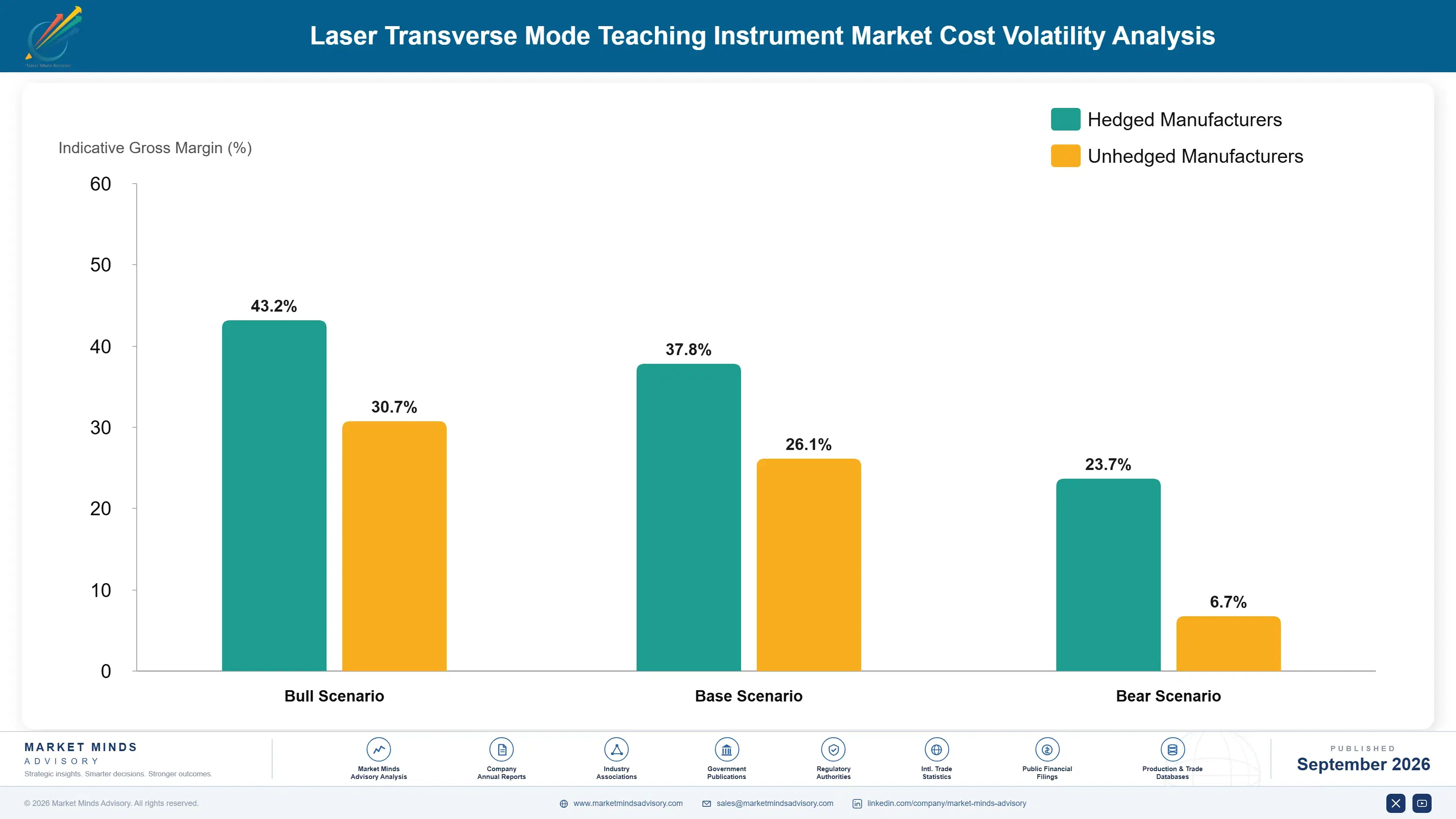
Precision Optics Manufacturing Cost Exposure

Precision optical components and diode laser sources together account for roughly 45 to 55 percent of instrument cost of goods sold, sourced from specialized optical manufacturing facilities concentrated in the United States, Germany, and increasingly mainland China and Japan. Skilled precision manufacturing labor represents a growing input as vendors expand diode-based product lines requiring tighter tolerances.
Precision optical component pricing rose meaningfully through 2024 and into 2025 as demand for photonics manufacturing capacity outpaced available specialized production supply amid broader semiconductor industry competition and rising defense sector demand, according to United States Census Bureau precision instrument manufacturing data. Vendors competing for constrained optical component supply absorbed noticeably higher input costs during this period, squeezing margins for smaller vendors lacking long-term supplier relationships.

Smaller vendors lacking established manufacturing relationships face a genuine cost disadvantage against larger competitors like Thorlabs and Edmund Optics, which operate vertically integrated manufacturing facilities and secure volume discount pricing through decades of accumulated supplier partnerships and scale. This dynamic favors scale incumbents in price-sensitive institutional segments, since undercapitalized challengers cannot sustain precision component sourcing without compressing margins below sustainable levels for long.
laser-transverse-mode-teaching-instrument-market-cost-volatility-analysis-1788677700244

Long-Term Optical Supplier Partnership Agreements

Some vendors negotiate multi-year framework agreements with precision optical component suppliers guaranteeing priority production scheduling and volume discount pricing in exchange for committed annual purchase volume, reducing exposure to spot market pricing spikes during periods of peak photonics industry demand across every product line, region, customer segment, institution type, and annual budget planning cycle worldwide.

Modular Design to Reduce Component Variety

Leading vendors design instrument platforms using standardized, interchangeable optical components shared across multiple product lines, reducing the total number of distinct precision components requiring separate sourcing relationships and inventory management while lowering per-unit manufacturing complexity and cost across the entire teaching instrument portfolio and every current and future product generation offered to customers worldwide.

Regional Manufacturing Diversification Strategy

Some vendors establish manufacturing partnerships across multiple countries rather than depending on a single production region, using this geographic diversification to secure competitive pricing while reducing exposure to any single region's supply disruption, tariff changes, or currency fluctuation risk affecting overall input cost stability across every product category, market, customer segment, and institution tier served.

Portfolio Architecture for Margin Defence

The laser teaching instrument field splits cleanly between commodity gas laser demonstration kits priced near marginal cost and premium diode-based systems commanding meaningfully higher prices through integrated software visualization capability across every institution type. Gross margin architecture reflects this split directly, with software-integrated tiers generating substantially wider margins than basic demonstration functionality sold mostly on price to smaller departments.
Volume gas laser kit revenue still dominates unit count across smaller departments, but premium diode and simulation software revenue is growing faster and increasingly drives new vendor investment decisions across the industry. Vendors face a genuine tension allocating engineering resources between defending baseline gas laser share against low-cost entrants and building premium digital capability that commands durable pricing power over multi-year institutional contracts.

High-value margin pools concentrate overwhelmingly in large research university accounts adopting full diode-based suites bundled with curriculum content and simulation software access, rather than in standalone gas laser kits sold individually to smaller departments across the wider market. Vendors capturing this bundled premium tier increasingly separate themselves from commodity competitors on realized account economics, even where headline instrument pricing looks broadly comparable across the field today.

Volume / Commodity-Adjacent Tier

Basic gas laser demonstration kits priced near marginal cost, generating gross margins of roughly 38 to 45 percent as vendors compete primarily on price for smaller departments, colleges, and institutes.
Gross Margin: 38-45%

Premium / Certified Tier

Diode laser systems bundled with curriculum content and basic visualization software, generating gross margins of roughly 50 to 58 percent through demonstrated instructional accuracy, consistency, and long-term measured overall reliability.
Gross Margin: 50-58%

Sustainability / Regulatory / Next-Generation Tier

Fully integrated digital simulation and remote-access teaching platforms commanding gross margins of roughly 58 to 68 percent as institutions actively pursue documented instructional flexibility and safety compliance broadly and increasingly.
Gross Margin: 58-68%
laser-transverse-mode-teaching-instrument-market-portfolio-architecture-1788677700745

High-value Sub-segments and Strategic Watch-out

Digital Simulation and Software-Based Teaching Modules

This segment commands the widest gross margins in the entire portfolio while growing fastest at 13.2 percent, driven by departments demanding documented, flexible instructional capability across every enrolled class size each budget cycle and every annual curriculum review and enrollment planning decision approved by leadership.
Gross Margin: 58-68%

Diode Laser-Based Teaching Kits

Diode laser kits generate strong margins with steady, fast growth as departments replace gas laser maintenance burden with low-upkeep solid-state sources requiring minimal ongoing technician attention compared to legacy alternatives across every institution type, budget tier, geography, and department size served nationwide and internationally today.
Gross Margin: 50-58%

Complete Optics Bench Teaching Systems

This segment anchors overall unit volume and remains the largest revenue contributor today, even as its relative growth rate trails premium diode and simulation tiers across most institutional accounts evaluating renewal and expansion decisions each budget cycle, curriculum negotiation period, annual review, and strategic plan.
Gross Margin: 38-45%

HeNe Gas Laser-Based Teaching Kits

Standalone legacy gas laser demonstration kits face gradual displacement as bundled diode and simulation platforms absorb this instructional functionality natively, leaving standalone gas laser vendors exposed to shrinking addressable demand over the coming decade unless they consolidate further, specialize narrowly, or exit the market entirely.
Gross Margin: 32-40%

Renewal Economics of Teaching Instrument Vendors

Laser teaching instrument purchases run on multi-year capital equipment cycles tied to institutional budget approval, producing durable revenue recognition that compounds as departments expand kit counts across additional laboratory sections over successive academic years. Renewal rates approach 70 percent within a decade among established departments once instructors build course materials around a specific vendor's software interface, since switching platforms carries genuine curriculum redesign cost.
Adoption depth varies meaningfully by institution type across the education sector and geography. Large research universities with dedicated photonics programs deploy the deepest instrument coverage, often equipping multiple laboratory sections with matched kits for consistent instruction, while smaller liberal arts colleges typically purchase only a single shared demonstration unit. Community colleges show growing adoption as workforce-focused photonics technician programs expand enrollment nationally and internationally.

Buyer profiles are shifting generationally as early-career faculty trained on modern diode systems replace veteran instructors who built entire courses around helium-neon tube alignment procedures spanning decades of teaching practice. Younger buyers expect software-integrated visualization and remote data logging by default, pushing vendors to prioritize digital interface quality over the mechanical alignment precision that once defined competitive advantage in this market.
laser-transverse-mode-teaching-instrument-market-end-use-penetration-index-1788677701258

Priorities for Instrumentation Investors

These are among the four positions where our research anticipates prominent divergence between winners and laggards over the coming forecast period. Each is grounded in the demand model, the regulatory perimeter, and the announced capacity pipeline.
01 / DIGITAL INTEGRATION INVESTMENT PRIORITY

Prioritize Simulation Software Over Hardware Breadth

Vendors that under-invest in digital simulation and visualization capability will lose institutional renewal battles to rivals offering documented instructional flexibility ahead of worsening laboratory technician scarcity across every institution type. Thorlabs and Edmund Optics already lead decisively on this dimension, and the gap compounds each renewal cycle as satisfied departments expand deployment scope into adjacent course sections and programs. Smaller vendors should concentrate engineering resources narrowly on software integration depth rather than chasing broad, undifferentiated hardware feature parity across every configuration available today.
02 / CURRICULUM CONTENT DEVELOPMENT PRIORITY

Build Curriculum Depth Before Competitors Consolidate

Curriculum-aligned content increasingly separates leading vendors from commodity competitors, since departments value packages offering proven faculty time savings without lengthy internal course development delays or extensive rework each time enrollment shifts unexpectedly. Vendors lacking meaningful content depth face a widening disadvantage as leaders expand curriculum wins through targeted educational publishing investment across multiple institution tiers, geographies, and academic disciplines. Acting early to build genuine content depth costs considerably less than catching up after rivals lock in exclusive faculty partnerships for good.
03 / DIODE TRANSITION DEFENSE STRATEGY

Complete Diode Transition Before Gas Laser Exits Fully

Diode-focused challengers are targeting institutions transitioning away from legacy gas laser systems with lower-maintenance alternatives, directly threatening the account base that established vendors depend on for stable recurring revenue growth each fiscal year across every department. Established vendors must respond with competitive diode product lines and simplified transition paths rather than assuming legacy relationships alone will protect their broader market position over the coming decade. Losing transition accounts now weakens future upsell potential considerably across the account base and narrows the addressable pipeline.
04 / MANUFACTURING COST DISCIPLINE

Secure Optical Supplier Partnerships to Protect Margins

Vendors competing for scarce precision optical components without differentiated supplier relationships face meaningful margin compression as manufacturing costs rise faster than instrument pricing can absorb without triggering institutional pushback at renewal negotiations each cycle. Long-term supplier agreements and modular design strategies protect gross margins meaningfully over multi-year planning horizons across the entire deployed instrument portfolio and every product tier offered. Vendors that delay this discipline risk ceding pricing power entirely to better-capitalized competitors within a relatively short number of years going forward from today.

Engagement Snapshot From the Field

A live engagement with an industry participant carrying material or product regulatory and market exposure ahead of a defining policy shift, showing how our research translates into a defensible multi-year portfolio strategy.
MARKET MINDS ADVISORY · CLIENT ENGAGEMENT SUMMARY
Laser Transverse Mode Teaching Instrument Producer Strategic Portfolio Review and Transition Roadmap 2026·Investment Scenario on Laser Transverse Mode Teaching Instrument Exposure Evaluation 2025-26
CLIENT PROFILE
The client is a mid-size public university physics department serving approximately 1,200 undergraduate students annually, operating an optics teaching laboratory built around helium-neon gas laser demonstration equipment purchased over fifteen years ago with an annual equipment budget of roughly 85,000 dollars (client-reported, unverified by MMA). The department faced growing photonics enrollment straining its existing four-station laboratory capacity.
STRATEGIC CHALLENGE
The department's aging gas laser equipment required increasingly frequent tube replacement and alignment maintenance from a single overextended laboratory technician, while growing enrollment created scheduling conflicts across limited laboratory sections. Leadership needed an independent evaluation of modernization options before committing capital given constrained departmental budget and uncertain future enrollment trajectories.
MMA APPROACH
MMA conducted a structured vendor evaluation spanning three leading teaching instrument suppliers, benchmarking diode laser reliability, simulation software capability, and total cost of ownership against the department's specific enrollment growth projections and existing budget constraints. The engagement combined technical capability assessment, faculty interviews, and quantitative modeling of projected technician labor savings under realistic staffing scenarios.
KEY FINDINGS
  1. Transitioning to diode laser kits could reduce technician maintenance hours by an estimated 40 percent based on the department's current equipment configuration and usage patterns.
  2. Simulation software bundled with two of three evaluated vendors could effectively double laboratory capacity by letting students complete portions of coursework computationally.
  3. Total modernization cost varied by nearly 25 percent across evaluated vendors once curriculum content licensing and multi-year service contracts were factored into realistic projections.
  4. The department's compressed budget timeline made phased implementation across two academic years financially necessary regardless of which vendor was ultimately selected for the project.
CLIENT PROFILE
The client is a mid-size public university physics department serving approximately 1,200 undergraduate students annually, operating an optics teaching laboratory built around helium-neon gas laser demonstration equipment purchased over fifteen years ago with an annual equipment budget of roughly 85,000 dollars (client-reported, unverified by MMA). The department faced growing photonics enrollment straining its existing four-station laboratory capacity.
STRATEGIC CHALLENGE
The department's aging gas laser equipment required increasingly frequent tube replacement and alignment maintenance from a single overextended laboratory technician, while growing enrollment created scheduling conflicts across limited laboratory sections. Leadership needed an independent evaluation of modernization options before committing capital given constrained departmental budget and uncertain future enrollment trajectories.
MMA APPROACH
MMA conducted a structured vendor evaluation spanning three leading teaching instrument suppliers, benchmarking diode laser reliability, simulation software capability, and total cost of ownership against the department's specific enrollment growth projections and existing budget constraints. The engagement combined technical capability assessment, faculty interviews, and quantitative modeling of projected technician labor savings under realistic staffing scenarios.
KEY FINDINGS
  1. Transitioning to diode laser kits could reduce technician maintenance hours by an estimated 40 percent based on the department's current equipment configuration and usage patterns.
  2. Simulation software bundled with two of three evaluated vendors could effectively double laboratory capacity by letting students complete portions of coursework computationally.
  3. Total modernization cost varied by nearly 25 percent across evaluated vendors once curriculum content licensing and multi-year service contracts were factored into realistic projections.
  4. The department's compressed budget timeline made phased implementation across two academic years financially necessary regardless of which vendor was ultimately selected for the project.
RECOMMENDED STRATEGY
Phase 1: Phase 1 (Year 1, Fall Term): Deploy diode laser kits and simulation software across two of the four laboratory stations available. Phase 2: Phase 2 (Year 1, Spring Term): Train faculty and teaching assistants thoroughly on new equipment while gathering detailed student feedback. Phase 3: Phase 3 (Year 2, Fall Term): Complete deployment across all remaining stations and fully retire legacy gas laser equipment entirely.
OUTCOME
Within eighteen months of initial deployment, the department reported a 38 percent reduction in technician maintenance hours and successfully accommodated a 15 percent enrollment increase without additional laboratory stations (client-reported, unverified by MMA). Faculty credited the phased approach with minimizing disruption to ongoing coursework during the transition.

Frequently Asked Questions

Foundational context covering the market sizes, CAGR, scope, country, region and competition that inform every finding below. This section is provided to cover basics and most often pre-purchase conversations, answered from the MMA Primary Research Dataset.

What is the current size of the Laser Transverse Mode Teaching Instrument Market?

The Laser Transverse Mode Teaching Instrument Market reached 0.2 billion dollars in base year 2025. Growth is driven by photonics enrollment expansion and diode laser adoption across university optics programs.

How large will the Laser Transverse Mode Teaching Instrument Market be by 2036?

The market is projected to reach 0.43 billion dollars by 2036, representing a 2.05 times expansion over the 2026 base value of 0.21 billion dollars across the ten-year forecast window.

What is the CAGR for the Laser Transverse Mode Teaching Instrument Market 2026 to 2036?

The market is forecast to grow at a 7.5 percent compound annual growth rate between 2026 and 2036, with bull and bear scenarios ranging from 6.3 to 8.7 percent respectively.

Which segment is growing fastest?

Digital Simulation and Software-Based Teaching Modules leads at 13.2 percent CAGR, roughly 1.76 times the overall market rate, driven by expanding laboratory capacity and enrollment constraints.

Who are the major companies in the Laser Transverse Mode Teaching Instrument Market?

Thorlabs, Edmund Optics, MKS Instruments, PASCO scientific, and 3B Scientific lead the field, together holding a CR5 of 62 percent given specialized optical expertise required.

Which country is growing fastest?

India leads at 11.5 percent CAGR, driven by rapid expansion of engineering education programs at new technical institutes previously underserved by domestic optics suppliers nationwide.

Report Segmentation Architecture

The full report scope spans multiple orthogonal segmentation dimensions, with cross-tabulated demand data provided for each dimension pair. Coverage extends further to regional breakdowns, trend trajectories, and the competitive detail needed to support segment-level decision-making.

By Primary Market Dimension

  • HeNe Gas Laser-Based Teaching Kits
  • Diode Laser-Based Teaching Kits
  • Solid-State Laser-Based Teaching Kits
  • Mode Pattern Visualization and Beam Profiling Accessories
  • Digital Simulation and Software-Based Teaching Modules
  • Complete Optics Bench Teaching Systems

By End-Use Industry

  • Research Universities
  • Liberal Arts Colleges
  • Community and Technical Colleges
  • Government Research Laboratories
  • Corporate Training Programs

By Commercial Dimension

  • Large Research Institutions
  • Small and Mid-Size Departments
  • Distributors and Resellers
  • Direct Institutional Procurement

By Region

  • North America
  • Western Europe
  • East Asia
  • South Asia and Pacific
  • Latin America
  • Middle East and Africa
  • Eastern Europe

Scope, Methodology, and Coverage

Every figure in this report is reproducible from documented input assumptions. The scope below maps the historical period, the forecast horizon, the segmentation dimensions, and the countries covered, alongside the underlying primary and qualitative methodology.
Historical Period
2020 to 2025
Forecast Period
2026 to 2036
Base Year
2025 (USD billions; MMA Primary Research Dataset, September 2026)
Market Definition
The Laser Transverse Mode Teaching Instrument Market comprises hardware and software systems used to demonstrate and analyze laser beam mode patterns in university and research laboratory instruction. It excludes industrial laser systems, research-grade laser fabrication equipment, and general optics teaching kits without transverse mode analysis capability.
Quantitative Units
USD billions (current prices); market share percentages; compound annual growth rates
Segmentation Dimensions
By Primary Market Dimension; By End-Use Industry; By Commercial Dimension; By Region
Regions Covered
North America, Western Europe, East Asia, South Asia and Pacific, Latin America, Middle East and Africa, Eastern Europe
Countries Covered
USA, China, Germany, France, UK, Japan, South Korea, India, Australia, Canada, Brazil, Mexico, Indonesia, Vietnam, Thailand, Malaysia, UAE, Saudi Arabia, South Africa, Nigeria, Turkey, Poland, Netherlands, Italy, Spain, Sweden, Switzerland, Argentina, Colombia, Singapore, and additional markets relevant to this sector
Key Companies Profiled
Thorlabs Inc, Edmund Optics Inc, MKS Instruments Inc, PASCO scientific, 3B Scientific GmbH, Vernier Science Education, Leybold GmbH, PHYWE Systeme GmbH, Daedalon Corporation, Arbor Scientific, Klinger Educational Products, Coherent Corp, LASER COMPONENTS GmbH, Standa Ltd, OZ Optics Ltd, CVI Laser Optics LLC, Optosigma Corporation, Holmarc Opto-Mechatronics Pvt Ltd, TeachSpin Inc, Elliot Scientific Ltd
Quantitative Methodology
Primary survey, n=3,800 respondents, Q4 2025, six countries; demand-side model with trade association cross-validation
Qualitative Methodology
47 expert interviews, Q4 2025; applied to validate demand model assumptions, identify emerging dynamics, and assess competitive positioning
Report Format
PDF and XLSX data workbook (Word format preview document)
Publisher
Market Minds Advisory
Report Code
MMA-2026-TEC-804
Published
September 2026
Contact
sales@marketmindsadvisory.com | www.marketmindsadvisory.com

Purchase the full Laser Transverse Mode Teaching Instrument Market Report (2026 to 2036).

This report delivers a comprehensive assessment of the global Laser Transverse Mode Teaching Instrument Market, covering demand drivers, competitive dynamics, and regional adoption patterns across research universities and technical institutions. It includes detailed segmentation analysis, five-year and ten-year forecast scenarios, and vendor competitive profiles. Twenty leading vendors are profiled, spanning established photonics component manufacturers and specialized education technology challengers across every institution size category. Buyers receive quantified input cost exposure, portfolio tier economics, and strategic recommendations tailored to vendor investment and department procurement decisions alike.
Twenty vendor competitive profiles and positioning analysis
Ten-year base, bull, and bear forecast scenarios
Seven-region demand and growth trend analysis
Six-segment MECE market breakdown and sizing
Input cost exposure and mitigation pathways
Portfolio tier and margin economics modeling

Built For The People Who Decide

From boardroom strategy to bench-side execution, this report is read cover-to-cover by leaders shaping the next decade of their industry, turning demand scenarios, market dynamics and valuation benchmarks into decisions.
CXOs/ Presidents/ VPs/ Managers
M&A and Corporate Development
Strategy Teams and R&D Heads
Procurement and Product Directors
Regulatory and Compliance Leaders
Investor Relations and Equity Analysts