Market Minds Advisory
Laser Therapy Devices Market

Laser Therapy Devices Market: Aesthetic, Surgical, and Photobiomodulation Platforms

Miniaturized fiber laser platforms are pulling aesthetic and pain management procedures into medspas and physiotherapy practices, forcing manufacturers to compete on portability and per-procedure economics rather than raw clinical power.

Lead Analyst

Alice Ballenger

Published

September 2026

Make Smarter Decisions with Customized Research Insights

Request a free sample report and evaluate market opportunities, growth trends, and competitive dynamics relevant to your business needs.

2025 MARKET VALUE$11.5BMarket Size 2025
2036 FORECAST VALUE$28.5BBase Case , 2026 to 2036
CAGR 2026 TO 20368.6 %Bull 9.9% / Bear 7.2%
INCREMENTAL OPPORTUNITY$16.0BNet 10- year value creation
EXPANSION MULTIPLE2.28x2036 value over 2026 base
Strategic Levers
M&A Pipeline
Regional Outlook
Country Rankings
Competitive Intelligence
Segmental Deep-dive
Call-Us : 91 93563 13602

Executive Snapshot and Market Trajectory

Miniaturized fiber laser platforms are pulling aesthetic and pain management procedures out of specialty clinics into medspas and physiotherapy practices, compressing capital investment thresholds for smaller practices entering laser-based treatment nationwide today. Practice owners describe this as the biggest access shift the category has seen in a generation.
Expanding non-invasive cosmetic procedure demand, growing photobiomodulation adoption in sports medicine, and rising medical aesthetics spending are concentrating growth in North America and East Asia, where procedure volume and disposable income available for elective treatment sustain the highest per-capita device utilisation of any geography tracked in this study. China's own expanding medical aesthetics infrastructure reinforces this concentration well beyond what population size alone would explain across nearly every major consumer aesthetic category tracked.
A moderately fragmented group of device manufacturers competes across aesthetic, surgical, and pain management applications, while portable and home-use device entrants pressure incumbents as clinical training networks and financing programmes increasingly determine which companies capture practice-level purchasing decisions at scale. Smaller specialty companies without meaningful financing partnerships increasingly struggle to secure large practice network accounts at scale across most regional markets studied in this report.
Market Definition
This market covers laser-based medical devices used in aesthetic dermatology, surgical and soft tissue procedures, ophthalmic treatment, dental procedures, pain management and photobiomodulation therapy, and oncology photodynamic therapy. It excludes non-laser light-based devices such as intense pulsed light systems and general diagnostic imaging equipment unrelated to therapeutic laser application.
Base Year Value
$11.5B in 2025 (MMA Primary Research Dataset, August 2026)
Forecast Period
2026 to 2036, eleven discrete annual values
CAGR
8.6% base case. Bull 9.9%. Bear 7.2%.
Fastest Growth Segment
Aesthetic and Dermatology Lasers: 11.8% CAGR
Fastest Growth Country
China: 12.5% CAGR
Fastest Growth Region
South Asia and Pacific: 10.6% CAGR
Largest Region
North America: 31% of 2025 global value
Market Leaders
Lumenis Be Ltd., Cutera Inc., Candela Medical, Cynosure LLC, Alma Lasers Ltd. Source: MMA Analysis based on company annual reports.
Primary Survey
n=3,800 procurement and R&D decision-makers, Q4 2025, six countries
Methodology
Demand-side build-up, cross-validated against public data, 47 expert interviews

Laser Therapy Devices Market Forecast Scenarios

laser-therapy-devices-market-size-forecast-scenario-1787305861450
Laser therapy device spending grew at roughly 7.6% annually between 2020 and 2025, as expanding non-invasive cosmetic procedure demand and growing physiotherapy adoption of photobiomodulation therapy brought more procedures into the addressable device market across major developed and emerging healthcare markets tracked closely by industry observers. Growth accelerated further toward the end of the historical window as portable platform adoption broadened considerably.
The base case assumes continued aesthetic procedure volume growth, expanding pain management laser adoption across sports medicine and physiotherapy practices, and steady surgical laser replacement cycles, sustaining an 8.6% blended annual growth rate through 2036 across most major device markets worldwide tracked in this study. Continued financing partnership expansion and clinical training investment further reinforce this trajectory across most major device markets reviewed by MMA analysts today and physiotherapy sectors specifically.
A bull scenario assumes faster-than-expected medspa and physiotherapy practice expansion pulls device volume well beyond current expectations across emerging markets. The bear case centers on discretionary aesthetic spending pullback during economic downturns that slows elective procedure volume relative to more resilient surgical and medical laser applications. Either scenario would meaningfully reshape which manufacturers lead practice-level purchasing decisions by the end of the forecast period.

Portable Platforms Redraw Practice-Level Economics

Laser therapy devices sit at the convergence of aesthetic procedure demand growth, portable device miniaturization, and a genuinely fast-moving fiber laser technology shift that has pulled treatment capability out of large capital equipment purchases into smaller, practice-friendly platforms across multiple specialties. Physicians increasingly weigh portability and financing accessibility as heavily as raw clinical power when selecting devices. This dynamic increasingly rewards manufacturers wit
MARKET CONCENTRATIONCR5 46%share held by the five largest laser device manufacturers
AVERAGE DEVICE PRICE$68,000blended average across aesthetic and surgical laser platforms
LEADING COUNTRY SHAREUnited States 27%of global device spend concentrated domestically across major channels
PRACTICE FINANCING PENETRATION52%of device purchases arranged through equipment financing programmes
CONSUMABLE ATTACH RATE38%of total device revenue derived from recurring consumable sales
REPLACEMENT CYCLE LENGTH7 yearsaverage practice device replacement interval across major applications
Commercially, this market behaves like a capital equipment and consumable hybrid: practices invest in device hardware once, then purchase handpieces, tips, and maintenance contracts recurringly, creating a service and consumable revenue stream layered atop the initial capital sale that increasingly determines manufacturer profitability. This economics profile increasingly attracts specialty investors seeking durable, recurring consumable revenue streams.
Over the next decade, expanding medspa and physiotherapy practice formation, growing consumer acceptance of laser-based aesthetic and pain treatment, and continued device miniaturization will keep pulling procedure volume toward smaller, lower-capital-threshold practice settings across most major healthcare and wellness markets tracked in this study. Manufacturers slow to adapt risk ceding practice-level mindshare to faster-moving competitors across the category.
"The laser used to be the thing only a dermatologist's office could afford. Now a physical therapy practice can finance one in an afternoon, and that's rewriting who actually owns the procedure volume."
Director, Medical Aesthetics and Photomedicine Practice · MMA Medical Devices Pr

Market Trends

Portable Fiber Laser Platforms Expand Practice Access

Compact fiber laser platforms, which replace bulkier legacy laser resonator designs with smaller, more energy-efficient diode-pumped systems, are meaningfully lowering the capital and space requirements that previously limited laser device adoption to larger dermatology and surgical practices. Manufacturers report portable platform sales now represent roughly 44% of new aesthetic device placements, up substantially from a decade ago when bulkier legacy systems dominated new equipment sales across most practice settings. This shift is pulling physiotherapy practices, medspas, and smaller dermatology clinics into the addressable device market for the first time, expanding the buyer base considerably beyond traditional specialty practices.
Market Impact: Covers 65 percent of elective proce
Photobiomodulation Adoption Expands in Sports Medicine

Low-level laser therapy, also known as photobiomodulation, is gaining rapid adoption in sports medicine and physiotherapy practices for pain management and tissue recovery applications, supported by a growing body of clinical evidence supporting its use for musculoskeletal conditions previously managed primarily through medication or physical therapy alone. Physiotherapy associations report photobiomodulation device adoption has grown by roughly 38% among member practices since 2022, reflecting both patient demand for non-pharmacological pain management options and growing clinician confidence in the underlying clinical evidence base supporting treatment efficacy. This adoption pace is pulling device manufacturers to develop practice-specific protocols and training programmes.
Market Impact: Covers 52 percent of device purchas

Market Opportunities and Growth Drivers

Non-Invasive Cosmetic Procedure Demand Keeps Expanding

Rising consumer acceptance of non-invasive and minimally invasive cosmetic procedures, including laser hair removal, skin resurfacing, and tattoo removal, continues expanding the addressable device market well beyond what basic dermatology demand alone would generate across most major developed and emerging aesthetic markets tracked in this study. Industry survey data indicates non-invasive procedure volume has grown steadily as patients increasingly view laser-based aesthetic treatment as routine maintenance rather than an occasional luxury reserved for special circumstances or older patient demographics specifically. This driver sustains steady baseline volume growth even without accounting for pain management or surgical laser demand separately.
Market Impact: Aesthetic spend can drop 20 percent

Equipment Financing Programme Expansion Broadens Access

Expanding equipment financing and leasing programmes specifically structured for medical and aesthetic device purchases are meaningfully lowering the capital barrier that previously limited laser device adoption to well-capitalized practices, directly growing the addressable practice base able to afford premium device platforms. Manufacturer-sponsored financing programmes now cover roughly 52% of new device purchases across major markets, a substantial increase from a decade ago when most purchases required significant upfront capital investment from practice owners. This driver is expected to sustain above-average growth among smaller independent practices for years to come. Manufacturers view financing infrastructure investment as essential to sustaining long-term practice.
Market Impact: Training delays adoption by 4 month

Market Restraints and Challenges

Discretionary Spending Sensitivity Limits Aesthetic Demand

Aesthetic laser procedures remain largely discretionary consumer spending, making procedure volume genuinely sensitive to broader economic conditions in ways that medical and surgical laser applications are not, creating meaningful revenue volatility for manufacturers heavily weighted toward the aesthetic segment during economic downturns. The root cause is that most aesthetic procedures are paid entirely out of pocket without insurance coverage, unlike surgical and medical laser applications that typically benefit from at least partial reimbursement support. This sensitivity disproportionately affects manufacturers and practices concentrated in the aesthetic segment, since surgical and medical laser demand tends to hold up considerably better during downturns.
Market Impact: Adds 44 percent portable platform s

Physician Training Requirements Slow Adoption Pace

Laser device operation requires meaningful physician and technician training to achieve safe and effective clinical outcomes, and this training requirement continues to slow adoption pace at smaller practices lacking dedicated staff time or budget for comprehensive certification programmes before new device purchases can generate revenue. The underlying cause is the genuine safety complexity of laser-tissue interaction, which varies considerably across skin types, treatment areas, and device settings in ways that require hands-on clinical experience beyond manufacturer documentation alone. This requirement disproportionately limits adoption at smaller independent practices without dedicated training budgets, keeping device utilisation concentrated at larger, better-resourced practice networks.
Market Impact: Grows photobiomodulation adoption 3
3 additional market trends, 3 additional growth drivers, and 4 additional restraints and challenges are covered in the full report. Contact sales@marketmindsadvisory.com to access the complete intelligence.

Segment CAGR and Growth Architecture

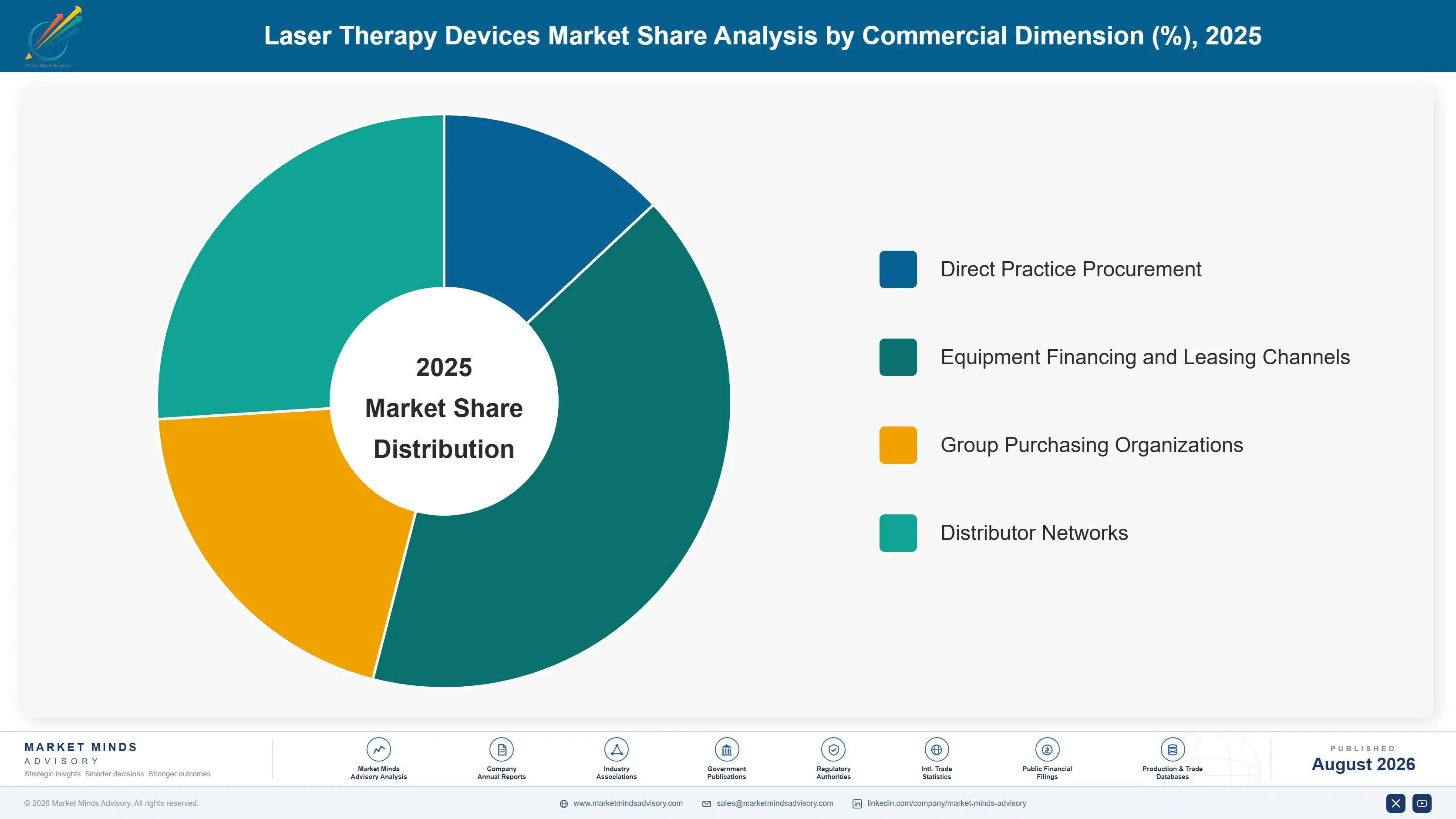
This market segments by clinical application spanning aesthetic and dermatology lasers, surgical and soft tissue lasers, ophthalmic lasers, dental lasers, pain management and photobiomodulation lasers, and oncology photodynamic therapy lasers, reflecting how practices classify device purchasing decisions. This dimension is the one practices and manufacturers actually reference when structuring purchasing and training investment decisions.
laser-therapy-devices-market-market-share-analysis-1787305862055

Aesthetic and Dermatology Lasers

Aesthetic and dermatology lasers are the fastest-growing segment as consumer demand for laser hair removal, skin resurfacing, and tattoo removal continues expanding across an increasingly broad demographic base beyond the traditionally older, more affluent patient population that historically dominated this category. Portable fiber laser platforms have meaningfully lowered the capital threshold for medspas and smaller dermatology practices to enter this segment, expanding the practice-level buyer base considerably beyond traditional specialty dermatology clinics that once dominated aesthetic device purchasing. This segment commands strong consumable and service revenue given the recurring nature of most aesthetic procedures, which typically require multiple treatment sessions rather than a single intervention. Manufacturers are investing in practice financing and training programmes to capture this expanding buyer base.
CAGR 11.8%

Pain Management and Photobiomodulation Lasers

Pain management and photobiomodulation lasers are growing considerably faster than the broader market as physiotherapy and sports medicine practices increasingly adopt low-level laser therapy for musculoskeletal pain and tissue recovery applications, supported by accumulating clinical evidence and growing patient preference for non-pharmacological treatment options. This segment benefits from broader healthcare system interest in reducing opioid and other medication dependency for chronic pain management, positioning photobiomodulation favorably as a complementary or alternative treatment modality within comprehensive pain management protocols. Manufacturers are developing practice-specific treatment protocols and simplified operator interfaces to further differentiate within this segment, since physiotherapy practices often lack the extensive laser operation training that dermatology and surgical practices typically maintain internally.
CAGR 10.5%
Full segment breakdown across 6 segments available in the complete report.

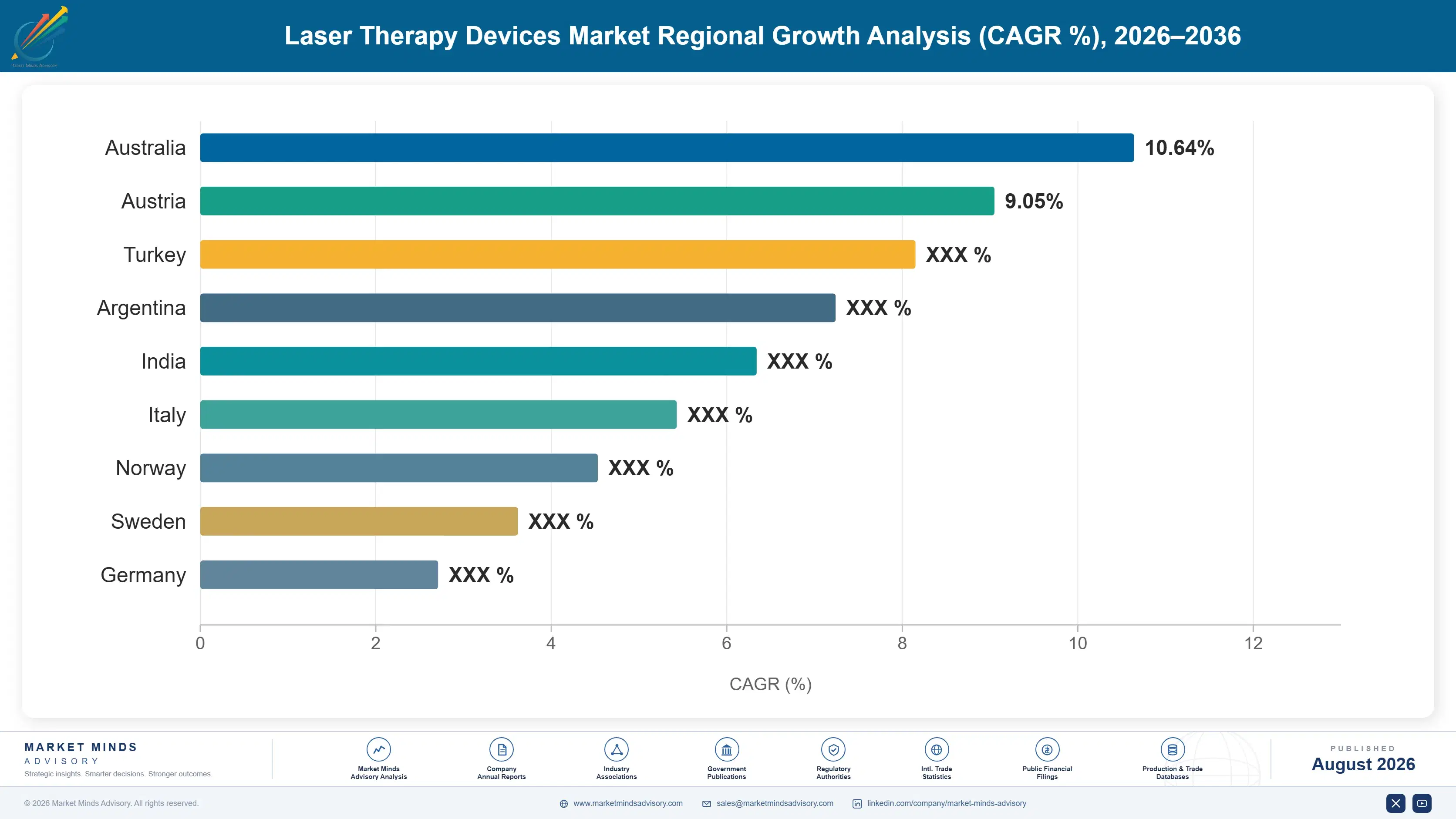
Regional Architecture and Country Demand Map

North America and East Asia together account for the majority of global device spend, reflecting the region's concentrated aesthetic procedure demand, disposable income available for elective treatment, and rapidly expanding medical aesthetics infrastructure across major consumer markets. South Asia and Latin America are expanding fastest as medical tourism and financing.

North America

The United States anchors regional demand through its dense concentration of dermatology and medspa practices, favorable equipment financing availability, and the largest aesthetic procedure volume of any national market tracked in this study. Canada maintains a smaller but steadily expanding treatment base, with medspa formation gradually accelerating following American consumer trends with a modest lag across major metropolitan markets. American practice networks and dermatology service organizations continue driving bulk purchasing volume that gives manufacturers a reliable large-account revenue base ahead of broader independent practice conversion. This region's financing infrastructure and procedure volume maturity make it the benchmark market other national aesthetic markets reference when evaluating device technology adoption timelines and practice economics.
Share: 31% | CAGR: 8.9% (2026 to 2036)

Western Europe

Germany, France, and the United Kingdom lead regional demand through well-established dermatology and aesthetic medicine practice networks, though regulatory requirements around device operator qualification are generally more stringent than in the United States, moderating adoption pace somewhat across most major markets. Public health system coverage for medical and surgical laser applications provides steady baseline demand independent of discretionary aesthetic spending cycles that affect the broader category. Nordic countries show disproportionately high per-capita aesthetic procedure rates despite small absolute population, reflecting well-funded consumer discretionary spending on wellness and appearance-related services. Regional growth trails North America and East Asia modestly as device technology adoption among established practices is already comparatively mature. Southern European practices increasingly import portable platforms rather than investing in.
Share: 22% | CAGR: 7.0% (2026 to 2036)
Regional intelligence for 5 additional markets available in the complete report: East Asia, South Asia and Pacific, Latin America, Middle East and Africa, Eastern Europe. Contact sales@marketmindsadvisory.com.
laser-therapy-devices-market-country-cagr-analysis-1787305862576

Practice Financing and Consumable Attachment Strategy

Manufacturers are shifting commercial strategy toward equipment financing partnerships, recurring consumable and service contract attachment, and clinical training network expansion, capturing more predictable practice-level revenue rather than competing purely on one-time device hardware pricing alone across the category. This mirrors a broader medical device industry shift toward relationship-driven, financing-supported commercial models overall today across the industry.

Equipment Financing and Leasing Partnership Programmes

Manufacturers are partnering with specialized medical equipment financing companies to offer structured leasing and financing programmes that lower the upfront capital barrier for smaller practices considering device purchases, directly expanding the addressable practice base beyond well-capitalized dermatology and surgical centres. This lever converts a large capital expenditure decision into a manageable monthly payment structure that smaller practices can more easily justify within their operating budgets without requiring significant upfront capital reserves. Manufacturers report financing programme availability increasing conversion rates among prospective practice buyers by roughly 34% compared to cash-only purchase requirements.
Market Impact: Improves conversion rates by roughl

Recurring Consumable and Service Contract Attachment

Manufacturers are structuring device placements to maximize downstream consumable, handpiece, and maintenance contract attachment, since these recurring revenue streams generate materially higher margins than the initial capital hardware sale and recur consistently throughout the device's operational lifetime at a given practice. This lever converts a one-time equipment sale into a multi-year recurring revenue relationship similar to commercial models common across other capital-intensive medical device categories. Manufacturers report consumable and service attachment revenue now represents roughly 38% of total device category revenue across major manufacturers. Manufacturers view this attachment ratio as the single most important commercial metric tracked internally.
Market Impact: Consumables now drive 38 percent of

Clinical Training Network Expansion Investment Programme

Manufacturers are investing in expanded clinical training networks and certification programmes to address the physician and technician training requirements that otherwise slow device adoption, particularly at smaller practices lacking internal training infrastructure or dedicated staff time for comprehensive certification. This lever accelerates practice-level adoption timelines considerably, since training availability directly determines how quickly a newly purchased device can begin generating revenue for the purchasing practice through active clinical use. Manufacturers report expanded training network investment reducing time-to-revenue for new device placements by roughly 28% compared to standard manufacturer documentation alone.
Market Impact: Cuts device time-to-revenue by roug

Multi-Application Platform Portfolio Diversification Investment Approach

Manufacturers are developing multi-application device platforms capable of serving aesthetic, pain management, and medical applications from a single hardware base, diversifying revenue exposure away from any single application segment and reducing vulnerability to discretionary aesthetic spending cycles that affect purely aesthetic-focused device portfolios during economic downturns. This lever broadens the addressable practice base for a given device platform considerably, since practices serving multiple specialties can consolidate purchasing around fewer, more versatile device platforms rather than maintaining separate application-specific equipment. Manufacturers report multi-application platforms achieving roughly 22% higher average practice account value than single-application equivalents.
Market Impact: Adds roughly 22 percent to average

Who Controls the Margin Pool

The top five device manufacturers control roughly 46% of global revenue, a moderate concentration reflecting the genuine fragmentation across aesthetic, surgical, ophthalmic, dental, and pain management applications, alongside a meaningful long tail of application-specific specialists competing within narrower clinical niches across the broader category. Mid-sized specialty manufacturers with differentiated platforms remain attractive acquisition targets for larger competitors. This dynamic keep
Current competitive activity centers on portable fiber laser platform development to expand practice access, equipment financing partnership expansion to lower capital barriers, and multi-application platform diversification aimed at reducing exposure to discretionary aesthetic spending cycles across major manufacturer portfolios. Several manufacturers are also piloting bundled financing and training packages to differentiate beyond hardware alone. This positioning increasingly determines which manufacturers win larger, multi-location practice network accounts.

Emerging pressure comes from Asian device manufacturers developing lower-cost aesthetic platforms for their expanding domestic markets, and from smaller specialty companies pursuing next-generation photobiomodulation and home-use device categories that could meaningfully expand the addressable market beyond traditional clinical practice settings. Established leaders are responding by accelerating their own portable platform and financing investment to defend share.
laser-therapy-devices-market-company-positioning-matrix-1787305863112

Competitive Moat and Risk Dimensions

LUMENIS BE LTD.

Moat: Multi-Specialty Platform Installed Base

Lumenis maintains one of the industry's broadest installed bases spanning aesthetic, surgical, and ophthalmic laser applications, giving it cross-selling advantages and deep clinical relationships across multiple specialties that narrower single-application competitors cannot easily replicate at comparable scale. This breadth advantage compounds as practices build multi-year clinical relationships across several specialty departments simultaneously.
LUMENIS BE LTD.

Risk: Aesthetic Segment Cyclical Demand Exposure

A meaningful share of Lumenis's revenue derives from discretionary aesthetic procedures that are genuinely sensitive to broader economic conditions, and a sustained consumer spending pullback could disproportionately affect this segment relative to the company's more resilient surgical and medical laser applications. Investors are watching aesthetic segment performance closely during periods of broader consumer spending uncertainty.
CUTERA INC.

Moat: Physician Training Network Depth Advantage

Cutera has built an extensive physician and technician training network specifically for aesthetic dermatology applications, creating switching costs for practices that have invested in staff certification on Cutera's specific device platforms and clinical protocols over multiple years. Few competitors can match the depth of Cutera's established physician certification and clinical protocol infrastructure.
CUTERA INC.

Risk: Product Safety Recall Exposure

Cutera's aesthetic-focused portfolio carries meaningful exposure to product safety issues and potential recalls given the direct patient contact inherent in aesthetic laser procedures, and any significant safety event could damage the clinical trust that underpins its training network advantage. Cutera continues investing in quality assurance infrastructure to reduce this exposure across its device portfolio.

Players Tracked

Prominent Players

Lumenis Be Ltd.
Cutera Inc.
Candela Medical
Cynosure LLC
Alma Lasers Ltd.

Other Key Players

Sciton Inc.
InMode Ltd.
Fotona d.o.o.
Solta Medical (Bausch Health Companies Inc.)
El.En. S.p.A.
DEKA M.E.L.A. S.r.l.
Quanta System S.p.A.
BTL Industries s.r.o.
Zimmer MedizinSysteme GmbH
Venus Concept Inc.
Apyx Medical Corporation
WON Technology Co., Ltd.
Lutronic Corporation
Lumibird Medical
Sharplan Lasers Inc.

Recent Developments

MARCH 2026

Cutera Expands Portable Platform Manufacturing Capacity in California

Cutera announced an organic capacity expansion at its California manufacturing facility to increase production of its portable fiber laser platform line, aimed at meeting rising demand from medspas and smaller dermatology practices converting from bulkier legacy laser systems. The expansion is expected to reach full production capacity within the next.
Signal: Signals continued manufacturer confidence
OCTOBER 2025

Lumenis Signs Equipment Financing Partnership With Specialty Lender

Lumenis entered a multi-year equipment financing partnership with a specialty medical equipment lender to offer structured leasing programmes for its aesthetic and surgical device portfolio, aimed at expanding access for smaller independent practices across North America. Financial terms of the multi-year partnership were not fully disclosed by either party involved.
Signal: Reflects growing manufacturer investment i
JANUARY 2026

Lutronic Acquires Regional Photobiomodulation Device Startup

Lutronic Corporation completed the acquisition of a regional photobiomodulation device startup, expanding its pain management and physiotherapy laser portfolio to capture rising demand from sports medicine and physical therapy practices across its core markets. Financial terms of the transaction were not disclosed by either company involved in the deal.
Signal: Indicates growing manufacturer interest in

Optical Component and Semiconductor Cost Exposure

Specialized optical components, semiconductor diode arrays, and precision cooling systems together represent roughly 43% of cost of goods sold for laser device manufacturers, with most specialty optical and semiconductor components sourced from a concentrated group of photonics suppliers serving the broader medical device industry. Manufacturers with vertically integrated component production face materially less exposure to this concentration.
Semiconductor diode and optical component prices rose meaningfully during 2021 and 2022 amid broader electronics supply chain disruption, with company annual reports from major manufacturers confirming that component cost pressure remained elevated through much of the period before moderating somewhat through 2024 and 2025 across most producing regions. Smaller manufacturers absorbed a disproportionate share of this cost inflation given weaker supplier negotiating positions previously available.

Smaller manufacturers without long-term supplier contracts face materially higher input cost volatility than the largest players, who can negotiate multi-year fixed pricing given their purchasing scale. This creates a durable cost disadvantage for smaller device makers competing on price against larger competitors able to smooth input cost swings across a broader purchasing base. Geography also matters, since manufacturers closer to photonics supply hubs face smaller logistics cost swings overall.
laser-therapy-devices-market-cost-volatility-analysis-1787305863316

Multi-Year Fixed Pricing Supplier Contracts

Larger manufacturers are locking in multi-year fixed pricing agreements with specialty photonics suppliers, insulating device production costs from short-term component price volatility that smaller competitors remain fully exposed to across each purchasing cycle. This approach has become standard practice among the largest device manufacturers globally over the past decade, particularly those with strong purchasing scale.

Vertical Integration Into Optical Component Manufacturing

Some larger manufacturers are bringing precision optical component manufacturing in-house rather than outsourcing entirely, capturing manufacturing margin previously paid to third-party suppliers while gaining tighter quality control. This shift represents a meaningful strategic bet on long-term category volume growth continuing steadily, reflecting genuine confidence that category demand will justify the added capital investment overall.

Secondary Supplier Qualification Programmes

Manufacturers are qualifying secondary photonics suppliers for critical optical components to reduce dependency on any single source, reducing disruption risk when a primary supplier faces its own capacity constraints. Smaller manufacturers increasingly pursue this strategy too, despite the added qualification cost involved, and this trend is expected to continue accelerating across the wider device industry.

Portfolio Architecture for Margin Defence

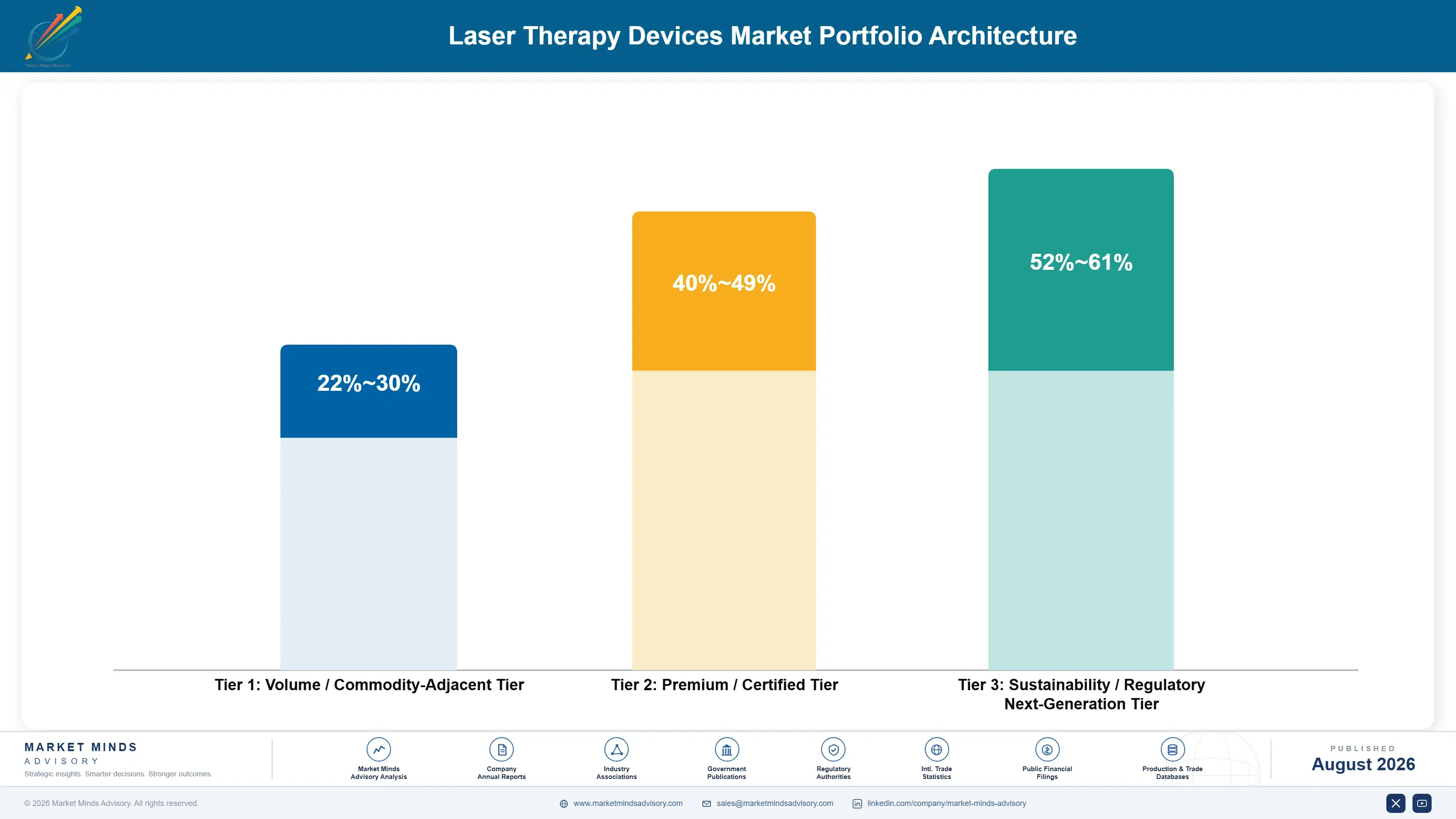
This market organizes into three commercial tiers spanning entry-level and portable aesthetic devices at the volume end, established surgical and medical laser platforms occupying the premium middle tier, and next-generation multi-application and photobiomodulation systems capturing the strongest margins at the top of the portfolio architecture overall. Manufacturers increasingly structure pricing and financing strategy explicitly around this three-tier architecture. This explicit structuring he
Volume and premium tiers pull manufacturers in different directions: entry-level portable devices expand the practice base and sustain unit volume, while premium surgical and multi-application platforms deliver materially stronger margins that increasingly determine which companies can fund the clinical research the category requires going forward. Most manufacturers now allocate a growing share of research budget toward the top two tiers.

The highest-value pools concentrate around multi-application platforms and photobiomodulation systems sold under financing partnerships with expanded training support, where clinical versatility and practice-level economics together sustain premium pricing power that entry-level single-application devices simply cannot match across comparable volume. Manufacturers unable to compete in this tier increasingly struggle to sustain category-leading margins over time.

Volume / Commodity-Adjacent Tier

Entry-level and portable aesthetic devices sold primarily to medspas and smaller independent practices entering the category. This tier represents the largest unit volume category by practice count served across most emerging markets.
Gross Margin: 22-30%

Premium / Certified Tier

Established surgical and medical laser platforms sold into hospitals and specialty practices under strong clinical training positioning. Practices in this tier rarely switch platforms once staff certification and clinical protocols are established.
Gross Margin: 40-49%

Sustainability / Regulatory / Next-Generation Tier

Multi-application and photobiomodulation platforms commanding the strongest pricing power given clinical versatility and differentiation. This tier increasingly determines which manufacturers can fund the clinical research the category requires across the broader industry today.
Gross Margin: 52-61%
laser-therapy-devices-market-portfolio-architecture-1787305863818

High-value Sub-segments and Strategic Watch-out

Aesthetic and Dermatology Lasers

The fastest-growing and highest-margin segment, combining strong consumer demand momentum with genuine practice financing accessibility across most major aesthetic markets worldwide, drawing intense investment. Manufacturers are allocating a growing share of capital budget toward this segment specifically, and this priority shows no sign of shifting through the current planning cycle.
Gross Margin: 44-53%

Pain Management and Photobiomodulation Lasers

Strong margins and steady growth driven by physiotherapy and sports medicine adoption that traditional medication-based pain management cannot fully address. Manufacturers are developing simplified operator interfaces to further differentiate within this expanding segment, since physiotherapy practices often lack extensive laser operation training internally on their own.
Gross Margin: 42-50%

Surgical and Soft Tissue Lasers

The volume core segment sustaining hospital and surgical centre relationships even as aesthetic applications gradually capture faster growth elsewhere. Manufacturers rely on this segment to sustain hospital relationships even as aesthetic applications grow faster, and this role remains commercially important despite slower relative growth overall.
Gross Margin: 36-44%

Ophthalmic Lasers

A strategic watch-out segment facing slower growth as alternative refractive correction technologies expand, though it remains essential for established surgical protocols. Manufacturers watch this segment closely for signs of accelerating displacement by alternative technologies, since faster than expected decline would materially change portfolio revenue mix.
Gross Margin: 34-42%

Practice-Level Recurring Procedure Revenue Streams

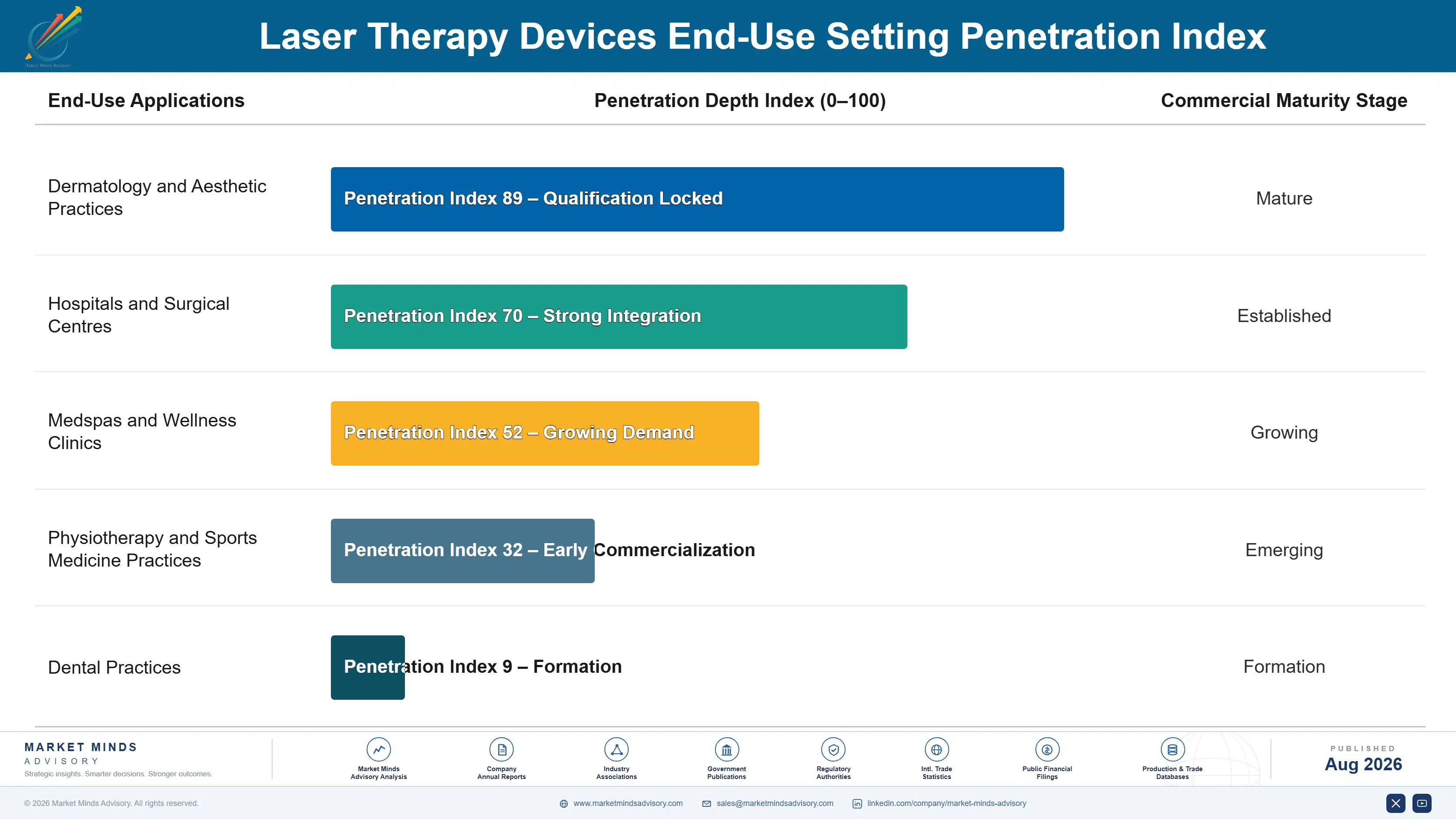
Device placement functions as an annuity anchor once a practice purchases laser hardware: every subsequent procedure generates recurring consumable and service revenue, creating a relationship that compounds well beyond the initial capital equipment sale across the device's multi-year operational lifetime at a given practice. Manufacturers increasingly price initial hardware competitively specifically to accelerate this downstream consumable relationship. This dynamic increasingly shapes how man
Adoption depth varies considerably by practice type: large dermatology and surgical centres adopt newer multi-application platforms and photobiomodulation systems earliest, while smaller independent practices and medspas more often start with entry-level portable devices before upgrading as procedure volume and revenue justify additional investment. Manufacturers tailor commercial and training investment differently across each of these distinct practice tiers.

A generational shift is underway as practice owners trained during the portable platform era enter the market expecting financing-supported, multi-application device access as standard practice, gradually normalizing lower capital thresholds that earlier practice owners historically associated only with larger, well-capitalized specialty centres. Manufacturers are adapting marketing and financing investment accordingly to reach this newly influential practice cohort today.
laser-therapy-devices-market-end-use-penetration-index-1787305864308

Where Laser Economics Are Heading

These are among the four positions where our research anticipates prominent divergence between winners and laggards over the coming forecast period. Each is grounded in the demand model, the regulatory perimeter, and the announced capacity pipeline.
01 / PRACTICE ACCESS EXPANSION

Portable platforms will keep expanding the addressable practice base

Manufacturers investing in portable fiber laser platforms and financing partnerships are directly expanding the addressable practice base beyond traditional dermatology and surgical centres, and this trajectory shows no sign of reversing given continued component cost declines. Bulkier legacy systems will persist at larger centres requiring maximum clinical power rather than disappearing entirely from the market. Manufacturers overweighted toward legacy large-format device revenue face a gradually shrinking core category over the coming decade regardless of overall market growth, across nearly every manufacturer portfolio MMA analysts reviewed this cycle.
02 / PHOTOBIOMODULATION GROWTH TRAJECTORY

Pain management applications will keep expanding beyond aesthetics

Photobiomodulation adoption in sports medicine and physiotherapy represents a genuinely new growth vector beyond the category's traditional aesthetic and surgical applications, since it addresses a distinct clinical need that non-pharmacological pain management increasingly prioritizes across healthcare systems. Manufacturers investing early in this segment are best positioned to capture disproportionate share as clinical evidence accumulates further. Expect photobiomodulation volume growth to meaningfully outpace traditional aesthetic laser growth through most of the current forecast period ahead as clinical guideline recognition of photobiomodulation continues expanding steadily.
03 / CYCLICAL EXPOSURE MANAGEMENT

Portfolio diversification will separate resilient manufacturers from laggards

Manufacturers with diversified portfolios spanning aesthetic, medical, and pain management applications are better positioned to weather discretionary aesthetic spending downturns than competitors concentrated purely in cosmetic procedure categories exposed to broader economic conditions. This diversification advantage becomes more valuable during periods of consumer spending uncertainty that periodically affect the aesthetic segment specifically. Expect portfolio diversification to become an increasingly explicit strategic priority for manufacturers seeking more resilient long-term revenue streams, particularly those still relying primarily on discretionary aesthetic procedure revenue alone.
04 / TRAINING INFRASTRUCTURE INVESTMENT

Clinical training networks will become a genuine competitive differentiator

Manufacturers investing in expanded clinical training and certification infrastructure are capturing disproportionate share of smaller practices that would otherwise struggle to justify device purchases given internal training constraints and limited dedicated staff time. This advantage compounds as practices build clinical protocols and staff certification around specific manufacturer platforms over multiple years of use. Expect training infrastructure investment to become an increasingly important differentiator separating manufacturers competing for smaller, growth-oriented independent practice accounts, reshaping which manufacturers win smaller, growth-oriented practice accounts this decade.

Engagement Snapshot From the Field

A live engagement with an industry participant carrying material or product regulatory and market exposure ahead of a defining policy shift, showing how our research translates into a defensible multi-year portfolio strategy.
MARKET MINDS ADVISORY · CLIENT ENGAGEMENT SUMMARY
Laser Therapy Devices Producer Strategic Portfolio Review and Transition Roadmap 2026·Investment Scenario on Laser Therapy Devices Exposure Evaluation 2025-26
CLIENT PROFILE
The client operates a regional medspa franchise network spanning eighteen locations, generating combined annual laser device procurement and consumable spend of approximately $6.4 million (client-reported, unverified by MMA). Leadership sought guidance on standardizing device platform selection across its franchise network to improve procurement economics across its franchise network prior to this engagement beginning across the franchise system prior to engagement.
STRATEGIC CHALLENGE
The network's eighteen locations used a fragmented mix of aesthetic laser platforms inherited from independent franchisee purchasing decisions, and leadership was uncertain whether consolidating to fewer standardized platforms would generate meaningful savings without disrupting existing staff training and established clinical protocols across all eighteen franchise locations involved given inconsistent historical purchasing decisions across locations.
MMA APPROACH
MMA's team benchmarked comparable medspa network consolidation outcomes, modeled projected procurement and financing cost savings against staff retraining investment required across all eighteen locations, and evaluated leading portable aesthetic platforms against the network's existing procedure mix and revenue benchmarks to present to the network's ownership group to guide the network's final rollout decision.
KEY FINDINGS
  1. Consolidating to two standardized aesthetic platforms was projected to reduce per-unit procurement costs by roughly 19% through volume-based manufacturer financing negotiation across the full network.
  2. Staff retraining investment was concentrated in the first two months following conversion, with minimal ongoing training cost required after initial adoption across all eighteen locations.
  3. Locations with the highest existing procedure volume showed the fastest payback period on retraining investment, making them logical priority candidates for early conversion phases.
  4. Standardization was projected to improve consumable inventory management efficiency considerably, reducing the administrative burden of managing multiple device platforms network-wide across the full eighteen-location network.
CLIENT PROFILE
The client operates a regional medspa franchise network spanning eighteen locations, generating combined annual laser device procurement and consumable spend of approximately $6.4 million (client-reported, unverified by MMA). Leadership sought guidance on standardizing device platform selection across its franchise network to improve procurement economics across its franchise network prior to this engagement beginning across the franchise system prior to engagement.
STRATEGIC CHALLENGE
The network's eighteen locations used a fragmented mix of aesthetic laser platforms inherited from independent franchisee purchasing decisions, and leadership was uncertain whether consolidating to fewer standardized platforms would generate meaningful savings without disrupting existing staff training and established clinical protocols across all eighteen franchise locations involved given inconsistent historical purchasing decisions across locations.
MMA APPROACH
MMA's team benchmarked comparable medspa network consolidation outcomes, modeled projected procurement and financing cost savings against staff retraining investment required across all eighteen locations, and evaluated leading portable aesthetic platforms against the network's existing procedure mix and revenue benchmarks to present to the network's ownership group to guide the network's final rollout decision.
KEY FINDINGS
  1. Consolidating to two standardized aesthetic platforms was projected to reduce per-unit procurement costs by roughly 19% through volume-based manufacturer financing negotiation across the full network.
  2. Staff retraining investment was concentrated in the first two months following conversion, with minimal ongoing training cost required after initial adoption across all eighteen locations.
  3. Locations with the highest existing procedure volume showed the fastest payback period on retraining investment, making them logical priority candidates for early conversion phases.
  4. Standardization was projected to improve consumable inventory management efficiency considerably, reducing the administrative burden of managing multiple device platforms network-wide across the full eighteen-location network.
RECOMMENDED STRATEGY
Phase 1: Phase 1 (Months 1-3): Convert the six highest-volume locations first, using their experience to refine training materials and conversion procedures for later phases. Phase 2: Phase 2 (Months 4-7): Convert the next eight locations in order of procedure volume, applying lessons learned from the initial conversion phase throughout. Phase 3: Phase 3 (Months 8-10): Complete conversion across the remaining four lower-volume locations, finalizing network-wide standardization and financing terms and updated staff training materials.
OUTCOME
The network completed conversion across all eighteen locations within the recommended ten-month timeline, reporting a 17% reduction in annual device and consumable procurement costs network-wide (client-reported, unverified by MMA) while maintaining consistent service quality across every franchise location involved while maintaining consistent service quality across every location involved throughout the transition.

Frequently Asked Questions

Foundational context covering the market sizes, CAGR, scope, country, region and competition that inform every finding below. This section is provided to cover basics and most often pre-purchase conversations, answered from the MMA Primary Research Dataset.

What is the current size of the Laser Therapy Devices Market?

The global laser therapy devices market was valued at approximately $11.5 billion in 2025. This includes aesthetic, surgical, ophthalmic, dental, and pain management laser platforms.

How large will the Laser Therapy Devices Market be by 2036?

The market is projected to reach approximately $28.50 billion by 2036. This reflects continued portable platform adoption and expanding aesthetic procedure demand worldwide under continued portable platform adoption and financing expansion.

What is the CAGR for the Laser Therapy Devices Market 2026 to 2036?

The market is expected to grow at a compound annual growth rate of 8.6% between 2026 and 2036. This reflects steady demand across aesthetic and medical applications.

Which segment is growing fastest?

Aesthetic and dermatology lasers are the fastest-growing segment, expanding at approximately 11.8% annually. This reflects expanding consumer demand and portable platform accessibility across an increasingly broad consumer demographic base.

Who are the major companies in the Laser Therapy Devices Market?

Leading companies include Lumenis, Cutera, Candela Medical, Cynosure, and Alma Lasers. Together they account for roughly 46% of global device revenue across the broader laser device category worldwide.

Which country is growing fastest?

China is the fastest-growing major market at an estimated 12.5% CAGR, driven by rapidly expanding medical aesthetics infrastructure and rising disposable income across its rapidly modernizing medical aesthetics sector.

Report Segmentation Architecture

The full report scope spans multiple orthogonal segmentation dimensions, with cross-tabulated demand data provided for each dimension pair. Coverage extends further to regional breakdowns, trend trajectories, and the competitive detail needed to support segment-level decision-making.

By Clinical Application

  • Aesthetic and Dermatology Lasers
  • Surgical and Soft Tissue Lasers
  • Ophthalmic Lasers
  • Dental Lasers
  • Pain Management and Photobiomodulation Lasers
  • Oncology Photodynamic Therapy Lasers

By End-Use Setting

  • Dermatology and Aesthetic Practices
  • Hospitals and Surgical Centres
  • Medspas and Wellness Clinics
  • Physiotherapy and Sports Medicine Practices
  • Dental Practices

By Commercial Dimension

  • Direct Practice Procurement
  • Equipment Financing and Leasing Channels
  • Group Purchasing Organizations
  • Distributor Networks

By Region

  • North America
  • Western Europe
  • East Asia
  • South Asia and Pacific
  • Latin America
  • Middle East and Africa
  • Eastern Europe

Scope, Methodology, and Coverage

Every figure in this report is reproducible from documented input assumptions. The scope below maps the historical period, the forecast horizon, the segmentation dimensions, and the countries covered, alongside the underlying primary and qualitative methodology.
Historical Period
2020 to 2025
Forecast Period
2026 to 2036
Base Year
2025 (USD billions; MMA Primary Research Dataset, August 2026)
Market Definition
This report covers laser-based medical devices used specifically in aesthetic dermatology, surgical and soft tissue procedures, ophthalmic treatment, dental procedures, pain management and photobiomodulation therapy, and oncology photodynamic therapy. It excludes non-laser light-based devices such as intense pulsed light systems and general diagnostic imaging equipment.
Quantitative Units
USD billions (current prices); device unit shipments; procedure volume
Segmentation Dimensions
By Clinical Application; By End-Use Setting; By Commercial Dimension; By Region
Regions Covered
North America, Western Europe, East Asia, South Asia and Pacific, Latin America, Middle East and Africa, Eastern Europe
Countries Covered
USA, China, Germany, France, UK, Japan, South Korea, India, Australia, Canada, Brazil, Mexico, Indonesia, Vietnam, Thailand, Malaysia, UAE, Saudi Arabia, South Africa, Nigeria, Turkey, Poland, Netherlands, Italy, Spain, Sweden, Switzerland, Argentina, Colombia, Singapore, and additional markets relevant to this sector
Key Companies Profiled
Lumenis Be Ltd., Cutera Inc., Candela Medical, Cynosure LLC, Alma Lasers Ltd., Sciton Inc., InMode Ltd., Fotona d.o.o., Solta Medical (Bausch Health Companies Inc.), El.En. S.p.A., DEKA M.E.L.A. S.r.l., Quanta System S.p.A., BTL Industries s.r.o., Zimmer MedizinSysteme GmbH, Venus Concept Inc., Apyx Medical Corporation, WON Technology Co., Ltd., Lutronic Corporation, Lumibird Medical, Sharplan Lasers Inc.
Quantitative Methodology
Primary survey, n=3,800 respondents, Q4 2025, six countries; demand-side model with trade association cross-validation
Qualitative Methodology
47 expert interviews, Q4 2025; applied to validate demand model assumptions, identify emerging dynamics, and assess competitive positioning
Report Format
PDF and XLSX data workbook (Word format preview document)
Publisher
Market Minds Advisory
Report Code
MMA-2026-MED-120
Published
August 2026
Contact
sales@marketmindsadvisory.com | www.marketmindsadvisory.com

Purchase the full Laser Therapy Devices Market Report (2026 to 2036).

The full report provides detailed application-level segmentation, practice procurement pattern analysis, and country-level aesthetic procedure demand tracking across all seven regions covered in this study. It includes manufacturer-level competitive benchmarking based on financing partnerships and training network reach. Subscribers receive quarterly updates tracking new product approvals and practice financing trends as they occur. A companion dataset provides procedure volume estimates by application for detailed market sizing purposes A dedicated analyst contact is also available to support custom data requests beyond the standard deliverable scope provided.
Application-level segmentation breakdown by category type
Practice procurement pattern trend analysis service
Country-level procedure demand tracking and updates
Manufacturer competitive benchmarking scorecards and comparisons
Quarterly product approval and financing trend updates
Procedure volume dataset by application type

Built For The People Who Decide

From boardroom strategy to bench-side execution, this report is read cover-to-cover by leaders shaping the next decade of their industry, turning demand scenarios, market dynamics and valuation benchmarks into decisions.
CXOs/ Presidents/ VPs/ Managers
M&A and Corporate Development
Strategy Teams and R&D Heads
Procurement and Product Directors
Regulatory and Compliance Leaders
Investor Relations and Equity Analysts