

Market Minds Advisory
Laser Technology Market

Laser Technology Market: Laser Technology Market. Trends and Forecast 2026 to 2036

Fiber laser cost declines and expanding semiconductor manufacturing precision requirements are pushing laser technology past traditional industrial cutting applications, forcing suppliers to prove beam quality and reliability as ultrafast laser adoption accelerates across electronics fabrication.

Lead Analyst

Published

September 2026

Make Smarter Decisions with Customized Research Insights

Request a free sample report and evaluate market opportunities, growth trends, and competitive dynamics relevant to your business needs.

2025 MARKET VALUE$19.5BMarket Size 2025
2036 FORECAST VALUE$47.8BBase Case , 2026 to 2036
CAGR 2026 TO 20368.5 %Bull 9.8% / Bear 7.3%
INCREMENTAL OPPORTUNITY$26.7BNet 10- year value creation
EXPANSION MULTIPLE2.26x2036 value over 2026 base
Strategic Levers
M&A Pipeline
Regional Outlook
Country Rankings
Competitive Intelligence
Segmental Deep-dive
Call-Us : 91 93563 13602

Executive Snapshot and Market Trajectory.

Laser technology is expanding beyond traditional industrial cutting and welding into precision semiconductor manufacturing and medical applications, as fiber and ultrafast laser cost decline makes previously prohibitive precision processing techniques commercially viable across broader manufacturing categories and industries worldwide today across most regions.
Commercial demand concentrates around fiber lasers serving industrial cutting and welding applications and ultrafast femtosecond lasers serving semiconductor and electronics manufacturing precision processing, with automotive and consumer electronics manufacturing driving substantial replacement and new equipment demand across most major manufacturing hubs. East Asia dominates given concentrated manufacturing infrastructure and the world's largest fiber laser production base, sustaining both domestic demand and growing export capability across major international manufacturing markets.
Competitive intensity remains moderate, with the top five suppliers controlling roughly 41% of global revenue given the specialized optical engineering and manufacturing precision expertise required to compete effectively across diverse laser technology applications, price segments, and geographies across most industries today. Rising demand for higher power density and beam quality specifications is reshaping competitive dynamics, favoring suppliers with proprietary fiber laser design capability over competitors dependent entirely on third-party gain medium sourcing arrangements.
Market Definition
The Laser Technology Market covers fiber, solid-state, gas, and ultrafast laser systems used for industrial cutting, welding, marking, semiconductor manufacturing, medical, and scientific applications across commercial and research settings. It excludes laser-adjacent consumer products like laser pointers and standalone optical component sales unrelated to complete laser systems.
Base Year Value
$19.5B in 2025 (MMA Primary Research Dataset, September 2026)
Forecast Period
2026 to 2036, eleven discrete annual values
CAGR
8.5% base case. Bull 9.8%. Bear 7.3%.
Fastest Growth Segment
Ultrafast Femtosecond Lasers: 13.5% CAGR
Fastest Growth Country
China: 11.0% CAGR
Fastest Growth Region
South Asia and Pacific: 10.5% CAGR
Largest Region
East Asia: 30% of 2025 global value
Market Leaders
Leading participants include IPG Photonics, Coherent, Trumpf, Han's Laser, and nLight. Source: MMA Analysis based on company annual reports.
Primary Survey
n=3,800 procurement and R&D decision-makers, Q4 2025, six countries
Methodology
Demand-side build-up, cross-validated against public data, 47 expert interviews

Laser Technology Market Forecast Scenarios

laser-technology-market-size-forecast-scenario-1789990231629
Laser technology demand grew steadily through 2020 to 2025 as fiber laser cost decline expanded industrial cutting and welding adoption beyond traditional gas laser systems across major manufacturing economies. Growth accelerated toward the end of the historical period as semiconductor manufacturing precision requirements expanded ultrafast laser demand meaningfully, pushing the historical CAGR to 7.5% by the period's close.
The base case assumes fiber laser cost decline and semiconductor manufacturing precision requirements keep expanding laser technology demand through the forecast decade. Three mechanisms drive this: continued fiber laser cost decline expanding industrial cutting and welding adoption into smaller manufacturing operations previously unable to justify the capital investment, semiconductor manufacturers requiring increasingly precise ultrafast laser processing for advanced chip fabrication nodes, and medical device manufacturers adopting laser-based surgical and diagnostic equipment at accelerating rates across major healthcare systems.
The bull case centers on accelerated semiconductor manufacturing capacity expansion pulling forward ultrafast laser demand well ahead of current adoption timelines across major chip fabrication facilities. The bear risk is manufacturing capital spending constraint: if global industrial capital budgets tighten meaningfully, equipment replacement cycles could lengthen, delaying new laser system adoption tied to manufacturing capacity expansion programs across major industrial economies.

Where Beam Quality Determines Supplier Selection

Laser systems have moved from specialized industrial equipment into essential precision manufacturing infrastructure, since semiconductor fabrication, medical device production, and advanced automotive manufacturing increasingly depend on laser processing precision that mechanical alternatives cannot achieve. Suppliers competing for the largest manufacturing contracts increasingly differentiate on beam quality and power efficiency specifications rather than general brand recognition alone.
MARKET CONCENTRATION41% CR5Top five suppliers control global laser system revenue share
AVERAGE SYSTEM PRICE$45,000 per unitBlended average price across industrial and precision laser categories
TOP PRODUCING COUNTRY SHARE33%China's share of global fiber laser manufacturing output currently
INDUSTRIAL APPLICATION SHARE48% of revenueIndustrial cutting and welding portion of total laser system revenue
POWER EFFICIENCY RATE35 to 45%Typical wall-plug efficiency across leading fiber laser system designs
SYSTEM REPLACEMENT CYCLE6 to 8 yearsTypical operational lifespan before laser system replacement or upgrade
China represents the largest single-country market given concentrated manufacturing infrastructure and the world's largest fiber laser production base, supplying both domestic demand and growing export capability across international manufacturing markets. Industrial cutting and welding applications represent the largest revenue category, though semiconductor and precision manufacturing applications are growing meaningfully faster as ultrafast laser technology cost declines expand the addressable market beyond traditional industrial use cases.
Power efficiency rates continue improving as fiber laser designs mature, reducing operating cost and expanding the addressable market among smaller manufacturing operations previously unable to justify the capital and energy cost of laser adoption. System replacement cycles running six to eight years create durable, predictable revenue visibility for suppliers holding existing manufacturing customer relationships, a stability that favors established players over newer entrants without comparable industrial customer relationships and technical support infrastructure.
"Lasers used to be a specialized tool for a handful of exotic manufacturing steps. Now they're becoming the default precision processing method across entire production lines, and that shift has quietly rewritten who wins the largest equipment contracts."
Director, Photonics and Precision Manufacturing Technology Practice · MMA Technology Practice · September 2026

Market Trends

Ultrafast Laser Adoption Expands Semiconductor Processing

Semiconductor manufacturers are increasingly adopting ultrafast femtosecond laser processing for advanced chip fabrication steps requiring precision beyond what conventional laser or mechanical processing methods can achieve reliably at scale. This adoption is driven by shrinking chip feature sizes demanding processing precision measured in nanometers rather than micrometers, a specification threshold that ultrafast laser pulse duration uniquely addresses among available processing technologies. Suppliers with proprietary ultrafast laser design capability are capturing disproportionate share of new semiconductor fabrication facility equipment contracts as advanced chip manufacturing capacity expansion continues across major global semiconductor manufacturing hubs and emerging production regions.
Market Impact: Semiconductor demand grows over 15%

Fiber Laser Cost Decline Expands Industrial Access

Continued fiber laser manufacturing cost decline is expanding industrial cutting and welding adoption into smaller manufacturing operations previously unable to justify the capital investment required for laser-based processing equipment over conventional mechanical alternatives. This cost decline reflects manufacturing scale improvements at major fiber laser producers, particularly in China, where domestic production capacity has expanded meaningfully faster than global demand growth. Smaller manufacturers adopting fiber laser technology for the first time are driving unit volume growth that partially offsets average selling price decline, sustaining overall industry revenue growth despite falling per-unit system pricing.
Market Impact: Medical laser demand grows over 12%

Market Opportunities and Growth Drivers

Advanced Chip Manufacturing Expands Ultrafast Laser Demand

Semiconductor manufacturing capacity expansion across multiple major global chip fabrication hubs is driving substantial new demand for ultrafast laser processing equipment capable of meeting increasingly precise manufacturing tolerance requirements at advanced process nodes across most facilities. This capacity expansion reflects sustained global semiconductor demand growth across automotive, consumer electronics, and artificial intelligence computing applications requiring specialized chip manufacturing capability. Ultrafast laser suppliers with established semiconductor industry relationships and proven reliability track records are capturing disproportionate share of new fabrication facility equipment contracts as capacity expansion programs continue across the industry.
Market Impact: Capital cost limits adoption by 15%

Medical Device Manufacturing Expands Laser Application

Medical device manufacturers are increasingly adopting laser-based surgical and diagnostic equipment given precision advantages over mechanical alternatives, driving sustained demand growth for medical-grade laser systems meeting stringent regulatory reliability and safety certification requirements across most healthcare markets. This adoption spans applications ranging from minimally invasive surgical instruments to diagnostic imaging equipment requiring precise laser-based measurement and analysis capability across expanding healthcare delivery settings. Suppliers with established medical device regulatory certification and proven clinical reliability track records are capturing disproportionate share of this expanding demand category as healthcare systems continue modernizing equipment.
Market Impact: Talent shortage delays deployment 6 months

Market Restraints and Challenges

High Capital Cost Limits Small Manufacturer Adoption

Advanced laser system capital cost remains substantial relative to conventional mechanical processing alternatives, creating a meaningful barrier for smaller manufacturing operations evaluating the return on investment timeline required to justify laser adoption over existing equipment. The root cause is the specialized optical engineering and precision manufacturing process required to produce reliable, high-power laser systems, which has not yet achieved the manufacturing scale economies that reduced fiber laser cost substantially for larger systems. Suppliers are mitigating this through leasing and financing arrangements that reduce upfront capital barriers, allowing smaller manufacturers to access laser processing capability without full ownership cost.
Market Impact: Ultrafast laser demand grows over 22%

Technical Talent Shortage Constrains Deployment Speed

Manufacturing operations adopting laser processing technology for the first time face a persistent shortage of technicians and engineers with specialized laser system operation and maintenance expertise, constraining deployment speed and increasing operational risk during the transition period. The root cause is that laser system operation requires specialized training distinct from conventional mechanical equipment operation, and educational institutions have not yet scaled training programs to match accelerating industry demand for qualified personnel. Suppliers are mitigating this through expanded training program investment and remote diagnostic support capability reducing the technical expertise burden on customer manufacturing staff.
Market Impact: Expands addressable market by roughly 18%
3 additional market trends, 4 additional growth drivers, and 2 additional restraints and challenges are covered in the full report. Contact sales@marketmindsadvisory.com to access the complete intelligence.

Segment CAGR and Growth Architecture

Laser technology segments by gain medium and application category across six categories spanning ultrafast, fiber, solid-state, gas, diode, and medical laser types sold across most industrial, scientific, and healthcare markets worldwide today across most regions. Each reflects a distinct optical engineering approach and application requirement rather than overlapping product tiers within a single technology family.
laser-technology-market-market-share-analysis-1789990232202

Ultrafast Femtosecond Lasers

Ultrafast femtosecond lasers form the fastest-growing segment, expanding at 13.5% CAGR as semiconductor manufacturers increasingly require processing precision measured in femtosecond pulse durations for advanced chip fabrication steps that conventional laser technology cannot achieve reliably at scale and comparable cost across most facilities. These lasers deliver extremely short pulse durations that minimize thermal damage to surrounding material during processing, a genuine technical advantage for applications requiring microscopic precision without affecting adjacent material properties or structural integrity. Suppliers with proprietary ultrafast laser design capability are capturing disproportionate share of new semiconductor fabrication facility equipment contracts as advanced chip manufacturing capacity expansion continues across major global production regions and emerging manufacturing hubs.
CAGR 13.5%

Medical and Surgical Lasers

Medical and surgical lasers form the second-fastest-growing segment at 11.0% CAGR, driven by expanding minimally invasive surgical procedure adoption and diagnostic imaging equipment requiring precise laser-based measurement and analysis capability across healthcare delivery settings, treatment specialties, and clinical research applications worldwide today across most regions. This segment benefits from growing healthcare system investment in advanced surgical technology that reduces patient recovery time compared to traditional surgical approaches, creating meaningful demand for laser systems meeting stringent medical device regulatory certification requirements. Suppliers with established medical device regulatory certification and proven clinical reliability track records are capturing disproportionate share of this expanding category as healthcare systems continue modernizing surgical and diagnostic equipment.
CAGR 11.0%
Full segment breakdown across 6 segments available in the complete report.

Regional Architecture and Country Demand Map

East Asia dominates given concentrated manufacturing infrastructure and the world's largest fiber laser production base built over several decades, while South Asia and Pacific grows fastest as expanding manufacturing capacity and semiconductor fabrication investment drive rising demand across the wider region and its major economies.

North America

Semiconductor manufacturing capacity expansion across the United States, driven partly by federal CHIPS Act investment incentives, is generating substantial new demand for ultrafast laser processing equipment supporting advanced chip fabrication facility construction and equipment installation. American medical device manufacturers maintain sophisticated laser-based surgical equipment development capability, contributing meaningfully to regional demand beyond purely industrial cutting and welding applications common in general manufacturing sectors. Canada's smaller industrial manufacturing base follows similar adoption patterns at a reduced scale relative to its larger southern neighbor's manufacturing and semiconductor investment programs. Group purchasing negotiations increasingly favor suppliers with proven manufacturing reliability, consolidating equipment relationships among fewer established laser system providers than in prior years.
Share: 26% | CAGR: 8.5% (2026 to 2036)

Western Europe

Germany's advanced manufacturing sector, anchored by established laser system manufacturers including Trumpf, drives substantial regional demand alongside stringent industrial safety regulation requiring specialized laser system certification. France and the United Kingdom maintain meaningful medical device manufacturing capability requiring specialized medical-grade laser systems meeting European Union regulatory certification standards for surgical and diagnostic equipment. Regional growth trails East Asia and North America somewhat given more constrained industrial capital investment budgets and slower semiconductor manufacturing capacity expansion relative to other major manufacturing regions globally. Nordic countries are also investing steadily in precision manufacturing pilots, requiring laser systems suited to specialized industrial applications beyond standard cutting and welding. Financing structures are evolving to support smaller manufacturer adoption.
Share: 22% | CAGR: 7.0% (2026 to 2036)
Regional intelligence for 5 additional markets available in the complete report: East Asia, South Asia and Pacific, Latin America, Middle East and Africa, Eastern Europe. Contact sales@marketmindsadvisory.com.
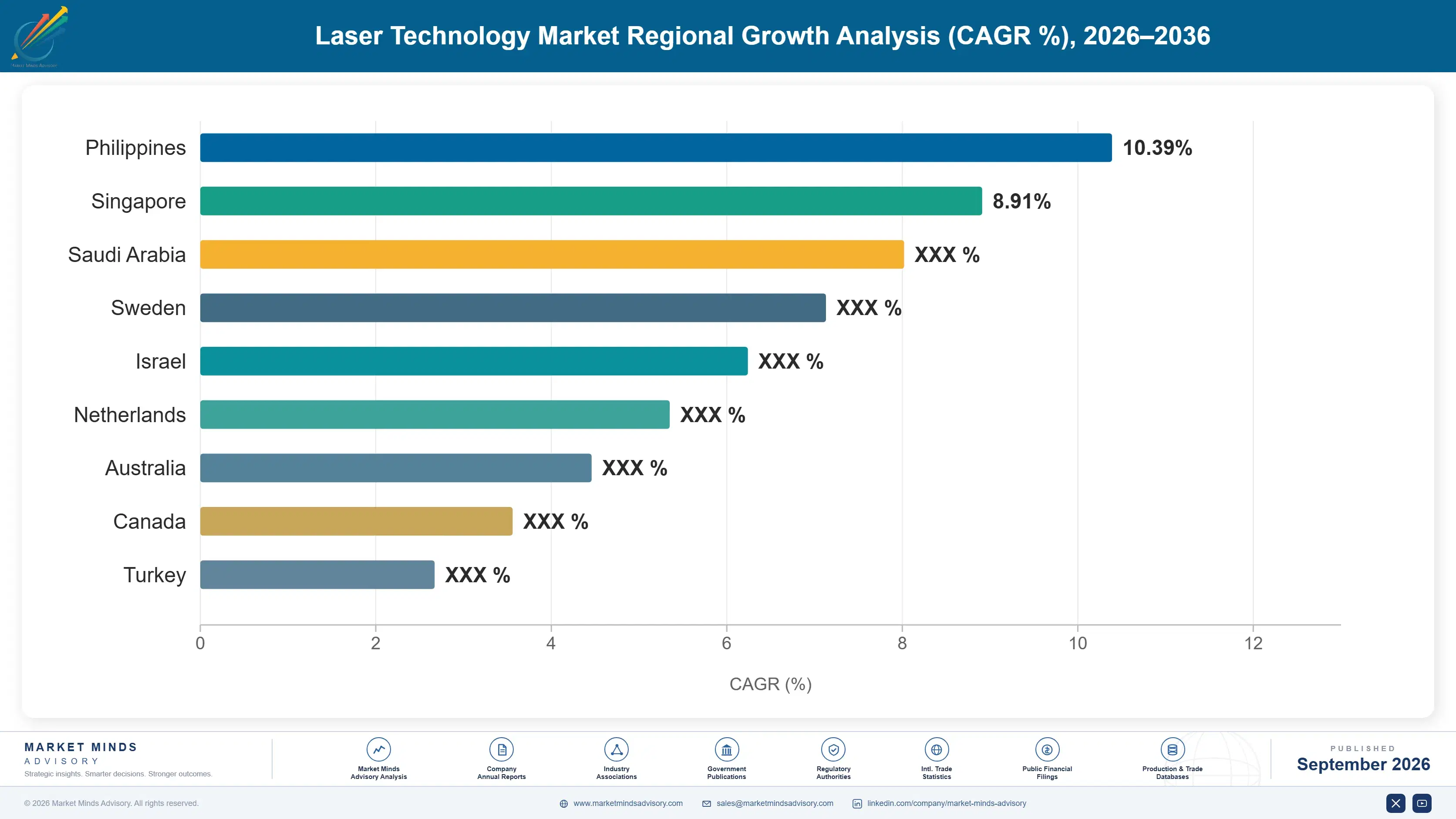
laser-technology-market-country-cagr-analysis-1789990232745

Where Suppliers Can Defend Pricing Power

Laser suppliers face steady price pressure from cost-conscious manufacturers, but four commercial levers let disciplined companies defend margin and win the largest, most valuable equipment contracts across the coming forecast decade and beyond. Each requires different capability investment, and suppliers combining several simultaneously are pulling ahead of single-lever competitors across most application segments today.

Proprietary Fiber Laser Design and Development

Suppliers investing in proprietary fiber laser gain medium and beam delivery design capability capture premium pricing that generic laser system assemblers dependent on third-party component sourcing cannot access regardless of unit cost competitiveness across most manufacturing segments. This design development requires sustained research investment in optical engineering distinct from standard system integration work, but delivers meaningful differentiation as manufacturers increasingly demand validated beam quality specifications before large-scale equipment commitments. Suppliers with proprietary fiber laser design are commanding roughly 28% higher unit pricing than competitors assembling systems from third-party components. Referral relationships also compound this pricing advantage.
Market Impact: Commands roughly 28% higher overall unit pricing annually

Semiconductor Industry Relationship and Trust Development

Suppliers achieving deep relationships with semiconductor fabrication facility operators, including validated equipment performance track records across multiple process nodes, capture preferred vendor status that smaller competitors offering only general industrial laser products cannot match easily. This relationship capability requires sustained engineering support investment and dedicated account management resources tailored specifically to semiconductor manufacturing quality and reliability requirements. Suppliers with proven semiconductor industry relationships are winning contracts at price points roughly 24% above competitors lacking comparable specialized industry track records and certification history. Fee structures also include ongoing technical support subscription components tied to equipment fleet size.
Market Impact: Wins contracts at prices roughly 24% above most peers

Medical Device Regulatory Certification and Compliance Investment

Suppliers achieving specialized medical device regulatory certification across multiple major healthcare markets capture premium-priced medical laser system contracts that generic industrial laser competitors without equivalent certification cannot access regardless of underlying technical capability. This certification process requires substantial upfront investment in clinical validation and regulatory documentation, but creates a durable competitive moat since certification renewal and clinical track record compound advantage over successive product generations. Certified medical laser suppliers are achieving gross margins roughly 30% higher than generic industrial laser competitors lacking comparable certification credentials and clinical validation. This credibility advantage compounds further over time.
Market Impact: Achieves gross margins roughly 30% higher each year

Financing and Leasing Program Development Strategy

Suppliers offering flexible financing and leasing arrangements that reduce upfront capital barriers for smaller manufacturing operations capture addressable market opportunity that competitors requiring full upfront purchase cannot access among cost-constrained customer segments. This financing capability requires developing distinct commercial structures and credit risk management processes separate from standard equipment sales transactions handled through traditional purchase agreements. Suppliers offering flexible financing programs are capturing customer relationships worth roughly 32% more in total lifetime contract value than competitors offering only standard purchase terms. These financing relationships also compound further as customer manufacturing capacity expands over successive cycles.
Market Impact: Captures relationships worth roughly 32% more each year

Who Controls the Margin Pool

The laser technology market shows moderate concentration, with the top five suppliers controlling roughly 41% of global revenue given the specialized optical engineering and manufacturing precision expertise required to compete effectively across diverse applications. IPG Photonics and Coherent hold a substantial scale advantage over Trumpf and the remaining challengers, backed by decades of accumulated fiber laser and beam delivery technology competitors cannot quickly replicate.
Current competitive activity centers on ultrafast laser development and semiconductor industry relationship building, with major suppliers announcing new femtosecond laser product lines specifically targeting advanced chip fabrication customers expanding manufacturing capacity. Several suppliers are pursuing medical device regulatory certification expansion, seeking to capture premium-priced medical laser system contracts that generic industrial laser competitors without equivalent certification cannot access.

Emerging pressure comes from Chinese domestic manufacturers rapidly closing the technology gap with established Western and Japanese producers, supported by substantial government industrial policy investment targeting fiber laser manufacturing self-sufficiency. Rankings could shift meaningfully over the coming decade as proprietary fiber laser design capability and semiconductor industry relationships, rather than raw manufacturing scale, become the primary basis for competitive differentiation across the highest-margin precision manufacturing segment.
laser-technology-market-company-positioning-matrix-1789990233275

Competitive Moat and Risk Dimensions

IPG PHOTONICS

Moat: Vertically Integrated Fiber Laser Manufacturing

IPG Photonics maintains the industry's deepest vertical integration in fiber laser manufacturing, controlling proprietary gain medium production and beam delivery component design that competitors dependent on third-party sourcing cannot replicate. This integration lets IPG capture margin across the entire manufacturing value chain while maintaining tighter quality control than assemblers.
IPG PHOTONICS

Risk: Intensifying Chinese Competitive Pressure

IPG Photonics faces intensifying competitive pressure from Chinese domestic fiber laser manufacturers rapidly closing the technology gap in standard industrial cutting applications, potentially compressing margin in historically profitable commodity segments. Maintaining pricing power will require continued investment in premium ultrafast and specialized application differentiation strategies.
COHERENT

Moat: Broad Multi-Technology Laser Portfolio

Coherent's diversified presence across fiber, solid-state, and ultrafast laser technologies gives it cross-selling advantages and manufacturing scale efficiencies that narrower single-technology competitors cannot access as easily across most markets. This diversification also provides revenue stability during periods when any single laser technology category faces cyclical demand weakness.
COHERENT

Risk: Complex Post-Merger Integration Challenges

Coherent's history of corporate acquisitions and mergers has created integration complexity across disparate manufacturing operations and product lines, potentially slowing responsiveness to fast-moving competitive technology innovation compared to more organically focused competitors across the industry. Achieving full integration synergy requires sustained management attention and resources.

Players Tracked

Prominent Players

IPG Photonics
Coherent
Trumpf
Han's Laser
nLight

Other Key Players

Jenoptik
Novanta
Lumentum
II-VI Incorporated
Amada Weld Tech
Bystronic
Rofin-Sinar
Mitsubishi Electric
Prima Power
GSI Group
Lumibird
Newport Corporation
SPI Lasers
Raycus Fiber Laser
Maxphotonics

Recent Developments

MARCH 2025

IPG Photonics launched a new ultrafast femtosecond laser product line specifically validated for advanced semiconductor chip fabrication applications, targeting fabrication facilities expanding manufacturing capacity across major global production regions, emerging markets, and secondary manufacturing hubs worldwide. This launch positions the company well ahead of competitors still developing comparable ultrafast products.
Signal: Ultrafast laser product launches are becoming an increasingly preferred path to major semiconductor industry contracts globally.
JULY 2025

Coherent announced a strategic partnership with a major medical device manufacturer to co-develop specialized surgical laser systems, addressing growing healthcare industry demand for precision minimally invasive procedure equipment across multiple treatment specialties globally. This partnership reflects rising healthcare industry demand for validated laser-based surgical technology.
Signal: Medical device partnerships are becoming an increasingly preferred path to specialized regulatory certification overall each year.
NOVEMBER 2025

Trumpf completed the acquisition of a specialized fiber laser component manufacturer, expanding its vertical integration capability to reduce dependence on external gain medium and beam delivery component suppliers across most product lines. This acquisition strengthens the company's position in the fastest-growing precision manufacturing segment. nationwide.
Signal: Established suppliers are increasingly acquiring vertical integration capability to capture much more overall margin quite quickly.

Gain Medium and Optical Component Cost Exposure

Specialized gain medium materials and precision optical components represent approximately 42% of total device manufacturing cost for laser system suppliers, given the exacting material purity and optical tolerance specifications required for reliable beam quality performance across most product categories and price tiers. Component sourcing depends heavily on a concentrated group of specialized optical material suppliers serving the broader photonics manufacturing industry.
Specialized rare earth doped fiber material prices rose an estimated 11% between 2023 and 2025 amid tightening global supply for critical minerals used in gain medium manufacturing, according to the IEA Critical Minerals Market Review 2025 tracking rare earth element supply chain trends across multiple industrial manufacturing categories including lasers, magnets, and electronic components simultaneously across the broader global supply chain and manufacturing base worldwide.

This exposure disadvantages smaller suppliers lacking negotiated volume material supply agreements, forcing them to absorb higher per-unit component costs than larger competitors with committed-use pricing arrangements secured well in advance of production needs and demand. Suppliers with proprietary gain medium formulation capability gain a meaningful and durable cost advantage over competitors dependent entirely on external material procurement from third-party specialty suppliers.
laser-technology-market-cost-volatility-analysis-1789990233474

Long-Term Rare Earth Material Supply Agreements

Larger suppliers negotiate multi-year volume purchase agreements directly with rare earth material processors to lock in favorable pricing and secure allocation priority ahead of demand spikes affecting the broader specialty materials market. Smaller suppliers without comparable purchasing scale remain exposed to spot market pricing swings, which materially compresses margin during tight supply cycles across the wider industry.

Proprietary Gain Medium Formulation Development

Some suppliers are developing proprietary gain medium formulations to reduce dependence on standard commercially available rare earth compositions subject to broader industrial and technology demand cycles affecting supply availability. This approach requires substantial upfront research investment but delivers meaningful cost stability and product differentiation advantage over competitors dependent entirely on external material sourcing arrangements.

Multi-Supplier Material Sourcing Diversification

Suppliers are qualifying multiple rare earth material sources across different geographic regions to reduce dependence on any single supplier experiencing capacity constraints or unexpected production disruption affecting delivery timelines and reliability. This diversification requires additional qualification cost and testing investment, but reduces the risk of production disruption tied to any single supplier relationship across the broader manufacturing operation.

Portfolio Architecture for Margin Defence

Laser technology economics divide along three tiers driven by application precision and regulatory certification. Standard industrial cutting and welding systems generate gross margins around 24 to 32%, while precision manufacturing and semiconductor-grade systems command 42 to 52%, and medical and ultrafast specialty products with proprietary design reach 55 to 65% given the technical and regulatory differentiation competitors cannot quickly replicate.
Standard industrial cutting and welding systems still represent substantial revenue given widespread manufacturing applicability worldwide, but the highest-value pools now concentrate in ultrafast and medical laser products serving semiconductor and healthcare applications. Suppliers must balance capital allocation between broad industrial accessibility and premium ultrafast and medical investment, since the two require fundamentally different research and regulatory certification capability entirely.

High-value margin pools concentrate specifically in ultrafast semiconductor-grade lasers and certified medical laser systems, since these command both premium pricing and multi-year customer contract commitment given technical differentiation and regulatory certification barriers across most industries. Suppliers positioned across all three tiers rather than concentrated purely in commodity industrial cutting are best placed to capture disproportionate profit as precision manufacturing demand keeps expanding through the forecast period.

Standard industrial cutting and welding laser systems sold to general manufacturing operations across most industrial sectors, competing mainly on price with gross margin around 24 to 32% amid intense manufacturer competition.
Gross Margin

Precision manufacturing and semiconductor-grade laser systems passing validated beam quality testing and thorough certification review, commanding gross margin of 42 to 52% through technical differentiation and demonstrated reliability track records.
Gross Margin

Medical and ultrafast specialty laser products with proprietary design and regulatory certification across major healthcare markets and jurisdictions worldwide, commanding the highest margin as precision manufacturing demand keeps accelerating globally.
Gross Margin
laser-technology-market-portfolio-architecture-1789990233983

High-value Sub-segments and Strategic Watch-out

Ultrafast Femtosecond Lasers

The fastest-growing and highest-value segment, commanding premium pricing as semiconductor manufacturers require processing precision that conventional laser technology cannot achieve reliably. Suppliers with proprietary ultrafast laser design capability are capturing disproportionate share of this expanding category through the forecast period as chip manufacturing capacity expansion continues.

Medical and Surgical Lasers

A high-value segment growing steadily as minimally invasive surgical procedure adoption and diagnostic imaging equipment expand across healthcare delivery settings globally and regionally. Suppliers with established medical device regulatory certification and proven clinical reliability track records are capturing disproportionate share of this expanding demand category.

Fiber Lasers

The volume core of industrial demand, sold heavily into cutting and welding applications across general manufacturing operations worldwide requiring reliable precision processing capability. Growth remains solid but margin stays moderate given competitive intensity among numerous established and emerging manufacturers, making this segment primarily a scale play.

Gas Lasers

A strategic watch-out segment where growth trails the broader category as fiber laser cost decline increasingly displaces gas laser technology even in traditional industrial cutting applications. Suppliers overexposed to this declining legacy category risk meaningful revenue erosion absent diversification into higher-growth fiber or ultrafast alternatives.

Why Manufacturers Rarely Switch Suppliers

Laser system sales generate durable, multi-year revenue through equipment integration relationships rather than transactional unit sales, since a laser system specified into a manufacturing production line typically remains in service for the entire operational lifespan of that equipment generation. Once a manufacturer clears process validation for a specific laser system on a critical production step, competitors face substantial switching cost and revalidation timelines to displace the incumbent supplier from that integrated process.
Adoption depth varies sharply by end-use vertical. Semiconductor and medical device manufacturers show near-total stickiness once process validation is complete, given the regulatory and quality risk of switching suppliers mid-production. General industrial cutting and welding customers show more willingness to switch during equipment replacement cycles, since standard fiber laser systems increasingly offer comparable performance across multiple qualified suppliers competing on price.

A generational shift is underway in buyer profile as manufacturing procurement decisions increasingly involve dedicated automation and precision engineering specialists rather than purely traditional equipment purchasing teams focused on unit cost alone. Younger manufacturing engineers designing next-generation production lines increasingly specify laser processing capability earlier in the design cycle, giving qualified suppliers more influence over technical specifications than commodity procurement processes previously allowed.
laser-technology-market-end-use-penetration-index-1789990234479

Where Suppliers Should Focus Now

These are among the four positions where our research anticipates prominent divergence between winners and laggards over the coming forecast period. Each is grounded in the demand model, the regulatory perimeter, and the announced capacity pipeline.
01 / ULTRAFAST LASER INVESTMENT

Ultrafast laser capability now determines who wins semiconductor contracts

Ultrafast femtosecond laser capability has become more consequential to winning semiconductor manufacturing contracts than raw industrial laser manufacturing scale, since chip fabrication precision requirements increasingly demand pulse duration specifications conventional laser technology cannot achieve. Suppliers without comparable ultrafast capability increasingly find themselves excluded from the fastest-growing segment of the market regardless of general industrial laser reputation or price competitiveness relative to certified competitors. Investing in ultrafast laser development now, despite substantial research cost, compounds into a durable technical advantage that late movers cannot easily close.
02 / MEDICAL CERTIFICATION STRATEGY

Medical device regulatory certification opens the highest-margin contracts

Suppliers achieving specialized medical device regulatory certification across multiple major healthcare markets are capturing premium-priced medical laser system contracts that generic industrial laser competitors without equivalent certification cannot access regardless of underlying technical capability. This certification requires substantial upfront investment in clinical validation and regulatory documentation, but creates a durable competitive moat since certification renewal and clinical track record compound advantage over successive product generations. Expanding certification coverage now will separate durable market leaders from competitors confined to commodity industrial positioning.
03 / VERTICAL INTEGRATION STRATEGY

Proprietary gain medium design increasingly determines pricing power

Vertically integrated fiber laser manufacturing controlling proprietary gain medium and beam delivery design gives suppliers cost and quality control advantages that competitors dependent on third-party component sourcing cannot replicate regardless of brand marketing investment or reputation. This integration requires substantial capital investment in specialized manufacturing capability, but delivers meaningful margin advantage as component cost represents a substantial share of total system manufacturing cost. Suppliers building this integration now will capture disproportionate share before competitive intensity increases meaningfully across the industry.
04 / FINANCING ACCESS STRATEGY

Flexible financing programs expand the addressable manufacturer base

Flexible financing and leasing arrangements that reduce upfront capital barriers for smaller manufacturing operations represent a meaningful addressable market expansion opportunity that competitors requiring full upfront purchase cannot access among cost-constrained customer segments and geographies worldwide. This financing capability requires developing distinct commercial structures and credit risk management processes separate from standard equipment sales transactions handled through traditional agreements. Suppliers offering flexible financing now will capture disproportionate share of the underserved smaller manufacturer segment before competitors recognize the full opportunity.

Engagement Snapshot From the Field

A live engagement with an industry participant carrying material or product regulatory and market exposure ahead of a defining policy shift, showing how our research translates into a defensible multi-year portfolio strategy.
MARKET MINDS ADVISORY · CLIENT ENGAGEMENT SUMMARY
Laser Technology Producer Strategic Portfolio Review and Transition Roadmap 2026·Investment Scenario on Laser Technology Exposure Evaluation 2025-26
CLIENT PROFILE
The client manufactures precision automotive components for multiple global automakers, sourcing laser cutting and welding equipment from a fragmented base of four suppliers across three continents without a unified qualification or cost benchmarking framework. Rising electric vehicle production volume across the client's customer base was straining existing supplier relationships, prompting leadership to evaluate consolidating toward fewer, more strategically aligned equipment partners.
STRATEGIC CHALLENGE
The client lacked a systematic basis for comparing supplier reliability performance, beam quality specifications, and total cost of ownership across its fragmented supplier base spanning multiple laser technology categories. Prior supplier disputes over equipment downtime had created friction with two existing partners, while leadership needed a defensible framework for board-level sourcing decisions ahead of a major new production line expansion.
MMA APPROACH
MMA benchmarked five laser equipment suppliers against beam quality validation, manufacturing reliability track record, and total cost of ownership using primary interviews with comparable automotive component manufacturers across the industry. The engagement modeled procurement scenarios across single-vendor and multi-vendor deployment structures, weighing supply security against negotiated volume pricing advantages over a five-year equipment horizon.
KEY FINDINGS
  1. Consolidating from four suppliers to two reduced projected five-year total procurement cost by approximately 16% across the program (client-reported, unverified by MMA).
  2. The top two evaluated suppliers held beam quality validation across roughly 45% more application categories than the client's smallest incumbent supplier (client-reported, unverified by MMA).
  3. Suppliers with vertically integrated fiber laser manufacturing showed meaningfully lower cost volatility during the 2023 to 2025 material price increase (client-reported, unverified by MMA).
  4. Dual-sourcing the highest-volume equipment category reduced single-supplier disruption risk while adding only approximately 5% to total procurement cost (client-reported, unverified by MMA).
CLIENT PROFILE
The client manufactures precision automotive components for multiple global automakers, sourcing laser cutting and welding equipment from a fragmented base of four suppliers across three continents without a unified qualification or cost benchmarking framework. Rising electric vehicle production volume across the client's customer base was straining existing supplier relationships, prompting leadership to evaluate consolidating toward fewer, more strategically aligned equipment partners.
STRATEGIC CHALLENGE
The client lacked a systematic basis for comparing supplier reliability performance, beam quality specifications, and total cost of ownership across its fragmented supplier base spanning multiple laser technology categories. Prior supplier disputes over equipment downtime had created friction with two existing partners, while leadership needed a defensible framework for board-level sourcing decisions ahead of a major new production line expansion.
MMA APPROACH
MMA benchmarked five laser equipment suppliers against beam quality validation, manufacturing reliability track record, and total cost of ownership using primary interviews with comparable automotive component manufacturers across the industry. The engagement modeled procurement scenarios across single-vendor and multi-vendor deployment structures, weighing supply security against negotiated volume pricing advantages over a five-year equipment horizon.
KEY FINDINGS
  1. Consolidating from four suppliers to two reduced projected five-year total procurement cost by approximately 16% across the program (client-reported, unverified by MMA).
  2. The top two evaluated suppliers held beam quality validation across roughly 45% more application categories than the client's smallest incumbent supplier (client-reported, unverified by MMA).
  3. Suppliers with vertically integrated fiber laser manufacturing showed meaningfully lower cost volatility during the 2023 to 2025 material price increase (client-reported, unverified by MMA).
  4. Dual-sourcing the highest-volume equipment category reduced single-supplier disruption risk while adding only approximately 5% to total procurement cost (client-reported, unverified by MMA).
RECOMMENDED STRATEGY
Phase 1: Phase one: consolidate from four suppliers to two within two quarters, prioritizing suppliers with the broadest beam quality validation credentials. Phase 2: Phase two: negotiate multi-year volume agreements with the two primary suppliers to lock in pricing ahead of the production expansion. Phase 3: Phase three: maintain a qualified third backup supplier for the highest-volume equipment category to preserve meaningful long-term supply security overall.
OUTCOME
The client completed supplier consolidation within six months, well ahead of the original nine-month target, achieving the full projected cost reduction while maintaining fully uninterrupted production planning across all affected manufacturing sites, vehicle programs, and several separate additional regional production facilities (client-reported, unverified by MMA).

Frequently Asked Questions

Foundational context covering the market sizes, CAGR, scope, country, region and competition that inform every finding below. This section is provided to cover basics and most often pre-purchase conversations, answered from the MMA Primary Research Dataset.

What is the current size of the Laser Technology Market?

The Laser Technology Market was valued at approximately $19.5 billion in 2025, the base year for this analysis. This figure covers global fiber, solid-state, gas, and ultrafast laser system revenue.

How large will the Laser Technology Market be by 2036?

The market is projected to reach approximately $47.84 billion by 2036, driven by semiconductor manufacturing and fiber laser cost decline. This represents a 2.26x expansion over the 2026 starting value.

What is the CAGR for the Laser Technology Market 2026 to 2036?

The market is forecast to grow at a compound annual growth rate of 8.5% between 2026 and 2036. The bull case reaches 9.8% while the bear case falls to 7.3%.

Which segment is growing fastest?

Ultrafast Femtosecond Lasers is the fastest-growing segment, expanding at 13.5% CAGR, roughly 1.59x the overall market rate. Demand is driven by advanced semiconductor manufacturing precision requirements.

Who are the major companies in the Laser Technology Market?

Leading participants include IPG Photonics, Coherent, Trumpf, Han's Laser, and nLight, alongside numerous specialized optical and industrial equipment manufacturers. Competitive positioning centers on proprietary fiber laser design and certification.

Which country is growing fastest?

China is the fastest-growing country market, expanding at approximately 11.0% CAGR overall. Expanding manufacturing infrastructure and semiconductor fabrication investment are driving accelerating demand there nationwide.

Report Segmentation Architecture

The full report scope spans multiple orthogonal segmentation dimensions, with cross-tabulated demand data provided for each dimension pair. Coverage extends further to regional breakdowns, trend trajectories, and the competitive detail needed to support segment-level decision-making.
  • Ultrafast Femtosecond Lasers
  • Fiber Lasers
  • Solid-State Lasers
  • Gas Lasers
  • Diode Lasers
  • Medical and Surgical Lasers
  • Semiconductors
  • Automotive
  • Medical and Healthcare
  • General Manufacturing
  • Aerospace and Defense
  • Scientific Research
  • Direct OEM Integration
  • Distributor and Channel Sales
  • Aftermarket Component Sales
  • Financing and Leasing Programs

By Region

  • North America
  • Western Europe
  • East Asia
  • South Asia and Pacific
  • Latin America
  • Middle East and Africa
  • Eastern Europe

Scope, Methodology, and Coverage

Every figure in this report is reproducible from documented input assumptions. The scope below maps the historical period, the forecast horizon, the segmentation dimensions, and the countries covered, alongside the underlying primary and qualitative methodology.
Historical Period
2020 to 2025
Forecast Period
2026 to 2036
Base Year
2025 (USD billions; MMA Primary Research Dataset, September 2026)
Market Definition
The Laser Technology Market covers fiber, solid-state, gas, and ultrafast laser systems used for industrial cutting, welding, marking, semiconductor manufacturing, medical, and scientific applications across commercial and research settings. It excludes laser-adjacent consumer products like laser pointers and standalone optical component sales unrelated to complete laser systems.
Quantitative Units
USD Billion, unit shipments, CAGR percentage
Segmentation Dimensions
Gain Medium Type, End-Use Industry, Commercial Dimension, Region
Regions Covered
North America, Western Europe, East Asia, South Asia and Pacific, Latin America, Middle East and Africa, Eastern Europe
Countries Covered
United States, Canada, Germany, France, United Kingdom, China, Japan, South Korea, India, Australia, Brazil, Mexico, United Arab Emirates, Israel, Poland
Key Companies Profiled
IPG Photonics, Coherent, Trumpf, Han's Laser, nLight, Jenoptik, Novanta, Lumentum, II-VI Incorporated, Amada Weld Tech, Bystronic, Rofin-Sinar, Mitsubishi Electric, Prima Power, GSI Group, Lumibird, Newport Corporation, SPI Lasers, Raycus Fiber Laser, Maxphotonics
Quantitative Methodology
Primary survey, n=3,800 respondents, Q4 2025, six countries; demand-side model with trade association cross-validation
Qualitative Methodology
47 expert interviews, Q4 2025; applied to validate demand model assumptions, identify emerging dynamics, and assess competitive positioning
Report Format
PDF and XLSX data workbook (Word format preview document)
Publisher
Market Minds Advisory
Report Code
MMA-2026-TEC-939
Published
September 2026
Contact
sales@marketmindsadvisory.com | www.marketmindsadvisory.com

Purchase the full Laser Technology Market Report (2026 to 2036).

This report provides a comprehensive assessment of the global Laser Technology Market through 2036. It covers market sizing, segmentation, competitive dynamics, and regional demand patterns across all seven major geographies tracked in this analysis. The analysis examines how ultrafast laser adoption and semiconductor manufacturing precision are reshaping vendor positioning across the photonics industry, alongside gain medium and rare earth material cost exposure across the broader supply chain. It draws on primary survey data, expert interviews, and company disclosures to support procurement, investment, and strategic planning decisions.
Ten-year market sizing and forecast model
Seven-region demand and competitive intensity breakdown
Five-vendor competitive benchmarking and moat analysis
Segment-level growth trajectory and margin analysis
Gain medium cost exposure and mitigation pathways
Anonymized client case study with recommendations

Built For The People Who Decide

From boardroom strategy to bench-side execution, this report is read cover-to-cover by leaders shaping the next decade of their industry, turning demand scenarios, market dynamics and valuation benchmarks into decisions.
CXOs/ Presidents/ VPs/ Managers
M&A and Corporate Development
Strategy Teams and R&D Heads
Procurement and Product Directors
Regulatory and Compliance Leaders
Investor Relations and Equity Analysts