Market Minds Advisory
Large Caliber Ammunitions Market

Large Caliber Ammunitions Market: Large Caliber Ammunitions: Energetics Capacity, Multi-Year Contracts And A Supply Chain Rebuilt Under Pressure

Three decades of treating munitions as a peacetime overhead left allied nations without the propellant and explosive capacity to sustain a month of serious artillery consumption anywhere on the European continent.

Lead Analyst

Published

September 2026

Make Smarter Decisions with Customized Research Insights

Request a free sample report and evaluate market opportunities, growth trends, and competitive dynamics relevant to your business needs.

2025 MARKET VALUE$8.6BMarket Size 2025
2036 FORECAST VALUE$17.7BBase Case , 2026 to 2036
CAGR 2026 TO 20366.8 %Bull 8.0% / Bear 5.6%
INCREMENTAL OPPORTUNITY$8.6BNet 10- year value creation
EXPANSION MULTIPLE1.93x2036 value over 2026 base
Strategic Levers
M&A Pipeline
Regional Outlook
Country Rankings
Competitive Intelligence
Segmental Deep-dive
Call-Us : 91 93563 13602

Executive Snapshot and Market Trajectory.

The binding constraint is chemistry rather than machining. Shell bodies can be produced by any competent forging and turning operation, and the propellant, explosive fill and initiators that make them useful come from a small number of plants nobody built for three decades. Nobody built them.
Propellant, explosive fill and energetic materials grow fastest at 10.2%, because that is where the shortage actually sits and where every capacity programme is now directed. Nitrocellulose supply became the constraint that decided artillery output across an entire alliance. Multi-year contracting has finally replaced annual appropriation, which is the only structure that justifies building a plant taking four years to commission. Annual appropriation guaranteed that no such plant would ever get built at all.
Concentration is 52% and rising as governments consolidate orders onto suppliers who can actually deliver. Capacity commitments now require contract terms measured in years rather than budget cycles. Producers who invested ahead of demand hold positions that competitors cannot match until their own plants come online, which will not be soon. A plant taking four years to commission is not something a competitor can decide to have quickly.
Market Definition
Revenue from ammunition of 20mm calibre and above procured for military use, covering artillery and mortar projectiles, tank and direct fire ammunition, naval gun ammunition, propellant, explosive fill and energetic materials, fuzes, primers and initiation systems, and precision guidance kits fitted to conventional projectiles. Excludes small arms ammunition below 20mm, guided missiles and rockets, aerial bombs, demolition and engineering explosives, and commercial or sporting ammunition.
Base Year Value
$8.6B in 2025 (MMA Primary Research Dataset, August 2026)
Forecast Period
2026 to 2036, eleven discrete annual values
CAGR
6.8% base case. Bull 8.0%. Bear 5.6%.
Fastest Growth Segment
Propellant, Explosive Fill and Energetic Materials: 10.2% CAGR
Fastest Growth Country
India: 8.8% CAGR
Fastest Growth Region
South Asia and Pacific: 8.8% CAGR
Largest Region
North America: 29% of 2025 global value
Market Leaders
Rheinmetall, General Dynamics Ordnance and Tactical Systems, Nammo, BAE Systems and Hanwha Aerospace lead on large calibre ammunition revenue. Source: company annual reports and MMA Primary Research Dataset, July 2026.
Primary Survey
n=3,800 procurement and R&D decision-makers, Q4 2025, six countries
Methodology
Demand-side build-up, cross-validated against public data, 47 expert interviews

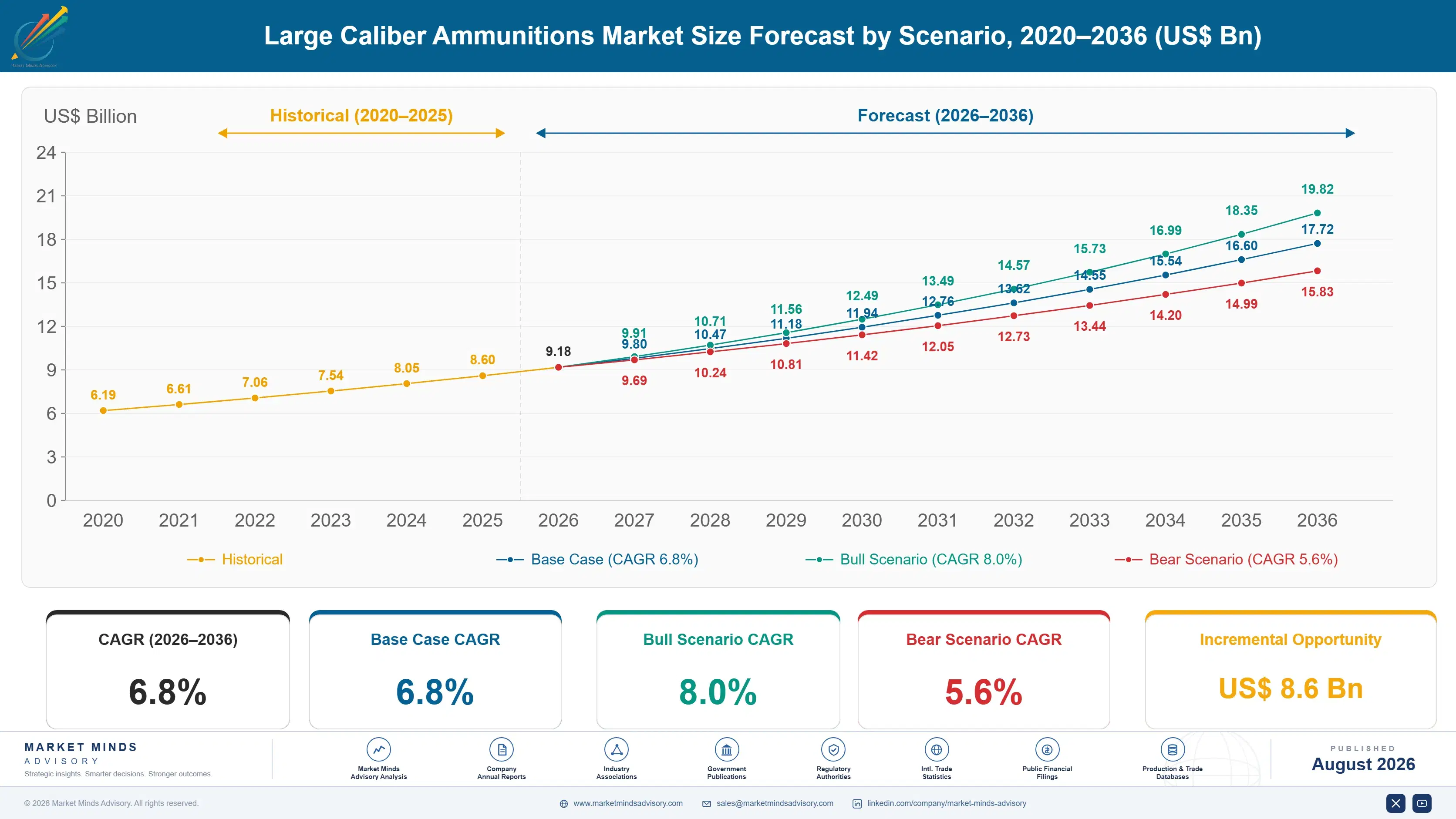
Large Caliber Ammunitions Market Forecast Scenarios

large-caliber-ammunitions-market-size-forecast-scenario-1788025491382
The 2020 to 2025 period exposed what three decades of treating munitions as overhead had actually cost. Consumption rates in sustained artillery operations exceeded allied production by an order of magnitude, and the shortage traced not to shell machining but to propellant and explosive capacity that nobody had built since the Cold War ended. Revenue compounded near 5.4%, held down early and then rising sharply as capacity programmes began.
Three mechanisms carry the base case. Energetic materials capacity expansion continues across allied nations on programmes commissioned during this period and taking years to complete. Stockpile replenishment obligations run well beyond current production even at expanded rates. And precision guidance kits fitted to conventional projectiles raise value per round substantially without changing the number of rounds anybody produces. None of the three depends on any further operational consumption occurring anywhere at all.
The bull catalyst is stockpile targets being written into binding alliance commitments rather than remaining aspirational, which would convert replenishment from budget-dependent into contractual. The bear risk is that a sustained reduction in operational demand leaves newly commissioned energetic plants running below the volumes their business cases required, which is how this capacity disappeared the first time.

Chemistry Not Machining

Everybody looked at the wrong end of this problem for two years. Shell bodies are forged and turned steel, and any competent engineering operation can be qualified to produce them. Propellant, explosive fill and initiation are chemistry performed in plants that take around 48 months to commission, require permits nobody grants quickly, and carry roughly 43% of projectile cost. Nitrocellulose supply decided artillery output across an alliance.
MARKET CONCENTRATION CR552%Share of large calibre ammunition revenue held by leading producers
ENERGETICS COST SHARE43%Portion of projectile cost from propellant, fill and initiation
PLANT COMMISSIONING TIME48 monthsTypical period from decision to an energetics facility producing
MULTI YEAR CONTRACT SHARE58%Procurement placed under commitments spanning several budget periods
PRECISION KIT VALUE UPLIFT6.4 timesCost of a guided round against a conventional equivalent projectile
STOCKPILE REPLENISHMENT BACKLOG9 yearsTime to restore holdings at current expanded production rates
The second thing that changed is the contract. Annual appropriation could never justify a plant taking four years to build and thirty to pay back, so capacity was not built and the industry consolidated. Around 58% of procurement now sits under multi-year commitments, which is the only structure under which a producer will commit capital to energetics. That change matters more than any single order announcement did.
Replenishment is the demand nobody can see the end of. Restoring allied holdings at current expanded production rates takes roughly nine years, and that assumes no further consumption in the meantime. Precision guidance kits meanwhile raise the value of a conventional projectile by around 6.4 times without changing how many rounds anybody makes, which is the most attractive content increase available in this market.
"The shell shortage was never a shell shortage. It was a nitrocellulose shortage wearing a shell shortage costume, and it took the procurement community most of two years to work out which end of the problem to fund."
Director, Defence Munitions Practice · MMA Defence Munitions Practice · August 2026

Market Trends

Energetics Capacity Replaced Shell Machining As The Constraint

Shell bodies can be produced by any competent forging and turning operation qualified within a reasonable period, while propellant and explosive fill come from plants taking around 48 months to commission against permits nobody issues quickly. Energetics account for roughly 43% of projectile cost and effectively all of the shortage. Capacity programmes across allied nations are now directed there rather than at machining capacity that was never actually the limiting factor at any point. Two years of funding the wrong constraint is what this actually cost the alliance in output.
Market Impact: Requires 9 years of production
Multi Year Contracting Finally Replaced Annual Appropriation

Around 58% of procurement now sits under commitments spanning several budget periods, which is the only structure under which a producer will commit capital to a plant taking four years to build and decades to repay. Annual appropriation guaranteed that capacity would not be built, and for three decades it was not. The contracting change matters considerably more than any individual order announcement, and it has already redirected investment that no order could have. Investment behaviour changed within months of the contracting structure changing, having not moved in thirty years.
Market Impact: Raises round value 6.4 times

Market Opportunities and Growth Drivers

Stockpile Replenishment Runs Years Beyond Current Production

Restoring allied holdings to target levels takes roughly nine years at current expanded production rates, and that calculation assumes no further consumption during the period, which no planner actually believes. The demand is therefore visible, quantified and extends well past any single budget cycle. It supports capacity investment in a way that operational consumption alone never could. Very few defence markets carry a backlog measured in years of full production ahead of them. Demand that outlasts every current political cycle is exactly what justifies a chemical plant, and this market has not had it for thirty years.
Market Impact: Delays capacity by 48 months

Precision Guidance Kits Multiply Value Per Round

Fitting guidance to a conventional projectile raises its value by around 6.4 times while consuming the same shell body, propellant and production line capacity as an unguided round. That is content growth entirely decoupled from volume, which matters enormously when volume is constrained by energetics rather than by demand. Accuracy improvements also reduce rounds required per effect, though procurement has not yet reduced volumes to reflect it in practice. Growth decoupled from tonnage is unusually valuable when tonnage is the thing nobody can increase, and this is the only place in the market it exists.
Market Impact: Risks plants after 48 months

Market Restraints and Challenges

Energetics Plants Cannot Be Built Inside Any Useful Timeframe

Commissioning an energetics facility takes around 48 months from decision, requiring environmental permits, specialised construction and process qualification that no amount of urgency compresses meaningfully. The root cause is that these are chemical plants handling hazardous processes under regulatory regimes written for peacetime industry. Commercially it caps output regardless of order book or funding. Mitigation runs through debottlenecking existing plants, qualifying alternative propellant chemistries, and importing energetic materials from allied producers with spare capacity. None of those mitigations produces a plant in less than the time a plant actually takes to build.
Market Impact: Takes 48 months to commission

Demand Reversal Would Strand Newly Built Capacity

Plants commissioned on current demand assumptions need sustained volume to justify their business cases, and a return to peacetime consumption leaves them running at fractions of capacity. The root cause is that this is precisely how the capacity disappeared the first time, when post-Cold War demand collapse closed plants nobody has replaced since. Commercially it makes producers cautious about uncontracted investment. Mitigation runs through multi-year offtake commitments, government-owned facilities under contractor operation, and export licensing flexibility. Every one of those routes asks a government to guarantee something beyond its own term.
Market Impact: Covers 58% of procurement now
4 additional market trends, 3 additional growth drivers, and 2 additional restraints and challenges are covered in the full report. Contact sales@marketmindsadvisory.com to access the complete intelligence.

Segment CAGR and Growth Architecture

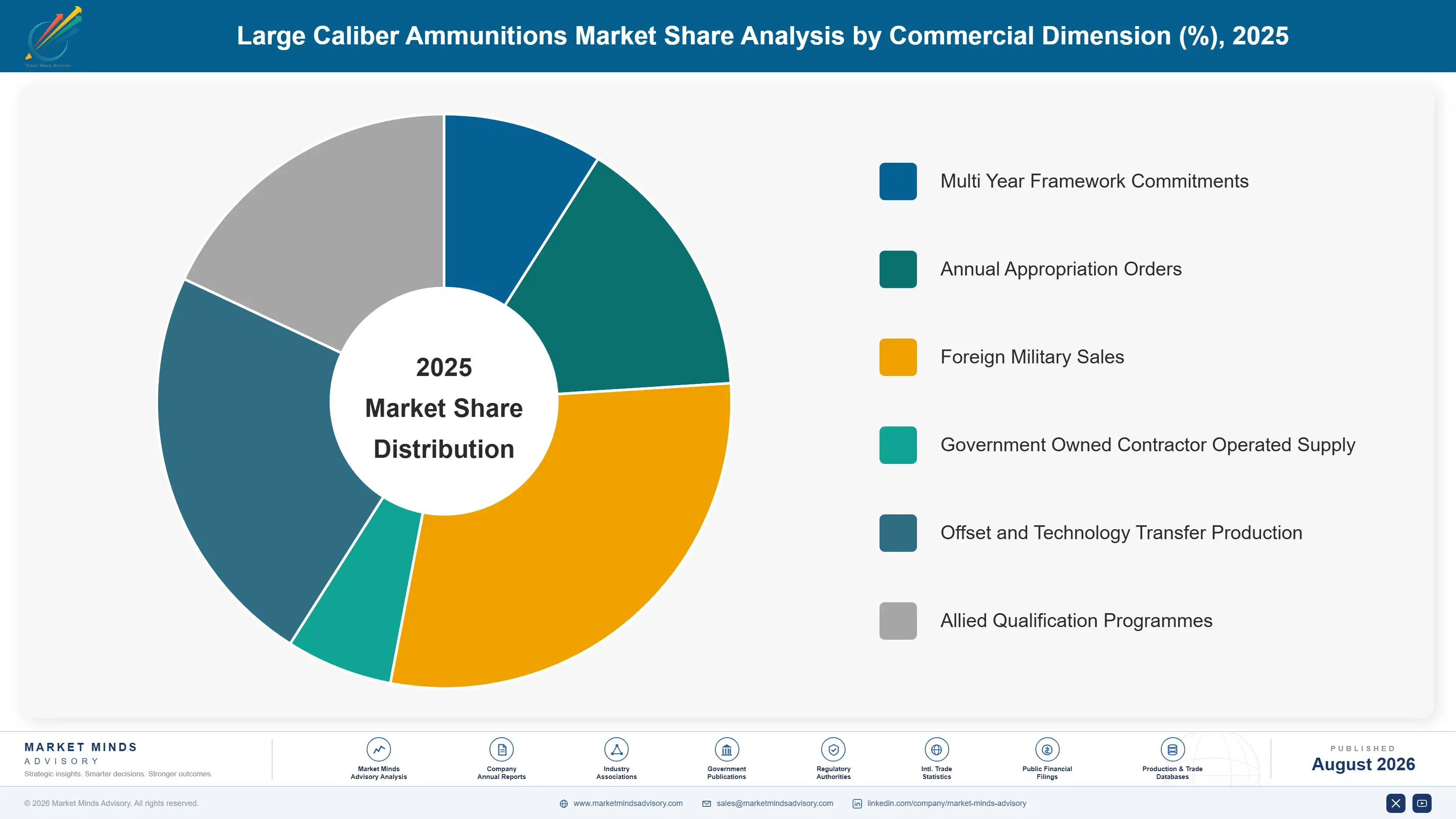
Segmentation follows product element, since projectile bodies, energetics, initiation and guidance are manufactured by different suppliers under entirely different constraints and qualification regimes. Six elements describe the market completely, from shell bodies that any competent engineering firm can be qualified to produce through to energetic materials where the shortage and the growth both actually sit.
large-caliber-ammunitions-market-market-share-analysis-1788025491921

Propellant, Explosive Fill and Energetic Materials

The fastest element grows at 10.2%, half again the market rate of 6.8%, and it grows because this is where the shortage was the whole time. Energetics account for roughly 43% of projectile cost and effectively all of the production constraint, since a plant takes around 48 months to commission against permits that nobody issues quickly and processes that nobody compresses. Nitrocellulose availability decided artillery output across an entire alliance while procurement authorities were still funding shell machining capacity. Every capacity programme now under way is directed here, and none of them will produce anything for several years yet. Everybody funded the wrong constraint first, and that mistake cost two years.
CAGR 10.2%

Precision Guidance Kits and Course Correction Systems

Guidance kits grow at 9.1% on a proposition that suits a constrained market unusually well. Fitting guidance to a conventional projectile raises its value by around 6.4 times while consuming exactly the same shell body, propellant charge and production line capacity as an unguided round would. That is value growth entirely decoupled from volume, which matters enormously when volume is capped by energetics rather than by demand or funding. Improved accuracy should eventually reduce rounds required per effect, though no procurement authority has yet adjusted volume targets downward to reflect that in practice. Growth without additional tonnage is the only kind available while the chemistry remains the binding limit here.
CAGR 9.1%
Full segment breakdown across 6 segments available in the complete report.

Regional Architecture and Country Demand Map

Production follows industrial capability and stockpile obligation rather than force size alone. Western Europe and North America hold most energetics capacity, with East Asia expanding rapidly on export-oriented production and South Asia growing fastest from a substantial domestic base. Preserved capacity matters more than force size.

North America

The largest share at 29% rests on artillery and tank ammunition production expanded sharply during this period, alongside precision guidance capability that no other region matches at comparable scale. Government-owned contractor-operated facilities carry much of the energetics capacity, which insulates producers from the demand reversal risk that deters private investment. Multi-year contracting was adopted here earlier and more completely than elsewhere. Nitrocellulose and propellant capacity expansion programmes commissioned during this period will not produce for several more years. Government ownership of the plant with contractor operation removes the demand reversal exposure that has kept private capital away from energetics investment everywhere else in the alliance for the past three decades.
Share: 29% | CAGR: 7.0% (2026 to 2036)

Western Europe

Energetics capacity here was reduced further than anywhere after the Cold War and is being rebuilt under considerable pressure, with Rheinmetall and Nammo expanding propellant and fill capability across several countries simultaneously. Environmental permitting has proved a genuine obstacle rather than a formality, adding months to programmes already measured in years. Shell body machining was never the constraint and remains readily available. Multi-year contracting arrived later here and has changed investment behaviour quickly once adopted. Rebuilding capacity that took forty years to dismantle is proving slower and more expensive than any of the announcements suggested, and the permitting alone has added a year to programmes that were already measured in years.
Share: 25% | CAGR: 5.6% (2026 to 2036)
Regional intelligence for 5 additional markets available in the complete report: East Asia, South Asia and Pacific, Eastern Europe, Middle East and Africa, Latin America. Contact sales@marketmindsadvisory.com.
large-caliber-ammunitions-market-country-cagr-analysis-1788025492440

Where Munitions Margin Actually Sits

Four levers work on energetics position, contract structure and content value rather than on projectile manufacturing capacity, which was never the constraint anybody thought it was. Upstream integration, multi-year commitment, guidance content and allied qualification each address something a producer can pursue now. None of the four turns on building more shell machining capacity anywhere.

Integrate Upstream Into Energetic Materials Production

Energetics account for roughly 43% of projectile cost and all of the production constraint, and producers buying propellant and fill from third parties are capacity-limited by decisions they do not control. Backward integration costs perhaps 300 million dollars and takes 48 months, which is why almost nobody did it for thirty years. Those who did are now the only participants able to increase output. The window for this decision is narrower than it appears, since capacity commissioned elsewhere eventually relieves the constraint. Nobody buys their way past a permitting queue.
Market Impact: Controls the 43% energetics share of projectile cost

Convert Every Order Into Multi Year Commitment

Around 58% of procurement now sits under multi-year commitments, and the remainder is still placed annually against budgets that cannot justify any capital investment at all. Producers should decline uncontracted capacity expansion and price annual orders to reflect the risk they carry. Governments have accepted multi-year structures where producers made the case clearly rather than simply requesting them. The producer who explains why a plant needs 10 years of committed volume generally gets a hearing now. Thirty years of annual ordering produced exactly the capacity position everybody is now complaining about.
Market Impact: Secures the 58% already placed under multi-year terms

Push Guidance Content Onto Conventional Rounds

A guidance kit raises projectile value by around 6.4 times while consuming the same shell body, propellant charge and line capacity as an unguided round. In a market where volume is capped by energetics rather than demand, that is the only route to growth that does not require new chemical plant. Producers without guidance capability are limited to whatever tonnage their propellant supply allows. Acquiring or partnering for it is considerably faster than building energetics capacity. Licensing guidance capability costs a small fraction of a 300 million dollar chemical plant.
Market Impact: Multiplies each round's value by roughly 6.4 times

Qualify Against Allied Standards Ahead Of Demand

Buyers are looking for capacity anywhere it exists, and the practical obstacle for producers outside the traditional allied base is qualification rather than capability or cost. Qualification typically takes 18 to 24 months and can be started before any customer asks. Producers who began early are supplying replenishment demand now while equally capable competitors are still in test programmes. The buyers are unusually willing to fund qualification, which is not normally true in defence procurement at all. Qualification is the cheapest capacity anybody can add in this market right now.
Market Impact: Requires roughly 24 months of allied qualification work

Who Controls the Margin Pool

Concentration sits around 52% across the five largest participants measured on large calibre ammunition revenue, and it is rising as governments consolidate orders onto producers who can actually deliver against them. The group is defined by energetics position rather than by assembly capacity. Several capable engineering firms produce shell bodies and hold no meaningful position, because bodies were never the scarce element. That distinction took two years to become obvious.
Competition runs on energetics access, contracted capacity and qualification breadth. Energetics access decides output regardless of anything else a producer holds. Contracted capacity decides whether investment can be justified at all. Qualification breadth decides how many customers a producer can serve, and it has become unusually important as buyers look for supply outside their traditional national sources. Access governs everything downstream.

Pressure is arriving from Asian and Eastern European producers rather than from new Western entrants. Korean output now supplies European replenishment at volumes European producers cannot match, and Eastern European capacity that survived when Western equivalents did not has become genuinely valuable. Rankings will shift toward producers holding energetics capacity and broad qualification, since one governs output and the other governs who may buy it.
large-caliber-ammunitions-market-company-positioning-matrix-1788025492976

Competitive Moat and Risk Dimensions

RHEINMETALL

Moat: Energetics integration across European capacity

Rheinmetall holds propellant and fill capability alongside projectile manufacture across several European countries, which makes it one of very few producers whose output is not limited by somebody else's chemical plant. Capacity expansion commissioned during this period compounds that position further. Multi-year contracting has funded investment that annual appropriation could never have supported at any point.
RHEINMETALL

Risk: Exposure to demand normalisation

Capacity commissioned on current demand assumptions requires sustained volume to justify business cases, and a return toward peacetime consumption leaves expensive plant running well below rated output. This is precisely how European capacity disappeared after the Cold War ended. Government commitments extending beyond current political cycles are difficult to secure and easy to revisit.
HANWHA AEROSPACE

Moat: Output scale with preserved capacity

Hanwha operates artillery ammunition capacity that was never reduced the way Western equivalents were, which allowed it to supply European replenishment at volumes domestic producers could not approach. Preserved energetics capability is the underlying advantage rather than any manufacturing distinction. Cost position and delivery performance together have won contracts that would not have been contested a decade ago.
HANWHA AEROSPACE

Risk: Export approval and political dependency

Supply into allied replenishment depends on export approvals subject to political conditions that shift with governments and with the conflicts involved. A restriction removes access to customers without any commercial cause. European producers rebuilding capacity will also compete directly for exactly the demand that opened this position originally.

Players Tracked

Prominent Players

Rheinmetall
General Dynamics Ordnance and Tactical Systems
Nammo
BAE Systems
Hanwha Aerospace

Other Key Players

Nexter Arrowtech
Eurenco
Poongsan Corporation
Yugoimport
MSM Group
Zakłady Metalowe Dezamet
Elbit Systems
Denel Munitions
Northrop Grumman Armament Systems
Expal Systems
Chemring Group
Junghans Defence
Diehl Defence
Kalyani Strategic Systems
IMBEL

Recent Developments

APRIL 2024

European producer commissioned new propellant production capacity

A European ammunition producer commissioned additional propellant manufacturing capacity, addressing the energetic materials constraint that had limited artillery output regardless of available shell body machining capability across the region. This was organic capacity investment rather than any acquisition, merger or joint venture between any of the producers involved.
Signal: Propellant capacity rather than shell machining was always the limiting factor on artillery output all along.
OCTOBER 2024

Defence ministry awarded multi-year ammunition supply commitment

A defence ministry awarded an ammunition supply commitment spanning several budget periods rather than a single annual order, explicitly to enable producer investment in capacity that annual appropriation could never have justified financially. This was a contract award rather than any corporate transaction between the suppliers involved.
Signal: Multi-year commitment is what makes energetics investment possible, and annual ordering guaranteed it would not happen.
FEBRUARY 2025

Asian producer qualified artillery ammunition against allied standards

An Asian ammunition producer completed qualification of artillery natures against allied standards, opening supply into European replenishment demand from capacity that had been preserved while Western equivalents were dismantled after the Cold War. This was a qualification programme rather than any commercial transaction between producers.
Signal: Qualification rather than capability decides which preserved capacity can actually be used to serve allied demand.

What A Large Calibre Round Costs

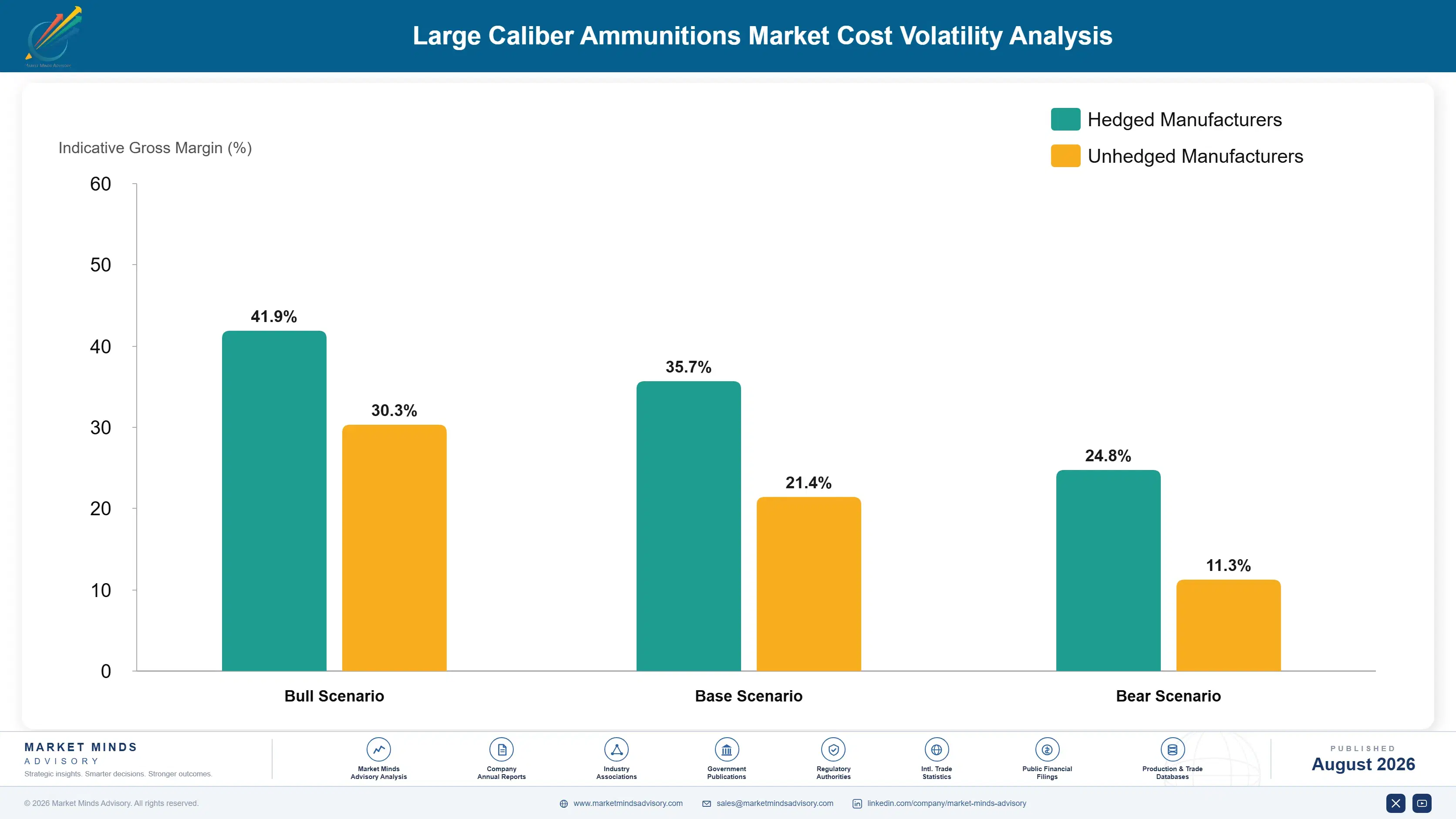
Cost divides four ways and energetics dominate more than most observers expect. Propellant, explosive fill and initiation absorb roughly 43% of projectile cost, steel body forging and machining near 24%, fuzing and electronics near 19%, and assembly, load and pack the remaining 14%. Producers pricing on machining content consistently underestimate what the chemistry actually costs and what its scarcity does to that cost during constrained periods.
Nitrocellulose and specialty chemical precursor pricing moved sharply across recent years and moved round economics with it, since qualified supply comes from very few producers with no substitution available under existing qualification. Rheinmetall and Nammo have both discussed energetic material cost and availability across recent reporting periods. Steel pricing has been comparatively unimportant by contrast, which surprised producers who had historically managed commodity exposure on the metal alone.

Exposure varies by integration position rather than by geography. Producers holding their own energetics capacity carry input cost but control availability, which during a shortage is worth considerably more than any price advantage. Those buying propellant externally carry both price and allocation exposure. Producers under multi-year contracts with indexation pass movement through, while annual contract holders absorb it entirely against pricing set before the movement occurred.
large-caliber-ammunitions-market-cost-volatility-analysis-1788025493172

Backward integration into propellant and fill capacity

Energetics absorb roughly 43% of projectile cost and all of the availability constraint, and producers buying externally are limited by allocation decisions taken elsewhere. Integration costs substantial capital and takes around four years, which is why so few did it. Those who did control their own output during exactly the period when everybody else could not increase theirs at all.

Precursor qualification across multiple chemical suppliers

Nitrocellulose and specialty precursors come from very few qualified sources, and substitution requires requalification measured in many months nobody schedules in advance. Qualifying alternatives before a shortage arrives costs comparatively little against production stopped for want of chemistry. Most producers began qualification only after allocation had already been reduced by their own existing supplier.

Indexation written into multi year supply commitments

Multi-year commitments spanning several budget periods expose producers to input movement across the whole term unless indexation is negotiated at award. Governments accept indexation more readily on long commitments than on annual orders, because the alternative is a producer unable to deliver at agreed pricing. Producers who omitted it are absorbing movement across contracts running for years.

Portfolio Architecture for Margin Defence

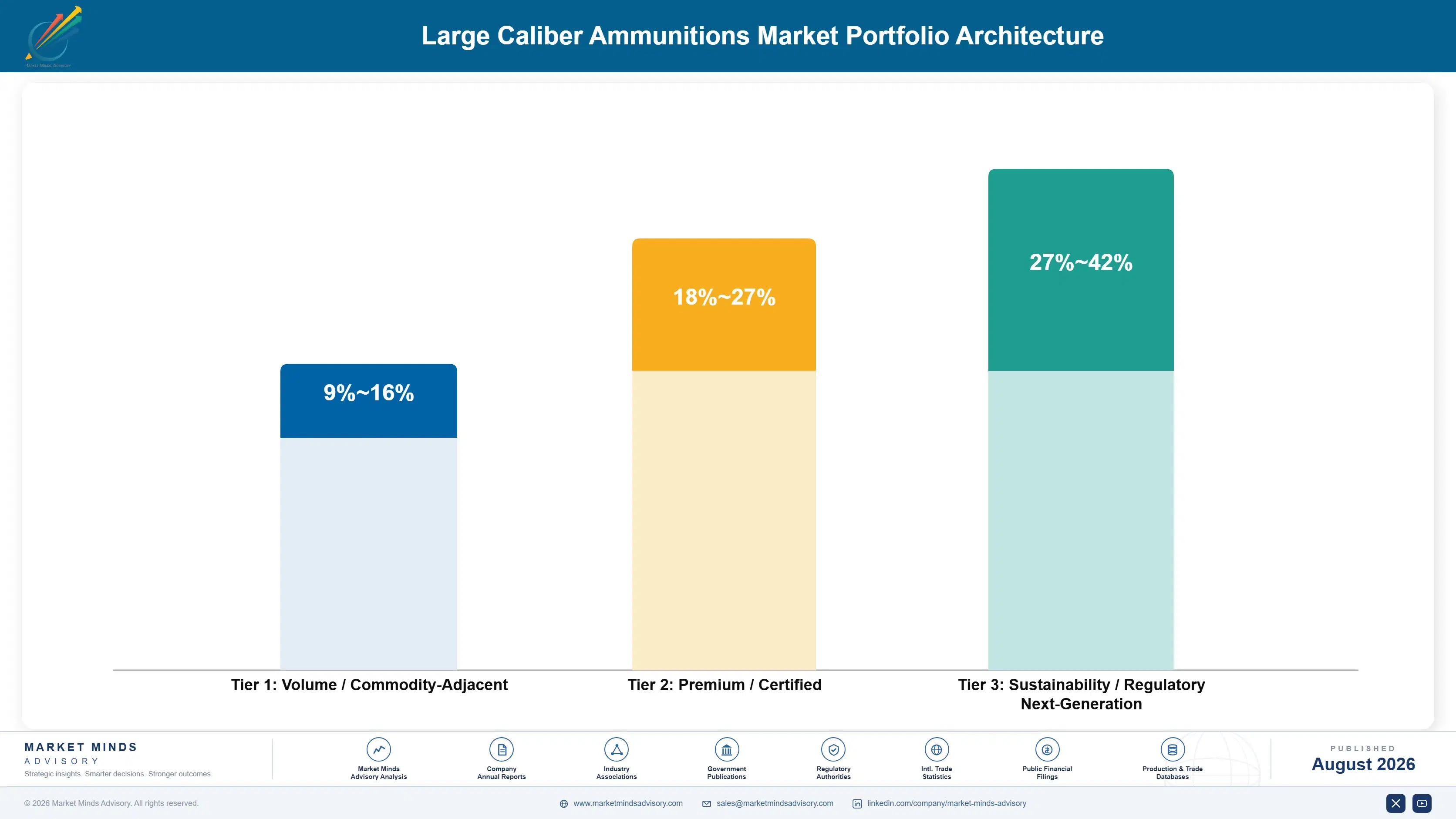
The portfolio separates by whether a producer controls chemistry. Shell body forging, machining and assembly form the volume core: substantial revenue, competition on cost and delivery, and margins reflecting a metalworking business that any competent engineering firm can be qualified into. It was never the scarce element and it has never carried a defensible position. Everybody funded it first anyway.
Margin concentrates in energetics and in guidance. Energetics account for roughly 43% of projectile cost, all of the production constraint, and a barrier measured in permits and 48 month commissioning schedules rather than capital alone. Guidance kits raise round value by around 6.4 times on the same line capacity. Both are positions competitors cannot enter quickly whatever they spend. Capital alone does not open either door.

The overlooked pool is qualification breadth. Buyers are looking for capacity anywhere it exists and the practical obstacle is qualification rather than capability, which takes eighteen to twenty-four months and can begin before any customer asks. Producers who started early are supplying replenishment now. Buyers are unusually willing to fund it, which is not normally true here at all. That has never been true here before.

Volume / Commodity-Adjacent

Shell body forging, machining, assembly and load and pack operations for conventional natures. Range spans seven points because throughput and delivery performance decide outcomes far more than any manufacturing distinction does.
Gross Margin: 9-16%

Premium / Certified

Complete conventional rounds, fuzing, initiation systems and naval and tank natures under national qualification. Range spans nine points because contract structure and indexation terms vary enormously between producers in this tier.
Gross Margin: 18-27%

Sustainability / Regulatory / Next-Generation

Propellant and explosive fill production, energetic materials and precision guidance kits. Range spans fifteen points because chemical plant economics and guidance electronics are barely comparable businesses inside one tier. Very few hold both.
Gross Margin: 27-42%
large-caliber-ammunitions-market-portfolio-architecture-1788025493670

High-value Sub-segments and Strategic Watch-out

Propellant, Explosive Fill and Energetic Materials

High value and high growth at 10.2%, holding roughly 43% of projectile cost and effectively all of the production constraint. The thirteen point range separates producers with their own commissioned plant from those buying externally at allocation determined elsewhere. Permits rather than capital govern this entirely.
Gross Margin: 29-42%

Precision Guidance Kits and Course Correction Systems

High value with moderate growth at 9.1%, raising round value 6.4 times on unchanged line capacity and unchanged propellant consumption. The nine point range reflects whether guidance capability is held internally or sourced from specialist electronics suppliers under licence. No new chemical plant is needed.
Gross Margin: 26-35%

Shell Bodies and Assembly Operations

The volume core and the part everybody funded first while the actual shortage sat elsewhere entirely. Any competent forging and machining operation can be qualified into it, which is precisely why no defensible position has ever existed here. Everybody funded this part of it first regardless.
Gross Margin: 9-16%

Energetics Demand Reversal Risk

The strategic watch-out rather than a growth pool. Plants commissioned on current assumptions need sustained volume, and a return toward peacetime consumption strands them exactly as it did after the Cold War ended. Nobody wants to be the producer holding an idle energetics plant again.
Gross Margin: Variable

Why Capacity Positions Persist

Energetics capacity produces annuity economics of an unusually physical kind. A commissioned plant supplies whoever owns it for decades, and a competitor wanting the same position needs permits, construction and process qualification taking around 48 months before producing anything at all. Around 58% of procurement now sits under multi-year commitments that fund exactly this, which converts a capacity position into contracted revenue rather than an option on future orders.
Stickiness varies enormously by element. Energetics positions are close to permanent for the reasons above, and qualification against national standards deepens them further. Guidance positions persist through a programme and are contested at each new nature. Shell body and assembly work has almost no stickiness at all, since any qualified engineering firm can produce it and buyers place it on cost and delivery each time.

Buyers have changed more in five years than in the preceding thirty. Procurement authorities that treated ammunition as an annual commodity purchase now write multi-year commitments, fund qualification for producers they have never bought from, and ask about upstream chemical supply. Producers whose commercial approach was built around annual competitive tendering find the new conversation unfamiliar and considerably more favourable.
large-caliber-ammunitions-market-end-use-penetration-index-1788025494159

Where Producers Should Commit Now

These are among the four positions where our research anticipates prominent divergence between winners and laggards over the coming forecast period. Each is grounded in the demand model, the regulatory perimeter, and the announced capacity pipeline.
01 / ENERGETICS CAPACITY INTEGRATION

Whoever owns the chemistry owns the output

Energetics account for roughly 43% of total projectile cost and effectively all of the production constraint, which means producers buying propellant and fill externally are capacity-limited by allocation decisions taken entirely outside of their own businesses. Backward integration costs substantial capital and takes around four full years to complete, which is precisely why almost nobody did it across the past three decades. Those who did are now the only participants in this market able to increase their output at all today.
02 / MULTI YEAR CONTRACT DISCIPLINE

Refuse uncontracted expansion, and price annual orders honestly

Around 58% of procurement now sits under commitments spanning several budget periods, and the remainder is still being placed annually against budgets that cannot justify any capital investment at all whatsoever. Producers should simply decline uncontracted capacity expansion outright and price annual orders to reflect the risk they are being asked to carry entirely alone on their own balance sheets. Governments have accepted multi-year structures wherever producers have made the case clearly rather than simply requesting them as a favour of some kind.
03 / GUIDANCE CONTENT GROWTH

The only growth that needs no chemical plant

A single guidance kit raises projectile value by around 6.4 times while consuming exactly the same shell body, propellant charge and production line capacity as an unguided round would consume. In a market where total volume is capped by energetics rather than by demand or funding, that is the only available route to growth requiring no new chemical plant of any kind. Producers without guidance capability remain limited to whatever tonnage their propellant supply happens to allow them each year.
04 / ALLIED QUALIFICATION SPEED

Buyers will fund the qualification if you start

Buyers are actively looking for production capacity anywhere it already exists, and the practical obstacle for producers outside the traditional allied supply base is qualification rather than any question of capability or of cost position at all. Qualification typically takes somewhere between eighteen and twenty-four months and can be started well before any customer has formally asked for it. Producers who began early are supplying replenishment demand today while equally capable competitors of theirs remain stuck inside their own test programmes.

Engagement Snapshot From the Field

A live engagement with an industry participant carrying material or product regulatory and market exposure ahead of a defining policy shift, showing how our research translates into a defensible multi-year portfolio strategy.
MARKET MINDS ADVISORY · CLIENT ENGAGEMENT SUMMARY
Large Caliber Ammunitions Producer Strategic Portfolio Review and Transition Roadmap 2026·Investment Scenario on Large Caliber Ammunitions Exposure Evaluation 2025-26
CLIENT PROFILE
A European producer of artillery and mortar ammunition operating shell body machining, assembly and load and pack capability while purchasing all propellant and explosive fill from external suppliers. Order intake had risen sharply across two years while deliveries had not, and management had responded by investing in additional machining capacity that subsequently ran well below its rated output.
STRATEGIC CHALLENGE
The board needed to establish why additional machining capacity had not increased deliveries, and whether backward integration into energetics justified capital measured in hundreds of millions against a demand outlook nobody could guarantee beyond a few years. It also had to decide whether to accept further orders under annual appropriation terms it had never previously questioned.
MMA APPROACH
MMA traced delivery shortfalls to their actual origin across two years of production records, separating machining throughput from energetics allocation. It modelled backward integration against continued external purchase under several demand scenarios. Expert interviews with defence ministries, propellant producers and competing manufacturers established what capacity exists, what is committed and what buyers will underwrite.
KEY FINDINGS
  1. Every delivery shortfall across the period traced to propellant allocation rather than to machining throughput, and the new machining capacity had not been the constraint at any point.
  2. External propellant suppliers were allocating to vertically integrated competitors first, which the client had not established and had never raised commercially with them.
  3. Defence ministries interviewed would commit multi-year volume to fund energetics investment, and the client had never asked any of them for such terms.
  4. Guidance kit capability was available under licence at a fraction of energetics investment and raised round value substantially without consuming additional propellant.
CLIENT PROFILE
A European producer of artillery and mortar ammunition operating shell body machining, assembly and load and pack capability while purchasing all propellant and explosive fill from external suppliers. Order intake had risen sharply across two years while deliveries had not, and management had responded by investing in additional machining capacity that subsequently ran well below its rated output.
STRATEGIC CHALLENGE
The board needed to establish why additional machining capacity had not increased deliveries, and whether backward integration into energetics justified capital measured in hundreds of millions against a demand outlook nobody could guarantee beyond a few years. It also had to decide whether to accept further orders under annual appropriation terms it had never previously questioned.
MMA APPROACH
MMA traced delivery shortfalls to their actual origin across two years of production records, separating machining throughput from energetics allocation. It modelled backward integration against continued external purchase under several demand scenarios. Expert interviews with defence ministries, propellant producers and competing manufacturers established what capacity exists, what is committed and what buyers will underwrite.
KEY FINDINGS
  1. Every delivery shortfall across the period traced to propellant allocation rather than to machining throughput, and the new machining capacity had not been the constraint at any point.
  2. External propellant suppliers were allocating to vertically integrated competitors first, which the client had not established and had never raised commercially with them.
  3. Defence ministries interviewed would commit multi-year volume to fund energetics investment, and the client had never asked any of them for such terms.
  4. Guidance kit capability was available under licence at a fraction of energetics investment and raised round value substantially without consuming additional propellant.
RECOMMENDED STRATEGY
Phase 1: Phase one: halt further machining investment and open multi-year commitment discussions with the two largest customers immediately and at board level. Phase 2: Phase two: commit to propellant capacity only against contracted volume, and qualify a second external supplier in the meantime as insurance. Phase 3: Phase three: license guidance kit capability to raise round value without consuming any additional propellant allocation of any kind at all.
OUTCOME
The client reported securing multi-year commitments from two ministries and beginning energetics investment against them (client-reported, unverified by MMA). A second propellant supplier was qualified within just three quarters. Guidance kit licensing raised the average round value materially, and machining capacity investment was suspended entirely thereafter.

Frequently Asked Questions

Foundational context covering the market sizes, CAGR, scope, country, region and competition that inform every finding below. This section is provided to cover basics and most often pre-purchase conversations, answered from the MMA Primary Research Dataset.

What is the current size of the Large Caliber Ammunitions Market?

The market is valued at USD 8.6 billion in 2025, measured as revenue from ammunition of 20mm calibre and above procured for military use worldwide.

How large will the Large Caliber Ammunitions Market be by 2036?

MMA forecasts USD 17.73 billion by 2036, up from USD 9.18 billion in 2026. That represents incremental revenue of USD 8.55 billion and an expansion multiple of 1.93 times.

What is the CAGR for the Large Caliber Ammunitions Market 2026 to 2036?

The base case CAGR is 6.8%, with a bull case of 8.0% and a bear case of 5.6%. Stockpile replenishment and energetics capacity expansion supply most of that growth.

Which segment is growing fastest?

Propellant, explosive fill and energetic materials grow at 10.2%, half again the market rate of 6.8%, because that is where the production shortage sat the entire time.

Who are the major companies in the Large Caliber Ammunitions Market?

Rheinmetall, General Dynamics Ordnance and Tactical Systems, Nammo, BAE Systems and Hanwha Aerospace lead on large calibre revenue, holding around 52% between them across global procurement.

Which country is growing fastest?

India grows fastest at 8.8%, expanding from a substantial domestic base into export supply as allied nations look for production capacity wherever it already exists.

Report Segmentation Architecture

The full report scope spans multiple orthogonal segmentation dimensions, with cross-tabulated demand data provided for each dimension pair. Coverage extends further to regional breakdowns, trend trajectories, and the competitive detail needed to support segment-level decision-making.

By Product Element

  • Artillery and Mortar Projectiles
  • Tank and Direct Fire Ammunition
  • Naval Gun Ammunition
  • Propellant, Explosive Fill and Energetic Materials
  • Fuzes, Primers and Initiation Systems
  • Precision Guidance Kits and Course Correction Systems

By End-Use Industry

  • Land Forces Artillery
  • Armoured and Mechanised Forces
  • Naval Surface Forces
  • Coastal and Territorial Defence
  • Training and Range Consumption
  • Stockpile and Reserve Holdings

By Commercial Dimension

  • Multi Year Framework Commitments
  • Annual Appropriation Orders
  • Foreign Military Sales
  • Government Owned Contractor Operated Supply
  • Offset and Technology Transfer Production
  • Allied Qualification Programmes

By Region

  • North America
  • Western Europe
  • East Asia
  • South Asia and Pacific
  • Eastern Europe
  • Middle East and Africa
  • Latin America

Scope, Methodology, and Coverage

Every figure in this report is reproducible from documented input assumptions. The scope below maps the historical period, the forecast horizon, the segmentation dimensions, and the countries covered, alongside the underlying primary and qualitative methodology.
Historical Period
2020 to 2025
Forecast Period
2026 to 2036
Base Year
2025 (USD billions; MMA Primary Research Dataset, August 2026)
Market Definition
Revenue from ammunition of 20mm calibre and above procured for military use, spanning artillery and mortar projectiles, tank and direct fire ammunition, naval gun ammunition, propellant, explosive fill and energetic materials, fuzes, primers and initiation systems, and precision guidance kits fitted to conventional projectiles. Multi-year framework commitments, annual appropriation orders, foreign military sales, government owned contractor operated supply, offset production and allied qualification programmes are all included. Small arms ammunition below 20mm, guided missiles and rockets, aerial bombs, demolition and engineering explosives, and commercial or sporting ammunition are excluded.
Quantitative Units
USD billions, large calibre ammunition and component revenue
Segmentation Dimensions
Product element, using force, commercial contracting model, region
Regions Covered
North America, Western Europe, East Asia, South Asia and Pacific, Eastern Europe, Middle East and Africa, Latin America
Countries Covered
United States, Germany, France, Norway, United Kingdom, Poland, Czechia, Bulgaria, South Korea, Japan, India, Australia, Brazil, South Africa
Key Companies Profiled
Rheinmetall, General Dynamics Ordnance and Tactical Systems, Nammo, BAE Systems, Hanwha Aerospace, Nexter Arrowtech, Eurenco, Poongsan Corporation, Expal Systems, Diehl Defence
Quantitative Methodology
Primary survey, n=3,800 respondents, Q4 2025, six countries; demand-side model with trade association cross-validation
Qualitative Methodology
47 expert interviews, Q4 2025; applied to validate demand model assumptions, identify emerging dynamics, and assess competitive positioning
Report Format
PDF and XLSX data workbook (Word format preview document)
Publisher
Market Minds Advisory
Report Code
MMA-2026-CON-421
Published
August 2026
Contact
sales@marketmindsadvisory.com | www.marketmindsadvisory.com

Purchase the full Large Caliber Ammunitions Market Report (2026 to 2036).

The full report follows this market to the constraint that actually governs it rather than the one procurement funded first. It quantifies energetics as a share of projectile cost and of the production shortage, maps commissioned and announced capacity against replenishment obligations, and separates multi-year contracted volume from annual appropriation across the producer base. Segment analysis covers all six product elements, with particular attention to propellant and explosive fill where the shortage and the growth are the same fact. Competitive assessment ranks twenty producers on large calibre ammunition revenue.
Six product element segmentation with growth rates
Energetics capacity mapped against replenishment obligations
Twenty producer assessment on large calibre revenue
Multi-year contracted volume separated from annual appropriation
Guidance kit value uplift quantified per projectile
Allied qualification timelines compared across producer regions

Built For The People Who Decide

From boardroom strategy to bench-side execution, this report is read cover-to-cover by leaders shaping the next decade of their industry, turning demand scenarios, market dynamics and valuation benchmarks into decisions.
CXOs/ Presidents/ VPs/ Managers
M&A and Corporate Development
Strategy Teams and R&D Heads
Procurement and Product Directors
Regulatory and Compliance Leaders
Investor Relations and Equity Analysts