Market Minds Advisory
Laparoscopic Gynecological Procedures Market

Laparoscopic Gynecological Procedures Market: When Surgical Precision Replaced Instrument Volume As The Real Product

A commercial reading of the laparoscopic gynecological procedures market, where robotic-assisted adoption and single-incision techniques are pulling hospital capital investment toward precision surgical platforms faster than the standard instrument sets that built this category.

Lead Analyst

Alice Ballenger

Published

September 2026

Make Smarter Decisions with Customized Research Insights

Request a free sample report and evaluate market opportunities, growth trends, and competitive dynamics relevant to your business needs.

2025 MARKET VALUE$8.4BMarket Size 2025
2036 FORECAST VALUE$18.0BBase Case , 2026 to 2036
CAGR 2026 TO 20367.2 %Bull 8.5% / Bear 5.9%
INCREMENTAL OPPORTUNITY$9.0BNet 10- year value creation
EXPANSION MULTIPLE2.00x2036 value over 2026 base
Strategic Levers
M&A Pipeline
Regional Outlook
Country Rankings
Competitive Intelligence
Segmental Deep-dive
Call-Us : 91 93563 13602

Executive Snapshot and Market Trajectory

Laparoscopic gynecological device selection increasingly turns on validated robotic-assisted precision data rather than raw instrument volume alone, as surgeons weigh proven procedural outcomes over simple manual instrument availability that once defined purchasing choice broadly across most surgical settings entirely and consistently today.
The market stands at USD 9.00 billion in 2025 and reaches USD 18.04 billion by 2036 at a 7.2% CAGR. Robotic-assisted laparoscopic systems grow fastest at 11.0%, roughly 1.53 times the overall rate, as hospitals pursue enhanced surgical precision for hysterectomy and myomectomy procedures across most major gynecological surgical categories. North America holds 34% of value on concentrated robotic surgical system installed base, while South Asia and Pacific posts the quickest regional growth at 9.2%.
Concentration sits near 48%, split between diversified surgical device majors holding broad laparoscopic portfolios and specialty robotic system developers competing on precision validation depth across most gynecological surgical markets worldwide today entirely and consistently now. Two forces dominate ahead. Robotic-assisted adoption is pulling hospital capital investment toward premium surgical platforms, and single-incision techniques are turning recovery time into a genuine competitive differentiator rather than a purely surgical consideration.
Market Definition
The laparoscopic gynecological procedures market covers minimally invasive surgical devices and instruments used in hysterectomy, myomectomy, and related gynecological surgeries, including robotic-assisted systems, energy devices, and visualization equipment. Open abdominal surgical devices are excluded.
Base Year Value
$8.4B in 2025 (MMA Primary Research Dataset, August 2026)
Forecast Period
2026 to 2036, eleven discrete annual values
CAGR
7.2% base case. Bull 8.5%. Bear 5.9%.
Fastest Growth Segment
Robotic-Assisted Laparoscopic Systems: 11.0% CAGR
Fastest Growth Country
United States: 8.9% CAGR
Fastest Growth Region
South Asia and Pacific: 9.2% CAGR
Largest Region
North America: 34% of 2025 global value
Market Leaders
Intuitive Surgical, Medtronic, Johnson and Johnson (Ethicon), Olympus Corporation, Karl Storz. Source: MMA Analysis based on company annual reports.
Primary Survey
n=3,800 procurement and R&D decision-makers, Q4 2025, six countries
Methodology
Demand-side build-up, cross-validated against public data, 47 expert interviews

Laparoscopic Gynecological Procedures Market Forecast Scenarios

laparoscopic-gynecological-procedures-market-size-forecast-scenario-1787298313827
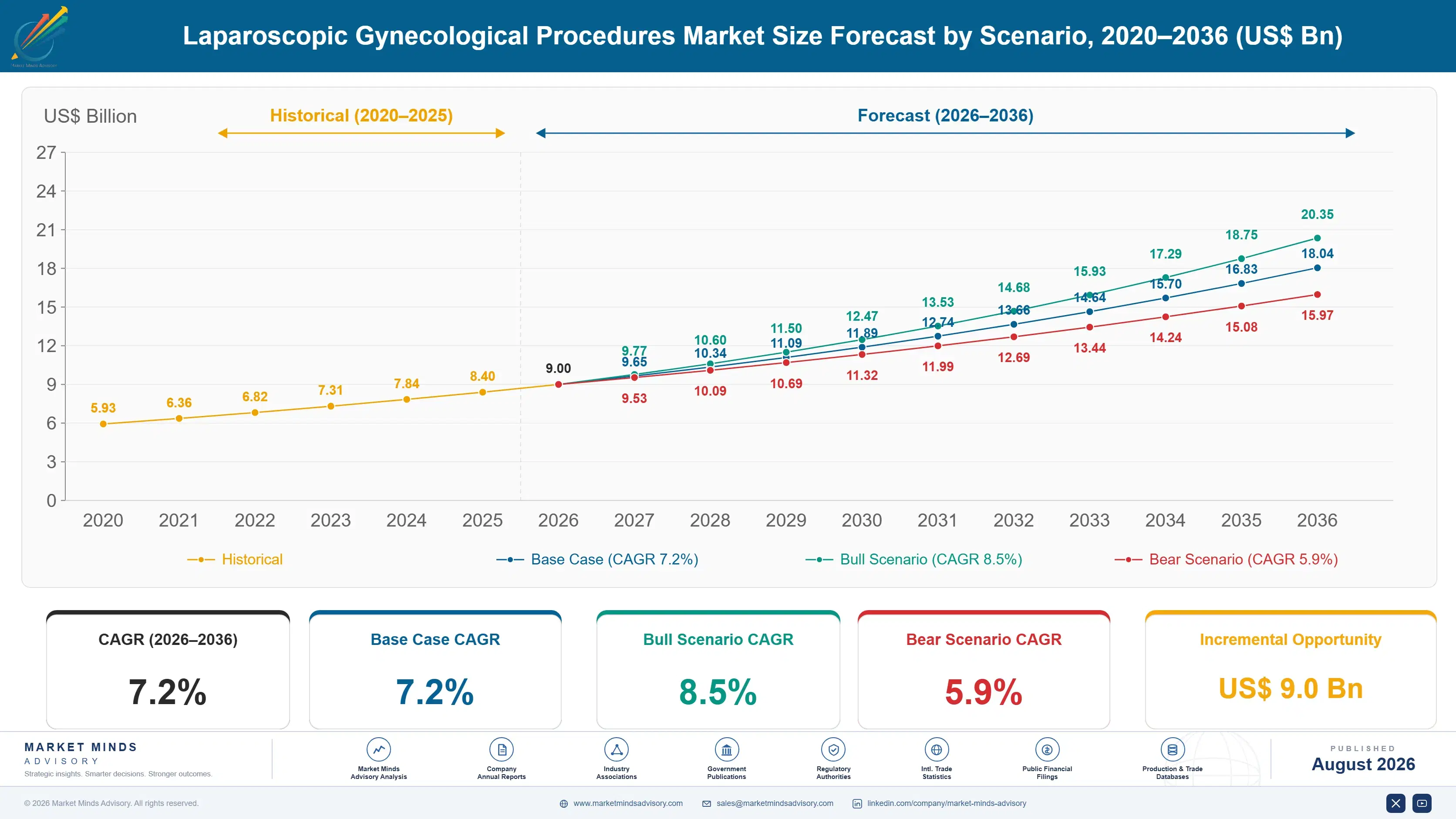
Growth from 2020 to 2025 compounded near 6.3%, tracking steady conversion from open abdominal surgery to minimally invasive techniques closely across most developed surgical markets globally, with robotic-assisted adoption accelerating sharply as hospital capital investment favored precision platforms during the period. Standard laparoscopic instrument volume grew more steadily, tracking established procedural conversion patterns and physician training availability.
Three mechanisms carry the base case to 7.2%. First, robotic-assisted laparoscopic system adoption expanding as hospitals pursue enhanced surgical precision for complex gynecological procedures across most major surgical categories worldwide currently building capital investment and surgeon training momentum steadily. Second, single-incision technique adoption continuing to reduce recovery time and improve cosmetic outcomes for eligible patients across developed markets. Third, energy device innovation continuing to drive incremental instrument replacement demand globally and consistently.
The bull case at 8.5% assumes robotic-assisted adoption and single-incision technique expansion accelerate faster than currently planned across major surgical markets worldwide today and consistently. The bear case at 5.9% assumes hospital capital budget constraints slow robotic system adoption considerably, reimbursement pressure limits premium platform investment, and single-incision technique adoption proceeds more gradually than current expectations suggest.

Why Surgical Precision, Not Instrument Volume, Now Sets Hospital Contracts

Three forces set demand here. Robotic-assisted laparoscopic system adoption drives the largest new-value growth, as hospitals pursue enhanced surgical precision for complex gynecological procedures entirely. Single-incision technique adoption drives a second stream, since patients increasingly prefer reduced recovery time. Energy device innovation drives a third, steadier stream overall.
MARKET CONCENTRATIONCR5: 48%Split between diversified surgical majors and specialty robotic system developers
ROBOTIC ADOPTION RATEUp to 35% of proceduresTypical share of eligible hysterectomy procedures performed with robotic assistance
RECOVERY TIME REDUCTION2 to 4 weeks fasterTypical recovery time improvement versus comparable open abdominal surgery
SINGLE-INCISION DEAL SHAREAbout 18% of new proceduresShare of new procedures directed toward single-incision surgical techniques
SURGEON TRAINING GROWTHRoughly 15% annuallyGrowth rate of newly certified robotic-assisted gynecological surgeons worldwide
CAPITAL EQUIPMENT COST SHAREAbout 40% of programme costShare of programme cost attributable to robotic system capital investment
The commercial character is defined by a widening split between validated robotic-assisted platforms and price-driven standard instrument supply. A hospital evaluating surgical device suppliers assesses procedural precision data and surgeon training support as primary specifications, not simply raw instrument price comparable across generic laparoscopic platforms. A supplier without validated precision outcome data increasingly loses hospital contracts regardless of price, since inadequate procedural accuracy directly threatens patient safety outcomes and surgical programme reputation considerably.
The decade turns on whether robotic-assisted adoption keeps expanding fast enough to offset any softening in general standard instrument demand as reimbursement pathways mature across major surgical markets worldwide today. Procedural precision data and surgeon training depth remain the primary forces separating suppliers building durable hospital relationships from those still competing purely on instrument price. That shift determines which suppliers lead the next decade.
"A hospital doesn't buy a laparoscope. They buy the difference between a patient discharged the same day and one recovering for a week in a hospital bed, and that's the entire commercial calculation."
Director, Minimally Invasive Surgical Technology Practice · MMA Medical Devices

Market Trends

Robotic-Assisted Adoption Is Expanding Precision Surgical Capability

Hospitals are increasingly investing in robotic-assisted laparoscopic surgical systems for complex gynecological procedures, since these platforms offer enhanced dexterity and three-dimensional visualization that traditional laparoscopic instruments cannot easily replicate during intricate dissection and suturing tasks across most major hysterectomy and myomectomy categories currently expanding capital investment and surgeon training development without requiring separate operating room infrastructure beyond the robotic console and instrument arms. That precision capability is converting gynecological surgical purchasing from a general instrument volume decision into a genuine capital infrastructure investment hospitals evaluate against documented outcome data. Hospitals with validated robotic programmes are capturing this adoption volume steadily.
Market Impact: Cuts complication rates by 35%
Single-Incision Techniques Are Reducing Patient Recovery Time

Surgeons are increasingly adopting single-incision laparoscopic surgery techniques for eligible gynecological procedures, since this approach reduces the number of abdominal incisions required compared to traditional multi-port laparoscopic surgery, improving cosmetic outcomes and reducing post-operative pain for patients across most major elective gynecological procedure categories currently expanding technique training and specialized single-port instrumentation adoption without requiring separate hospital infrastructure beyond specialized single-port access devices. That recovery advantage is converting technique selection from a purely surgical preference decision into a genuine patient satisfaction investment hospitals evaluate against documented recovery outcomes. Surgeons with proven single-incision expertise are capturing this procedure volume steadily.
Market Impact: Cuts recovery time by 3 weeks

Market Opportunities and Growth Drivers

Complex Procedure Demand Is Driving Robotic Platform Investment

Hospitals treating complex gynecological cases requiring enhanced surgical precision are creating demand independent of general laparoscopic instrument spending alone, since robotic platform investment proceeds on its own capital budgeting and surgeon training schedule regardless of broader surgical device cycle timing or economic conditions affecting other instrument categories across most major surgical markets currently expanding hospital capital investment activity and surgeon certification programmes. That complexity-driven demand creates a durable order pipeline for developers with dedicated robotic capability, regardless of general instrument spending trends, since hospitals pursue precision independent of broader surgical sector conditions. Each new complex case strengthens this pipeline.
Market Impact: Systems cost over $1 million

Patient Preference For Faster Recovery Is Driving Technique Adoption

Patients seeking reduced recovery time and improved cosmetic outcomes are creating demand independent of general surgical technique cycles alone, since single-incision investment continues on its own patient preference and surgeon training schedule regardless of broader elective surgery conditions or economic cycles affecting other procedure categories across most major elective gynecological markets currently expanding technique training programmes and specialized instrumentation adoption. That preference-driven demand creates procedures tied to recovery outcome requirements rather than general elective activity alone, since patients pursue faster recovery independent of broader healthcare spending conditions. Each new trained surgeon strengthens this demand pipeline considerably.
Market Impact: Training requires 6 to 12 months

Market Restraints and Challenges

High Robotic System Costs Limit Adoption Among Smaller Hospitals

Smaller hospitals evaluating robotic-assisted laparoscopic surgical adoption face substantial capital equipment costs combined with ongoing maintenance and disposable instrument expenses, since robotic platforms require significant upfront investment that many regional facilities cannot easily justify given their surgical volume. The root cause is that robotic surgical technology remains genuinely expensive to manufacture and maintain, requiring specialized components and ongoing software support that smaller manufacturers have not yet successfully commoditized. The commercial impact is that many smaller hospitals continue relying on conventional laparoscopic instruments despite recognized precision advantages. Mitigation runs through flexible leasing models several manufacturers are now offering.
Market Impact: Cuts complication rates by 35%

Surgeon Training Requirements Slow Broader Technique Adoption

Hospitals evaluating robotic-assisted and single-incision surgical adoption face substantial surgeon training requirements, since these techniques demand specialized certification and proctored case experience before surgeons can independently perform complex gynecological procedures safely. The root cause is that minimally invasive robotic and single-incision techniques require genuinely different spatial reasoning and instrument handling skills compared to conventional open or standard laparoscopic surgery, making the learning curve meaningfully steeper than manufacturers often suggest. The commercial impact is that many surgeons delay adoption until sufficient training capacity becomes available. Mitigation runs through expanded simulation-based training programmes several manufacturers now sponsor.
Market Impact: Cuts recovery time by 3 weeks
3 additional market trends, 4 additional growth drivers, and 3 additional restraints and challenges are covered in the full report. Contact sales@marketmindsadvisory.com to access the complete intelligence.

Segment CAGR and Growth Architecture

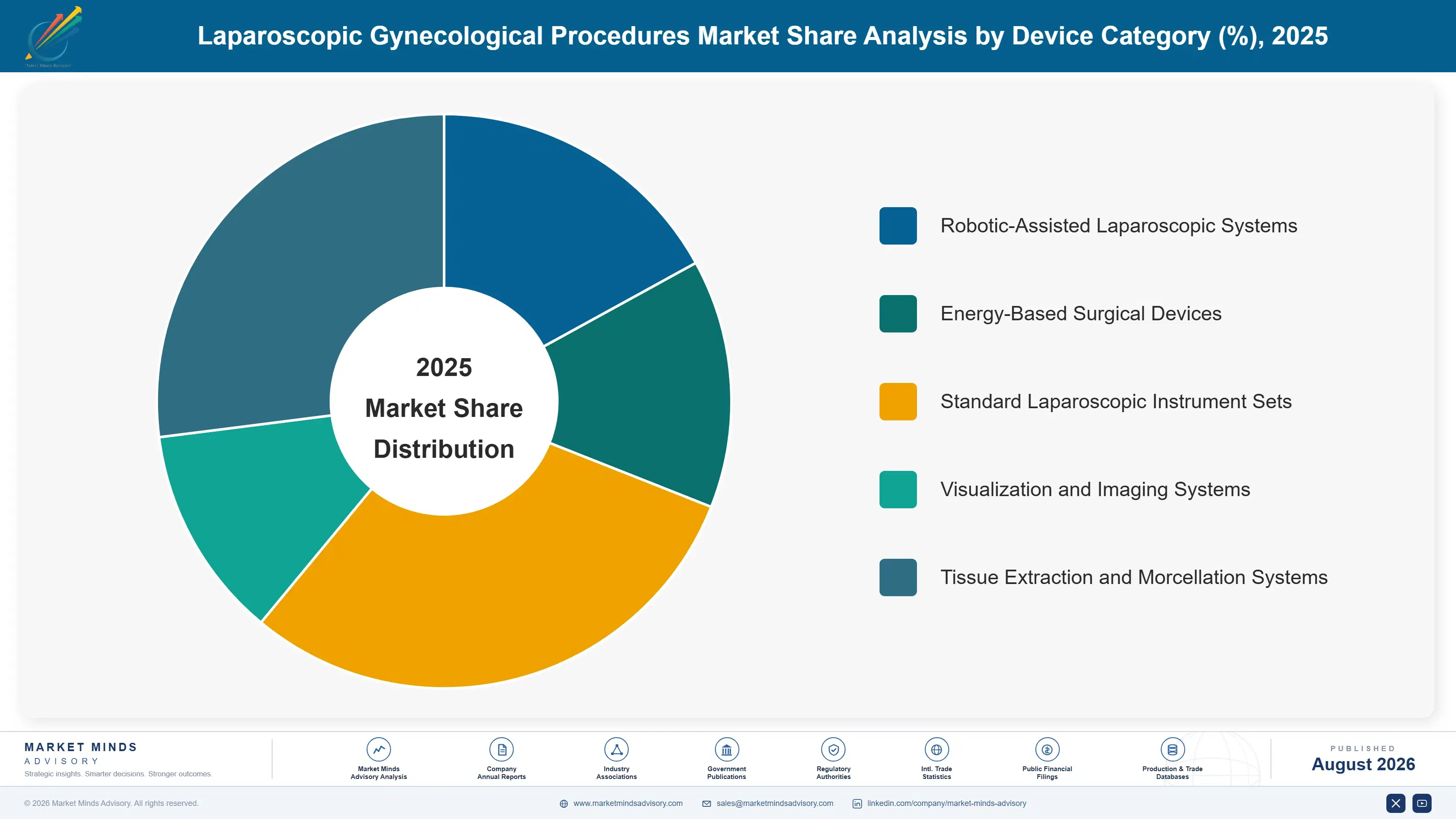
Segmentation follows device category, a single functional logic describing which physical component of the laparoscopic surgical system generates revenue, rather than which specific hospital actually performs the procedure or which particular patient demographic ultimately receives treatment once finally scheduled. Each device category carries its own margin, cost, and adoption profile distinctly across the market.
laparoscopic-gynecological-procedures-market-market-share-analysis-1787298314410

Robotic-Assisted Laparoscopic Systems

Robotic-assisted laparoscopic systems grow fastest at 11.0%, about 1.53 times the overall 7.2% rate, as hospitals increasingly pursue enhanced surgical precision for complex hysterectomy and myomectomy procedures across most major gynecological surgical categories currently expanding capital investment and surgeon training momentum globally. Growth concentrates where developers demonstrate validated procedural outcome data and consistent precision mechanisms, since hospitals now require documented clinical performance history before committing capital to a new robotic programme. Intuitive Surgical and Medtronic both hold established positions in this segment through years of platform engineering and clinical investment. Outcome data depth, not raw instrument volume alone, remains the primary constraint on how fast this segment keeps expanding globally.
CAGR 11.0%

Energy-Based Surgical Devices

Energy-based surgical devices grow at 8.6%, serving surgeons requiring precise tissue cutting, sealing, and coagulation capability across most major gynecological procedure categories currently expanding electrosurgical and ultrasonic device adoption considerably each passing calendar year and quarter quite steadily indeed now and reliably and consistently across most developed and developing surgical markets worldwide. Adoption concentrates among surgeons pursuing bleeding control and tissue precision strategies, since energy-based devices offer sealing consistency that mechanical instruments cannot easily match during vascular tissue dissection. Johnson and Johnson and Olympus both hold strong positions built on established hospital partner relationships spanning years of surgical device expertise. Device reliability, not raw cutting power alone, remains the primary constraint shaping how quickly surgeons adopt newer energy platforms.
CAGR 8.6%
Full segment breakdown across 5 segments available in the complete report.

Regional Architecture and Country Demand Map

Robotic system installed base and surgical infrastructure density, more than procedure incidence alone, drive this seven-region value distribution across the global laparoscopic gynecological device network today. North America dominates on robotic installed base, while South Asia and Pacific grows fastest on expanding surgical infrastructure access.

North America

North America holds 34% of value at 8.2% growth, sitting above the standard 22 to 32% band because the United States hosts the majority of the world's installed robotic-assisted surgical systems, concentrating capital equipment and disposable instrument revenue disproportionately across the region's largest hospital networks nationally and consistently. Intuitive Surgical and Medtronic both maintain deep domestic distribution infrastructure spanning years of hospital partner relationships and surgeon training support across most major surgical categories nationally and internationally as well. US demand leads decisively, driven by both concentrated robotic installed base and established reimbursement pathways covering complex gynecological procedures broadly. Canadian demand follows at considerably smaller scale, concentrated in major academic surgical hospitals specifically.
Share: 34% | CAGR: 8.2% (2026 to 2036)

Western Europe

Western Europe holds 24% of value at 5.8% growth, shaped by established hospital infrastructure and mature surgical technology adoption moving more deliberately than the fastest-expanding developing surgical markets elsewhere in the world currently and quite consistently indeed today and reliably and durably. Johnson and Johnson and Karl Storz both hold meaningful regional positions built on established relationships with major hospital systems spanning decades of surgical device development, quality validation, and technical support. German and UK hospitals lead regional deployment, driven by dense surgical infrastructure and established clinical validation relationships across major treatment hubs. Growth reflects steady demand rather than the explosive expansion characterizing the fastest-growing developing surgical markets globally today.
Share: 24% | CAGR: 5.8% (2026 to 2036)
Regional intelligence for 5 additional markets available in the complete report: East Asia, South Asia and Pacific, Latin America, Middle East and Africa, Eastern Europe. Contact sales@marketmindsadvisory.com.
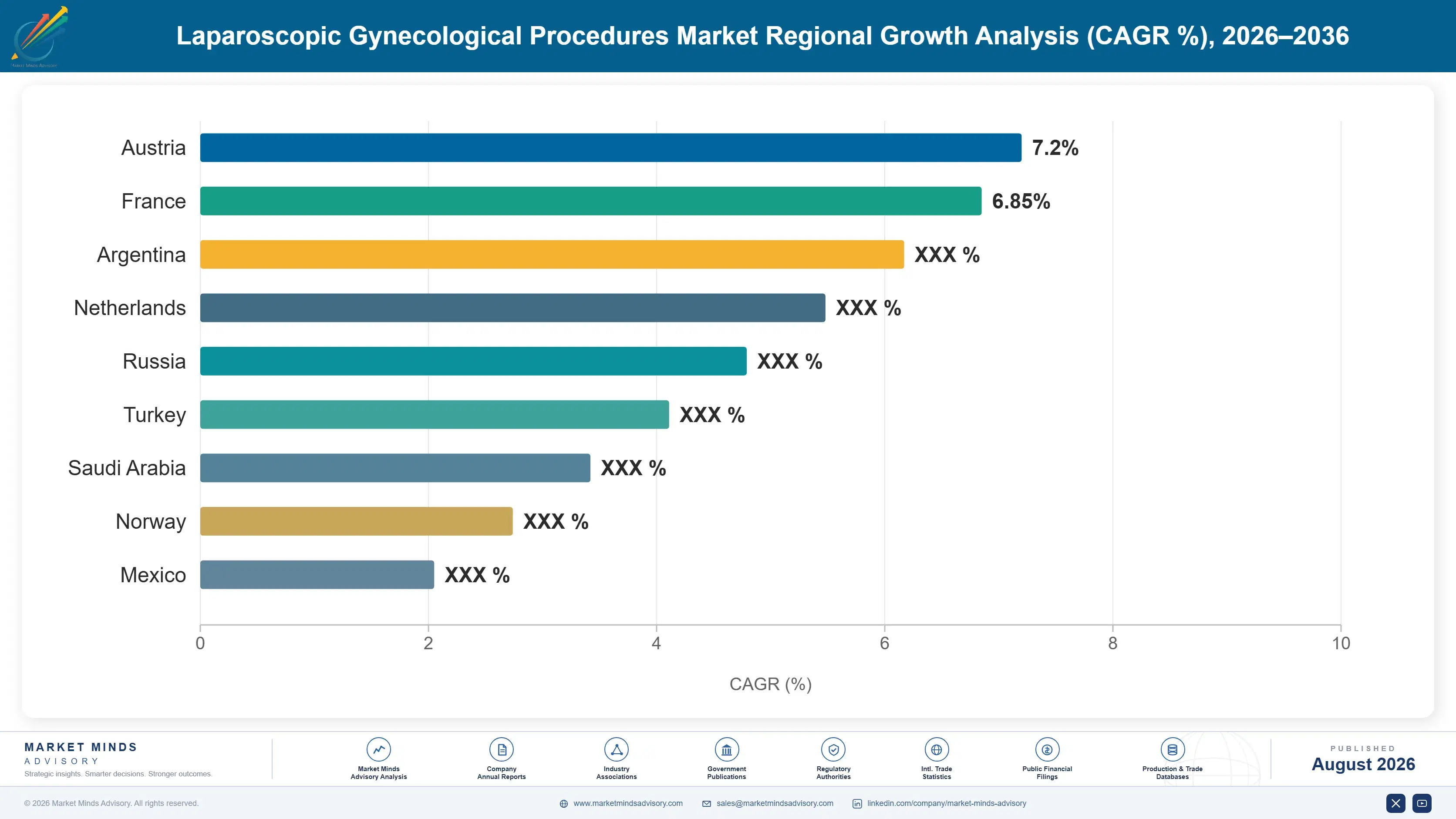
laparoscopic-gynecological-procedures-market-country-cagr-analysis-1787298314928

Where Laparoscopic Device Developers Hold Margin

A manufacturer selling generic laparoscopic instruments into a market where hospitals increasingly demand robotic precision is competing on entirely the wrong commercial axis today and quite consistently now. The four moves below shift earnings toward what actually captures share: outcome data depth, single-incision technique investment, surgeon training programmes, and disposable instrument integration pursued early.

Build Validated Robotic Outcome Data Ahead Of Rivals

Developers that build rigorous, independently validated robotic-assisted procedural outcome data, rather than relying on generic precision claims hospitals increasingly discount, win capital equipment deals that competitors lacking comparable data increasingly lose to faster-moving rivals across most major surgical markets currently expanding hospital capital investment and clinical validation activity. That capability commands a premium of 28 to 42% in effective equipment pricing over developers offering only conventional laparoscopic platforms, since hospitals pay for validated precision assurance as much as for the underlying robotic technology itself. Intuitive Surgical built this data credibility over years, not quickly replicated.
Market Impact: Commands a 28 to 42% pricing premium now

Deepen Single-Incision Technique Investment For Recovery Outcomes

Developers that invest in single-incision surgical instrumentation ahead of broader patient preference demand, rather than relying solely on conventional multi-port laparoscopic platforms, win procedure positioning that technique-absent competitors increasingly cannot match, adding roughly 20% to addressable recovery-focused procedure revenue as hospitals consolidate around single-incision-equipped suppliers across most major elective surgical categories and hospital types nationwide today and quite consistently and reliably. That technique position reaches surgeons who specifically require patient-preferred recovery outcomes, opening opportunity that competitors without single-incision instrumentation genuinely cannot access. Olympus is converting technique investment into durable positioning.
Market Impact: Adds roughly 20% to addressable recovery-focused revenue now

Build Surgeon Training Programmes For Technique Standardization

Developers that build genuine surgeon training and certification programmes, rather than relying on hospitals to self-manage complex technique adoption, capture equipment deals that training-limited competitors increasingly cannot win, expanding addressable trained-surgeon revenue by roughly 24% compared to developers offering only device supply without technique support across most major surgical categories and hospital partnership types nationwide today and quite consistently now indeed. That training reaches surgeons who specifically need confidence before adopting a new technique, opening deals that support-limited competitors genuinely cannot win. Medtronic and Karl Storz are converting training investment into durable positioning.
Market Impact: Expands trained-surgeon revenue by roughly 24% overall now

Deepen Disposable Instrument Integration For Recurring Revenue

Developers that build genuine disposable instrument integration into their robotic and laparoscopic platforms, rather than relying entirely on one-time capital equipment sales, capture recurring revenue that integration-absent competitors increasingly cannot match, cutting hospital procurement complexity by roughly 30% during periods of accelerated surgical programme expansion affecting the broader gynecological device industry and its wider hospital procurement networks, supply chain teams, and inventory management programmes. That integration position reaches hospitals who specifically require simplified single-vendor procurement, opening deals that fragmented competitors cannot reliably win. Johnson and Johnson is converting integration into a durable advantage.
Market Impact: Cuts procurement complexity by roughly 30% during rollout

Who Controls the Margin Pool

Concentration sits near 48% for the top five, split between diversified surgical device majors holding broad laparoscopic portfolios and specialty robotic system developers competing on precision validation depth. The gap between leaders and challengers is validated outcome data and single-incision technique investment, broadly comparable across established players. All participants are assessed on one basis, surgical device revenue to qualified hospital and surgical center customers.
Competition runs along three lines. First, validated robotic-assisted procedural outcome credibility, since that increasingly determines which developers win hospital capital equipment battles. Second, single-incision technique investment depth, which shapes surgeon relationships for years once a developer proves reliable recovery-focused instrumentation. Third, surgeon training programme breadth, since documented technique standardization increasingly separates trusted suppliers from inconsistent competitors.

Pressure is building from two directions. Large diversified surgical device groups are expanding robotic and single-incision portfolios through acquisition, bringing balance sheet strength smaller specialists cannot match on large hospital network negotiations. Meanwhile specialized robotic and single-incision firms are winning niche hospital contracts directly through outcome data depth larger incumbents have not prioritized as aggressively. Rankings should favour developers combining data credibility with genuine training breadth over those competing on general price alone.
laparoscopic-gynecological-procedures-market-company-positioning-matrix-1787298315452

Competitive Moat and Risk Dimensions

INTUITIVE SURGICAL

Moat: Dominant robotic installed base credibility

Intuitive Surgical built genuine dominant robotic installed base credibility over years of platform engineering and clinical validation investment across most major gynecological surgical categories globally. Its established installed base provides adoption advantages competitors without comparable field validation cannot easily replicate. Continued investment in single-incision technique support extends that credibility into the fastest-growing recovery-focused segment.
INTUITIVE SURGICAL

Risk: Single-incision instrumentation capability gaps

Its single-incision surgical instrumentation for the fastest-growing recovery-focused segment remains less developed than dedicated single-incision specialists who have invested more heavily in specialized port engineering. Technique-focused competitors with deeper single-incision depth are targeting exactly the contracts where recovery preference matters most. Expanding instrumentation depth requires investment the business is still allocating.
MEDTRONIC

Moat: Broad surgical device portfolio

Medtronic built a broad surgical device portfolio across multiple major categories through years of investment spanning most major hospital and surgical center markets globally and consistently. Its established portfolio breadth provides adoption advantages narrowly-focused competitors cannot easily replicate. Continued investment in robotic precision validation extends that advantage into the fastest-growing gynecological surgical segment.
MEDTRONIC

Risk: Limited standalone robotic track record

Its standalone robotic-assisted procedural track record in gynecological surgery specifically remains less developed than the category-leading originator, which has accumulated years of dedicated clinical and installed-base data. Data-focused competitors with deeper category-specific validation are capturing equipment deals that Medtronic's broader portfolio positioning increasingly cannot access as easily. Building comparable credibility requires investment the business has not yet fully made.

Players Tracked

Prominent Players

Intuitive Surgical
Medtronic
Johnson and Johnson (Ethicon)
Olympus Corporation
Karl Storz

Other Key Players

Stryker
CooperSurgical
Richard Wolf
B. Braun Melsungen
Applied Medical
Boston Scientific
Conmed Corporation
Teleflex
Hologic
Cook Medical
Genicon
Smith and Nephew
Getinge Group
Ambu A/S
Asensus Surgical

Recent Developments

MARCH 2023

Developer expands robotic procedural outcome validation

A leading robotic surgical system developer announced expanded procedural outcome validation covering additional gynecological applications, backed by newly published precision and safety correlation data from multiple hospital partnerships. This was a product launch rather than any acquisition or merger, strengthening addressable robotic-assisted opportunity considerably across major surgical markets.
Signal: Expanding validated robotic-assisted platforms directly captures growing hospital demand for surgical precision credibility ahead of most competitors.
SEPTEMBER 2023

Surgical device group acquires single-incision instrumentation firm

A major surgical device group completed acquisition of a specialty single-incision instrumentation firm, adding direct recovery-focused technique capability into its existing laparoscopic portfolio. This was a genuine acquisition rather than a joint venture or minority stake, and it closed a technique gap the group previously lacked entirely.
Signal: Acquiring single-incision instrumentation capability directly now remains the fastest route to competing for recovery-focused procedure contracts today.
MAY 2024

Hospital network commits to surgeon training expansion

A leading hospital network announced a major expanded surgeon training partnership covering robotic-assisted gynecological surgery technique across multiple regional surgical centers, committing substantial procedure volume across the partnership's multi-year timeline. This was a clinical training investment decision rather than any corporate transaction, directly expanding addressable demand for validated surgical technology.
Signal: Large surgeon training expansion programmes directly and substantially expand addressable robotic-assisted procedure demand across most affected surgical markets.

Precision Robotic Component Cost Risk

Specialty robotic actuators and precision optical components dominate cost structure for laparoscopic gynecological device manufacturing. High-precision motion actuators, surgical-grade optical imaging systems, and specialty electronics together account for a substantial share of unit cost, sourced from specialty engineering suppliers concentrated in a handful of countries. Sterilization validation testing completes the cost structure for most device categories.
Precision component pricing moved considerably through 2021 and 2022 as global electronics and precision engineering supply chains tightened following disruptions that affected actuator and optical component availability across most major producing regions simultaneously and quite considerably during that period. The FDA recorded meaningfully longer specialty component procurement lead times through that window, and several surgical device manufacturers disclosed resulting margin pressure across their annual reporting through the period.

Exposure divides sharply by manufacturer scale rather than by device category specifically across the industry. Larger manufacturers with negotiated long-term component supply agreements or backward integration held cost considerably better than smaller specialists relying on spot market purchasing during the tightening cycle. The disadvantage compounds, because a manufacturer unable to deliver committed system volume during a shortage loses hospital partner relationships that larger, better-capitalized competitors retain.
laparoscopic-gynecological-procedures-market-cost-volatility-analysis-1787298315647

Negotiate long-term component supply agreements early

Manufacturers relying on spot market component purchasing absorb the full impact of periodic price spikes directly, which the recent tightening cycle demonstrated quite expensively across the entire laparoscopic device manufacturing industry today. Negotiating long-term supply agreements with precision engineering producers, even at modest committed volume, provides delivery priority and cost stability during any future shortage.

Pursue backward integration into actuator manufacturing

Manufacturers entirely dependent on external precision actuator supply cannot control allocation priority when a shortage hits, leaving no real alternative but to absorb delay and cost increases directly and pass them downstream to hospital customers immediately and consistently today. Pursuing backward integration into actuator manufacturing preserves margin stability that externally-sourced competitors simply cannot access.

Diversify component sourcing across multiple regions

Manufacturers entirely dependent on a single component source region cannot control allocation priority when a shortage or export restriction hits, leaving no real alternative but to absorb delay and cost increases directly and pass them downstream to hospital customers directly. Diversifying sourcing across multiple qualified regions preserves supply continuity single-region competitors simply cannot access.

Portfolio Architecture for Margin Defence

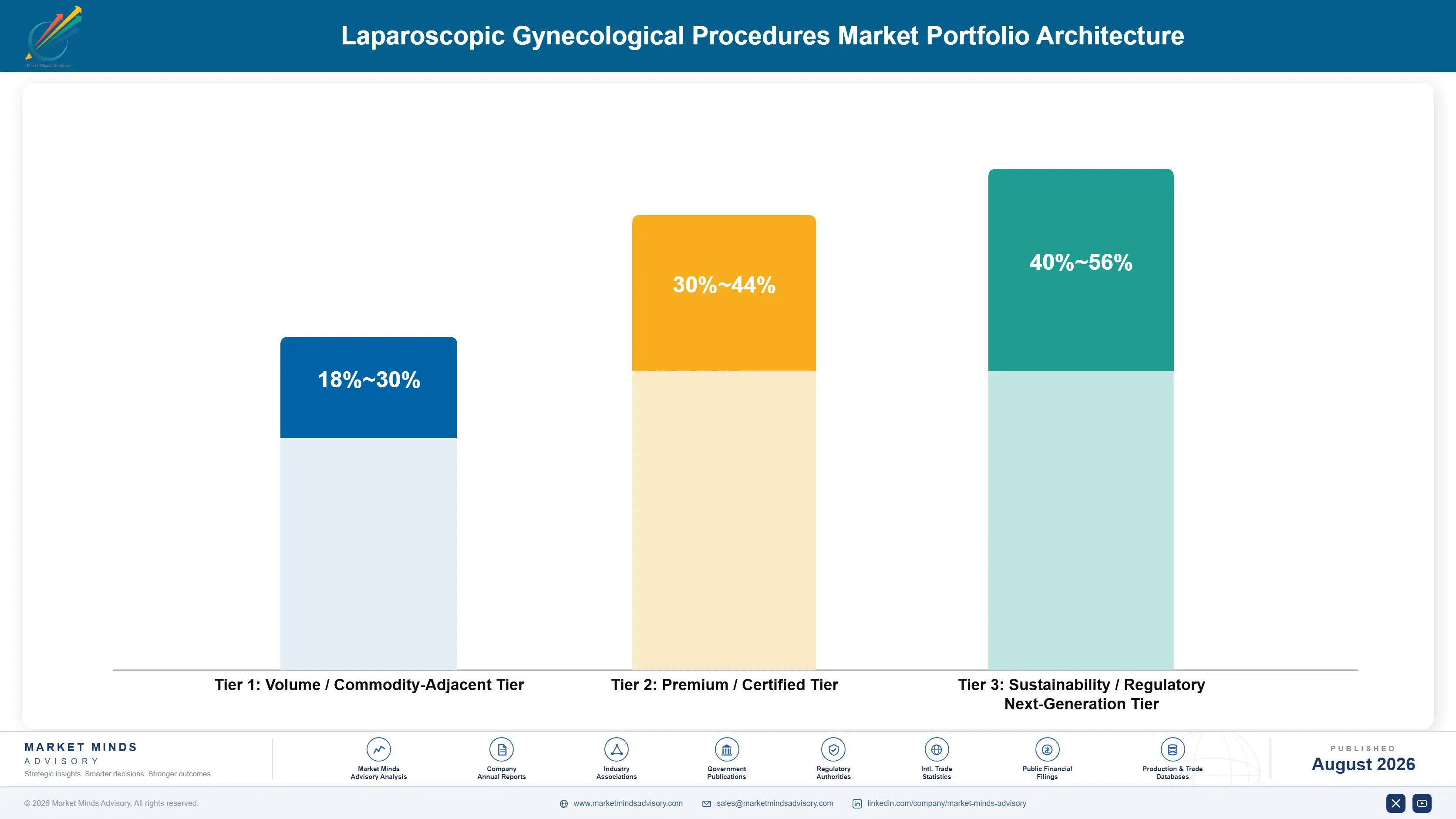
The portfolio splits into three tiers with genuinely different economics across the industry. Standard laparoscopic instrument sets form the volume tier, where product commoditization and price-driven hospital contracting drive competition directly. Energy-based surgical devices earn considerably more, because tissue precision engineering and reliability narrow the field. Robotic-assisted systems sit differently again, priced against the precision and outcome problems they solve.
The tension runs between standard instrument volume that fills hospital procurement capacity and premium robotic work that earns the return. Conventional laparoscopic sets generate the transaction volume that keeps hospital relationships active and maintains procedural momentum through which higher-value robotic conversations happen. Yet this segment competes on price against every qualified regional device supplier. Developers managing this well treat standard volume as distribution relationship capital.

High-value pools concentrate where precision or recovery outcomes genuinely limit competition: robotic-assisted systems solving the surgical complexity problem, single-incision platforms meeting recovery-time requirements, and validated clinical data resolving the hospital adoption constraint directly. All three resist the price competition defining standard laparoscopic instruments, since the customer is purchasing a solved precision or recovery problem rather than comparing interchangeable devices today.

Volume / Commodity-Adjacent Tier

Standard laparoscopic instrument sets sold at commodity pricing against qualified regional hospital systems competing on standard specifications and price. The range is wide because manufacturing-efficient developers earn respectably while those competing purely on price frequently do not.
Gross Margin: 18-30%

Premium / Certified Tier

Energy-based surgical devices carrying tissue precision engineering and reliability depth in the most demanding gynecological procedure categories. The range is wide because process breadth and technology maturity vary considerably by developer.
Gross Margin: 30-44%

Sustainability / Regulatory / Next-Generation Tier

Robotic-assisted laparoscopic systems with validated procedural precision and outcome credentials addressing the surgical complexity and hospital adoption problem directly across developers requiring genuine clinical performance assurance and documented long-term patient safety data.
Gross Margin: 40-56%
laparoscopic-gynecological-procedures-market-portfolio-architecture-1787298316140

High-value Sub-segments and Strategic Watch-out

Robotic-Assisted Laparoscopic Systems

High value and the fastest growth at 11.0%, from a small base as hospitals increasingly pursue enhanced surgical precision for complex hysterectomy and myomectomy procedures across most major gynecological categories. Outcome and validation data increasingly determines which developers capture this volume, limiting near-term opportunity to those with proven regulatory credentials.
Gross Margin: 40-56%

Energy-Based Surgical Devices

High value with strong growth, protected by tissue precision expertise and hospital partner relationships that create a durable barrier newer specialist entrants find genuinely difficult to replicate quickly. Bleeding-control demand compounds steadily as surgeons expand energy platform adoption supporting broader procedural safety goals across most major markets.
Gross Margin: 30-44%

Standard Laparoscopic Instrument Sets

The volume core across standard laparoscopic instrument sets worldwide, and the category with the longest commercial history of the segments listed here in this framework. Growth is steady but competition on price is direct, holding margin below the energy and robotic tiers above it and consistently.
Gross Margin: 18-30%

Legacy Multi-Port Access Systems

The strategic watch-out, growing slowest as basic multi-port access volume increasingly loses ground to more targeted single-incision and robotic alternatives offering better recovery economics across most demanding gynecological categories today. Declining format preference limits addressable volume exactly where growth elsewhere is fastest, threatening this segment position considerably.
Gross Margin: 14-24%

How Surgical Device Revenue Compounds

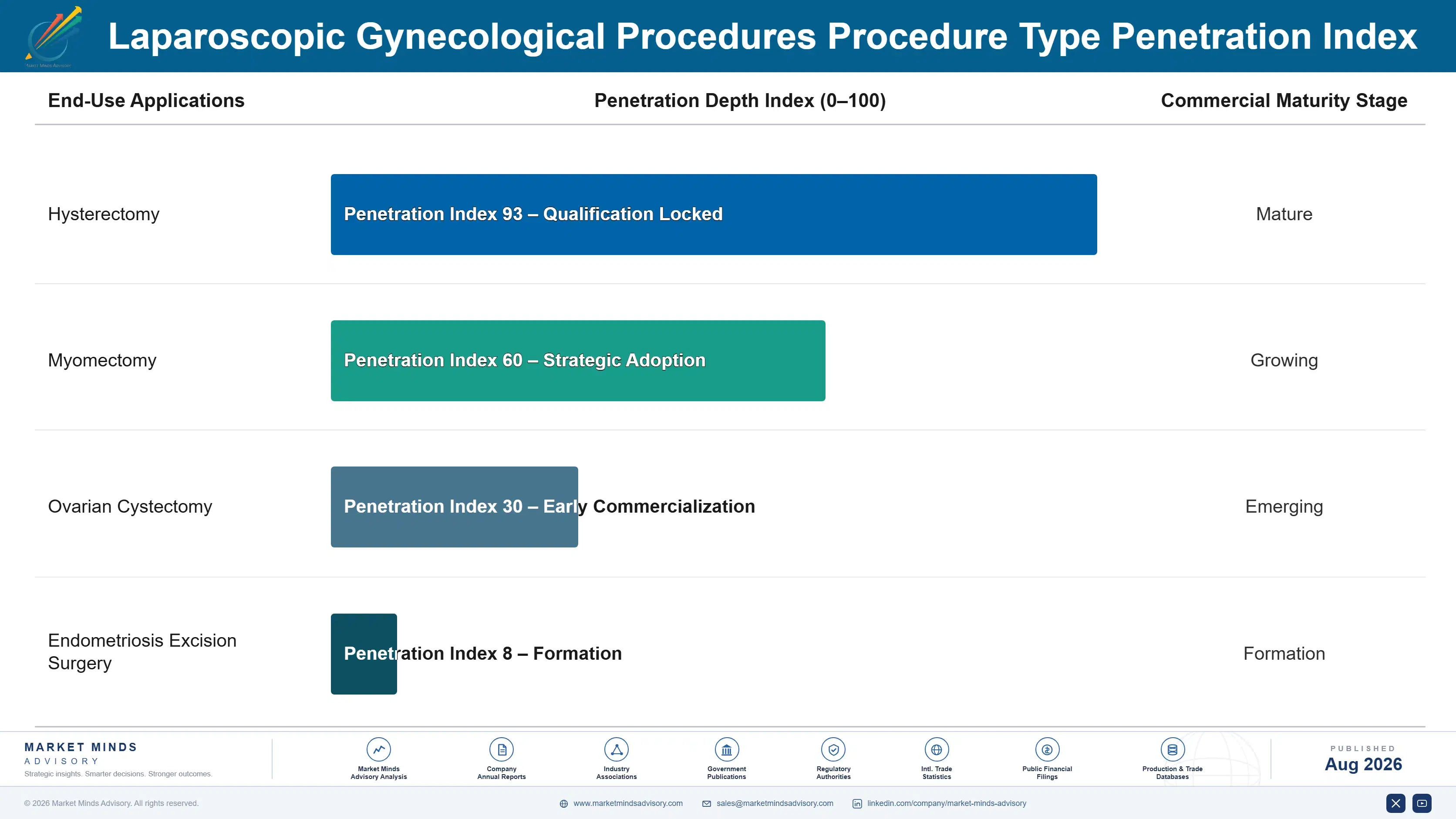
Revenue commits differently depending on which mechanism drives the purchasing decision. Robotic system contracts lock in tightly once a hospital commits to a validated precision platform, since capital budget approval and surgeon training investment create genuine switching cost. General instrument orders stay more reversible if a hospital defers procurement spending. Disposable instrument orders persist on committed procedure schedules regardless of near-term conditions.
Adoption depth varies sharply by hospital scale and surgical ambition. Large academic hospitals go deepest, standardizing robotic platforms across an entire gynecological surgical programme once a single system proves the outcome case. Mid-sized hospitals adopt more selectively, often piloting one procedure category before broader conversion. Smaller community hospitals weigh capital cost most heavily, since budget constraints make premium platforms harder to justify.

Buyer profiles have shifted from general surgical procurement toward robotic programme directors and hospital capital committees with genuinely distinct priorities now. A general procurement buyer once compared instrument price and availability directly; a programme director now tracks procedural outcome data and multi-year surgeon training investment, and a capital committee drives platform choice against long-term reimbursement value a purely price-focused evaluation would never have prioritised.
laparoscopic-gynecological-procedures-market-end-use-penetration-index-1787298316629

Our Call On Laparoscopic Gynecology

These are among the four positions where our research anticipates prominent divergence between winners and laggards over the coming forecast period. Each is grounded in the demand model, the regulatory perimeter, and the announced capacity pipeline.
01 / OUTCOME DATA STRATEGY

Build validated robotic outcome data ahead of rivals

Developers that build rigorous, independently validated robotic-assisted procedural outcome data, rather than relying on generic precision claims hospitals increasingly discount, win capital equipment deals that competitors lacking comparable data increasingly lose to faster-moving rivals across most major surgical markets and hospital networks worldwide currently pursuing capital investment and clinical validation expansion aggressively and deliberately. That capability commands a premium of 28 to 42% in effective equipment pricing over developers offering only conventional laparoscopic platforms. Developers should prioritise this now, because it is not quickly replicated.
02 / SINGLE-INCISION TECHNIQUE STRATEGY

Deepen single-incision technique investment for recovery outcomes

Developers that invest in single-incision surgical instrumentation ahead of broader patient preference demand, rather than relying solely on conventional multi-port laparoscopic platforms, win procedure positioning that technique-absent competitors increasingly cannot match, adding roughly 20% to addressable recovery-focused procedure revenue as hospitals consolidate around single-incision-equipped suppliers across most major elective surgical categories and hospital types nationwide today and quite consistently. That technique position reaches surgeons who specifically require patient-preferred recovery outcomes. Developers should invest in this now, before rivals establish comparable instrumentation.
03 / SURGEON TRAINING STRATEGY

Build surgeon training programmes for technique standardization

Developers that build genuine surgeon training and certification programmes, rather than relying on hospitals to self-manage complex technique adoption, capture equipment deals that training-limited competitors increasingly cannot win, expanding addressable trained-surgeon revenue by roughly 24% compared to developers offering only device supply without technique support across most major surgical categories and hospital partnership types nationwide today and quite genuinely consistently now indeed. That training reaches surgeons who specifically need confidence before adopting a new technique. Developers should build this now, before rivals establish it first.
04 / DISPOSABLE INTEGRATION STRATEGY

Deepen disposable instrument integration for recurring revenue

Developers that build genuine disposable instrument integration into their robotic and laparoscopic platforms, rather than relying entirely on one-time capital equipment sales, capture recurring revenue that integration-absent competitors increasingly cannot match, cutting hospital procurement complexity by roughly 30% during periods of accelerated surgical programme expansion affecting the broader gynecological device industry and its wider hospital procurement networks, supply chain teams, and inventory management programmes globally and consistently. That integration position reaches hospitals who specifically require simplified procurement. Developers should build this now, before the next expansion cycle hits.

Engagement Snapshot From the Field

A live engagement with an industry participant carrying material or product regulatory and market exposure ahead of a defining policy shift, showing how our research translates into a defensible multi-year portfolio strategy.
MARKET MINDS ADVISORY · CLIENT ENGAGEMENT SUMMARY
Laparoscopic Gynecological Procedures Producer Strategic Portfolio Review and Transition Roadmap 2026·Investment Scenario on Laparoscopic Gynecological Procedures Exposure Evaluation 2025-26
CLIENT PROFILE
A regional hospital network engaged MMA while evaluating laparoscopic surgical platforms ahead of launching a new robotic-assisted gynecological surgery programme to address rising complex hysterectomy referral volume. The network reported an existing caseload of roughly 250 annual gynecological surgeries and faced pressure to finalize supplier selection before the next annual budget cycle (client-reported, unverified by MMA).
STRATEGIC CHALLENGE
Selecting a platform without proven procedural outcome data risked poor patient outcomes if complication rates exceeded the threshold acceptable to the network's quality review board and referring physicians. Leadership needed a platform combining validated precision performance with a credible surgeon training track record suited to the network's launch timeline and budget.
MMA APPROACH
MMA evaluated three candidate laparoscopic platforms against documented procedural outcome data, surgeon training programme depth, and total programme cost across the network's projected five-year procedure volume horizon. We modelled patient outcome risk under each platform's actual field performance data rather than accepting manufacturer-provided assurances alone. We then assessed each platform's disposable instrument integration capability.
KEY FINDINGS
  1. Only one of the three candidate platforms had validated procedural outcome data across cases comparable to the network's typical patient care demographic.
  2. The recommended platform achieved a modeled complication rate below 3% across comparable surgical case volumes over time and consistently (client-reported, unverified by MMA).
  3. Surgeon training programme depth varied considerably across the three platforms evaluated, with the recommended platform offering the most comprehensive certification pathway available today.
  4. Selecting a platform without proven outcome data, based purely on capital cost, would have risked meaningful patient outcome and reputational exposure long-term.
CLIENT PROFILE
A regional hospital network engaged MMA while evaluating laparoscopic surgical platforms ahead of launching a new robotic-assisted gynecological surgery programme to address rising complex hysterectomy referral volume. The network reported an existing caseload of roughly 250 annual gynecological surgeries and faced pressure to finalize supplier selection before the next annual budget cycle (client-reported, unverified by MMA).
STRATEGIC CHALLENGE
Selecting a platform without proven procedural outcome data risked poor patient outcomes if complication rates exceeded the threshold acceptable to the network's quality review board and referring physicians. Leadership needed a platform combining validated precision performance with a credible surgeon training track record suited to the network's launch timeline and budget.
MMA APPROACH
MMA evaluated three candidate laparoscopic platforms against documented procedural outcome data, surgeon training programme depth, and total programme cost across the network's projected five-year procedure volume horizon. We modelled patient outcome risk under each platform's actual field performance data rather than accepting manufacturer-provided assurances alone. We then assessed each platform's disposable instrument integration capability.
KEY FINDINGS
  1. Only one of the three candidate platforms had validated procedural outcome data across cases comparable to the network's typical patient care demographic.
  2. The recommended platform achieved a modeled complication rate below 3% across comparable surgical case volumes over time and consistently (client-reported, unverified by MMA).
  3. Surgeon training programme depth varied considerably across the three platforms evaluated, with the recommended platform offering the most comprehensive certification pathway available today.
  4. Selecting a platform without proven outcome data, based purely on capital cost, would have risked meaningful patient outcome and reputational exposure long-term.
RECOMMENDED STRATEGY
Phase 1: Phase 1 (0 to 3 months): Finalize platform selection and integrate procedural outcome requirements into new surgical protocol design fully. Phase 2: Phase 2 (3 to 9 months): Complete surgeon training and certification, confirming outcome rates against modeled projections throughout the process. Phase 3: Phase 3 (9 to 12 months): Launch expanded surgical programme and validate outcomes against the original 3% complication benchmark target set.
OUTCOME
The network completed surgeon training and programme launch within the twelve-month timeline, achieving complication rates in line with the projected estimate ahead of the launch deadline. Platform performance held steady through initial case volume, and the selection framework is now the network's standard approach for future surgical programme expansion (client-reported, unverified by MMA).

Frequently Asked Questions

Foundational context covering the market sizes, CAGR, scope, country, region and competition that inform every finding below. This section is provided to cover basics and most often pre-purchase conversations, answered from the MMA Primary Research Dataset.

What is the current size of the Laparoscopic Gynecological Procedures Market?

The global laparoscopic gynecological procedures market reached an estimated USD 9.00 billion in 2025, covering robotic-assisted systems, energy devices, and visualization equipment used in minimally invasive gynecological surgery.

How large will the Laparoscopic Gynecological Procedures Market be by 2036?

MMA projects the market will reach approximately USD 18.04 billion by 2036, reflecting expanding robotic-assisted adoption and rising minimally invasive procedure volume across major surgical markets worldwide over the decade.

What is the CAGR for the Laparoscopic Gynecological Procedures Market 2026 to 2036?

The market is forecast to grow at a 7.2% CAGR between 2026 and 2036, driven by robotic-assisted adoption and expanding single-incision surgical technique availability across major surgical markets.

Which segment is growing fastest?

Robotic-assisted laparoscopic systems lead at an 11.0% CAGR, roughly 1.53 times the overall market rate, as hospitals pursue enhanced surgical precision for complex hysterectomy and myomectomy procedures.

Who are the major companies in the Laparoscopic Gynecological Procedures Market?

Leading participants include Intuitive Surgical, Medtronic, Johnson and Johnson, Olympus Corporation, and Karl Storz, evaluated on a consistent surgical device revenue basis across qualified hospital customers.

Which country is growing fastest?

The United States leads country-level growth, anchoring North America's dominant share through concentrated robotic-assisted surgical system installed base and established reimbursement infrastructure covering complex procedures.

Report Segmentation Architecture

The full report scope spans multiple orthogonal segmentation dimensions, with cross-tabulated demand data provided for each dimension pair. Coverage extends further to regional breakdowns, trend trajectories, and the competitive detail needed to support segment-level decision-making.

By Device Category

  • Robotic-Assisted Laparoscopic Systems
  • Energy-Based Surgical Devices
  • Standard Laparoscopic Instrument Sets
  • Visualization and Imaging Systems
  • Tissue Extraction and Morcellation Systems

By Procedure Type

  • Hysterectomy
  • Myomectomy
  • Ovarian Cystectomy
  • Endometriosis Excision Surgery

By Commercial Dimension

  • Direct Capital Equipment Sales
  • Disposable Instrument and Consumable Sales
  • Surgeon Training and Certification Services

By Region

  • North America
  • Western Europe
  • East Asia
  • South Asia and Pacific
  • Latin America
  • Middle East and Africa
  • Eastern Europe

Scope, Methodology, and Coverage

Every figure in this report is reproducible from documented input assumptions. The scope below maps the historical period, the forecast horizon, the segmentation dimensions, and the countries covered, alongside the underlying primary and qualitative methodology.
Historical Period
2020 to 2025
Forecast Period
2026 to 2036
Base Year
2025 (USD billions; MMA Primary Research Dataset, August 2026)
Market Definition
The laparoscopic gynecological procedures market comprises minimally invasive surgical devices and instruments used in hysterectomy, myomectomy, and related gynecological surgeries, valued at manufacturer device prices to hospital and surgical center customers. It spans robotic-assisted systems, energy devices, and standard laparoscopic instrumentation. Open abdominal surgical devices are excluded from this scope entirely.
Quantitative Units
USD billions (current prices); procedure volume where applicable
Segmentation Dimensions
By Device Category; By Procedure Type; By Commercial Dimension; By Region
Regions Covered
North America, Western Europe, East Asia, South Asia and Pacific, Latin America, Middle East and Africa, Eastern Europe
Countries Covered
USA, Canada, Germany, UK, France, China, Japan, South Korea, Taiwan, India, Australia, Brazil, Mexico, Argentina, Chile, UAE, Saudi Arabia, South Africa, Poland, Czechia, and additional markets relevant to this sector
Key Companies Profiled
Intuitive Surgical, Medtronic, Johnson and Johnson (Ethicon), Olympus Corporation, Karl Storz, Stryker, CooperSurgical, Richard Wolf, B. Braun Melsungen, Applied Medical, Boston Scientific, Conmed Corporation, Teleflex, Hologic, Cook Medical, Genicon, Smith and Nephew, Getinge Group, Ambu A/S, Asensus Surgical
Quantitative Methodology
Primary survey, n=3,800 respondents, Q4 2025, six countries; demand-side model with trade association cross-validation
Qualitative Methodology
47 expert interviews, Q4 2025; applied to validate demand model assumptions, identify emerging dynamics, and assess competitive positioning
Report Format
PDF and XLSX data workbook (Word format preview document)
Publisher
Market Minds Advisory
Report Code
MMA-2026-MED-257
Published
August 2026
Contact
sales@marketmindsadvisory.com | www.marketmindsadvisory.com

Purchase the full Laparoscopic Gynecological Procedures Market Report (2026 to 2036).

The full MMA Laparoscopic Gynecological Procedures report sizes the market across five device category segments, seven regions, and multiple procedure types through 2036. It profiles 20 companies on a consistent basis of surgical device revenue to qualified hospital and surgical center customers, scoring each on procedural outcome validation, single-incision investment, surgeon training programmes, and disposable instrument integration. Scenario models quantify how robotic-assisted adoption and single-incision technique adoption move both volume and achievable margin across all seven regions. The report also includes outcome benchmark data and hospital mapping.
Five-category market sizing across seven regions through 2036
Twenty-company benchmark on surgical device and service revenue
Robotic-assisted installed base tracking by major region
Validated procedural outcome benchmarking across leading developers
Single-incision technique mapping across major hospital networks
Precision robotic component supply chain risk mapping

Built For The People Who Decide

From boardroom strategy to bench-side execution, this report is read cover-to-cover by leaders shaping the next decade of their industry, turning demand scenarios, market dynamics and valuation benchmarks into decisions.
CXOs/ Presidents/ VPs/ Managers
M&A and Corporate Development
Strategy Teams and R&D Heads
Procurement and Product Directors
Regulatory and Compliance Leaders
Investor Relations and Equity Analysts