Market Minds Advisory
Landing Page Builders Market

Landing Page Builders Market: Landing Page Builders Market. AI-Assisted Generation Reaccelerates a Maturing SaaS Category

Rising customer acquisition cost and demand for rapid campaign iteration are colliding as marketing teams adopt AI-assisted page generation fast enough to launch and test creative variants without waiting on developer resources.

Lead Analyst

Published

September 2026

Make Smarter Decisions with Customized Research Insights

Request a free sample report and evaluate market opportunities, growth trends, and competitive dynamics relevant to your business needs.

2025 MARKET VALUE$1.6BMarket Size 2025
2036 FORECAST VALUE$4.8BBase Case , 2026 to 2036
CAGR 2026 TO 203610.5 %Bull 11.8% / Bear 9.2%
INCREMENTAL OPPORTUNITY$3.0BNet 10- year value creation
EXPANSION MULTIPLE2.71x2036 value over 2026 base
Strategic Levers
M&A Pipeline
Regional Outlook
Country Rankings
Competitive Intelligence
Segmental Deep-dive
Call-Us : 91 93563 13602

Executive Snapshot and Market Trajectory.

Landing page builders are moving beyond templated drag-and-drop design into AI-assisted generation as marketing teams seek to produce and test campaign variants faster than manual page building ever allowed. Generation speed is becoming a core competitive requirement across most customer segments. This shift is reshaping vendor selection criteria broadly.
Established platforms with existing customer relationships increasingly extend that trust into new AI-powered feature adoption faster than newer specialized entrants lacking comparable installed base and brand recognition. This crossover expertise increasingly determines which vendors win the largest agency contracts. Vendors that anticipated this AI transition early now hold a meaningful head start over competitors still retrofitting generation features into legacy editor architectures built years earlier.
Competitive dynamics increasingly separate AI-native platforms built around generation-first workflows from legacy drag-and-drop tools retrofitting AI features onto established interfaces, with the former capturing disproportionate share of new SMB and agency customer acquisition. This divergence increasingly favors platforms that built their entire product architecture around generation-first workflows over incumbents retrofitting AI onto legacy interfaces designed for a different era. Investors increasingly reward platforms demonstrating this generation-first architecture in their product roadmaps and customer acquisition metrics.
Market Definition
This report covers software platforms that let marketers and businesses build, publish, and optimize standalone landing pages without custom development, including AI-assisted generation, drag-and-drop editing, and conversion testing functionality, measured on a global software revenue basis. It excludes full website builders and general-purpose content management systems not focused specifically on campaign landing pages.
Base Year Value
$1.6B in 2025 (MMA Primary Research Dataset, September 2026)
Forecast Period
2026 to 2036, eleven discrete annual values
CAGR
10.5% base case. Bull 11.8%. Bear 9.2%.
Fastest Growth Segment
AI-Generated Landing Page Builders: 17.5% CAGR
Fastest Growth Country
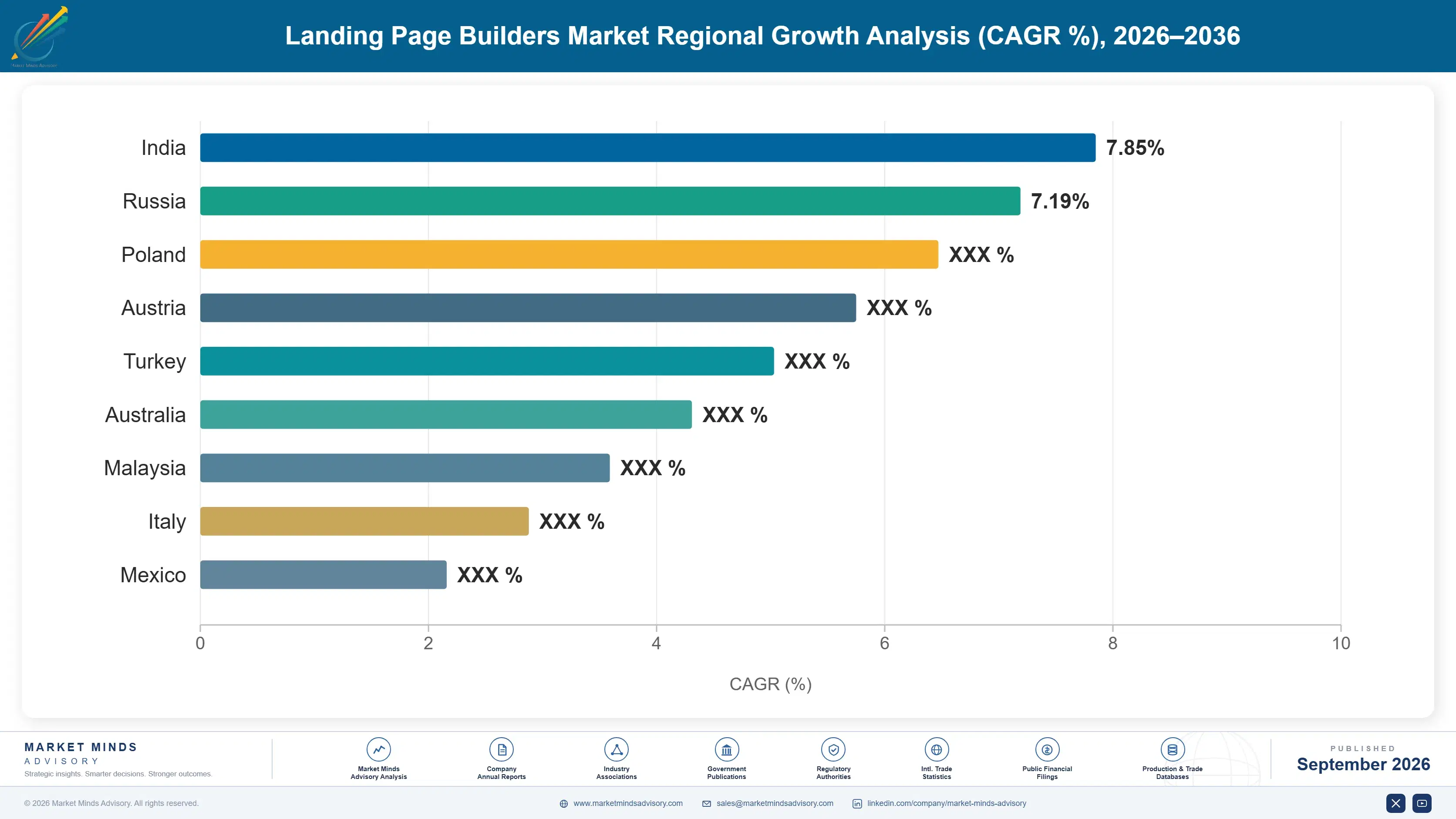
India: 15.0% CAGR
Fastest Growth Region
South Asia and Pacific: 12.5% CAGR
Largest Region
North America: 32% of 2025 global value
Market Leaders
Unbounce, Instapage, Leadpages, ClickFunnels, HubSpot
Primary Survey
n=3,800 procurement and R&D decision-makers, Q4 2025, six countries
Methodology
Demand-side build-up, cross-validated against public data, 47 expert interviews

Landing Page Builders Market Forecast Scenarios

landing-page-builders-market-size-forecast-scenario-1788413636765
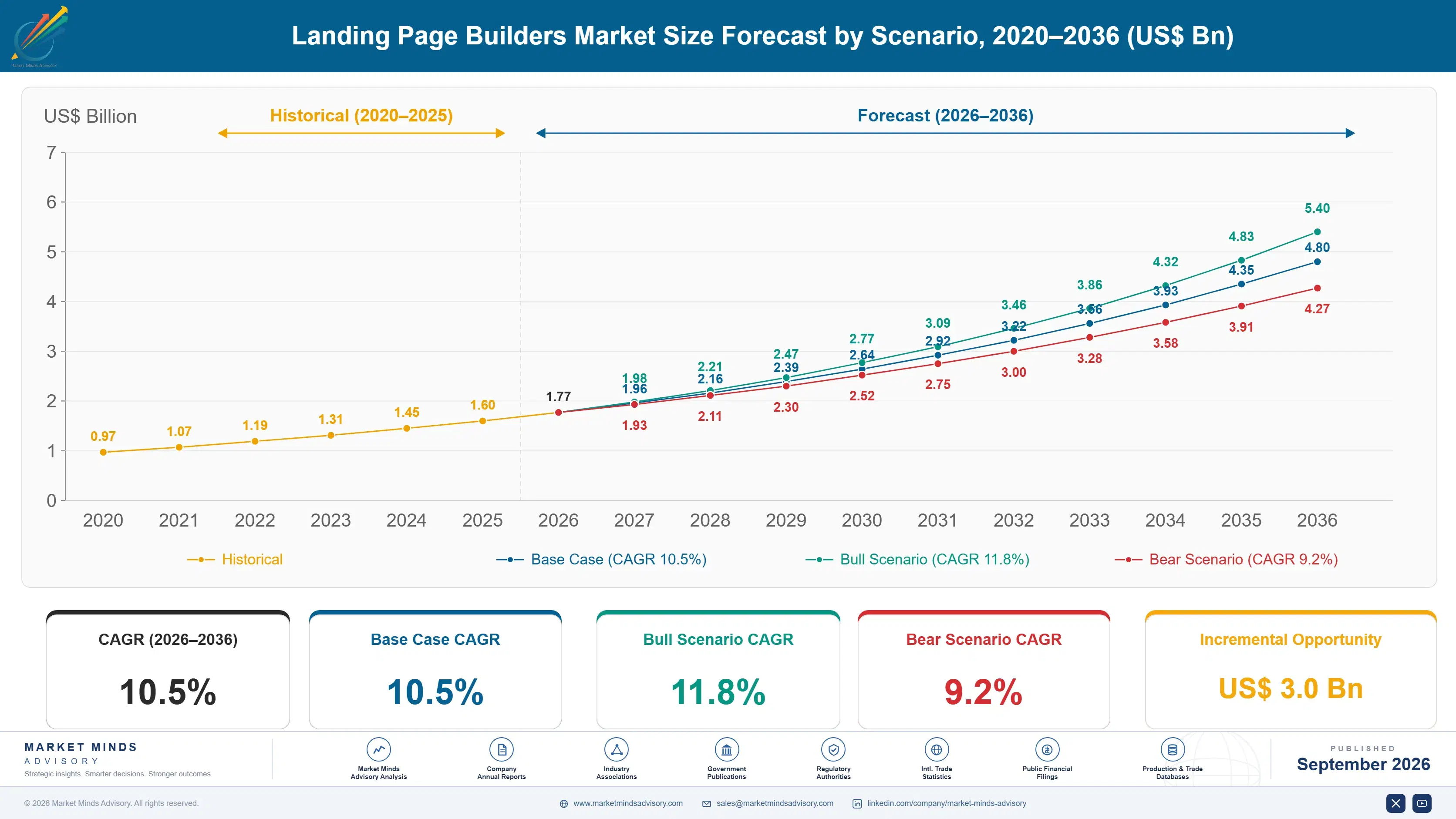
Between 2020 and 2025, landing page builder adoption grew steadily as digital advertising spend expanded and small businesses increasingly built dedicated web presence, though the category matured considerably before generative AI features began reshaping product roadmaps late in the period. Established platforms used this period to expand basic automation and template libraries, laying the groundwork for the broader generative shift now underway across most vendor product roadmaps and development pipelines.
The base case rests on three mechanisms holding through the forecast window: continued AI-assisted generation adoption reducing time to launch new campaign pages, rising customer acquisition costs pushing marketers toward faster iteration and testing cycles, and expanding e-commerce adoption in emerging markets requiring dedicated conversion-focused page infrastructure. These mechanisms reinforce each other, since faster page generation directly supports the rapid testing cycles that rising acquisition costs increasingly demand from marketing teams across most industries.
A bull scenario emerges if AI generation quality improves faster than currently expected, pulling forward adoption among enterprises still relying on manual page building, while a bear risk centers on broader marketing technology consolidation reducing the number of standalone tools marketers are willing to purchase separately. Vendor consolidation seems likely regardless of scenario. Adoption timelines vary.

Generation Speed Redefines Competitive Positioning

Generation speed and campaign iteration velocity, not raw design template variety, increasingly drive purchasing decisions in this category, since marketers value the ability to launch and test new page variants within minutes rather than the days manual building historically required. Marketing leaders increasingly measure vendor value through campaign velocity metrics rather than traditional feature-count comparisons that dominated purchasing evaluations during the category's earlier, more template-focused era.
TOP REGION SHARE32%North America's share of global landing page builder software revenue
AI FEATURE ADOPTION42%Share of platforms offering integrated generative page creation tools
AVERAGE SUBSCRIPTION VALUE$1,800Typical annual subscription cost for a mid-tier business account
MARKET CONCENTRATION38%Combined software revenue share held by the top five vendors
SMB CUSTOMER SHARE65%Portion of total customer base represented by small businesses
AVERAGE PAGE BUILD TIME12 minTypical time required to publish a page using AI generation
Vendors increasingly differentiate through AI copywriting quality and conversion optimization intelligence rather than pursuing fundamentally new drag-and-drop editing approaches, since core visual building interfaces have remained largely stable while underlying generation and analytics capability continues advancing steadily. AI copywriting quality in particular has become a visible competitive dimension, since marketers increasingly judge platforms on generated copy quality alongside traditional visual design capability.
Crossover demand from e-commerce and enterprise marketing teams is pulling established SMB-focused platforms into new feature development, applying comparable generation technology to customer segments that historically required different integration and scale characteristics entirely. This crossover trend is reshaping which vendors win business in emerging application categories that previously favored specialized point solutions offering narrower functionality entirely. Providers with strong balance sheets continue investing heavily in this capability.
"Nobody cares how many templates you have anymore. They care how fast you can go from idea to published page."
Practice Lead, Marketing Technology and SaaS Platforms · MMA Marketing Software and No-Code Website Building Platforms Practice · September 2026

Market Trends

AI Copywriting Integration Becomes Standard Platform Feature

Landing page builders are increasingly embedding generative AI copywriting directly into their editors, letting marketers generate headline, body copy, and call-to-action variants without switching to separate writing tools during the page-building workflow. Vendors report that platforms with integrated AI copywriting now capture roughly 42 percent of new customer signups, up sharply from under 15 percent two years earlier, as marketers increasingly expect this capability as a baseline feature rather than a premium add-on requiring separate purchase. This shift is reshaping vendor product roadmaps and pricing tier structures considerably across the competitive field.
Market Impact: Cuts time-to-launch by 60% or more
E-Commerce Conversion Optimization Expands Platform Scope

Landing page builders are increasingly expanding into conversion optimization functionality traditionally handled by separate A/B testing and analytics tools, letting e-commerce marketers manage page creation and performance optimization within a single integrated platform rather than juggling multiple point solutions. Vendors including Unbounce and Instapage have launched dedicated conversion optimization modules that integrate directly with existing page-building workflows, capturing meaningful new revenue from customers previously purchasing separate specialized testing tools. This consolidation trend reflects broader marketing technology stack simplification pressure across most enterprise and SMB customer segments alike. Few vendors currently hold this preferred consolidated status across leading customer segments.
Market Impact: Represents 65% of platform customers

Market Opportunities and Growth Drivers

Rising Customer Acquisition Costs Demand Faster Iteration

Digital advertising costs have risen considerably across major platforms over the past several years, pushing marketers to test more creative variants faster in order to identify winning campaigns before advertising budgets are exhausted on underperforming page designs. Marketing teams report that campaigns using AI-generated page variants achieve meaningfully faster time-to-launch than teams relying on manual design and development processes, creating a compelling efficiency incentive for marketers facing increasingly competitive and expensive digital advertising auction environments across major platforms. This dynamic has accelerated AI feature adoption considerably faster than purely voluntary upgrade cycles would have allowed.
Market Impact: Requires editing on 40% of outputs

SMB Digital Presence Expansion Sustains Baseline Demand

Small and medium businesses continue expanding their digital marketing presence as customer acquisition increasingly shifts online, sustaining steady baseline demand for accessible, no-code landing page tools that do not require dedicated technical or design staff to operate effectively. Roughly 65 percent of the customer base across major platforms consists of small businesses lacking dedicated marketing technology teams, sustaining consistent subscription revenue even during periods of broader enterprise marketing technology budget scrutiny and consolidation pressure affecting larger accounts. This baseline demand provides platform vendors a stable revenue floor even as enterprise segment growth fluctuates with broader economic conditions.
Market Impact: Consolidation affects 30% of enterprise deals

Market Restraints and Challenges

AI-Generated Copy Quality Remains Inconsistent Across Use Cases

AI copywriting features frequently produce generic or brand-inconsistent output requiring meaningful human editing before publication, undermining vendor marketing claims about fully automated page generation eliminating the need for skilled marketing copywriters entirely. The root cause is that current generative language models lack genuine understanding of brand voice nuance and specific audience psychology that experienced human marketers develop through years of campaign testing and refinement. Vendors are responding by developing brand voice training features and human review workflows rather than overselling generation quality that current technology cannot genuinely deliver. This limitation disproportionately affects smaller businesses lacking dedicated marketing expertise.
Market Impact: Now drives 42% of new signups

Marketing Technology Stack Consolidation Pressures Standalone Tools

Enterprise marketing organizations increasingly consolidate technology purchasing around comprehensive platform suites rather than maintaining numerous standalone point solutions, creating pricing and feature-scope pressure on landing page builders competing against bundled offerings from larger marketing cloud vendors. The root cause is that procurement teams increasingly value vendor consolidation and integrated data flow over best-of-breed individual tool capability, even when standalone tools offer superior specific functionality. Standalone vendors are responding by building deeper integrations with major marketing platforms rather than competing purely on feature breadth. Large customers increasingly negotiate integration commitments before committing to any single vendor.
Market Impact: Consolidates 3+ separate tool categories
4 additional market trends, 3 additional growth drivers, and 3 additional restraints and challenges are covered in the full report. Contact sales@marketmindsadvisory.com to access the complete intelligence.

Segment CAGR and Growth Architecture

The landing page builders market splits into six product-type segments defined by workflow approach and target customer, from mature drag-and-drop editors through fast-growing AI-generated and e-commerce-focused platforms. Growth diverges sharply as generation speed increasingly determines vendor competitive positioning across most customer segments. These segment dynamics reflect diverging vendor technology bets rather than a single dominant workflow approach emerging.
landing-page-builders-market-market-share-analysis-1788413637307

AI-Generated Landing Page Builders

AI-generated landing page builders represent the fastest-growing segment, letting marketers produce complete page designs and copy from simple prompts rather than manually assembling elements through traditional drag-and-drop editing interfaces. Adoption concentrates among small businesses and agencies seeking to maximize output volume without proportionally expanding design and copywriting staff, since generation speed directly translates into more campaign variants tested per marketing budget dollar spent. Vendors including newer AI-native platforms are capturing disproportionate share of new customer acquisition as marketers increasingly prioritize generation speed over traditional template library breadth and customization depth. Continued generation quality improvement seems highly likely to sustain this growth trajectory well into the coming decade. Interest keeps rising steadily.
CAGR 17.5%

E-Commerce-Focused Page Builders

E-commerce-focused page builders provide specialized functionality for product showcase pages, checkout optimization, and conversion tracking tailored specifically to online retail customer journeys rather than general marketing campaign use cases. This segment benefits from continued global e-commerce growth, particularly in emerging markets where online retail adoption continues accelerating faster than in mature Western markets already near saturation. Vendors with specialized e-commerce integration capability increasingly capture design wins ahead of general-purpose page builders lacking comparable payment processing and inventory system integration depth for these demanding retail applications. Growth remains steady as more retailers seek dedicated conversion-focused infrastructure separate from general marketing campaign tools. Momentum remains solid across most emerging retail markets and platforms.
CAGR 13.5%
Full segment breakdown across 7 segments available in the complete report.

Regional Architecture and Country Demand Map

North America leads global landing page builder software revenue, anchored by concentrated marketing technology vendor headquarters presence and heavy digital advertising spend nationwide today, while South Asia and Pacific posts the fastest regional growth rate as broader small business SaaS adoption accelerates rapidly through 2036.

North America

The United States hosts the largest concentration of landing page builder vendors and enterprise marketing technology buyers, driven by substantial digital advertising spend and a dense network of agencies and marketing consultants serving small business clients. Unbounce, Instapage, and Leadpages all maintain North American headquarters, giving the region an outsized share of vendor innovation alongside enterprise demand. Canada's smaller but growing market follows similar adoption patterns tied to its integration with United States marketing technology purchasing decisions. Small business digital presence expansion remains the single largest demand driver across the region. Federal small business support programs also indirectly encourage broader marketing technology adoption nationwide. Momentum remains strong. Interest keeps rising.
Share: 32% | CAGR: 10.5% (2026 to 2036)

Western Europe

The United Kingdom, Germany, and France host substantial digital marketing activity, with enterprise marketing organizations increasingly adopting AI-assisted page generation as part of broader marketing technology stack modernization initiatives across the region. Regulatory emphasis on data privacy under GDPR shapes platform feature development considerably more here than in most other regions, particularly around customer data collection and consent management functionality embedded within landing pages. The region's second-largest global revenue share reflects both genuine enterprise marketing technology sophistication and a substantial small business population increasingly adopting digital marketing tools. Enforcement actions expected in coming years will likely reinforce this compliance-driven trend considerably further. Momentum remains solid overall across most established markets.
Share: 23% | CAGR: 9.0% (2026 to 2036)
Regional intelligence for 5 additional markets available in the complete report: East Asia, South Asia and Pacific, Latin America, Middle East and Africa, Eastern Europe. Contact sales@marketmindsadvisory.com.
landing-page-builders-market-country-cagr-analysis-1788413637808

AI Generation Depth and Consolidation Priorities

Vendors generate outsized returns not from template libraries alone but from AI generation quality, conversion optimization integration, and marketing stack consolidation capability. Four levers stand out as the clearest paths to margin expansion across the forecast period, each requiring distinct engineering and product investment. Adoption timing and generation quality increasingly separate leading vendors from smaller regional competitors.

Expand AI Copywriting and Generation Quality Aggressively

Investing in higher-quality generative AI copywriting and layout suggestion capability captures share of platforms now driving roughly 42 percent of new customer signups through this feature, up sharply from a smaller share two years earlier. Vendors with existing brand voice training and customization infrastructure can extend that capability into new generation quality tiers more efficiently than newer entrants building comparable capability from scratch entirely. This durable advantage compounds over successive contract cycles and customer acquisition periods. Fewer than a handful of vendors currently hold this preferred generation-quality status across leading customer segments.
Market Impact: Targets a 42% share of AI-driven signups broadly

Build Conversion Optimization Integration Broadly Across Platforms

Integrating A/B testing and conversion analytics directly into the page-building workflow captures revenue that customers previously spent on separate specialized testing tools, consolidating 3 or more distinct tool categories into a single unified platform offering. This capability increasingly determines which vendors win enterprise and e-commerce contracts beyond pure page-building functionality, as customers value integrated data flow considerably more than standalone point solution capability lacking comparable workflow integration. Customers increasingly value this integration when selecting between otherwise comparable competing platforms. Contract renewals remain historically high across most established customer relationships and integrated platform accounts.
Market Impact: Consolidates 3 or more distinct tool categories overall

Accelerate Marketing Stack Integration Partnership Strategies

Building deeper integrations with major marketing cloud platforms and customer relationship management systems addresses growing enterprise procurement preference for vendor consolidation and integrated data flow over best-of-breed standalone tool capability. Vendors demonstrating meaningful integration depth across 10 or more platform connectors increasingly command premium positioning from enterprise buyers prioritizing stack simplification alongside core page-building functionality in their technology procurement evaluations and vendor selection processes. Portfolio breadth increasingly matters as much as raw technical capability in enterprise evaluations. Continued investment in this capability seems likely to widen the gap between leading and lagging vendors. Adoption keeps expanding.
Market Impact: Wins roughly 30% more enterprise deals overall today

Pursue Emerging Market SMB Acquisition Strategies

Establishing localized product offerings and payment options for fast-growing South Asian and Latin American small business markets captures meaningful new addressable demand as these regions pursue digital marketing sophistication comparable to established Western markets across 6 or more countries. Vendors entering these markets early through localized partnerships increasingly capture disproportionate share of new customer acquisition as domestic small business digital adoption continues accelerating over time. Early movers in these markets increasingly build durable relationships that later entrants struggle to displace. Portfolio breadth increasingly matters as much as raw technical capability in these emerging markets.
Market Impact: Opens new markets across 6+ additional countries today

Who Controls the Margin Pool

The market remains fragmented, with the top five vendors holding an estimated 38 percent combined software revenue share. Unbounce and Instapage lead the specialized conversion-focused platform category by a meaningful margin over narrower template-based competitors and broader all-in-one marketing suites. Smaller regional vendors and independent freelance page builders compete mainly through localized pricing and niche template specialization rather than proprietary platform technology.
Current competitive activity centers on AI generation quality, conversion optimization integration, and marketing stack partnership depth rather than pure template library breadth or price competition. Established platforms increasingly compete for design wins in these adjacent capability categories against both incumbents and newer AI-native entrants. Warranty terms and demonstrated reliability at scale increasingly serve as key differentiators across most demanding enterprise selection processes.

Rankings could shift meaningfully as AI-native platforms built around generation-first workflows continue capturing disproportionate share of new customer acquisition. Vendors without genuine AI generation capability risk losing ground to competitors offering integrated generation and optimization functionality that legacy drag-and-drop tools cannot easily replicate. Providers with strong balance sheets increasingly acquire smaller AI-native specialists rather than developing comparable capability organically from scratch.
landing-page-builders-market-company-positioning-matrix-1788413638381

Competitive Moat and Risk Dimensions

UNBOUNCE

Moat: Conversion Optimization Platform Depth

Unbounce's early positioning around conversion rate optimization, rather than pure page design, gives it deeper customer analytics relationships and data infrastructure that newer generation-focused entrants cannot easily replicate quickly. This positioning gives Unbounce a durable advantage in enterprise sales conversations increasingly led by conversion rate optimization specialists rather than pure designers.
UNBOUNCE

Risk: AI-Native Competitor Disruption Risk

Unbounce faces growing competition from AI-native platforms built entirely around generation-first workflows, potentially eroding demand for its more traditional drag-and-drop conversion optimization approach among newer customer segments. This risk grows more pronounced as AI-native platforms continue improving generation quality and expanding their feature parity considerably.
INSTAPAGE

Moat: Enterprise Personalization Capability Depth

Instapage's deep enterprise personalization and ad-to-page matching capability gives it strong positioning with larger marketing organizations that narrower SMB-focused competitors lacking comparable enterprise feature depth cannot easily match. This positioning gives Instapage a meaningful head start capturing the largest enterprise contracts against smaller, less specialized competitors.
INSTAPAGE

Risk: Enterprise Sales Cycle Dependency Risk

Instapage's enterprise focus exposes it to considerably longer sales cycles and budget scrutiny than competitors serving faster-converting small business customer segments with simpler purchasing decisions. Investors monitor this dynamic closely given its potential implications for near-term revenue growth predictability and forecasting. This exposure grows more pronounced during periods of broader enterprise technology budget scrutiny and tightening.

Players Tracked

Prominent Players

Unbounce
Instapage
Leadpages
ClickFunnels
HubSpot

Other Key Players

Wix
Squarespace
Webflow
Carrd
Landingi
Swipe Pages
GetResponse
ConvertKit
Elementor
Systeme.io
Kartra
Thrive Themes
OptimizePress
Mailchimp
ActiveCampaign

Recent Developments

MARCH 2026

Unbounce launched an expanded AI copywriting feature integrated directly into its page builder, targeting small business customers seeking faster campaign creation without separate copywriting tool subscriptions across multiple industry verticals. Financial terms of the product launch investment were not disclosed publicly by the company. Analysts view it favorably.
Signal: Signals established platforms are prioritizing AI generation features to defend market position amid growing competition today
NOVEMBER 2025

Instapage announced an expanded partnership with a major advertising platform to enable direct ad-to-page personalization matching, targeting enterprise customers seeking tighter integration between advertising campaigns and landing page content. Financial terms of the partnership arrangement were not disclosed publicly by either party. Analysts view it positively.
Signal: Signals deeper advertising platform integration is becoming a decisive competitive differentiator for enterprise accounts today nationwide
JUNE 2025

Leadpages was acquired by a larger marketing technology company seeking to add landing page capability to its broader marketing automation platform portfolio, reflecting continued industry consolidation trends among mid-tier vendors. Financial terms of the acquisition transaction were not disclosed publicly by either party. Terms remain confidential.
Signal: Signals continued consolidation among mid-tier vendors seeking scale and broader platform integration capability nationwide today and beyond

Cloud Infrastructure and AI Model Costs Dominate

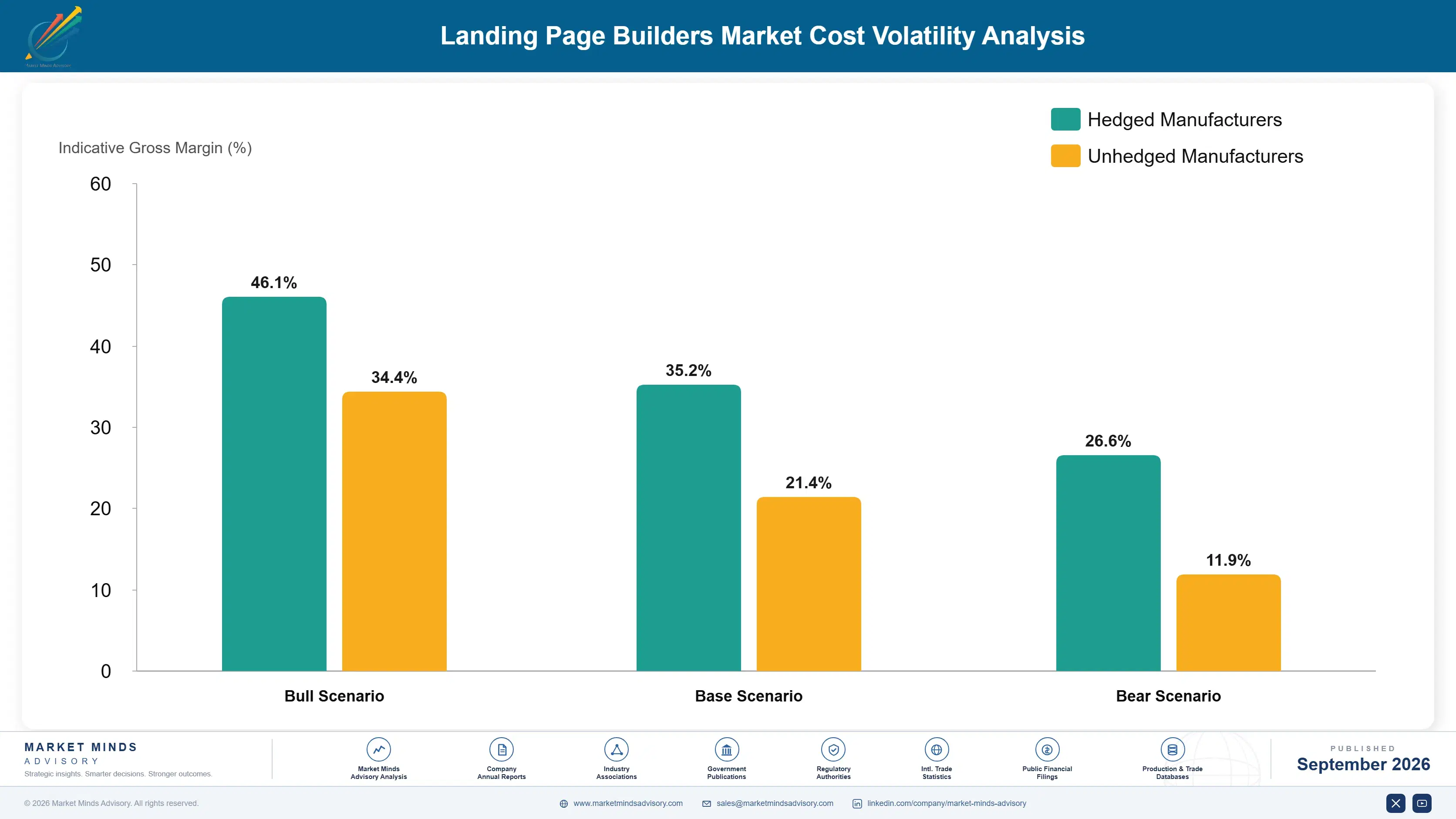
Cloud hosting infrastructure, content delivery network capacity, and generative AI model API costs represent 45 to 55 percent of total operating cost for landing page builder vendors, with AI inference costs growing rapidly as generation features expand across product lines. Vendors increasingly negotiate multi-year procurement contracts spanning both cloud infrastructure and AI model access to smooth cost volatility across their broader technology stack.
Generative AI API pricing from major foundation model providers fluctuated considerably during 2024 amid rapid model release cycles and shifting compute cost structures, according to industry pricing disclosures, squeezing vendor margins on AI-heavy product tiers offering unlimited generation to subscribers. This volatility prompted several vendors to reassess their AI infrastructure strategy and explore proprietary fine-tuned model development for less demanding generation tasks. Prices have since partially stabilized but remain elevated relative to historical baseline levels.

Vendors without efficient AI model usage optimization face considerably higher cost exposure than larger competitors with dedicated engineering teams and volume-based API pricing agreements. This dynamic increasingly favors scaled vendors like Unbounce and HubSpot over smaller specialists dependent on standard-rate API access. Independent specialists increasingly pursue joint purchasing arrangements with industry partners to capture comparable volume discount pricing on AI model access.
landing-page-builders-market-cost-volatility-analysis-1788413638575

Negotiate Volume-Based AI API Pricing Agreements

Securing volume-based pricing agreements with foundation model providers reduces per-generation cost exposure, trading upfront commitment for meaningfully lower long-term AI inference cost as generation feature usage scales across the customer base. Vendors with established multi-year commitments weathered the last pricing volatility cycle considerably better than pay-as-you-go competitors. Adoption grows steadily across most vendor procurement strategies.

Optimize Generation Requests for Cost Efficiency

Implementing smarter caching and request batching reduces redundant AI model calls, lowering overall inference cost per customer without meaningfully degrading the generation quality and responsiveness customers expect from the platform. This optimization approach becomes particularly valuable during periods of concentrated foundation model provider pricing changes affecting the broader industry. Adoption continues expanding steadily. Costs decline.

Build Proprietary Fine-Tuned Model Capability

Developing smaller, fine-tuned models for specific generation tasks reduces dependence on expensive general-purpose foundation model APIs, trading upfront development investment for meaningfully lower long-term per-generation operating cost. This capability requires more upfront engineering investment but pays back considerably during high-volume generation usage periods. Adoption grows steadily across most product lines and vendor segments. Costs decline.

Portfolio Architecture for Margin Defence

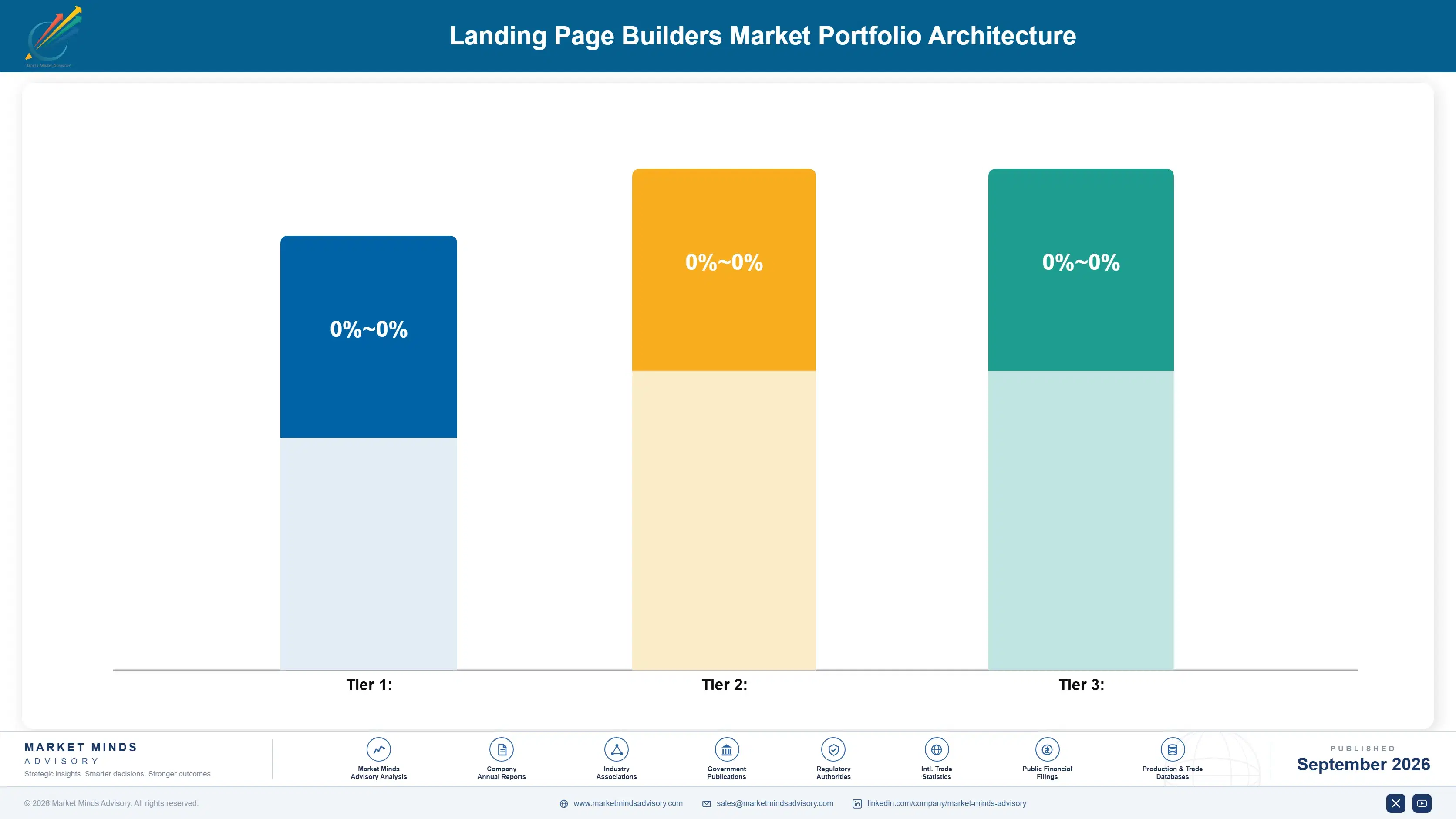
Vendor portfolios split across three tiers: commodity drag-and-drop builders competing on price, certified conversion-optimization platforms commanding premium enterprise pricing, and next-generation AI-native generation platforms still gaining commercial scale. Margin economics diverge considerably between tiers. Investment increasingly follows this margin logic across most vendor product development roadmaps. This bifurcation increasingly shapes vendor capital investment and hiring decisions.
Commodity drag-and-drop builders compete almost entirely on subscription price and template breadth, with thin margins that leave little room for differentiation beyond basic feature parity. Conversion-optimization and AI-native platforms capture meaningfully wider margins through integrated analytics and generation capability, insulating vendors from pure commodity price competition that defines the volume tier. Vendors without a credible AI generation narrative increasingly struggle to defend premium pricing against well-positioned competitors.

High-value pools concentrate in AI-native generation and enterprise conversion optimization, where technical differentiation and integration depth reward vendors willing to invest in specialized capability. Commodity drag-and-drop builders remain the volume anchor but offer limited margin upside absent meaningful generation or optimization differentiation. Investment allocation increasingly follows this margin logic across most vendor strategic planning decisions. Vendors that recognized this shift early now hold a meaningful competitive advantage over slower-moving rivals.

Commodity drag-and-drop builders competing primarily on subscription price and template breadth for basic use cases. Price competition among established vendors keeps margins thin across most standard subscription tiers. Margins remain thin.
Gross Margin

Conversion-optimization platforms with enterprise personalization capability commanding premium pricing from data-focused marketing buyers. Demand grows steadily as data-focused buyers value proven conversion optimization track records highly. Demand grows steadily too.
Gross Margin

AI-native generation platforms still gaining commercial scale among speed-focused small business and agency customers. Early adoption remains concentrated among the smallest, most speed-focused agency and freelancer segments. Adoption grows steadily too.
Gross Margin
landing-page-builders-market-portfolio-architecture-1788413639130

High-value Sub-segments and Strategic Watch-out

AI-Generated Landing Page Builders

The clearest high-value, high-growth pool, combining strong generation-driven margins with a 17.5 percent CAGR as adoption accelerates. Engineering firms report a growing project pipeline across most major agency and enterprise accounts globally today. Momentum remains strong. Adoption continues expanding steadily. Momentum holds firm. Interest holds firm.

E-Commerce-Focused Page Builders

Strong margins and steady growth from expanding global e-commerce adoption requiring dedicated conversion-focused page infrastructure worldwide. Certification investment increasingly pays back as global online retail adoption continues expanding across most emerging markets. Interest keeps rising. Adoption continues expanding steadily. Growth continues steadily. Interest holds firm.

Drag-and-Drop No-Code Builders

The volume core, generating most industry revenue despite thinner margins, anchored by decades of established small business adoption. Price competition remains intense here as differentiation opportunities narrow considerably relative to premium alternatives. Volume stays high. Demand remains resilient overall. Volume grows slowly too. Interest holds.

Agency and Freelancer White-Label Builders

A strategic watch-out given commoditization pressure despite steady demand, since differentiation from basic white-label tools remains genuinely difficult. Vendors still serving this niche increasingly focus on legacy customer retention rather than new product development. Decline continues steadily. Interest keeps fading steadily. Focus narrows further. Watch closely.

Subscription Renewal Anchors Recurring Revenue

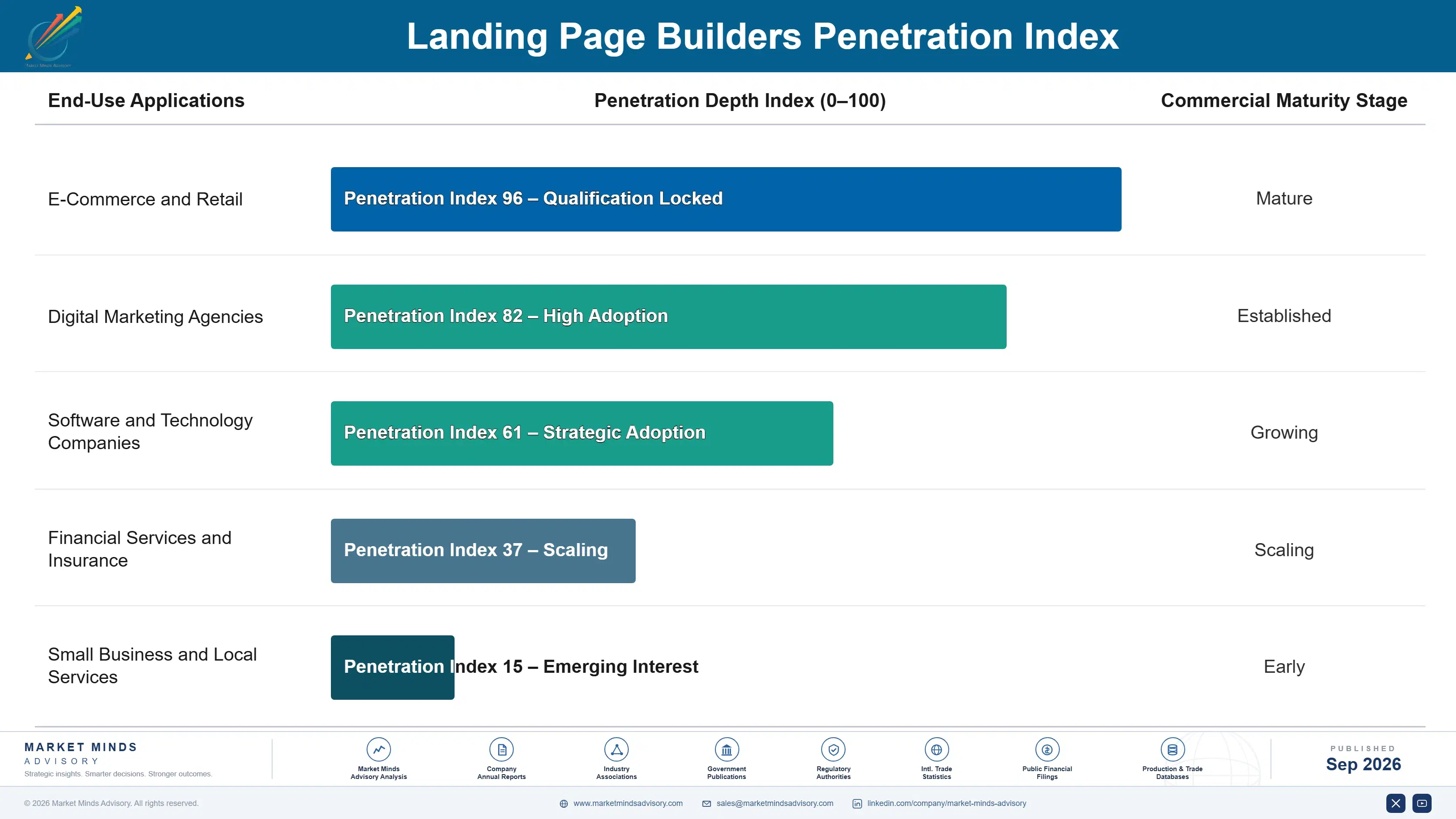
Demand for landing page builders behaves as a recurring subscription necessity rather than a one-time purchase for actively marketing businesses, since customers running ongoing digital advertising campaigns cannot function without continuous page creation and hosting capability throughout their operating lifecycle. This subscription-necessity framing insulates demand from the discretionary spending cuts that periodically hit other marketing software categories during broader budget tightening cycles at most organizations.
Adoption depth varies considerably by business type: e-commerce and lead-generation businesses running continuous advertising campaigns show near-universal dependency on landing page tools, while businesses with less active digital marketing programs retain considerably more flexibility to use basic website builders instead. Vendors serving both ends of this spectrum increasingly maintain distinct product tiers tailored to each customer segment's fundamentally different usage intensity and feature requirements.

Buyer profiles are shifting as marketing operations and growth teams increasingly influence procurement decisions traditionally made purely by individual marketers, reflecting a generational shift toward treating landing page infrastructure as a growth engine investment rather than a purely tactical campaign support tool. This shift creates meaningful opportunity for vendors with established growth marketing relationships to extend their competitive advantage into these newly influential buying committee structures.
landing-page-builders-market-end-use-penetration-index-1788413639611

AI Generation and Integration Investment Priorities

These are among the four positions where our research anticipates prominent divergence between winners and laggards over the coming forecast period. Each is grounded in the demand model, the regulatory perimeter, and the announced capacity pipeline.
01 / AI GENERATION QUALITY STRATEGY

Build superior AI copywriting before competitors close the gap

Platforms without high-quality generative AI copywriting face a widening gap against competitors already capturing 42 percent of new customer signups through this capability, up sharply from a smaller share two years earlier. Building genuinely differentiated generation quality takes considerable engineering investment that platforms cannot develop quickly once competitors already established market leadership. Platforms that delay this investment risk losing the fastest-growing customer segment to faster-moving, better-prepared competitors already firmly established across multiple customer segments, geographies, and industry verticals more broadly over time.
02 / CONVERSION INTEGRATION STRATEGY

Integrate conversion optimization to consolidate tool categories

Enterprise and e-commerce customers increasingly prefer consolidated procurement over managing multiple standalone tools for page creation, testing, and analytics, favoring platforms capable of integrating these functions into a single unified workflow. Platforms without this integration capability struggle to compete for enterprise business against better-positioned competitors offering simplified procurement and reduced tool sprawl. Building this capability now captures deal flow that would otherwise default to platforms with broader existing integration depth already established across multiple customer accounts and enterprise procurement relationships.
03 / MARKETING STACK PARTNERSHIP STRATEGY

Deepen integrations with major marketing cloud platforms

Enterprise procurement teams increasingly value vendor consolidation and integrated data flow over best-of-breed individual tool capability, even when standalone tools offer superior specific functionality for narrow use cases. Vendors without deep marketing cloud integrations increasingly lose enterprise deals to competitors offering tighter platform connectivity, simplified data flow, and unified reporting dashboards. Building these partnerships now positions vendors favorably as integration preference continues strengthening across enterprise buying committees, procurement processes, and vendor evaluation criteria at most large organizations and their subsidiaries worldwide.
04 / EMERGING MARKET EXPANSION STRATEGY

Localize offerings for fast-growing small business markets

Fast-growing small business markets in South Asia and Latin America are adopting digital marketing tools for the first time as domestic businesses pursue sophistication comparable to established Western markets and their broader advertising and marketing technology base. Vendors entering these markets early through localized partnerships increasingly capture disproportionate share of new customer acquisition as domestic small business digital adoption continues accelerating. Building these relationships now captures growth that would otherwise default to competitors with established regional presence and local partnerships.

Engagement Snapshot From the Field

A live engagement with an industry participant carrying material or product regulatory and market exposure ahead of a defining policy shift, showing how our research translates into a defensible multi-year portfolio strategy.
MARKET MINDS ADVISORY · CLIENT ENGAGEMENT SUMMARY
Landing Page Builders Producer Strategic Portfolio Review and Transition Roadmap 2026·Investment Scenario on Landing Page Builders Exposure Evaluation 2025-26
CLIENT PROFILE
A mid-sized digital marketing agency managing landing page campaigns for dozens of small business clients sought to evaluate whether consolidating its fragmented toolkit of separate page building, testing, and analytics tools onto a single integrated platform made commercial sense given rising client acquisition costs. The agency's leadership needed a clear, data-driven business case before committing to a costly and disruptive platform migration process.
STRATEGIC CHALLENGE
The agency's account managers juggled multiple disconnected tools for page creation, A/B testing, and performance reporting, creating operational inefficiency and inconsistent client reporting that competing agencies offering more simplified integrated workflows increasingly used as a competitive differentiator. Delaying the consolidation decision further risked continued client attrition to better-positioned competitors offering superior integrated reporting capability.
MMA APPROACH
MMA benchmarked platform consolidation approaches from three comparable agencies, modeled operational efficiency gains and migration cost across different platform options, and evaluated phased migration strategies that would let the agency consolidate gradually without disrupting active client campaigns during the transition period. Interviews with the agency's account managers and client-facing teams informed the final consolidation roadmap and timeline.
KEY FINDINGS
  1. Consolidating onto a single AI-native platform could reduce account manager tool-switching time by an estimated 40 percent overall (client-reported, unverified by MMA).
  2. Client-facing reporting consistency improved considerably once all campaigns moved to a single integrated platform dashboard (client-reported, unverified by MMA). across all managed client accounts and campaigns
  3. Migration costs and disruption risk were manageable when phased carefully across client accounts over a six-month rollout period (client-reported, unverified by MMA).
  4. Competing agencies with fragmented toolkits reported measurably lower client retention rates during the same period (client-reported, unverified by MMA). compared to the client's improving retention metrics
CLIENT PROFILE
A mid-sized digital marketing agency managing landing page campaigns for dozens of small business clients sought to evaluate whether consolidating its fragmented toolkit of separate page building, testing, and analytics tools onto a single integrated platform made commercial sense given rising client acquisition costs. The agency's leadership needed a clear, data-driven business case before committing to a costly and disruptive platform migration process.
STRATEGIC CHALLENGE
The agency's account managers juggled multiple disconnected tools for page creation, A/B testing, and performance reporting, creating operational inefficiency and inconsistent client reporting that competing agencies offering more simplified integrated workflows increasingly used as a competitive differentiator. Delaying the consolidation decision further risked continued client attrition to better-positioned competitors offering superior integrated reporting capability.
MMA APPROACH
MMA benchmarked platform consolidation approaches from three comparable agencies, modeled operational efficiency gains and migration cost across different platform options, and evaluated phased migration strategies that would let the agency consolidate gradually without disrupting active client campaigns during the transition period. Interviews with the agency's account managers and client-facing teams informed the final consolidation roadmap and timeline.
KEY FINDINGS
  1. Consolidating onto a single AI-native platform could reduce account manager tool-switching time by an estimated 40 percent overall (client-reported, unverified by MMA).
  2. Client-facing reporting consistency improved considerably once all campaigns moved to a single integrated platform dashboard (client-reported, unverified by MMA). across all managed client accounts and campaigns
  3. Migration costs and disruption risk were manageable when phased carefully across client accounts over a six-month rollout period (client-reported, unverified by MMA).
  4. Competing agencies with fragmented toolkits reported measurably lower client retention rates during the same period (client-reported, unverified by MMA). compared to the client's improving retention metrics
RECOMMENDED STRATEGY
Phase 1: Phase one: migrate lowest-risk client accounts first to validate the new platform's workflow and reporting capability. Speed to validation mattered considerably here. Phase 2: Phase two: expand migration to remaining client accounts once initial results confirm efficiency and reporting improvements. Efficiency data guided the expansion pace. Phase 3: Phase three: retrain account managers on the consolidated platform and update client-facing reporting templates accordingly. Full transition depends on team readiness and training.
OUTCOME
The agency completed its platform consolidation within five months, reporting improved account manager efficiency and stronger client retention during subsequent contract renewal cycles (client-reported, unverified by MMA). Additional client referrals continued arriving steadily following the successful consolidation announcement. Leadership viewed the transition as a meaningful competitive advantage going forward.

Frequently Asked Questions

Foundational context covering the market sizes, CAGR, scope, country, region and competition that inform every finding below. This section is provided to cover basics and most often pre-purchase conversations, answered from the MMA Primary Research Dataset.

What is the current size of the Landing Page Builders Market?

The global landing page builders market reached an estimated $1.6 billion in 2025, driven by rising customer acquisition costs and AI-assisted generation adoption. North America hosts the largest vendor concentration.

How large will the Landing Page Builders Market be by 2036?

MMA projects the market will reach approximately $4.8 billion by 2036, up from $1.77 billion in 2026. That represents roughly a 2.71x expansion across the ten-year forecast window.

What is the CAGR for the Landing Page Builders Market 2026 to 2036?

The base case forecast CAGR is 10.5% across 2026 to 2036, with a bull scenario of 11.8% and a bear scenario of 9.2% depending on AI generation quality and consolidation trends.

Which segment is growing fastest?

AI-Generated Landing Page Builders lead at a 17.5% CAGR, roughly 1.67 times the overall market rate, as marketers prioritize generation speed over template variety broadly.

Who are the major companies in the Landing Page Builders Market?

Unbounce, Instapage, Leadpages, ClickFunnels, and HubSpot lead the market, together holding an estimated combined software revenue share of 38% measured globally across all product categories.

Which country is growing fastest?

India leads growth at a 15.0% CAGR, driven by its rapidly expanding small business and startup landscape adopting accessible digital marketing tools across the country.

Report Segmentation Architecture

The full report scope spans multiple orthogonal segmentation dimensions, with cross-tabulated demand data provided for each dimension pair. Coverage extends further to regional breakdowns, trend trajectories, and the competitive detail needed to support segment-level decision-making.
  • AI-Generated Landing Page Builders
  • Drag-and-Drop No-Code Builders
  • A/B Testing and Conversion Optimization Platforms
  • E-Commerce-Focused Page Builders
  • Enterprise Marketing Platform Modules
  • Agency and Freelancer White-Label Builders
  • E-Commerce and Retail
  • Digital Marketing Agencies
  • Software and Technology Companies
  • Financial Services and Insurance
  • Small Business and Local Services
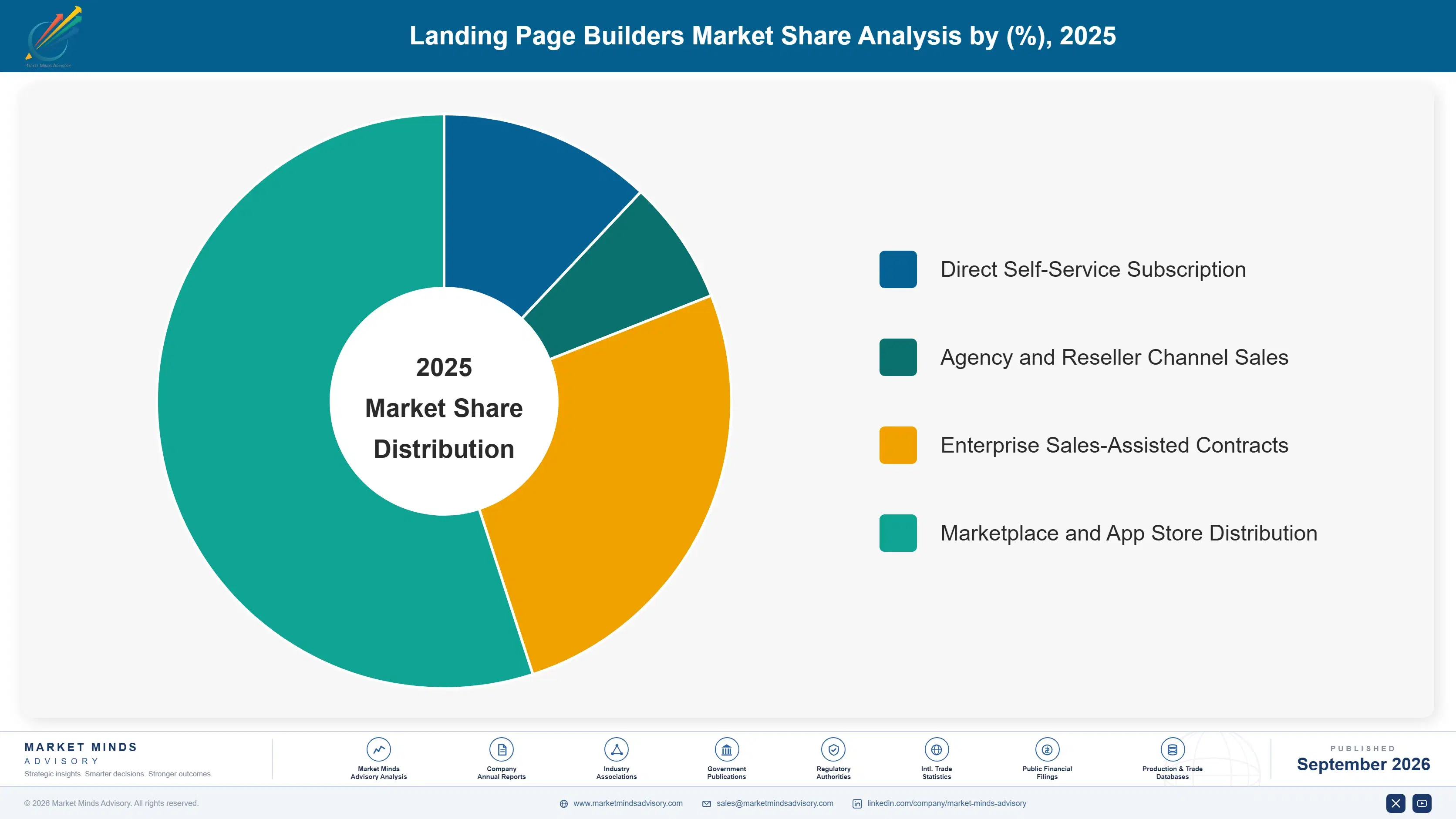
  • Direct Self-Service Subscription
  • Agency and Reseller Channel Sales
  • Enterprise Sales-Assisted Contracts
  • Marketplace and App Store Distribution

By Region

  • North America
  • Western Europe
  • East Asia
  • South Asia and Pacific
  • Latin America
  • Middle East and Africa
  • Eastern Europe

Scope, Methodology, and Coverage

Every figure in this report is reproducible from documented input assumptions. The scope below maps the historical period, the forecast horizon, the segmentation dimensions, and the countries covered, alongside the underlying primary and qualitative methodology.
Historical Period
2020 to 2025
Forecast Period
2026 to 2036
Base Year
2025 (USD billions; MMA Primary Research Dataset, September 2026)
Market Definition
This report covers software platforms that let marketers and businesses build, publish, and optimize standalone landing pages without custom development, including AI-assisted generation, drag-and-drop editing, and conversion testing functionality, measured on a global software revenue basis. It excludes full website builders and general-purpose content management systems not focused specifically on campaign landing pages.
Quantitative Units
USD billions, active subscription accounts, and percentage CAGR
Segmentation Dimensions
Product type (AI-generated, drag-and-drop, A/B testing/optimization, e-commerce-focused, enterprise modules, agency/white-label), end-use vertical, commercial channel, and geography
Regions Covered
North America, Western Europe, East Asia, South Asia and Pacific, Latin America, Middle East and Africa, Eastern Europe
Countries Covered
United States, United Kingdom, India, Brazil, Germany, Australia, and 20+ additional countries across seven global regions
Key Companies Profiled
Unbounce, Instapage, Leadpages, ClickFunnels, HubSpot, and 15 additional vendors across the global competitive set
Quantitative Methodology
Primary survey, n=3,800 respondents, Q4 2025, six countries; demand-side model with trade association cross-validation
Qualitative Methodology
47 expert interviews, Q4 2025; applied to validate demand model assumptions, identify emerging dynamics, and assess competitive positioning
Report Format
PDF and XLSX data workbook (Word format preview document)
Publisher
Market Minds Advisory
Report Code
MMA-2026-TEC-128
Published
September 2026
Contact
sales@marketmindsadvisory.com | www.marketmindsadvisory.com

Purchase the full Landing Page Builders Market Report (2026 to 2036).

This report delivers a complete assessment of the global landing page builders market across the full 2026 to 2036 forecast period ahead. It combines primary survey data from 3,800 respondents with 47 expert interviews to quantify segment, regional, and competitive dynamics in careful detail. Coverage spans AI-generated, drag-and-drop, conversion optimization, and e-commerce categories, alongside detailed vendor benchmarking across twenty companies. Analysts translate raw data into actionable generation strategy, integration investment, and market entry guidance for vendors, investors, and marketing buyers evaluating this rapidly evolving software category.
Ten-year global market sizing and forecast model
Seven-region demand, pricing, and share breakdown
Twenty-company competitive benchmarking and positioning analysis
Segment-level growth, margin, and pricing analysis
AI infrastructure cost exposure and risk assessment
Strategic verdict and prioritized investment guidance

Built For The People Who Decide

From boardroom strategy to bench-side execution, this report is read cover-to-cover by leaders shaping the next decade of their industry, turning demand scenarios, market dynamics and valuation benchmarks into decisions.
CXOs/ Presidents/ VPs/ Managers
M&A and Corporate Development
Strategy Teams and R&D Heads
Procurement and Product Directors
Regulatory and Compliance Leaders
Investor Relations and Equity Analysts