Market Minds Advisory
Lager Market

Lager Market: Premiumisation Against Declining Volume, Alcohol-Free Quality And Packaging Costs That Exceed The Beer

Packaging costs more than the beer inside it across most of this market, which is why aluminium pricing moves brewer margins further than barley harvests ever manage to on their own.

Lead Analyst

Lisa Gevelber

Published

September 2026

Make Smarter Decisions with Customized Research Insights

Request a free sample report and evaluate market opportunities, growth trends, and competitive dynamics relevant to your business needs.

2025 MARKET VALUE$265.0BMarket Size 2025
2036 FORECAST VALUE$391.0BBase Case , 2026 to 2036
CAGR 2026 TO 20363.6 %Bull 4.8% / Bear 2.4%
INCREMENTAL OPPORTUNITY$116.5BNet 10- year value creation
EXPANSION MULTIPLE1.42x2036 value over 2026 base
Strategic Levers
M&A Pipeline
Regional Outlook
Country Rankings
Competitive Intelligence
Segmental Deep-dive
Call-Us : 91 93563 13602

Executive Snapshot and Market Trajectory

Packaging costs more than the beer inside it across most of this market, which is the detail that explains why aluminium pricing moves brewer margins further than any barley harvest manages on its own. Beer is mostly water and packaging is not, which is arithmetic rather than commentary.
Alcohol-free lager carries the growth because dealcoholisation finally produces something people order twice, and excise duty falls away entirely in most jurisdictions. Premium and super-premium lager grows nearly as fast on the premiumisation strategy every large brewer has pursued for a decade. East Asia holds the largest share on Chinese volume that dwarfs any other single market, with premiumisation now running there too.
Concentration reads at 58% for the top five after decades of consolidation, though it understates regional positions where individual brewers hold far more. Volume is flat or declining across most developed markets, which means value growth has to come from mix rather than from litres, and every commercial decision in this industry now follows from that single arithmetic reality. Alcohol-free is the first genuinely new segment here in years. Quality was the whole barrier.
Market Definition
This market covers lager beer at brewer realised value, spanning alcohol-free and low-alcohol lager, premium and super-premium lager, craft and speciality lager, mainstream standard lager, and economy and value lager, across on-trade and off-trade channels. Ales, stouts, wheat beers and other non-lager styles, cider and flavoured malt beverages, hard seltzer, and beer sold as a home-brewing ingredient are excluded from the sizing.
Base Year Value
$265.0B in 2025 (MMA Primary Research Dataset, August 2026)
Forecast Period
2026 to 2036, eleven discrete annual values
CAGR
3.6% base case. Bull 4.8%. Bear 2.4%.
Fastest Growth Segment
Alcohol-Free And Low-Alcohol Lager: 5.4% CAGR
Fastest Growth Country
India: 7.4% CAGR
Fastest Growth Region
South Asia and Pacific: 5.9% CAGR
Largest Region
East Asia: 28% of 2025 global value
Market Leaders
Anheuser-Busch InBev, Heineken, Carlsberg, Molson Coors and China Resources Beer lead on lager brewing revenue. Source: MMA Primary Research Dataset, July 2026.
Primary Survey
n=3,800 procurement and R&D decision-makers, Q4 2025, six countries
Methodology
Demand-side build-up, cross-validated against public data, 47 expert interviews

Lager Market Forecast Scenarios

lager-market-size-forecast-scenario-1787460213449
Growth ran at 2.6% annually between 2020 and 2025, and almost none of it came from volume. Litres were flat or falling across most developed markets while value rose through premiumisation and price increases that brewers pushed harder than usual to recover input inflation. The pandemic disrupted on-trade badly and off-trade absorbed some of it, though not all and not permanently.
The base case at 3.6% rests on three mechanisms. Premiumisation continues delivering value growth where volume cannot, since drinkers in developed markets consume less beer but spend more per litre when they do. Alcohol-free lager keeps growing on genuine quality improvement rather than on any wellness argument. And Indian and Southeast Asian volume expands as legal drinking populations grow and formal retail distribution reaches further into those markets. None of the three depends on drinkers consuming more beer.
The bull case at 4.8% turns on alcohol-free reaching double-digit volume share in major markets, which would add duty-free margin at scale. The bear case at 2.4% reflects economic pressure sending drinkers down the price ladder, since trading down in beer happens quickly once it starts and premium positions are considerably harder to rebuild than to lose.

Value Growth Without Volume Growth Anywhere

Beer people talk about barley and hops. Brewery finance directors talk about aluminium. Packaging runs roughly 27% of manufactured cost against 21% for malt and barley combined, which means a can price movement hits margin harder than a poor harvest does, and it explains a great deal about why brewers hedge metals as carefully as they hedge grain.
TOP FIVE CONCENTRATION58%High, reflecting decades of consolidation across most major markets
ALCOHOL-FREE VOLUME SHARE6%Portion of lager volume in alcohol-free and low presentations
PREMIUM VOLUME SHARE24%Portion of volume sold at premium pricing and above
PACKAGING COST SHARE27% of COGSCans, glass and secondary packaging share of brewing cost
MALT COST SHARE21% of COGSMalt and barley contribution to total brewing manufactured cost
ON-TRADE VALUE SHARE38%Portion of value sold through bars, pubs and restaurants
The other governing fact is that volume stopped growing. Litres are flat or declining across most developed markets, so value growth has to come from mix, and premiumisation is the strategy every large brewer has pursued for a decade in response. Premium carries roughly 24% of volume and a considerably larger share of profit, which is what makes the position worth defending so hard. Defending that mix is what every portfolio decision now serves.
Alcohol-free is the genuinely new thing. Dealcoholisation and reformulated brewing finally produce beer people order twice rather than tolerate, which is a low bar the category spent thirty years failing to clear. Excise duty falls away in most jurisdictions, so margin is better than mainstream lager, and it reaches occasions alcoholic beer cannot reach at all.
"The industry spent a decade arguing about hops and provenance while the actual margin story was aluminium and excise. Alcohol-free is the first genuinely new thing here in years, and it works because somebody finally made it taste acceptable."
Director, Beverages and Brewing Practice · MMA Beverages Practice · August 2026

Market Trends

Alcohol-Free Lager Finally Reaches Drinkable Quality At Scale

Alcohol-free beer spent thirty years being tolerated rather than enjoyed, and dealcoholisation technology combined with reformulated brewing finally changed that around the start of this decade. Quality is what drives the growth rather than any wellness argument, because nobody orders a second beer they dislike whatever their health intentions were. Volume sits near 6% of lager and climbs annually. Excise duty falls away in most jurisdictions, which makes the margin better than mainstream lager rather than worse. It also reaches occasions that alcoholic beer cannot legally or practically serve at all.
Market Impact: India grows at 7.4% annually
Premiumisation Substitutes For Volume Growth That Stopped

Litres are flat or declining across most developed markets, which leaves value growth dependent entirely on mix rather than on selling more beer to anybody. Every large brewer has pursued premiumisation for a decade in response, and premium now carries roughly 24% of volume alongside a considerably larger share of profit. The strategy works while economies hold. Trading down in beer happens quickly once it starts, and premium positions are far harder to rebuild than they were to establish. Every commercial decision in this industry now follows from that single arithmetic reality.
Market Impact: East Asia grows at 4.5% annually

Market Opportunities and Growth Drivers

Indian And Southeast Asian Legal Drinking Populations Keep Expanding

Most beer growth in the world now comes from places where the legal drinking population is still growing and formal retail distribution is still extending, which describes India and much of Southeast Asia and almost nowhere in the developed world. Indian volume grows near 7.4% annually against state-level licensing and distribution complexity that makes it harder than the demographics alone suggest. Vietnamese and Filipino consumption is also expanding steadily from established bases. African urban markets are following a comparable path from a considerably lower base. Demographics do most of the work.
Market Impact: Packaging is 27% of manufactured cost

Chinese Premiumisation Adds Value Without Adding Any Volume

Chinese beer volume peaked years ago and has been declining slowly since, yet the market keeps growing in value because drinkers there are trading up rapidly from economy lager toward premium and imported brands. That is the same premiumisation story running in developed markets, arriving later and moving faster. China Resources and Tsingtao have both restructured portfolios around it. Value growth continues on falling litres, which is a pattern this industry now recognises everywhere. Falling litres with rising value is a pattern this industry recognises everywhere now. Portfolios have been restructured around it.
Market Impact: Cuts per-capita volume 14% since 2015

Market Restraints and Challenges

Packaging Costs Exceed Ingredient Costs And Move Independently

Aluminium, glass and secondary packaging run roughly 27% of manufactured cost against 21% for malt and barley together, so a metals price movement hits brewer margin harder than a poor harvest does. The root cause is that beer is mostly water and packaging is not, which is arithmetic rather than commentary. Commercially this exposes brewers to markets entirely unconnected to agriculture. Participants are responding with metals hedging, lightweighting, returnable glass in suitable markets and packaging mix shifts. Most brewing organisations still treat packaging as procurement rather than as margin. Metals hedging is the obvious answer.
Market Impact: Volume reaches 6% of lager

Younger Drinkers Consume Less Beer Than Predecessors Did

Legal drinking age cohorts across developed markets drink less alcohol than the generations before them, and the decline is consistent enough across countries that no single explanation covers it. The root cause appears to be a genuine behavioural shift rather than any temporary economic effect. Commercially this caps volume permanently in the markets that generate most profit. Participants are responding with alcohol-free ranges, occasion-based marketing, and premiumisation that extracts more value from fewer litres sold. Those who do drink beer increasingly drink better beer less often instead. No temporary explanation covers the decline.
Market Impact: Premium holds 24% of volume
3 additional market trends, 4 additional growth drivers, and 2 additional restraints and challenges are covered in the full report. Contact sales@marketmindsadvisory.com to access the complete intelligence.

Segment CAGR and Growth Architecture

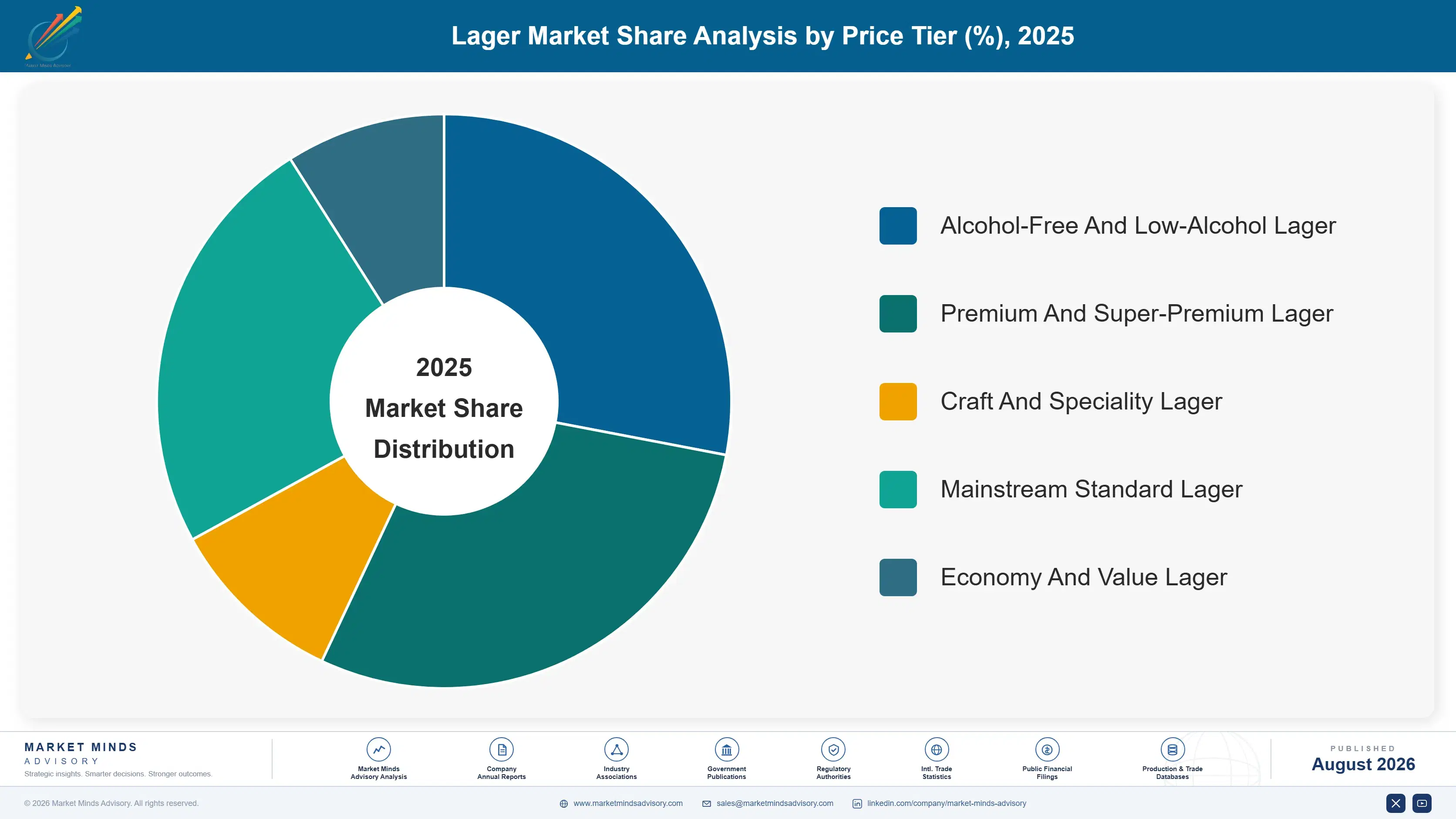
Five price and format tiers divide this market on where a beer sits commercially rather than on brewing method, which varies far less between lagers than marketing suggests. Tier determines margin, channel access and how quickly a drinker abandons it when money gets tight, and those three factors govern every portfolio decision brewers make.
lager-market-market-share-analysis-1787460213986

Alcohol-Free And Low-Alcohol Lager

Growing at 5.4% and the fastest part of this market by a wide margin. Alcohol-free and low-alcohol lager stopped being a compromise product somewhere around 2020, when dealcoholisation technology and reformulated brewing finally produced something people would order twice. That single quality improvement matters more than any wellness argument, because nobody drinks a beer they dislike for their health. Volume sits near 6% of total lager and climbs every year, and it carries better margin than mainstream lager since excise duty falls away entirely in most jurisdictions. Brewers also find it reaches occasions that alcoholic beer cannot, which is genuinely new demand rather than substitution. Quality rather than any wellness argument is what actually drives it.
CAGR 5.4%

Premium And Super-Premium Lager

Growing at 4.6% on premium and super-premium lager, where international brands and locally brewed premium labels take share from mainstream at considerably better margin. Premiumisation is the single strategy every large brewer has pursued for a decade, because volume growth in developed markets stopped and value growth had to come from somewhere else. It works: premium carries roughly 24% of volume and a far larger share of profit. The risk is that economic pressure sends drinkers back down the price ladder faster than brewers can defend the position, and trading down in beer happens quickly once it starts. Premium carries a far larger share of profit than of volume. Every large brewer has pursued this for a decade now.
CAGR 4.6%
Full segment breakdown across 5 segments available in the complete report.

Regional Architecture and Country Demand Map

East Asia holds 28% of global value on Chinese volume that dwarfs any other single market, with premiumisation now running there as well. North America follows at 22%, while South Asia and Pacific grows fastest as legal drinking populations expand. Volume declines almost everywhere else.

East Asia

China is the largest beer market on earth by volume and has been for two decades, though litres peaked years ago and decline slowly now while value keeps rising as drinkers trade up from economy lager toward premium and imported brands. China Resources and Tsingtao have restructured portfolios around exactly that. Japanese consumption is falling on demographics and the tax structure that distinguishes beer from happoshu shapes product design in ways no other market requires. Korean demand is smaller, heavily on-trade weighted and increasingly served by imported premium brands rather than domestic mainstream ones. Value growth continues on falling litres across the whole region. Japanese tax structure shapes product design uniquely.
Share: 28% | CAGR: 4.5% (2026 to 2036)

North America

Volume has been declining for years while value holds up through premiumisation, imported brand growth and price increases that brewers pushed harder after input inflation. Mexican imports have taken remarkable share in the United States and now outsell several established domestic brands outright. Alcohol-free adoption is growing quickly from a low base and younger drinkers consume noticeably less than previous cohorts did. Craft brewing consolidated after years of expansion, with several acquisitions and closures. Canadian volumes follow similar patterns, with provincial distribution structures adding complexity that brewers manage rather than change. Mexican imports now outsell several established domestic brands outright. Alcohol-free adoption is climbing quickly from a low base. Craft consolidated after years of expansion.
Share: 22% | CAGR: 2.8% (2026 to 2036)
Regional intelligence for 5 additional markets available in the complete report: Western Europe, South Asia and Pacific, Latin America, Middle East and Africa, Eastern Europe. Contact sales@marketmindsadvisory.com.
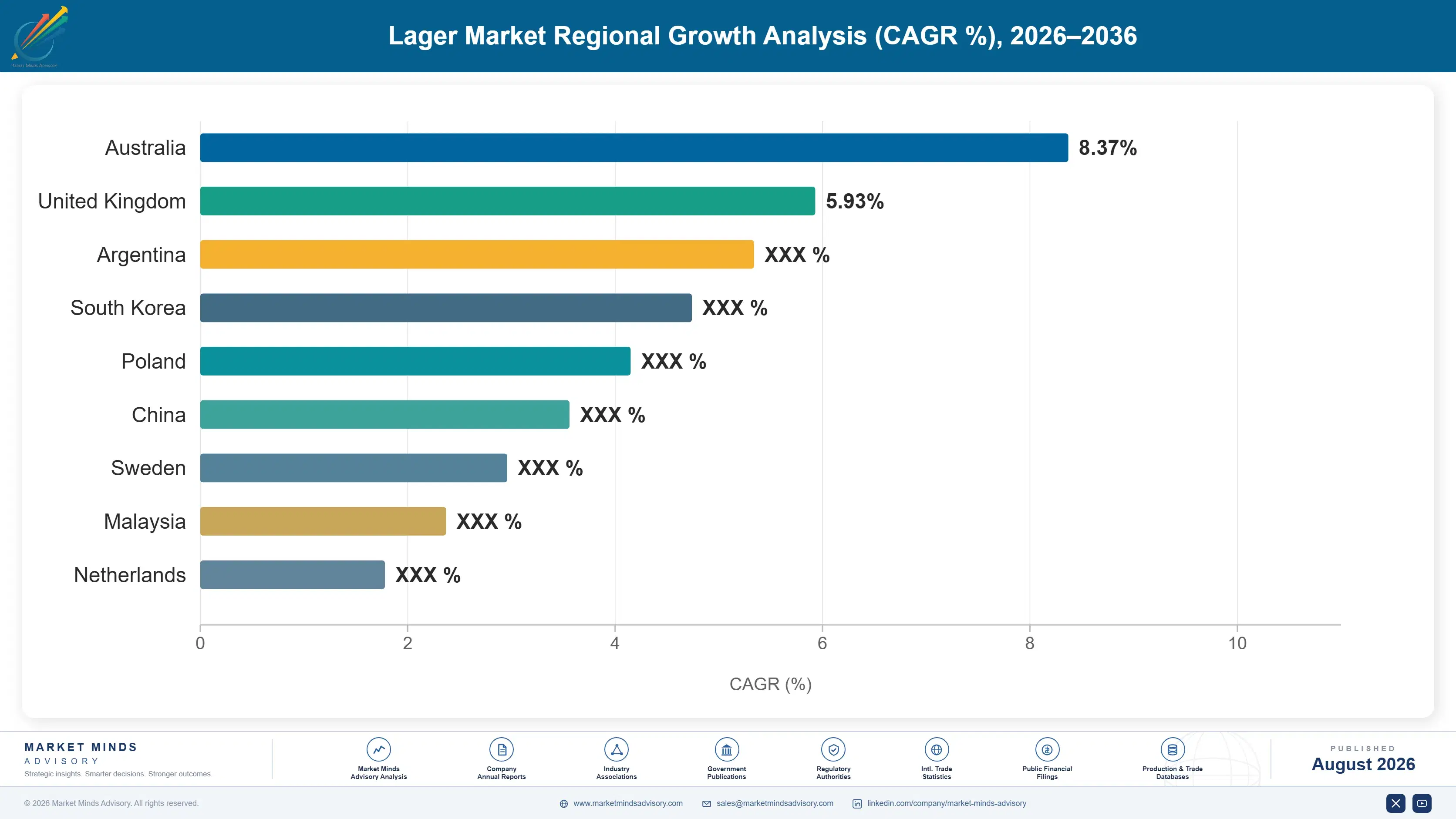
lager-market-country-cagr-analysis-1787460214500

Where Brewing Margin Is Actually Made

Four positions separate brewers growing value from those defending litres that keep falling: building alcohol-free ranges people order twice, defending premium mix against trading down, managing packaging cost as the dominant input it actually is, and pursuing growth markets where drinking populations are still expanding. Only the last takes decades rather than years. All four are available now.

Build Alcohol-Free Ranges People Order Twice

Excise duty falls away entirely in most jurisdictions, which makes alcohol-free lager carry better margin than mainstream at roughly 8 to 12 points above comparable alcoholic volume. Quality is the whole constraint, since nobody orders a second beer they disliked whatever their intentions were. Dealcoholisation and reformulated brewing now clear that bar. The segment also reaches occasions alcoholic beer cannot legally or practically serve, which makes it genuinely additional rather than substitutional volume. That makes the volume genuinely additional rather than merely substitutional. Nobody orders a second bad beer. Duty exemption does the rest.
Market Impact: Adds up to 12 points of brewing margin

Defend Premium Mix Against Downward Trading Pressure

Premium carries roughly 24% of volume and a considerably larger share of profit, and every large brewer has built a decade of value growth on that mix rather than on litres. Trading down happens quickly once economic pressure starts and premium positions are far harder to rebuild than to establish. Brewers holding premium share through a downturn preserve 20% to 28% more profit than those who discount into it and try to recover afterwards. Discounting into a downturn is considerably easier than climbing back out of one. Mix rather than litres carries value now.
Market Impact: Preserves up to 28% more profit through downturns

Manage Packaging As The Dominant Input Cost

Aluminium, glass and secondary packaging run roughly 27% of manufactured cost against 21% for malt and barley together, which means metals markets move brewer margin further than agriculture does. Brewers hedging metals as carefully as grain, lightweighting cans and shifting format mix absorb 30% to 40% of a packaging cost spike that unhedged competitors take entirely. Most brewing organisations still treat packaging as procurement rather than as a margin variable. Metals markets have nothing whatever to do with agriculture. Beer is mostly water and packaging is not. Hedging discipline transfers straight across.
Market Impact: Absorbs up to 40% of packaging cost spikes

Pursue Markets Where Drinking Populations Still Grow

Volume has stopped growing across every developed market and value substitution can only carry so far before mix improvement exhausts itself entirely. India, Vietnam and much of Africa still have expanding legal drinking populations and extending formal retail, with Indian volume growing near 7.4% annually. Building position there is slow, regulated and frequently frustrating, and it is the only place in this industry where litres still increase rather than merely holding. It is the only place in this industry where litres genuinely still rise. Regulation makes it slow and frustrating.
Market Impact: Indian volume keeps growing at 7.4% every year

Who Controls the Margin Pool

Concentration reads at 58% for the top five measured on lager brewing revenue, the basis used throughout this section, and it understates regional reality considerably since individual brewers hold dominant positions in specific countries. Anheuser-Busch InBev leads globally by a wide margin. Heineken holds the broadest geographic spread, Carlsberg and Molson Coors substantial regional positions, and China Resources enormous domestic volume.
Competition runs on three fronts. Premium portfolio strength is the first and it determines whether value grows when volume does not. Alcohol-free capability is the second, and it is the only genuinely new segment in a mature category. Route to market and distribution control is the third, which decides who reaches drinkers in markets where formal retail is still developing. None of the three is a brewing argument.

Pressure arrives from two directions. Younger drinkers consume less beer across every developed market, which caps volume permanently in the geographies generating most profit. Separately, hard seltzer and ready-to-drink spirits compete for the same occasions. Rankings will shift toward brewers holding alcohol-free capability and growth market position rather than those defending mature premium franchises alone. Mature premium franchises alone no longer secure a position.
lager-market-company-positioning-matrix-1787460215023

Competitive Moat and Risk Dimensions

ANHEUSER-BUSCH INBEV

Moat: Scale and brand portfolio depth

Global scale in procurement, brewing and distribution produces cost advantages competitors cannot match, and a brand portfolio spanning every price tier lets the group capture drinkers trading up and defend those trading down within its own range. Latin American positions in particular generate profit pools that few businesses in any consumer category can approach.
ANHEUSER-BUSCH INBEV

Risk: Mature market volume decline

Heavy exposure to markets where volume is falling and younger drinkers consume less leaves the group dependent on premiumisation that eventually exhausts itself. Debt taken on through acquisition also constrains flexibility, and alcohol-free capability was built later than at several European competitors who moved earlier on it.
HEINEKEN

Moat: Geographic spread and alcohol-free

The broadest geographic footprint in brewing spreads exposure across markets at different stages, so declining developed volume is offset by African and Asian growth in a way more concentrated competitors cannot manage. Early and committed investment in alcohol-free lager also produced a position in the only genuinely growing segment before most rivals took it seriously.
HEINEKEN

Risk: Emerging market currency exposure

Broad emerging market exposure brings currency volatility and political risk that translate directly into reported earnings regardless of underlying volume performance. Premium positioning across many markets also depends on economic conditions holding, and trading down would affect the group more than brewers weighted toward mainstream and economy tiers.

Players Tracked

Prominent Players

Anheuser-Busch InBev
Heineken
Carlsberg
Molson Coors
China Resources Beer

Other Key Players

Asahi Group Holdings
Kirin Holdings
Suntory Holdings
Tsingtao Brewery
Constellation Brands
Thai Beverage
San Miguel Corporation
Anadolu Efes
Boston Beer Company
Sapporo Holdings
Beijing Yanjing Brewery
United Breweries Limited
Castel Group
Royal Unibrew
Mahou San Miguel

Recent Developments

FEBRUARY 2025

Alcohol-free lager capacity expanded across European brewing network

A major brewer expanded dealcoholisation capacity across several European breweries, responding to alcohol-free volume growth that had outrun installed capability and to margin that excise exemption makes better than comparable alcoholic lager volume. Installed capability had been the binding constraint rather than any shortage of demand.
Signal: Capacity rather than demand has been the constraint limiting alcohol-free growth at several of the largest brewers
JUNE 2025

Aluminium hedging programme extended after packaging cost volatility

A brewing group extended its aluminium hedging programme across a longer horizon following packaging cost movements that hit margin harder than agricultural inputs did, formalising treatment of metals as a margin variable rather than a procurement matter. Grain hedging had been formalised for years by comparison.
Signal: Packaging costs move brewer margins further than barley harvests do, which brewing organisations have consistently underweighted
OCTOBER 2025

Premium portfolio restructured as trading down pressure emerged

A brewer restructured its portfolio in several markets to defend premium positions as economic pressure pushed drinkers toward value tiers, prioritising mix defence over volume retention on the basis that premium positions are difficult to rebuild. Volume was allowed to fall in the value tier instead.
Signal: Brewers defend premium mix through downturns because rebuilding those positions afterwards proves considerably harder work later

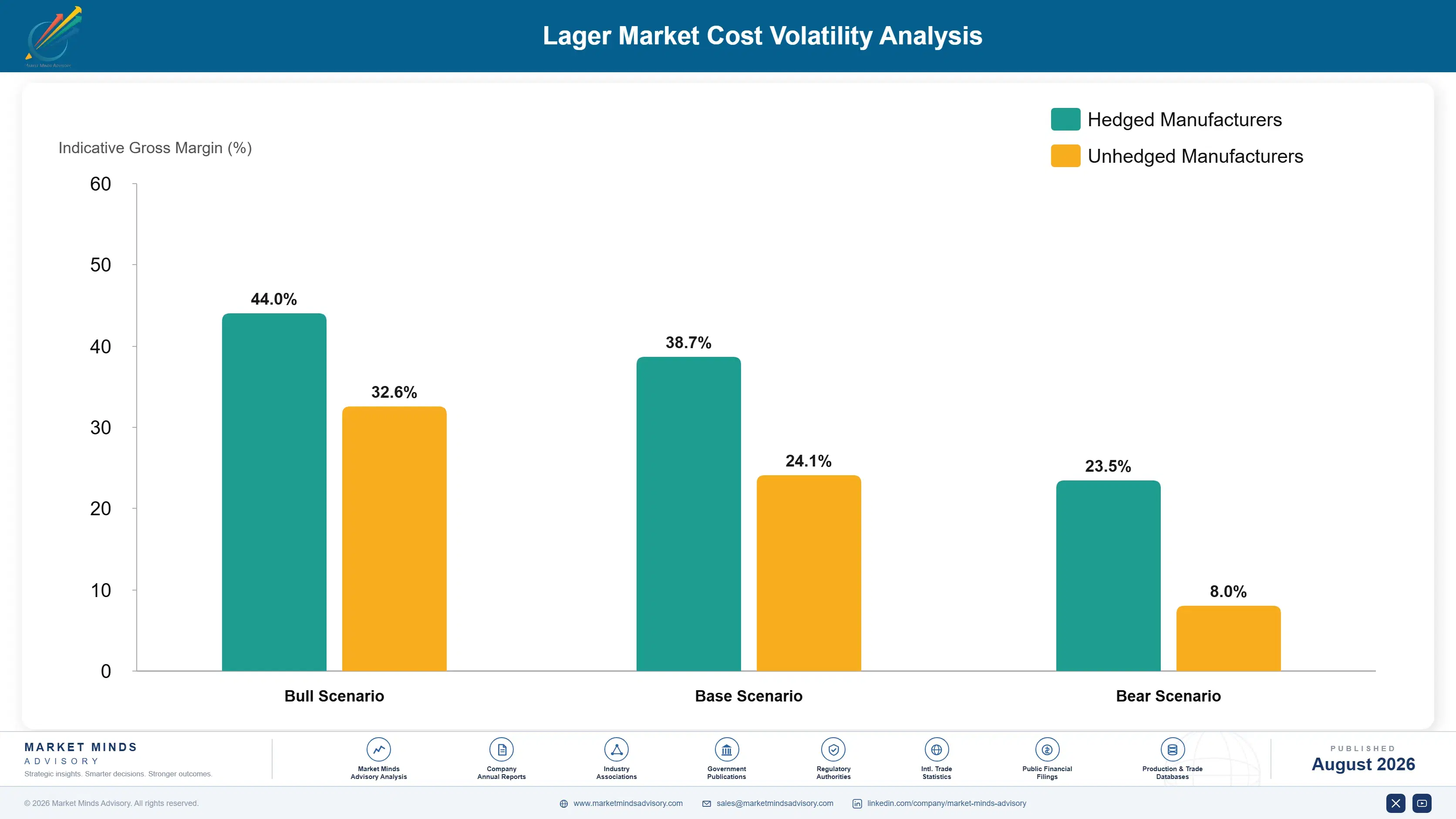
What Drives Brewing Cost Position

Packaging accounts for roughly 27% of manufactured cost, with aluminium cans the largest single line and glass, crowns and secondary packaging making up the balance. Malt and barley contribute around 21%. Brewing and packaging energy adds about 14%, distribution roughly 18% given how heavy and low-value beer is per pallet, and labour, water and treatment close to 20% across a typical operation.
European industrial energy pricing rose sharply through 2022 and carbon dioxide supply tightened alongside it, which affected brewing directly since carbonation depends on it, according to International Energy Agency data covering that period. Barley prices moved separately on Ukrainian and European harvest disruption tracked in United States Department of Agriculture grain data across the same seasons. Brewers absorbed a considerable share of both. Neither was fully recovered through pricing.

The disadvantage mechanism is that beer is heavy, low-value and mostly water, so distribution cost per unit of revenue is high and rises with fuel prices regardless of anything happening at the brewery. Exposure varies by geography and format, since returnable glass systems in Latin America and parts of Africa carry different economics entirely from the one-way can markets that dominate North America and much of Europe.
lager-market-cost-volatility-analysis-1787460215218

Hedge metals with the discipline applied to grain

Packaging exceeds ingredient cost in most brewing operations, yet metals exposure is frequently managed as procurement while grain gets a formal hedging programme. Extending the same discipline to aluminium absorbs a meaningful share of any packaging spike. Hedging costs money and locks in cost that may prove above market, which is the honest trade against the volatility it removes.

Brew closer to consumption to cut distribution cost

Beer is heavy, low-value and mostly water, which makes distribution roughly 18% of cost and rising with every fuel price movement. Brewing closer to where beer is drunk cuts that materially and is why brewers operate many plants rather than few large ones. The constraint is that each site carries fixed cost, so consumption density must justify it first.

Extend returnable glass where infrastructure supports it

Returnable bottle systems carry entirely different economics from one-way cans and remain commercially important across Latin America and parts of Africa where collection infrastructure exists. Packaging cost per fill falls substantially across a bottle's life. Building collection and washing infrastructure where none exists is expensive and slow, which is why the format has not returned to markets that abandoned it.

Portfolio Architecture for Margin Defence

Portfolio economics here divide on price tier rather than on brewing method, which varies far less between lagers than any marketing suggests. Economy and value lager competes on shelf price against every other cheap beer, carries the thinnest margin in the category, and exists mainly to hold volume through a brewery that needs filling. Nothing about that tier is defensible commercially.
The middle tier is mainstream standard lager, which is where most volume still sits and where brand strength does real work. Margins reach the high twenties and the position is defensible on distribution and recognition, though volume is flat or declining across every developed market and mix improvement is the only route to value growth from here. Brand recognition does the real work here.

Above both sit premium and alcohol-free. Premium carries roughly 24% of volume and a far larger share of profit, while alcohol-free adds 8 to 12 margin points through excise exemption on top of a segment that is genuinely growing. Margins reach the mid forties. Holding both requires brand equity and dealcoholisation capability that not every brewer built in time. Not every brewer built dealcoholisation capability in time.

Volume / Commodity-Adjacent

Economy and value lager competing on shelf price against every other cheap beer. The range reflects packaging and distribution cost rather than brand strength, and the tier mainly exists to fill brewery capacity.
Gross Margin: 14 to 22%

Premium / Certified

Mainstream standard lager carrying most remaining volume across every market. The range reflects brand strength and distribution position, though volume is flat or declining almost everywhere it is sold. Mix is the only route forward.
Gross Margin: 26 to 34%

Sustainability / Regulatory / Next-Generation

Premium, super-premium and alcohol-free lager together. The wide range reflects excise exemption on alcohol-free and how far premium positioning holds against trading down when economic pressure arrives. Both capabilities are needed together.
Gross Margin: 40 to 50%
lager-market-portfolio-architecture-1787460215712

High-value Sub-segments and Strategic Watch-out

Alcohol-Free Lager Volume

High value and high growth together, carrying excise exemption on top of a segment that is genuinely expanding. The wide range reflects dealcoholisation capability and whether quality clears the bar drinkers actually apply to a second order. Excise exemption changes the arithmetic entirely. Quality remains the constraint.
Gross Margin: 44 to 54%

Premium And Super-Premium Ranges

High value on steady growth and where a decade of brewer strategy has concentrated. The range reflects brand equity and how far positions hold when economic pressure pushes drinkers down the price ladder quickly. Rebuilding a lost position costs considerably more. Economic conditions decide it.
Gross Margin: 38 to 47%

Mainstream Standard Lager

The volume core of this market and where most litres still sit. The range reflects brand strength and distribution position, though volume declines almost everywhere and mix improvement is the only route to value. Litres decline across every developed market. Distribution position matters most. Brands endure.
Gross Margin: 26 to 34%

Economy And Value Tier Supply

The strategic watch-out. Volumes are real but margin is the thinnest anywhere in brewing, drinkers arrive only on price, and the tier mainly exists to keep a brewery running. The range reflects packaging and distribution alone. Capacity utilisation is the only argument. Margin is the thinnest anywhere.
Gross Margin: 14 to 22%

How Lager Demand Actually Repeats

Beer repeats on habit more reliably than almost any consumer category, which is what makes brand positions in this industry so durable and so expensive to establish. A drinker who settles on a lager orders it for years without reconsidering, and switching usually requires a specific prompt rather than any gradual persuasion. That stability is why brewers pay so much for brands rather than building new ones.
Stickiness varies sharply by tier and occasion. On-trade positions hold best, since a drinker orders what is on the tap in a place they already chose to be. Premium brands bought deliberately hold well because the choice was considered rather than defaulted. Alcohol-free holds where quality is genuinely acceptable and nowhere else. Economy tier holds worst, moving on shelf price without any hesitation at all.

The buyer profile has shifted in a way that caps the category permanently. Younger legal drinking cohorts across developed markets consume less alcohol than the generations before them, consistently enough across countries that no temporary explanation covers it. Those who do drink beer increasingly drink better beer less often, which is exactly the pattern premiumisation was built to serve.
lager-market-end-use-penetration-index-1787460216202

Where To Compete And Why

These are among the four positions where our research anticipates prominent divergence between winners and laggards over the coming forecast period. Each is grounded in the demand model, the regulatory perimeter, and the announced capacity pipeline.
01 / ALCOHOL-FREE CAPABILITY BUILDING

Excise exemption changes the arithmetic

Excise duty falls away entirely in most jurisdictions, which makes alcohol-free lager carry 8 to 12 margin points above comparable alcoholic volume rather than costing a brewer anything to sell. Quality is the whole constraint, since nobody orders a second beer they disliked whatever their intentions had been. Dealcoholisation now clears that bar reliably, and the segment reaches occasions alcoholic beer cannot legally or practically serve at all, which is what makes the volume genuinely additional rather than merely substitutional.
02 / PREMIUM MIX DEFENCE

Rebuilding costs more than holding

Premium carries roughly 24% of volume and a considerably larger share of profit, and a decade of brewer value growth has been built on mix rather than on selling anybody more litres. Trading down happens quickly once economic pressure starts and premium positions are far harder to rebuild than they were to establish originally. Brewers holding share through a downturn preserve 20% to 28% more profit than those who discount into it and then attempt to climb back out afterwards.
03 / PACKAGING COST DISCIPLINE

Aluminium matters more than barley

Packaging runs roughly 27% of manufactured cost against 21% for malt and barley together, which means metals markets move brewer margin further than agricultural harvests ever manage to on their own. Brewers hedging metals as carefully as grain, lightweighting and shifting format mix absorb 30% to 40% of any packaging spike that unhedged competitors end up taking in full. Most brewing organisations still treat packaging as a procurement matter rather than as the margin variable that it has genuinely become.
04 / GROWTH MARKET POSITIONING

Litres still rise somewhere

Volume has stopped growing across every developed market and mix improvement can only carry value so far before it genuinely exhausts itself as a strategy. India, Vietnam and much of Africa still have expanding legal drinking populations and extending formal retail, with Indian volume alone growing near 7.4% annually. Building a position there is slow, heavily regulated and frequently frustrating, and it remains the only place anywhere in this industry where litres actually still increase rather than merely holding steady.

Engagement Snapshot From the Field

A live engagement with an industry participant carrying material or product regulatory and market exposure ahead of a defining policy shift, showing how our research translates into a defensible multi-year portfolio strategy.
MARKET MINDS ADVISORY · CLIENT ENGAGEMENT SUMMARY
Lager Producer Strategic Portfolio Review and Transition Roadmap 2026·Investment Scenario on Lager Exposure Evaluation 2025-26
CLIENT PROFILE
A European regional brewing group with annual revenue near $1.4 billion (client-reported, unverified by MMA), operating six breweries across four countries with a portfolio weighted toward mainstream and economy lager. Alcohol-free represented under 3% of volume against regional averages considerably higher, and packaging procurement sat entirely outside any formal hedging programme of any kind at all.
STRATEGIC CHALLENGE
Volume had declined for four consecutive years while packaging cost volatility had hit margin harder than management expected, and alcohol-free competitors were taking share in exactly the segment the group had underinvested in. Management needed to decide between defending mainstream volume, building alcohol-free capability, or restructuring how packaging cost was managed entirely.
MMA APPROACH
MMA modelled contribution by tier and market across five years of the client's own data, benchmarked alcohol-free capability and volume share against regional competitors, and assessed dealcoholisation investment against hedging programme alternatives. Twenty-one expert interviews with brewers, on-trade operators and packaging suppliers tested where the group could realistically improve its position.
KEY FINDINGS
  1. Economy tier volume delivered barely positive contribution after distribution cost and had been defended for four years on capacity utilisation grounds rather than on any economic argument.
  2. Alcohol-free volume at competitors carried roughly 11 margin points above their mainstream equivalents, and the group's own limited alcohol-free product had never been assessed on that basis.
  3. Packaging cost movements had cost more margin across two years than every agricultural input movement combined, and no formal hedging existed against the larger of the two exposures.
  4. Dealcoholisation capacity could be installed at two existing breweries within fourteen months, which was considerably faster and cheaper than management had assumed when the option was last discussed.
CLIENT PROFILE
A European regional brewing group with annual revenue near $1.4 billion (client-reported, unverified by MMA), operating six breweries across four countries with a portfolio weighted toward mainstream and economy lager. Alcohol-free represented under 3% of volume against regional averages considerably higher, and packaging procurement sat entirely outside any formal hedging programme of any kind at all.
STRATEGIC CHALLENGE
Volume had declined for four consecutive years while packaging cost volatility had hit margin harder than management expected, and alcohol-free competitors were taking share in exactly the segment the group had underinvested in. Management needed to decide between defending mainstream volume, building alcohol-free capability, or restructuring how packaging cost was managed entirely.
MMA APPROACH
MMA modelled contribution by tier and market across five years of the client's own data, benchmarked alcohol-free capability and volume share against regional competitors, and assessed dealcoholisation investment against hedging programme alternatives. Twenty-one expert interviews with brewers, on-trade operators and packaging suppliers tested where the group could realistically improve its position.
KEY FINDINGS
  1. Economy tier volume delivered barely positive contribution after distribution cost and had been defended for four years on capacity utilisation grounds rather than on any economic argument.
  2. Alcohol-free volume at competitors carried roughly 11 margin points above their mainstream equivalents, and the group's own limited alcohol-free product had never been assessed on that basis.
  3. Packaging cost movements had cost more margin across two years than every agricultural input movement combined, and no formal hedging existed against the larger of the two exposures.
  4. Dealcoholisation capacity could be installed at two existing breweries within fourteen months, which was considerably faster and cheaper than management had assumed when the option was last discussed.
RECOMMENDED STRATEGY
Phase 1: Phase one: establish formal aluminium and glass hedging on the same basis as grain, since this addresses the larger exposure and requires no capital investment at all. Phase 2: Phase two: install dealcoholisation capacity at two breweries, entering the only genuinely growing segment with margin above the group's mainstream volume. Phase 3: Phase three: withdraw from economy tier listings where contribution is negligible, releasing brewery capacity for alcohol-free and premium production instead.
OUTCOME
The client established metals hedging within four months and commissioned dealcoholisation at both sites inside fourteen months (client-reported, unverified by MMA). Alcohol-free reached 9% of volume in the first full year, blended gross margin improved by roughly six points, and economy listings were reduced across two markets.

Frequently Asked Questions

Foundational context covering the market sizes, CAGR, scope, country, region and competition that inform every finding below. This section is provided to cover basics and most often pre-purchase conversations, answered from the MMA Primary Research Dataset.

What is the current size of the Lager Market?

The global lager market was valued at $265.00 billion in 2025, reaching an estimated $274.54 billion in 2026. That measures lager beer at brewer realised value across on-trade and off-trade channels.

How large will the Lager Market be by 2036?

MMA forecasts the market reaching $391.02 billion by 2036, an increase of $116.48 billion over the 2026 base. That represents an expansion multiple of 1.42 times across the forecast period.

What is the CAGR for the Lager Market 2026 to 2036?

The base case compound annual growth rate is 3.6%, with a bull case of 4.8% and a bear case of 2.4%. Historical growth between 2020 and 2025 ran at 2.6% annually.

Which segment is growing fastest?

Alcohol-free and low-alcohol lager grows at 5.4%, a full 1.50 times the market rate, on genuine quality improvement and excise exemption. Premium and super-premium lager follows at 4.6%.

Who are the major companies in the Lager Market?

Anheuser-Busch InBev, Heineken, Carlsberg, Molson Coors and China Resources Beer lead on lager brewing revenue. Together they account for roughly 58% of global value after decades of consolidation.

Which country is growing fastest?

India grows fastest at 7.4% annually as the legal drinking population expands and formal retail distribution extends further. Vietnam and Nigeria follow on similar demographic patterns.

Report Segmentation Architecture

The full report scope spans multiple orthogonal segmentation dimensions, with cross-tabulated demand data provided for each dimension pair. Coverage extends further to regional breakdowns, trend trajectories, and the competitive detail needed to support segment-level decision-making.

By Price Tier

  • Alcohol-Free And Low-Alcohol Lager
  • Premium And Super-Premium Lager
  • Craft And Speciality Lager
  • Mainstream Standard Lager
  • Economy And Value Lager

By End-Use Industry

  • Bars, Pubs And Nightlife
  • Restaurants And Casual Dining
  • Hotels And Hospitality
  • Grocery And Supermarket Retail
  • Convenience And Independent Retail
  • Stadiums, Festivals And Events

By Commercial Dimension

  • Owned Brand Brewing And Distribution
  • Licensed And Contract Brewing
  • Import And Distribution Agreements
  • Retailer Private Label Brewing
  • Direct On-Trade Supply Agreements

By Region

  • North America
  • Western Europe
  • East Asia
  • South Asia and Pacific
  • Latin America
  • Middle East and Africa
  • Eastern Europe

Scope, Methodology, and Coverage

Every figure in this report is reproducible from documented input assumptions. The scope below maps the historical period, the forecast horizon, the segmentation dimensions, and the countries covered, alongside the underlying primary and qualitative methodology.
Historical Period
2020 to 2025
Forecast Period
2026 to 2036
Base Year
2025 (USD billions; MMA Primary Research Dataset, August 2026)
Market Definition
This report covers lager beer measured at brewer realised value, spanning alcohol-free and low-alcohol lager, premium and super-premium lager, craft and speciality lager, mainstream standard lager, and economy and value lager, across on-trade and off-trade channels including owned brewing, licensed production, import agreements and private label supply. Ales, stouts, porters, wheat beers and other non-lager styles, cider and perry, flavoured malt beverages and hard seltzer, ready-to-drink spirits, and malt sold as a brewing ingredient are excluded from the sizing.
Quantitative Units
USD billions at brewer realised value; volume in million hectolitres; realised pricing in USD per hectolitre.
Segmentation Dimensions
By price tier; by end-use industry; by commercial dimension; by region.
Regions Covered
North America, Western Europe, East Asia, South Asia and Pacific, Latin America, Middle East and Africa, Eastern Europe
Countries Covered
China, Japan, South Korea, Vietnam, India, Thailand, Australia, United States, Canada, Mexico, Brazil, Colombia, Argentina, Germany, United Kingdom, Spain, Netherlands, Poland, Czech Republic, Nigeria.
Key Companies Profiled
Anheuser-Busch InBev, Heineken, Carlsberg, Molson Coors, China Resources Beer, Asahi Group Holdings, Kirin Holdings, Tsingtao Brewery, Constellation Brands, Thai Beverage, San Miguel Corporation, Anadolu Efes, United Breweries Limited, Castel Group and others.
Quantitative Methodology
Primary survey, n=3,800 respondents, Q4 2025, six countries; demand-side model with trade association cross-validation
Qualitative Methodology
47 expert interviews, Q4 2025; applied to validate demand model assumptions, identify emerging dynamics, and assess competitive positioning
Report Format
PDF and XLSX data workbook (Word format preview document)
Publisher
Market Minds Advisory
Report Code
MMA-2026-AGR-236
Published
August 2026
Contact
sales@marketmindsadvisory.com | www.marketmindsadvisory.com

Purchase the full Lager Market Report (2026 to 2036).

The full report sizes the lager market across five price tiers, six channels and seven regions, with hectolitre volume and realised pricing detail behind every value estimate. It profiles twenty companies on premium portfolio strength, alcohol-free capability and growth market position. Regional chapters cover per-capita consumption, excise structures and channel mix by market. Cost analysis quantifies packaging, malt, energy and distribution exposure by format and geography. Consumption analysis tracks how younger drinking cohorts are changing volume across every one of the developed markets that are covered.
Hectolitre volume and realised pricing by price tier
Excise duty structures compared across major brewing markets
Packaging and ingredient cost exposure modelled by format
Alcohol-free adoption and dealcoholisation capacity mapped globally
Competitive position assessments across twenty companies
Per-capita consumption trends by drinking age cohort

Built For The People Who Decide

From boardroom strategy to bench-side execution, this report is read cover-to-cover by leaders shaping the next decade of their industry, turning demand scenarios, market dynamics and valuation benchmarks into decisions.
CXOs/ Presidents/ VPs/ Managers
M&A and Corporate Development
Strategy Teams and R&D Heads
Procurement and Product Directors
Regulatory and Compliance Leaders
Investor Relations and Equity Analysts