Market Minds Advisory
Laboratory Information Systems (LIS) Market

Laboratory Information Systems (LIS) Market: The Module Inside the Enterprise Contract, and the Labs That Escaped It

Hospital laboratories no longer get to choose their own software, because the enterprise records contract already includes a laboratory module and the chief information officer signed that agreement several years earlier.

Lead Analyst

Alice Ballenger

Published

September 2026

Make Smarter Decisions with Customized Research Insights

Request a free sample report and evaluate market opportunities, growth trends, and competitive dynamics relevant to your business needs.

2025 MARKET VALUE$2.6BMarket Size 2025
2036 FORECAST VALUE$6.3BBase Case , 2026 to 2036
CAGR 2026 TO 20368.4 %Bull 9.6% / Bear 7.2%
INCREMENTAL OPPORTUNITY$3.5BNet 10- year value creation
EXPANSION MULTIPLE2.24x2036 value over 2026 base
Strategic Levers
M&A Pipeline
Regional Outlook
Country Rankings
Competitive Intelligence
Segmental Deep-dive
Call-Us : 91 93563 13602

Executive Snapshot and Market Trajectory

The laboratory stopped choosing its own software. Roughly 58% of hospital labs now run whatever module came bundled with the enterprise electronic health record, and that decision was made by a chief information officer for reasons that had almost nothing to do with laboratory workflow. Integration won, not capability.
Anatomic and digital pathology systems compound at 12.6%, a full 1.50x the market rate, because whole slide imaging created storage, viewing and workflow requirements no general laboratory system was built to handle. North America holds 38% of global value, which reflects United States outreach billing and regulatory compliance layers that no other health system requires laboratories to maintain. That gap is where the growth is. Specialty depth is what bundled modules have not delivered.
Concentration is moderate at 52%. Epic and Oracle Health sell through the enterprise contract; Clinisys, Sysmex and Dedalus compete account by account on laboratory capability. Specialty work is where the second group holds ground, since anatomic pathology, molecular reporting and outreach billing all demand depth that a bundled module has not matched. That gap is the entire competitive question here. Nothing else in this market is genuinely open.
Market Definition
This market covers clinical laboratory informatics software, spanning core clinical laboratory information systems, anatomic and digital pathology systems, molecular and genomics laboratory software, instrument middleware and connectivity, laboratory outreach and billing software, and blood bank and transfusion management systems. Coverage includes hospital, reference, specialty and public health laboratories. Research and industrial laboratory information management systems, electronic health record platforms outside their laboratory modules, analyser hardware, reagent supply, and standalone bioinformatics pipelines are excluded.
Base Year Value
$2.6B in 2025 (MMA Primary Research Dataset, August 2026)
Forecast Period
2026 to 2036, eleven discrete annual values
CAGR
8.4% base case. Bull 9.6%. Bear 7.2%.
Fastest Growth Segment
Anatomic and Digital Pathology Systems: 12.6% CAGR
Fastest Growth Country
China: 11.8% CAGR
Fastest Growth Region
South Asia and Pacific: 10.6% CAGR
Largest Region
North America: 38% of 2025 global value
Market Leaders
Epic Systems, Oracle Health, Clinisys, Sysmex, and Dedalus. Source: MMA Primary Research Dataset, July 2026.
Primary Survey
n=3,800 procurement and R&D decision-makers, Q4 2025, six countries
Methodology
Demand-side build-up, cross-validated against public data, 47 expert interviews

Laboratory Information Systems (LIS) Market Forecast Scenarios

laboratory-information-systems-market-size-forecast-scenario-1787305694849
Growth ran near 7.2% from 2020 to 2025 while the competitive structure changed underneath it. Enterprise electronic health record vendors kept absorbing hospital laboratory work through bundled modules, which shifted value rather than creating it. What genuinely grew was specialty: digital pathology deployments, molecular reporting for expanding genomic test menus, and the middleware layer connecting an ever larger analyser fleet.
Base case growth of 8.4% rests on three mechanisms. Digital pathology adoption keeps moving from image storage pilots toward primary diagnosis workflow, which requires software the laboratory did not previously own. Molecular test menus keep expanding, and variant interpretation and reporting sit outside what core systems handle. And laboratory outreach programmes continue growing as hospitals pursue outpatient volume, which brings billing complexity with it. None depends on hospital core system replacement, where growth stopped some years ago.
The bull case at 9.6% assumes digital pathology reaches routine primary diagnosis use across mid-sized hospital networks rather than staying in academic centres. The bear case at 7.2% reflects enterprise vendors closing the specialty capability gap through their own development, which would convert the remaining best-of-breed positions into modules inside a contract that laboratories cannot influence.

Laboratory Informatics: Bundled Core, Specialty Edges

The laboratory information system used to be a laboratory decision. A pathologist and a laboratory director evaluated workflow, instrument interfaces and turnaround performance, then chose. That has largely ended in hospital settings: roughly 58% of hospital laboratories now run the module included in their enterprise electronic health record contract, selected by a chief information officer optimising for integration across the whole institution rather than for laboratory throughput.
TOP FIVE CONCENTRATION52%Split between enterprise records vendors and laboratory specialists
EHR-BUNDLED LAB SHARE58%Hospital laboratories running the module bundled with enterprise records
PLATFORM REPLACEMENT INTERVAL11 yearsAverage time a laboratory keeps one informatics platform running
IMPLEMENTATION CYCLE LENGTH14 monthsTime from contract signature to full laboratory go-live
ANALYSERS PER INTERFACE18 instrumentsAnalysers connected through a typical middleware deployment layer
SOFTWARE SHARE OF OPEX3.1%Portion of laboratory operating expenditure absorbed by informatics
The trade is real in both directions. A bundled module removes an interface that used to break, puts results into one patient record without mapping work, and arrives inside a contract already signed. What it gives up is depth. Anatomic pathology workflow, molecular variant reporting, outreach billing and blood bank traceability all involve requirements a general module addresses thinly, and laboratories notice quickly.
So the market has split. Core hospital chemistry and haematology work is being absorbed into enterprise contracts and is growing at around 5.2%. Specialty domains where the bundled module cannot follow are growing at two to three times that rate. Digital pathology alone compounds at 12.6%, driven by imaging requirements that arrived with whole slide scanning and that no general system was ever designed to carry.
"The best-of-breed vendors did not lose on product, they lost on who signs. Once the laboratory system became a line item inside an enterprise agreement, the laboratory director stopped being the buyer. The only durable ground left is work the enterprise module genuinely cannot do, and that ground is narrower every year."
Principal Analyst, Diagnostics and Laboratory Informatics Practice · MMA Technol

Market Trends

Enterprise records vendors absorb the hospital laboratory decision

Roughly 58% of hospital laboratories now run a module bundled into the enterprise electronic health record contract, and the proportion keeps rising with each health system consolidation. The buying decision moved from the laboratory director to the chief information officer, who weighs institution-wide integration against laboratory-specific capability and generally chooses integration. Best-of-breed vendors have found no answer to this, because they cannot participate in a decision that is made as part of a much larger agreement. Product quality stopped being the deciding variable some years ago. Nothing a specialist vendor builds changes who signs the agreement.
Market Impact: Molecular segment compounding at 11

Whole slide imaging created software requirements nobody had

Digitising glass slides produces image files measured in gigabytes per case, and managing them requires storage architecture, viewing software and case workflow that a general laboratory system was never built to handle. Regulatory clearance of whole slide imaging for primary diagnosis moved the question from research to routine practice, and artificial intelligence tools now reaching clearance add another software layer above that. The segment compounds at 12.6% against a market rate of 8.4%, and no enterprise records module currently competes in it seriously. Pathology departments therefore run a second system alongside the enterprise module in most institutions.
Market Impact: Outreach software compounding at 8.

Market Opportunities and Growth Drivers

Molecular test menus outgrow what core systems can report

Sequencing-based testing has moved from specialist reference laboratories into hospital molecular units, and the reporting requirements travel with it. A variant call needs interpretation, classification against curated databases, and a structured report that a core laboratory system was never designed to produce or store. Laboratories running these menus buy dedicated molecular software regardless of what their hospital contract already includes, which is one of the few remaining situations where a laboratory director still makes an independent purchase decision. Interpretation quality depends on how recently the knowledge base was curated. The segment compounds at 11.4%.
Market Impact: Replacement interval near 11 years

Outreach programmes bring billing complexity hospitals never had

Hospital laboratories pursuing outpatient and physician office volume need client billing, requisition management, courier logistics and payer-specific claim handling that inpatient laboratory work never required. None of that sits inside a bundled enterprise module in usable form. Outreach revenue is attractive enough that hospitals pursue it regardless, then discover the software gap afterward. That sequence has sustained a specialist billing and outreach software category that would otherwise have been absorbed alongside everything else. Courier scheduling, requisition formats and payer claim rules all arrive together, and none existed in the inpatient workflow. Outreach software compounds at 8.2%.
Market Impact: Core segment growth below 5.2%

Market Restraints and Challenges

Replacement cycles run longer than most software categories

Laboratories keep informatics platforms for around eleven years, and implementation runs roughly fourteen months from signature to full go-live. The root cause is that a laboratory system connects to dozens of analysers through validated interfaces, and every one requires revalidation on migration alongside staff retraining on result entry that carries patient safety consequences. Commercial impact is that addressable opportunity in any given year is a fraction of the installed base. Vendors respond by selling specialty modules alongside incumbent platforms rather than waiting for replacement windows. Waiting for a replacement window means waiting most of a decade.
Market Impact: Bundled modules holding 58% share

Specialty vendors cannot participate in the bundled decision

When a laboratory module arrives inside an enterprise agreement, the specialist competitor is not evaluated, rejected or outbid; it is simply absent from a conversation happening at institutional level. The root cause is procurement structure rather than product capability. Commercial impact is that best-of-breed positions erode without any competitive event a vendor could influence. Participants respond by concentrating on laboratory types outside enterprise contracts entirely, including reference, specialty and public health laboratories that no hospital agreement covers. That account population is considerably smaller than the hospital base. Product capability never enters the conversation at all.
Market Impact: Pathology segment compounding at 12
3 additional market trends, 4 additional growth drivers, and 2 additional restraints and challenges are covered in the full report. Contact sales@marketmindsadvisory.com to access the complete intelligence.

Segment CAGR and Growth Architecture

Six application classes divide this market, and the division tracks precisely where the enterprise records module can and cannot follow the laboratory. Core hospital work is being absorbed. Everything requiring domain-specific workflow, imaging or reporting depth remains an independent purchase decision made by laboratory leadership. The dividing line is capability the bundled module has not matched, not clinical importance.
laboratory-information-systems-market-market-share-analysis-1787305695390

Anatomic and Digital Pathology Systems

Compounding at 12.6%, a full 1.50x the market rate, this class covers case management for surgical pathology and cytology alongside the image management that whole slide scanning introduced. Files measured in gigabytes per case created storage, viewing and workflow requirements that general laboratory systems never carried, and regulatory clearance for primary diagnosis moved the question from research into routine use. Artificial intelligence tools reaching clearance add a further software layer above the viewer. Enterprise records modules do not compete here in any serious way, which makes this the most defensible position available to specialist vendors. Once a pathology department standardises its slide workflow, replacing that system proves as slow as replacing a core laboratory platform.
CAGR 12.6%

Molecular and Genomics Laboratory Software

Growing at 11.4%, this class handles sequencing workflow, variant interpretation against curated knowledge bases, and structured clinical reporting that core laboratory systems cannot produce. Test menus have moved from reference laboratories into hospital molecular units, and the software requirement travels with the menu rather than with the institution. Laboratories buy this independently of whatever the hospital enterprise contract includes, which preserves a genuine purchase decision for laboratory directors. Knowledge base currency rather than software features increasingly decides selection, since interpretation quality depends on how recently the underlying evidence was curated. Laboratories interviewed described curation lag as the single trigger that makes them consider switching vendors, which is unusual in enterprise software and expensive to defend against.
CAGR 11.4%
Full segment breakdown across 6 segments available in the complete report.

Regional Architecture and Country Demand Map

Regional distribution reflects health system structure far more than laboratory volume. Where laboratories bill payers directly and carry regulatory compliance obligations of their own, informatics spending per laboratory runs several times higher than in systems where the laboratory is purely an internal hospital function. Health system structure decides this map.

North America

Thirty-eight per cent of global value, well above the region's share of laboratory volume. Note: this exceeds the 22 to 32% band because United States laboratories bill payers directly, maintain their own regulatory compliance documentation and run outreach programmes, all of which require software layers that laboratories in single-payer systems simply do not need. Enterprise records bundling has advanced further here than anywhere else, and Epic and Oracle Health between them hold the majority of hospital laboratory installations. Independent reference and specialty laboratories remain the strongest ground for best-of-breed vendors, and that ground is holding. Digital pathology deployment is also further advanced here than in any other region, concentrated in academic centres and large integrated networks.
Share: 38% | CAGR: 7.8% (2026 to 2036)

East Asia

Twenty-two per cent of value and the second largest position, built on hospital count rather than on spending per laboratory. China's tertiary hospitals have automated laboratory operations extensively over the past decade, and provincial hospitals are following with domestically developed systems priced far below imported alternatives. Chinese demand compounds at 11.8%, the fastest of any country covered. Japan's position is more mature and more valuable per site, with Sysmex holding deep relationships built through analyser supply that carries workflow software alongside it. South Korea and Taiwan run well-digitised laboratory networks with established domestic vendors. Regional pricing sits well below North American levels across every application class, so value grows more slowly than installation counts would suggest.
Share: 22% | CAGR: 9.6% (2026 to 2036)
Regional intelligence for 5 additional markets available in the complete report: Western Europe, South Asia and Pacific, Latin America, Middle East and Africa, Eastern Europe. Contact sales@marketmindsadvisory.com.
laboratory-information-systems-market-country-cagr-analysis-1787305695914

Where Laboratory Software Value Remains

The core hospital laboratory decision has largely been lost to enterprise bundling, and no product improvement reverses that. What remains is work the bundled module cannot perform, laboratory types no hospital contract covers, and layers that sit alongside an incumbent system rather than replacing it. All three routes avoid the contest that has already been lost.

Sell alongside the incumbent, not against it

Replacement cycles run near eleven years and implementations take fourteen months, so waiting for a displacement window means waiting most of a decade for a contest that is increasingly decided elsewhere. Specialty modules that connect to an existing platform rather than replacing it face none of that: no revalidation of analyser interfaces, no staff retraining on result entry, no capital approval. Vendors selling this way reported sales cycles roughly 60% shorter than replacement bids required. The incumbent relationship becomes a channel rather than an obstacle. Attachment also raises renewal probability on the core platform measurably.
Market Impact: Sales cycles roughly 60% shorter th

Concentrate on laboratories outside enterprise contracts

Reference laboratories, independent specialty laboratories, private diagnostic chains and public health laboratories are not covered by any hospital enterprise agreement, so the buying decision still belongs to laboratory leadership evaluating laboratory capability. These account types now represent the majority of genuinely contestable revenue in this market despite holding well under half the installed base. Commercial focus on hospital accounts consumes effort in contests that procurement structure decided before a vendor arrived. The distinction matters more than segment or geography does. These account types hold roughly 50% of contestable revenue against well under half the installed base.
Market Impact: Contestable revenue above 50% of th

Own the pathology image layer before it consolidates

Digital pathology compounds at 12.6% and enterprise records vendors have not competed in it seriously, which leaves the most defensible ground in this market currently open. Image management, viewing workflow and integration with clearance-holding artificial intelligence tools all demand capability that general systems have no path toward quickly. Establishing position while the category is still forming is worth considerably more than entering after workflow standards settle. Once a pathology department standardises, replacement is as slow as core laboratory replacement is. The segment compounds at 12.6% while the category is still forming, and standards have not yet settled.
Market Impact: Pathology segment compounding at 12

Compete on knowledge base currency in molecular reporting

Molecular software selection increasingly turns on how recently the variant knowledge base was curated rather than on software features, because interpretation quality depends directly on evidence currency. That is an operating commitment rather than a development project, and it is expensive to sustain: laboratories interviewed described curation lag as their primary switching trigger. Vendors treating curation as a product rather than as overhead hold accounts considerably longer. Roughly 11.4% segment growth flows toward participants who can demonstrate the currency rather than assert it. Accounts held by vendors funding curation continuously run considerably longer than the market average.
Market Impact: Molecular segment growing at 11.4%

Who Controls the Margin Pool

The top five hold 52% of the market measured on laboratories under contract, the basis used throughout this section. The structure is unusual because the participants are not competing on comparable terms: Epic Systems and Oracle Health reach laboratories through enterprise records agreements negotiated at institutional level, while Clinisys, Sysmex and Dedalus win laboratories on laboratory capability. The leader-to-challenger gap in hospital settings is wide and widening.
Competitive activity runs along three lines. Enterprise vendors are extending module depth into anatomic pathology and molecular reporting, closing the gap that currently protects specialists. Specialist vendors are consolidating, with Roper having combined Sunquest and Clinisys into a single business it already owned. And instrument manufacturers are pushing middleware and workflow software as an extension of analyser supply, reaching laboratories through a relationship that predates any software decision.

Pressure is building from both ends. If enterprise modules reach genuine parity in pathology and molecular work, the remaining best-of-breed positions convert into modules inside contracts specialists cannot bid for. If they do not, specialists hold defensible ground indefinitely. Rankings will shift on that single question, and the pathology image layer is where it gets decided first.
laboratory-information-systems-market-company-positioning-matrix-1787305696437

Competitive Moat and Risk Dimensions

EPIC SYSTEMS

Moat: Bundled inside enterprise agreement

The laboratory module reaches hospitals inside an enterprise records contract signed for institution-wide reasons, which removes the laboratory purchase decision from laboratory leadership entirely. Competing vendors are not outbid so much as absent from the conversation. Integration into one patient record also removes interface maintenance laboratories previously carried, a genuine operational benefit rather than mere procurement convenience.
EPIC SYSTEMS

Risk: Specialty depth remains thinner

Anatomic pathology case workflow, digital pathology image management, molecular variant reporting and outreach client billing all remain thinner than dedicated alternatives, and laboratories performing that work notice within weeks. Specialty laboratories therefore stay outside, and hospital pathology departments frequently run a second system alongside the enterprise module, which undercuts the integration argument the bundle was sold on.
CLINISYS

Moat: Depth across laboratory disciplines

Coverage spans clinical, anatomic pathology, molecular and public health laboratory work across a global installed base, built through the combination of two businesses under common ownership. That breadth suits laboratory organisations running several disciplines and reference laboratories whose workflows no hospital module addresses, and it is the kind of depth that takes a decade of domain development to assemble.
CLINISYS

Risk: Cannot bid the bundled decision

In hospital accounts where the laboratory module arrives inside an enterprise agreement, the company has no route to participate regardless of product advantage, because the decision happens at institutional level and concerns far more than the laboratory. That exclusion pushes commercial focus toward reference, specialty and public health laboratories, which is sound strategy but a considerably smaller installed base.

Players Tracked

Prominent Players

Epic Systems
Oracle Health
Clinisys
Sysmex
Dedalus

Other Key Players

Siemens Healthineers
Roche Diagnostics
Beckman Coulter
Orchard Software
SCC Soft Computer
Meditech
Altera Digital Health
InterSystems
CompuGroup Medical
Data Innovations
Xifin
Psyche Systems
Sectra
Proscia
Technidata

Recent Developments

SEPTEMBER 2021

First artificial intelligence pathology product authorised

The United States Food and Drug Administration granted De Novo authorisation to an artificial intelligence product supporting prostate cancer detection in digitised pathology slides, the first of its kind. The clearance established a pathway subsequent products have followed, adding a software layer above the viewer.
Signal: Digital pathology gained a regulated softw
JUNE 2022

Oracle completes Cerner acquisition

Oracle completed its acquisition of Cerner, bringing one of the two dominant enterprise electronic health record platforms and its bundled laboratory module under new ownership. The transaction was an acquisition rather than a merger or joint venture, and it placed laboratory informatics inside a much larger enterprise software portfolio.
Signal: Laboratory software is increasingly just a
SEPTEMBER 2022

Sunquest and Clinisys combined under single brand

Roper Technologies combined Sunquest Information Systems with Clinisys, two laboratory informatics businesses it already owned, under a single Clinisys brand and organisation. This was an internal reorganisation of commonly owned assets rather than an acquisition or merger between independent parties, and it consolidated laboratory discipline coverage.
Signal: Specialist vendors are consolidating scale

What Actually Costs Money Here

Engineering and implementation dominate this cost base, and implementation refuses to scale. Product engineering absorbs roughly 29% of combined cost of revenue and operating expense, concentrated across the United States, Western Europe and India. Implementation, interface validation and customer support carry around 31%, and a fourteen-month deployment involving dozens of validated analyser interfaces requires specialist staff who cannot be substituted easily.
Cloud hosting costs moved against vendors through 2022 and 2023 as committed-use pricing reset while digital pathology image volumes grew at rates nobody had budgeted for, since a single scanned slide carries more data than a year of numerical results. Health information technology filings across the period documented hosting growth outpacing revenue. Engineering wage pressure compounded it, particularly for developers with laboratory domain and interface standard experience.

Exposure varies by deployment architecture and by customer mix. Vendors still supporting on-premise and single-tenant installations carry per-customer upgrade, validation and support cost that multi-tenant competitors avoid, and laboratory regulatory validation makes those upgrades slower than in most software categories. Participants serving many small independent laboratories also carry a cost to serve that large reference laboratory accounts absorb far more comfortably across the contract.
laboratory-information-systems-market-cost-volatility-analysis-1787305696632

Interface library reuse across implementations

Analyser interface validation consumes much of a fourteen-month deployment, and most laboratories run instruments that other customers already connected. Maintaining a validated, reusable interface library turns bespoke engineering into configuration, which shortens implementations materially. It requires disciplined version management, and vendors that neglect that end up maintaining variants rather than a library. Few vendors treat the library as an asset.

Tiered image storage for pathology workloads

Whole slide images are enormous and accessed intensely for a short period then rarely thereafter. Moving older cases to lower-cost storage tiers cuts hosting cost substantially without affecting the working experience, provided retrieval latency stays inside what pathologists tolerate for retrospective review. Retention requirements set the floor and vary considerably by jurisdiction. Tiering errors are visible to pathologists.

Domain-split engineering across geographies

Integration, reporting and infrastructure engineering relocate offshore comfortably, while regulated laboratory workflow and validation work generally does not, since it demands familiarity with accreditation requirements. Vendors splitting the portfolio this way hold regulated development onshore and reduce blended cost without accepting risk in the parts an inspector examines. Accreditation familiarity cannot be hired quickly in any market.

Portfolio Architecture for Margin Defence

Margin structure separates by how much implementation and validation each product demands after signature. Core laboratory systems carry heavy interface work, validation documentation and support against pricing anchored by enterprise bundling, which holds gross margin in the low sixties. Specialty modules attaching to an existing platform require none of that migration work and clear well above eighty per cent, which is the entire economic argument for the attachment strategy.
The tension is between installed base and contestability. Core hospital systems still represent most laboratories under contract and carry the domain credibility that specialty selling depends upon. They are also the part of the market least contestable, since the decision happens above the laboratory. Specialty modules are fully contestable and highly profitable, yet they depend on a domain reputation that only core work builds.

High-value pools concentrate where a laboratory director still holds the decision. Digital pathology, molecular reporting, outreach billing and public health laboratory work all sit there, because no enterprise agreement covers them adequately and the buyer evaluates laboratory capability directly. Everything inside the hospital enterprise contract competes on integration arguments that a specialist vendor has no standing to make at all.

Volume / Commodity-Adjacent Tier

Core clinical laboratory systems and blood bank modules delivered into hospital settings where enterprise records bundling anchors pricing, carrying heavy interface validation and support cost against a decision the laboratory does not control.
Gross Margin: 58-68%

Premium / Certified Tier

Instrument middleware, outreach billing and molecular reporting modules sold to laboratory leadership on capability grounds, attaching to existing platforms without migration and priced against operational value rather than against bundled alternatives.
Gross Margin: 72-84%

Sustainability / Regulatory / Next-Generation Tier

Digital pathology image management and regulated artificial intelligence integration, defended by imaging architecture and clearance pathways that general laboratory systems have no near-term route toward matching. This is the one tier still genuinely open to whoever moves first.
Gross Margin: 80-90%
laboratory-information-systems-market-portfolio-architecture-1787305697141

Who Decides and What Persists

Revenue here is subscription and maintenance against platforms laboratories keep for around eleven years, which makes account lifetime value enormous relative to any single contract term. Implementation runs fourteen months and involves validating dozens of analyser interfaces, so switching is genuinely expensive in both money and clinical risk. Winning an account therefore matters far more than renewing one, and losing one is close to irreversible.
Stickiness varies by laboratory discipline rather than by institution size. Blood bank and transfusion systems are the stickiest of all, because traceability requirements and regulatory validation make any change a documented undertaking with patient safety exposure. Core chemistry and haematology follow closely on interface validation burden. Anatomic pathology and molecular systems sit looser, since they attach to workflows that were digitised recently and carry less validated history.

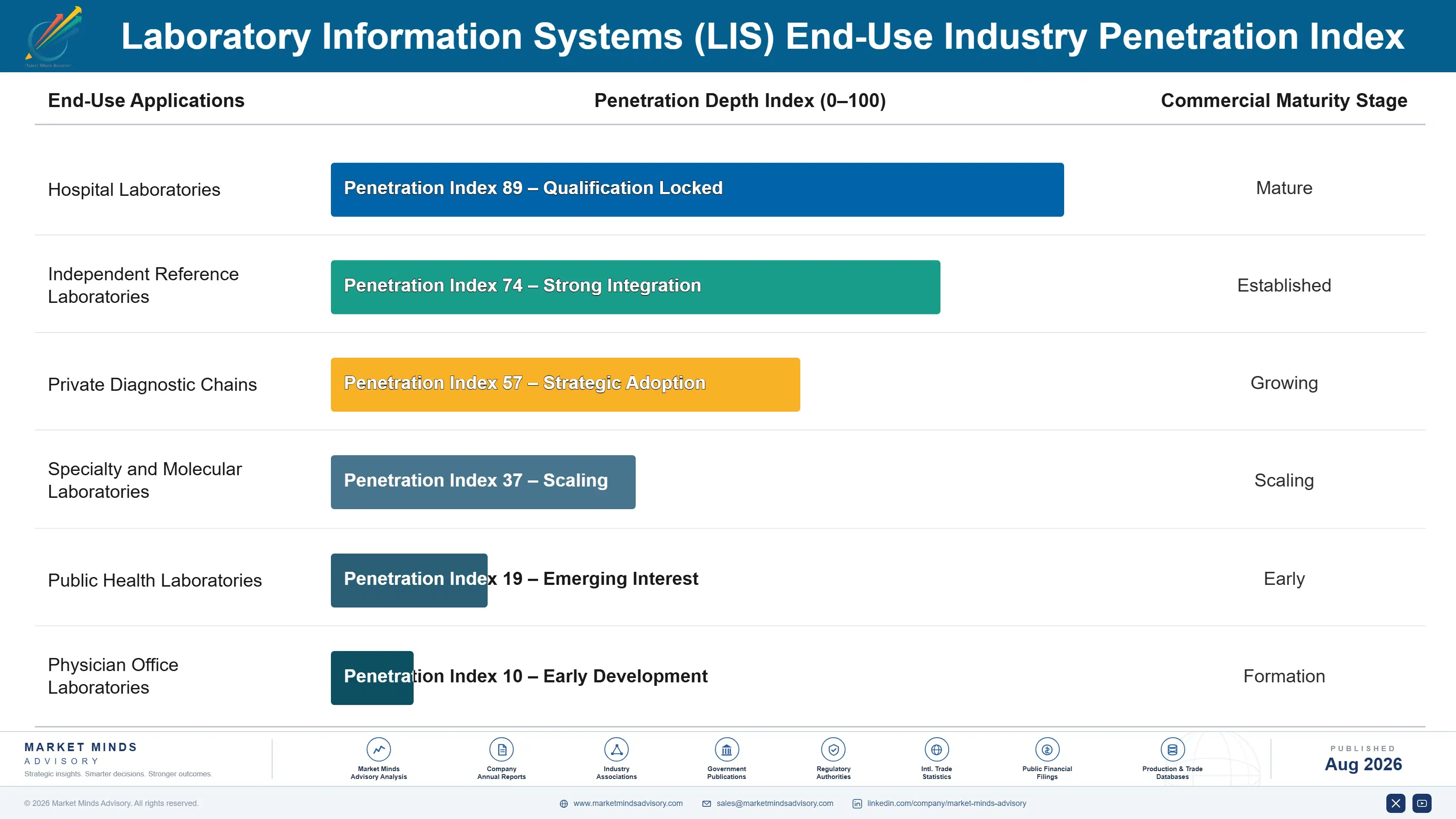
The buyer has changed permanently in hospital settings and not at all elsewhere. Hospital laboratory software is now chosen by information technology leadership weighing institutional integration, while reference laboratories, private diagnostic chains and public health laboratories still decide through laboratory directors evaluating workflow and turnaround. Those two buyers respond to entirely different arguments, and vendors addressing both with one commercial approach reach neither convincingly.
laboratory-information-systems-market-end-use-penetration-index-1787305697636

Where Value Actually Sits

These are among the four positions where our research anticipates prominent divergence between winners and laggards over the coming forecast period. Each is grounded in the demand model, the regulatory perimeter, and the announced capacity pipeline.
01 / ATTACHMENT SELLING DISCIPLINE

Sell beside the incumbent rather than against it

Replacement cycles run near eleven years and implementations take fourteen months, so competing for displacement means waiting most of a decade for a contest that enterprise bundling increasingly decides elsewhere. Specialty modules that attach to an existing platform avoid interface revalidation, bedside staff retraining and capital approval entirely. Vendors that sell this way reported sales cycles running roughly 60% shorter than replacement bids demanded, and the incumbent relationship becomes a route into the account rather than a barrier to it.
02 / CONTESTABLE ACCOUNT TARGETING

Chase the laboratories no enterprise contract covers

Reference laboratories, private diagnostic chains, independent specialty laboratories and public health laboratories all sit outside every hospital enterprise agreement, so laboratory leadership still evaluates laboratory capability directly and still makes the decision. Those account types now hold the clear majority of genuinely contestable revenue in this market, despite representing well under half of the installed base worldwide. Commercial effort spent on bundled hospital accounts goes into contests that procurement structure had already decided long before any specialist vendor arrived to compete for them.
03 / PATHOLOGY LAYER POSITION

Take the image layer before standards settle

Digital pathology compounds at 12.6% and the enterprise records vendors have not yet competed in it with any seriousness at all, which leaves the most defensible ground in this market temporarily open to whoever moves. Image management, viewing workflow and integration with clearance-holding artificial intelligence tools all demand storage and software architecture that general laboratory systems cannot assemble quickly. Once a pathology department standardises its slide workflow, replacing that system proves every bit as slow and disruptive as replacing a core laboratory platform.
04 / CURATION AS PRODUCT

Fund variant curation like a product, not overhead

Molecular software selection turns increasingly on how recently the variant knowledge base was curated, because interpretation quality depends directly on evidence currency rather than on any software feature a vendor can build. Laboratories interviewed identified curation lag as their single primary trigger for switching vendors at all, which makes this an ongoing operating commitment rather than a development milestone anyone reaches. Participants that fund curation continuously and visibly hold their accounts considerably longer than those treating it as a background overhead cost.

Engagement Snapshot From the Field

A live engagement with an industry participant carrying material or product regulatory and market exposure ahead of a defining policy shift, showing how our research translates into a defensible multi-year portfolio strategy.
MARKET MINDS ADVISORY · CLIENT ENGAGEMENT SUMMARY
Laboratory Information Systems (LIS) Producer Strategic Portfolio Review and Transition Roadmap 2026·Investment Scenario on Laboratory Information Systems (LIS) Exposure Evaluation 2025-26
CLIENT PROFILE
A laboratory informatics vendor with annual revenue near $190 million (client-reported, unverified by MMA), holding roughly 700 laboratory installations concentrated in mid-sized hospitals across two regions. The business had lost several accounts to enterprise records bundling over three years without ever being invited into an evaluation, and leadership wanted to understand whether the hospital segment could be defended or whether commercial focus should move entirely.
STRATEGIC CHALLENGE
Every hospital account loss had followed the same pattern: an enterprise records decision made at institutional level with no laboratory software evaluation at all. The company needed to know how much of its installed base sat under that risk, whether specialty modules could hold accounts the core platform would lose, and which account types remained genuinely contestable.
MMA APPROACH
We classified the entire installed base by enterprise records vendor presence and contract renewal timing, then interviewed 38 laboratory directors and 14 hospital information technology leaders on how the decision actually gets made. Specialty module attachment rates were benchmarked against comparable vendors. We modelled a hospital defence strategy against a redirection toward reference and specialty accounts.
KEY FINDINGS
  1. Roughly 54% of the hospital installed base sat in institutions running an enterprise records platform with a laboratory module available, and every one of those accounts was at risk without a competitive event.
  2. Laboratory directors in those institutions had almost no influence over the decision, and 29 of 38 described learning about it after the enterprise contract was already signed.
  3. Accounts holding two or more specialty modules retained at roughly three times the rate of core-only accounts, because pathology and molecular workflows survived the enterprise migration intact.
  4. Reference laboratories and private diagnostic chains showed no bundling exposure at all and evaluated on laboratory capability, but represented only 18% of the current installed base.
CLIENT PROFILE
A laboratory informatics vendor with annual revenue near $190 million (client-reported, unverified by MMA), holding roughly 700 laboratory installations concentrated in mid-sized hospitals across two regions. The business had lost several accounts to enterprise records bundling over three years without ever being invited into an evaluation, and leadership wanted to understand whether the hospital segment could be defended or whether commercial focus should move entirely.
STRATEGIC CHALLENGE
Every hospital account loss had followed the same pattern: an enterprise records decision made at institutional level with no laboratory software evaluation at all. The company needed to know how much of its installed base sat under that risk, whether specialty modules could hold accounts the core platform would lose, and which account types remained genuinely contestable.
MMA APPROACH
We classified the entire installed base by enterprise records vendor presence and contract renewal timing, then interviewed 38 laboratory directors and 14 hospital information technology leaders on how the decision actually gets made. Specialty module attachment rates were benchmarked against comparable vendors. We modelled a hospital defence strategy against a redirection toward reference and specialty accounts.
KEY FINDINGS
  1. Roughly 54% of the hospital installed base sat in institutions running an enterprise records platform with a laboratory module available, and every one of those accounts was at risk without a competitive event.
  2. Laboratory directors in those institutions had almost no influence over the decision, and 29 of 38 described learning about it after the enterprise contract was already signed.
  3. Accounts holding two or more specialty modules retained at roughly three times the rate of core-only accounts, because pathology and molecular workflows survived the enterprise migration intact.
  4. Reference laboratories and private diagnostic chains showed no bundling exposure at all and evaluated on laboratory capability, but represented only 18% of the current installed base.
RECOMMENDED STRATEGY
Phase 1: Phase one: drive specialty module attachment across the at-risk hospital base, targeting pathology and molecular where the enterprise module cannot follow the workflow. Phase 2: Phase two: redirect new business effort toward reference laboratories, private diagnostic chains and public health laboratories, where the decision remains a laboratory one. Phase 3: Phase three: invest product development in the pathology image layer, the segment with the widest capability gap against enterprise records competitors.
OUTCOME
Specialty attachment across the at-risk base rose from 1.4 to 2.2 modules per account within a year, and account losses fell by roughly half (client-reported, unverified by MMA). Two reference laboratory wins delivered contract values several times the hospital average. Pathology development was funded at the expense of core platform enhancements.

Frequently Asked Questions

Foundational context covering the market sizes, CAGR, scope, country, region and competition that inform every finding below. This section is provided to cover basics and most often pre-purchase conversations, answered from the MMA Primary Research Dataset.

What is the current size of the Laboratory Information Systems (LIS) Market?

The global market is valued at $2.6 billion in 2025, rising to $2.82 billion in 2026. North America holds 38% of that value, reflecting billing and compliance layers other health systems do not require.

How large will the Laboratory Information Systems (LIS) Market be by 2036?

MMA forecasts $6.31 billion by 2036, an increase of $3.49 billion over the 2026 base and an expansion multiple of 2.24x. Specialty domains rather than core hospital systems carry most of that growth.

What is the CAGR for the Laboratory Information Systems (LIS) Market 2026 to 2036?

The base case compound annual growth rate is 8.4%, with a bull case at 9.6% and a bear case at 7.2%. Historical growth from 2020 to 2025 ran near 7.2% while the competitive structure changed underneath it.

Which segment is growing fastest?

Anatomic and digital pathology systems compound at 12.6%, a full 1.50x the market rate. Whole slide imaging created storage, viewing and workflow requirements that general laboratory systems were never designed to carry.

Who are the major companies in the Laboratory Information Systems (LIS) Market?

Epic Systems, Oracle Health, Clinisys, Sysmex and Dedalus together hold 52% of laboratories under contract. The first two reach laboratories through enterprise records agreements rather than laboratory evaluations.

Which country is growing fastest?

China compounds at 11.8%, faster than any other country covered, as provincial hospitals digitise laboratory operations using domestically developed systems. Tertiary hospitals completed that transition over the previous decade.

Report Segmentation Architecture

The full report scope spans multiple orthogonal segmentation dimensions, with cross-tabulated demand data provided for each dimension pair. Coverage extends further to regional breakdowns, trend trajectories, and the competitive detail needed to support segment-level decision-making.

By Software Application Class

  • Core Clinical Laboratory Information Systems
  • Anatomic and Digital Pathology Systems
  • Molecular and Genomics Laboratory Software
  • Instrument Middleware and Connectivity
  • Laboratory Outreach and Billing Software
  • Blood Bank and Transfusion Management Systems

By End-Use Industry

  • Hospital Laboratories
  • Independent Reference Laboratories
  • Private Diagnostic Chains
  • Specialty and Molecular Laboratories
  • Public Health Laboratories
  • Physician Office Laboratories

By Commercial Dimension

  • Enterprise Records Bundled Supply
  • Direct Laboratory Subscription Sales
  • Public Tender Procurement
  • Instrument Manufacturer Channel
  • Specialty Module Attachment
  • Reseller and Implementation Partners

By Region

  • East Asia
  • North America
  • Western Europe
  • South Asia and Pacific
  • Latin America
  • Middle East and Africa
  • Eastern Europe

Scope, Methodology, and Coverage

Every figure in this report is reproducible from documented input assumptions. The scope below maps the historical period, the forecast horizon, the segmentation dimensions, and the countries covered, alongside the underlying primary and qualitative methodology.
Historical Period
2020 to 2025
Forecast Period
2026 to 2036
Base Year
2025 (USD billions; MMA Primary Research Dataset, August 2026)
Market Definition
This market comprises clinical laboratory informatics software, measured at vendor revenue across enterprise records bundled supply, direct laboratory subscription sales, public tender procurement, instrument manufacturer channels, specialty module attachment within existing accounts, and reseller or implementation partner distribution. Coverage spans core clinical laboratory information systems handling chemistry, haematology, microbiology and immunology workflow, anatomic and digital pathology systems including whole slide image management and case workflow, molecular and genomics laboratory software covering sequencing workflow and variant interpretation and reporting, instrument middleware and connectivity connecting analysers to laboratory systems, laboratory outreach and billing software covering client billing, requisition management and payer claims, and blood bank and transfusion management systems. Research and industrial laboratory information management systems serving pharmaceutical, food, environmental and materials testing, electronic health record platforms outside their laboratory modules, analyser and scanner hardware, reagent and consumable supply, standalone bioinformatics pipelines used in research settings, and laboratory automation track hardware fall outside scope.
Quantitative Units
USD millions (current prices); laboratories under contract; installations by laboratory type; subscription revenue per laboratory; specialty module attachment rate; implementation cycle length; platform replacement interval
Segmentation Dimensions
By Software Application Class; By End-Use Industry; By Commercial Dimension; By Region
Regions Covered
East Asia, North America, Western Europe, South Asia and Pacific, Latin America, Middle East and Africa, Eastern Europe
Countries Covered
United States, Canada, China, Japan, South Korea, Taiwan, Germany, United Kingdom, France, Italy, Spain, Netherlands, Belgium, Sweden, Switzerland, India, Australia, Singapore, Thailand, Malaysia, Indonesia, Brazil, Mexico, Chile, Argentina, Colombia, Saudi Arabia, United Arab Emirates, South Africa, Poland, Czechia, Hungary, Romania, Turkey, and additional markets relevant to laboratory informatics analysis
Key Companies Profiled
Epic Systems, Oracle Health, Clinisys, Sysmex, Dedalus, Siemens Healthineers, Roche Diagnostics, Beckman Coulter, Orchard Software, SCC Soft Computer, Meditech, Altera Digital Health, InterSystems, CompuGroup Medical, Data Innovations, Xifin, Psyche Systems, Sectra, Proscia, Technidata
Quantitative Methodology
Primary survey, n=3,800 respondents, Q4 2025, six countries; demand-side model with trade association cross-validation
Qualitative Methodology
47 expert interviews, Q4 2025; applied to validate demand model assumptions, identify emerging dynamics, and assess competitive positioning
Report Format
PDF and XLSX data workbook (Word format preview document)
Publisher
Market Minds Advisory
Report Code
MMA-2026-TEC-451
Published
August 2026
Contact
sales@marketmindsadvisory.com | www.marketmindsadvisory.com

Purchase the full Laboratory Information Systems (LIS) Market Report (2026 to 2036).

The full MMA report explains why the laboratory stopped choosing its own software and what commercial ground remains for vendors that cannot bid a bundled enterprise decision. It sizes six application classes and seven regions to 2036, modelling laboratories under contract, installations by laboratory type, revenue per laboratory, module attachment and replacement intervals separately. Competitive assessment covers twenty vendors on one consistent basis of laboratories under contract. Cost exposure is traced through engineering, implementation and image storage. Four commercial levers and a strategic verdict close the report, grounded in 47 expert interviews and a 3,800-respondent survey.
Six application classes sized separately through 2036
Enterprise bundling exposure mapped by laboratory type
Specialty module attachment rates benchmarked across vendor bases
Twenty vendors assessed on laboratories under contract
Digital pathology capability gaps quantified against enterprise modules
Anonymised vendor engagement with tested commercial recommendations

Built For The People Who Decide

From boardroom strategy to bench-side execution, this report is read cover-to-cover by leaders shaping the next decade of their industry, turning demand scenarios, market dynamics and valuation benchmarks into decisions.
CXOs/ Presidents/ VPs/ Managers
M&A and Corporate Development
Strategy Teams and R&D Heads
Procurement and Product Directors
Regulatory and Compliance Leaders
Investor Relations and Equity Analysts