Market Minds Advisory
Kosher-Certified Cosmetic Colorant Systems for Global Brands Market

Kosher-Certified Cosmetic Colorant Systems for Global Brands Market: Kosher-Certified Cosmetic Colorant Systems for Global Brands: Carrier Chemistry, Audit Trails and Clean-Label Proxy Demand, 2026 to 2036

The pigment almost never fails certification in this market. The dispersant does, and most of the brands paying the premium for that certification hold no religious interest in it whatsoever.

Lead Analyst

Published

September 2026

Make Smarter Decisions with Customized Research Insights

Request a free sample report and evaluate market opportunities, growth trends, and competitive dynamics relevant to your business needs.

2025 MARKET VALUE$0.6BMarket Size 2025
2036 FORECAST VALUE$1.6BBase Case , 2026 to 2036
CAGR 2026 TO 20368.6 %Bull 9.8% / Bear 7.4%
INCREMENTAL OPPORTUNITY$0.9BNet 10- year value creation
EXPANSION MULTIPLE2.29x2036 value over 2026 base
Strategic Levers
M&A Pipeline
Regional Outlook
Country Rankings
Competitive Intelligence
Segmental Deep-dive
Call-Us : 91 93563 13602

Executive Snapshot and Market Trajectory.

Certification in this market almost never fails on the pigment. It fails on the carrier, because 61% of rejections trace to dispersants, stearates, and glycerin derivatives that may have started life as animal tallow. Only 23% of cosmetic pigment plants hold the certification, and that scarcity supports the price.
Plant derived and botanical colorants grow at 12.9%, half again the market rate of 8.6%, since a botanical route sidesteps the carmine problem entirely and carmine is the single largest kosher exclusion in cosmetic colour. Microbial and fermentation derived systems follow at 11.6%, though the fermentation medium itself needs certifying, which surprises a good number of newcomers to this trade. Certified mineral oxides raise no origin question and grow far more slowly than either.
About 78% of buyers specifying the mark have no religious requirement at all. They read it as an audit trail covering animal origin, shared equipment, and traceability, which is precisely what it is. That reading has done more for demand than observant consumption ever did, and nobody in the supply chain says so out loud. Certified capacity is scarce enough that the mark also functions as a supply barrier.
Market Definition
This market covers colorant systems for cosmetic use that carry current kosher certification, including certified organic synthetic pigments and lakes, inorganic mineral pigments and oxides, plant derived and botanical colorants, effect and pearlescent pigments, carbon black and charcoal based colorants, and microbial and fermentation derived colorants. It excludes food and pharmaceutical colorants, uncertified colorant chemistry, finished cosmetic products, and halal-only certified systems.
Base Year Value
$0.6B in 2025 (MMA Primary Research Dataset, September 2026)
Forecast Period
2026 to 2036, eleven discrete annual values
CAGR
8.6% base case. Bull 9.8%. Bear 7.4%.
Fastest Growth Segment
Plant Derived And Botanical Colorants: 12.9% CAGR
Fastest Growth Country
India: 12.4% CAGR
Fastest Growth Region
South Asia and Pacific: 10.7% CAGR
Largest Region
North America: 31% of 2025 global value
Market Leaders
Sun Chemical, Merck KGaA, Sensient Technologies, Eckart, and Kobo Products lead the field. Source: MMA Primary Research Dataset, July 2026.
Primary Survey
n=3,800 procurement and R&D decision-makers, Q4 2025, six countries
Methodology
Demand-side build-up, cross-validated against public data, 47 expert interviews

Kosher-Certified Cosmetic Colorant Systems for Global Brands Market Forecast Scenarios

kosher-certified-cosmetic-colorant-systems-for-glo-size-forecast-scenario-1790013404880
Between 2020 and 2025 the category grew at 7.3% on a demand shift nobody in certification planned for. Clean-label scrutiny pushed brands toward supply chains with documented animal-origin status, and the kosher mark already provided exactly that documentation at scale. Certification volume grew fastest among brands with no observant customer base to serve at all.
The base case at 8.6% rests on three mechanisms. Global brands consolidate toward single certified supply chains so one formulation ships into every market without reformulation. Carmine replacement continues pushing red and pink shade demand toward botanical and synthetic routes that certify cleanly. And Indian and Chinese pigment manufacturers pursue certification to enter global brand supply chains they were previously locked out of entirely. None of the three depends on observant consumption growing at all.
The bull case at 9.8% depends on vegan claims and kosher certification converging into a single documented animal-origin standard that brands can audit once. The bear case at 7.4% is certification body capacity: plant inspections run on roughly 12 month cycles, auditors are scarce, and a manufacturer waiting eighteen months for a first certification simply loses the programme to somebody already listed.

Where Certification Actually Fails

The colour molecule is rarely the issue. Iron oxides, titanium dioxide, and most certified organic pigments are mineral or petrochemical in origin and raise no question at all. What fails is everything the pigment is suspended in: the stearates, the glycerin, the fatty acid esters and the wetting agents, any of which may derive from animal tallow depending on which plant made them that month.
TOP FIVE CONCENTRATION34%Share of category revenue held by the leading suppliers
CERTIFIED PLANT SHARE23%Cosmetic pigment plants holding current kosher certification worldwide
DISPERSANT FAILURE RATE61%Certification failures traced to carrier rather than to pigment
NON-OBSERVANT PURCHASE SHARE78%Buyers choosing the mark as a general purity proxy
CERTIFICATION AUDIT INTERVAL12 monthsTypical period between plant inspections by certifying bodies
PRICE PREMIUM OVER BASE17%Uplift certified systems command against uncertified equivalent chemistry
Carmine is the honourable exception, and it is a large one. Derived from cochineal insects, it is the strongest red available in cosmetic chemistry and it cannot be certified under any circumstances. That single exclusion drives most of the botanical and synthetic red development in this market, and it is why replacement chemistry sits at the fastest growing end of the segmentation.
Shared equipment is the third failure route and the most expensive to fix. A dispersion line that has run an uncertified carrier requires documented cleaning verified by an inspector before certified production resumes, which means certification is really a manufacturing discipline rather than a formulation choice. Only about 23% of cosmetic pigment plants currently hold it, and that scarcity is what supports the premium.
"Nobody fails on the pigment. They fail on the stearate that arrived from a plant that also processes tallow, and they usually find out at the audit rather than at the specification stage. The mark has become a general animal-origin audit trail, and roughly four buyers in five are purchasing it for exactly that."
Practice Director, Specialty Chemicals and Personal Care Ingredients · MMA Chemicals and Materials Practice · September 2026

Market Trends

Kosher Marks Now Serve As Animal-Origin Audit Trails

Roughly 78% of buyers specifying certified colorant systems have no observant customer base whatsoever. They use the mark because it documents animal origin, shared equipment handling, and batch traceability in a form that has been audited by a third party for decades. Vegan certification schemes cover similar ground with far less established audit infrastructure behind them. Brands consolidating supply chains increasingly treat the two as interchangeable evidence for the same underlying question. Nobody in the supply chain states the position that plainly, since the religious framing remains the conventional way to present the certification
Market Impact: Premium reaches 17% uplift

Carmine Exclusion Drives Botanical Red Development

Carmine comes from cochineal insects, delivers the strongest red available in cosmetic chemistry, and cannot be certified under any interpretation. That single exclusion has pushed development toward beetroot, anthocyanin, and synthetic nature-identical alternatives across lip and cheek applications where red performance matters most. Botanical colorants grow at 12.9% partly on this pressure alone. None of the alternatives yet matches carmine on chroma at equivalent loading, which is the honest technical position. Formulators frequently accept a compromise on chroma rather than reformulating the whole shade family around a weaker red. Matched shade development commands margin for that reason.
Market Impact: Country grows at 12.4%

Market Opportunities and Growth Drivers

Global Brands Consolidate Toward Single Certified Supply Chains

A brand holding one certified colorant specification ships the same formulation into every market without reformulating for regional animal-origin requirements, which removes both inventory complexity and regulatory review from each launch. That consolidation pulls certification demand upstream to pigment and dispersion suppliers who previously served regional accounts. The 17% premium certified systems command is comfortably absorbed by brands who save considerably more on reformulation and stock keeping unit reduction. Regulatory review cycles shorten as well, since one documented animal-origin position answers questions across every jurisdiction rather than requiring a separate submission for each market entered.
Market Impact: Causes 61% of failures

Indian Pigment Manufacturers Pursue Certification For Access

Indian growth of 12.4% leads every country covered, driven by domestic pigment manufacturers seeking certification specifically to enter global brand supply chains that previously excluded them on documentation grounds rather than on quality. Certification has become the entry ticket to accounts these producers could already serve technically. Chinese manufacturers are following the same route at slightly lower pace, and both groups compete directly against established Western suppliers on certified product. Certification cost is modest against the account value it opens, which is why the route has attracted producers who previously saw no commercial case for pursuing it.
Market Impact: Intervals run 12 months

Market Restraints and Challenges

Carrier Chemistry Causes Most Certification Failures

Around 61% of certification failures trace to dispersants, stearates, glycerin, and fatty acid esters rather than to any pigment, and the root cause is that these carriers are sourced on price from suppliers whose feedstock varies between vegetable and tallow by month. Commercially it means a formulation passing one audit can fail the next without any recipe change. Manufacturers respond by contracting carrier supply with declared origin and by qualifying vegetable-only sources exclusively. The price difference on a declared carrier is trivial against the cost of a suspended listing. Few buy carriers that way.
Market Impact: Covers 78% of buyers

Certification Body Capacity Limits Plant Onboarding

Plant inspections run on roughly 12 month cycles and qualified auditors are genuinely scarce, so a manufacturer seeking first certification can wait well over a year before production is listed. The root cause is that certification bodies grew around food manufacturing and cosmetic chemistry arrived late. Commercially it means capacity cannot respond quickly to demand. Manufacturers respond by certifying dedicated lines ahead of orders and by working with multiple certifying agencies simultaneously. Neither approach shortens the queue for a producer starting from nothing. Cosmetic chemistry reached these agencies long after food manufacturing did,
Market Impact: Segment grows at 12.9%
3 additional market trends, 4 additional growth drivers, and 2 additional restraints and challenges are covered in the full report. Contact sales@marketmindsadvisory.com to access the complete intelligence.

Segment CAGR and Growth Architecture

Segmentation follows colorant chemistry origin across six categories: certified organic synthetic pigments and lakes, inorganic mineral pigments and oxides, plant derived and botanical colorants, effect and pearlescent pigments, carbon black and charcoal based colorants, and microbial and fermentation derived colorants. Dispersion format, application, and certifying body are treated as separate dimensions. Carriers are counted within the colorant system they suspend.
kosher-certified-cosmetic-colorant-systems-for-glo-market-share-analysis-1790013405418

Plant Derived And Botanical Colorants

Botanical colorants grow at 12.9%, half again the market rate of 8.6%, and carmine replacement drives more of that than any general preference for natural chemistry. Beetroot, anthocyanin, annatto, and paprika extracts all certify cleanly and all fall short of carmine on chroma at equivalent loading, which is the technical position the marketing generally avoids stating. Stability under light and pH remains the practical limitation across lip and cheek applications. Extraction solvents and carriers still require certification in their own right, so a botanical origin resolves the pigment question without resolving the system. Formulators generally accept a compromise on chroma rather than rebuilding a whole shade family. Rebuilding the family around a weaker red is rarely commercially viable.
CAGR 12.9%

Microbial And Fermentation Derived Colorants

Fermentation derived colorants grow at 11.6% on a promise of consistent supply that agricultural extraction cannot match season to season. The certification question shifts rather than disappearing: the fermentation medium, the nutrient feedstock, and any downstream processing aid all require the same animal-origin documentation as a conventional carrier does. Producers arriving from industrial biotechnology are frequently unprepared for that, having assumed the organism was the only variable. Scale-up economics remain the harder constraint, and unit costs sit well above synthetic equivalents at current production volumes. Certifying bodies have limited experience with these processes, which lengthens first inspection considerably and adds a timing risk that conventional pigment chemistry does not carry at all.
CAGR 11.6%
Full segment breakdown across 6 segments available in the complete report.

Regional Architecture and Country Demand Map

Regional shares here reflect where certified colorant systems are actually specified and consumed rather than where the pigment chemistry is manufactured, since certification attaches to the plant and then travels with the product. All seven regions sit inside the standard bands for share and growth.

North America

Demand originates here more than anywhere, and the honest reason is that the major certifying agencies are American institutions with decades of audit infrastructure behind them. Brands headquartered here treat the mark as a general animal-origin credential rather than a religious one, which is why 78% of specification comes from buyers with no observant customer base. Growth of 8.2% tracks close to the world rate. Retailer own brand programmes increasingly require the certification as a standing condition of supply. Certification bodies here also hold the deepest cosmetic experience, since the sector approached them earlier than agencies elsewhere and the accumulated audit precedent shortens first inspection meaningfully. Retailer conditions have hardened noticeably over three years.
Share: 31% | CAGR: 8.2% (2026 to 2036)

East Asia

Manufacturing rather than specification drives the region, with Chinese, Japanese, and Korean pigment and dispersion plants pursuing certification to serve brands headquartered elsewhere. Growth of 9.6% exceeds the world rate. Korean colour cosmetic development moves fast enough that certification timelines have become a genuine constraint on launch schedules. Japanese suppliers hold disproportionate strength in effect and pearlescent pigments, where certification is comparatively straightforward given the mineral chemistry involved. Chinese producers have pursued certification hardest of the three, competing directly against Western suppliers on identical documentation at considerably lower prices. Carrier origin control remains the weaker part of that offer, and audit failure rates across the region run above the world average as a result.
Share: 27% | CAGR: 9.6% (2026 to 2036)
Regional intelligence for 5 additional markets available in the complete report: Western Europe, South Asia and Pacific, Latin America, Middle East and Africa, Eastern Europe. Contact sales@marketmindsadvisory.com.
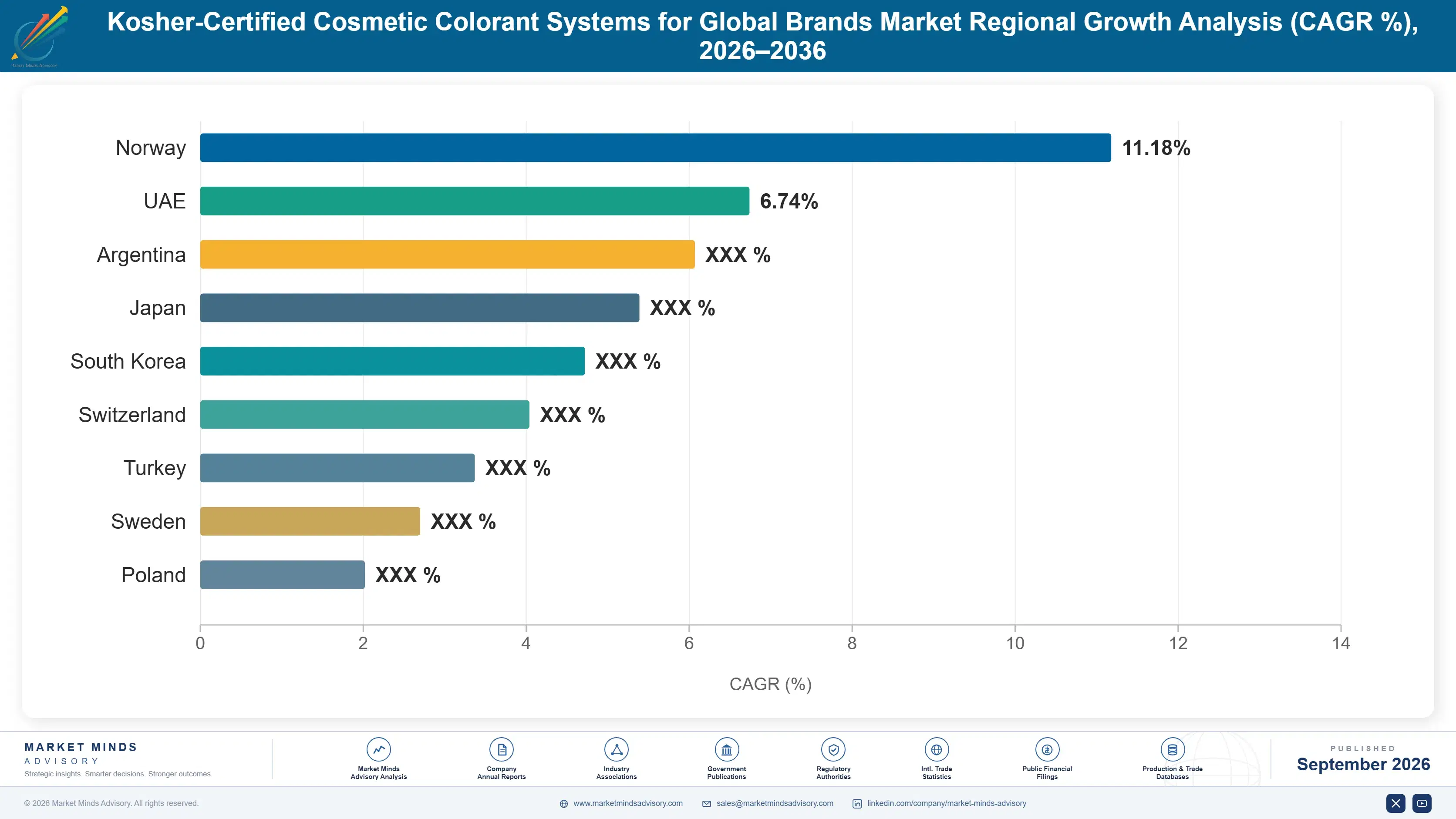
kosher-certified-cosmetic-colorant-systems-for-glo-country-cagr-analysis-1790013405945

Where Suppliers Build Certified Positions

Four commercial moves separate suppliers holding durable certified positions from those treating the mark as a document to obtain once and then forget about entirely. Each addresses the gap between what certification actually audits and what most manufacturers assume it audits at the outset. Two of the four cost almost nothing beyond a change in purchasing discipline.

Contract Carrier Supply With Declared Vegetable Origin

About 61% of certification failures trace to dispersants and stearates whose feedstock varies between vegetable and tallow depending on which month the supplier bought it. Producers contracting carrier supply with declared origin report audit failure rates 4.3 times lower than those buying on price alone. The cost difference on the carrier is small against a failed audit that suspends a listing and takes months of production out of a global brand programme. Most producers still confirm origin per shipment rather than contracting it. Contracting it costs a conversation with the purchasing team and nothing more.
Market Impact: Cuts audit failure rates to 4.3 times lower

Certify Dedicated Lines Ahead Of Demand

Certification bodies inspect on roughly 12 month cycles and qualified auditors are scarce, so a manufacturer starting the process after winning an account frequently loses it before listing completes. Producers certifying dedicated lines speculatively report new programme win rates 2.6 times higher than those responding reactively. It is inventory carrying cost applied to capacity rather than to stock, and it converts certification from a barrier into a selling position. The certified line also becomes a reason for a brand to open the conversation at all, since certified capacity is genuinely scarce across this industry.
Market Impact: Raises new programme win rates 2.6 times higher

Sell The Audit Trail Rather Than The Faith

Roughly 78% of buyers specifying certified colorant systems have no observant customer base and are reading the mark as documented animal-origin assurance. Suppliers positioning it that way explicitly report specification conversion 1.9 times higher than those presenting certification as a religious credential. The honest framing wins because it matches what the buyer actually wants, and it opens accounts that would never respond to the conventional pitch. Presenting certification as a religious credential closes conversations that the documentation framing would have opened, which is a positioning error rather than a product one and costs nothing to correct.
Market Impact: Raises specification conversion rates to 1.9 times higher

Build Carmine Replacement Shade Matching Capability

Carmine cannot be certified under any interpretation and no botanical or synthetic alternative matches it on chroma at equivalent loading, so replacement is a formulation problem rather than a substitution. Suppliers offering matched shade development report project values 2.2 times greater than those supplying pigment alone. The technical service is where the margin sits, since brands attempting the match unaided almost invariably return with a wider brief than they started with. Light and pH stability are where those briefs usually widen. Suppliers holding a matched shade library answer those briefs in weeks rather than months.
Market Impact: Raises average project values to 2.2 times greater

Who Controls the Margin Pool

Concentration is moderate. Five suppliers hold 34% of category revenue, measured consistently on that basis across all participants, and the gap between the global pigment houses and specialist cosmetic colour businesses is wide in scale but considerably narrower in certified product depth. Only about 23% of cosmetic pigment plants hold current certification, which limits the field to a narrow group. Barriers to entry are procedural rather than technical, which is unusual for a chemistry market and explains why certification timing matters more than formulation capability for most entrants.
Competition currently turns on three dimensions: certified plant capacity, which decides whether a supplier can quote a global brand programme at all; carrier origin control, where most audit failures actually happen; and shade matching capability for carmine replacement, which is where formulation service rather than pigment supply generates the margin.

Pressure builds from two directions. Indian and Chinese manufacturers are certifying plants and competing on price with equivalent documentation. Meanwhile vegan certification schemes contest the same claim. Rankings will shift toward suppliers holding certified capacity ahead of demand, since certification cannot be obtained at the speed a programme award requires. Carrier origin control separates the durable positions from the merely certified ones.
kosher-certified-cosmetic-colorant-systems-for-glo-company-positioning-matrix-1790013406469

Competitive Moat and Risk Dimensions

SUN CHEMICAL

Moat: Certified Capacity Across Regions

Certified production across multiple regions lets the business quote global brand programmes that single-site competitors cannot serve without qualifying additional plants first. Certification renews rather than expiring, and the audit history accumulated over years is itself an asset that a newly certified competitor cannot replicate at any speed.
SUN CHEMICAL

Risk: Carrier Sourcing Breadth Exposure

Purchasing carriers across a wide supplier base at scale creates exactly the origin variability that causes most certification failures in this market. Controlling that at the volumes involved requires contracting discipline the business applies unevenly across sites, and a single failed audit suspends a listing rather than merely flagging it.
SENSIENT TECHNOLOGIES

Moat: Botanical Colorant Development Depth

Extraction and stabilisation competence built across food colour development transfers directly into cosmetic botanical systems, which is where the fastest growth sits at 12.9%. That capability took decades to accumulate and it addresses carmine replacement, the single largest certified formulation problem brands currently bring to suppliers.
SENSIENT TECHNOLOGIES

Risk: Botanical Performance Ceiling Persists

No botanical route yet matches carmine on chroma at equivalent loading, and light and pH stability remain genuinely unresolved across lip and cheek applications. A synthetic nature-identical breakthrough from a competitor would undercut the position considerably, and several petrochemical suppliers are working on precisely that.

Players Tracked

Prominent Players

Sun Chemical
Merck KGaA
Sensient Technologies
Eckart
Kobo Products

Other Key Players

BASF
Clariant
Sudarshan Chemical Industries
Koel Colours
Neelikon Food Dyes and Chemicals
DIC Corporation
Toyo Ink SC Holdings
Vibrantz Technologies
Chromatech Incorporated
LANXESS
Venator Materials
ROHA Group
Geotech International
Impact Colors
Kolortek

Recent Developments

FEBRUARY 2026

Sun Chemical Obtains Kosher Certification Across Additional Cosmetic Pigment Lines

Sun Chemical received certification decisions covering additional cosmetic pigment and dispersion lines at two sites, extending the range of certified shades it can supply into global brand programmes. Both sites now hold certification across dispersion as well as pigment production. The carrier handover interrupting the chain is removed.
Signal: Certified capacity is being built ahead of demand rather than in response. Certified capacity is now a selling position.
SEPTEMBER 2025

Sudarshan Chemical Expands Certified Dispersion Capacity In India

Sudarshan Chemical Industries completed an organic capacity expansion for certified pigment dispersion, funded internally with no partner involved, after global brand demand for documented animal-origin supply outran available dedicated line throughput. The expansion covers dedicated certified lines rather than shared equipment, removing the cleaning verification step entirely.
Signal: Indian producers are certifying capacity specifically to contest Western supplier accounts. Documentation rather than chemistry had been the barrier.
MAY 2025

Sensient Technologies Acquires Botanical Colorant Specialist

Sensient Technologies completed an acquisition of a botanical colorant specialist, adding anthocyanin stabilisation competence and carmine replacement shade development to a portfolio previously weighted toward food colour applications. The acquired business brings anthocyanin stabilisation work and a matched shade library. That shade library would have taken years to assemble.
Signal: Carmine replacement capability is being bought rather than developed from scratch. Shade matching capability commands the margin here.

What Certified Colour Costs

Three input groups dominate cost. Pigment chemistry itself runs 34% to 42% of cost of goods sold, and the eight-point range separates commodity iron oxides from effect pigments and botanical extracts. Carriers, dispersants, and stearates take 18% to 26%, with declared-origin vegetable grades at the upper end. Certification, audit, and documentation overhead adds 8% to 14% and falls entirely outside conventional chemical cost structures.
Titanium dioxide and iron oxide pricing moved through 2024 and 2025 alongside energy costs at the mineral processing stage, and several pigment manufacturers described the resulting margin pressure in their annual reports for those years. Vegetable stearate pricing followed palm and coconut derivative markets on a separate path entirely, which matters because declared-origin carriers cannot be substituted with tallow grades when vegetable supply tightens. No equivalent constraint exists elsewhere in pigment purchasing.

The competitive disadvantage mechanism runs through certification overhead rather than through chemistry. A supplier amortising audit and documentation cost across a narrow certified range carries far more burden per kilogram than one running certified production at scale, and the gap widens as certification requirements broaden. Exposure varies by portfolio: broad certified ranges absorb the cost easily while single-product offerings rarely justify it.
kosher-certified-cosmetic-colorant-systems-for-glo-cost-volatility-analysis-1790013406669

Contract Declared-Origin Carriers On Multi-Year Terms

Carriers cause most certification failures because their feedstock alternates between vegetable and tallow depending on what the supplier bought that month. Multi-year contracts specifying declared vegetable origin remove that variability entirely, and the modest price difference is trivial against a suspended listing on a global brand programme. Most producers still verify origin shipment by shipment instead.

Amortise Certification Overhead Across Wider Ranges

Audit and documentation cost is close to fixed per site rather than per product, so a supplier certifying a narrow range carries a far heavier burden per kilogram than one running broad certified production. Extending the certified range is usually cheaper than the arithmetic suggests, since inspection covers the plant. Narrow certified offerings rarely justify the overhead commercially.

Qualify Multiple Certifying Bodies In Parallel

Auditor scarcity means a single certifying relationship can leave a plant waiting well over a year for inspection, which is long enough to lose a programme award entirely. Working with several agencies simultaneously shortens the path considerably and provides continuity if one relationship becomes difficult. Agencies differ in cosmetic experience, and that shows directly in inspection timing.

Portfolio Architecture for Margin Defence

Margin follows how hard the certified position is to replicate. Certified iron oxides and titanium dioxide compete close to commodity terms, since the chemistry raises no origin question and certification is nearly automatic. Effect pigments earn better on manufacturing complexity. Botanical and carmine replacement systems earn most, because the technical service around shade matching carries the value rather than the pigment. The spread across those groups is wider than the chemistry alone would suggest.
The tension between volume and premium runs through whether the supplier sells material or formulation. A certified pigment sold against a specification competes on price with every other certified pigment meeting it. A matched carmine replacement developed with the brand's formulation team competes with nothing, and it embeds the supplier in the next launch as well as this one.

High-value pools concentrate where certification intersects a genuine technical problem: red and pink shades needing carmine replacement, lip products where light stability is unforgiving, and fermentation systems where the medium itself requires documentation. Where certification simply confirms a mineral pigment is what it always was, price decides and the mark adds very little. That divide has held steady as the certified base has grown.

Volume / Commodity-Adjacent

Certified iron oxides, titanium dioxide, and mineral pigments where chemistry raises no origin question and certification is close to procedural. The ten-point range reflects manufacturing scale and certification overhead amortisation rather than any product difference.
Gross Margin: 22% to 32%

Premium / Certified

Certified organic synthetic pigments, lakes, and effect systems where carrier origin control and dispersion quality both matter commercially. The twelve-point range separates suppliers holding contracted declared-origin carriers from those buying on price.
Gross Margin: 36% to 48%

Sustainability / Regulatory / Next-Generation

Botanical, fermentation derived, and carmine replacement systems sold with matched shade development rather than as pigment alone. The sixteen-point range reflects whether formulation service accompanies the material or the brand is left to solve it.
Gross Margin: 52% to 68%
kosher-certified-cosmetic-colorant-systems-for-glo-portfolio-architecture-1790013407167

High-value Sub-segments and Strategic Watch-out

Carmine Replacement Shade Systems

Highest value in the category, addressing the single exclusion that cannot be certified under any interpretation available. The sixteen-point range reflects whether matched shade development accompanies supply or the brand attempts the match unaided. Formulation service rather than pigment supply captures the value. Chroma remains the unsolved technical limit.
Gross Margin: 54% to 70%

Fermentation Derived Colorant Systems

High value growing at 11.6% on supply consistency that agricultural extraction cannot offer season to season. The fourteen-point range reflects scale-up maturity, since unit costs remain well above synthetic equivalents at current production volumes. Medium and feedstock both require their own documentation. Scale-up economics remain the harder constraint.
Gross Margin: 44% to 58%

Certified Effect And Pearlescent Pigments

Volume core where mineral chemistry certifies straightforwardly and manufacturing complexity rather than origin sets the price. The ten-point range reflects coating technology depth and the substrate quality that determines optical performance in finished products. Certification is close to automatic on this chemistry. Optical performance rather than origin sets the premium.
Gross Margin: 34% to 44%

Commodity Certified Mineral Oxides

The strategic watch-out. Certification adds no defensibility where chemistry never raised an origin question, and newly certified Indian and Chinese plants compete directly on identical documentation. The ten-point range reflects scale alone. Nothing about the mark defends this position at all. Newly certified Asian plants compete on identical papers.
Gross Margin: 20% to 30%

How Certified Demand Repeats

Recurring revenue here is unusually sticky because switching a certified colorant means re-auditing a formulation rather than simply comparing prices. A brand that has documented a supply chain to a certifying body's satisfaction will not disturb it for a modest saving, and the documentation itself becomes a barrier working in the incumbent supplier's favour year after year without further effort.
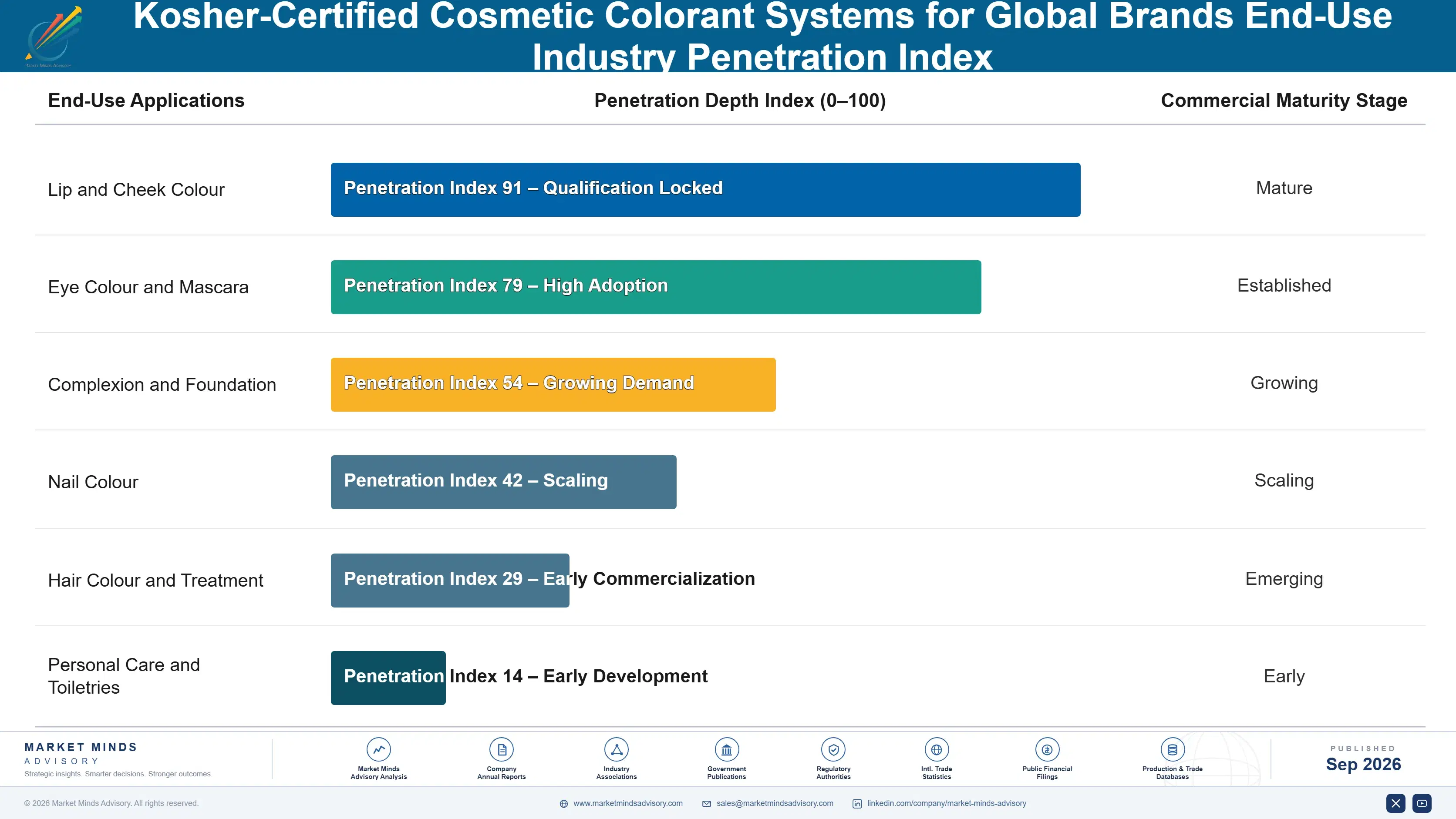
Adoption depth varies sharply by product category. Lip and cheek products require certification most urgently, since carmine exclusion bites hardest exactly where red performance matters. Foundation and complexion products certify almost automatically on mineral chemistry. Nail and hair colour sit at the shallow end, where specification is inconsistent and brands frequently carry certified and uncertified variants of the same shade simultaneously. Specification consistency improves considerably where a single regulatory team owns it.

The buyer profile has shifted decisively away from observance. Certification was once specified by brands serving observant consumers and is now specified overwhelmingly by clean-label positioning teams reading the mark as an animal-origin audit trail. That change has multiplied the addressable base several times over, and it has also made the technical conversation considerably easier for suppliers to open.
kosher-certified-cosmetic-colorant-systems-for-glo-end-use-penetration-index-1790013407684

Where This Market Rewards

These are among the four positions where our research anticipates prominent divergence between winners and laggards over the coming forecast period. Each is grounded in the demand model, the regulatory perimeter, and the announced capacity pipeline.
01 / CARRIER ORIGIN CONTROL

The dispersant fails, never the pigment

Roughly 61% of certification failures trace to dispersants, stearates, and glycerin derivatives whose feedstock alternates between vegetable and tallow by purchasing month. Producers contracting their declared-origin carrier supply on multi-year terms report audit failure rates 4.3 times lower than those buying carriers on price alone. The premium on a declared carrier is trivial against a suspended listing that removes months of production from a global programme, and most producers still verify origin shipment by shipment rather than contracting it properly.
02 / SPECULATIVE CERTIFICATION TIMING

Certify before the account exists

Certification bodies inspect on roughly 12 month cycles, and qualified auditors remain genuinely scarce across cosmetic chemistry rather than the food manufacturing they grew around. Producers certifying dedicated production lines speculatively ahead of demand report new programme win rates 2.6 times higher than those beginning the process after an award. Starting certification when the account is won usually means losing it, because listing completes long after the brand needed supply, and the certified line itself becomes a reason for a brand to make contact.
03 / AUDIT TRAIL POSITIONING

Sell documentation, not religious observance

About 78% of the buyers specifying certified colorant systems have no observant customer base at all, and are reading the mark purely as documented animal-origin assurance across the supply chain. Suppliers positioning the certification explicitly in that way now report specification conversion 1.9 times higher than competitors presenting it as a religious credential instead. The honest framing wins because it describes exactly what the buyer actually wants from the mark, and correcting the framing costs nothing beyond rewriting the sales conversation.
04 / SHADE MATCHING SERVICE

Replacement is formulation, not substitution

Carmine cannot be certified under any interpretation and no botanical or synthetic route matches it on chroma at equivalent loading anywhere in current chemistry. Suppliers offering matched shade development alongside material supply report project values 2.2 times greater than competitors supplying pigment against a written specification alone. Brands attempting the match unaided almost always come back with a considerably wider brief than the one they started out with, usually once light and pH stability testing has run on the first candidate.

Engagement Snapshot From the Field

A live engagement with an industry participant carrying material or product regulatory and market exposure ahead of a defining policy shift, showing how our research translates into a defensible multi-year portfolio strategy.
MARKET MINDS ADVISORY · CLIENT ENGAGEMENT SUMMARY
Kosher-Certified Cosmetic Colorant Systems for Global Brands Producer Strategic Portfolio Review and Transition Roadmap 2026·Investment Scenario on Kosher-Certified Cosmetic Colorant Systems for Global Brands Exposure Evaluation 2025-26
CLIENT PROFILE
A global colour cosmetics brand with annual revenue near USD 1.4 billion (client-reported, unverified by MMA), selling into thirty-one markets across lip, cheek, eye, and complexion categories. Certification requirements had been applied inconsistently across regional formulations, and a supplier audit failure had suspended supply on two lip shades during a launch window. The board wanted the exposure quantified across the whole portfolio.
STRATEGIC CHALLENGE
Procurement treated the failure as a supplier quality issue and had proposed dual sourcing every certified colorant. Nobody had established whether the failure originated in the pigment, the carrier, or the manufacturing line, or whether dual sourcing would have prevented anything at all in the circumstances. The two readings implied entirely different remedies at very different costs.
MMA APPROACH
MMA traced the failed audit to its origin, reviewed certification documentation across all forty-two colorant specifications in the portfolio, mapped carrier origin declarations by supplier and plant, and modelled supply risk under dual sourcing, carrier contracting, and specification consolidation scenarios. Carrier suppliers were traced back to their own feedstock sources, which no previous review had attempted at any point.
KEY FINDINGS
  1. The failure originated in a stearate dispersant whose supplier had switched feedstock from vegetable to tallow between shipments, with no notification and no specification breach involved.
  2. Nineteen of forty-two colorant specifications carried no declared carrier origin at all, leaving the same failure mode open across roughly 45% of the certified portfolio.
  3. Dual sourcing would not have prevented the suspension, since both qualified suppliers purchased carriers from the same regional stearate producer without knowing it.
  4. Consolidating from forty-two specifications to twenty-six would have covered every shade in the range while cutting certification documentation overhead substantially. Shade coverage would have been unaffected by the consolidation.
CLIENT PROFILE
A global colour cosmetics brand with annual revenue near USD 1.4 billion (client-reported, unverified by MMA), selling into thirty-one markets across lip, cheek, eye, and complexion categories. Certification requirements had been applied inconsistently across regional formulations, and a supplier audit failure had suspended supply on two lip shades during a launch window. The board wanted the exposure quantified across the whole portfolio.
STRATEGIC CHALLENGE
Procurement treated the failure as a supplier quality issue and had proposed dual sourcing every certified colorant. Nobody had established whether the failure originated in the pigment, the carrier, or the manufacturing line, or whether dual sourcing would have prevented anything at all in the circumstances. The two readings implied entirely different remedies at very different costs.
MMA APPROACH
MMA traced the failed audit to its origin, reviewed certification documentation across all forty-two colorant specifications in the portfolio, mapped carrier origin declarations by supplier and plant, and modelled supply risk under dual sourcing, carrier contracting, and specification consolidation scenarios. Carrier suppliers were traced back to their own feedstock sources, which no previous review had attempted at any point.
KEY FINDINGS
  1. The failure originated in a stearate dispersant whose supplier had switched feedstock from vegetable to tallow between shipments, with no notification and no specification breach involved.
  2. Nineteen of forty-two colorant specifications carried no declared carrier origin at all, leaving the same failure mode open across roughly 45% of the certified portfolio.
  3. Dual sourcing would not have prevented the suspension, since both qualified suppliers purchased carriers from the same regional stearate producer without knowing it.
  4. Consolidating from forty-two specifications to twenty-six would have covered every shade in the range while cutting certification documentation overhead substantially. Shade coverage would have been unaffected by the consolidation.
RECOMMENDED STRATEGY
Phase 1: Phase one: require declared vegetable origin on every carrier across all certified specifications, contracted rather than confirmed per shipment. Verification per shipment had already proved inadequate. Phase 2: Phase two: consolidate the certified colorant range from forty-two specifications to twenty-six, retaining shade coverage while reducing audit surface. Audit surface falls with every specification removed. Phase 3: Phase three: qualify a second certified supplier holding independent carrier contracts rather than duplicating the existing sourcing pattern. Shared carrier sourcing had defeated the previous plan.
OUTCOME
No further certification failures occurred across the following six quarters (client-reported, unverified by MMA). Specification consolidation cut documentation overhead by roughly a third. Two launches proceeded on schedule that would previously have carried unmanaged supply risk. Procurement now treats carrier origin as the primary certification control rather than supplier count.

Frequently Asked Questions

Foundational context covering the market sizes, CAGR, scope, country, region and competition that inform every finding below. This section is provided to cover basics and most often pre-purchase conversations, answered from the MMA Primary Research Dataset.

What is the current size of the Kosher-Certified Cosmetic Colorant Systems for Global Brands Market?

The market was worth USD 0.6 billion in 2025 and reaches USD 0.7 billion in 2026. Value covers certified colorant systems for cosmetic use across all chemistry origins.

How large will the Kosher-Certified Cosmetic Colorant Systems for Global Brands Market be by 2036?

MMA forecasts USD 1.6 billion by 2036, an increase of USD 0.9 billion across the forecast period. That represents 2.29 times the 2026 base of USD 0.7 billion.

What is the CAGR for the Kosher-Certified Cosmetic Colorant Systems for Global Brands Market 2026 to 2036?

The base case compound annual growth rate is 8.6%, with a bull case at 9.8% and a bear case at 7.4%. Historical growth from 2020 to 2025 ran at 7.3%.

Which segment is growing fastest?

Plant derived and botanical colorants grow at 12.9%, half again the market rate of 8.6%. Carmine cannot be certified, which pushes red and pink development toward botanical routes.

Who are the major companies in the Kosher-Certified Cosmetic Colorant Systems for Global Brands Market?

Sun Chemical, Merck KGaA, Sensient Technologies, Eckart, and Kobo Products lead the category. Together they hold 34% of revenue, with certified plant capacity limiting the wider field.

Which country is growing fastest?

India grows at 12.4%, driven by domestic pigment manufacturers certifying plants specifically to enter global brand supply chains that previously excluded them on documentation grounds.

Report Segmentation Architecture

The full report scope spans multiple orthogonal segmentation dimensions, with cross-tabulated demand data provided for each dimension pair. Coverage extends further to regional breakdowns, trend trajectories, and the competitive detail needed to support segment-level decision-making.

By Colorant Chemistry Origin

  • Certified Organic Synthetic Pigments and Lakes
  • Inorganic Mineral Pigments and Oxides
  • Plant Derived and Botanical Colorants
  • Effect and Pearlescent Pigments
  • Carbon Black and Charcoal Based Colorants
  • Microbial and Fermentation Derived Colorants

By End-Use Industry

  • Lip and Cheek Colour
  • Eye Colour and Mascara
  • Complexion and Foundation
  • Nail Colour
  • Hair Colour and Treatment
  • Personal Care and Toiletries

By Commercial Dimension

  • Global Brand Direct Supply
  • Contract Manufacturer and ODM Supply
  • Retailer Own Brand Programmes
  • Specialty Ingredient Distribution
  • Independent and Indie Brand Supply
  • Formulation and Technical Service Contracts

By Region

  • North America
  • East Asia
  • Western Europe
  • South Asia and Pacific
  • Latin America
  • Middle East and Africa
  • Eastern Europe

Scope, Methodology, and Coverage

Every figure in this report is reproducible from documented input assumptions. The scope below maps the historical period, the forecast horizon, the segmentation dimensions, and the countries covered, alongside the underlying primary and qualitative methodology.
Historical Period
2020 to 2025
Forecast Period
2026 to 2036
Base Year
2025 (USD billions; MMA Primary Research Dataset, September 2026)
Market Definition
This market covers colorant systems for cosmetic use carrying current kosher certification, including certified organic synthetic pigments and lakes, inorganic mineral pigments and oxides, plant derived and botanical colorants, effect and pearlescent pigments, carbon black and charcoal based colorants, and microbial and fermentation derived colorants. It excludes food and pharmaceutical colorants, uncertified chemistry, finished cosmetic products, and halal-only certified systems.
Quantitative Units
USD billions, revenue at supplier selling price
Segmentation Dimensions
Colorant chemistry origin, end-use industry, commercial dimension, region
Regions Covered
North America, East Asia, Western Europe, South Asia and Pacific, Latin America, Middle East and Africa, Eastern Europe
Countries Covered
United States, Canada, Mexico, China, Japan, South Korea, Taiwan, Germany, France, United Kingdom, Italy, Spain, Netherlands, Switzerland, Poland, Czechia, India, Indonesia, Thailand, Australia, Singapore, Brazil, Mexico, Colombia, Chile, Israel, Saudi Arabia, United Arab Emirates, Egypt, South Africa
Key Companies Profiled
Sun Chemical, Merck KGaA, Sensient Technologies, Eckart, Kobo Products, BASF, Clariant, Sudarshan Chemical Industries, Koel Colours, Neelikon Food Dyes and Chemicals, DIC Corporation, Toyo Ink SC Holdings, Vibrantz Technologies, Chromatech Incorporated, LANXESS, Venator Materials, ROHA Group, Geotech International, Impact Colors, Kolortek
Quantitative Methodology
Primary survey, n=3,800 respondents, Q4 2025, six countries; demand-side model with trade association cross-validation
Qualitative Methodology
47 expert interviews, Q4 2025; applied to validate demand model assumptions, identify emerging dynamics, and assess competitive positioning
Report Format
PDF and XLSX data workbook (Word format preview document)
Publisher
Market Minds Advisory
Report Code
MMA-2026-CHM-201
Published
September 2026
Contact
sales@marketmindsadvisory.com | www.marketmindsadvisory.com

Purchase the full Kosher-Certified Cosmetic Colorant Systems for Global Brands Market Report (2026 to 2036).

The full report sizes the kosher-certified cosmetic colorant market across six chemistry origins, seven regions, and thirty countries, with forecasts to 2036 under base, bull, and bear cases. It establishes why most certification failures originate in carriers rather than pigments, quantifies the share of buyers specifying the mark for reasons unrelated to observance, and examines carmine replacement as the category's central formulation problem. Competitive analysis covers twenty participants evaluated consistently on category revenue, with detailed treatment of certified plant capacity and auditor availability. Cost structure, certification overhead, and shade matching service economics are analysed throughout. Primary research includes 3,800 survey responses and 47 expert interviews.
Six colorant chemistry origins sized and forecast separately
Twenty participants evaluated on category revenue consistently
Certification failure modes analysed by carrier and pigment
Carmine replacement chemistry benchmarked on chroma and stability
Certified plant capacity mapped by region and chemistry
Clean-label proxy demand quantified against observant specification

Built For The People Who Decide

From boardroom strategy to bench-side execution, this report is read cover-to-cover by leaders shaping the next decade of their industry, turning demand scenarios, market dynamics and valuation benchmarks into decisions.
CXOs/ Presidents/ VPs/ Managers
M&A and Corporate Development
Strategy Teams and R&D Heads
Procurement and Product Directors
Regulatory and Compliance Leaders
Investor Relations and Equity Analysts