Market Minds Advisory
Knee Reconstruction Devices Market

Knee Reconstruction Devices Market: Robotic Adoption and Revision Volume Growth

Robotic-assisted platforms are becoming the deciding factor in hospital knee implant contracts, as surgeons demonstrate measurably tighter alignment outcomes that push health systems toward capital investment cycles once driven almost entirely by implant pricing alone.

Lead Analyst

Alice Ballenger

Published

September 2026

Make Smarter Decisions with Customized Research Insights

Request a free sample report and evaluate market opportunities, growth trends, and competitive dynamics relevant to your business needs.

2025 MARKET VALUE$9.5BMarket Size 2025
2036 FORECAST VALUE$18.8BBase Case , 2026 to 2036
CAGR 2026 TO 20366.4 %Bull 7.6% / Bear 5.2%
INCREMENTAL OPPORTUNITY$8.7BNet 10- year value creation
EXPANSION MULTIPLE1.86x2036 value over 2026 base
Strategic Levers
M&A Pipeline
Regional Outlook
Country Rankings
Competitive Intelligence
Segmental Deep-dive
Call-Us : 91 93563 13602

Executive Snapshot and Market Trajectory

Hospital orthopedic departments are increasingly tying implant purchasing decisions to robotic-assisted surgical platform access, reflecting genuine surgeon demand for the alignment precision these systems deliver rather than simply chasing a marketing differentiator. Momentum in this shift shows no sign of slowing across most hospital systems tracked.
Robotic-assisted platforms are growing far faster than conventional manual instrumentation, concentrated heavily in North American hospital systems investing in capital equipment, while revision knee procedures are climbing steadily as the first large cohort of early-generation implants placed decades ago reaches the end of its functional service life across major healthcare markets. Buyers everywhere are watching this shift closely as procurement criteria genuinely broaden across markets tracked today.
Five companies hold well over three in four dollars of category revenue, reflecting decades of accumulated surgeon training relationships and regulatory approval history that keep this an unusually concentrated device category. Robotic platform installed base is becoming the most consequential factor determining which supplier captures each hospital's ongoing implant volume. Smaller competitors face growing pressure to differentiate through outcomes data rather than pricing alone entirely today. Buyers confirm no sign of reversing.
Market Definition
The knee reconstruction devices market covers total knee replacement systems, partial knee replacement systems, revision knee systems, patellofemoral replacement systems, and the robotic-assisted surgical platforms and patient-specific instrumentation used to implant them. It excludes general orthopedic surgical instruments not specific to knee procedures, knee braces and non-surgical orthotic devices, and hip or shoulder reconstruction systems sold as separate product lines.
Base Year Value
$9.5B in 2025 (MMA Primary Research Dataset, August 2026)
Forecast Period
2026 to 2036, eleven discrete annual values
CAGR
6.4% base case. Bull 7.6%. Bear 5.2%.
Fastest Growth Segment
Robotic-Assisted Surgical Platforms: 12.8% CAGR
Fastest Growth Country
India: 9.6% CAGR
Fastest Growth Region
South Asia and Pacific: 8.4% CAGR
Largest Region
North America: 32% of 2025 global value
Market Leaders
Zimmer Biomet, Stryker, DePuy Synthes, Smith+Nephew, and Enovis. Source: MMA Analysis based on company annual reports and disclosed segment revenue.
Primary Survey
n=3,800 procurement and R&D decision-makers, Q4 2025, six countries
Methodology
Demand-side build-up, cross-validated against public data, 47 expert interviews

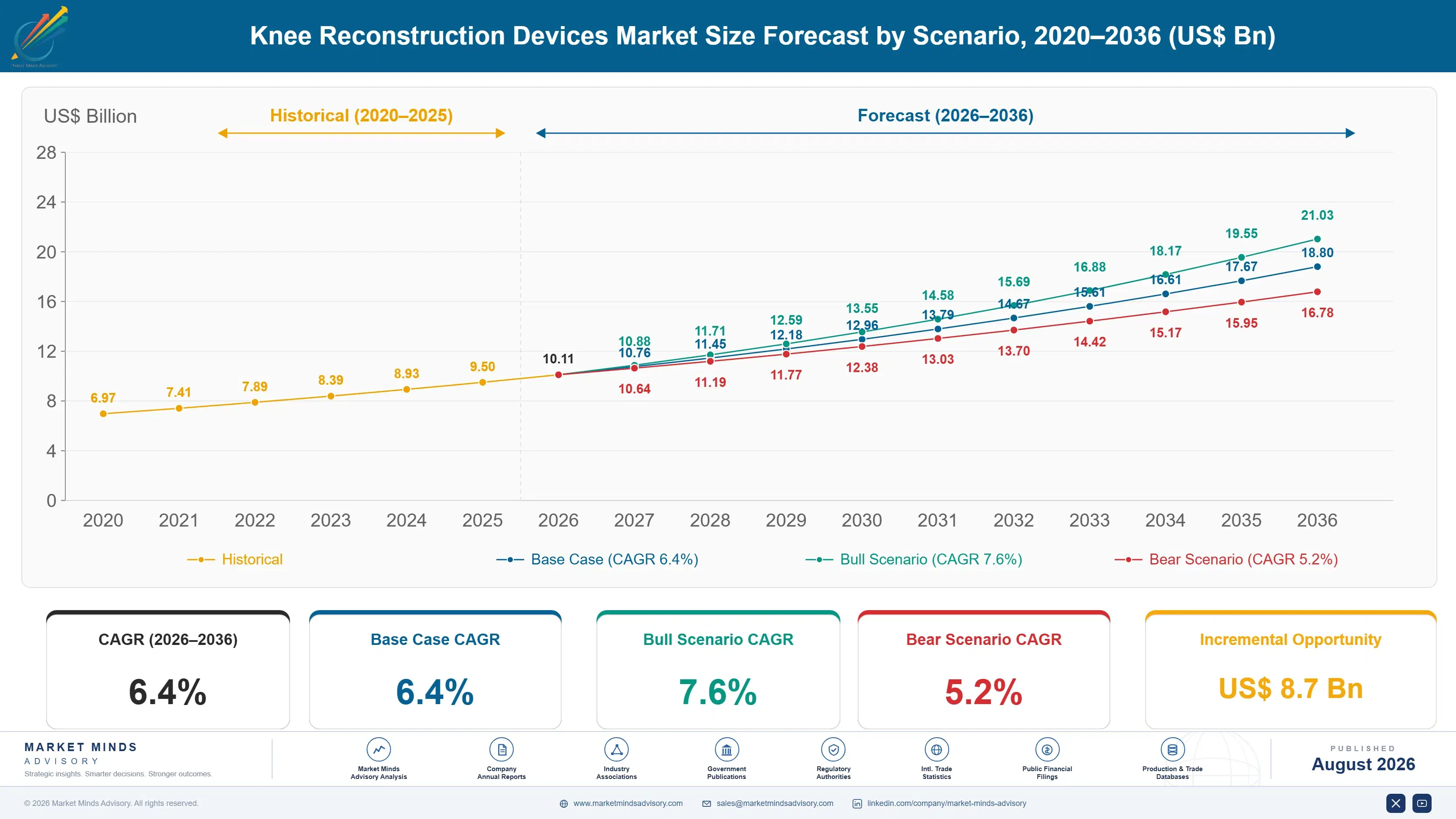
Knee Reconstruction Devices Market Forecast Scenarios

knee-reconstruction-devices-market-size-forecast-scenario-1787305035878
Between 2020 and 2025 the market grew at roughly 5.4% a year, a pace held back early by pandemic-era elective surgery deferrals before accelerating as deferred knee replacement procedures resumed and robotic-assisted platform adoption expanded considerably faster than manufacturers had originally projected across major hospital systems during the recovery period. across most major treatment economies tracked closely.
The base case assumes 6.4% annual growth through 2036, driven by three commercial mechanisms operating together across the industry: robotic-assisted platform adoption displacing manual instrumentation as hospitals invest in alignment precision technology, revision procedure volume climbing steadily as early-generation implants reach end of functional service life, and rising obesity and osteoarthritis prevalence expanding the eligible surgical candidate population across most developed markets. Patient-specific instrumentation adoption adds a fourth complementary growth channel worth tracking closely across the period.
A bull case near 7.7% follows if robotic platform reimbursement and hospital capital investment accelerate faster than currently expected by most industry observers tracking adoption trends closely. A bear case near 5.1% follows instead if hospital capital budgets tighten meaningfully, slowing the pace of robotic platform placement and broader elective surgical volume growth across major healthcare systems.

Robotic Platform Adoption Reshapes Implant Purchasing

Three forces converge on knee reconstruction device procurement this decade: robotic-assisted platform adoption displacing manual instrumentation as hospitals invest in demonstrated alignment precision technology, revision procedure volume climbing steadily as early-generation implants placed decades ago reach the end of their functional service life, and rising obesity and osteoarthritis prevalence expanding the eligible surgical candidate population across most developed healthcare markets tra
MARKET CONCENTRATIONCR5 78%share held by top five companies by disclosed revenue
AVERAGE PROCEDURE COST$28,000-$52,000range spans conventional to robotic-assisted knee replacement surgery
TOP PRODUCING COUNTRYUSA, 33% shareof global knee reconstruction device manufacturing output by value
ROBOTIC PLATFORM PENETRATION34%share of total knee procedures performed using robotic assistance
REVISION PROCEDURE SHARE11%typical functional lifespan before revision surgery is necessary
IMPLANT SERVICE LIFE20-25 yearstypical functional lifespan before revision surgery becomes necessary
Commercial character has shifted from single-implant transactional sales toward hospital-wide capital equipment relationships bundling robotic platform placement, implant supply agreements, and surgeon training into a single multi-year vendor commitment. Hospital systems increasingly select an implant partner during broader orthopedic service line planning rather than purchasing implants as an isolated procurement decision made independently by each surgeon. This bundling approach is becoming the default expectation among large hospital systems negotiating contracts.
Over the next decade, robotic platform installed base expansion, revision procedure growth, and surgeon training investment will keep separating manufacturers with genuine hospital-wide capital relationships from smaller competitors still selling primarily standalone implants into markets where robotic-assisted surgery has not yet become the default expectation among practicing surgeons. Companies investing in evidence generation now are shaping how the whole field evolves going forward.
"A decade ago a hospital chose its knee implant supplier and the robot, if there was one, came along almost as an afterthought. Now the robot decides the implant relationship, and that reversal has completely rewritten how these accounts get won."
Director, Medical Devices Practice · MMA Medical Devices Practice ·

Market Trends

Robotic-Assisted Platforms Become the Default Hospital Expectation

Robotic-assisted knee surgery platforms are increasingly becoming a baseline expectation among orthopedic surgeons rather than a premium differentiator hospitals could once treat as optional capital investment, as accumulated clinical evidence demonstrates measurably tighter implant alignment and component positioning compared to conventional manual instrumentation techniques used historically. Hospital systems report robotic platform access becoming a genuine factor in orthopedic surgeon recruitment and retention decisions, since newly trained surgeons increasingly expect access to the technology as a condition of practice. Manufacturers including Stryker and Zimmer Biomet have expanded robotic platform placement considerably faster than originally projected across most major markets.
Market Impact: Drives 4.8 percent yearly prevalenc
Revision Procedure Volume Climbs as Early Implants Age Out

The large cohort of knee replacement implants placed during the significant volume growth of the 2000s and early 2010s is now reaching the end of its typical twenty-to-twenty-five-year functional service life, driving steadily climbing revision procedure volume that operates largely independent of new primary procedure growth trends affecting the broader category. Revision procedures carry meaningfully higher implant and instrumentation costs than primary procedures, reflecting the additional surgical complexity these cases typically require. Manufacturers report revision system order volume tracking closely with the ageing installed implant base across most major healthcare markets currently.
Market Impact: Adds 3.6 percent capital-investment

Market Opportunities and Growth Drivers

Rising Obesity and Osteoarthritis Prevalence Expands Candidate Pool

Obesity rates continue climbing across major developed markets, directly expanding the osteoarthritis patient population since excess body weight represents one of the strongest risk factors for knee joint degeneration requiring eventual surgical intervention. This demographic and health trend is expanding the addressable surgical candidate population considerably faster than population growth alone would suggest, since a growing share of adults now present with joint degeneration severe enough to warrant surgical evaluation earlier in life than prior generations experienced. Orthopedic practices report growing referral volume from primary care physicians as osteoarthritis awareness and treatment-seeking behaviour both continue expanding broadly.
Market Impact: Limits adoption 14 pct

Hospital Capital Investment in Orthopedic Service Line Expansion

Hospital systems are investing directly in orthopedic service line expansion, including robotic platform capital purchases and dedicated joint replacement surgical suites, recognising the specialty's meaningful contribution margin and predictable elective procedure scheduling compared to less predictable emergency surgical volume that strains broader hospital capacity planning. This investment directly expands the installed base of robotic platforms and dedicated orthopedic capacity, pulling forward implant procurement decisions considerably as hospitals build out comprehensive joint replacement programmes. Manufacturers report capital equipment order volume tracking closely with broader hospital orthopedic service line investment trends across most major healthcare systems currently expanding capacity.
Market Impact: Extends training timelines by 10 pe

Market Restraints and Challenges

Robotic Platform Capital Cost Limits Smaller Hospital Adoption

Robotic-assisted surgical platforms carry a substantial capital cost that many smaller and rural hospital systems find genuinely difficult to justify given lower surgical volume that extends payback timelines considerably compared to high-volume urban academic medical centres. The root cause is that robotic platform economics depend heavily on procedure volume to justify the capital investment, creating a durable cost disadvantage for smaller facilities that cannot spread fixed equipment costs across comparable case volume. Manufacturers are mitigating this by offering per-procedure and leasing pricing models that reduce upfront capital burden, though meaningful access gaps persist across smaller and rural hospital systems broadly.
Market Impact: Adds 12.8 percent segment growth ye

Surgeon Training Requirements Slow Platform Transition

Transitioning an established surgical practice from conventional manual instrumentation to robotic-assisted technique requires genuine surgeon training investment and a meaningful learning curve period during which procedure times and surgeon comfort typically lag mature manual technique performance considerably. The root cause is that robotic-assisted surgery represents a genuinely different technical workflow rather than an incremental refinement of established manual technique, requiring dedicated proctoring and case experience before surgeons feel confident operating independently at full efficiency. Manufacturers are mitigating this by expanding structured training and proctoring programmes considerably across most major hospital systems currently.
Market Impact: Lifts revision procedure share 8 pe
3 additional market trends, 3 additional growth drivers, and 4 additional restraints and challenges are covered in the full report. Contact sales@marketmindsadvisory.com to access the complete intelligence.

Segment CAGR and Growth Architecture

Segmentation follows device type, the dimension that determines surgical approach, implant complexity, and which patient population a given system typically serves, since device category drives both regulatory pathway and hospital purchasing decisions more than any other factor considered by most surgical teams. across most current surgical settings and patient populations. right now overall today.
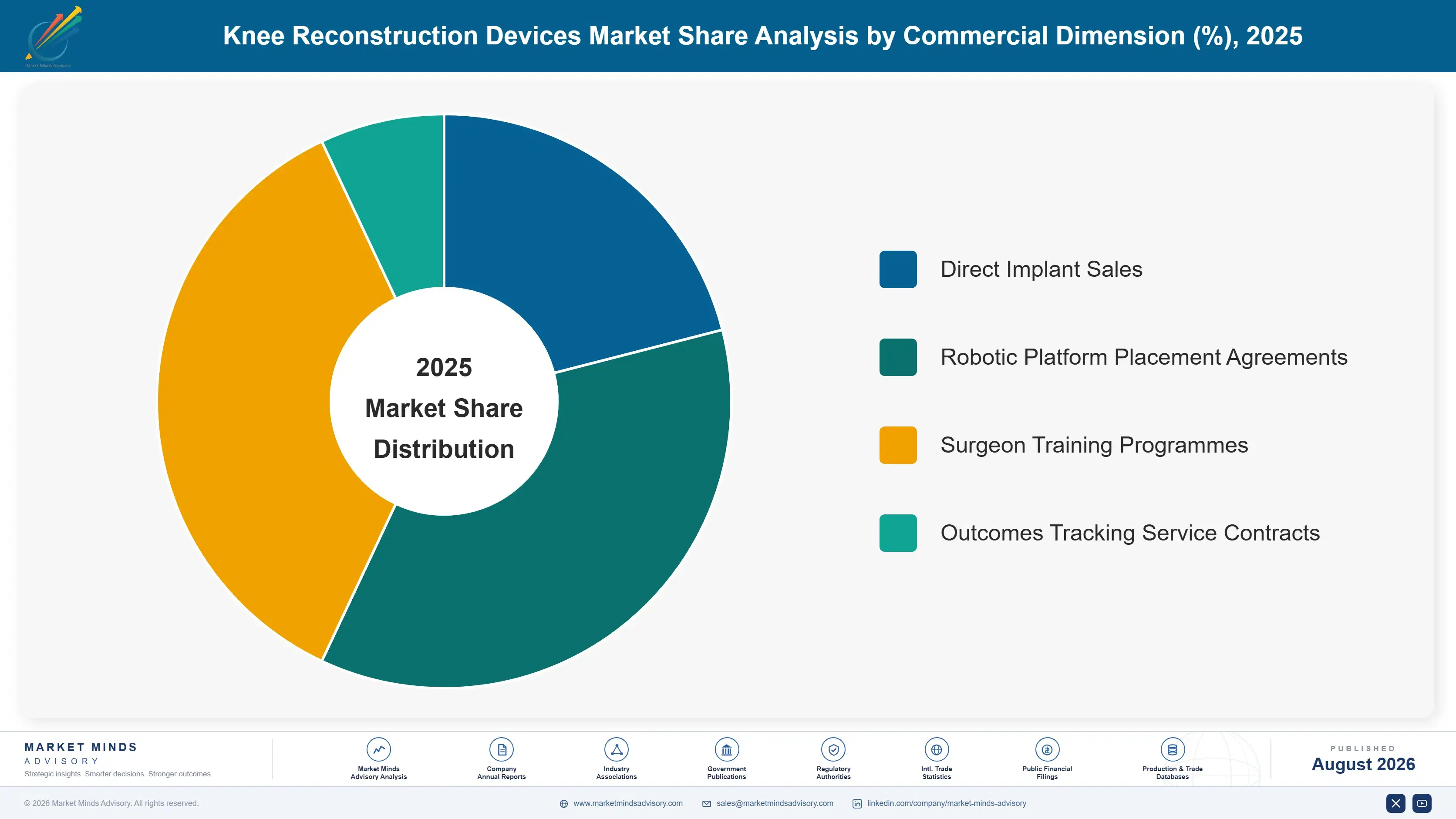
knee-reconstruction-devices-market-market-share-analysis-1787305036413

Robotic-Assisted Surgical Platforms

Robotic-assisted surgical platforms are pulling dramatically ahead as accumulated clinical evidence demonstrates measurably tighter implant alignment and component positioning compared to conventional manual instrumentation techniques used historically across most primary and revision procedures performed. Surgeons increasingly view robotic assistance as a genuine clinical advantage rather than a marketing differentiator, particularly for complex anatomy cases where precise alignment matters most to long-term implant survivorship and patient outcomes. Growth concentrates in North American academic hospital systems first, where capital investment capacity and procedure volume support the technology's meaningful cost premium. Manufacturers including Stryker and Zimmer Biomet have expanded robotic platform development specifically to meet this fast-rising demand, and the segment's growth consistently outpaces every other device category tracked.
CAGR 12.8%

Revision Knee Systems

Revision knee systems form the second-fastest category, driven by the large cohort of knee replacement implants placed during the significant volume growth of the 2000s and early 2010s now reaching the end of their typical twenty-to-twenty-five-year functional service life across most major healthcare markets. Revision procedures require specialised implant components and instrumentation designed to address bone loss and soft tissue compromise that primary procedures never need to consider during initial surgical planning. Growth concentrates in markets with the longest-established joint replacement surgical history first, where the largest cohort of ageing implants creates the most predictable revision procedure demand pipeline for manufacturers and hospital systems to plan capacity around confidently. Manufacturers increasingly design revision-specific lines to capture this predictable demand.
CAGR 8.6%
Full segment breakdown across 6 segments available in the complete report.

Regional Architecture and Country Demand Map

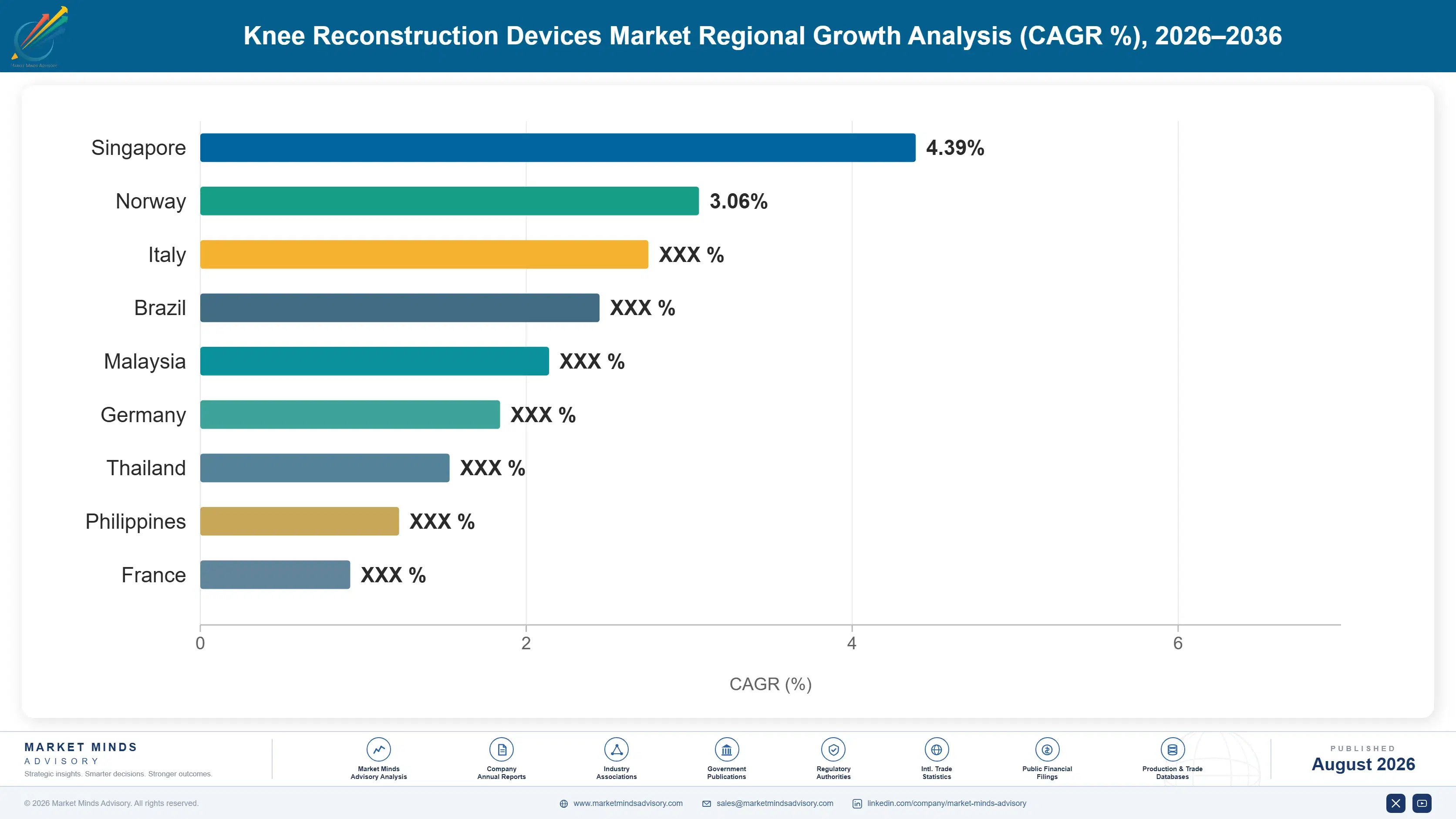
North America leads on both robotic platform adoption and surgical volume, while South Asia and Pacific grows fastest as India's joint replacement infrastructure and medical tourism sector expand rapidly. East Asia and Western Europe both show steady, demographically driven growth. Latin America shows steadier, private-insurance-driven growth patterns.

North America

Robotic-assisted platform adoption forms the dominant demand mechanism here, with US hospital systems increasingly tying orthopedic surgeon recruitment and retention decisions to robotic platform access as newly trained surgeons expect the technology as a condition of practice at their chosen institution. Stryker and Zimmer Biomet, both with substantial domestic manufacturing and hospital relationships, supply the large majority of robotic platforms and implants sold into the region's dense concentration of orthopedic surgical centres nationwide. Rising obesity rates continue expanding the osteoarthritis patient population considerably faster than population growth alone would suggest across most major healthcare markets. Growth here outpaces most developed markets given the sheer scale of both robotic platform investment and surgical volume occurring domestically today.
Share: 32% | CAGR: 7.0% (2026 to 2036)

Western Europe

National health system procurement processes across Germany, France, and the UK increasingly favour robotic-assisted platform adoption as clinical evidence accumulates supporting improved alignment outcomes, driving steady capital investment even as the pace proceeds somewhat more deliberately than in North America given more centralised, publicly funded procurement processes across different national systems. Smith+Nephew, headquartered in the region, supplies a meaningful share of regional demand directly from local manufacturing and distribution infrastructure built specifically to serve European hospital systems. Growth trails North America because robotic platform penetration, while expanding, remains somewhat less advanced than the concentration of adoption already established domestically in the United States market currently across most treatment centres. Regional payers continue closely tracking real-world outcomes as adoption widens further.
Share: 24% | CAGR: 4.9% (2026 to 2036)
Regional intelligence for 5 additional markets available in the complete report: East Asia, South Asia and Pacific, Latin America, Middle East and Africa, Eastern Europe. Contact sales@marketmindsadvisory.com.
knee-reconstruction-devices-market-country-cagr-analysis-1787305036919

Platform Placement, Implant Contracts, and Training Revenue

Manufacturers are shifting revenue toward robotic platform placement agreements, multi-year implant supply contracts, and surgeon training programme fees, capturing more value across the full hospital relationship rather than competing purely on the price of a single implant sold through traditional transactional purchasing arrangements across most healthcare systems today. across the wider manufacturer and hospital community tracked.

Robotic Platform Placement and Implant Tie-In Agreements

Manufacturers including Stryker and Zimmer Biomet are placing robotic platforms in hospitals at reduced or subsidised upfront cost in exchange for multi-year implant supply commitments, converting a capital equipment sale into a recurring implant revenue relationship tied directly to the hospital's procedure volume over the placement agreement term. This lever removes a significant capital budget barrier for hospitals while guaranteeing manufacturers predictable implant volume across the placement agreement duration negotiated with each account. Manufacturers report platform placement agreements now covering roughly 46% of new robotic installations, up considerably from prior years before this model became standard commercial practice.
Market Impact: Covers roughly 46 percent of instal

Surgeon Training and Certification Programme Fees

Manufacturers are charging structured fees for surgeon training and certification programmes that build robotic platform proficiency, addressing the genuine clinical reality that surgeons require dedicated proctoring and case experience before operating independently at full efficiency with new technology. This lever converts what was once a cost centre supporting equipment sales into a genuine revenue stream, while building surgeon loyalty that extends well beyond the initial training relationship established. Manufacturers report certified surgeons showing platform utilisation roughly 26% higher than non-certified surgeons. This gain has held steady across two consecutive years since certification programmes first launched broadly.
Market Impact: Lifts platform utilisation by rough

Patient-Specific Instrumentation Premium Pricing Strategy Approach

Manufacturers are offering patient-specific instrumentation and pre-operative planning services at meaningful price premiums over standard off-the-shelf instrumentation, capturing additional revenue from surgeons and hospitals seeking the precision these customised tools provide for complex anatomy cases requiring careful pre-operative surgical planning across every stage. This lever extends revenue considerably beyond the implant itself, building a comprehensive surgical planning and instrumentation offering around each procedure performed. Manufacturers report patient-specific instrumentation adoption adding roughly 18% to average revenue per complex case. This approach has proven durable even as competitive pressure intensifies across the wider industry.
Market Impact: Adds roughly 18 percent revenue per

Extended Implant Warranty and Outcomes Tracking Services

Manufacturers are introducing extended implant warranty programmes bundled with structured outcomes tracking services that help hospitals demonstrate quality metrics increasingly required by value-based payment arrangements with major payers evaluating orthopedic service line performance across the network. This lever addresses genuine hospital demand for outcomes data supporting payer negotiations, while building manufacturer visibility into long-term implant performance that strengthens future product development. Manufacturers report outcomes tracking programmes adding roughly 15% to hospital contract value. This growth has held steady across two consecutive years since tracking programmes first launched broadly. across most enrolled hospital accounts.
Market Impact: Adds roughly 15 percent to contract

Who Controls the Margin Pool

Five companies hold a combined 78% of revenue on a consistent company-disclosed segment revenue basis, an unusually concentrated level reflecting decades of accumulated surgeon training relationships, regulatory approval history, and robotic platform installed base that keep smaller competitors from easily challenging established leaders directly. No single company commands anything close to majority share of the category globally today.
Current competitive activity centres on three fronts at once: robotic platform installed base expansion racing to capture hospital orthopedic service line investment ahead of competitors, revision system portfolio development targeting the growing ageing-implant patient population, and surgeon training programme investment aimed at building long-term platform loyalty among practicing and newly trained orthopedic surgeons alike. Each front requires meaningfully different capital and manufacturing investment from companies involved.

Pressure is building steadily from mid-tier and regional manufacturers offering competitively priced robotic platforms and implants targeting smaller hospital systems the largest manufacturers have not fully penetrated, a dynamic that could compress established leaders' pricing power meaningfully in price-sensitive markets where hospital capital budgets remain considerably more constrained than at leading academic medical centres. Established leaders are watching this shift closely and adjusting commercial strategy accordingly broadly.
knee-reconstruction-devices-market-company-positioning-matrix-1787305037433

Competitive Moat and Risk Dimensions

ZIMMER BIOMET HOLDINGS INC.

Moat: Broad robotic and implant portfolio

Zimmer Biomet's ROSA robotic platform combined with its extensive implant portfolio gives it cross-selling advantages and hospital relationship depth that narrower specialist competitors find genuinely difficult to match, particularly in comprehensive orthopedic service line contract negotiations valuing broad category coverage from a single vendor relationship.
ZIMMER BIOMET HOLDINGS INC.

Risk: Intense robotic platform competition

Zimmer Biomet faces meaningful competitive pressure from Stryker's earlier-established Mako platform installed base, creating real risk of losing hospital accounts to a competitor with a longer track record and larger existing robotic platform footprint across major healthcare systems. Analysts flag this competitive gap as a genuine watch item across the industry.
STRYKER CORPORATION

Moat: Established robotic platform leadership

Stryker's Mako robotic platform holds the largest installed base and longest clinical track record in the category, giving it accumulated surgeon training relationships and outcomes data that competing platforms cannot replicate quickly regardless of available development capital or technical sophistication brought to newer systems. today.
STRYKER CORPORATION

Risk: Premium pricing under competitive pressure

Stryker prices its robotic platform and implant portfolio toward the upper end of the market, creating exposure if competitors offering comparable clinical outcomes at meaningfully lower total cost of ownership succeed in converting price-sensitive hospital systems away from the established leader. today. across most price-sensitive markets today.

Players Tracked

Prominent Players

Zimmer Biomet Holdings Inc.
Stryker Corporation
DePuy Synthes (Johnson & Johnson)
Smith+Nephew plc
Enovis Corporation

Other Key Players

Medacta International SA
Corin Group
MicroPort Orthopedics (MicroPort Scientific Corporation)
Aesculap (B. Braun Melsungen AG)
Exactech Inc.
Conformis Inc.
Corentec Co. Ltd.
United Orthopedic Corporation
Waldemar Link GmbH & Co. KG
Groupe Lépine
Implantcast GmbH
Meril Life Sciences Pvt. Ltd.
Aequos Endoprothetik GmbH
Naton Medical Group
Limacorporate S.p.A.

Recent Developments

FEBRUARY 2025

Stryker expands Mako robotic platform manufacturing capacity

Stryker announced a manufacturing capacity expansion for its Mako robotic platform, aimed at meeting hospital demand that has outpaced available supply since accelerating adoption began, and export orders from international markets seeking access ahead of broader global commercial availability expansion. nationwide today. nationwide overall today.
Signal: Signals manufacturers are betting robotic
SEPTEMBER 2024

Zimmer Biomet signs platform placement agreement with hospital network

Zimmer Biomet signed a multi-year robotic platform placement agreement with a major US hospital network, bundling ROSA platform installation with implant supply commitments across the network's full orthopedic service line rather than negotiating each facility independently as practiced previously. going forward broadly. nationwide overall today.
Signal: Confirms platform placement bundling is be
MAY 2025

Medacta expands surgeon training programme internationally

Medacta International expanded its surgeon training and certification programme to additional international markets, aimed at building robotic platform proficiency among a broader surgeon base as the company works to compete more directly against the category's established Western manufacturing leaders. Analysts see this as a durable trend.
Signal: Shows mid-tier manufacturers investing hea

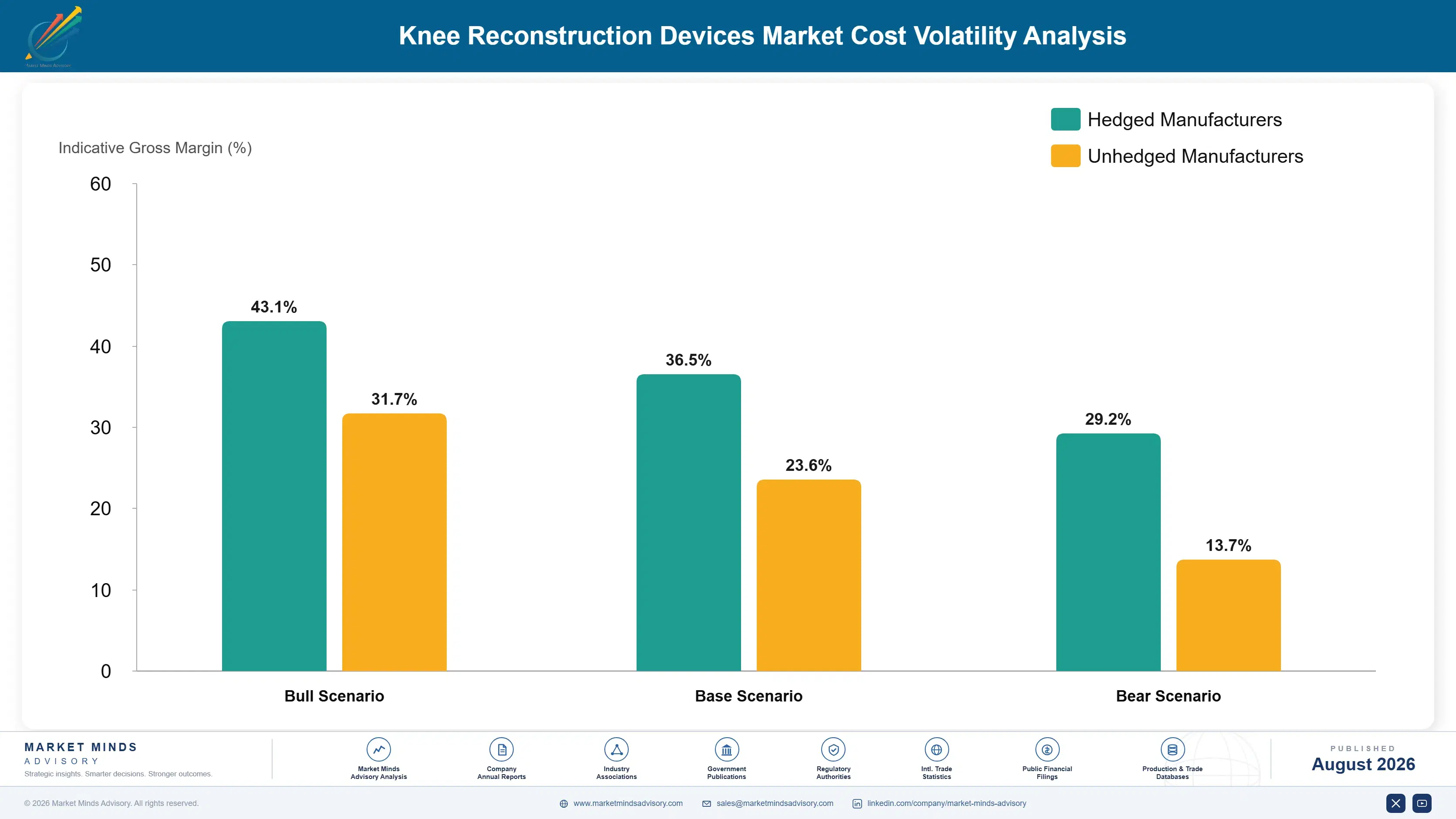
Titanium Alloy and Precision Robotics Component Costs

Titanium and cobalt-chromium alloy implant materials account for roughly 34% of unit cost of goods sold for knee reconstruction devices, sourced primarily from specialised medical-grade metals suppliers in the United States and Germany, while precision robotics and sensor components for surgical platforms add another 21%, sourced from a concentrated group of specialised component manufacturers. today.
Medical-grade titanium price volatility during 2022 and 2023 raised manufacturing costs across several orthopedic device categories, and company annual reports from that period documented rising material costs as a factor compressing margins during a period when titanium supply faced broader industrial demand pressure across multiple sectors competing for the same limited specialised material simultaneously. reflecting how significantly this constrained manufacturer margins across the industry that year.

Larger manufacturers with diversified titanium sourcing agreements and greater purchasing scale absorbed the cost pressure more smoothly than smaller specialists dependent on fewer suppliers, giving them a durable margin advantage during the disruption period that followed shortly afterward. Smaller competitors without established long-term material supply agreements remain the most exposed to any future cost pressure of this kind affecting the broader orthopedic implant manufacturing supply chain.
knee-reconstruction-devices-market-cost-volatility-analysis-1787305037628

Diversified Titanium Alloy Supply Agreements

Larger manufacturers are qualifying multiple medical-grade titanium and cobalt-chromium alloy suppliers across different geographies rather than depending on a single source, reducing exposure to the kind of material cost volatility that squeezed smaller competitors hardest during the 2022 to 2023 disruption period referenced across the industry today. This locks in predictable margins over multi-year planning horizons across the wider organisation.

In-House Precision Machining Capacity Investment

Several larger manufacturers are bringing precision implant machining partially in-house rather than depending entirely on external specialised suppliers, reducing exposure to the concentrated component supply base that has occasionally constrained production schedules across the industry broadly in recent years. This diversification spans production facilities across several countries and component suppliers. across the wider global supply chain.

Robotics Component Inventory Buffer Strategy

Manufacturers are maintaining larger safety stock inventory buffers for critical robotics and sensor components than pre-pandemic practice typically required, accepting modestly higher carrying costs in exchange for production continuity during periods of potential future supply disruption. This investment has already paid off during one recent period of elevated component pricing. for critical robotics component needs.

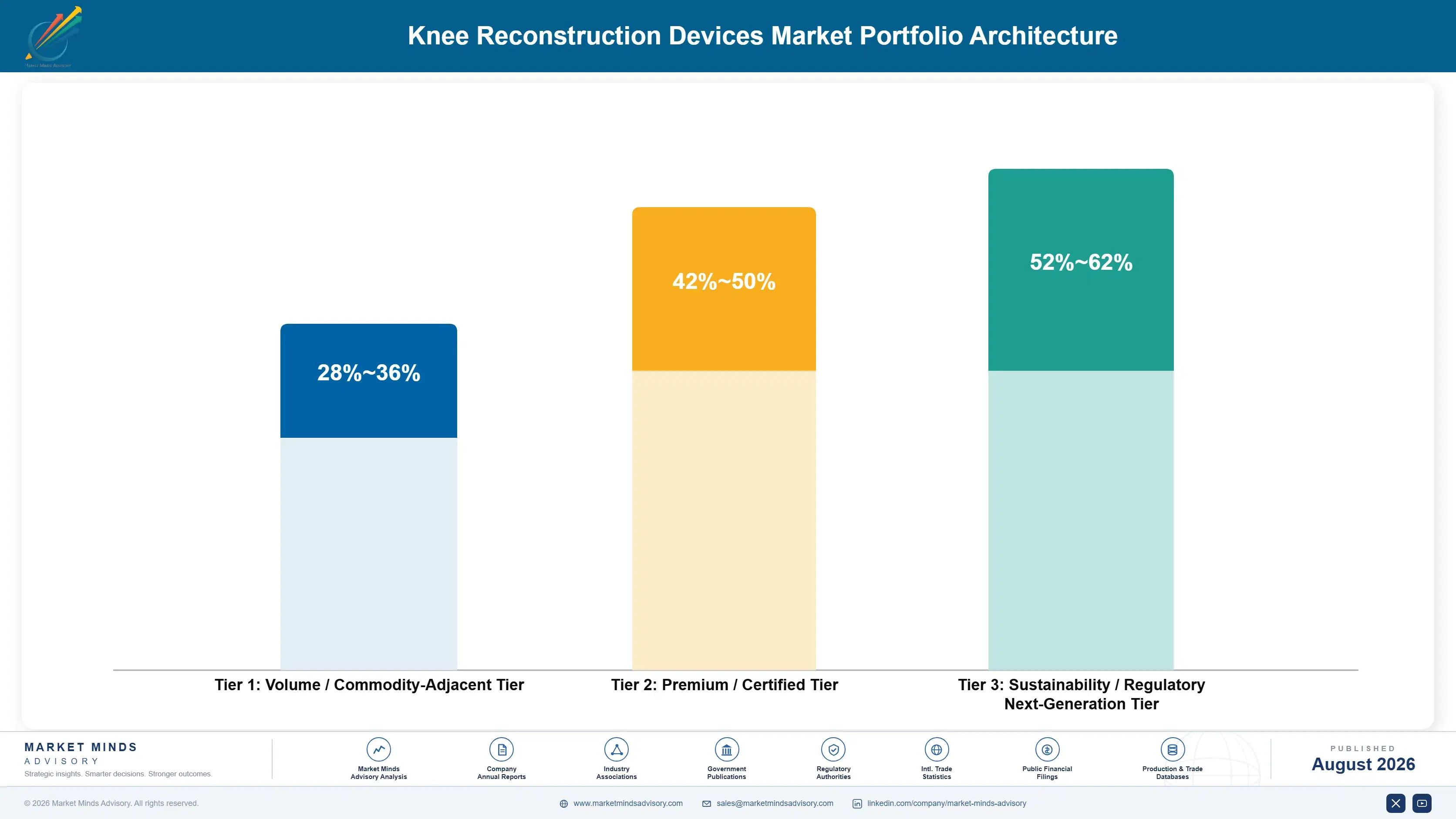
Portfolio Architecture for Margin Defence

The portfolio splits into three tiers running from standard primary knee replacement systems sold largely on established procedure economics, through revision and complex primary systems carrying specialised implant components and higher surgical complexity, up to next-generation robotic-assisted platforms aimed at hospitals and surgeons pursuing the strongest available alignment precision currently achievable. Margins widen as clinical precision and surgical complexity increase across the full
Standard primary systems still account for the largest procedure volume overall but generate comparatively thinner margins than newer technology categories, while robotic-assisted platforms and revision systems, though representing a smaller share of total procedures performed, generate a disproportionate share of category profit as hospitals and surgeons pay considerably more for demonstrated precision and specialised surgical capability. This dynamic mirrors patterns seen across many other premiumising medical device categories in recent years.

The highest-value pools concentrate in robotic-assisted platforms serving hospitals pursuing the strongest available alignment outcomes, where surgeons stay least price-sensitive given the clinical and recruitment benefit, followed closely by revision systems serving the growing population of patients whose early-generation implants have reached the end of their functional service life. Companies with strong hospital and surgeon partnerships capture a disproportionate share of this pool.

Volume / Commodity-Adjacent Tier

Standard primary knee replacement systems sold largely on established procedure economics into hospitals performing routine, uncomplicated joint replacement surgery. Volume stays highest here across most routine hospital surgical settings nationwide today.
Gross Margin: 28-36%

Premium / Certified Tier

Revision and complex primary systems carrying specialised implant components and higher surgical complexity, sold into hospitals managing the growing ageing-implant patient population. Margins improve meaningfully once specialised implant components are attached to a case.
Gross Margin: 42-50%

Sustainability / Regulatory / Next-Generation Tier

Robotic-assisted surgical platforms sold into hospitals and surgeons pursuing the strongest available alignment precision and clinical outcomes currently achievable anywhere. Margins run highest here across the entire three-tier portfolio structure considered.
Gross Margin: 52-62%
knee-reconstruction-devices-market-portfolio-architecture-1787305038126

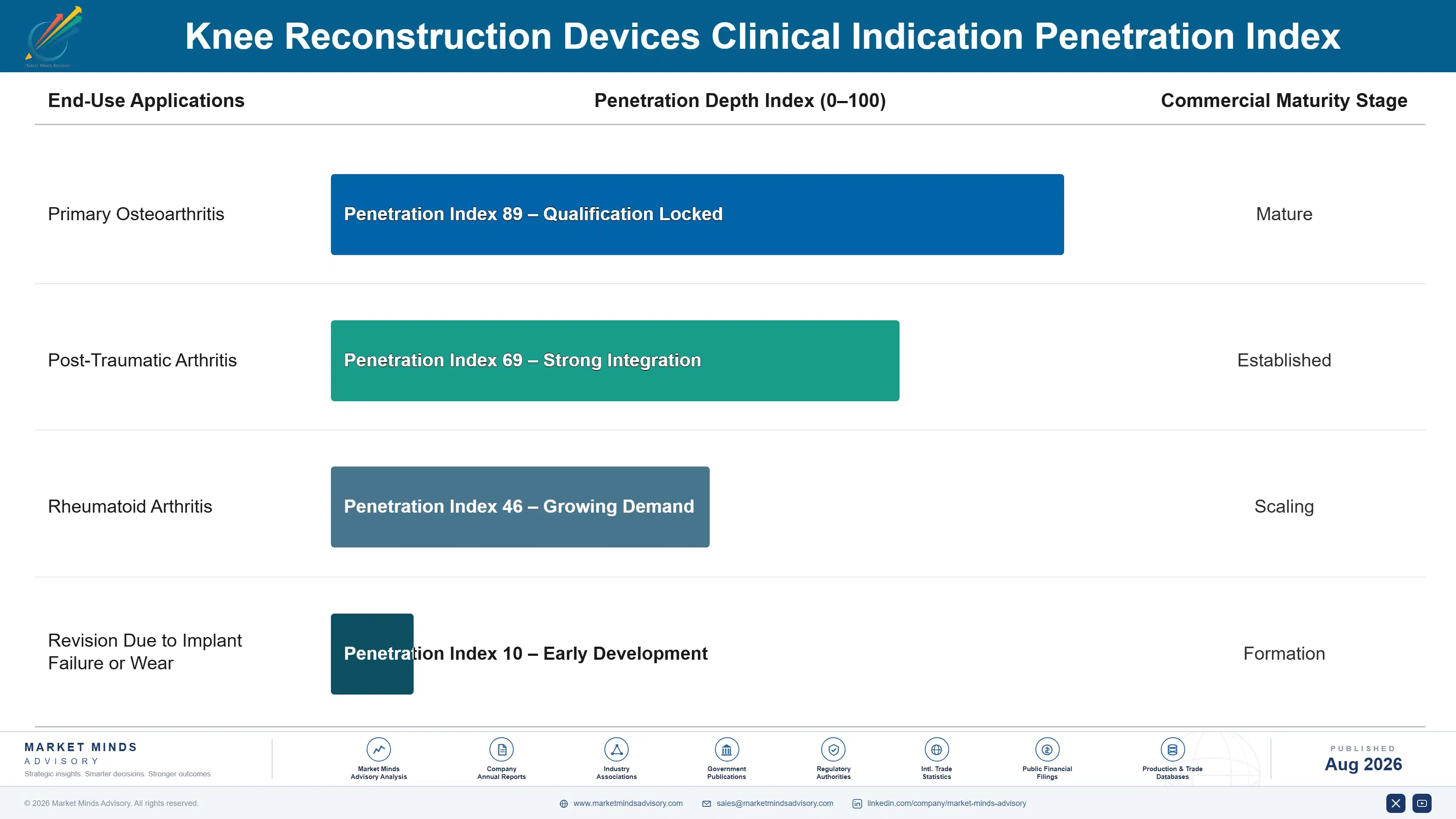
Implant Lifecycle and Hospital Contract Renewal

Demand behaves less like a one-time equipment purchase and increasingly like a multi-decade implant lifecycle relationship, since knee reconstruction devices require eventual revision surgery after twenty to twenty-five years of functional service, and manufacturers increasingly capture this predictable renewal cycle through structured outcomes tracking and long-term hospital contracts rather than leaving it to ad hoc procurement decisions. This dynamic rewards consistent clinical reliability ov
Adoption depth varies sharply by hospital type: academic medical centres and larger community hospital systems standardise on robotic-assisted platforms across their full orthopedic service line for consistency and surgeon recruitment advantage, while smaller community hospitals often continue relying primarily on conventional manual instrumentation pending broader capital investment capacity and procedure volume growth reaching these facilities. Hospitals increasingly tailor capital budgeting around these two distinct adoption behaviours across networks today.

A generational shift is underway in the surgeon population itself, as younger orthopedic surgeons trained during residency programmes that already incorporated robotic-assisted technique increasingly expect access to the technology as a baseline condition of practice, while more senior surgeons accustomed to conventional manual instrumentation remain somewhat more cautious about departing from decades of established surgical habit and technique. nationwide today.
knee-reconstruction-devices-market-end-use-penetration-index-1787305038613

Where Hospital Contract Advantage Concentrates Next

These are among the four positions where our research anticipates prominent divergence between winners and laggards over the coming forecast period. Each is grounded in the demand model, the regulatory perimeter, and the announced capacity pipeline.
01 / ROBOTIC PLATFORM LEADERSHIP

Installed base depth will keep compounding competitive advantage

Manufacturers with the largest accumulated robotic platform installed base and surgeon training relationships are winning new hospital contracts considerably more easily than competitors still building comparable clinical evidence and surgeon familiarity from a smaller starting position across the industry. Companies without meaningful robotic platform presence are ceding this fast-growing category entirely to established leaders who invested early in the underlying technology and training infrastructure. This dynamic will keep favouring Stryker and Zimmer Biomet over the next several forecast years across most major hospital systems tracked closely.
02 / REVISION PORTFOLIO DEPTH

Ageing implant cohorts will sustain demand independent of new procedures

Revision system portfolio depth is becoming an increasingly important competitive differentiator as the large cohort of implants placed during earlier decades of significant volume growth steadily reaches the end of its functional service life across most major healthcare markets tracked closely. Companies without comprehensive revision system offerings are ceding this predictable, demographically driven demand pipeline to competitors with broader specialised implant portfolios built for this purpose. Expect revision system revenue to keep growing meaningfully faster than standard primary procedure volume through the remainder of the forecast period.
03 / HOSPITAL PLACEMENT STRATEGY

Platform placement agreements will determine long-term implant loyalty

Manufacturers offering robotic platform placement agreements tied to multi-year implant supply commitments are locking in considerably more predictable, durable revenue relationships than competitors relying entirely on transactional implant sales negotiated separately with each hospital account evaluated. This lever requires meaningful upfront capital investment from manufacturers with returns that depend on sustained implant volume over the full agreement term negotiated. Expect placement agreement adoption to keep expanding as more manufacturers recognise the durable relationship value this commercial model provides across the industry.
04 / MID-TIER COMPETITIVE PRESSURE

Regional challengers will keep pressuring smaller hospital pricing

Mid-tier and regional manufacturers offering competitively priced robotic platforms targeting smaller hospital systems represent a genuine competitive threat to established leaders' pricing power in price-sensitive markets where hospital capital budgets remain considerably more constrained than at leading academic medical centres evaluated across the industry. This pressure will intensify as regional manufacturers continue building clinical evidence and surgeon training infrastructure comparable to established leaders over time and across markets. Expect pricing compression to hit smaller hospital contracts hardest across the current forecast period ahead.

Engagement Snapshot From the Field

A live engagement with an industry participant carrying material or product regulatory and market exposure ahead of a defining policy shift, showing how our research translates into a defensible multi-year portfolio strategy.
MARKET MINDS ADVISORY · CLIENT ENGAGEMENT SUMMARY
Knee Reconstruction Devices Producer Strategic Portfolio Review and Transition Roadmap 2026·Investment Scenario on Knee Reconstruction Devices Exposure Evaluation 2025-26
CLIENT PROFILE
The client operates a regional hospital network with five facilities across two states, performing approximately 3,800 knee replacement procedures annually and generating related orthopedic service line revenue of approximately $210 million (client-reported, unverified by MMA). Leadership sought guidance on robotic platform investment strategy following growing surgeon and patient demand for the technology across the network.
STRATEGIC CHALLENGE
The client's five facilities varied considerably in procedure volume, and leadership was uncertain whether to invest in robotic platforms at every facility simultaneously or concentrate initial investment at the highest-volume locations first, given the substantial capital cost each platform placement required across the network. Leadership wanted a data-driven comparison before committing scarce capital resources.
MMA APPROACH
MMA's team analysed procedure volume, payer mix, and competitive referral pressure across all five facilities, then modelled robotic platform placement economics against continued reliance on conventional manual instrumentation across the network. The analysis incorporated surgeon training capacity and phased rollout timing directly. The recommendation weighed payback timing against competitive urgency carefully.
KEY FINDINGS
  1. Two of five facilities, both serving markets with strong competing hospital systems already offering robotic-assisted surgery, faced the most urgent competitive pressure to adopt quickly.
  2. A phased rollout prioritising these two facilities first could achieve meaningful competitive positioning within twelve months without disrupting overall network procedure capacity.
  3. Platform placement financing reduced upfront capital burden by an estimated 55%, based on vendor financing terms gathered during the procurement evaluation phase conducted.
  4. Surgeon training capacity, not equipment availability, represented the primary bottleneck limiting how quickly the network could transition to the new technology platform fully.
CLIENT PROFILE
The client operates a regional hospital network with five facilities across two states, performing approximately 3,800 knee replacement procedures annually and generating related orthopedic service line revenue of approximately $210 million (client-reported, unverified by MMA). Leadership sought guidance on robotic platform investment strategy following growing surgeon and patient demand for the technology across the network.
STRATEGIC CHALLENGE
The client's five facilities varied considerably in procedure volume, and leadership was uncertain whether to invest in robotic platforms at every facility simultaneously or concentrate initial investment at the highest-volume locations first, given the substantial capital cost each platform placement required across the network. Leadership wanted a data-driven comparison before committing scarce capital resources.
MMA APPROACH
MMA's team analysed procedure volume, payer mix, and competitive referral pressure across all five facilities, then modelled robotic platform placement economics against continued reliance on conventional manual instrumentation across the network. The analysis incorporated surgeon training capacity and phased rollout timing directly. The recommendation weighed payback timing against competitive urgency carefully.
KEY FINDINGS
  1. Two of five facilities, both serving markets with strong competing hospital systems already offering robotic-assisted surgery, faced the most urgent competitive pressure to adopt quickly.
  2. A phased rollout prioritising these two facilities first could achieve meaningful competitive positioning within twelve months without disrupting overall network procedure capacity.
  3. Platform placement financing reduced upfront capital burden by an estimated 55%, based on vendor financing terms gathered during the procurement evaluation phase conducted.
  4. Surgeon training capacity, not equipment availability, represented the primary bottleneck limiting how quickly the network could transition to the new technology platform fully.
RECOMMENDED STRATEGY
Phase 1: Phase 1 (Months 1-6): Deploy robotic platforms at the two facilities facing the most urgent competitive pressure, prioritising surgeon training capacity there first immediately. Phase 2: Phase 2 (Months 7-14): Extend deployment to two additional facilities, sequencing by surgeon training availability and competitive referral pressure levels. Phase 3: Phase 3 (Months 15-18): Complete network-wide deployment at the final facility while establishing ongoing surgeon training infrastructure for future staff onboarding.
OUTCOME
The client completed network-wide robotic platform deployment two months ahead of the original eighteen-month timeline and reported (client-reported, unverified by MMA) a 16% increase in knee replacement referral volume at the two priority facilities following the technology upgrade. Capital outlay came in under budget due to the placement financing structure adopted during the phased rollout.

Frequently Asked Questions

Foundational context covering the market sizes, CAGR, scope, country, region and competition that inform every finding below. This section is provided to cover basics and most often pre-purchase conversations, answered from the MMA Primary Research Dataset.

What is the current size of the Knee Reconstruction Devices Market?

The global knee reconstruction devices market reached an estimated $9.5 billion in 2025, based on MMA's primary research dataset and company-disclosed segment revenue across the five largest companies tracked worldwide.

How large will the Knee Reconstruction Devices Market be by 2036?

The market is projected to reach approximately $18.80 billion by 2036, roughly 1.86 times its 2026 value under MMA's base-case forecast scenario for the coming decade ahead.

What is the CAGR for the Knee Reconstruction Devices Market 2026 to 2036?

The base-case compound annual growth rate is 6.4%, with a bull case near 7.6% and a bear case near 5.2% depending on robotic platform adoption and hospital capital budget conditions.

Which segment is growing fastest?

Robotic-assisted surgical platforms are the fastest-growing segment at a 12.8% CAGR, roughly twice the overall market rate, driven by demonstrated alignment precision advantages over conventional manual instrumentation.

Who are the major companies in the Knee Reconstruction Devices Market?

Zimmer Biomet, Stryker, DePuy Synthes, Smith+Nephew, and Enovis are the five largest companies by disclosed segment revenue, together holding a combined 78% share of the category.

Which country is growing fastest?

India is the fastest-growing major market at an estimated 9.6% CAGR, driven primarily by rapidly expanding joint replacement infrastructure and growing medical tourism volume nationally.

Report Segmentation Architecture

The full report scope spans multiple orthogonal segmentation dimensions, with cross-tabulated demand data provided for each dimension pair. Coverage extends further to regional breakdowns, trend trajectories, and the competitive detail needed to support segment-level decision-making.

By Device Type

  • Total Knee Replacement Systems
  • Partial (Unicompartmental) Knee Systems
  • Revision Knee Systems
  • Patellofemoral Replacement Systems
  • Robotic-Assisted Surgical Platforms
  • Patient-Specific Instrumentation

By Clinical Indication

  • Primary Osteoarthritis
  • Post-Traumatic Arthritis
  • Rheumatoid Arthritis
  • Revision Due to Implant Failure or Wear

By Commercial Dimension

  • Direct Implant Sales
  • Robotic Platform Placement Agreements
  • Surgeon Training Programmes
  • Outcomes Tracking Service Contracts

By Region

  • North America
  • Western Europe
  • East Asia
  • South Asia and Pacific
  • Latin America
  • Middle East and Africa
  • Eastern Europe

Scope, Methodology, and Coverage

Every figure in this report is reproducible from documented input assumptions. The scope below maps the historical period, the forecast horizon, the segmentation dimensions, and the countries covered, alongside the underlying primary and qualitative methodology.
Historical Period
2020 to 2025
Forecast Period
2026 to 2036
Base Year
2025 (USD billions; MMA Primary Research Dataset, August 2026)
Market Definition
The knee reconstruction devices market covers total knee replacement systems, partial knee replacement systems, revision knee systems, patellofemoral replacement systems, and the robotic-assisted surgical platforms and patient-specific instrumentation used to implant them. General orthopedic surgical instruments not specific to knee procedures, knee braces and non-surgical orthotic devices, and hip or shoulder reconstruction systems sold as separate product lines are excluded from this scope.
Quantitative Units
USD billions (current prices); implant procedure volume where disclosed
Segmentation Dimensions
By Device Type; By Clinical Indication; By Commercial Dimension; By Region
Regions Covered
North America, Western Europe, East Asia, South Asia and Pacific, Latin America, Middle East and Africa, Eastern Europe
Countries Covered
USA, China, Germany, France, UK, Japan, South Korea, India, Australia, Canada, Brazil, Mexico, Indonesia, Vietnam, Thailand, Malaysia, UAE, Saudi Arabia, South Africa, Nigeria, Turkey, Poland, Netherlands, Italy, Spain, Sweden, Switzerland, Argentina, Colombia, Singapore, and additional markets relevant to this sector
Key Companies Profiled
Zimmer Biomet Holdings Inc., Stryker Corporation, DePuy Synthes (Johnson & Johnson), Smith+Nephew plc, Enovis Corporation, Medacta International SA, Corin Group, MicroPort Orthopedics (MicroPort Scientific Corporation), Aesculap (B. Braun Melsungen AG), Exactech Inc., Conformis Inc., Corentec Co. Ltd., United Orthopedic Corporation, Waldemar Link GmbH & Co. KG, Groupe Lépine, Implantcast GmbH, Meril Life Sciences Pvt. Ltd., Aequos Endoprothetik GmbH, Naton Medical Group, Limacorporate S.p.A.
Quantitative Methodology
Primary survey, n=3,800 respondents, Q4 2025, six countries; demand-side model with trade association cross-validation
Qualitative Methodology
47 expert interviews, Q4 2025; applied to validate demand model assumptions, identify emerging dynamics, and assess competitive positioning
Report Format
PDF and XLSX data workbook (Word format preview document)
Publisher
Market Minds Advisory
Report Code
MMA-2026-MED-110
Published
August 2026
Contact
sales@marketmindsadvisory.com | www.marketmindsadvisory.com

Purchase the full Knee Reconstruction Devices Market Report (2026 to 2036).

The full Knee Reconstruction Devices Market report delivers detailed segmentation by device type, clinical indication, and commercial channel across all seven world regions through 2036. It includes company-level competitive profiles for all twenty companies profiled, covering robotic platform technology, installed base data, and training programme investment underway across the category. Regional chapters detail country-level surgical volume, robotic adoption, and reimbursement patterns for each of the seven regions covered. A dedicated input cost chapter tracks titanium alloy and precision robotics component exposure alongside mitigation strategies used by leading manufacturers today.
Full seven-region data tables and CAGR breakdowns
Twenty-company competitive profiles and moat analysis
Robotic platform installed base tracker included here
Input cost exposure and mitigation playbook detailed
Segment-level growth and margin forecasts provided
Editable data appendix in spreadsheet format

Built For The People Who Decide

From boardroom strategy to bench-side execution, this report is read cover-to-cover by leaders shaping the next decade of their industry, turning demand scenarios, market dynamics and valuation benchmarks into decisions.
CXOs/ Presidents/ VPs/ Managers
M&A and Corporate Development
Strategy Teams and R&D Heads
Procurement and Product Directors
Regulatory and Compliance Leaders
Investor Relations and Equity Analysts