Market Minds Advisory
Knee Hyaluronic Acid Injections Market

Knee Hyaluronic Acid Injections Market: Where Guidelines And Practice Have Parted Company

American orthopaedic guidelines recommend against it. Japanese clinicians administer nine million doses a year. The gap between those two facts is where every commercial decision in this market actually gets made.

Lead Analyst

Alice Ballenger

Published

September 2026

Make Smarter Decisions with Customized Research Insights

Request a free sample report and evaluate market opportunities, growth trends, and competitive dynamics relevant to your business needs.

2025 MARKET VALUE$1.9BMarket Size 2025
2036 FORECAST VALUE$3.3BBase Case , 2026 to 2036
CAGR 2026 TO 20365.2 %Bull 6.5% / Bear 4.0%
INCREMENTAL OPPORTUNITY$1.3BNet 10- year value creation
EXPANSION MULTIPLE1.66x2036 value over 2026 base
Strategic Levers
M&A Pipeline
Regional Outlook
Country Rankings
Competitive Intelligence
Segmental Deep-dive
Call-Us : 91 93563 13602

Executive Snapshot and Market Trajectory

Clinical guidance and clinical practice have separated completely here, and neither side shows any sign of moving. Major American orthopaedic bodies recommend against viscosupplementation for knee osteoarthritis, while Japanese clinicians administer roughly nine million injections every single year under full national reimbursement and settled clinical convention.
The market reaches USD 1.9 billion in 2025 and compounds at 5.2% to USD 3.32 billion by 2036. Cross-linked single-injection formulations grow fastest at 7.8%, exactly 1.50 times the market rate, because one visit costs a practice far less than five and patients complete the course. East Asia holds 34% of value, above the band this framework applies, on Japanese treatment volume that no other country approaches.
Concentration sits at 46% across the top five, unusually high for a market this size, because regional brands hold entrenched positions that global companies have never displaced. What actually determines commercial performance in this market is not the trial data at all. It is the reimbursement spread between acquisition cost and payment in an office setting, and that spread has narrowed very sharply across the United States over the past five years.
Market Definition
The knee hyaluronic acid injections market covers intra-articular hyaluronic acid and hylan products administered into the knee joint for symptomatic osteoarthritis, spanning cross-linked single-injection formulations, high and low molecular weight multi-injection courses, hyaluronic acid and corticosteroid combination products, and formulations combining hyaluronic acid with a biologic adjunct. Injections into joints other than the knee, corticosteroid-only injections, platelet-rich plasma administered alone, dermal and ophthalmic hyaluronic acid, and knee arthroplasty are excluded.
Base Year Value
$1.9B in 2025 (MMA Primary Research Dataset, August 2026)
Forecast Period
2026 to 2036, eleven discrete annual values
CAGR
5.2% base case. Bull 6.5%. Bear 4.0%.
Fastest Growth Segment
Cross-Linked Single-Injection Formulations: 7.8% CAGR
Fastest Growth Country
China: 9.2% CAGR
Fastest Growth Region
South Asia and Pacific: 7.6% CAGR
Largest Region
East Asia: 34% of 2025 global value
Market Leaders
Sanofi, Seikagaku, Bioventus, Anika Therapeutics, Zimmer Biomet. Source: MMA Primary Research Dataset, July 2026.
Primary Survey
n=3,800 procurement and R&D decision-makers, Q4 2025, six countries
Methodology
Demand-side build-up, cross-validated against public data, 47 expert interviews

Knee Hyaluronic Acid Injections Market Forecast Scenarios

knee-hyaluronic-acid-injections-market-size-forecast-scenario-1787297940578
The 2020 to 2025 period pulled this market in two directions at once. Elective procedure volumes collapsed through 2020 and recovered unevenly, while American reimbursement tightened as average sales price calculations caught up with widespread discounting. Asian volume grew steadily throughout and was barely affected by either. A 4.1% historical CAGR averages a declining Western market against an expanding Eastern one.
Three mechanisms carry the 5.2% base case. Chinese and Southeast Asian adoption is the largest, since ageing populations combine with knee replacement capacity that cannot possibly meet demand and a treatment that postpones surgery has obvious value. Single-injection conversion is the second, cutting practice cost and improving course completion. And arthroplasty deferral economics are the third, as health systems facing surgical backlogs fund anything that safely delays a joint replacement.
The 6.5% bull case rests on a rigorous trial demonstrating meaningful arthroplasty delay as a primary endpoint, which would reframe the entire clinical argument away from pain scores where the evidence has always looked weak. The 4.0% bear case is further American reimbursement compression, since practice economics rather than clinical conviction drive the majority of United States treatment volume.

Evidence, Reimbursement And Practice

The trial evidence on pain reduction is genuinely mixed and nobody in this industry seriously disputes that. Effect sizes against saline injection are small and inconsistent across studies, which is why several American orthopaedic bodies now recommend against routine use. Yet global volume keeps rising. Anyone modelling this market from guideline positions alone will get the direction wrong, because guidelines are not what governs the treatment decision at the point of care.
TOP FIVE CONCENTRATION46%Regional brands hold positions global players never displaced
COURSE PRICE BENCHMARKUSD 780Typical payer cost for a full treatment course administered
SINGLE INJECTION SHARE38%Portion of courses now delivered in one visit
SURGERY DELAY ACHIEVED14 monthsMedian postponement of knee replacement following a course
LARGEST MARKET VOLUME9 millionAnnual injections administered in the single largest market
PRACTICE MARGIN SPREAD14%Gap between acquisition cost and payment in office settings
What governs it is the alternative. A patient with moderate knee osteoarthritis who is not yet a surgical candidate has few options between analgesics and arthroplasty, and health systems everywhere face joint replacement backlogs measured in years. An injection carrying low procedural risk that postpones surgery by a median fourteen months has value the pain score endpoints were never designed to capture at all.
Commercially, the number that matters is the reimbursement spread. Under buy-and-bill arrangements a practice purchases product and bills a payer, and the margin between the two funded much of American treatment volume for two decades. Average sales price recalculation has compressed that spread toward 14%, and volume followed it down rather than following any change in the published evidence.
"I have watched companies spend years funding trials to answer the evidence critics. Meanwhile the product that gained the most share simply moved from five injections to one, because a practice earns the same fee for a fifth of the chair time."
Principal, Musculoskeletal Therapeutics Practice · MMA Medical Devices Practice

Market Trends

Single-Injection Formulations Displace Multi-Visit Treatment Courses

Cross-linking raises residence time in the joint enough to deliver a full course in one administration rather than three or five, and the commercial consequences run well beyond convenience. A practice occupies one appointment slot instead of five for broadly similar reimbursement, patients complete courses they previously abandoned partway through, and no-show economics improve substantially. Single-injection products now account for roughly 38% of courses delivered globally and take share every year. The clinical difference between formats is modest. The operational difference is not modest at all, and that is what has driven the switch.
Market Impact: 9 million injections given annually
Arthroplasty Backlogs Push Systems Toward Deferral Strategies

Knee replacement waiting lists across publicly funded systems run into years in several countries, and surgical capacity cannot expand fast enough to meet demographic demand. That has changed how health economists view a low-risk injection that postpones surgery by a median fourteen months. The argument shifts from symptom relief, where the evidence has always looked thin, toward capacity management, where the arithmetic is straightforward. Several European health technology assessment bodies have begun evaluating viscosupplementation on exactly these terms rather than on symptom relief alone, which changes which evidence matters commercially.
Market Impact: Growth exceeds 9% in China

Market Opportunities and Growth Drivers

Japanese Reimbursement Sustains The Largest Treatment Volume

Japan reimburses intra-articular hyaluronic acid as standard care for knee osteoarthritis, and roughly nine million injections are administered annually, more than any other country in the world by a very wide margin. Seikagaku's Artz established the treatment convention domestically decades ago and clinical practice has never moved away from it. An ageing population with high arthritis prevalence and comparatively low arthroplasty rates sustains that volume year after year. Nothing in the American guideline debate has affected Japanese clinical practice or Japanese reimbursement policy in any measurable way, and nothing suggests it will.
Market Impact: Coverage restricted across 3 systems

Chinese Adoption Expands With Ageing And Surgical Capacity Limits

Chinese knee osteoarthritis prevalence is high and rising with age structure, while arthroplasty capacity outside major tier-one hospitals remains limited relative to the population that needs it. Domestic manufacturers including Bloomage and Haohai supply hyaluronic acid at prices imported products cannot match, which has made the treatment accessible well beyond wealthy urban patients. Provincial reimbursement coverage has widened considerably over the past three years and continues to do so. Volume growth here exceeds every other market in this forecast, and it comes from genuinely new patients rather than from switching between competing products.
Market Impact: Spread compressed toward 14%

Market Restraints and Challenges

American Orthopaedic Guidelines Recommend Against Routine Use

Several major American orthopaedic bodies advise against viscosupplementation for knee osteoarthritis, citing effect sizes against placebo injection that are small and inconsistent across published trials. The root cause is that pain score endpoints in a condition with a large placebo response are a demanding way to demonstrate benefit. Commercially this gives payers a defensible reason to restrict coverage, and across the United States it has done exactly that. Participants are mitigating through arthroplasty deferral evidence, through health economic rather than symptomatic endpoints, and through expansion into markets where guideline positions differ substantially.
Market Impact: Single injection holds 38% share

Reimbursement Spread Compression Removes Practice Incentive

American buy-and-bill economics depended on the gap between what a practice paid for product and what a payer reimbursed, and average sales price recalculation has narrowed that toward 14%. The root cause is that widespread competitive discounting feeds directly into the reimbursement benchmark, so price competition destroys the spread for everybody including the discounter. Commercially, volume tracks the spread rather than the evidence. Mitigation runs toward single-injection products that cut chair time, toward ambulatory surgery centre channels with different payment structures, and toward disciplined list pricing that protects the benchmark.
Market Impact: Defers surgery a median 14 months
3 additional market trends, 2 additional growth drivers, and 4 additional restraints and challenges are covered in the full report. Contact sales@marketmindsadvisory.com to access the complete intelligence.

Segment CAGR and Growth Architecture

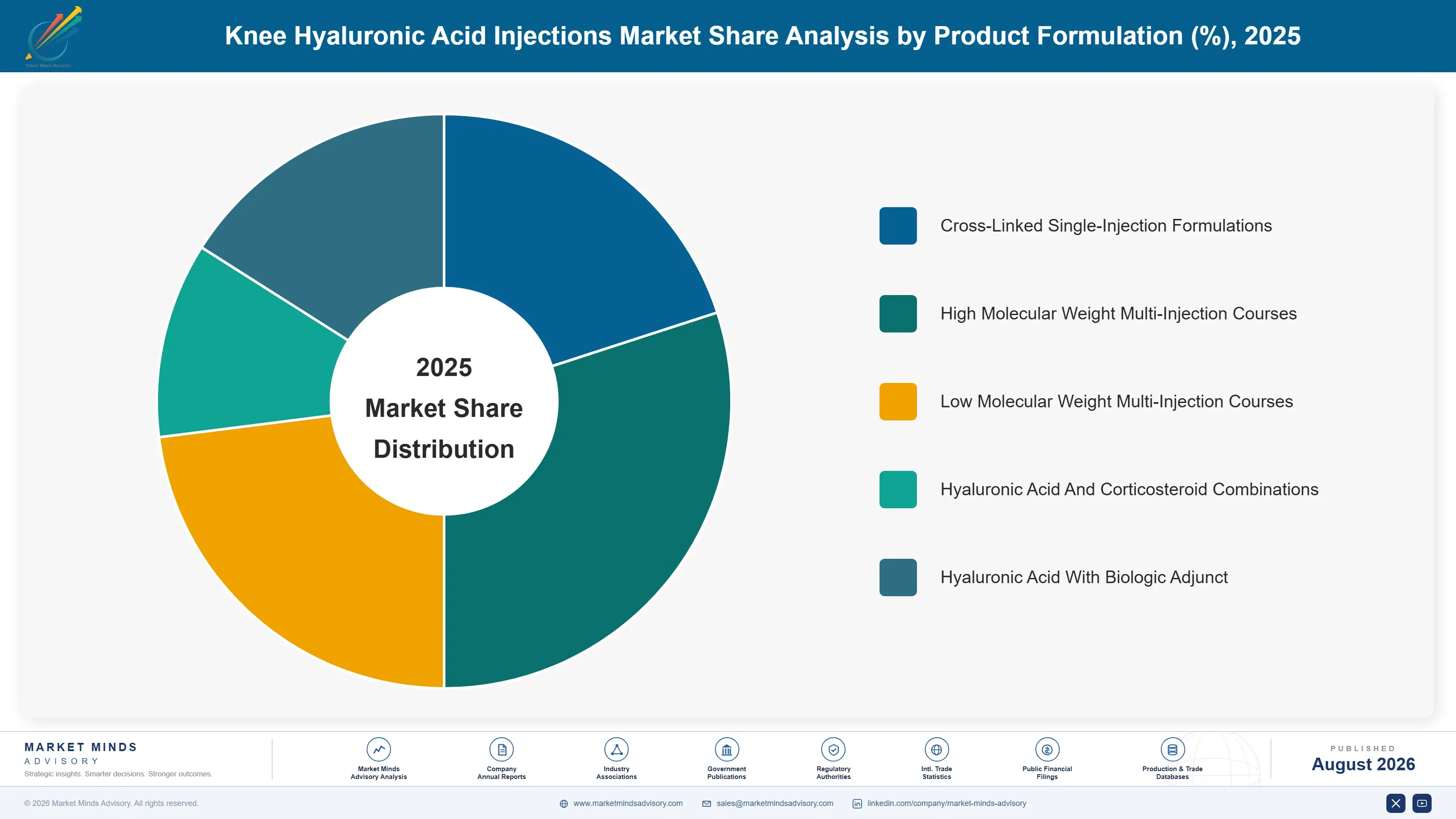
Segmentation follows product formulation, because molecular weight, cross-linking, and any added agent together determine the injection schedule, the regulatory pathway, the reimbursement code, and the practice economics that drive most prescribing. Care setting, patient severity, and payer type are handled in the framework and in commentary rather than being treated as separate segments here.
knee-hyaluronic-acid-injections-market-market-share-analysis-1787297941158

Cross-Linked Single-Injection Formulations

Cross-linked single-injection products grow fastest at 7.8%, exactly 1.50 times the market rate, using chemical cross-linking to extend joint residence time enough that one administration replaces a three or five injection course. The clinical advantage over multi-injection regimens is modest and contested. The operational advantage is neither: a practice fills one appointment slot rather than five for broadly comparable reimbursement, and patients finish courses they would otherwise abandon after the second visit. Roughly 38% of courses delivered globally now use this format, and that share rises every year across every region we track. Regulatory approval for cross-linked formats runs three to four years, so portfolio decisions here are taken well ahead of need.
CAGR 7.8%

Hyaluronic Acid With Biologic Adjunct

Formulations combining hyaluronic acid with a biologic adjunct, most commonly platelet-rich plasma or a growth factor preparation, grow at 6.9% from a genuinely small base. The commercial logic is that hyaluronic acid provides lubrication and the adjunct is claimed to influence the joint environment itself, though controlled evidence for the combination remains thin and the regulatory pathway varies considerably between jurisdictions. Pricing runs well above standard courses, and much of the volume sits in self-pay sports medicine practice rather than in any reimbursed care setting. Adoption is strongest across Korea, Japan, and private European sports medicine clinics, and it is expanding into Latin American private practice on similar self-pay terms.
CAGR 6.9%
Full segment breakdown across 5 segments available in the complete report.

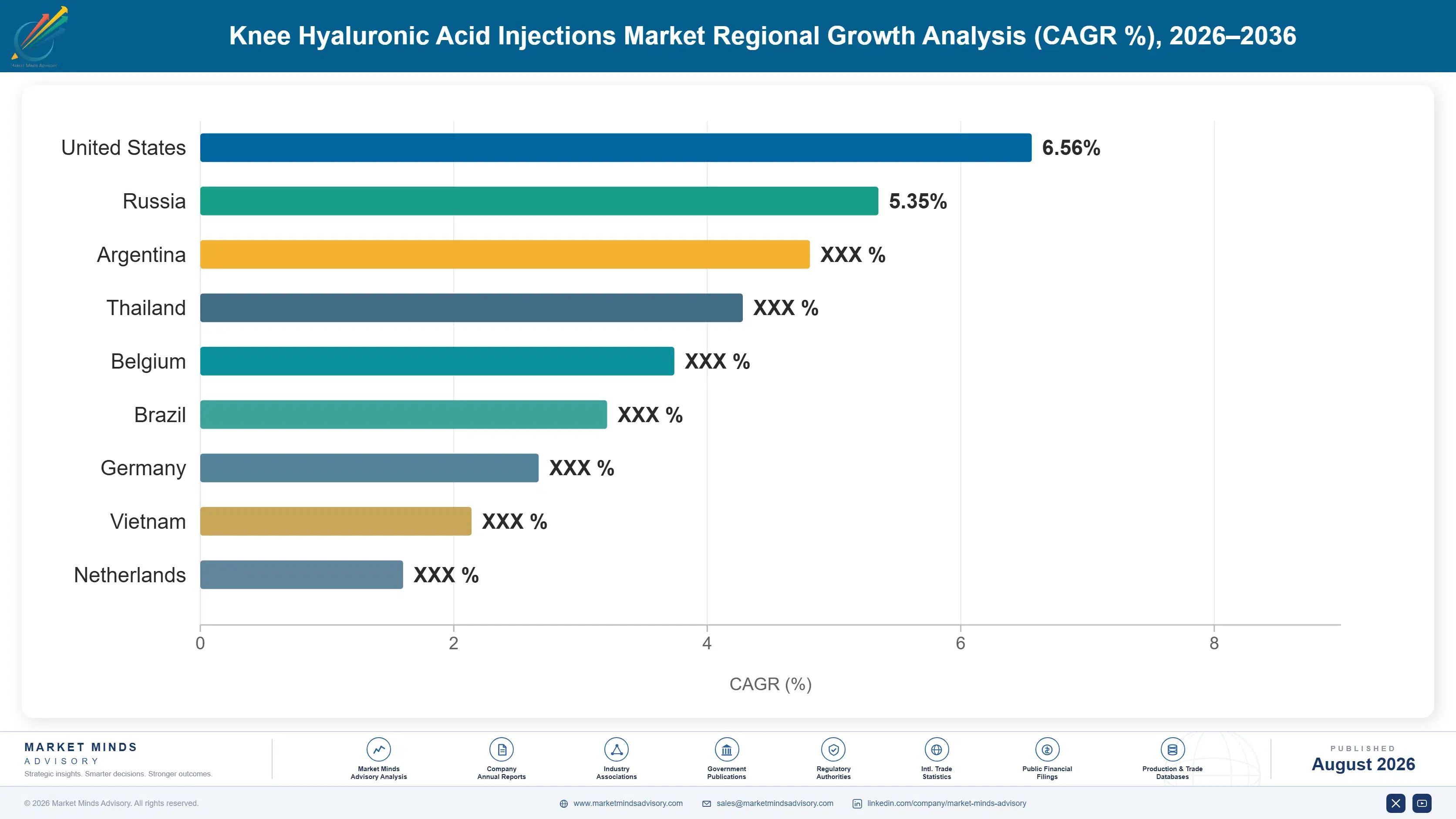
Regional Architecture and Country Demand Map

Regional shares here track reimbursement policy and clinical convention far more than they track osteoarthritis prevalence, which is broadly similar everywhere. Where a health system pays for the injection, volume is high. Where guidelines discourage it and payers have followed that lead, volume is falling steadily.

East Asia

East Asia holds 34% of value against a 30% ceiling in this framework, and Japanese practice alone accounts for most of the breach. Roughly nine million injections are administered annually in Japan under full reimbursement, a volume no other country approaches, and Seikagaku established that convention decades ago through Artz. Korean adoption is high and increasingly includes biologic adjunct combinations sold at premium prices through private sports medicine practice. Chinese volume is growing fastest of all, on domestic supply available at prices imported products cannot match. Provincial reimbursement additions across China continue widening the treated population. Growth at 6.4% exceeds the global rate, driven by China rather than by the mature Japanese base.
Share: 34% | CAGR: 6.4% (2026 to 2036)

South Asia and Pacific

Fastest growth in this forecast sits in South Asia and Pacific at 7.6%, with Indian volume expanding through private orthopaedic practice where arthroplasty remains unaffordable for most patients who need it. Domestic hyaluronic acid manufacturing keeps course pricing at a fraction of Western levels, which is what makes the treatment reachable at all. Australian practice follows European convention closely, with reimbursement restrictions attached in much the same way. Southeast Asian adoption is growing steadily through private hospital networks across Thailand, Malaysia, and Indonesia. Almost all of this is genuinely new patient volume rather than substitution between competing products. Arthroplasty access across the region is limited well outside major urban centres.
Share: 11% | CAGR: 7.6% (2026 to 2036)
Regional intelligence for 5 additional markets available in the complete report: North America, Western Europe, Latin America, Middle East and Africa, Eastern Europe. Contact sales@marketmindsadvisory.com.
knee-hyaluronic-acid-injections-market-country-cagr-analysis-1787297941753

Selling Into A Contested Evidence Base

No amount of pain score data is going to settle the guideline argument, so the levers that work here route around it entirely. Practice economics, arthroplasty deferral evidence, channel choice, and geographic weighting each move revenue without requiring anybody to change their mind about the trials. Four follow, and none of them is a clinical study.

Convert The Portfolio To Single-Injection Formats

A practice occupies one appointment slot instead of five for broadly comparable total reimbursement, which changes revenue per chair hour by roughly 4 times regardless of what any guideline says. Course completion also improves, since patients who abandon a five-injection regimen after the second visit generate no further product demand. Cross-linking development and regulatory approval run three to four years, so the decision is a portfolio one taken well ahead of need. Single-injection products already hold 38% of courses delivered globally and continue taking share every year in every region.
Market Impact: Revenue per chair hour rises about 4 times

Fund Arthroplasty Deferral Rather Than Pain Endpoints

Pain score superiority against saline in a condition with a large placebo response is a demanding endpoint that twenty years of trials have failed to settle convincingly. Time to knee replacement is a harder endpoint, it is cheaper to capture from registry data, and it speaks directly to health systems facing surgical backlogs measured in years. A median deferral of 14 months carries a calculable value in any system with a waiting list. Registry studies cost a small fraction of a randomised controlled trial and deliver an argument payers can actually act on.
Market Impact: Deferral evidence covers a median of 14 months

Shift Volume Toward Ambulatory Surgery Centre Channels

Reimbursement spread compression has hit office-based buy-and-bill hardest, while ambulatory surgery centres operate under different payment structures where the economics remain workable. Products positioned and priced for that channel retain practice incentive that has largely disappeared from the physician office setting. The shift also reaches patients being evaluated for surgery, which is exactly where a deferral argument lands best. Roughly 30% of American volume has already moved into that channel, and the direction of travel is unmistakable across every account we track. Pricing discipline matters more here, since the benchmark is shared.
Market Impact: Roughly 30% of that volume has already shifted

Weight Commercial Investment Toward Asian Reimbursement Markets

Japan reimburses this treatment as standard care and administers around 9 million injections annually, while American coverage narrows year after year and practice spread compresses toward 14%. Chinese provincial reimbursement continues widening against arthroplasty capacity that cannot come close to meeting demographic demand. Commercial resource allocated on historical revenue rather than on reimbursement trajectory consistently overweights declining Western markets by a wide margin. Companies that rebalanced toward Asia early hold positions latecomers now find expensive to buy, since regional brands are deeply entrenched and prescriber loyalty in this category runs unusually deep.
Market Impact: Japan alone administers 9 million injections every year

Who Controls the Margin Pool

Concentration at 46% across the top five is high for a market this size, and it reflects entrenched regional brands rather than global scale. Seikagaku's position in Japan and domestic Chinese manufacturers have never been displaced by any multinational. All participants here are compared on measured global revenue from intra-articular hyaluronic acid products for knee osteoarthritis, which is the only basis that works across pharmaceutical and device regulatory pathways.
Competition runs on formulation and channel rather than on clinical differentiation, since no product has demonstrated convincing superiority over another in head-to-head work. Sanofi's Synvisc franchise and Bioventus both compete hard in single-injection formats. Anika supplies its own brands and manufactures for others. Seikagaku holds Japan through decades of clinical convention. Domestic Chinese suppliers compete almost entirely on price into a rapidly widening reimbursed population.

Pressure is building from two directions that pull opposite ways. American reimbursement compression keeps squeezing Western revenue while Asian volume expands, so the geographic centre of this market keeps moving east. Meanwhile biologic adjunct combinations are creating a self-pay premium tier outside reimbursement entirely. Rankings shift most on Chinese provincial coverage decisions and on whichever company first produces credible arthroplasty deferral evidence.
knee-hyaluronic-acid-injections-market-company-positioning-matrix-1787297942445

Competitive Moat and Risk Dimensions

SANOFI

Moat: Established Brand Across Multiple Jurisdictions

The Synvisc franchise carries approvals, clinical familiarity, and orthopaedic prescriber recognition across a very large number of markets, built over decades and supported by a distribution reach no specialist competitor matches. In a category where products differentiate poorly on evidence, prescriber habit carries real weight. Rebuilding that recognition from a standing start is close to impossible.
SANOFI

Risk: Concentrated In Declining Western Markets

The franchise's strongest positions sit in exactly the markets where guidelines discourage use and reimbursement spread has compressed hardest. Growth is happening in Japan and China where regional brands hold entrenched physician loyalty. A portfolio weighted toward North America and Western Europe faces a shrinking base and expensive entry into the markets that are actually expanding.
SEIKAGAKU

Moat: Defining Position In Japanese Practice

Seikagaku established intra-articular hyaluronic acid as standard Japanese care decades ago, and Japanese clinical convention has never moved away from it despite the guideline debate elsewhere. Around nine million annual injections make this the largest treatment population in the world. Prescriber familiarity built across generations of orthopaedic training is not a position a competitor can buy.
SEIKAGAKU

Risk: Heavy Single-Country Revenue Dependence

The company's strength rests overwhelmingly on one national reimbursement decision that has held for decades but is not guaranteed to hold forever. Japanese healthcare cost containment reviews recur regularly and an ageing population increases the pressure. International expansion has been modest, which leaves limited offset if domestic reimbursement policy ever shifts against the treatment.

Players Tracked

Prominent Players

Sanofi
Seikagaku
Bioventus
Anika Therapeutics
Zimmer Biomet

Other Key Players

Ferring Pharmaceuticals
LG Chem
Fidia Farmaceutici
IBSA Group
TRB Chemedica
Lifecore Biomedical
Bloomage Biotechnology
Haohai Biological Technology
Shandong Freda Pharmaceutical
Contipro
Croma-Pharma
Hyundai Bioland
Ono Pharmaceutical
Chugai Pharmaceutical
Kaken Pharmaceutical

Recent Developments

JANUARY 2025

Bioventus Broadens Single-Injection Portfolio Across European Markets

Bioventus extended availability of its single-injection hyaluronic acid product across additional European markets, following reimbursement discussions in several countries. The expansion was organic rather than acquired, and the company cited practice workflow economics rather than any new clinical evidence as the commercial argument behind it.
Signal: Practice chair time economics sell this whole category far more effectively than any clinical differentiation claim
APRIL 2025

Chinese Provincial Authorities Widen Reimbursement Coverage For Viscosupplementation

Additional Chinese provincial health insurance schemes added intra-articular hyaluronic acid to reimbursed treatment for knee osteoarthritis during the period under review. Domestic Chinese manufacturers were the immediate beneficiaries given their price positioning, and the published decisions cited arthroplasty capacity constraints alongside the rapidly ageing patient population.
Signal: Coverage decisions citing surgical capacity rather than symptom evidence reframe the entire commercial argument in this market
JULY 2025

Anika Therapeutics Reports Continued Pressure On United States Pricing

Anika described continued average sales price erosion across its United States hyaluronic acid business, attributing it to competitive discounting feeding directly into the reimbursement benchmark. The company noted a shift in volume toward ambulatory surgery centre settings where payment structures differ from physician office arrangements.
Signal: Competitive discounting quietly destroys the reimbursement spread for every single participant, including whoever started the discounting

Fermentation, Cross-Linking And Sterile Fill

Fermentation-derived hyaluronic acid raw material accounts for roughly 18% to 26% of cost of goods, produced by bacterial culture at a modest number of qualified sites across China, Europe, and Japan. Cross-linking chemistry and purification add 14% to 20% on the products that use it. Sterile prefilled syringe components, aseptic fill and finish, and validated release testing together form the largest block at 34% to 42%.
Fermentation input and utility costs rose sharply through 2022 as European energy pricing moved with the gas shock the IEA documented across that year, and fermentation is energy intensive in both culture and purification. Bloomage Biotechnology's 2022 annual reporting described raw material and energy pressure across its hyaluronic acid operations. Chinese producers absorbed the move more comfortably than European ones, which widened an already meaningful cost gap.

Exposure separates by backward integration into fermentation. A company producing its own hyaluronic acid controls the largest volatile input and can supply competitors as a second revenue line. A company buying raw material competes for supply against dermal filler and ophthalmic manufacturers who pay more per gram. Chinese integrated producers sit at the bottom of the cost curve, which is why domestic products dominate their home market.
knee-hyaluronic-acid-injections-market-cost-volatility-analysis-1787297942648

Integrate Backward Into Fermentation Capacity

Buying hyaluronic acid raw material means competing for supply against dermal filler and ophthalmic manufacturers whose products carry higher value per gram and who will outbid an orthopaedic buyer when capacity tightens. Owning fermentation converts that exposure into a managed asset and creates a second revenue line supplying competitors, which several integrated producers already run profitably.

Dual-Source Prefilled Syringe Components Across Regions

Sterile syringe barrels, plungers, and needle assemblies come from a narrow supplier base, and a single qualification means any disruption stops product release entirely. Qualifying a second component source in a different region takes twelve to eighteen months of stability and compatibility work. The cost is modest against the revenue at risk from a release stoppage during a supply interruption.

Contract Aseptic Fill Capacity On Multi-Year Terms

Aseptic fill and finish is the largest cost block and capacity is contested by every injectable product category, with biologics manufacturers bidding well above orthopaedic economics. Multi-year committed volume agreements secure slot availability and pricing that spot arrangements cannot match, and the commitment risk is manageable given how predictable annual course volumes are in this category.

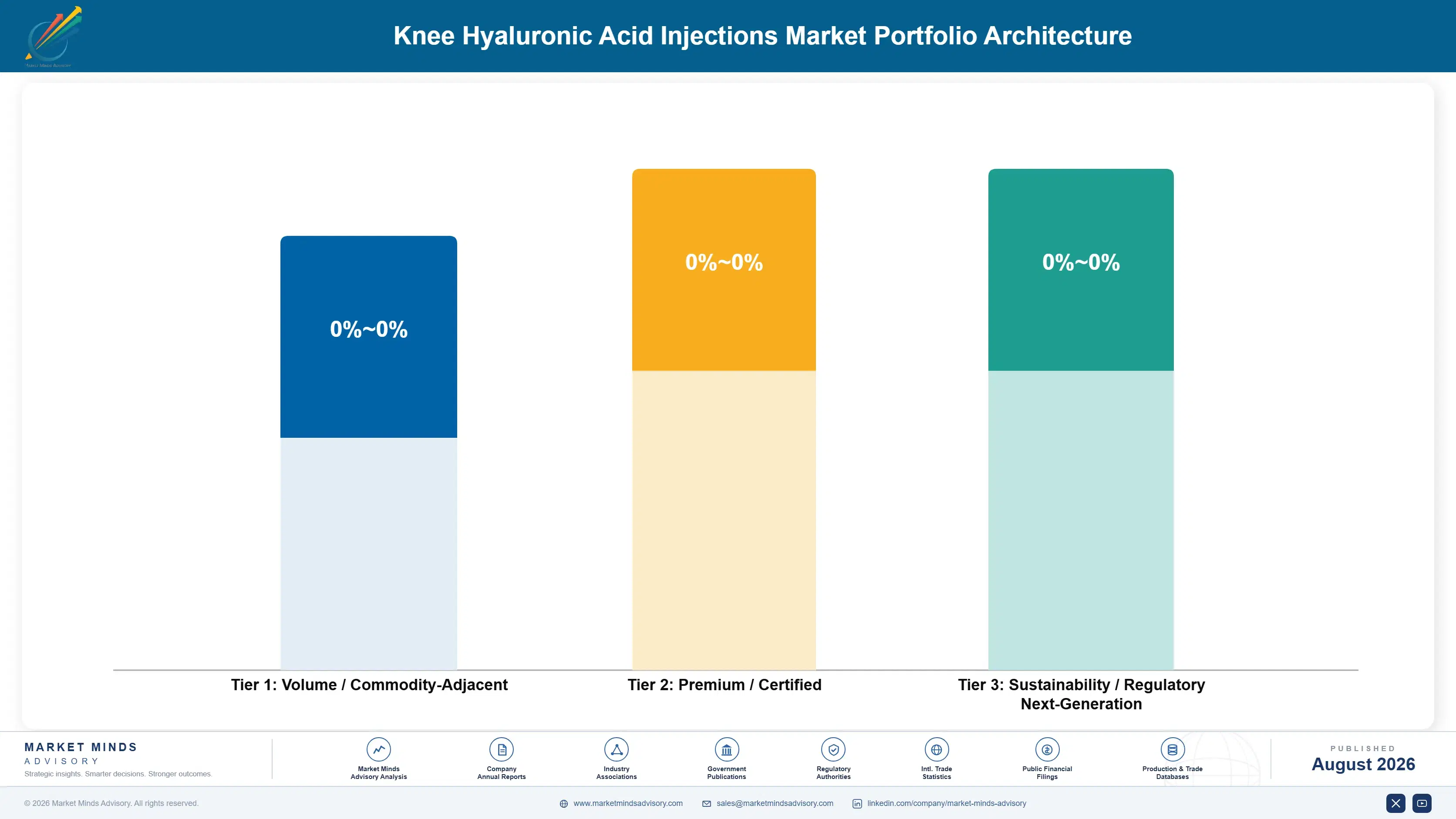
Portfolio Architecture for Margin Defence

Margin architecture separates by whether a payer is involved at all. Reimbursed multi-injection courses sold into compressed spread markets earn 34% to 44%, with average sales price recalculation continuing to erode the upper end. Single-injection and biologic adjunct products sold at premium or self-pay pricing earn 58% to 70%, because the practice economics justify the price and no reimbursement benchmark drags it downward.
The tension is that reimbursed volume is far larger and self-pay volume is far more profitable, and the two require different commercial models entirely. Selling into a reimbursed market means engaging payers, coding, and health economics. Selling self-pay means marketing to sports medicine practices and to patients directly. Almost no company in this market does both well, and several have damaged one attempting the other.

High-value pools concentrate in single-injection formats, biologic adjunct combinations, and fermentation raw material supply to competitors. The first two escape the reimbursement benchmark and the third earns from everybody's volume regardless of whose brand wins. Biologic adjunct products carry the widest margin range, because pricing is set by what a self-pay patient will accept rather than by any published schedule.

Volume / Commodity-Adjacent

Standard multi-injection reimbursed courses sold under buy-and-bill or equivalent payer arrangements, where competitive discounting feeds into the reimbursement benchmark. The ten-point range separates integrated producers from those buying raw material on the open market.
Gross Margin: 34% to 44%

Premium / Certified

Cross-linked single-injection products and premium branded courses where practice workflow economics support pricing above the reimbursement drag. The twelve-point range separates reimbursed single-injection sales from privately funded courses in markets with no payer benchmark at all.
Gross Margin: 58% to 70%

Sustainability / Regulatory / Next-Generation

Biologic adjunct combinations, self-pay sports medicine formats, and fermentation raw material supplied to other manufacturers. The thirty-four point range reflects genuine divergence: raw material supply earns industrial margins while self-pay combination products price on what patients will accept.
Gross Margin: 40% to 74%
knee-hyaluronic-acid-injections-market-portfolio-architecture-1787297943148

High-value Sub-segments and Strategic Watch-out

Single-Injection Cross-Linked Products

Highest growth and strong margin, driven by practice chair time economics rather than by any clinical superiority claim. One appointment slot replaces five for comparable total reimbursement, which is roughly a fourfold change in revenue per chair hour. Share continues rising in every region we track.
Gross Margin: 58% to 68%

Biologic Adjunct Combinations

High value with strong growth, sold largely self-pay through sports medicine practice outside any reimbursement benchmark. Controlled evidence for the combination remains thin and regulatory treatment varies widely between jurisdictions. Pricing is set by what patients will accept rather than by any published payment schedule anywhere.
Gross Margin: 48% to 74%

Reimbursed Multi-Injection Courses

The volume core of this market, still the largest block of treatment worldwide and the most exposed to reimbursement policy. Competitive discounting feeds directly into the benchmark, which erodes the spread for everyone including whoever discounted first. Volume in this tier tracks payment policy rather than published evidence.
Gross Margin: 34% to 44%

United States Office-Based Volume

Strategic watch-out. Guideline positions have given payers a defensible basis to restrict coverage while average sales price recalculation has compressed practice spread toward 14%. Volume is migrating to ambulatory surgery centres or disappearing entirely, and neither of those trends shows any sign at all of reversing.
Gross Margin: 26% to 38%

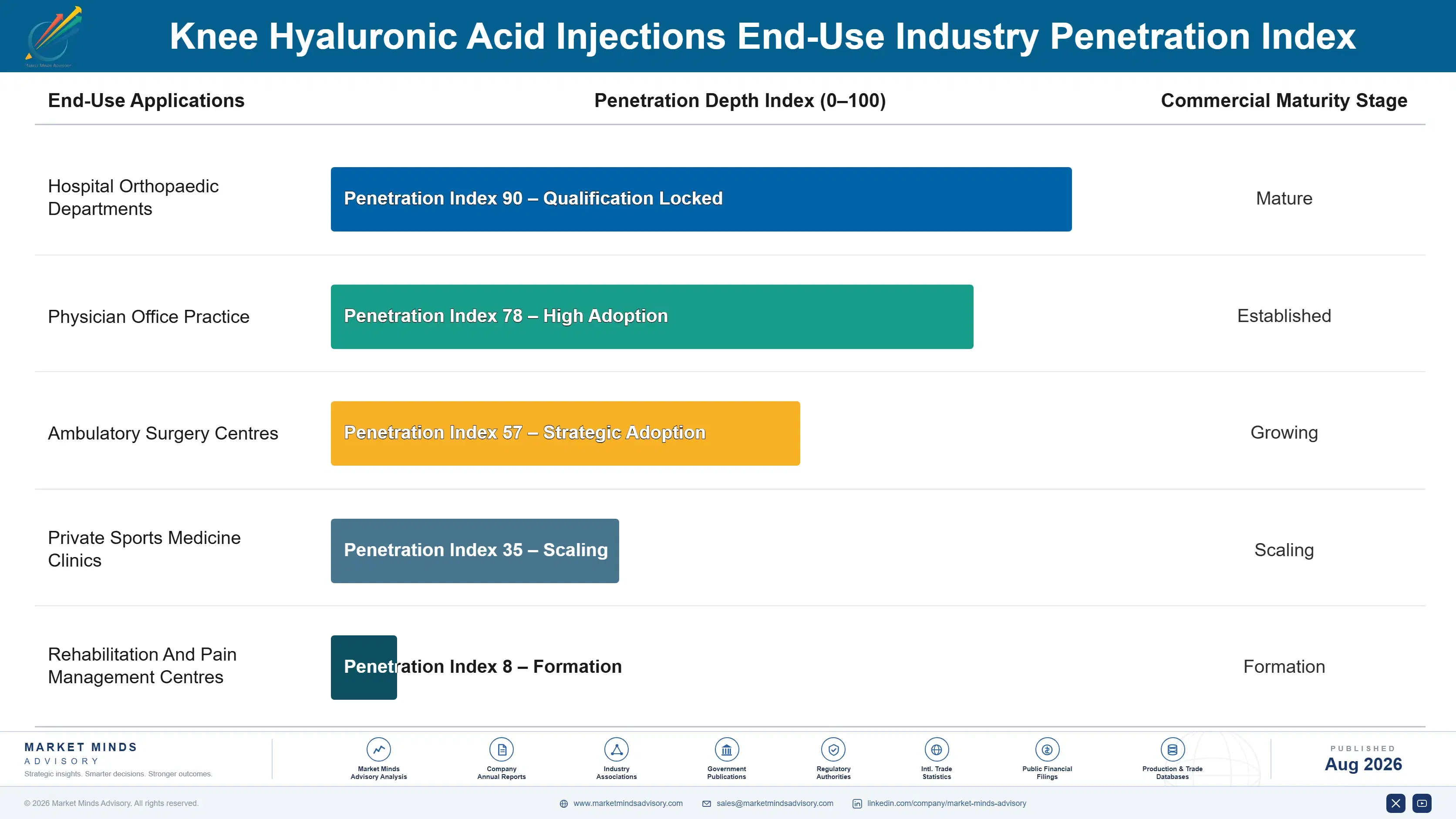
How Courses Actually Repeat

The annuity here is the repeat course rather than any contract. Knee osteoarthritis is progressive and symptomatic relief is temporary, so a patient treated successfully returns at six to twelve month intervals for years until surgery eventually becomes unavoidable. That makes the first course the acquisition event and everything after it retention. Products that patients abandon partway through a five-injection regimen never establish the pattern at all, which is the strongest commercial argume
Depth varies considerably by care setting. Japanese and Korean orthopaedic practice is the stickiest, with treatment embedded in routine care and prescriber habit built across generations of training. Private sports medicine practice is next, where patient relationships are direct and self-pay removes payer interference. American office-based practice is the shallowest, switching product whenever the acquisition spread changes. Public systems sit outside the pattern, buying on tender.

Buyer profiles have shifted meaningfully. Product selection moved from the individual orthopaedic surgeon toward group purchasing organisations and hospital committees evaluating acquisition cost against reimbursement. Patients arrive far better informed and frequently request specific products by name. Both changes favour companies with disciplined pricing and demonstrable practice economics over those competing on clinical claims.
knee-hyaluronic-acid-injections-market-end-use-penetration-index-1787297943644

Where We Come Out

These are among the four positions where our research anticipates prominent divergence between winners and laggards over the coming forecast period. Each is grounded in the demand model, the regulatory perimeter, and the announced capacity pipeline.
01 / ENDPOINT REFRAMING PRIORITY

Stop arguing about pain scores and measure surgery deferral

Twenty years of trials have failed to settle pain score superiority against saline injection in a condition with an unusually large placebo response, and another trial will not change that. Time to knee replacement is a harder endpoint, cheaper to capture from existing registry data, and it speaks directly to health systems carrying surgical waiting lists measured in years rather than months. A median deferral of fourteen months has calculable value that no symptom score has ever managed to demonstrate convincingly.
02 / PRACTICE ECONOMICS FOCUS

Chair time sells this category, not clinical differentiation

A practice filling one appointment slot instead of five for broadly comparable total reimbursement sees revenue per chair hour change by roughly four times, and no guideline position affects that arithmetic in any way. Single-injection products have taken share every year on exactly this basis while companies funded studies nobody's mind was changed by. The commercial argument that actually works in this category is operational rather than clinical, and on the evidence of the last decade it always has been.
03 / GEOGRAPHIC WEIGHT REBALANCING

The centre of this market is already in Asia

Japan administers around nine million injections annually under stable reimbursement while American coverage narrows and practice spread compresses year after year. Chinese provincial coverage keeps widening against arthroplasty capacity that cannot meet demographic demand. Commercial resource allocated on historical revenue rather than on reimbursement trajectory consistently overweights the declining half of this market, and the companies that rebalanced early now hold positions latecomers find expensive to buy into, because regional brands are entrenched and prescriber loyalty in this category runs unusually deep.
04 / PRICING DISCIPLINE ENFORCEMENT

Discounting destroys the benchmark that pays everybody

Average sales price recalculation means competitive discounting in the United States feeds directly into the reimbursement benchmark that determines what every participant receives, including the company that discounted to win the account. The practice spread has compressed toward fourteen percent and treatment volume has followed it downward, rather than following any change in the published clinical evidence. Share bought through price under this structure destroys considerably more industry revenue than it captures, and unlike an ordinary price war it does so permanently.

Engagement Snapshot From the Field

A live engagement with an industry participant carrying material or product regulatory and market exposure ahead of a defining policy shift, showing how our research translates into a defensible multi-year portfolio strategy.
MARKET MINDS ADVISORY · CLIENT ENGAGEMENT SUMMARY
Knee Hyaluronic Acid Injections Producer Strategic Portfolio Review and Transition Roadmap 2026·Investment Scenario on Knee Hyaluronic Acid Injections Exposure Evaluation 2025-26
CLIENT PROFILE
A European orthopaedic injectables company with roughly EUR 120 million in annual revenue (client-reported, unverified by MMA) from intra-articular hyaluronic acid products, selling a three-injection course across fifteen European markets and the United States. The company bought hyaluronic acid raw material on the open market and held no single-injection product, with about 62% of revenue coming from reimbursed European volume.
STRATEGIC CHALLENGE
United States revenue had fallen for three consecutive years as reimbursement spread compressed, and European tender pricing was eroding under competition from Asian-manufactured product. The board was weighing whether to fund cross-linked single-injection development at considerable cost and delay, or to defend the existing portfolio through pricing and expand into markets where reimbursement remained intact.
MMA APPROACH
MMA modelled practice economics for three-injection versus single-injection courses across six European payment systems, interviewed forty-one orthopaedic prescribers on product selection drivers, and assessed reimbursement trajectory across Asian markets against the client's regulatory and commercial capability. Raw material supply exposure was benchmarked against integrated competitors, and development timelines for cross-linking were validated with contract developers.
KEY FINDINGS
  1. Prescribers ranked appointment slot economics above every clinical attribute in thirty-four of the forty-one interviews, and none ranked published evidence in their top three.
  2. Cross-linked single-injection development to European approval was costed at 18 to 24 months longer and 40% above the internal estimate the board had been working from.
  3. Open market hyaluronic acid purchase cost 34% above the transfer price integrated competitors achieved, and dermal filler demand was projected to tighten supply further.
  4. Japanese and Chinese reimbursement trajectories supported volume growth the client could not access without a regulatory pathway it had never built or budgeted for.
CLIENT PROFILE
A European orthopaedic injectables company with roughly EUR 120 million in annual revenue (client-reported, unverified by MMA) from intra-articular hyaluronic acid products, selling a three-injection course across fifteen European markets and the United States. The company bought hyaluronic acid raw material on the open market and held no single-injection product, with about 62% of revenue coming from reimbursed European volume.
STRATEGIC CHALLENGE
United States revenue had fallen for three consecutive years as reimbursement spread compressed, and European tender pricing was eroding under competition from Asian-manufactured product. The board was weighing whether to fund cross-linked single-injection development at considerable cost and delay, or to defend the existing portfolio through pricing and expand into markets where reimbursement remained intact.
MMA APPROACH
MMA modelled practice economics for three-injection versus single-injection courses across six European payment systems, interviewed forty-one orthopaedic prescribers on product selection drivers, and assessed reimbursement trajectory across Asian markets against the client's regulatory and commercial capability. Raw material supply exposure was benchmarked against integrated competitors, and development timelines for cross-linking were validated with contract developers.
KEY FINDINGS
  1. Prescribers ranked appointment slot economics above every clinical attribute in thirty-four of the forty-one interviews, and none ranked published evidence in their top three.
  2. Cross-linked single-injection development to European approval was costed at 18 to 24 months longer and 40% above the internal estimate the board had been working from.
  3. Open market hyaluronic acid purchase cost 34% above the transfer price integrated competitors achieved, and dermal filler demand was projected to tighten supply further.
  4. Japanese and Chinese reimbursement trajectories supported volume growth the client could not access without a regulatory pathway it had never built or budgeted for.
RECOMMENDED STRATEGY
Phase 1: Phase one: license a cross-linked single-injection product rather than developing one internally, accepting royalty economics in exchange for two years of speed. Phase 2: Phase two: withdraw from United States office-based tenders below a defined spread threshold and redirect that commercial resource toward European premium accounts. Phase 3: Phase three: secure multi-year hyaluronic acid raw material supply with indexation, and evaluate backward integration once single-injection volume justifies the capital.
OUTCOME
The client licensed a single-injection product within two quarters and launched across seven European markets the following year. Group revenue grew 8% against a 21% decline in United States volume, and gross margin improved by six points as the mix shifted toward the licensed product (client-reported, unverified by MMA).

Frequently Asked Questions

Foundational context covering the market sizes, CAGR, scope, country, region and competition that inform every finding below. This section is provided to cover basics and most often pre-purchase conversations, answered from the MMA Primary Research Dataset.

What is the current size of the Knee Hyaluronic Acid Injections Market?

The global knee hyaluronic acid injections market reached USD 1.9 billion in 2025, covering intra-articular hyaluronic acid and hylan products for knee osteoarthritis. That spans single-injection, multi-injection, combination, and biologic adjunct formulations.

How large will the Knee Hyaluronic Acid Injections Market be by 2036?

MMA forecasts USD 3.32 billion by 2036, up from USD 2.0 billion in 2026, an increase of USD 1.32 billion. That represents an expansion multiple of 1.66 times across the forecast period.

What is the CAGR for the Knee Hyaluronic Acid Injections Market 2026 to 2036?

The base case CAGR is 5.2%, with a bull case of 6.5% and a bear case of 4.0%. Historical growth between 2020 and 2025 ran at 4.1%, averaging a declining Western market against an expanding Eastern one.

Which segment is growing fastest?

Cross-linked single-injection formulations grow fastest at 7.8%, exactly 1.50 times the market rate, on practice workflow economics rather than clinical superiority. Hyaluronic acid with biologic adjunct follows at 6.9% from a small base.

Who are the major companies in the Knee Hyaluronic Acid Injections Market?

Sanofi, Seikagaku, Bioventus, Anika Therapeutics, and Zimmer Biomet lead, together holding 46% of the market. Regional brands hold entrenched positions that global companies have never displaced.

Which country is growing fastest?

China grows fastest at 9.2%, driven by widening provincial reimbursement, domestic manufacturing at accessible prices, and arthroplasty capacity that cannot meet demographic demand. Volume comes from genuinely new patients.

Report Segmentation Architecture

The full report scope spans multiple orthogonal segmentation dimensions, with cross-tabulated demand data provided for each dimension pair. Coverage extends further to regional breakdowns, trend trajectories, and the competitive detail needed to support segment-level decision-making.

By Product Formulation

  • Cross-Linked Single-Injection Formulations
  • High Molecular Weight Multi-Injection Courses
  • Low Molecular Weight Multi-Injection Courses
  • Hyaluronic Acid And Corticosteroid Combinations
  • Hyaluronic Acid With Biologic Adjunct

By End-Use Industry

  • Hospital Orthopaedic Departments
  • Physician Office Practice
  • Ambulatory Surgery Centres
  • Private Sports Medicine Clinics
  • Rehabilitation And Pain Management Centres

By Commercial Dimension

  • Reimbursed Buy-And-Bill Supply
  • Hospital And Group Purchasing Tenders
  • Self-Pay Private Practice Sales
  • Distributor And Agent Channels
  • Contract Manufacturing Supply

By Region

  • East Asia
  • South Asia and Pacific
  • North America
  • Western Europe
  • Latin America
  • Middle East and Africa
  • Eastern Europe

Scope, Methodology, and Coverage

Every figure in this report is reproducible from documented input assumptions. The scope below maps the historical period, the forecast horizon, the segmentation dimensions, and the countries covered, alongside the underlying primary and qualitative methodology.
Historical Period
2020 to 2025
Forecast Period
2026 to 2036
Base Year
2025 (USD billions; MMA Primary Research Dataset, August 2026)
Market Definition
The knee hyaluronic acid injections market covers intra-articular hyaluronic acid and hylan preparations administered into the knee joint for symptomatic osteoarthritis, whether regulated as devices or as pharmaceuticals in the relevant jurisdiction. Scope spans cross-linked single-injection formulations, high and low molecular weight multi-injection courses, hyaluronic acid and corticosteroid combination products, and formulations combining hyaluronic acid with a biologic adjunct. Injections into other joints, corticosteroid-only injections, platelet-rich plasma administered alone, dermal and ophthalmic hyaluronic acid, and knee arthroplasty are excluded.
Quantitative Units
USD billions at manufacturer revenue level; injections administered annually; treatment courses delivered.
Segmentation Dimensions
By product formulation; by end-use industry; by commercial dimension; by region.
Regions Covered
East Asia, South Asia and Pacific, North America, Western Europe, Latin America, Middle East and Africa, Eastern Europe
Countries Covered
United States, Canada, Germany, France, Italy, Spain, United Kingdom, Netherlands, Poland, Czech Republic, Japan, South Korea, China, India, Australia, Thailand, Brazil, Mexico, United Arab Emirates, South Africa.
Key Companies Profiled
Sanofi, Seikagaku, Bioventus, Anika Therapeutics, Zimmer Biomet, Ferring Pharmaceuticals, LG Chem, Fidia Farmaceutici, IBSA Group, TRB Chemedica, Lifecore Biomedical, Bloomage Biotechnology, Haohai Biological Technology, Shandong Freda Pharmaceutical, Contipro, Croma-Pharma, Hyundai Bioland, Ono Pharmaceutical, Chugai Pharmaceutical, Kaken Pharmaceutical.
Quantitative Methodology
Primary survey, n=3,800 respondents, Q4 2025, six countries; demand-side model with trade association cross-validation
Qualitative Methodology
47 expert interviews, Q4 2025; applied to validate demand model assumptions, identify emerging dynamics, and assess competitive positioning
Report Format
PDF and XLSX data workbook (Word format preview document)
Publisher
Market Minds Advisory
Report Code
MMA-2026-MED-785
Published
August 2026
Contact
sales@marketmindsadvisory.com | www.marketmindsadvisory.com

Purchase the full Knee Hyaluronic Acid Injections Market Report (2026 to 2036).

The full MMA report on knee hyaluronic acid injections covers formulation, regional, and competitive analysis in detail, with separate treatment of the reimbursement mechanics that govern volume far more than clinical evidence does. It includes practice economics modelling across payment systems, average sales price erosion analysis by market, arthroplasty deferral evidence review, and Asian reimbursement trajectory tracking by country and province. Regional chapters cover twenty countries with coverage policy assessed individually. Competitive profiling spans twenty companies compared on a single consistent revenue basis throughout the analysis.
Twenty country regional demand mechanism chapters
Practice economics modelling across payment systems
Average sales price erosion analysis by market
Arthroplasty deferral evidence review and analysis
Twenty company competitive profiles compared consistently
Asian reimbursement trajectory tracking by province

Built For The People Who Decide

From boardroom strategy to bench-side execution, this report is read cover-to-cover by leaders shaping the next decade of their industry, turning demand scenarios, market dynamics and valuation benchmarks into decisions.
CXOs/ Presidents/ VPs/ Managers
M&A and Corporate Development
Strategy Teams and R&D Heads
Procurement and Product Directors
Regulatory and Compliance Leaders
Investor Relations and Equity Analysts