Market Minds Advisory
Klinefelter Syndrome Therapeutics Market

Klinefelter Syndrome Therapeutics Market: Diagnosis Deficit, Fertility Timing, and Lifelong Persistence Economics

Roughly three quarters of men with this condition are never diagnosed at all, and those who are typically find out at thirty-one during an infertility investigation, long after the tissue that mattered has gone.

Lead Analyst

Alice Ballenger

Published

September 2026

Make Smarter Decisions with Customized Research Insights

Request a free sample report and evaluate market opportunities, growth trends, and competitive dynamics relevant to your business needs.

2025 MARKET VALUE$0.7BMarket Size 2025
2036 FORECAST VALUE$1.7BBase Case , 2026 to 2036
CAGR 2026 TO 20368.4 %Bull 9.7% / Bear 7.1%
INCREMENTAL OPPORTUNITY$0.9BNet 10- year value creation
EXPANSION MULTIPLE2.24x2036 value over 2026 base
Strategic Levers
M&A Pipeline
Regional Outlook
Country Rankings
Competitive Intelligence
Segmental Deep-dive
Call-Us : 91 93563 13602

Executive Snapshot and Market Trajectory

This is a finding problem rather than a treatment problem. Only about 26% of men with Klinefelter syndrome are ever diagnosed, the medicines are generic and inexpensive, and everything commercially interesting sits upstream of the prescription. Median identification arrives at thirty-one, during an infertility investigation. Nothing in development changes that.
Oral testosterone undecanoate compounds at 12.6%, a full 1.50x the market rate, because therapy starts in adolescence and continues for fifty years, which makes tolerability and adherence worth more than any efficacy difference. North America holds the largest share at 30%, on a diagnosis rate roughly triple the global average, testosterone reimbursement and the deepest surgical sperm retrieval capacity anywhere. The largest undiagnosed populations sit elsewhere entirely.
Concentration sits at 51%, with Bayer and AbbVie leading through formulations developed for hypogonadism generally rather than for this condition specifically. Prenatal screening is now detecting sex chromosome aneuploidies incidentally at scale, which will move diagnosis from thirty-one to birth and change what this market treats entirely. Manufacturers who fund detection pathways enlarge the treated population itself rather than competing for a share of it, which is unusual and worth noticing.
Market Definition
This market covers therapeutic interventions delivered to individuals with Klinefelter syndrome, spanning injectable testosterone esters, transdermal gels and solutions, oral testosterone undecanoate formulations, subcutaneous pellets and auto-injectors, fertility preservation and assisted reproduction interventions including surgical sperm retrieval, and adjunctive metabolic and bone health therapy. Measurement covers revenue attributable to this population specifically. Genetic and karyotype diagnostics, testosterone prescribed for age-related hypogonadism, general endocrinology services, and psychological or educational support are excluded.
Base Year Value
$0.7B in 2025 (MMA Primary Research Dataset, August 2026)
Forecast Period
2026 to 2036, eleven discrete annual values
CAGR
8.4% base case. Bull 9.7%. Bear 7.1%.
Fastest Growth Segment
Oral Testosterone Undecanoate Formulations: 12.6% CAGR
Fastest Growth Country
China: 13.4% CAGR
Fastest Growth Region
South Asia and Pacific: 10.6% CAGR
Largest Region
North America: 30% of 2025 global value
Market Leaders
Bayer, AbbVie, Endo, Viatris, and Tolmar. Source: MMA Primary Research Dataset, July 2026.
Primary Survey
n=3,800 procurement and R&D decision-makers, Q4 2025, six countries
Methodology
Demand-side build-up, cross-validated against public data, 47 expert interviews

Klinefelter Syndrome Therapeutics Market Forecast Scenarios

klinefelter-syndrome-therapeutics-market-size-forecast-scenario-1787304943809
Growth ran at roughly 7.2% between 2020 and 2025, driven almost entirely by diagnosis rather than by any therapeutic development. Testosterone formulations available in 2020 remain the mainstay today, and most are generic. What changed was awareness among endocrinologists and fertility specialists, alongside the beginnings of incidental detection through prenatal screening programmes that were never designed to find this condition at all.
Base case growth of 8.4% rests on three mechanisms. Prenatal and paediatric detection keeps improving, which adds patients to lifelong therapy decades earlier than infertility investigation ever did. Oral and subcutaneous formulations displace injections and gels among adolescents facing fifty years of treatment. And fertility preservation is moving earlier, since surgical retrieval succeeds more often in younger patients and awareness of that has spread through specialist practice. None of the three depends on a new molecule.
The bull case at 9.7% assumes prenatal screening programmes formally report sex chromosome findings and health systems build paediatric care pathways behind them. The bear case at 7.1% reflects the opposite risk: incidental prenatal detection without any agreed counselling framework has already prompted termination decisions on limited information, and a restrictive policy response would close the most promising route to earlier diagnosis.

Klinefelter Therapeutics: Detection Gap and Lifelong Treatment

The defining fact about this market is how few of its patients it reaches. Klinefelter syndrome affects roughly one in six hundred male births, which makes it the most common sex chromosome condition in existence, and only about 26% of affected men are ever identified. Median diagnosis arrives at thirty-one, generally during an infertility investigation, by which point the germ cells that treatment might have preserved have largely disappeared.
TOP FIVE CONCENTRATION51%Testosterone formulations developed for hypogonadism generally rather than this condition
LIFETIME DIAGNOSIS RATE26%Affected individuals ever identified across a complete lifetime
MEDIAN DIAGNOSIS AGE31 yearsTypical age at identification, usually during an infertility investigation
ANNUAL THERAPY COSTUSD 1,850Blended yearly spend per treated patient across all formulations
SPERM RETRIEVAL SUCCESS44%Surgical extraction procedures recovering viable sperm for preservation
TREATMENT PERSISTENCE RATE58%Patients continuing therapy beyond the second year after starting
Therapy itself is unglamorous and cheap. Testosterone replacement in one formulation or another, mostly generic, at roughly eighteen hundred dollars a year, continued from adolescence for five decades. Nothing in development promises to change that. What differentiates formulations is tolerability, injection burden and transference risk, because a treatment lasting fifty years is judged on whether a patient keeps taking it rather than on whether it works.
The change worth watching originates outside this field entirely. Non-invasive prenatal screening, adopted at scale for chromosomal conditions, incidentally detects sex chromosome aneuploidies as a by-product. That could move median diagnosis from thirty-one to birth, transforming a condition found after damage into one managed from the beginning. It has also created counselling situations that health systems were not prepared for and have not yet resolved.
"Three quarters of these men go their whole lives without knowing, and the ones who find out usually find out in a fertility clinic at thirty when it is too late to do the one thing that mattered. That is the market. The drugs are almost beside the point."
Principal Analyst, Endocrinology and Rare Condition Therapeutics Practice · MMA

Market Trends

Prenatal screening detects sex chromosome conditions incidentally at scale

Non-invasive prenatal testing was adopted to screen for trisomy 21 and related conditions, and it identifies sex chromosome aneuploidies as an unintended by-product across a very large screened population. Detection rates for these findings are high enough that programmes now encounter them routinely. That could shift median diagnosis from thirty-one to birth, converting a condition found after irreversible damage into one managed from infancy. Health systems have not built the counselling frameworks or paediatric pathways that such a shift plainly requires. European societies have issued guidance addressing that gap and most programmes have not acted.
Market Impact: Therapy continues beyond 50 years
Fertility preservation moves earlier as retrieval success declines with age

Surgical sperm retrieval recovers viable cells in roughly 44% of procedures, and that figure falls steadily with patient age as remaining germ cells are progressively lost. The clinical argument for attempting retrieval during adolescence is therefore strong and getting stronger as data accumulates. The ethical argument is considerably harder, since consenting a fourteen-year-old to a testicular procedure for a future he cannot yet evaluate is genuinely difficult. That debate is unresolved and it determines a growing part of this market. Individual centres are deciding it independently, and few have sought the institutional ethics approval such programmes require.
Market Impact: Life expectancy reduced by 2 years

Market Opportunities and Growth Drivers

Lifelong therapy from adolescence produces exceptional treated duration

A patient diagnosed in adolescence and started on testosterone replacement continues for five decades or more, which is among the longest treatment durations in any therapeutic area. Each additional patient identified early therefore represents far more lifetime value than an adult diagnosis does, and the difference compounds as detection improves. That makes formulation tolerability and persistence commercially decisive, because a patient lost to poor adherence at twenty represents thirty years of forgone treatment rather than a single lapsed prescription. No other endocrine indication offers a patient relationship of comparable length to anybody.
Market Impact: Only 26% ever diagnosed

Comorbidity burden requires coordinated care most patients never receive

Klinefelter syndrome carries elevated risk of metabolic syndrome, osteoporosis, venous thromboembolism and breast cancer, and life expectancy is measurably reduced compared with the general population. Testosterone replacement addresses some of that and not all of it. Most diagnosed men have no coordinating specialist and receive fragmented care from whoever happened to make the diagnosis, which leaves adjunctive treatment substantially undelivered. Specialist multidisciplinary clinics improve outcomes measurably and exist in very few health systems. Most diagnosed men receive fragmented care from whichever specialist happened to make the diagnosis, and adjunctive treatment goes substantially undelivered as a result.
Market Impact: Persistence falls to 58%

Market Restraints and Challenges

Three quarters of affected men are never identified at all

Only about 26% of individuals with Klinefelter syndrome receive a diagnosis during their lifetime, and the presentation is variable enough that many never come to clinical attention. The root cause is that features overlap with normal variation, so tall stature, reduced fertility and mild learning difficulty rarely prompt karyotyping on their own. Commercial impact is a treated population a fraction of the true one. Prenatal screening incidental findings and paediatric endocrine referral pathways are the two realistic routes to improving that. Neither route is being pursued systematically by anybody at present.
Market Impact: Moves diagnosis from 31 years

Persistence collapses on a therapy that must last decades

Roughly 58% of patients continue testosterone replacement beyond the second year, which is poor for a condition requiring lifelong treatment and reflects injection burden, gel transference concerns and the absence of symptoms patients can feel improving. The root cause is that benefits are largely preventive rather than immediate. Commercial impact is that treated population growth overstates revenue growth considerably. Newer oral and subcutaneous formulations, adolescent transition clinics and specialist follow-up all improve continuation measurably. Transition from paediatric to adult services is where continuation most often fails, and almost no health system runs a structured programme addressing it.
Market Impact: Success rate around 44%
3 additional market trends, 4 additional growth drivers, and 2 additional restraints and challenges are covered in the full report. Contact sales@marketmindsadvisory.com to access the complete intelligence.

Segment CAGR and Growth Architecture

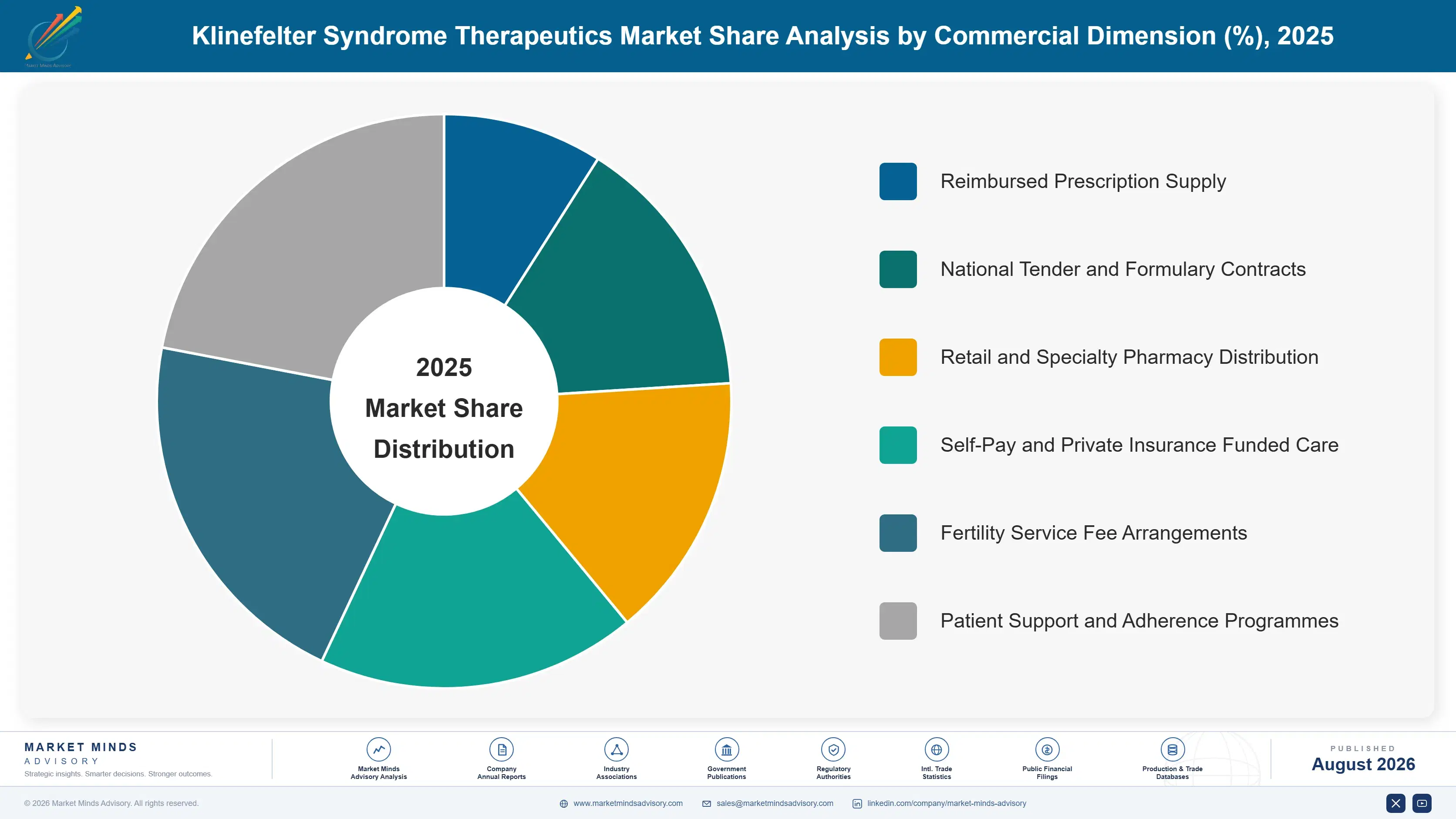
Segmentation follows the intervention a patient receives, because intervention type determines the specialist involved, the setting, the reimbursement route and the duration of the relationship that follows. Six intervention types cover Klinefelter care without overlap. Age at diagnosis cuts across every intervention and is treated as a patient characteristic rather than as a segment here.
klinefelter-syndrome-therapeutics-market-market-share-analysis-1787304944339

Oral Testosterone Undecanoate Formulations

Growing at 12.6%, a full 1.50x the market rate, oral undecanoate formulations avoid both injection burden and the transference risk that makes transdermal gels awkward in households with children or partners. For a patient starting in adolescence and continuing for fifty years, those practical considerations outweigh any pharmacokinetic argument, and persistence at roughly 58% across the category shows how much room exists for improvement. Twice-daily dosing with food is the trade-off. Pricing sits well above generic injectable esters, which payers accept more readily for younger patients facing lifelong therapy. Prescriber preference among younger patients has shifted noticeably toward this route without any regulatory change prompting it. No regulatory change prompted it.
CAGR 12.6%

Fertility Preservation and Assisted Reproduction

Fertility preservation grows at 10.6% as awareness spreads that surgical sperm retrieval succeeds in roughly 44% of attempts and that the figure declines with age as germ cells are progressively lost. Microdissection testicular sperm extraction followed by cryopreservation and later assisted reproduction is the pathway, and it is expensive, specialised and available in relatively few centres. The unresolved question is timing: retrieving during adolescence improves the odds and requires consenting a minor to a procedure whose value he cannot yet assess for himself. Value per patient here runs several times the annual cost of testosterone replacement, and specialist surgical centres rather than manufacturers deliver all of it. Availability is genuinely limited.
CAGR 10.6%
Full segment breakdown across 6 segments available in the complete report.

Regional Architecture and Country Demand Map

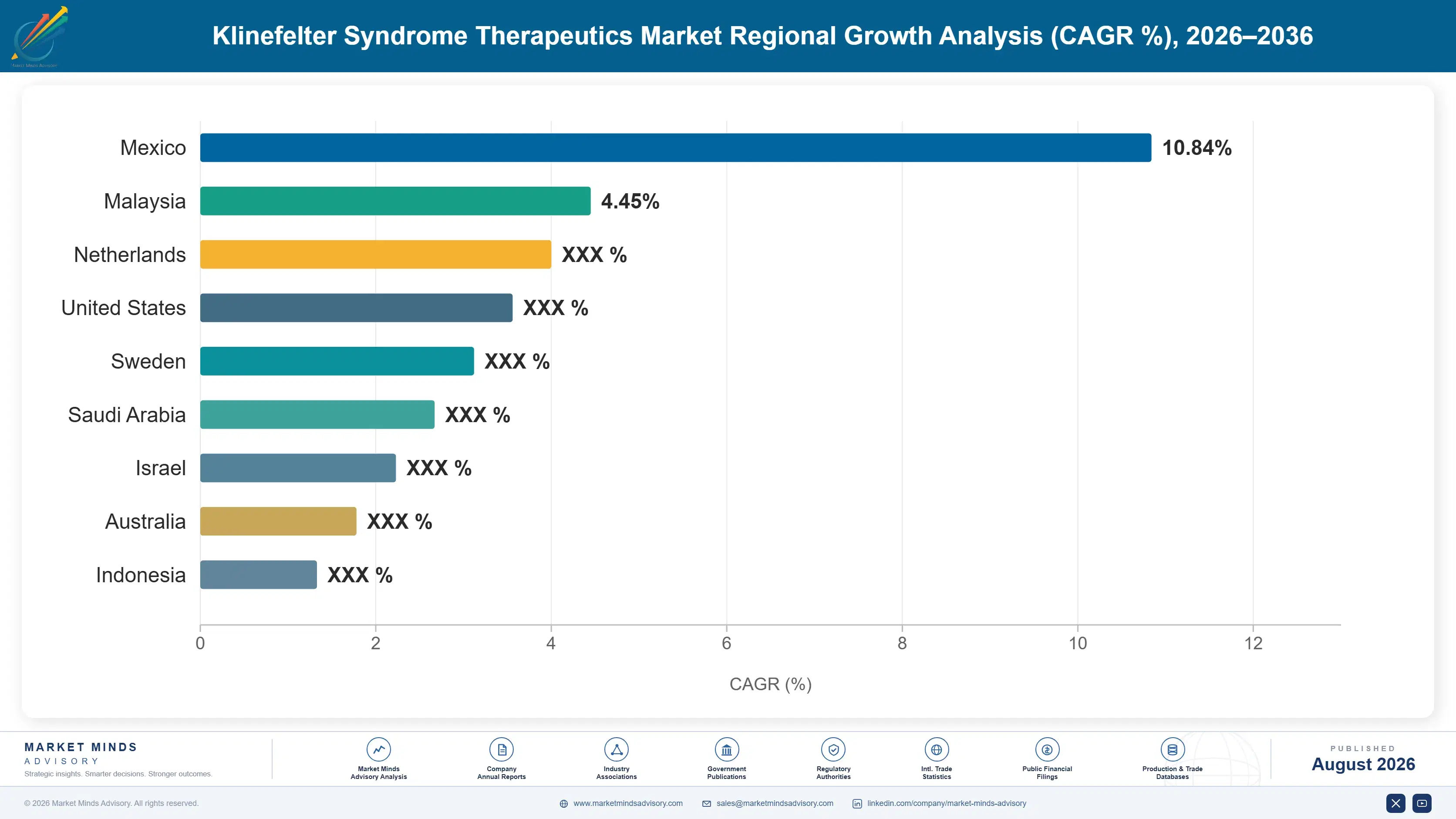
Regional value follows diagnosis rates and treatment access rather than prevalence, which is essentially uniform worldwide at around one in six hundred male births. The largest undiagnosed populations therefore sit in the regions generating the least revenue. Prevalence explains none of the regional distribution here.

North America

North America holds the largest share at 30% on diagnosis rather than on prevalence, which is identical everywhere. United States diagnosis rates run roughly triple the global average because karyotyping is ordered more readily during infertility investigation and paediatric endocrine referral is comparatively accessible. Surgical sperm retrieval capacity is the deepest anywhere, with experienced microdissection programmes concentrated in academic fertility centres. Testosterone is a controlled substance here, which shapes refill logistics and telehealth prescribing in ways no other region contends with. Growth at 7.4% is modest because the identified population is already comparatively well served. Specialist multidisciplinary clinics remain rare even here, so most patients are managed by whoever diagnosed them.
Share: 30% | CAGR: 7.4% (2026 to 2036)

Western Europe

Twenty-four per cent of value, growing at 6.8%, the slowest rate of the seven regions. Danish and Dutch registry work has produced most of what is known about outcomes and life expectancy in this condition, and Nordic health systems identify patients more systematically than almost anywhere. Long-acting injectable testosterone undecanoate is the regional standard for primary hypogonadism and Bayer's franchise reflects that. Fertility preservation is publicly funded to varying degrees, with several systems covering surgical retrieval. Specialist multidisciplinary clinics exist in a handful of centres and demonstrably improve outcomes where patients can reach them. Registry data from this region underpins almost everything known about long-term outcomes in this condition worldwide.
Share: 24% | CAGR: 6.8% (2026 to 2036)
Regional intelligence for 5 additional markets available in the complete report: East Asia, South Asia and Pacific, Latin America, Middle East and Africa, Eastern Europe. Contact sales@marketmindsadvisory.com.
klinefelter-syndrome-therapeutics-market-country-cagr-analysis-1787304944863

Where Klinefelter Treatment Value Sits

The medicines are generic, cheap and largely unchanged for two decades, so nothing durable is won on the molecule. Value accrues to whoever finds patients earlier, whoever keeps them on therapy across fifty years, and whoever reaches them before fertility becomes irrecoverable. Detection rather than promotion is what actually grows this category at all.

Support paediatric and prenatal detection pathways deliberately

Only about 26% of affected men are ever diagnosed, and median identification at thirty-one arrives long after fertility preservation could have helped. Prenatal screening already detects these findings incidentally, and paediatric endocrine referral pathways catch a further group. Manufacturers funding clinician education, referral criteria and counselling resources enlarge the treated population itself rather than competing for share of it. That is unusual and it is the only route to material category growth available to anybody here. Competitors benefit alongside, which is why almost nobody funds it. That is a public health argument with a genuine commercial return attached.
Market Impact: Addresses the 74% who are never dia

Compete on persistence rather than on pharmacokinetics

Roughly 58% of patients continue beyond the second year on a therapy meant to last five decades, and a patient lost at twenty forgoes thirty years of treatment rather than one prescription. Injection burden, gel transference and the absence of felt benefit all drive discontinuation. Formulations removing those obstacles win on continuation regardless of serum profile comparisons, and improving persistence by ten points is worth considerably more than any share gain promotion could deliver in this category. Improving persistence by ten points is worth more than any share gain promotion could deliver here.
Market Impact: Persistence currently sits at only

Build the adolescent transition clinic relationship early

Patients identified in childhood move from paediatric to adult endocrinology in late adolescence, and that transition is where continuation most often fails. Structured transition clinics, adolescent-appropriate formulations and follow-up designed for young men rather than for older hypogonadal patients all measurably improve continuation. Manufacturers supporting transition pathways secure a relationship lasting 50 years rather than a prescription lasting two, which is the longest patient relationship available anywhere in endocrinology. Paediatric endocrinologists identify that handover consistently as the largest single cause of discontinuation, and almost none report a structured programme operating in their own centre.
Market Impact: Secures patient relationships lasti

Fund the fertility timing evidence that changes practice

Surgical sperm retrieval succeeds in roughly 44% of attempts and declines with age, which argues for adolescent intervention while the ethics of consenting a minor argue against it. That debate is unresolved because the evidence comparing outcomes by age at retrieval is thin. Whoever funds the studies that settle it shapes a clinical pathway rather than competing within one, and fertility preservation is already compounding at 10.6% on awareness alone without any definitive data behind it. Fertility preservation is already compounding at 10.6% on awareness alone. Nobody has funded the comparative outcome studies that would settle it.
Market Impact: Retrieval succeeds in 44% of all at

Who Controls the Margin Pool

Concentration sits at 51% across the top five, measured on annual revenue attributable to Klinefelter syndrome and primary hypogonadism treatment, the single basis applied throughout. Bayer leads through long-acting injectable undecanoate that became the European standard, AbbVie through transdermal gel that shaped American practice, and Endo, Viatris and Tolmar follow across injectable, generic and oral formulations respectively. None of these products was developed for this condition specifica
Competition runs on tolerability and administration burden rather than on efficacy, which is equivalent across formulations that all restore serum testosterone adequately. Persistence over decades decides commercial outcomes, and the formulation a patient will actually keep taking beats the one with the better pharmacokinetic profile every time. Fertility preservation competes on an entirely separate basis, since surgical centres rather than manufacturers deliver it.

Pressure builds from two directions. Generic injectable esters cost very little and dominate volume wherever payers control formulary choice, which caps pricing on newer formulations. Separately, prenatal detection may enlarge the diagnosed population substantially, which would reward whoever built paediatric and adolescent relationships in advance. Rankings shift most where a manufacturer treats persistence and early diagnosis as commercial priorities rather than as public health matters somebody else handles.
klinefelter-syndrome-therapeutics-market-company-positioning-matrix-1787304945382

Competitive Moat and Risk Dimensions

BAYER

Moat: Long-acting injectable standard position

Long-acting testosterone undecanoate requiring administration every ten to fourteen weeks removes the frequent injection burden that drives discontinuation on shorter-acting esters, and it became the European standard for primary hypogonadism on that basis. Clinician familiarity built across two decades of use in a lifelong indication is genuinely difficult for a newer formulation to displace.
BAYER

Risk: Injection route resistance

Any injectable faces resistance among adolescents beginning fifty years of therapy, and oral and subcutaneous alternatives address exactly that objection. Administration requires a clinic visit that oral formulations avoid entirely. Generic competition on shorter-acting esters caps pricing across the whole injectable category regardless of the dosing interval advantage.
ABBVIE

Moat: Transdermal familiarity and prescriber base

Transdermal gel established daily testosterone replacement in American practice and carries prescriber familiarity across endocrinology, urology and primary care that newer entrants must build from nothing. Daily self-administration without injections suits patients who will not accept a needle, and the prescribing base extends far beyond the specialists who diagnose this particular condition.
ABBVIE

Risk: Transference and adherence exposure

Secondary transfer to partners and children is a genuine limitation in family households, and it is precisely the population starting lifelong therapy in adolescence. Daily application drives adherence failure over decades. Generic gel competition has eroded pricing substantially, and oral formulations answer both the transference and the daily burden objections at once.

Players Tracked

Prominent Players

Bayer
AbbVie
Endo
Viatris
Tolmar

Other Key Players

Marius Pharmaceuticals
Antares Pharma
Halozyme Therapeutics
Ferring Pharmaceuticals
Merck KGaA
Organon
Sun Pharmaceutical Industries
Cipla
Hikma Pharmaceuticals
Teva Pharmaceutical Industries
Acerus Pharmaceuticals
Kyowa Kirin
Besins Healthcare
IBSA Group
CooperSurgical

Recent Developments

FEBRUARY 2025

European societies publish guidance on incidental prenatal sex chromosome findings

European genetics and endocrinology societies issued joint guidance on managing sex chromosome aneuploidies detected incidentally through prenatal screening, addressing counselling content and paediatric follow-up pathways that health systems had been handling inconsistently since incidental detection began occurring at scale. National programmes have largely not acted on it yet.
Signal: Prenatal detection is arriving considerabl
SEPTEMBER 2025

Fertility centres extend adolescent sperm preservation programmes

Several academic fertility centres extended surgical sperm retrieval and cryopreservation programmes to adolescent patients with Klinefelter syndrome, responding to evidence that retrieval success declines with age while acknowledging that consent for a minor remains genuinely contested clinically. Institutional ethics approval was required in every case.
Signal: Retrieval timing is being decided by indiv
JANUARY 2026

Oral testosterone formulations gain adolescent prescribing traction

Oral testosterone undecanoate formulations gained prescribing share among adolescent and young adult patients starting lifelong replacement, an organic clinical shift rather than any regulatory change, driven by injection avoidance and the transference concerns that limit gels in family households. Injection avoidance was the reason patients gave.
Signal: Formulation choice for lifelong therapy is

Active Ingredient and Delivery System Exposure

Cost structures reflect how mature these products are. Testosterone active ingredient accounts for roughly 12% of finished product cost across most formulations, sourced predominantly from Chinese and Indian manufacturers who supply the global steroid intermediate chain. Delivery systems carry considerably more: auto-injector devices, metered gel pumps and modified-release oral capsule technology together contribute around 34%, and sterile fill-finish adds a further amount on injectables.
Steroid intermediate supply through 2021 and 2023 showed the exposure. Chinese production curtailment affected sterol-derived intermediates used across the hormone sector, and Viatris and Teva both referenced active ingredient sourcing and cost pressure in their reporting for those years. Generic testosterone products sold at very low prices had no room to absorb the increase, and several presentations were discontinued rather than repriced through the period.

The disadvantage falls hardest on generic manufacturers with no delivery differentiation. A company selling injectable esters competes purely on cost against Indian and Chinese producers with permanently lower bases, while a company holding auto-injector or modified-release technology prices on the delivery system rather than the hormone. Geography compounds it: the active ingredient itself originates in Asia regardless of where a finished product is manufactured or sold.
klinefelter-syndrome-therapeutics-market-cost-volatility-analysis-1787304945577

Qualify secondary steroid intermediate suppliers outside single-country sourcing

Sterol-derived intermediates for hormone synthesis originate from a narrow Asian supplier base, and regulatory change control makes substitution slow enough that it must be completed before any disruption. Manufacturers holding a qualified second source avoided the discontinuations that removed several presentations from the market entirely during the last supply interruption. Several presentations disappeared entirely.

Shift value capture toward delivery systems rather than the hormone

Testosterone itself is a commodity contributing a small share of finished cost, and competing on it against Asian producers is unwinnable. Auto-injectors, metered pumps and modified-release oral technology carry genuine development and tooling barriers, and they are what patients actually choose between when the hormone is identical across every option. Patients choose between delivery systems, not molecules.

Index long-term generic supply contracts to published intermediate pricing

Fixed multi-year tender pricing on generic presentations transferred the full intermediate cost increase onto manufacturers during the last cycle, and several responded by withdrawing products entirely. Narrow indexation tied to published intermediate benchmarks keeps low-margin presentations commercially viable, which matters for patients who depend on them. Patients depending on those presentations have no alternative at all.

Portfolio Architecture for Margin Defence

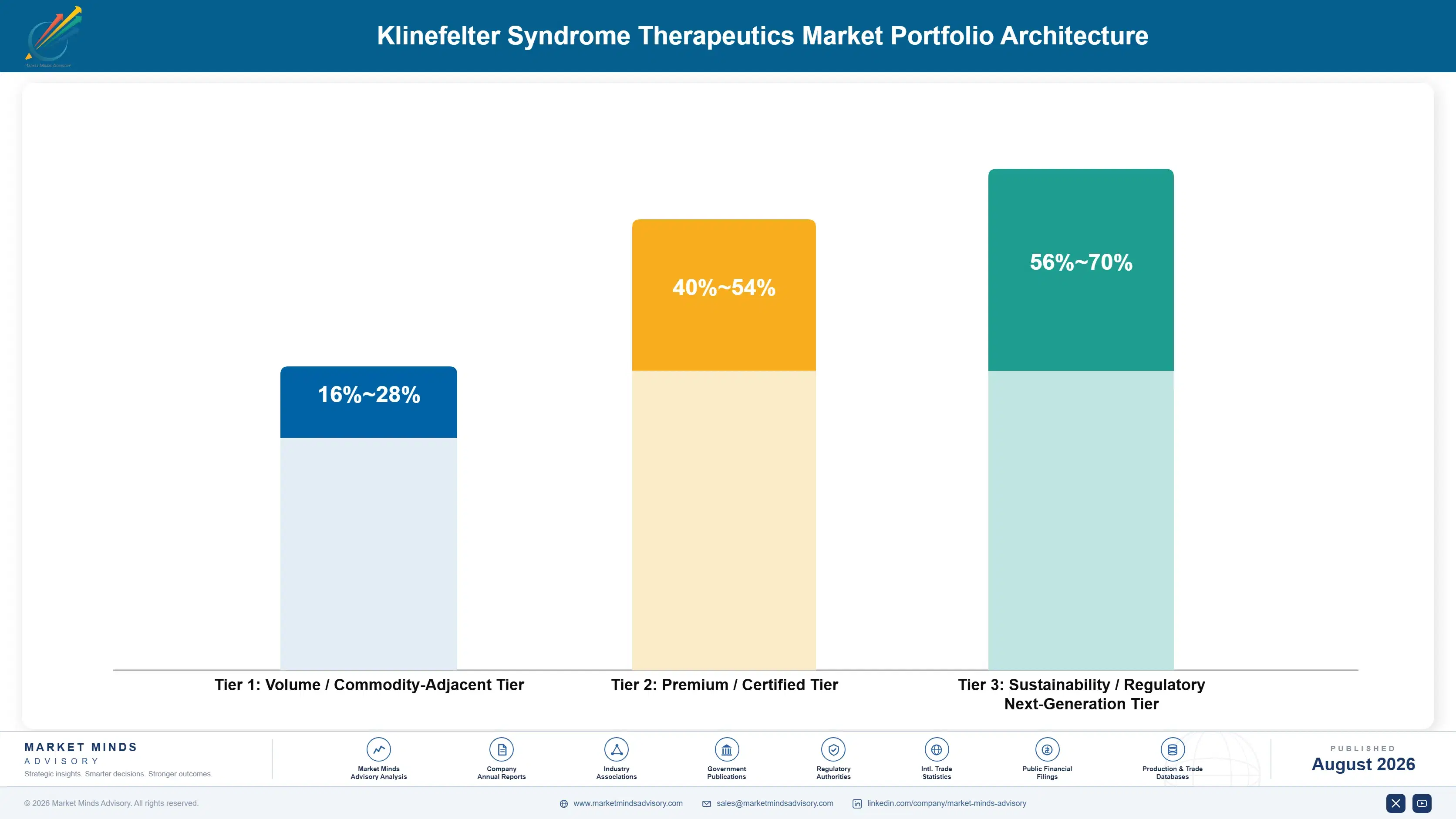
Margin architecture divides on delivery rather than on the hormone, which is identical everywhere and costs almost nothing. Generic injectable esters compete purely on tender price and earn accordingly. Transdermal gels earn moderately better on brand familiarity that generic entry keeps eroding. Oral modified-release and subcutaneous auto-injector formulations earn most, because the delivery technology carries genuine development barriers and answers objections patients actually raise.
The volume versus premium tension runs along patient age. Adults diagnosed at thirty-one and treated within general endocrinology receive whatever the formulary offers, usually a generic injectable, and that is most of the treated population by count. Adolescents beginning fifty years of therapy justify formulations chosen on tolerability and persistence, and payers accept that argument more readily for younger patients with far more treatment years ahead.

High-value pools sit outside the pharmacy entirely. Surgical sperm retrieval, cryopreservation and subsequent assisted reproduction represent several times the annual cost of testosterone replacement per patient, delivered by specialist centres rather than by manufacturers. Multidisciplinary specialist clinics that coordinate metabolic, bone and cardiovascular care similarly capture value the prescription never touches. Generic testosterone supplied into a tender sits at the opposite extreme completely.

Volume / Commodity-Adjacent Tier

Generic injectable testosterone esters and generic transdermal gels supplied into formulary and tender processes, competing purely on delivered price against Indian and Chinese producers with permanently lower cost positions. Nothing here is defensible at all.
Gross Margin: 16-28%

Premium / Certified Tier

Long-acting injectable undecanoate and branded transdermal preparations, protected by prescriber familiarity built across two decades in a lifelong indication and by dosing intervals that reduce administration burden. Generic entry keeps eroding both positions steadily.
Gross Margin: 40-54%

Sustainability / Regulatory / Next-Generation Tier

Oral modified-release undecanoate, subcutaneous auto-injectors and fertility preservation pathways, protected by delivery technology, specialist surgical capability and the persistence advantages patients genuinely value. Payers accept the premium more readily for adolescent patients facing five decades of continuous therapy.
Gross Margin: 56-70%
klinefelter-syndrome-therapeutics-market-portfolio-architecture-1787304946074

Fifty Year Treatment Against Poor Persistence

Treatment duration here is close to unmatched anywhere in medicine. A patient identified in adolescence and started on replacement continues for five decades, so a single early diagnosis is worth many multiples of an adult one in lifetime terms. That arithmetic makes detection the most valuable activity in the category, and it explains why manufacturers who fund clinician education enlarge the market rather than merely competing within it.
Stickiness depends almost entirely on formulation burden. Patients on long-acting injectables administered every few months attend clinic and continue reliably, because the decision is made for them at each visit. Patients on daily gels or frequent self-injections discontinue at considerably higher rates, particularly during the transition from paediatric to adult services in late adolescence. Roughly 58% remain on therapy beyond the second year across all formulations.

Buyer profiles vary sharply by diagnosis route. Adults identified during infertility investigation are managed by urologists or fertility specialists who rarely provide long-term endocrine follow-up. Children identified through prenatal or paediatric routes enter paediatric endocrinology and transfer to adult services later. Very few health systems have specialist multidisciplinary clinics, so most patients are treated by whoever happened to diagnose them.
klinefelter-syndrome-therapeutics-market-end-use-penetration-index-1787304946561

Where Klinefelter Strategy Must Land

These are among the four positions where our research anticipates prominent divergence between winners and laggards over the coming forecast period. Each is grounded in the demand model, the regulatory perimeter, and the announced capacity pipeline.
01 / DETECTION PATHWAY INVESTMENT

Finding patients grows this market, competing for them does not

Only about 26% of affected men are ever diagnosed and median identification arrives at thirty-one, long after fertility preservation could have made any difference to them. Prenatal screening already detects these findings incidentally, and paediatric endocrine referral catches a further group that nobody currently pursues in any systematic way. Manufacturers funding clinician education, referral criteria and counselling resources enlarge the treated population itself, which is the only route to material category growth available to anybody operating in this condition at all.
02 / PERSISTENCE OVER PHARMACOLOGY

The formulation patients keep taking beats the better profile

Roughly 58% of all patients continue beyond the second year on a therapy that is intended to last five decades, and a patient lost at twenty forfeits a further thirty years of treatment rather than one single lapsed prescription. Injection burden, gel transference into family households and the complete absence of any felt benefit all drive that discontinuation. Formulations removing those specific obstacles win on continuation regardless of how the serum profiles happen to compare in any published pharmacokinetic study anywhere.
03 / ADOLESCENT TRANSITION FOCUS

Continuation fails at the move to adult services

Patients identified in childhood transfer from paediatric to adult endocrinology in late adolescence, and that handover is precisely where continuation most often breaks down across every health system examined. Structured transition clinics, adolescent-appropriate formulations and follow-up designed for young men rather than for older hypogonadal patients all measurably improve continuation through that period. Supporting those pathways secures a patient relationship lasting fifty years instead of a prescription that lasts barely two, which is the longest such relationship available anywhere in endocrinology.
04 / FERTILITY EVIDENCE FUNDING

Nobody has settled when retrieval should actually happen

Surgical sperm retrieval succeeds in roughly 44% of attempts, and that success rate declines steadily with patient age, which argues for adolescent intervention, while the ethics of consenting a minor to a testicular procedure argue quite firmly against it. That debate persists only because comparative evidence on outcomes by age at retrieval remains thin, and nobody has yet funded it properly. Whoever generates that evidence shapes an entire clinical pathway rather than competing inside one that somebody else already defined.

Engagement Snapshot From the Field

A live engagement with an industry participant carrying material or product regulatory and market exposure ahead of a defining policy shift, showing how our research translates into a defensible multi-year portfolio strategy.
MARKET MINDS ADVISORY · CLIENT ENGAGEMENT SUMMARY
Klinefelter Syndrome Therapeutics Producer Strategic Portfolio Review and Transition Roadmap 2026·Investment Scenario on Klinefelter Syndrome Therapeutics Exposure Evaluation 2025-26
CLIENT PROFILE
A specialty pharmaceutical company marketing testosterone replacement formulations across European and North American markets, with annual revenue attributable to primary hypogonadism of approximately USD 96 million (client-reported, unverified by MMA). Roughly 70% came from an injectable presentation prescribed largely to adult patients. The company held no adolescent-specific formulation, no transition clinic programme and no involvement in fertility preservation pathways.
STRATEGIC CHALLENGE
Generic competition had eroded injectable pricing for three consecutive years and prescriber preference among younger patients was shifting toward oral and subcutaneous alternatives the company did not offer. The board wanted to know whether to acquire an oral formulation to defend the younger patient segment, or to invest in diagnosis and transition pathway support that would enlarge the treated population but benefit competitors alongside it.
MMA APPROACH
MMA conducted 47 expert interviews across paediatric and adult endocrinologists, reproductive urologists, clinical geneticists, prenatal screening programme leads and patient organisation representatives in six countries. A quantitative survey of 3,800 respondents established diagnosis pathways, formulation preference and discontinuation reasons across age groups. We then modelled treated population and revenue under both options against observed detection trends and persistence data by formulation.
KEY FINDINGS
  1. Paediatric endocrinologists identified transition to adult services as the single largest cause of treatment discontinuation, and none reported a structured transition programme operating in their centre.
  2. Adolescent patients and their families rejected injectable and gel formulations at markedly higher rates than adults, citing needle avoidance and household transference concerns respectively.
  3. Prenatal screening programmes were detecting sex chromosome findings routinely, but no surveyed programme had an agreed counselling pathway or defined paediatric referral route behind it.
  4. Reproductive urologists reported declining retrieval success with patient age consistently, yet none would offer adolescent retrieval without institutional ethics approval that few centres had sought.
CLIENT PROFILE
A specialty pharmaceutical company marketing testosterone replacement formulations across European and North American markets, with annual revenue attributable to primary hypogonadism of approximately USD 96 million (client-reported, unverified by MMA). Roughly 70% came from an injectable presentation prescribed largely to adult patients. The company held no adolescent-specific formulation, no transition clinic programme and no involvement in fertility preservation pathways.
STRATEGIC CHALLENGE
Generic competition had eroded injectable pricing for three consecutive years and prescriber preference among younger patients was shifting toward oral and subcutaneous alternatives the company did not offer. The board wanted to know whether to acquire an oral formulation to defend the younger patient segment, or to invest in diagnosis and transition pathway support that would enlarge the treated population but benefit competitors alongside it.
MMA APPROACH
MMA conducted 47 expert interviews across paediatric and adult endocrinologists, reproductive urologists, clinical geneticists, prenatal screening programme leads and patient organisation representatives in six countries. A quantitative survey of 3,800 respondents established diagnosis pathways, formulation preference and discontinuation reasons across age groups. We then modelled treated population and revenue under both options against observed detection trends and persistence data by formulation.
KEY FINDINGS
  1. Paediatric endocrinologists identified transition to adult services as the single largest cause of treatment discontinuation, and none reported a structured transition programme operating in their centre.
  2. Adolescent patients and their families rejected injectable and gel formulations at markedly higher rates than adults, citing needle avoidance and household transference concerns respectively.
  3. Prenatal screening programmes were detecting sex chromosome findings routinely, but no surveyed programme had an agreed counselling pathway or defined paediatric referral route behind it.
  4. Reproductive urologists reported declining retrieval success with patient age consistently, yet none would offer adolescent retrieval without institutional ethics approval that few centres had sought.
RECOMMENDED STRATEGY
Phase 1: Phase one: license rather than acquire an oral formulation, since building one internally would arrive well after prescriber preference among younger patients had already settled elsewhere. Phase 2: Phase two: fund structured transition clinic programmes with paediatric and adult endocrinology societies, addressing the discontinuation point every clinician independently identified. Phase 3: Phase three: support prenatal counselling pathway development with genetics societies, accepting that competitors benefit alongside from any enlargement of the diagnosed population.
OUTCOME
The client licensed an oral formulation within nine months and funded transition programmes across four countries (client-reported, unverified by MMA). Two-year persistence among patients entering adult services through those programmes improved by roughly a third, and the oral presentation reached a fifth of new adolescent starts within its first year on the market.

Frequently Asked Questions

Foundational context covering the market sizes, CAGR, scope, country, region and competition that inform every finding below. This section is provided to cover basics and most often pre-purchase conversations, answered from the MMA Primary Research Dataset.

What is the current size of the Klinefelter Syndrome Therapeutics Market?

The global Klinefelter syndrome therapeutics market was valued at USD 0.7 billion in 2025, covering testosterone replacement across formulations, fertility preservation interventions and adjunctive metabolic therapy. Genetic diagnostics and general age-related hypogonadism treatment fall outside this definition.

How large will the Klinefelter Syndrome Therapeutics Market be by 2036?

MMA forecasts the market at USD 1.7 billion by 2036, expanding 2.24 times from the 2026 base of USD 0.76 billion. That represents roughly USD 0.94 billion of incremental value across the forecast decade.

What is the CAGR for the Klinefelter Syndrome Therapeutics Market 2026 to 2036?

The base case compound annual growth rate is 8.4%, with a bull case of 9.7% and a bear case of 7.1%. Both cases turn on whether prenatal detection translates into structured paediatric care pathways.

Which segment is growing fastest?

Oral testosterone undecanoate formulations grow at 12.6%, a full 1.50x the overall market rate. They avoid injection burden and gel transference for patients beginning five decades of continuous replacement therapy.

Who are the major companies in the Klinefelter Syndrome Therapeutics Market?

Bayer, AbbVie, Endo, Viatris and Tolmar together hold 51% of revenue. None of these products was developed specifically for Klinefelter syndrome, having been created for hypogonadism generally instead.

Which country is growing fastest?

China grows fastest at 13.4%, as expanding endocrinology capacity and enormous assisted reproduction volumes bring more men to investigation. North America remains the largest region at 30% of value on diagnosis rates.

Report Segmentation Architecture

The full report scope spans multiple orthogonal segmentation dimensions, with cross-tabulated demand data provided for each dimension pair. Coverage extends further to regional breakdowns, trend trajectories, and the competitive detail needed to support segment-level decision-making.

By Intervention Type

  • Injectable Testosterone Esters
  • Transdermal Testosterone Gels and Solutions
  • Oral Testosterone Undecanoate Formulations
  • Subcutaneous Pellets and Auto-Injectors
  • Fertility Preservation and Assisted Reproduction
  • Adjunctive Metabolic and Bone Health Therapy

By End-Use Industry

  • Adult Endocrinology Services
  • Paediatric Endocrinology Services
  • Reproductive Urology and Fertility Centres
  • Clinical Genetics and Prenatal Screening Programmes
  • Primary Care and General Practice
  • Specialist Multidisciplinary Clinics

By Commercial Dimension

  • Reimbursed Prescription Supply
  • National Tender and Formulary Contracts
  • Retail and Specialty Pharmacy Distribution
  • Self-Pay and Private Insurance Funded Care
  • Fertility Service Fee Arrangements
  • Patient Support and Adherence Programmes

By Region

  • North America
  • Western Europe
  • East Asia
  • South Asia and Pacific
  • Latin America
  • Middle East and Africa
  • Eastern Europe

Scope, Methodology, and Coverage

Every figure in this report is reproducible from documented input assumptions. The scope below maps the historical period, the forecast horizon, the segmentation dimensions, and the countries covered, alongside the underlying primary and qualitative methodology.
Historical Period
2020 to 2025
Forecast Period
2026 to 2036
Base Year
2025 (USD billions; MMA Primary Research Dataset, August 2026)
Market Definition
This market comprises therapeutic interventions delivered to individuals diagnosed with Klinefelter syndrome, measured at revenue attributable to this population across reimbursed prescription, formulary tender, specialty pharmacy, self-pay and fertility service channels. Coverage spans injectable testosterone esters including enanthate, cypionate and long-acting undecanoate, transdermal testosterone gels and solutions, oral testosterone undecanoate modified-release formulations, subcutaneous testosterone pellets and auto-injector presentations, fertility preservation interventions including microdissection testicular sperm extraction, cryopreservation and subsequent assisted reproduction, and adjunctive therapy addressing metabolic, bone density and cardiovascular comorbidity. Karyotype and genetic diagnostic testing, non-invasive prenatal screening services, testosterone prescribed for age-related or acquired hypogonadism, general endocrinology consultation services, speech, educational and psychological support interventions, and gynaecomastia surgery fall outside scope.
Quantitative Units
USD billions (current prices); treated patient counts by intervention; annual therapy cost per patient; diagnosis rate and median diagnosis age; treatment persistence rates
Segmentation Dimensions
By Intervention Type; By End-Use Industry; By Commercial Dimension; By Region
Regions Covered
North America, Western Europe, East Asia, South Asia and Pacific, Latin America, Middle East and Africa, Eastern Europe
Countries Covered
United States, Canada, Mexico, Germany, United Kingdom, France, Italy, Spain, Denmark, Netherlands, Sweden, China, Japan, South Korea, Taiwan, India, Australia, Singapore, Thailand, Indonesia, Brazil, Argentina, Colombia, Chile, Saudi Arabia, United Arab Emirates, Israel, Egypt, South Africa, Poland, Czechia, Hungary, and additional markets relevant to endocrine care access analysis
Key Companies Profiled
Bayer, AbbVie, Endo, Viatris, Tolmar, Marius Pharmaceuticals, Antares Pharma, Halozyme Therapeutics, Ferring Pharmaceuticals, Merck KGaA, Organon, Sun Pharmaceutical Industries, Cipla, Hikma Pharmaceuticals, Teva Pharmaceutical Industries, Acerus Pharmaceuticals, Kyowa Kirin, Besins Healthcare, IBSA Group, CooperSurgical
Quantitative Methodology
Primary survey, n=3,800 respondents, Q4 2025, six countries; demand-side model with trade association cross-validation
Qualitative Methodology
47 expert interviews, Q4 2025; applied to validate demand model assumptions, identify emerging dynamics, and assess competitive positioning
Report Format
PDF and XLSX data workbook (Word format preview document)
Publisher
Market Minds Advisory
Report Code
MMA-2026-HLT-234
Published
August 2026
Contact
sales@marketmindsadvisory.com | www.marketmindsadvisory.com

Purchase the full Klinefelter Syndrome Therapeutics Market Report (2026 to 2036).

The full MMA report treats detection rather than therapy as the commercial variable in this condition, quantifying the diagnosis deficit by region and modelling what earlier identification would do to treated population and lifetime value. It sizes six intervention types and seven regions to 2036, modelling treated patients, annual therapy cost, persistence and diagnosis rates separately so that population growth can be distinguished from revenue growth. Competitive assessment covers twenty companies on one consistent revenue basis. Input cost exposure is traced through steroid intermediate sourcing and delivery system technology. Four commercial levers and a strategic verdict close the report, grounded in 47 expert interviews and a 3,800-respondent survey.
Six intervention types sized separately to 2036
Diagnosis deficit quantified across all seven regions
Persistence modelled by formulation and patient age
Twenty companies assessed on one consistent basis
Prenatal detection scenarios modelled against treated population
Anonymised client engagement with tested strategic recommendations

Built For The People Who Decide

From boardroom strategy to bench-side execution, this report is read cover-to-cover by leaders shaping the next decade of their industry, turning demand scenarios, market dynamics and valuation benchmarks into decisions.
CXOs/ Presidents/ VPs/ Managers
M&A and Corporate Development
Strategy Teams and R&D Heads
Procurement and Product Directors
Regulatory and Compliance Leaders
Investor Relations and Equity Analysts