Market Minds Advisory
Kinase Inhibitor in Autoimmune Diseases Market

Kinase Inhibitor in Autoimmune Diseases Market: One Trial, a Class Warning, and the Selectivity Escape

A single post-marketing safety study of one molecule produced a warning applied to an entire drug class, and every commercial decision in this category since has been shaped by that one document.

Lead Analyst

Alice Ballenger

Published

September 2026

Make Smarter Decisions with Customized Research Insights

Request a free sample report and evaluate market opportunities, growth trends, and competitive dynamics relevant to your business needs.

2025 MARKET VALUE$11.8BMarket Size 2025
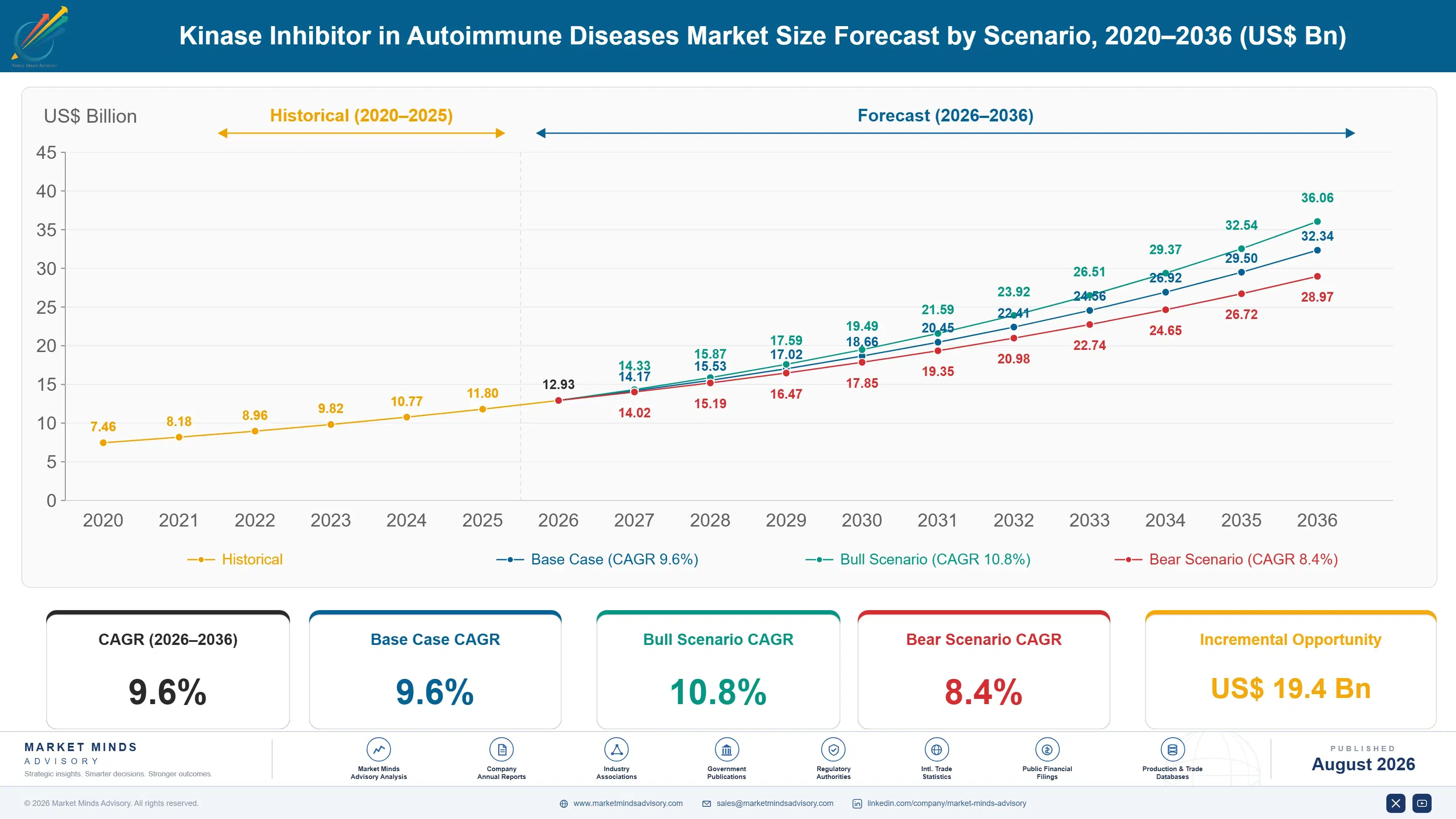
2036 FORECAST VALUE$32.3BBase Case , 2026 to 2036
CAGR 2026 TO 20369.6 %Bull 10.8% / Bear 8.4%
INCREMENTAL OPPORTUNITY$19.4BNet 10- year value creation
EXPANSION MULTIPLE2.50x2036 value over 2026 base
Strategic Levers
M&A Pipeline
Regional Outlook
Country Rankings
Competitive Intelligence
Segmental Deep-dive
Call-Us : 91 93563 13602

Executive Snapshot and Market Trajectory

One post-marketing safety study of a single molecule produced a boxed warning applied across the whole Janus kinase class, including products that never ran the trial. Every positioning decision since has been made around that document rather than around efficacy. Efficacy has repeatedly proved insufficient against it.
TYK2 inhibitors compound at 14.4%, a full 1.50x the market, because binding the pseudokinase domain rather than the ATP site avoids the class effects entirely, and the absence of a boxed warning is worth a great deal. North America holds 34%, above the standard band, because net price per treated patient runs several times ex-United States levels, so a modest share of patients carries most of the value.
Concentration is extreme at 88%, with AbbVie and Pfizer leading on breadth of approved indication rather than on any single disease. Roughly 76% of prescribing sits second-line behind tumour necrosis factor inhibitors, which caps the addressable population despite several head-to-head trials favouring the oral agents outright. Generic entry on the earliest molecules is already compressing pricing across the category. Indication breadth rather than any single disease position separates the leaders. Prescriber familiarity favours incumbents.
Market Definition
This market covers small molecule kinase inhibitors approved or in late-stage development for autoimmune and immune-mediated inflammatory disease, spanning pan-JAK and multi-JAK inhibitors, JAK1-selective inhibitors, TYK2 inhibitors, BTK inhibitors and SYK or other kinase inhibitors, across systemic and topical delivery, measured at manufacturer revenue. Biologic therapies including monoclonal antibodies and fusion proteins, kinase inhibitors indicated solely in oncology, conventional immunosuppressants, and diagnostic or monitoring products are excluded.
Base Year Value
$11.8B in 2025 (MMA Primary Research Dataset, August 2026)
Forecast Period
2026 to 2036, eleven discrete annual values
CAGR
9.6% base case. Bull 10.8%. Bear 8.4%.
Fastest Growth Segment
TYK2 Inhibitors: 14.4% CAGR
Fastest Growth Country
China: 15.6% CAGR
Fastest Growth Region
South Asia and Pacific: 11.6% CAGR
Largest Region
North America: 34% of 2025 global value
Market Leaders
AbbVie, Pfizer, Eli Lilly, Bristol Myers Squibb, and Novartis. Source: MMA Primary Research Dataset, July 2026.
Primary Survey
n=3,800 procurement and R&D decision-makers, Q4 2025, six countries
Methodology
Demand-side build-up, cross-validated against public data, 47 expert interviews

Kinase Inhibitor in Autoimmune Diseases Market Forecast Scenarios

kinase-inhibitor-in-autoimmune-diseases-market-size-forecast-scenario-1787304937260
Growth ran near 8.4% from 2020 to 2025, and the number conceals two opposite movements. A post-marketing safety study reported in 2021 triggered a boxed warning across the entire Janus kinase class, pushing several products second-line and stalling the earliest entrant. Meanwhile a newer selective agent expanded across rheumatology, dermatology and gastroenterology fast enough to carry the whole category.
Base case growth of 9.6% rests on three mechanisms operating largely independently. Indication expansion continues, with a single molecule amortising development cost across rheumatology, dermatology and gastroenterology and reaching three separate prescriber populations. Selective agents outside the Janus kinase family avoid the class warning and can therefore compete for first-line positioning. And Chinese and Indian reimbursement expansion brings oral therapy to populations that biologic pricing never reached at all. None of the three requires the others.
The bull case at 10.8% assumes selective agents accumulate enough safety data to move ahead of tumour necrosis factor inhibitors in treatment guidelines, opening a first-line population several times the current one. The bear case at 8.4% is further safety restriction: any signal in a newer agent extends the class warning rather than containing it, and generic entry compresses pricing across the category.

Autoimmune Kinase Inhibitors: Warnings, Selectivity and Breadth

Very few therapeutic categories have been reshaped this completely by one clinical trial. A post-marketing study compared an early Janus kinase inhibitor against tumour necrosis factor inhibitors in rheumatoid arthritis patients over fifty carrying a cardiovascular risk factor, and reported higher rates of major cardiac events and malignancy. Regulators applied a boxed warning across the whole class, including newer molecules never tested in that population.
TOP FIVE CONCENTRATION88%Extremely concentrated across large pharmaceutical companies holding broad indication portfolios
ANNUAL THERAPY COSTUSD 68,000List price for a full year of branded oral therapy
PRODUCTS CARRYING WARNING5 productsJanus kinase agents carrying the class boxed safety warning
APPROVED AUTOIMMUNE INDICATIONS14 indicationsDistinct immune-mediated conditions with at least one approved kinase inhibitor
SECOND-LINE POSITIONING SHARE76%Prescribing occurring after failure of an established biologic therapy
TWELVE MONTH PERSISTENCE58%Patients remaining on initial oral therapy after a full year
The commercial consequence is a positioning ceiling. Roughly 76% of prescribing now sits second-line, after a biologic has already failed, even though several head-to-head trials found the oral agents superior to the injectable comparator they are required to follow. A drug can win on efficacy and still lose on sequence. Payers and prescribers default to the safer-labelled option, and the label rather than the data governs that.
So the strategic contest has moved to selectivity. Allosteric TYK2 inhibitors bind the pseudokinase domain rather than the conserved ATP pocket, achieving a specificity that spares the pathways implicated in the class effects, and the resulting product carries no boxed warning at all. That single regulatory difference is worth more commercially than any efficacy increment, and it explains where the category's development capital has moved.
"You can run a head-to-head trial, beat the biologic on every endpoint, and still find yourself written after it because of a warning generated by a different molecule in a different population. In this category the label is the market, not the data."
Principal Analyst, Immunology and Inflammation Therapeutics Practice · MMA Healt

Market Trends

Allosteric selectivity becomes the route around the class warning

TYK2 inhibitors binding the pseudokinase regulatory domain rather than the conserved ATP pocket achieve a selectivity that conventional kinase chemistry could not deliver, and the approved product in this class carries no boxed warning of any kind. The segment compounds at 14.4% on that regulatory distinction rather than on demonstrated efficacy advantage. Development capital has moved decisively toward allosteric and highly selective chemistry, and several companies have redirected whole discovery programmes on exactly this reasoning. Potency optimisation at the ATP site has become the wrong objective, since value now sits in what a molecule avoids.
Market Impact: Persistence reaching 58% yearly

Indication breadth amortises one molecule across three specialties

A single selective agent now holds approvals spanning rheumatoid arthritis, psoriatic arthritis, axial spondyloarthritis, atopic dermatitis, ulcerative colitis and Crohn's disease, reaching rheumatologists, dermatologists and gastroenterologists from one development programme. Roughly 14 distinct immune-mediated conditions now have at least one approved kinase inhibitor. The economics are unusually favourable, since each additional indication carries incremental trial cost against an already established safety database and an existing manufacturing and commercial base. Each approval reaches a fresh prescriber population without proportional commercial investment, and the window closes as exclusivity runs down. Few companies have moved fast enough.
Market Impact: China compounding at 15.6% annually

Market Opportunities and Growth Drivers

Oral administration competes against injection across every indication

Biologic therapy in autoimmune disease requires subcutaneous injection or infusion, and a meaningful proportion of patients will accept somewhat lower expected benefit for a tablet instead. That preference is strongest in dermatology and among younger patients, and it holds even where the oral option sits second-line by label. Twelve-month persistence at 58% still exceeds several injectable comparators. Convenience is not a soft argument in chronic therapy taken for decades; it determines whether patients continue at all. Dermatology adoption has been fastest for exactly this reason, since the alternative involves injection for a visible condition and patients weigh that heavily.
Market Impact: Warning applied across 5 products

Asian reimbursement brings oral therapy to untreated populations

China compounds at 15.6% as national reimbursement negotiation adds kinase inhibitors at prices far below Western levels and domestic developers bring competing molecules through approval. Biologic pricing never reached most of these patients, so oral small molecules manufactured at conventional cost open populations that injectable therapy could not serve economically. Indian and Southeast Asian access follows a similar pattern. Volume rather than price drives that value, which changes the commercial model considerably. Manufacturing an oral small molecule at conventional cost supports steep discount in a way biologic economics never could.
Market Impact: Generics below 20% of price

Market Restraints and Challenges

A class boxed warning caps positioning regardless of efficacy

Regulators applied a boxed safety warning across every Janus kinase inhibitor after a post-marketing study of one molecule, and 5 products now carry it including agents never tested in the population concerned. The root cause is regulatory treatment of kinase inhibition as a class effect rather than a molecule-specific finding. Commercial impact is 76% of prescribing sitting second-line behind biologics. Participants are pursuing allosteric selectivity, large cardiovascular outcome databases and topical delivery that avoids systemic exposure. None of those routes removes the warning from an agent that already carries it.
Market Impact: Compounding at 14.4% each year

Generic entry compresses pricing across the established molecules

The earliest Janus kinase inhibitors have reached or are approaching loss of exclusivity in several major markets, and small molecule generics enter at a fraction of branded pricing with none of the manufacturing barriers biosimilars face. The root cause is straightforward chemistry: these are tablets, not proteins. Commercial impact reaches beyond the affected molecules, since payers use generic availability to negotiate across the whole class. Newer agents respond by competing on indication breadth and label differentiation instead. Payers press that availability well beyond the affected molecules themselves, across every branded agent.
Market Impact: Approvals across 14 distinct indica
4 additional market trends, 3 additional growth drivers, and 2 additional restraints and challenges are covered in the full report. Contact sales@marketmindsadvisory.com to access the complete intelligence.

Segment CAGR and Growth Architecture

Segmentation follows kinase target, because the target determines the selectivity profile, the regulatory label a product carries, the safety database required and the positioning achievable in treatment guidelines. Five target classes cover kinase inhibitor supply in autoimmune disease without overlap. Indication and delivery route both cut across several classes at once and are treated here as use attributes.
kinase-inhibitor-in-autoimmune-diseases-market-market-share-analysis-1787304937796

TYK2 Inhibitors

Growing at 14.4%, a full 1.50x the market rate, allosteric TYK2 inhibitors bind the pseudokinase regulatory domain rather than the conserved ATP pocket that every earlier kinase inhibitor targeted, achieving a selectivity that spares the pathways implicated in the class safety findings. The approved agent carries no boxed warning at all, and that single label difference is worth more commercially than any efficacy increment the category has produced. Psoriasis was the entry indication and inflammatory bowel disease and lupus programmes follow. Development capital across the whole category has moved decisively in this direction. Several companies redirected whole discovery programmes on precisely this reasoning. Conventional ATP-site chemistry now looks like a solved problem addressing the wrong question.
CAGR 14.4%

BTK Inhibitors

Bruton tyrosine kinase inhibitors grow at 12.8%, moving from haematological oncology into autoimmune disease where B cell and mast cell signalling drives pathology. Chronic spontaneous urticaria has proved the most productive entry point, with covalent selective agents reaching approval in patients inadequately controlled on antihistamines. Multiple sclerosis programmes represent the larger prize and have encountered hepatic safety questions that slowed several of them considerably. The class sits outside the Janus kinase warning entirely, which gives it positioning flexibility that JAK agents no longer have available. Development capital continues moving toward the class as oncology-derived chemistry finds autoimmune applications, though the covalent binding mechanism raises long-term safety questions that regulators are examining carefully in chronic non-malignant use.
CAGR 12.8%
Full segment breakdown across 5 segments available in the complete report.

Regional Architecture and Country Demand Map

Regional value here tracks net price per treated patient far more closely than patient numbers, because the pricing gap between the United States and everywhere else exceeds any plausible difference in disease prevalence between regions. Patient numbers and revenue point to quite different places in this category.

North America

North America holds 34% of value. Note: this sits above the standard regional band because net price per treated patient runs several times ex-United States levels across every product in this category, so a modest share of treated patients generates a disproportionate share of revenue. List pricing near USD 68,000 annually before rebates has no international equivalent. Specialty pharmacy distribution and prior authorisation requirements shape prescribing heavily, and payers use the second-line label positioning as a straightforward utilisation control across rheumatology and dermatology alike. Generic entry on the earliest molecules has begun, and payers already press that availability in negotiation across the newer branded agents as well. Patient awareness of the warning is unusually high.
Share: 34% | CAGR: 8.8% (2026 to 2036)

Western Europe

Twenty-four per cent of value, growing at 8.0%, the slowest of the seven regions. Health technology assessment bodies price these agents against tumour necrosis factor biosimilars that have already fallen sharply in cost, which compresses achievable pricing considerably and makes the value argument genuinely difficult. European regulators applied their own restrictions following the safety findings, limiting use in patients over sixty five, smokers and those with cardiovascular risk factors. That narrows the eligible population more explicitly than the United States warning does, and prescribers follow it closely. Oral administration nonetheless carries genuine weight with dermatology prescribers here, where the injectable alternative treats a visible condition. Reimbursement decisions vary considerably between member states.
Share: 24% | CAGR: 8.0% (2026 to 2036)
Regional intelligence for 5 additional markets available in the complete report: East Asia, South Asia and Pacific, Latin America, Middle East and Africa, Eastern Europe. Contact sales@marketmindsadvisory.com.
kinase-inhibitor-in-autoimmune-diseases-market-country-cagr-analysis-1787304938316

Where Kinase Inhibitor Value Is Defended

A class warning generated by one molecule governs positioning for every product here, and second-line sequencing caps the addressable population regardless of trial results. Value therefore accrues to selectivity that escapes the label, to indication breadth that amortises one molecule widely, and to delivery avoiding systemic exposure. Efficacy alone has repeatedly proved insufficient here.

Pursue selectivity that keeps the label clean

Allosteric TYK2 inhibition binds the pseudokinase domain rather than the ATP pocket, and the resulting approved product carries no boxed warning while 5 Janus kinase agents do. That difference determines whether a drug competes for first-line positioning or waits behind a biologic, and it is worth considerably more than any efficacy increment achievable through conventional chemistry. Discovery programmes still optimising potency at the ATP site are optimising the variable that stopped mattering commercially several years ago. What a molecule avoids now matters more than what it inhibits. Several companies have already redirected whole discovery efforts on this reasoning.
Market Impact: Avoids the class warning carried by

Amortise one molecule across three prescriber specialties

A single agent holding approvals across rheumatology, dermatology and gastroenterology reaches three separate prescriber populations from one development programme and one safety database, with roughly 14 immune-mediated conditions now carrying at least one approved kinase inhibitor. Each additional indication costs incremental trial spend against infrastructure already built and paid for. Companies pursuing a single flagship indication are leaving the most reliable return in this category unclaimed, and the window narrows as exclusivity runs down. Sequencing expansion while exclusivity still runs is what determines whether the investment returns anything at all.
Market Impact: Now reaching across 14 approved aut

Use topical delivery to sidestep the systemic safety debate

Topical kinase inhibition delivers drug to inflamed skin with minimal systemic absorption, which removes the cardiovascular and malignancy concerns underpinning the class warning from the conversation entirely. Chronic hand eczema and localised dermatitis are the established entry points, and the addressable population is large because these conditions rarely justify systemic therapy at USD 68,000 annually. Formulation rather than chemistry is the barrier, which favours companies with dermatology development capability over pure discovery organisations. Dermatology development capability matters more here than discovery chemistry does. The segment adds patients rather than moving existing ones.
Market Impact: Avoids the USD 68,000 annual system

Build volume positions where biologic pricing never reached

China compounds at 15.6% and India follows a similar pattern, both bringing oral therapy to patients that injectable biologic pricing excluded entirely. Reimbursement negotiation there trades steep discounts for volume across enormous populations, and manufacturing an oral small molecule at conventional cost supports that trade in a way biologics never could. Companies applying Western pricing logic to these markets forgo the volume without protecting price anywhere else, since reference pricing rarely reaches across that gap. International reference pricing rarely reaches across a gap of this magnitude. Volume rather than price carries the return here.
Market Impact: Chinese demand is growing at 15.6%

Who Controls the Margin Pool

Concentration is extreme at 88% across the top five, measured on annual revenue from kinase inhibitors indicated in autoimmune and immune-mediated inflammatory disease, the single basis applied throughout. AbbVie and Pfizer lead on breadth of approved indication rather than on any individual disease position, with Eli Lilly, Bristol Myers Squibb and Novartis holding meaningful positions across Janus kinase, TYK2 and Bruton tyrosine kinase chemistry respectively.
Competition runs on three dimensions that rarely resolve together. Label competition turns on which agents carry the class boxed warning and which do not, and it governs sequencing more powerfully than efficacy does. Indication competition is a development race, since each new approval reaches a fresh prescriber population at incremental cost. Price competition arrived through generic entry on the earliest molecules and Asian reimbursement negotiation on newer ones.

Pressure builds from two directions. Chinese domestic developers have brought competing molecules through approval at pricing that reframes the whole category's economics in the largest patient population anywhere. Separately, oral interleukin pathway inhibitors outside the kinase family are entering the same indications with no class safety history at all. Rankings shift most where a selective agent accumulates enough cardiovascular data to move ahead of biologics in guidelines.
kinase-inhibitor-in-autoimmune-diseases-market-company-positioning-matrix-1787304938837

Competitive Moat and Risk Dimensions

ABBVIE

Moat: Unmatched approved indication breadth

Holding approvals across rheumatology, dermatology and gastroenterology from a single molecule gives AbbVie three prescriber populations and a development cost base amortised more widely than any competitor manages. The immunology commercial infrastructure built over two decades of biologic leadership supports each new indication launch without proportional incremental investment, which competitors entering one specialty cannot replicate.
ABBVIE

Risk: Class warning and exclusivity

The flagship agent carries the Janus kinase class boxed warning despite selectivity that was never tested in the population that generated it, which holds roughly 76% of prescribing second-line behind biologics. Loss of exclusivity approaches within the forecast period. Selective agents outside the class can pursue first-line positioning that this molecule cannot.
PFIZER

Moat: Broadest kinase chemistry portfolio

Pfizer holds agents spanning pan-JAK, JAK1-selective and JAK3 with TEC family chemistry across rheumatology, dermatology and alopecia areata, giving it more shots at differentiated positioning than any single-molecule competitor. Deep kinase discovery capability and the largest accumulated safety database in the class support both regulatory discussions and prescriber confidence.
PFIZER

Risk: Originating molecule safety burden

The post-marketing study that produced the class warning examined Pfizer's own earliest agent, which leaves the company carrying the reputational weight of a finding now applied to every competitor as well. That molecule has reached generic entry in several markets. Newer selective chemistry from competitors escapes a label constraint Pfizer's portfolio largely cannot.

Players Tracked

Prominent Players

AbbVie
Pfizer
Eli Lilly
Bristol Myers Squibb
Novartis

Other Key Players

Incyte
Alfasigma
Galapagos
Astellas Pharma
LEO Pharma
Sun Pharmaceutical Industries
Reistone Biopharma
Jiangsu Hengrui Pharmaceuticals
Zelgen Biopharmaceuticals
Ventyx Biosciences
Alumis
Sanofi
Merck KGaA
Takeda
Kyowa Kirin

Recent Developments

MARCH 2025

Topical kinase inhibition reaches approval in chronic hand eczema

A topical pan-Janus kinase inhibitor secured approval for chronic hand eczema in European markets, delivering local pathway inhibition with minimal systemic absorption and therefore avoiding the cardiovascular and malignancy concerns underpinning the systemic class warning entirely. Formulation rather than new chemistry delivered that outcome. Systemic exposure remained minimal throughout.
Signal: Formulation is proving a considerably fast
AUGUST 2025

Bruton kinase inhibition advances in chronic spontaneous urticaria

Selective covalent Bruton tyrosine kinase inhibitors advanced toward and through approval in chronic spontaneous urticaria for patients inadequately controlled on antihistamines, opening an autoimmune indication for chemistry developed originally within haematological oncology programmes. Multiple sclerosis programmes represent the larger prize and have encountered hepatic safety questions that slowed several considerably.
Signal: Kinase families outside the Janus group ca
DECEMBER 2025

Chinese reimbursement negotiation adds agents at steep discount

China's national reimbursement negotiation added further kinase inhibitors at prices far below Western levels, an organic policy process trading substantial discounts for access across a patient population that branded biologic pricing had never reached in meaningful volume. Domestic developers competed alongside multinational agents throughout the process.
Signal: The largest patient population anywhere is

Synthesis, Trial and Safety Database Costs

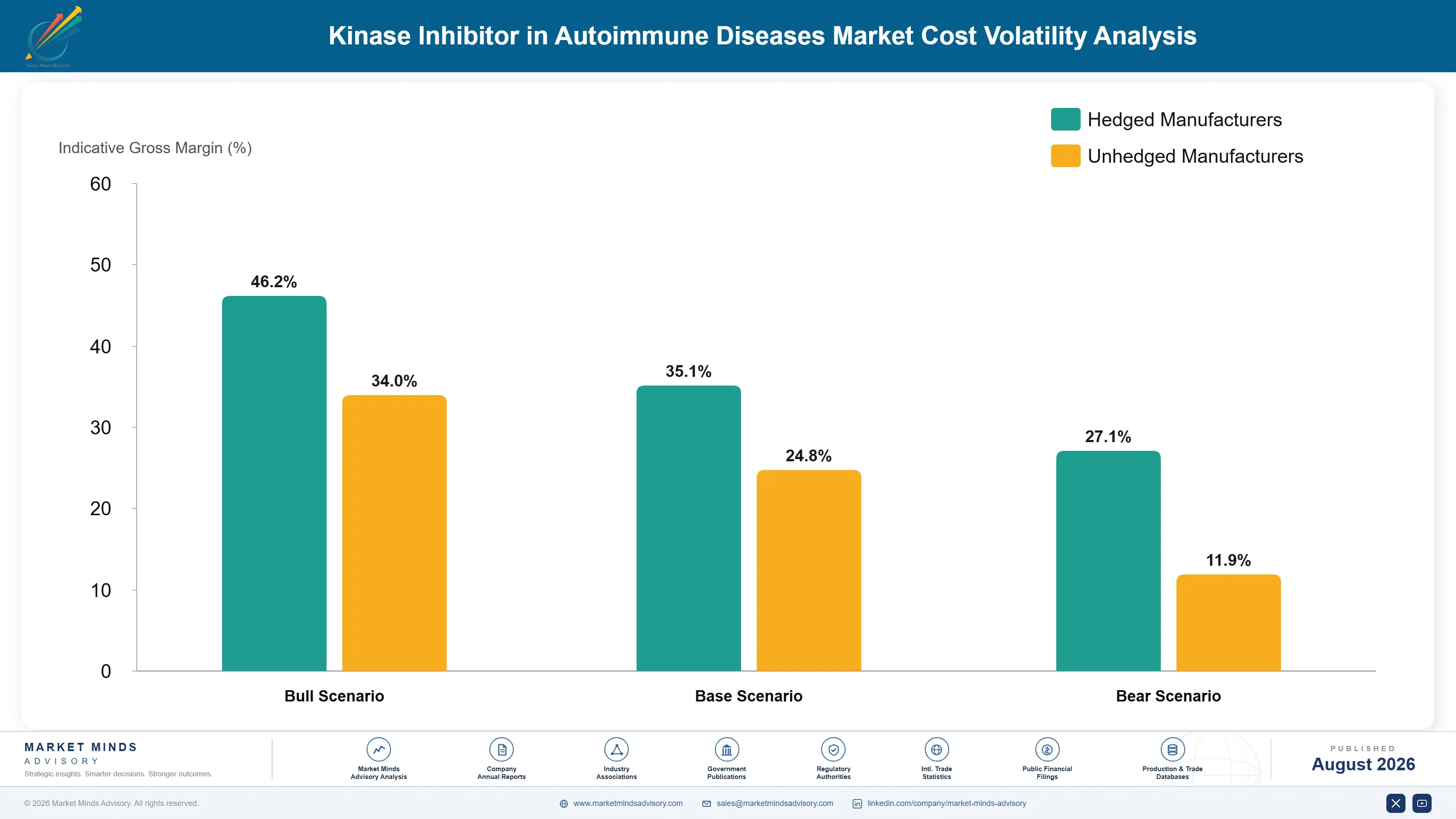
Manufacturing cost is close to irrelevant here and everything else is not. Active pharmaceutical ingredient synthesis and tablet formulation account for roughly 8% of revenue at branded pricing, with intermediates sourced predominantly from Indian and Chinese fine chemical manufacturers. Clinical development, post-marketing safety commitments and specialty commercial infrastructure consume the overwhelming majority of the cost base, and the safety commitments in this category are unusually heavy
The post-marketing cardiovascular outcome requirements imposed after the class safety findings represent a genuine cost input rather than a compliance footnote. Company annual reports across recent years documented substantial long-term safety study commitments spanning thousands of patients over several years, with registry obligations extending beyond them. Those requirements now attach from the outset, raising the capital needed to bring any new kinase inhibitor to approval.

Exposure varies sharply by portfolio position. Companies with agents already carrying the class warning fund extensive ongoing surveillance while competing against newer chemistry that escapes it, which is the worst combination available. Geography compounds the picture: Chinese and Indian developers operate with lower trial and manufacturing costs and price accordingly, and generic manufacture of the earliest molecules now sets a reference cost that the branded category cannot ignore anywhere.
kinase-inhibitor-in-autoimmune-diseases-market-cost-volatility-analysis-1787304939033

Design cardiovascular safety databases into programmes from the start

Post-marketing safety requirements now attach to kinase inhibitor programmes as a matter of course rather than arriving afterwards, and retrofitting a cardiovascular outcome study onto an approved product costs considerably more than building it into the original development plan. Programmes assuming a clean label without the supporting database will meet the requirement anyway, later and at higher cost.

Sequence indication expansion against the existing safety base

Each additional approved indication draws on a safety database already assembled and paid for, so incremental trial cost is modest relative to the prescriber population it opens. Sequencing expansion while exclusivity still runs maximises the return on that infrastructure. Companies deferring indication work until a flagship matures consistently reach approval too close to loss of exclusivity to benefit.

Source intermediates across both Indian and Chinese suppliers

Active ingredient intermediates for these molecules come predominantly from a concentrated Indian and Chinese fine chemical base, and single-region sourcing exposes supply to policy and logistics disruption that branded pricing makes easy to overlook. Qualifying alternate suppliers costs regulatory filing work rather than capital. The exposure stays invisible precisely because the input is inexpensive.

Portfolio Architecture for Margin Defence

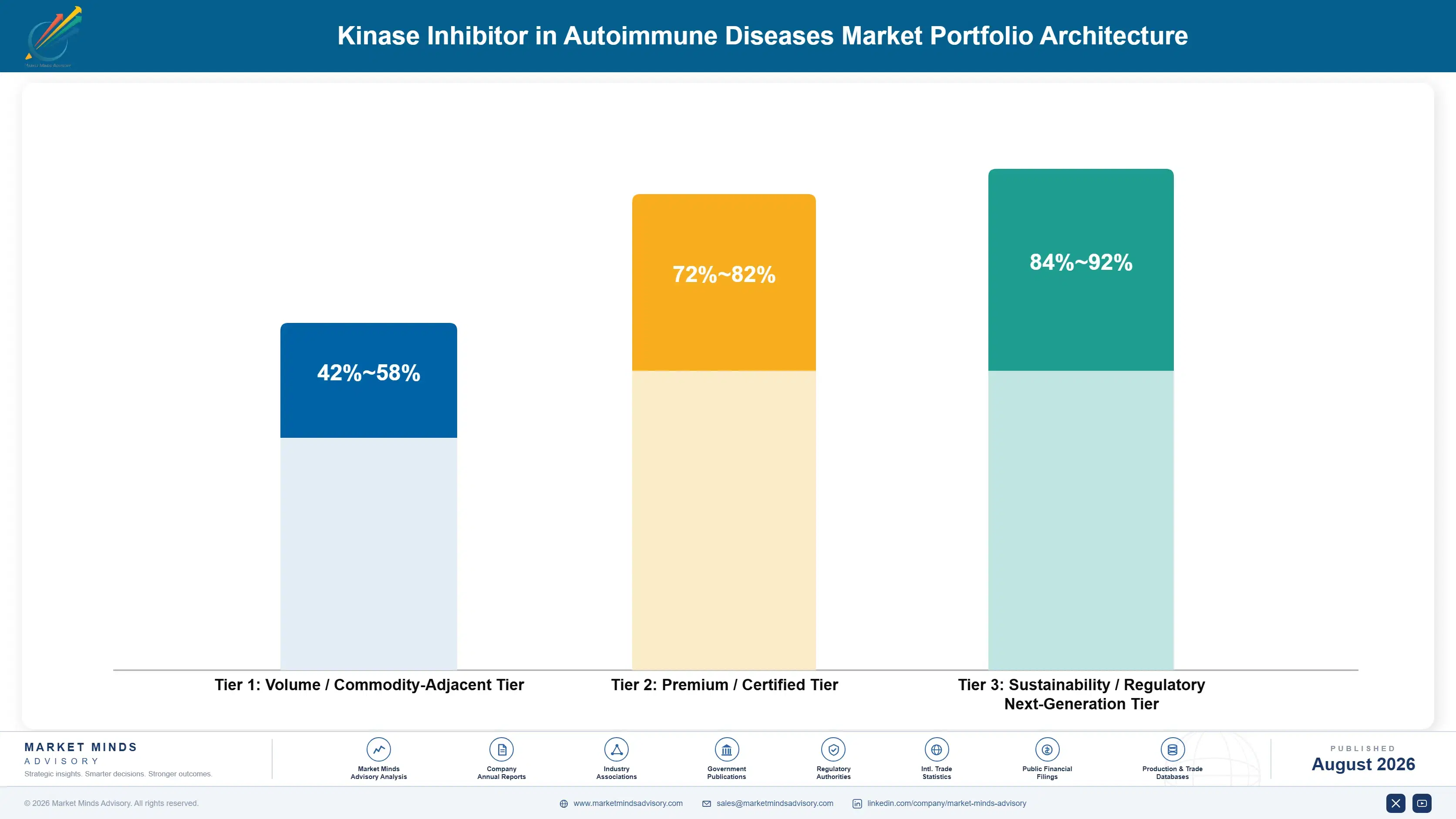
Margin architecture in this category separates on label rather than on chemistry or manufacturing. Agents carrying the class boxed warning fund heavy ongoing safety surveillance while accepting second-line positioning, which compresses both realised price and volume simultaneously. Selective agents outside the warning command premium pricing and compete for earlier positioning. Generic versions of the earliest molecules earn commodity margins and set a reference price that reaches across the ent
The volume against premium tension runs along geography rather than product tier. North American pricing near USD 68,000 annually generates a third of category value from a modest share of treated patients, while Chinese and Indian volumes serve populations many times larger at a small fraction of that price. Both are worth having, and each needs a commercial model the other would not recognise.

High-value pools concentrate around clean labels and broad approvals. Selective agents free of the class warning, molecules approved across three prescriber specialties, and topical formulations avoiding systemic exposure altogether all command pricing that warned systemic agents cannot. Established Janus kinase inhibitors approaching exclusivity loss, whatever their efficacy record, face generic pricing and a label constraint that no commercial effort resolves.

Volume / Commodity-Adjacent Tier

Generic Janus kinase inhibitors following loss of exclusivity, together with reimbursement-negotiated supply into Asian markets, competing on manufacturing cost and setting a reference price across the whole category. Payers apply that reference price everywhere.
Gross Margin: 42-58%

Premium / Certified Tier

Branded Janus kinase agents carrying the class warning, protected by indication breadth and established prescriber familiarity while funding heavy post-marketing safety surveillance from second-line positioning. Second-line sequencing caps volume regardless of efficacy record.
Gross Margin: 72-82%

Sustainability / Regulatory / Next-Generation Tier

Allosteric selective agents outside the class warning and topical formulations avoiding systemic exposure, commanding premium because the label rather than the efficacy data determines achievable treatment positioning. Discovery capital has moved decisively toward this tier.
Gross Margin: 84-92%
kinase-inhibitor-in-autoimmune-diseases-market-portfolio-architecture-1787304939536

Chronic Therapy and Sequencing Gates

Demand here is about as annuity-like as pharmaceuticals get. Autoimmune disease is lifelong, therapy continues indefinitely once a patient responds, and revenue per patient accumulates over years rather than through a defined course. Twelve-month persistence at 58% understates that, since patients who pass the first year frequently continue for many more. Each patient started is worth a multiple of the first year, which is why acquisition economics dominate planning.
Adoption depth varies sharply by specialty rather than by geography. Dermatologists adopted oral kinase inhibitors quickly, since the alternative involves injection for a visible condition and patient preference weighs heavily. Rheumatologists proved more cautious after the safety findings, given an older population with more cardiovascular risk. Gastroenterologists sit between the two, weighing a genuine efficacy advantage in ulcerative colitis against sequencing rules that most payers apply strictly regardless.

Decision profiles have broadened well beyond the prescriber. Payer utilisation management determines sequence in the United States through prior authorisation that codifies the second-line label into a hard requirement, and health technology assessment does comparable work in Europe against biosimilar reference pricing. Patients now arrive informed about the class warning, which makes safety part of every initiation.
kinase-inhibitor-in-autoimmune-diseases-market-end-use-penetration-index-1787304940027

Where Kinase Inhibitor Strategy Lands

These are among the four positions where our research anticipates prominent divergence between winners and laggards over the coming forecast period. Each is grounded in the demand model, the regulatory perimeter, and the announced capacity pipeline.
01 / LABEL OVER EFFICACY

Sequence beats data in every payer conversation

Several head-to-head trials found oral kinase inhibitors superior to the injectable comparators they are nonetheless required to follow, and roughly 76% of prescribing still sits second-line behind a biologic that lost on the endpoints. Payer prior authorisation codifies that boxed warning into a hard sequencing requirement which clinical data alone has never once been able to move. Commercial planning built on demonstrated trial superiority rather than on actual label position consistently and substantially overestimates the addressable patient population genuinely available.
02 / SELECTIVITY INVESTMENT PRIORITY

Allosteric chemistry buys a clean regulatory label

Binding the pseudokinase regulatory domain rather than the conserved ATP pocket achieves a selectivity that spares the pathways implicated in the class safety findings, and the approved agent carries no boxed warning of any kind whatsoever. That single distinction determines whether a molecule competes for first-line positioning or spends its commercial life waiting behind an established biologic therapy. Discovery programmes still optimising binding potency at the conserved ATP site are refining the one variable that stopped determining commercial outcomes several years ago.
03 / INDICATION BREADTH ECONOMICS

One molecule should reach three prescriber specialties

A single agent holding approvals across rheumatology, dermatology and gastroenterology reaches three separate prescriber populations from one development programme and one accumulated safety database that has already been paid for. Each additional indication costs only incremental trial spend set against commercial and manufacturing infrastructure that has already been fully built and paid for. Companies concentrating on a single flagship indication leave the most reliable return available in this entire category unclaimed, and the exclusivity window keeps closing on them regardless of how the flagship performs.
04 / ASIAN VOLUME COMMITMENT

Western pricing logic forfeits the largest populations

China compounds at 15.6% and India follows closely, both reaching patients that injectable biologic pricing had entirely excluded, through reimbursement negotiation trading steep discounts for access at very large volume. Manufacturing an oral small molecule at entirely conventional cost supports that particular trade in a way that no biologic production economics could ever have done. Companies declining the discount forgo that volume without protecting price anywhere else, since international reference pricing rarely reaches across a pricing gap of this particular magnitude.

Engagement Snapshot From the Field

A live engagement with an industry participant carrying material or product regulatory and market exposure ahead of a defining policy shift, showing how our research translates into a defensible multi-year portfolio strategy.
MARKET MINDS ADVISORY · CLIENT ENGAGEMENT SUMMARY
Kinase Inhibitor in Autoimmune Diseases Producer Strategic Portfolio Review and Transition Roadmap 2026·Investment Scenario on Kinase Inhibitor in Autoimmune Diseases Exposure Evaluation 2025-26
CLIENT PROFILE
A mid-cap pharmaceutical company holding one approved JAK1-selective inhibitor in rheumatoid arthritis, a dermatology programme in late-stage development and an early allosteric discovery effort. Annual product revenue was approximately USD 640 million (client-reported, unverified by MMA), concentrated in a single indication across North American and European markets with limited Asian presence. Exclusivity on the approved agent had roughly six years remaining.
STRATEGIC CHALLENGE
The approved agent carried the class boxed warning and sat second-line despite trial data favouring it against the biologic comparator, while a competitor's allosteric molecule was reaching approval without any warning at all. The board needed to decide whether to fund a large cardiovascular outcome study to differentiate within the class, or redirect capital toward the early allosteric programme instead.
MMA APPROACH
MMA conducted 47 expert interviews spanning rheumatologists, dermatologists, gastroenterologists, payer medical directors, pharmacy benefit managers, health technology assessment advisers and regulatory affairs specialists across six countries. A quantitative survey of 3,800 respondents established prescribing sequence behaviour, patient safety concerns and treatment persistence patterns. We then modelled revenue and margin outcomes under both capital allocations against observed prior authorisation criteria and competitor development timelines.
KEY FINDINGS
  1. Payer medical directors in five of six markets confirmed the boxed warning was written directly into prior authorisation criteria, and none would revise that on head-to-head efficacy data alone.
  2. Rheumatologists rated cardiovascular safety above efficacy when initiating therapy in patients over fifty, whereas dermatologists weighted oral administration and speed of response considerably higher.
  3. Regulatory advisers judged that a cardiovascular outcome study would take longer than the client's remaining exclusivity and would not remove the class warning in any case.
  4. Patients surveyed were substantially more aware of the class warning than prescribers assumed, and raised it unprompted during initiation discussions in most reported consultations.
CLIENT PROFILE
A mid-cap pharmaceutical company holding one approved JAK1-selective inhibitor in rheumatoid arthritis, a dermatology programme in late-stage development and an early allosteric discovery effort. Annual product revenue was approximately USD 640 million (client-reported, unverified by MMA), concentrated in a single indication across North American and European markets with limited Asian presence. Exclusivity on the approved agent had roughly six years remaining.
STRATEGIC CHALLENGE
The approved agent carried the class boxed warning and sat second-line despite trial data favouring it against the biologic comparator, while a competitor's allosteric molecule was reaching approval without any warning at all. The board needed to decide whether to fund a large cardiovascular outcome study to differentiate within the class, or redirect capital toward the early allosteric programme instead.
MMA APPROACH
MMA conducted 47 expert interviews spanning rheumatologists, dermatologists, gastroenterologists, payer medical directors, pharmacy benefit managers, health technology assessment advisers and regulatory affairs specialists across six countries. A quantitative survey of 3,800 respondents established prescribing sequence behaviour, patient safety concerns and treatment persistence patterns. We then modelled revenue and margin outcomes under both capital allocations against observed prior authorisation criteria and competitor development timelines.
KEY FINDINGS
  1. Payer medical directors in five of six markets confirmed the boxed warning was written directly into prior authorisation criteria, and none would revise that on head-to-head efficacy data alone.
  2. Rheumatologists rated cardiovascular safety above efficacy when initiating therapy in patients over fifty, whereas dermatologists weighted oral administration and speed of response considerably higher.
  3. Regulatory advisers judged that a cardiovascular outcome study would take longer than the client's remaining exclusivity and would not remove the class warning in any case.
  4. Patients surveyed were substantially more aware of the class warning than prescribers assumed, and raised it unprompted during initiation discussions in most reported consultations.
RECOMMENDED STRATEGY
Phase 1: Phase one: redirect capital from the proposed cardiovascular outcome study toward the allosteric discovery programme, since the warning cannot be removed within the exclusivity window. Phase 2: Phase two: accelerate the dermatology indication, where prescribers weight oral administration highly and the sequencing constraint binds considerably less tightly. Phase 3: Phase three: pursue Asian reimbursement listing on volume terms, opening large patient populations that the current Western pricing model excludes entirely.
OUTCOME
The client cancelled the outcome study, redirected roughly USD 180 million into allosteric development (client-reported, unverified by MMA), and accelerated the dermatology filing. The allosteric candidate entered clinical study a year earlier than planned, dermatology approval arrived ahead of forecast, and two Asian reimbursement listings delivered volume the original plan had not counted.

Frequently Asked Questions

Foundational context covering the market sizes, CAGR, scope, country, region and competition that inform every finding below. This section is provided to cover basics and most often pre-purchase conversations, answered from the MMA Primary Research Dataset.

What is the current size of the Kinase Inhibitor in Autoimmune Diseases Market?

The global market was valued at USD 11.8 billion in 2025, spanning pan-JAK, JAK1-selective, TYK2, BTK and other kinase inhibitors in immune-mediated disease. Roughly 14 distinct autoimmune indications now carry an approved kinase inhibitor.

How large will the Kinase Inhibitor in Autoimmune Diseases Market be by 2036?

MMA forecasts the market at USD 32.33 billion by 2036, expanding 2.50 times from the 2026 base of USD 12.93 billion. That represents roughly USD 19.40 billion of incremental value across the forecast decade.

What is the CAGR for the Kinase Inhibitor in Autoimmune Diseases Market 2026 to 2036?

The base case compound annual growth rate is 9.6%, with a bull case of 10.8% and a bear case of 8.4%. The bull case assumes selective agents move ahead of biologics in treatment guidelines.

Which segment is growing fastest?

TYK2 inhibitors grow at 14.4%, a full 1.50x the overall market rate. Allosteric binding at the pseudokinase domain achieves selectivity that avoids the class boxed warning entirely.

Who are the major companies in the Kinase Inhibitor in Autoimmune Diseases Market?

AbbVie, Pfizer, Eli Lilly, Bristol Myers Squibb and Novartis together hold 88% of revenue. They lead on breadth of approved indication rather than on any individual disease position.

Which country is growing fastest?

China grows fastest at 15.6%, as national reimbursement negotiation adds these agents at prices far below Western levels. North America remains the largest region at 34% of value on pricing rather than patient numbers.

Report Segmentation Architecture

The full report scope spans multiple orthogonal segmentation dimensions, with cross-tabulated demand data provided for each dimension pair. Coverage extends further to regional breakdowns, trend trajectories, and the competitive detail needed to support segment-level decision-making.

By Kinase Target Class

  • Pan-JAK and Multi-JAK Inhibitors
  • JAK1-Selective Inhibitors
  • TYK2 Inhibitors
  • BTK Inhibitors
  • SYK and Other Kinase Inhibitors

By End-Use Industry

  • Rheumatology Practice
  • Dermatology Practice
  • Gastroenterology Practice
  • Neurology and Multiple Sclerosis Services
  • Allergy and Immunology Clinics
  • Hospital Specialty Outpatient Services

By Commercial Dimension

  • Specialty Pharmacy Distribution
  • Retail Pharmacy Dispensing
  • National Reimbursement Listing
  • Hospital Formulary and Tender Supply
  • Patient Assistance and Access Programmes
  • Licensing and Regional Partnership Agreements

By Region

  • North America
  • Western Europe
  • East Asia
  • South Asia and Pacific
  • Latin America
  • Middle East and Africa
  • Eastern Europe

Scope, Methodology, and Coverage

Every figure in this report is reproducible from documented input assumptions. The scope below maps the historical period, the forecast horizon, the segmentation dimensions, and the countries covered, alongside the underlying primary and qualitative methodology.
Historical Period
2020 to 2025
Forecast Period
2026 to 2036
Base Year
2025 (USD billions; MMA Primary Research Dataset, August 2026)
Market Definition
This market comprises small molecule kinase inhibitors approved or in late-stage development for autoimmune and immune-mediated inflammatory disease, measured at manufacturer revenue across specialty pharmacy distribution, retail dispensing, national reimbursement listing, hospital formulary and tender supply, patient assistance programmes and regional licensing agreements. Coverage spans pan-JAK and multi-JAK inhibitors, JAK1-selective inhibitors, allosteric and ATP-competitive TYK2 inhibitors, Bruton tyrosine kinase inhibitors indicated in autoimmune disease, and SYK or other kinase inhibitors, across oral, topical and other locally delivered formulations. Biologic therapies including monoclonal antibodies, fusion proteins and biosimilars, kinase inhibitors indicated solely in oncology or haematological malignancy, conventional immunosuppressants and corticosteroids, oral agents acting on non-kinase targets, and diagnostic, monitoring or companion testing products fall outside scope.
Quantitative Units
USD millions (current prices); treated patients by indication; annual therapy cost; prescriptions by line of therapy; twelve month persistence rate; approved indications held
Segmentation Dimensions
By Kinase Target Class; By End-Use Industry; By Commercial Dimension; By Region
Regions Covered
North America, Western Europe, East Asia, South Asia and Pacific, Latin America, Middle East and Africa, Eastern Europe
Countries Covered
United States, Canada, Mexico, Germany, France, United Kingdom, Italy, Spain, Netherlands, Sweden, Switzerland, China, Japan, South Korea, Taiwan, India, Australia, Thailand, Indonesia, Brazil, Argentina, Colombia, Chile, Saudi Arabia, United Arab Emirates, Israel, South Africa, Poland, Czechia, Hungary, Russia, and additional markets relevant to autoimmune therapy analysis
Key Companies Profiled
AbbVie, Pfizer, Eli Lilly, Bristol Myers Squibb, Novartis, Incyte, Alfasigma, Galapagos, Astellas Pharma, LEO Pharma, Sun Pharmaceutical Industries, Reistone Biopharma, Jiangsu Hengrui Pharmaceuticals, Zelgen Biopharmaceuticals, Ventyx Biosciences, Alumis, Sanofi, Merck KGaA, Takeda, Kyowa Kirin
Quantitative Methodology
Primary survey, n=3,800 respondents, Q4 2025, six countries; demand-side model with trade association cross-validation
Qualitative Methodology
47 expert interviews, Q4 2025; applied to validate demand model assumptions, identify emerging dynamics, and assess competitive positioning
Report Format
PDF and XLSX data workbook (Word format preview document)
Publisher
Market Minds Advisory
Report Code
MMA-2026-HLT-290
Published
August 2026
Contact
sales@marketmindsadvisory.com | www.marketmindsadvisory.com

Purchase the full Kinase Inhibitor in Autoimmune Diseases Market Report (2026 to 2036).

The full MMA report treats the class boxed warning as the commercial fact it actually is, quantifying how label position rather than trial data determines the addressable population for every agent in this category. It sizes five kinase target classes and seven regions to 2036, modelling treated patients, therapy pricing, line of therapy, persistence and indication breadth separately so that label-driven constraints can be assessed directly. Competitive assessment covers twenty developers on one consistent revenue basis. Cost exposure is traced through synthesis, trial and safety database commitments. Four commercial levers and a strategic verdict close the report, grounded in 47 expert interviews and a 3,800-respondent survey.
Five kinase target classes sized separately through 2036
Label position modelled against addressable patient population
Indication breadth economics quantified across three prescriber specialties
Twenty developers assessed on one consistent revenue basis
Asian reimbursement volume separated from Western pricing value
Anonymised client engagement with tested strategic recommendations

Built For The People Who Decide

From boardroom strategy to bench-side execution, this report is read cover-to-cover by leaders shaping the next decade of their industry, turning demand scenarios, market dynamics and valuation benchmarks into decisions.
CXOs/ Presidents/ VPs/ Managers
M&A and Corporate Development
Strategy Teams and R&D Heads
Procurement and Product Directors
Regulatory and Compliance Leaders
Investor Relations and Equity Analysts