

Market Minds Advisory
Kids Sports Injury Treatment Market

Kids Sports Injury Treatment Market: Pediatric Sports Medicine, Bracing, and Prevention Through 2036

Youth sports specialization is driving injury volumes that outpace pediatric orthopedic capacity, forcing insurers and specialty clinics to expand bracing, rehabilitation, and prevention screening programs faster than most health systems anticipated just five years ago.

Lead Analyst

Alice Ballenger

Published

September 2026

Make Smarter Decisions with Customized Research Insights

Request a free sample report and evaluate market opportunities, growth trends, and competitive dynamics relevant to your business needs.

2025 MARKET VALUE$3.8BMarket Size 2025
2036 FORECAST VALUE$9.2BBase Case , 2026 to 2036
CAGR 2026 TO 20368.4 %Bull 9.6% / Bear 7.1%
INCREMENTAL OPPORTUNITY$5.1BNet 10- year value creation
EXPANSION MULTIPLE2.24x2036 value over 2026 base
Strategic Levers
M&A Pipeline
Regional Outlook
Country Rankings
Competitive Intelligence
Segmental Deep-dive
Call-Us : 91 93563 13602

Executive Snapshot and Market Trajectory

Youth sports injuries are no longer treated as inevitable childhood setbacks. Specialized pediatric sports medicine has become its own clinical category, with parents actively seeking board-certified specialists over general pediatricians for anything beyond a minor sprain, reshaping referral patterns across youth athletics nationwide.
Wearable injury-monitoring devices and force-plate screening programs are pulling investment away from reactive bracing toward prevention, the fastest-growing corner of the category. Physical therapy and rehabilitation services follow close behind as insurers expand coverage for structured return-to-play protocols. North America anchors nearly a third of global demand, reflecting its dense network of insurance-reimbursed specialist clinics and organized school and travel sports leagues that funnel young athletes toward formal, documented clinical care rather than home management.
Competitively, the market splits between large orthopedic device makers extending pediatric product lines into youth-specific sizing and a fragmented base of regional physical therapy chains competing on access rather than brand. Concussion protocol legislation and ACL prevention mandates in youth leagues are reshaping demand toward standardized, documented care pathways, pushing clinics to adopt screening technology that would have been unnecessary for a sprained ankle a decade ago.
Market Definition
The kids sports injury treatment market covers diagnosis, bracing, rehabilitation, surgical intervention, and prevention technology for athletes under eighteen. It excludes adult sports medicine and general pediatric orthopedic care unrelated to athletic activity.
Base Year Value
$3.8B in 2025 (MMA Primary Research Dataset, August 2026)
Forecast Period
2026 to 2036, eleven discrete annual values
CAGR
8.4% base case. Bull 9.6%. Bear 7.1%.
Fastest Growth Segment
Wearable Injury Monitoring and Prevention Devices: 14.8% CAGR
Fastest Growth Country
India: 12.3% CAGR
Fastest Growth Region
South Asia and Pacific: 10.5% CAGR
Largest Region
North America: 30% of 2025 global value
Market Leaders
Arthrex Inc., Stryker Corporation, Smith & Nephew plc, Ossur hf, DJO LLC (Enovis). Source: MMA Analysis based on company annual reports.
Primary Survey
n=3,800 procurement and R&D decision-makers, Q4 2025, six countries
Methodology
Demand-side build-up, cross-validated against public data, 47 expert interviews

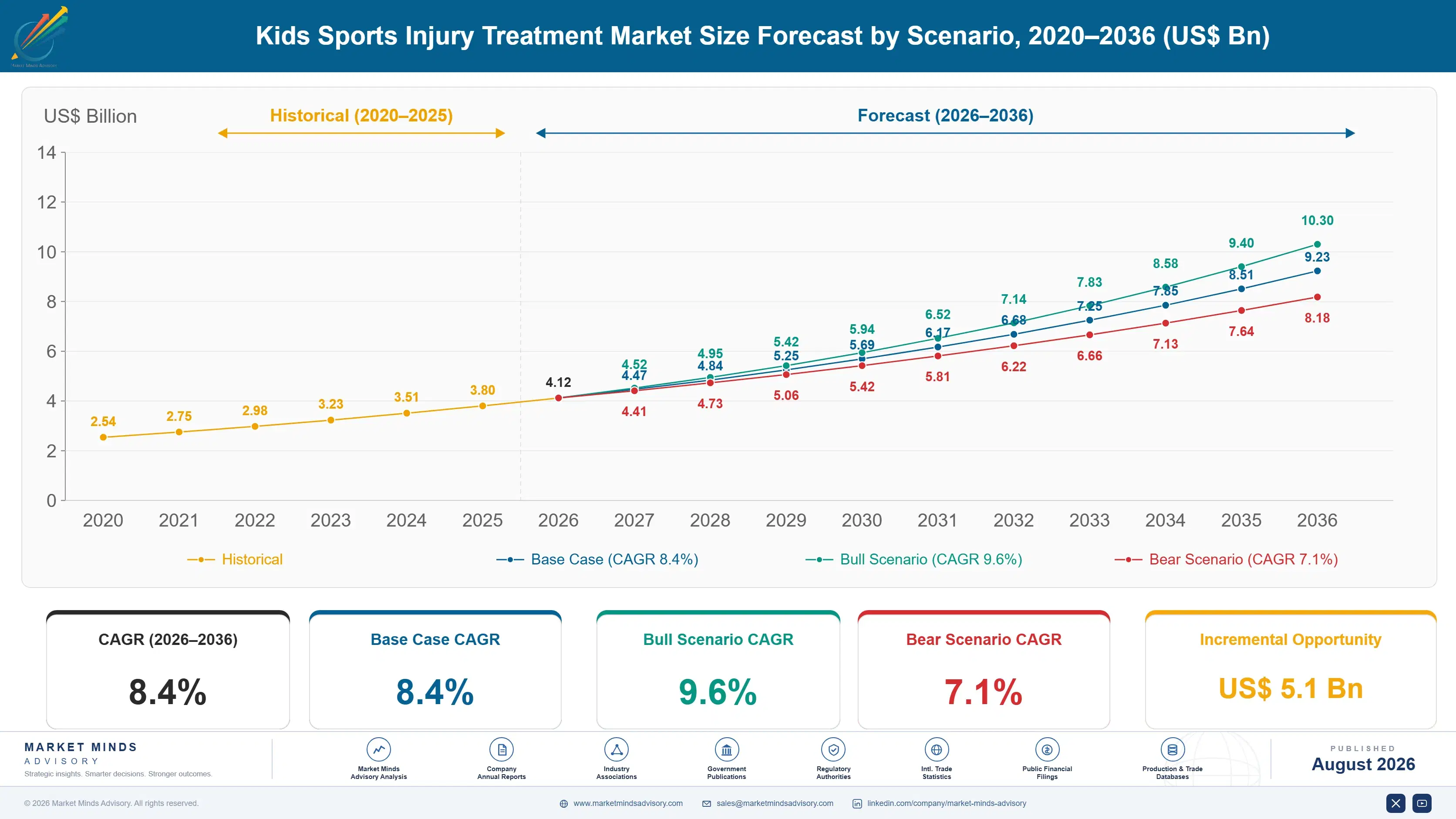
Kids Sports Injury Treatment Market Forecast Scenarios

kids-sports-injury-treatment-market-size-forecast-scenario-1787304710005
Between 2020 and 2025 the category grew steadily as youth sports participation rebounded from pandemic disruption and specialization intensified, with single-sport training year-round becoming the norm in competitive youth leagues rather than the exception. Insurance coverage expanded gradually, but clinic capacity struggled to keep pace, leaving wait times as the binding constraint on realized growth.
The base case assumes continued expansion driven by three mechanisms. Broader insurance reimbursement is extending formal care to injury types and age groups that previously went untreated beyond a general pediatrician. Wider adoption of wearable screening technology by school and travel leagues is creating a documented referral pipeline into specialist clinics that did not exist five years ago. And growing parental willingness to pursue structured, multi-week rehabilitation rather than informal rest is extending the average treatment episode.
The bull case turns on faster reimbursement policy expansion across more US states and European health systems, paired with league mandates that make screening and documented clearance a condition of participation. The bear case centers on rising out-of-pocket costs pushing lower-income families back toward untreated or informally managed injuries, capping visit growth even as underlying incidence keeps climbing.

Why Youth Sports Medicine Became Its Own Category

Three forces are converging on pediatric sports medicine at once: rising youth participation, earlier single-sport specialization, and a cultural shift toward treating injuries as clinical events rather than something a child simply plays through until it stops hurting. Together they are pulling volume into a formal care system that was originally built and staffed for adult recreational athletes, not children navigating growth plates and developing joints.
MARKET CONCENTRATIONCR5 32%Top five players hold modest combined revenue share overall
AVERAGE TREATMENT COST$340Per specialist episode across bracing and therapy visits
TOP TREATING COUNTRY SHAREUS 27%Largest single national share of total clinic visits
SPECIALIST CLINIC UTILIZATION71%Average booked capacity across pediatric sports medicine clinics
INSURANCE REIMBURSEMENT RATE64%Share of treatment episodes carrying partial insurance coverage
DEVICE REPLACEMENT CYCLE18 monthsTypical bracing and support device usable service lifespan
Commercially, the category behaves like a hybrid of medical devices and outpatient services, and that hybrid structure shapes how participants compete. Bracing and diagnostic equipment carry device-style margins and replacement cycles tied to a child's growth, while physical therapy and rehabilitation revenue depends on visit volume and reimbursement rates that vary sharply by geography and insurance type. Few competitors operate meaningfully across both halves of the business today.
Over the next decade, prevention technology and standardized return-to-play protocols will matter more than any single new bracing product, as leagues and insurers push toward documented, measurable recovery rather than parental judgment calls about when a child is ready to play again. That shift favors organizations that can prove clinical outcomes, not just sell equipment.
"The real shift isn't more injuries, it's that parents stopped accepting them as normal. Every sprained ankle now gets a referral, and that referral is what built this market."
Director, Healthcare and Medical Devices Practice · MMA Healthcare Practice

Market Trends

Wearable Screening Enters Youth League Operations

Force-plate and wearable sensor screening programs, once limited to college and professional athletics, are moving into youth leagues at meaningful scale. Over 1,400 US youth sports organizations had piloted movement-screening or wearable monitoring programs by the end of 2025, aimed at flagging ACL injury risk and concussion history before a season starts rather than reacting after the fact. Insurers in several states have begun offering premium discounts to leagues that adopt standardized screening, a financial incentive that did not exist five years ago and is accelerating adoption well beyond early pilot programs into mainstream league operations nationwide.
Market Impact: 14% participation growth since 2021

Concussion Protocol Laws Mandate Documented Clearance

Concussion protocol legislation now covers youth sports in all fifty US states plus most EU member markets, requiring documented return-to-play clearance from a licensed provider rather than a coach's judgment call before a child can resume play. That documentation requirement alone has pushed roughly 30% more youth athletes through formal specialist visits than the informal sideline assessments common a decade ago. Clinics report the biggest volume increase in concussion follow-up visits of any single injury category, and several have added dedicated pediatric concussion coordinators to manage the new documentation load.
Market Impact: 58% cite coverage as primary reason

Market Opportunities and Growth Drivers

Youth Sports Participation and Early Specialization Rising

Youth sports participation in organized leagues has climbed roughly 14% since 2021 across the six countries in MMA's primary survey, driven by post-pandemic rebound and expanding travel and club league infrastructure that did not exist at this scale a generation ago. Single-sport specialization before age twelve, once rare, is now common in competitive travel programs, and specialization is directly correlated with overuse injury rates in published pediatric sports medicine literature. That correlation is what is pulling volume into specialist clinics rather than general pediatric practices, since overuse injuries require a different diagnostic and treatment approach than acute trauma.
Market Impact: $200 to 450 per episode

Insurance Coverage Expansion for Specialist Visits

Insurance coverage for pediatric sports medicine specialist visits has expanded steadily as large US payers added dedicated youth athlete benefit tiers over the past several plan years, with 58% of surveyed parents citing improved coverage as their primary reason for choosing a specialist over a general practitioner for a sports injury. That shift matters commercially because specialist visits carry both higher reimbursement rates and repeat-visit rehabilitation revenue that general pediatric care rarely generates, giving clinics a strong incentive to market directly to youth sports organizations, school athletic programs, and the travel league operators who influence where families seek care.
Market Impact: 6+ week wait times peak season

Market Restraints and Challenges

Out-of-Pocket Cost Barriers for Underinsured Families

Out-of-pocket costs for bracing, imaging, and multi-session rehabilitation remain a real barrier for underinsured families, with typical per-episode costs running $200 to $450 even after partial insurance coverage. The root cause is that youth sports medicine sits outside standard pediatric preventive care benefit categories in many US insurance plans, so families often face deductibles designed for adult orthopedic care applied in full to a child's injury. Some clinics have responded with sliding-scale payment plans and community league subsidy partnerships, but coverage remains inconsistent across states and insurance types, leaving lower-income families more likely to delay or skip formal treatment entirely.
Market Impact: 1,400+ leagues piloting screening p

Pediatric Sports Medicine Specialist Shortage Nationwide

A persistent shortage of fellowship-trained pediatric sports medicine physicians constrains capacity even where demand and insurance coverage both support growth, with wait times exceeding six weeks in several major metropolitan markets during peak fall sports season. The root cause is a narrow physician training pipeline: pediatric sports medicine fellowships graduate only a few hundred specialists annually across the entire United States. Clinics are responding by expanding physician-extender roles for athletic trainers and physical therapists to handle initial screening, freeing physician time for cases that genuinely require specialist diagnosis or surgical evaluation.
Market Impact: 30% more athletes in formal visits
3 additional market trends, 3 additional growth drivers, and 3 additional restraints and challenges are covered in the full report. Contact sales@marketmindsadvisory.com to access the complete intelligence.

Segment CAGR and Growth Architecture

Segmentation follows treatment modality, the clearest lens for a category spanning devices, diagnostics, and outpatient services rather than a single product type. Six modalities cover the full pathway from prevention screening through surgical intervention and post-operative rehabilitation for young athletes, each with distinct buyers, reimbursement mechanics, and growth trajectories worth tracking separately rather than as one undifferentiated category.
kids-sports-injury-treatment-market-market-share-analysis-1787304710539

Wearable Injury Monitoring and Prevention Devices

Wearable injury monitoring and prevention devices are growing fastest as youth leagues adopt force-plate and sensor-based screening ahead of the season rather than waiting for an injury to occur. Adoption is concentrated in competitive travel and club leagues with the budget to fund screening programs, though several state athletic associations have begun subsidizing costs for public school programs. Device makers are partnering directly with league operators rather than selling through traditional medical device distribution channels, a shift that shortens sales cycles but requires building entirely new relationships with athletic directors and league administrators who have no prior purchasing relationship with medical device companies of any kind, and who tend to value peer references from other leagues over traditional clinical marketing.
CAGR 14.8%

Physical Therapy and Rehabilitation Services

Physical therapy and rehabilitation services represent the second-fastest segment, benefiting directly from expanded insurance coverage and growing acceptance of structured, multi-week recovery protocols over informal rest at home. Demand concentrates around ACL reconstruction recovery and overuse injury management, both of which require sustained clinical contact over months rather than a single visit or a short course of exercises handed out on a sheet of paper. Providers are increasingly bundling therapy with return-to-play testing to capture the full recovery episode under one billing relationship, a model that improves margin predictability compared to standalone per-visit billing, which leaves revenue exposed to patient no-shows and early discontinuation once symptoms subside well before a full recovery is clinically confirmed.
CAGR 10.2%
Full segment breakdown across 6 segments available in the complete report.

Regional Architecture and Country Demand Map

North America leads on organized youth sports infrastructure and insurance-reimbursed specialist access, while East Asia and South Asia and Pacific post the fastest growth as academy systems and clinic networks expand rapidly across the region's largest developing economies, narrowing the access gap with mature markets.

North America

The United States built the specialist infrastructure other regions are now trying to replicate: school athletic trainers, insurance-reimbursed sports medicine clinics, and formal concussion protocols embedded directly into state legislation over the past decade. Travel and club league participation keeps climbing even as overall youth population growth flattens, driving injury volume higher through specialization rather than sheer participant count. Canadian provinces have followed similar concussion documentation requirements, though clinic density trails the US considerably outside major metropolitan centres. Insurance coverage remains the single biggest determinant of whether a family pursues specialist care or manages an injury informally at home, and that coverage gap is widest for lower-income households across both countries, shaping which families show up in specialist waiting rooms.
Share: 30% | CAGR: 7.8% (2026 to 2036)

Western Europe

German and French youth football academies have adopted structured ACL prevention and screening programs earlier than most other Western European systems, reflecting both national football federation mandates and public health system willingness to fund preventive sports medicine at the youth level. United Kingdom clinics operate under National Health Service referral pathways that run considerably slower than the direct-access specialist model common in the US, lengthening time to treatment for non-emergency injuries and pushing some families toward private clinics instead. Scandinavian countries show comparatively high formal treatment rates relative to population, supported by strong public health infrastructure and cultural trust in preventive medical care for youth athletes across every income bracket, not just wealthier households.
Share: 20% | CAGR: 6.6% (2026 to 2036)
Regional intelligence for 5 additional markets available in the complete report: East Asia, South Asia and Pacific, Latin America, Middle East and Africa, Eastern Europe. Contact sales@marketmindsadvisory.com.
kids-sports-injury-treatment-market-country-cagr-analysis-1787304711054

Capturing Margin Beyond the Bracing Aisle

Margin in pediatric sports injury treatment concentrates wherever formal, documented care replaces informal management, and wherever a provider can prove clinical outcomes rather than simply sell equipment or fill a therapy schedule. Four levers separate share gainers from providers stuck competing purely on price and proximity to a family's home, neither of which builds durable differentiation over time.

League-Level Wearable Screening Program Contracts and Data

Wearable and force-plate screening programs sold directly to youth leagues carry gross margins of 55% to 65%, well above traditional bracing hardware, because the real value sits in software-driven risk scoring rather than the sensor itself. League-level contracts also lock in multi-season commitments rather than one-off equipment purchases, giving vendors predictable recurring revenue year over year. Device makers that built direct relationships with athletic directors, rather than selling through traditional medical distribution, are capturing this margin premium fastest, since the buying decision now sits with league administrators rather than individual clinicians who rarely control equipment budgets.
Market Impact: Adds 55 to 65 points of software gr

Bundled Therapy and Return-to-Play Clearance Testing

Bundling physical therapy visits with structured return-to-play testing under a single billing episode lifts realized revenue per patient by roughly 30% to 40% compared to standalone per-visit billing, because it captures the full recovery arc rather than losing patients to early discontinuation once pain subsides. Clinics that have adopted bundled protocols report materially lower no-show rates during the final testing phase, since parents perceive the return-to-play clearance as a required credential rather than an optional extra visit they can skip once symptoms improve enough for a child to feel fine at home.
Market Impact: Lifts realized per-patient revenue

Dedicated Concussion Compliance Coordination and Documentation

Clinics that add dedicated pediatric concussion coordinators to manage documentation and state compliance requirements are winning 2 to 3 times more new patient referrals from schools and leagues than clinics without one, since administrators increasingly steer families toward providers who can handle paperwork correctly the first time. That referral advantage compounds over multiple seasons as word spreads among coaches and athletic directors, who talk to each other constantly about which providers actually make the compliance process manageable rather than adding administrative burden to an already stressed athletic department each season.
Market Impact: Wins 2 to 3 times more new referral

Embedded Athletic Trainer Partnerships With Leagues

Direct partnerships with travel and club league operators, bypassing traditional referral networks entirely, are giving early-moving providers first access to newly diagnosed injuries before competitors even hear about them. These partnerships typically involve on-site athletic trainers employed or contracted by the clinic itself, embedding the provider inside the league's daily operations rather than waiting for a family to independently seek out specialist care after an injury occurs weeks later. Clinics with embedded trainers report time-to-treatment cut by 3 to 5 days compared to those relying on traditional referral pathways alone.
Market Impact: Cuts average time-to-treatment by 3

Who Controls the Margin Pool

Five companies hold 32% of revenue on a combined device-and-service basis, a modest concentration reflecting how fragmented physical therapy and rehabilitation delivery remains compared to the device side of the category. Arthrex and Stryker lead among device makers, while the gap to the largest physical therapy chains is narrower than in most healthcare categories, since no single operator has built dominant national scale in pediatric-specific rehabilitation delivery.
Current competitive activity centers on three fronts. Device makers are extending adult sports medicine product lines into youth-specific sizing and marketing rather than building ground-up pediatric portfolios. Physical therapy chains are acquiring smaller regional pediatric practices to build referral density around youth sports hubs. And several providers are investing directly in wearable screening technology partnerships with league operators, treating prevention as a new channel rather than a bolt-on service.

Pressure is building from two directions that could reshuffle rankings by the early 2030s. Digital-first rehabilitation platforms offering remote monitoring are lowering the capital required to enter therapy delivery, threatening incumbents built around physical clinic footprints. Meanwhile device makers with strong league-level screening relationships are positioned to capture referral volume upstream of any competitor still waiting for patients to arrive through traditional pediatrician referral.
kids-sports-injury-treatment-market-company-positioning-matrix-1787304711575

Competitive Moat and Risk Dimensions

ARTHREX INC.

Moat: Deep surgeon training network

Arthrex built its position through an extensive surgeon training and education network that gives orthopedic surgeons hands-on familiarity with its instrumentation before they ever choose a supplier, a relationship-driven moat that is difficult for newer entrants to replicate quickly regardless of product quality or price positioning.
ARTHREX INC.

Risk: Adult-focused product heritage

Much of Arthrex's instrumentation and sizing was originally developed for adult anatomy, requiring meaningful engineering adaptation for pediatric patients with open growth plates. Competitors building pediatric-first products from scratch could erode this advantage in youth-specific procedure volume steadily over the next several years as surgeon familiarity shifts.
STRYKER CORPORATION

Moat: Broad hospital system relationships

Stryker's existing relationships across hospital purchasing systems give it a distribution advantage when pediatric sports medicine departments expand within hospitals that already buy Stryker equipment for adult orthopedics, shortening sales cycles considerably compared to a new vendor entering the relationship completely cold with no prior contract history.
STRYKER CORPORATION

Risk: Limited pediatric specialization depth

Stryker's pediatric sports medicine offering remains a smaller piece of a much larger adult-focused orthopedic portfolio, and specialized competitors with deeper pediatric clinical focus could steadily win share among physicians who prioritize dedicated expertise over broad supplier relationships and hospital-wide purchasing convenience alone over time.

Players Tracked

Prominent Players

Arthrex Inc.
Stryker Corporation
Smith & Nephew plc
Ossur hf
DJO LLC (Enovis)

Other Key Players

Zimmer Biomet Holdings Inc.
Breg Inc.
Bauerfeind AG
Mueller Sports Medicine Inc.
Ottobock SE & Co. KGaA
ATI Physical Therapy Inc.
Select Medical Holdings Corporation
U.S. Physical Therapy Inc.
Athletico Physical Therapy
CORA Health Services
Hanger Inc.
Performance Health Holdings
Fillauer LLC
Thuasne Group
Corflex Inc.

Recent Developments

FEBRUARY 2025

Arthrex launches pediatric-specific ACL reconstruction system

Arthrex introduced a dedicated pediatric ACL reconstruction instrumentation system designed specifically for patients with open growth plates, addressing a procedure that previously required surgeons to adapt adult-sized instrumentation on the fly. The launch included a companion surgeon training program covering growth-plate-sparing technique and post-operative protocol.
Signal: Device makers are now building pediatric-f
JUNE 2025

Select Medical acquires regional pediatric sports therapy chain

Select Medical acquired a regional physical therapy chain specializing in pediatric sports rehabilitation, adding several dozen clinic locations concentrated around major youth travel league hubs across two neighboring states. The acquisition extends Select Medical's pediatric-specific service footprint considerably beyond its existing general outpatient therapy network and referral base.
Signal: Consolidation is targeting clinic density
OCTOBER 2025

Ossur signs wearable screening partnership with youth league operator

Ossur signed a multi-season partnership agreement with a national youth football league operator to deploy wearable injury-risk screening technology across participating teams nationwide starting next season. The agreement gives Ossur direct access to screening data and an established referral pathway into its bracing and rehabilitation product lines.
Signal: Device makers are trading screening techno

Clinical Labor and Sensor Component Exposure

Clinical labor, specifically physical therapist and athletic trainer compensation, accounts for roughly 50% to 60% of cost of goods sold for service-based providers, while medical-grade silicone, thermoplastic, and electronic sensor components drive device-side costs. Therapist labor sources domestically in nearly every market given licensing requirements, while sensor components trace primarily to East Asian electronics manufacturing supply chains.
A 2024 licensed physical therapist shortage, documented in US Bureau of Labor Statistics workforce data, pushed average therapist compensation up roughly 9% within a single year as clinics competed hard for a limited graduate pipeline entering the profession. Clinics without long-term staff retention programs absorbed the increase directly through compressed margins, while several larger chains responded by raising new patient co-pays to offset rising labor costs across their entire clinic network rather than cutting service quality.

Large multi-clinic chains with centralized recruiting and training infrastructure absorb labor cost volatility more easily than independent regional practices operating on thinner administrative overhead. Device makers face comparatively less exposure to therapist wage inflation but remain sensitive to semiconductor and sensor component pricing, which affects wearable screening hardware margins more than traditional bracing products that use simpler material inputs.
kids-sports-injury-treatment-market-cost-volatility-analysis-1787304711770

Therapist retention and internal training pipelines

Larger clinic chains are building internal residency and mentorship programs to improve new graduate retention, reducing dependence on a constrained external hiring market and lowering the recruiting costs that spike during periods of regional therapist shortage. Several chains now track retention formally as an operating metric alongside clinical outcomes and patient satisfaction scores each quarter.

Multi-source sensor component procurement

Wearable device makers are qualifying multiple component suppliers across different regions to reduce exposure to any single electronics manufacturer, protecting production schedules and pricing from disruption at one facility or one country's export restrictions. This mirrors sourcing practices long used by larger consumer electronics manufacturers facing similar geographic concentration risk in their own supply chains.

Athletic trainer task-shifting for initial screening

Shifting initial injury screening to athletic trainers and physician extenders, freeing licensed therapist and physician time for cases requiring specialist judgment, stretches constrained clinical labor further without compromising care quality for genuinely complex injuries that need a physician's direct attention, diagnostic expertise, and surgical decision-making authority that extenders simply cannot provide on their own.

Portfolio Architecture for Margin Defence

Provider portfolios split across three tiers with distinct margin economics. Volume commodity-adjacent bracing and standard therapy visits anchor patient volume at modest margins, premium certified specialist programs capture materially higher margins on lower visit counts, and next-generation prevention and screening technology sits at the top of the pyramid where scale is still building.
The tension between volume and premium tiers shapes how providers allocate clinical staff time. Standard bracing and general rehabilitation still account for the bulk of patient visits and anchor referral relationships with general pediatricians, but margin has compressed as insurance networks negotiate tighter per-visit reimbursement. Premium specialist programs and prevention technology carry the margin upside, which is why leading providers keep shifting clinical capacity toward these tiers even at the cost of shorter wait-list availability for routine visits.

High-value margin pools concentrate most heavily in league-level screening contracts and bundled return-to-play programs sold through direct relationships with schools and travel leagues rather than traditional pediatrician referral. Volume core bracing and standard therapy remain the largest revenue base today, but their share of total category profit keeps shrinking as prevention technology and bundled specialist programs capture a disproportionate share of margin dollars relative to visit count.

Volume / Commodity-Adjacent Tier

Standard bracing, supports, and general rehabilitation visits sold through mainstream insurance-reimbursed clinic networks at high patient volume and modest per-visit margin, anchoring most referral relationships with general pediatricians nationwide each season.
Gross Margin: 20-28%

Premium / Certified Tier

Specialist-delivered structured recovery programs and bundled return-to-play testing carrying meaningfully higher reimbursement than standard general therapy visits, sold primarily to families actively seeking documented, credentialed clearance before returning to competitive play.
Gross Margin: 35-42%

Sustainability / Regulatory / Next-Generation Tier

Wearable screening technology and league-level prevention contracts sold on a software and subscription basis at the category's richest margin, capturing referral volume well ahead of any injury actually occurring at all.
Gross Margin: 50-60%
kids-sports-injury-treatment-market-portfolio-architecture-1787304712266

Repeat Visits Across a Career

Pediatric sports injury treatment functions more like a recurring seasonal service than a one-time purchase, since a single young athlete typically generates repeat visits across multiple injuries and recovery episodes throughout a multi-year athletic career. That annuity character underpins provider revenue: a family that trusts one clinic for an ankle sprain returns for the next injury rather than shopping for a new provider each season.
Adoption depth varies meaningfully by sport and injury type. Contact and high-impact sports such as football and soccer drive the deepest specialist engagement, given higher injury rates and greater parental willingness to invest in prevention screening. Individual sports like swimming and track generate lower specialist visit rates per participant, with overuse injuries managed more often through general practitioners rather than dedicated specialists, since severity and urgency both tend to be lower.

Generational buyer shifts are reshaping how families engage with care over the long run. Younger parents raised during the rise of youth sports specialization increasingly treat specialist visits and prevention screening as a default expectation, breaking from an older generation's tendency to wait out minor injuries at home. That shift compounds as families move through multiple children and seasons.
kids-sports-injury-treatment-market-end-use-penetration-index-1787304712754

Where Providers Should Move Next

These are among the four positions where our research anticipates prominent divergence between winners and laggards over the coming forecast period. Each is grounded in the demand model, the regulatory perimeter, and the announced capacity pipeline.
01 / PREVENTION TECHNOLOGY INVESTMENT

Build league partnerships before every competitor has one

Prevention technology is no longer a marketing add-on; it is the fastest path to margin and referral volume simultaneously, expanding at nearly double the overall market's growth rate on a sustained basis. Providers still treating wearable screening as a bolt-on service rather than a core league-partnership channel are ceding first access to newly diagnosed injuries to faster-moving competitors who embedded trainers earlier. The window to build credible league-level relationships before every major device maker has one of its own is narrowing each season that passes without action.
02 / BUNDLED BILLING STRATEGY

Move to bundled return-to-play billing over per-visit charges

Bundled billing for therapy and return-to-play testing captures meaningfully more revenue per patient than standalone visits, and that gap will keep widening as insurers grow comfortable reimbursing structured programs rather than itemized individual sessions billed one at a time. Providers still billing purely per-visit are leaving revenue on the table with every recovery episode, and they are risking higher patient drop-off before a full recovery is clinically confirmed and documented properly. Clinics that move first on bundling will set the reimbursement expectation that slower competitors are eventually forced to match.
03 / COMPLIANCE AS REFERRAL CHANNEL

Treat concussion documentation as a growth lever, not a burden

Concussion and documentation compliance is shifting from a legal obligation into a genuine referral advantage for providers who handle it well. Schools and leagues are actively steering families toward clinics that make compliance simple rather than burdensome, and that referral pattern compounds across multiple seasons as word spreads among coaches and athletic directors who compare notes constantly about which providers actually deliver. Providers without dedicated compliance staff risk losing this referral channel entirely to better-organized competitors who invested in it early.
04 / CLINICAL STAFFING RESILIENCE

Build internal therapist training pipelines ahead of shortages

Clinical labor shortages will keep pressuring margin for any provider without a retention strategy beyond simply paying market wage rates for therapists and trainers each hiring cycle. Chains building internal training pipelines and residency programs are insulating themselves from wage volatility that smaller independent practices cannot absorb as easily given thinner administrative overhead and less negotiating leverage. This is an operational staffing discipline question, not a demand question, and it will separate resilient margins from volatile ones over the next several years of continued clinician shortages.

Engagement Snapshot From the Field

A live engagement with an industry participant carrying material or product regulatory and market exposure ahead of a defining policy shift, showing how our research translates into a defensible multi-year portfolio strategy.
MARKET MINDS ADVISORY · CLIENT ENGAGEMENT SUMMARY
Kids Sports Injury Treatment Producer Strategic Portfolio Review and Transition Roadmap 2026·Investment Scenario on Kids Sports Injury Treatment Exposure Evaluation 2025-26
CLIENT PROFILE
The client is a regional physical therapy chain operating twelve clinics across a major US metropolitan area, with roughly $42 million in annual revenue (client-reported, unverified by MMA), historically serving a general outpatient population alongside a modest pediatric sports caseload. The chain had no dedicated pediatric sports medicine service line as of the engagement start.
STRATEGIC CHALLENGE
Two competing chains had recently launched dedicated pediatric sports programs with embedded athletic trainers at major local travel league facilities, and the client was losing new pediatric referrals steadily as a result. The client lacked both the trainer relationships and the bundled billing infrastructure to compete for league-level partnerships within its existing general outpatient operating model.
MMA APPROACH
MMA conducted primary interviews with local youth league administrators and benchmarked the client's referral sources against three competing chains already operating embedded trainer programs in the same metropolitan market. The engagement mapped a phased path to a dedicated pediatric service line built around the client's existing twelve-clinic footprint and current staff.
KEY FINDINGS
  1. League administrators ranked embedded on-site athletic trainer access as their single most important selection criterion when choosing a preferred provider partnership for their athletes.
  2. Bundled return-to-play billing could lift per-patient revenue by roughly 35% compared to the client's existing standalone per-visit billing model used across all twelve clinics.
  3. Two of three competing chains had already signed exclusive league partnerships, meaning the client needed to target leagues not yet locked under an exclusive contract.
  4. A phased single-league pilot reduced upfront staffing investment by roughly half compared to launching the full program across all twelve clinics simultaneously.
CLIENT PROFILE
The client is a regional physical therapy chain operating twelve clinics across a major US metropolitan area, with roughly $42 million in annual revenue (client-reported, unverified by MMA), historically serving a general outpatient population alongside a modest pediatric sports caseload. The chain had no dedicated pediatric sports medicine service line as of the engagement start.
STRATEGIC CHALLENGE
Two competing chains had recently launched dedicated pediatric sports programs with embedded athletic trainers at major local travel league facilities, and the client was losing new pediatric referrals steadily as a result. The client lacked both the trainer relationships and the bundled billing infrastructure to compete for league-level partnerships within its existing general outpatient operating model.
MMA APPROACH
MMA conducted primary interviews with local youth league administrators and benchmarked the client's referral sources against three competing chains already operating embedded trainer programs in the same metropolitan market. The engagement mapped a phased path to a dedicated pediatric service line built around the client's existing twelve-clinic footprint and current staff.
KEY FINDINGS
  1. League administrators ranked embedded on-site athletic trainer access as their single most important selection criterion when choosing a preferred provider partnership for their athletes.
  2. Bundled return-to-play billing could lift per-patient revenue by roughly 35% compared to the client's existing standalone per-visit billing model used across all twelve clinics.
  3. Two of three competing chains had already signed exclusive league partnerships, meaning the client needed to target leagues not yet locked under an exclusive contract.
  4. A phased single-league pilot reduced upfront staffing investment by roughly half compared to launching the full program across all twelve clinics simultaneously.
RECOMMENDED STRATEGY
Phase 1: Phase 1 (Months 1 to 3): Recruit and embed a dedicated pediatric athletic trainer at one uncommitted major regional travel league. Phase 2: Phase 2 (Months 4 to 9): Launch bundled return-to-play billing and closely track referral volume and revenue growth per patient. Phase 3: Phase 3 (Months 10 to 18): Expand the embedded trainer model to two additional clinics based on validated pilot results.
OUTCOME
The client secured an exclusive partnership with the target league and reported a 22% increase in new pediatric patient referrals within twelve months (client-reported, unverified by MMA). Bundled program revenue per patient ran roughly 33% above the chain's legacy per-visit average during the same period (client-reported, unverified by MMA).

Frequently Asked Questions

Foundational context covering the market sizes, CAGR, scope, country, region and competition that inform every finding below. This section is provided to cover basics and most often pre-purchase conversations, answered from the MMA Primary Research Dataset.

What is the current size of the Kids Sports Injury Treatment Market?

The global kids sports injury treatment market was valued at $3.8 billion in 2025. Growth is driven by rising youth sports specialization and expanding insurance coverage for specialist care.

How large will the Kids Sports Injury Treatment Market be by 2036?

The market is forecast to reach $9.23 billion by 2036, up from $4.12 billion in 2026. That represents a 2.24 times expansion over the forecast decade.

What is the CAGR for the Kids Sports Injury Treatment Market 2026 to 2036?

The base case CAGR is 8.4% annually through the forecast period, with a bull scenario of 9.6% and a bear scenario of 7.1% depending on reimbursement policy expansion.

Which segment is growing fastest?

Wearable injury monitoring and prevention devices are growing fastest at a 14.8% CAGR, roughly 1.8 times the overall market rate, driven by league-level screening adoption.

Who are the major companies in the Kids Sports Injury Treatment Market?

Leading companies include Arthrex, Stryker, Smith & Nephew, Ossur, and DJO (Enovis), together holding 32% of revenue on a combined device-and-service basis across the category.

Which country is growing fastest?

India is growing fastest at a 12.3% CAGR, driven by rapidly professionalizing youth cricket and football academy training programs across every major urban centre nationwide.

Report Segmentation Architecture

The full report scope spans multiple orthogonal segmentation dimensions, with cross-tabulated demand data provided for each dimension pair. Coverage extends further to regional breakdowns, trend trajectories, and the competitive detail needed to support segment-level decision-making.

By Treatment Modality

  • Orthopedic Bracing and Support Devices
  • Physical Therapy and Rehabilitation Services
  • Diagnostic Imaging and Assessment Services
  • Surgical Intervention
  • Wearable Injury Monitoring and Prevention Devices
  • Pain Management and Recovery Aids

By End-Use Setting

  • Hospital-Affiliated Sports Medicine Clinics
  • Independent Physical Therapy Practices
  • School and League-Embedded Care
  • Home-Based Rehabilitation Programs
  • Ambulatory Surgical Centers

By Commercial Dimension

  • Insurance-Reimbursed Care
  • Direct-Pay Private Care
  • League and School Institutional Contracts
  • Direct-to-Consumer Device Sales

By Region

  • North America
  • Western Europe
  • East Asia
  • South Asia and Pacific
  • Latin America
  • Middle East and Africa
  • Eastern Europe

Scope, Methodology, and Coverage

Every figure in this report is reproducible from documented input assumptions. The scope below maps the historical period, the forecast horizon, the segmentation dimensions, and the countries covered, alongside the underlying primary and qualitative methodology.
Historical Period
2020 to 2025
Forecast Period
2026 to 2036
Base Year
2025 (USD billions; MMA Primary Research Dataset, August 2026)
Market Definition
The kids sports injury treatment market comprises diagnosis, bracing, rehabilitation, surgical intervention, and prevention technology for athletes under eighteen years of age. It excludes adult sports medicine and general pediatric orthopedic care unrelated to athletic activity.
Quantitative Units
USD billions (current prices); visit volume in millions where cited
Segmentation Dimensions
By Treatment Modality; By End-Use Setting; By Commercial Dimension; By Region
Regions Covered
North America, Western Europe, East Asia, South Asia and Pacific, Latin America, Middle East and Africa, Eastern Europe
Countries Covered
USA, China, Germany, France, UK, Japan, South Korea, India, Australia, Canada, Brazil, Mexico, Indonesia, Vietnam, Thailand, Malaysia, UAE, Saudi Arabia, South Africa, Nigeria, Turkey, Poland, Netherlands, Italy, Spain, Sweden, Switzerland, Argentina, Colombia, Singapore, and additional markets relevant to this sector
Key Companies Profiled
Arthrex Inc., Stryker Corporation, Smith & Nephew plc, Ossur hf, DJO LLC (Enovis), Zimmer Biomet Holdings Inc., Breg Inc., Bauerfeind AG, Mueller Sports Medicine Inc., Ottobock SE & Co. KGaA, ATI Physical Therapy Inc., Select Medical Holdings Corporation, U.S. Physical Therapy Inc., Athletico Physical Therapy, CORA Health Services, Hanger Inc., Performance Health Holdings, Fillauer LLC, Thuasne Group, Corflex Inc.
Quantitative Methodology
Primary survey, n=3,800 respondents, Q4 2025, six countries; demand-side model with trade association cross-validation
Qualitative Methodology
47 expert interviews, Q4 2025; applied to validate demand model assumptions, identify emerging dynamics, and assess competitive positioning
Report Format
PDF and XLSX data workbook (Word format preview document)
Publisher
Market Minds Advisory
Report Code
MMA-2026-HLT-201
Published
August 2026
Contact
sales@marketmindsadvisory.com | www.marketmindsadvisory.com

Purchase the full Kids Sports Injury Treatment Market Report (2026 to 2036).

The full Kids Sports Injury Treatment Market report delivers a complete quantitative and qualitative assessment covering sizing, segmentation, and regional forecasts through 2036 across all seven world regions. It includes detailed competitive profiling of all twenty companies named in this summary, clinical labor cost risk analysis, and portfolio margin benchmarking across three service tiers. Primary research draws on a 3,800-respondent household survey spanning six countries and 47 expert interviews conducted in Q4 2025. The report is designed for strategy, clinical operations, and business development teams evaluating service line and partnership decisions.
Full seven-region market sizing and forecast
Twenty-company competitive benchmarking and profile analysis
Clinical labor supply and cost risk analysis
Three-tier portfolio margin economics breakdown by segment
Primary survey data across six countries
Segment-level growth, CAGR, and margin detail

Built For The People Who Decide

From boardroom strategy to bench-side execution, this report is read cover-to-cover by leaders shaping the next decade of their industry, turning demand scenarios, market dynamics and valuation benchmarks into decisions.
CXOs/ Presidents/ VPs/ Managers
M&A and Corporate Development
Strategy Teams and R&D Heads
Procurement and Product Directors
Regulatory and Compliance Leaders
Investor Relations and Equity Analysts