Market Minds Advisory
Keloid Treatment Market

Keloid Treatment Market: Recurrence economics, off-label practice and underserved populations to 2036 

No drug is licensed anywhere specifically to treat keloids, roughly 71% of them return after surgical removal, and the patients most affected are the ones dermatology research has consistently studied least.

Lead Analyst

Alice Ballenger

Published

September 2026

Make Smarter Decisions with Customized Research Insights

Request a free sample report and evaluate market opportunities, growth trends, and competitive dynamics relevant to your business needs.

2025 MARKET VALUE$1.1BMarket Size 2025
2036 FORECAST VALUE$2.6BBase Case , 2026 to 2036
CAGR 2026 TO 20368.0 %Bull 9.3% / Bear 6.8%
INCREMENTAL OPPORTUNITY$1.4BNet 10- year value creation
EXPANSION MULTIPLE2.16x2036 value over 2026 base
Strategic Levers
M&A Pipeline
Regional Outlook
Country Rankings
Competitive Intelligence
Segmental Deep-dive
Call-Us : 91 93563 13602

Executive Snapshot and Market Trajectory

There is no approved drug for keloids in any major market and there never has been. Every pharmacological treatment in routine use is prescribed off-label, which means nobody ran the registration trial, no payer has a licensed product to reimburse, and the evidence sits in journals rather than a label.
Intralesional antimetabolite and combination therapy grows at 12.0%, half again the market rate of 8.0%, because injecting a single corticosteroid recurs too often and clinicians have worked out that combinations do better. North America holds 30% of value on procedure pricing rather than patient numbers. The Middle East and Africa carries incidence rates far above any other region and 6% of the value, which is the central inequity in this market.
Five suppliers hold 24% of treatment revenue, the most fragmented healthcare category in this series, because the market is generic injectables, dressings sold over the counter and capital devices that nobody classifies together. Around 62% of treatment cost is paid directly by patients, since insurers frequently classify keloids as cosmetic despite the pain, itch and contracture that bring people to a clinic in the first place.
Market Definition
This report covers therapies and devices used to treat keloid and hypertrophic scarring, spanning intralesional corticosteroid injection, silicone gel sheeting and topical dressings, laser and energy-based therapy, surgical excision with adjuvant radiation, intralesional antimetabolite and combination therapy, and cryotherapy systems. Value is measured at manufacturer level. Excluded are general wound care products, cosmetic scar concealment, aesthetic resurfacing for non-scar indications, and surgical instruments sold for general use.
Base Year Value
$1.1B in 2025 (MMA Primary Research Dataset, August 2026)
Forecast Period
2026 to 2036, eleven discrete annual values
CAGR
8.0% base case. Bull 9.3%. Bear 6.8%.
Fastest Growth Segment
Intralesional Antimetabolite and Combination Therapy: 12.0% CAGR
Fastest Growth Country
India: 10.8% CAGR
Fastest Growth Region
South Asia and Pacific: 10.2% CAGR
Largest Region
North America: 30% of 2025 global value
Market Leaders
Bausch Health, Merz Pharma, Alliance Pharma, Candela Corporation and Smith+Nephew lead the market. Source: MMA Primary Research Dataset, July 2026.
Primary Survey
n=3,800 procurement and R&D decision-makers, Q4 2025, six countries
Methodology
Demand-side build-up, cross-validated against public data, 47 expert interviews

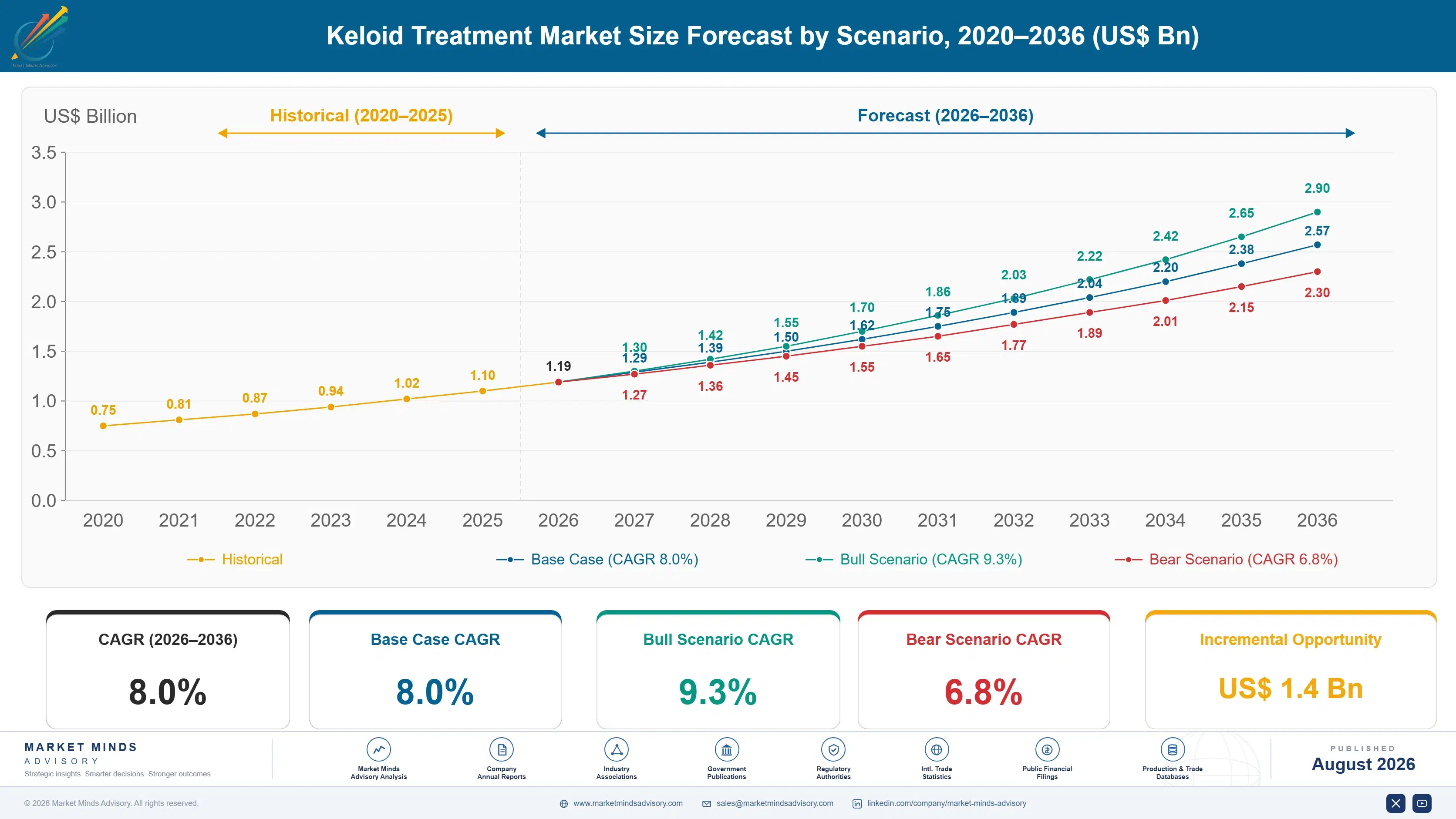
Keloid Treatment Market Forecast Scenarios

keloid-treatment-market-size-forecast-scenario-1787553468893
Growth ran at 6.6% between 2020 and 2025 with elective dermatology deferred heavily through 2020 and recovering unevenly afterwards. What changed underneath was clinical practice rather than product availability: combination intralesional protocols moved from academic centres into routine dermatology, and energy-based devices reached price points that community clinics could justify. Neither development involved a regulatory approval or a registration trial anywhere.
The 8.0% base case rests on three mechanisms. Combination intralesional therapy keeps displacing corticosteroid monotherapy at 12.0% because recurrence rates are visibly better and dermatologists talk to each other. Energy-based device installation keeps expanding into community dermatology as capital costs fall. And dermatology access keeps improving across India, Southeast Asia and parts of Africa where keloid incidence is highest and treatment provision has historically been thinnest. None of the three depends on a regulatory approval arriving.
The 9.3% bull case is a registration trial succeeding and producing the first licensed keloid indication, which would open reimbursement and change payer classification. The 6.8% bear case is out-of-pocket payment: 62% of treatment cost falls on patients directly, which makes this demand unusually sensitive to household income in exactly the populations where incidence concentrates.

A Market Without An Approval

Everything about this market follows from one fact: no drug is licensed anywhere specifically to treat keloids. Triamcinolone, fluorouracil, bleomycin and verapamil are all used routinely and all off-label, which means no company funded a registration trial, no payer has a licensed product to reimburse against, and the evidence guiding practice sits in journal articles rather than in a regulatory label. Clinicians have built effective protocols regardless, and they did it without any commercial sponsor.
TOP-FIVE CONCENTRATION24%Combined position across keloid treatment supply held by leaders
POST-EXCISION RECURRENCE RATE71%Proportion of keloids returning after removal without adjuvant therapy
APPROVED INDICATION COUNT0Drugs licensed specifically for keloid treatment in major markets
DARKER SKIN INCIDENCE MULTIPLE15 timesRelative keloid incidence against lighter skin phototypes globally
TREATMENT COURSE DURATION9 monthsTypical period across which a therapy course runs
OUT-OF-POCKET PAYMENT SHARE62%Portion of treatment cost paid directly by patients themselves
Recurrence is the clinical and commercial centre. Around 71% of keloids return after surgical excision performed without adjuvant therapy, which makes surgery alone close to indefensible and puts the value in whatever follows it. That is why combination intralesional protocols and adjuvant radiation grow while monotherapy does not. A course of treatment runs about nine months, so adherence rather than efficacy is frequently what determines the outcome anybody actually sees.
Incidence runs up to 15 times higher in darker skin phototypes, which concentrates this disease in African, Caribbean, South Asian and East Asian populations. Payment concentrates elsewhere entirely, since 62% of cost falls directly on patients. Disease burden and commercial activity sit in different places entirely, which is the central inequity here.
"The clinical community solved this problem without the industry and the industry has never quite worked out how to monetise that. Whoever runs the first proper registration trial gets a label, a reimbursement pathway and a market that has been treating itself off-label for forty years."
Director, Dermatology and Wound Therapeutics Practice · MMA Healthcare Practice · August 2026

Market Trends

Combination intralesional protocols displace corticosteroid monotherapy

Injecting triamcinolone alone works reasonably and recurs often enough that dermatologists kept looking for better. Combining it with fluorouracil, or using bleomycin or verapamil in resistant lesions, produces recurrence rates that clinicians observe directly in their own patients and share at conferences. Growth at 12.0% follows that diffusion of practice rather than any marketing campaign, since none of these agents is licensed for the indication and nobody promotes them. The commercially awkward consequence is that a generic injectable manufacturer captures the volume growth while contributing nothing to the clinical development at all.
Market Impact: Addresses a 71% recurrence rate
Energy-based devices reach community dermatology price points

Pulsed dye and fractional ablative lasers reduce keloid vascularity and bulk and were confined to academic centres for years on capital cost alone. Device prices have fallen enough that a community dermatology practice can justify one against procedure volume, which moves treatment out of tertiary referral and into the clinics where patients actually present. Growth at 9.4% follows device installation rather than clinical evidence, which has been reasonably settled for a decade. The practical constraint is operator training, since energy settings for darker phototypes differ substantially and getting them wrong causes exactly the pigmentary damage patients feared.
Market Impact: Reaches 15 times higher incidence

Market Opportunities and Growth Drivers

Recurrence after excision drives adjuvant therapy demand

Around 71% of keloids return after surgical excision performed without any adjuvant therapy, which is a failure rate no surgeon defends and no patient accepts twice. That single number is why the commercial value in this market sits after the operation rather than in it. Adjuvant radiation, intralesional injection courses and pressure therapy all exist to address it, and combinations do better than any of them alone. Surgeons who once excised and hoped now book the adjuvant course at the same consultation, which converts a single procedure into a nine month treatment relationship.
Market Impact: Leaves 62% paid privately

Dermatology access expands where keloid incidence is highest

Keloid incidence runs up to 15 times higher in darker skin phototypes, which concentrates the disease across African, Caribbean, South Asian and East Asian populations. Dermatology provision in exactly those places has historically been thin, so a large share of patients have never had access to any treatment beyond reassurance. That is changing as health systems across India, Southeast Asia, Nigeria and South Africa expand specialist provision. Demand growth here is genuine incidence finally reaching treatment rather than any increase in disease, which makes it more durable than most healthcare growth stories.
Market Impact: Excludes 62% of cost

Market Restraints and Challenges

Absence of any licensed indication blocks reimbursement pathways

No drug carries a keloid indication in any major market, which means every prescription is off-label and no payer has a licensed product to build a reimbursement policy around. The root cause is commercial rather than scientific: keloids affect a population that dermatology research underserved for decades, and generic injectables offer no sponsor an economic return on a registration trial. Commercially this leaves 62% of treatment cost with patients. Some academic groups are pursuing registration with public funding, and a licensed indication would reset payer classification across every market at once.
Market Impact: Segment compounding at 12.0%

Cosmetic classification excludes patients from insurance coverage

Insurers across several major markets classify keloid treatment as cosmetic, which is a defensible reading of a raised scar and an indefensible one for a lesion causing pain, itching and joint contracture. The root problem is that classification decisions were made when the only available treatment was excision, and nobody has revisited them. Commercially this caps treatment volume well below clinical need, particularly in the populations where incidence is highest. Dermatology bodies have submitted evidence on symptom burden repeatedly, and a licensed indication would probably do more than any amount of argument.
Market Impact: Segment growing at 9.4% annually
3 additional market trends, 4 additional growth drivers, and 2 additional restraints and challenges are covered in the full report. Contact sales@marketmindsadvisory.com to access the complete intelligence.

Segment CAGR and Growth Architecture

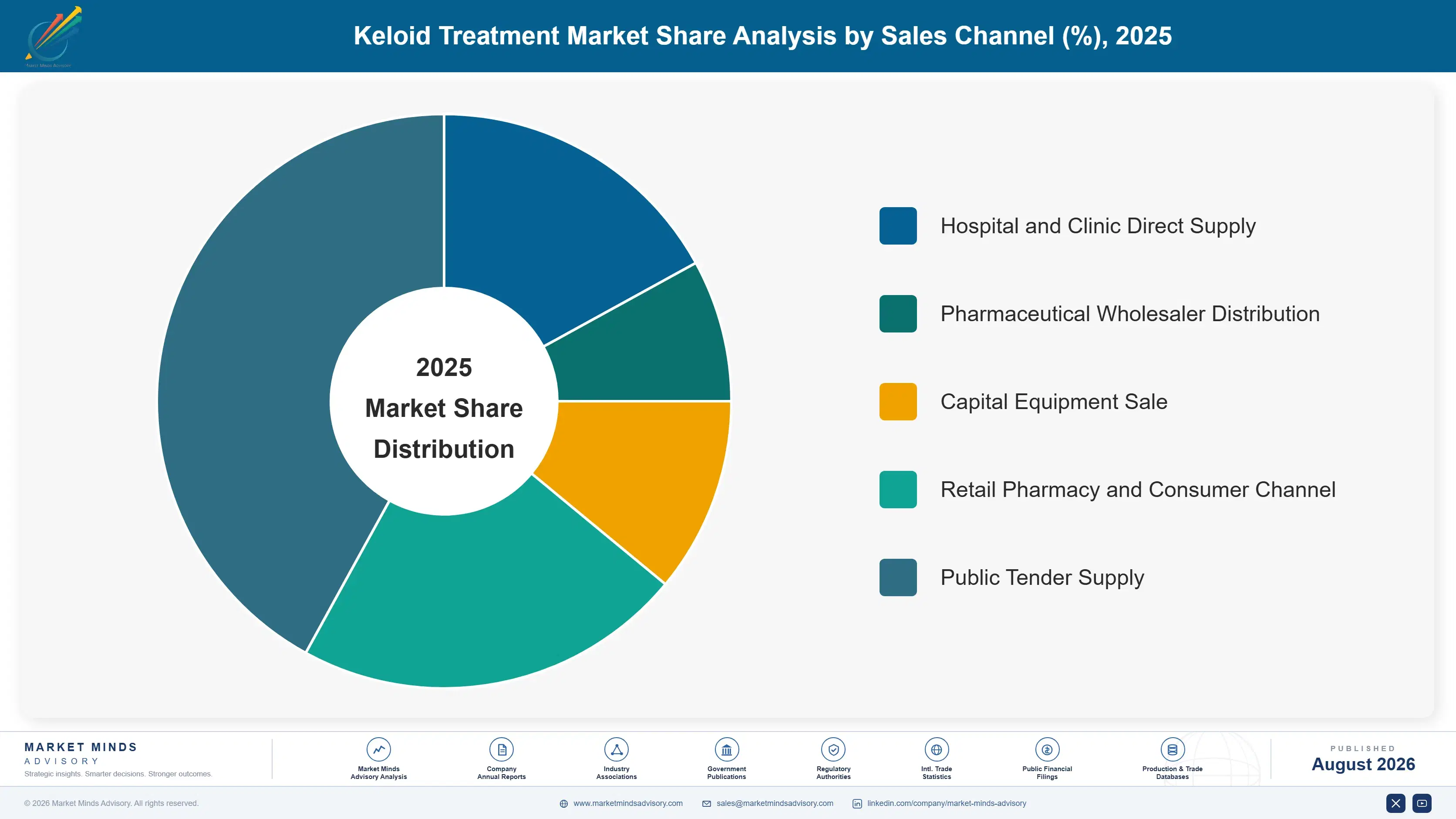
Treatments are classified here by therapeutic modality, since that determines who delivers the care, what capital or product is involved and how it gets paid for. Patient phototype, lesion location and care setting are handled separately in the framework, because a single modality serves every presentation with the same product behind it. Modality decides everything downstream.
keloid-treatment-market-market-share-analysis-1787553469426

Intralesional Antimetabolite and Combination Therapy

Growing at 12.0%, half again the market rate, and doing so entirely without a licensed indication or a commercial sponsor anywhere. Combining corticosteroid with fluorouracil, or using bleomycin or verapamil in resistant lesions, produces recurrence rates that clinicians observe directly in their own patients and pass on to colleagues. Growth follows the diffusion of practice rather than any promotion, since nobody may promote an unlicensed use. The commercially strange consequence is that generic injectable manufacturers capture volume growth they contributed nothing to creating. Whoever eventually funds a registration trial for one of these combinations would convert a diffuse off-label practice into an owned position. Nobody has seriously attempted that yet.
CAGR 12.0%

Laser and Energy-Based Therapy

Pulsed dye lasers reduce keloid vascularity and fractional ablative systems reduce bulk, and both were confined to academic centres for years purely on capital cost. Device prices have fallen far enough that community dermatology practices can justify the investment against procedure volume, which is what growth at 9.4% actually reflects. The clinical evidence settled a decade ago. Operator training is the practical constraint and it is a serious one, because energy settings appropriate for lighter phototypes cause pigmentary damage in the darker skin where keloids concentrate. Device manufacturers who built phototype-specific training programmes are selling considerably better than those shipping a machine and a manual. Training is the product here.
CAGR 9.4%
Full segment breakdown across 6 segments available in the complete report.

Regional Architecture and Country Demand Map

North America holds 30% of value on procedure pricing rather than patient numbers, which is the pattern across most of this market. The Middle East and Africa carries incidence far above any other region and 6% of the value. Payment capacity rather than disease burden explains this map.

North America

Procedure pricing rather than patient volume is what puts this region at the top, since a laser session or an injection course costs several times what the same treatment costs almost anywhere else. African American and Hispanic populations carry substantially elevated keloid incidence and dermatology access varies enormously with insurance status, which produces a treated population considerably smaller than the affected one. Insurers frequently classify treatment as cosmetic, leaving most of the cost with patients directly. Growth at 7.6% reflects combination protocol adoption and device installation into community practice rather than any expansion in who can afford to be treated. Affordability rather than clinical need caps the treated population here.
Share: 30% | CAGR: 7.6% (2026 to 2036)

Western Europe

National health systems cover keloid treatment more consistently than American insurers do, which produces better access and considerably lower prices per procedure. That combination caps market value while improving outcomes, and it is the correct trade even though it makes the region look small commercially. Immigrant populations across the United Kingdom, France and the Netherlands carry elevated incidence and dermatology provision reaches them unevenly. Growth at 6.4% is the weakest of the seven regions and reflects a mature care pathway rather than any lack of clinical need. European academic groups run more keloid research than anywhere and none of it has produced a registered product yet. The research capability and the commercial activity have never quite connected.
Share: 21% | CAGR: 6.4% (2026 to 2036)
Regional intelligence for 5 additional markets available in the complete report: East Asia, South Asia and Pacific, Latin America, Middle East and Africa, Eastern Europe. Contact sales@marketmindsadvisory.com.
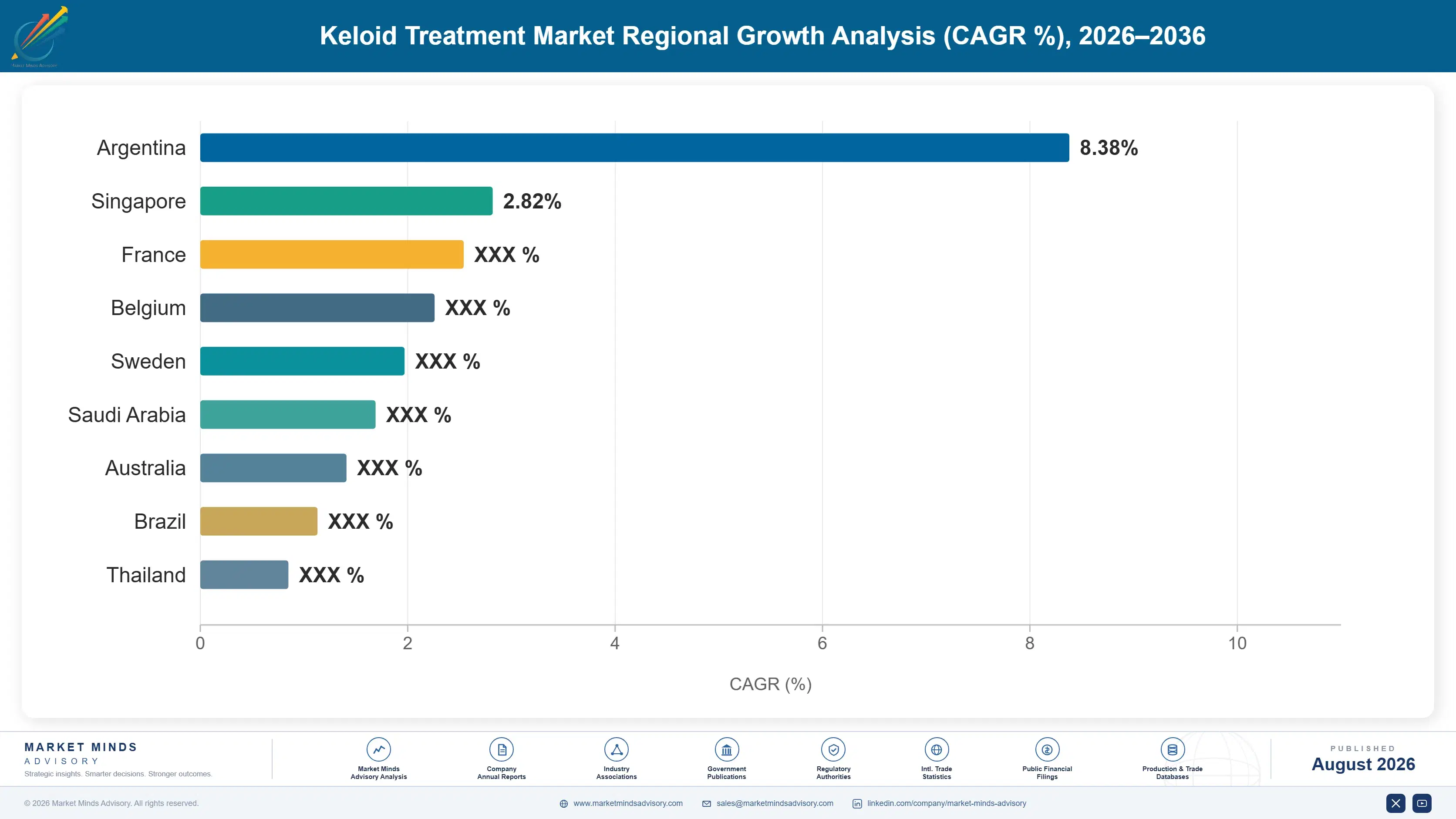
keloid-treatment-market-country-cagr-analysis-1787553469940

Where Treatment Value Actually Sits

Four moves matter in a market where no product is licensed, most cost falls on patients and the disease concentrates in populations research has underserved. Two are about converting off-label practice into an owned position, and two are about reaching patients who are affected and untreated. Competing on injectable price is not among them.

Run the registration trial nobody has funded

No drug carries a keloid indication anywhere, which means the first company to register one takes a market that has been treating itself off-label for forty years. The clinical work is largely done: combination intralesional protocols have published evidence and established practice behind them, and the trial would confirm rather than discover. A licensed indication resets payer classification across every market simultaneously and converts 62% out-of-pocket payment into something reimbursable. The obstacle is that the agents are generic, which means the sponsor needs a formulation, device or combination worth protecting.
Market Impact: Converts the full 62% out-of-pocket share into reimbursement

Sell the adjuvant alongside the excision

Around 71% of keloids return after surgery performed without adjuvant therapy, which means the surgeon and the patient both already understand that excision alone fails. Presenting a treatment as the thing that makes surgery work rather than as a separate product reaches a decision already being made in the consultation room. That converts a single procedure into a nine month treatment relationship with predictable repeat contact. Manufacturers selling to dermatology and ignoring surgery are missing the moment when the patient is most motivated and the clinical argument is strongest. That consultation is the whole opportunity.
Market Impact: Prevents most of a 71% keloid recurrence rate

Build phototype-specific training into device sales

Energy settings appropriate for lighter skin cause pigmentary damage in the darker phototypes where keloid incidence runs up to 15 times higher, which makes operator training a clinical safety question rather than a service extra. Device manufacturers who built phototype-specific protocols and training sell considerably better, because a dermatologist treating this population will not risk a machine they cannot use safely. Growth at 9.4% in energy-based therapy runs through community practices with limited training budgets. Supplying the protocol removes the barrier and creates a relationship the next device purchase runs through.
Market Impact: Serves a population carrying 15 times the incidence

Reach the untreated population through primary care

A large share of keloid patients have never seen a dermatologist and were told by a general practitioner that nothing much could be done, which was true twenty years ago and is not now. Incidence runs up to 15 times higher in darker phototypes and dermatology provision reaches those populations unevenly everywhere. Educating primary care on what treatment now achieves converts undiagnosed burden into referrals and demand. It costs almost nothing against the volume involved and no manufacturer in this market has attempted it at any scale. The volume involved is genuinely large.
Market Impact: Addresses a treatment gap at 15 times incidence

Who Controls the Margin Pool

Five suppliers hold 24% of keloid treatment revenue, measured at manufacturer level across drug, device and dressing categories, the basis used throughout this section. That is the most fragmented healthcare category in this series and it follows directly from the absence of any licensed product: generic injectables, over-the-counter dressings and capital devices compete for the same clinical problem without competing with each other at all in any conventional sense.
Competition runs on three dimensions. Clinical evidence generation, which in a market with no approvals means investigator-led studies rather than registration trials. Practitioner training and support, particularly on darker phototypes where technique matters most. And channel reach into the specialties that actually see these patients, which include surgery and primary care rather than dermatology alone.

Rankings would shift completely if anybody registered an indication, which is the single largest strategic question in this market and one nobody has answered. Until then, device manufacturers hold the most defensible positions because capital equipment creates a relationship that a generic vial cannot. Dressing brands compete on retail shelf and consumer recognition in a channel most of the industry ignores.
keloid-treatment-market-company-positioning-matrix-1787553470460

Competitive Moat and Risk Dimensions

BAUSCH HEALTH

Moat: Dermatology channel breadth

Bausch Health reaches dermatology practices across several product categories, which means a keloid product travels on a sales relationship built for the whole speciality rather than requiring one of its own. In a market too small and too unlicensed to justify dedicated coverage, that shared channel is the practical difference between reaching prescribers and not reaching them at all.
BAUSCH HEALTH

Risk: No licensed keloid product

The portfolio contains nothing licensed for keloids and neither does anybody else's, which means the position rests on channel rather than on any asset a competitor cannot replicate. Whoever registers an indication first would displace that advantage immediately, and the company holds no particular head start in a race nobody has yet begun properly.
CANDELA CORPORATION

Moat: Phototype-specific device capability

Candela built laser platforms and treatment protocols validated across darker skin phototypes, which matters more in keloid treatment than in almost any other dermatology application because that is where the disease concentrates. Clinicians treating this population will not adopt equipment they cannot use safely, and the validation work behind those protocols took years that a competitor cannot compress.
CANDELA CORPORATION

Risk: Capital purchase cycle exposure

Device revenue depends on practices making capital decisions, which pause immediately whenever credit tightens or procedure volumes wobble. Consumable and pharmaceutical competitors carry demand that continues through those periods. A device business also earns nothing between purchases unless it has built a service and consumable attachment that many have not.

Players Tracked

Prominent Players

Bausch Health
Merz Pharma
Alliance Pharma
Candela Corporation
Smith+Nephew

Other Key Players

Lutronic
Lumenis
Mölnlycke Health Care
Sonoma Pharmaceuticals
Perrigo
Teva Pharmaceutical Industries
Sun Pharmaceutical Industries
Hikma Pharmaceuticals
Sensus Healthcare
Brymill Cryogenic Systems
CryoConcepts
Scar Heal
Rejuvaskin
Newmedical Technology
Enaltus

Recent Developments

FEBRUARY 2025

Candela Corporation expanded phototype-specific training programmes for keloid applications

Candela Corporation extended clinical training programmes covering energy settings and treatment protocols for darker skin phototypes across keloid and hypertrophic scar applications. This was an organic expansion of clinical education resource rather than any transaction, and it addresses the operator competence gap limiting device adoption.
Signal: Training rather than technology is the adoption constraint in this application, and the manufacturers who understand that are winning placements
JULY 2025

An academic consortium opened a registration study for combination intralesional therapy

A multi-centre academic consortium began a registration-directed study of combination intralesional therapy for keloid treatment, funded through public and foundation sources rather than industry. No commercial sponsor is attached, and the study addresses an indication that has never carried a licensed product in any market.
Signal: The registration work is being done by academics without industry funding, which leaves the eventual commercial position genuinely open
DECEMBER 2025

Sensus Healthcare expanded superficial radiotherapy placement for post-excision adjuvant use

Sensus Healthcare increased placement of superficial radiotherapy systems into dermatology and surgical practices treating keloids after excision. The expansion was organic commercial activity rather than an acquisition, and it targets the recurrence problem that makes surgery alone clinically indefensible. Surgeons rather than dermatologists were the target audience throughout.
Signal: Adjuvant capability is being sold to surgeons rather than dermatologists, which reaches the decision where it happens

What Drives Treatment Cost

Clinician time accounts for around 54% of delivered treatment cost across injection and device modalities, with the product itself, facility overhead and consumables making up the balance. Generic injectable agents cost very little per dose and come from established manufacturers in India, Europe and North America. Device capital amortises across procedure volume. Silicone sheeting is manufactured at scale and priced as a consumer product.
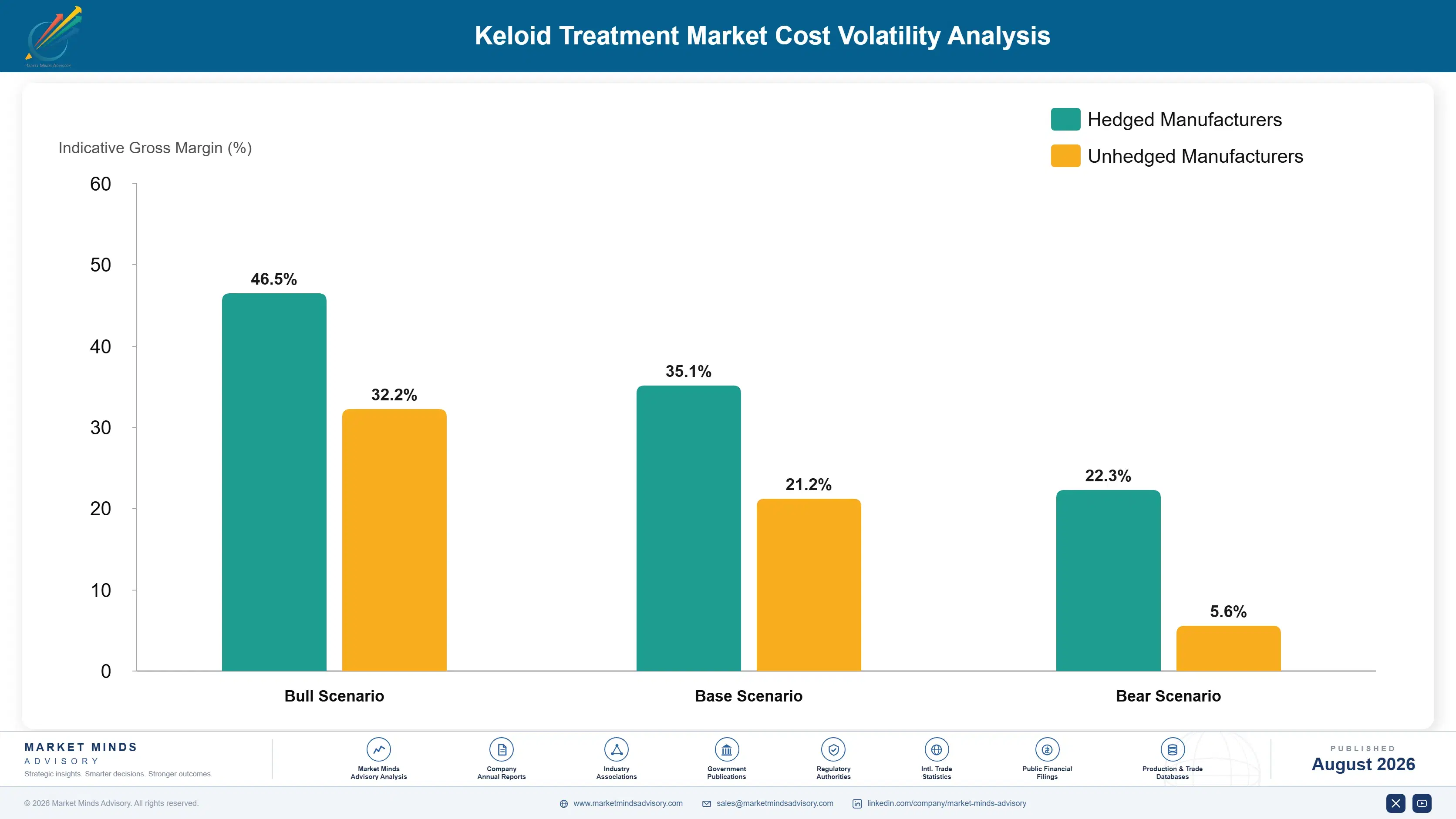
Sterile injectable supply disruption through 2022 and 2023 affected several agents used in keloid protocols, since generic injectables carry thin margins and few manufacturers hold redundant capacity. Teva reported supply and manufacturing cost pressure across its generic injectable operations in its Annual Report 2022. Clinics absorbed the disruption by substituting protocols rather than by repricing, because a treatment course is quoted to a patient in advance and cannot be changed midway.

The quoted course is what makes this exposure unusual. A nine month protocol is priced at the first consultation and delivered across a period in which nothing about the cost base is guaranteed. Device-based practices carry capital amortisation instead and face different exposure. Public system providers face neither, since the pricing decision sits with a health authority rather than with anybody delivering the care.
keloid-treatment-market-cost-volatility-analysis-1787553470655

Qualify a second source for every protocol agent

Generic injectables used in keloid protocols come from thin manufacturing bases and the 2022 disruption showed how quickly a shortage becomes a treatment substitution. Clinics and health systems holding a qualified second source for each agent avoid rewriting protocols mid-course. The work is procurement rather than clinical and almost nobody does it until a shortage has already arrived.

Price the course rather than the individual session

Quoting session by session across a nine month protocol invites patients to stop when symptoms improve and before recurrence risk has passed, which produces worse outcomes and lost revenue together. Course pricing agreed at the first consultation improves adherence and removes the repricing exposure. Patients paying directly generally prefer knowing the total, which most clinics assume wrongly.

Attach consumables and service to device placements

A device earns nothing between capital purchases unless consumables or service revenue attach to it, and keloid applications generate steady procedure volume once a practice is trained. Manufacturers treating placement as the transaction rather than the beginning of one leave recurring revenue with nobody collecting it. The attachment has to be designed into the platform rather than added afterwards.

Portfolio Architecture for Margin Defence

Margin in keloid treatment tracks whether anything protects the position, and in a market with no approvals very little does. Generic intralesional agents run at commodity injectable margins, since any manufacturer may supply them and no promotion is permitted for the use anyway. Silicone dressings run somewhat better on brand recognition in a retail channel. Energy-based devices run considerably higher, because capital equipment creates a switching cost and phototype-validated protocols create a genuine capability barrier.
The tension is that the therapies with the best clinical evidence are the least commercially protectable, which is unusual and explains why this market has no dominant participant. Combination intralesional protocols work best and consist of generic agents nobody owns. Devices are protectable and address a narrower part of the clinical problem. Any company wanting a defensible position has to create one through registration rather than find one already there.

High-value pools sit in device platforms with phototype validation, adjuvant radiation placement into surgical practice and any eventual licensed indication. None of the three is where the treated patient volume currently is. Manufacturing capability by itself defends nothing whatsoever here.

Volume / Commodity-Adjacent

Generic intralesional agents and basic silicone dressings supplied into protocols any clinician may prescribe from any manufacturer. The eight-point range separates suppliers with reliable sterile injectable capacity from those competing on tender price alone in a thin manufacturing base.
Gross Margin: 18%-26%

Premium / Certified

Branded scar dressings, cryotherapy systems and pressure therapy products carrying clinical evidence and practitioner familiarity. The nine-point spread reflects whether the supplier holds retail brand recognition or competes purely through clinical channels for the same indication.
Gross Margin: 32%-41%

Sustainability / Regulatory / Next-Generation

Energy-based device platforms with phototype-validated protocols, superficial radiotherapy systems and any future licensed pharmaceutical indication. The eighteen-point range is genuinely wide because capital pricing, clinical scarcity and an absent regulatory pathway make comparison impossible.
Gross Margin: 44%-62%
keloid-treatment-market-portfolio-architecture-1787553471157

High-value Sub-segments and Strategic Watch-out

Registration Pathway Opportunity

No drug carries a keloid indication anywhere and the clinical work is largely done, which means the first registration converts forty years of off-label practice into an owned position. Academic groups are running the study without industry funding. The commercial position remains genuinely open. Somebody will take it.
Gross Margin: 50%-70%

Phototype-Validated Device Platforms

Incidence runs 15 times higher in darker phototypes and energy settings validated for lighter skin cause pigmentary damage there, which makes protocol validation a safety requirement rather than a feature. Clinicians will not adopt equipment they cannot use safely. That barrier holds. Validation takes years to build.
Gross Margin: 44%-58%

Generic Intralesional Agents

The therapy with the best clinical evidence and the least commercial protection anywhere, growing at 12.0% in combination use while nobody captures a defensible position from it. Any manufacturer may supply and none may promote. Volume growth without pricing power throughout. Nobody owns any of it.
Gross Margin: 18%-26%

Post-Excision Adjuvant Channel

Around 71% of keloids return after surgery without adjuvant therapy, which means the surgeon already knows excision alone fails and the patient already understands why. Reaching that consultation converts one procedure into nine months of treatment. Very few manufacturers call on surgery. That absence is the opening.
Gross Margin: 40%-56%

How Treatment Demand Renews

Keloid demand renews through recurrence, which is an uncomfortable thing to write and commercially accurate. Around 71% of lesions return after excision without adjuvant therapy, and treated keloids frequently need repeat courses across years. A course runs about nine months, so a single patient generates sustained contact rather than a transaction. The clinical objective and the revenue pattern point in opposite directions.
Stickiness runs through the clinician rather than the patient. A dermatologist who has built a protocol that works keeps using the same agents and the same device, because changing anything mid-practice risks outcomes they have learned to predict. Device placements are stickiest, since capital and training both sunk. Generic injectable choice changes on availability alone. Patients are loyal to whoever treated them and have no influence over what gets used.

The buyer is unusual in that there frequently is not one. With 62% of cost falling directly on patients, the purchase decision sits with somebody paying from personal income for a condition their insurer calls cosmetic. That makes affordability rather than clinical judgement the binding constraint almost everywhere, concentrating treated volume in populations that can pay.
keloid-treatment-market-end-use-penetration-index-1787553471649

Where To Place The Bet

These are among the four positions where our research anticipates prominent divergence between winners and laggards over the coming forecast period. Each is grounded in the demand model, the regulatory perimeter, and the announced capacity pipeline.
01 / REGISTRATION PATHWAY INVESTMENT

Register the indication nobody has ever registered

No drug carries a keloid indication in any major market and every pharmacological treatment in routine use is prescribed entirely off-label, which is a gap forty years old and still completely open today. The clinical work is largely finished, since combination intralesional protocols carry published evidence and established practice, so a trial would confirm rather than discover anything genuinely new. A licensed indication resets payer classification everywhere at once and converts 62% out-of-pocket payment into a reimbursable pathway across every market simultaneously.
02 / SURGICAL CHANNEL ENTRY

Sell adjuvant therapy to the surgeon

Around 71% of keloids return after excision performed without any adjuvant therapy, which means the surgeon and the patient have both already accepted that surgery alone will not work on its own. Presenting a treatment as what makes the operation succeed reaches a decision being made in the consultation room rather than competing for attention afterwards, and it converts a single procedure into a nine month treatment relationship. Manufacturers calling only on dermatology are missing the moment when clinical motivation is strongest.
03 / PHOTOTYPE PROTOCOL VALIDATION

Validate device protocols for the affected population

Keloid incidence runs up to 15 times higher in darker skin phototypes and energy settings validated on lighter skin cause exactly the pigmentary damage those patients most fear, which makes protocol validation a clinical safety requirement rather than a marketing feature. Dermatologists treating this population simply will not adopt equipment they cannot use safely on the patients in front of them. The validation work takes years that a competitor cannot compress, which makes it a genuinely durable commercial position to hold.
04 / PRIMARY CARE EDUCATION

Convert undiagnosed burden into referred demand

A large share of keloid patients were told by a general practitioner that nothing much could be done, which was broadly true twenty years ago and is plainly not true now with current combination protocols. Incidence runs up to 15 times higher in darker phototypes and dermatology provision reaches those populations unevenly across every market including wealthy ones. Educating primary care on what treatment now achieves converts undiagnosed burden into referrals, and it costs almost nothing against the patient volume involved.

Engagement Snapshot From the Field

A live engagement with an industry participant carrying material or product regulatory and market exposure ahead of a defining policy shift, showing how our research translates into a defensible multi-year portfolio strategy.
MARKET MINDS ADVISORY · CLIENT ENGAGEMENT SUMMARY
Keloid Treatment Producer Strategic Portfolio Review and Transition Roadmap 2026·Investment Scenario on Keloid Treatment Exposure Evaluation 2025-26
CLIENT PROFILE
A global dermatology device manufacturer with annual revenue around USD 740 million (client-reported, unverified by MMA), selling energy-based platforms into aesthetic and medical dermatology across thirty markets. Keloid treatment was an unpromoted use of existing platforms rather than a supported indication. Clinical training material covered lighter phototypes almost exclusively. No commercial attention had been given to the application.
STRATEGIC CHALLENGE
Field reports indicated that platforms were being used for keloid treatment in several markets with variable results and occasional pigmentary complications (client-reported, unverified by MMA). The clinical affairs team wanted the use discouraged. Commercial leadership wanted to know whether it represented an opportunity worth supporting properly or a liability worth closing down.
MMA APPROACH
MMA sized treated keloid volume by market against incidence and dermatology provision rather than against existing device sales, establishing where addressable demand actually sits. Complication reports were reviewed against operator training coverage by phototype through the expert interview programme. Competitor training and protocol provision was assessed, and referral pathways from surgery and primary care were mapped in three representative markets.
KEY FINDINGS
  1. Complications correlated closely with operator training coverage rather than with platform capability, which meant the problem was educational rather than technical in nature.
  2. Addressable treated volume across the client's existing markets was considerably larger than current keloid-related device use suggested, concentrated in populations with elevated incidence.
  3. Two competitors already provided phototype-specific protocols and were winning placements in exactly the practices treating the largest affected patient populations anywhere at all.
  4. Surgical referral pathways generated more keloid presentations than dermatology self-referral in all three markets examined, and nobody was calling on surgery at all.
CLIENT PROFILE
A global dermatology device manufacturer with annual revenue around USD 740 million (client-reported, unverified by MMA), selling energy-based platforms into aesthetic and medical dermatology across thirty markets. Keloid treatment was an unpromoted use of existing platforms rather than a supported indication. Clinical training material covered lighter phototypes almost exclusively. No commercial attention had been given to the application.
STRATEGIC CHALLENGE
Field reports indicated that platforms were being used for keloid treatment in several markets with variable results and occasional pigmentary complications (client-reported, unverified by MMA). The clinical affairs team wanted the use discouraged. Commercial leadership wanted to know whether it represented an opportunity worth supporting properly or a liability worth closing down.
MMA APPROACH
MMA sized treated keloid volume by market against incidence and dermatology provision rather than against existing device sales, establishing where addressable demand actually sits. Complication reports were reviewed against operator training coverage by phototype through the expert interview programme. Competitor training and protocol provision was assessed, and referral pathways from surgery and primary care were mapped in three representative markets.
KEY FINDINGS
  1. Complications correlated closely with operator training coverage rather than with platform capability, which meant the problem was educational rather than technical in nature.
  2. Addressable treated volume across the client's existing markets was considerably larger than current keloid-related device use suggested, concentrated in populations with elevated incidence.
  3. Two competitors already provided phototype-specific protocols and were winning placements in exactly the practices treating the largest affected patient populations anywhere at all.
  4. Surgical referral pathways generated more keloid presentations than dermatology self-referral in all three markets examined, and nobody was calling on surgery at all.
RECOMMENDED STRATEGY
Phase 1: Phase one: develop and publish phototype-specific treatment protocols and training for existing platforms rather than discouraging a use that will continue regardless. Phase 2: Phase two: build commercial coverage into surgical practices performing excision, where the adjuvant conversation happens and the client is currently absent. Phase 3: Phase three: support investigator-led evidence generation on device use in darker phototypes, which no competitor has funded meaningfully to date.
OUTCOME
Phototype-specific protocols and training launched across the client's largest markets and complication reports have fallen. Surgical channel coverage has begun in two markets. The client reports keloid-related platform placements running well ahead of plan and an investigator-led study now underway (client-reported, unverified by MMA). Complication reports have stopped entirely.

Frequently Asked Questions

Foundational context covering the market sizes, CAGR, scope, country, region and competition that inform every finding below. This section is provided to cover basics and most often pre-purchase conversations, answered from the MMA Primary Research Dataset.

What is the current size of the Keloid Treatment Market?

The market was valued at USD 1.1 billion in 2025, rising to an estimated USD 1.19 billion in 2026. North America holds the largest regional share at 30% of value.

How large will the Keloid Treatment Market be by 2036?

MMA forecasts USD 2.56 billion by 2036 under the base case, an expansion multiple of 2.16 times the 2026 value. That represents USD 1.37 billion of incremental value.

What is the CAGR for the Keloid Treatment Market 2026 to 2036?

The base case runs at 8.0% compound annual growth between 2026 and 2036, with a bull case at 9.3% and a bear case at 6.8%. Historical growth from 2020 to 2025 was 6.6%.

Which segment is growing fastest?

Intralesional antimetabolite and combination therapy leads at 12.0%, half again the market rate, driven by recurrence rates that clinicians observe directly. Laser and energy-based therapy follows at 9.4%.

Who are the major companies in the Keloid Treatment Market?

Bausch Health, Merz Pharma, Alliance Pharma, Candela Corporation and Smith+Nephew hold 24% between them. Channel reach and device capability sustain those positions, since no licensed product exists.

Which country is growing fastest?

India leads at 10.8%, driven by high keloid incidence meeting dermatology provision that has expanded substantially. Most of that growth is untreated burden finally reaching care.

Report Segmentation Architecture

The full report scope spans multiple orthogonal segmentation dimensions, with cross-tabulated demand data provided for each dimension pair. Coverage extends further to regional breakdowns, trend trajectories, and the competitive detail needed to support segment-level decision-making.

By Treatment Modality

  • Intralesional Corticosteroid Injection
  • Silicone Gel Sheeting and Topical Dressings
  • Laser and Energy-Based Therapy
  • Surgical Excision with Adjuvant Radiation
  • Intralesional Antimetabolite and Combination Therapy
  • Cryotherapy Systems

By End-Use Industry

  • Hospital Dermatology
  • Community Dermatology Practice
  • Plastic and Reconstructive Surgery
  • Aesthetic Clinics
  • Primary Care
  • Consumer Retail Pharmacy

By Sales Channel

  • Hospital and Clinic Direct Supply
  • Pharmaceutical Wholesaler Distribution
  • Capital Equipment Sale
  • Retail Pharmacy and Consumer Channel
  • Public Tender Supply

By Region

  • North America
  • Western Europe
  • East Asia
  • South Asia and Pacific
  • Latin America
  • Middle East and Africa
  • Eastern Europe

Scope, Methodology, and Coverage

Every figure in this report is reproducible from documented input assumptions. The scope below maps the historical period, the forecast horizon, the segmentation dimensions, and the countries covered, alongside the underlying primary and qualitative methodology.
Historical Period
2020 to 2025
Forecast Period
2026 to 2036
Base Year
2025 (USD billions; MMA Primary Research Dataset, August 2026)
Market Definition
The market comprises therapies, devices and dressings used to treat keloid and hypertrophic scarring, covering intralesional corticosteroid injection, silicone gel sheeting and topical dressings, laser and energy-based therapy, surgical excision with adjuvant radiation, intralesional antimetabolite and combination therapy, and cryotherapy systems. Value is measured at manufacturer level across clinical and consumer channels. General wound care and burn dressings, cosmetic scar concealment products, aesthetic resurfacing for non-scar indications, general surgical instruments, and reconstructive surgery services fall outside scope.
Quantitative Units
USD billions (current prices); million treated patients annually; USD per completed treatment course by modality
Segmentation Dimensions
By Treatment Modality; By End-Use Industry; By Sales Channel; By Region
Regions Covered
North America, Western Europe, East Asia, South Asia and Pacific, Latin America, Middle East and Africa, Eastern Europe
Countries Covered
United States, Canada, Mexico, Brazil, Colombia, Chile, United Kingdom, France, Germany, Netherlands, Italy, Spain, Sweden, Poland, Romania, Czechia, China, Japan, South Korea, Taiwan, India, Indonesia, Thailand, Philippines, Australia, Nigeria, South Africa, Kenya, Saudi Arabia, United Arab Emirates
Key Companies Profiled
Bausch Health, Merz Pharma, Alliance Pharma, Candela Corporation, Smith+Nephew, Lutronic, Lumenis, Mölnlycke Health Care, Sonoma Pharmaceuticals, Perrigo, Teva Pharmaceutical Industries, Sun Pharmaceutical Industries, Hikma Pharmaceuticals, Sensus Healthcare, Brymill Cryogenic Systems, CryoConcepts, Scar Heal, Rejuvaskin, Newmedical Technology, Enaltus
Quantitative Methodology
Primary survey, n=3,800 respondents, Q4 2025, six countries; demand-side model with trade association cross-validation
Qualitative Methodology
47 expert interviews, Q4 2025; applied to validate demand model assumptions, identify emerging dynamics, and assess competitive positioning
Report Format
PDF and XLSX data workbook (Word format preview document)
Publisher
Market Minds Advisory
Report Code
MMA-2026-HLT-072
Published
August 2026
Contact
sales@marketmindsadvisory.com | www.marketmindsadvisory.com

Purchase the full Keloid Treatment Market Report (2026 to 2036).

The full report sizes the global keloid treatment market to 2036 across six therapeutic modalities and seven regions, measured at manufacturer level across clinical and consumer channels. It treats the complete absence of any licensed indication as the governing commercial fact, and maps recurrence economics, payer classification and phototype incidence against where treatment actually reaches patients. Competitive analysis covers 20 participants evaluated on treatment revenue, with moat and risk assessment for the two leaders. The gap between disease burden and commercial activity is quantified by region, and four revenue levers close the analysis.
Six-modality segment sizing with segment-level growth rates
Seven-region share and growth breakdown to 2036
Twenty-participant competitive map on one revenue basis
Disease burden compared against treated volume by region
Payer classification and out-of-pocket exposure by market
Four quantified revenue levers with commercial impact ranges

Built For The People Who Decide

From boardroom strategy to bench-side execution, this report is read cover-to-cover by leaders shaping the next decade of their industry, turning demand scenarios, market dynamics and valuation benchmarks into decisions.
CXOs/ Presidents/ VPs/ Managers
M&A and Corporate Development
Strategy Teams and R&D Heads
Procurement and Product Directors
Regulatory and Compliance Leaders
Investor Relations and Equity Analysts