Market Minds Advisory
Jewelry Cleaners Market

Jewelry Cleaners Market: Jewelry Cleaners Market. Home Care Replaces the Jeweler Visit

Affordable home ultrasonic devices and direct-to-consumer cleaning solution brands push jewelry maintenance out of the jeweler's back counter into everyday household routines, while gold price appreciation raises the stakes buyers place on protecting pieces.

Lead Analyst

Published

September 2026

Make Smarter Decisions with Customized Research Insights

Request a free sample report and evaluate market opportunities, growth trends, and competitive dynamics relevant to your business needs.

2025 MARKET VALUE$0.7BMarket Size 2025
2036 FORECAST VALUE$1.4BBase Case , 2026 to 2036
CAGR 2026 TO 20366.4 %Bull 7.7% / Bear 5.1%
INCREMENTAL OPPORTUNITY$0.6BNet 10- year value creation
EXPANSION MULTIPLE1.86x2036 value over 2026 base
Strategic Levers
M&A Pipeline
Regional Outlook
Country Rankings
Competitive Intelligence
Segmental Deep-dive
Call-Us : 91 93563 13602

Executive Snapshot and Market Trajectory.

Jewelry cleaning has shifted from a periodic jeweler visit toward a routine home task, as affordable ultrasonic machines and packaged cleaning solutions let owners maintain pieces between professional servicing appointments across most developed markets tracked closely this year and next across every major region worldwide.
Ultrasonic devices and steam cleaners are pulling share away from simple dip solutions and polishing cloths, since buyers increasingly want deeper cleaning results comparable to professional jeweler equipment without leaving home. Growth concentrates most heavily in East Asia and North America, where large jewelry retail markets and strong e-commerce distribution both reward branded home care products over generic alternatives sold cheaply at mass retail chains. Retailers increasingly bundle cleaning kits with new jewelry purchases.
Competition remains fragmented across specialty jewelry care brands, home appliance manufacturers entering the ultrasonic cleaning category, and private-label retail lines, with no single player commanding outsized share of global volume or pricing power today. Rising gold and gemstone prices reinforce buyer willingness to invest in proper maintenance products that protect increasingly valuable existing pieces from damage, tarnish, and everyday wear. Direct-to-consumer brands increasingly market these products through jewelry care content.
Market Definition
The jewelry cleaners market covers liquid solutions, ultrasonic machines, steam devices, wipes, and immersion kits designed for cleaning gold, silver, and gemstone jewelry at home or in professional settings. It excludes general household cleaning products not formulated specifically for jewelry and jewelry repair or resizing services.
Base Year Value
$0.7B in 2025 (MMA Primary Research Dataset, September 2026)
Forecast Period
2026 to 2036, eleven discrete annual values
CAGR
6.4% base case. Bull 7.7%. Bear 5.1%.
Fastest Growth Segment
Ultrasonic Cleaning Machines: 9.8% CAGR
Fastest Growth Country
India: 8.3% CAGR
Fastest Growth Region
South Asia and Pacific: 8.6% CAGR
Largest Region
East Asia: 29% of 2025 global value
Market Leaders
Connoisseurs, Weiman, iSonic, Speidel, GemOro. Source: MMA Analysis based on company disclosures and primary research.
Primary Survey
n=3,800 procurement and R&D decision-makers, Q4 2025, six countries
Methodology
Demand-side build-up, cross-validated against public data, 47 expert interviews

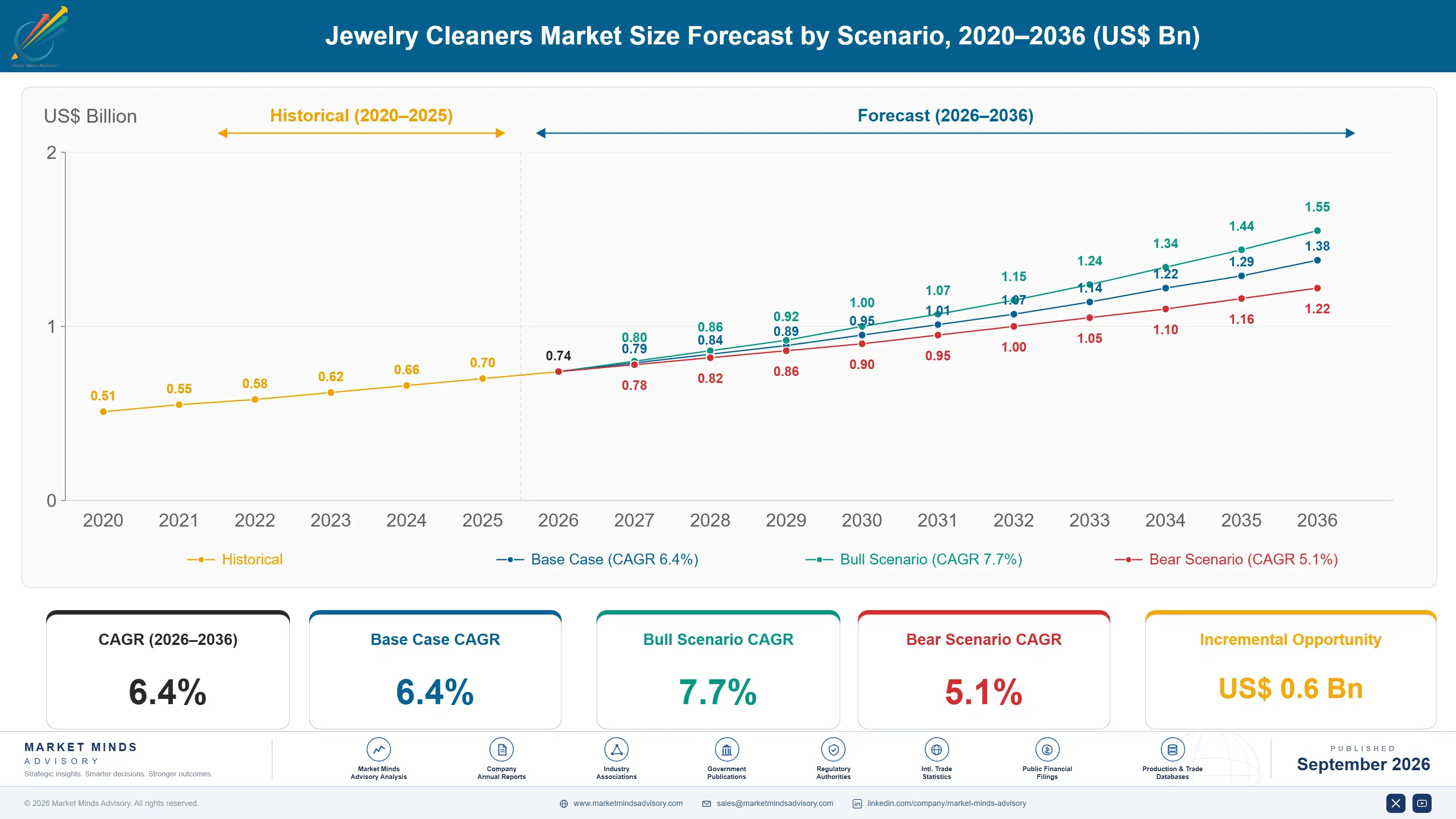
Jewelry Cleaners Market Forecast Scenarios

jewelry-cleaners-market-size-forecast-scenario-1790025345209
Between 2020 and 2025 the market grew steadily as home care habits formed during periods of limited access to professional jewelry services persisted well afterward, with ultrasonic device sales accelerating well above prior trend for two consecutive years across most tracked markets globally, domestically, and in several emerging economies as well, and beyond into new categories.
The base case assumes continued adoption of home ultrasonic cleaning devices, expanding direct-to-consumer specialty brand distribution through e-commerce channels reaching buyers directly without retail intermediation taking a meaningful margin cut, and sustained gold price appreciation that reinforces buyer motivation to protect existing jewelry investments properly over time. These three mechanisms together sustain growth even as basic dip solution penetration approaches saturation across most developed markets already familiar with the category.
A stronger bull case hinges on jewelry care content creators accelerating ultrasonic device discovery across social platforms considerably faster than organic adoption alone would justify across most tracked markets. The bear risk is a shift toward disposable, low-cost fashion jewelry that buyers replace rather than maintain, reducing the addressable base of pieces worth the investment in dedicated cleaning products.

Home Care Becomes a Retail Category

Jewelry cleaning sits at the intersection of luxury goods ownership and household appliance convenience, a category that grew considerably as buyers sought ways to maintain sentimental and valuable pieces without the cost and inconvenience of frequent jeweler visits. Buyers now treat cleaning device selection partly as a protective investment in existing jewelry value, reshaping how retailers merchandise the category alongside jewelry displays. Insurance appraisers increasingly recommend regular cleaning to preserve documented item condition.
MARKET CONCENTRATIONCR5 31%shows a fragmented field of specialist and appliance brands
AVERAGE SELLING PRICE$19blends basic solutions with premium ultrasonic machine kits
TOP PRODUCING COUNTRY SHAREChina 44%captures the dominant manufacturing base for global devices
CAPACITY UTILIZATION71%indicates moderate headroom across contract manufacturing facilities today
E-COMMERCE CHANNEL SHARE42%shows how much category revenue bypasses traditional jewelry retail
REPLACEMENT CYCLE LENGTH3 yearscaptures how long buyers typically keep a device before replacing
Manufacturing remains heavily concentrated in China for entry and mid-tier ultrasonic devices, while premium cleaning solutions retain meaningful production in the United States and Germany, where formulation expertise commands a premium buyers are willing to pay for gemstone-safe chemistry and reliability. E-commerce distribution has increasingly displaced traditional jewelry store counters for specialty cleaning product sales nationwide.
Replacement demand now rivals first-time purchase as a growth driver, since buyers who bought a basic dip solution years ago increasingly upgrade to ultrasonic or steam alternatives as their jewelry collections grow in value and complexity over time. This replacement cycle gives established brands a second monetization opportunity per household well beyond the initial cleaning product purchase made years earlier in their ownership history.
"People used to think a fifty-dollar ultrasonic machine was overkill for a drawer of jewelry. Now it is considered basic maintenance, the same way you would not skip an oil change on a car you actually like."
Senior Analyst, Consumer Products Practice · MMA Consumer Products Practice · September 2026

Market Trends

Home Ultrasonic Devices Replace Routine Jeweler Visits

Buyers increasingly purchase affordable home ultrasonic machines rather than scheduling routine jeweler cleaning appointments, since the devices now deliver comparable results at a fraction of the cumulative cost over a typical ownership period. Manufacturers report ultrasonic device sales climbing meaningfully faster among buyers who previously visited jewelers exclusively for cleaning rather than repair, since the convenience of cleaning multiple pieces at home outweighs the in-store visit for routine maintenance. This shift is pulling category spending toward device ownership and away from recurring service fees, forcing jewelers to reposition cleaning as a loyalty service.
Market Impact: lifts premium product spend by 29%

Gemstone-Safe Formulation Becomes a Purchase Differentiator

Buyers increasingly research whether a cleaning solution is safe for specific gemstones before purchasing, since improper chemistry can damage porous stones like opals, pearls, and emeralds that require gentler treatment than durable diamonds. This awareness has pushed manufacturers to develop stone-specific formulations and clearer labeling that identifies compatible gemstone types, moving the category away from generic all-purpose solutions that once dominated shelf space. Specialty retailers increasingly stock formulation-specific product lines rather than a single generic cleaner, reflecting rising buyer sophistication about jewelry care chemistry and gemstone vulnerability. Buyers now compare formulation labels the way they compare skincare ingredient lists.
Market Impact: e-commerce sales grow 38% annually

Market Opportunities and Growth Drivers

Rising Gold Prices Increase Investment in Jewelry Maintenance

Sustained gold and gemstone price appreciation has raised the replacement value of existing jewelry considerably, motivating owners to invest in proper maintenance products that protect pieces now worth meaningfully more than at time of purchase. Buyers increasingly view cleaning products as protective insurance for an appreciating asset rather than a discretionary cosmetic purchase, justifying spending on premium formulations and devices over generic alternatives. This behavioral shift has proven durable across multiple commodity price cycles, sustaining cleaning product demand even during periods of broader consumer spending caution. Insurance appraisers reinforce this behavior by documenting maintenance history.
Market Impact: damage complaints affect 13% of buyers

E-Commerce Distribution Expands Specialty Brand Reach

Direct-to-consumer specialty jewelry care brands increasingly bypass traditional jewelry store counters entirely, reaching buyers through e-commerce platforms and social media content that demonstrates product effectiveness on camera. This distribution shift has proven particularly effective for smaller specialty brands lacking the retail relationships that larger consumer products conglomerates have built over decades, leveling competitive access to buyers considerably. Retailers and marketplaces increasingly feature dedicated jewelry care sections, reflecting the category's growing standalone commercial significance beyond its historical status as an afterthought add-on sale. This visibility considerably narrows the marketing gap between large and small manufacturers.
Market Impact: counterfeit returns run 21% higher

Market Restraints and Challenges

Improper Chemistry Risks Damaging Sensitive Gemstones

Generic all-purpose cleaning solutions applied to porous or treated gemstones like opals, pearls, and emeralds can cause discoloration, cracking, or coating damage, generating negative buyer experiences that undermine trust in packaged cleaning products broadly. The root cause is insufficient consumer education about gemstone-specific vulnerability combined with generic labeling that fails to clearly communicate compatibility limitations before purchase. Manufacturers are countering with clearer stone-compatibility labeling and formulation-specific product lines, along with educational content that helps buyers match products to their specific jewelry collections correctly. Retailers increasingly train sales staff to guide buyers toward compatible formulations at checkout.
Market Impact: ultrasonic device sales up 34%

Counterfeit and Low-Quality Devices Undermine Category Trust

Counterfeit ultrasonic devices sold through third-party online marketplaces increasingly underperform or fail prematurely, generating negative reviews that undermine consumer trust in the broader home ultrasonic cleaning category regardless of which brand a buyer ultimately purchases. This friction discourages some buyers from investing in premium devices at all, since distinguishing genuine quality products from convincing low-cost counterfeits has become increasingly difficult through marketplace listings alone. Manufacturers are responding with authorized retailer programs and authentication features, reducing counterfeit exposure considerably in markets with stronger enforcement capability. Some manufacturers now embed serial verification directly into packaging design.
Market Impact: formulation-specific sales reach 27% of volume
3 additional market trends, 4 additional growth drivers, and 2 additional restraints and challenges are covered in the full report. Contact sales@marketmindsadvisory.com to access the complete intelligence.

Segment CAGR and Growth Architecture

The market segments by product form rather than by material or price tier, since how a cleaning product physically interacts with jewelry, whether through vibration, liquid immersion, steam, or manual application, determines its effectiveness and target buyer. Six forms together capture the full addressable scope of jewelry cleaning sold globally across every region and price point.
jewelry-cleaners-market-market-share-analysis-1790025346295

Ultrasonic Cleaning Machines

Ultrasonic cleaning machines use high-frequency vibration to dislodge dirt and buildup from intricate jewelry settings that manual cleaning cannot reach effectively, delivering professional-grade results at home without harsh chemical solutions. This segment is growing fastest as affordable consumer versions have proliferated across mass retail and e-commerce platforms, making a technology previously reserved for jewelers accessible to ordinary households at a price point most buyers consider reasonable and worthwhile. Consumer electronics manufacturers entering the category have accelerated this segment's expansion considerably, applying manufacturing scale and distribution relationships that traditional jewelry care brands lack at comparable cost and speed. Retailers increasingly bundle these devices with cleaning solution refills to boost recurring revenue.
CAGR 9.8%

Steam Cleaning Devices

Steam cleaning devices use pressurized steam to remove buildup and disinfect jewelry without abrasive contact, appealing to buyers seeking a gentler alternative to ultrasonic vibration for delicate or antique pieces prone to loosening under vibration. This segment benefits from crossover appeal with facial steamers and garment steamers already familiar to many households, lowering the education barrier compared to purpose-built ultrasonic technology entirely unfamiliar to most buyers. Growth concentrates among buyers with larger, more valuable jewelry collections who are willing to invest in a dedicated device rather than relying on liquid solutions or wipes for routine maintenance. Specialty retailers increasingly position steam devices as the premium tier above basic ultrasonic options.
CAGR 8.6%
Full segment breakdown across 6 segments available in the complete report.

Regional Architecture and Country Demand Map

East Asia leads on the strength of China's massive jewelry retail market and rapidly expanding e-commerce distribution of specialty cleaning products, narrowly ahead of North America, while South Asia and Pacific posts the fastest regional growth from a smaller base as gold jewelry culture drives adoption.

North America

North America holds the second largest regional share, driven by the strongest concentration of direct-to-consumer specialty jewelry care brands anywhere in the world and dense big-box retail distribution reaching buyers efficiently. American buyers show particularly strong appetite for ultrasonic devices, since home shopping networks and e-commerce platforms have normalized jewelry care product bundling with new purchases for decades. Canadian demand mirrors the United States closely, tracking similar retail distribution patterns, jewelry ownership rates, and household income levels across comparable urban and suburban markets. Insurance appraisal culture further reinforces regular maintenance habits across both markets, sustaining steady replacement demand each year. Retailers continue expanding jewelry care shelf space near fine jewelry counters to capture demand.
Share: 25% | CAGR: 6.9% (2026 to 2036)

Western Europe

Western European demand centers on Germany, the United Kingdom, and France, where established jewelry retail infrastructure and strong formulation manufacturing heritage support steady cleaning product adoption across a broad range of household income levels. Growth trails North America and East Asia since jewelry ownership and cleaning product awareness here reflect a more mature, already-saturated market with less headroom than regions still building category awareness from a lower base. German buyers in particular show strong preference for precision-formulated gemstone-safe solutions that reflect broader cultural values around chemical safety and product transparency. Scandinavian markets show comparatively stronger per-capita adoption given higher disposable income for premium jewelry care. Retail partners report gemstone-safe formulation sales growing faster than generic cleaner sales.
Share: 19% | CAGR: 5.0% (2026 to 2036)
Regional intelligence for 5 additional markets available in the complete report: East Asia, South Asia and Pacific, Latin America, Middle East and Africa, Eastern Europe. Contact sales@marketmindsadvisory.com.
jewelry-cleaners-market-country-cagr-analysis-1790025347655

Where Recurring Refill Revenue Concentrates

Device and formulation margins differ sharply, since ultrasonic machines face constant price pressure from generic manufacturers while proprietary cleaning solution refills carry considerably richer economics. Manufacturers capture disproportionate returns from solution replenishment, bundled accessory kits, and premium formulation positioning rather than from the initial device sale, which increasingly functions as an entry point into a longer consumable relationship.

Proprietary Cartridge Refill Subscription Program Design

Manufacturers selling ultrasonic devices bundled with proprietary cleaning solution cartridges capture recurring refill revenue that considerably exceeds the initial device sale over a typical multi-year ownership period, since buyers locked into a specific cartridge format cannot easily switch to generic alternatives. Brands with formal refill subscription programs report subscriber lifetime solution spend 44% higher than non-subscriber buyers purchasing refills ad hoc through retail, since automatic replenishment removes the friction of running out unexpectedly. This recurring revenue stream justifies selling devices near cost to maximize cartridge format adoption across the installed base.
Market Impact: lifts subscriber lifetime spend by 44% across buyers

Direct-to-Consumer Formulation Replenishment Sales Channel Program

Cleaning solution replenishment sold through owned e-commerce and app-based reordering carries considerably higher margin than the same solutions sold through retail channels that demand meaningful listing fees and shelf placement discounts from smaller manufacturers. Brands operating direct replenishment programs report gross margins near 58% on solution sales, well above the blended margin achieved through big-box retail distribution agreements negotiated annually. This channel also generates valuable purchase data that manufacturers use to time targeted upsell offers for formulation-specific product lines and adjacent accessories. Loyal subscribers rarely defect once automated reordering is configured.
Market Impact: captures gross margins near 58% through direct channels

Bundled Device and Formulation Starter Kits

Manufacturers that bundle a premium ultrasonic device with two or three formulation-specific cleaning solutions at purchase see meaningfully higher average order value than unbundled device sales, since the perceived formulation variety justifies the higher sticker price psychologically for buyers with mixed gemstone collections. This bundled configuration lifts average order value by 39% compared to a device sold alone, while also pre-committing the buyer to the manufacturer's proprietary cartridge standard before a competing brand can capture future consumable spending. Retailers favor these bundles too, since they carry higher absolute margin dollars per shelf unit sold.
Market Impact: lifts average order value by 39% for bundles

Insurance and Appraisal Partnership Referral Programs

Manufacturers partnering directly with jewelry insurance appraisers and independent jewelers capture cleaning product sales at the point of professional appraisal, when buyers are already thinking seriously about protecting their jewelry investment and cleaning feels like a natural extension of that conversation. Brands with formal appraiser partnership programs report 26% higher attach rates during appraisal visits than brands relying solely on retail shelf discovery. This channel also generates considerably higher average order value, since appraisers typically recommend complete maintenance kits rather than single cleaning products. These referral relationships also shorten sales cycles considerably compared to cold retail discovery.
Market Impact: lifts appraisal channel attach rates by 26% overall

Who Controls the Margin Pool

Ranked by global unit shipments across devices and cleaning solutions, the market shows meaningful fragmentation with a CR5 near 31%. Connoisseurs holds a modest lead built on broad big-box and specialty retail distribution across cleaning solutions specifically. Weiman trails as the strongest formulation challenger, while the gap to iSonic and Speidel remains narrow enough that rank changes look plausible within a normal planning horizon.
Current competitive activity centers on ultrasonic device launches and formulation-specific solutions rather than generic all-purpose cleaners alone, since most established brands already offer comparable basic dip solutions at similar price points. Several manufacturers have launched gemstone-safe formulation lines within the past two years specifically to counter buyer concerns about stone damage, while others pursue subscription refill programs to deepen recurring solution revenue relationships.

Emerging pressure comes from consumer electronics manufacturers entering the ultrasonic category who skip legacy jewelry care branding entirely, designing devices around general small-item cleaning rather than jewelry specifically. These challengers cannot match incumbent formulation expertise, but they are shifting where mid-tier rankings sit within five years, particularly as buyers increasingly treat ultrasonic cleaning as a general household capability rather than a jewelry-specific purchase.
jewelry-cleaners-market-company-positioning-matrix-1790025349093

Competitive Moat and Risk Dimensions

CONNOISSEURS

Moat: Broad Retail Shelf Presence

Connoisseurs' decades-long relationships with major mass and specialty retailers give it shelf presence and consumer trust that newer direct-to-consumer brands struggle to match quickly across physical retail. Its established formulation reputation reinforces brand recognition among buyers who already trust the brand for basic jewelry cleaning needs, creating loyalty specialist challengers cannot easily replicate.
CONNOISSEURS

Risk: Limited Ultrasonic Device Presence

Connoisseurs' portfolio remains weighted toward liquid solutions rather than the ultrasonic devices gaining share fastest, leaving it exposed as buyers increasingly prefer device-based cleaning over manual dip application. Building comparable device engineering and manufacturing capability would require meaningful investment the company has been slower to commit relative to consumer electronics entrants.
WEIMAN

Moat: Strong Formulation Chemistry Expertise

Weiman's decades of surface cleaning chemistry expertise translate directly into gemstone-safe formulation development, a capability newer entrants without comparable chemistry research investment struggle to replicate quickly. This expertise reinforces buyer trust in formulation safety claims, particularly among buyers with sensitive or treated gemstones requiring careful chemical compatibility.
WEIMAN

Risk: Limited Direct-to-Consumer Channel Presence

Weiman's sales remain concentrated in traditional mass retail channels, limiting its ability to capture the recurring subscription revenue that digitally native competitors increasingly build through owned e-commerce relationships. Building comparable direct channel capability would require sustained investment and could create channel conflict with existing retail partners.

Players Tracked

Prominent Players

Connoisseurs
Weiman
iSonic
Speidel
GemOro

Other Key Players

Sunshine Polishing Cloth Company
Hagerty
Zenith Ultrasonic
CO-Z
Magnasonic
Ultra Wave
Blitz Manufacturing
Simple Shine
Jewel Clean
Bench Master
Pro-Ject Metal Care
Tarn-X (Reckitt)
Nevr-Dull (George Basch Co.)
3M Jewelry Care
Rio Grande (Jewelry Supply)

Recent Developments

JUNE 2025

Connoisseurs Launches Gemstone-Safe Formulation Line

Connoisseurs launched a gemstone-specific formulation line covering opals, pearls, and emeralds, directly responding to competitive pressure from smaller specialty brands already offering comparable stone-safe products nationwide. The launch included clearer compatibility labeling and expanded educational content aimed at converting generic solution buyers toward formulation-specific alternatives.
Signal: Shows an established formulation leader fast-following stone-safe positioning pioneered earlier by smaller specialty challengers overall today.
DECEMBER 2024

iSonic Opens Direct Subscription Refill Program

iSonic launched a formal subscription refill program for its ultrasonic device cartridges, aiming to capture recurring solution revenue previously ceded entirely to retail and marketplace sellers competing on price alone. The program includes automatic reordering and personalized formulation recommendations based on the buyer's stated jewelry collection composition.
Signal: Signals subscription refill programs becoming a standard retention strategy across leading ultrasonic device manufacturers industry-wide this year.
APRIL 2026

Speidel Enters Appraiser Partnership Referral Agreement

Speidel entered a referral partnership agreement with a national jewelry appraisal network to distribute maintenance kits at the point of professional appraisal visits, aiming to capture share in a high-intent purchase moment. The agreement covers referral commissions rather than equity investment, limiting balance sheet exposure considerably.
Signal: Indicates mid-tier challengers pursuing appraiser channel partnerships rather than costly direct-to-consumer marketing investment programs entirely alone.

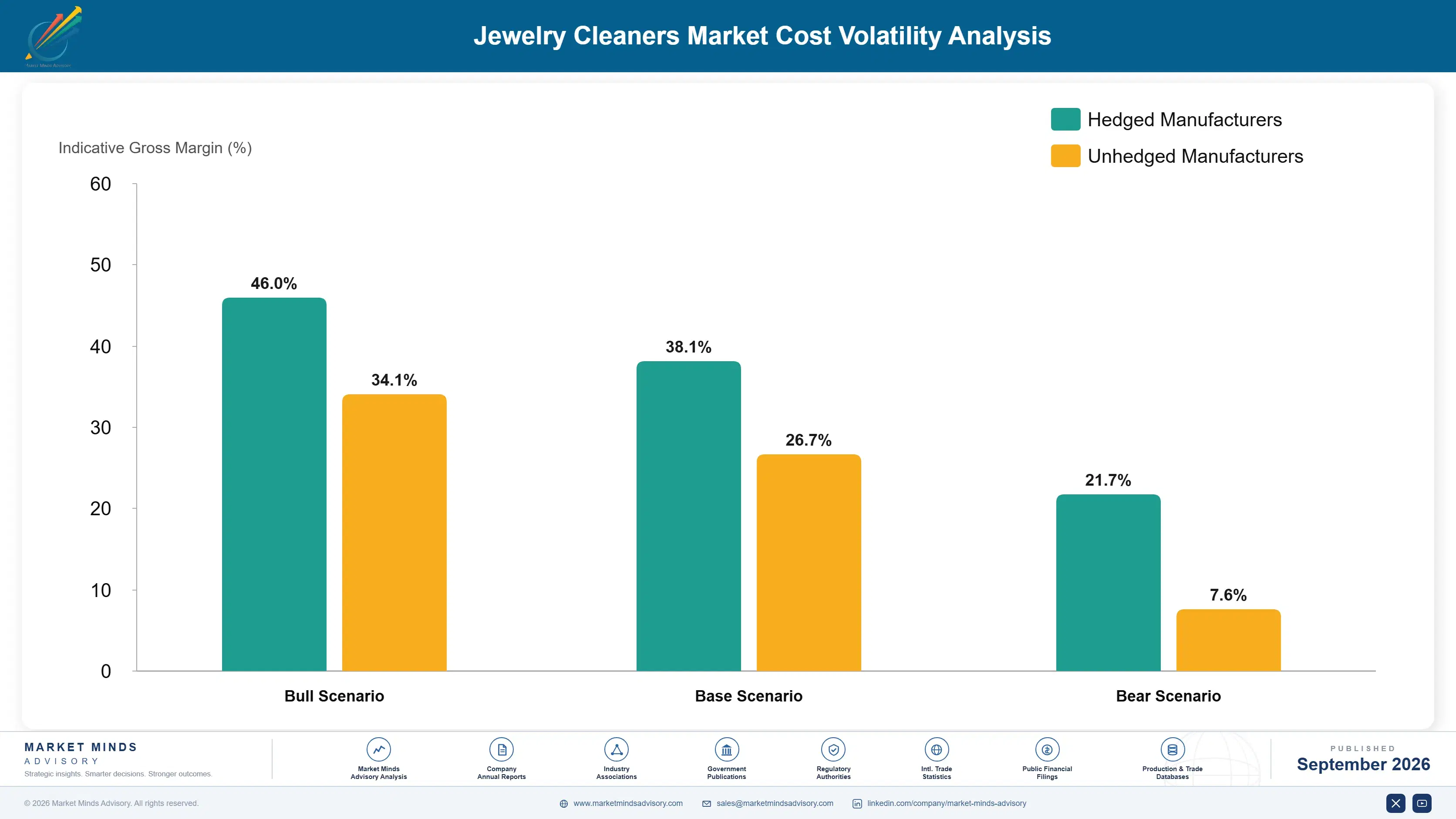
Surfactant and Electronics Cost Exposure

Surfactant and chelating chemical inputs make up the largest cost category for liquid solutions, typically 29% to 33% of cost of goods sold, sourced from global specialty chemical suppliers priced against petrochemical benchmarks. Piezoelectric transducers and electronic components for ultrasonic devices add a meaningful cost share, sourced primarily from Chinese electronics manufacturers. Plastic housings draw on polymer resin pricing tied to petrochemical markets.
Specialty chemical prices rose considerably during 2024 amid supply tightness reported by the EIA's petroleum and other liquids outlook, pushing solution production costs up for manufacturers without hedged long-term chemical supply contracts. Reckitt's annual report cited elevated raw material costs as a factor compressing household and personal care segment margins during the period, forcing several manufacturers to pass part of the increase through to retail pricing later that year.

Smaller manufacturers without scale purchasing agreements face a distinct competitive disadvantage here, since they cannot lock in multi-year chemical and electronics contracts the way larger diversified consumer products conglomerates can through broader purchasing volume. This exposure compounds regionally too, since manufacturers sourcing electronics in Asia face different currency dynamics than those relying on domestic chemical formulation, widening the cost gap between scaled and boutique competitors.
jewelry-cleaners-market-cost-volatility-analysis-1790025349498

Multi-Year Chemical Supply Contracts

Larger manufacturers increasingly lock in multi-year surfactant and chelating chemical supply contracts with fixed or collared pricing, insulating solution production margins from short-term petrochemical price spikes that smaller competitors must absorb directly into retail pricing decisions each cycle. This approach requires meaningful working capital commitment upfront but protects pricing stability across successive product cycles.

Electronics Component Sourcing Diversification

Manufacturers are qualifying secondary electronics component suppliers across Vietnam, India, and Indonesia alongside existing Chinese relationships, reducing the single-region tariff and currency exposure that has hurt device margins across recent years of trade disruption and shipping volatility. This diversification adds supplier qualification cost initially but shortens recovery time considerably following any single-region supply disruption.

Portfolio Architecture for Margin Defence

Gross margin architecture splits sharply by tier, with volume-tier dip solutions and wipes carrying thin margin after mass retail promotion, while premium ultrasonic devices and formulation-specific solutions carry considerably richer economics that manufacturers increasingly prioritize. This gap drives most manufacturer strategy today, since the entry-level solution increasingly functions as a category awareness vehicle rather than a meaningful profit center in itself.
The tension between volume and premium tiers plays out most visibly in retail promotional calendars, where basic solutions get discounted heavily during holiday gift-giving periods specifically to build household awareness that premium device upsell later monetizes. Manufacturers accept compressed entry-tier margin deliberately, treating it as a customer acquisition cost against the higher-margin device and refill revenue that follows over subsequent years.

High-value margin pools concentrate overwhelmingly in ultrasonic devices, proprietary cartridges, and direct-to-consumer subscription channels that bypass retail intermediary fees entirely, capturing a larger share of each dollar spent. Formulation-specific and gemstone-safe positioning remains a smaller but growing pool, as buyers increasingly weight chemical safety claims when choosing between otherwise similar premium cleaning product lines. Retail buyers increasingly stock these lines separately from generic all-purpose cleaning aisles.

Volume / Commodity-Adjacent

Entry-level dip solutions and wipes sold through mass retail channels nationwide and through drugstore chains with minimal formulation differentiation, competing primarily on price rather than gemstone-safety claims or brand heritage.
Gross Margin: 14% to 22%

Premium / Certified

Established brands offering ultrasonic devices, formulation-specific solutions, and recognized brand heritage built over decades that supports higher retail pricing and recurring refill subscription revenue over time and across product generations.
Gross Margin: 36% to 46%

Sustainability / Regulatory / Next-Generation

Biodegradable, non-toxic formulations paired with recyclable device housings and fully recyclable packaging materials, appealing to buyers who weight environmental claims heavily alongside traditional gemstone-safety considerations, chemical transparency, and disposal standards.
Gross Margin: 34% to 44%
jewelry-cleaners-market-portfolio-architecture-1790025350497

High-value Sub-segments and Strategic Watch-out

Ultrasonic Cleaning Machines

The fastest-growing and highest-value segment, driven by professional-quality home cleaning demand among design-conscious households furnishing new jewelry collections for the first time. Manufacturers are racing to expand cartridge variety and simplify device operation to sustain this adoption momentum going forward across markets. Retailers stock these devices near premium jewelry displays.
Gross Margin: MMA Estimate, July 2026.

Steam Cleaning Devices

A high-value category with strong growth among buyers seeking gentler alternatives to ultrasonic vibration for delicate pieces prone to loosening under repeated vibration. Crossover appeal with facial and garment steamers already familiar to many households influences purchase decisions across most regions. Retail merchandising separates steam from ultrasonic options.
Gross Margin: MMA Estimate, July 2026.

Liquid Cleaning Solutions

The volume core of the market, bundled with nearly every first jewelry purchase and generating steady but unremarkable replacement demand as bottles run out or lose effectiveness over time across most household budgets, income levels, and geographic regions worldwide. Retailers rarely promote this segment heavily since margins run thinner.
Gross Margin: MMA Estimate, July 2026.

Private-Label Retail Cleaning Lines

A strategic watch-out as retailers expand house-brand cleaning lines that replicate premium formulations at considerably lower price points nationwide, threatening the differentiation margin branded manufacturers depend on most heavily for sustained growth. Incumbents are exploring exclusive retail partnerships to slow this substitution. Encrypted cartridge verification chips remain an emerging countermeasure.
Gross Margin: MMA Estimate, July 2026.

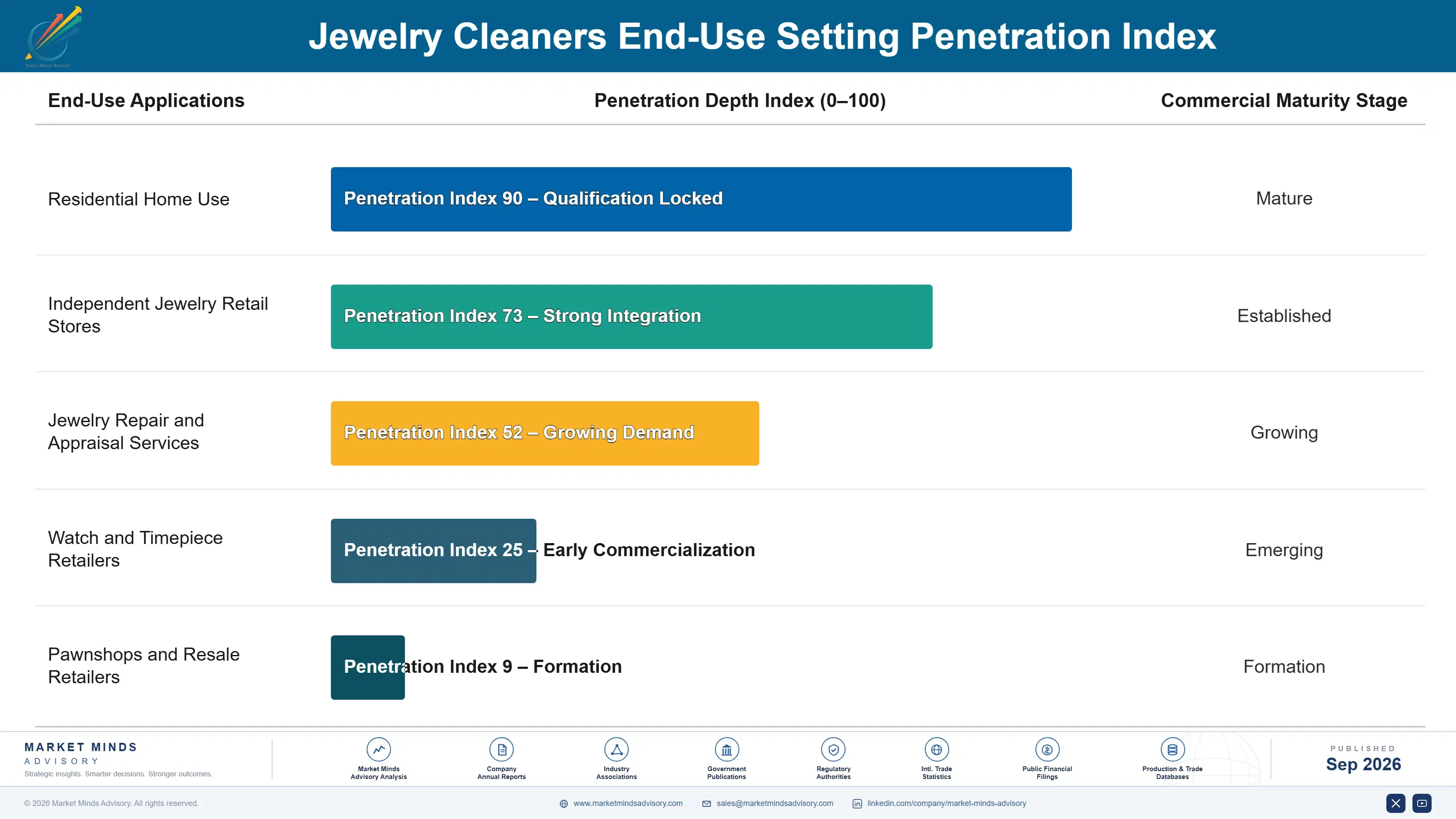
Why Cleaning Habits Stay Once Formed

Jewelry cleaning purchases function as an annuity for manufacturers controlling a proprietary cartridge or formulation, since a household that adopts a specific device statistically continues purchasing that brand's refills for years, generating recurring revenue that considerably exceeds the initial device sale. This pattern makes the device sale the start of a long-term revenue relationship rather than a single transaction.
Adoption stickiness varies meaningfully by end-use vertical. Serious jewelry collectors who invested in an ultrasonic device show the deepest engagement, often purchasing formulation-specific cartridges and maintenance accessories for years after the initial purchase. Casual buyers who bought a basic dip solution mainly for occasional cleaning show shallower engagement, frequently switching brands entirely once a competitor offers a cheaper alternative or a compelling promotional bundle.

Generational buyer shifts are reshaping the category too. Younger buyers discover jewelry care content through short-form video before they even own significant jewelry, often building brand preference around formulation safety and sustainability credentials rather than pure convenience or price. This rewards brands with strong social media content and transparent chemical sourcing over legacy manufacturers relying solely on in-store retail merchandising and price promotion.
jewelry-cleaners-market-end-use-penetration-index-1790025351458

The MMA Strategic Read

These are among the four positions where our research anticipates prominent divergence between winners and laggards over the coming forecast period. Each is grounded in the demand model, the regulatory perimeter, and the announced capacity pipeline.
01 / DEVICE INVESTMENT PRIORITY

Prioritize ultrasonic device engineering over incremental solution reformulation

Manufacturers still investing primarily in solution reformulation are fighting to protect a segment growing meaningfully slower than ultrasonic devices, which increasingly define premium purchase decisions across most developed markets worldwide today and going forward. Ultrasonic devices command considerably higher average selling prices and generate recurring cartridge revenue that liquid solutions rarely capture at comparable scale or consistency over a typical ownership period. Brands that redirect meaningful R&D spend from solution iteration toward device engineering should capture disproportionate premium share over the next decade.
02 / REFILL CHANNEL BUILD

Build direct refill subscription channels before generic cartridges erode margin

Generic compatible cartridges increasingly erode proprietary format volume, particularly among price-sensitive buyers seeking cheaper alternatives to official refills sold through conventional retail channels nationwide and increasingly online through marketplaces too. Brands still relying on retail refill sales without a direct subscription channel are more exposed to this substitution than brands with strong app-based reordering relationships already in place today. The window to build defensible subscription loyalty before generic sellers capture considerably more share is narrowing steadily across most developed markets.
03 / CHEMICAL SOURCING STRATEGY

Diversify surfactant sourcing before the next commodity price spike

Chemical cost exposure hits smaller solution manufacturers considerably harder than scaled incumbents with existing multi-year purchasing agreements already locked in at favorable negotiated rates well ahead of any price spikes each cycle. Waiting for the next spike to begin supplier diversification guarantees margin compression precisely when competitors with hedged contracts gain relative pricing room to invest in formulation defense instead of expansion. Acting now, while sourcing conditions remain relatively stable, costs considerably less than acting reactively once prices move again.
04 / FORMULATION SAFETY POSITIONING

Redirect formulation investment toward gemstone-specific safety credentials

Buyer awareness of gemstone-specific vulnerability is moving faster than many manufacturers have adjusted their formulation and labeling roadmaps, creating meaningful reputational exposure for brands still reliant entirely on generic all-purpose claims sold at considerable scale nationwide and internationally. Brands that redirect formulation investment toward gemstone-specific safety credentials now can capture increasingly sophisticated buyers before competitors close the credibility gap already opening in the market today. Delaying this shift risks ceding an increasingly informed buyer segment entirely to smaller, purpose-built challengers.

Engagement Snapshot From the Field

A live engagement with an industry participant carrying material or product regulatory and market exposure ahead of a defining policy shift, showing how our research translates into a defensible multi-year portfolio strategy.
MARKET MINDS ADVISORY · CLIENT ENGAGEMENT SUMMARY
Jewelry Cleaners Producer Strategic Portfolio Review and Transition Roadmap 2026·Investment Scenario on Jewelry Cleaners Exposure Evaluation 2025-26
CLIENT PROFILE
The client is a mid-tier jewelry care brand with established retail distribution across North America, competing against larger incumbents with dominant liquid solution market share. The company had built solid brand recognition around basic dip solutions but lacked an ultrasonic device product line, limiting its ability to capture the premium revenue that leading competitors monetized effectively across their growing installed customer base.
STRATEGIC CHALLENGE
Leadership needed to decide whether to develop an in-house ultrasonic device platform or license existing engineering, while competitors continued expanding device catalog depth faster than the client could match internally. The board questioned whether device expansion or international market entry would generate stronger near-term returns given comparable capital investment across both paths.
MMA APPROACH
MMA conducted primary research across the client's existing customer base alongside competitor device benchmarking, quantifying premium price willingness and refill subscription attach rates by product category. The engagement combined survey data with expert interviews among jewelry retail buyers to identify which device categories carried the strongest combination of growth and defensible differentiation.
KEY FINDINGS
  1. Buyers who tried a competitor's ultrasonic device reported meaningfully higher satisfaction than those using basic dip solutions or wipes every single day.
  2. Refill subscription attach rates for ultrasonic devices ran considerably higher than for basic solution repurchases across every benchmarked competitor examined (client-reported, unverified by MMA).
  3. Licensing existing device engineering carried a considerably shorter payback period than in-house development given the client's limited internal engineering capacity and expertise.
  4. International market entry showed considerably longer payback periods than domestic device expansion given the client's existing brand recognition and distribution investment already in place.
CLIENT PROFILE
The client is a mid-tier jewelry care brand with established retail distribution across North America, competing against larger incumbents with dominant liquid solution market share. The company had built solid brand recognition around basic dip solutions but lacked an ultrasonic device product line, limiting its ability to capture the premium revenue that leading competitors monetized effectively across their growing installed customer base.
STRATEGIC CHALLENGE
Leadership needed to decide whether to develop an in-house ultrasonic device platform or license existing engineering, while competitors continued expanding device catalog depth faster than the client could match internally. The board questioned whether device expansion or international market entry would generate stronger near-term returns given comparable capital investment across both paths.
MMA APPROACH
MMA conducted primary research across the client's existing customer base alongside competitor device benchmarking, quantifying premium price willingness and refill subscription attach rates by product category. The engagement combined survey data with expert interviews among jewelry retail buyers to identify which device categories carried the strongest combination of growth and defensible differentiation.
KEY FINDINGS
  1. Buyers who tried a competitor's ultrasonic device reported meaningfully higher satisfaction than those using basic dip solutions or wipes every single day.
  2. Refill subscription attach rates for ultrasonic devices ran considerably higher than for basic solution repurchases across every benchmarked competitor examined (client-reported, unverified by MMA).
  3. Licensing existing device engineering carried a considerably shorter payback period than in-house development given the client's limited internal engineering capacity and expertise.
  4. International market entry showed considerably longer payback periods than domestic device expansion given the client's existing brand recognition and distribution investment already in place.
RECOMMENDED STRATEGY
Phase 1: Phase one licensed ultrasonic device engineering from an established provider, targeting launch within ten months to capture near-term customer demand quickly. Phase 2: Phase two built a formal refill subscription program bundled with every new device sold, generating recurring cartridge revenue almost immediately. Phase 3: Phase three expanded formulation-specific cartridge variety once initial device adoption proved its expected return on the earlier licensing investment made.
OUTCOME
Within fourteen months of the device launch, the client reported a 31% increase in average order value and meaningfully improved customer retention scores across its core North American market (client-reported, unverified by MMA). The refill subscription program captured a growing share of recurring cartridge revenue previously ceded entirely to third-party marketplace sellers.

Frequently Asked Questions

Foundational context covering the market sizes, CAGR, scope, country, region and competition that inform every finding below. This section is provided to cover basics and most often pre-purchase conversations, answered from the MMA Primary Research Dataset.

What is the current size of the Jewelry Cleaners Market?

The global jewelry cleaners market reached approximately 0.7 billion dollars in 2025. Growth is driven by rising home ultrasonic device adoption and sustained gold price appreciation among owners.

How large will the Jewelry Cleaners Market be by 2036?

The market is projected to reach approximately 1.38 billion dollars by 2036. This reflects sustained ultrasonic device adoption and steady refill subscription revenue across established regional markets.

What is the CAGR for the Jewelry Cleaners Market 2026 to 2036?

The market is forecast to grow at a 6.4% compound annual growth rate between 2026 and 2036. Ultrasonic cleaning machines are expected to grow considerably faster than this overall average.

Which segment is growing fastest?

Ultrasonic cleaning machines are the fastest-growing segment, expanding at roughly 9.8% annually. That is well above the overall market's projected growth rate through the 2036 forecast horizon.

Who are the major companies in the Jewelry Cleaners Market?

Leading companies in this market include Connoisseurs, Weiman, and iSonic, alongside Speidel and GemOro. These five brands together hold a CR5 near 31% of global shipments.

Which country is growing fastest?

India is the fastest-growing major national market, expanding at approximately 8.3% annually. Deep-rooted gold jewelry culture and rising e-commerce distribution continue driving strong domestic adoption.

Report Segmentation Architecture

The full report scope spans multiple orthogonal segmentation dimensions, with cross-tabulated demand data provided for each dimension pair. Coverage extends further to regional breakdowns, trend trajectories, and the competitive detail needed to support segment-level decision-making.

By Product Form

  • Ultrasonic Cleaning Machines
  • Steam Cleaning Devices
  • Liquid Cleaning Solutions
  • Cleaning Wipes and Cloths
  • Dip and Immersion Cleaning Kits
  • Cleaning Brushes and Tools

By End-Use Setting

  • Residential Home Use
  • Independent Jewelry Retail Stores
  • Jewelry Repair and Appraisal Services
  • Watch and Timepiece Retailers
  • Pawnshops and Resale Retailers

By Commercial Dimension

  • Retail Channel Sales
  • Direct-to-Consumer E-Commerce
  • Refill Subscription Programs
  • Private-Label Retail Sales

By Region

  • North America
  • Western Europe
  • East Asia
  • South Asia and Pacific
  • Latin America
  • Middle East and Africa
  • Eastern Europe

Scope, Methodology, and Coverage

Every figure in this report is reproducible from documented input assumptions. The scope below maps the historical period, the forecast horizon, the segmentation dimensions, and the countries covered, alongside the underlying primary and qualitative methodology.
Historical Period
2020 to 2025
Forecast Period
2026 to 2036
Base Year
2025 (USD billions; MMA Primary Research Dataset, September 2026)
Market Definition
The jewelry cleaners market covers liquid solutions, ultrasonic machines, steam devices, wipes, and immersion kits designed for cleaning gold, silver, and gemstone jewelry at home or in professional settings. It excludes general household cleaning products not formulated specifically for jewelry and jewelry repair or resizing services.
Quantitative Units
USD billions (current prices); unit shipment volume where applicable
Segmentation Dimensions
By Product Form; By End-Use Setting; By Commercial Dimension; By Region
Regions Covered
North America, Western Europe, East Asia, South Asia and Pacific, Latin America, Middle East and Africa, Eastern Europe
Countries Covered
USA, China, Germany, France, UK, Japan, South Korea, India, Australia, Canada, Brazil, Mexico, Indonesia, Vietnam, Thailand, Malaysia, UAE, Saudi Arabia, South Africa, Nigeria, Turkey, Poland, Netherlands, Italy, Spain, Sweden, Switzerland, Argentina, Colombia, Singapore, and additional markets relevant to this sector
Key Companies Profiled
Connoisseurs, Weiman, iSonic, Speidel, GemOro, Sunshine Polishing Cloth Company, Hagerty, Zenith Ultrasonic, CO-Z, Magnasonic, Ultra Wave, Blitz Manufacturing, Simple Shine, Jewel Clean, Bench Master, Pro-Ject Metal Care, Tarn-X (Reckitt), Nevr-Dull (George Basch Co.), 3M Jewelry Care, Rio Grande (Jewelry Supply)
Quantitative Methodology
Primary survey, n=3,800 respondents, Q4 2025, six countries; demand-side model with trade association cross-validation
Qualitative Methodology
47 expert interviews, Q4 2025; applied to validate demand model assumptions, identify emerging dynamics, and assess competitive positioning
Report Format
PDF and XLSX data workbook (Word format preview document)
Publisher
Market Minds Advisory
Report Code
MMA-2026-CHM-119
Published
September 2026
Contact
sales@marketmindsadvisory.com | www.marketmindsadvisory.com

Purchase the full Jewelry Cleaners Market Report (2026 to 2036).

This report delivers a complete quantitative and qualitative assessment of the global jewelry cleaners market through 2036, built on primary survey and expert interview data. It covers segmentation by product form, end-use setting, and commercial dimension, alongside detailed regional analysis across all seven world regions. Competitive profiling covers twenty companies spanning established jewelry care brands and emerging consumer electronics challengers competing for device leadership. The report also includes base, bull, and bear forecast scenarios, input cost exposure analysis, and strategic recommendations for portfolio tier positioning and revenue lever prioritization.
Ten-year market sizing and forecast to 2036
Six-category product form and technology segmentation
Full seven-region demand and growth breakdown
Twenty-company competitive profiling and market positioning
Input cost exposure and mitigation strategy review
Strategic revenue lever and portfolio tier analysis

Built For The People Who Decide

From boardroom strategy to bench-side execution, this report is read cover-to-cover by leaders shaping the next decade of their industry, turning demand scenarios, market dynamics and valuation benchmarks into decisions.
CXOs/ Presidents/ VPs/ Managers
M&A and Corporate Development
Strategy Teams and R&D Heads
Procurement and Product Directors
Regulatory and Compliance Leaders
Investor Relations and Equity Analysts