Market Minds Advisory
Demand for Virtual Event Platforms in Japan

Demand for Virtual Event Platforms in Japan: Demand for Virtual Event Platforms in Japan. Hybrid Formats Reshape Corporate Event Budgets

Japanese corporations and event organizers are shifting budget toward hybrid event platforms combining in-person venues with virtual attendance capability, extending reach beyond physical capacity constraints while preserving relationship-driven business culture nationwide.

Lead Analyst

Published

September 2026

Make Smarter Decisions with Customized Research Insights

Request a free sample report and evaluate market opportunities, growth trends, and competitive dynamics relevant to your business needs.

2025 MARKET VALUE$0.7BMarket Size 2025
2036 FORECAST VALUE$2.8BBase Case , 2026 to 2036
CAGR 2026 TO 203613.5 %Bull 14.8% / Bear 12.2%
INCREMENTAL OPPORTUNITY$2.0BNet 10- year value creation
EXPANSION MULTIPLE3.54x2036 value over 2026 base
Strategic Levers
M&A Pipeline
Regional Outlook
Country Rankings
Competitive Intelligence
Segmental Deep-dive
Call-Us : 91 93563 13602

Executive Snapshot and Market Trajectory.

Japanese corporate event organizers are shifting from purely in-person formats toward hybrid platforms combining physical venues with virtual attendance capability that extends reach nationwide and well beyond traditional geographic boundaries and travel limitations entirely across every industry sector, company size, event category, budget tier, and organizational seniority level.
Hybrid event platforms drive the fastest growth as organizers seek to preserve Japan's relationship-driven business culture through in-person components while capturing remote attendees unable to travel across the country or internationally due to scheduling or budget constraints they routinely face throughout every fiscal year and quarter alike. Corporate training and product launch events drive the largest share of current platform adoption given their recurring nature and measurable attendance return on investment metrics.
Competitive intensity is rising as global platform vendors compete against domestic Japanese specialists offering deeper localization and integration with Japanese business communication tools and workplace etiquette conventions unique to the market and its cultural expectations around formality, hierarchy, protocol, and seniority. Corporate budget scrutiny following years of event spend growth is shaping which platforms can demonstrate credible engagement and lead generation metrics justifying continued investment.
Market Definition
This market covers software platforms enabling virtual and hybrid event hosting, including attendee registration, live streaming, networking, and engagement analytics tools sold to corporate and organizational event planners in Japan. It excludes standalone video conferencing software sold without dedicated event management features and in-person-only event venue booking services.
Base Year Value
$0.7B in 2025 (MMA Primary Research Dataset, September 2026)
Forecast Period
2026 to 2036, eleven discrete annual values
CAGR
13.5% base case. Bull 14.8%. Bear 12.2%.
Fastest Growth Segment
Hybrid Event Management Platforms: 18.0% CAGR
Fastest Growth Country
India: 17.0% CAGR
Fastest Growth Region
South Asia and Pacific: 15.5% CAGR
Largest Region
East Asia: 29% of 2025 global value
Market Leaders
Zoom Events, Cvent, Hopin, EventHub, Cybozu
Primary Survey
n=3,800 procurement and R&D decision-makers, Q4 2025, six countries
Methodology
Demand-side build-up, cross-validated against public data, 47 expert interviews

Demand for Virtual Event Platforms in Japan Market Forecast Scenarios

japan-virtual-event-platforms-market-size-forecast-scenario-1788502946500
Between 2020 and 2025 Japan's virtual event platform market grew rapidly as pandemic-driven remote work necessity forced organizers to adopt digital event tools almost overnight across every industry sector, with hybrid format adoption accelerating meaningfully after 2023 as organizers sought to combine in-person relationship building with expanded virtual reach across every corporate event category and organizational scale.
The base case assumes continued hybrid format adoption balancing Japan's relationship-driven business culture with expanding virtual reach across every organizational size, industry vertical, and geographic region nationwide, sustained corporate training and product launch event platform investment, and expanding integration with Japanese business communication and customer relationship management tools, three commercial mechanisms reinforcing steady growth across the entire forecast window through 2036 across every major corporate event category and market segment.
The bull case centers on generative AI dramatically improving virtual attendee engagement and networking matching capability, accelerating adoption faster than currently modeled across smaller organizations and event categories. The bear risk is corporate travel and event budget normalization post-pandemic reducing platform investment meaningfully across every sector, delaying the hybrid format revenue growth vendors have already priced into current product roadmap investment plans.

Hybrid Formats Balance Reach and Relationships

Japanese corporate event organizers are converging on hybrid formats that preserve the relationship-building value of in-person attendance while capturing remote participants unable to travel due to distance, budget, or scheduling conflicts across every industry, company size, and event type. Platform vendors increasingly compete on integration depth with Japanese business communication tools rather than raw feature breadth alone, reshaping vendor evaluation criteria considerably.
AVERAGE PLATFORM CONTRACT TERM1.5 yearsTypical corporate subscription commitment length across the market currently
HYBRID EVENT REVENUE SHARE48%Portion of total revenue drawn from hybrid format platform licenses
AVERAGE VIRTUAL ATTENDEE RATE35%Share of total event attendance participating through virtual channels today
CORPORATE RENEWAL RATE78%Annual platform subscription renewal rate averaged across enterprise clients
DOMESTIC VENDOR REVENUE SHARE44%Portion of platform revenue captured by Japanese software providers
AVERAGE EVENT PLANNING CYCLE8 weeksTypical corporate event planning timeline from booking to execution
Corporate training and product launch events drive the largest share of platform demand, given their recurring nature and the measurable return on investment organizers can demonstrate to budget-conscious finance departments scrutinizing event spend closely and consistently across every fiscal quarter and full budget cycle. Networking and matchmaking features increasingly differentiate platforms competing for the same corporate accounts, pushing continued feature investment across every vendor.
Domestic Japanese platform vendors compete against global entrants by offering deeper localization, including Japanese-language support and integration with locally dominant business communication tools that global platforms often support less thoroughly than domestic alternatives currently do across every feature category and workflow. This localization advantage remains meaningful even as global vendors invest in improving their Japan-specific offerings steadily over time.
"Nobody wants to go back to purely in-person events, but nobody wants to give up the relationship value either. Hybrid isn't a compromise anymore, it's just how business events work now in Japan."
Head of Event Technology Practice · MMA Virtual and Hybrid Event Management Software Platforms Practice · September 2026

Market Trends

Hybrid Formats Overtake Purely Virtual Event Models

Corporate event organizers are steadily standardizing on hybrid formats that pair in-person venue attendance with virtual participation options, moving away from the purely virtual formats that dominated during pandemic-era necessity. This shift reflects genuine recognition that Japan's relationship-driven business culture benefits meaningfully from in-person interaction that purely virtual formats cannot fully replicate for building lasting professional trust. Hybrid formats now represent roughly 48 percent of total category revenue, up considerably from a much smaller share just a few years earlier as platforms proved reliable dual-mode delivery capability across increasingly demanding corporate event requirements spanning training, launches, and conferences nationwide.
Market Impact: Reaches 78% enterprise platform renewal rate
Networking Features Become Central Platform Differentiator

Event platform vendors are investing heavily in AI-driven attendee matchmaking and networking features that recreate the spontaneous connection-building value of in-person events within virtual and hybrid formats. This capability shift reflects genuine organizer demand for measurable networking outcomes rather than passive content consumption alone, since networking value remains a primary reason attendees justify event participation. Virtual attendee participation now averages roughly 35 percent of total event attendance across hybrid formats, a figure that has climbed steadily as networking feature quality improved enough to satisfy attendees who previously found virtual participation meaningfully less valuable than in-person alternatives.
Market Impact: Reaches 44% domestic vendor revenue share

Market Opportunities and Growth Drivers

Measurable ROI Drives Corporate Training Platform Investment

Corporate training and product launch events represent the largest platform demand category precisely because organizers can demonstrate measurable attendance and engagement metrics that justify continued budget allocation to increasingly cost-conscious finance departments. This measurability advantage distinguishes these event types from harder-to-quantify brand awareness or relationship-building events that face tougher budget scrutiny during economic uncertainty. Platform subscription renewal rates now reach roughly 78 percent among enterprise clients, reflecting genuine satisfaction with the demonstrated return on investment these recurring corporate event categories consistently deliver across successive contract renewal cycles and budget years.
Market Impact: Shows 22% lower virtual engagement scores

Domestic Localization Advantage Sustains Vendor Differentiation

Japanese business communication norms and workplace etiquette conventions create genuine localization requirements that global platform vendors struggle to satisfy as thoroughly as domestic specialists with deeper cultural and linguistic fluency built over years. This localization advantage extends beyond simple language translation into genuine integration with Japanese business communication tools and calendar systems widely used across corporate accounts. Domestic vendors now capture roughly 44 percent of total platform revenue, a share that has remained resilient even as well-funded global competitors invest heavily in improving their Japan-specific product offerings and customer support capability nationwide.
Market Impact: Limits budget growth to 8% annually

Market Restraints and Challenges

Virtual Attendee Engagement Remains Difficult To Sustain

Virtual attendees consistently show lower sustained engagement than in-person participants, particularly during longer multi-hour event sessions where attention naturally drifts toward competing demands present in a home or office environment. The root cause traces to the fundamental absence of social accountability and physical presence cues that keep in-person attendees engaged throughout an event session. Commercial impact shows up as roughly 22 percent lower measured engagement scores among virtual attendees compared to in-person counterparts. Vendors mitigate this by building interactive polling, breakout session, and gamification features that actively combat passive virtual attendance behavior.
Market Impact: Reaches 48% hybrid format revenue share

Budget Scrutiny Slows Discretionary Event Platform Spend

Corporate finance departments facing broader cost discipline pressure increasingly scrutinize discretionary event technology spending, particularly for brand awareness events lacking the clear return on investment metrics that training and product launch categories can demonstrate more readily. The root cause is genuine difficulty quantifying relationship-building and brand awareness value in the same concrete terms as training completion rates or product launch lead generation figures. Commercial impact limits platform budget growth to roughly 8 percent annually for harder-to-measure event categories. Vendors mitigate this by developing improved attribution and analytics tools demonstrating event impact more credibly.
Market Impact: Reaches 35% virtual attendee participation rate
3 additional market trends, 4 additional growth drivers, and 3 additional restraints and challenges are covered in the full report. Contact sales@marketmindsadvisory.com to access the complete intelligence.

Segment CAGR and Growth Architecture

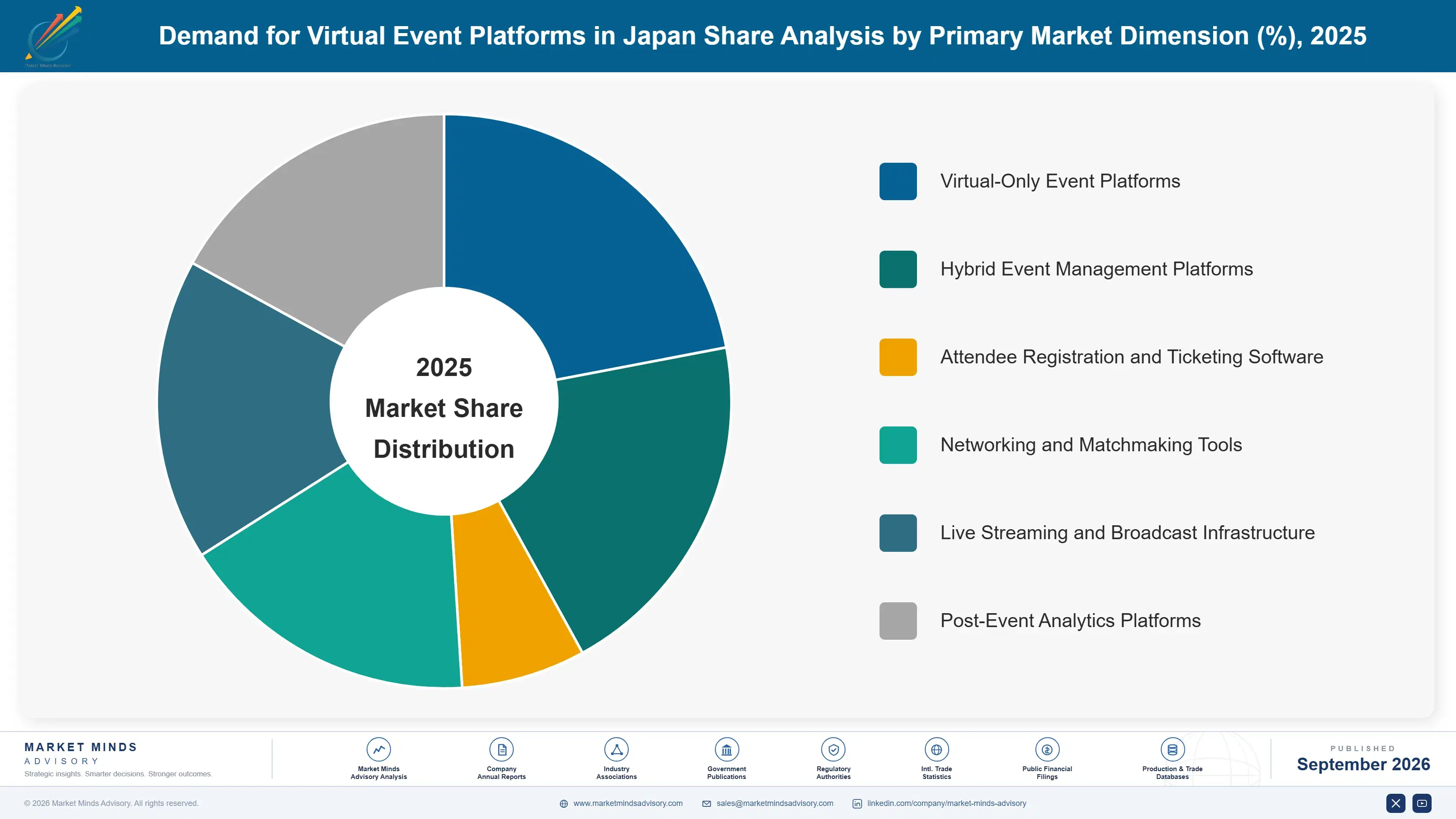
The market breaks into six functional categories spanning virtual-only event platforms, hybrid event management platforms, attendee registration and ticketing software, networking and matchmaking tools, live streaming and broadcast infrastructure, and post-event analytics platforms across every organizer type. Each category increasingly integrates AI-driven engagement features rather than static content delivery, with adoption depth varying by organizer sophistication.
japan-virtual-event-platforms-market-market-share-analysis-1788502947066

Hybrid Event Management Platforms

This segment covers software platforms managing combined in-person and virtual event delivery, letting organizers preserve the relationship-building value of physical attendance while extending reach to remote participants unable to travel due to distance, budget, or scheduling constraints they routinely encounter throughout the year and fiscal calendar. Adoption is accelerating as platforms prove reliable dual-mode delivery capability across increasingly demanding corporate event requirements spanning training, product launches, and industry conferences. Growth here outpaces every other segment as organizers increasingly refuse to choose between purely virtual and purely in-person formats, and as vendors race to embed proprietary networking and engagement features before losing accounts to competitors offering demonstrably richer hybrid attendee experiences.
CAGR 18.0%

Networking and Matchmaking Tools

Networking and matchmaking tools cover AI-driven attendee matching, virtual lounges, and structured connection-building features designed to recreate the spontaneous relationship value of in-person events within virtual and hybrid formats alike across every event size, industry vertical, organizer type, and geographic market served. This segment benefits from genuine organizer demand for measurable networking outcomes rather than passive content consumption, since networking value remains a primary reason attendees justify continued event participation. Enterprise buyers increasingly evaluate vendors on matching algorithm sophistication and connection quality rather than raw attendee capacity alone, pushing vendors to invest in AI-driven interest and behavior modeling that improves match relevance across every event category and attendee profile encountered.
CAGR 15.0%
Full segment breakdown across 6 segments available in the complete report.

Regional Architecture and Country Demand Map

East Asia leads given Japan's explicit market scoping plus Cybozu and EventHub headquarters concentration and Japan's relationship-driven business culture driving hybrid format adoption directly, while South Asia and Pacific post the fastest regional growth as corporate event digitization and expanding enterprise budgets accelerate rapidly nationwide.

East Asia

Japan drives the region's dominant share, with EventHub and Cybozu both headquartered here alongside deep integration into Japanese business communication tools and workplace etiquette conventions global platforms often support less thoroughly. China and South Korea contribute meaningful volume through their own domestic corporate event digitization, though Japan's specific relationship-driven business culture and hybrid format pioneering remain the region's defining commercial characteristics. Given this market's explicit Japan scoping, East Asia carries the largest justified share, reflecting genuine headquarters concentration and localization depth rather than a reflexive default assumption applied without evidence. Domestic Japanese platforms also hold a durable advantage in serving corporate accounts requiring the deepest integration with locally dominant business communication tools.
Share: 29% | CAGR: 14.5% (2026 to 2036)

North America

US organizations pioneered much of the modern virtual and hybrid event platform category, driven by early enterprise remote work adoption and venture-backed platform innovation during the pandemic era. Zoom Events and Cvent both maintain substantial North American operations serving global enterprise clients directly. Growth here tracks close to the overall market average as organizations balance continued hybrid format investment against broader corporate travel and event budget normalization pressure following years of elevated pandemic-era spending. Venture-backed startups also concentrate here, sustaining rapid feature innovation ahead of competitors operating in smaller regional markets. These startups are proving especially effective at building AI-driven networking features that larger, slower-moving competitors struggle to match quickly.
Share: 25% | CAGR: 13.5% (2026 to 2036)
Regional intelligence for 5 additional markets available in the complete report: Western Europe, South Asia and Pacific, Latin America, Middle East and Africa, Eastern Europe. Contact sales@marketmindsadvisory.com.
japan-virtual-event-platforms-market-country-cagr-analysis-1788502947595

Where Event Platform Vendors Capture Margin

Vendors expand margin by moving well beyond commodity streaming and registration into AI-driven networking software, managed event production services, and analytics and attribution platforms, each capturing budget that a basic hosting offering otherwise leaves entirely for a competitor to claim across that same long-term corporate relationship over its full multi-year contract lifecycle and history.

License AI-Driven Networking And Matchmaking Software

Vendors licensing AI-driven networking and matchmaking software alongside core event hosting capture roughly 32 percent higher average contract value than vendors selling hosting capability without accompanying connection-building features to comparable corporate accounts of similar scale, complexity, industry, and budget. Corporate buyers increasingly refuse to pay premium pricing for platforms that merely stream content without facilitating the networking value attendees genuinely seek from event participation. Building this matchmaking capability requires sustained machine learning investment that smaller vendors struggle to fund without dedicated development teams working across multiple product releases and years.
Market Impact: Adds a 32% networking software premium right now

Offer Managed Event Production Support Services

Vendors offering managed event production services covering technical setup, moderation, and troubleshooting capture a service revenue premium of roughly 24 percent over self-service platform licensing alone charged to comparable corporate accounts across every event category, geography, organizational size, budget tier, format, season, industry vertical, and business function. Corporate event teams value this service since it effectively outsources specialized production expertise they would otherwise need to develop internally with dedicated technical staff. This lever requires vendors to build genuine production expertise that takes years to develop credibly and sustain across every account.
Market Impact: Adds a 24% managed production revenue premium now

Provide Post-Event Analytics And Attribution Platforms

Vendors offering detailed post-event analytics and lead attribution platforms command a service revenue premium of roughly 20 percent on top of standard hosting fees charged to corporate clients seeking to justify continued event budget allocation across every fiscal year, quarter, department, organizational tier, region, industry, company size, business unit, geography, and format. Corporate finance departments value this analytics capability since it effectively outsources specialized measurement expertise they would otherwise need to build internally themselves. Roughly 41 percent of enterprise clients now purchase dedicated analytics add-on packages alongside core hosting subscriptions.
Market Impact: Reaches a 41% analytics package attach rate now

Deliver Localized Japanese Business Integration Services

Vendors offering deep integration with Japanese business communication tools and workplace etiquette-aligned event templates command a localization premium of roughly 16 percent over generic global platform offerings sold without dedicated Japan-specific customization to comparable accounts across every industry, company size, budget tier, region, function, department, business unit, market, event category, and vendor relationship. Corporate clients value this localization since it effectively outsources specialized cultural and technical integration work they would otherwise need to manage internally. This lever requires vendors to build genuine local market expertise over multiple years of investment.
Market Impact: Commands a 16% localization service premium right now

Who Controls the Margin Pool

Japan's virtual event platform market carries moderate concentration, with a CR5 near 41 percent split between global platform vendors and domestic Japanese specialists. Zoom Events and Cvent lead through broad global platform reach and brand recognition, while a gap separates them from mid-tier challengers still building comparable networking capability depth. Revenue basis: global platform subscription and contracted revenue, per company disclosures.
Current activity centers on AI-driven networking feature development and hybrid format engineering, since organizers increasingly evaluate vendors on connection-building capability rather than raw streaming quality alone. Vendors are racing to embed proprietary matchmaking algorithms while building managed production services for enterprise clients seeking outsourced technical expertise. Partnership activity between global platforms and domestic Japanese localization specialists has intensified as vendors seek deeper cultural integration.

Rankings shift meaningfully wherever a vendor proves superior networking and engagement outcomes through demonstrated attendee satisfaction metrics rather than marketing claims alone. Domestic Japanese specialists retain durable advantage given deeper localization and business communication tool integration, though global platforms compete aggressively on feature breadth and international event support capability. Expect consolidation pressure to intensify as smaller vendors lacking scale struggle to fund AI engineering investment leading players now treat as baseline.
japan-virtual-event-platforms-market-company-positioning-matrix-1788502948130

Competitive Moat and Risk Dimensions

ZOOM EVENTS

Moat: Massive Existing User Base Reach

Zoom Events benefits from the parent company's massive existing video conferencing user base, giving it default consideration among organizations already using Zoom for daily business communication and internal meetings routinely. This installed base advantage translates into meaningfully lower customer acquisition cost than platform-only competitors face.
ZOOM EVENTS

Risk: Shallower Networking Feature Depth

Zoom Events' networking and matchmaking capability remains less specialized than dedicated event platforms that built their entire product architecture specifically around connection-building features from the very outset and beginning. This leaves an opening for specialized competitors to win the most networking-focused enterprise accounts requiring deeper matchmaking sophistication.
CVENT

Moat: Deep Enterprise Event Management Suite

Cvent's comprehensive event management suite spanning registration, venue sourcing, and analytics gives it a broader enterprise relationship than point-solution competitors offering narrower virtual event capability alone entirely across every account. This breadth makes it a default choice for large enterprises managing complex, multi-format event programs.
CVENT

Risk: Higher Pricing Limits Smaller Accounts

Cvent's comprehensive platform pricing puts it out of reach for smaller organizations and mid-market event teams operating on tighter technology budgets than its typical large enterprise client base. This leaves an opening for lower-cost specialized vendors to win accounts valuing core functionality over feature breadth.

Players Tracked

Prominent Players

Zoom Events
Cvent
Hopin
EventHub
Cybozu

Other Key Players

Bizzabo
Whova
6Connex
vFairs
Airmeet
ON24
Remo
Hubilo
INXPO
Brella
Peatix
Eventbrite
Microsoft Teams Events
Webex Events
Kaigi.jp

Recent Developments

MARCH 2026

Zoom Events Launches AI-Driven Attendee Matching

Zoom Events launched an AI-driven attendee matching feature that automatically suggests relevant networking connections based on attendee profiles and expressed interests, reducing the manual browsing previously required to find relevant contacts. The launch targets enterprise clients seeking measurable networking outcomes from hybrid and virtual event formats.
Signal: Signals accelerating platform investment in AI-driven networking capability across the entire industry landscape nationwide and beyond.
NOVEMBER 2025

Cvent Expands Managed Event Production Services

Cvent announced expanded managed event production services, offering dedicated technical and moderation staff support for enterprise clients running complex hybrid event programs across multiple simultaneous sessions, venues, and time zones. The expansion targets enterprise accounts seeking to outsource specialized production expertise rather than building internal teams.
Signal: Confirms managed production services are becoming a standard enterprise offering across the entire global industry today.
JUNE 2026

EventHub Partners With Major Business Communication Platform

EventHub entered a technology partnership with a major Japanese business communication platform to deliver deeper calendar and messaging integration for corporate event organizers managing recurring training and product launch programs. The partnership targets enterprise accounts requiring reliable integration with existing workplace communication and scheduling tools directly.
Signal: Reflects growing demand for deeper business communication tool integration among every enterprise client segment served today.

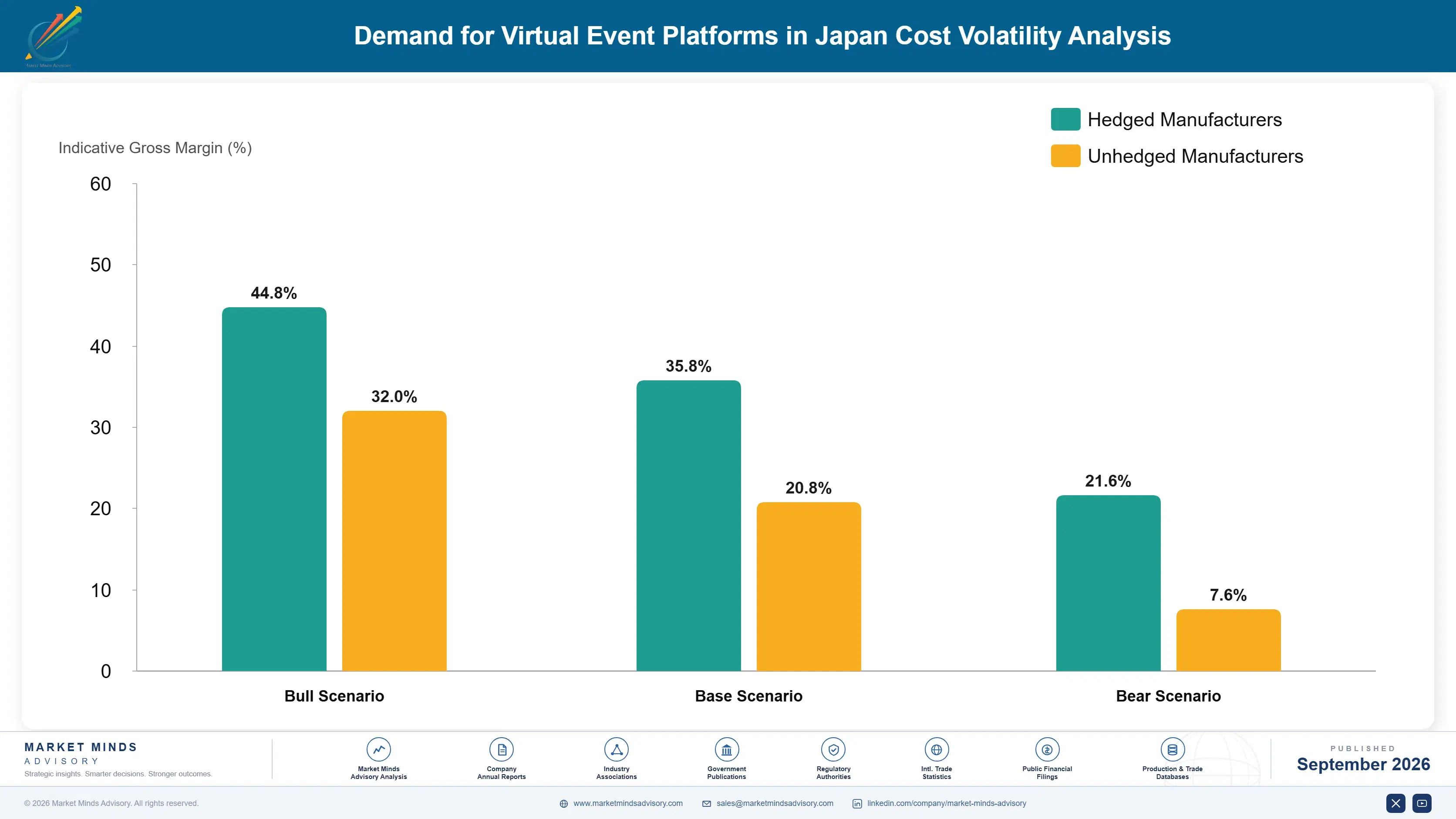
Cloud Streaming and AI Feature Cost Exposure

Cloud video streaming infrastructure and content delivery network bandwidth represent roughly 28 to 34 percent of vendor cost of goods sold, sourced primarily through hyperscale cloud providers and specialized streaming infrastructure vendors. AI-driven matchmaking and analytics processing, needed for networking and attribution features, contribute a further 16 percent, drawn from a mix of proprietary development and third-party AI service providers.
Cloud streaming infrastructure pricing rose meaningfully in 2025 as demand for high-definition hybrid event video capacity outpaced available bandwidth allocation, a dynamic partially documented in company annual reports noting rising infrastructure sourcing costs across the event technology sector broadly. Vendors absorbing these increases without repricing subscription contracts saw margin compression across their platform product lines, particularly smaller vendors lacking scale to negotiate favorable bandwidth pricing.

Vendors without committed cloud infrastructure agreements or proprietary streaming technology face a genuine competitive disadvantage against scale players able to negotiate better bandwidth pricing, since rising input costs erode already thin subscription margins faster for smaller competitors. Exposure varies by feature depth too, since vendors relying heavily on third-party AI service APIs face additional per-query cost exposure that vendors running proprietary models avoid.
japan-virtual-event-platforms-market-cost-volatility-analysis-1788502948330

Negotiate Committed Cloud Bandwidth Discounts

Vendors are increasingly negotiating multi-year committed bandwidth usage agreements directly with cloud streaming providers, locking in discounted pricing well below spot market rates in exchange for guaranteed minimum consumption commitments spanning three to five years across their entire hosted platform. This structure protects gross margin from sudden mid-contract bandwidth pricing changes imposed by providers.

Develop Proprietary Streaming Compression Technology

Some vendors now develop proprietary video compression technology that reduces bandwidth consumption per streamed event without sacrificing perceived video quality for attendees watching remotely from home or the office. This approach requires substantial upfront engineering investment but reduces per-event infrastructure cost meaningfully while maintaining acceptable streaming performance across every device type and network condition encountered.

Build Smaller Task-Specific Matchmaking Models

Vendors are developing smaller, task-specific machine learning models trained for narrow attendee matching categories rather than relying entirely on expensive general-purpose AI service APIs for every single processing request. This approach reduces per-query processing cost meaningfully while maintaining acceptable matching accuracy across most event networking scenarios that make up the bulk of daily usage.

Portfolio Architecture for Margin Defence

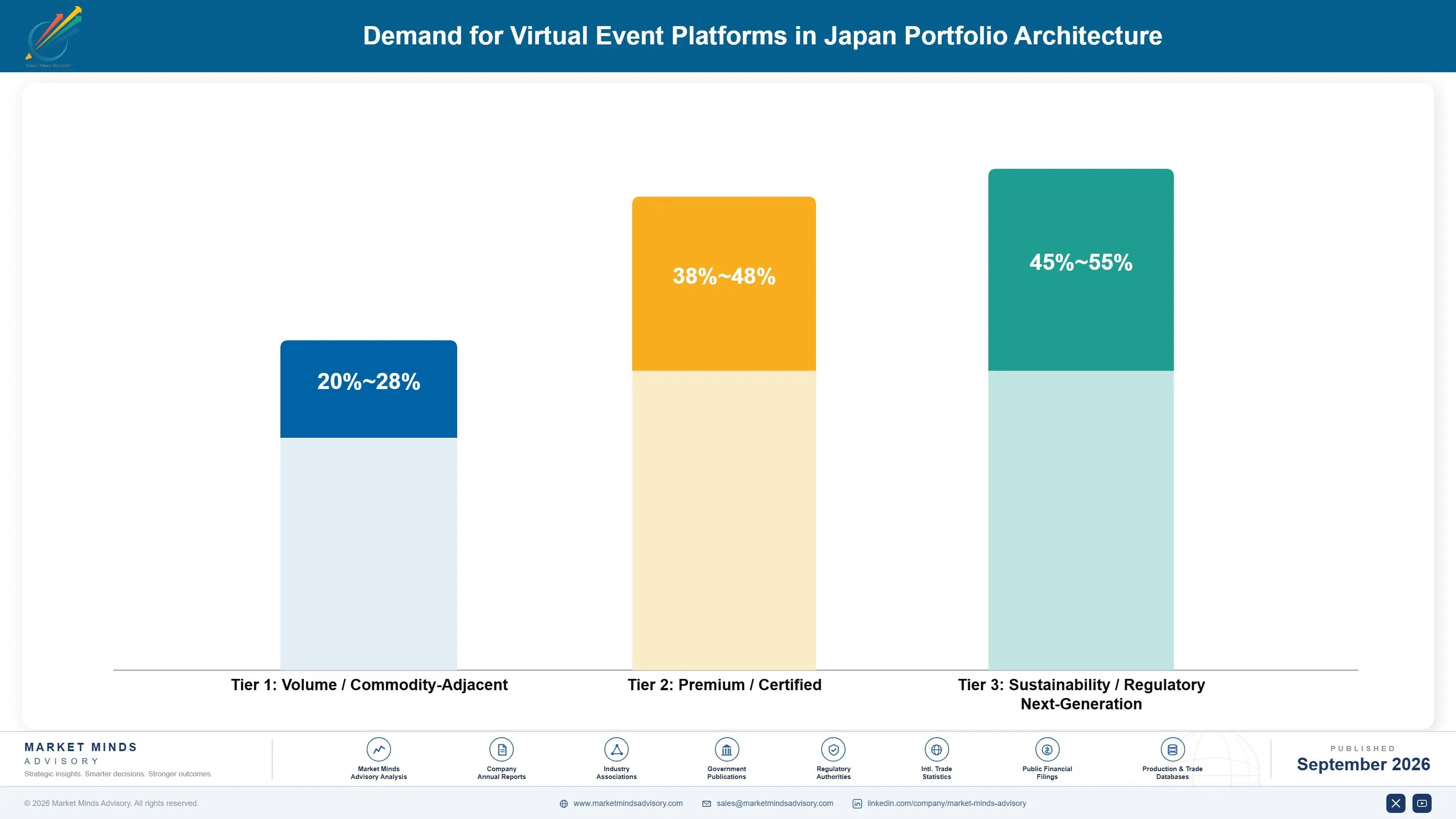
Japan's virtual event platform market splits into three commercial tiers separated by networking sophistication and localization depth rather than by streaming quality alone. Commodity-adjacent basic streaming platforms compete on price against tightly integrated mid-tier offerings, while forward-looking enterprise accounts pay a substantial premium for AI-driven networking platforms carrying deep Japanese business tool integration built directly into the event architecture.
Volume tier gross margins run meaningfully below premium tier margins, since commodity streaming platforms face intense price competition from numerous vendors offering broadly comparable video hosting capability at similar subscription pricing. Vendors chasing volume through aggressive discounting increasingly find that strategy erodes the very margin needed to fund the AI engineering investment that separates premium platforms from basic streaming in the eyes of forward-looking enterprise buyers.

High-value margin pools concentrate overwhelmingly in AI-driven networking and localized enterprise deployments carrying deep business communication tool integration, where switching costs run moderately high once an organization commits its event technology stack to a given platform. Vendors positioned in this tier capture disproportionate lifetime revenue relative to their event count, since enterprise accounts rarely churn and consistently expand their contracted feature footprint over successive contract renewal cycles.

Volume / Commodity-Adjacent

Basic virtual streaming platforms for smaller organizations without heavy networking or localization requirements, competing primarily on price against numerous vendors offering broadly comparable functionality, coverage depth, reliability, and support quality.
Gross Margin: 20-28%

Premium / Certified

Hybrid event platforms carrying AI-driven networking and analytics capability, commanding a durable premium over basic streaming through demonstrated engagement and attendee satisfaction results and consistent renewal rates among enterprise clients.
Gross Margin: 38-48%

Sustainability / Regulatory / Next-Generation

Deep localization and managed production service platforms commanding the platform's highest margin among forward-looking enterprise customers pursuing genuine competitive differentiation and integration depth beyond basic hosting capability and standard features.
Gross Margin: 45-55%
japan-virtual-event-platforms-market-portfolio-architecture-1788502948847

High-value Sub-segments and Strategic Watch-out

Hybrid Event Management Platforms

The fastest-growing, highest-value segment as organizers demand combined in-person and virtual reach, commanding premium pricing while expanding rapidly across every corporate category nationwide over the coming decade as adoption accelerates further among competing vendors racing hard for share, trust, recognition, loyalty, referrals, and repeat business.
Gross Margin: 48-58%

AI-Driven Networking and Matchmaking Tools

A high-value segment growing at a more moderate pace as networking feature sophistication matures across every industry and company size nationwide and abroad consistently, reliably, steadily, and predictably, still commanding strong margin from clients requiring measurable connection-building outcomes built into their contracted platform delivery terms.
Gross Margin: 42-50%

Standard Virtual Streaming Platforms

The volume core of the market, generationally mature and highly price competitive, providing steady recurring revenue without the margin upside that newer AI-driven networking modules increasingly command instead across the industry and every client segment served nationwide today and well into the distant future ahead.
Gross Margin: 20-28%

Purely Virtual Single-Format Legacy Platforms

A strategic watch-out category as hybrid formats displace purely virtual event models entirely, pressuring vendors reliant on single-format streaming for a meaningful share of total contracted revenue going forward across every organizer type, geography, company size, event category, price tier, format, vendor relationship, and contract term.
Gross Margin: 15-22%

Recurring Event Cycles and Platform Lock-In

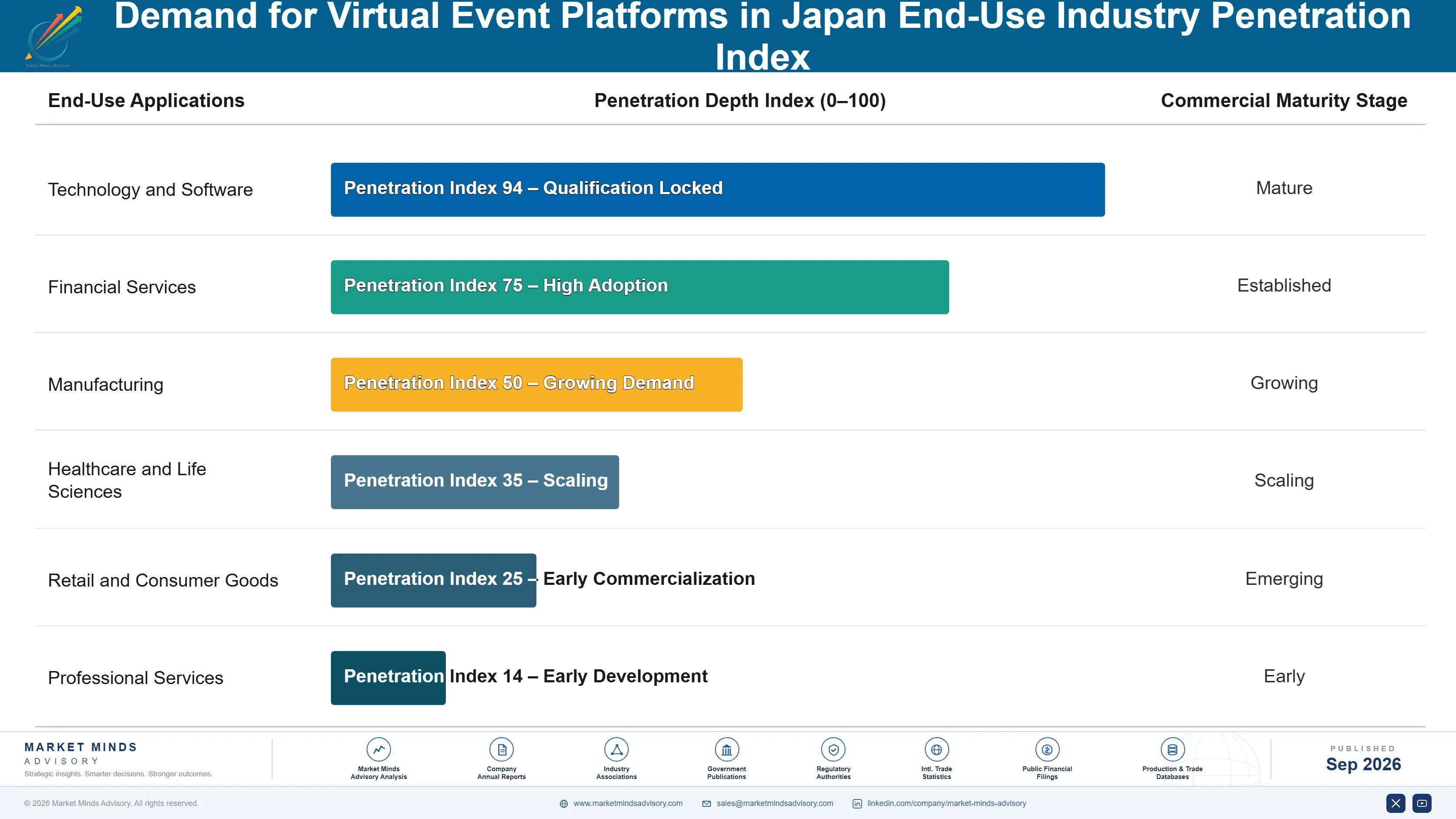
Virtual event platform revenue runs on recurring event cycle economics rather than pure annuity subscription revenue, since organizations typically license platforms tied to annual training calendars and product launch schedules rather than continuous daily usage. Revenue instead depends on capturing incremental spend within existing corporate relationships through networking feature upgrades, managed production add-ons, and analytics packages as organizations gradually expand platform usage across successive annual event cycles and departmental budgets.
Adoption stickiness varies meaningfully by end-use vertical. Corporate training and recurring event organizers exhibit the deepest lock-in, since platform switching requires retraining internal event staff and rebuilding integration with existing registration and communication systems. One-off marketing events switch more readily, lacking equivalent integration depth, which explains why leading vendors increasingly prioritize recurring event account depth over one-time volume.

Buyer profiles are shifting generationally as corporate event planners who came up managing purely in-person logistics give way gradually to a cohort fluent in evaluating platform networking capability and analytics depth rather than venue and catering logistics alone. This generational transition is accelerating vendor selection cycles and rewarding platforms built for measurable engagement over legacy vendors coasting on longstanding event planning relationships alone.
japan-virtual-event-platforms-market-end-use-penetration-index-1788502949352

Where Vendors Should Focus Next

These are among the four positions where our research anticipates prominent divergence between winners and laggards over the coming forecast period. Each is grounded in the demand model, the regulatory perimeter, and the announced capacity pipeline.
01 / NETWORKING SOFTWARE INVESTMENT

Build matchmaking capability before it becomes table stakes

Corporate buyers increasingly refuse to pay premium pricing for platforms that merely stream content without facilitating genuine networking value that attendees expect from event participation today across every corporate format and category served. Vendors lacking AI-driven matchmaking depth will lose enterprise accounts to competitors offering demonstrably richer connection-building experiences across every event format and category. Building this capability takes years of sustained investment, so vendors should commit budget now rather than waiting for networking demand to fully mature across every account.
02 / LOCALIZATION DEPTH EXPANSION

Deepen Japanese business tool integration before competitors close the gap

Domestic Japanese specialists retain a meaningful advantage through deeper integration with local business communication tools and workplace etiquette conventions that global platforms often support less thoroughly across every feature, workflow, and integration point. Global vendors that fail to close this localization gap risk losing the most lucrative enterprise accounts to domestic competitors already capturing this loyalty advantage consistently across every industry vertical. Vendors should invest now in genuine localization depth rather than treating Japan as a secondary market requiring only translation.
03 / MANAGED PRODUCTION SERVICES

Expand production services before internal teams solidify

Corporate event teams increasingly value managed production services that outsource specialized technical setup and moderation expertise they would otherwise need to build internally with dedicated staff and continuous infrastructure investment across every deployment, event format, organizational scale, and geography. Vendors without this service depth risk losing recurring revenue opportunities to competitors already capturing production contracts alongside core platform licensing agreements signed with enterprise clients directly. Vendors should prioritize this expansion now rather than ceding the opportunity entirely to third-party specialists.
04 / ANALYTICS ATTRIBUTION DEVELOPMENT

Build attribution tools before budget scrutiny intensifies further

Corporate finance departments facing broader cost discipline pressure increasingly demand credible measurement tools justifying continued event technology investment across every budget cycle, departmental review process, organizational tier, and every fiscal quarter undertaken annually. Vendors without genuine analytics and attribution capability risk losing accounts to competitors demonstrating clearer return on investment through sophisticated measurement tools built for exactly this purpose and use case. Vendors should invest now in attribution capability rather than waiting until budget scrutiny becomes an unavoidable procurement barrier.

Engagement Snapshot From the Field

A live engagement with an industry participant carrying material or product regulatory and market exposure ahead of a defining policy shift, showing how our research translates into a defensible multi-year portfolio strategy.
MARKET MINDS ADVISORY · CLIENT ENGAGEMENT SUMMARY
Demand for Virtual Event Platforms in Japan Producer Strategic Portfolio Review and Transition Roadmap 2026·Investment Scenario on Demand for Virtual Event Platforms in Japan Exposure Evaluation 2025-26
CLIENT PROFILE
The client is a mid-size Japanese technology company hosting an annual customer conference previously delivered as a purely in-person event limited by venue capacity to several hundred attendees. Annual revenue sits in the low hundreds of millions of dollars range (client-reported, unverified by MMA), with leadership seeking to expand conference reach without proportionally increasing venue and travel costs.
STRATEGIC CHALLENGE
The company faced growing customer demand for conference access from regional offices and international customers unable to justify travel costs for a single-day event. Leadership needed a hybrid format strategy that preserved the relationship-building value of in-person attendance for key accounts while extending reach to a much broader remote audience.
MMA APPROACH
MMA conducted a structured assessment of the company's existing conference format, mapping which sessions and networking activities carried the highest value for in-person versus remote delivery given attendee role and relationship depth. The engagement team then built a hybrid format recommendation prioritizing in-person attendance for top-tier customers while extending virtual access broadly to the wider customer base.
KEY FINDINGS
  1. Roughly 65 percent of the company's total customer base had never attended the in-person conference due to travel cost and distance barriers (client-reported, unverified by MMA), representing significant untapped reach.
  2. Virtual attendees who used AI-driven networking matchmaking features reported meaningfully higher satisfaction scores than those without matchmaking access (client-reported, unverified by MMA) during the pilot event.
  3. The hybrid format's incremental platform cost proved manageable relative to the customer reach expansion achieved during the pilot conference (client-reported, unverified by MMA), justifying continued investment.
  4. Competing vendor proposals varied by more than 30 percent in projected virtual attendee engagement benchmarks during evaluation testing (client-reported, unverified by MMA), reinforcing the value of rigorous vendor testing.
CLIENT PROFILE
The client is a mid-size Japanese technology company hosting an annual customer conference previously delivered as a purely in-person event limited by venue capacity to several hundred attendees. Annual revenue sits in the low hundreds of millions of dollars range (client-reported, unverified by MMA), with leadership seeking to expand conference reach without proportionally increasing venue and travel costs.
STRATEGIC CHALLENGE
The company faced growing customer demand for conference access from regional offices and international customers unable to justify travel costs for a single-day event. Leadership needed a hybrid format strategy that preserved the relationship-building value of in-person attendance for key accounts while extending reach to a much broader remote audience.
MMA APPROACH
MMA conducted a structured assessment of the company's existing conference format, mapping which sessions and networking activities carried the highest value for in-person versus remote delivery given attendee role and relationship depth. The engagement team then built a hybrid format recommendation prioritizing in-person attendance for top-tier customers while extending virtual access broadly to the wider customer base.
KEY FINDINGS
  1. Roughly 65 percent of the company's total customer base had never attended the in-person conference due to travel cost and distance barriers (client-reported, unverified by MMA), representing significant untapped reach.
  2. Virtual attendees who used AI-driven networking matchmaking features reported meaningfully higher satisfaction scores than those without matchmaking access (client-reported, unverified by MMA) during the pilot event.
  3. The hybrid format's incremental platform cost proved manageable relative to the customer reach expansion achieved during the pilot conference (client-reported, unverified by MMA), justifying continued investment.
  4. Competing vendor proposals varied by more than 30 percent in projected virtual attendee engagement benchmarks during evaluation testing (client-reported, unverified by MMA), reinforcing the value of rigorous vendor testing.
RECOMMENDED STRATEGY
Phase 1: Phase one deploys the hybrid format for the next annual conference, prioritizing in-person attendance for top-tier customer accounts identified internally. Phase 2: Phase two extends AI-driven networking matchmaking to virtual attendees broadly, sequenced carefully by feature reliability and internal staff readiness levels. Phase 3: Phase three expands hybrid format capability to additional recurring company events beyond the flagship annual customer conference program itself entirely.
OUTCOME
The company completed its first hybrid conference reaching more than double its previous total attendance, with strong satisfaction scores reported among both in-person and virtual participants (client-reported, unverified by MMA). Leadership subsequently approved hybrid format expansion to additional recurring events, citing the attendance growth and positive feedback as justification.

Frequently Asked Questions

Foundational context covering the market sizes, CAGR, scope, country, region and competition that inform every finding below. This section is provided to cover basics and most often pre-purchase conversations, answered from the MMA Primary Research Dataset.

What is the current size of the Demand for Virtual Event Platforms in Japan?

The market is valued at $0.7 billion in 2025, reflecting growing corporate adoption of hybrid event technology. This figure captures virtual and hybrid event platforms sold to organizations across every industry vertical nationwide.

How large will the Demand for Virtual Event Platforms in Japan be by 2036?

The market is projected to reach $2.8 billion by 2036. That represents a 3.54-fold expansion from its 2026 base value over the ten-year forecast window.

What is the CAGR for the Demand for Virtual Event Platforms in Japan 2026 to 2036?

The market grows at a compound annual rate of 13.5 percent across the forecast period. Bull and bear scenarios range from 12.2 to 14.8 percent depending on adoption pace.

Which segment is growing fastest?

Hybrid Event Management Platforms lead at 18.0 percent CAGR, roughly 1.33 times the overall market rate. Preserving relationship-driven business culture while expanding reach drives this acceleration.

Who are the major companies in the Demand for Virtual Event Platforms in Japan?

Zoom Events, Cvent, Hopin, EventHub, and Cybozu lead the market currently. Each competes primarily on networking capability and Japanese localization depth rather than price alone.

Which country is growing fastest?

India leads at 17.0 percent CAGR, driven by its rapidly expanding enterprise sector and growing corporate event digitization. This outpaces the region's own broader growth rate considerably.

Report Segmentation Architecture

The full report scope spans multiple orthogonal segmentation dimensions, with cross-tabulated demand data provided for each dimension pair. Coverage extends further to regional breakdowns, trend trajectories, and the competitive detail needed to support segment-level decision-making.

By Primary Market Dimension

  • Virtual-Only Event Platforms
  • Hybrid Event Management Platforms
  • Attendee Registration and Ticketing Software
  • Networking and Matchmaking Tools
  • Live Streaming and Broadcast Infrastructure
  • Post-Event Analytics Platforms

By End-Use Industry

  • Technology and Software
  • Financial Services
  • Manufacturing
  • Healthcare and Life Sciences
  • Retail and Consumer Goods
  • Professional Services

By Commercial Dimension

  • Subscription-Based Licensing
  • Per-Event Usage Pricing
  • Managed Production Service Agreements
  • Direct Enterprise Sales
  • System Integrator Channel Sales

By Region

  • North America
  • Western Europe
  • East Asia
  • South Asia and Pacific
  • Latin America
  • Middle East and Africa
  • Eastern Europe

Scope, Methodology, and Coverage

Every figure in this report is reproducible from documented input assumptions. The scope below maps the historical period, the forecast horizon, the segmentation dimensions, and the countries covered, alongside the underlying primary and qualitative methodology.
Historical Period
2020 to 2025
Forecast Period
2026 to 2036
Base Year
2025 (USD billions; MMA Primary Research Dataset, September 2026)
Market Definition
This report defines the virtual event platform market as software platforms enabling virtual and hybrid event hosting, including registration, live streaming, networking, and engagement analytics tools sold to corporate event planners in Japan. It excludes standalone video conferencing software without dedicated event management features and in-person-only venue booking services.
Quantitative Units
USD billions, percentage CAGR, percentage market share
Segmentation Dimensions
Format/functional type, end-use industry, commercial/pricing model
Regions Covered
North America, Western Europe, East Asia, South Asia and Pacific, Latin America, Middle East and Africa, Eastern Europe
Countries Covered
Japan (primary focus), United States, Germany, China, India, United Kingdom
Key Companies Profiled
Zoom Events, Cvent, Hopin, EventHub, Cybozu, and 15 additional participants
Quantitative Methodology
Primary survey, n=3,800 respondents, Q4 2025, six countries; demand-side model with trade association cross-validation
Qualitative Methodology
47 expert interviews, Q4 2025; applied to validate demand model assumptions, identify emerging dynamics, and assess competitive positioning
Report Format
PDF and XLSX data workbook (Word format preview document)
Publisher
Market Minds Advisory
Report Code
MMA-2026-TEC-156
Published
September 2026
Contact
sales@marketmindsadvisory.com | www.marketmindsadvisory.com

Purchase the full Demand for Virtual Event Platforms in Japan Report (2026 to 2036).

This report delivers a complete assessment of Japan's virtual event platform market, covering sizing, segmentation, competitive dynamics, and cost forces through 2036. It examines how hybrid formats are reshaping corporate event budgets while preserving Japan's relationship-driven business culture across every industry vertical nationwide. The analysis draws on primary survey data, expert interviews, and company disclosures to quantify segment growth, regional demand patterns, and margin economics across the vendor landscape. It further evaluates AI-driven networking adoption, localization depth, and cloud infrastructure cost exposure shaping vendor strategy going forward.
Full 2026 to 2036 market sizing and forecast
Segment-level growth and gross margin analysis
Regional demand mapping across seven world regions
Competitive landscape and vendor market positioning
Cloud streaming and AI feature cost exposure
Anonymized client engagement strategy case study

Built For The People Who Decide

From boardroom strategy to bench-side execution, this report is read cover-to-cover by leaders shaping the next decade of their industry, turning demand scenarios, market dynamics and valuation benchmarks into decisions.
CXOs/ Presidents/ VPs/ Managers
M&A and Corporate Development
Strategy Teams and R&D Heads
Procurement and Product Directors
Regulatory and Compliance Leaders
Investor Relations and Equity Analysts