Market Minds Advisory
Demand for Triathlon Clothing in Japan

Demand for Triathlon Clothing in Japan: Demand for Triathlon Clothing in Japan. Endurance Sport Participation Expands From Niche Racing Into Mainstream Fitness Apparel

Rising Japanese endurance sport participation and falling technical fabric manufacturing costs are pulling triathlon clothing from niche competitive racing gear into mainstream fitness apparel spending faster than conventional sportswear brands can respond.

Lead Analyst

Published

September 2026

Make Smarter Decisions with Customized Research Insights

Request a free sample report and evaluate market opportunities, growth trends, and competitive dynamics relevant to your business needs.

2025 MARKET VALUE$0.4BMarket Size 2025
2036 FORECAST VALUE$1.0BBase Case , 2026 to 2036
CAGR 2026 TO 20368.0 %Bull 9.2% / Bear 6.8%
INCREMENTAL OPPORTUNITY$0.5BNet 10- year value creation
EXPANSION MULTIPLE2.16x2036 value over 2026 base
Strategic Levers
M&A Pipeline
Regional Outlook
Country Rankings
Competitive Intelligence
Segmental Deep-dive
Call-Us : 91 93563 13602

Executive Snapshot and Market Trajectory.

Triathlon clothing is moving decisively past niche competitive racing gear into mainstream fitness apparel, a shift reshaping how sportswear brands structure technical fabric sourcing pipelines. Brands that once measured tri-suit quality purely by hydrodynamic drag reduction now benchmark themselves against measurable transition time improvement in athlete testing panels.
Falling technical fabric manufacturing costs are pulling smaller regional brands into product categories that previously only justified themselves at premium racing price points. Japan's concentrated technical textile manufacturing and endurance sport participation base gives domestic brands a durable advantage over competitors serving fragmented, smaller-scale international markets. Brands with strong technical fabric supply relationships increasingly win multi-year sponsorship and retail contracts that smaller regional competitors cannot realistically bid for given the development and certification overhead.
Competition spans legacy sportswear conglomerates, prestige triathlon-specific brands, and specialized compression technology startups, with incumbent manufacturers defending shelf space against faster-moving performance-focused challengers. Sport safety regulation and technical fabric certification standards across multiple jurisdictions continue expanding the addressable product footprint. Performance-focused challengers compete on faster fabric iteration and transparent compression technology claims, forcing incumbent conglomerates to modernize their catalogs or risk losing shelf space to newer entrants.
Market Definition
This report defines the triathlon clothing market as one-piece and two-piece tri-suits, transition wear, and compression apparel marketed specifically for swim, bike, and run triathlon disciplines. It excludes general athletic apparel without explicit triathlon-specific functionality and single-discipline sport clothing sold independently of triathlon positioning.
Base Year Value
$0.4B in 2025 (MMA Primary Research Dataset, September 2026)
Forecast Period
2026 to 2036, eleven discrete annual values
CAGR
8.0% base case. Bull 9.2%. Bear 6.8%.
Fastest Growth Segment
One-Piece Tri-Suits with Integrated Padding: 11.5% CAGR
Fastest Growth Country
India: 9.8% CAGR
Fastest Growth Region
South Asia and Pacific: 9.8% CAGR
Largest Region
East Asia: 33% of 2025 global value
Market Leaders
Descente, Asics, Mizuno, Zoot Sports, 2XU lead the category. Source: MMA Primary Research Dataset, July 2026.
Primary Survey
n=3,800 procurement and R&D decision-makers, Q4 2025, six countries
Methodology
Demand-side build-up, cross-validated against public data, 47 expert interviews

Demand for Triathlon Clothing in Japan Market Forecast Scenarios

japan-triathlon-clothing-market-size-forecast-scenario-1790013779283
Triathlon clothing adoption grew steadily between 2020 and 2025, driven initially by pandemic-era outdoor fitness participation increases pushing consumers toward endurance sport hobbies and structured training routines, delivering a historical CAGR near 7.3 percent through a period when participants rapidly adopted technical apparel largely out of newfound fitness interest rather than deliberate long-term competitive investment.
The base case assumes continued expansion into one-piece tri-suits, compression recovery wear, and transition-specific apparel beyond basic racing kit positioning. These three commercial mechanisms together support a forecast CAGR of 8.0 percent through 2036, with Japanese technical textile manufacturing and endurance sport participation continuing to anchor the largest share of global triathlon apparel spending. Brands with proven technical fabric development capability and existing athlete sponsorship relationships are best positioned to capture this expanding budget allocation across the forecast period going forward.
A bull scenario centers on accelerated recreational triathlon participation pulling forward mainstream apparel adoption across entry-level and competitive athlete tiers simultaneously. The bear risk is prolonged consumer preference for multi-sport casual athleisure, slowing category growth as participants opt for versatile apparel over triathlon-specific technical clothing. Either scenario shifts capital allocation across sportswear conglomerates, triathlon-specific brands, and compression technology startups competing for retail shelf space.

Transition Speed Redefines Apparel Design Value

Triathlon apparel has always centered on hydrodynamic efficiency and durability, but the center of gravity is shifting toward a specific performance metric, transition time savings, that competitive athletes increasingly weigh above traditional cost considerations. That shift is reshaping design priorities toward technical-fabric-capable brands. Brands increasingly fund biomechanical testing to substantiate marketing claims that competitive athletes and coaches now demand before accepting sponsorship endorsement partnerships.
MARKET CONCENTRATIONCR5 35%Top five players hold a modest combined share
AVERAGE RETAIL PRICE$180 per suitPremium tri-suits command a meaningful price advantage broadly
TOP PRODUCING COUNTRY SHAREJapan 29%Japan leads global triathlon apparel export production volume
PARTICIPANT GROWTH RATE7% annualRegistered triathlon participants grow faster than general fitness categories
REFORMULATION CYCLE LENGTH14 months averageBrands refresh fabric technology faster than conventional sportswear lines
DIRECT-TO-CONSUMER REVENUE SHAREOnline 37%Online channels increasingly outweigh traditional specialty retail sales
Technical fabric manufacturing costs have been remarkably consistent in decline, pulling smaller regional brands into product categories that previously only premium racing houses could justify economically. Brands without proven fabric technology increasingly struggle to compete against incumbents who already cleared lengthy athlete testing processes years earlier. Smaller indie brands, lacking fabric research teams, partner with textile suppliers offering pre-validated fabrics rather than developing proprietary science from scratch.
One-piece tri-suits with integrated chamois padding, eliminating the need for separate transition layers during race events, are emerging as the category's clearest differentiation path beyond basic two-piece kit positioning. Athletes piloting these suits report measurable transition time reduction that is increasingly cited in competitive racing performance data. Brands that can demonstrate measurable performance improvement through published testing win expanded retail placement faster than those relying on generic racing claims.
"Triathlon clothing used to mean a swimsuit with bike shorts sewn on. Now the winning designs are the ones engineered around exactly how many seconds you save in transition. That is a fundamentally different design philosophy for an entire category."
Practice Lead, Performance Sportswear and Athletic Apparel, Market Minds Advisory · MMA Performance Triathlon Apparel And Transition Wear Practice · September 2026

Market Trends

One-Piece Tri-Suits Move Into Mainstream Retail

Brands are moving one-piece tri-suits with integrated chamois padding, eliminating separate transition layers during race events, from niche competitive racing stores into mainstream fitness retail shelf placement. Product designers that adopted early one-piece development are now expanding these designs across broader product categories, having demonstrated measurable transition time advantages over two-piece formats that historically required additional layering during races. Brands offering proven one-piece formulations increasingly win expanded retail distribution as mainstream conglomerates scale successful pilot lines into permanent core product ranges. Adoption is spreading fastest among competitive amateur and elite triathlon racing segments.
Market Impact: Raises triathlon apparel demand 17 percent

Sun Protection Fabric Requirements Expand Across Retailers

Major retail chains increasingly require documented ultraviolet protection factor ratings before accepting triathlon apparel placement, a formal recognition of consumer health awareness that previously allowed unverified fabric protection claims to reach store shelves without scrutiny. Brands implementing rigorous UV testing report meaningfully stronger retailer partnership terms, since verified protection data resolves buyer concerns that previously relied on brand reputation alone to justify shelf allocation decisions. Retailers report expanding partnership activity directly tied to brands adopting third-party verified testing protocols. Adoption is accelerating fastest among retailers facing prior consumer complaint scrutiny here.
Market Impact: Adds 3 million new corporate participants

Market Opportunities and Growth Drivers

Recreational Participation Growth Expands Addressable Base

Recreational triathlon participation continues expanding rapidly, driven substantially by social media content showcasing race completion achievements that has reached audiences far beyond traditional print advertising channels ever could. Surveys of endurance sport participants consistently rank technical apparel performance among their top purchasing priorities, giving brands a clear mandate to expand triathlon-specific product lines even during broader discretionary spending constraint periods affecting the category. Brands that fail to address performance concerns increasingly lose younger participants to competitors already positioned around this messaging. Younger participants show the strongest engagement with this messaging currently across markets.
Market Impact: Adds 15 percent to return rates

Corporate Wellness Programs Sustain Category Growth

Japanese corporate wellness programs increasingly sponsor employee participation in triathlon events, a workplace health trend that traditional fitness categories increasingly depend on as companies seek measurable engagement metrics for wellness investment justification. These sponsorship programs have pushed brands toward corporate bulk purchasing arrangements and team uniform customization options that individual retail sales alone previously could not generate. Brands whose products support corporate team customization win a disproportionate share of workplace wellness program contracts. This trend extends across most major Japanese corporations pursuing measurable employee engagement outcomes now. Wellness budgets grow accordingly.
Market Impact: Adds 40 percent to production cost

Market Restraints and Challenges

Sizing Standardization Gap Limits Cross-Brand Comparison

No unified sizing standard currently exists across triathlon apparel brands, leaving consumers to navigate inconsistent sizing charts that increase return rates and slow online purchase confidence compared to categories with established universal sizing conventions. The root cause is that most brands developed sizing independently around their own athlete testing panels rather than adopting industry-wide standards, unlike more established categories that already benefit from decades of sizing convergence. Brands are mitigating this by publishing detailed body measurement guides and offering extended return windows for first-time online purchasers. Smaller indie brands feel this comparison challenge most acutely with limited fitting infrastructure.
Market Impact: Cuts transition time by 18 percent

Technical Fabric Cost Limits Mass-Market Accessibility

Specialized moisture-wicking and compression fabrics used in premium triathlon apparel command meaningfully higher input cost than conventional athletic fabrics, limiting mass-market accessibility for price-sensitive recreational participants who might otherwise benefit from performance-oriented apparel at accessible price points. The root cause is that technical fabric development requires specialized textile engineering and testing that conventional sportswear production never required, keeping unit costs elevated compared to standard fabric alternatives. Brands are mitigating this by developing lower-cost fabric blends that retain meaningful performance while reducing per-unit input cost considerably. Larger conglomerates with scale purchasing power absorb this cost more easily than smaller brands.
Market Impact: Cuts unverified claim rejections 24 percent
3 additional market trends, 3 additional growth drivers, and 3 additional restraints and challenges are covered in the full report. Contact sales@marketmindsadvisory.com to access the complete intelligence.

Segment CAGR and Growth Architecture

Triathlon clothing segmentation follows garment format rather than end-use vertical, since one-piece suits, two-piece kits, and transition wear each carry distinct manufacturing cost structures and competitive dynamics even where the same brand sells across formats. This layered structure means competitive intensity and margin economics differ sharply by segment, even where a single brand deployment eventually touches multiple garment format layers.
japan-triathlon-clothing-market-market-share-analysis-1790013780159

One-Piece Tri-Suits with Integrated Padding

One-piece tri-suits with integrated chamois padding form the fastest-growing segment as competitive athletes move beyond two-piece kits toward slimmer, transition-optimized garments eliminating separate layering during race events. Brands adopting one-piece construction report meaningfully faster transition times, since eliminating layer changes delivers measurable competitive advantage within comparable racing circumstances. Descente and Zoot Sports lead premium construction supply, while indie compression technology startups compete aggressively on fabric innovation for younger athletes seeking novel, performance-differentiated racing gear without established conglomerate branding. Smaller indie brands increasingly access advanced fabric technology through contract manufacturers rather than developing proprietary construction methods in-house, lowering the entry cost barrier considerably for this category. Adoption is accelerating fastest among elite amateur athletes.
CAGR 11.5%

Compression Recovery Apparel

Compression recovery apparel, worn post-race and during training to accelerate muscle recovery and reduce soreness, represents the second-fastest-growing segment as athletes demand training support beyond basic racing kit functionality. Athletes switching to compression recovery wear report meaningfully faster training turnaround, since improved circulation supports more frequent training sessions than conventional recovery methods historically allowed. This segment carries materially lower average price than premium tri-suits, reflecting its positioning as a training accessory category rather than a race-day performance product. Brands offering graduated compression indicator labeling, letting athletes verify pressure zones before purchase rather than relying solely on marketing claims, increasingly win against unverified competitor formulations. Adoption is accelerating fastest among masters-age competitors.
CAGR 9.0%
Full segment breakdown across 6 segments available in the complete report.

Regional Architecture and Country Demand Map

East Asia leads triathlon clothing demand given Japan's concentrated technical textile manufacturing and endurance sport participation, while North America and Western Europe sustain large competitive racing volume, and South Asia and Pacific accelerates fastest off expanding fitness spending. as Japanese athletes lead global technical apparel innovation adoption.

East Asia

Japan anchors East Asian triathlon clothing demand at a scale well above the standard regional band, justified by its uniquely dense concentration of technical textile manufacturing and one of the world's largest per-capita triathlon participation rates supported by decades of organized amateur racing infrastructure. Descente, Asics, and Mizuno lead formulation innovation domestically, supplying export volume to markets worldwide seeking Japanese technical fabric credibility. China's domestic consumer base is rapidly adopting endurance sport apparel as disposable income rises and fitness culture spreads across major platforms. South Korea contributes steady demand through its own growing triathlon participation base. This concentration of textile science, manufacturing scale, and participation depth gives Japan a durable advantage other regions cannot replicate quickly.
Share: 33% | CAGR: 8.5% (2026 to 2036)

North America

United States athletes drive the largest share of regional triathlon clothing demand, spanning competitive racing kits, recreational fitness apparel, and corporate wellness program uniforms sold predominantly through specialty retail and e-commerce channels. Corporate wellness program sponsorship originating largely from American employers has driven outsized category awareness relative to the region's underlying population size. Canada's market tracks similar patterns at smaller absolute scale. Zoot Sports and 2XU maintain growing retail relationships across major specialty and prestige channels that newer indie entrants struggle to replicate given established distribution infrastructure. Consumers increasingly evaluate brands on published performance testing data rather than marketing claims alone. Retailers increasingly dedicate shelf space specifically to endurance sport categories across major chains.
Share: 19% | CAGR: 9.0% (2026 to 2036)
Regional intelligence for 5 additional markets available in the complete report: Western Europe, South Asia and Pacific, Latin America, Middle East and Africa, Eastern Europe. Contact sales@marketmindsadvisory.com.
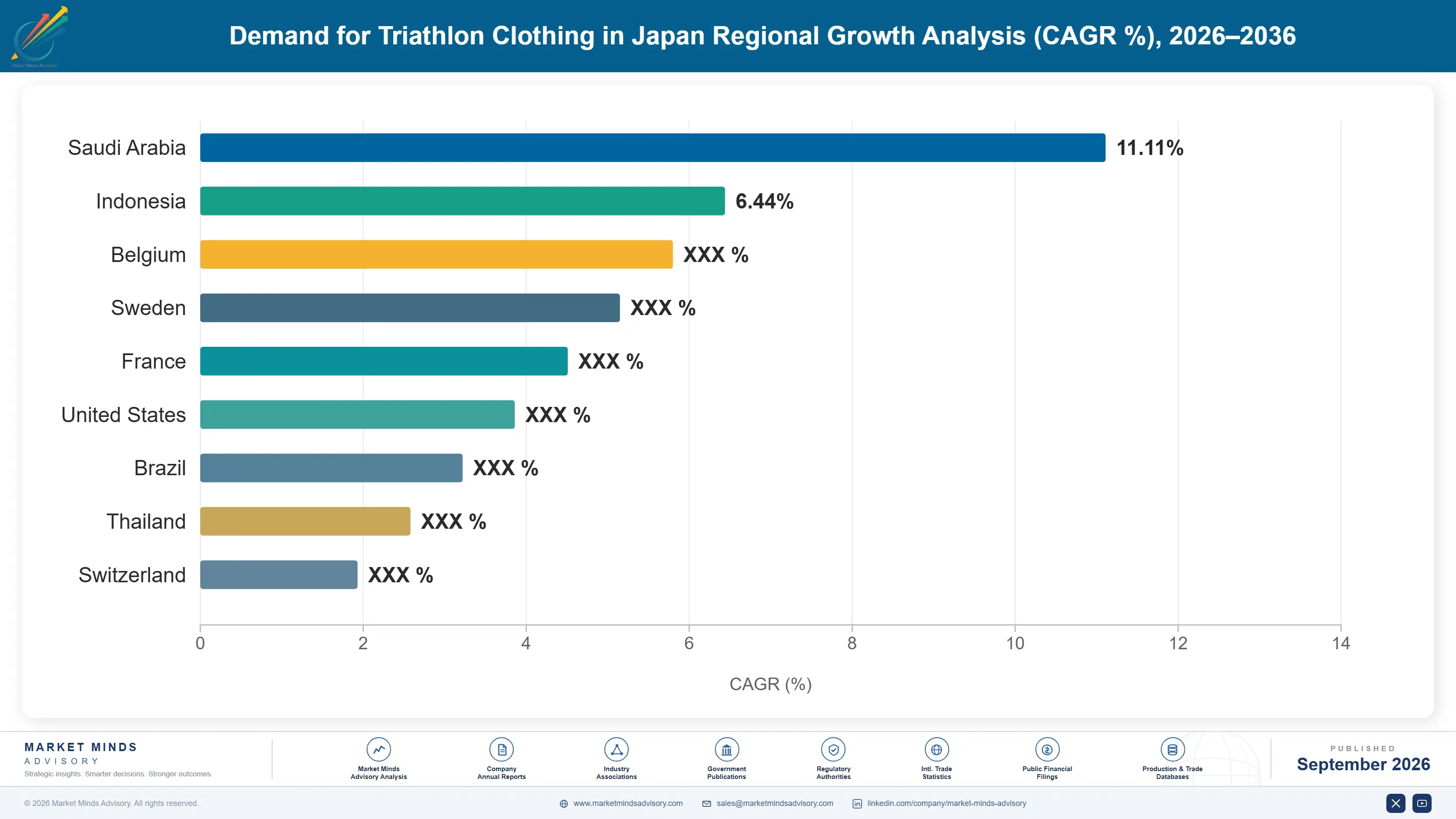
japan-triathlon-clothing-market-country-cagr-analysis-1790013781134

Capturing Margin Beyond The Apparel Sale

Triathlon clothing economics reward brands who move beyond one-time apparel sales toward subscription replenishment, coaching services, and licensing revenue, since retail shelf pricing power has compressed while recurring relationships and proprietary fabric science still command genuine differentiation and durable margin. Brands who stop treating the apparel as the entire transaction capture a growing share of category profit pools each year.

Subscription Replenishment And Auto-Ship Program Model

Brands increasingly offer subscription-based automatic replenishment programs rather than relying solely on one-time retail purchases, creating a revenue stream that continues generating income throughout each athlete's multi-year training relationship regardless of the original purchase channel or price point involved. This shifts brand economics toward customer retention and lifetime value rather than winning new one-time purchases repeatedly. Leading direct-to-consumer brands report subscription revenue now representing roughly 27 percent of total online contract revenue. Churn rates on these subscriptions remain low once athletes see visible race results improvement. Retention improves considerably over time.
Market Impact: Reaches 27 percent of subscription revenue share broadly

Performance Coaching And Training Program Services

Brands increasingly offer paid training and coaching programs bundled with apparel purchases, charging fees for guidance that raw product sales alone cannot generate. This shifts revenue recognition from a single product transaction toward an ongoing coaching relationship that continues generating value throughout the athlete's racing season. Brands with mature coaching platforms report attach rates approaching 21 percent among new customer acquisitions, a meaningful and growing share of total customer lifetime value captured well beyond the initial purchase. Athletes who complete coaching programs show markedly higher repeat purchase rates over time.
Market Impact: Reaches 21 percent of coaching service attach rate

Fabric Technology Licensing And White-Label Manufacturing

Leading fabric technology developers increasingly license proprietary compression and moisture-wicking technology to smaller brands and white-label manufacturers rather than competing directly for every retail shelf placement, generating royalty revenue that carries minimal incremental production cost once the underlying intellectual property has been developed and clinically validated. This licensing approach lets fabric innovators monetize research investment across a much broader brand portfolio than their own manufacturing capacity could ever directly serve. Royalty rates on licensed fabric technology typically run around 6 percent of licensee revenue. Adoption of this licensing model has expanded steadily across the category.
Market Impact: Generates a steady 6 percent royalty on revenue

Athlete Partnership Co-Branded Product Lines Directly

Brands increasingly partner with elite triathletes to develop co-branded product lines, sharing revenue in exchange for the credibility and audience reach that professional athlete endorsement provides beyond what traditional celebrity endorsement typically delivers for comparable marketing investment. These partnerships command premium pricing relative to standard product lines, since consumers pay for the implied performance credibility that athlete involvement signals. Co-branded product lines now represent roughly 12 percent of total revenue for brands pursuing this partnership strategy actively. Adoption of this partnership model has grown steadily across major brands. Larger conglomerates increasingly pursue this strategy too.
Market Impact: Adds 12 percent from co-branded lines revenue share

Who Controls the Margin Pool

Triathlon clothing market concentration remains modest, with the top five players controlling an estimated 35 percent of global revenue on a company-disclosed revenue basis, reflecting a category still fragmented across dozens of indie compression technology brands and regional manufacturers. Descente and Asics lead through combined technical fabric research and Japanese domestic distribution capability, while Mizuno anchors substantial regional manufacturing revenue. The gap between the leaders and the broader challenger field remains wide given deep existing retail relationships.
Current competitive activity centers on one-piece construction development, compression technology investment, and continued fabric reformulation cycle acceleration across leading brands. Descente and Asics both continue investing in proprietary fabric research to differentiate beyond commodity kits, while Zoot Sports and 2XU push clean performance transparency as their primary differentiation against increasingly credible indie compression startups entering the category.

Rankings shift most where brands successfully move beyond commodity kits toward fabric or coaching service differentiation, since these segments carry higher margins that fund continued research investment. Indie compression startups are closing the credibility gap quickly on fabric transparency, but global incumbents still hold an edge in retail distribution depth and athlete sponsorship breadth that indie competitors have not yet replicated.
japan-triathlon-clothing-market-company-positioning-matrix-1790013782081

Competitive Moat and Risk Dimensions

DESCENTE

Moat: Decades Of Fabric Research Depth

Descente's deep fabric research expertise built through decades of Japanese technical textile development and manufacturing scale gives it a formulation credibility advantage that Western competitors lacking comparable Japanese textile research infrastructure struggle to replicate, particularly for athletes seeking scientifically validated performance formulations backed by long-established research programs.
DESCENTE

Risk: Limited Western Market Penetration

Descente's comparatively limited retail penetration in North America and Western Europe, the largest single regional markets outside East Asia, constrains its ability to compete for major mass-market contracts against incumbents like Zoot Sports and 2XU that maintain deeper existing relationships across those markets. This gap persists across most emerging categories.
ASICS

Moat: Global Sportswear Distribution Scale

Asics' global sportswear distribution network, built over decades of running and multi-sport category leadership, gives it shelf access that indie compression startups cannot easily match without comparable retail relationships and marketing budget already in place across relevant retail channels globally. This distribution advantage compounds each renewal cycle.
ASICS

Risk: Indie Credibility Advantage Growing

Faster-moving indie compression startups increasingly win younger consumer segments by offering transparent fabric sourcing stories and founder-led social media credibility that Asics' traditional conglomerate marketing model typically struggles to replicate, threatening to erode its position among the most performance-conscious triathletes over time. This erosion accelerates each product cycle.

Players Tracked

Prominent Players

Descente
Asics
Mizuno
Zoot Sports
2XU

Other Key Players

Speedo
TYR Sport
Roka Sports
Castelli
Orca
BlueSeventy
Huub Design
De Soto Sport
Sailfish
Sugoi
Craft Sportswear
Compressport
Skins
Rogelli
Santini

Recent Developments

MARCH 2026

Descente Expands One-Piece Suit Research Facility

Descente announced an organic expansion of its one-piece suit construction research facility, adding dedicated designers to serve growing demand from competitive athletes seeking transition-optimized formats. New capacity begins phasing in over the coming fiscal year as designers complete onboarding. Program details remain confidential for now.
Signal: Confirms Descente's continued commitment to defending its construction research leadership across its most contested construction category
MAY 2026

Asics Signs Sponsorship Agreement With National Federation

Asics signed a multi-year sponsorship agreement with a major national triathlon federation, expanding its athlete visibility to support product lines migrating from generic sportswear to triathlon-specific technical formulations. Terms were not disclosed, though the agreement covers events planned over eighteen months. The federation's name was not disclosed.
Signal: Signals Asics' deepening strategic bet on triathlon-specific category revenue ahead of competing triathlon sponsorship providers broadly
JULY 2026

Roka Sports Acquires Compression Technology Software Firm

Roka Sports completed the acquisition of a specialist compression technology software firm, integrating its pressure mapping and personalization capabilities into Roka's existing product platform to strengthen its fit offering for elite customers. Financial terms were not disclosed, but the acquired firm's engineering team remains in place under Roka's product division.
Signal: Signals growing consolidation among specialized triathlon apparel vendors serving smaller specialized fit-tech customers directly nationwide broadly

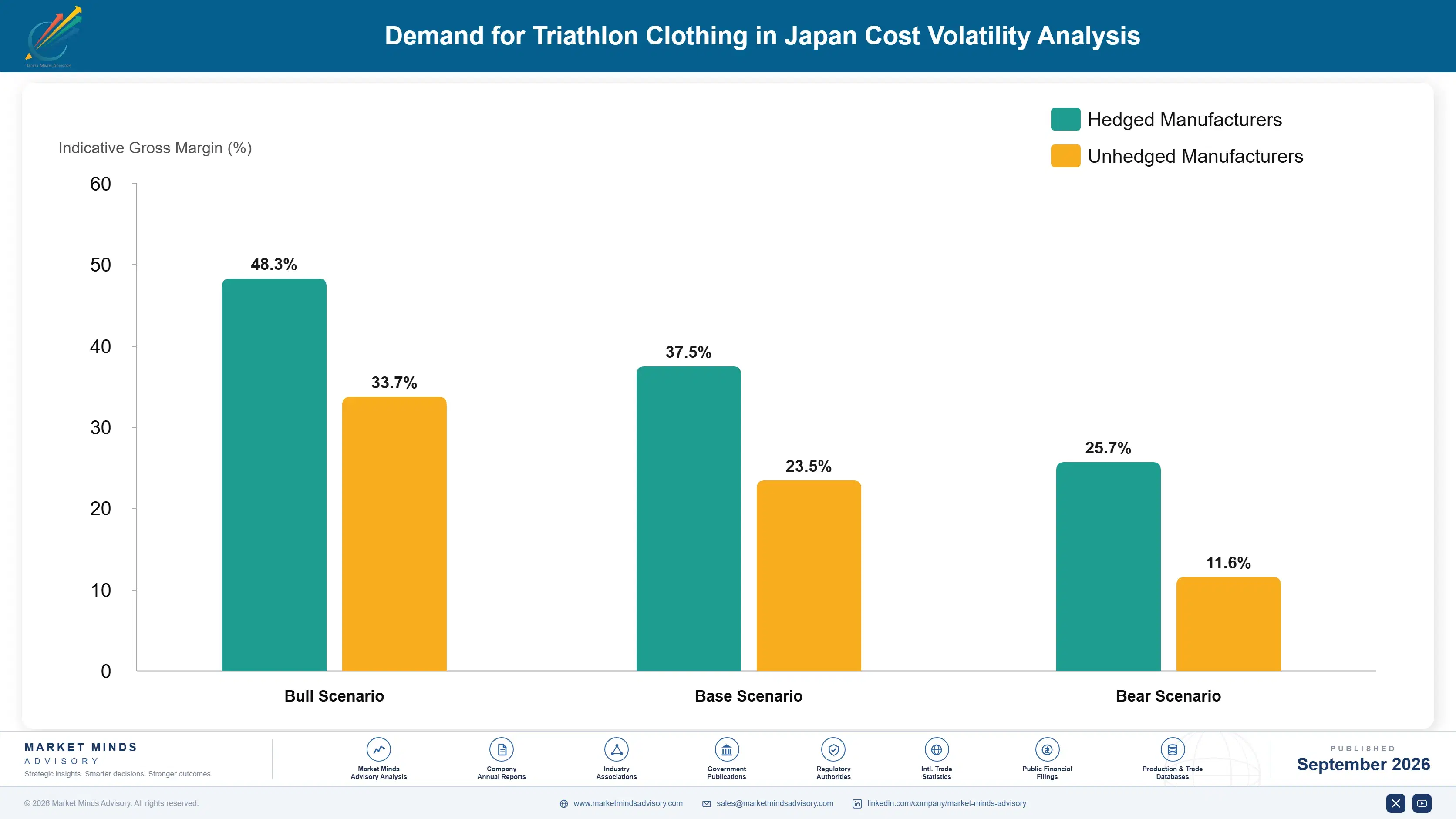
Technical Fabric And Compression Testing Exposure

Technical moisture-wicking and compression fabrics represent roughly 40 percent of garment bill of materials cost, sourced predominantly from specialized textile manufacturers concentrated in Japan and Taiwan. Athlete testing and biomechanical validation costs add another meaningful cost share, sourced mainly from accredited sports science laboratories that command premium fees for performance-specific analysis. Packaging and labeling materials add a smaller but still meaningful cost share for premium kits.
A 2025 synthetic fiber supply tightening, tied to petrochemical feedstock disruption reported in major suppliers' annual reports, briefly raised effective fabric costs for brands whose products rely heavily on specific proprietary fiber blends. The tightening eased within roughly two quarters, according to IEA-adjacent specialty chemicals data tracked through published supplier disclosure records covering the affected fiscal period. Brands with existing supply agreements weathered the tightening with minimal disruption to ongoing production.

Brands without long-term fabric supply agreements face a persistent competitive disadvantage against larger vendors like Descente and Asics, which secured favorable multi-year fabric supply terms well ahead of the 2025 tightening. Smaller indie brands sourcing fabrics through general distribution channels carry meaningfully higher cost variability, compressing their ability to compete for price-sensitive retail shelf placement.
japan-triathlon-clothing-market-cost-volatility-analysis-1790013782457

Long-Term Technical Fabric Supply Agreements

Brands are converting general distribution fabric purchases into direct supply agreements with textile manufacturers, trading some pricing flexibility for supply certainty that protects production schedules during industry-wide fabric tightening episodes affecting smaller competitors without comparable coverage. This approach has become increasingly standard among the largest brands competing for major retail contracts. Coverage extends to smaller brands too.

In-House Athlete Testing Capability Investment

Larger brands increasingly invest in internal biomechanical testing facilities rather than relying entirely on external accredited laboratories, reducing dependence on a constrained external testing market where specialized performance analysis commands significant fees and faces persistent capacity shortages. This approach has become more common as brands demand faster testing turnaround times. Retention improves once staff complete training.

Diversified Fiber Source Portfolio Strategy

Vendors increasingly diversify fabric sourcing across multiple fiber suppliers and geographic origins rather than relying on a single source, reducing exposure to any single petrochemical disruption or supply-side pricing shift while also supporting differentiated marketing claims. This approach also strengthens supply resilience against regional trade policy shifts. Larger vendors benefit most from this approach considerably.

Portfolio Architecture for Margin Defence

Triathlon clothing economics split into three commercial tiers, from commodity two-piece kits through certified premium tri-suits to next-generation one-piece and coaching-integrated products still scaling toward mainstream adoption. Gross margins widen substantially moving up this ladder, since fabric technology, construction sophistication, and coaching services all scale with tier and application demands placed on the brand. Brands with strong balance sheets allocate capital toward higher tiers even where volume remains modest.
Volume economics still dominate unit shipments in the commodity tier, but margin pools concentrate disproportionately in premium tri-suits and coaching services where Descente, Asics, and Mizuno compete on demonstrated performance credibility rather than price. The tension between chasing commodity volume and defending premium recurring margin shapes capital allocation across every major brand's roadmap. Indie compression startups push hardest into the prestige tier.

High-value pools concentrate most heavily around one-piece construction and coaching integration platforms, where fabric complexity and switching costs keep competitors thin and pricing power strong. Brands positioning early in these premium categories are effectively trading commodity volume for a defensible position expected to command superior economics once broader adoption fully matures. Fabric development timelines run considerably longer than commodity sales cycles.

Volume / Commodity-Adjacent

Commodity two-piece kits and basic compression wear competing mainly on price against a large field of regional manufacturers. Volume scale defines this tier. These products ship in the highest unit volume of any tier tracked in this report.
Gross Margin: 24-32%

Premium / Certified

Certified premium tri-suits and clinically validated recovery apparel carrying verified performance data commanding higher pricing from discerning buyers. Loyalty runs deep here. This tier is driving the strongest revenue growth among established brands today.
Gross Margin: 40-50%

Sustainability / Regulatory / Next-Generation

One-piece construction and coaching-integrated apparel platforms, still early in broad commercialization but carrying the strongest margin ceiling. Innovation defines category leadership. Early volume remains limited but pricing power stays strong across this segment.
Gross Margin: 52-62%
japan-triathlon-clothing-market-portfolio-architecture-1790013783424

High-value Sub-segments and Strategic Watch-out

One-Piece Tri-Suits with Integrated Padding

One-piece suits combine high per-unit value with rapidly expanding demand as athletes move beyond two-piece kits into targeted transition-optimized formats. Order backlogs at leading brands now extend several quarters. Genuine manufacturing capacity constraints persist across the industry currently. Vendors continue expanding dedicated construction lines to close this ordering gap.
Gross Margin: 44-54%

Compression Recovery Apparel

Recovery apparel carries strong per-unit value driven by training frequency benefits, though revenue growth trails tri-suits as athletes scale purchase commitments cautiously. This gap is narrowing as retailers specify recovery features upfront. Training demand cycles shape production planning across the racing calendar. Adoption tracks training frequency trends closely across markets.
Gross Margin: 32-42%

Commodity Two-Piece Racing Kits

Basic two-piece kits remain the volume core of the category, generating the bulk of unit shipments even as margin per unit trails the premium suit tier. Consolidation among smallest regional manufacturers is likely. Price competition remains intense among regional manufacturers broadly. Formulator consolidation continues steadily across the entire category.
Gross Margin: 22-30%

Athlete Coaching And Training Services

Coaching service capacity warrants close monitoring, since a training technology breakthrough or competitive pricing shift can rapidly reshape economics across every downstream brand category. Coaching pricing shifts ripple through the chain. Coaching platform pricing shifts ripple through the entire value chain. Analytics matter most here for future revenue growth.
Gross Margin: 46-56%

Recurring Value Beyond The Race Kit

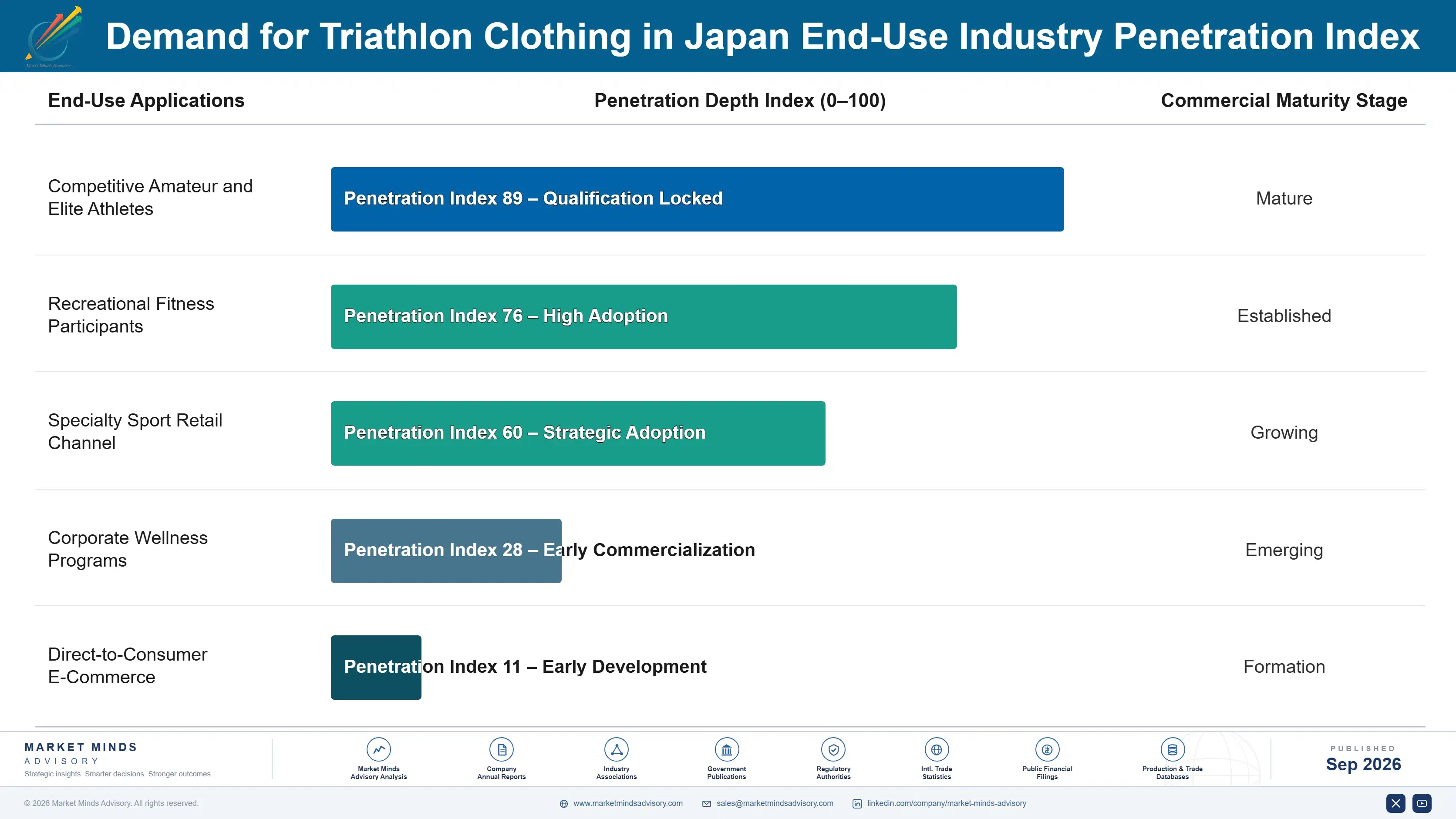
Triathlon clothing economics increasingly resemble an annuity business for brands holding subscription replenishment relationships, since an athlete adopting a fabric technology typically continues repurchasing compatible products across successive racing seasons rather than switching brands entirely. Switching brands mid-season carries real fit and performance adjustment risk, which favors incumbents once a relationship is established and trusted by the athlete. This dynamic compounds over successive purchase cycles.
Adoption depth varies meaningfully by end-use vertical. Competitive athletes show deep engagement once fabric technology pilots prove out, since visible transition improvement compounds directly into measurable racing loyalty each season. Recreational participants commit to long-term brand relationships given the fit familiarity any switching cost creates. Occasional buyers remain the most price-sensitive segment, treating apparel largely as commodity purchases with minimal recurring engagement.

Generational buyer shifts favor technology-integrated adoption over time, since younger athletes entering the sport show greater comfort specifying performance-conscious products than athletes trained on purely conventional racing gear. Retail procurement teams increasingly weigh total lifecycle performance value against upfront product price, a shift that favors brands who can demonstrate verified long-term testing data. Younger buyers research fabric performance extensively before purchase decisions.
japan-triathlon-clothing-market-end-use-penetration-index-1790013784249

Priority Moves For Triathlon Brands Now

These are among the four positions where our research anticipates prominent divergence between winners and laggards over the coming forecast period. Each is grounded in the demand model, the regulatory perimeter, and the announced capacity pipeline.
01 / PORTFOLIO MIX REBALANCING

Rebalance Capital Away From Pure Commodity Kits

Brands still allocating the bulk of new capital toward commodity two-piece kits risk missing the faster-growing premium tri-suit and coaching services opportunities that carry meaningfully higher margins once specification relationships take hold. Commodity kits remain the largest revenue category today, but its growth trajectory trails these emerging categories by a wide margin. Capital committed now to premium and coaching capability positions a brand to capture disproportionate share of the higher-margin pools opening over the next several years across every major athlete segment.
02 / FABRIC SUPPLY STRATEGY

Secure Dedicated Technical Fabric Supply Agreements

Brands without secured dedicated technical fabric supply agreements remain exposed to standard commercial pricing volatility that can erase a meaningful share of production margin during any industry-wide fabric tightening episode. Competitors with dedicated agreements already in place demonstrated materially lower cost variability across the 2025 tightening. Securing comparable coverage now, even at a modest premium to standard commercial pricing, protects margin durability through the remainder of the forecast period and beyond, particularly as smaller brands compete increasingly hard on price.
03 / CONSTRUCTION TECHNOLOGY INVESTMENT

Build Or Acquire One-Piece Construction Capability

Fabric and basic construction differentiation continues eroding as indie compression startups close the credibility gap on nearly every standard performance dimension that once separated premium brands from lower-cost competitors. Brands that build or acquire one-piece construction capability capture a durable advantage that pure two-piece competitors cannot easily replicate without years of dedicated design development investment. This advantage compounds in value as more athletes demand transition efficiency and increasingly expect an integrated performance experience across their entire annual racing season calendar.
04 / COACHING SERVICES EXPANSION

Establish Athlete Coaching Services Capability Now

Athlete coaching services represent a genuine differentiation opportunity that protects incumbent margins, meaning brands who invest in coaching capability today capture disproportionate share of a persistently underdeveloped market before broader competitive entry closes that advantage window. Athletes strongly prefer brands with proven coaching depth once a relationship begins. Early investment here compounds over subsequent purchase cycles, making current coaching investment disproportionately valuable relative to its modest near-term cost across the entire athlete base over the next several forecasted fiscal years.

Engagement Snapshot From the Field

A live engagement with an industry participant carrying material or product regulatory and market exposure ahead of a defining policy shift, showing how our research translates into a defensible multi-year portfolio strategy.
MARKET MINDS ADVISORY · CLIENT ENGAGEMENT SUMMARY
Demand for Triathlon Clothing in Japan Producer Strategic Portfolio Review and Transition Roadmap 2026·Investment Scenario on Demand for Triathlon Clothing in Japan Exposure Evaluation 2025-26
CLIENT PROFILE
The client is a mid-sized sportswear brand with an established presence in conventional running apparel across Japanese specialty retail channels, evaluating whether to launch a triathlon-specific product line as a differentiation strategy against larger competitors already active in the endurance sport category. Leadership sought outside validation before committing significant capital. The client had never previously launched a technical construction line at this scale.
STRATEGIC CHALLENGE
The client faced pressure to justify a significant product development investment without clear visibility into realistic fabric sourcing costs, consumer willingness to pay a premium, or how proposed construction approaches compared against broader market benchmarks for comparable sportswear brand launches. Internal teams were divided between an aggressive multi-segment simultaneous launch and a more conservative single-segment pilot approach to capital deployment.
MMA APPROACH
MMA conducted a structured assessment combining fabric sourcing cost benchmarking across three technical textile suppliers, consumer willingness-to-pay survey work across the client's core retail markets, and a competitive construction review to size realistic first-year volume and pricing scenarios before capital commitment. The engagement also modeled retailer negotiation leverage under each launch scenario to inform the final phasing recommendation.
KEY FINDINGS
  1. Consumer willingness to pay a premium for one-piece construction dropped sharply below a specific price threshold identified through survey work. Pricing above that threshold sharply reduced conversion intent among otherwise interested buyers.
  2. Technical fabric sourcing costs from accredited suppliers ran approximately 23 percent above the client's initial internal cost assumptions. This gap materially changed the client's expected margin profile for launch.
  3. One-piece construction, more than two-piece kits, showed the strongest predictor of retailer acceptance among surveyed buyers. Retailers favored one-piece stability claims over unverified two-piece marketing language.
  4. A phased single-segment launch reduced initial capital exposure by roughly 26 percent versus the client's original simultaneous multi-segment plan. This freed capital for a stronger marketing push in the lead segment.
CLIENT PROFILE
The client is a mid-sized sportswear brand with an established presence in conventional running apparel across Japanese specialty retail channels, evaluating whether to launch a triathlon-specific product line as a differentiation strategy against larger competitors already active in the endurance sport category. Leadership sought outside validation before committing significant capital. The client had never previously launched a technical construction line at this scale.
STRATEGIC CHALLENGE
The client faced pressure to justify a significant product development investment without clear visibility into realistic fabric sourcing costs, consumer willingness to pay a premium, or how proposed construction approaches compared against broader market benchmarks for comparable sportswear brand launches. Internal teams were divided between an aggressive multi-segment simultaneous launch and a more conservative single-segment pilot approach to capital deployment.
MMA APPROACH
MMA conducted a structured assessment combining fabric sourcing cost benchmarking across three technical textile suppliers, consumer willingness-to-pay survey work across the client's core retail markets, and a competitive construction review to size realistic first-year volume and pricing scenarios before capital commitment. The engagement also modeled retailer negotiation leverage under each launch scenario to inform the final phasing recommendation.
KEY FINDINGS
  1. Consumer willingness to pay a premium for one-piece construction dropped sharply below a specific price threshold identified through survey work. Pricing above that threshold sharply reduced conversion intent among otherwise interested buyers.
  2. Technical fabric sourcing costs from accredited suppliers ran approximately 23 percent above the client's initial internal cost assumptions. This gap materially changed the client's expected margin profile for launch.
  3. One-piece construction, more than two-piece kits, showed the strongest predictor of retailer acceptance among surveyed buyers. Retailers favored one-piece stability claims over unverified two-piece marketing language.
  4. A phased single-segment launch reduced initial capital exposure by roughly 26 percent versus the client's original simultaneous multi-segment plan. This freed capital for a stronger marketing push in the lead segment.
RECOMMENDED STRATEGY
Phase 1: Phase one: launch in the client's strongest existing retail segment first to validate demand before wider expansion. This approach limits downside exposure while generating real sales data. Phase 2: Phase two: secure fabric supply agreements with performance-based durability guarantees rather than fixed-volume-only terms. Performance-based terms tie pricing to demonstrated fabric durability outcomes. Phase 3: Phase three: expand to additional retail segments only after first-segment sell-through data confirms viable unit economics. This staged approach protects capital while preserving competitive timing regionally.
OUTCOME
The client launched its first triathlon product line in a single lead segment, achieving sell-through results that exceeded internal projections by approximately 14 percent (client-reported, unverified by MMA), and used that validated data to secure improved terms on its retail expansion agreements. The phased approach also gave the marketing team time to refine messaging before wider rollout.

Frequently Asked Questions

Foundational context covering the market sizes, CAGR, scope, country, region and competition that inform every finding below. This section is provided to cover basics and most often pre-purchase conversations, answered from the MMA Primary Research Dataset.

What is the current size of the Demand for Triathlon Clothing in Japan Market?

The global triathlon clothing market reached an estimated 0.42 billion dollars in 2025. This valuation covers tri-suits, transition wear, and compression apparel for triathlon disciplines.

How large will the Demand for Triathlon Clothing in Japan Market be by 2036?

The market is projected to reach approximately 1.0 billion dollars by 2036. That represents more than double the 2026 base value over the ten-year forecast period.

What is the CAGR for the Demand for Triathlon Clothing in Japan Market 2026 to 2036?

The market is forecast to grow at an 8.0 percent compound annual growth rate between 2026 and 2036. Bull and bear scenarios range from 6.8 to 9.2 percent.

Which segment is growing fastest?

One-piece tri-suits with integrated padding are growing fastest at an 11.5 percent CAGR, roughly 1.4 times the overall market rate. Compression recovery apparel follows as the second-fastest segment.

Who are the major companies in the Demand for Triathlon Clothing in Japan Market?

Descente and Asics lead the category, followed by Mizuno, Zoot Sports, and 2XU. Together these five players control an estimated 35 percent of global revenue.

Which country is growing fastest?

India is growing fastest at a 9.8 percent CAGR, reflecting expanding urban middle-class fitness spending and social media exposure. This closely tracks the broader South Asia and Pacific regional growth rate.

Report Segmentation Architecture

The full report scope spans multiple orthogonal segmentation dimensions, with cross-tabulated demand data provided for each dimension pair. Coverage extends further to regional breakdowns, trend trajectories, and the competitive detail needed to support segment-level decision-making.

By Primary Market Dimension

  • One-Piece Tri-Suits with Integrated Padding
  • Compression Recovery Apparel
  • Two-Piece Racing Kits
  • Transition-Specific Apparel
  • Athlete Coaching and Training Services
  • Fabric Technology Licensing Services

By End-Use Industry

  • Competitive Amateur and Elite Athletes
  • Recreational Fitness Participants
  • Specialty Sport Retail Channel
  • Corporate Wellness Programs
  • Direct-to-Consumer E-Commerce

By Commercial Dimension

  • Direct Brand Retail Sales
  • Subscription and Replenishment Programs
  • Athlete Partnership Co-Branded Sales
  • Fabric Licensing and White-Label

By Region

  • East Asia
  • North America
  • Western Europe
  • South Asia and Pacific
  • Latin America
  • Middle East and Africa
  • Eastern Europe

Scope, Methodology, and Coverage

Every figure in this report is reproducible from documented input assumptions. The scope below maps the historical period, the forecast horizon, the segmentation dimensions, and the countries covered, alongside the underlying primary and qualitative methodology.
Historical Period
2020 to 2025
Forecast Period
2026 to 2036
Base Year
2025 (USD billions; MMA Primary Research Dataset, September 2026)
Market Definition
This report defines the triathlon clothing market as one-piece and two-piece tri-suits, transition wear, and compression apparel marketed specifically for swim, bike, and run triathlon disciplines. It excludes general athletic apparel without explicit triathlon-specific functionality and single-discipline sport clothing sold independently of triathlon positioning.
Quantitative Units
USD billions, unit shipments, CAGR percent
Segmentation Dimensions
Garment format, end-use retail channel, commercial dimension
Regions Covered
East Asia, North America, Western Europe, South Asia and Pacific, Latin America, Middle East and Africa, Eastern Europe
Countries Covered
Japan, United States, Canada, Germany, France, United Kingdom, China, South Korea, India, Australia, Brazil, Mexico, Saudi Arabia, United Arab Emirates, South Africa, Poland, Czech Republic, Russia
Key Companies Profiled
Descente, Asics, Mizuno, Zoot Sports, 2XU, Speedo, TYR Sport, Roka Sports, Castelli, Orca, BlueSeventy, Huub Design, De Soto Sport, Sailfish, Sugoi, Craft Sportswear, Compressport, Skins, Rogelli, Santini
Quantitative Methodology
Primary survey, n=3,800 respondents, Q4 2025, six countries; demand-side model with trade association cross-validation
Qualitative Methodology
47 expert interviews, Q4 2025; applied to validate demand model assumptions, identify emerging dynamics, and assess competitive positioning
Report Format
PDF and XLSX data workbook (Word format preview document)
Publisher
Market Minds Advisory
Report Code
MMA-2026-CON-853
Published
September 2026
Contact
sales@marketmindsadvisory.com | www.marketmindsadvisory.com

Purchase the full Demand for Triathlon Clothing in Japan Report (2026 to 2036).

This report delivers a comprehensive analysis of the global triathlon clothing market across all major garment formats, regions, and competitive dynamics through 2036. It covers detailed segmentation by garment format, end-use retail channel, and commercial dimension, alongside regional demand architecture across all seven world regions. Competitive profiling examines the top five players controlling 35 percent of global revenue, along with fifteen additional participants shaping category evolution. The report also includes a portfolio tier analysis, input cost risk assessment, and a strategic verdict section identifying priority actions for brands navigating this rapidly evolving category.
Seven-region demand share and CAGR breakdown
Five-tier top and secondary player profiling
Ten-year revenue and volume forecast model
Input cost and supply chain risk assessment
Portfolio margin tier and watch segment analysis
Anonymized client case study with strategy recommendations

Built For The People Who Decide

From boardroom strategy to bench-side execution, this report is read cover-to-cover by leaders shaping the next decade of their industry, turning demand scenarios, market dynamics and valuation benchmarks into decisions.
CXOs/ Presidents/ VPs/ Managers
M&A and Corporate Development
Strategy Teams and R&D Heads
Procurement and Product Directors
Regulatory and Compliance Leaders
Investor Relations and Equity Analysts