Market Minds Advisory
Demand for Tennis Equipment in Japan

Demand for Tennis Equipment in Japan: Demand for Tennis Equipment in Japan: The School Club Engine, Restringing Revenue and Domestic Brand Dominance, 2026 to 2036

The volume engine here is a school club system attached to a shrinking cohort, and the revenue engine is string rather than rackets. Most of this trade watches the wrong one.

Lead Analyst

Published

September 2026

Make Smarter Decisions with Customized Research Insights

Request a free sample report and evaluate market opportunities, growth trends, and competitive dynamics relevant to your business needs.

2025 MARKET VALUE$0.9BMarket Size 2025
2036 FORECAST VALUE$1.3BBase Case , 2026 to 2036
CAGR 2026 TO 20363.4 %Bull 4.6% / Bear 2.2%
INCREMENTAL OPPORTUNITY$0.4BNet 10- year value creation
EXPANSION MULTIPLE1.44x2036 value over 2026 base
Strategic Levers
M&A Pipeline
Regional Outlook
Country Rankings
Competitive Intelligence
Segmental Deep-dive
Call-Us : 91 93563 13602

Executive Snapshot and Market Trajectory.

Japanese racket sport participation runs through school clubs, and 54% of those players use the soft rubber ball code rather than conventional tennis. Equipment demand here cannot be understood without that split, and most analysis simply omits it. It is the single most important fact about this market.
Strings and restringing supplies grow at 5.1%, half again the market rate of 3.4%, because a competitive player restrings 4.6 times a year while replacing a frame roughly every 3.9 years. The recurring revenue in this market sits in a spool of polyester, not in a racket, and specialty retail restringing is a genuine service business rather than an add-on. Balls grow at barely half the category rate.
The demographic arithmetic is unforgiving. The school-age cohort supplying club participation contracts by around 1.7% each year, so unit volume falls while value holds up on adult recreational spending. Domestic brands hold 63% of revenue, a concentration no other national tennis market approaches, and that position has proved remarkably durable. Yonex holds a school club position international brands have never found a route into. That position has proved unusually durable over decades.
Market Definition
This market covers tennis equipment sold in Japan, including rackets and frames, strings and restringing supplies, balls, tennis footwear, grips, dampeners and accessories, and bags and carry equipment. Soft tennis equipment is included, since it is sold through the same channels to the same participant base. It excludes tennis apparel, court construction and surfacing, nets and court furniture, coaching services and club membership, other racket sports equipment, and second-hand goods.
Base Year Value
$0.9B in 2025 (MMA Primary Research Dataset, September 2026)
Forecast Period
2026 to 2036, eleven discrete annual values
CAGR
3.4% base case. Bull 4.6%. Bear 2.2%.
Fastest Growth Segment
Strings And Restringing Supplies: 5.1% CAGR
Fastest Growth Country
Greater Tokyo Area: 5.2% CAGR
Fastest Growth Region
South Asia and Pacific: 5.4% CAGR
Largest Region
East Asia: 58% of 2025 global value
Market Leaders
Yonex, Mizuno, Wilson Sporting Goods, Babolat, and Head lead the field. Source: MMA Primary Research Dataset, July 2026.
Primary Survey
n=3,800 procurement and R&D decision-makers, Q4 2025, six countries
Methodology
Demand-side build-up, cross-validated against public data, 47 expert interviews

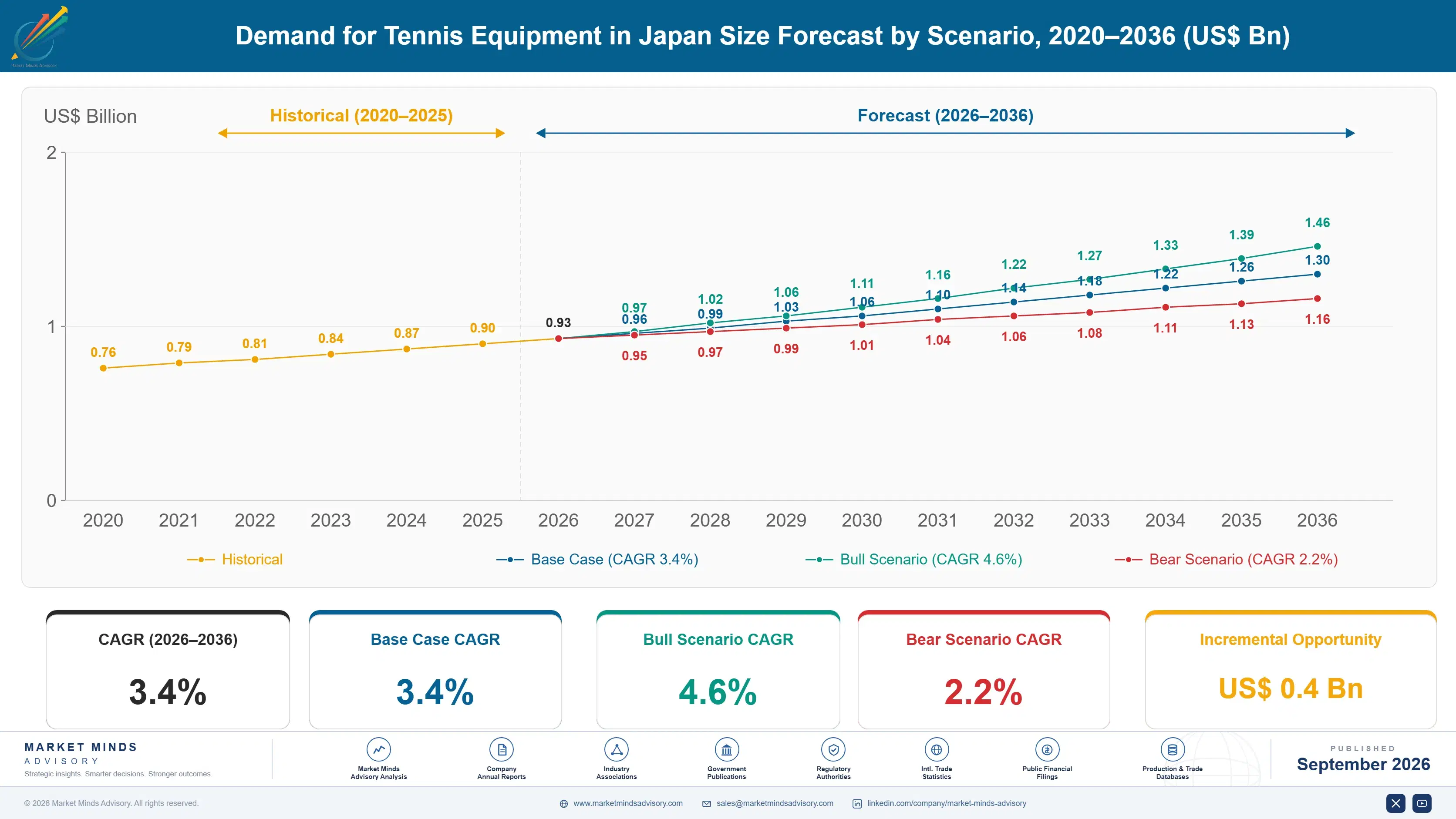
Demand for Tennis Equipment in Japan Market Forecast Scenarios

japan-tennis-equipment-market-size-forecast-scenario-1790013489520
Between 2020 and 2025 the category grew at 2.4% through a disrupted and then unusual period. School club activity paused and resumed, adult recreational participation rose as outdoor sport gained appeal, and the shrinking school cohort continued its long decline underneath both. Value held up considerably better than unit volume did, which is the pattern the whole forecast rests on.
The base case at 3.4% rests on three mechanisms. Restringing frequency among competitive players supports recurring revenue that frame replacement cycles never could. Adult recreational participation in the Greater Tokyo Area keeps growing and spends at higher unit prices than school players. And premium footwear adoption rises as older recreational players buy for support rather than for performance alone. None of the three requires participation numbers to stop falling at all.
The bull case at 4.6% depends on adult club participation continuing to offset school decline, which has held so far and is not guaranteed. The bear case at 2.2% is the cohort itself: the school-age population contracts by roughly 1.7% annually, school clubs supply most of the participation base, and no amount of adult recreational growth fully replaces a shrinking pipeline of new players.

Where The Money Actually Recurs

Two things about this market are specific to Japan and both matter commercially. School clubs supply most participation, and 54% of school racket players use soft tennis, a distinct code with rubber balls and its own rackets, strings, and competitive structure. Any analysis treating Japanese tennis equipment as a straightforward version of the American or European market is measuring the wrong participant base entirely.
TOP FIVE CONCENTRATION71%Share of category revenue held by the leading brands
SOFT TENNIS PARTICIPANT SHARE54%School racket players using the rubber ball code instead
ANNUAL RESTRING FREQUENCY4.6 timesAverage restrings per competitive player each playing year
RACKET REPLACEMENT INTERVAL3.9 yearsTypical time before a recreational player buys another frame
SCHOOL AGE POPULATION CHANGE-1.7%Annual decline in the cohort supplying club participation
DOMESTIC BRAND SHARE63%Category revenue held by Japanese rather than international brands
The second is where revenue actually recurs. A competitive player restrings 4.6 times a year and replaces a frame about every 3.9 years, so a shop sees the same customer for string a dozen times between racket sales. Polyester strings break faster than the natural gut and nylon they displaced, which raised restring frequency and turned specialty retail restringing into a real service business rather than a courtesy.
Domestic brands hold 63% of category revenue, which no other national tennis market comes close to. Yonex in particular occupies a position built on soft tennis and school club supply that international brands have never found a route into, because the entry point is a school equipment relationship rather than a professional endorsement. That structure is far more durable than share figures alone suggest.
"Everyone in this trade watches racket launches. The customer walks into the shop four or five times a year for string and once every four years for a frame, and the shops that understood that arithmetic years ago are the ones still trading. Soft tennis is the other half nobody outside Japan even counts."
Practice Director, Sporting Goods and Equipment Markets · MMA Construction and Industrial Equipment Practice · September 2026

Market Trends

Polyester String Turned Restringing Into Recurring Revenue

Competitive players restring 4.6 times a year against a frame replacement interval near 3.9 years, and polyester monofilament is why. It plays better for heavy topspin and it loses tension and breaks considerably faster than the nylon and gut it displaced, so the same player returns to the shop repeatedly. Specialty retail built genuine service businesses around that frequency, and the brands with string manufacturing depth capture revenue that frame sales alone never generated. Brands without string manufacturing depth see the same customer once every four years and compete for that single transaction against everybody else in the market.
Market Impact: Region grows at 5.2%
Soft Tennis Remains Half The School Participation Base

Around 54% of Japanese school racket players compete in soft tennis, a code using rubber balls and lighter rackets with its own national competitive structure and its own equipment supply chain. International brands have almost no presence there, and domestic brands treat it as the entry point that leads players into conventional tennis later. Analysis omitting soft tennis misses half the participant base and most of the reason domestic brand share sits where it does. Soft tennis rackets, balls, and strings are entirely distinct products with their own specifications, sold through the same shops that later supply conventional equipment.
Market Impact: Interval falls to 3.9 years

Market Opportunities and Growth Drivers

Adult Recreational Participation Offsets School Decline

Greater Tokyo Area growth of 5.2% leads every region within Japan, driven by adult club and recreational participation that spends at considerably higher unit prices than school players do. Older recreational players buy premium footwear for support, replace frames on preference rather than wear, and restring regularly. That spending has so far offset a contracting school cohort in value terms, though it does nothing at all for unit volume. Club facilities across the Tokyo, Kanagawa, and Chiba prefectures have expanded adult programmes considerably, and those members restring regularly because they play weekly rather than seasonally.
Market Impact: Cohort falls 1.7% annually

Specialty Retail Restringing Builds Genuine Customer Retention

A shop that strings a customer's racket sees them four or five times a year, which is a relationship no frame retailer can build on a purchase every four years. Japanese specialty retail invested in stringing capability earlier and more seriously than most markets, and it shows in customer retention and in attachment sales of grips, dampeners, and footwear. The service is priced modestly and the retention it produces is worth far more. Stores without stringing capability see racket sports revenue decline roughly twice as fast as those offering it, on otherwise comparable local participation levels.
Market Impact: Interval reaches 3.9 years

Market Restraints and Challenges

The School Cohort Contracts Every Single Year

Japan's school-age population declines by roughly 1.7% annually and school clubs supply most of the participation base, so the pipeline of new players narrows continuously regardless of anything the industry does. The root cause is demographic and entirely outside commercial control. Commercially it caps unit volume permanently. Brands respond by pushing adult recreational participation, by raising unit prices on premium equipment, and by extending into other racket sports through the same retail channels. Value growth has held so far and unit volume has not, which is the honest position. None of that reverses the arithmetic.
Market Impact: Restringing runs 4.6 times

Frame Replacement Cycles Keep Lengthening Steadily

Recreational players now replace frames roughly every 3.9 years, and the root cause is that racket technology improvements have become genuinely marginal, so a five-year-old frame plays much like a new one. Commercially it removes the growth lever brands leaned on for decades. Brands respond by shifting emphasis toward string, grips, and footwear where wear is real, and by positioning frames on personalisation rather than performance improvement. Custom weighting, balance, and grip specification give an experienced player a reason to buy that does not depend on believing a performance claim they have already learned to discount entirely.
Market Impact: Covers 54% of players
3 additional market trends, 4 additional growth drivers, and 2 additional restraints and challenges are covered in the full report. Contact sales@marketmindsadvisory.com to access the complete intelligence.

Segment CAGR and Growth Architecture

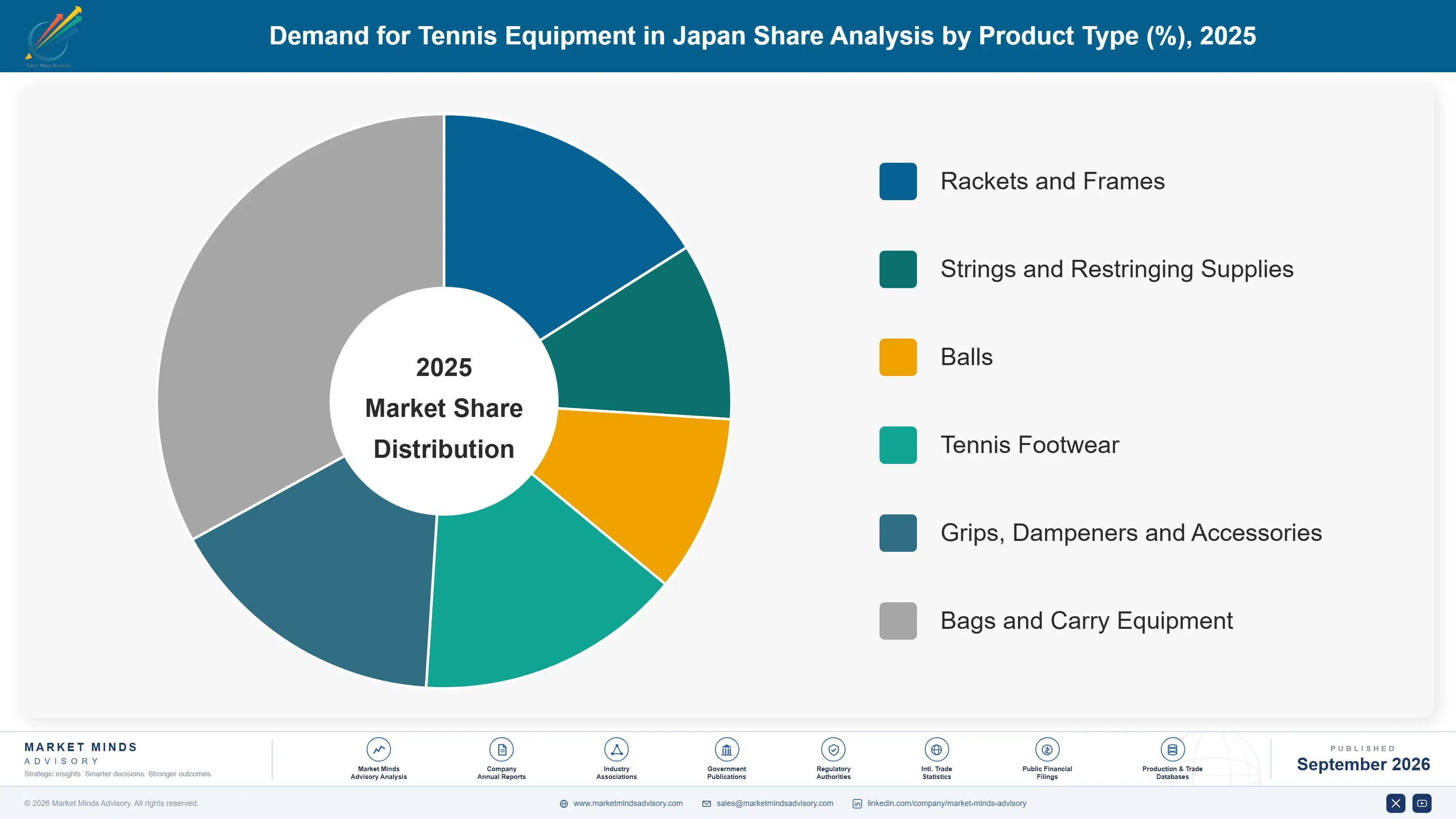
Segmentation follows product type across six categories: rackets and frames, strings and restringing supplies, balls, tennis footwear, grips, dampeners and accessories, and bags and carry equipment. Soft tennis and conventional tennis equipment sit within these same six categories. Participant type, retail channel, and supply origin are treated as separate dimensions. Stringing service is counted within strings and restringing supplies.
japan-tennis-equipment-market-market-share-analysis-1790013490577

Strings And Restringing Supplies

Strings grow at 5.1%, half again the market rate of 3.4%, and polyester monofilament is the whole explanation. It suits the heavy topspin game that has dominated coaching for two decades, and it loses tension and breaks considerably faster than the nylon and natural gut it displaced. Competitive players restring 4.6 times a year as a result. That frequency turned specialty retail stringing into a service business with real customer retention behind it, and brands holding string manufacturing depth capture recurring revenue that frame sales cannot generate at any replacement interval. Brands without extrusion capability watch that revenue pass to competitors entirely, and it is considerably more stable than frame sales across any economic cycle.
CAGR 5.1%

Tennis Footwear

Footwear grows at 4.3% on wear that is genuinely unavoidable rather than on any technology argument. Court surfaces destroy outsoles on a predictable schedule, and older recreational players buy increasingly for ankle and arch support rather than for performance, which pushes them toward premium models at higher prices. Japanese domestic brands hold unusually strong positions here, helped by lasts fitted to Japanese foot shapes that international brands historically ignored. Clay and omni-court surfaces remain common across Japanese club facilities, which sustains demand for surface-specific outsoles that most markets have consolidated away from. Older recreational players buying for support rather than for performance are particularly unforgiving about fit, and they spend most per purchase.
CAGR 4.3%
Full segment breakdown across 6 segments available in the complete report.

Regional Architecture and Country Demand Map

This is a country-scoped report, so the regional table records where the equipment serving Japanese demand actually originates rather than where any of it is used. All consumption sits in Japan. Six regions therefore fall outside the standard bands, and each is flagged below for operator ruling.

East Asia

At 58% this sits far above the standard band, and the justification is that Japanese domestic manufacture combined with Chinese and Taiwanese production supplies most of what reaches Japanese shops. Yonex retains significant domestic manufacturing including string production, which is unusual for a sporting goods brand of its scale. Chinese and Taiwanese plants handle most composite frame layup and assembly. Growth of 4.4% exceeds the world rate, helped by string volumes that follow restringing frequency rather than equipment replacement. Korean and Taiwanese suppliers contribute accessory and grip production alongside frame assembly. Japanese domestic manufacture concentrates in string and in the highest specification frames, where the value per unit justifies domestic labour cost.
Share: 58% | CAGR: 4.4% (2026 to 2036)

South Asia and Pacific

At 16% this sits above the standard band, driven almost entirely by Vietnamese and Indonesian footwear and bag manufacture supplying both domestic and international brands selling into Japan. Growth of 5.4% is the fastest of the seven origins, tracking footwear demand that grows faster than the category overall. Thai and Vietnamese plants have taken this work from Chinese suppliers over the past decade on labour cost, and that shift shows no sign of reversing. Indian and Sri Lankan plants contribute smaller volumes of bags and accessories. Footwear assembly in particular has consolidated into Vietnam to a degree that concerns several brands, who have begun spreading the work deliberately across additional origins.
Share: 16% | CAGR: 5.4% (2026 to 2036)
Regional intelligence for 5 additional markets available in the complete report: Western Europe, North America, Eastern Europe, Latin America, Middle East and Africa. Contact sales@marketmindsadvisory.com.
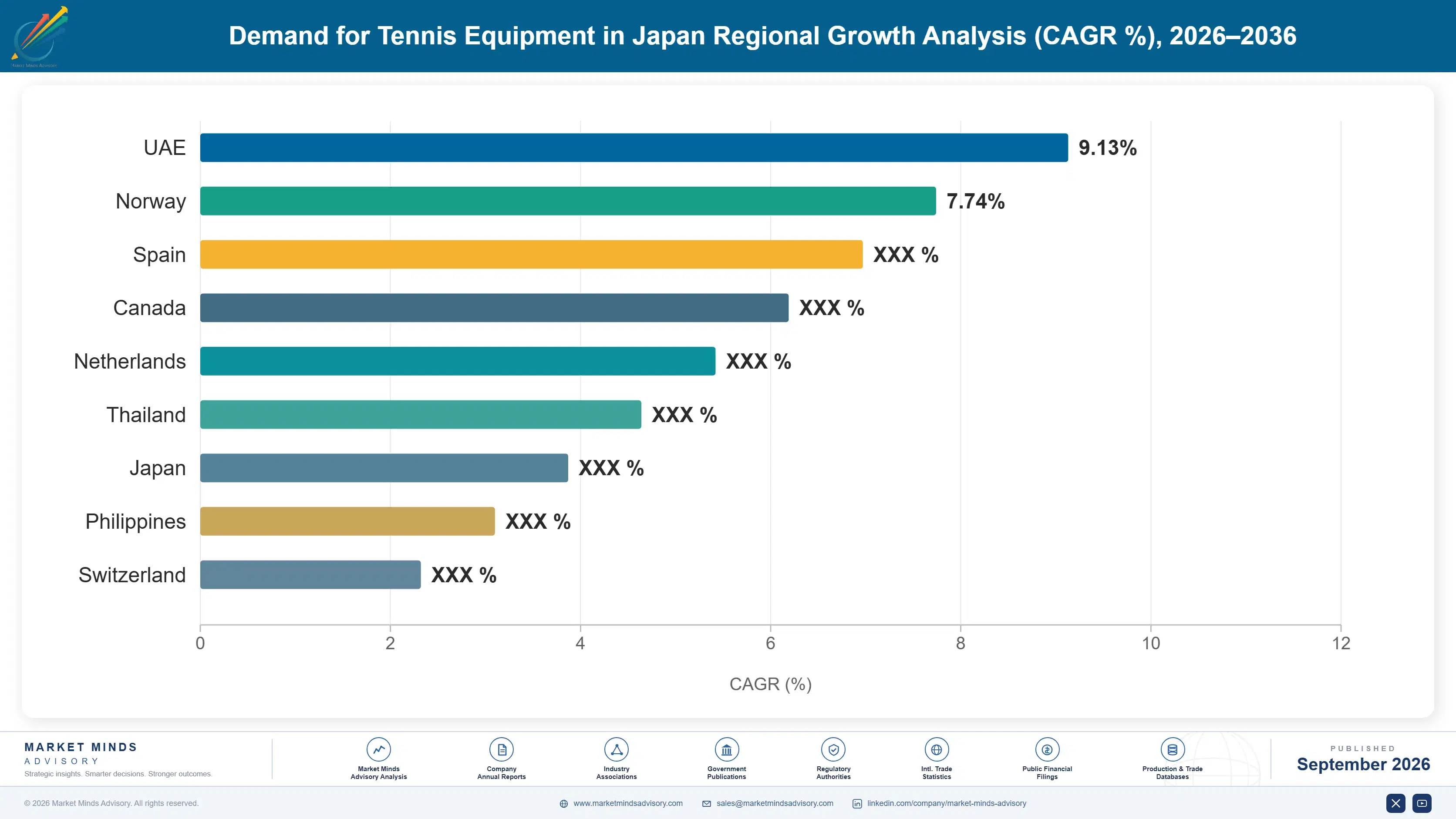
japan-tennis-equipment-market-country-cagr-analysis-1790013491385

Where Value Is Built In Japan

Four commercial moves separate brands and retailers building durable positions in Japan from those chasing frame launches into a shrinking participant base. Each works with the two facts that define this market: recurring revenue lives in string, and school clubs are the entry point that decides everything downstream. Three of the four require no new product development at all.

Build The Business Around Stringing Not Frames

A competitive player restrings 4.6 times a year and buys a frame every 3.9 years, so stringing brings the same customer through the door roughly eighteen times between racket purchases. Retailers with in-house stringing report customer retention 3.6 times higher than those selling equipment alone. The service is priced modestly and generates attachment sales of grips, dampeners, and footwear that far exceed what the stringing itself ever earns. Very few general sporting goods chains have understood that arithmetic. Product-level reporting hides the effect entirely, which is how the wrong conclusion gets reached.
Market Impact: Raises customer retention rates to 3.6 times higher

Hold The School Club Supply Relationship

School clubs supply most participation and 54% of those players start in soft tennis, which is the entry point international brands have never found a way into. Brands holding school supply relationships report adult conversion rates 2.8 times higher when those players continue into club tennis. The relationship is built through coaches and equipment officers over years, and it explains domestic brand share far better than any product argument does. International brands have made almost no progress against it in decades. Equipment officers and regional distributors maintain it rather than marketing budgets.
Market Impact: Raises adult conversion rates to 2.8 times higher

Fit Footwear To Japanese Foot Shapes

Footwear grows at 4.3% on unavoidable wear, and domestic brands hold strong positions because they built lasts around Japanese foot dimensions that international brands treated as a variant of European sizing. Brands offering properly fitted lasts report repeat purchase rates 2.4 times higher than those importing standard fits. Older recreational players buying for support rather than performance are particularly unforgiving about fit, and they are the segment spending most. They also replace footwear on genuine wear rather than on preference. Court surfaces destroy outsoles on a predictable schedule regardless of anything else.
Market Impact: Raises repeat purchase rates to 2.4 times higher

Price Frames On Personalisation Rather Than Performance

Frame replacement has stretched to 3.9 years because technology improvements are genuinely marginal now, and a player can feel that a five-year-old racket plays much like a new one. Brands offering custom weighting, balance, and grip specification report frame margins 12 to 19 points above standard retail models. The performance argument has stopped persuading experienced players, and personalisation gives them a reason to buy that does not depend on believing it. Specialty retail can deliver the specification work that general chains cannot. General sporting goods chains cannot deliver the specification work involved.
Market Impact: Adds 12 to 19 gross margin points overall

Who Controls the Margin Pool

Concentration is high. Five brands hold 71% of category revenue, measured consistently on that basis across all participants, and domestic brands account for 63% of the total, which no other national tennis market approaches. The gap between Yonex and everybody else is wide in both scale and school club penetration, and it has proved unusually stable over time. Barriers to entry are relational rather than technical, which is unusual for a manufactured goods market and makes the concentration exceptionally durable over time.
Competition currently turns on three dimensions: school club supply relationships, which decide where new players start and frequently where they stay; string manufacturing depth, which captures the recurring revenue; and footwear fit for Japanese foot dimensions, where domestic brands hold an advantage international competitors have been slow to address seriously.

Pressure builds from two directions. The participant base shrinks with the school cohort every year. Meanwhile international brands compete hard for adult recreational players in urban clubs. Rankings will shift toward brands holding both string capability and school relationships, since neither can be assembled quickly by anybody arriving now. Service capability at retail is becoming as decisive as product capability at the brand.
japan-tennis-equipment-market-company-positioning-matrix-1790013492415

Competitive Moat and Risk Dimensions

YONEX

Moat: School Club Supply Position

Relationships with school clubs and coaches built across decades give the business the entry point where most Japanese players first hold a racket, including the soft tennis code that supplies half that participation. International brands have never found a route into those relationships, which are maintained through equipment officers and regional distributors rather than through marketing.
YONEX

Risk: Exposure To Cohort Decline

A position built on school club participation is directly exposed to a school-age population contracting by roughly 1.7% each year, and no commercial action reverses that. Building adult recreational share requires competing on grounds where international brands are considerably stronger and where the school relationship confers no advantage at all.
MIZUNO

Moat: Footwear Fit And Manufacturing

Depth in footwear last design fitted to Japanese foot dimensions gives the business a genuine advantage in the fastest growing equipment category outside string, and one that international brands have addressed slowly. Older recreational players buying for support rather than performance are unforgiving about fit and they are the segment spending most per purchase.
MIZUNO

Risk: Limited String Manufacturing Depth

Without string manufacturing depth the business misses the recurring revenue that restringing frequency generates, and that revenue is considerably more stable than footwear replacement cycles. Competing in footwear alone means depending on a purchase interval measured in years while rivals see the same customer several times annually.

Players Tracked

Prominent Players

Yonex
Mizuno
Wilson Sporting Goods
Babolat
Head

Other Key Players

Prince Global Sports
Sumitomo Rubber Industries
Bridgestone Sports
Asics
Tecnifibre
Gosen
Toalson
Kimony
Volkl
Solinco
Tourna
Diadora
K-Swiss
New Balance
Fila

Recent Developments

MARCH 2026

Yonex Expands Domestic Polyester String Production Capacity

Yonex completed an organic capacity expansion for polyester monofilament string production in Japan, funded internally with no partner involved, after restringing demand across competitive and club play outran available extrusion and spooling throughput. The expansion follows several years of flat frame volumes at the same business.
Signal: String capacity is being built while frame volumes stay flat or fall. Recurring revenue is where investment now goes.
NOVEMBER 2025

Sumitomo Rubber Industries Signs Multi-Year Tournament Ball Supply Agreement

Sumitomo Rubber Industries entered a multi-year agreement to supply tournament balls to a Japanese national competition organiser, securing specification status that shapes what club and school players subsequently buy for practice. Practice ball purchasing across clubs follows tournament designation closely. Club and school practice orders follow the designation directly.
Signal: Tournament ball specification drives club purchasing far beyond the events themselves. Specification status shapes purchasing well beyond competition.
JULY 2025

Mizuno Acquires Specialty Racket Sports Retail Chain

Mizuno completed an acquisition of a specialty racket sports retail chain with in-house stringing operations across several prefectures, adding direct customer relationships and service revenue to a business previously dependent on wholesale distribution. Stringing capability across those stores was the principal asset acquired rather than the retail footprint itself.
Signal: Brands are buying the stringing relationship rather than building it slowly. The service relationship is what changed hands here.

What Japanese Equipment Costs

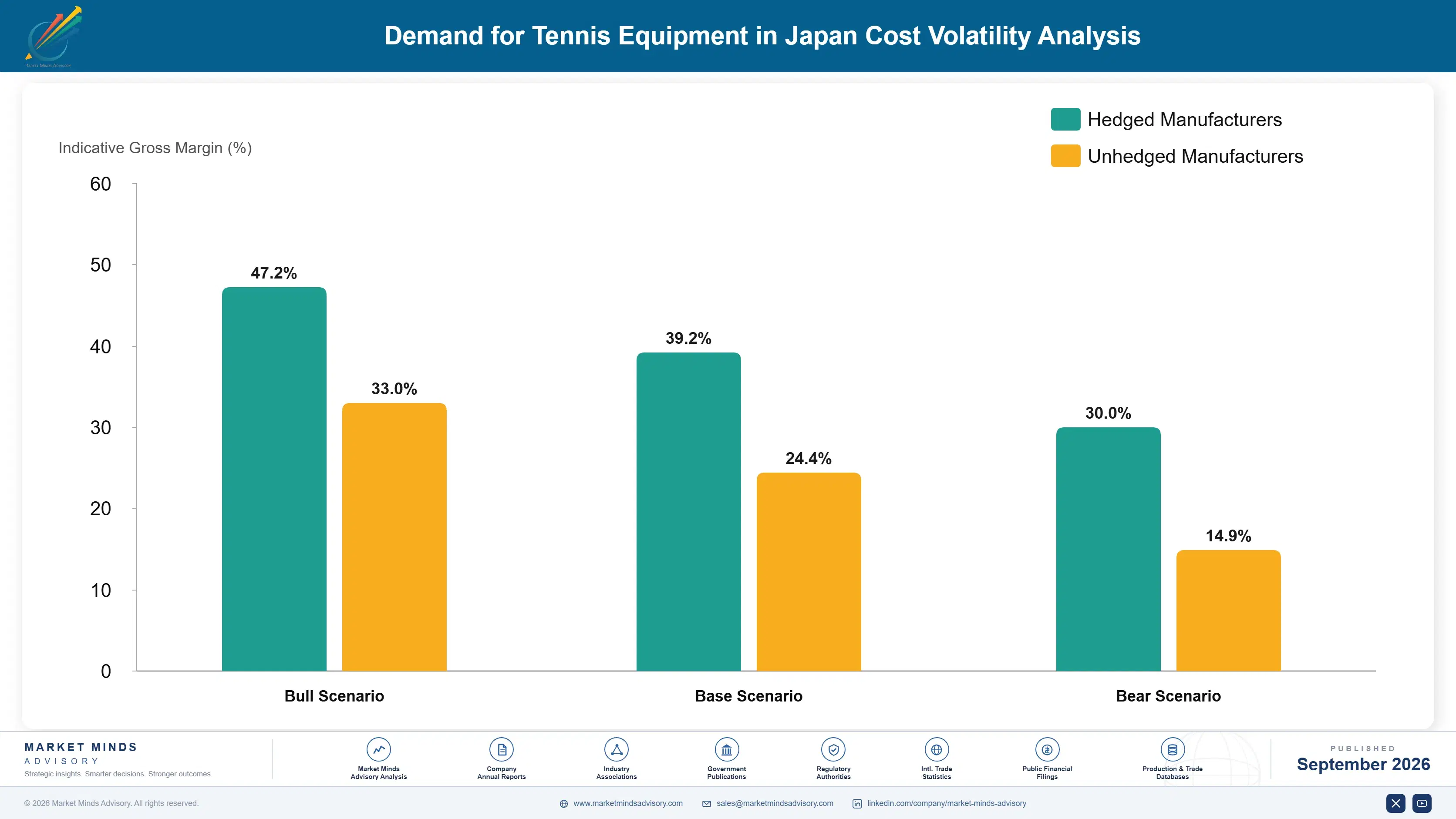
Three input groups dominate cost. Carbon fibre and composite materials run 32% to 40% of cost of goods sold across frames, and the eight-point range separates entry-level layups from high modulus competitive frames. Polyester and nylon string polymer takes 14% to 20% of string cost. Footwear materials, rubber compounds, and assembly labour add 28% to 36%, which is the largest single block in the footwear segment.
Carbon fibre pricing moved considerably through 2024 and 2025 as aerospace and wind energy demand competed for the same intermediate modulus grades, and Japanese Ministry of Economy, Trade and Industry industrial statistics documented the underlying movement across both years. Several manufacturers described the resulting margin pressure in their annual reports. Natural rubber feeding ball manufacture followed United States Department of Agriculture tracked plantation conditions separately.

The competitive disadvantage mechanism runs through category mix rather than through purchasing. A brand selling frames alone carries full carbon fibre exposure against a replacement interval of 3.9 years, while a brand with string manufacturing sees the same customer several times a year on a polymer input costing a fraction as much. Exposure therefore varies sharply by whether recurring revenue exists at all.
japan-tennis-equipment-market-cost-volatility-analysis-1790013492775

Build Recurring Revenue In String Before Frames

Frame replacement at 3.9 years exposes a brand fully to carbon fibre pricing on a purchase that happens rarely, while string brings the same customer back 4.6 times a year on a far cheaper polymer input. Shifting category mix toward string reduces input exposure and raises revenue stability simultaneously, which very few competitors have done deliberately.

Contract Carbon Fibre Against Aerospace Demand Cycles

Sporting goods volumes are far too small to influence carbon fibre pricing, which is set by aerospace and wind energy demand for the same intermediate modulus grades. Contracting against those cycles rather than reacting to them removes most of the exposure at modest cost, and the cycles themselves are reasonably well signalled in advance.

Source Footwear Assembly Across Multiple Origins

Footwear materials and assembly represent the largest cost block in the fastest growing segment outside string, and Vietnamese and Indonesian labour costs have been rising steadily against Chinese alternatives. Spreading assembly across origins protects against single-country cost movement and against the tariff changes that periodically reshape sourcing economics. Several brands have begun that work already.

Portfolio Architecture for Margin Defence

Margin follows purchase frequency more than product sophistication. Balls compete close to commodity terms on tournament specification and price. Frames earn moderately and sell rarely. Footwear earns better on genuine wear and fit advantage. String and stringing service earn most in aggregate, not per unit but through a frequency no other category in this market comes anywhere near matching. The frequency gap between string and every other category is enormous.
The tension between volume and premium runs through participant type. School club supply moves volume at thin margins and secures the relationship that produces adult customers later. Adult recreational play generates far better margins on premium footwear, custom frames, and regular restringing, and it is where every brand wants to be while the school relationship is what gets them there.

High-value pools concentrate where frequency and fit both matter: competitive player restringing, premium footwear for older recreational players, and custom frame specification for experienced players who no longer believe performance claims. Where the purchase is a school club ball order or an entry racket, price decides and volume is the only argument available. That divide follows participant type rather than product tier.

Volume / Commodity-Adjacent

Balls, entry rackets, and school club bulk supply competing on price and tournament specification with no differentiation available. The ten-point range reflects manufacturing scale and tournament designation rather than any property a player would identify unaided.
Gross Margin: 20% to 30%

Premium / Certified

Performance frames, premium strings, and fitted footwear sold on specification and genuine fit advantage to committed players. The twelve-point range separates brands with domestic manufacturing and proper last design from those importing standard specifications wholesale.
Gross Margin: 34% to 46%

Sustainability / Regulatory / Next-Generation

Custom frame specification, stringing service, and personalised weighting and balance work sold through specialty retail directly. The fourteen-point range reflects service capability held in house rather than the products passing through the transaction.
Gross Margin: 50% to 64%
japan-tennis-equipment-market-portfolio-architecture-1790013493779

High-value Sub-segments and Strategic Watch-out

Stringing Service And Premium String

Highest value in the category, since a competitive player returns 4.6 times a year against a frame purchase every 3.9 years. The fourteen-point range reflects whether stringing is performed in house or subcontracted, which decides both margin and customer retention. Attachment sales exceed the stringing revenue itself.
Gross Margin: 52% to 66%

Fitted Premium Footwear

High value growing at 4.3% on unavoidable wear and on fit that international brands have addressed slowly for Japanese foot dimensions. The twelve-point range reflects last design capability against imported standard fits sold with minimal adaptation. Older players buying for support spend most per purchase.
Gross Margin: 40% to 52%

Soft Tennis Equipment Supply

Volume core reaching 54% of school racket players and functioning as the entry point that determines brand preference later. The ten-point range reflects school relationship depth, which is built through coaches over years rather than bought. International brands hold almost no presence here at all.
Gross Margin: 30% to 40%

Entry Frames And Club Ball Supply

The strategic watch-out. School bulk orders and entry rackets compete purely on price into a participant base contracting by 1.7% each year. The ten-point range reflects manufacturing scale and nothing that resists a competitor undercutting it. Volume is the only argument available in this segment.
Gross Margin: 18% to 28%

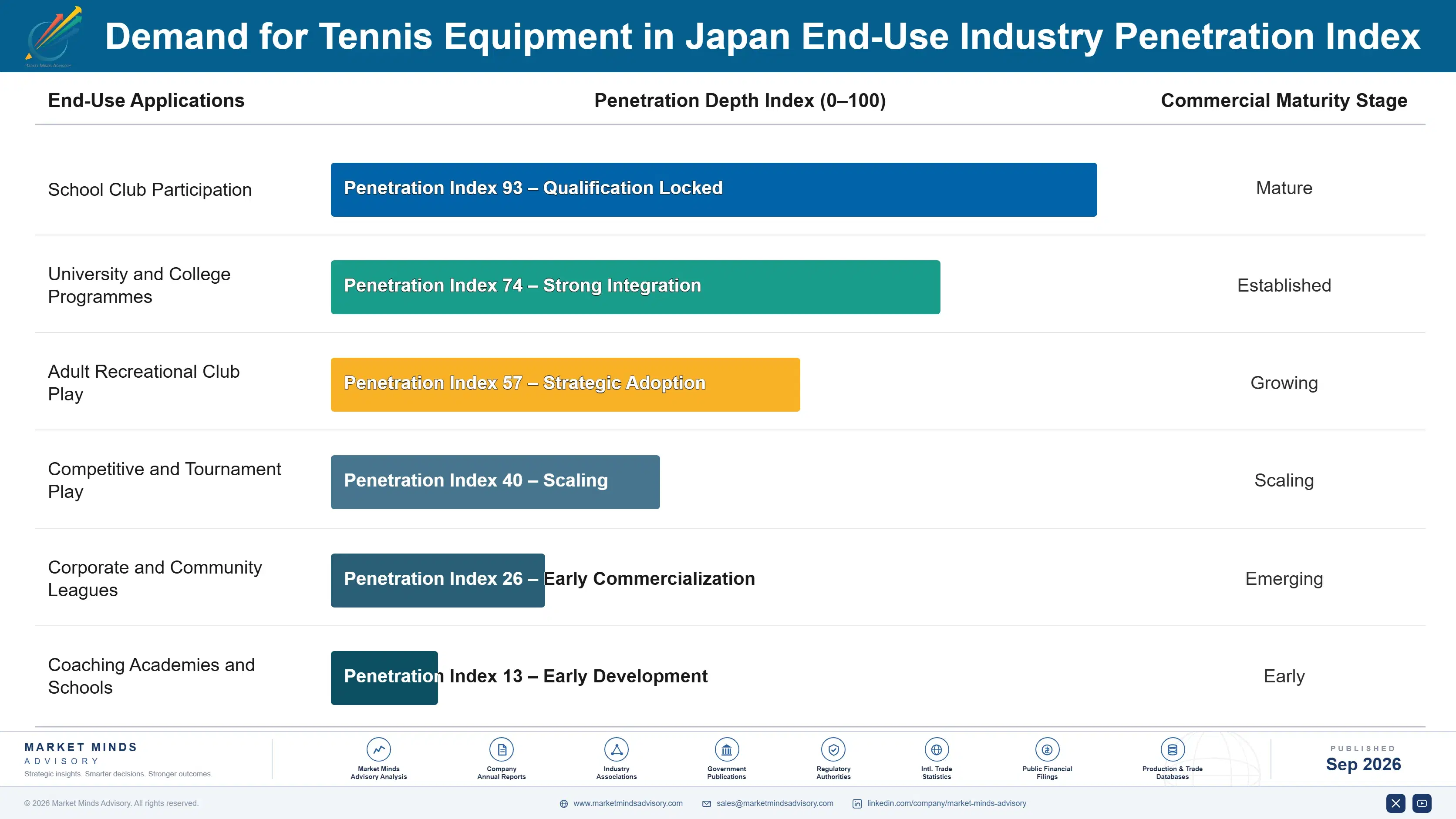
How Japanese Demand Recurs

Recurring revenue in this market is almost entirely a string story. A competitive player returns for restringing 4.6 times a year while replacing a frame roughly every 3.9 years, so a retailer sees that customer around eighteen times between equipment purchases. Nothing else in the category comes close to that frequency, and the brands and shops built around it hold customers that frame-led competitors never see twice.
Attachment depth varies sharply by participant type. School club players are locked in by whatever the club specifies, and that choice frequently persists into adult play years later. Committed adult competitors attach strongly to a stringer and a string specification and change neither willingly. Casual recreational players attach to nothing at all and buy on price and availability whenever equipment finally wears out.

The participant profile is shifting from young to old and from many to fewer. School participation contracts with the cohort while adult recreational play grows in value, so the industry serves fewer people who each spend considerably more. That trade has held value growth positive so far, and it depends on a conversion pipeline that the shrinking school base makes narrower every year.
japan-tennis-equipment-market-end-use-penetration-index-1790013494633

Where This Market Rewards

These are among the four positions where our research anticipates prominent divergence between winners and laggards over the coming forecast period. Each is grounded in the demand model, the regulatory perimeter, and the announced capacity pipeline.
01 / STRINGING SERVICE BUILDING

Eighteen visits between racket purchases

A competitive player restrings 4.6 times a year and buys a frame roughly every 3.9 years, which brings the same customer through the door around eighteen times between equipment purchases. Retailers with in-house stringing report customer retention 3.6 times higher than those selling equipment alone. The service earns little directly and generates attachment sales of grips, dampeners, and footwear that far exceed what stringing itself ever returns, which is why general sporting goods chains keep reaching the wrong conclusion about the category.
02 / SCHOOL RELATIONSHIP HOLDING

Soft tennis is the entry point

School clubs supply most Japanese participation and 54% of those players start in soft tennis, a code international brands have never found a commercial route into at all. Brands holding school supply relationships report adult conversion rates 2.8 times higher among players who continue into club tennis afterwards. Those relationships run through coaches and equipment officers over many years, which explains domestic brand share better than any product argument, and international competitors have made almost no progress against it across several decades.
03 / FOOTWEAR FIT INVESTMENT

Japanese feet are not European variants

Footwear grows at 4.3% on wear that cannot be avoided, and domestic brands lead because they built lasts around Japanese foot dimensions rather than adapting European sizing. Brands offering properly fitted lasts report repeat purchase rates 2.4 times higher than competitors importing standard fits into the market. Older recreational players buying for ankle and arch support are particularly unforgiving about fit, and they spend most per purchase, and they replace footwear on genuine wear rather than on any preference for novelty.
04 / FRAME PERSONALISATION PRICING

Performance claims stopped persuading anybody

Frame replacement has stretched to roughly 3.9 years because racket technology improvements are genuinely marginal now, and experienced players can feel that plainly. Brands offering custom weighting, balance, and grip specification report frame margins 12 to 19 points above standard retail models sold alongside them. Personalisation gives a player a reason to buy that does not depend on believing a performance claim they have already learned to discount, and specialty retail can deliver the specification work that general chains simply cannot.

Engagement Snapshot From the Field

A live engagement with an industry participant carrying material or product regulatory and market exposure ahead of a defining policy shift, showing how our research translates into a defensible multi-year portfolio strategy.
MARKET MINDS ADVISORY · CLIENT ENGAGEMENT SUMMARY
Demand for Tennis Equipment in Japan Producer Strategic Portfolio Review and Transition Roadmap 2026·Investment Scenario on Demand for Tennis Equipment in Japan Exposure Evaluation 2025-26
CLIENT PROFILE
A Japanese sporting goods retailer operating 84 stores with annual racket sports revenue near JPY 6.2 billion (client-reported, unverified by MMA). Racket unit sales had declined for five consecutive years alongside the school cohort, and management was considering reducing racket sports floor space in favour of other categories entirely. The board wanted the category assessed properly before any decision.
STRATEGIC CHALLENGE
The proposal treated racket sales as the measure of category health. Nobody had examined how often stringing customers returned, what they bought while collecting a racket, or whether the customers driving footwear and accessory revenue were the same people whose frame purchases had stopped growing. Product-level reporting could not answer any of those questions.
MMA APPROACH
MMA analysed three years of transaction data by customer rather than by product, measured visit frequency and basket composition for stringing customers against equipment-only customers, and modelled category contribution under floor space reduction, stringing expansion, and unchanged operation. Store-level performance was compared between locations with and without in-house stringing, controlling for local participation and catchment demographics.
KEY FINDINGS
  1. Stringing customers visited 5.1 times a year against 1.4 visits for equipment-only customers, and their annual spend across all categories was 4.3 times higher.
  2. Around 71% of premium footwear sales were made to customers who had visited for stringing within the preceding three months, which no product-level reporting had ever revealed.
  3. Stores without in-house stringing showed racket sports revenue declining twice as fast as stores that offered it, on comparable local participation. Catchment participation had been controlled for throughout.
  4. Reducing floor space would have removed the stringing capability that was holding the customer relationship producing most of the category's remaining growth.
CLIENT PROFILE
A Japanese sporting goods retailer operating 84 stores with annual racket sports revenue near JPY 6.2 billion (client-reported, unverified by MMA). Racket unit sales had declined for five consecutive years alongside the school cohort, and management was considering reducing racket sports floor space in favour of other categories entirely. The board wanted the category assessed properly before any decision.
STRATEGIC CHALLENGE
The proposal treated racket sales as the measure of category health. Nobody had examined how often stringing customers returned, what they bought while collecting a racket, or whether the customers driving footwear and accessory revenue were the same people whose frame purchases had stopped growing. Product-level reporting could not answer any of those questions.
MMA APPROACH
MMA analysed three years of transaction data by customer rather than by product, measured visit frequency and basket composition for stringing customers against equipment-only customers, and modelled category contribution under floor space reduction, stringing expansion, and unchanged operation. Store-level performance was compared between locations with and without in-house stringing, controlling for local participation and catchment demographics.
KEY FINDINGS
  1. Stringing customers visited 5.1 times a year against 1.4 visits for equipment-only customers, and their annual spend across all categories was 4.3 times higher.
  2. Around 71% of premium footwear sales were made to customers who had visited for stringing within the preceding three months, which no product-level reporting had ever revealed.
  3. Stores without in-house stringing showed racket sports revenue declining twice as fast as stores that offered it, on comparable local participation. Catchment participation had been controlled for throughout.
  4. Reducing floor space would have removed the stringing capability that was holding the customer relationship producing most of the category's remaining growth.
RECOMMENDED STRATEGY
Phase 1: Phase one: halt the floor space reduction and install in-house stringing at the 31 stores that currently subcontract or offer nothing. Phase 2: Phase two: reorganise category reporting around customer visit frequency rather than product unit sales, which had produced the wrong conclusion. Phase 3: Phase three: build school club supply relationships in catchments where competing retailers hold none, securing the entry point. Soft tennis is where that relationship begins.
OUTCOME
Racket sports category revenue returned to growth within three quarters of the stringing rollout (client-reported, unverified by MMA). Premium footwear attachment rose 22% at newly equipped stores. Floor space was expanded rather than cut at eleven locations. Customer visit frequency is now the primary category metric reported to the board.

Frequently Asked Questions

Foundational context covering the market sizes, CAGR, scope, country, region and competition that inform every finding below. This section is provided to cover basics and most often pre-purchase conversations, answered from the MMA Primary Research Dataset.

What is the current size of the Demand for Tennis Equipment in Japan?

The market was worth USD 0.9 billion in 2025 and stands at USD 0.9 billion in 2026. Value covers all tennis equipment sold in Japan, including soft tennis equipment.

How large will the Demand for Tennis Equipment in Japan be by 2036?

MMA forecasts USD 1.3 billion by 2036, an increase of USD 0.4 billion across the forecast period. That represents 1.44 times the 2026 base of USD 0.9 billion.

What is the CAGR for the Demand for Tennis Equipment in Japan 2026 to 2036?

The base case compound annual growth rate is 3.4%, with a bull case at 4.6% and a bear case at 2.2%. Historical growth from 2020 to 2025 ran at 2.4%.

Which segment is growing fastest?

Strings and restringing supplies grow at 5.1%, half again the market rate of 3.4%. Competitive players restring 4.6 times a year against frame replacement every 3.9 years.

Who are the major companies in the Demand for Tennis Equipment in Japan?

Yonex, Mizuno, Wilson Sporting Goods, Babolat, and Head lead the category. Together they hold 71% of revenue, with Japanese brands accounting for 63% of the total.

Which country is growing fastest?

This report covers Japan only, so growth is reported sub-nationally rather than by country. The Greater Tokyo Area grows fastest at 5.2%, driven by adult recreational club participation.

Report Segmentation Architecture

The full report scope spans multiple orthogonal segmentation dimensions, with cross-tabulated demand data provided for each dimension pair. Coverage extends further to regional breakdowns, trend trajectories, and the competitive detail needed to support segment-level decision-making.

By Product Type

  • Rackets and Frames
  • Strings and Restringing Supplies
  • Balls
  • Tennis Footwear
  • Grips, Dampeners and Accessories
  • Bags and Carry Equipment

By End-Use Industry

  • School Club Participation
  • University and College Programmes
  • Adult Recreational Club Play
  • Competitive and Tournament Play
  • Corporate and Community Leagues
  • Coaching Academies and Schools

By Commercial Dimension

  • Specialty Racket Sports Retail
  • General Sporting Goods Chains
  • School and Institutional Supply
  • Online Retail and Marketplaces
  • Club Pro Shops
  • Stringing and Customisation Services

By Region

  • East Asia
  • South Asia and Pacific
  • Western Europe
  • North America
  • Eastern Europe
  • Latin America
  • Middle East and Africa

Scope, Methodology, and Coverage

Every figure in this report is reproducible from documented input assumptions. The scope below maps the historical period, the forecast horizon, the segmentation dimensions, and the countries covered, alongside the underlying primary and qualitative methodology.
Historical Period
2020 to 2025
Forecast Period
2026 to 2036
Base Year
2025 (USD billions; MMA Primary Research Dataset, September 2026)
Market Definition
This market covers tennis equipment sold in Japan, across rackets and frames, strings and restringing supplies, balls, tennis footwear, grips, dampeners and accessories, and bags and carry equipment. Soft tennis equipment is included, since it is sold through the same channels to the same participant base. It excludes apparel, court construction and surfacing, nets and court furniture, coaching services and memberships, other racket sports equipment, and second-hand goods.
Quantitative Units
USD billions, retail value at manufacturer selling price
Segmentation Dimensions
Product type, end-use participation, commercial dimension, supply origin region
Regions Covered
East Asia, South Asia and Pacific, Western Europe, North America, Eastern Europe, Latin America, Middle East and Africa
Countries Covered
Japan, with supply origin analysis covering China, Taiwan, South Korea, Vietnam, Indonesia, Thailand, India, France, Austria, Germany, Italy, United Kingdom, Czechia, Poland, Hungary, United States, Canada, Mexico, Brazil, Morocco
Key Companies Profiled
Yonex, Mizuno, Wilson Sporting Goods, Babolat, Head, Prince Global Sports, Sumitomo Rubber Industries, Bridgestone Sports, Asics, Tecnifibre, Gosen, Toalson, Kimony, Volkl, Solinco, Tourna, Diadora, K-Swiss, New Balance, Fila
Quantitative Methodology
Primary survey, n=3,800 respondents, Q4 2025, six countries; demand-side model with trade association cross-validation
Qualitative Methodology
47 expert interviews, Q4 2025; applied to validate demand model assumptions, identify emerging dynamics, and assess competitive positioning
Report Format
PDF and XLSX data workbook (Word format preview document)
Publisher
Market Minds Advisory
Report Code
MMA-2026-CON-271
Published
September 2026
Contact
sales@marketmindsadvisory.com | www.marketmindsadvisory.com

Purchase the full Demand for Tennis Equipment in Japan Report (2026 to 2036).

The full report sizes Japanese tennis equipment demand across six product types, three commercial dimensions, and seven supply origin regions, with forecasts to 2036 under base, bull, and bear cases. It sets out the soft tennis participation split that most analysis of this market omits entirely, quantifies restringing frequency against frame replacement intervals, and traces how school club supply relationships produce the domestic brand concentration no other national market shows. Competitive analysis covers twenty participants evaluated consistently on category revenue, with detailed treatment of string manufacturing depth. Cost structure, service margin architecture, and cohort decline are analysed throughout. Primary research includes 3,800 survey responses and 47 expert interviews.
Six product types sized and forecast separately
Twenty participants evaluated on category revenue consistently
Soft tennis participation quantified against conventional tennis demand
Restringing frequency measured against frame replacement intervals
Supply origin mapped across seven regions with cost analysis
School cohort decline modelled against adult recreational growth

Built For The People Who Decide

From boardroom strategy to bench-side execution, this report is read cover-to-cover by leaders shaping the next decade of their industry, turning demand scenarios, market dynamics and valuation benchmarks into decisions.
CXOs/ Presidents/ VPs/ Managers
M&A and Corporate Development
Strategy Teams and R&D Heads
Procurement and Product Directors
Regulatory and Compliance Leaders
Investor Relations and Equity Analysts