Market Minds Advisory
Demand for Tablet in Japan

Demand for Tablet in Japan: Demand for Tablet in Japan. Replacement Cycles and Enterprise Adoption in a Mature Device Market

Japan's saturated tablet market, where replacement cycles and education procurement now drive nearly all volume, previews the demand pattern mature economies worldwide are approaching as first-time ownership growth fades entirely.

Lead Analyst

Published

September 2026

Make Smarter Decisions with Customized Research Insights

Request a free sample report and evaluate market opportunities, growth trends, and competitive dynamics relevant to your business needs.

2025 MARKET VALUE$52.0BMarket Size 2025
2036 FORECAST VALUE$84.4BBase Case , 2026 to 2036
CAGR 2026 TO 20364.5 %Bull 5.7% / Bear 3.3%
INCREMENTAL OPPORTUNITY$30.0BNet 10- year value creation
EXPANSION MULTIPLE1.55x2036 value over 2026 base
Strategic Levers
M&A Pipeline
Regional Outlook
Country Rankings
Competitive Intelligence
Segmental Deep-dive
Call-Us : 91 93563 13602

Executive Snapshot and Market Trajectory.

Japan's tablet market has become the clearest global example of a device category where replacement demand, not new adoption, now drives nearly every unit sold each year across both consumer households and large institutional buyers managing thousands of device fleets nationwide.
Japan's GIGA School Program, which placed a managed tablet with nearly every public school student, has created a predictable multi-year replacement cycle that global vendors now study closely as a template for mature-market device planning strategies and detailed procurement forecasting practices. Demand concentrates in enterprise and education procurement channels, where large institutional buyers replace devices on fixed schedules rather than consumer impulse purchases driven by new feature releases each product cycle across the industry.
Established consumer electronics vendors compete against enterprise-focused device management specialists building tablets specifically for institutional refresh cycles rather than retail consumer appeal alone or seasonal promotional campaigns tied to holiday shopping periods. Regulatory pressure from education procurement standards and enterprise device security requirements is reshaping product specifications faster than manufacturers can evaluate competing vendor claims about total cost of ownership across a device's full service life and extended support window.
Market Definition
This report covers consumer, enterprise, and education-market tablet devices including their operating system platforms and managed device services, with global market sizing and Japan featured as the leading indicator of mature-market replacement-cycle demand. It excludes laptop computers, smartphones, and e-reader devices without general-purpose computing capability.
Base Year Value
$52.0B in 2025 (MMA Primary Research Dataset, September 2026)
Forecast Period
2026 to 2036, eleven discrete annual values
CAGR
4.5% base case. Bull 5.7%. Bear 3.3%.
Fastest Growth Segment
Enterprise and Education Managed Tablets: 8.0% CAGR
Fastest Growth Country
India: 9.5% CAGR
Fastest Growth Region
South Asia and Pacific: 6.5% CAGR
Largest Region
East Asia: 28% of 2025 global value
Market Leaders
Led by Apple Inc, Samsung Electronics, Lenovo Group, Huawei Technologies, and Amazon.com Inc. Source: MMA Primary Research Dataset, July 2026.
Primary Survey
n=3,800 procurement and R&D decision-makers, Q4 2025, six countries
Methodology
Demand-side build-up, cross-validated against public data, 47 expert interviews

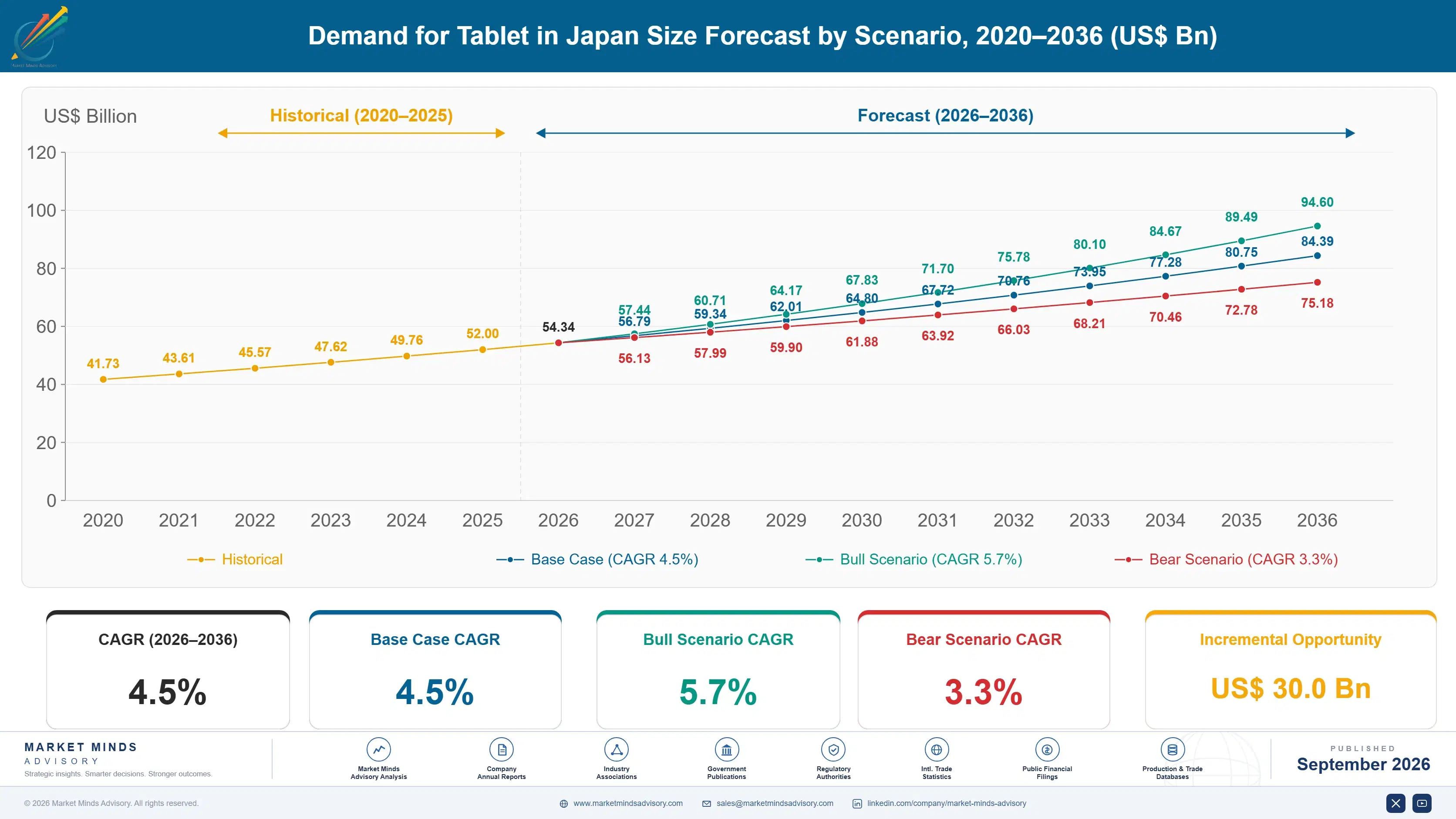
Demand for Tablet in Japan Market Forecast Scenarios

japan-tablet-market-size-forecast-scenario-1788426801270
The 2020 to 2025 period saw global tablet demand shift decisively from first-time consumer adoption toward institutional replacement cycles as markets like Japan and Western Europe reached saturation. Adoption growth slowed in mature economies while education and enterprise procurement programs sustained volume, producing a historical CAGR of roughly 4.5 percent as replacement-driven demand offset declining first-time purchase rates.
The base case assumes continued expansion of enterprise device management contracts, steady multi-year education procurement replacement cycles in mature markets, and gradual first-time adoption growth in price-sensitive emerging economies still building smartphone-adjacent device penetration. Vendors increasingly treat total cost of ownership and device management software as differentiators rather than hardware specifications alone, enterprise buyers standardize procurement around longer support windows, and emerging market growth offsets flat demand in saturated mature economies like Japan.
A bull scenario assumes accelerated enterprise digitization programs in emerging markets pull forward tablet adoption faster than current procurement cycles suggest, meaningfully expanding the addressable institutional buyer base. The bear case centers on smartphone screen sizes continuing to grow, eroding tablet differentiation for casual consumer use cases and slowing replacement cycle renewal rates across price-sensitive consumer segments globally.

Where Replacement Cycles Define Demand

Japan's tablet market reveals a pattern other mature economies are approaching gradually: institutional buyers, not individual consumers, now determine when replacement waves happen and at what precise national scale. The GIGA School Program's synchronized device rollout means an entire national cohort of tablets ages together, creating a predictable, forecastable replacement bulge unlike the staggered consumer purchase patterns typical elsewhere globally.
MARKET CONCENTRATIONCR5 68%top five vendors hold a heavily concentrated combined revenue share
AVERAGE SELLING PRICE$340/unittypical retail and enterprise blended price across all tablet segments
TOP PRODUCING COUNTRYChina 62%share of global tablet hardware manufacturing output currently
JAPAN ENTERPRISE SHARE41%share of Japan tablet volume sold through institutional procurement channels
SOFTWARE ATTACH RATE54%units bundled with device management or productivity software subscriptions
REPLACEMENT CYCLE LENGTH4 yearstypical service life before a full device replacement occurs
Hardware margins have compressed as component costs standardized across vendors, pushing manufacturers toward device management software and extended support contracts as the primary profit center instead of one-time hardware sales entirely. The vendors building the most reliable fleet management platforms are winning multi-year enterprise and education contracts specifically because institutional buyers value predictable total cost of ownership over raw hardware specifications alone.
Enterprise share above 40 percent in Japan signals a market where institutional procurement now outweighs individual consumer purchasing decisions, a reversal from the tablet category's original consumer-first positioning strategy across the industry. This shift is pushing vendors to redesign products around fleet management, security compliance, and multi-year support commitments rather than the annual feature refresh cycles that once defined consumer tablet marketing entirely and completely.
"Japan already lives in the tablet market's future: nobody buys one because they want a new toy, they buy one because the old one's warranty just ran out. That's where this whole category is heading."
Director, Consumer Electronics and Device Markets Practice · MMA Technology Practice · September 2026

Market Trends

GIGA School Program Creates Synchronized Replacement Waves

Japan's Ministry of Education GIGA School Program, which distributed managed tablets to nearly every public school student starting in 2020, has created a synchronized national replacement cycle now approaching its first major refresh wave. Because devices across the entire program were procured within a compressed timeframe, their eventual replacement will similarly concentrate within a narrow window, giving vendors an unusually predictable multi-year demand forecast rare in consumer electronics. Several major vendors have already begun positioning dedicated education refresh bids ahead of the anticipated wave, and municipal procurement offices across Japan have started budgeting for replacement cycles through 2027 and beyond.
Market Impact: Hybrid work sustains 22 percent demand
Enterprise Device Management Contracts Standardize Around Fleet Software

Japanese enterprises increasingly bundle tablet procurement with device management software subscriptions covering security compliance, remote configuration, and lifecycle tracking across entire device fleets rather than purchasing hardware and software separately. This has turned device management platform capability into a primary vendor selection criterion, since enterprise IT departments now evaluate total fleet management cost alongside hardware specifications when renewing multi-year procurement contracts. Vendors offering integrated management platforms are winning renewal contracts at meaningfully higher rates than hardware-only competitors, and adoption of bundled contracts is expanding across mid-size enterprises previously reliant on manual device management.
Market Impact: Senior-focused tablets grow 11 percent yearly

Market Opportunities and Growth Drivers

Remote Work Sustains Enterprise Tablet Demand

Japanese enterprises maintaining hybrid work arrangements continue to procure tablets as secondary mobile computing devices for employees who split time between office and remote locations, sustaining demand levels that pure office-based work models would not support. This has kept enterprise tablet procurement volumes elevated compared with pre-pandemic baselines, since companies now standardize on tablets as a lightweight complement to laptops for employees requiring mobility without full computing power. Several major Japanese corporations have publicly disclosed multi-year tablet fleet expansion plans tied explicitly to hybrid work policy commitments, and vendors are building sales strategies around this sustained mobility use case.
Market Impact: Casual tablet purchases fell 18 percent

Aging Population Drives Simplified Interface Tablet Adoption

Japan's aging population is driving demand for simplified, large-format tablets designed specifically for older users seeking an easier computing interface than smartphones or full laptops for basic communication and entertainment needs. This has created a distinct product category within the broader tablet market, with vendors developing specialized interfaces, larger text defaults, and simplified navigation specifically targeting Japan's substantial elderly consumer population and their adult children. Several vendors have launched dedicated senior-focused tablet lines in Japan specifically, and this demographic-driven demand segment is expected to grow steadily as Japan's population continues aging over the coming decade.
Market Impact: Budget delays push refresh 6 months

Market Restraints and Challenges

Smartphone Screen Growth Erodes Casual Tablet Use Cases

Smartphone screen sizes have grown steadily larger over the past decade, narrowing the practical gap between phone and tablet for casual browsing, video watching, and light productivity tasks that once justified separate tablet purchases. The root cause is that consumer electronics manufacturers found phone screen enlargement more commercially viable than expected, since a single larger phone eliminates the need for consumers to carry and charge a second device entirely. Tablet vendors are responding by emphasizing productivity features, stylus support, and multi-window capability that phones cannot easily replicate, positioning tablets as complementary work tools rather than casual entertainment devices.
Market Impact: GIGA refresh covers 12 million devices

Budget Constraints Delay Municipal Education Refresh Cycles

Japanese municipal education budgets face persistent funding constraints that can delay planned GIGA School Program device replacement cycles beyond their originally scheduled timeline, creating revenue timing uncertainty for vendors planning around forecasted refresh waves. The root cause is that municipal budget allocation for education technology competes directly with other public spending priorities, and national government subsidy programs do not always fully cover replacement costs at the local level. Vendors are increasingly offering extended financing arrangements and phased replacement proposals to municipalities, helping smooth budget impact and reduce the risk of indefinitely delayed procurement decisions across affected districts.
Market Impact: Bundled contracts renew at 85 percent
3 additional market trends, 4 additional growth drivers, and 2 additional restraints and challenges are covered in the full report. Contact sales@marketmindsadvisory.com to access the complete intelligence.

Segment CAGR and Growth Architecture

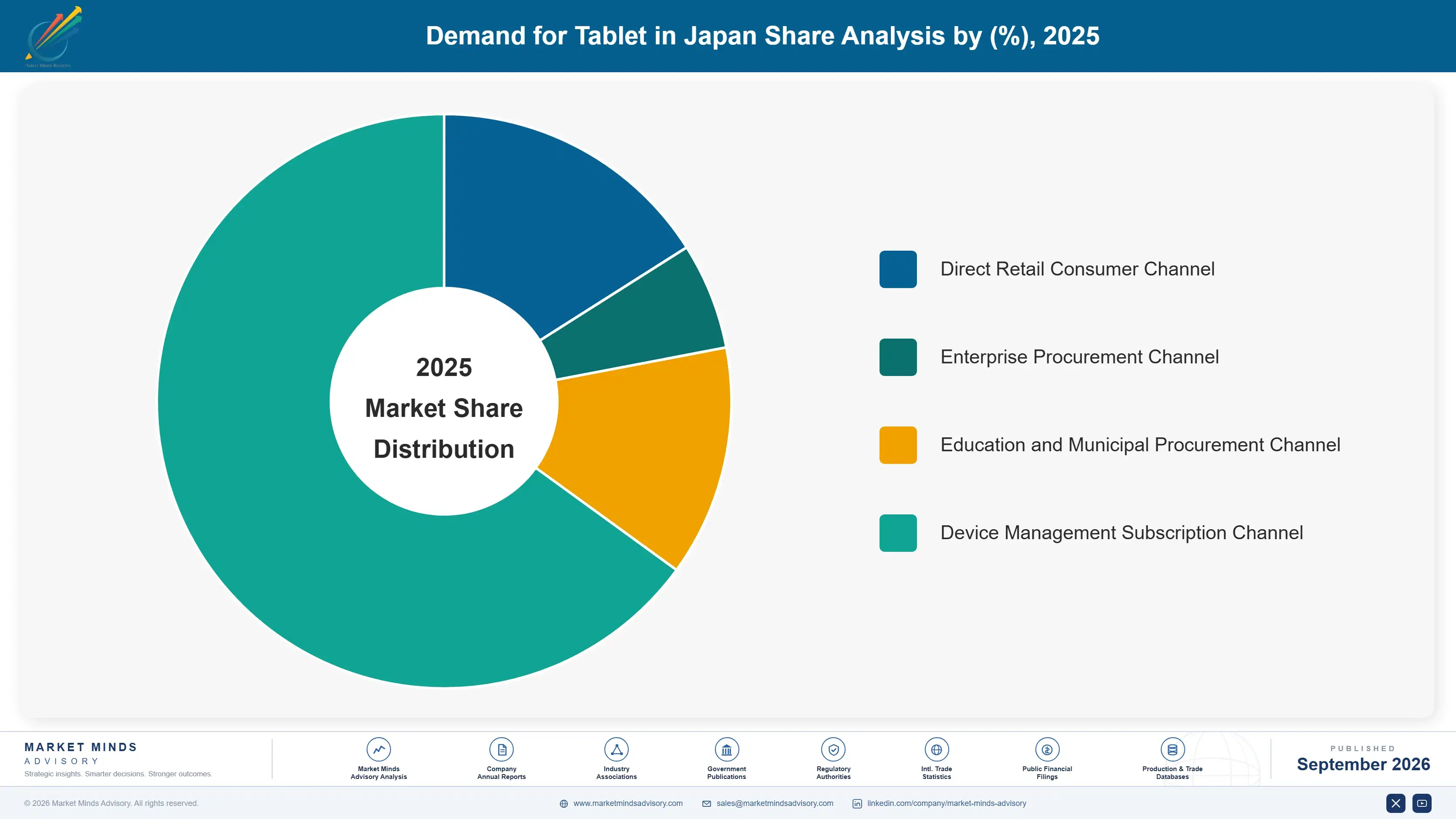
Six segments span the tablet value chain from consumer entertainment devices and productivity 2-in-1 designs through enterprise and education managed devices, accessories, and device management software services. Enterprise and education managed tablets are pulling ahead of consumer segments as institutional procurement replaces first-time consumer adoption as the primary demand driver shaping vendor strategy across the industry.
japan-tablet-market-market-share-analysis-1788426801828

Enterprise and Education Managed Tablets

Enterprise and education managed tablets have become the fastest-growing segment in this market, expanding at roughly 8.0 percent annually as institutional buyers replace individual consumers as the primary demand driver across mature markets like Japan and its major metropolitan cities and prefectures. Vendors with the most reliable fleet management platforms and predictable multi-year support commitments win large institutional procurement contracts specifically because administrators gate purchasing decisions on total cost of ownership rather than raw hardware appeal alone. Consumer-focused tablet suppliers are racing to build institutional sales capability internally, since large buyers increasingly refuse contracts with vendors lacking a credible device management roadmap and demonstrated fleet support track record over time.
CAGR 8.0%

Productivity 2-in-1 and Stylus-Enabled Tablets

Productivity 2-in-1 and stylus-enabled tablets are growing at roughly 6.5 percent annually as consumers and professionals seek devices that complement laptop functionality rather than simply serving as larger smartphones for casual browsing and light entertainment purposes each day. This segment sits between consumer entertainment tablets and full enterprise device fleets, handling the specialized work of supporting note-taking, creative applications, and light document editing that pure consumer tablets do not prioritize as heavily or consistently. Established consumer electronics vendors and specialized stylus accessory makers both compete here, and the segment benefits directly from remote and hybrid work adoption since every new productivity use case represents recurring accessory and software revenue streams.
CAGR 6.5%
Full segment breakdown across 7 segments available in the complete report.

Regional Architecture and Country Demand Map

East Asia and North America lead global demand, with Japan's replacement-cycle dynamics inside East Asia previewing where other mature markets are headed as first-time adoption growth fades across developed economies worldwide, while South Asia and Pacific still expand rapidly from a much smaller installed base.

North America

North America's tablet demand rests on a mature consumer base alongside a growing enterprise and education device management market that increasingly mirrors Japan's institutional procurement patterns and predictable replacement cycles across most regions and states. US school districts have adopted one-to-one device programs similar in structure to Japan's GIGA School Program, though implementation remains more fragmented across thousands of independent local school district budgets rather than a single coordinated national initiative. Enterprise adoption continues steadily as companies standardize tablet fleets for mobile workers, with device management software increasingly bundled into procurement contracts across most major industries. Canada's market mirrors US adoption patterns closely across both consumer and institutional buyer segments nationwide.
Share: 27% | CAGR: 4.5% (2026 to 2036)

Western Europe

Western Europe's demand reflects a similarly mature consumer market to Japan's, with first-time adoption largely complete and replacement cycles now driving the majority of unit volume across most major regional economies and cities today and going forward. Germany, France, and the UK have each implemented national or regional education technology initiatives comparable in ambition to Japan's GIGA School Program, though rollout timelines and funding levels vary considerably by country and region. Enterprise adoption trails North America somewhat, reflecting more conservative corporate technology procurement cycles typical across much of the region's established business culture and practices. Regional growth remains the slowest among major markets given near-complete market saturation across most demographic segments.
Share: 20% | CAGR: 3.0% (2026 to 2036)
Regional intelligence for 5 additional markets available in the complete report: East Asia, South Asia and Pacific, Latin America, Middle East and Africa, Eastern Europe. Contact sales@marketmindsadvisory.com.
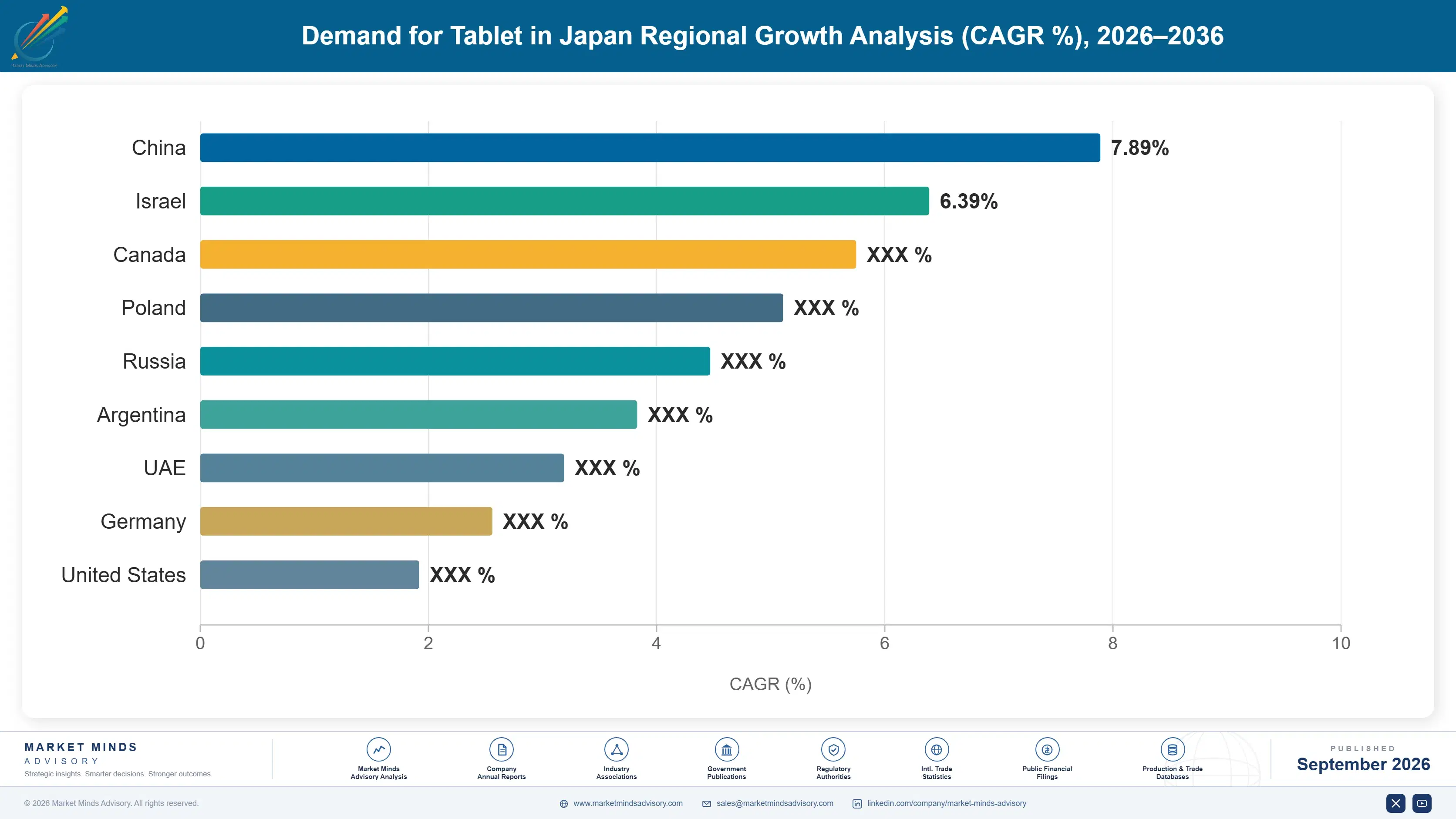
japan-tablet-market-country-cagr-analysis-1788426802334

Paths to Margin Beyond Hardware Volume

Vendors face a clear choice between competing on hardware price alone or building recurring revenue through device management software, extended support contracts, and accessory bundles that compound over multi-year institutional relationships. The vendors capturing fleet management contracts and predictable replacement cycle bids are pulling well ahead on total account value far beyond the initial hardware sale.

Fleet Management Software Compounding Institutional Value

Vendors that bundle device management software with hardware sales capture recurring subscription revenue that compounds annually rather than a single upfront device purchase from an institution. Institutions that adopt full fleet management suites generate roughly 30 percent more total account revenue over a device's service life than hardware-only purchases, since subscription fees continue well past the initial deployment and renewal rates run high among engaged administrators. This dynamic rewards vendors who invest in management platform reliability rather than treating software as an afterthought bolted onto commodity hardware, since renewal decisions increasingly hinge on platform quality rather than device specifications alone.
Market Impact: Fleet software adds 30 percent more account revenue

Extended Support Contracts Creating Predictable Revenue

Vendors that offer extended multi-year support and warranty contracts position themselves to capture predictable recurring revenue tied to institutional procurement cycles rather than relying solely on one-time hardware sales. Support-contract-enabled vendors report contract values roughly 20 percent higher than competitors offering standard warranties, since institutions increasingly prefer vendors who can guarantee support continuity across an entire multi-year device deployment period. This favors vendors with dedicated institutional support infrastructure over pure hardware manufacturers, who typically lack the service delivery expertise this work demands across dozens of distinct school district and enterprise contracts.
Market Impact: Extended support adds 20 percent more contract value

GIGA Replacement Wave Bidding Commanding Volume Contracts

Vendors positioning early for Japan's anticipated GIGA School Program replacement wave capture volume contracts that competitors entering the bidding process later cannot match given municipal procurement timelines and budget cycles. Early-positioned vendors close roughly 35 percent more municipal education contracts than late entrants, since school districts increasingly favor vendors who demonstrated reliability during the original 2020 rollout and understand local procurement processes. This lever rewards vendors who invest in government relations and municipal sales teams, since education procurement decisions favor familiar vendors with established local support infrastructure and demonstrated track records.
Market Impact: Early bidding wins 35 percent more municipal contracts

Senior-Focused Accessibility Features Expanding Consumer Reach

Vendors offering simplified interfaces and accessibility features designed for Japan's aging population capture consumer segments that standard tablet designs fail to serve given typical smartphone-style navigation complexity for older users unfamiliar with modern interfaces. Accessibility-focused vendors command roughly 25 percent pricing premiums on senior-targeted product lines, since families purchasing devices for elderly relatives prioritize ease of use over raw hardware specifications or brand prestige. This favors vendors with dedicated accessibility design teams over competitors treating senior users as an afterthought segment rather than a distinct product category worth genuine specialized investment.
Market Impact: Accessibility features command a 25 percent price premium

Who Controls the Margin Pool

CR5 of 68 percent reflects a heavily concentrated competitive field where five leading vendors hold more than two-thirds of global revenue, leaving little room for smaller challengers. Apple leads comfortably ahead of Samsung and the remaining top-five field, whose combined share still trails the leader by a substantial margin across most categories. Revenue is the evaluation basis used consistently throughout this section, since unit shipment counts alone understate premium-tier vendor advantage.
Current competitive activity centers on fleet management platform acquisitions, as hardware-focused vendors race to add device management software depth rather than build it internally over years. Several mid-tier competitors have announced extended support contract offerings this year, recognizing predictable multi-year revenue is quickly becoming a baseline requirement. Senior-focused accessibility features have also become a battleground, as vendors seek premium contracts tied to Japan's aging population.

Emerging pressure comes from budget device manufacturers offering adequate specifications at meaningfully lower price points, who can undercut premium vendors on price-sensitive segments. These challengers lack the institutional sales relationships and fleet management depth incumbents built over years, but partnerships with regional distributors are closing that gap. Rankings could shift if a well-funded entrant partners with a major Japanese school district procurement program.
japan-tablet-market-company-positioning-matrix-1788426802861

Competitive Moat and Risk Dimensions

APPLE INC

Moat: Device Portfolio Lock-In Advantage

Apple's tight integration between iPad and its broader hardware and software portfolio creates switching costs that pure-play tablet competitors cannot replicate, since customers already invested in Apple devices default to iPad for continuity. Japan's enterprise and education buyers particularly value this integration, given widespread existing Apple device deployment across Japanese corporate and school environments already.
APPLE INC

Risk: Premium Pricing Vulnerability

Apple's premium pricing sits well above budget competitors, creating vulnerability among cost-conscious institutional buyers who increasingly find adequate functionality in lower-priced Android alternatives lacking Apple's full device integration depth. Municipal education budgets facing funding constraints could accelerate defection toward cheaper alternatives during tight fiscal cycles ahead.
SAMSUNG ELECTRONICS CO LTD

Moat: Broad Price Tier Coverage

Samsung's tablet lineup spans budget to premium price tiers far more comprehensively than Apple's narrower range, letting Samsung capture both cost-conscious institutional buyers and premium consumer segments within a single unified brand relationship. This breadth gives Samsung flexibility to win diverse procurement bids that Apple's premium-only positioning cannot address.
SAMSUNG ELECTRONICS CO LTD

Risk: Brand Perception Below Apple

Samsung's tablets carry less premium brand cachet than Apple's iPad among Japanese consumers specifically, a market where Apple maintains unusually strong brand loyalty compared with most other developed economies globally. This has cost Samsung consumer market share it must instead capture through institutional and budget-tier channels.

Players Tracked

Prominent Players

Apple Inc
Samsung Electronics Co Ltd
Lenovo Group Limited
Huawei Technologies Co Ltd
Amazon.com Inc

Other Key Players

Microsoft Corporation
Xiaomi Corporation
ASUSTeK Computer Inc
Acer Inc
Sony Group Corporation
Sharp Corporation
Fujitsu Limited
NEC Corporation
Dynabook Inc
TCL Technology Group
Alcatel Mobile
Vankyo Electronics
Onyx International Inc
Chuwi Innovation Limited
Teclast Electronics Co Ltd

Recent Developments

MAY 2026

Apple Acquires Fleet Management Software Startup

Apple completed the acquisition of a device fleet management software startup specializing in education and enterprise deployment tracking, adding platform depth the company previously lacked in-house. The deal closes a gap between Apple's hardware scale and its comparatively basic management console offering, positioning it against dedicated management specialists.
Signal: Hardware incumbents are increasingly buying fleet management capability rather than spending years slowly building it internally.
MARCH 2026

Samsung Signs Supply Agreement With Japanese Municipality Consortium

Samsung Electronics signed a multi-year supply agreement with a consortium of Japanese municipalities to provide replacement tablets across their GIGA School Program device fleets, replacing a competitor's aging hardware. The agreement was a supply deal rather than an acquisition or joint venture, reflecting the consortium's preference for a single vendor.
Signal: Municipal education buyers are increasingly consolidating vendor relationships rather than splitting purchases across multiple hardware suppliers.
JANUARY 2026

Lenovo Launches Dedicated Senior Accessibility Tablet Line

Lenovo Group launched a dedicated senior-focused tablet line featuring simplified interfaces and large-format displays targeting Japan's aging consumer population, an organic product expansion rather than an acquisition. The launch responds directly to families seeking easier computing devices for elderly relatives without hiring a separate accessibility consultant.
Signal: Vendors are increasingly building accessibility-focused product lines internally rather than relying on third-party specialist product designers.

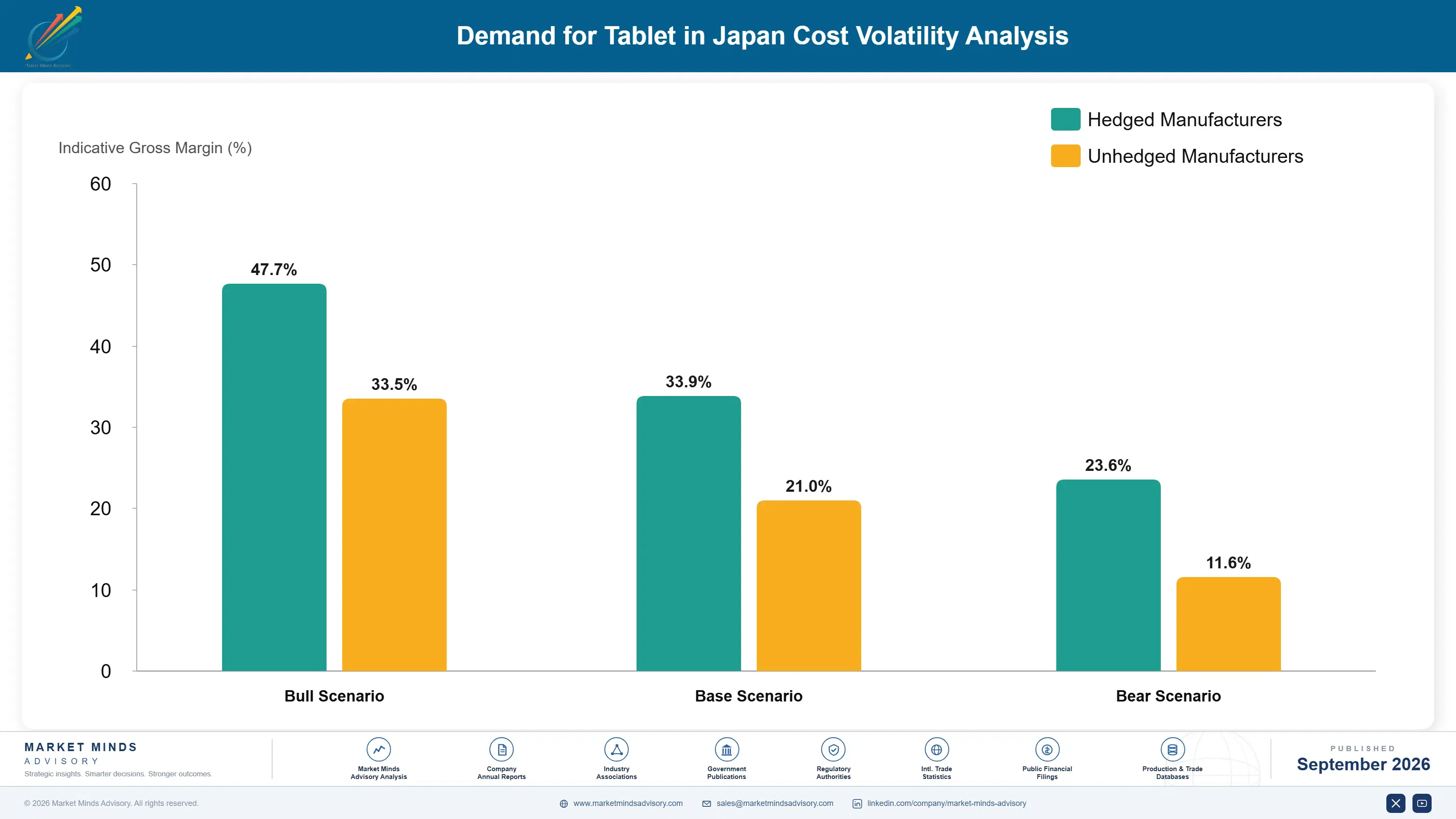
Display Panel and Chipset Cost Exposure

Display panels and application processor chipsets together represent roughly 48 percent of tablet hardware cost of goods sold, sourced predominantly from South Korean and Taiwanese manufacturing facilities. Battery and memory components add another 20 percent, sourced through global commodity markets rather than any single dominant supplier, exposing manufacturers to price swings tied to consumer electronics demand cycles.
The 2021 to 2022 global semiconductor shortage, documented extensively in IEA and industry supply chain reporting, extended tablet chipset lead times from roughly six weeks to over twenty weeks at the shortage's peak. Several vendors reported production delays that pushed committed shipment schedules back by entire quarters, forcing some retailers to temporarily restrict tablet inventory allocation while awaiting chipset delivery from backlogged suppliers globally. The episode pushed most major vendors to diversify component sourcing across additional regions.

Smaller regional tablet manufacturers lacking direct display panel and chipset supply relationships face the steepest exposure, since they typically buy through distributors at spot prices rather than negotiated contracts. Large incumbents like Apple and Samsung negotiate direct component allocation agreements with panel and chip manufacturers, insulating them from the worst price volatility that smaller competitors absorb directly, a durable cost advantage during any future shortage cycle.
japan-tablet-market-cost-volatility-analysis-1788426803056

Diversify Display Panel Sourcing Across Regions

Leading vendors now qualify display panels from at least two independent manufacturing regions rather than relying on a single geographic source, reducing exposure to any single country's export controls or facility-level disruptions entirely. This dual-sourcing approach adds modest qualification cost upfront but has prevented delivery delays during several subsequent regional supply disruptions since 2022.

Negotiate Multi-Year Chipset Allocation Contracts

Larger vendors increasingly negotiate multi-year chipset allocation agreements directly with semiconductor manufacturers rather than buying through distributors at spot prices, locking in both volume and price predictability years ahead of any actual future need. Smaller competitors are forming buying consortiums to access similar negotiated terms collectively, since none can match incumbent purchase volume alone.

Portfolio Architecture for Margin Defence

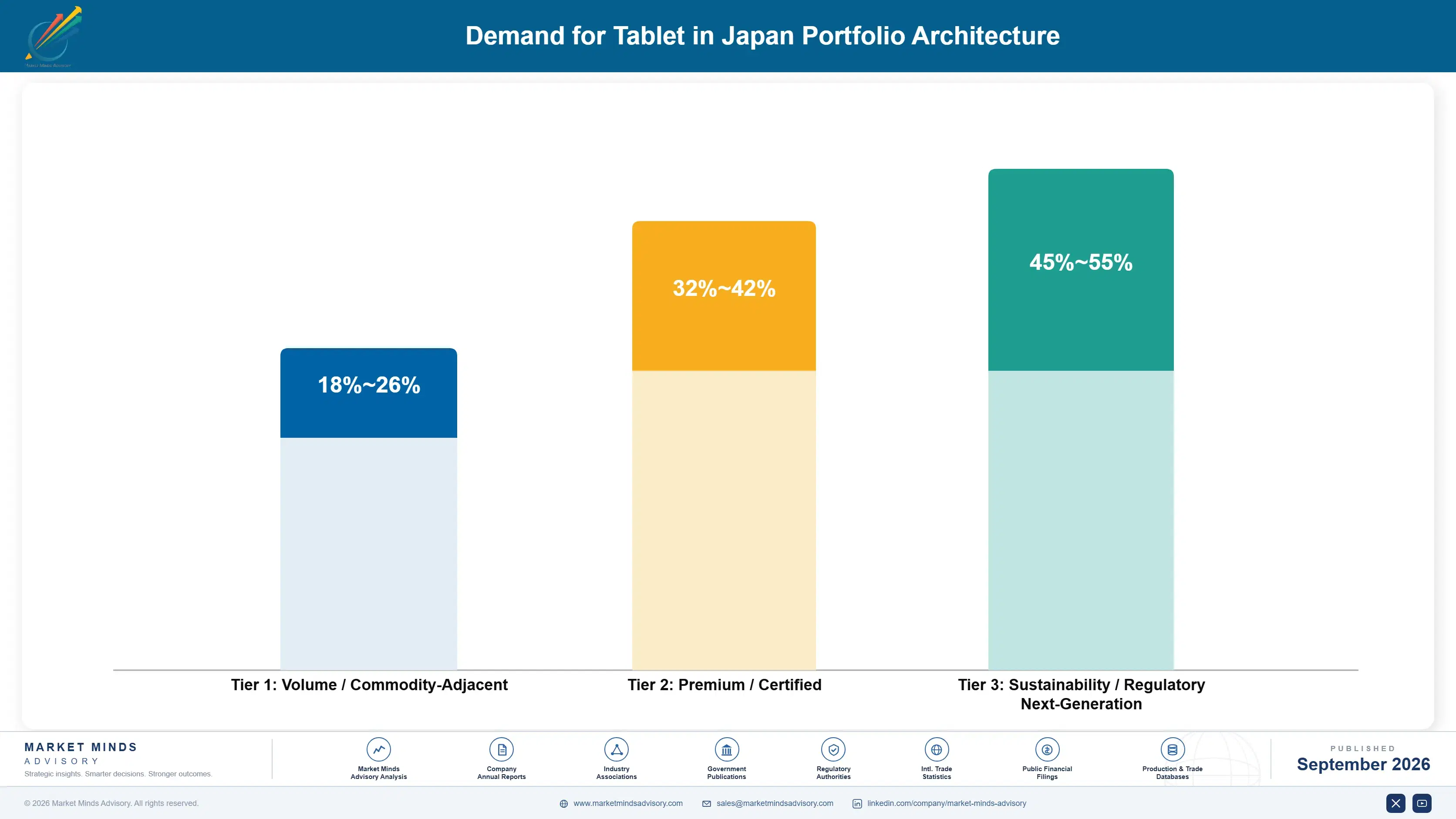
Three tiers structure this market's margin economics, from volume budget hardware sold on price to certified enterprise-managed devices and next-generation accessibility offerings that command the widest margins across the industry. Volume tier competition remains intense on unit price alone, while premium and next-generation tiers reward vendors with fleet management and specialized interface capability that budget hardware competitors cannot easily replicate at comparable cost.
Tension between volume and premium tiers plays out most visibly in cost-conscious consumer segments, where budget-constrained buyers often choose baseline hardware despite the long-term cost of forgoing device management revenue over a device's remaining service life. Premium tier buyers, largely enterprise and education institutions pursuing predictable total cost of ownership, are willing to pay more for integrated management software and extended support bundled into a single accountable vendor relationship.

High-value margin pools concentrate overwhelmingly in the sustainability and regulatory tier, where fleet management contracts and GIGA School Program replacement bids both command premium pricing well above ordinary hardware margins across most major programs. Vendors positioning exclusively in the volume tier face the greatest long-term margin compression as component costs standardize further and price competition intensifies among an expanding field of low-cost budget device manufacturers entering the space.

Volume / Commodity-Adjacent

Standardized budget tablets and basic Android devices competing primarily on unit price with minimal software bundling, sold largely to cost-sensitive consumer segments and price-sensitive emerging market buyers across most countries nationwide.
Gross Margin: 18-26%

Premium / Certified

Tablets bundled with device management software and extended support contracts, sold to enterprise and education institutions pursuing predictable total cost of ownership and detailed multi-year procurement planning cycles each year.
Gross Margin: 32-42%

Sustainability / Regulatory / Next-Generation

Fleet management platforms and accessibility-focused devices sold as institutional infrastructure to school districts and municipal buyers facing large-scale synchronized replacement cycles and detailed annual budget planning requirements nationwide and abroad.
Gross Margin: 45-55%
japan-tablet-market-portfolio-architecture-1788426803559

High-value Sub-segments and Strategic Watch-out

Enterprise and Education Managed Tablets

Enterprise and education managed tablets combine the fastest growth rate in the entire market with premium subscription pricing, making them the clearest high-value high-growth opportunity for vendors with the patient capital needed to build fleet management platform depth rather than rely purely on commodity hardware sales alone.

Productivity 2-in-1 and Stylus-Enabled Tablets

Productivity 2-in-1 and stylus-enabled tablets offer strong margins tied to hybrid work demand, though growth trails the enterprise managed segment since it depends on individual professional adoption timelines rather than pure institutional procurement alone, making this a high-value but moderate-growth opportunity worth watching closely for further acceleration.

Consumer Entertainment Tablets

Consumer entertainment tablets remain the volume core of this market, generating steady if unspectacular revenue as the entry point most households specify first before considering productivity accessories or management add-ons that vendors hope to attach later during subsequent replacement purchase cycles across the household unit.

Smartphone Screen Size Growth Erosion

Smartphone screen size growth represents a strategic watch-out given persistent erosion of casual tablet use cases that could cap consumer segment growth regardless of underlying replacement demand strength, making productivity differentiation a critical priority vendors must address collectively or risk losing consumer relevance over time.

Fleet Contracts Anchor Multi-Year Revenue

Once a school district or enterprise standardizes device management infrastructure around a specific vendor's platform, switching providers mid-contract means migrating an entire fleet's configuration and support relationships, a cost few institutions choose to absorb. This creates an annuity dynamic stronger than typical consumer electronics renewal patterns, since institutional procurement contracts run three to five years and switching mid-cycle risks disrupting service continuity administrators cannot easily justify.
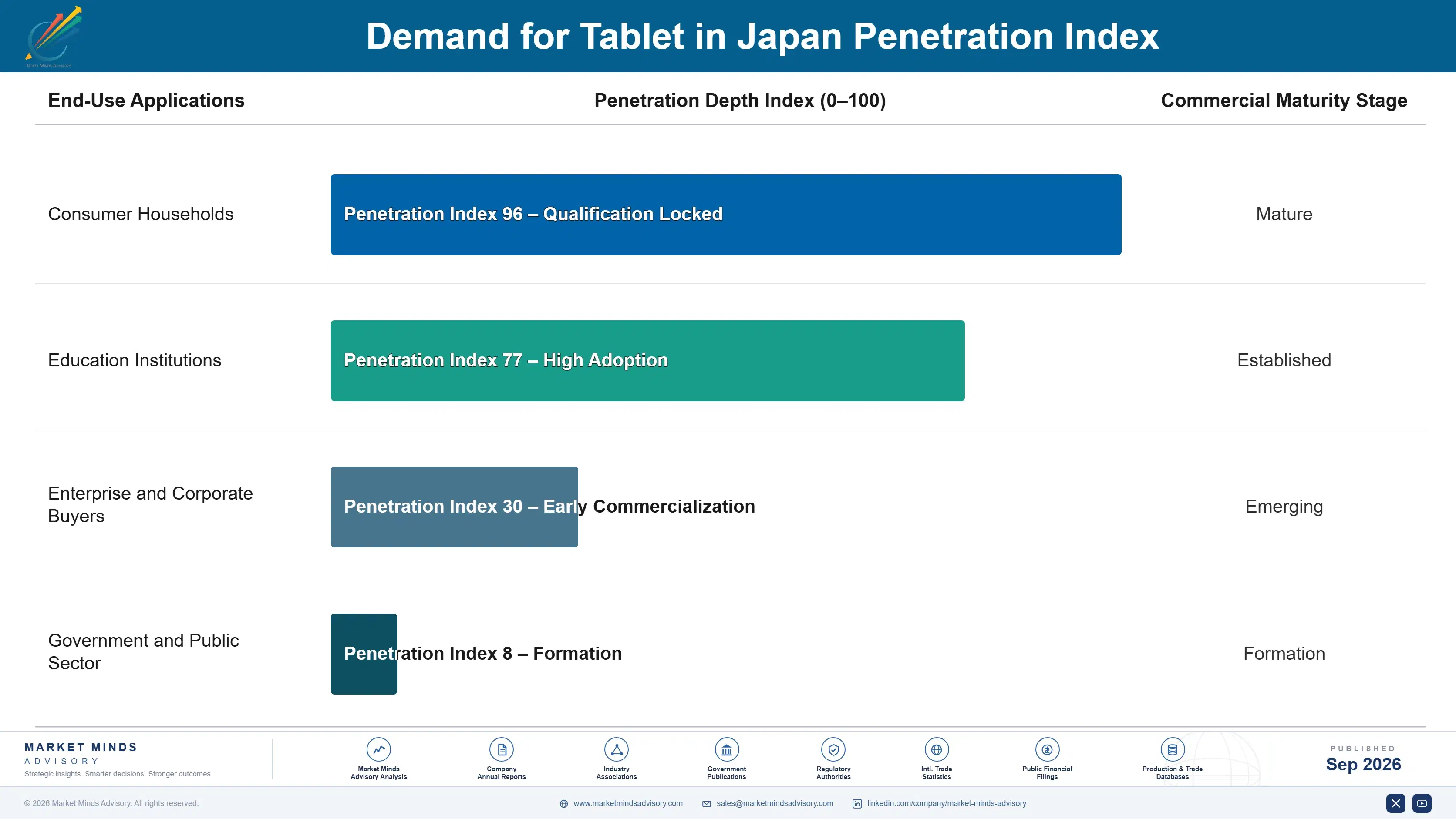
Adoption depth varies sharply by end-use vertical: education and enterprise buyers adopt full device management and extended support packages as standard procurement practice, while individual consumers increasingly treat tablets as secondary devices purchased less frequently than smartphones. Government and healthcare institutional buyers show intermediate adoption, driven less by budget cycles and more by security compliance requirements that make managed device platforms a near-mandatory purchase regardless of cost.

A generational shift is underway as younger IT administrators who grew up managing cloud-based enterprise software expect device fleet management to work like modern subscription services rather than legacy hardware procurement cycles. Procurement authority is also shifting from general IT departments toward dedicated device management and security teams who evaluate vendors on fleet management platform capability rather than raw hardware specifications alone.
japan-tablet-market-end-use-penetration-index-1788426804045

Where Fleet Contracts Win Replacement Cycles

These are among the four positions where our research anticipates prominent divergence between winners and laggards over the coming forecast period. Each is grounded in the demand model, the regulatory perimeter, and the announced capacity pipeline.
01 / FLEET MANAGEMENT INVESTMENT

Build or acquire device management depth before hardware margins compress further

Vendors still selling tablets as standalone hardware are ceding the most durable and profitable revenue stream in this entire market to competitors who bundle device management software from day one. The gap will widen further as institutional buyers increasingly require verified fleet visibility and security compliance that only software-enabled platforms can reliably deliver at meaningful scale across thousands of devices. MMA expects hardware-only vendors to lose specification battles on enterprise and education contracts within the next three to four years unless they acquire or build credible management capability soon.
02 / GIGA REPLACEMENT WAVE POSITIONING

Position early for Japan's GIGA School Program replacement wave before bidding closes

Japan's GIGA School Program replacement wave represents a rare, predictable, large-scale procurement event that vendors positioning early will capture disproportionately relative to competitors entering the bidding process later in the cycle. Early movers are building relationships with municipal procurement offices now, well ahead of the anticipated peak replacement period, giving them insider knowledge of local requirements that latecomers cannot easily replicate. MMA views this window as narrowing steadily over the next one to two years as major municipalities finalize vendor shortlists for their coming replacement cycles.
03 / SENIOR ACCESSIBILITY PRODUCT DEVELOPMENT

Invest early in senior-focused accessibility to capture Japan's aging demographic

Japan's aging population represents a distinct and growing consumer segment that standard tablet designs fail to serve adequately given typical smartphone-style navigation complexity most seniors find genuinely difficult to use. Vendors building dedicated accessibility features now are positioned to capture premium-tier consumer contracts that general-purpose competitors simply cannot serve with comparable simplicity or usability for older users. MMA expects accessibility specialization to become a meaningful differentiator within the next several years as Japan's population continues aging steadily across the country.
04 / PRODUCTIVITY DIFFERENTIATION AGAINST SMARTPHONES

Emphasize productivity features to defend against smartphone screen encroachment

Smartphone screen size growth continues to erode the practical justification for casual tablet purchases, forcing vendors to compete on genuine productivity differentiation rather than simply offering a larger version of a phone. Vendors emphasizing stylus support, multi-window capability, and productivity software integration are positioned to defend tablet relevance better than competitors relying solely on screen size and entertainment use cases. MMA recommends vendors invest in productivity feature development immediately rather than waiting for smartphone encroachment to further erode casual consumer tablet demand.

Engagement Snapshot From the Field

A live engagement with an industry participant carrying material or product regulatory and market exposure ahead of a defining policy shift, showing how our research translates into a defensible multi-year portfolio strategy.
MARKET MINDS ADVISORY · CLIENT ENGAGEMENT SUMMARY
Demand for Tablet in Japan Producer Strategic Portfolio Review and Transition Roadmap 2026·Investment Scenario on Demand for Tablet in Japan Exposure Evaluation 2025-26
CLIENT PROFILE
The client is a municipal education board overseeing roughly 80 public schools across a mid-size Japanese prefecture, managing a fleet of tablets originally deployed under the 2020 GIGA School Program rollout. Facing an approaching replacement wave with constrained annual budgets, the board sought guidance on which vendor could reliably deliver replacement devices while minimizing disruption to ongoing classroom instruction and existing device management infrastructure.
STRATEGIC CHALLENGE
The client needed to sequence a fleet-wide device replacement across dozens of schools without a clear framework for prioritization, risking both budget overruns and classroom disruption if the rollout proceeded poorly across the entire district. Internal teams lacked confidence in vendor selection criteria for such a large-scale multi-year procurement effort.
MMA APPROACH
MMA conducted a device-by-device condition assessment combined with a vendor capability evaluation across the five leading tablet suppliers serving Japan's education procurement market and municipal buyers. The engagement produced a phased replacement sequence and vendor shortlist tied to projected total cost of ownership and classroom disruption minimization across the multi-year rollout.
KEY FINDINGS
  1. Roughly 30 percent of the existing fleet showed battery degradation severe enough to warrant immediate priority replacement across the district (client-reported, unverified by MMA).
  2. Vendors offering integrated fleet management software reduced projected IT support burden by 40 percent compared with hardware-only bids (client-reported, unverified by MMA).
  3. Phased replacement across three school years was projected to reduce peak-year budget impact by roughly 35 percent overall (client-reported, unverified by MMA).
  4. Vendor pricing varied by up to 22 percent across the five suppliers evaluated during the assessment period overall (client-reported, unverified by MMA).
CLIENT PROFILE
The client is a municipal education board overseeing roughly 80 public schools across a mid-size Japanese prefecture, managing a fleet of tablets originally deployed under the 2020 GIGA School Program rollout. Facing an approaching replacement wave with constrained annual budgets, the board sought guidance on which vendor could reliably deliver replacement devices while minimizing disruption to ongoing classroom instruction and existing device management infrastructure.
STRATEGIC CHALLENGE
The client needed to sequence a fleet-wide device replacement across dozens of schools without a clear framework for prioritization, risking both budget overruns and classroom disruption if the rollout proceeded poorly across the entire district. Internal teams lacked confidence in vendor selection criteria for such a large-scale multi-year procurement effort.
MMA APPROACH
MMA conducted a device-by-device condition assessment combined with a vendor capability evaluation across the five leading tablet suppliers serving Japan's education procurement market and municipal buyers. The engagement produced a phased replacement sequence and vendor shortlist tied to projected total cost of ownership and classroom disruption minimization across the multi-year rollout.
KEY FINDINGS
  1. Roughly 30 percent of the existing fleet showed battery degradation severe enough to warrant immediate priority replacement across the district (client-reported, unverified by MMA).
  2. Vendors offering integrated fleet management software reduced projected IT support burden by 40 percent compared with hardware-only bids (client-reported, unverified by MMA).
  3. Phased replacement across three school years was projected to reduce peak-year budget impact by roughly 35 percent overall (client-reported, unverified by MMA).
  4. Vendor pricing varied by up to 22 percent across the five suppliers evaluated during the assessment period overall (client-reported, unverified by MMA).
RECOMMENDED STRATEGY
Phase 1: Phase one replaces the highest-priority degraded devices across ten schools within the first full school year of the overall program. Phase 2: Phase two extends replacement to remaining schools over two additional school years while renegotiating existing vendor support terms directly with each supplier. Phase 3: Phase three establishes ongoing device condition monitoring tied directly to the board's ongoing multi-year budget planning and full procurement cycle.
OUTCOME
The client began phase one replacement within four months of the engagement, reporting budget impact consistent with MMA's phased projections across the district (client-reported, unverified by MMA). The prioritization framework was subsequently shared with neighboring prefectures facing similar GIGA School Program replacement timelines, extending its use regionally.

Frequently Asked Questions

Foundational context covering the market sizes, CAGR, scope, country, region and competition that inform every finding below. This section is provided to cover basics and most often pre-purchase conversations, answered from the MMA Primary Research Dataset.

What is the current size of the Demand for Tablet in Japan Market?

The global tablet market, of which Japan is the analytical focus of this report, is valued at $52.0 billion in 2025. Growth is driven primarily by institutional replacement cycles and enterprise device management adoption.

How large will the Demand for Tablet in Japan Market be by 2036?

The market is projected to reach $84.39 billion by 2036. This reflects sustained demand from enterprise and education managed tablet adoption alongside gradual emerging market growth.

What is the CAGR for the Demand for Tablet in Japan Market 2026 to 2036?

The market is expected to grow at a compound annual rate of 4.5 percent between 2026 and 2036. Bull and bear scenarios range from 3.3 to 5.7 percent.

Which segment is growing fastest?

Enterprise and Education Managed Tablets leads at roughly 8.0 percent annually, about 1.78 times the overall market rate. Institutional buyers requiring fleet management and predictable replacement cycles drive this segment.

Who are the major companies in the Demand for Tablet in Japan Market?

Apple, Samsung Electronics, Lenovo, Huawei Technologies, and Amazon lead the competitive field across consumer, enterprise, and education device categories. Together the top five vendors hold 68 percent combined revenue share.

Which country is growing fastest?

India leads at roughly 9.5 percent annually, driven by rapidly expanding first-time adoption as smartphone-adjacent computing spreads into previously underserved households and schools nationwide today.

Report Segmentation Architecture

The full report scope spans multiple orthogonal segmentation dimensions, with cross-tabulated demand data provided for each dimension pair. Coverage extends further to regional breakdowns, trend trajectories, and the competitive detail needed to support segment-level decision-making.
  • Consumer Entertainment Tablets
  • Productivity 2-in-1 and Stylus-Enabled Tablets
  • Enterprise and Education Managed Tablets
  • Senior-Focused Accessibility Tablets
  • Device Management Software and Services
  • Accessories and Peripheral Devices
  • Consumer Households
  • Education Institutions
  • Enterprise and Corporate Buyers
  • Government and Public Sector
  • Direct Retail Consumer Channel
  • Enterprise Procurement Channel
  • Education and Municipal Procurement Channel
  • Device Management Subscription Channel

By Region

  • North America
  • Western Europe
  • East Asia
  • South Asia and Pacific
  • Latin America
  • Middle East and Africa
  • Eastern Europe

Scope, Methodology, and Coverage

Every figure in this report is reproducible from documented input assumptions. The scope below maps the historical period, the forecast horizon, the segmentation dimensions, and the countries covered, alongside the underlying primary and qualitative methodology.
Historical Period
2020 to 2025
Forecast Period
2026 to 2036
Base Year
2025 (USD billions; MMA Primary Research Dataset, September 2026)
Market Definition
This report covers consumer, enterprise, and education-market tablet devices including their operating system platforms and managed device services, with global market sizing and Japan featured as the leading indicator of mature-market replacement-cycle demand. It excludes laptop computers, smartphones, and e-reader devices without general-purpose computing capability.
Quantitative Units
USD billions (current prices)
Segmentation Dimensions
By Product Type; By End-Use Industry; By Commercial Dimension; By Region
Regions Covered
North America, Western Europe, East Asia, South Asia and Pacific, Latin America, Middle East and Africa, Eastern Europe
Countries Covered
USA, China, Germany, France, UK, Japan, South Korea, India, Australia, Canada, Brazil, Mexico, Indonesia, Vietnam, Thailand, Malaysia, UAE, Saudi Arabia, South Africa, Nigeria, Turkey, Poland, Netherlands, Italy, Spain, Sweden, Switzerland, Argentina, Colombia, Singapore, and additional markets relevant to this sector
Key Companies Profiled
Apple Inc, Samsung Electronics Co Ltd, Lenovo Group Limited, Huawei Technologies Co Ltd, Amazon.com Inc, Microsoft Corporation, Xiaomi Corporation, ASUSTeK Computer Inc, Acer Inc, Sony Group Corporation, Sharp Corporation, Fujitsu Limited, NEC Corporation, Dynabook Inc, TCL Technology Group, Alcatel Mobile, Vankyo Electronics, Onyx International Inc, Chuwi Innovation Limited, Teclast Electronics Co Ltd
Quantitative Methodology
Primary survey, n=3,800 respondents, Q4 2025, six countries; demand-side model with trade association cross-validation
Qualitative Methodology
47 expert interviews, Q4 2025; applied to validate demand model assumptions, identify emerging dynamics, and assess competitive positioning
Report Format
PDF and XLSX data workbook (Word format preview document)
Publisher
Market Minds Advisory
Report Code
MMA-2026-TEC-241
Published
September 2026
Contact
sales@marketmindsadvisory.com | www.marketmindsadvisory.com

Purchase the full Demand for Tablet in Japan Report (2026 to 2036).

This report delivers a complete assessment of the global tablet market, using Japan's mature replacement-cycle dynamics as an analytical lens for where other developed economies are headed through 2036. It quantifies segment-level growth rates, regional demand concentration, and competitive positioning among twenty leading device vendors. The analysis draws on primary survey data from 3,800 respondents and 47 expert interviews conducted in the fourth quarter of 2025. Readers gain a clear view of where institutional replacement demand concentrates and which vendors are best positioned to capture it.
Ten-year market sizing and growth forecasts
Segment-level CAGR and demand growth analysis
Competitive benchmarking of twenty leading vendors
Regional demand architecture across seven regions
Input cost and display panel supply risk assessment
Strategic revenue lever identification for vendors

Built For The People Who Decide

From boardroom strategy to bench-side execution, this report is read cover-to-cover by leaders shaping the next decade of their industry, turning demand scenarios, market dynamics and valuation benchmarks into decisions.
CXOs/ Presidents/ VPs/ Managers
M&A and Corporate Development
Strategy Teams and R&D Heads
Procurement and Product Directors
Regulatory and Compliance Leaders
Investor Relations and Equity Analysts