Market Minds Advisory
Demand for Storage Area Network (SAN) in Japan

Demand for Storage Area Network (SAN) in Japan: Demand for Storage Area Network (SAN) in Japan. Enterprise Storage Network Modernization for AI-Scale Data Growth

Japanese enterprises are rearchitecting storage networks around NVMe over Fabrics as AI workload data volumes strain legacy Fibre Channel infrastructure across finance, manufacturing, and hyperscale data center segments nationwide today.

Lead Analyst

Published

September 2026

Make Smarter Decisions with Customized Research Insights

Request a free sample report and evaluate market opportunities, growth trends, and competitive dynamics relevant to your business needs.

2025 MARKET VALUE$19.5BMarket Size 2025
2036 FORECAST VALUE$52.9BBase Case , 2026 to 2036
CAGR 2026 TO 20369.5 %Bull 10.7% / Bear 8.3%
INCREMENTAL OPPORTUNITY$31.6BNet 10- year value creation
EXPANSION MULTIPLE2.48x2036 value over 2026 base
Strategic Levers
M&A Pipeline
Regional Outlook
Country Rankings
Competitive Intelligence
Segmental Deep-dive
Call-Us : 91 93563 13602

Executive Snapshot and Market Trajectory.

Japanese enterprise storage buyers are shifting budget from legacy Fibre Channel arrays toward NVMe-based fabrics as AI training and analytics workloads push data volumes beyond what spinning-disk architecture can sustain across their production data center footprints nationwide this current planning cycle, straining budgets already stretched thin.
Financial services and manufacturing conglomerates concentrate the heaviest near-term spending, with Tokyo-area data centers absorbing a disproportionate share of new NVMe-oF deployment as hyperscale and enterprise buyers race to support generative AI inference pipelines at scale nationwide, while regional carriers and mid-sized manufacturers follow more gradually behind the leading Tokyo cluster's adoption curve, constrained by tighter capital budgets, slower internal migration planning cycles, and noticeably smaller dedicated infrastructure engineering teams across most regional facilities overall.
Competition centers on a small group of established vendors defending installed-base relationships against faster-moving NVMe-native challengers, while government-backed digital infrastructure initiatives and semiconductor supply chain policy add further momentum to network storage modernization across regulated industries, and incumbent Japanese conglomerates increasingly favor domestic vendor relationships over pure performance benchmarking when awarding long-term storage infrastructure contracts across their networks and subsidiaries nationwide, favoring long-standing supplier familiarity over unproven challenger performance claims.
Market Definition
This report covers block-level storage area network hardware, switching fabric, and management software deployed across Japanese enterprise and hyperscale data centers, including Fibre Channel, iSCSI, and NVMe over Fabrics architectures. It excludes standalone direct-attached storage, object storage platforms, and public cloud storage services procured without dedicated on-premises SAN infrastructure.
Base Year Value
$19.5B in 2025 (MMA Primary Research Dataset, September 2026)
Forecast Period
2026 to 2036, eleven discrete annual values
CAGR
9.5% base case. Bull 10.7%. Bear 8.3%.
Fastest Growth Segment
NVMe over Fabrics (NVMe-oF) SAN Systems: 14.5% CAGR
Fastest Growth Country
Japan: 10.8% CAGR
Fastest Growth Region
South Asia and Pacific: 11.5% CAGR
Largest Region
East Asia: 30% of 2025 global value
Market Leaders
Hitachi Vantara, NetApp, Dell Technologies, Hewlett Packard Enterprise, and Pure Storage lead the market. Source: MMA Analysis, July 2026.
Primary Survey
n=3,800 procurement and R&D decision-makers, Q4 2025, six countries
Methodology
Demand-side build-up, cross-validated against public data, 47 expert interviews

Demand for Storage Area Network (SAN) in Japan Market Forecast Scenarios

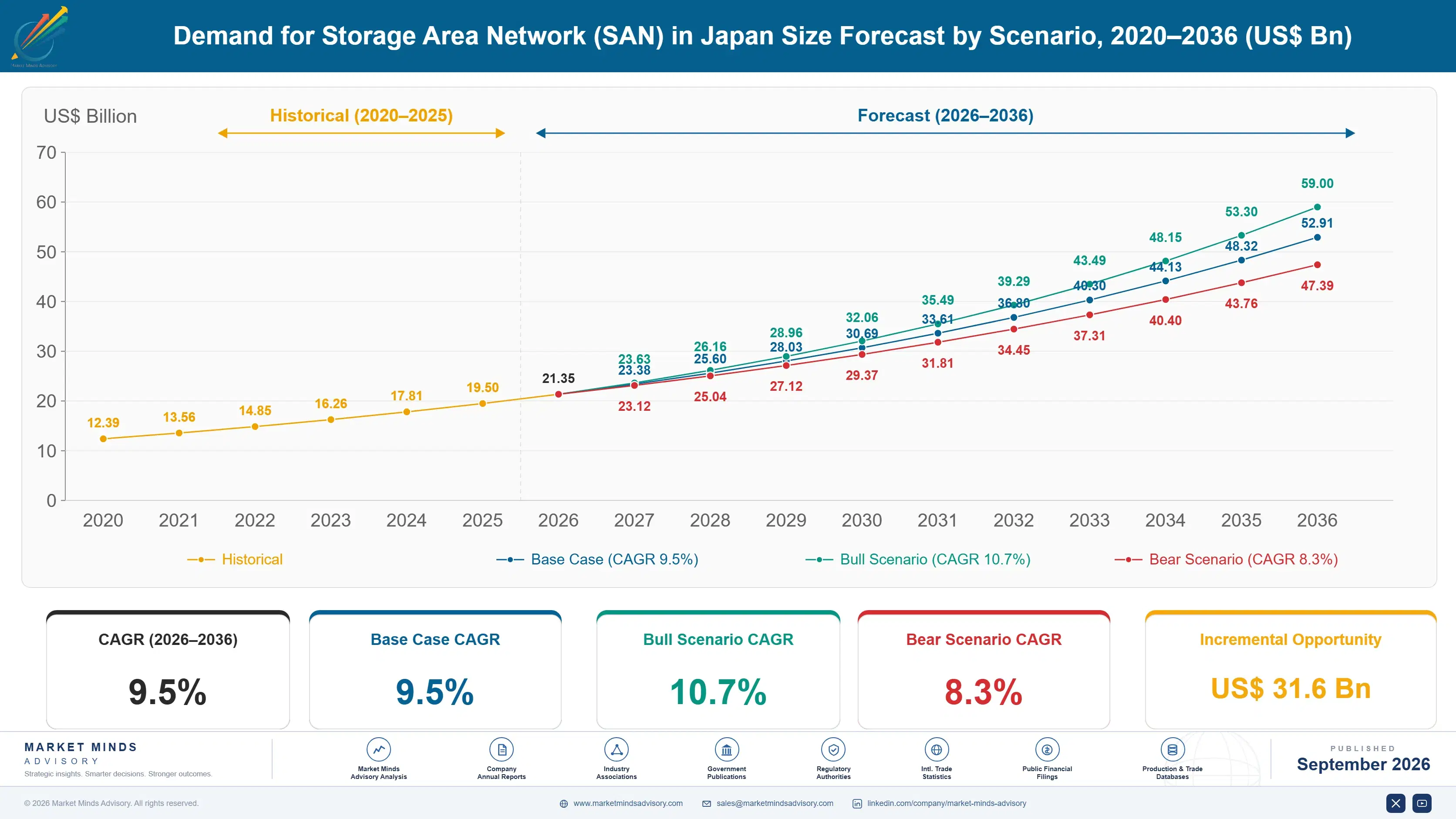
japan-storage-area-network-san-market-size-forecast-scenario-1788427994317
Japan's SAN market grew steadily through 2020 to 2025 as enterprises modernized aging Fibre Channel infrastructure and expanded flash storage capacity, though growth remained constrained by conservative capital planning cycles typical of large domestic conglomerates and slower-than-expected AI workload adoption across most regulated industries during the earlier portion of that historical window across most regulated sectors nationwide.
The base case assumes continued NVMe-oF adoption acceleration, sustained AI infrastructure investment from hyperscale and enterprise data centers, and gradual displacement of legacy Fibre Channel arrays as vendors extend certified compatibility across broader server and networking infrastructures throughout the forecast window. Government digital infrastructure incentives further support upgrade cycles across regulated financial and manufacturing sectors nationwide, while domestic vendor relationships continue shaping long-term procurement decisions across most conglomerate buying committees.
A stronger bull case assumes faster generative AI inference scaling pulls forward network storage capital spending across Tokyo-area data centers well ahead of current projections, compressing typical multi-year upgrade cycles into a much shorter window. The bear case assumes prolonged semiconductor supply constraints delay NVMe hardware availability, pushing enterprise upgrade timelines out by several fiscal quarters nationwide and dampening near-term vendor revenue growth.

AI Workloads Force Storage Fabric Modernization

Japanese enterprises are converging on a common storage modernization thesis: legacy Fibre Channel arrays cannot sustain AI training and inference data volumes without costly fabric upgrades, forcing budget reallocation from routine maintenance toward wholesale NVMe-oF migration projects across finance, manufacturing, and hyperscale data center segments over the coming several years nationwide, reshaping vendor selection criteria across most large domestic conglomerates in the process this cycle.
MARKET CONCENTRATIONCR5 66%Top five vendors hold majority installed base share
AVERAGE FABRIC SWITCH PRICE$48,000Per enterprise-grade director class switching unit installed nationwide
DOMESTIC VENDOR SHARE38%Of total installed base held by Japanese suppliers
FLASH STORAGE PENETRATION61%Of newly deployed SAN capacity nationwide this cycle
REFRESH CYCLE LENGTH5-7 yearsTypical enterprise storage array replacement interval before upgrade
IMPLEMENTATION COST SHARE22%Of total deployment budget beyond base hardware pricing
Commercial character in this market favors incumbent vendors with deep installed-base relationships, though NVMe-native challengers are winning greenfield hyperscale deployments where legacy compatibility carries less weight than raw throughput performance, particularly among newer data center operators lacking long-standing procurement ties to established domestic suppliers and their extended maintenance contract networks built up over many decades of continuous enterprise infrastructure servicing relationships nationwide.
Government digital infrastructure policy and semiconductor supply chain considerations will shape vendor selection over the coming decade, alongside domestic conglomerates' persistent preference for suppliers offering localized support and long-term maintenance guarantees, a dynamic that continues to favor incumbent Japanese and multinational vendors with established service networks nationwide over challengers still building comparable domestic support infrastructure across the country.
"Every large Japanese enterprise we've spoken with treats their storage refresh cycle as a forced AI readiness decision now, not a routine hardware swap they can defer another budget cycle."
Director, Enterprise Infrastructure Practice · MMA Enterprise Storage Infrastructure and Networked Data Systems Practice · September 2026

Market Trends

AI Inference Pipelines Push Storage Toward NVMe Fabrics

Generative AI inference and training workloads require sustained low-latency data access at throughput levels legacy Fibre Channel arrays cannot deliver economically at scale. Japanese hyperscale operators and large enterprises are deploying NVMe over Fabrics infrastructure to feed GPU clusters continuously, avoiding the storage bottlenecks that stall model training runs across production environments. Vendors certifying NVMe-oF compatibility across broader server and networking hardware are capturing greenfield deployment budget faster than incumbents still reliant on legacy fabric architecture and slower internal qualification cycles overall this cycle across most competing product lines and vendor roadmaps.
Market Impact: 28 percent capacity growth AI-linked

Domestic Semiconductor Policy Shapes Storage Hardware Sourcing

Japan's semiconductor supply chain resilience policy increasingly favors storage hardware sourced through domestic or allied-nation manufacturing channels, particularly for government and regulated financial sector deployments across the country. This has pushed several vendors to expand local assembly and qualification capacity within Japan rather than relying solely on offshore production facilities. Buyers in regulated sectors increasingly weight supply chain provenance alongside raw performance when evaluating competing storage fabric vendors during procurement cycles, adding a new qualification dimension beyond traditional price and throughput benchmarks nationwide across nearly every regulated procurement cycle underway.
Market Impact: 31 percent nearing end-of-life

Market Opportunities and Growth Drivers

AI Data Center Capacity Expansion Drives Fabric Demand

Japan's largest hyperscale operators and cloud providers are expanding data center capacity specifically to support generative AI training and inference workloads, and each new facility requires dedicated high-throughput storage fabric infrastructure from day one. This capacity buildout is concentrated around Tokyo and Osaka metropolitan corridors, where power availability and fiber connectivity support the dense compute clusters AI workloads demand. Storage vendors with proven NVMe-oF deployment references are winning a disproportionate share of these greenfield facility contracts over slower-moving incumbents still qualifying newer fabric technology internally across their broader product portfolios and regional sales channels.
Market Impact: 23 percent delay planned migration

Legacy Fibre Channel End-of-Life Forces Refresh Cycles

A substantial share of Japan's installed Fibre Channel SAN base is approaching vendor end-of-support dates, forcing enterprises into mandatory refresh decisions regardless of underlying AI workload pressure. Financial institutions and manufacturing conglomerates operating under strict data availability requirements cannot run unsupported hardware, creating a predictable multi-year replacement wave independent of discretionary AI infrastructure spending. This refresh cycle gives incumbent vendors an opening to cross-sell NVMe-oF capability to buyers who might otherwise have deferred any storage infrastructure decision for several additional fiscal years absent this forced compliance timeline across their existing infrastructure footprint.
Market Impact: 17 percent evaluate switching vendors annually

Market Restraints and Challenges

NVMe-oF Migration Complexity Slows Enterprise Adoption Pace

Migrating production storage environments from Fibre Channel to NVMe over Fabrics requires extensive compatibility testing across servers, networking hardware, and application layers, and Japanese enterprises operating mission-critical financial and manufacturing systems cannot tolerate migration downtime or data integrity risk. The root cause is that many legacy applications were architected around Fibre Channel latency assumptions never designed for NVMe throughput characteristics. Vendors are responding with staged migration tooling and parallel-run compatibility layers that let enterprises validate NVMe-oF performance before fully decommissioning legacy fabric infrastructure across production environments, reducing operational risk during the transition window considerably.
Market Impact: 34 percent of deployments now NVMe-oF

High Switching Costs Entrench Incumbent Vendor Relationships

Enterprise SAN deployments involve deep integration with existing server virtualization, backup, and disaster recovery systems, and switching vendors requires re-certifying compatibility across this entire technology stack at considerable cost and risk. The root cause is decades of accumulated vendor-specific tooling and staff expertise that would need retraining under a new supplier relationship. This commercial impact locks smaller challengers out of large enterprise accounts even when their NVMe-oF performance benchmarks are competitive, though some challengers are mitigating this through phased pilot deployments limited to non-critical workloads first, building trust gradually over successive contract renewal cycles.
Market Impact: 19 percent require domestic sourcing
3 additional market trends, 4 additional growth drivers, and 3 additional restraints and challenges are covered in the full report. Contact sales@marketmindsadvisory.com to access the complete intelligence.

Segment CAGR and Growth Architecture

This report segments Japan's SAN market by underlying fabric technology and protocol architecture, the dimension most directly shaping vendor competitive positioning, buyer procurement decisions, and total cost of ownership as enterprises migrate from legacy Fibre Channel toward NVMe-native infrastructure across their production environments nationwide, spanning finance, manufacturing, and hyperscale operators alike across the country's largest metropolitan corridors.
Section default visual

NVMe over Fabrics (NVMe-oF) SAN Systems

NVMe-oF systems are the fastest-growing segment in Japan's SAN market, expanding at 14.5 percent annually as hyperscale operators and large enterprises deploy fabric infrastructure specifically engineered for AI training and inference throughput demands. Vendors certifying broad server and networking compatibility are capturing disproportionate greenfield deployment budget, while incumbents extend legacy Fibre Channel product lines with NVMe-oF add-on modules to retain installed-base customers reluctant to fully replatform. Tokyo and Osaka data center corridors concentrate the heaviest near-term deployment volume nationwide this cycle across most facility types, as hyperscale operators race to keep pace with GPU cluster expansion and AI inference demand growth across their newest data halls, a pattern likely to persist through most of the forecast period.
CAGR 14.5%

All-Flash Fibre Channel SAN Arrays

All-flash Fibre Channel arrays remain the second-fastest-growing segment, expanding at 12.0 percent annually as enterprises upgrade capacity without fully replatforming onto NVMe-native fabric architecture. This segment appeals to buyers wanting flash performance gains while preserving existing Fibre Channel switching investments and staff expertise built up over many years of continuous operation. Financial institutions with strict data availability requirements favor this incremental upgrade path over riskier wholesale NVMe-oF migration projects, sustaining steady demand even as newer protocol adoption accelerates elsewhere across the broader market, particularly among mid-sized manufacturers still completing earlier flash storage modernization investment cycles nationwide before considering any further protocol transition across their remaining legacy storage footprint nationwide and abroad.
CAGR 12.0%
Full segment breakdown across 6 segments available in the complete report.

Regional Architecture and Country Demand Map

This report's analytical scope concentrates on Japan's SAN market specifically, with East Asia's regional share reflecting Japan's outsized weight within it. The other six regions provide benchmarking context for comparative technology adoption patterns nationwide, though direct commercial linkage varies considerably across each of the six benchmarking regions covered.

East Asia

This region's 30 percent share sits at the top of its standard 22 to 30 percent band, justified because this report analyzes Japan's SAN market specifically, and East Asia's regional figure reflects Japan's outsized weight within the broader regional total. Japanese enterprises are migrating from legacy Fibre Channel toward NVMe over Fabrics infrastructure faster than most regional peers, driven by AI inference demand concentrated around Tokyo and Osaka data center corridors. South Korean and Taiwanese semiconductor manufacturers add further regional demand, though Japan's regulated financial and manufacturing sectors dominate this report's specific analytical focus nationwide. Domestic conglomerates increasingly weight supply chain provenance and long-term maintenance guarantees when selecting between competing storage fabric vendors during procurement cycles nationwide.
Share: 30% | CAGR: 10.5% (2026 to 2036)

North America

United States hyperscale operators lead global NVMe-oF adoption, and their deployment patterns provide useful benchmarking context for this report's Japan-focused analysis, though direct commercial linkage between the two markets remains limited given distinct vendor landscapes, regulatory environments, and domestic sourcing preferences that shape Japanese enterprise procurement decisions differently across most large conglomerate buying committees nationwide. Their sourcing models, semiconductor supply chain positioning, and regulatory frameworks diverge sharply from the domestic preferences shaping Japanese enterprise storage procurement across most conglomerate buying committees. North American hyperscale capital spending on AI infrastructure vastly exceeds Japan's absolute deployment scale, though the underlying NVMe-oF technology transition follows a broadly similar trajectory across both mature enterprise storage markets.
Share: 26% | CAGR: 9.5% (2026 to 2036)
Regional intelligence for 5 additional markets available in the complete report: Western Europe, South Asia and Pacific, Latin America, Middle East and Africa, Eastern Europe. Contact sales@marketmindsadvisory.com.
japan-storage-area-network-san-market-market-share-analysis-1788427994854

Capturing Value Beyond Standard Fabric Hardware Sales

Beyond core fabric hardware sales, vendors in Japan's SAN market can build durable margin through certification services, migration tooling, and analytics capability that address specific enterprise pain points during the ongoing NVMe transition nationwide across regulated financial, manufacturing, and hyperscale customer segments alike, each weighing switching costs and long-term maintenance commitments differently across their existing budget cycles.

Expand NVMe-oF Migration Consulting Service Lines

Enterprises facing complex Fibre Channel to NVMe-oF migration decisions increasingly pay for structured consulting engagements that de-risk the transition, covering compatibility testing, staged rollout planning, and staff retraining across production environments. Vendors building dedicated migration consulting practices capture recurring service revenue beyond one-time hardware sales, particularly among financial institutions and manufacturers unwilling to risk downtime. This service layer, typically priced at 12 to 18 percent of contract value, also strengthens long-term account relationships that support future hardware refresh cycles across the enterprise customer base nationwide, compounding revenue across successive renewal periods.
Market Impact: Captures a share of the 23 percent delayed-migration segment now

Build Domestic Supply Chain Certification Programs

Government and regulated financial sector buyers increasingly require documented domestic or allied-nation sourcing provenance before awarding storage infrastructure contracts, and vendors building formal certification programs around this requirement capture a growing share of policy-driven procurement nationwide. This certification layer commands premium pricing over standard hardware sales given the compliance assurance it provides regulated buyers facing strict internal audit requirements. This certification layer typically commands a 15 to 20 percent price premium, and vendors slow to build this capability risk losing regulated-sector accounts to faster-moving domestic competitors entirely across their existing customer base.
Market Impact: Captures a share of the 19 percent domestic-sourcing segment now

Develop AI Workload Performance Analytics Tools

Enterprises deploying NVMe-oF infrastructure for AI training and inference workloads increasingly want visibility into fabric performance bottlenecks affecting model training throughput, creating demand for dedicated analytics tooling beyond basic storage monitoring. Vendors bundling workload-aware performance analytics with their fabric hardware differentiate on measurable AI infrastructure outcomes rather than raw throughput specifications alone. This capability also generates recurring software subscription revenue, typically adding 8 to 12 percent to total contract value, improving overall account profitability well beyond the initial hardware sale nationwide across most deployments and successive renewal contract cycles across the broader installed base.
Market Impact: Captures the 34 percent NVMe-oF deployment segment now

Offer Phased Pilot Deployment Programs For Challengers

Smaller NVMe-native vendors lacking established enterprise relationships can capture switching-cost-averse buyers through structured phased pilot programs that limit initial risk to non-critical workloads before broader production deployment. This approach lowers the switching barrier that otherwise favors incumbent vendors with deep installed-base relationships, letting challengers prove performance claims incrementally across successive contract renewal cycles. Vendors executing this strategy well convert roughly 40 percent of pilot engagements into full production contracts, meaningfully higher rates than cold enterprise sales outreach alone typically achieves across comparable buyer segments and account types nationwide this cycle.
Market Impact: Captures the 17 percent vendor-switching evaluation segment now

Who Controls the Margin Pool

Japan's SAN market carries a CR5 of 66 percent, reflecting a concentration where five established vendors hold most installed-base revenue while a wider field of smaller specialists compete for greenfield and challenger accounts nationwide. The gap between leading vendors and mid-tier challengers remains substantial, anchored by decades of enterprise service relationships and domestic sourcing preferences that favor incumbents heavily across most large conglomerate accounts.
Current competitive activity centers on NVMe-oF certification breadth, domestic supply chain qualification, and expanding migration consulting service lines that deepen account relationships beyond one-time hardware sales across regulated financial and manufacturing segments. Vendors are also racing to certify compatibility across the widest possible range of server and networking hardware combinations that Japanese enterprises already operate within their production environments nationwide.

Emerging pressure comes from NVMe-native challengers unencumbered by legacy Fibre Channel product lines, who are winning greenfield hyperscale deployments where raw throughput matters more than installed-base familiarity across most newer data center facilities. Rankings could shift meaningfully over the next several years if these challengers successfully convert pilot deployments into broader enterprise account wins across regulated sectors nationwide, particularly if domestic sourcing requirements tighten further.
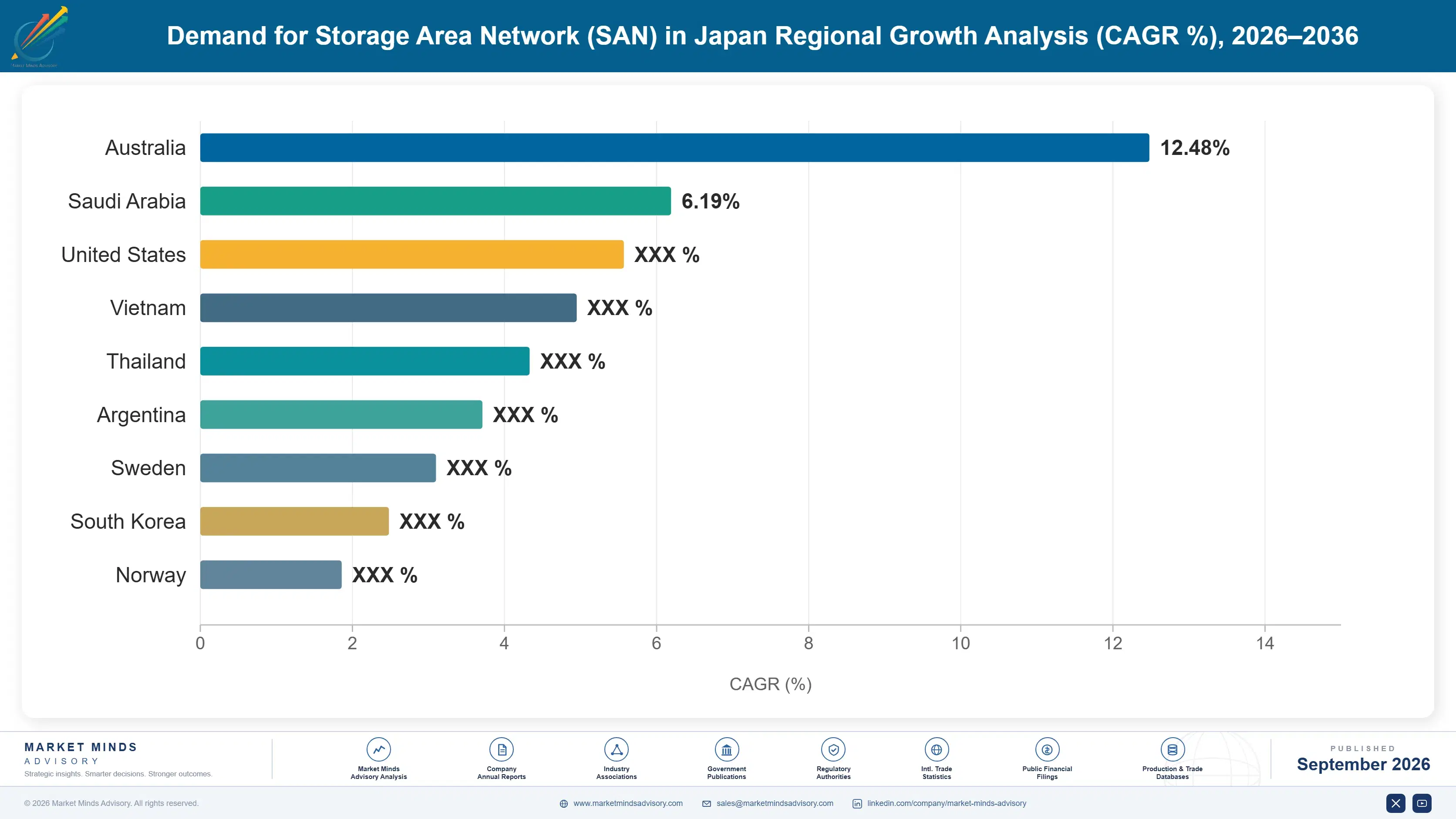
japan-storage-area-network-san-market-country-cagr-analysis-1788427995379

Competitive Moat and Risk Dimensions

HITACHI VANTARA

Moat: Deep Domestic Enterprise Relationships

Hitachi Vantara benefits from decades of embedded relationships across Japanese financial and manufacturing conglomerates, reinforced by domestic sourcing preferences and long-standing maintenance contract networks that competitors struggle to replicate quickly, particularly given the company's deep familiarity with regulated-sector compliance requirements and audit expectations. This depth of relationship extends well beyond product performance alone.
HITACHI VANTARA

Risk: Slower NVMe-Native Product Pivot

Hitachi Vantara's NVMe-oF product roadmap trails pure-play challengers focused exclusively on next-generation fabric technology, risking gradual share erosion in greenfield hyperscale deployment opportunities where legacy compatibility carries less weight than raw throughput and certified performance benchmarks. Younger technical buyers increasingly weigh this gap heavily during vendor selection.
NETAPP

Moat: Broad Multi-Environment Software Integration

NetApp's storage management software integrates broadly across hybrid cloud and on-premises environments, giving enterprise buyers a unified operational layer that increases switching costs once deeply embedded across their infrastructure, particularly among multinational conglomerates operating across several regions simultaneously with centralized management requirements. This integration depth strengthens retention meaningfully over successive contract cycles.
NETAPP

Risk: Premium Pricing Limits Smaller Buyers

NetApp's premium pricing structure limits adoption among smaller Japanese enterprises and mid-tier manufacturers facing tighter capital budgets than the large conglomerates that anchor its core customer base, leaving an opening for lower-cost domestic and NVMe-native challengers to win price-sensitive accounts. This pricing gap widens further as budget-constrained buyers evaluate alternatives.

Players Tracked

Prominent Players

Hitachi Vantara
NetApp
Dell Technologies
Hewlett Packard Enterprise
Pure Storage

Other Key Players

IBM
Fujitsu
NEC
Lenovo
Huawei
Infinidat
Nutanix
DataDirect Networks
Cisco
Broadcom
Kioxia
Toshiba Digital Solutions
Western Digital
Seagate Technology
Excelero

Recent Developments

MARCH 2026

Hitachi Vantara Launches NVMe-oF Certified Fabric Platform

Hitachi Vantara introduced a new NVMe over Fabrics platform certified for compatibility with major server vendors, targeting AI infrastructure buyers seeking to modernize legacy Fibre Channel deployments across Japanese enterprise data centers, with initial rollout prioritizing financial and manufacturing sector accounts ahead of broader nationwide availability.
Signal: Signals accelerating incumbent response to NVMe-native challenger pressure across the broader enterprise storage segment nationwide this cycle.
OCTOBER 2025

NetApp Acquires Storage Analytics Startup

NetApp acquired a workload performance analytics startup to strengthen its AI infrastructure monitoring capability, extending its software differentiation beyond core storage management into performance-aware fabric optimization tooling for enterprise buyers nationwide, deepening its recurring software revenue base considerably ahead of the next major product roadmap announcement expected later this year.
Signal: Signals growing vendor emphasis on analytics-driven differentiation beyond raw hardware specifications across the broader storage category.
JUNE 2025

Pure Storage Signs Supply Agreement With Data Center Operator

Pure Storage signed a multi-year supply agreement with a major Japanese hyperscale data center operator to provide NVMe-oF infrastructure supporting AI training workloads, expanding its greenfield deployment footprint across the Tokyo metropolitan corridor and establishing a foothold among hyperscale accounts previously dominated by incumbent suppliers nationwide.
Signal: Signals challenger vendors successfully converting pilot relationships into larger production contracts across the broader hyperscale segment.

Semiconductor and Flash Memory Cost Exposure

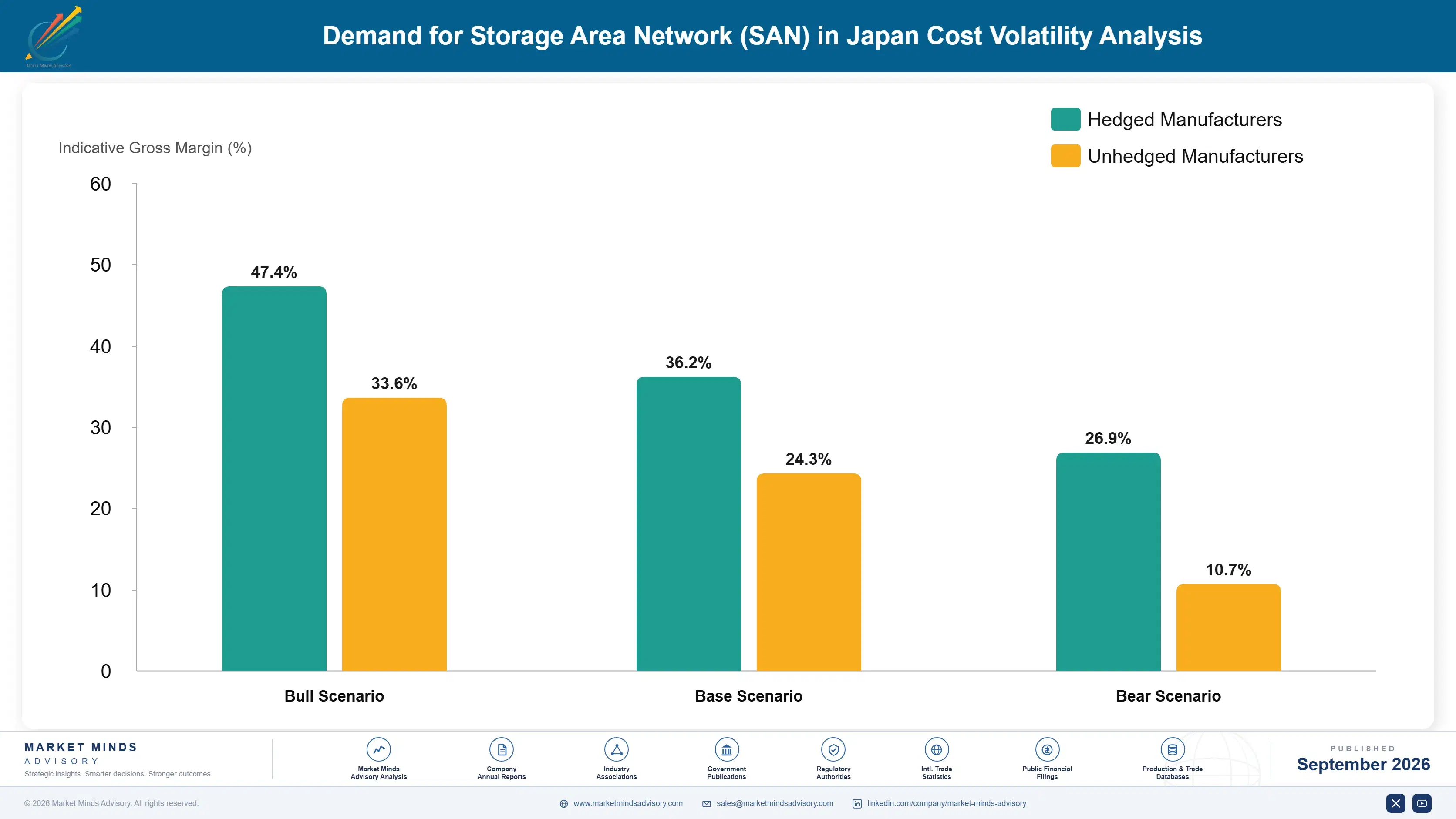
Flash memory and controller silicon represent the largest cost input for SAN hardware vendors, typically accounting for roughly 45 percent of cost of goods sold across all-flash and NVMe-oF product lines. Most flash supply originates from a small group of global semiconductor manufacturers concentrated in Japan, South Korea, and Taiwan, creating meaningful geographic concentration risk for vendors sourcing components internationally.
NAND flash pricing swung sharply during 2024 and 2025 amid fluctuating fabrication capacity investment cycles, with unit pricing rising by roughly 30 percent within a single fiscal year according to industry capacity disclosures from major flash manufacturers. Vendors without locked-in supply agreements absorbed meaningfully compressed margins during this period, particularly smaller challengers lacking negotiating scale with major flash manufacturers and their preferred customer allocation programs.

This cost exposure disadvantages smaller NVMe-native challengers most severely, since they typically lack the purchasing scale and multi-year supply agreements that established incumbents negotiate directly with flash manufacturers well ahead of demand cycles. Vendors sourcing through domestic Japanese suppliers face somewhat different exposure given semiconductor policy incentives that favor local sourcing relationships over pure cost optimization across their component procurement strategies nationwide.
japan-storage-area-network-san-market-company-positioning-matrix-1788427995574

Negotiate Multi-Year Flash Supply Agreements

Vendors committing to multi-year flash purchasing volumes secure more predictable unit pricing from major semiconductor manufacturers, insulating margin from short-term spot market volatility that smaller competitors without similar scale cannot avoid as easily across their existing product lines. This approach also strengthens vendor relationships that pay dividends during future supply constraints, particularly across tighter fabrication capacity cycles.

Diversify Component Sourcing Across Regions

Vendors qualifying multiple flash and controller suppliers across Japan, South Korea, and Taiwan reduce single-source dependency risk, though this diversification requires additional compatibility testing overhead that smaller vendors sometimes find difficult to absorb quickly. Vendors pursuing this strategy typically build stronger resilience against regional supply disruptions overall and unexpected future geopolitical trade policy constraints.

Pass Through Costs Via Tiered Pricing

Vendors structuring tiered pricing models that pass a portion of flash cost volatility through to enterprise buyers protect margin during pricing spikes, though this approach requires careful communication to avoid damaging long-term account relationships and renewal negotiations. Vendors executing this well maintain customer trust while protecting profitability during volatile pricing periods across multiple fiscal quarters.

Portfolio Architecture for Margin Defence

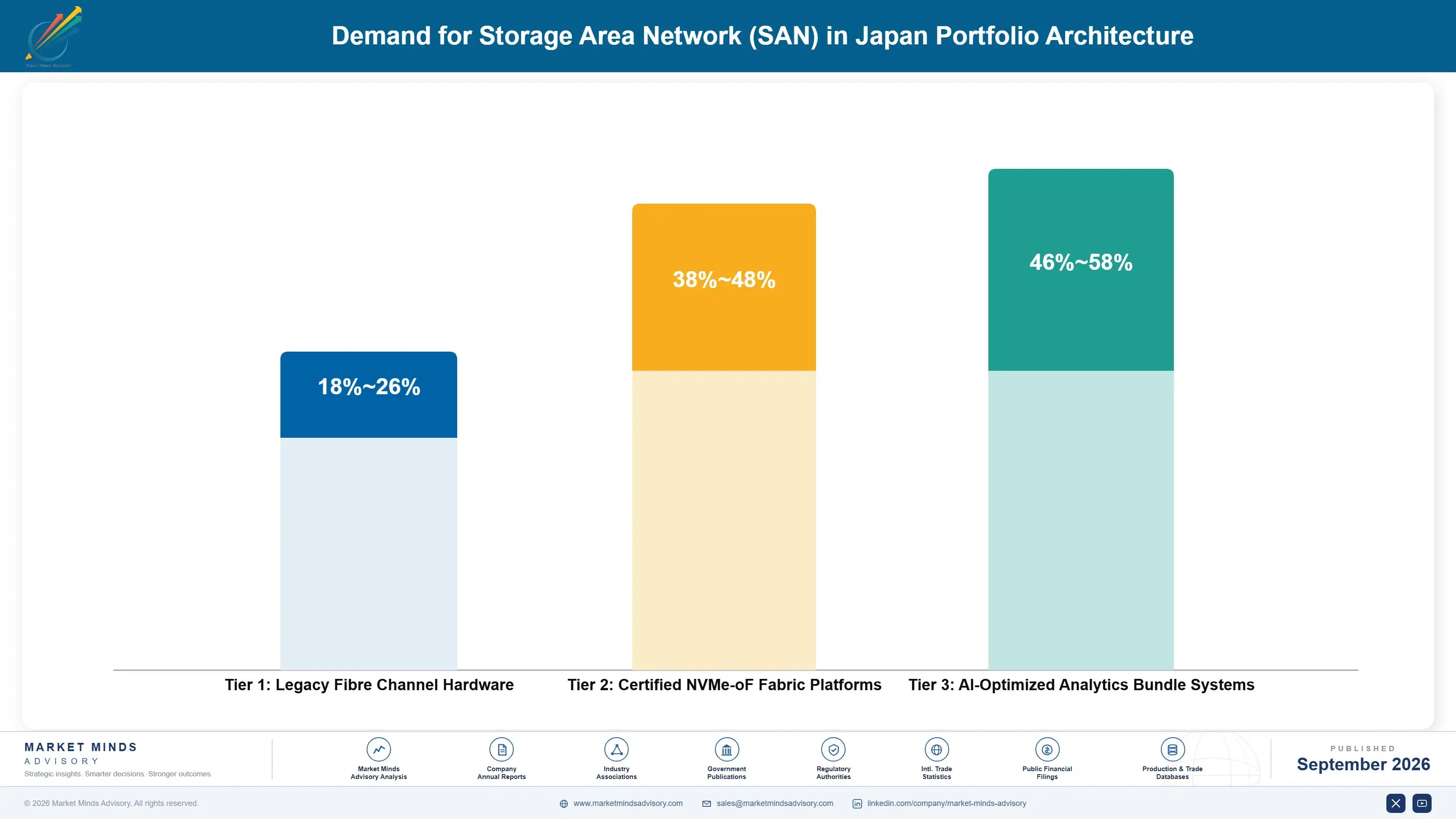
SAN vendors operate across three margin tiers, from legacy Fibre Channel hardware carrying thin unit economics through certified NVMe-oF platforms commanding meaningfully stronger margin, up to AI-optimized analytics-bundled fabric systems capturing the richest gross margins in the category. Volume tiers monetize through hardware refresh cycles, while premium tiers monetize through certification depth and performance analytics bundling sold to enterprise accounts.
Tension persists between volume growth, which favors standardized hardware sold at competitive pricing to cost-conscious mid-tier manufacturers, and premium positioning, which favors NVMe-oF certification and AI workload analytics commanding materially higher willingness to pay among hyperscale and financial services accounts. Vendors chasing both simultaneously risk diluting brand positioning across a fragmented buyer base. Larger conglomerates increasingly demand both, forcing vendors to segment their product portfolios more deliberately by account tier.

High-value margin pools concentrate in NVMe-oF certification and AI workload analytics, both commanding meaningfully higher gross margin than legacy Fibre Channel hardware sold without additional capability bundling attached. Vendors building durable certification capability and analytics relationships capture disproportionate margin relative to their installed base across the broader competitive landscape today. Vendors ignoring this shift risk ceding the most profitable accounts to faster-moving specialist rivals over time.

Legacy Fibre Channel Hardware

Standardized Fibre Channel arrays sold at competitive pricing to cost-conscious mid-tier manufacturers prioritizing baseline reliability over advanced analytics, carrying thin unit economics but broad reach nationwide. nationwide across most regional manufacturing corridors, reflecting steady but unremarkable demand growth.
Gross Margin: 18-26%

Certified NVMe-oF Fabric Platforms

Certified NVMe over Fabrics platforms bundling documented compatibility testing and compliance support, commanding stronger recurring revenue and materially higher gross margin than standard hardware sold without certification. across regulated financial and manufacturing accounts nationwide.
Gross Margin: 38-48%

AI-Optimized Analytics Bundle Systems

Integrated platforms bundling AI workload performance analytics with certified NVMe-oF fabric hardware, carrying the richest margin profile in the category given urgent commercial demand and expanding buyer willingness to pay.
Gross Margin: 46-58%
japan-storage-area-network-san-market-cost-volatility-analysis-1788427996072

High-value Sub-segments and Strategic Watch-out

NVMe over Fabrics (NVMe-oF) SAN Systems

Fastest-growing and highest-value segment, combining strong pricing power with accelerating adoption as hyperscale operators seek documented AI workload throughput improvements across Tokyo and Osaka data center corridors nationwide this cycle. Federal and prefectural digital infrastructure incentives further support this segment's continued rapid expansion pace nationwide.

All-Flash Fibre Channel SAN Arrays

High-value segment with moderate growth, anchored by steady enterprise upgrade demand, though smaller manufacturer budgets constrain broader adoption pace relative to larger financial institution accounts pursuing faster migration timelines nationwide. This segment remains a dependable revenue base even as newer protocol adoption accelerates elsewhere nationwide.

Hybrid Flash-HDD Fibre Channel SAN Arrays

Volume core of the market, delivering steady deployment counts and established margin, serving as the primary entry point into certification services and eventual analytics bundle adoption across most enterprise customer tiers nationwide. Vendors use this tier to build trust before upselling into higher-margin certified offerings later.

Traditional HDD-Based Fibre Channel SAN

Strategic watch-out segment facing intensifying end-of-life pressure from vendors, pushing enterprises toward paid upgrade decisions and requiring vendors to differentiate through migration tooling depth and pricing accessibility for smaller accounts. Vendors offering attractive trade-in incentives capture a meaningful share of this transitioning customer base nationwide.

Refresh Cycles Anchor Recurring Vendor Revenue

SAN hardware and software increasingly behaves like an annuity business rather than a project sale. Enterprises sign multi-year maintenance and certification renewal agreements tied to installed hardware, and NVMe-oF migration consulting locks vendors into recurring revenue streams that compound as data volumes expand. This shifts vendor valuation toward retained installed base rather than one-time hardware sale volume, rewarding vendors with durable enterprise relationships over pure technology differentiation alone.
Adoption stickiness varies sharply by end-use vertical. Large financial institutions integrate SAN infrastructure deeply into mission-critical compliance systems, making switching costs prohibitive once certification and compatibility testing are complete across their production environments. Mid-tier manufacturers show shallower stickiness, often price-shopping at refresh cycle renewal given tighter budgets and simpler network topology, which keeps competitive pressure alive at the lower end of the market nationwide.

Buyer profiles are shifting generationally as infrastructure teams increasingly favor cloud-native, API-accessible storage management over legacy monolithic systems built around older Fibre Channel architecture. Younger technical buyers prioritize analytics integration and deployment speed over the incumbent vendor relationships that shaped prior purchasing cycles, gradually eroding legacy negotiating leverage and opening room for newer entrants offering more modern deployment tooling nationwide.
Section default visual

Where Storage Vendors Should Focus Next

These are among the four positions where our research anticipates prominent divergence between winners and laggards over the coming forecast period. Each is grounded in the demand model, the regulatory perimeter, and the announced capacity pipeline.
01 / NVME-OF CERTIFICATION DEPTH

Deepen NVMe-oF certification breadth across server platforms

NVMe over Fabrics is the fastest-growing segment in Japan's SAN market, expanding at 14.5 percent annually against a category average of 9.5 percent, roughly 1.53 times the overall rate. Vendors deepening certification breadth now capture disproportionate share of greenfield hyperscale deployment budget tied to AI infrastructure buildout across the Tokyo and Osaka metropolitan corridors specifically. Waiting risks ceding this segment permanently to faster-moving NVMe-native challengers already active in several key hyperscale accounts nationwide and building lasting relationships with hyperscale accounts there ahead of the broader field.
02 / DOMESTIC SUPPLY CHAIN POSITIONING

Build formal domestic sourcing certification programs now

Government and regulated financial sector buyers increasingly require documented domestic or allied-nation sourcing provenance before awarding storage infrastructure contracts across their networks. Vendors building formal certification programs around this requirement now capture a growing share of policy-driven procurement ahead of competitors still relying purely on raw performance benchmarking claims alone. This capability gap will widen further as semiconductor supply chain policy tightens across the forecast period ahead for every participating vendor across the broader storage category nationwide and internationally over time.
03 / MIGRATION CONSULTING SERVICES

Package structured migration consulting ahead of refresh waves

A substantial share of Japan's installed Fibre Channel base is approaching vendor end-of-support dates, forcing enterprises into mandatory refresh decisions regardless of discretionary AI infrastructure spending plans. Vendors packaging structured migration consulting capture this urgency before competitors respond at scale nationwide, particularly among financial institutions and manufacturers unwilling to risk any production downtime whatsoever. Vendors that delay risk missing the compliance-driven window when switching costs are lowest for still-undecided regional buyers weighing multiple vendor options carefully across this current cycle.
04 / FLASH SUPPLY CHAIN MANAGEMENT

Lock in multi-year flash supply agreements before pricing tightens

Flash memory represents roughly 45 percent of cost of goods sold for SAN hardware vendors, and NAND pricing volatility directly compresses margin for vendors without locked-in multi-year supply agreements in place. Vendors negotiating multi-year flash commitments now secure more favorable unit economics ahead of anticipated fabrication capacity tightening across the broader semiconductor sector this cycle. Competitors that delay these negotiations risk facing structurally worse cost positions during the next major renewal cycle across their full product portfolio nationwide and internationally as well.

Engagement Snapshot From the Field

A live engagement with an industry participant carrying material or product regulatory and market exposure ahead of a defining policy shift, showing how our research translates into a defensible multi-year portfolio strategy.
MARKET MINDS ADVISORY · CLIENT ENGAGEMENT SUMMARY
Demand for Storage Area Network (SAN) in Japan Producer Strategic Portfolio Review and Transition Roadmap 2026·Investment Scenario on Demand for Storage Area Network (SAN) in Japan Exposure Evaluation 2025-26
CLIENT PROFILE
The client is a mid-sized Japanese regional bank operating a network of branches across the Kansai region, managing sensitive transaction data under strict domestic regulatory retention requirements. Facing an approaching Fibre Channel end-of-support deadline, the bank's technology leadership sought an independent assessment of NVMe-oF vendor options before committing to a multi-year infrastructure contract. The engagement was commissioned ahead of the bank's fiscal year budget planning cycle.
STRATEGIC CHALLENGE
The bank's existing legacy Fibre Channel infrastructure faced vendor end-of-support within twelve months, but technology leadership lacked clarity on which certified NVMe-oF suppliers could meet strict domestic data sourcing requirements without prohibitive integration costs across its distributed branch network and central data processing facility. Leadership also faced pressure to minimize disruption to customer-facing transaction processing systems during any transition.
MMA APPROACH
MMA conducted a structured vendor capability assessment spanning five leading storage suppliers, benchmarking domestic sourcing certification, NVMe-oF compatibility maturity, and total implementation cost against the bank's specific compliance requirements and existing infrastructure footprint, including projected multi-year total cost of ownership across the full contract term. The assessment also incorporated interviews with technology staff across the bank's central and regional data processing teams.
KEY FINDINGS
  1. Two of five evaluated vendors offered fully documented domestic sourcing certification meeting the bank's regulatory compliance requirements without exception. This eliminated three vendors from further consideration early in the process.
  2. Implementation cost estimates varied by roughly 28 percent (client-reported, unverified by MMA) across vendors offering functionally comparable NVMe-oF capability and support terms.
  3. Certification testing timelines ranged from three to seven months depending on vendor documentation maturity and prior financial-sector deployment experience. Vendors with prior banking-sector references completed testing meaningfully faster than newer entrants.
  4. Smaller regional institutions in similar compliance-heavy environments showed measurably higher switching costs once initial certification testing was substantially complete. This underscored the importance of early vendor engagement well ahead of mandatory deadlines.
CLIENT PROFILE
The client is a mid-sized Japanese regional bank operating a network of branches across the Kansai region, managing sensitive transaction data under strict domestic regulatory retention requirements. Facing an approaching Fibre Channel end-of-support deadline, the bank's technology leadership sought an independent assessment of NVMe-oF vendor options before committing to a multi-year infrastructure contract. The engagement was commissioned ahead of the bank's fiscal year budget planning cycle.
STRATEGIC CHALLENGE
The bank's existing legacy Fibre Channel infrastructure faced vendor end-of-support within twelve months, but technology leadership lacked clarity on which certified NVMe-oF suppliers could meet strict domestic data sourcing requirements without prohibitive integration costs across its distributed branch network and central data processing facility. Leadership also faced pressure to minimize disruption to customer-facing transaction processing systems during any transition.
MMA APPROACH
MMA conducted a structured vendor capability assessment spanning five leading storage suppliers, benchmarking domestic sourcing certification, NVMe-oF compatibility maturity, and total implementation cost against the bank's specific compliance requirements and existing infrastructure footprint, including projected multi-year total cost of ownership across the full contract term. The assessment also incorporated interviews with technology staff across the bank's central and regional data processing teams.
KEY FINDINGS
  1. Two of five evaluated vendors offered fully documented domestic sourcing certification meeting the bank's regulatory compliance requirements without exception. This eliminated three vendors from further consideration early in the process.
  2. Implementation cost estimates varied by roughly 28 percent (client-reported, unverified by MMA) across vendors offering functionally comparable NVMe-oF capability and support terms.
  3. Certification testing timelines ranged from three to seven months depending on vendor documentation maturity and prior financial-sector deployment experience. Vendors with prior banking-sector references completed testing meaningfully faster than newer entrants.
  4. Smaller regional institutions in similar compliance-heavy environments showed measurably higher switching costs once initial certification testing was substantially complete. This underscored the importance of early vendor engagement well ahead of mandatory deadlines.
RECOMMENDED STRATEGY
Phase 1: Phase one prioritized vendor shortlisting based on documented domestic sourcing certification and financial-sector compliance track record. nationwide across the bank's full branch network. Phase 2: Phase two structured contract negotiation around phased implementation milestones tied to measurable compliance verification targets rather than flat deployment fees. Phase 3: Phase three established ongoing performance benchmarking against regulatory audit requirements to protect continued compliance certification eligibility nationwide. across subsequent renewal cycles.
OUTCOME
The bank selected a certified vendor offering strong domestic sourcing documentation, completing certification testing within five months and reporting improved regulatory audit readiness (client-reported, unverified by MMA). Leadership credited the structured vendor comparison with avoiding a costlier, less compliant platform choice originally under serious consideration.

Frequently Asked Questions

Foundational context covering the market sizes, CAGR, scope, country, region and competition that inform every finding below. This section is provided to cover basics and most often pre-purchase conversations, answered from the MMA Primary Research Dataset.

What is the current size of the Demand for Storage Area Network (SAN) in Japan?

The market reached 19.5 billion dollars in 2025, driven by AI workload data growth and accelerating migration from legacy Fibre Channel toward NVMe-based fabric infrastructure nationwide.

How large will the Demand for Storage Area Network (SAN) in Japan be by 2036?

MMA projects the market will reach 52.91 billion dollars by 2036, more than doubling from 2025 levels as enterprises complete their fabric modernization cycles nationwide.

What is the CAGR for the Demand for Storage Area Network (SAN) in Japan 2026 to 2036?

The base case CAGR is 9.5 percent, with a bull scenario of 10.7 percent and a bear scenario of 8.3 percent depending on AI infrastructure investment pacing.

Which segment is growing fastest?

NVMe over Fabrics (NVMe-oF) SAN Systems leads at 14.5 percent CAGR, roughly 1.53 times the overall market rate, driven by AI inference throughput demand nationwide.

Who are the major companies in the Demand for Storage Area Network (SAN) in Japan?

Hitachi Vantara, NetApp, Dell Technologies, Hewlett Packard Enterprise, and Pure Storage lead the market, reflecting deep enterprise relationships built over many years of continuous service.

Which country is growing fastest?

Japan itself leads within this report's defined scope, expanding at 10.8 percent annually as enterprises accelerate AI-driven fabric modernization across regulated industries nationwide and abroad.

Report Segmentation Architecture

The full report scope spans multiple orthogonal segmentation dimensions, with cross-tabulated demand data provided for each dimension pair. Coverage extends further to regional breakdowns, trend trajectories, and the competitive detail needed to support segment-level decision-making.

By Fabric Technology and Protocol Type

    By End-Use Industry Vertical

      By Commercial Deployment Model

        By Region

        • North America
        • Western Europe
        • East Asia
        • South Asia and Pacific
        • Latin America
        • Middle East and Africa
        • Eastern Europe

        Scope, Methodology, and Coverage

        Every figure in this report is reproducible from documented input assumptions. The scope below maps the historical period, the forecast horizon, the segmentation dimensions, and the countries covered, alongside the underlying primary and qualitative methodology.
        Historical Period
        2020 to 2025
        Forecast Period
        2026 to 2036
        Base Year
        2025 (USD billions; MMA Primary Research Dataset, September 2026)
        Market Definition
        This report covers block-level storage area network hardware, switching fabric, and management software deployed across Japanese enterprise and hyperscale data centers, including Fibre Channel, iSCSI, and NVMe over Fabrics architectures. It excludes standalone direct-attached storage, object storage platforms, and public cloud storage services procured without dedicated on-premises SAN infrastructure.
        Quantitative Units
        USD billions, market share percentages, CAGR percentages
        Segmentation Dimensions
        Fabric technology and protocol type, end-use industry vertical, commercial deployment model
        Regions Covered
        North America, Western Europe, East Asia, South Asia and Pacific, Latin America, Middle East and Africa, Eastern Europe
        Countries Covered
        Japan, with regional benchmarking context across North America, East Asia, Western Europe, South Asia and Pacific, Latin America, Middle East and Africa, and Eastern Europe
        Key Companies Profiled
        Hitachi Vantara, NetApp, Dell Technologies, Hewlett Packard Enterprise, Pure Storage, and 15 additional participants
        Quantitative Methodology
        Primary survey, n=3,800 respondents, Q4 2025, six countries; demand-side model with trade association cross-validation
        Qualitative Methodology
        47 expert interviews, Q4 2025; applied to validate demand model assumptions, identify emerging dynamics, and assess competitive positioning
        Report Format
        PDF and XLSX data workbook (Word format preview document)
        Publisher
        Market Minds Advisory
        Report Code
        MMA-2026-TEC-715
        Published
        September 2026
        Contact
        sales@marketmindsadvisory.com | www.marketmindsadvisory.com

        Purchase the full Demand for Storage Area Network (SAN) in Japan Report (2026 to 2036).

        This full report delivers comprehensive analysis of Japan's SAN market. It covers vendor competitive positioning, NVMe-oF adoption timelines, and domestic sourcing policy shaping enterprise procurement decisions nationwide. The report includes detailed segmentation across fabric technology types, industry verticals, and deployment models, alongside a proprietary MMA primary survey of enterprise infrastructure decision-makers spanning multiple regions. Analysts detail margin economics, cost exposure, and competitive dynamics shaping vendor positioning across the category. Strategic recommendations guide vendors navigating this transitioning infrastructure category through 2036 and beyond, with particular attention to domestic sourcing economics.
        Full seven-region data tables and CAGR breakdowns
        Complete company profiles for twenty market participants
        Primary survey dataset covering 3,800 respondents nationwide
        Expert interview findings from 47 industry specialists
        Editable data tables in spreadsheet format included
        Quarterly market update subscription available separately

        Built For The People Who Decide

        From boardroom strategy to bench-side execution, this report is read cover-to-cover by leaders shaping the next decade of their industry, turning demand scenarios, market dynamics and valuation benchmarks into decisions.
        CXOs/ Presidents/ VPs/ Managers
        M&A and Corporate Development
        Strategy Teams and R&D Heads
        Procurement and Product Directors
        Regulatory and Compliance Leaders
        Investor Relations and Equity Analysts