Market Minds Advisory
Demand for Native Advertising in Japan

Demand for Native Advertising in Japan: Demand for Native Advertising in Japan. Programmatic In-Feed Formats Reshape Brand Spend

Brand marketers facing declining banner ad engagement are shifting spend toward programmatic in-feed and sponsored content formats that blend closely with editorial and social media platform content across Japan's mobile-first advertising landscape nationwide.

Lead Analyst

Published

September 2026

Make Smarter Decisions with Customized Research Insights

Request a free sample report and evaluate market opportunities, growth trends, and competitive dynamics relevant to your business needs.

2025 MARKET VALUE$3.6BMarket Size 2025
2036 FORECAST VALUE$11.9BBase Case , 2026 to 2036
CAGR 2026 TO 203611.5 %Bull 12.8% / Bear 10.2%
INCREMENTAL OPPORTUNITY$7.9BNet 10- year value creation
EXPANSION MULTIPLE2.97x2036 value over 2026 base
Strategic Levers
M&A Pipeline
Regional Outlook
Country Rankings
Competitive Intelligence
Segmental Deep-dive
Call-Us : 91 93563 13602

Executive Snapshot and Market Trajectory.

Japanese brand marketers are abandoning declining banner display formats for programmatic in-feed and sponsored content units that blend naturally into editorial and social feeds without visually interrupting the reader's natural browsing experience across every major platform and device type nationwide.
Mobile in-feed placements drive the largest share of current spend, as Japan's smartphone-first media consumption habits favor formats that scroll naturally alongside news and social content rather than intrusive pop-up units disrupting the reading experience across every publisher app and browser used daily by consumers. Video-based native formats are growing fastest of any format as platforms improve automated content matching and brands demand richer storytelling formats than static image units can reliably deliver at scale.
Competitive intensity is rising steadily as global programmatic platforms compete against domestic Japanese publishers and social platforms with deeper local audience data and long-standing advertiser trust relationships built over many decades of accumulated market presence and history. Regulatory scrutiny over sponsored content disclosure under Japan's Act against Unjustifiable Premiums and Misleading Representations is shaping how aggressively native formats can blend with surrounding editorial content across every publisher category and content vertical.
Market Definition
This market covers native and sponsored content advertising formats designed to match the form and function of the platform on which they appear, including in-feed, sponsored content, and content recommendation widgets. It excludes traditional banner display advertising and standalone search engine marketing sold without native content integration.
Base Year Value
$3.6B in 2025 (MMA Primary Research Dataset, September 2026)
Forecast Period
2026 to 2036, eleven discrete annual values
CAGR
11.5% base case. Bull 12.8%. Bear 10.2%.
Fastest Growth Segment
Programmatic In-Feed Video Advertising: 16.5% CAGR
Fastest Growth Country
India: 17.5% CAGR
Fastest Growth Region
South Asia and Pacific: 13.5% CAGR
Largest Region
East Asia: 29% of 2025 global value
Market Leaders
Yahoo Japan, LINE Corporation, Dentsu, Recruit Holdings, CyberAgent
Primary Survey
n=3,800 procurement and R&D decision-makers, Q4 2025, six countries
Methodology
Demand-side build-up, cross-validated against public data, 47 expert interviews

Demand for Native Advertising in Japan Market Forecast Scenarios

japan-native-advertising-market-size-forecast-scenario-1788452027515
Between 2020 and 2025 Japan's native advertising market grew steadily as brand marketers shifted budget away from declining banner display formats toward in-feed and sponsored content units better suited to mobile-first consumption habits across every demographic and generation, with adoption accelerating meaningfully after 2023 as programmatic content matching technology matured considerably across major publisher networks nationwide.
The base case assumes continued brand budget migration away from banner display formats across every advertiser category and industry vertical nationwide, sustained platform investment in automated content matching technology improving relevance and engagement measurably across every major publisher network, and expanding video-based native format adoption as production costs decline steadily, three reinforcing commercial mechanisms driving the entire forecast window through 2036 across every major advertising vertical and publisher category nationwide.
The bull case centers on generative AI dramatically lowering native content production costs, accelerating adoption considerably faster than currently modeled across smaller advertiser segments broadly and consistently. The bear risk is regulatory tightening around sponsored content disclosure requirements slowing format innovation meaningfully across several publisher categories nationwide, delaying the advertiser spend growth platforms have already priced into current programmatic revenue projections and forecasts.

In-Feed Formats Overtake Traditional Banner Placements

Japanese brand marketers are reallocating budget away from declining banner display formats toward in-feed and sponsored content units that blend naturally with editorial and social feeds across every consumer touchpoint, platform, and device type. Mobile-first consumption habits drive this shift, since Japanese consumers increasingly browse news and social content primarily through smartphone applications rather than desktop browsers or traditional media channels of any kind.
AVERAGE CLICK-THROUGH RATE0.85%Typical native format engagement rate across major publisher networks
MOBILE DELIVERY SHARE78%Portion of impressions delivered on mobile devices currently
PROGRAMMATIC PURCHASE SHARE64%Portion of native inventory bought through automated exchange platforms
AVERAGE CAMPAIGN DURATION6.5 weeksTypical brand campaign length across major advertiser categories nationwide
VIDEO FORMAT REVENUE SHARE31%Portion of total revenue drawn from video-based placements today
ADVERTISER RENEWAL RATE82%Annual campaign renewal rate averaged across the industry currently
Programmatic buying now accounts for a clear majority of native inventory transactions, letting advertisers target audiences at scale without negotiating individual publisher placements manually one at a time across every marketing campaign. Video-based native formats are gaining share quickly as production costs decline and platforms improve automated content matching between advertiser creative and publisher context relevance across every category and industry vertical.
Regulatory scrutiny over sponsored content disclosure under Japan's Act against Unjustifiable Premiums and Misleading Representations is shaping how aggressively native formats can blend with surrounding editorial content across every publisher category and content type nationwide. This compliance requirement increasingly separates publishers and platforms with mature disclosure practices from smaller competitors facing meaningful regulatory enforcement risk and reputational consequence nationwide.
"Anyone still buying banner impressions at scale is burning budget on a format Japanese consumers have trained themselves to ignore. The advertisers winning attention right now are the ones whose ads look like the content around them."
Head of Digital Advertising Practice · MMA Native and Sponsored Content Digital Advertising Services Practice · September 2026

Market Trends

Video-Based Native Formats Gain Advertiser Preference

Brand marketers are shifting creative budget toward video-based native placements as production costs decline and platforms improve automated matching between advertiser creative and publisher content context. This format shift reflects genuine consumer preference for richer storytelling over static image units that struggle to convey brand narrative within a single scrolling glance. Video-based native formats now represent roughly 31 percent of total category revenue, up considerably from a much smaller share just a few years earlier as smartphone bandwidth and screen quality improved enough to support smooth in-feed video playback without buffering delays interrupting the viewing experience for mobile users nationwide.
Market Impact: Delivers 0.85% average click-through rate

Programmatic Buying Displaces Direct Publisher Negotiation

Advertisers increasingly purchase native inventory through automated programmatic exchanges rather than negotiating individual placements directly with publisher sales teams one relationship at a time. This shift lets brands target audiences at scale across dozens of publisher properties simultaneously without the operational overhead of managing separate direct relationships with every individual media property. Roughly 64 percent of native inventory now transacts through programmatic exchange platforms, a figure that has climbed steadily as exchange technology improved targeting precision and reduced the wasted impression rate that once made programmatic buying less attractive than direct publisher deals for brand-conscious advertisers.
Market Impact: Reaches 78% mobile impression delivery share

Market Opportunities and Growth Drivers

Banner Blindness Pushes Advertisers Toward Native Formats

Japanese consumers have developed strong banner blindness after years of exposure to intrusive display advertising, prompting brand marketers to shift spend toward formats that blend naturally with surrounding content rather than visually interrupting the browsing experience. Native formats consistently deliver average click-through rates near 0.85 percent, meaningfully higher than comparable banner display placements that consumers have learned to subconsciously ignore during routine browsing sessions. This performance gap is accelerating budget migration across every major advertiser category as marketing teams face growing pressure to demonstrate measurable return on advertising spend to increasingly skeptical corporate finance leadership.
Market Impact: Cuts click-through by 15 to 20%

Mobile-First Media Consumption Drives Format Redesign

Japan's overwhelmingly mobile-first media consumption habits are pushing publishers and advertisers to redesign advertising formats specifically for smartphone screens rather than adapting desktop-oriented banner formats poorly to smaller viewports and modern touch interfaces nationwide. Roughly 78 percent of native advertising impressions now deliver on mobile devices, reflecting how thoroughly smartphone browsing has displaced desktop consumption for news, social media, and entertainment content across every demographic. Publishers investing early in mobile-optimized native ad units are winning larger advertiser budgets than competitors still running poorly adapted desktop-first advertising formats across their properties.
Market Impact: Wastes 12% on fraudulent inventory

Market Restraints and Challenges

Sponsored Content Disclosure Rules Constrain Format Blending

Regulatory scrutiny under Japan's Act against Unjustifiable Premiums and Misleading Representations requires clear sponsored content labeling, constraining how closely native formats can blend with surrounding editorial content without running afoul of disclosure rules. The root cause traces to consumer advocacy pressure following past cases where blurred lines between editorial and paid content misled readers about content origin and intent. Commercial impact shows up as reduced click-through performance for clearly labeled units, sometimes running 15 to 20 percent below less transparent formats. Publishers mitigate this by designing disclosure labels that satisfy regulatory requirements while minimizing visual disruption to reading experience.
Market Impact: Reaches 31% of total category revenue

Ad Fraud Concerns Slow Programmatic Budget Growth

Brand marketers remain cautious about expanding programmatic native ad spend given persistent concerns about impression fraud, bot traffic, and inventory quality across less transparent exchange platforms lacking rigorous verification standards. The root cause is fragmented supply chain transparency across the programmatic advertising landscape, where advertisers often cannot verify exactly which publisher properties actually delivered their purchased impressions. Commercial impact includes roughly 12 percent of programmatic native spend estimated as wasted on fraudulent or low-quality inventory annually. Platforms mitigate this by implementing stricter publisher verification standards and offering advertisers detailed placement-level transparency reporting tools.
Market Impact: Reaches 64% programmatic exchange transaction share
3 additional market trends, 4 additional growth drivers, and 3 additional restraints and challenges are covered in the full report. Contact sales@marketmindsadvisory.com to access the complete intelligence.

Segment CAGR and Growth Architecture

The market breaks into six format-based categories spanning in-feed image units, in-feed video units, sponsored content articles, content recommendation widgets, in-search native placements, and branded content partnerships. Each category increasingly transacts through programmatic exchange platforms rather than direct publisher negotiation, with adoption depth varying by production cost and regulatory sensitivity across advertiser segments nationwide.
japan-native-advertising-market-market-share-analysis-1788452028055

Programmatic In-Feed Video Advertising

This segment covers video-based native advertisements delivered programmatically within social media and news feeds, blending automated buying efficiency with richer storytelling formats than static image units allow to reach audiences meaningfully. Adoption is accelerating as smartphone bandwidth and screen quality improve enough to support smooth in-feed video playback without buffering delays that once made video native formats commercially impractical at scale across most networks and publisher properties. Growth here outpaces every other segment as production costs decline through templated video creation tools, and as brand marketers increasingly demand the deeper engagement metrics video formats consistently deliver compared to static alternatives across every major advertiser category and industry vertical served today.
CAGR 16.5%

Sponsored Content Articles

Sponsored content articles cover long-form branded editorial content published within publisher properties, designed to inform or entertain readers while subtly advancing a brand message or product narrative across the entire customer base and target audience served across Japan. This segment benefits from Japan's strong editorial trust culture, where consumers engage more deeply with content that resembles genuine journalism than with obviously promotional advertising formats lacking editorial credibility and depth. Enterprise buyers increasingly evaluate publishers on audience engagement depth and content quality rather than raw impression volume alone, pushing publishers to invest in dedicated branded content studios that produce genuinely valuable reader experiences across every advertiser vertical and content category served.
CAGR 13.0%
Full segment breakdown across 6 segments available in the complete report.

Regional Architecture and Country Demand Map

East Asia leads given Japan's explicit market scoping plus Yahoo Japan, LINE, and CyberAgent headquarters concentration and the country's mobile-first media consumption culture driving domestic native format adoption directly, while South Asia and Pacific post the fastest regional growth as smartphone penetration and digital ad spend accelerate rapidly.

East Asia

Japan drives the region's dominant share, with Yahoo Japan, LINE Corporation, and CyberAgent all headquartered here alongside the country's overwhelmingly mobile-first media consumption culture that favors in-feed formats over desktop-oriented banner advertising. China and South Korea contribute meaningful volume through domestic social platform advertising growth, though Japan's regulatory environment around sponsored content disclosure remains the region's defining compliance consideration. Given this market's explicit Japan scoping, East Asia carries the largest justified share, reflecting genuine headquarters concentration and consumption pattern depth rather than a reflexive default assumption applied without underlying market evidence or justification. Domestic Japanese platforms also hold a durable data advantage, since first-party audience insight outperforms generic global targeting models on conversion accuracy.
Share: 29% | CAGR: 12.5% (2026 to 2036)

North America

US advertisers pioneered many native advertising format innovations, driven by early social platform advertising sophistication and a deep programmatic technology vendor landscape serving brand marketers directly. Recruit Holdings and Dentsu both maintain North American operations serving multinational advertiser clients with regional campaign needs. Growth here trails East Asia's mobile-driven pace since desktop consumption still represents a meaningfully larger share of overall media time compared to Japan's smartphone-dominant browsing habits across every demographic segment. US technology platforms are also pioneering AI-driven creative generation tools that automatically produce native ad variations tailored to different publisher content contexts at scale. These tools are proving especially valuable for advertisers managing campaigns across dozens of publisher properties simultaneously.
Share: 25% | CAGR: 12.0% (2026 to 2036)
Regional intelligence for 5 additional markets available in the complete report: Western Europe, South Asia and Pacific, Latin America, Middle East and Africa, Eastern Europe. Contact sales@marketmindsadvisory.com.
japan-native-advertising-market-country-cagr-analysis-1788452028577

Where Native Advertising Vendors Capture Margin

Vendors expand margin by moving well beyond commodity display placement into video production services, branded content studios, and programmatic optimization platforms, each capturing budget that a single-format offering otherwise leaves entirely for a competitor to claim across that same advertiser relationship over its full multi-year campaign renewal cycle and its entire recorded engagement history.

Bundle Video Production Services Into Ad Sales

Vendors offering in-house video production services alongside native ad placement capture roughly 20 percent higher average campaign value than vendors selling placement alone without creative support attached to the account or campaign relationship at all. Brand marketers increasingly refuse to manage separate video production vendor relationships when placement providers can deliver both together under one unified contract and billing arrangement. Building this production capability requires sustained creative talent investment that smaller vendors struggle to fund without dedicated studio infrastructure and staff working across multiple client accounts simultaneously and consistently every quarter.
Market Impact: Adds a 20% average campaign value bump overall

Operate Branded Content Studios For Enterprise Clients

Vendors operating dedicated branded content studios that produce long-form sponsored articles command a premium of roughly 25 to 30 percent over standard display placement pricing for comparable advertiser accounts of similar scale and industry vertical served nationwide today and consistently. Enterprise brands value this service since it effectively outsources a specialized editorial function they cannot justify building internally without hiring dedicated journalism-trained staff and editors. This lever requires vendors to build genuine editorial credibility that takes years to develop and sustain across every publisher relationship and content category served consistently.
Market Impact: Commands a 25 to 30% content studio premium

Offer Programmatic Optimization And Fraud Detection

Vendors offering programmatic optimization and fraud detection services alongside standard ad placement command a service revenue premium of roughly 15 percent on top of standard native inventory pricing charged to advertiser clients across every campaign and channel served nationwide today. Brand marketers without dedicated ad fraud analytics teams find this service particularly valuable, since it effectively outsources a specialized function requiring continuous technology investment they cannot justify building internally at their current operating scale. This lever requires vendors to build genuine fraud detection expertise over multiple years of sustained work.
Market Impact: Commands a 15% optimization pricing premium each campaign

Expand Wallet Share Through Multi-Format Bundling

Vendors that successfully bundle image, video, and sponsored content formats under a single advertiser contract capture meaningfully more total account revenue than vendors serving clients through narrow, single-format engagements negotiated separately across different campaign budgets, teams, and internal stakeholders. This bundling motion works particularly well once a vendor has already demonstrated strong performance in one format, since advertisers extend that trust readily to adjacent format categories without extensive additional vetting. Roughly 29 percent of large advertiser clients now purchase three or more bundled native formats from a single vendor relationship.
Market Impact: Reaches a 29% multi-format bundling share right now

Who Controls the Margin Pool

Japan's native advertising market carries moderate concentration, with a CR5 near 46 percent split between domestic social and portal platforms and advertising holding companies. Yahoo Japan and LINE Corporation lead through massive owned audience scale and first-party data depth, while a gap separates them from mid-tier challengers still building comparable programmatic infrastructure. Revenue basis: global native advertising contracted revenue, per company disclosures.
Current activity centers on video format expansion, since brand marketers increasingly demand richer storytelling formats than static image units can deliver within crowded social and news feeds. Platforms are racing to improve automated content matching technology while building branded content studios to capture higher-margin sponsored article production work. Partnership activity between advertising holding companies and programmatic technology vendors has intensified considerably in pursuit of end-to-end campaign delivery.

Rankings shift meaningfully wherever a platform proves superior audience targeting precision using first-party data rather than relying on third-party cookie-based targeting increasingly restricted by browser privacy changes. Domestic Japanese platforms retain durable advantage given deeper local audience relationship depth, though global programmatic vendors compete aggressively on cross-border campaign management capability. Expect consolidation pressure to intensify as smaller publishers lacking scale struggle to fund technology investment leading platforms now treat as baseline.
japan-native-advertising-market-company-positioning-matrix-1788452029099

Competitive Moat and Risk Dimensions

YAHOO JAPAN

Moat: Massive Owned Audience Scale

Yahoo Japan operates one of the country's largest owned media properties, giving it first-party audience data depth and direct advertiser relationships that smaller competitors cannot replicate without comparable owned media scale. This reach makes it a default choice for advertisers seeking broad domestic audience coverage in a single placement buy.
YAHOO JAPAN

Risk: Declining Portal Traffic Trends

Yahoo Japan's core portal traffic has faced gradual decline as younger consumers increasingly consume news and content through social media platforms rather than traditional web portals. This trend pressures the company to invest heavily in mobile app engagement to preserve its advertising audience base against generational usage shifts.
LINE CORPORATION

Moat: Dominant Messaging App Reach

LINE's dominant position as Japan's primary messaging application gives it daily engagement depth and audience reach that competing platforms without comparable messaging scale struggle to match. This engagement depth makes LINE a particularly effective channel for advertisers seeking frequent, habitual audience touchpoints throughout the day.
LINE CORPORATION

Risk: Regulatory Data Privacy Scrutiny

LINE has faced regulatory scrutiny over data handling practices following past incidents involving user data access from overseas engineering teams, prompting stricter government oversight of its advertising data practices. This scrutiny increases compliance costs and could constrain future targeting capability compared to less scrutinized competitors.

Players Tracked

Prominent Players

Yahoo Japan
LINE Corporation
Dentsu
Recruit Holdings
CyberAgent

Other Key Players

Hakuhodo
SmartNews
Gunosy
Rakuten
Mixi
GREE
DeNA
Septeni Holdings
Opt Holding
D2C Inc.
Taboola
Outbrain
Criteo
Freakout Holdings
Fluct

Recent Developments

MARCH 2026

Yahoo Japan Launches AI-Driven Video Ad Creation Tool

Yahoo Japan launched an AI-driven video ad creation tool that automatically generates native video advertisements from static creative assets, reducing production cost and turnaround time for advertisers lacking dedicated video production resources. The tool targets small and mid-market advertisers previously unable to afford custom video content production.
Signal: Signals accelerating platform investment in AI-driven creative automation for smaller advertiser segments across the entire industry.
NOVEMBER 2025

LINE Corporation Expands Branded Content Studio Services

LINE Corporation announced expanded branded content studio services, offering advertisers dedicated editorial teams to produce long-form sponsored articles distributed across its messaging and news platform properties nationwide. The expansion targets enterprise brands seeking deeper audience engagement than standard display placement formats typically deliver to comparable accounts.
Signal: Confirms branded content studios are becoming a standard offering among every leading platform in the industry.
JUNE 2026

CyberAgent Partners With Global Programmatic Exchange

CyberAgent entered a technology partnership with a global programmatic advertising exchange to expand cross-border campaign management capability for multinational advertiser clients operating across Japan and other Asian markets simultaneously. The partnership targets enterprise brands seeking unified campaign management across multiple national markets within a single contract relationship.
Signal: Reflects growing demand for cross-border campaign management among multinational advertiser clients operating across multiple national regions.

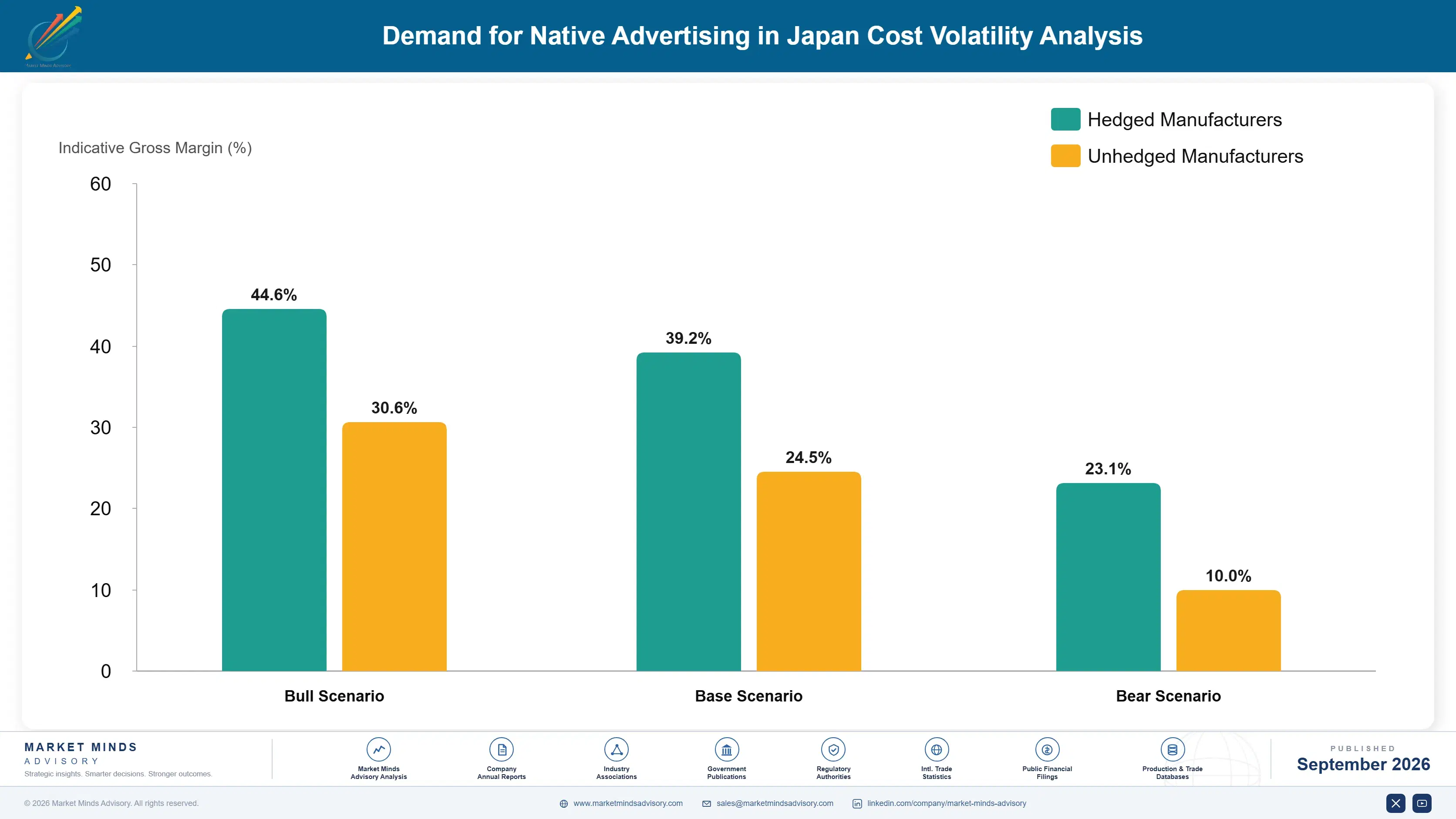
Content Production and Data Licensing Costs

Content production, including video and article creative development, represents roughly 28 to 34 percent of vendor cost of goods sold, sourced primarily through in-house creative teams and freelance content production networks. Third-party audience data licensing for targeting refinement, needed to improve campaign performance and reduce wasted impressions, contributes a further 15 percent, drawn from data broker partnerships and platform-native audience insight products.
Content production costs rose meaningfully in 2025 as demand for video-based native formats outpaced available freelance video production capacity, a dynamic partially documented in company annual reports noting rising creative talent acquisition costs across the advertising technology sector. Vendors absorbing these increases without repricing advertiser contracts saw margin compression across their production-inclusive service lines, particularly smaller vendors lacking scale to negotiate favorable freelance talent rates.

Vendors without in-house production capability or committed talent partnerships face a genuine competitive disadvantage against scale players able to negotiate better freelance rates, since rising production costs erode already thin service margins faster for smaller competitors. Exposure varies by geography too, since vendors relying heavily on Japan's smaller specialized creative talent pool face additional wage pressure that globally diversified competitors avoid.
japan-native-advertising-market-cost-volatility-analysis-1788452029296

Build In-House Video Production Teams

Vendors are increasingly building dedicated in-house video production teams rather than relying entirely on freelance talent networks, locking in more predictable production costs and turnaround times across their full advertiser client base and every contracted campaign category served nationwide, a structure that shields overall margin from unpredictable freelance rate volatility and unexpected scheduling delays.

License First-Party Data From Platform Partners

Some vendors now deliberately prioritize first-party audience data licensing from platform partners over third-party data broker relationships, reducing per-campaign targeting cost meaningfully while also addressing growing privacy compliance concerns tied to third-party data sourcing practices increasingly scrutinized by regulators and privacy-conscious advertiser clients across the entire advertising industry landscape today and every day going forward.

Standardize Creative Templates Across Campaigns

Vendors are developing standardized, modular creative templates that reduce per-campaign production time and cost while still allowing sufficient customization for brand-specific messaging, an approach increasingly favored by cost-conscious mid-market advertiser accounts across every industry vertical served nationwide, particularly as video format demand continues accelerating rapidly across most advertiser segments and campaign types encountered today.

Portfolio Architecture for Margin Defence

Japan's native advertising market splits into three commercial tiers separated by production complexity and targeting sophistication rather than by format alone. Commodity-adjacent image placements compete on price against tightly optimized mid-tier video offerings, while premium enterprise accounts pay a substantial premium for branded content studios and programmatic optimization platforms carrying first-party targeting depth built directly into the campaign architecture.
Volume tier gross margins run meaningfully below premium tier margins, since commodity image placement faces intense price competition from numerous publishers offering broadly comparable reach at similar impression pricing. Vendors chasing volume through aggressive discounting increasingly find that strategy erodes the very margin needed to fund the production investment that separates premium platforms from basic placement in the eyes of large enterprise buyers.

High-value margin pools concentrate overwhelmingly in branded content studio and video production engagements carrying deep first-party targeting requirements, where switching costs run moderately high once an advertiser commits its creative production relationship to a given vendor. Vendors positioned in this tier capture disproportionate lifetime revenue relative to their client count, since enterprise accounts rarely churn and consistently expand their contracted format footprint over successive renewal cycles.

Volume / Commodity-Adjacent

Basic in-feed image placements for cost-sensitive smaller advertisers without heavy production or targeting requirements, competing primarily on price against numerous domestic and global publishers offering broadly comparable reach and impression volume pricing.
Gross Margin: 20-28%

Premium / Certified

Video-based native placements carrying first-party targeting depth and automated content matching technology, commanding a durable premium over static image offerings through demonstrated engagement performance results and consistent contract renewal rates among enterprise clients.
Gross Margin: 38-48%

Sustainability / Regulatory / Next-Generation

Branded content studios and programmatic optimization services commanding the platform's highest margin among forward-looking enterprise customers pursuing genuine competitive differentiation beyond basic format placement and standard impression delivery pricing structures.
Gross Margin: 45-55%
japan-native-advertising-market-portfolio-architecture-1788452029791

High-value Sub-segments and Strategic Watch-out

Programmatic In-Feed Video Advertising

The fastest-growing, highest-value segment as advertisers demand richer storytelling formats, commanding premium pricing while expanding rapidly across every advertiser category nationwide over the coming decade as production costs continue declining steadily across the industry and every format category, buyer segment, publisher network, and geography served.
Gross Margin: 48-58%

Sponsored Content Articles and Branded Studios

A high-value segment growing at a more moderate pace as enterprise brands seek deeper audience engagement across every touchpoint and content type served nationwide, still commanding strong margin from clients requiring dedicated editorial production built into their contracted campaign delivery terms directly and consistently over time.
Gross Margin: 42-50%

Standard In-Feed Image Placements

The volume core of the market, generationally mature and highly price competitive, providing steady recurring revenue without the margin upside that newer video and branded content formats increasingly command instead across the industry and every advertiser segment served nationwide today and well into the future.
Gross Margin: 22-30%

Third-Party Cookie-Dependent Targeting Services

A strategic watch-out category as browser privacy restrictions phase out third-party cookie targeting entirely across every major browser and platform, pressuring vendors still reliant on legacy targeting infrastructure for a meaningful share of total contracted revenue going forward across every account, geography, and campaign type.
Gross Margin: 15-22%

Recurring Campaign Revenue and Account Depth

Native advertising runs largely on repeat campaign economics, since brand marketers who see strong performance from a given placement partner tend to renew and expand budget rather than testing new vendors each cycle. Contracted programmatic revenue and retainer-based studio agreements dominate leading vendor income statements, with expanded format adoption inside existing advertiser accounts contributing more incremental revenue than net-new client acquisition across most established vendor portfolios operating in Japan today.
Adoption stickiness varies meaningfully by end-use vertical. Enterprise consumer brands exhibit the deepest lock-in, since switching production and targeting vendors requires rebuilding creative workflows and audience data integration that took considerable time to optimize. Small and mid-market advertisers switch more readily, lacking equivalent integration depth, which explains why leading vendors increasingly prioritize enterprise account depth over volume expansion into less sticky smaller advertiser segments.

Buyer profiles are shifting generationally as media buyers who came up managing manual banner placement negotiations give way gradually to a cohort fluent in evaluating programmatic optimization technology and first-party targeting capability rather than publisher relationship alone. This generational transition is accelerating vendor selection cycles and rewarding platforms built for measurable performance over legacy publishers coasting on longstanding brand reputation and audience scale alone.
japan-native-advertising-market-end-use-penetration-index-1788452030281

Where Publishers Should Focus Next

These are among the four positions where our research anticipates prominent divergence between winners and laggards over the coming forecast period. Each is grounded in the demand model, the regulatory perimeter, and the announced capacity pipeline.
01 / VIDEO FORMAT INVESTMENT

Build video production capability before demand outpaces supply

Brand marketers increasingly demand richer storytelling formats than static image units can deliver within crowded social and news feeds, and vendors lacking video production depth will lose campaign budget to competitors demonstrating stronger engagement results. Building genuine video production capability takes sustained creative talent investment, so vendors should commit budget now rather than waiting until video format demand fully outpaces available production capacity across the industry. Partnering with freelance production networks can bridge this gap for vendors starting from a smaller existing talent base and infrastructure.
02 / FIRST-PARTY DATA STRATEGY

Shift targeting toward first-party data before cookies disappear

Browser privacy restrictions are phasing out third-party cookie targeting steadily across every major browser and advertising exchange, and vendors still reliant on legacy targeting infrastructure will lose campaign effectiveness relative to competitors already using first-party audience data directly. The transition requires sustained investment in direct audience relationship building and consent management infrastructure that takes considerable time to develop credibly and maintain. Vendors should invest now rather than scrambling once cookie deprecation fully takes effect across every major browser platform and advertising exchange.
03 / DISCLOSURE COMPLIANCE READINESS

Build disclosure practices ahead of regulatory enforcement

Regulatory scrutiny over sponsored content disclosure is intensifying steadily across every publisher category, and publishers without clear, compliant disclosure practices risk losing enterprise advertiser accounts unwilling to accept reputational or legal risk exposure. Building disclosure practices that satisfy regulators while minimizing visual disruption to the reading experience requires careful design investment and thorough testing across every format offered. Publishers should invest now rather than scrambling to retrofit disclosure practices reactively once stricter enforcement actions begin affecting competitors across the industry.
04 / CROSS-FORMAT ACCOUNT EXPANSION

Bundle image, video, and content formats into accounts

Vendors that successfully bundle image, video, and sponsored content formats under a single advertiser contract capture meaningfully more account revenue than those serving narrow, single-format engagements negotiated separately across different campaign budgets. This expansion motion works best once a vendor has already demonstrated strong performance in one format, since advertisers extend that trust to adjacent format categories readily and without extensive additional vetting. Vendors should prioritize this cross-sell motion over chasing entirely new advertiser accounts wherever existing account trust already exists.

Engagement Snapshot From the Field

A live engagement with an industry participant carrying material or product regulatory and market exposure ahead of a defining policy shift, showing how our research translates into a defensible multi-year portfolio strategy.
MARKET MINDS ADVISORY · CLIENT ENGAGEMENT SUMMARY
Demand for Native Advertising in Japan Producer Strategic Portfolio Review and Transition Roadmap 2026·Investment Scenario on Demand for Native Advertising in Japan Exposure Evaluation 2025-26
CLIENT PROFILE
The client is a mid-size Japanese consumer electronics brand selling audio and mobile accessory products, previously relying almost entirely on banner display advertising for digital brand awareness campaigns across major Japanese publisher properties. Annual revenue sits in the low hundreds of millions of dollars range (client-reported, unverified by MMA), with marketing spend concentrated heavily on impression volume rather than measured engagement or conversion outcomes across its campaign portfolio.
STRATEGIC CHALLENGE
The brand faced declining banner ad engagement metrics despite maintaining consistent impression volume, with click-through rates falling well below industry benchmarks for comparable consumer electronics advertisers. Leadership needed a format migration strategy that would improve engagement without significantly increasing overall campaign budget, while still reaching the same target demographic across existing publisher relationships already established.
MMA APPROACH
MMA conducted a structured assessment of the brand's existing campaign performance, benchmarking banner engagement against native format performance data across comparable consumer electronics advertisers. The engagement team then built a phased migration plan shifting budget progressively from static banner placements toward in-feed image and video formats, sequenced by publisher partner readiness and available production capacity.
KEY FINDINGS
  1. Banner display click-through rates for the brand's campaigns ran approximately 70 percent below comparable native format benchmarks (client-reported, unverified by MMA) across similar consumer electronics advertisers.
  2. Video-based native placements delivered engagement rates roughly three times higher than static image native formats during initial pilot testing (client-reported, unverified by MMA) across tested publisher properties.
  3. Mobile-delivered native placements outperformed desktop placements by a wide margin during the pilot period (client-reported, unverified by MMA), reflecting the brand's target demographic's mobile-first browsing habits.
  4. Production costs for video native content proved manageable within existing budget once templated creative approaches were adopted (client-reported, unverified by MMA), avoiding significant new spend.
CLIENT PROFILE
The client is a mid-size Japanese consumer electronics brand selling audio and mobile accessory products, previously relying almost entirely on banner display advertising for digital brand awareness campaigns across major Japanese publisher properties. Annual revenue sits in the low hundreds of millions of dollars range (client-reported, unverified by MMA), with marketing spend concentrated heavily on impression volume rather than measured engagement or conversion outcomes across its campaign portfolio.
STRATEGIC CHALLENGE
The brand faced declining banner ad engagement metrics despite maintaining consistent impression volume, with click-through rates falling well below industry benchmarks for comparable consumer electronics advertisers. Leadership needed a format migration strategy that would improve engagement without significantly increasing overall campaign budget, while still reaching the same target demographic across existing publisher relationships already established.
MMA APPROACH
MMA conducted a structured assessment of the brand's existing campaign performance, benchmarking banner engagement against native format performance data across comparable consumer electronics advertisers. The engagement team then built a phased migration plan shifting budget progressively from static banner placements toward in-feed image and video formats, sequenced by publisher partner readiness and available production capacity.
KEY FINDINGS
  1. Banner display click-through rates for the brand's campaigns ran approximately 70 percent below comparable native format benchmarks (client-reported, unverified by MMA) across similar consumer electronics advertisers.
  2. Video-based native placements delivered engagement rates roughly three times higher than static image native formats during initial pilot testing (client-reported, unverified by MMA) across tested publisher properties.
  3. Mobile-delivered native placements outperformed desktop placements by a wide margin during the pilot period (client-reported, unverified by MMA), reflecting the brand's target demographic's mobile-first browsing habits.
  4. Production costs for video native content proved manageable within existing budget once templated creative approaches were adopted (client-reported, unverified by MMA), avoiding significant new spend.
RECOMMENDED STRATEGY
Phase 1: Phase one migrates 30 percent of banner budget to in-feed image placements, prioritizing publishers with the strongest existing engagement data available. Phase 2: Phase two expands into video-based native formats using templated production approaches to manage cost while carefully testing overall engagement performance. Phase 3: Phase three fully retires remaining banner placements in favor of native formats once performance data confirms sustained engagement gains firmly.
OUTCOME
The brand achieved a 45 percent improvement in average campaign click-through rate within the first two quarters following full native format migration (client-reported, unverified by MMA). Leadership subsequently reallocated the entire remaining banner budget toward native formats, citing the sustained engagement improvement as justification for accelerating the transition timeline across all remaining product lines.

Frequently Asked Questions

Foundational context covering the market sizes, CAGR, scope, country, region and competition that inform every finding below. This section is provided to cover basics and most often pre-purchase conversations, answered from the MMA Primary Research Dataset.

What is the current size of the Demand for Native Advertising in Japan?

The market is valued at $3.6 billion in 2025, reflecting growing brand marketer adoption of in-feed and sponsored content formats. This figure captures placements replacing declining banner display advertising spend nationwide.

How large will the Demand for Native Advertising in Japan be by 2036?

The market is projected to reach $11.91 billion by 2036. That represents a 2.97-fold expansion from its 2026 base value over the ten-year forecast window.

What is the CAGR for the Demand for Native Advertising in Japan 2026 to 2036?

The market grows at a compound annual rate of 11.5 percent across the forecast period. Bull and bear scenarios range from 10.2 to 12.8 percent depending on adoption pace.

Which segment is growing fastest?

Programmatic In-Feed Video Advertising leads at 16.5 percent CAGR, roughly 1.43 times the overall market rate. Declining production costs and richer storytelling formats drive this acceleration.

Who are the major companies in the Demand for Native Advertising in Japan?

Yahoo Japan, LINE Corporation, Dentsu, Recruit Holdings, and CyberAgent lead the market. Each competes primarily on owned audience scale and first-party targeting depth rather than price alone.

Which country is growing fastest?

India leads at 17.5 percent CAGR, driven by its rapidly expanding smartphone user base and growing digital ad spend. This outpaces Japan's own domestic growth rate considerably.

Report Segmentation Architecture

The full report scope spans multiple orthogonal segmentation dimensions, with cross-tabulated demand data provided for each dimension pair. Coverage extends further to regional breakdowns, trend trajectories, and the competitive detail needed to support segment-level decision-making.

By Primary Market Dimension

  • In-Feed Image Advertising
  • In-Feed Video Advertising
  • Sponsored Content Articles
  • Content Recommendation Widgets
  • In-Search Native Placements
  • Branded Content Partnerships

By End-Use Industry

  • Consumer Electronics
  • Retail and E-Commerce
  • Automotive
  • Financial Services
  • Travel and Hospitality
  • Food and Beverage

By Commercial Dimension

  • Programmatic Exchange Purchasing
  • Direct Publisher Negotiation
  • Managed Content Studio Services
  • Self-Service Ad Platform Sales
  • Advertising Holding Company Channel Sales

By Region

  • North America
  • Western Europe
  • East Asia
  • South Asia and Pacific
  • Latin America
  • Middle East and Africa
  • Eastern Europe

Scope, Methodology, and Coverage

Every figure in this report is reproducible from documented input assumptions. The scope below maps the historical period, the forecast horizon, the segmentation dimensions, and the countries covered, alongside the underlying primary and qualitative methodology.
Historical Period
2020 to 2025
Forecast Period
2026 to 2036
Base Year
2025 (USD billions; MMA Primary Research Dataset, September 2026)
Market Definition
This report defines the native advertising market as advertising formats designed to match the form and function of the platform on which they appear, including in-feed, sponsored content, and content recommendation widgets. It excludes traditional banner display advertising and standalone search engine marketing sold without native content integration.
Quantitative Units
USD billions, percentage CAGR, percentage market share
Segmentation Dimensions
Format type, end-use industry, commercial/purchasing model
Regions Covered
North America, Western Europe, East Asia, South Asia and Pacific, Latin America, Middle East and Africa, Eastern Europe
Countries Covered
Japan (primary focus), United States, Germany, China, India, United Kingdom
Key Companies Profiled
Yahoo Japan, LINE Corporation, Dentsu, Recruit Holdings, CyberAgent, and 15 additional participants
Quantitative Methodology
Primary survey, n=3,800 respondents, Q4 2025, six countries; demand-side model with trade association cross-validation
Qualitative Methodology
47 expert interviews, Q4 2025; applied to validate demand model assumptions, identify emerging dynamics, and assess competitive positioning
Report Format
PDF and XLSX data workbook (Word format preview document)
Publisher
Market Minds Advisory
Report Code
MMA-2026-TEC-151
Published
September 2026
Contact
sales@marketmindsadvisory.com | www.marketmindsadvisory.com

Purchase the full Demand for Native Advertising in Japan Report (2026 to 2036).

This report delivers a complete assessment of Japan's native advertising market, covering sizing, segmentation, competitive dynamics, and regulatory forces through 2036. It examines how declining banner engagement and mobile-first consumption habits are reshaping brand marketer format preferences across every major advertiser category nationwide. The analysis draws on primary survey data, expert interviews, and company disclosures to quantify segment growth, regional demand patterns, and margin economics across the publisher landscape. It further evaluates video format adoption, disclosure compliance investment, and input cost exposure shaping vendor strategy going forward.
Full 2026 to 2036 market sizing and forecast
Segment-level growth and gross margin analysis
Regional demand mapping across seven world regions
Competitive landscape and publisher market positioning
Content production and data licensing cost exposure
Anonymized client engagement strategy case study

Built For The People Who Decide

From boardroom strategy to bench-side execution, this report is read cover-to-cover by leaders shaping the next decade of their industry, turning demand scenarios, market dynamics and valuation benchmarks into decisions.
CXOs/ Presidents/ VPs/ Managers
M&A and Corporate Development
Strategy Teams and R&D Heads
Procurement and Product Directors
Regulatory and Compliance Leaders
Investor Relations and Equity Analysts