

Market Minds Advisory
Japan Heavy-Duty Corrugated Packaging Market

Japan Heavy-Duty Corrugated Packaging Market: Returnable Displacement, JIS Compliance and a Shrinking Industrial Base

A domestic industrial base that has stopped growing, an export machinery sector that still ships worldwide, and returnable containers taking the routes where the same box travels the same road every week.

Lead Analyst

Bilal Shaikh

Published

September 2026

Make Smarter Decisions with Customized Research Insights

Request a free sample report and evaluate market opportunities, growth trends, and competitive dynamics relevant to your business needs.

2025 MARKET VALUE$1.9BMarket Size 2025
2036 FORECAST VALUE$3.0BBase Case , 2026 to 2036
CAGR 2026 TO 20364.2 %Bull 5.4% / Bear 3.0%
INCREMENTAL OPPORTUNITY$1.0BNet 10- year value creation
EXPANSION MULTIPLE1.51x2036 value over 2026 base
Strategic Levers
M&A Pipeline
Regional Outlook
Country Rankings
Competitive Intelligence
Segmental Deep-dive
Call-Us : 91 93563 13602

Executive Snapshot and Market Trajectory

Japanese heavy-duty corrugated survives on export machinery rather than domestic industry. Machine tools, robots, semiconductor equipment and automotive components still ship worldwide from Japan, and every one of them needs a box engineered to survive an ocean crossing and a customs inspection. Domestic industry provides nothing beneath that.
Moisture-resistant and coated heavy-duty board compounds at 6.3%, exactly 1.50 times the market, because a container crossing the Pacific in a humid hold loses compression strength as the board takes up water. East Asia holds 34% of demand within the study frame, well above the standard band, reflecting where the goods actually go. Ordinary board arrives at destination substantially weaker than it left.
Five converters hold 62%, high for corrugated anywhere, and the reason is that Japanese industrial customers qualify a supplier against Japanese Industrial Standards testing and then keep them. Returnable plastic containers are the genuine threat, taking exactly the fixed domestic routes where a box travels the same road weekly. Export freight is immune to that pressure, because nobody funds returning an empty container across an ocean, which is where the commercial attention has moved.
Market Definition
The market covers heavy-duty corrugated packaging produced in Japan for industrial and export applications, spanning double and triple wall shipping cases, heavy-duty pallet boxes and bulk containers, moisture-resistant and coated board, engineered internal fitments, returnable and multi-trip corrugated systems, and heavy-duty corrugated pallets. Standard single wall retail and e-commerce cases, containerboard sold as reels, and plastic or wooden transit packaging are excluded.
Base Year Value
$1.9B in 2025 (MMA Primary Research Dataset, August 2026)
Forecast Period
2026 to 2036, eleven discrete annual values
CAGR
4.2% base case. Bull 5.4%. Bear 3.0%.
Fastest Growth Segment
Moisture-Resistant and Coated Heavy-Duty Board: 6.3% CAGR
Fastest Growth Country
India: 6.4% CAGR
Fastest Growth Region
South Asia and Pacific: 6.2% CAGR
Largest Region
East Asia: 34% of 2025 global value
Market Leaders
Rengo, Oji Holdings, Nippon Paper Industries, Tomoku, Settsu Carton. Source: MMA Analysis based on company annual reports.
Primary Survey
n=3,800 procurement and R&D decision-makers, Q4 2025, six countries
Methodology
Demand-side build-up, cross-validated against public data, 47 expert interviews

Japan Heavy-Duty Corrugated Packaging Market Forecast Scenarios

japan-heavy-duty-corrugated-market-size-forecast-scenario-1787308544142
Growth ran at an implied 3.2% across 2020 to 2025 and it tracked export machinery shipments rather than domestic activity. Capital equipment orders collapsed through 2020, recovered strongly across 2021 and 2022 as global manufacturing investment resumed, then flattened as Chinese demand softened, and heavy-duty box volume followed each turn with a short lag. Domestic activity explained almost none of it.
The base case at 4.2% rests on three mechanisms. Japanese export machinery, robotics and semiconductor equipment shipments continue at volumes the domestic economy alone would never generate. Moisture-resistant grades keep taking volume as ocean transit conditions and longer routes expose ordinary board. And engineered fitments displace expanded foam as customers pursue single-material recyclable transit packs. None of the three depends on Japanese industrial output recovering, which it will not. Export capital cycles set the pace.
The bull case at 5.4% assumes semiconductor and battery equipment exports accelerate on overseas fabrication investment, since those shipments use the most demanding heavy-duty specifications in the market. The bear case at 3.0% follows from returnable plastic container adoption spreading beyond fixed domestic routes into regional export lanes, which would remove volume permanently rather than cyclically.

Boxes Built for Machines That Leave the Country

Japanese industrial output stopped growing decades ago and heavy-duty corrugated demand should have followed it down. It did not, because Japan continues to export machine tools, industrial robots, semiconductor production equipment and automotive components at volumes wholly out of proportion to the size of its domestic economy, and each shipment needs a box engineered for the journey. That export base is the whole business.
TOP FIVE CONCENTRATION62%Combined share held by the five largest domestic converters
EXPORT APPLICATION SHARE58% of volumeHeavy-duty board volume packing goods shipped outside the country
HUMIDITY STRENGTH LOSS37% reductionCompression strength lost by uncoated board in saturated ocean transit
RETURNABLE ROUTE PENETRATION44% of fixed lanesDomestic repeating routes converted to reusable container systems
CONTAINERBOARD COST SHARE63% of COGSBoard input as proportion of total converted case cost
SPECIFICATION REQUALIFICATION11 weeksTypical time to requalify a case design after any change
Ocean transit is what makes those boxes difficult. A container crossing the Pacific holds air near saturation for weeks, and uncoated corrugated loses around 37% of its compression strength as the board takes up moisture. A stack that was safe leaving Yokohama can fail before it reaches Long Beach. Moisture-resistant and coated grades exist entirely to solve that, and they price accordingly.
The pressure point is domestic. Returnable plastic containers have taken roughly 44% of fixed repeating routes, where the same box travels the same road every week and reuse economics are unarguable. That conversion is permanent. What it cannot reach is export freight, where the container does not come back and nobody wants to pay to return an empty. Nobody funds returning an empty across an ocean.
"The domestic story here is genuinely bleak and everybody in the industry knows it. What keeps these converters in business is that Japan still ships extremely valuable machinery to places where a damaged crate means a factory does not start on schedule."
Director, Industrial Packaging and Transit Systems Practice · MMA Industrial Cor

Market Trends

Returnable Containers Take Every Route That Repeats

Reusable plastic containers and folding sleeve packs have converted roughly 44% of fixed domestic routes, principally automotive component supply, electronics subassembly and grocery distribution where the same box travels the same road weekly. The economics are unarguable on a repeating lane and the conversion never reverses. What returnables cannot address is export freight, since nobody funds returning an empty container across an ocean, which is why converters have shifted their commercial attention almost entirely toward shipments that leave the country. Defending those lanes wastes commercial effort. Attention has moved to export freight.
Market Impact: Export applications at 58% of volum

Moisture Resistance Becomes Standard on Ocean Freight

Uncoated corrugated loses around 37% of its compression strength when board moisture rises toward equilibrium in a saturated container hold, and Pacific and Indian Ocean routes hold those conditions for weeks. Damage claims on high-value machinery are expensive enough that shippers now specify coated, impregnated or laminated board as a default rather than an upgrade. The segment compounds at 6.3% against a market at 4.2%, and it is the only part of the domestic converting base growing meaningfully faster than industrial output. Specification once changed is never reversed. Coated board is now the default.
Market Impact: Fitment work at 21% of value

Market Opportunities and Growth Drivers

Export Machinery Shipments Sustain Demand Domestic Industry Cannot

Japan exports machine tools, industrial robots, semiconductor production equipment and precision automotive components at volumes far beyond what its domestic economy would generate, and 58% of heavy-duty board volume packs goods leaving the country. Those shipments carry high value per unit and long transit exposure, which makes packaging specification a risk decision rather than a cost one. Overseas semiconductor fabrication investment has been particularly supportive, since equipment shipments use the most demanding specifications in the entire market. Packaging becomes a project risk item rather than a purchasing line. Domestic demand contributes nothing comparable.
Market Impact: Domestic base flat across 20 years

Engineered Fitments Replace Foam in Recyclable Transit Packs

Expanded polystyrene and polyurethane fitments have long protected machinery inside heavy-duty cases, and customers pursuing single-material recyclable transit packaging want them gone. Engineered corrugated fitments, die-cut and laminated to carry the same shock and vibration loads, let the whole pack enter one recycling stream at destination. The design work is genuine mechanical engineering rather than box making, since a fitment must locate a machine precisely and absorb drop energy without transmitting it into a casting. Drop testing and design iteration rather than box conversion decide who wins that content, and it carries roughly 21% of pack value.
Market Impact: Board at 63% of case cost

Market Restraints and Challenges

Domestic Industrial Output Provides No Underlying Growth

Japanese manufacturing output has been broadly flat for two decades and the working-age population continues to fall, so domestic heavy-duty packaging demand has no organic growth beneath it. The root cause is demographic and economy-wide rather than anything the packaging industry influences. Converters mitigate by concentrating on export applications, which now carry 58% of volume, and by moving up the value chain into engineered fitments and coated grades where specification rather than tonnage determines the price. Tonnage growth is simply unavailable domestically. Specification rather than tonnage sets price there. Growth has to be found abroad.
Market Impact: Returnables holding 44% of fixed la

Containerboard Cost Dominates Converted Case Economics

Board accounts for 63% of converted case cost, and Japanese converters buy from a small number of integrated domestic mills with limited alternative supply. The root cause is that heavy-duty grades require specific liner and medium combinations that import substitution cannot readily match on specification and lead time. Price movements therefore pass through with little converter influence. Mitigation runs through design optimisation, reducing board consumption per case through flute and construction changes rather than through purchasing leverage that does not exist. Import substitution matches neither specification nor lead time reliably.
Market Impact: Coated grades compounding at 6.3%
3 additional market trends, 4 additional growth drivers, and 2 additional restraints and challenges are covered in the full report. Contact sales@marketmindsadvisory.com to access the complete intelligence.

Segment CAGR and Growth Architecture

Segmentation follows board construction and pack format, because each carries different compression performance, different qualification testing and a different customer. A triple wall export case and an engineered internal fitment sit inside the same shipment and are designed, specified and priced through entirely separate processes. Construction decides the testing regime and the buyer alike.
japan-heavy-duty-corrugated-market-market-share-analysis-1787308544675

Moisture-Resistant and Coated Heavy-Duty Board

Coated and moisture-resistant grades compound at 6.3%, exactly 1.50 times the market rate, on a problem that only appears at sea. Board takes up moisture toward equilibrium in a container hold held near saturation for weeks, and compression strength falls roughly 37% as it does. A stack certified safe at loading can collapse before discharge, and on high-value machinery that failure costs vastly more than the packaging. Wax replacement coatings, impregnated liners and laminated constructions all address it at different cost points, and recyclability requirements have pushed the market away from wax toward dispersion coatings that repulp. Japanese converters hold genuine technical depth here, developed against export routes nobody else ships as consistently.
CAGR 6.3%

Engineered Internal Fitments and Inserts

Engineered fitments grow at 5.4% by replacing expanded foam inside heavy-duty cases, letting the whole transit pack enter a single recycling stream at destination. The work is mechanical engineering rather than box conversion: a fitment must locate a machine tool or robot precisely, absorb drop and vibration energy without transmitting shock into a casting or an optical assembly, and assemble without tools in a packing hall. Design iteration against drop testing is where the value sits, and it accounts for roughly 21% of heavy-duty pack value despite a much smaller share of board tonnage. Converters without design engineering capability quote the case and lose the fitment to somebody else entirely. Design engineering is the entry requirement.
CAGR 5.4%
Full segment breakdown across 6 segments available in the complete report.

Regional Architecture and Country Demand Map

This is a Japanese production market whose demand is set by destination rather than origin. Regional shares describe where the packed goods are shipped, since 58% of heavy-duty volume leaves the country and destination conditions determine specification. Destination humidity and handling severity together set the board construction required.

East Asia

East Asia accounts for 34% of demand within this study. Note: this exceeds the standard band because the figure describes destination of Japanese heavy-duty packed goods, and the largest single destination is East Asia itself, comprising Japanese domestic consumption alongside machinery and component exports into China, Korea and Taiwan. Domestic volume sits in automotive component supply, electronics subassembly and industrial distribution, and it is precisely where returnable containers have converted 44% of fixed routes. Chinese and Korean destinations take semiconductor equipment, machine tools and robots requiring the most demanding specifications. Short sea routes reduce moisture exposure, shifting the grade mix toward uncoated constructions. Growth of 4.8% is second fastest of the seven.
Share: 34% | CAGR: 4.8% (2026 to 2036)

South Asia and Pacific

South Asia and Pacific takes 12% of demand and grows fastest at 6.2%, with India compounding at 6.4%. Indian manufacturing investment has drawn Japanese machine tools, robots and automotive production equipment in growing volume, supported by production-linked incentive programmes and by Japanese manufacturers establishing Indian assembly capacity. Those shipments cross the Indian Ocean and arrive in humid conditions, so moisture-resistant specification is routine rather than optional. Southeast Asian destinations across Thailand, Vietnam and Indonesia take substantial automotive and electronics equipment volume on similar terms. Australian destinations are smaller and dominated by mining and construction machinery, where crate specification is driven by handling severity rather than by humidity. Humidity exposure makes coated specification routine.
Share: 12% | CAGR: 6.2% (2026 to 2036)
Regional intelligence for 5 additional markets available in the complete report: North America, Western Europe, Latin America, Middle East and Africa, Eastern Europe. Contact sales@marketmindsadvisory.com.
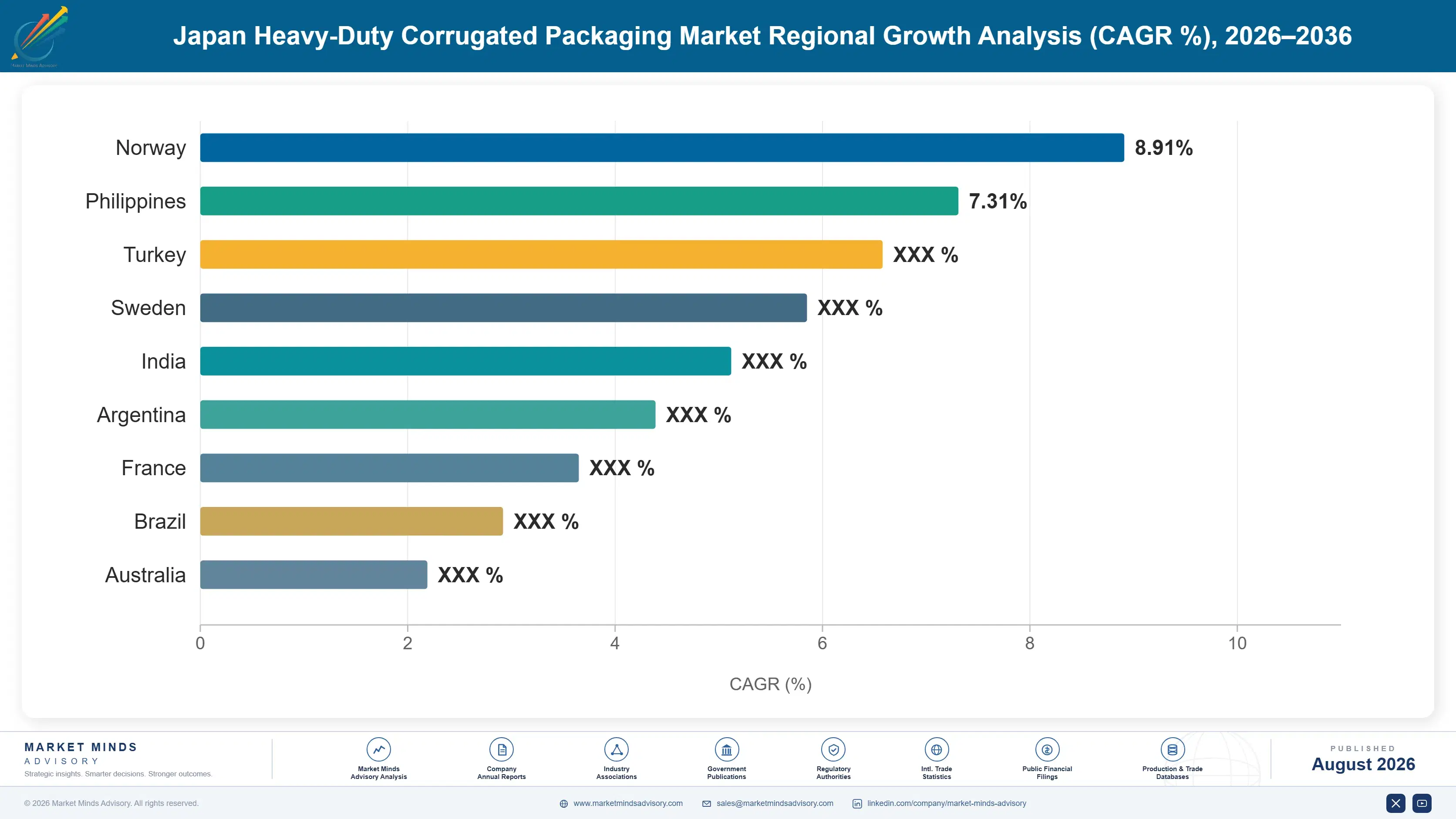
japan-heavy-duty-corrugated-market-country-cagr-analysis-1787308545198

Building on Exports Rather Than Home Demand

The domestic base offers no growth and returnables are taking the routes that repeat. Everything commercially worth pursuing sits where a shipment leaves the country, arrives somewhere humid, and carries a machine expensive enough that packaging is a risk decision rather than a cost line. Four positions follow. Board area prices none of them.

Specify Moisture Resistance as Default on Ocean Routes

Board loses roughly 37% of compression strength as moisture rises toward equilibrium in a saturated container hold, and transpacific and Indian Ocean routes hold those conditions for weeks. A stack certified at loading can fail before discharge. Converters that present that arithmetic with route-specific humidity data convert customers from uncoated to coated grades permanently, since nobody reverses a specification after seeing it. Coated grades compound at 6.3% and carry gross margins roughly 9 to 15 points above uncoated equivalents on the same board tonnage. Route data does the selling. Damage costs dwarf packaging cost.
Market Impact: Coated grades carrying 9 to 15 marg

Build Design Engineering for Fitments Rather Than Cases

Engineered internal fitments account for roughly 21% of heavy-duty pack value on a much smaller share of board tonnage, because the work is mechanical design rather than conversion. A fitment must locate a machine precisely, absorb drop energy without transmitting shock into a casting or optical assembly, and assemble without tools. Converters holding drop testing and design iteration capability win the fitment alongside the case. Those without it quote the box and watch somebody else take the engineered content, which is where the margin actually sits. The box itself is almost incidental.
Market Impact: Fitments carrying 21% of the total

Concede Fixed Domestic Routes and Redeploy Deliberately

Returnable containers have taken 44% of fixed domestic lanes and the economics on a repeating route are unarguable. Defending that volume consumes commercial effort on business that will convert regardless. Converters that concede those lanes early and redeploy toward export applications, which carry 58% of volume and no returnable threat, protect margin rather than tonnage. The uncomfortable part is that this means planning capacity down in one part of the business while investing in another, which corrugated operators are historically reluctant to do explicitly. Explicit planning beats gradual attrition. Margin matters more than tonnage.
Market Impact: Export applications now holding 58%

Replace Wax Coatings With Repulpable Dispersion Systems

Wax-coated board delivers moisture resistance and cannot be repulped, which increasingly fails at destination where receiving customers hold recyclability commitments and pay disposal costs. Dispersion and barrier coatings that repulp cleanly solve the same transit problem without the end-of-life penalty, and European and North American receivers now specify them. Converters offering documented repulpability capture conversions that a wax specification would lose outright, and the coating cost difference is small against the value of the machinery inside the crate. Uncoated board loses roughly 37% of compression strength at sea, so both arguments point the same way.
Market Impact: Strength loss reaching 37% when the

Who Controls the Margin Pool

Five converters hold 62% of the market measured on heavy-duty corrugated revenue, the basis applied consistently through this section. Concentration is high for corrugated because Japanese industrial customers qualify suppliers against Japanese Industrial Standards testing and long-standing relationships, then rarely revisit the decision. Rengo and Oji Holdings lead, both integrated from containerboard through conversion. Relationships outlast individual specifications here. Both are integrated
Competition operates on three dimensions. Containerboard integration decides cost position, since board is 63% of converted case cost and domestic supply is concentrated. Design engineering capability decides who wins engineered fitments rather than only the outer case. And export application experience decides who can specify credibly for a route the customer has not shipped before. All three are earned rather than purchased. Conversion capacity alone decides nothing.

Two pressures are reshaping position. Returnable container providers are taking fixed domestic lanes and will not be displaced from them. Against that, export machinery packing rewards converters with drop testing capability and route-specific specification experience. Rankings will move toward whoever pairs board integration with genuine transit engineering rather than conversion capacity alone. Very few hold both today.
japan-heavy-duty-corrugated-market-company-positioning-matrix-1787308545719

Competitive Moat and Risk Dimensions

RENGO

Moat: Integration and industrial relationships

Rengo operates from containerboard through conversion, which matters where board represents 63% of case cost and domestic supply is concentrated among few mills. Long-standing relationships with Japanese machinery and automotive manufacturers, built around Japanese Industrial Standards qualification, produce specification positions that are rarely reopened once a case design has performed reliably on an export route.
RENGO

Risk: Domestic volume erosion

A substantial position in domestic industrial packaging faces returnable container conversion on the fixed repeating routes where reuse economics are strongest, and 44% of those lanes have already gone. That conversion does not reverse. Replacing the volume requires winning export applications where the competition is on transit engineering rather than on the relationships that secured the domestic base.
OJI HOLDINGS

Moat: Board technology and coating depth

Oji brings substantial paper science capability to moisture-resistant and coated heavy-duty grades, which is the only part of this market growing meaningfully faster than industrial output. Dispersion coating development that repulps cleanly addresses exactly what receiving customers in Europe and North America now demand, and that capability comes from mill technology rather than converting practice.
OJI HOLDINGS

Risk: Fitment design capability

Engineered internal fitments carry roughly 21% of heavy-duty pack value on a small share of board tonnage, and winning them requires mechanical design and drop testing rather than paper technology. A board-led position can supply the outer case and still lose the engineered content to a converter with design engineers, which concedes the higher-margin portion of the same shipment.

Players Tracked

Prominent Players

Rengo
Oji Holdings
Nippon Paper Industries
Tomoku
Settsu Carton

Other Key Players

Daio Paper
Hokuetsu Corporation
Chuetsu Pulp and Paper
Marusan Paper
Asahi Printing
Kyodo Printing
Fuji Corrugated Case
Meiwa Corporation
Yamato Packing Service
Mitsubishi Paper Mills
Sumitomo Corporation
Kuraray
Nagoya Paper
Shikoku Kakoki
Sanko Corrugated

Recent Developments

MARCH 2025

Semiconductor equipment exports lift demanding crate specifications

Japanese semiconductor production equipment shipments to overseas fabrication projects continued at elevated volumes, requiring the most demanding heavy-duty crate and fitment specifications in the domestic market. This reflects capital investment cycles rather than any commercial development between converters. Crate and fitment requirements exceed anything domestic industry demands.
Signal: The most technically demanding packaging i
JULY 2025

Returnable systems extend across automotive component lanes

Automotive component suppliers extended reusable container systems across further fixed domestic supply routes, displacing single-trip heavy-duty corrugated on lanes where the same pack travels weekly. These were logistics decisions rather than corporate transactions, and the conversion does not reverse. Single-trip corrugated is displaced permanently on those lanes.
Signal: Every repeating domestic route is eventual
NOVEMBER 2025

Receiving customers specify repulpable coatings over wax

European and North American recipients of Japanese machinery increasingly specified moisture-resistant board using dispersion coatings that repulp, rather than wax constructions that cannot. These were customer specification changes rather than regulatory actions or supplier transactions. Disposal cost at destination now drives the coating decision made in Japan.
Signal: End-of-life handling at destination is now

Board, Coatings and Energy

Containerboard accounts for roughly 63% of cost of goods, purchased from a small number of integrated domestic mills producing the specific liner and medium combinations heavy-duty grades require. Coatings and adhesives run a further 11%, with dispersion barrier systems carrying materially higher cost than wax. Conversion labour, die-cutting tooling and energy make up most of the remainder, and freight is significant given case bulk.
Japanese energy costs rose sharply through 2022 and 2023 as liquefied natural gas import pricing followed the European supply disruption that International Energy Agency reporting documents, and containerboard production is energy intensive. Board prices moved with it and converters passed through only part, since industrial customers hold annual pricing. Company annual reports covering Japanese paperboard and packaging segments disclose the resulting margin compression across several quarters.

Exposure divides by integration rather than by scale. Integrated converters producing their own containerboard carry the energy cost at mill level but avoid the merchant board margin, while independent converters face both a concentrated supply base and full price pass-through with no alternative source. Import substitution is limited because heavy-duty grades demand specific liner and medium combinations that overseas mills do not readily match on specification or lead time.
japan-heavy-duty-corrugated-market-cost-volatility-analysis-1787308545913

Reduce board consumption through construction design

With board at 63% of cost and purchasing influence limited, design is the only meaningful lever. Flute selection, wall count and internal reinforcement can hold compression performance while reducing board weight per case, particularly where a legacy specification was set conservatively years ago and never revisited against current board strength. Legacy specifications reward review.

Qualify dispersion coatings against wax on total cost

Dispersion barrier coatings cost more per square metre than wax but repulp cleanly, which receiving customers increasingly require and which avoids disposal charges at destination. Presenting the comparison on total delivered cost including end-of-life handling, rather than on coating price alone, is what makes the conversion commercially straightforward for the customer. The conversation becomes straightforward.

Contract containerboard against forecast export volumes

Export machinery shipments are more predictable than domestic industrial demand because they follow capital investment programmes announced well in advance. Contracting board against that forecast rather than against total volume stabilises the largest cost line where visibility genuinely exists, and leaves spot exposure only on the less predictable domestic remainder. Domestic demand remains the harder half to forecast.

Portfolio Architecture for Margin Defence

The portfolio separates on whether the pack has to survive something. Standard double wall cases for domestic industrial distribution are conversion work sold on delivered price, and returnables are taking the best of those routes anyway. Coated and moisture-resistant grades solve an ocean transit problem. Engineered fitments solve a shock and location problem, and both are specified by engineers rather than buyers. Survival requirement draws the whole ladder.
The tension is that domestic case volume still fills the converting lines and carries fixed cost, even as returnables take the repeating lanes. Conceding it entirely leaves capacity idle before export and engineered volume replaces it. The converters managing this well are reducing domestic capacity deliberately against forecast conversion rather than defending lanes that will be lost regardless of effort. Corrugated operators are historically reluctant to plan capacity down explicitly. Planning down is harder than defending.

High-value pools concentrate where a shipment is long, humid or valuable. Semiconductor and machine tool export crating, moisture-resistant board and engineered fitments all qualify, and none is awarded on price per square metre of board. Engineers rather than buyers award each of them.

Volume / Commodity-Adjacent Tier

Standard double wall shipping cases and heavy-duty pallet boxes for domestic industrial distribution. Sold on delivered price with board cost dominating, and increasingly exposed to returnable container conversion on any route that repeats regularly.
Gross Margin: 14-21%

Premium / Certified Tier

Triple wall export cases and heavy-duty corrugated pallets qualified against Japanese Industrial Standards testing for high-value machinery shipments. Route experience and compression certification rather than converting cost determine which supplier is specified.
Gross Margin: 24-34%

Sustainability / Regulatory / Next-Generation Tier

Moisture-resistant and repulpable coated board plus engineered internal fitments replacing expanded foam. The wide margin range reflects the gap between established coated grades and fitment design work priced against engineering content rather than board area.
Gross Margin: 28-46%
japan-heavy-duty-corrugated-market-portfolio-architecture-1787308546410

High-value Sub-segments and Strategic Watch-out

Coated Ocean Transit Board

Compounding at 6.3% because uncoated board loses roughly 37% of compression strength in a saturated container hold over weeks at sea. Damage to high-value machinery costs vastly more than the packaging, which makes the specification conversation straightforward once the data is presented. Route data settles the argument.
Gross Margin: 30-40%

Engineered Machinery Fitments

Growing at 5.4% and carrying roughly 21% of pack value on a small share of board tonnage, because the work is mechanical design and drop testing rather than conversion. Converters without design engineers quote the case and lose the engineered content entirely. Foam replacement drives adoption.
Gross Margin: 34-46%

Standard Domestic Industrial Cases

The volume core at 3.0%, sold on delivered price with board at 63% of cost and returnables taking 44% of the fixed routes. Run for converting utilisation while capacity is deliberately reduced against forecast conversion rather than defended lane by lane. Returnables keep taking lanes.
Gross Margin: 14-21%

Wax-Coated Moisture Barrier Board

The watch-out. It solves the transit problem effectively and cannot be repulped, which receiving customers in Europe and North America increasingly refuse. Dispersion coatings address the same requirement without the end-of-life penalty at destination. Receiving customers increasingly refuse it outright. Disposal charges land on the recipient.
Gross Margin: 20-38%

Specifications That Outlast Buyers

Demand here is qualification-locked in a way that offsets the absence of growth. A heavy-duty case design tested against Japanese Industrial Standards compression and drop requirements, and proven on a specific export route, is reordered for the life of the machine model it packs. Requalifying a changed design takes around 11 weeks and nobody undertakes it to save on board. That stickiness is what has kept five converters holding 62% of a market with no underlying expansion.
Depth varies by shipment value. Semiconductor and precision equipment shippers buy deepest, involving converters in drop testing and treating packaging as a project risk item. Machine tool and robot exporters buy deeply on route-proven designs. General industrial distribution buys on delivered price. Domestic component supply on fixed lanes buys least of all, because it is converting to returnables and knows it.

The deciding population has shifted toward engineering. Case specification once sat with purchasing weighing board cost against damage history. On export machinery it now sits with product engineering and logistics risk functions who evaluate compression margin and shock transmission, and who never see the price per square metre.
japan-heavy-duty-corrugated-market-end-use-penetration-index-1787308546899

Where Japanese Converters Should Fight

These are among the four positions where our research anticipates prominent divergence between winners and laggards over the coming forecast period. Each is grounded in the demand model, the regulatory perimeter, and the announced capacity pipeline.
01 / EXPORT ROUTE CONCENTRATION

The only defensible volume is packaging that leaves the country

Returnable containers have already taken 44% of fixed domestic lanes, and the economics on a repeating route make that conversion permanent rather than contestable. Export freight is immune to that pressure, because nobody funds returning an empty container across an ocean, and roughly 58% of all heavy-duty volume already packs goods leaving Japan. Converters that concede those repeating lanes early and redeploy commercial effort toward export applications protect their margin instead of defending tonnage which will convert regardless of any effort.
02 / OCEAN HUMIDITY ARGUMENT

A stack certified at loading can still fail before discharge

Uncoated corrugated loses roughly 37% of its compression strength as board moisture rises toward equilibrium inside a container hold held near saturation for weeks at a time. Transpacific and Indian Ocean routes sustain exactly those conditions across the entire crossing, so a stack certified safe at loading can still fail before discharge. Presenting route-specific humidity data converts customers from uncoated to coated grades permanently, because a specification is never reversed once that arithmetic has been seen, and coated grades carry 9 to 15 additional points of margin.
03 / FITMENT ENGINEERING CAPTURE

The margin sits inside the box, not around it

Engineered internal fitments account for roughly 21% of heavy-duty pack value on a far smaller share of board tonnage, because the work is mechanical design rather than corrugated conversion. A fitment has to locate a machine precisely, absorb drop energy without transmitting shock into a casting, and assemble without tools in a packing hall. Converters holding drop testing and design iteration capability take both parts of the shipment, while those without it quote the outer case and lose everything valuable inside it.
04 / COATING END-OF-LIFE COMPLIANCE

What happens to the box at destination now decides the coating

Wax coatings deliver moisture resistance and cannot be repulped at all, which increasingly fails at destination where receiving customers hold recyclability commitments and pay the disposal charges themselves. Dispersion barrier coatings solve exactly the same transit problem and repulp cleanly, and European and North American recipients now specify them directly in their own purchase terms. The coating cost difference is trivial against the value of the machinery inside the crate, so converters that offer documented repulpability win those conversions outright every time.

Engagement Snapshot From the Field

A live engagement with an industry participant carrying material or product regulatory and market exposure ahead of a defining policy shift, showing how our research translates into a defensible multi-year portfolio strategy.
MARKET MINDS ADVISORY · CLIENT ENGAGEMENT SUMMARY
Japan Heavy-Duty Corrugated Packaging Producer Strategic Portfolio Review and Transition Roadmap 2026·Investment Scenario on Japan Heavy-Duty Corrugated Packaging Exposure Evaluation 2025-26
CLIENT PROFILE
A machine tool manufacturer shipping roughly 4,800 machines annually (client-reported, unverified by MMA) from three Japanese plants into North American, European and Southeast Asian markets. Export packaging spend ran near JPY 2.9 billion (client-reported, unverified by MMA), specified plant by plant with case designs that in several cases had not been reviewed in over a decade.
STRATEGIC CHALLENGE
Transit damage claims had risen on Southeast Asian and North American routes, and the packaging engineering group attributed them to rougher handling at destination ports. Procurement had separately tendered corrugated on price per square metre and awarded to a lower-cost converter. Neither function had examined whether the board specification suited the route conditions at all.
MMA APPROACH
MMA instrumented a sample of shipments to record humidity, temperature and shock events across each major route, then measured board moisture content and residual compression strength on arrival. Existing case designs were compared against the compression margin actually available at discharge rather than at loading. Fitment materials were reviewed against customer disposal concerns.
KEY FINDINGS
  1. Board moisture at discharge on Southeast Asian routes removed around 37% of the compression strength the case designs assumed, and every damage claim examined involved a stack safe at loading.
  2. Handling severity at destination ports was well within design tolerance on the recorded shipments, which eliminated the explanation the packaging engineering group had been working to for two years.
  3. The tendered converter had quoted an uncoated construction meeting the written specification exactly, because the specification itself had never referenced humidity or route conditions in any form.
  4. Engineered fitments on two machine families were still expanded polystyrene, and three European customers had raised disposal cost concerns that nobody inside the client had recorded centrally.
CLIENT PROFILE
A machine tool manufacturer shipping roughly 4,800 machines annually (client-reported, unverified by MMA) from three Japanese plants into North American, European and Southeast Asian markets. Export packaging spend ran near JPY 2.9 billion (client-reported, unverified by MMA), specified plant by plant with case designs that in several cases had not been reviewed in over a decade.
STRATEGIC CHALLENGE
Transit damage claims had risen on Southeast Asian and North American routes, and the packaging engineering group attributed them to rougher handling at destination ports. Procurement had separately tendered corrugated on price per square metre and awarded to a lower-cost converter. Neither function had examined whether the board specification suited the route conditions at all.
MMA APPROACH
MMA instrumented a sample of shipments to record humidity, temperature and shock events across each major route, then measured board moisture content and residual compression strength on arrival. Existing case designs were compared against the compression margin actually available at discharge rather than at loading. Fitment materials were reviewed against customer disposal concerns.
KEY FINDINGS
  1. Board moisture at discharge on Southeast Asian routes removed around 37% of the compression strength the case designs assumed, and every damage claim examined involved a stack safe at loading.
  2. Handling severity at destination ports was well within design tolerance on the recorded shipments, which eliminated the explanation the packaging engineering group had been working to for two years.
  3. The tendered converter had quoted an uncoated construction meeting the written specification exactly, because the specification itself had never referenced humidity or route conditions in any form.
  4. Engineered fitments on two machine families were still expanded polystyrene, and three European customers had raised disposal cost concerns that nobody inside the client had recorded centrally.
RECOMMENDED STRATEGY
Phase 1: Phase 1 (months 1 to 6): Rewrite export case specifications to state compression margin required at discharge under recorded route humidity rather than at loading. Phase 2: Phase 2 (months 6 to 16): Convert Southeast Asian and transpacific routes to coated moisture-resistant board and requalify the affected case designs. Phase 3: Phase 3 (months 16 to 28): Replace expanded polystyrene fitments with engineered corrugated on the two machine families raising disposal concerns.
OUTCOME
Transit damage claims fell by approximately 61% within a year of the specification change (client-reported, unverified by MMA). Packaging spend rose by roughly JPY 210 million against claims and rework savings near JPY 780 million. Two European customers withdrew their disposal cost concerns following fitment conversion (client-reported, unverified by MMA).

Frequently Asked Questions

Foundational context covering the market sizes, CAGR, scope, country, region and competition that inform every finding below. This section is provided to cover basics and most often pre-purchase conversations, answered from the MMA Primary Research Dataset.

What is the current size of the Japan Heavy-Duty Corrugated Packaging Market?

The market was worth USD 1.86 billion in 2025, reaching USD 1.94 billion in 2026. East Asia takes 34% of packed goods by destination, including Japanese domestic consumption.

How large will the Japan Heavy-Duty Corrugated Packaging Market be by 2036?

MMA forecasts USD 2.98 billion by 2036, an expansion multiple of 1.51 times the 2026 base. That represents roughly USD 1.04 billion of incremental value.

What is the CAGR for the Japan Heavy-Duty Corrugated Packaging Market 2026 to 2036?

The base case compounds at 4.2% annually, with a bull case of 5.4% and a bear case of 3.0%. Historical growth from 2020 to 2025 ran at 3.2%.

Which segment is growing fastest?

Moisture-resistant and coated heavy-duty board compounds at 6.3%, exactly 1.50 times the market rate. Uncoated board loses roughly 37% of compression strength in saturated ocean transit.

Who are the major companies in the Japan Heavy-Duty Corrugated Packaging Market?

Rengo, Oji Holdings, Nippon Paper Industries, Tomoku and Settsu Carton hold a combined 62% of the market. Concentration is high because industrial customers rarely revisit a qualified supplier.

Which country is growing fastest?

India compounds at 6.4% as a destination market, ahead of every other. Japanese machine tools, robots and production equipment are moving there in growing volume.

Report Segmentation Architecture

The full report scope spans multiple orthogonal segmentation dimensions, with cross-tabulated demand data provided for each dimension pair. Coverage extends further to regional breakdowns, trend trajectories, and the competitive detail needed to support segment-level decision-making.

By Board Construction and Format

  • Double Wall Shipping Cases
  • Triple Wall Export Cases
  • Heavy-Duty Pallet Boxes and Bulk Containers
  • Moisture-Resistant and Coated Heavy-Duty Board
  • Engineered Internal Fitments and Inserts
  • Heavy-Duty Corrugated Pallets

By End-Use Industry

  • Machine Tools and Industrial Equipment
  • Semiconductor and Electronics Production Equipment
  • Automotive Components and Assemblies
  • Industrial Robotics and Automation
  • Chemicals and Industrial Materials

By Commercial Dimension

  • Direct Supply to Manufacturers
  • Contract Packing and Export Crating Services
  • Distributor and Trading House Channel
  • Design and Testing Service Supply

By Region

  • North America
  • Western Europe
  • East Asia
  • South Asia and Pacific
  • Latin America
  • Middle East and Africa
  • Eastern Europe

Scope, Methodology, and Coverage

Every figure in this report is reproducible from documented input assumptions. The scope below maps the historical period, the forecast horizon, the segmentation dimensions, and the countries covered, alongside the underlying primary and qualitative methodology.
Historical Period
2020 to 2025
Forecast Period
2026 to 2036
Base Year
2025 (USD billions; MMA Primary Research Dataset, August 2026)
Market Definition
The market covers heavy-duty corrugated packaging produced in Japan for industrial and export applications, spanning double and triple wall shipping cases, heavy-duty pallet boxes and bulk containers, moisture-resistant and coated heavy-duty board, engineered internal fitments and inserts, and heavy-duty corrugated pallets. Standard single wall retail and electronic commerce cases, containerboard sold as reels to other converters, plastic and wooden transit packaging, and returnable container systems are excluded. Sizing is measured at converter revenue in current prices, with regional shares describing destination of packed goods.
Quantitative Units
USD billions (current prices); square metres of converted board and cases shipped where applicable
Segmentation Dimensions
By Board Construction and Format; By End-Use Industry; By Commercial Dimension; By Region
Regions Covered
North America, Western Europe, East Asia, South Asia and Pacific, Latin America, Middle East and Africa, Eastern Europe
Countries Covered
USA, China, Germany, France, UK, Japan, South Korea, India, Australia, Canada, Brazil, Mexico, Indonesia, Vietnam, Thailand, Malaysia, UAE, Saudi Arabia, South Africa, Nigeria, Turkey, Poland, Netherlands, Italy, Spain, Sweden, Switzerland, Argentina, Colombia, Singapore, and additional markets relevant to this sector
Key Companies Profiled
Rengo, Oji Holdings, Nippon Paper Industries, Tomoku, Settsu Carton, Daio Paper, Hokuetsu Corporation, Chuetsu Pulp and Paper, Marusan Paper, Asahi Printing, Kyodo Printing, Fuji Corrugated Case, Meiwa Corporation, Yamato Packing Service, Mitsubishi Paper Mills, Sumitomo Corporation, Kuraray, Nagoya Paper, Shikoku Kakoki, Sanko Corrugated
Quantitative Methodology
Primary survey, n=3,800 respondents, Q4 2025, six countries; demand-side model with trade association cross-validation
Qualitative Methodology
47 expert interviews, Q4 2025; applied to validate demand model assumptions, identify emerging dynamics, and assess competitive positioning
Report Format
PDF and XLSX data workbook (Word format preview document)
Publisher
Market Minds Advisory
Report Code
MMA-2026-PAC-738
Published
August 2026
Contact
sales@marketmindsadvisory.com | www.marketmindsadvisory.com

Purchase the full Japan Heavy-Duty Corrugated Packaging Market Report (2026 to 2036).

The full report sizes Japanese heavy-duty corrugated packaging across six construction formats, three commercial dimensions and seven destination regions, with annual forecasts to 2036 under base, bull and bear scenarios. Route humidity exposure is modelled against residual compression strength at discharge, which is where export case designs actually fail rather than at loading. Returnable container penetration is tracked lane by lane across domestic industrial routes. Engineered fitment value is separated from outer case value, since the two are won on entirely different capabilities. Twenty converters are profiled on a consistent heavy-duty revenue basis.
Route humidity modelled against compression strength at discharge
Returnable penetration tracked lane by lane across domestic routes
Engineered fitment value separated from outer case revenue
Export machinery shipment forecasts by equipment category
Repulpable coating specification requirements assessed by destination
Containerboard supply concentration quantified across domestic mills

Built For The People Who Decide

From boardroom strategy to bench-side execution, this report is read cover-to-cover by leaders shaping the next decade of their industry, turning demand scenarios, market dynamics and valuation benchmarks into decisions.
CXOs/ Presidents/ VPs/ Managers
M&A and Corporate Development
Strategy Teams and R&D Heads
Procurement and Product Directors
Regulatory and Compliance Leaders
Investor Relations and Equity Analysts