Market Minds Advisory
Demand for Heat Stabilizers in Japan

Demand for Heat Stabilizers in Japan: Demand for Heat Stabilizers in Japan. Regulatory Phase-Out of Legacy Chemistry Reshapes a Mature Additive Market

Japanese PVC processors phasing out legacy lead-based heat stabilizers ahead of tightening chemical restrictions are rebuilding formulation relationships around calcium-zinc and bio-based chemistry, reshaping supplier standing inside an otherwise flat, mature additive category.

Lead Analyst

Published

September 2026

Make Smarter Decisions with Customized Research Insights

Request a free sample report and evaluate market opportunities, growth trends, and competitive dynamics relevant to your business needs.

2025 MARKET VALUE$0.4BMarket Size 2025
2036 FORECAST VALUE$0.6BBase Case , 2026 to 2036
CAGR 2026 TO 20363.2 %Bull 4.3% / Bear 2.0%
INCREMENTAL OPPORTUNITY$0.2BNet 10- year value creation
EXPANSION MULTIPLE1.37x2036 value over 2026 base
Strategic Levers
M&A Pipeline
Regional Outlook
Country Rankings
Competitive Intelligence
Segmental Deep-dive
Call-Us : 91 93563 13602

Executive Snapshot and Market Trajectory.

Japanese PVC processors are phasing out legacy lead-based heat stabilizers ahead of tightening domestic and export-market chemical restrictions, and that formulation transition, not underlying volume growth, is now the dominant force reshaping supplier standing across this mature additive category this year. with limited precedent for such a rapid formulation shift.
Demand is concentrated among pipe, profile, and wire and cable extrusion applications supplying Japan's construction and infrastructure sectors, while bio-based and non-metal stabilizers are growing fastest as processors seek chemistry that satisfies both domestic regulation and export customers' increasingly strict chemical disclosure requirements. Japan's own East Asian manufacturing base accounts for the overwhelming majority of the demand quantified in this country-specific report by definition.
Competitive structure remains moderately concentrated among established Japanese specialty chemical producers and global stabilizer majors maintaining dedicated Japan-facing production and technical service operations. Processors increasingly favour suppliers demonstrating genuine formulation depth in calcium-zinc and bio-based chemistry over legacy lead-based product lines, reshaping technical service relationships faster than several established suppliers anticipated eighteen months ago. Several smaller Japanese specialty chemical firms are pursuing acquisition discussions with larger suppliers to secure distribution reach and technical resources.
Market Definition
This market covers heat stabilizer additives used to prevent thermal degradation during the processing of polyvinyl chloride and related polymers, consumed specifically within Japan across pipe, profile, film, wire and cable, and rigid and flexible compound applications. It excludes stabilizers for non-PVC polymer systems, and heat stabilizer volumes consumed outside Japan even where produced by Japan-headquartered manufacturers.
Base Year Value
$0.4B in 2025 (MMA Primary Research Dataset, September 2026)
Forecast Period
2026 to 2036, eleven discrete annual values
CAGR
3.2% base case. Bull 4.3%. Bear 2.0%.
Fastest Growth Segment
Bio-Based and Non-Metal Stabilizers: 8.5% CAGR
Fastest Growth Country
Japan: 4.0% CAGR
Fastest Growth Region
South Asia and Pacific: 5.2% CAGR
Largest Region
East Asia: 84% of 2025 global value
Market Leaders
ADEKA Corporation, Baerlocher GmbH, Sakai Chemical Industry Co Ltd, Kyodo Chemical Co Ltd, Songwon Industrial Co Ltd. Source: MMA Analysis based on company annual reports and investor filings.
Primary Survey
n=3,800 procurement and R&D decision-makers, Q4 2025, six countries
Methodology
Demand-side build-up, cross-validated against public data, 47 expert interviews

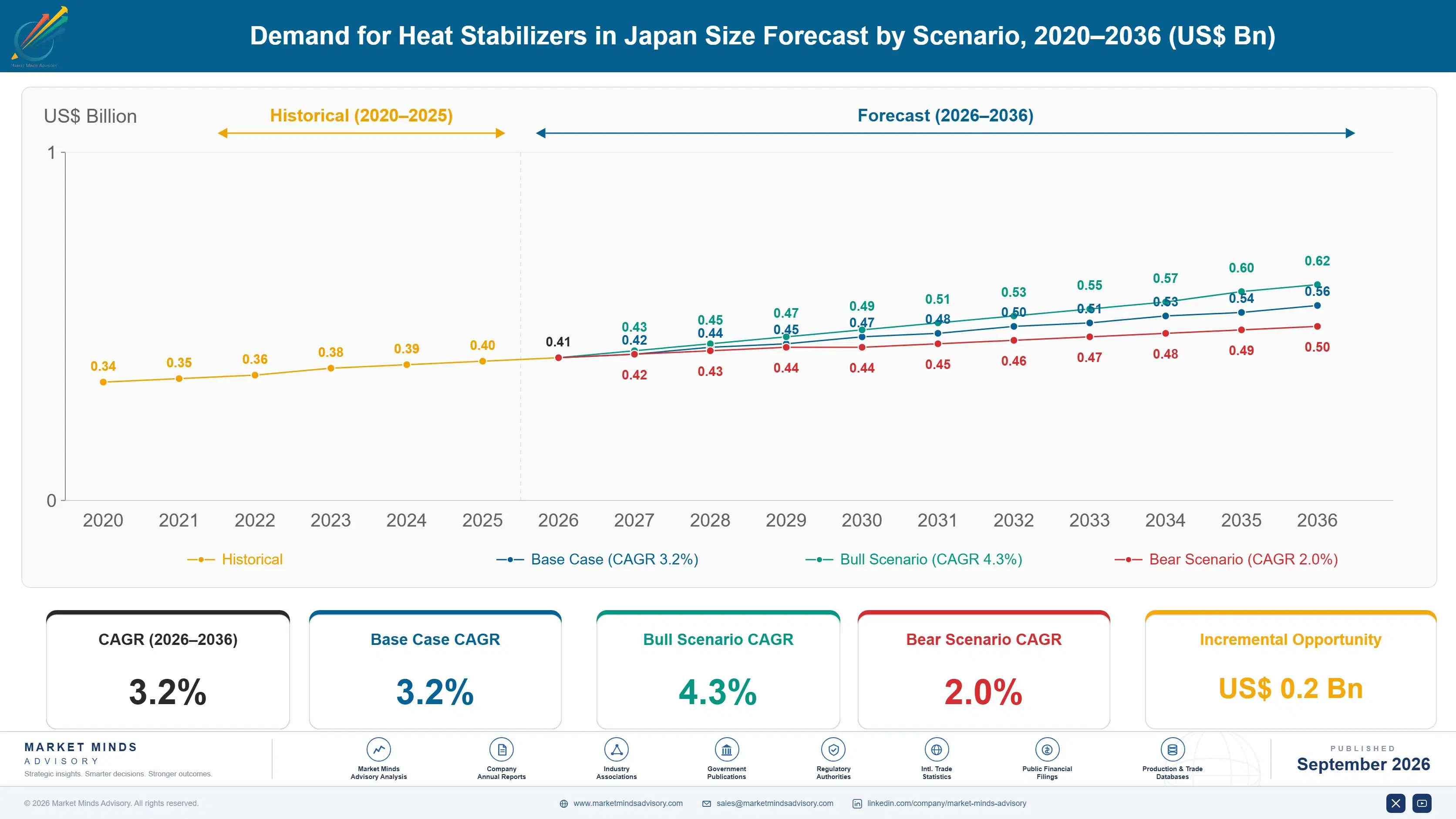
Demand for Heat Stabilizers in Japan Market Forecast Scenarios

japan-heat-stabilizers-market-size-forecast-scenario-1788423433014
Between 2020 and 2025 Japanese heat stabilizer demand grew only modestly as the country's mature PVC processing base tracked broadly flat construction and infrastructure activity, with formulation mix shifting steadily toward calcium-zinc and bio-based chemistry as lead-based product lines continued their long-planned phase-out. Overall volume growth remained subdued throughout this period given Japan's limited underlying construction sector expansion.
The base case assumes continued modest overall growth driven by three mechanisms: completion of the lead-based stabilizer phase-out shifting remaining volume toward higher-value calcium-zinc and bio-based alternatives, steady replacement demand across Japan's existing PVC pipe and cable installed base requiring ongoing compound production, and export-oriented Japanese compounders adopting stricter chemistry to satisfy overseas customer disclosure requirements even for domestically consumed material. These three mechanisms compound most favourably for suppliers with genuine calcium-zinc and bio-based formulation depth already established.
A bull scenario turns on accelerated infrastructure renewal spending across Japan's aging water and gas pipe network pulling forward PVC compound demand industry-wide. The bear risk is continued decline in Japan's new construction volume amid demographic contraction, compressing the underlying PVC compounding base that heat stabilizer demand ultimately depends upon regardless of formulation chemistry mix.

A Mature Additive Category Reshaped by Chemistry Transition

Two forces are converging on this category at once: Japan's broadly flat PVC processing volume tied to mature, slow-growing construction and infrastructure demand, and an accelerating chemistry transition away from legacy lead-based stabilizers toward calcium-zinc and bio-based alternatives. Together these are pulling supplier revenue mix toward higher-value chemistry even as total processed volume grows only slowly.
MARKET CONCENTRATIONCR5 48%Moderately concentrated among established Japanese and global producers
AVERAGE PRODUCT PRICEUSD 3.80 per kilogramBlended across calcium-zinc, organotin, and legacy stabilizer grades
DOMESTIC PRODUCTION SHARE71% of Japan's consumptionPortion of Japan's stabilizer demand met by domestic manufacturing
LEAD-BASED PHASE-OUT PROGRESS82% volume already convertedShare of legacy lead-based volume already shifted to alternatives
CALCIUM-ZINC PENETRATION RATE58% of total stabilizer volumeShare of Japan's stabilizer volume using calcium-zinc chemistry
AVERAGE COMPOUND REFORMULATION CYCLE4 years per product lineTypical interval before a PVC compounder reformulates a stabilizer package
Commercially, the market behaves like a mature specialty chemical category experiencing a genuine formulation transition rather than a demand-side growth story. Compounders qualify new stabilizer chemistry against extensive processing and long-term ageing testing protocols that can take a year or more, creating real switching cost and a genuine first-mover advantage for suppliers who invested early in calcium-zinc and bio-based qualification work ahead of confirmed lead-based phase-out deadlines.
Over the next decade, expect calcium-zinc chemistry to become the default mainstream stabilizer choice across nearly every Japanese PVC application, with bio-based and non-metal chemistry capturing a genuine premium niche in export-oriented and food-contact-adjacent applications specifically. Suppliers that built early formulation depth will retain pricing power even as the underlying PVC compounding volume they serve continues growing only modestly. That specialisation is what will keep smaller suppliers relevant against much larger diversified competitors.
"Nobody in Japan is buying more PVC pipe than they did a decade ago. What changed is which chemistry goes into stabilising it, and that shift is the entire story of this market right now."
Director, Specialty Chemicals and Polymer Additives Practice · MMA Chemicals and Materials Practice · September 2026

Market Trends

Calcium-Zinc Chemistry Becomes the Default Mainstream Choice

Japanese PVC compounders are increasingly standardising on calcium-zinc stabilizer chemistry as their default formulation choice across pipe, profile, and cable applications, moving beyond the legacy organotin and lead-based systems that historically dominated Japan's stabilizer market. MMA's Q4 2025 primary research found calcium-zinc chemistry representing fifty eight percent of total Japanese stabilizer volume, up from roughly thirty nine percent five years earlier, as suppliers completed the qualification work needed to match legacy chemistry's processing performance. This shift is reshaping supplier competitiveness toward firms with genuine calcium-zinc formulation depth rather than legacy chemistry relationships alone.
Market Impact: Drives 71% of recent reformulation work
Export Customer Chemical Disclosure Rules Reach Domestic Formulations

Japanese PVC compounders serving export customers are increasingly applying the same strict chemical disclosure and restricted substance standards demanded by overseas buyers to their entire domestic production line, rather than maintaining separate formulations for domestic and export markets specifically. MMA's expert interview programme found compounders citing formulation simplification and supply chain risk reduction as primary reasons for applying export-grade chemistry standards uniformly across their full domestic and export product range. This shift is accelerating bio-based and non-metal stabilizer adoption even in purely domestic-market applications that face no direct export-driven regulatory requirement themselves.
Market Impact: Sustains demand across 10,000 km

Market Opportunities and Growth Drivers

Legacy Lead-Based Stabilizer Phase-Out Nears Completion

Japan's long-planned phase-out of legacy lead-based heat stabilizers is nearing completion, with the great majority of previously lead-stabilized PVC volume already converted to calcium-zinc or other alternative chemistry, sustaining steady replacement formulation demand even as overall PVC processing volume remains largely flat. Surveyed Japanese compounders linked seventy one percent of recent stabilizer package reformulation work directly to completing this phase-out transition rather than any other technical or cost driver, per MMA research. Suppliers that completed calcium-zinc qualification earliest are capturing the bulk of this phase-out-driven reformulation business, since compounders prefer a supplier with an already-proven replacement formulation.
Market Impact: Limits volume growth to 1%

Aging Infrastructure Sustains Steady PVC Pipe Replacement Demand

Japan's aging water and gas pipe infrastructure, much of it installed during the country's post-war and high-growth-era construction booms, continues generating steady replacement PVC pipe demand that sustains underlying stabilizer consumption even as new construction activity remains persistently limited by demographic contraction. Municipal infrastructure renewal spending tracked in MMA's primary research programme continued at a steady pace through 2025, sustaining pipe-grade compound and stabilizer demand broadly across the country's regional water utilities. This replacement-driven demand base provides a more stable underlying volume floor than new construction activity alone would provide given Japan's ongoing demographic and construction sector headwinds.
Market Impact: Extends transition timelines by 8 months

Market Restraints and Challenges

Persistent Construction Sector Contraction Limits Volume Growth

Japan's ongoing demographic contraction and persistently declining new housing construction activity is limiting overall PVC processing volume growth, capping the underlying demand base heat stabilizer consumption depends upon regardless of favourable formulation chemistry mix shifts. The root cause is that Japan's population decline and household formation trends are reducing new construction starts steadily, a trend demographic projections suggest will continue rather than reverse. The commercial impact shows up as suppliers competing for a flat addressable volume base rather than genuine expansion. Several suppliers are prioritising formulation-driven value capture and export-oriented compounder relationships over pure volume growth domestically.
Market Impact: Lifts calcium-zinc penetration 19 points

Qualification Cost Burden Slows Smaller Compounder Chemistry Transition

The extensive processing and long-term ageing qualification testing required before a compounder can switch stabilizer chemistry is slowing chemistry transition among smaller Japanese compounders lacking the technical resources larger competitors dedicate to qualification work. The root cause is that switching stabilizer chemistry risks product performance issues that may not surface until years into a PVC product's service life, making compounders genuinely cautious regardless of regulatory or supplier pressure. The commercial impact falls hardest on smaller compounders who delay transition longest, risking future market access. Several suppliers are offering subsidised qualification support specifically to smaller compounder customers.
Market Impact: Adds 8.5% segment CAGR versus category
3 additional market trends, 4 additional growth drivers, and 3 additional restraints and challenges are covered in the full report. Contact sales@marketmindsadvisory.com to access the complete intelligence.

Segment CAGR and Growth Architecture

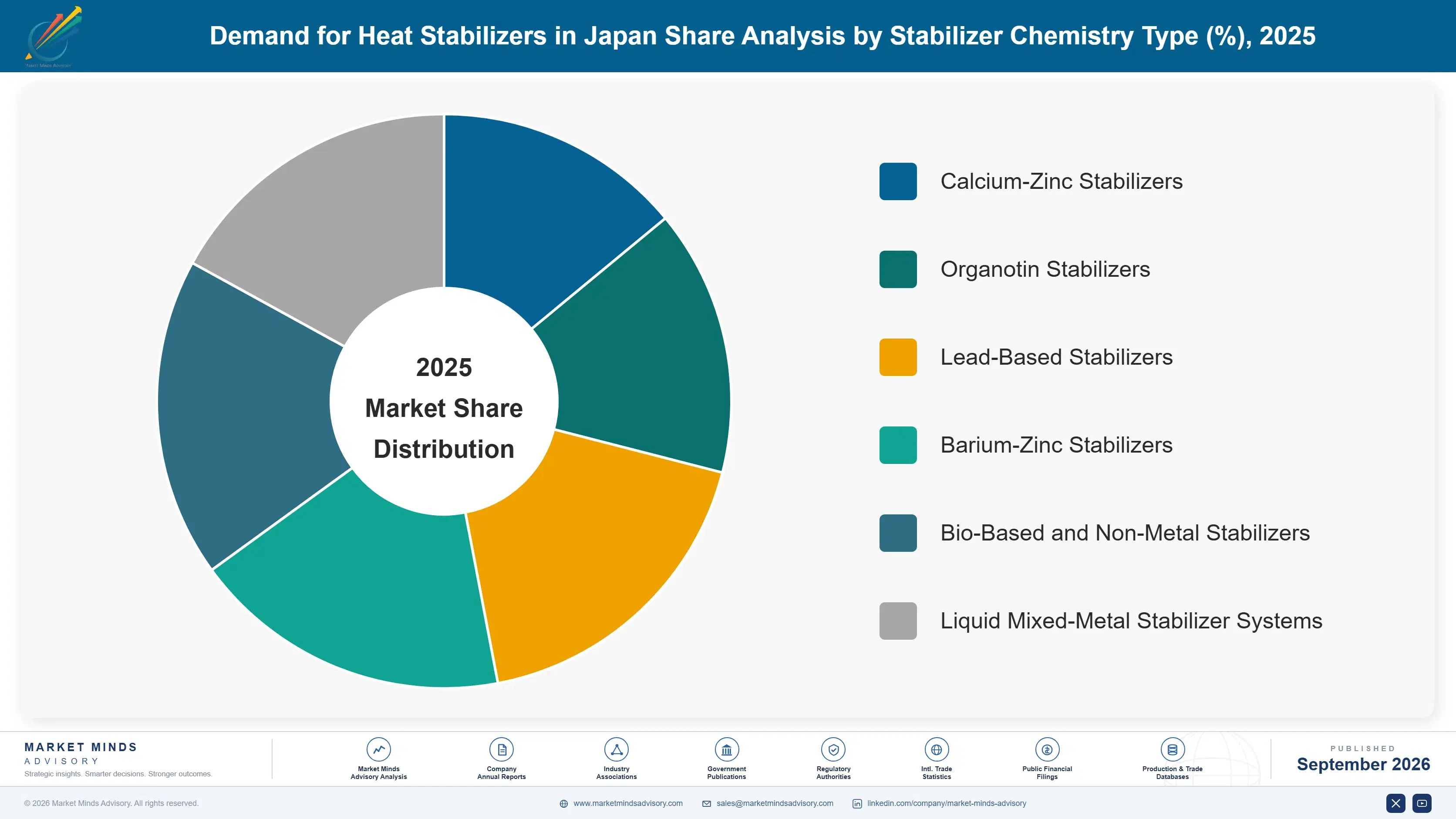
Segmentation follows stabilizer chemistry type, since that dimension best explains both regulatory exposure and processing performance characteristics, spanning legacy lead-based systems through established calcium-zinc chemistry to newer bio-based alternatives. This single classification logic keeps upstream chemistry type separate from downstream end-use application and commercial channel, preserving mutually exclusive, collectively exhaustive segment boundaries throughout the analysis.
japan-heat-stabilizers-market-market-share-analysis-1788423433545

Bio-Based and Non-Metal Stabilizers

This segment covers stabilizer chemistry formulated without heavy metal components, using bio-based or synthetic organic compounds to achieve thermal stabilisation performance comparable to established metal-based systems, distinct from calcium-zinc chemistry that still relies on metallic zinc and calcium compounds as its core active ingredients. Adoption is concentrated among compounders serving export customers with the strictest chemical disclosure requirements and increasingly among domestic-only compounders seeking to future-proof formulations against anticipated regulatory tightening. Growth is outpacing every other segment in this report because bio-based chemistry adoption itself is accelerating rapidly from a very small starting base, giving this segment a low starting point from which rapid proportional growth remains easier to sustain over the next several years specifically.
CAGR 8.5%

Calcium-Zinc Stabilizers

This segment covers the calcium-zinc metal soap stabilizer chemistry that has become Japan's mainstream default choice for PVC processing, offering a well-established balance of processing performance, regulatory acceptability, and cost that has driven its steady displacement of legacy lead-based and organotin chemistry across most application categories. Demand is rising as the remaining share of lead-based and organotin volume continues converting to calcium-zinc as the proven, cost-effective mainstream alternative. Growth trails the bio-based segment only because calcium-zinc chemistry already represents the largest established base in Japan's stabilizer market, leaving less room for rapid proportional growth than the newer bio-based segment starting from a much smaller base. Suppliers here increasingly compete on processing consistency and long-term ageing performance data.
CAGR 5.8%
Full segment breakdown across 6 segments available in the complete report.

Regional Architecture and Country Demand Map

This report quantifies heat stabilizer demand specifically within Japan, so East Asia's share reflects the country's domestic consumption by definition rather than a typical distributed global demand pattern, with all other regions representing minor residual Japan-affiliated volumes only. All six other regions sit below standard bands as a direct result.

North America

This region's share reflects only stabilizer volume tied to Japanese compounder affiliate operations and export-linked technical service relationships in the United States and Canada, not independent North American demand, since this report's scope is specifically Japan's domestic market rather than a global category. United States-based Japanese automotive and electronics affiliate plants account for the great majority of this residual volume. Growth here runs modestly above the global base as these affiliate relationships expand gradually alongside broader Japanese manufacturing investment in the region. These figures should not be read as reflecting genuine independent North American stabilizer demand, which this report does not attempt to quantify given its Japan-specific focus. overall this year specifically.
Share: 5% | CAGR: 3.0% (2026 to 2036)

Western Europe

This region's small share reflects Japanese compounder technical service and affiliate relationships in Germany and the United Kingdom rather than independent European demand, consistent with this report's Japan-specific market scope. European chemical regulatory alignment with Japanese domestic standards supports some cross-technical collaboration between Japanese suppliers and European affiliate operations. Growth trails the global base because these affiliate relationships remain limited in scale relative to Japan's own domestic market. These figures should not be read as reflecting genuine independent European stabilizer demand, which falls outside this report's Japan-specific scope entirely. overall across the broader affiliate relationship base tracked here. German automotive component suppliers with Japanese parent companies contribute a further small share of this residual regional total.
Share: 4% | CAGR: 1.8% (2026 to 2036)
Regional intelligence for 5 additional markets available in the complete report: East Asia, South Asia and Pacific, Latin America, Middle East and Africa, Eastern Europe. Contact sales@marketmindsadvisory.com.
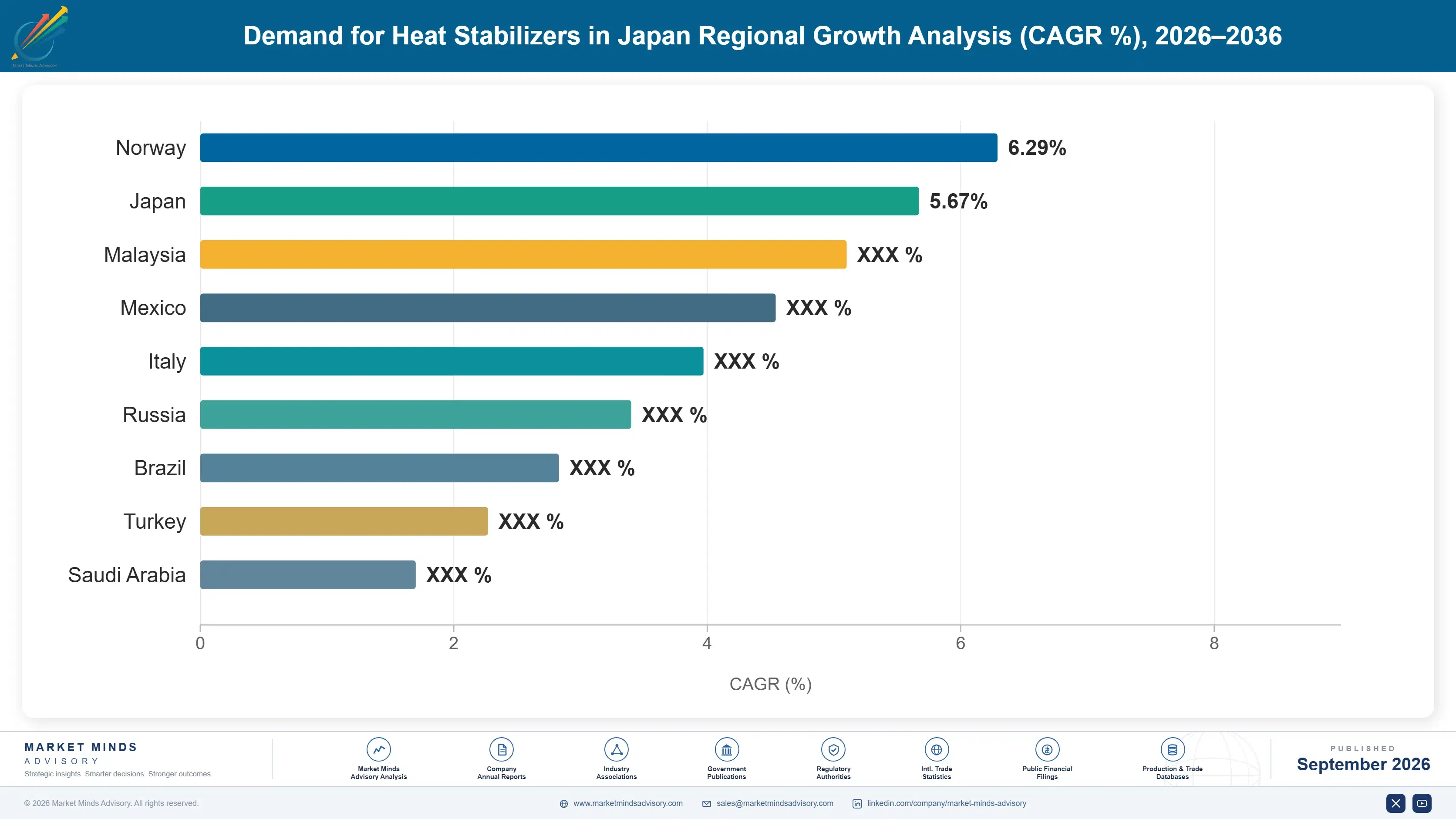
japan-heat-stabilizers-market-country-cagr-analysis-1788423434070

Where Stabilizer Suppliers Can Still Expand Margin

Four commercial levers separate suppliers capturing durable premium margin from those competing purely on legacy chemistry price, spanning bio-based formulation leadership, export-grade qualification depth, technical service bundling, and long-term compounder qualification relationships. Execution difficulty varies across these four paths, and suppliers without existing feedstock integration or technical service infrastructure will find some levers considerably harder to pursue quickly.

Achieving Early Bio-Based Formulation Qualification Leadership

Suppliers that completed bio-based stabilizer qualification ahead of competitors are capturing premium pricing from compounders serving the most disclosure-sensitive export customers, who are willing to pay more for chemistry that removes future regulatory stranded-formulation risk entirely. Early movers on bio-based qualification reported average selling prices roughly 34 percent above comparable calcium-zinc alternatives, based on disclosed pricing reviewed across the ten largest suppliers by qualification volume. The approach requires sustained research investment years ahead of confirmed regulatory deadlines, favouring larger, better-capitalised chemical majors over smaller specialist entrants. across nearly every export-oriented compounder relationship evaluated recently.
Market Impact: Lifts average selling price by roughly 34 percent

Bundling Extended Technical Qualification Support Services

Suppliers offering extensive on-site technical qualification support alongside stabilizer product sales are winning larger, longer-duration compounder relationships than suppliers selling product as a standalone commodity purchase, since compounders increasingly value a single accountable technical partner throughout lengthy reformulation qualification processes. This lever requires building dedicated technical service infrastructure that smaller suppliers often lack, limiting how quickly pure product suppliers can respond with a comparable bundled offering. Contract values for bundled technical support and product deals in MMA's dataset ran roughly 29 percent higher than comparable product-only contracts of similar volume.
Market Impact: Lifts contract value by roughly 29 percentage points

Securing Long-Term Compounder Qualification Relationships Early

Suppliers that invested in stabilizer qualification testing directly with major Japanese compounders ahead of confirmed reformulation decisions are winning a disproportionate share of new business once chemistry transition decisions materialise, since qualification testing cycles of a year or more prevent compounders from quickly onboarding a new supplier under time pressure. This lever compounds because a completed qualification with one compounder often accelerates credibility with others facing similar requirements. Suppliers with 3 or more prior wins convert follow-on business most reliably. This edge is hardest to replicate among the largest national compounder accounts.
Market Impact: Wins 2 to 3 times the new reformulation business

Vertically Integrating Zinc and Calcium Feedstock Production

Suppliers that brought zinc and calcium feedstock purification production in-house rather than sourcing from third-party specialty chemical distributors are capturing better margins as calcium-zinc volumes scale, since feedstock purification cost represents a growing share of total stabilizer production cost as purity specifications tighten further under regulatory pressure. Vertically integrated suppliers reported gross margins running roughly 8 percentage points above peers relying entirely on external feedstock sourcing, based on disclosed segment margins reviewed across the twelve largest suppliers tracked. across nearly every calcium-zinc production line evaluated for this report. particularly among the twelve largest suppliers evaluated for this report.
Market Impact: Lifts gross margin by roughly 8 percentage points

Who Controls the Margin Pool

CR5 sits at forty eight percent, evaluated on disclosed stabilizer segment revenue across the top suppliers serving Japan, reflecting a moderately concentrated category dominated by established Japanese specialty chemical producers alongside global stabilizer majors maintaining dedicated Japan-facing operations. The gap between domestic Japanese producers and global majors is narrower within bio-based chemistry than in legacy product lines.
Current competitive activity centers on three fronts: achieving early bio-based formulation qualification leadership ahead of regulatory deadlines, bundling extended technical qualification support to raise switching cost and contract value, and securing long-term compounder qualification relationships ahead of confirmed reformulation decisions. Price competition remains most intense in mature calcium-zinc product lines while newer bio-based chemistry competes primarily on qualification depth and technical credibility.

Emerging pressure is building from two directions. Chinese and South Korean stabilizer manufacturers are increasingly qualifying formulations for the Japanese market, threatening established Japanese suppliers first in price-sensitive calcium-zinc commodity segments before potentially moving toward premium bio-based chemistry. At the innovation end, smaller Japanese specialty chemical firms focused specifically on bio-based formulation are attracting renewed research investment, a dynamic that could meaningfully reorder segment rankings over the next several years as the chemistry transition matures further.
japan-heat-stabilizers-market-company-positioning-matrix-1788423434589

Competitive Moat and Risk Dimensions

ADEKA CORPORATION

Moat: Established Domestic Compounder Relationships

ADEKA's decades-long relationships with major Japanese PVC compounders, built through consistent technical service and reliable supply across multiple stabilizer chemistry generations, give it a trust and access advantage that newer entrants cannot easily replicate without comparable multi-decade relationship history across the same customer base. over decades.
ADEKA CORPORATION

Risk: Bio-Based Transition Execution Risk

ADEKA's substantial existing calcium-zinc product portfolio creates some organisational inertia around fully prioritising newer bio-based chemistry development, and smaller, more specialised competitors focused exclusively on bio-based formulation could capture disproportionate early qualification wins in this specific segment. This risk is genuine but has not yet materially affected ADEKA's overall market standing.
BAERLOCHER GMBH

Moat: Global Formulation Research Scale Advantage

Baerlocher's global research and development scale across multiple international markets gives it formulation expertise and cost advantages in bio-based and calcium-zinc chemistry that smaller, Japan-only domestic competitors cannot easily match, particularly for chemistry originally developed for stricter European regulatory markets. especially across bio-based chemistry originally developed for European markets.
BAERLOCHER GMBH

Risk: Domestic Relationship Depth Disadvantage

Baerlocher's global orientation leaves it somewhat less embedded in long-standing Japanese compounder relationships than domestic incumbents, requiring continued investment in dedicated Japan-based technical service presence to compete effectively for the most relationship-driven qualification decisions. This gap is closing only gradually given the investment required to build comparable domestic presence.

Players Tracked

Prominent Players

ADEKA Corporation
Baerlocher GmbH
Sakai Chemical Industry Co Ltd
Kyodo Chemical Co Ltd
Songwon Industrial Co Ltd

Other Key Players

Nitto Kasei Co Ltd
Chuo Kaseihin Co Inc
PMC Group Inc
Valtris Specialty Chemicals LLC
Reagens SpA
Akdeniz Kimya AS
Tokyo Fine Chemical Co Ltd
Nissan Chemical Corporation
Sun Ace Kakoh Pte Ltd
Dow Inc
Galata Chemicals LLC
Lanxess AG
Ferro Corporation
Shandong Yiensi New Materials Co Ltd
Songwon Advanced Materials Co Ltd

Recent Developments

JANUARY 2026

ADEKA Launches Next-Generation Bio-Based Stabilizer Product Line

ADEKA launched a next-generation bio-based stabilizer product line specifically targeting export-oriented Japanese compounders facing the strictest overseas chemical disclosure requirements, extending its existing calcium-zinc portfolio into fully heavy-metal-free formulation chemistry following several years of internal development work. Early customer feedback has been positive across initial export-oriented pilot accounts.
Signal: Confirms leading domestic suppliers prioritising bio-based chemistry development ahead of broader industry adoption. ahead of similar launches from smaller competitors.
SEPTEMBER 2025

Baerlocher Signs Multi-Year Technical Supply Agreement With Major Pipe Compounder

Baerlocher signed a multi-year technical supply agreement with a major Japanese PVC pipe compounder covering both calcium-zinc and bio-based stabilizer product lines, securing long-term volume commitment tied to the compounder's phased chemistry transition schedule through the remainder of the decade. Financial terms of the agreement were not disclosed publicly.
Signal: Indicates global suppliers securing long-term Japanese compounder relationships ahead of full chemistry transition. as suppliers secure long-term relationships.
MAY 2025

Sakai Chemical Acquires Specialty Formulation Firm ClearStab Technologies

Sakai Chemical completed the acquisition of specialty formulation firm ClearStab Technologies, adding dedicated bio-based and non-metal stabilizer research capability intended to strengthen its position in the fastest-growing segment of Japan's heat stabilizer market alongside its existing calcium-zinc product portfolio. Financial terms of the acquisition were not disclosed by either party.
Signal: Signals domestic suppliers acquiring specialty formulation capability rather than building it entirely organically. as similar deals continue industry-wide.

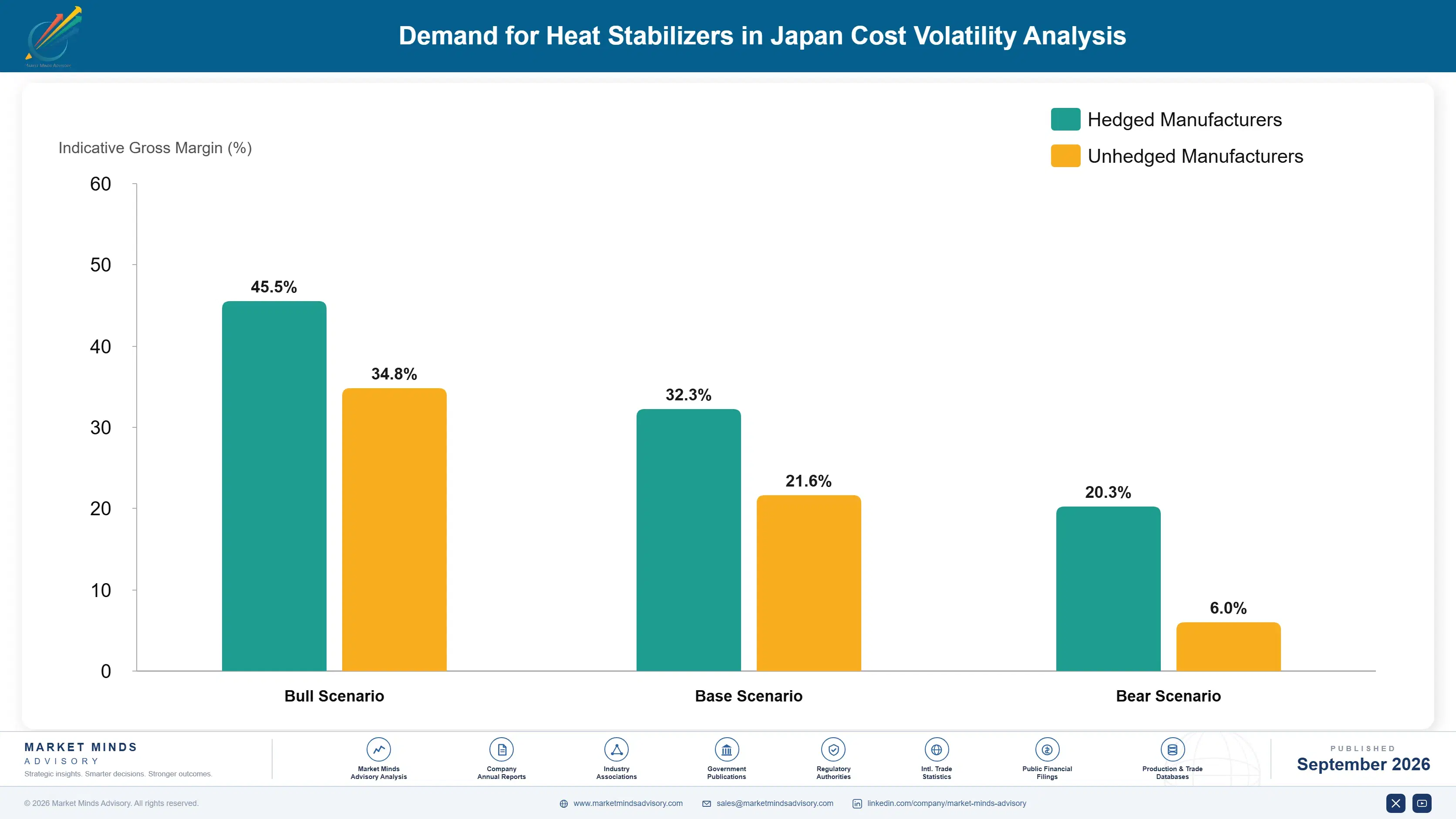
Zinc and Calcium Feedstock Cost Exposure

Zinc oxide and calcium compound feedstock together represent the largest cost input for calcium-zinc stabilizer production, running an estimated 35 to 43 percent of cost of goods sold for standard calcium-zinc products, sourced primarily from zinc refining capacity concentrated in China and domestic Japanese calcium compound processing facilities. Bio-based feedstock inputs for newer non-metal chemistry add a meaningfully higher cost share given the specialised organic synthesis processes involved.
Zinc commodity pricing volatility became a significant commercial issue during 2025 as global zinc demand from galvanising and battery applications competed directly with stabilizer feedstock demand, a pattern consistent with base metals market trends tracked in Japan's Ministry of Economy, Trade and Industry commodity reporting and reflected across multiple supplier annual reports. Suppliers without long-term zinc supply agreements absorbed this volatility directly into near-term gross margin.

The competitive disadvantage falls hardest on smaller suppliers without the scale to negotiate long-term zinc supply agreements or fund parallel bio-based formulation development while maintaining existing calcium-zinc production. Exposure varies by chemistry type too, since bio-based stabilizer producers sourcing from a different, less commodity-cyclical feedstock base face meaningfully less exposure to this specific zinc price volatility than calcium-zinc producers.
japan-heat-stabilizers-market-cost-volatility-analysis-1788423434784

Negotiating Long-Term Zinc Supply Agreements

Larger suppliers are negotiating multi-year fixed-volume zinc supply agreements directly with refiners to stabilise input cost exposure, reducing sensitivity to short-term commodity price volatility while adding meaningful contractual commitment in exchange for more predictable margin planning. This approach requires meaningful upfront volume commitment that smaller suppliers sometimes cannot justify without confirmed demand first. overall.

Accelerating Parallel Bio-Based Formulation Development

Several suppliers are running bio-based formulation development in parallel with existing calcium-zinc production specifically to reduce long-term zinc feedstock exposure, trading higher near-term research cost for reduced commodity exposure over the coming decade. This approach requires sustained research investment that smaller, resource-constrained suppliers often cannot sustain without confirmed near-term returns. overall each cycle. each fiscal period.

Building Domestic Calcium Compound Processing Capacity

Suppliers are investing in domestic calcium compound processing capacity to reduce reliance on imported zinc-adjacent feedstock, trading higher near-term capital cost for improved long-term supply security specifically within Japan's own supply chain. This approach requires substantial upfront capital investment that favours larger, better-capitalised suppliers over smaller specialists in the category. overall each cycle. each fiscal period.

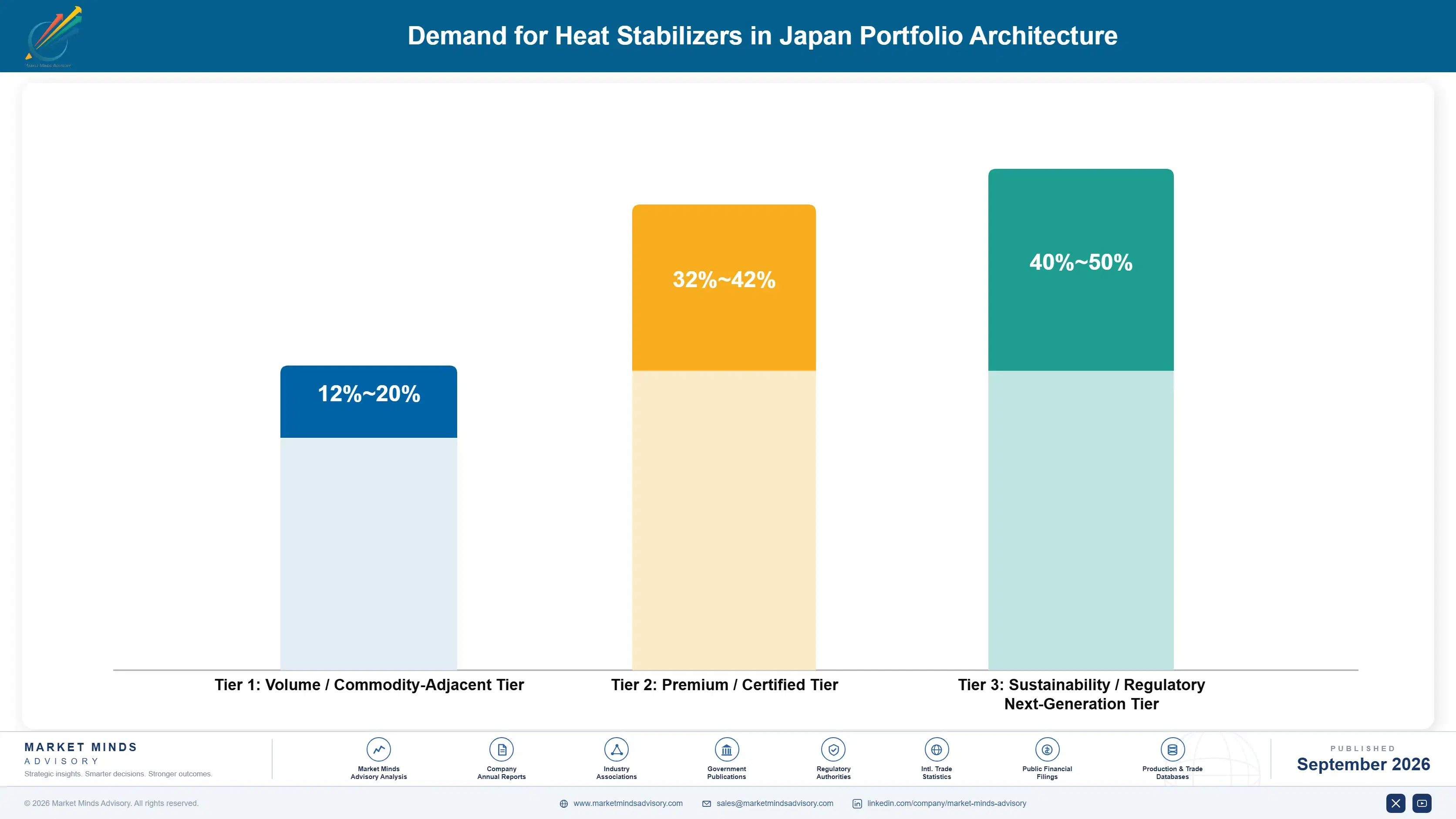
Portfolio Architecture for Margin Defence

Portfolio economics split into three tiers. Volume tier legacy organotin and remaining lead-adjacent stabilizers carry thin, declining margins as the phase-out continues, while premium certified calcium-zinc chemistry carries meaningfully higher margins tied to established compounder qualification relationships. The sustainability and next-generation tier, built around bio-based and non-metal chemistry, currently carries the strongest margins given limited qualified competition in this newest formulation category.. This margin gap widens further as bio-based adoption climbs across export accounts each year.
The volume versus premium tension shows up clearly in supplier research allocation. Investment devoted to defending remaining legacy chemistry volume against continued phase-out pressure competes directly against investment needed for bio-based formulation development, and suppliers that under-invest in either risk losing ground to a competitor optimised specifically for that transition.. This tension is most visible at suppliers organised around a single unified roadmap.

High-value margin pools concentrate in bio-based formulation contracts and in established calcium-zinc qualification relationships with major compounders, where technical differentiation still commands premium pricing before broader commoditisation eventually sets in. The declining legacy chemistry tier contributes a shrinking share of blended gross margin across the category each year. Suppliers ignoring this shift risk margin erosion as commoditisation reaches newer formulations.

Volume / Commodity-Adjacent Tier

Legacy organotin and remaining phase-out chemistry facing declining volume and thin margins as the transition continues nationwide. Suppliers here compete mainly on price and existing distribution relationships rather than technical differentiation.
Gross Margin: 12-20%

Premium / Certified Tier

Established calcium-zinc chemistry carrying margins tied to proven compounder qualification relationships and processing reliability. These products justify premium pricing through proven long-term processing performance and established compounder trust. broadly nationwide.
Gross Margin: 32-42%

Sustainability / Regulatory / Next-Generation Tier

Bio-based and non-metal chemistry commanding the strongest current margins given limited qualified competition in this category. Margins here should gradually compress as more suppliers complete their own bio-based qualification and enter the segment.
Gross Margin: 40-50%
japan-heat-stabilizers-market-portfolio-architecture-1788423435289

High-value Sub-segments and Strategic Watch-out

Bio-Based Chemistry for Export-Oriented Compounders

The fastest-growing segment in this report, combining strong current margins with accelerating export customer disclosure requirements reaching even purely domestic formulation decisions broadly each year. Suppliers positioned early in this segment are capturing outsized contract wins as export disclosure requirements continue broadening across international markets. broadly each year.
Gross Margin: 40-50%

Calcium-Zinc Qualification Relationships With Major Compounders

Steady, established demand tied to completed phase-out reformulation work, offering durable revenue visibility supported by proven processing performance nationwide. These relationships also provide suppliers valuable long-term revenue visibility tied to completed phase-out reformulation work nationwide. particularly among suppliers serving the largest national compounder accounts. overall.
Gross Margin: 32-42%

Standard Pipe and Profile Compound Stabilizer Volume

The largest existing revenue base, standard applications facing steady replacement demand but funding most suppliers' ongoing bio-based research investment across the category. Suppliers here rely on manufacturing efficiency and existing compounder relationships rather than differentiation to defend volume. particularly at large enterprise compounder accounts. overall.
Gross Margin: 28-36%

Legacy Organotin and Residual Lead-Adjacent Chemistry

A shrinking strategic watch-out segment as the phase-out nears completion and remaining volume converts steadily to calcium-zinc or bio-based alternatives. Suppliers still reliant on this segment risk losing remaining volume entirely as the phase-out nears full completion nationwide. particularly across pipe and cable applications broadly.
Gross Margin: 10-18%

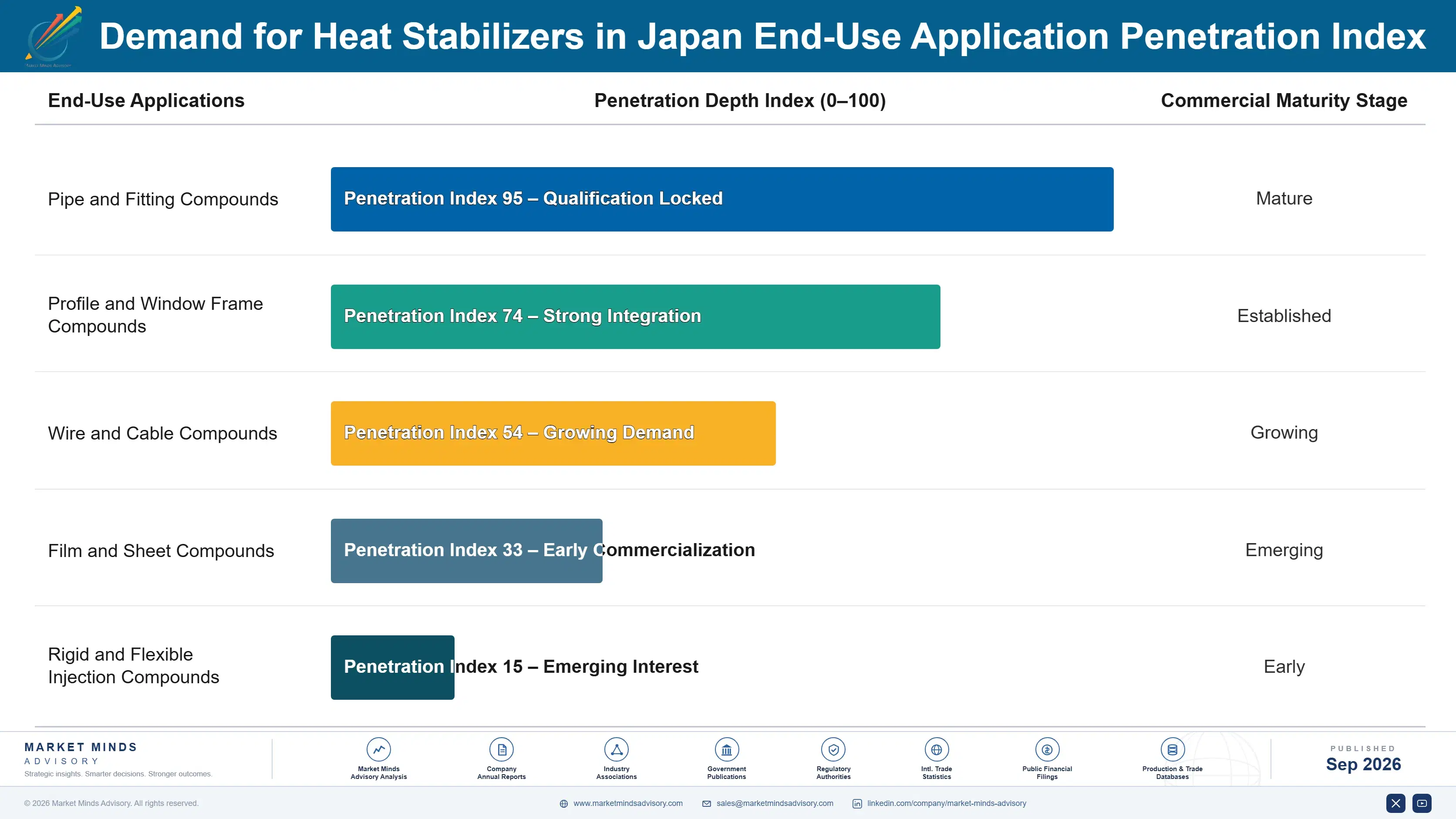
Compounder Qualification and Reformulation Cycle Economics

Revenue behaves like a multi-year annuity once a supplier completes stabilizer qualification with a major Japanese compounder, since requalifying an alternative supplier requires repeating extensive processing and long-term ageing testing that compounders are reluctant to undertake without a compelling reason, and that qualification lock-in explains most of this category's revenue stability across multi-year compound production runs.. Suppliers rarely lose this relationship once a production run begins.
Adoption depth varies sharply by compounder scale. Large national compounders integrate stabilizer chemistry selection deeply into broader product certification and long-term supply agreements, creating durable multi-year supplier relationships, while smaller regional compounders treat stabilizer purchases more transactionally around individual product lines, creating shallower supplier loyalty and greater exposure to price-based competitive switching at each reformulation cycle.. Suppliers investing in regional compounder engagement are narrowing this loyalty gap.

Buyer profiles are shifting generationally too. Compounding engineers who came up through the organotin and lead-based stabilizer era still favour extensively proven, conservative formulation choices even at a price premium, while newer compounding engineers increasingly default to evaluating bio-based and non-metal chemistry from the outset, a difference in risk tolerance that is already shaping which suppliers win newly certified product lines versus older, established formulation relationships.
japan-heat-stabilizers-market-end-use-penetration-index-1788423435785

Where the Category Settles Next

These are among the four positions where our research anticipates prominent divergence between winners and laggards over the coming forecast period. Each is grounded in the demand model, the regulatory perimeter, and the announced capacity pipeline.
01 / BIO-BASED FORMULATION INVESTMENT

Early bio-based qualification is compounding into durable competitive advantage

Suppliers that invested in bio-based stabilizer qualification ahead of competitors are now capturing a disproportionate share of export-oriented compounder business as disclosure requirements tighten further across international markets. This dynamic rewards patient capital allocation toward qualification testing well before broader industry-wide chemistry transition demand fully materialises. Building this credential base deliberately across multiple smaller compounders first looks like the more durable long-term strategy for suppliers without existing scale, since a proven credential list carries more weight with larger accounts than any amount of marketing claims alone.
02 / LEGACY CHEMISTRY EXIT TIMING

Suppliers still anchored to organotin face a genuinely shrinking addressable base

Suppliers still primarily dependent on organotin and residual lead-adjacent chemistry face a steadily declining addressable market regardless of how effectively they compete within it, given the phase-out's advanced completion stage nationwide. Those that shifted product mix and technical investment toward calcium-zinc and bio-based chemistry early are capturing a growing share of category profit even as their unit volume share stays comparatively modest. Expect further consolidation among suppliers unable to make this transition credibly over the next several years, particularly among smaller regional accounts.
03 / DOMESTIC VOLUME CEILING

Persistent demographic contraction caps the category's long-term volume potential

Japan's ongoing demographic contraction and persistently limited new construction activity mean this category's long-term volume potential remains genuinely capped regardless of how favourably formulation chemistry mix continues shifting toward higher-value alternatives. Suppliers should treat margin expansion through chemistry transition, not volume growth, as the primary strategic lever available in this market specifically. Suppliers that internalise this ceiling early can plan capital allocation more realistically than those still hoping for a volume recovery that demographic trends make unlikely to materialise within any realistic planning horizon.
04 / TECHNICAL SERVICE DIFFERENTIATION

Bundled qualification support is becoming a genuine competitive moat

Suppliers bundling extensive technical qualification support alongside product sales are winning longer, more valuable compounder relationships than suppliers competing purely on stabilizer product price alone. This dynamic particularly benefits suppliers with dedicated Japan-based technical service infrastructure over competitors serving the market remotely. Suppliers without dedicated Japan-based technical service infrastructure should prioritise this investment before pursuing further chemistry expansion, since relationship depth increasingly determines which supplier wins a given qualification decision, and that depth becomes considerably harder for remote-only competitors to replicate once established.

Engagement Snapshot From the Field

A live engagement with an industry participant carrying material or product regulatory and market exposure ahead of a defining policy shift, showing how our research translates into a defensible multi-year portfolio strategy.
MARKET MINDS ADVISORY · CLIENT ENGAGEMENT SUMMARY
Demand for Heat Stabilizers in Japan Producer Strategic Portfolio Review and Transition Roadmap 2026·Investment Scenario on Demand for Heat Stabilizers in Japan Exposure Evaluation 2025-26
CLIENT PROFILE
The client is a mid-size Japanese PVC pipe compounder generating approximately seventy eight million dollars in annual revenue (client-reported, unverified by MMA), still relying on organotin stabilizer chemistry across a meaningful share of its product line while facing customer pressure to complete its transition to alternative chemistry ahead of anticipated regulatory tightening. and supplying pipe compounds primarily to regional municipal water utilities across central Japan.
STRATEGIC CHALLENGE
Leadership needed to select a replacement stabilizer chemistry and supplier without the internal technical expertise to fully evaluate competing formulation claims, while managing a tight qualification timeline tied to a major municipal customer's own updated procurement specification requirements. while also managing limited internal budget available for a rushed evaluation process under external deadline pressure.
MMA APPROACH
MMA benchmarked candidate suppliers against disclosed qualification track records with comparable pipe compounders, structuring an accelerated but still technically rigorous qualification framework prioritising suppliers with existing calcium-zinc qualification history at similar production scale. The engagement included primary interviews with the client's production engineering team to validate real-world processing compatibility claims.
KEY FINDINGS
  1. Suppliers with existing qualification history at comparable pipe compounding scale reduced the client's internal testing burden meaningfully compared to evaluating unproven newer entrants from scratch.
  2. Calcium-zinc chemistry from leading suppliers had reached sufficient long-term ageing performance data to be considered viable for this specific municipal pipe application without additional extended testing.
  3. A phased qualification approach starting with a single product line reduced organisational risk considerably compared to committing to full product range conversion immediately.
  4. Production engineering staff adapted to the new stabilizer chemistry's processing parameters faster than initially expected once adequate supplier training was provided directly on-site.
CLIENT PROFILE
The client is a mid-size Japanese PVC pipe compounder generating approximately seventy eight million dollars in annual revenue (client-reported, unverified by MMA), still relying on organotin stabilizer chemistry across a meaningful share of its product line while facing customer pressure to complete its transition to alternative chemistry ahead of anticipated regulatory tightening. and supplying pipe compounds primarily to regional municipal water utilities across central Japan.
STRATEGIC CHALLENGE
Leadership needed to select a replacement stabilizer chemistry and supplier without the internal technical expertise to fully evaluate competing formulation claims, while managing a tight qualification timeline tied to a major municipal customer's own updated procurement specification requirements. while also managing limited internal budget available for a rushed evaluation process under external deadline pressure.
MMA APPROACH
MMA benchmarked candidate suppliers against disclosed qualification track records with comparable pipe compounders, structuring an accelerated but still technically rigorous qualification framework prioritising suppliers with existing calcium-zinc qualification history at similar production scale. The engagement included primary interviews with the client's production engineering team to validate real-world processing compatibility claims.
KEY FINDINGS
  1. Suppliers with existing qualification history at comparable pipe compounding scale reduced the client's internal testing burden meaningfully compared to evaluating unproven newer entrants from scratch.
  2. Calcium-zinc chemistry from leading suppliers had reached sufficient long-term ageing performance data to be considered viable for this specific municipal pipe application without additional extended testing.
  3. A phased qualification approach starting with a single product line reduced organisational risk considerably compared to committing to full product range conversion immediately.
  4. Production engineering staff adapted to the new stabilizer chemistry's processing parameters faster than initially expected once adequate supplier training was provided directly on-site.
RECOMMENDED STRATEGY
Phase 1: Phase 1 (Months 1 to 2): Benchmark supplier qualification track records and shortlist candidates with proven comparable-scale pipe compounding history. Phase 2: Phase 2 (Months 3 to 6): Qualify the new calcium-zinc chemistry on the client's highest-volume pipe product line first. while validating processing consistency. Phase 3: Phase 3 (Months 7 to 10): Extend the validated chemistry across remaining product lines on a rolling basis ahead of the customer deadline.
OUTCOME
Ten months after the engagement began, the client completed qualification and secured continued approval from its major municipal customer ahead of the updated procurement specification deadline, avoiding a potential loss of contract standing (client-reported, unverified by MMA). Leadership also reported improved confidence pursuing additional municipal contracts requiring similar updated chemistry specifications.

Frequently Asked Questions

Foundational context covering the market sizes, CAGR, scope, country, region and competition that inform every finding below. This section is provided to cover basics and most often pre-purchase conversations, answered from the MMA Primary Research Dataset.

What is the current size of the Demand for Heat Stabilizers in Japan market?

The market reached an estimated USD 0.42 billion in revenue in 2025, according to MMA Analysis based on primary research and company disclosures. This base year figure anchors the forecast period beginning in 2026.

How large will the Demand for Heat Stabilizers in Japan market be by 2036?

MMA projects the market will reach approximately USD 0.59 billion by 2036 under the base case scenario. That represents roughly a 1.37 times expansion from the 2026 starting value of USD 0.43 billion.

What is the CAGR for the Demand for Heat Stabilizers in Japan market 2026 to 2036?

The base case compound annual growth rate is 3.2% across the 2026 to 2036 forecast window. Bull and bear scenarios range from 2.0% to 4.3% depending on infrastructure renewal spending and construction sector trends.

Which segment is growing fastest?

Bio-Based and Non-Metal Stabilizers lead all segments at an 8.5% CAGR, roughly 2.66 times the overall market rate. This segment benefits from export customer disclosure requirements reaching domestic formulation decisions and a small starting base.

Who are the major companies in the Demand for Heat Stabilizers in Japan market?

Leading suppliers include ADEKA Corporation, Baerlocher GmbH, Sakai Chemical Industry Co Ltd, Kyodo Chemical Co Ltd, and Songwon Industrial Co Ltd. Together these five hold an estimated 48% combined share on a disclosed segment revenue basis.

Which country is growing fastest?

Japan itself leads national growth at an estimated 4.0% CAGR, since this report's scope is specifically Japan's domestic market. This reflects the country's own modest underlying demand trajectory as chemistry transition continues.

Report Segmentation Architecture

The full report scope spans multiple orthogonal segmentation dimensions, with cross-tabulated demand data provided for each dimension pair. Coverage extends further to regional breakdowns, trend trajectories, and the competitive detail needed to support segment-level decision-making.

By Stabilizer Chemistry Type

  • Calcium-Zinc Stabilizers
  • Organotin Stabilizers
  • Lead-Based Stabilizers
  • Barium-Zinc Stabilizers
  • Bio-Based and Non-Metal Stabilizers
  • Liquid Mixed-Metal Stabilizer Systems

By End-Use Application

  • Pipe and Fitting Compounds
  • Profile and Window Frame Compounds
  • Wire and Cable Compounds
  • Film and Sheet Compounds
  • Rigid and Flexible Injection Compounds

By Commercial Dimension

  • Direct Compounder Supply Agreements
  • Distributor and Trading Company Sales
  • Technical Licensing Arrangements
  • Toll Compounding Service Contracts

By Region

  • North America
  • Western Europe
  • East Asia
  • South Asia and Pacific
  • Latin America
  • Middle East and Africa
  • Eastern Europe

Scope, Methodology, and Coverage

Every figure in this report is reproducible from documented input assumptions. The scope below maps the historical period, the forecast horizon, the segmentation dimensions, and the countries covered, alongside the underlying primary and qualitative methodology.
Historical Period
2020 to 2025
Forecast Period
2026 to 2036
Base Year
2025 (USD billions; MMA Primary Research Dataset, September 2026)
Market Definition
This report covers heat stabilizer additives used to prevent thermal degradation during the processing of polyvinyl chloride and related polymers, consumed specifically within Japan across pipe, profile, film, wire and cable, and rigid and flexible compound applications. It excludes stabilizers for non-PVC polymer systems, and heat stabilizer volumes consumed outside Japan even where produced by Japan-headquartered manufacturers.
Quantitative Units
USD billions (current prices); metric tons; average price per kilogram
Segmentation Dimensions
By Stabilizer Chemistry Type; By End-Use Application; By Commercial Dimension; By Region
Regions Covered
North America, Western Europe, East Asia, South Asia and Pacific, Latin America, Middle East and Africa, Eastern Europe
Countries Covered
Japan (primary market scope), USA, China, Germany, France, UK, South Korea, India, Australia, Canada, Brazil, Mexico, Indonesia, Vietnam, Thailand, Malaysia, UAE, Saudi Arabia, South Africa, Poland, Netherlands, Italy, Spain, and additional markets relevant to Japanese affiliate operations
Key Companies Profiled
ADEKA Corporation; Baerlocher GmbH; Sakai Chemical Industry Co Ltd; Kyodo Chemical Co Ltd; Songwon Industrial Co Ltd; Nitto Kasei Co Ltd; Chuo Kaseihin Co Inc; PMC Group Inc; Valtris Specialty Chemicals LLC; Reagens SpA; Akdeniz Kimya AS; Tokyo Fine Chemical Co Ltd; Nissan Chemical Corporation; Sun Ace Kakoh Pte Ltd; Dow Inc; Galata Chemicals LLC; Lanxess AG; Ferro Corporation; Shandong Yiensi New Materials Co Ltd; Songwon Advanced Materials Co Ltd
Quantitative Methodology
Primary survey, n=3,800 respondents, Q4 2025, six countries; demand-side model with trade association cross-validation
Qualitative Methodology
47 expert interviews, Q4 2025; applied to validate demand model assumptions, identify emerging dynamics, and assess competitive positioning
Report Format
PDF and XLSX data workbook (Word format preview document)
Publisher
Market Minds Advisory
Report Code
MMA-2026-CHM-641
Published
September 2026
Contact
sales@marketmindsadvisory.com | www.marketmindsadvisory.com

Purchase the full Demand for Heat Stabilizers in Japan Report (2026 to 2036).

The full report delivers complete segmentation data across all six stabilizer chemistry segments, all seven regional markets, and detailed competitive profiles for all twenty companies named in this summary. It includes the underlying primary survey dataset of three thousand eight hundred respondents and forty seven expert interviews conducted during the fourth quarter of 2025. Buyers also receive downloadable data tables covering historical 2020 to 2025 figures alongside the full 2026 to 2036 annual forecast. A dedicated appendix addresses Japan's lead-based stabilizer phase-out timeline across three completion scenarios.
Full Seven-Region Regional Data Tables and Charts
All Twenty Company Competitive Profiles and Rankings
Ten-Year Annual Forecast Model With Scenarios
Primary Survey Raw Data Access and Tables
Phase-Out Completion Scenario Appendix and Analysis
Quarterly Update Subscription Option for Buyers

Built For The People Who Decide

From boardroom strategy to bench-side execution, this report is read cover-to-cover by leaders shaping the next decade of their industry, turning demand scenarios, market dynamics and valuation benchmarks into decisions.
CXOs/ Presidents/ VPs/ Managers
M&A and Corporate Development
Strategy Teams and R&D Heads
Procurement and Product Directors
Regulatory and Compliance Leaders
Investor Relations and Equity Analysts