Market Minds Advisory
Japan Flexible Intermediate Bulk Containers Market

Japan Flexible Intermediate Bulk Containers Market: Import Dependence, Audited Weaving Plants and Disposal Cost Nobody Else Pays

Japan buys almost every bulk bag it uses from a weaving plant somewhere else, audits those plants harder than any other buyer, then pays a fifth of the price again to dispose of it.

Lead Analyst

Bilal Shaikh

Published

September 2026

Make Smarter Decisions with Customized Research Insights

Request a free sample report and evaluate market opportunities, growth trends, and competitive dynamics relevant to your business needs.

2025 MARKET VALUE$0.4BMarket Size 2025
2036 FORECAST VALUE$0.7BBase Case , 2026 to 2036
CAGR 2026 TO 20364.0 %Bull 5.2% / Bear 2.8%
INCREMENTAL OPPORTUNITY$0.2BNet 10- year value creation
EXPANSION MULTIPLE1.48x2036 value over 2026 base
Strategic Levers
M&A Pipeline
Regional Outlook
Country Rankings
Competitive Intelligence
Segmental Deep-dive
Call-Us : 91 93563 13602

Executive Snapshot and Market Trajectory

Japan weaves almost no polypropylene fabric for bulk bags and uses several million a year. Every one arrives from a plant in China, India, Vietnam or Bangladesh, and Japanese buyers audit those plants to a standard nobody else in the trade imposes anywhere.
Type C conductive bags compound at 6.0%, exactly 1.50 times the market, because Japanese chemical and fine powder handling treats electrostatic ignition as an engineering certainty rather than a remote possibility. East Asia supplies 44% of bags entering Japan, well outside the standard band, since Chinese weaving capacity sits closest to the destination. South Asian weaving supplies most of the remainder. A single foreign fibre rejects the whole delivery.
Five suppliers hold 38%, most of them trading houses and converters rather than weavers. What they sell is inspection, traceability and the confidence that a container arriving from an audited plant will contain no foreign fibre, no insect and no dimensional surprise. Disposal by incineration runs roughly 22% of the purchase price, so every gram of fabric is paid for twice in this market rather than once. Inspection is what buyers pay for.
Market Definition
The market covers flexible intermediate bulk containers supplied into Japan for industrial, chemical, food and civil engineering use, spanning Type A standard bags, Type B non-static bags, Type C conductive bags, Type D antistatic dissipative bags, food-grade lined bulk bags, and civil engineering and disaster response bags. Rigid intermediate bulk containers, drums, small sacks below 100 litres, and liners sold separately from bags are excluded.
Base Year Value
$0.4B in 2025 (MMA Primary Research Dataset, August 2026)
Forecast Period
2026 to 2036, eleven discrete annual values
CAGR
4.0% base case. Bull 5.2%. Bear 2.8%.
Fastest Growth Segment
Type C Conductive Bulk Bags: 6.0% CAGR
Fastest Growth Country
India: 6.2% CAGR
Fastest Growth Region
South Asia and Pacific: 5.8% CAGR
Largest Region
East Asia: 44% of 2025 global value
Market Leaders
Nihon Matai, Greif, LC Packaging, Conitex Sonoco, Emmbi Industries. Source: MMA Analysis based on company annual reports.
Primary Survey
n=3,800 procurement and R&D decision-makers, Q4 2025, six countries
Methodology
Demand-side build-up, cross-validated against public data, 47 expert interviews

Japan Flexible Intermediate Bulk Containers Market Forecast Scenarios

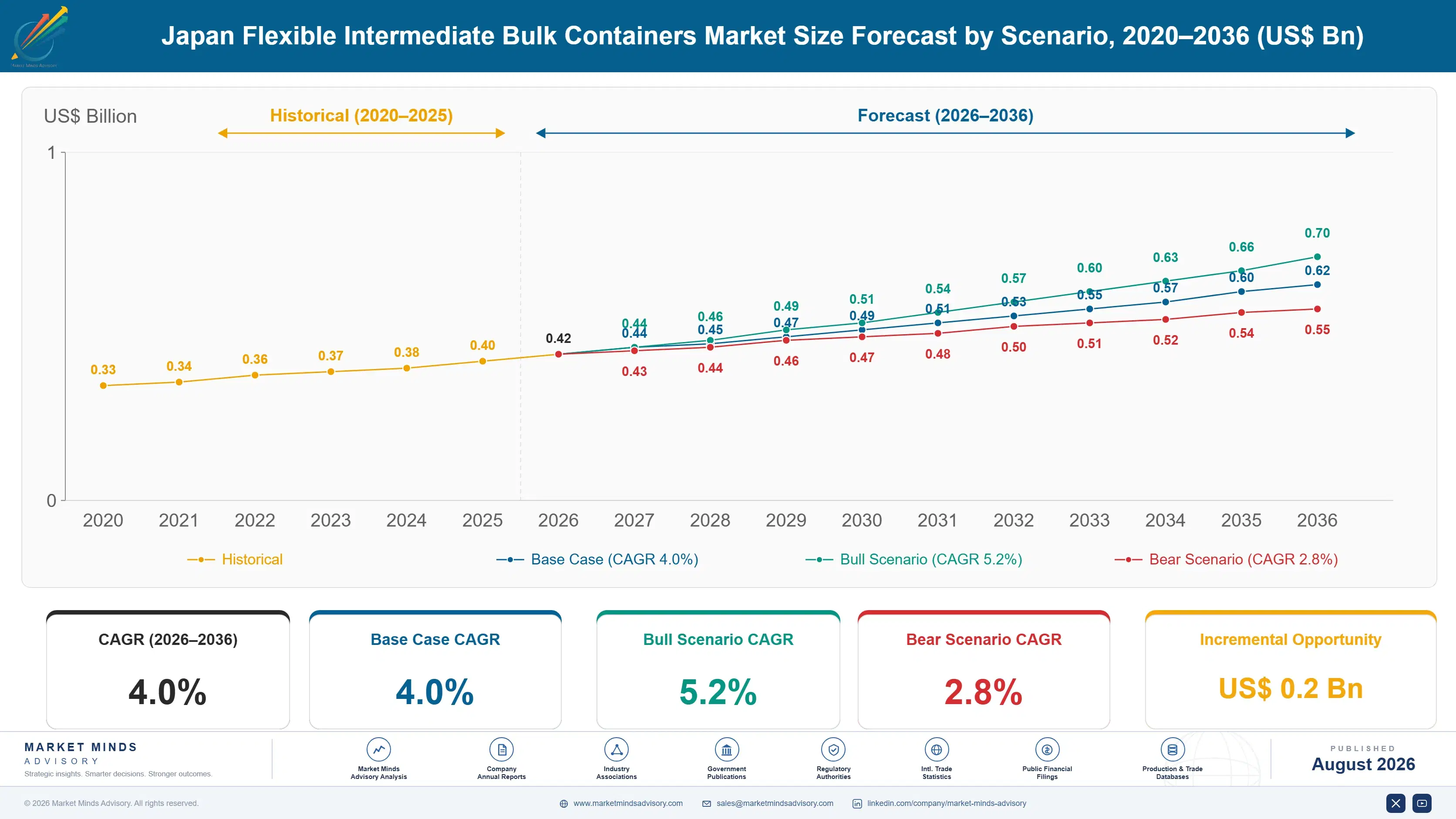
japan-flexible-intermediate-bulk-containers-market-size-forecast-scenario-1787308538376
Growth ran at an implied 3.2% across 2020 to 2025 and it followed two quite separate things. Chemical and resin handling volumes moved with industrial production, while civil engineering demand followed weather: typhoon and flood events in 2020, 2022 and 2024 each pulled forward substantial disaster response bag consumption that had nothing to do with manufacturing at all. Two demand curves sit inside one number.
The base case at 4.0% rests on three mechanisms. Workforce ageing keeps pushing manual sack handling toward bulk containers, since one bag replaces roughly forty twenty-five kilogram sacks. Conductive and antistatic types keep displacing standard bags as powder handling risk assessment becomes routine. And civil engineering demand rises with river and slope reinforcement programmes responding to intensifying rainfall. None of the three depends on industrial output recovering. Handling conversion is the only genuine growth.
The bull case at 5.2% assumes national resilience infrastructure spending accelerates, since river works and landslide countermeasures consume civil engineering bags in very large quantities during construction. The bear case at 2.8% follows from continued domestic chemical and resin production decline, which removes the industrial base that most bulk bag volume ultimately serves. Neither scenario turns on weaving cost.

Buying Bags Nobody Here Makes

Roughly 96% of the bulk bags used in Japan are woven somewhere else, and the reason is not cost alone. Polypropylene tape weaving is labour intensive, land hungry and low margin, and Japan gave it up decades ago along with most other commodity textile conversion. What did not go away was a set of quality expectations no other importing market applies with the same seriousness. Nobody else audits this hard.
TOP FIVE CONCENTRATION38%Combined share held by the five largest suppliers into Japan
IMPORT DEPENDENCE96% of volumeBags entering the country rather than woven domestically
SACK HANDLING REPLACED40 sacks per bagManual handling operations eliminated by one bulk container
DISPOSAL COST SHARE22% of purchaseIncineration and handling charge relative to delivered bag price
SUPPLIER AUDIT FREQUENCY1.8 per yearWeaving plant inspections typical buyers conduct on each source
SINGLE-TRIP SHARE87% of bagsContainers used once rather than reconditioned for further service
Those expectations govern the whole commercial structure. Japanese buyers audit overseas weaving plants an average of 1.8 times a year, checking for foreign fibre, insect ingress, dimensional drift and contamination in the extrusion and sewing areas. A container arriving with a single strand of the wrong polymer is rejected. Suppliers who cannot sustain that scrutiny lose the account permanently rather than temporarily.
Disposal is the other distinctly Japanese feature. Used bags are incinerated rather than landfilled or reconditioned, and the charge runs around 22% of what the bag cost to buy. Reconditioning, which carries much of the European and North American market, barely exists here on hygiene grounds, so 87% of bags are used exactly once.
"Buyers elsewhere ask what a bag costs. Japanese buyers ask what the weaving shed floor looks like, how the operators are trained and what happens to the bag afterwards. Suppliers who treat that as a formality lose the business inside a year and rarely understand why."
Director, Industrial Bulk Packaging and Materials Handling Practice · MMA Indust

Market Trends

Workforce Ageing Pushes Sack Handling Into Bulk Containers

Japan's manufacturing workforce is ageing faster than any comparable industrial economy, and repeated manual lifting of twenty-five kilogram sacks has become both a recruitment obstacle and an injury liability. One bulk container replaces roughly forty of those lifts and moves on a forklift instead. Chemical, resin, food ingredient and construction material handlers have all converted volume on that basis, and the argument strengthens each year as the available workforce contracts further rather than stabilising. Recruitment is the binding constraint. The available workforce keeps contracting rather than stabilising, which strengthens the argument every year.
Market Impact: Civil engineering at 19% of volume

Powder Ignition Risk Assessment Converts Standard Bags to Conductive

Discharging fine powder from a bulk bag generates static, and where the powder or the surrounding atmosphere is flammable that charge is an ignition source rather than a nuisance. Japanese chemical and pharmaceutical intermediate handlers have moved decisively toward Type C conductive and Type D dissipative constructions as formal ignition risk assessment became routine rather than exceptional. Type C compounds at 6.0% against a market at 4.0%, and conversions do not reverse once a safety assessment has documented the requirement. The specification moves into the operating procedure. Purchase orders stop deciding it.
Market Impact: Audits running 1.8 times annually

Market Opportunities and Growth Drivers

Resilience Infrastructure Consumes Civil Engineering Bags at Scale

River embankment reinforcement, slope stabilisation and flood countermeasure works consume large-format woven bags in enormous quantities, filled on site with sand, gravel or crushed stone. Ministry of Land, Infrastructure, Transport and Tourism resilience programmes have expanded steadily as rainfall intensity increased, and typhoon events in 2020, 2022 and 2024 each pulled emergency consumption forward sharply. Roughly 19% of Japanese bulk bag volume now serves civil engineering rather than industrial handling, and that share rises with every severe weather season. Weather rather than manufacturing drives it. Emergency demand arrives faster than lead times allow.
Market Impact: Domestic base flat across 20 years

Contamination Standards Concentrate Supply on Audited Plants

Japanese food, pharmaceutical intermediate and high-purity chemical buyers reject bags containing foreign fibre, insect matter or extrusion contamination outright, and the rejection applies to the delivery rather than the individual bag. Meeting that reliably requires controlled weaving environments, trained operators and inspection discipline that a low-cost plant serving other markets does not maintain. Buyers audit each source around 1.8 times annually, and the practical effect is that a small number of qualified plants supply a disproportionate share of Japanese volume. A small number of qualified plants therefore supply a disproportionate share of the total Japanese volume.
Market Impact: Disposal at 22% of purchase price

Market Restraints and Challenges

Domestic Industrial Base Provides No Underlying Volume Growth

Japanese chemical, resin and industrial materials production has been broadly flat for two decades and the working population continues to fall. The root cause is demographic and economy-wide rather than anything the packaging industry influences, and bulk bag demand tracks tonnage handled rather than value produced. Suppliers mitigate by pursuing conversion from sack handling, which continues regardless of total volume, and by concentrating on civil engineering demand that follows infrastructure spending rather than manufacturing output. Tonnage handled decides the demand. Conversion from sacks is the only real growth available to suppliers.
Market Impact: One bag replacing 40 manual lifts

Incineration Disposal Cost Discourages Heavier Constructions

Used bags are incinerated rather than landfilled or reconditioned, at a charge running roughly 22% of the delivered bag price. The root cause is Japanese waste policy and the hygiene concerns that rule out the reconditioning market carrying much of Europe and North America. Every additional gram of fabric therefore costs the buyer twice. Suppliers mitigate by offering lighter constructions that hold the same safe working load, and by exploring take-back arrangements that remain commercially difficult at current volumes. Take-back arrangements remain commercially difficult at current volumes. Volumes remain too low.
Market Impact: Conductive types compounding at 6.0
3 additional market trends, 4 additional growth drivers, and 2 additional restraints and challenges are covered in the full report. Contact sales@marketmindsadvisory.com to access the complete intelligence.

Segment CAGR and Growth Architecture

Segmentation follows bag construction type, because construction determines the electrostatic behaviour, the certification required and the application it can legally serve. A Type C conductive bag and a standard Type A bag look broadly similar and cannot be substituted for one another in any flammable atmosphere. Certification decides the permitted application. Substitution is simply not available.
japan-flexible-intermediate-bulk-containers-market-market-share-analysis-1787308538908

Type C Conductive Bulk Bags

Type C bags compound at 6.0%, exactly 1.50 times the market rate, on a hazard Japanese industry now assesses formally rather than intuitively. Discharging fine powder generates static, and in a flammable atmosphere that charge ignites rather than merely irritating an operator. Type C construction weaves conductive threads through the fabric and requires the bag to be earthed during filling and discharge, which places an operating discipline on the user as well as a specification on the supplier. Chemical intermediates, pharmaceutical actives, fine metal powders and certain food ingredients all fall inside the requirement. Once a formal ignition risk assessment documents the need, the conversion is permanent and the specification passes into the operating procedure rather than the purchase order.
CAGR 6.0%

Type D Antistatic Dissipative Bags

Type D bags grow at 5.4% by solving the same static problem without requiring an earth connection. The fabric incorporates quasi-conductive or antistatic yarns that dissipate charge safely into the surrounding air rather than conducting it to ground, which removes the operator step that Type C depends on. That matters considerably in Japanese operations where handling is increasingly performed by fewer and older staff, and where a missed earthing connection is a genuine failure mode rather than a theoretical one. The fabric costs more than Type C and the safety case is stronger in practice because it does not rely on a human action being performed correctly every single time. Human error is designed out.
CAGR 5.4%
Full segment breakdown across 6 segments available in the complete report.

Regional Architecture and Country Demand Map

This is a Japanese consumption market supplied almost entirely from abroad, so regional shares describe where bags are woven rather than where they are used. Weaving geography is far more concentrated than the industry's customer base. Sourcing origin rather than end use is the map worth reading here.

East Asia

East Asia supplies 44% of bags entering Japan. Note: this exceeds the standard band because the figure describes weaving origin rather than consumption, and Chinese capacity sits closest to the destination with the shortest lead times and lowest freight. Chinese plants in Shandong, Zhejiang and Jiangsu have invested in the controlled environments Japanese buyers demand, and several maintain lines dedicated to Japanese customers with separate material handling. A small residual Japanese domestic weaving capacity survives for specialist civil engineering and disaster stock formats where lead time matters more than cost. Korean supply is minimal. Regional growth of 4.6% reflects Chinese producers holding share against South Asian competition on quality consistency rather than price.
Share: 44% | CAGR: 4.6% (2026 to 2036)

South Asia and Pacific

South Asia and Pacific supplies 36% of Japanese bulk bag volume. Note: this far exceeds the standard band for the same reason, since India, Bangladesh and Vietnam between them weave a very large share of the world's polypropylene bulk bag fabric. Indian producers around Gujarat and Maharashtra hold the strongest positions, with several plants operating Japanese-audited lines and holding food grade certification. Vietnamese capacity has grown quickly as buyers sought alternatives to Chinese concentration. Bangladeshi supply competes hardest on price and least well on the contamination standards Japanese buyers apply. Growth of 5.8% is the fastest of the seven, reflecting share gain from Chinese suppliers on cost. Contamination standards remain the differentiator.
Share: 36% | CAGR: 5.8% (2026 to 2036)
Regional intelligence for 5 additional markets available in the complete report: Western Europe, North America, Eastern Europe, Middle East and Africa, Latin America. Contact sales@marketmindsadvisory.com.
japan-flexible-intermediate-bulk-containers-market-country-cagr-analysis-1787308539432

Selling Inspection Rather Than Fabric

Japanese buyers can source woven polypropylene from a hundred plants at prices nobody supplying them can match. What they cannot source easily is confidence that the container will arrive uncontaminated, correctly dimensioned and legally appropriate for the powder inside it. Four positions build on that. Fabric price alone reaches nobody. Confidence is what they cannot source.

Hold Audited Weaving Lines Dedicated to Japanese Specification

Japanese buyers audit each source around 1.8 times a year and reject entire deliveries over a single foreign fibre, which a plant running mixed customer work cannot reliably prevent. Suppliers holding lines dedicated to Japanese specification, with separated material handling and trained operators, sustain that scrutiny where general-purpose plants fail within a year. Dedicated capacity costs utilisation flexibility and buys a position competitors cannot enter without committing the same capacity. Roughly 96% of bags are imported, so this is the only defensible ground available. Utilisation flexibility is the cost. Competitors must commit equally.
Market Impact: Imports covering fully 96% of all J

Convert Sack Handling Rather Than Compete for Bag Volume

One bulk container replaces roughly forty manual lifts of a twenty-five kilogram sack, and Japan's manufacturing workforce is ageing faster than any comparable economy. Presented as a handling and injury liability argument to operations rather than as a packaging price to procurement, that converts volume which was never previously in the bulk bag market at all. The conversion is permanent and it grows the addressable base rather than redistributing it, which is the only source of genuine growth in a flat domestic industrial economy. One bag removes roughly 40 manual lifts.
Market Impact: Each bag removing 40 separate manua

Build Conductive Capability Ahead of Risk Assessments

Formal ignition risk assessment has become routine in Japanese chemical and pharmaceutical intermediate handling, and each assessment documenting a static hazard converts a standard bag specification permanently into a conductive or dissipative one. Type C compounds at 6.0% and Type D at 5.4%, both well above the market. Suppliers holding certified construction, documented resistance testing and the ability to explain the earthing discipline to a customer's safety function reach the conversion at the point it happens rather than tendering afterwards. Tendering afterwards reaches nobody who matters. Documented resistance testing is the requirement.
Market Impact: Conductive types now compounding at

Reduce Fabric Weight Against Incineration Disposal Charges

Used bags are incinerated at a charge running roughly 22% of the delivered price, so every gram of fabric costs a Japanese buyer twice over rather than once. Suppliers offering lighter constructions that hold the same certified safe working load reduce both the purchase and the disposal line simultaneously, which is an argument no other market rewards in the same way. It requires genuine fabric engineering rather than simply thinning the weave, since safe working load certification is unforgiving and a failure is a serious incident. Both parties gain from it.
Market Impact: Disposal charges reaching 22% of th

Who Controls the Margin Pool

Five suppliers hold 38% of the Japanese market measured on bulk container revenue, the basis applied consistently through this section. Most are trading houses and converters rather than weavers, since almost nobody selling into Japan owns the looms. Nihon Matai and Greif lead, from domestic relationship and international sourcing positions respectively. Almost nobody selling here owns a loom.
Competition operates on three dimensions. Audited weaving plant access decides whether a supplier can meet contamination standards that reject whole deliveries. Certification and technical documentation decide participation in Type C, Type D and food grade work. And civil engineering channel access decides exposure to the demand that follows infrastructure programmes rather than industrial production. All three are earned rather than purchased. Audit access in particular takes years to establish.

Two pressures are reshaping position. South Asian weavers are taking share from Chinese suppliers on cost while closing the quality gap, which reshuffles sourcing rather than the customer relationship. Against that, disposal cost and workforce ageing both favour suppliers who engineer rather than merely source. Rankings will move toward whoever pairs dedicated audited capacity with genuine fabric engineering. Very few hold both today.
japan-flexible-intermediate-bulk-containers-market-company-positioning-matrix-1787308539947

Competitive Moat and Risk Dimensions

NIHON MATAI

Moat: Domestic relationships and inspection depth

Nihon Matai's position rests on long-standing relationships with Japanese chemical, food and construction customers alongside inspection and quality management practice built specifically around Japanese expectations. Managing overseas weaving plants to that standard is a coordination discipline rather than a manufacturing one, and it is what a Japanese buyer is actually paying a domestic supplier to provide on its behalf.
NIHON MATAI

Risk: No owned weaving capacity

Without owned looms the company depends on overseas plants that also serve other customers, and dedicated line commitments require negotiation rather than direction. As South Asian weavers gain scale and approach Japanese buyers directly, the intermediary position becomes harder to defend on cost, particularly for standard industrial formats where inspection adds less that a buyer will pay for.
GREIF

Moat: Owned weaving and global sourcing

Greif combines owned flexible packaging manufacturing with a global industrial packaging position, which lets it direct capacity to Japanese specification rather than negotiating for it. Serving multinational chemical customers across several countries also means a single qualification can carry into Japanese operations, which shortens what is otherwise a slow and audit-heavy approval process considerably.
GREIF

Risk: Japanese market specificity

Japanese contamination expectations, disposal economics and single-trip practice differ enough from European and North American norms that a global operating model fits imperfectly. Reconditioning capability, which carries real value elsewhere, is worth almost nothing in a market where 87% of bags are used once, and the local relationship depth domestic suppliers hold is not quickly replicated.

Players Tracked

Prominent Players

Nihon Matai
Greif
LC Packaging
Conitex Sonoco
Emmbi Industries

Other Key Players

Rishi FIBC Solutions
Jumbo Bag Limited
Bulk Lift International
Berry Global
Intertape Polymer Group
Global-Pak
Halsted Corporation
Sackmaker
BAG Corp
Taihua Group
Zhejiang Huifeng
Bang Polypacks
Flexituff International
Shree Tirupati Balajee
NNZ Group

Recent Developments

MARCH 2025

Ignition risk assessments convert powder handling to conductive bags

Japanese chemical and pharmaceutical intermediate handlers extended formal electrostatic ignition risk assessment across further powder transfer operations, converting standard bag specifications to Type C and Type D constructions. These were internal safety assessments rather than regulatory actions or commercial developments. Cost comparison plays no part in the decision.
Signal: Once a documented safety assessment specif
JULY 2025

Buyers diversify weaving sources away from Chinese concentration

Japanese buyers qualified additional Vietnamese and Indian weaving plants to reduce dependence on Chinese supply concentration, undertaking the audit and approval process that Japanese specification requires. These were sourcing decisions rather than corporate transactions between suppliers. Audit and approval work ran across many months before any order followed.
Signal: Qualifying a new weaving source is an audi
NOVEMBER 2025

Resilience works consume civil engineering bags after severe rainfall

River embankment and slope stabilisation works following heavy rainfall events drew substantial civil engineering bag volume, filled on site with sand and crushed stone. This reflects infrastructure response rather than any commercial development, and demand arrived faster than normal lead times accommodate. Normal lead times could not accommodate it.
Signal: Weather rather than industrial production

Resin, Weaving Labour and Freight

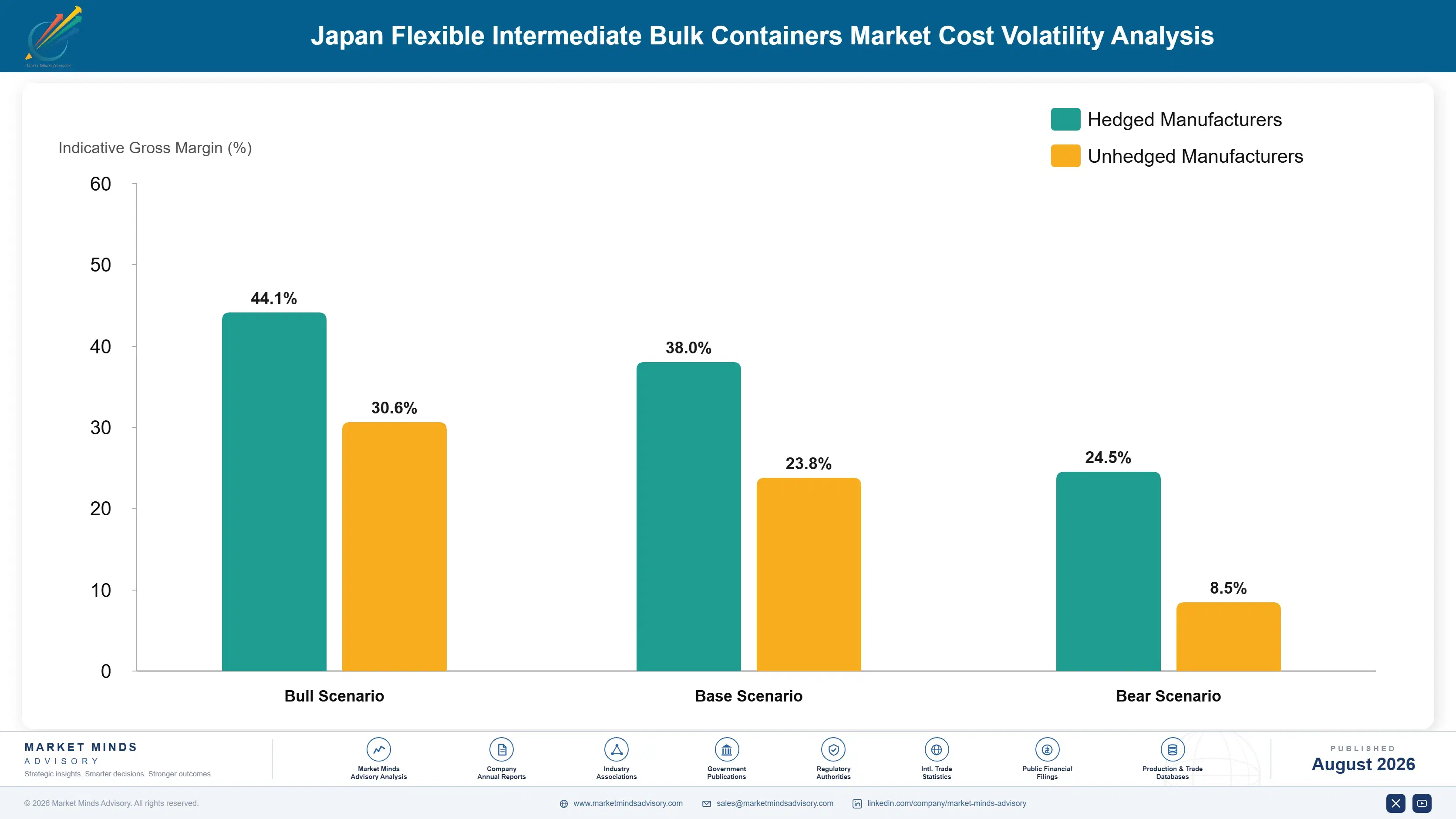
Polypropylene resin accounts for roughly 52% of delivered bag cost, purchased by weaving plants from regional petrochemical producers rather than by the Japanese buyer directly. Weaving and sewing labour runs a further 17%, which is precisely why the work sits in South and East Asia rather than in Japan. Ocean freight, inspection and inland distribution make up most of the remainder.
Polypropylene pricing moved sharply through 2022 and 2023 as European energy disruption fed through petrochemical markets globally, and International Energy Agency reporting across that period documents the underlying movement. Suppliers into Japan absorbed much of it because Japanese purchase agreements run annually and buyers resist mid-term adjustment. Company annual reports covering industrial packaging segments disclose the resulting margin compression clearly across those quarters. Recovery lagged into the following year.

Exposure divides by sourcing structure rather than by scale. Suppliers holding dedicated audited lines carry higher fixed cost at the plant and price against a qualification barrier competitors cannot cross quickly. Those sourcing from general-purpose plants carry lower cost and compete on price against everybody else doing the same, which in a market that rejects deliveries over contamination is a considerably riskier position than it appears.
japan-flexible-intermediate-bulk-containers-market-cost-volatility-analysis-1787308540144

Contract resin visibility through weaving plant agreements

Japanese buyers hold annual pricing and resist mid-term adjustment, while weaving plants buy polypropylene at regional spot or short contract terms. Building resin index visibility into the plant agreement, even where it cannot be passed to the customer immediately, at least makes the exposure predictable and allows it to be priced into the following annual negotiation properly.

Qualify a second audited plant per specification family

A single audited weaving line is a genuine continuity risk in a market that rejects whole deliveries over contamination and where requalifying a new source takes months of audit work. Carrying a second qualified plant per specification family costs an additional audit programme and removes an exposure that becomes acute precisely when a supplier can least afford it.

Engineer fabric weight down against certified working load

Every gram of fabric costs a Japanese buyer twice, once on purchase and again at incineration at roughly 22% of price. Reducing weight while holding certified safe working load requires genuine weave and tape engineering rather than simple thinning, and it is one of very few cost arguments that improves the customer's position and the supplier's simultaneously.

Portfolio Architecture for Margin Defence

The portfolio separates on whether certification or inspection stands behind the bag. Standard Type A and Type B industrial bags are woven polypropylene sold on delivered price, and any of a hundred plants can make them. Type C and Type D carry electrostatic certification. Food grade carries liner systems and contamination documentation. Civil engineering bags carry safe working load certification for a filled weight nobody wants to test in service. Certification draws the whole ladder here.
The tension is that standard bags carry the volume and the customer relationships from which certified work follows, while carrying almost no margin against suppliers sourcing from general-purpose plants. Conceding them entirely removes the account presence from which a conductive bag conversation eventually starts. Most successful suppliers run them at minimal margin explicitly as relationship maintenance. Relationship and margin are separate objectives.

High-value pools concentrate where a safety assessment, a contamination standard or a load certification sets the requirement. Type C and Type D constructions, food grade lined bags and civil engineering formats all qualify, and none of them is awarded on delivered price per bag. Delivered price decides none of them.

Volume / Commodity-Adjacent Tier

Standard Type A and Type B woven bulk bags for general industrial and agricultural handling. Available from a hundred weaving plants worldwide and sold on delivered price, with inspection quality the only differentiation a buyer can perceive.
Gross Margin: 13-21%

Premium / Certified Tier

Type C conductive and Type D dissipative constructions carrying electrostatic certification and resistance testing documentation. Specification follows a formal ignition risk assessment rather than a purchasing preference, and substitution is not permitted.
Gross Margin: 24-34%

Sustainability / Regulatory / Next-Generation Tier

Food grade lined bags with contamination documentation, and lightweight constructions engineered against incineration disposal cost. The wide margin range reflects the gap between established food grade positions and weight reduction work still being proven against certified load.
Gross Margin: 26-44%
japan-flexible-intermediate-bulk-containers-market-portfolio-architecture-1787308540643

High-value Sub-segments and Strategic Watch-out

Type C and Type D Conductive Bags

Compounding at 6.0% and 5.4% respectively on formal ignition risk assessment becoming routine in Japanese powder handling. Once documented, the specification passes into the operating procedure rather than the purchase order and effectively stops being contestable. Safety functions rather than buyers decide it. Reversal is effectively impossible.
Gross Margin: 27-34%

Food Grade Lined Bulk Bags

Growing on contamination standards that reject entire deliveries over a single foreign fibre, which requires controlled weaving environments general-purpose plants do not maintain. Audited line access rather than any fabric capability decides who can supply this work. Rejection applies to the delivery. Controlled environments are essential.
Gross Margin: 28-38%

Standard Type A and B Industrial Bags

The volume core at 2.4 to 3.0%, available from a hundred weaving plants and sold on delivered price with inspection as the only visible difference. Run at minimal margin explicitly to hold the account presence from which certified work follows later. Inspection is the only visible difference.
Gross Margin: 13-21%

Lightweight Disposal-Optimised Constructions

The watch-out and the opportunity together. Incineration at 22% of purchase price makes weight reduction uniquely valuable here, and safe working load certification is unforgiving of any weave engineering that gets it wrong. Weave and tape engineering is required rather than simple thinning of the fabric.
Gross Margin: 22-44%

Approved Sources Rarely Change

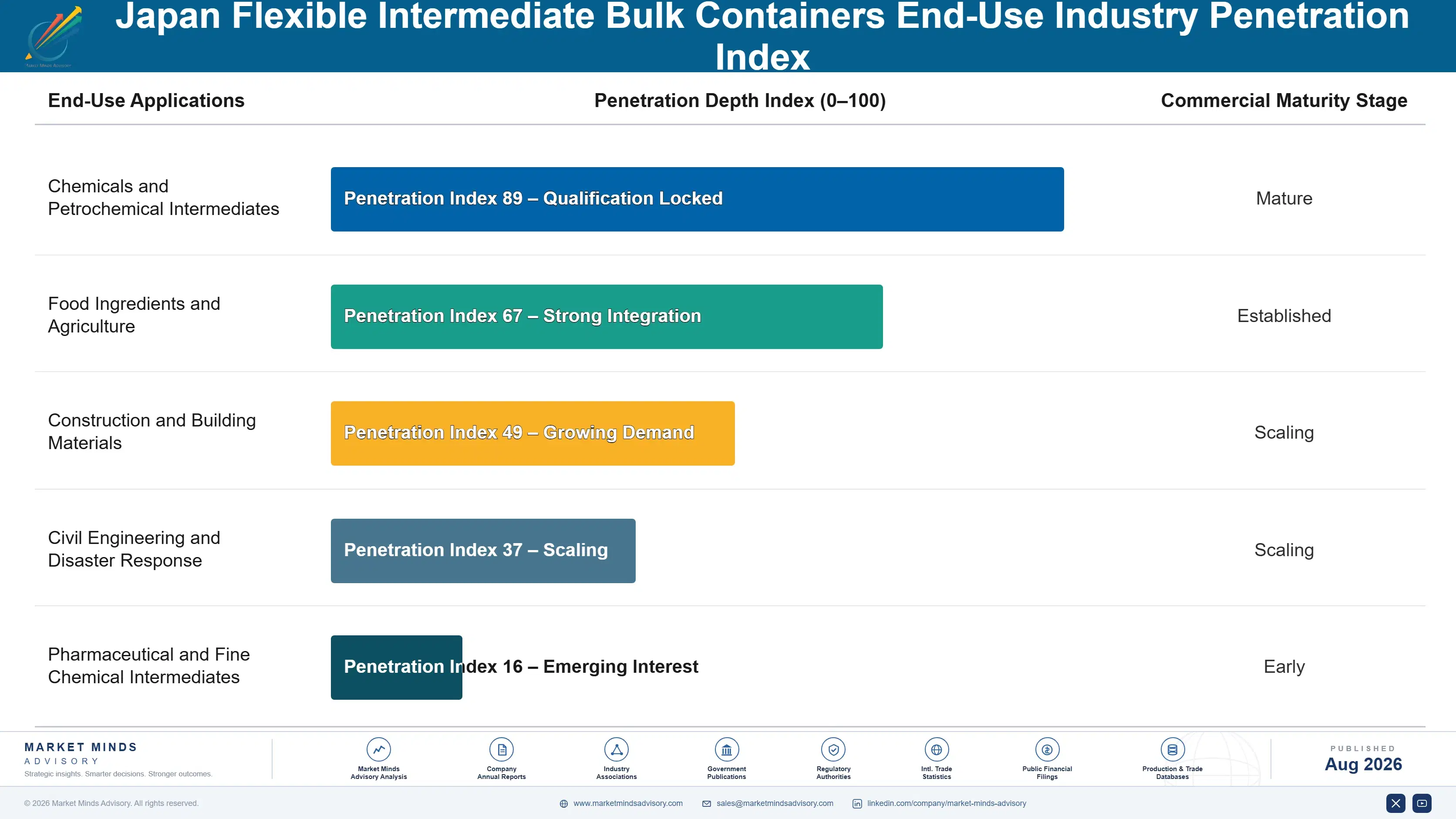
Demand here is locked by supplier approval rather than by contract. A weaving plant audited and approved for Japanese specification supplies for years, because qualifying an alternative means an audit programme running many months and carrying real risk of a rejected delivery in the meantime. That process makes switching expensive in time rather than in money, which is a stronger deterrent in Japanese purchasing practice than a price difference would ever be.
Depth varies by what the bag holds. Food and pharmaceutical intermediate handlers buy deepest, auditing plants themselves and treating contamination as a rejection matter rather than a quality note. Chemical handlers buy deeply on electrostatic certification. General industrial and agricultural users buy on delivered price. Civil engineering buyers purchase against project schedules and tender competitively each time, with almost no supplier continuity at all.

The deciding population has broadened. Bag selection sat historically with purchasing weighing price against reliability. Ignition risk assessments moved a substantial part of it to safety functions, and workforce handling arguments increasingly involve operations, and neither of those participants evaluates delivered price per bag in the way procurement did.
japan-flexible-intermediate-bulk-containers-market-end-use-penetration-index-1787308541136

Where Suppliers Into Japan Win

These are among the four positions where our research anticipates prominent divergence between winners and laggards over the coming forecast period. Each is grounded in the demand model, the regulatory perimeter, and the announced capacity pipeline.
01 / AUDITED CAPACITY COMMITMENT

A shared weaving line eventually fails a Japanese inspection

Japanese buyers audit each source around 1.8 times annually and reject entire deliveries over a single foreign fibre, which a plant running mixed customer work simply cannot prevent reliably, however careful its intentions may be. Suppliers that hold weaving lines dedicated to Japanese specification, with separated material handling and trained operators, sustain that scrutiny where general-purpose plants fail inside a year. Roughly 96% of bags entering Japan are imported, so audited dedicated capacity is the only genuinely defensible ground available to anybody.
02 / HANDLING CONVERSION GROWTH

The only new volume comes from sacks, not from competitors

Japanese industrial production has been flat for two decades and the working population keeps falling, so bulk bag volume cannot grow by taking share alone. One container replaces roughly forty manual lifts of a twenty-five kilogram sack, and an ageing workforce makes that an injury liability rather than a preference. Presented to operations as a handling and injury argument rather than to procurement as a packaging price, it converts volume that was never in the bulk bag market at all.
03 / SAFETY ASSESSMENT TIMING

A documented static hazard removes the choice from purchasing

Formal electrostatic ignition risk assessment has become routine across Japanese chemical and pharmaceutical intermediate handling, and each assessment that documents a static hazard converts a standard specification into a certified conductive or dissipative one permanently. Type C construction compounds at 6.0%, exactly 1.50 times the market rate, and Type D at 5.4% alongside it. Suppliers present at that assessment, able to explain earthing discipline to a customer's safety function, capture that conversion rather than tendering against it many months afterwards.
04 / DISPOSAL WEIGHT ECONOMICS

Every gram of fabric is paid for twice in this market

Used bags are incinerated rather than reconditioned, at a charge running roughly 22% of the delivered purchase price, and some 87% of bags are used exactly once. That makes fabric weight a cost the buyer carries once on purchase and again on disposal, which no other major market rewards reducing in quite the same way. Lighter constructions that hold the same certified safe working load require genuine weave engineering, and the argument improves both parties' economics at the same time.

Engagement Snapshot From the Field

A live engagement with an industry participant carrying material or product regulatory and market exposure ahead of a defining policy shift, showing how our research translates into a defensible multi-year portfolio strategy.
MARKET MINDS ADVISORY · CLIENT ENGAGEMENT SUMMARY
Japan Flexible Intermediate Bulk Containers Producer Strategic Portfolio Review and Transition Roadmap 2026·Investment Scenario on Japan Flexible Intermediate Bulk Containers Exposure Evaluation 2025-26
CLIENT PROFILE
A speciality chemical manufacturer operating six Japanese plants with roughly JPY 210 billion in revenue (client-reported, unverified by MMA), handling powder and granular products across intermediates, additives and fine chemicals. Bulk bag spend ran near JPY 1.4 billion annually (client-reported, unverified by MMA), sourced through three trading intermediaries with plant-level purchasing and no group specification.
STRATEGIC CHALLENGE
A static discharge incident during powder transfer had prompted a safety review across all six plants, and the engineering group had specified conductive bags for every powder product regardless of flammability. Procurement objected on cost. Neither function had established which products actually presented an ignition hazard under formal assessment. Nobody had run a formal assessment.
MMA APPROACH
MMA ran formal electrostatic ignition risk assessment across the client's powder portfolio, classifying products by minimum ignition energy and surrounding atmosphere rather than by handling convenience. Supplier weaving plant audit records were reviewed, and disposal cost was quantified separately from purchase price for the first time at group level. Earthing compliance was reviewed at plant level.
KEY FINDINGS
  1. Formal assessment identified genuine ignition hazard on 41% of powder products rather than the whole portfolio, which reduced the conductive bag requirement substantially against the engineering specification.
  2. Two of the three intermediaries sourced from weaving plants running mixed customer work, and both had recorded contamination rejections in the previous eighteen months that plant purchasing had never escalated.
  3. Incineration disposal charges appeared in facilities budgets rather than packaging spend, so nobody had ever compared them against bag purchase cost or considered fabric weight in the specification.
  4. Type D construction was appropriate for several applications where Type C had been specified, removing an earthing step that plant operators had been recorded skipping during audits.
CLIENT PROFILE
A speciality chemical manufacturer operating six Japanese plants with roughly JPY 210 billion in revenue (client-reported, unverified by MMA), handling powder and granular products across intermediates, additives and fine chemicals. Bulk bag spend ran near JPY 1.4 billion annually (client-reported, unverified by MMA), sourced through three trading intermediaries with plant-level purchasing and no group specification.
STRATEGIC CHALLENGE
A static discharge incident during powder transfer had prompted a safety review across all six plants, and the engineering group had specified conductive bags for every powder product regardless of flammability. Procurement objected on cost. Neither function had established which products actually presented an ignition hazard under formal assessment. Nobody had run a formal assessment.
MMA APPROACH
MMA ran formal electrostatic ignition risk assessment across the client's powder portfolio, classifying products by minimum ignition energy and surrounding atmosphere rather than by handling convenience. Supplier weaving plant audit records were reviewed, and disposal cost was quantified separately from purchase price for the first time at group level. Earthing compliance was reviewed at plant level.
KEY FINDINGS
  1. Formal assessment identified genuine ignition hazard on 41% of powder products rather than the whole portfolio, which reduced the conductive bag requirement substantially against the engineering specification.
  2. Two of the three intermediaries sourced from weaving plants running mixed customer work, and both had recorded contamination rejections in the previous eighteen months that plant purchasing had never escalated.
  3. Incineration disposal charges appeared in facilities budgets rather than packaging spend, so nobody had ever compared them against bag purchase cost or considered fabric weight in the specification.
  4. Type D construction was appropriate for several applications where Type C had been specified, removing an earthing step that plant operators had been recorded skipping during audits.
RECOMMENDED STRATEGY
Phase 1: Phase 1 (months 1 to 6): Apply the formal assessment classification and specify conductive construction only where genuine ignition hazard was identified. Phase 2: Phase 2 (months 6 to 16): Consolidate sourcing onto suppliers holding dedicated audited weaving lines and requalify the two intermediaries with contamination history. Phase 3: Phase 3 (months 16 to 26): Introduce a group specification stating certified safe working load and maximum fabric weight together.
OUTCOME
Conductive bag specification fell from the whole portfolio to 41% of products, saving roughly JPY 160 million annually (client-reported, unverified by MMA). Contamination rejections ceased following resourcing. Disposal cost fell by approximately 14% as fabric weight came down against the same certified load (client-reported, unverified by MMA).

Frequently Asked Questions

Foundational context covering the market sizes, CAGR, scope, country, region and competition that inform every finding below. This section is provided to cover basics and most often pre-purchase conversations, answered from the MMA Primary Research Dataset.

What is the current size of the Japan Flexible Intermediate Bulk Containers Market?

The market was worth USD 0.44 billion in 2025, reaching USD 0.46 billion in 2026. East Asia supplies 44% of bags entering Japan by weaving origin.

How large will the Japan Flexible Intermediate Bulk Containers Market be by 2036?

MMA forecasts USD 0.68 billion by 2036, an expansion multiple of 1.48 times the 2026 base. That represents roughly USD 0.22 billion of incremental value.

What is the CAGR for the Japan Flexible Intermediate Bulk Containers Market 2026 to 2036?

The base case compounds at 4.0% annually, with a bull case of 5.2% and a bear case of 2.8%. Historical growth from 2020 to 2025 ran at 3.2%.

Which segment is growing fastest?

Type C conductive bulk bags compound at 6.0%, exactly 1.50 times the market rate. Formal ignition risk assessment has become routine across Japanese powder handling operations.

Who are the major companies in the Japan Flexible Intermediate Bulk Containers Market?

Nihon Matai, Greif, LC Packaging, Conitex Sonoco and Emmbi Industries hold a combined 38% of the market. Most are trading houses and converters rather than weavers.

Which country is growing fastest?

India compounds at 6.2% as a supply origin, ahead of every other. Indian plants hold Japanese-audited lines and food grade certification that competitors on price lack.

Report Segmentation Architecture

The full report scope spans multiple orthogonal segmentation dimensions, with cross-tabulated demand data provided for each dimension pair. Coverage extends further to regional breakdowns, trend trajectories, and the competitive detail needed to support segment-level decision-making.

By Bag Construction Type

  • Type A Standard Bulk Bags
  • Type B Non-Static Bulk Bags
  • Type C Conductive Bulk Bags
  • Type D Antistatic Dissipative Bags
  • Food-Grade Lined Bulk Bags
  • Civil Engineering and Disaster Response Bags

By End-Use Industry

  • Chemicals and Petrochemical Intermediates
  • Food Ingredients and Agriculture
  • Construction and Building Materials
  • Civil Engineering and Disaster Response
  • Pharmaceutical and Fine Chemical Intermediates

By Commercial Dimension

  • Trading House Intermediated Supply
  • Direct Import from Audited Weavers
  • Domestic Converter and Distributor Channel
  • Public Works and Tender Procurement

By Region

  • East Asia
  • South Asia and Pacific
  • Western Europe
  • North America
  • Eastern Europe
  • Middle East and Africa
  • Latin America

Scope, Methodology, and Coverage

Every figure in this report is reproducible from documented input assumptions. The scope below maps the historical period, the forecast horizon, the segmentation dimensions, and the countries covered, alongside the underlying primary and qualitative methodology.
Historical Period
2020 to 2025
Forecast Period
2026 to 2036
Base Year
2025 (USD billions; MMA Primary Research Dataset, August 2026)
Market Definition
The market covers flexible intermediate bulk containers supplied into Japan for industrial, chemical, food ingredient and civil engineering use, spanning Type A standard bags, Type B non-static bags, Type C conductive bags, Type D antistatic dissipative bags, food-grade lined bulk bags, and civil engineering and disaster response formats, together with the liners supplied fitted within them. Rigid intermediate bulk containers, steel and plastic drums, small sacks below 100 litres capacity, and liners sold separately from bags are excluded. Sizing is measured at supplier revenue in current prices, with regional shares describing weaving origin rather than consumption.
Quantitative Units
USD billions (current prices); bag units and safe working load in tonnes where applicable
Segmentation Dimensions
By Bag Construction Type; By End-Use Industry; By Commercial Dimension; By Region
Regions Covered
East Asia, South Asia and Pacific, Western Europe, North America, Eastern Europe, Middle East and Africa, Latin America
Countries Covered
USA, China, Germany, France, UK, Japan, South Korea, India, Australia, Canada, Brazil, Mexico, Indonesia, Vietnam, Thailand, Malaysia, UAE, Saudi Arabia, South Africa, Nigeria, Turkey, Poland, Netherlands, Italy, Spain, Sweden, Switzerland, Argentina, Colombia, Singapore, and additional markets relevant to this sector
Key Companies Profiled
Nihon Matai, Greif, LC Packaging, Conitex Sonoco, Emmbi Industries, Rishi FIBC Solutions, Jumbo Bag Limited, Bulk Lift International, Berry Global, Intertape Polymer Group, Global-Pak, Halsted Corporation, Sackmaker, BAG Corp, Taihua Group, Zhejiang Huifeng, Bang Polypacks, Flexituff International, Shree Tirupati Balajee, NNZ Group
Quantitative Methodology
Primary survey, n=3,800 respondents, Q4 2025, six countries; demand-side model with trade association cross-validation
Qualitative Methodology
47 expert interviews, Q4 2025; applied to validate demand model assumptions, identify emerging dynamics, and assess competitive positioning
Report Format
PDF and XLSX data workbook (Word format preview document)
Publisher
Market Minds Advisory
Report Code
MMA-2026-PAC-794
Published
August 2026
Contact
sales@marketmindsadvisory.com | www.marketmindsadvisory.com

Purchase the full Japan Flexible Intermediate Bulk Containers Market Report (2026 to 2036).

The full report sizes Japanese flexible intermediate bulk container demand across six construction types, three commercial dimensions and seven supply regions, with annual forecasts to 2036 under base, bull and bear scenarios. Weaving plant audit status is mapped by origin country, identifying which plants hold Japanese-qualified lines and which serve mixed customer work. Total cost of ownership is modelled including incineration disposal, which sits in facilities budgets and is almost never compared against purchase price. Electrostatic classification requirements are set out by powder type and atmosphere. Twenty suppliers are profiled on a consistent bulk container revenue basis.
Weaving plant audit status mapped by origin country
Total cost modelled including incineration disposal charges
Electrostatic classification requirements set out by powder type
Civil engineering demand tracked against infrastructure programmes
Sack handling conversion opportunity quantified by industry
Fabric weight against certified safe working load benchmarked

Built For The People Who Decide

From boardroom strategy to bench-side execution, this report is read cover-to-cover by leaders shaping the next decade of their industry, turning demand scenarios, market dynamics and valuation benchmarks into decisions.
CXOs/ Presidents/ VPs/ Managers
M&A and Corporate Development
Strategy Teams and R&D Heads
Procurement and Product Directors
Regulatory and Compliance Leaders
Investor Relations and Equity Analysts