Market Minds Advisory
Demand for Duplication Disc in Japan

Demand for Duplication Disc in Japan: Demand for Duplication Disc in Japan: A Shrinking Market With Vanishing Capacity, Which Is Not the Same as a Bad One

Roughly 44% of replication capacity has been scrapped over a decade while Japanese physical music still takes 58% of recorded revenue, which leaves survivors with pricing power nobody in the industry expected.

Lead Analyst

Published

September 2026

Make Smarter Decisions with Customized Research Insights

Request a free sample report and evaluate market opportunities, growth trends, and competitive dynamics relevant to your business needs.

2025 MARKET VALUE$3.2BMarket Size 2025
2036 FORECAST VALUE$4.6BBase Case , 2026 to 2036
CAGR 2026 TO 20363.4 %Bull 4.6% / Bear 2.2%
INCREMENTAL OPPORTUNITY$1.3BNet 10- year value creation
EXPANSION MULTIPLE1.40x2036 value over 2026 base
Strategic Levers
M&A Pipeline
Regional Outlook
Country Rankings
Competitive Intelligence
Segmental Deep-dive
Call-Us : 91 93563 13602

Executive Snapshot and Market Trajectory.

Everybody outside Japan assumes this market ended. Japanese physical formats still carry about 58% of recorded music revenue, because a disc there is a merchandise item bundled with event access rather than a way of listening to anything. Streaming was never actually competing with any of it at all.
Archival and cold storage discs grow at 5.1%, half again the market rate of 3.4%, on retention obligations measured in decades where competing media needs copying forward every 8 years. Collector and bundled entertainment discs follow at 4.6%. East Asia takes 52% of value, which reflects both Japanese consumption and the replication capacity that survived elsewhere in the region. Software distribution has gone entirely and blank recordable media declines at 0.8% a year.
Concentration sits near 61% across the top five on measured replication and media revenue, and the reason is that roughly 44% of industry capacity has been scrapped over a decade. A shrinking market with vanishing capacity is not the same thing as a bad one, and the survivors have started to notice. Several are still quoting at the prices they set during the overcapacity years.
Market Definition
This market covers replicated and duplicated optical discs and the recordable media supporting them, spanning archival and cold storage discs, collector and bundled entertainment discs, software and content distribution discs, automotive and embedded system discs, professional video and broadcast discs, and blank recordable media. Revenue is measured as disc, replication service and attributable packaging value at supplier level, with Japan treated as the analytical centre within a global sizing frame. Disc drives and readers, content licensing and royalties, streaming and download distribution, magnetic tape and hard disk storage, and printed packaging sold without discs are excluded.
Base Year Value
$3.2B in 2025 (MMA Primary Research Dataset, September 2026)
Forecast Period
2026 to 2036, eleven discrete annual values
CAGR
3.4% base case. Bull 4.6%. Bear 2.2%.
Fastest Growth Segment
Archival and Cold Storage Discs: 5.1% CAGR
Fastest Growth Country
India: 6.0% CAGR
Fastest Growth Region
South Asia and Pacific: 5.6% CAGR
Largest Region
East Asia: 52% of 2025 global value
Market Leaders
Sony, Panasonic, Memory-Tech, Arvato and Verbatim lead on measured replication and media revenue. Source: MMA Primary Research Dataset, July 2026.
Primary Survey
n=3,800 procurement and R&D decision-makers, Q4 2025, six countries
Methodology
Demand-side build-up, cross-validated against public data, 47 expert interviews

Demand for Duplication Disc in Japan Market Forecast Scenarios

japan-duplication-disc-market-size-forecast-scenario-1788453035623
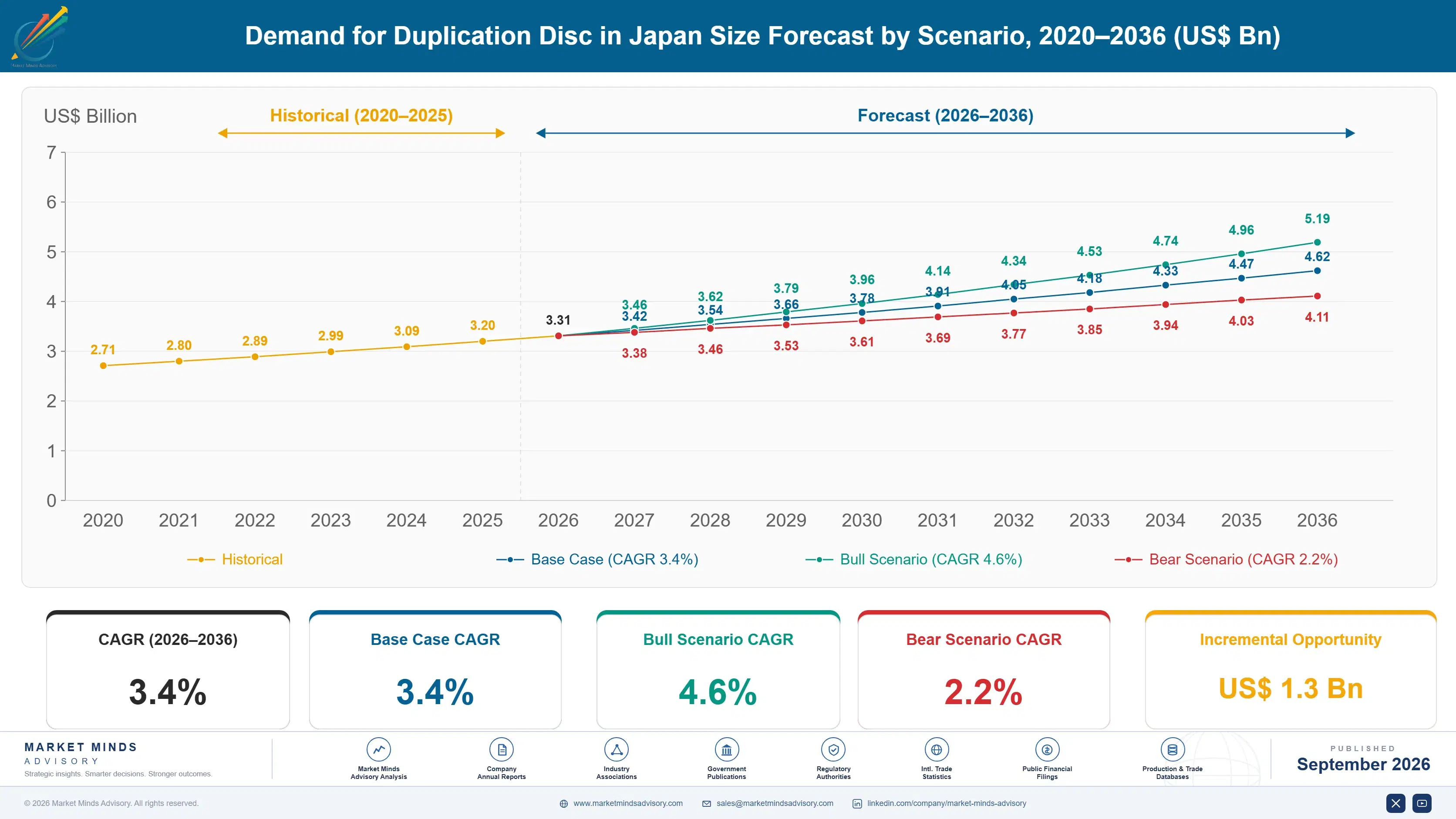
Growth ran at 2.4% from 2020 to 2025, which is a better outcome than anybody outside Japan predicted for optical media. Software and content distribution collapsed as expected. Japanese collector releases held up because the disc functions as merchandise, and archival demand grew from almost nothing as organisations with decades-long retention obligations examined what magnetic media actually costs to keep alive.
The base case at 3.4% rests on three mechanisms. Archival storage grows because a written disc needs no power and no migration for around 50 years, while competing media requires copying forward roughly every 8 years at labour cost that compounds. Japanese collector releases hold at retail prices near USD 62 because buyers are purchasing event access and physical objects rather than recordings. Third, capacity retirement of roughly 44% has left pricing power with whoever remains.
The bull case at 4.6% assumes archival adoption accelerates as organisations complete the arithmetic on decades-long retention, which very few have done properly. The bear case at 2.2% is that Japanese collector formats finally follow every other market toward digital, which would remove the volume base that keeps replication lines economic and leave archival demand alone to carry the industry.

Fewer Lines, Steadier Prices

Japanese physical media persists for reasons that have almost nothing to do with sound quality or nostalgia. Around 58% of recorded music revenue is still physical because a single is merchandise carrying event access, voting entitlements and variants, and buyers purchase several copies. The disc inside is close to incidental. Anyone modelling this as a format preference has misread what the object is.
TOP FIVE CONCENTRATION61%Concentrated among the surviving replication and media manufacturers
JAPANESE PHYSICAL MUSIC SHARE58%Recorded music revenue still taken through physical formats
ARCHIVAL RETENTION PERIOD50 yearsReadable life without migration or continuous power supply
REPLICATION CAPACITY SCRAPPED44%Lines retired across the industry over a decade
COLLECTOR DISC UNIT PRICEUSD 62Typical retail price for a bundled entertainment release
TAPE MIGRATION INTERVAL8 yearsPeriod before competing archive media requires copying forward
Archival is the segment that grows, on an argument nobody in entertainment cares about. A written optical disc remains readable for around 50 years with no power and no migration, while magnetic archive media needs copying forward roughly every 8 years at labour cost that repeats indefinitely. Organisations with retention obligations measured in decades find that compelling once somebody performs it, which most have not.
The supply side is where this becomes interesting. Roughly 44% of replication capacity has been scrapped over a decade as manufacturers left, and rebuilding a line is not something anybody will finance against a declining market. That leaves survivors serving demand falling slowly with capacity that fell faster. Concentration near 61% is the result, and pricing has begun to reflect it in a way the last twenty years never did.
"The reflex is to treat a declining market as a bad market, and this one is quietly disproving that. Demand fell perhaps a third; capacity fell by nearly half; nobody is building new lines. The remaining operators have a pricing position their predecessors would have envied throughout the boom."
Director, Media Manufacturing and Physical Distribution Practice · MMA Packaging Practice · September 2026

Market Trends

Capacity Left Faster Than Demand Did

Roughly 44% of replication capacity has been retired over a decade as manufacturers closed plants and wrote off lines that nobody would finance rebuilding against a declining market. Demand fell too, and it fell more slowly, which has left the surviving operators serving a shrinking order book with a shortage of places to fill it. Concentration near 61% is the direct result. Pricing has begun moving in favour of manufacturers for the first time in twenty years, and several are still pricing as though it had not. The position changed and the behaviour has not.
Market Impact: Holds 58% of music revenue

Archival Buyers Are Doing the Migration Arithmetic

Organisations holding data under retention obligations measured in decades are comparing a written disc readable for around 50 years without power against magnetic media needing migration roughly every 8 years, and the labour cost of repeated copying compounds in a way capital cost does not. Archival discs grow at 5.1%, the fastest here, on that calculation alone. Very few organisations have actually performed it, which means adoption is limited by awareness rather than by any technical or commercial obstacle. Storage teams evaluate capacity and throughput, and neither of those figures contains the actual argument.
Market Impact: Removes 6 migration cycles

Market Opportunities and Growth Drivers

Japanese Discs Are Merchandise Rather Than Recordings

A Japanese music single sold at retail carries event access, voting entitlements and collectable variants, and dedicated buyers purchase multiple copies of the same release for those attachments rather than for the audio. That places demand entirely outside the format competition streaming won everywhere else, since nobody is choosing between a disc and a subscription. Physical formats accordingly hold about 58% of recorded music revenue in Japan. Anime and film releases follow the same logic at retail prices near USD 62. The format competition that streaming won elsewhere never took place here at all.
Market Impact: Blank media declines at 0.8%

Long Retention Obligations Punish Media Needing Migration

Government records, medical imaging, broadcast masters and regulated financial data carry retention requirements measured in decades, and magnetic archive media must be copied forward roughly every 8 years to remain readable. Each migration consumes staff time, verification effort and risk, and the cost recurs for as long as the obligation lasts. A written disc readable for around 50 years without power removes that cycle entirely. The argument is arithmetic rather than technology, which makes it durable once anybody actually presents it. Six migration cycles across fifty years is the comparison that decides it.
Market Impact: Compares 50 years against 8

Market Restraints and Challenges

Every Segment Except Archival Is Shrinking

Software distribution has essentially ended, blank recordable media declines at 0.8%, and even collector releases grow only at 4.6% against a Japanese market that will eventually age. The root cause is that digital distribution is better at everything a disc was originally for, and only the merchandise and archival functions survive that comparison. Commercially this caps the market whatever happens to pricing. Suppliers mitigate by concentrating on archival and collector work, which is sensible and does not change the overall direction. Pricing power improves the returns and changes none of the underlying direction.
Market Impact: Retired 44% of industry capacity

Archival Adoption Is Limited by Awareness Alone

Organisations with decades-long retention obligations mostly have not compared the cost of migrating magnetic media every 8 years against a disc readable for 50 years without touching it, because nobody has ever asked them to. The root cause is that archive decisions are made by storage teams evaluating capacity and throughput rather than by finance teams modelling decades of recurring labour. Commercially this leaves the fastest segment growing slowly against its actual potential. Mitigation requires selling to a different function entirely. The obstacle is who gets asked rather than what the answer is.
Market Impact: Avoids migration every 8 years
3 additional market trends, 4 additional growth drivers, and 2 additional restraints and challenges are covered in the full report. Contact sales@marketmindsadvisory.com to access the complete intelligence.

Segment CAGR and Growth Architecture

Segmentation follows what the disc is actually for, because that determines whether digital distribution replaced it. Where a disc carried information, it is gone. Where it carries merchandise value or survives without power for decades, it is not, and those two survivors have nothing whatever in common commercially. Only the disc itself is actually shared.
japan-duplication-disc-market-market-share-analysis-1788453036160

Archival and Cold Storage Discs

Archival discs grow at 5.1%, half again the market rate of 3.4%, on a comparison that has nothing to do with capacity or speed. A written disc stays readable for around 50 years with no power and no migration, while magnetic archive media must be copied forward roughly every 8 years at labour cost that recurs for the whole retention period. Government records, medical imaging and broadcast archives carry obligations measured in decades where that difference compounds enormously. Adoption is limited by awareness rather than by any obstacle, since archive decisions sit with storage teams who evaluate capacity rather than decades of recurring cost. The argument is arithmetic and it survives any technical objection.
CAGR 5.1%

Collector and Bundled Entertainment Discs

Collector releases grow at 4.6% because in Japan a disc is a merchandise item rather than a recording, carrying event access, voting entitlements and variant artwork that dedicated buyers purchase repeatedly. Retail prices near USD 62 reflect the attachments rather than the content, and streaming competes with none of it. Anime and film box sets follow identical logic with production values that make the physical object the product. The commercial risk is demographic rather than technological, since the buying behaviour is generational and nobody has established whether it transfers to younger audiences. Multiple copies of one release bought by the same person is ordinary behaviour here, which no other developed market produces at comparable scale.
CAGR 4.6%
Full segment breakdown across 6 segments available in the complete report.

Regional Architecture and Country Demand Map

This report is Japan-centred within a global sizing frame, so regional shares describe where comparable value is produced and consumed worldwide. Cultural purchasing behaviour and archival policy explain the pattern, and neither correlates with population or income. Population and income predict absolutely none of this. Behaviour does.

East Asia

East Asia holds 52%, far above the regional band, because Japan alone sustains physical music and video purchasing at levels no other developed market approaches, and because surviving replication capacity is concentrated across the region. Japanese physical formats hold about 58% of recorded music revenue on merchandise attachments rather than on listening preference, and domestic demand grows at 4.6%. Korean releases follow similar collector logic at smaller scale. Taiwanese and Chinese manufacturers supply blank media and replication for markets that no longer manufacture domestically at all. Replication capacity retirement has been less severe here than in Western markets, because domestic demand justified keeping lines running when European and American operators were writing theirs off entirely.
Share: 52% | CAGR: 4.4% (2026 to 2036)

North America

North America holds 18%, below the regional band, on entertainment demand that has largely disappeared and archival demand that is beginning to appear in its place. Government record retention, medical imaging archives and broadcast libraries are the categories where migration arithmetic actually gets examined. Collector releases persist in film and music at specialist scale rather than mainstream volume. Growth at 2.6% is well below the market, since archival expansion has not yet offset an entertainment decline that ran further and faster here than anywhere. Replication capacity retirement was correspondingly severe here, leaving remaining operators with pricing positions they are only beginning to use. Entertainment purchasing moved to digital earlier and more completely than in any comparable market.
Share: 18% | CAGR: 2.6% (2026 to 2036)
Regional intelligence for 5 additional markets available in the complete report: Western Europe, South Asia and Pacific, Latin America, Middle East and Africa, Eastern Europe. Contact sales@marketmindsadvisory.com.
japan-duplication-disc-market-country-cagr-analysis-1788453036700

Earning From a Shrinking Base

The instinct in a declining market is to chase volume and defend price, and that is precisely backwards here. Capacity left faster than demand, which hands survivors a position their predecessors never had. The levers that matter are about pricing that reality, and about selling archival to a function that has never been asked.

Price for the Capacity That Disappeared

Roughly 44% of replication capacity has been scrapped and nobody will finance rebuilding a line against a declining market, which means surviving operators face demand that fell more slowly than their competition did. Manufacturers repricing to reflect that recover around 15% on comparable volume, and customers have nowhere obvious to take the work. Many are still quoting as though the boom-era capacity glut persisted. The commercial position changed several years ago and the pricing behaviour has not caught up. Nobody is going to build a new line, which is the fact that changes everything.
Market Impact: Recovers around 15% on exactly the same volume

Sell Archival to Finance, Not Storage Teams

Archive decisions are made by storage teams evaluating capacity and throughput, who have no reason to model decades of recurring migration labour, while the entire optical argument depends on exactly that comparison. Presenting a disc readable for 50 years against media requiring migration every 8 years to a finance function changes the audience and the answer together. Conversion running through finance sponsorship is roughly 3 times that achieved through storage evaluation. Almost nobody in this industry is doing it. The comparison is straightforward arithmetic that almost nobody has ever been shown. That is the opportunity.
Market Impact: Converts at roughly 3 times the storage route

Hold the Embedded and Professional Lines

Vehicle infotainment, medical imaging and broadcast installed bases will run for another decade and continue needing media, which is small predictable demand that several suppliers abandoned as unglamorous. It requires holding low-volume production capability and long-term availability commitments rather than any technical investment. Retained lines generate roughly 2 times the margin of high-volume entertainment replication, since buyers with no alternative supplier do not negotiate hard. Abandoning them handed steady business to whoever stayed in. These customers order small quantities on long notice and value availability far above unit price, which is a comfortable position.
Market Impact: Generates roughly 2 times the entertainment replication margin

Sell Merchandise Production, Not Disc Replication

A Japanese collector release retailing near USD 62 is a packaged object with a disc inside, and its value sits in printing, binding, inserts, variant management and the fulfilment of event entitlements. Suppliers positioning as merchandise producers rather than disc replicators capture around 40% more of each release's production budget. It requires print and packaging capability alongside replication. Manufacturers who sold only the disc watched packaging specialists take the larger and considerably more durable share. Print and packaging capability is acquirable rather than developed, and several survivors bought it from firms leaving the industry.
Market Impact: Captures around 40% more of each release budget

Who Controls the Margin Pool

Concentration sits near 61% across the top five on measured replication and media revenue, and it rose because competitors left rather than because anybody gained share by competing. Roughly 44% of industry capacity has been scrapped over a decade, written off by manufacturers who concluded the market was ending. Those remaining serve demand that fell more slowly than supply did, an unusual position several have not yet priced.
Competition runs on three dimensions. Capacity availability is first and increasingly decisive, since a customer with a large order has fewer places to take it every year. Second is packaging and merchandise capability, particularly in Japan where the disc is the smallest part of what a collector release actually contains. Third is archival product qualification, which requires longevity evidence and standards work that entertainment replication never demanded.

Two pressures will move positions. Archival growth rewards manufacturers holding longevity-qualified products and the ability to sell to finance functions rather than storage teams, which is a capability almost nobody in this industry built. Meanwhile Japanese collector demand rests on a generational buying behaviour whose transfer to younger audiences remains genuinely unproven, and every regional participant is exposed to that question.
japan-duplication-disc-market-company-positioning-matrix-1788453037223

Competitive Moat and Risk Dimensions

SONY

Moat: Archival format and content position

Sony holds both archival optical format capability and a substantial content publishing position in Japanese music and anime, which places it on both sides of the only two segments that are growing. Its longevity qualification work supports archival sales that entertainment replicators cannot make. Content relationships secure collector release volume that would otherwise be tendered competitively across surviving manufacturers.
SONY

Risk: Generational demand exposure

Japanese collector purchasing rests on merchandise attachments and buying behaviour that is generational, and nobody has established whether it transfers to younger audiences at comparable intensity. Archival growth is limited by awareness rather than capability, so it cannot be accelerated by product work alone. Both of the company's growing positions depend on demand conditions outside its influence.
MEMORY-TECH

Moat: Japanese replication and packaging

Memory-Tech combines surviving Japanese replication capacity with print and packaging capability, which matters because a collector release is a packaged object where the disc is the smallest component. Domestic proximity supports the short lead times and variant management that Japanese releases demand. Capacity retirement across the industry leaves it serving customers with progressively fewer alternatives available domestically.
MEMORY-TECH

Risk: Single market concentration

Revenue depends heavily on Japanese entertainment purchasing behaviour that no other market shares, which makes the company entirely exposed to a demographic question nobody can answer. Archival positions require longevity qualification and finance-level selling that a replication and packaging organisation is not naturally configured to perform. Export opportunities are limited, since foreign markets no longer buy at meaningful volume.

Players Tracked

Prominent Players

Sony
Panasonic
Memory-Tech
Arvato
Verbatim

Other Key Players

Technicolor
Cinram
Ritek
CMC Magnetics
Falcon Technologies
Mitsubishi Chemical
Pioneer
Toshiba
Sharp
JVCKenwood
Hitachi-LG Data Storage
Nimbus
Optical Disc Solutions
Amaray
Shinano Kenshi

Recent Developments

MARCH 2025

Surviving replicators begin repricing against reduced industry capacity

Manufacturers raised quoted prices on replication work after capacity retirement left customers with materially fewer alternatives, particularly for larger orders and short lead times. Several operators had continued quoting at levels set during a period of substantial industry overcapacity. The change followed capacity retirement by several years.
Signal: Pricing behaviour lags supply conditions by years, and the survivors are only now discovering their position.
JULY 2025

Government archives evaluate optical media against migration labour cost

Public record and broadcast archive organisations began comparing repeated magnetic media migration against write-once optical media readable for decades, modelling recurring staff cost across full retention periods rather than acquisition cost alone. Finance functions rather than storage teams led several evaluations. Acquisition cost alone had favoured magnetic media throughout.
Signal: The archival argument only works when somebody models decades of labour, which storage evaluations never do.
NOVEMBER 2025

Japanese collector releases sustain volumes on merchandise attachments

Music and anime releases continued selling at prices near USD 62 on event access, voting entitlements and variant artwork, with dedicated buyers purchasing multiple copies of individual titles. Streaming availability of the same content had no measurable effect on those sales. Dedicated buyers treated the release as an object.
Signal: Japanese physical purchasing is merchandise behaviour, which means streaming was never actually competing with it at all.

What Pressing a Disc Costs

Cost structure is dominated by fixed capacity rather than by materials. Polycarbonate, metallisation and lacquer together account for roughly 23% of a replicated disc, while line depreciation, mastering, changeover labour and quality control absorb most of the remainder. That fixed weighting is why capacity retirement changed the economics: a line below its volume threshold loses money whatever materials cost.
Polycarbonate pricing has been the most visible input movement. Optical grade resin comes from a small producer group serving far larger automotive and electronics markets, and pricing moved unfavourably through 2024 and 2025 as those sectors absorbed capacity. Mitsubishi Chemical and Panasonic both referenced materials and production cost conditions in recent annual reporting. Manufacturers passed more of it through than a decade ago, since customers have fewer places to go.

Exposure varies by capacity utilisation rather than by scale. Operators running lines near their volume threshold cover fixed cost and earn on incremental orders. Those running well below it lose money on every shift regardless of pricing, which is why capacity left the industry rather than simply idling. Manufacturers with packaging and print capability spread overhead across a wider revenue base, the clearest survival advantage this industry has shown.
japan-duplication-disc-market-cost-volatility-analysis-1788453037419

Consolidate volume onto fewer lines before retiring capacity

A line below its volume threshold loses money every shift whatever it charges, and operators running several partially loaded lines lose on all of them. Consolidating onto fewer fully loaded lines converts a distributed loss into a working operation. The retirement decision is difficult emotionally and obvious financially, which is why so many manufacturers delayed it too long.

Add packaging and print capability alongside replication

A Japanese collector release near USD 62 spends most of its budget on printing, binding, inserts and variant handling rather than the disc, so a pure replicator captures the smallest portion of it. Adding print and packaging spreads fixed overhead across a wider base and captures roughly 40% more of each release. The capability is acquirable rather than developed.

Index polycarbonate exposure into replication contracts

Optical grade resin comes from producers serving far larger markets, so pricing moves independently of disc demand and manufacturers historically absorbed it. Reduced industry capacity has changed that negotiating position materially. Indexation against published resin pricing is now achievable where it was not a decade ago, and manufacturers still absorbing it are declining an advantage their own scarcity created.

Portfolio Architecture for Margin Defence

Margin architecture separates on whether the buyer has an alternative. Blank recordable media and software distribution discs compete against digital delivery that is better and cheaper, so pricing collapses regardless of manufacturing efficiency. Collector releases compete against nothing, since the merchandise attachments have no digital equivalent. Archival discs compete against magnetic media on a total cost comparison that favours them once anybody models it properly.
The tension runs between capacity utilisation and segment selection. High-volume entertainment replication fills lines and keeps fixed cost covered, while earning little per unit and declining steadily. Archival and collector work earns considerably more on volumes that will not fill a line by themselves. Operators need both, which is why the industry consolidated onto fewer manufacturers running mixed order books rather than specialising the way most declining industries do.

High-value revenue concentrates in archival discs and in Japanese collector production including packaging. Archival is defended by longevity qualification and standards work entertainment replicators never performed. Collector production is defended by packaging capability and domestic proximity rather than by replication itself. Blank media and distribution discs are the volume base, earning almost nothing and keeping lines above their threshold.

Volume / Commodity-Adjacent

Blank recordable media and software distribution discs competing against digital delivery on every measure. The range separates operators running lines above their volume threshold from those below it. Volume here keeps fixed cost covered and earns very little else.
Gross Margin: 6-19%

Premium / Certified

Collector and bundled entertainment production including print, packaging and variant management. Margin depends on how much of the release budget a supplier captures beyond the disc. Japanese domestic proximity and short lead times matter more than replication capability.
Gross Margin: 22-41%

Sustainability / Regulatory / Next-Generation

Archival and cold storage discs qualified for decades-long retention without migration. The widest range in the portfolio, reflecting longevity qualification and verification service content. Highest margin and defended by standards work entertainment replicators never had reason to perform.
Gross Margin: 38-64%
japan-duplication-disc-market-portfolio-architecture-1788453037927

High-value Sub-segments and Strategic Watch-out

Archival and Cold Storage

High value with the fastest growth at 5.1%, winning on a comparison against migration every 8 years that very few buyers have actually performed. The range reflects longevity qualification and verification services. Adoption is limited by awareness rather than by any obstacle, which makes the selling approach decisive here.
Gross Margin: 40-64%

Collector Production and Packaging

High value with steady growth at 4.6%, where a release retailing near USD 62 spends most of its budget on packaging rather than on the disc. The range reflects how much of that budget a supplier captures. Its exposure is generational rather than technological, which nobody can resolve.
Gross Margin: 24-43%

Entertainment Volume Replication

The volume core, keeping lines above their threshold so fixed cost is covered and higher-margin work has somewhere to run. The range separates well-loaded operators from those below threshold. It earns little and remains necessary, which is an uncomfortable position to defend internally at any budget meeting.
Gross Margin: 9-22%

Blank Recordable Media

The strategic watch-out, declining at 0.8% against digital alternatives that are better at everything the format was for. Manufacturing continues largely because the lines exist rather than because the economics justify it. Several operators are running this volume purely to avoid confronting a capacity decision.
Gross Margin: 0-14%

What Keeps Orders Coming

Recurrence works completely differently across the two surviving segments. Collector releases recur with publishing schedules, which are frequent, predictable within a season and entirely dependent on the popularity of individual artists and titles. Archival discs recur with data creation under a retention obligation, which is steady, slow and continues for as long as the obligation does. Embedded and professional media recurs with installed equipment that will run another decade regardless.
Adoption depth varies with what the customer would have to change. A publisher can move replication between surviving manufacturers at the next release, subject to capacity being available somewhere. An archive that has committed a retention programme to optical media has verification procedures, equipment and audit evidence built around it, and changing means re-establishing all three. Archival customers are therefore far stickier than entertainment ones ever were.

The buyer has not shifted so much as narrowed. Entertainment replication was bought by publishing operations from large panels of competing manufacturers. It is now bought by the same functions from a much shorter list, which changes the negotiating dynamic entirely. Archival is bought by a different organisation, and reaching it means selling to finance rather than the storage teams evaluating everything else.
japan-duplication-disc-market-end-use-penetration-index-1788453038423

Where Scarcity Pays

These are among the four positions where our research anticipates prominent divergence between winners and laggards over the coming forecast period. Each is grounded in the demand model, the regulatory perimeter, and the announced capacity pipeline.
01 / SCARCITY PRICING DISCIPLINE

Price for the capacity that left, not the market

Roughly 44% of replication capacity has been scrapped over a decade and nobody will finance rebuilding a line against a market widely assumed to be ending, which leaves survivors serving demand that fell more slowly than their competition did over the same period. Manufacturers repricing to reflect that recover around 15% on comparable volume, because customers with large orders have nowhere obvious at all to take them. Many are still quoting at levels set during an overcapacity period that ended several years ago.
02 / FINANCE FUNCTION SELLING

Take archival to finance, never to storage teams

Archive decisions are made by storage teams evaluating capacity and throughput, who have no reason at all to model decades of recurring migration labour, while the entire optical argument depends on precisely that comparison being made. Presenting a disc readable for 50 years against media requiring migration every 8 years to a finance function changes both the audience and the answer, and conversion through finance sponsorship runs roughly 3 times storage evaluation. Almost nobody in this industry has attempted it.
03 / MERCHANDISE PRODUCTION POSITIONING

Manufacture the object, not merely the disc inside

A Japanese collector release retailing near USD 62 spends most of its production budget on printing, binding, inserts, variant management and event entitlement fulfilment rather than on the disc it happens to contain at all. Suppliers positioning as merchandise producers rather than replicators capture around 40% more of each release budget, and the print and packaging capability required is acquirable rather than developed from scratch. Manufacturers who sold only the disc watched packaging specialists take the larger and considerably more durable share of it.
04 / LONG TAIL LINE RETENTION

Keep the unglamorous lines competitors abandoned

Vehicle infotainment, medical imaging and broadcast installed bases will run for another decade at least and continue needing media, which is small predictable demand that several suppliers walked away from as insufficiently interesting to bother with. Retained lines generate roughly 2 times the margin of high-volume entertainment replication work, because buyers with no alternative supplier do not negotiate hard on price at all. Holding them requires low-volume production capability and availability commitments rather than any technical investment whatsoever from anybody involved.

Engagement Snapshot From the Field

A live engagement with an industry participant carrying material or product regulatory and market exposure ahead of a defining policy shift, showing how our research translates into a defensible multi-year portfolio strategy.
MARKET MINDS ADVISORY · CLIENT ENGAGEMENT SUMMARY
Demand for Duplication Disc in Japan Producer Strategic Portfolio Review and Transition Roadmap 2026·Investment Scenario on Demand for Duplication Disc in Japan Exposure Evaluation 2025-26
CLIENT PROFILE
An optical media manufacturer operating six replication lines across two plants with annual revenue near USD 96 million (client-reported, unverified by MMA). Four lines ran well below their volume threshold, the business had been loss-making for three years, and management was preparing to close one of the two plants entirely to stop the bleeding. Nobody had looked outside the business.
STRATEGIC CHALLENGE
The board had approved closure of the smaller plant at an estimated cost of USD 14 million (client-reported, unverified by MMA), on the assumption that a declining market offered no alternative. Nobody had examined what industry capacity had done relative to demand, or what the client's own pricing looked like against the alternatives customers actually had.
MMA APPROACH
MMA measured surviving industry capacity against order volumes rather than analysing the client's cost base, which management had reviewed exhaustively. We surveyed 21 customers on where else they could place work, mapped remaining regional capacity by format and lead time, and modelled line loading under consolidation rather than under closure.
KEY FINDINGS
  1. Surviving regional capacity had fallen further than demand, and 17 of 21 customers surveyed had two or fewer alternative suppliers for their volumes.
  2. The client's quoted prices had not moved in nine years, having been set when industry overcapacity made price the only competitive dimension available.
  3. Consolidating volume onto three fully loaded lines would cover fixed cost without closing either plant or losing any customer capability at all.
  4. Archival product qualification had been abandoned in 2019 as a distraction, and two customers had since asked about long retention media unprompted.
CLIENT PROFILE
An optical media manufacturer operating six replication lines across two plants with annual revenue near USD 96 million (client-reported, unverified by MMA). Four lines ran well below their volume threshold, the business had been loss-making for three years, and management was preparing to close one of the two plants entirely to stop the bleeding. Nobody had looked outside the business.
STRATEGIC CHALLENGE
The board had approved closure of the smaller plant at an estimated cost of USD 14 million (client-reported, unverified by MMA), on the assumption that a declining market offered no alternative. Nobody had examined what industry capacity had done relative to demand, or what the client's own pricing looked like against the alternatives customers actually had.
MMA APPROACH
MMA measured surviving industry capacity against order volumes rather than analysing the client's cost base, which management had reviewed exhaustively. We surveyed 21 customers on where else they could place work, mapped remaining regional capacity by format and lead time, and modelled line loading under consolidation rather than under closure.
KEY FINDINGS
  1. Surviving regional capacity had fallen further than demand, and 17 of 21 customers surveyed had two or fewer alternative suppliers for their volumes.
  2. The client's quoted prices had not moved in nine years, having been set when industry overcapacity made price the only competitive dimension available.
  3. Consolidating volume onto three fully loaded lines would cover fixed cost without closing either plant or losing any customer capability at all.
  4. Archival product qualification had been abandoned in 2019 as a distraction, and two customers had since asked about long retention media unprompted.
RECOMMENDED STRATEGY
Phase 1: Consolidate volume onto three lines and retire the other three, rather than closing a plant and forfeiting geographic coverage customers value. Phase 2: Reprice replication work against the alternatives customers actually have, which are considerably fewer today than the current pricing had assumed. Phase 3: Restart archival qualification, since two customers asked unprompted and the segment grows faster than anything else available to the business.
OUTCOME
Consolidation returned the business to profitability within two quarters without closing either plant (client-reported, unverified by MMA). Repricing lifted realised prices by about 13% with no customer loss, and archival qualification was restarted with one of the two enquiring customers funding part of the work.

Frequently Asked Questions

Foundational context covering the market sizes, CAGR, scope, country, region and competition that inform every finding below. This section is provided to cover basics and most often pre-purchase conversations, answered from the MMA Primary Research Dataset.

What is the current size of the Demand for Duplication Disc in Japan?

The market was worth USD 3.2 billion in 2025 and reaches USD 3.31 billion in 2026 on a global sizing frame. Japan is the analytical centre of this report.

How large will the Demand for Duplication Disc in Japan be by 2036?

MMA forecasts USD 4.62 billion by 2036, an expansion of 1.40 times over the forecast period. That represents USD 1.31 billion of incremental annual revenue against 2026.

What is the CAGR for the Demand for Duplication Disc in Japan 2026 to 2036?

The base case is 3.4% compound annual growth, with a bull case at 4.6% and a bear case at 2.2%. Japanese demand specifically grows at 4.6% across the period.

Which segment is growing fastest?

Archival and cold storage discs grow at 5.1%, half again the market rate of 3.4%. A written disc lasts around 50 years without the migration magnetic media requires.

Who are the major companies in the Demand for Duplication Disc in Japan?

Sony, Panasonic, Memory-Tech, Arvato and Verbatim lead on measured replication and media revenue. Together they hold roughly 61%, concentration produced by exits rather than by competition.

Which country is growing fastest?

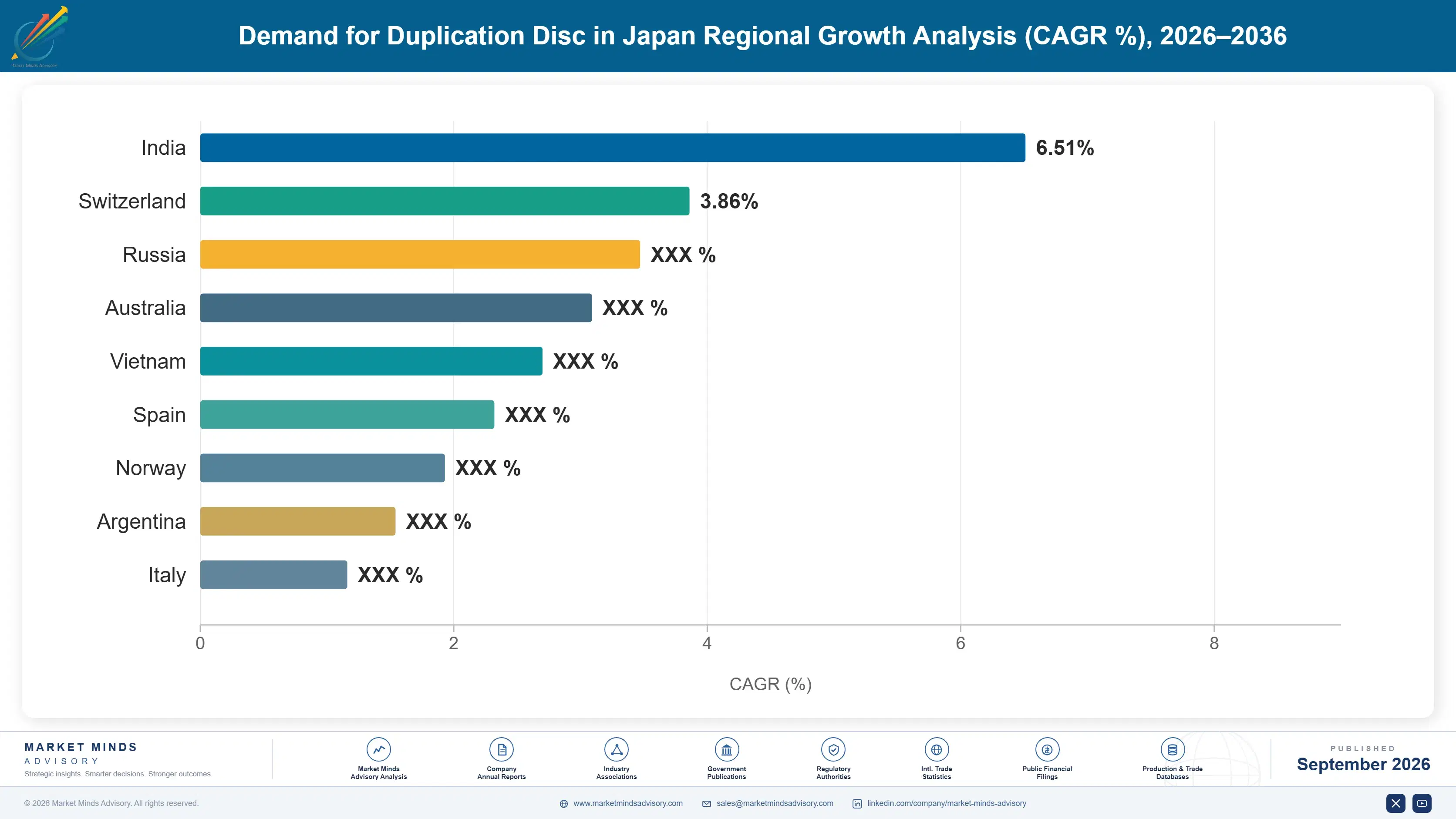
India grows fastest at 6.0%, on government record retention programmes carrying obligations measured in decades that have begun evaluating optical archive media seriously against migration cost.

Report Segmentation Architecture

The full report scope spans multiple orthogonal segmentation dimensions, with cross-tabulated demand data provided for each dimension pair. Coverage extends further to regional breakdowns, trend trajectories, and the competitive detail needed to support segment-level decision-making.

By Primary Market Dimension

  • Archival and Cold Storage Discs
  • Collector and Bundled Entertainment Discs
  • Software and Content Distribution Discs
  • Automotive and Embedded System Discs
  • Professional Video and Broadcast Discs
  • Blank Recordable Media

By End-Use Industry

  • Music and Entertainment Publishing
  • Film, Anime and Video Distribution
  • Government and Public Records
  • Healthcare and Medical Imaging
  • Broadcast and Media Archives
  • Automotive and Industrial Equipment

By Commercial Dimension

  • Publisher Replication Contracts
  • Archive Programme Supply
  • Merchandise Production Services
  • Retail Blank Media Distribution
  • Equipment Manufacturer Supply
  • Broadcast Framework Agreements

By Region

  • East Asia
  • North America
  • Western Europe
  • South Asia and Pacific
  • Latin America
  • Middle East and Africa
  • Eastern Europe

Scope, Methodology, and Coverage

Every figure in this report is reproducible from documented input assumptions. The scope below maps the historical period, the forecast horizon, the segmentation dimensions, and the countries covered, alongside the underlying primary and qualitative methodology.
Historical Period
2020 to 2025
Forecast Period
2026 to 2036
Base Year
2025 (USD billions; MMA Primary Research Dataset, September 2026)
Market Definition
This market covers replicated and duplicated optical discs together with the recordable media supporting them, spanning archival and cold storage discs, collector and bundled entertainment discs, software and content distribution discs, automotive and embedded system discs, professional video and broadcast discs, and blank recordable media. Revenue is measured as disc, replication service and attributable packaging and print value at supplier level, with Japan treated as the analytical centre within a global sizing frame required by the seven-region reporting structure. Optical disc drives and readers, content licensing and royalty revenue, streaming and download distribution, magnetic tape and hard disk storage media, and printed packaging sold without discs are excluded from scope.
Quantitative Units
USD billions, disc, replication service and attributable packaging revenue at supplier level
Segmentation Dimensions
Disc purpose, end-use industry, commercial channel, region
Regions Covered
East Asia, North America, Western Europe, South Asia and Pacific, Latin America, Middle East and Africa, Eastern Europe
Countries Covered
Japan, South Korea, China, Taiwan, Hong Kong, India, Australia, Indonesia, Thailand, Singapore, United States, Canada, Mexico, Brazil, Argentina, Chile, Germany, United Kingdom, France, Netherlands, Italy, Spain, Austria, Poland, Czechia, Hungary, Romania, United Arab Emirates, Saudi Arabia, South Africa
Key Companies Profiled
Sony, Panasonic, Memory-Tech, Arvato, Verbatim, Technicolor, Cinram, Ritek, CMC Magnetics, Falcon Technologies, Mitsubishi Chemical, Pioneer, Toshiba, Sharp, JVCKenwood, Hitachi-LG Data Storage, Nimbus, Optical Disc Solutions, Amaray, Shinano Kenshi
Quantitative Methodology
Primary survey, n=3,800 respondents, Q4 2025, six countries; demand-side model with trade association cross-validation
Qualitative Methodology
47 expert interviews, Q4 2025; applied to validate demand model assumptions, identify emerging dynamics, and assess competitive positioning
Report Format
PDF and XLSX data workbook (Word format preview document)
Publisher
Market Minds Advisory
Report Code
MMA-2026-PAC-071
Published
September 2026
Contact
sales@marketmindsadvisory.com | www.marketmindsadvisory.com

Purchase the full Demand for Duplication Disc in Japan Report (2026 to 2036).

The full MMA report explains why a market everybody wrote off is quietly profitable for the manufacturers who stayed, and why Japanese physical purchasing was never actually competing with streaming. It sizes the market to 2036 across six disc purposes, seven regions and 30 countries, with segment growth rates and regional demand mechanisms detailed. Competitive analysis covers 20 suppliers assessed on measured replication and media revenue, with moat and risk assessment for the two leaders. The report quantifies capacity and materials cost structure, archival migration economics and margin architecture across three portfolio tiers. It closes with four verdicts and an anonymised media manufacturer engagement.
Six disc purposes sized through 2036
Seven regions with demand mechanism analysis
Twenty suppliers on consistent revenue basis
Capacity retirement and migration cost benchmarks
Margin architecture across three portfolio tiers
Anonymised optical media capacity and pricing engagement

Built For The People Who Decide

From boardroom strategy to bench-side execution, this report is read cover-to-cover by leaders shaping the next decade of their industry, turning demand scenarios, market dynamics and valuation benchmarks into decisions.
CXOs/ Presidents/ VPs/ Managers
M&A and Corporate Development
Strategy Teams and R&D Heads
Procurement and Product Directors
Regulatory and Compliance Leaders
Investor Relations and Equity Analysts