Market Minds Advisory
Demand for Data Center CPU in Japan

Demand for Data Center CPU in Japan: Demand for Data Center CPU in Japan. Trends and Forecast 2026 to 2036

Japanese enterprises are shifting data center CPU procurement from general-purpose x86 processors toward AI accelerator-optimized architectures, forcing established chipmakers to defend performance-per-watt claims against ARM-based challengers gaining traction across deployments.

Lead Analyst

Published

September 2026

Make Smarter Decisions with Customized Research Insights

Request a free sample report and evaluate market opportunities, growth trends, and competitive dynamics relevant to your business needs.

2025 MARKET VALUE$4.6BMarket Size 2025
2036 FORECAST VALUE$13.8BBase Case , 2026 to 2036
CAGR 2026 TO 203610.5 %Bull 11.8% / Bear 9.2%
INCREMENTAL OPPORTUNITY$8.7BNet 10- year value creation
EXPANSION MULTIPLE2.71x2036 value over 2026 base
Strategic Levers
M&A Pipeline
Regional Outlook
Country Rankings
Competitive Intelligence
Segmental Deep-dive
Call-Us : 91 93563 13602

Executive Snapshot and Market Trajectory.

Japanese data center operators are accelerating CPU refresh cycles as AI workload demand strains existing server infrastructure, forcing enterprises and hyperscale operators alike to weigh performance-per-watt efficiency against raw processing throughput when selecting next-generation processor architectures across their expanding domestic data center footprint nationwide and across the wider region.
AI accelerator-optimized server CPUs represent the fastest-growing category as Japanese enterprises increasingly deploy processors specifically designed to feed data efficiently to attached AI accelerator hardware rather than relying on general-purpose architectures never optimized for this specific workload pattern at meaningful scale. Government-backed digital infrastructure investment through Japan's economic security legislation increasingly favors domestic and allied semiconductor supply chains, creating meaningful commercial tailwind for processor vendors demonstrating supply chain resilience alongside raw technical performance credentials.
Competitive dynamics remain intense as ARM-based server processors continue gaining share against traditional x86 architecture, particularly among hyperscale operators building custom infrastructure optimized for specific workload profiles and cost structures. Power costs in Japan run meaningfully higher than several competing data center markets, making processor energy efficiency a genuinely material purchasing criterion rather than a secondary consideration among procurement decision-makers evaluating vendor proposals.
Market Definition
The Demand for Data Center CPU Market covers server-grade central processing units deployed in data center infrastructure across hyperscale, enterprise, and colocation facilities, measured by unit shipment and processor revenue. It excludes GPU and AI accelerator chips sold separately, memory and storage components, and general-purpose consumer or desktop processors not deployed in data center environments.
Base Year Value
$4.6B in 2025 (MMA Primary Research Dataset, September 2026)
Forecast Period
2026 to 2036, eleven discrete annual values
CAGR
10.5% base case. Bull 11.8%. Bear 9.2%.
Fastest Growth Segment
AI Accelerator-Optimized Server CPUs: 16.0% CAGR
Fastest Growth Country
India: 13.0% CAGR
Fastest Growth Region
South Asia and Pacific: 12.5% CAGR
Largest Region
East Asia: 30% of 2025 global value
Market Leaders
Leading participants include Intel Corporation, Advanced Micro Devices, NVIDIA Corporation, Ampere Computing, and Fujitsu Limited. Source: MMA Primary Research Dataset, July 2026.
Primary Survey
n=3,800 procurement and R&D decision-makers, Q4 2025, six countries
Methodology
Demand-side build-up, cross-validated against public data, 47 expert interviews

Demand for Data Center CPU in Japan Market Forecast Scenarios

japan-data-center-cpu-market-size-forecast-scenario-1788452746233
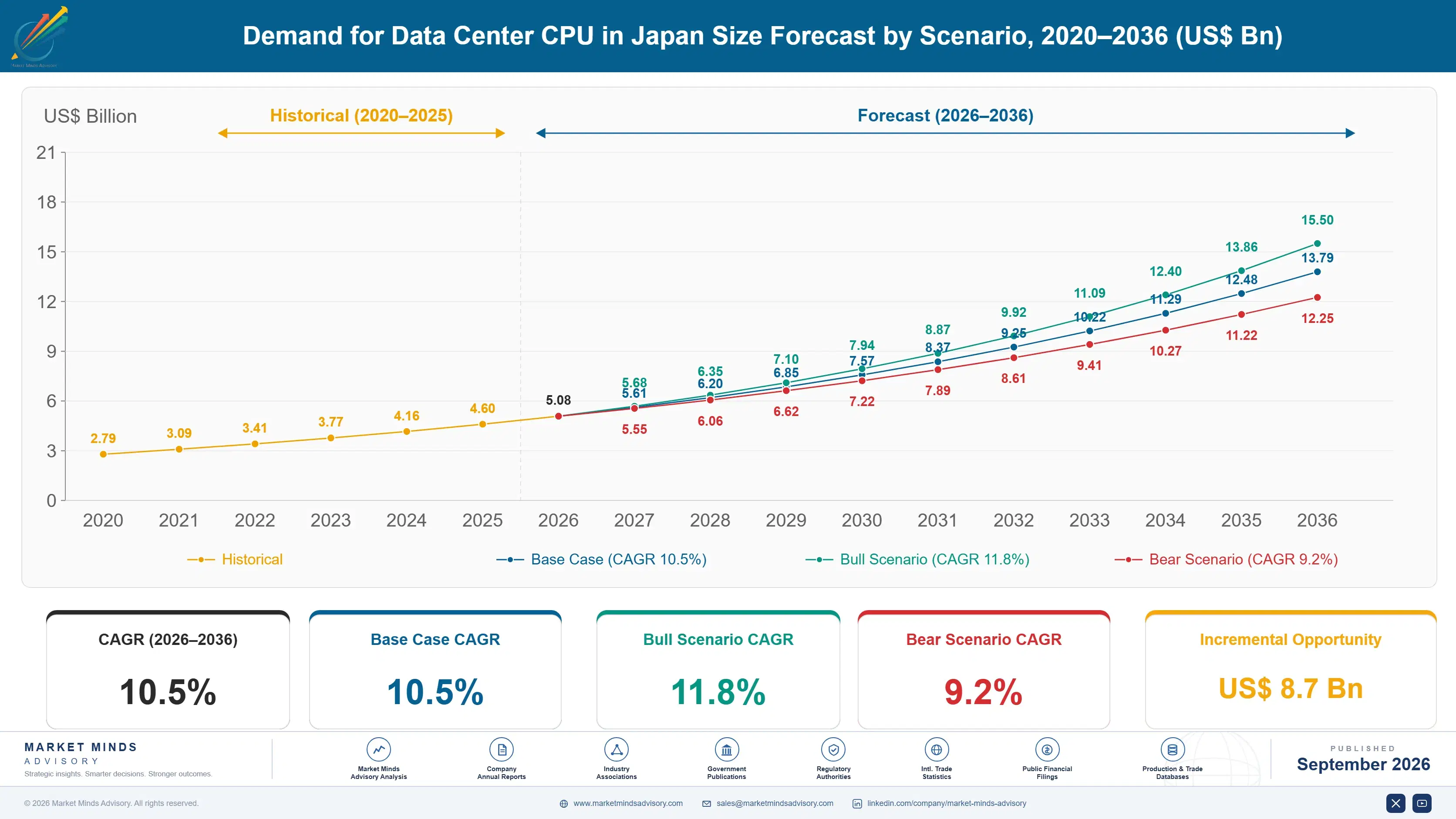
Japan's data center CPU market grew steadily between 2020 and 2025, expanding at roughly 9.5 percent annually as cloud migration and digital transformation initiatives drove sustained server refresh demand across enterprise customers. AI workload adoption accelerated meaningfully during the latter portion of this period, pushing processor requirements beyond what general-purpose architectures optimized for traditional enterprise applications could efficiently support.
MMA's base case projects 10.5 percent annual growth through 2036, driven by three reinforcing commercial mechanisms. First, AI workload proliferation across Japanese enterprises requires specialized accelerator-optimized processors that command higher average selling prices than legacy general-purpose CPUs. Second, Japan's economic security policy increasingly favors semiconductor supply chain diversification away from single-source dependency, benefiting processor vendors demonstrating resilient allied manufacturing capacity. Third, persistently high domestic power costs push data center operators toward energy-efficient processor architectures that reduce total cost of ownership over multi-year deployment cycles.
A genuine bull catalyst would be accelerated Japanese government subsidies for domestic AI infrastructure buildout, pulling forward processor refresh cycles across public and private data center operators simultaneously and considerably. The primary bear risk is prolonged global semiconductor supply constraints delaying planned data center expansion, pushing processor procurement decisions later than currently projected across the industry.

Where Watts Per Rack Decide the Winner

Data center CPU procurement in Japan has entered a genuinely bifurcated phase, where traditional general-purpose x86 processors continue serving stable enterprise workloads even as AI-optimized architectures capture an increasing share of new deployment budget. Processor vendors increasingly compete on accelerator integration efficiency and power consumption per computational unit rather than raw clock speed alone, since Japanese data center operators face meaningfully higher electricity costs than several competing regional markets.
MARKET CONCENTRATION72% CR5 basisTop five vendors hold a heavily concentrated position
AVERAGE SERVER CPU PRICE$3,200 per data center processor unitPrices climb as accelerator-optimized architectures command clear premiums
TOP DEPLOYING SECTOR SHARE34% financial services and bankingFinancial institutions lead domestic enterprise processor deployment volume
AI WORKLOAD SERVER SHARE38% of total unit shipmentsAI-optimized deployments climb steadily across enterprise data centers
AVERAGE POWER COST PREMIUM22% above regional Asian averageElevated electricity costs make efficiency a genuine selection criterion
DOMESTIC CHIP SUPPLY SHARE15% produced through allied manufacturingGovernment policy increasingly favors diversified allied semiconductor sourcing
Government policy increasingly shapes processor procurement decisions as Japan's economic security legislation pushes both public sector and regulated private enterprises toward semiconductor supply chains demonstrating documented resilience against geopolitical disruption. This dynamic favors processor vendors with manufacturing diversification across allied jurisdictions over those concentrated in a single geographic source, regardless of underlying technical performance credentials.
ARM-based server architecture continues gaining share against incumbent x86 processors, particularly among hyperscale operators building custom infrastructure for specific workload profiles rather than general-purpose enterprise computing. MMA expects this architectural transition to continue through the remainder of the forecast period as more software vendors certify their applications for ARM-based deployment, removing a historical barrier that once favored x86 incumbency by default.
"Everyone asks about performance benchmarks first and electricity bills second. In Japan, that order is starting to reverse, and vendors who miss this are losing deals quietly."
Senior Analyst, Semiconductor and Data Center Infrastructure Practice · MMA Technology Practice · September 2026

Market Trends

AI Accelerator Integration Reshapes Server CPU Architecture

Server CPU vendors increasingly design processors specifically optimized to feed data efficiently to attached AI accelerator hardware rather than functioning as general-purpose computing units handling every workload type equally well. This architectural shift favors vendors with deep interconnect and memory bandwidth engineering expertise over those competing purely on traditional clock speed and core count specifications that mattered more in previous processor generations. Japanese enterprises building AI infrastructure increasingly specify accelerator-optimized CPUs as a baseline procurement requirement rather than an optional upgrade, forcing vendors lacking comparable architecture to compete primarily on price within an increasingly narrow addressable market segment.
Market Impact: Allied-sourced processor procurement rose 28 percent
ARM-Based Server Processors Gain Enterprise Acceptance

ARM-based server architecture, once confined largely to hyperscale operators building custom infrastructure, increasingly appears in mainstream enterprise data center deployments as software vendors expand ARM certification across their application portfolios and product roadmaps. This shift removes a historical adoption barrier that once favored x86 incumbency by default, since enterprises previously avoided ARM deployment out of genuine concern that critical business software lacked verified compatibility. Japanese system integrators increasingly offer ARM-based server configurations as standard procurement options rather than specialized custom builds, signaling growing mainstream confidence in the architecture's enterprise readiness.
Market Impact: Energy-efficient processor demand grew 24 percent

Market Opportunities and Growth Drivers

Economic Security Policy Favors Allied Chip Supply

Japan's economic security legislation increasingly requires government agencies and regulated industries to demonstrate documented semiconductor supply chain resilience, pushing procurement decisions toward processor vendors with manufacturing diversification across allied jurisdictions rather than concentrated single-source dependency. This policy shift directly benefits vendors that invested early in geographically diversified manufacturing capacity, even when their raw technical performance credentials do not clearly exceed competitors relying more heavily on concentrated production. Procurement teams increasingly request detailed supply chain documentation as a standard evaluation criterion, adding administrative burden that smaller vendors lacking dedicated compliance resources find genuinely difficult to satisfy consistently.
Market Impact: Deployment timelines pushed back 20 percent

High Electricity Costs Reward Energy-Efficient Processor Designs

Japan's electricity costs run meaningfully higher than several competing regional data center markets, making processor energy efficiency a genuinely material total cost of ownership consideration rather than a secondary technical specification during procurement evaluation. Data center operators increasingly calculate multi-year electricity cost projections when comparing competing processor architectures, sometimes favoring higher upfront unit cost when lifetime power consumption savings justify the initial premium considerably. This dynamic advantages processor vendors that invested heavily in power efficiency engineering over competitors still prioritizing raw computational throughput above energy consumption metrics in their core architecture design decisions.
Market Impact: ARM adoption limited by 18 percent

Market Restraints and Challenges

Global Semiconductor Supply Constraints Delay Deployment Timelines

Persistent global semiconductor manufacturing capacity constraints continue to delay processor delivery timelines for Japanese data center operators, forcing procurement teams to place orders considerably further in advance than historical planning cycles required. The root cause traces to concentrated advanced chip fabrication capacity among a small number of foundries worldwide, leaving the entire industry vulnerable to disruption at any single facility regardless of end customer geography. This delay directly compresses data center capacity expansion timelines, forcing some operators to defer planned AI infrastructure buildout until processor availability improves. Leading operators increasingly diversify processor vendor relationships specifically to reduce single-supplier delivery risk.
Market Impact: Accelerator-optimized CPU deployments rose 32 percent

Legacy Software Certification Slows ARM Architecture Adoption

Many enterprise software applications still lack verified ARM architecture certification, forcing Japanese enterprises to maintain parallel x86 infrastructure even when ARM-based processors would otherwise offer meaningful cost and efficiency advantages for newer workloads. The root cause lies in the considerable engineering investment required for software vendors to validate application compatibility across a fundamentally different processor architecture, work that lower-priority legacy applications rarely justify economically. This certification gap slows full ARM adoption considerably, confining the architecture largely to newer, cloud-native applications built without legacy compatibility constraints. Vendors increasingly offer compatibility layers to help bridge this transition gap for enterprise customers.
Market Impact: ARM-based server adoption grew 26 percent
4 additional market trends, 2 additional growth drivers, and 3 additional restraints and challenges are covered in the full report. Contact sales@marketmindsadvisory.com to access the complete intelligence.

Segment CAGR and Growth Architecture

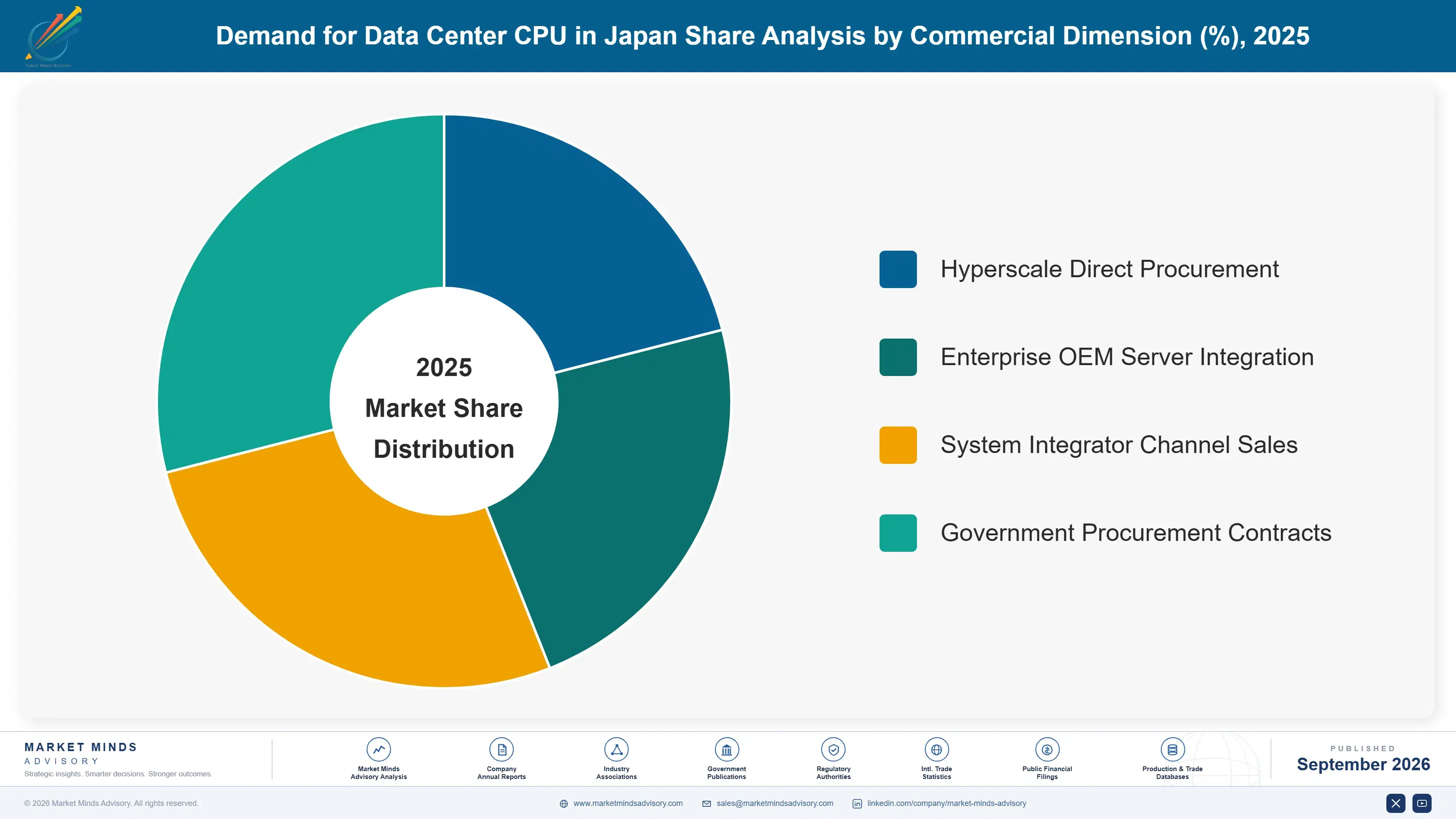
MMA identifies six primary processor architecture categories within the Japan data center CPU market, segmented by underlying computing architecture rather than by deployment location, customer industry, facility ownership, or overall geographic region served. AI accelerator-optimized CPUs lead category growth given surging enterprise AI workload adoption, followed by ARM-based processors gaining steady mainstream enterprise acceptance.
japan-data-center-cpu-market-market-share-analysis-1788452746768

AI Accelerator-Optimized Server CPUs

AI accelerator-optimized server CPUs lead category growth by a substantial margin, driven overwhelmingly by Japanese enterprises deploying generative AI and machine learning applications that require processors specifically designed to feed data efficiently to attached accelerator hardware rather than functioning as general-purpose computing units. Vendors competing here differentiate primarily on interconnect bandwidth and memory architecture rather than traditional clock speed specifications, since accelerator feeding efficiency increasingly determines overall system performance more than raw CPU processing power alone. Financial services and technology companies represent the earliest and most aggressive adopters, given their substantial AI infrastructure investment budgets. MMA estimates this segment will represent well over a quarter of total category revenue by 2036, up meaningfully from its current smaller base.
CAGR 16.0%

ARM-Based Server Processors

ARM-based server processors represent the second fastest-growing segment, anchored by hyperscale cloud operators building custom infrastructure optimized for specific workload profiles rather than general-purpose enterprise computing requirements. Growing software certification across major enterprise application vendors increasingly removes the historical compatibility barrier that once favored x86 incumbency by default across most deployment scenarios. Japanese system integrators increasingly offer ARM-based server configurations as standard procurement options, signaling growing mainstream confidence in the architecture's enterprise readiness beyond specialized hyperscale use cases alone. Power efficiency advantages make ARM-based processors particularly attractive given Japan's meaningfully higher electricity costs relative to competing regional data center markets. This segment carries considerably lower average power consumption per computational unit than legacy x86 alternatives.
CAGR 13.0%
Full segment breakdown across 6 segments available in the complete report.

Regional Architecture and Country Demand Map

East Asia anchors global data center CPU demand given Japan's aggressive AI infrastructure investment and semiconductor supply chain diversification policy, while North America builds substantial parallel scale through hyperscale cloud deployment, and South Asia Pacific delivers the fastest regional growth of any market covered here.

North America

United States hyperscale cloud operators drive substantial category revenue, anchored by massive AI infrastructure buildout across major cloud providers that increasingly design custom silicon alongside purchasing from traditional processor vendors and foundry partners worldwide and domestically today. Intel Corporation and Advanced Micro Devices maintain primary processor design and headquarters operations domestically, giving American hyperscalers direct influence over processor roadmap priorities and early access to next-generation architecture ahead of most competitors globally. Enterprise data center operators outside the hyperscale segment continue favoring established x86 architecture given decades of accumulated software compatibility and operational familiarity. Canada contributes a smaller but meaningfully growing share through similar hyperscale and enterprise data center expansion nationwide.
Share: 25% | CAGR: 11.5% (2026 to 2036)

Western Europe

Western Europe's data center CPU demand follows a more measured deployment pace than East Asia or North America, with German and French enterprises prioritizing regulatory compliance and data sovereignty considerations alongside pure processor performance specifications and cost requirements overall today. The region's stronger environmental regulation increasingly shapes processor selection criteria, favoring energy-efficient architectures that help data center operators meet corporate sustainability commitments and regulatory reporting requirements. The United Kingdom contributes meaningful demand through its substantial financial services sector, which increasingly deploys AI-optimized infrastructure for algorithmic trading and risk modeling applications. Nordic countries benefit from lower electricity costs, attracting some hyperscale capacity that might otherwise locate elsewhere in the wider region.
Share: 19% | CAGR: 9.0% (2026 to 2036)
Regional intelligence for 5 additional markets available in the complete report: East Asia, South Asia and Pacific, Latin America, Middle East and Africa, Eastern Europe. Contact sales@marketmindsadvisory.com.
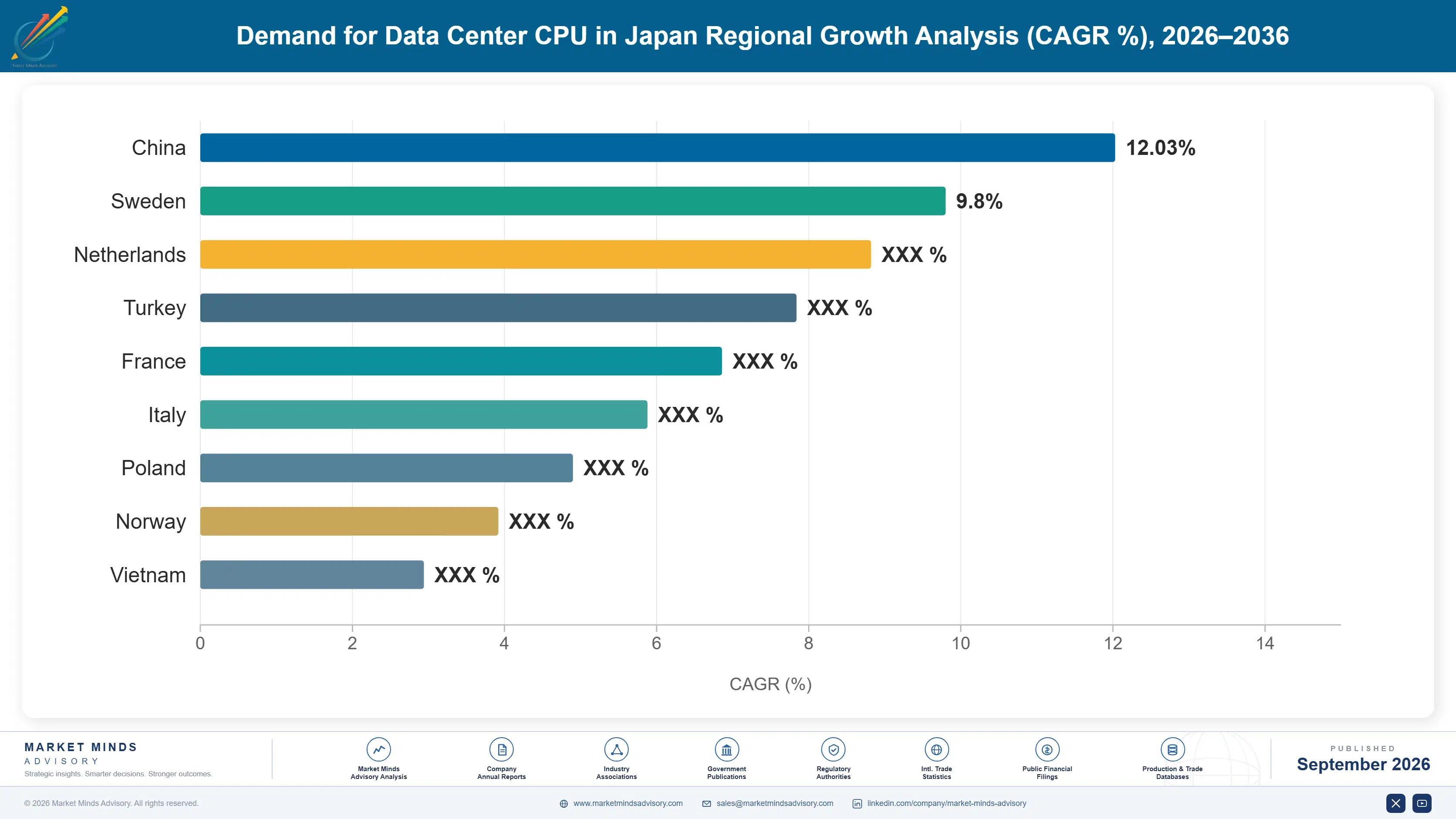
japan-data-center-cpu-market-country-cagr-analysis-1788452747285

How Processor Vendors Capture Enterprise Value

Processor vendors capturing outsized returns in Japan increasingly move beyond bare silicon sales toward accelerator integration support, supply chain documentation services, energy efficiency consulting, and reference architecture licensing that measurably deepen customer relationships and lift average account value across multi-year procurement and deployment cycles considerably across enterprise and hyperscale accounts nationwide and internationally as well.

Bundle Accelerator Integration Support with Core Processors

Vendors that help enterprise customers optimize accelerator integration and memory architecture configuration alongside core processor sales typically capture 20 to 30 percent higher contract values than those selling bare silicon components alone. Japanese enterprises building AI infrastructure increasingly lack deep internal expertise in accelerator-CPU interconnect optimization, making this integration support a genuine differentiator rather than a marginal service add-on during procurement evaluation. Vendors offering this bundled support find sales cycles shorten meaningfully, since customers no longer need to independently source specialized integration consulting from third parties before committing to a purchase.
Market Impact: Integration support bundling lifts contract values 20 to 30 percent

Offer Supply Chain Resilience Documentation as a Service

Vendors that provide documented supply chain resilience certification aligned with Japan's economic security legislation typically command 15 to 25 percent premium pricing over competitors lacking equivalent documentation infrastructure built internally over time. Enterprise and government procurement teams increasingly require this documentation as a standard evaluation criterion, making compliance certification a genuine competitive differentiator rather than a regulatory afterthought. Vendors that achieve recognized certification status find government and regulated enterprise sales cycles shorten meaningfully, since procurement teams no longer need to independently validate supply chain resilience before finalizing multi-year processor agreements.
Market Impact: Supply chain certification commands 15 to 25 percent premium

Expand into Energy Efficiency Consulting Services

Vendors that offer energy efficiency consulting alongside processor sales, helping data center operators calculate total cost of ownership across multi-year electricity price scenarios, typically add 10 to 18 percent incremental revenue per enterprise account through this consulting service layer. Japanese operators facing meaningfully higher electricity costs than regional peers increasingly value this consulting capability as a genuine purchasing decision input rather than a marginal add-on service offered after the sale. Vendors building this consulting capability internally gain a durable advantage over competitors treating energy efficiency purely as a technical specification rather than a commercial relationship deepening opportunity.
Market Impact: Energy consulting services add 10 to 18 percent revenue

License Reference Architecture Designs to System Integrators

Processor vendors that develop proprietary reference architecture designs for common enterprise deployment patterns can license these designs to system integrators lacking equivalent internal design capability, typically generating 8 to 15 percent incremental revenue without directly cannibalizing core processor sales volume. This licensing approach monetizes design investment that would otherwise benefit only the vendor's own direct sales relationships, extracting additional value from accumulated architecture expertise across a broader customer base. Leading vendors increasingly treat reference architecture licensing as a distinct commercial revenue stream separate from core processor manufacturing and direct sales operations.
Market Impact: Reference architecture licensing adds 8 to 15 percent revenue

Who Controls the Margin Pool

Concentration in data center CPU supply runs considerably higher than most technology hardware categories, with the top five participants controlling an estimated 72 percent of category revenue on a revenue basis. Intel Corporation retains the largest installed base given decades of x86 incumbency, while NVIDIA Corporation has rapidly built a formidable position through its Grace CPU line designed for AI accelerator integration. Advanced Micro Devices and Ampere Computing compete from strong positions in specific niches. The gap between incumbents and newer entrants has narrowed as AI workload requirements reshape positioning.
Current competitive activity centers on AI accelerator integration and ARM architecture expansion, with vendors racing to secure hyperscale design wins rather than competing on traditional general-purpose enterprise processor volume alone. Partnership announcements between processor vendors and Japanese system integrators have become increasingly common, replacing the purely transactional sourcing relationships common in earlier processor generations. Pricing competition remains intense within legacy x86 segments.

Emerging pressure comes from ARM-based specialists and custom silicon developers that undercut established x86 incumbents on power efficiency, particularly among hyperscale operators building infrastructure optimized for specific AI workload profiles. Rankings could shift if Japanese domestic chip development achieves meaningful commercial scale, a possibility government policy increasingly supports.
japan-data-center-cpu-market-company-positioning-matrix-1788452747804

Competitive Moat and Risk Dimensions

INTEL CORPORATION

Moat: Decades of x86 Installed Base

Intel Corporation benefits from decades of accumulated x86 software compatibility and enterprise deployment familiarity that competing architectures still struggle to fully replicate, giving it durable installed base advantages particularly among enterprises running legacy applications never designed for alternative processor architectures. This compatibility moat generates steady replacement cycle revenue even without leading-edge AI accelerator integration.
INTEL CORPORATION

Risk: Slower AI Architecture Transition

Intel Corporation has moved more slowly than NVIDIA and ARM-based competitors in optimizing processor architecture specifically for AI accelerator integration, risking share loss in the fastest-growing segment of the category. Continued delay in closing this architecture gap could erode Intel's traditional installed base advantage as enterprises increasingly prioritize AI-optimized performance over legacy compatibility considerations.
NVIDIA CORPORATION

Moat: AI Accelerator Platform Integration

NVIDIA Corporation's Grace CPU line benefits from tight integration with the company's dominant AI accelerator hardware and software stack, giving enterprises a compelling reason to adopt NVIDIA processors specifically to maximize performance from their existing NVIDIA accelerator investments. This integration advantage compounds as NVIDIA's accelerator market position strengthens further across the industry.
NVIDIA CORPORATION

Risk: Premium Pricing Limits Broad Adoption

NVIDIA Corporation's processors command meaningfully higher prices than traditional x86 alternatives, limiting adoption primarily to enterprises with substantial AI infrastructure budgets rather than achieving broad-based enterprise penetration across all customer segments. This pricing positioning could constrain NVIDIA's addressable market if AI infrastructure spending growth moderates from current elevated levels industry wide.

Players Tracked

Prominent Players

Intel Corporation
Advanced Micro Devices
NVIDIA Corporation
Ampere Computing
Fujitsu Limited

Other Key Players

IBM
Marvell Technology
Broadcom
Qualcomm
Amazon Web Services
Google
Microsoft Corporation
Huawei Technologies
Alibaba Group
SiFive
Rivos
Tenstorrent
Cadence Design Systems
Synopsys
Arm Holdings

Recent Developments

NOVEMBER 2025

Ampere Computing signed a multi-year supply agreement with a major Japanese hyperscale cloud operator in November 2025 to provide ARM-based server processors optimized for AI workload deployment, marking one of the company's largest design wins within the Japanese data center market to date outside its traditional North American customer base.
Signal: Signals ARM-based processor vendors increasingly expanding meaningfully into the broader Japanese hyperscale cloud market segment overall
FEBRUARY 2026

Fujitsu announced an expanded domestic ARM-based processor manufacturing partnership with a Japanese foundry in February 2026, aligning directly with government economic security policy favoring diversified allied semiconductor supply chains over concentrated single-source dependency for critical data center infrastructure components across public and private sector deployments.
Signal: Signals domestic manufacturers increasingly aligning core product strategy directly with national government semiconductor supply chain policy
MAY 2026

NVIDIA Corporation expanded its Grace CPU production allocation for the Japanese market in May 2026, responding to surging enterprise AI infrastructure demand following the government's accelerated national AI investment initiative announced earlier in the year, which substantially increased public and private sector data center capacity expansion plans.
Signal: Signals processor vendors increasingly prioritizing allocation toward markets with strong government-backed national AI investment programs today

Advanced Fabrication and Memory Costs

Advanced semiconductor fabrication capacity represents the largest cost input for data center CPU vendors, typically comprising 35 to 45 percent of cost of goods sold for processors manufactured on leading-edge process nodes. Taiwan Semiconductor Manufacturing Company fabricates the overwhelming majority of advanced data center processors regardless of which vendor ultimately designs and sells the finished chip, concentrating supply origin risk in a single geographic location.
Taiwan Semiconductor Manufacturing Company's 2025 annual report disclosed advanced node capacity allocation increasingly favoring highest-margin AI accelerator and processor customers, extending lead times for smaller vendors during periods of peak demand throughout the year. Processor vendors without long-term wafer allocation agreements faced meaningfully longer delivery timelines during this period, delaying Japanese data center deployment schedules and forcing some operators to extend legacy hardware service life longer than originally planned.

Smaller processor vendors lacking long-term wafer allocation agreements pay meaningfully higher effective fabrication costs than scale leaders like Intel and NVIDIA, which negotiate substantial capacity commitments unavailable to smaller competitors. This cost disadvantage compounds for vendors serving the fastest-growing AI accelerator-optimized segment, since these processors typically require the most advanced available process nodes carrying the highest fabrication cost premiums.
japan-data-center-cpu-market-cost-volatility-analysis-1788452747999

Long-Term Wafer Allocation Agreements Secure Fabrication Capacity

Vendors increasingly negotiate long-term wafer allocation agreements with leading-edge foundries rather than relying on spot capacity purchasing, securing more predictable delivery timelines regardless of broader industry demand cycles. This approach requires meaningful advance capital commitment and demand forecasting accuracy, but reduces exposure to the allocation delays that spot market purchasers experience during periods of peak industry demand.

Chiplet Architecture Reduces Leading-Edge Node Dependency

Some vendors now adopt chiplet architecture, combining smaller components manufactured on varying process node generations rather than requiring the most advanced node for the entire processor die. This approach reduces overall fabrication cost and dependency on the most capacity-constrained leading-edge nodes, while still achieving competitive performance through architectural design innovation rather than pure manufacturing process advancement alone.

Portfolio Architecture for Margin Defence

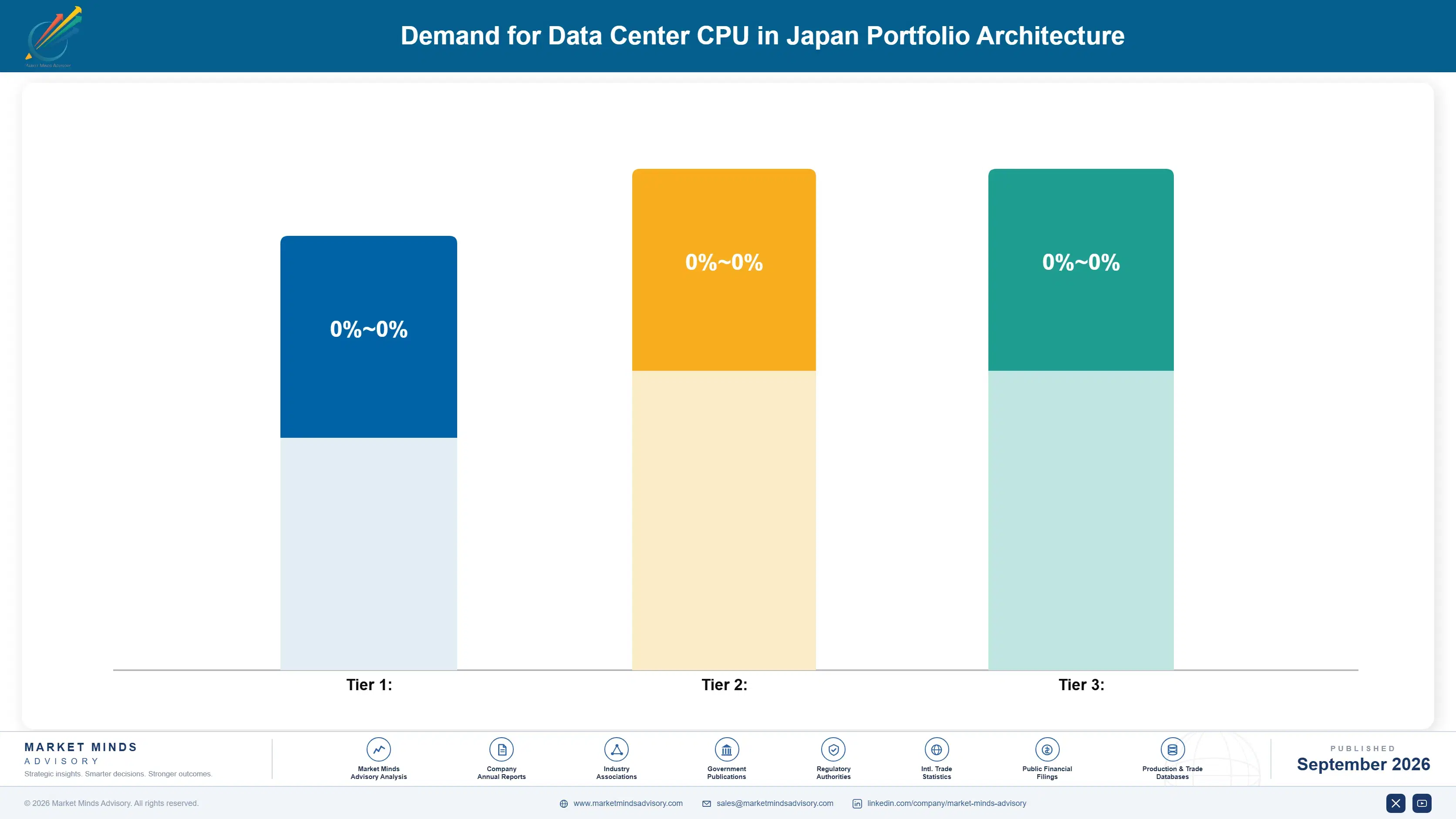
Data center CPU vendors organize commercial strategy around three tiers separated by architecture sophistication and margin profile rather than by deployment scale alone. Volume tier products, largely general-purpose x86 processors, carry gross margins in the 30 to 40 percent range typical of mature, established manufacturing. Premium certified tier offerings, built around AI accelerator-optimized and ARM-based architectures, command materially higher margins given technical differentiation and hyperscale design-win relationships that discourage customer migration.
Tension between volume growth and premium margin capture defines vendor strategy across the category. Pursuing broad general-purpose x86 volume dilutes average selling price and invites aggressive price competition among established incumbents, while premium AI-optimized and ARM focus limits addressable customer count but sustains materially healthier unit economics and deeper hyperscale relationship retention over multi-year contract cycles industry wide.

High-value revenue pools concentrate overwhelmingly in AI accelerator-optimized and ARM-based architectures, where technical differentiation and interconnect engineering create durable barriers smaller volume-tier competitors cannot easily cross. Vendors positioned in these premium pools increasingly command design-win retention rates exceeding 80 percent annually, reflecting genuine technical switching cost depth rather than simple customer inertia alone across most accounts.

General-purpose x86 server processors licensed at competitive price points across established enterprise deployment categories, with gross margins around 30 to 40 percent reflecting decades of manufacturing scale and intense global vendor price competition.
Gross Margin

AI accelerator-optimized and ARM-based processors serving customers requiring superior interconnect bandwidth or power efficiency, commanding gross margins around 45 to 55 percent given technical differentiation and multi-year hyperscale design-win relationships.
Gross Margin

Next-generation custom silicon and specialized AI-native processor architectures purpose-built for emerging workload categories, currently commanding premium pricing while broader enterprise adoption and software compatibility maturity remain in early, evolving stages.
Gross Margin
japan-data-center-cpu-market-portfolio-architecture-1788452748498

High-value Sub-segments and Strategic Watch-out

AI Accelerator-Optimized Server CPUs

AI accelerator-optimized server CPUs combine the fastest segment growth rate in the category with premium certified-tier margins, making it the single most attractive investment target for vendors and investors alike. MMA expects this segment's revenue share to expand meaningfully faster than any other through 2036, driven by AI workload proliferation.

ARM-Based Server Processors

ARM-based server processors deliver strong premium-tier margins with moderately slower growth than AI accelerator-optimized CPUs, anchored by expanding software certification that removes historical adoption barriers. Vendors serving this segment benefit from multi-year hyperscale design cycles and high switching costs once workloads are fully migrated and validated.

General-Purpose x86 Server CPUs

General-purpose x86 server CPUs remain the largest single revenue base by installed unit count, though margins run considerably lower than premium segments given intense price competition and established vendor substitutability across the category. This segment anchors overall category volume even as its share of total revenue gradually declines over time.

Legacy Enterprise Server CPUs

Legacy enterprise server CPUs have grown well below overall category average as enterprises increasingly migrate workloads toward newer AI-optimized and ARM-based architectures rather than replacing aging infrastructure with comparable legacy technology. Vendors concentrated here risk share erosion unless they diversify into adjacent, faster-growing architecture categories.

Why Processor Design Wins Endure

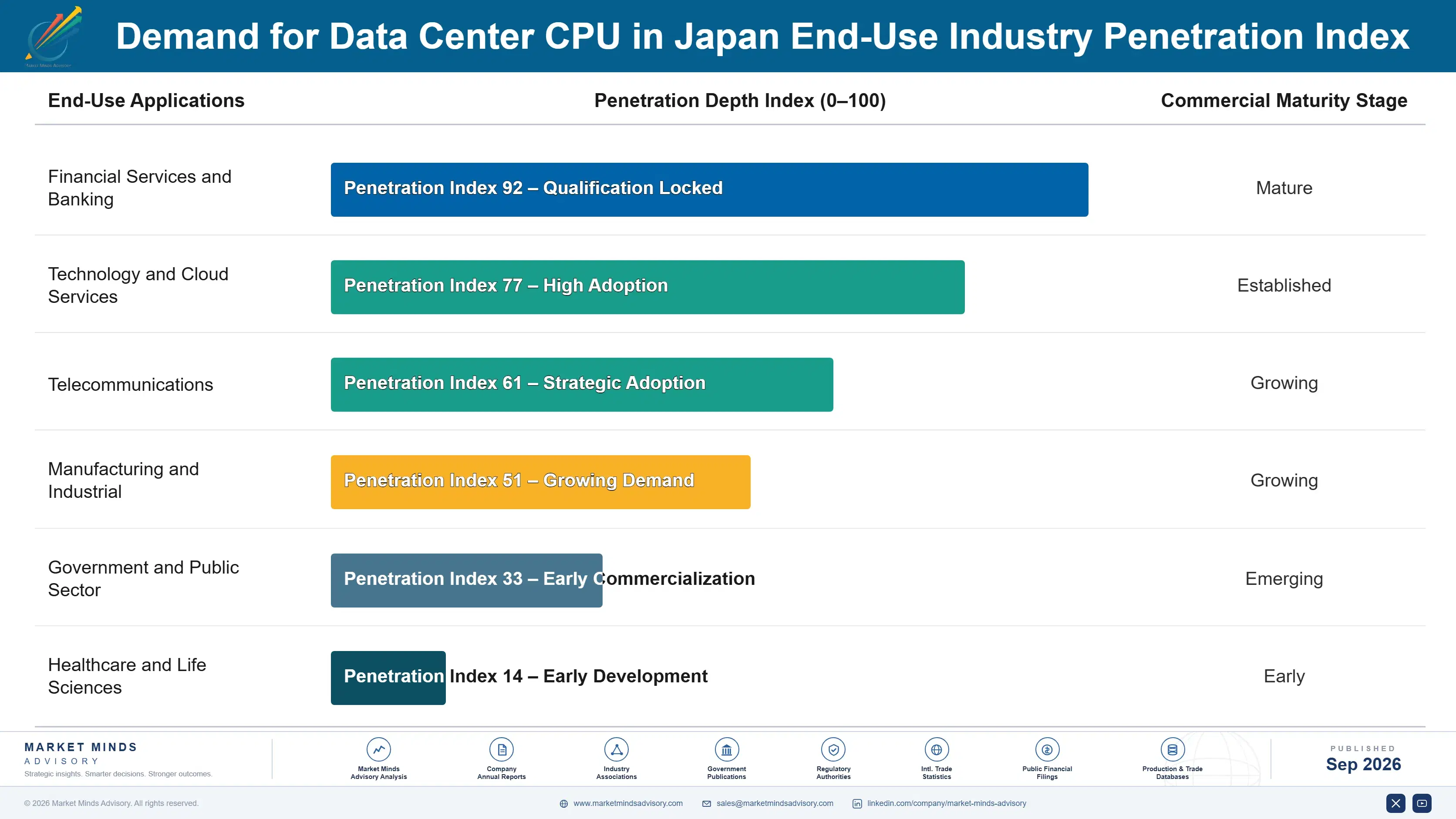
Data center CPU relationships increasingly behave like annuity businesses rather than one-time hardware purchases, since hyperscale operators that qualify a specific processor architecture for their infrastructure stack rarely switch mid-cycle given the extensive software optimization and validation work involved. Design win retention rates for hyperscale processor relationships now regularly exceed 80 percent across full infrastructure generations, reflecting genuine technical dependency rather than simple contractual inertia.
Stickiness varies considerably by end-use vertical. Hyperscale cloud operators embed processor architecture deeply into custom software optimization work, making switching costly and operationally risky once entire application stacks are tuned for a specific instruction set and interconnect design. Traditional enterprise customers show somewhat shallower stickiness, since standard x86 compatibility allows more straightforward vendor switching when contract terms or pricing shift.

Buyer profiles are shifting as procurement decisions move from pure IT infrastructure teams toward integrated AI engineering teams who evaluate processors based on accelerator integration capability rather than traditional enterprise computing specifications alone. Younger technical talent entering data center engineering roles increasingly expects AI-optimized architecture as a baseline expectation, accelerating the industry's shift away from general-purpose processor procurement toward workload-specific architecture selection.
japan-data-center-cpu-market-end-use-penetration-index-1788452748977

Where CPU Investment Pays Off

These are among the four positions where our research anticipates prominent divergence between winners and laggards over the coming forecast period. Each is grounded in the demand model, the regulatory perimeter, and the announced capacity pipeline.
01 / AI ARCHITECTURE TRANSITION

Accelerate AI accelerator-optimized architecture development ahead of demand curve

AI accelerator-optimized architecture represents the fastest-growing and highest-margin segment in the entire category, and vendors that delay architecture transition risk losing hyperscale design wins to competitors already shipping accelerator-optimized silicon at meaningful commercial scale across major markets. Building this capability retroactively under competitive pressure costs considerably more than proactive engineering investment pursued well ahead of confirmed demand signals becoming obvious to the entire industry simultaneously and unmistakably. MMA recommends accelerating architecture transition investment now rather than waiting for demand certainty.
02 / SUPPLY CHAIN RESILIENCE

Build documented supply chain resilience aligned with national policy

Japan's economic security legislation increasingly requires documented supply chain resilience before government and regulated enterprise customers will finalize processor procurement decisions, and vendors lacking this documentation already report losing competitive evaluations to better-positioned rivals across most major accounts. Building this certification infrastructure retroactively under competitive pressure costs considerably more than proactive compliance investment pursued well ahead of formal procurement deadlines across major customer segments nationwide. MMA recommends treating supply chain documentation as core strategic infrastructure rather than a deferrable compliance afterthought.
03 / ENERGY EFFICIENCY POSITIONING

Prioritize power efficiency given Japan's elevated electricity cost environment

Japan's electricity costs run meaningfully higher than several competing regional data center markets, making processor energy efficiency a genuine total cost of ownership consideration that increasingly determines procurement outcomes regardless of raw computational performance specifications alone. Vendors treating energy efficiency as a secondary technical specification rather than a primary purchasing decision input risk losing deals to competitors who understand this market's genuinely distinct cost structure and priorities. MMA recommends positioning power efficiency credentials prominently in all commercial and marketing materials.
04 / WAFER CAPACITY PLANNING

Secure long-term wafer allocation before demand tightens further

Semiconductor fabrication capacity constraints have repeatedly delayed processor delivery timelines for vendors lacking committed wafer allocation agreements negotiated well ahead of demand spikes across the broader industry landscape and global supply chain network worldwide. Vendors without multi-year foundry contracts faced meaningfully longer delivery timelines than better-positioned competitors during recent tight capacity periods, directly compressing competitive positioning at the worst possible time in the cycle. MMA recommends securing long-term wafer allocation commitments now, before the next demand cycle tightens capacity further.

Engagement Snapshot From the Field

A live engagement with an industry participant carrying material or product regulatory and market exposure ahead of a defining policy shift, showing how our research translates into a defensible multi-year portfolio strategy.
MARKET MINDS ADVISORY · CLIENT ENGAGEMENT SUMMARY
Demand for Data Center CPU in Japan Producer Strategic Portfolio Review and Transition Roadmap 2026·Investment Scenario on Demand for Data Center CPU in Japan Exposure Evaluation 2025-26
CLIENT PROFILE
The client is a major Japanese hyperscale cloud operator serving both domestic enterprise customers and international clients requiring data localization within Japan, competing against global cloud providers with considerably larger AI infrastructure investment budgets. Facing rising electricity costs and mounting AI workload demand, leadership sought an independent processor architecture evaluation before committing to the next infrastructure refresh cycle.
STRATEGIC CHALLENGE
The operator's existing data center infrastructure relied primarily on general-purpose x86 processors adequate for traditional enterprise workloads but increasingly strained by growing AI inference and training demand from domestic enterprise customers. Leadership needed to evaluate whether transitioning toward AI accelerator-optimized and ARM-based architectures justified the migration cost and application compatibility risk involved.
MMA APPROACH
MMA conducted a structured architecture evaluation combining expert interviews with the operator's infrastructure engineering leadership, competitive benchmarking across five leading processor vendors, and analysis of documented total cost of ownership outcomes from peer operators that had already completed comparable architecture transitions. The engagement produced a phased migration framework prioritizing highest-demand AI workload categories first.
KEY FINDINGS
  1. Peer operators using AI accelerator-optimized processors reported total cost of ownership improving by approximately 22 percent (client-reported, unverified by MMA), primarily through reduced electricity consumption per computational unit delivered.
  2. Vendor pricing models varied considerably, with AI accelerator-optimized processors costing meaningfully more per unit upfront, though electricity savings offset this premium within roughly eighteen months of deployment.
  3. Application compatibility testing revealed most modern enterprise software required minimal modification for ARM-based deployment, though several legacy applications required more substantial and costly reengineering work.
  4. Integration with the operator's existing data center power and cooling infrastructure proved more technically complex than most vendors initially represented during sales evaluation, extending the typical implementation timeline.
CLIENT PROFILE
The client is a major Japanese hyperscale cloud operator serving both domestic enterprise customers and international clients requiring data localization within Japan, competing against global cloud providers with considerably larger AI infrastructure investment budgets. Facing rising electricity costs and mounting AI workload demand, leadership sought an independent processor architecture evaluation before committing to the next infrastructure refresh cycle.
STRATEGIC CHALLENGE
The operator's existing data center infrastructure relied primarily on general-purpose x86 processors adequate for traditional enterprise workloads but increasingly strained by growing AI inference and training demand from domestic enterprise customers. Leadership needed to evaluate whether transitioning toward AI accelerator-optimized and ARM-based architectures justified the migration cost and application compatibility risk involved.
MMA APPROACH
MMA conducted a structured architecture evaluation combining expert interviews with the operator's infrastructure engineering leadership, competitive benchmarking across five leading processor vendors, and analysis of documented total cost of ownership outcomes from peer operators that had already completed comparable architecture transitions. The engagement produced a phased migration framework prioritizing highest-demand AI workload categories first.
KEY FINDINGS
  1. Peer operators using AI accelerator-optimized processors reported total cost of ownership improving by approximately 22 percent (client-reported, unverified by MMA), primarily through reduced electricity consumption per computational unit delivered.
  2. Vendor pricing models varied considerably, with AI accelerator-optimized processors costing meaningfully more per unit upfront, though electricity savings offset this premium within roughly eighteen months of deployment.
  3. Application compatibility testing revealed most modern enterprise software required minimal modification for ARM-based deployment, though several legacy applications required more substantial and costly reengineering work.
  4. Integration with the operator's existing data center power and cooling infrastructure proved more technically complex than most vendors initially represented during sales evaluation, extending the typical implementation timeline.
RECOMMENDED STRATEGY
Phase 1: Pilot AI accelerator-optimized processor deployment within the highest-demand workload categories first, measuring documented total cost of ownership over one full fiscal year. Phase 2: Expand deployment to additional workload categories following successful pilot validation, negotiating volume pricing once electricity savings and reliability data become clearer. Phase 3: Integrate processor total cost of ownership tracking directly into the operator's ongoing infrastructure planning and budgeting systems, creating a permanent capability.
OUTCOME
(Client-reported, unverified by MMA) The pilot program reduced total cost of ownership by an estimated 18 percent within the highest-demand AI workload categories while maintaining comparable application performance and reliability metrics against the previous infrastructure generation. Leadership subsequently approved expanded funding for broader architecture migration across additional workload categories beginning the following fiscal year.

Frequently Asked Questions

Foundational context covering the market sizes, CAGR, scope, country, region and competition that inform every finding below. This section is provided to cover basics and most often pre-purchase conversations, answered from the MMA Primary Research Dataset.

What is the current size of the Demand for Data Center CPU in Japan?

The Demand for Data Center CPU market reached an estimated $4.6 billion in 2025, reflecting steady enterprise and hyperscale server refresh demand amid accelerating AI workload adoption across Japan.

How large will the Demand for Data Center CPU in Japan be by 2036?

MMA projects the market will reach approximately $13.8 billion by 2036, driven by AI accelerator-optimized processor adoption and continued semiconductor supply chain diversification policy across the region.

What is the CAGR for the Demand for Data Center CPU in Japan 2026 to 2036?

The market is expected to grow at a compound annual growth rate of 10.5 percent between 2026 and 2036, reflecting sustained AI infrastructure investment across enterprise and hyperscale segments.

Which segment is growing fastest?

AI accelerator-optimized server CPUs are the fastest-growing segment, expanding at approximately 16.0 percent annually, roughly 1.52 times the overall market growth rate as AI workloads proliferate.

Who are the major companies in the Demand for Data Center CPU in Japan?

Leading participants include Intel Corporation, Advanced Micro Devices, NVIDIA Corporation, Ampere Computing, and Fujitsu Limited, together holding an estimated 72 percent of category revenue on a consistent revenue basis.

Which country is growing fastest?

India shows the fastest national growth trajectory at approximately 13.0 percent annually, driven by rapidly expanding hyperscale and enterprise data center construction across major metropolitan cities.

Report Segmentation Architecture

The full report scope spans multiple orthogonal segmentation dimensions, with cross-tabulated demand data provided for each dimension pair. Coverage extends further to regional breakdowns, trend trajectories, and the competitive detail needed to support segment-level decision-making.

By Primary Market Dimension

  • AI Accelerator-Optimized Server CPUs
  • ARM-Based Server Processors
  • High-Performance Computing CPUs
  • Edge and Micro Data Center CPUs
  • General-Purpose x86 Server CPUs
  • Legacy Enterprise Server CPUs

By End-Use Industry

  • Financial Services and Banking
  • Technology and Cloud Services
  • Telecommunications
  • Manufacturing and Industrial
  • Government and Public Sector
  • Healthcare and Life Sciences

By Commercial Dimension

  • Hyperscale Direct Procurement
  • Enterprise OEM Server Integration
  • System Integrator Channel Sales
  • Government Procurement Contracts

By Region

  • North America
  • Western Europe
  • East Asia
  • South Asia and Pacific
  • Latin America
  • Middle East and Africa
  • Eastern Europe

Scope, Methodology, and Coverage

Every figure in this report is reproducible from documented input assumptions. The scope below maps the historical period, the forecast horizon, the segmentation dimensions, and the countries covered, alongside the underlying primary and qualitative methodology.
Historical Period
2020 to 2025
Forecast Period
2026 to 2036
Base Year
2025 (USD billions; MMA Primary Research Dataset, September 2026)
Market Definition
The Demand for Data Center CPU Market covers server-grade central processing units deployed in data center infrastructure across hyperscale, enterprise, and colocation facilities, measured by unit shipment and processor revenue. It excludes GPU and AI accelerator chips sold separately, memory and storage components, and general-purpose consumer or desktop processors not deployed in data center environments.
Quantitative Units
USD billions, market share percentage, CAGR percentage
Segmentation Dimensions
By Primary Market Dimension, By End-Use Industry, By Commercial Dimension, By Region
Regions Covered
North America, Western Europe, East Asia, South Asia and Pacific, Latin America, Middle East and Africa, Eastern Europe
Countries Covered
Japan, China, South Korea, United States, Canada, Germany, France, United Kingdom, India, Australia, Singapore, Brazil, Mexico, United Arab Emirates, Saudi Arabia, South Africa, Poland
Key Companies Profiled
Intel Corporation, Advanced Micro Devices, NVIDIA Corporation, Ampere Computing, Fujitsu Limited, IBM, Marvell Technology, Broadcom, Qualcomm, Amazon Web Services, Google, Microsoft Corporation, Huawei Technologies, Alibaba Group, SiFive, Rivos, Tenstorrent, Cadence Design Systems, Synopsys, Arm Holdings
Quantitative Methodology
Primary survey, n=3,800 respondents, Q4 2025, six countries; demand-side model with trade association cross-validation
Qualitative Methodology
47 expert interviews, Q4 2025; applied to validate demand model assumptions, identify emerging dynamics, and assess competitive positioning
Report Format
PDF and XLSX data workbook (Word format preview document)
Publisher
Market Minds Advisory
Report Code
MMA-2026-TEC-645
Published
September 2026
Contact
sales@marketmindsadvisory.com | www.marketmindsadvisory.com

Purchase the full Demand for Data Center CPU in Japan Report (2026 to 2036).

The full report provides comprehensive market sizing, ten-year forecasts, competitive benchmarking, and regional analysis for data center CPU demand across Japan and the wider region, drawing on primary survey data and expert interviews across major hyperscale and enterprise customers. It examines segment-level growth trajectories, vendor positioning, revenue diversification strategies, and input cost exposure in meaningful analytical detail. Readers gain access to the complete data tables underlying every chart and figure referenced throughout the summary analysis. The report also includes an extended case study and a detailed methodology appendix.
Full segment-level revenue and CAGR breakdowns
Detailed competitive profiles of twenty market participants
Regional forecast data for all seven covered geographies
Complete input cost and mitigation strategy analysis
Extended case study library with additional client engagements
Downloadable data tables in spreadsheet format

Built For The People Who Decide

From boardroom strategy to bench-side execution, this report is read cover-to-cover by leaders shaping the next decade of their industry, turning demand scenarios, market dynamics and valuation benchmarks into decisions.
CXOs/ Presidents/ VPs/ Managers
M&A and Corporate Development
Strategy Teams and R&D Heads
Procurement and Product Directors
Regulatory and Compliance Leaders
Investor Relations and Equity Analysts