Market Minds Advisory
Demand for Consent Management in Japan

Demand for Consent Management in Japan: Demand for Consent Management in Japan. Privacy Consent Infrastructure for Amended APPI Compliance

Japanese enterprises are deploying consent management platforms as amended Act on Protection of Personal Information enforcement tightens, forcing domestic and multinational companies to rebuild data collection consent infrastructure nationwide across most industries.

Lead Analyst

Published

September 2026

Make Smarter Decisions with Customized Research Insights

Request a free sample report and evaluate market opportunities, growth trends, and competitive dynamics relevant to your business needs.

2025 MARKET VALUE$0.7BMarket Size 2025
2036 FORECAST VALUE$2.7BBase Case , 2026 to 2036
CAGR 2026 TO 203613.5 %Bull 14.8% / Bear 12.2%
INCREMENTAL OPPORTUNITY$2.0BNet 10- year value creation
EXPANSION MULTIPLE3.55x2036 value over 2026 base
Strategic Levers
M&A Pipeline
Regional Outlook
Country Rankings
Competitive Intelligence
Segmental Deep-dive
Call-Us : 91 93563 13602

Executive Snapshot and Market Trajectory.

Japanese enterprises are rebuilding data collection consent infrastructure as amended Act on Protection of Personal Information enforcement tightens, forcing website operators nationwide to formalize cookie and preference management practices. Buyers increasingly treat consent infrastructure as a mandatory compliance investment rather than a discretionary privacy enhancement across their digital operations.
Retail, financial services, and technology companies concentrate the heaviest near-term platform spending, with Tokyo-headquartered multinationals absorbing a disproportionate share of enterprise deployment activity as organizations race to demonstrate compliance ahead of expanding regulatory audit scrutiny across their digital properties nationwide. Regional and smaller domestic companies follow more gradually, constrained by tighter compliance budgets and thinner internal legal capability compared to well-resourced multinational enterprise accounts. nationwide currently.
Competition centers on a handful of established privacy platform vendors defending existing enterprise relationships against domestic Japanese specialists offering localized regulatory expertise, while cross-border data transfer requirements and third-party vendor audit obligations add further momentum to platform investment across the industry. Vendors investing in Japan-specific regulatory expertise and localized language support are winning enterprise contracts even as buyers weigh switching costs against the operational risk of prolonged non-compliance exposure. nationwide today.
Market Definition
This report covers software platforms managing website cookie consent, data subject preference centers, and privacy compliance documentation for organizations operating in Japan under amended Act on Protection of Personal Information requirements. It excludes general-purpose customer data platforms without dedicated consent tracking capability and standalone legal advisory services.
Base Year Value
$0.7B in 2025 (MMA Primary Research Dataset, September 2026)
Forecast Period
2026 to 2036, eleven discrete annual values
CAGR
13.5% base case. Bull 14.8%. Bear 12.2%.
Fastest Growth Segment
Cookie and Website Consent Banner Management: 19.5% CAGR
Fastest Growth Country
Japan: 15.0% CAGR
Fastest Growth Region
South Asia and Pacific: 15.5% CAGR
Largest Region
East Asia: 28% of 2025 global value
Market Leaders
OneTrust, Usercentrics, TrustArc, Didomi, and Osano lead the market. Source: MMA Analysis, July 2026.
Primary Survey
n=3,800 procurement and R&D decision-makers, Q4 2025, six countries
Methodology
Demand-side build-up, cross-validated against public data, 47 expert interviews

Demand for Consent Management in Japan Market Forecast Scenarios

japan-consent-management-market-size-forecast-scenario-1788454034231
Japan's consent management demand grew steadily through 2020 to 2025 as amended APPI enforcement provisions took effect gradually, though growth accelerated sharply toward the end of that period as regulatory audit activity intensified across major industry sectors. Larger multinational enterprises with dedicated legal teams moved fastest, while smaller domestic companies lagged behind given tighter compliance budgets and thinner internal privacy capability during this earlier period nationwide.
The base case assumes continued regulatory enforcement intensity, sustained cross-border data transfer compliance requirements for multinational enterprises, and gradual platform consolidation as organizations move beyond basic cookie banners toward comprehensive preference center capability. Third-party vendor audit obligations increasingly determine which platforms retain long-term enterprise contracts across the forecast window. Vendors without recognized Japan-specific regulatory expertise increasingly struggle to win enterprise accounts as organizations formalize supplier qualification criteria around localized compliance documentation standards.
A stronger bull case assumes faster regulatory enforcement expansion pulls forward platform spending well ahead of current projections across leading Japanese enterprises. The bear case assumes slower audit enforcement pacing delays broader platform adoption, pushing vendor revenue growth out by several additional years nationwide. Regulatory enforcement intensity will determine which scenario actually materializes across the coming decade nationwide.

Regulatory Enforcement Drives Platform Consolidation

Japanese enterprises are converging on a common consent management thesis: manual cookie banners and spreadsheet-based tracking cannot sustain the documentation rigor that amended APPI enforcement now expects, forcing budget reallocation toward unified platform investment. Vendors that fail to demonstrate sufficient documentation rigor risk exclusion from enterprise procurement shortlists entirely. This urgency shows no signs of easing as regulatory audit activity intensifies across the country's largest enterprise sectors.
MARKET CONCENTRATIONCR5 61%Top five vendors hold majority enterprise platform revenue
AVERAGE ENTERPRISE LICENSE PRICE$65,000Per annual multi-site consent platform licensing agreement nationwide
COOKIE BANNER COMPLIANCE RATE54%Of major websites meeting current consent documentation standards
CROSS-BORDER TRANSFER SHARE38%Of enterprise deployments requiring cross-border compliance tracking currently
IMPLEMENTATION TIMELINE2-4 monthsTypical duration from contract signing to full deployment
DSAR AUTOMATION ATTACH RATE42%Of enterprise contracts including subject rights request automation
Commercial character in this market favors vendors with deep Japan-specific regulatory expertise and proven enterprise deployment track records, since large multinational accounts weight compliance documentation and audit readiness heavily over marginal feature differences. Vendors succeeding here typically maintain dedicated Japanese legal affairs teams that generalist software competitors have not built out. This dynamic increasingly favors vendors with established regulatory documentation over purely feature-driven competitive positioning.
Cross-border data transfer regulation and evolving APPI enforcement priorities will shape vendor positioning over the coming decade, alongside global privacy standardization momentum that continues reshaping how enterprises evaluate competing platforms nationwide. Vendors positioning early for these dual pressures capture disproportionate share once enterprise platform consolidation decisions finally solidify. Vendors ignoring these pressures risk losing enterprise accounts to faster-moving competitors already building comparable capability.
"The companies that treated their cookie banner as a checkbox exercise five years ago are the ones scrambling hardest now that regulators actually started reading the documentation."
Director, Data Privacy and Compliance Practice · MMA Data Privacy Compliance and Consent Governance Software Practice · September 2026

Market Trends

Personal Information Protection Commission Expands Audit Activity

Japan's Personal Information Protection Commission has expanded its regulatory audit activity significantly, issuing formal guidance clarifying documentation expectations for consent collection and cross-border data transfer disclosure that many enterprises previously interpreted loosely. This heightened enforcement is pushing organizations to prioritize platform investment even when facing budget constraints elsewhere in their operations. Vendors offering validated, audit-ready consent documentation frameworks are winning enterprise contracts specifically because buyers can no longer treat privacy compliance gaps as an acceptable operational risk given intensifying regulatory scrutiny nationwide. This dynamic rewards vendors with deep Japan-specific regulatory relationships built over successive enforcement cycles.
Market Impact: 33 percent cite APPI enforcement

Multinational Enterprises Standardize Cross-Border Consent Frameworks

Multinational enterprises operating across Japan and other jurisdictions increasingly standardize on unified consent management platforms capable of handling cross-border data transfer disclosure requirements consistently across their global operations rather than managing separate regional systems. This standardization trend favors vendors with proven multi-jurisdictional compliance capability over specialists focused exclusively on domestic Japanese requirements alone. Vendors building genuinely global platforms with Japan-specific configuration depth are capturing disproportionate share of enterprise renewal decisions as organizations consolidate vendor relationships across their international footprint nationwide. This dynamic is likely to persist as global privacy regulation continues converging across leading economies.
Market Impact: 26 percent prioritize unified global platforms

Market Opportunities and Growth Drivers

Amended APPI Enforcement Provisions Force Platform Adoption

Amended Act on Protection of Personal Information provisions have introduced stricter consent documentation, breach notification, and cross-border transfer disclosure requirements that many legacy manual processes cannot reliably satisfy without substantial engineering intervention. This regulatory pressure is forcing organizations across retail, financial services, and technology sectors to prioritize platform modernization even when facing budget constraints elsewhere in their operations. Vendors offering validated, audit-ready platforms with documented compliance frameworks are winning enterprise contracts specifically because buyers can no longer treat consent management gaps as an acceptable operational risk. This regulatory pressure shows no signs of easing given continuing enforcement priorities.
Market Impact: 21 percent delay planned adoption

Global Privacy Regulation Convergence Sustains Investment

Sustained global privacy regulation convergence across Japan, the European Union, and other major markets continues supporting consent management platform investment, even as broader technology spending has moderated in other categories. Multinational enterprises increasingly view unified consent infrastructure as foundational to global operations rather than a jurisdiction-specific compliance expense, accelerating adoption timelines relative to more conservative domestic-only organizations. Vendors serving this convergence-driven buyer segment are capturing design-in relationships with organizations still building out their core privacy technology infrastructure from the ground up nationwide. Vendors that build this positioning early capture disproportionate influence over how these organizations scale their platforms.
Market Impact: 17 percent report failed integration attempts

Market Restraints and Challenges

Localization Complexity Delays Multinational Deployment Decisions

Multinational platform vendors must adapt their consent management systems to Japan-specific legal terminology, cultural presentation norms, and Personal Information Protection Commission guidance interpretation, a localization process that typically requires substantially more effort than translation alone. The root cause is that many global platforms were architected around European or American regulatory frameworks without dedicated consideration for Japan's distinct legal and cultural context. Vendors are responding by building dedicated Japan-specific product teams and localization partnerships that improve platform fit, easing deployment decisions for enterprises reluctant to accept generic global configurations. This approach builds local trust faster than translated products alone.
Market Impact: 36 percent cite audit pressure

Legacy System Integration Risk Discourages Platform Migration

Enterprises operating decades-old legacy website and customer data infrastructure face substantial integration risk when deploying modern consent management platforms, given the difficulty of reliably connecting consent signals across multiple incompatible legacy systems accumulated over many years. The root cause is that legacy infrastructure often lacks standardized integration capability, requiring costly custom engineering for each individual enterprise instance. Some vendors are mitigating this through phased integration approaches that run legacy and new consent systems in parallel, reducing the risk of compliance gaps during transition. This approach lets enterprises build confidence gradually before fully decommissioning legacy infrastructure entirely.
Market Impact: 29 percent standardize on global platforms
3 additional market trends, 4 additional growth drivers, and 3 additional restraints and challenges are covered in the full report. Contact sales@marketmindsadvisory.com to access the complete intelligence.

Segment CAGR and Growth Architecture

This report segments the market by consent management function, the dimension most directly shaping enterprise procurement decisions, vendor development priorities, and regulatory compliance requirements across retail, financial services, and technology buyers nationwide. This lens also aligns most directly with how enterprise legal and compliance teams structure their own internal procurement and budget allocation frameworks.
Section default visual

Cookie and Website Consent Banner Management

Cookie and website consent banner management is the fastest-growing segment, expanding at 19.5 percent annually as amended APPI enforcement pushes enterprises to formalize documentation practices previously handled through informal or manually maintained processes. This segment benefits from being the most visible and frequently audited consent function, making it the primary entry point for enterprises beginning platform modernization efforts. Vendors building compliant, regularly updated banner configurations that adapt to evolving Personal Information Protection Commission guidance are capturing disproportionate share of enterprise deployment budget nationwide as regulatory scrutiny intensifies further. Tokyo and Osaka enterprise technology hubs concentrate the heaviest near-term deployment activity as organizations race to validate compliance ahead of expanding audit scrutiny.
CAGR 19.5%

Preference Center and Subject Rights Request Automation

Preference center and subject rights request automation is the second-fastest-growing segment, expanding at 16.5 percent annually as enterprises move beyond basic cookie consent toward comprehensive data subject rights fulfillment capability. This segment benefits from growing consumer awareness of data subject rights and increasing willingness to submit formal access and deletion requests that enterprises must document and fulfill within regulatory timelines. Vendors building automated request fulfillment workflows are capturing disproportionate share of enterprise renewal decisions as manual processes prove increasingly unsustainable at scale nationwide. Standards bodies increasingly reference specific fulfillment timeline benchmarks during regulatory guidance updates, giving early movers meaningful influence over how future compliance expectations ultimately take shape. Vendors slow to build this capability risk losing renewal accounts nationwide.
CAGR 16.5%
Full segment breakdown across 6 segments available in the complete report.

Regional Architecture and Country Demand Map

This report's analytical scope concentrates on Japan's consent management market specifically, with East Asia's regional share reflecting Japan's outsized weight within it nationwide. The other six regions offer benchmarking context, with South Asia and Pacific showing the fastest regional growth given expanding digital economy infrastructure nationwide.

East Asia

This region's 28 percent share sits at the top of its standard 22 to 30 percent band, justified because this report analyzes Japan's consent management market specifically, and East Asia's regional figure reflects Japan's outsized weight within the broader regional total. Tokyo and Osaka enterprise headquarters concentrate the heaviest platform demand nationwide, anchored by Personal Information Protection Commission enforcement that shows no signs of relaxing. South Korean and Taiwanese enterprises follow broadly similar compliance-driven purchasing patterns, though at meaningfully smaller absolute volume than their Japanese counterparts. Domestic Japanese enterprises increasingly weight regulatory documentation depth and localized language support when selecting between competing consent platform vendors during procurement cycles nationwide. This advantage compounds further as vendors expand dedicated Japan-specific compliance teams.
Share: 28% | CAGR: 14.7% (2026 to 2036)

North America

United States and Canadian enterprises pursue similar consent management adoption trajectories, and their deployment patterns provide useful benchmarking context for this report's Japan-focused analysis, though direct commercial linkage between the two markets remains limited given distinct vendor landscapes, regulatory environments, and domestic sourcing preferences shaping Japanese enterprise procurement decisions differently across most industry sectors nationwide. Their sourcing models, privacy technology maturity, and regulatory frameworks diverge sharply from the domestic preferences shaping Japanese enterprise consent management procurement across most enterprise buying committees. This advantage compounds further as United States privacy technology vendors expand dedicated Japan-focused engineering teams serving multinational enterprise accounts. nationwide. Vendors monitoring this gap closely adapt product roadmaps for Japanese market conditions.
Share: 27% | CAGR: 13.0% (2026 to 2036)
Regional intelligence for 5 additional markets available in the complete report: Western Europe, South Asia and Pacific, Latin America, Middle East and Africa, Eastern Europe. Contact sales@marketmindsadvisory.com.
japan-consent-management-market-market-share-analysis-1788454034761

Building Margin Beyond Standard Platform Licensing

Beyond core platform licensing, vendors can build durable margin through regulatory compliance consulting, cross-border configuration services, and audit support that address specific enterprise pain points during this enforcement-driven modernization period nationwide across leading industries. Vendors moving early on these fronts build defensible positioning that compounds meaningfully across successive contract renewal cycles. nationwide today currently.

Expand Japan-Specific Regulatory Consulting Services Broadly

Enterprises navigating complex amended APPI requirements increasingly pay for dedicated regulatory consulting that helps them design compliant consent architecture rather than managing regulatory interpretation entirely in-house. Vendors building specialized consulting teams, typically priced at 12 to 18 percent of contract value, capture recurring service revenue while strengthening the enterprise relationships that support future platform expansion decisions across successive contract renewal cycles nationwide. Vendors that build this capability early rarely lose accounts to competitors lacking comparable regulatory expertise. This positioning proves especially valuable as competing platforms narrow toward eventual convergence. Enterprises value this considerably.
Market Impact: Captures a share of the 33 percent APPI segment now

Offer Cross-Border Data Transfer Configuration Bundles

Multinational enterprises seeking unified consent management across multiple jurisdictions increasingly pay premium pricing for integrated cross-border transfer configuration bundles rather than managing separate regional compliance systems individually. This bundled offering, typically commanding 20 to 25 percent premium pricing over single-jurisdiction contracts, generates high-margin recurring revenue while deepening account relationships across a client's full global compliance footprint. Vendors executing this well typically become the default compliance partner across a client's full jurisdictional footprint. This positioning proves especially valuable as enterprises consolidate around fewer preferred vendors. Enterprises value this quite considerably today.
Market Impact: Captures a share of the 29 percent global-platform segment now

Provide Regulatory Audit Preparation Support Broadly

Enterprises facing Personal Information Protection Commission audit scrutiny increasingly value dedicated audit preparation support that helps them assemble documentation and demonstrate compliance readiness ahead of formal regulatory review processes. This consulting layer, typically representing 10 to 15 percent of total contract value, positions vendors as trusted compliance partners rather than commodity software suppliers competing purely on licensing price. Vendors offering this expertise win business from enterprises unwilling to bear audit risk alone. This positioning proves especially valuable during the current period of intensifying enforcement. Enterprises value this quite considerably today.
Market Impact: Captures a share of the 36 percent audit-pressure segment now

Build Legacy System Integration Engineering Services

Enterprises facing complex legacy website and customer data integration challenges increasingly pay for dedicated engineering services that reduce deployment timelines and compliance risk across their existing technology infrastructure. This service layer, typically adding 15 to 20 percent to total implementation contract value, differentiates vendors capable of handling complex enterprise integrations from smaller competitors lacking comparable engineering depth. Vendors pursuing this strategy build lasting relationships that persist well beyond any single integration project. This positioning proves especially valuable as enterprises accumulate more legacy data volume. Enterprises value this quite considerably today.
Market Impact: Captures a share of the 17 percent failed-integration segment now

Who Controls the Margin Pool

Japan's consent management market carries a CR5 of 61 percent, reflecting a concentration where five established vendors hold most enterprise platform revenue while a wider field of smaller specialists compete for domestic and niche accounts. The gap between leading vendors and mid-tier challengers remains substantial, anchored by decades-long global privacy compliance expertise. Regulatory documentation depth remains the biggest differentiator separating leaders from smaller challengers.
Current competitive activity centers on Japan-specific regulatory expertise expansion, cross-border configuration depth, and expanding audit support consulting that deepen enterprise relationships beyond commodity licensing. Vendors are also racing to build localized product teams capable of interpreting evolving Personal Information Protection Commission guidance quickly. Vendors are also expanding dedicated compliance affairs teams to capture recurring service revenue ahead of eventual full localization convergence nationwide.

Emerging pressure comes from domestic Japanese specialists unencumbered by global platform architecture constraints, who are winning accounts where localized compliance depth matters more than installed-base familiarity. Rankings could shift meaningfully over the next several years if these specialists successfully convert domestic relationships into broader multinational enterprise contracts. Vendors slow to adapt to this evolving buyer landscape risk permanent share loss as domestic specialists reshape the competitive field further.
japan-consent-management-market-country-cagr-analysis-1788454035282

Competitive Moat and Risk Dimensions

ONETRUST

Moat: Deep Multi-Jurisdictional Compliance Depth

OneTrust benefits from its broad global privacy compliance platform footprint, giving it natural advantages when multinational enterprises already run their global data governance operations on its infrastructure, reinforcing switching costs that competitors struggle to replicate quickly. This depth of relationship extends well beyond pure compliance capability alone.
ONETRUST

Risk: Weaker Japan-Specific Localization Depth

OneTrust's Japan-specific localization capability trails domestic specialists focused exclusively on Personal Information Protection Commission requirements, risking gradual share erosion in accounts prioritizing local regulatory nuance over broad global platform integration. Younger domestic buyers increasingly weigh this localization gap during vendor selection decisions. This gap could accelerate share loss.
USERCENTRICS

Moat: Broad Cookie Consent Technical Reliability

Usercentrics benefits from proven technical reliability across its core cookie consent management capability, giving enterprises confidence in its foundational compliance layer that smaller entrants without comparable deployment history cannot easily match. This reliability advantage strengthens further as enterprises seek proven multi-site deployment references. Few rivals match this depth.
USERCENTRICS

Risk: Limited Subject Rights Automation Depth

Usercentrics's data subject rights automation capability trails specialist vendors building purpose-built fulfillment modules, risking gradual share erosion among buyers prioritizing comprehensive rights management over foundational cookie consent alone. This gap widens further as buyers increasingly prioritize measurable rights automation outcomes. This gap could accelerate share loss.

Players Tracked

Prominent Players

OneTrust
Usercentrics
TrustArc
Didomi
Osano

Other Key Players

Securiti.ai
Ketch
Transcend
Termly
DataGrail
WireWheel
Privado
BigID
Sourcepoint
Cookieyes
Enzuzo
Iubenda
Fides
Consentmo
Piwik PRO

Recent Developments

FEBRUARY 2026

OneTrust Launches Japan-Specific Compliance Module

OneTrust introduced a new dedicated compliance module tailored to amended APPI requirements, targeting multinational enterprises seeking unified global consent management with deeper Japan-specific regulatory documentation and localization capability. The module launched initially across three major enterprise verticals before expanding availability nationwide later this year across most industries.
Signal: Signals accelerating incumbent response to localization pressure, driving demand for compliance tools across most enterprise accounts.
SEPTEMBER 2025

Usercentrics Acquires Subject Rights Automation Startup

Usercentrics acquired a specialist subject rights request automation startup to strengthen its compliance capability, extending its software differentiation beyond core cookie consent management into comprehensive data subject rights fulfillment tooling. Financial terms of the transaction were not publicly disclosed by either participating organization involved. Analysts expect similar acquisitions.
Signal: Signals growing vendor emphasis on subject rights automation, determining which vendors gain preferred procurement status nationwide.
MAY 2025

TrustArc Signs Enterprise Agreement With Major Retailer

TrustArc signed a multi-year enterprise licensing agreement with a leading Japanese retail conglomerate to deploy consent management infrastructure across its digital properties, expanding its footprint among major domestic accounts seeking proven compliance capability. Financial terms of the agreement were not publicly disclosed by either participating organization involved.
Signal: Signals established vendors successfully defending domestic accounts through proven deployment scale against specialist challengers nationwide currently.

Legal Engineering and Localization Exposure

Legal and compliance engineering staffing, including Japan-qualified privacy counsel and localization specialists, represents roughly 40 percent of cost of goods sold for consent management vendors, with Japan-specific product development commanding the highest cost intensity. Most specialized legal expertise concentrates among a small group of qualified Japanese privacy professionals. This concentration creates meaningful supply chain risk for smaller consent management vendors dependent on a narrow set of qualified legal professionals nationwide.
Compliance engineering staffing costs rose noticeably during 2024 and 2025 amid rising demand for Japan-qualified privacy expertise, with compensation increasing by roughly 17 percent within a single fiscal year according to industry compensation disclosures. Vendors without established Japanese talent pipelines absorbed meaningfully compressed margins during this period. Smaller specialist vendors lacking established Japanese recruiting relationships absorbed the sharpest margin compression during this volatile compensation period.

This cost exposure disadvantages smaller specialist vendors most severely, since they typically lack the recruiting scale and established relationships that larger incumbents maintain with Japanese legal and compliance talent networks. Vendors serving heavily regulated multinational accounts face additional exposure given the cross-jurisdictional expertise those deployments require. Vendors sourcing through diversified legal partnership relationships face somewhat different exposure given varying advisory pricing terms across leading firms.
japan-consent-management-market-company-positioning-matrix-1788454035476

Build Dedicated Japan Compliance Talent Pipelines

Vendors investing in dedicated recruiting and training pipelines for Japan-qualified privacy talent secure more predictable staffing costs and retention, insulating margin from short-term talent market volatility that smaller competitors without similar scale cannot avoid as easily. This approach also strengthens vendor relationships that pay dividends during future talent market tightening cycles. This dynamic favors vendors with established talent relationships.

Partner With Local Legal Advisory Firms

Vendors partnering with established Japanese legal advisory firms rather than building fully in-house compliance teams reduce fixed staffing costs while maintaining regulatory documentation quality, though this approach requires careful partner selection and ongoing coordination overhead. Vendors pursuing this strategy typically build stronger cost efficiency against expanding enterprise account volume. This dynamic favors vendors willing to invest early in local partnerships.

Standardize Reusable Compliance Documentation Templates

Vendors building standardized, reusable compliance documentation templates reduce per-deployment legal engineering hours considerably, since much of the required regulatory documentation follows predictable patterns across similar enterprise deployment configurations and buyer types. Vendors executing this well reduce total legal engineering cost meaningfully across successive deployment projects. This dynamic favors vendors already positioned within regulated enterprise accounts nationwide.

Portfolio Architecture for Margin Defence

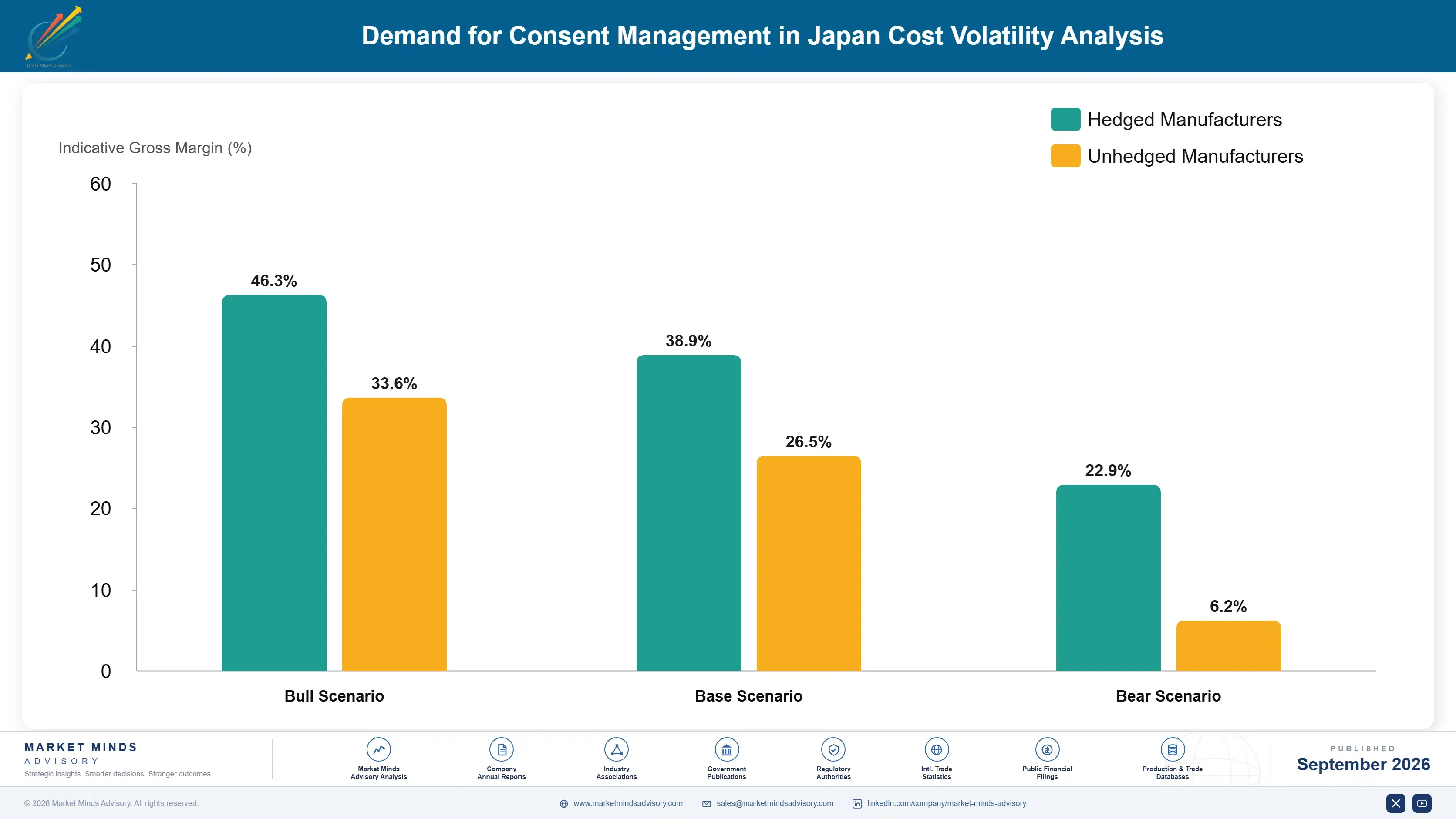
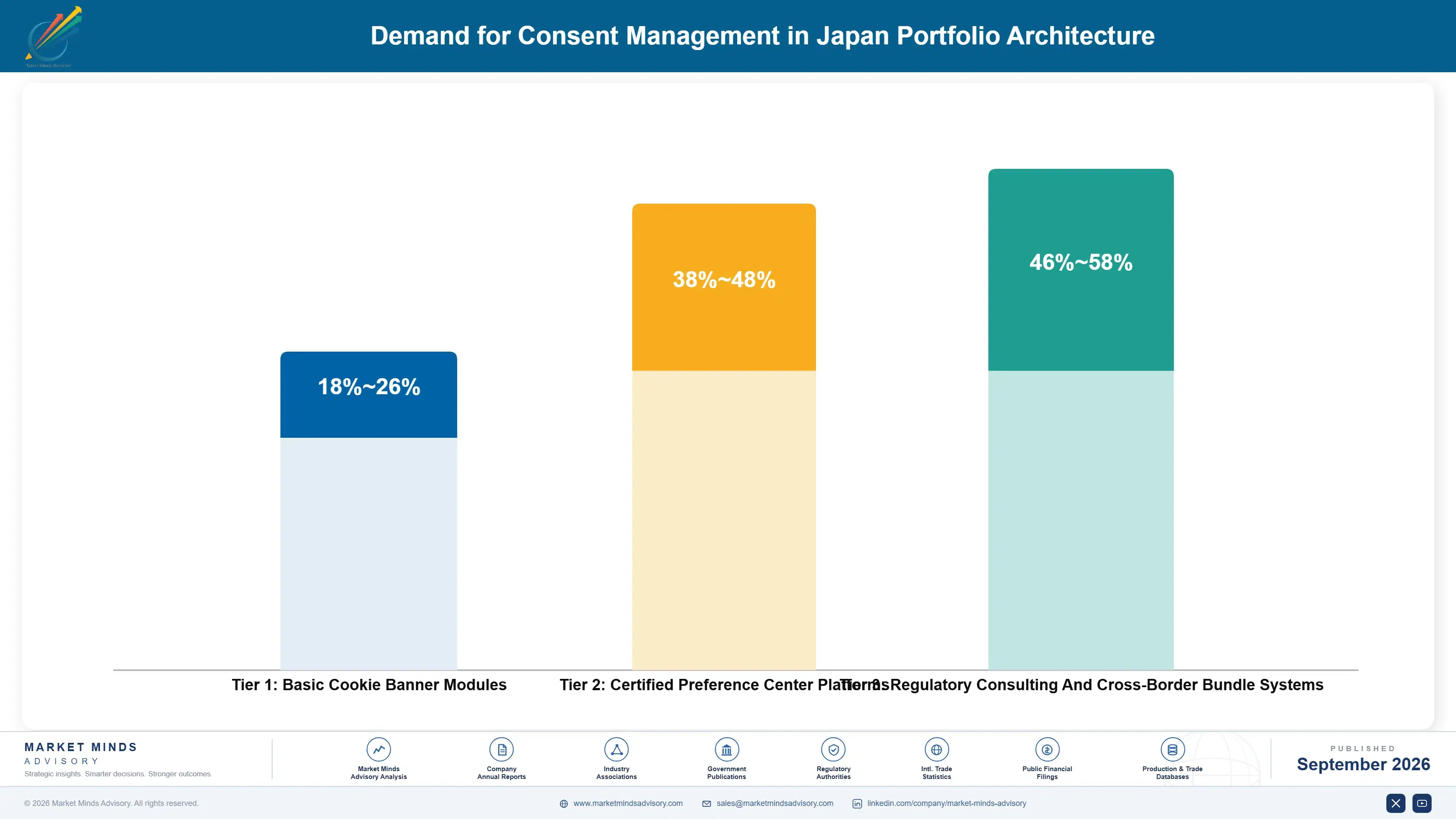
Consent management vendors operate across three margin tiers, from basic cookie banner modules carrying thin unit economics through certified preference center platforms commanding meaningfully stronger margin, up to regulatory consulting and cross-border bundle systems capturing the richest gross margins in the category. Volume tiers monetize through per-site licensing scale, while premium tiers monetize through regulatory depth and audit support bundling.
Tension persists between volume growth, which favors standardized modules sold at competitive pricing to smaller domestic companies, and premium positioning, which favors Japan-specific regulatory expertise and cross-border configuration commanding materially higher willingness to pay among large multinational enterprise accounts. Vendors chasing both simultaneously risk diluting brand positioning across a fragmented buyer base. Larger multinational accounts increasingly demand both, forcing vendors to segment portfolios more deliberately by customer tier and budget profile.

High-value margin pools concentrate in regulatory consulting and cross-border configuration services, both commanding meaningfully higher gross margin than basic cookie banner modules sold without additional capability bundling. Vendors building durable regulatory relationships and audit support capability capture disproportionate margin relative to their enterprise count across the broader competitive landscape today. Vendors ignoring this shift risk ceding the most profitable accounts to faster-moving specialist rivals over the coming enforcement cycle.

Basic Cookie Banner Modules

Standardized cookie consent banner modules sold at accessible pricing to smaller domestic companies prioritizing baseline capability over advanced regulatory depth, carrying thin unit economics but broad reach nationwide. nationwide, reflecting steady but unremarkable demand growth across most budget-constrained buyer categories.
Gross Margin: 18-26%

Certified Preference Center Platforms

Certified preference center platforms bundling documented subject rights automation and audit-ready compliance support, commanding stronger recurring revenue and materially higher gross margin than basic banner modules sold without this depth. across multinational and domestic enterprise accounts nationwide.
Gross Margin: 38-48%

Regulatory Consulting And Cross-Border Bundle Systems

Integrated platforms bundling Japan-specific regulatory consulting with cross-border transfer configuration support, carrying the richest margin profile in the category given urgent commercial demand and expanding buyer willingness to pay. across multinational enterprise accounts nationwide currently.
Gross Margin: 46-58%
japan-consent-management-market-cost-volatility-analysis-1788454035971

High-value Sub-segments and Strategic Watch-out

Cookie and Website Consent Banner Management

Fastest-growing and highest-value segment, combining strong pricing power with accelerating adoption as enterprises seek documented compliance capability across retail, financial services, and technology sectors across most enterprise buyer categories nationwide and abroad this cycle. Regulatory momentum further supports this segment's continued rapid expansion pace nationwide.

Preference Center and Subject Rights Request Automation

High-value segment with strong growth, anchored by growing consumer awareness of subject rights, though smaller domestic company budgets constrain broader adoption pace relative to multinational enterprise accounts across most enterprise buyer categories nationwide. This segment remains a dependable revenue base even as basic banner sales decline.

Data Subject Access Request Fulfillment Software

Volume core of the market, delivering steady deployment counts and established margin, serving as the primary entry point into certification services and eventual preference center module adoption over time nationwide. Vendors use this tier to build trust before upselling into higher-margin offerings over successive contract cycles later.

Marketing Consent and Opt-In Management

Strategic watch-out segment facing moderate relative growth as enterprises prioritize regulatory documentation over discretionary marketing preference features, requiring vendors to differentiate through integration depth and pricing accessibility. Vendors offering integrated bundling capture a meaningful share of this segment across most surviving vendor product lines nationwide.

Compliance Contracts Anchor Recurring Revenue

Consent management platforms increasingly behave like an annuity business rather than a one-time deployment. Enterprises sign multi-year licensing and regulatory consulting contracts tied to ongoing compliance obligations, and audit support renewals lock vendors into recurring revenue streams that compound as regulatory scrutiny intensifies. This shifts vendor valuation toward retained enterprise relationships rather than one-time implementation project fees, rewarding vendors with durable regulatory expertise over pure software capability alone.
Adoption stickiness varies sharply by end-use vertical. Large multinational enterprises integrate consent management vendors deeply into their global compliance workflows, making switching costs prohibitive once configuration and audit documentation are complete across their multi-jurisdictional operations. Smaller domestic companies show shallower stickiness, often price-shopping at contract renewal given tighter budgets and simpler regulatory requirements, which keeps competitive pressure alive at that end of the market.

Buyer profiles are shifting generationally as compliance teams increasingly favor cloud-native, analytics-forward platforms over legacy manual tracking systems built around older regulatory frameworks. Younger technical buyers prioritize automation depth and rapid deployment over the incumbent vendor relationships that shaped prior purchasing cycles, gradually eroding legacy negotiating leverage and opening room for newer entrants offering more modern deployment tooling.
Section default visual

Where Consent Vendors Should Focus Next

These are among the four positions where our research anticipates prominent divergence between winners and laggards over the coming forecast period. Each is grounded in the demand model, the regulatory perimeter, and the announced capacity pipeline.
01 / COOKIE BANNER COMPLIANCE DEPTH

Build compliant, regularly updated banner configurations now

Cookie and website consent banner management forms the fastest-growing segment in this market, expanding at 19.5 percent annually against a category average of 13.5 percent, roughly 1.44 times the overall category rate. Vendors building compliant, regularly updated configurations now capture disproportionate share of enterprise deployment budget as regulatory scrutiny intensifies further across most industry sectors nationwide and internationally. Waiting risks ceding this segment permanently to faster-moving specialists already active across most enterprise categories and industry verticals currently expanding rapidly nationwide.
02 / JAPAN-SPECIFIC REGULATORY DEPTH

Deepen Japan-specific localization and regulatory expertise

Multinational vendors must adapt their consent platforms to Japan-specific legal terminology and Personal Information Protection Commission guidance interpretation, a localization process many global platforms continue to handle inadequately even today. Vendors deepening this localization capability now build trusted partner relationships that compound as regulatory complexity increases across successive enforcement cycles nationwide, internationally, and across most enterprise sectors. This capability gap will widen further as APPI enforcement intensifies across the forecast period ahead for every participating vendor in the broader category worldwide today.
03 / CROSS-BORDER CONFIGURATION DEPTH

Build unified cross-border compliance configuration now

Multinational enterprises seeking unified consent management across multiple jurisdictions increasingly value vendors offering integrated cross-border configuration rather than managing separate, standalone regional compliance systems individually across their broader existing technology infrastructure. Vendors building these configurations now capture disproportionate share of enterprise standardization decisions ahead of competitors still relying entirely on jurisdiction-specific deployment models and processes. Vendors that delay risk losing ground to faster-moving unified platform challengers already active nationwide across most enterprise categories and jurisdictions nationwide and abroad currently expanding.
04 / REGULATORY TALENT INVESTMENT

Build dedicated Japan compliance talent pipelines now

Specialized legal and compliance engineering talent represents roughly 40 percent of cost of goods sold for consent management vendors, and talent scarcity directly compresses margin for vendors without established recruiting pipelines in place. Vendors investing in dedicated talent pipelines now secure more favorable staffing economics ahead of anticipated compliance talent market tightening across the broader industry. Competitors that delay these investments risk facing structurally worse cost positions during the next major hiring cycle across their full compliance talent pipeline nationwide.

Engagement Snapshot From the Field

A live engagement with an industry participant carrying material or product regulatory and market exposure ahead of a defining policy shift, showing how our research translates into a defensible multi-year portfolio strategy.
MARKET MINDS ADVISORY · CLIENT ENGAGEMENT SUMMARY
Demand for Consent Management in Japan Producer Strategic Portfolio Review and Transition Roadmap 2026·Investment Scenario on Demand for Consent Management in Japan Exposure Evaluation 2025-26
CLIENT PROFILE
The client is a mid-sized multinational retail group headquartered in Tokyo, operating e-commerce platforms across Japan and several other Asian markets requiring consolidated privacy compliance. Facing an upcoming Personal Information Protection Commission audit cycle, the group's compliance leadership sought an independent assessment of consent management vendor options before committing to a multi-year platform contract. nationwide.
STRATEGIC CHALLENGE
The group's fragmented collection of legacy cookie banners and manual tracking spreadsheets could not satisfy amended APPI documentation expectations, but compliance leadership lacked clarity on which vendors offered genuinely localized regulatory expertise versus generic global platforms requiring extensive customization. Leadership also faced pressure to demonstrate compliance readiness ahead of imminent regulatory audit scheduling notifications.
MMA APPROACH
MMA conducted a structured vendor capability assessment spanning five leading consent management suppliers, benchmarking Japan-specific regulatory depth, cross-border configuration maturity, and total cost of ownership against the group's specific multi-market compliance requirements, including projected multi-year budget implications. The assessment also incorporated interviews with compliance staff across each participating regional market team.
KEY FINDINGS
  1. Two of five evaluated vendors offered genuinely localized Japan-specific compliance documentation meeting regulatory expectations without exception. This eliminated three vendors from further consideration early in the process.
  2. Total cost of ownership estimates varied by roughly 25 percent (client-reported, unverified by MMA) across vendors offering functionally comparable platform capability. across vendors offering comparable platform capability.
  3. Cross-border configuration maturity varied significantly, with only two vendors offering production-ready multi-jurisdiction support rather than roadmap commitments. This distinction proved decisive for the group's final selection.
  4. Smaller retail groups in similar multi-market compliance situations showed measurably higher switching costs once initial platform deployment was substantially complete. This underscored the value of early engagement well ahead of audit deadlines.
CLIENT PROFILE
The client is a mid-sized multinational retail group headquartered in Tokyo, operating e-commerce platforms across Japan and several other Asian markets requiring consolidated privacy compliance. Facing an upcoming Personal Information Protection Commission audit cycle, the group's compliance leadership sought an independent assessment of consent management vendor options before committing to a multi-year platform contract. nationwide.
STRATEGIC CHALLENGE
The group's fragmented collection of legacy cookie banners and manual tracking spreadsheets could not satisfy amended APPI documentation expectations, but compliance leadership lacked clarity on which vendors offered genuinely localized regulatory expertise versus generic global platforms requiring extensive customization. Leadership also faced pressure to demonstrate compliance readiness ahead of imminent regulatory audit scheduling notifications.
MMA APPROACH
MMA conducted a structured vendor capability assessment spanning five leading consent management suppliers, benchmarking Japan-specific regulatory depth, cross-border configuration maturity, and total cost of ownership against the group's specific multi-market compliance requirements, including projected multi-year budget implications. The assessment also incorporated interviews with compliance staff across each participating regional market team.
KEY FINDINGS
  1. Two of five evaluated vendors offered genuinely localized Japan-specific compliance documentation meeting regulatory expectations without exception. This eliminated three vendors from further consideration early in the process.
  2. Total cost of ownership estimates varied by roughly 25 percent (client-reported, unverified by MMA) across vendors offering functionally comparable platform capability. across vendors offering comparable platform capability.
  3. Cross-border configuration maturity varied significantly, with only two vendors offering production-ready multi-jurisdiction support rather than roadmap commitments. This distinction proved decisive for the group's final selection.
  4. Smaller retail groups in similar multi-market compliance situations showed measurably higher switching costs once initial platform deployment was substantially complete. This underscored the value of early engagement well ahead of audit deadlines.
RECOMMENDED STRATEGY
Phase 1: Phase one prioritized vendor shortlisting based on documented Japan-specific regulatory expertise and cross-border configuration track record. across the group's full regional market footprint. Phase 2: Phase two structured contract negotiation around phased deployment milestones tied to measurable compliance verification rather than flat licensing fees. tied to documented compliance milestones. Phase 3: Phase three established ongoing platform performance benchmarking against evolving APPI requirements to protect continued audit readiness nationwide. across subsequent audit cycles.
OUTCOME
The group selected a vendor offering strong Japan-specific expertise and cross-border configuration maturity, completing initial deployment within five months and reporting improved audit preparation outcomes (client-reported, unverified by MMA). Leadership credited the structured comparison with avoiding a costlier, less compliant platform choice originally under serious consideration.

Frequently Asked Questions

Foundational context covering the market sizes, CAGR, scope, country, region and competition that inform every finding below. This section is provided to cover basics and most often pre-purchase conversations, answered from the MMA Primary Research Dataset.

What is the current size of the Demand for Consent Management in Japan?

The market reached 0.68 billion dollars in 2025, driven by amended APPI enforcement pressure and platform consolidation across Japanese enterprise sectors nationwide and across most major industries.

How large will the Demand for Consent Management in Japan be by 2036?

MMA projects the market will reach 2.73 billion dollars by 2036, more than tripling from 2025 levels as regulatory enforcement accelerates across most industries and enterprise categories nationwide.

What is the CAGR for the Demand for Consent Management in Japan 2026 to 2036?

The base case CAGR is 13.5 percent, with a bull scenario of 14.8 percent and a bear scenario of 12.2 percent depending on enforcement intensity pacing.

Which segment is growing fastest?

Cookie and Website Consent Banner Management leads at 19.5 percent CAGR, roughly 1.44 times the overall market rate, driven by regulatory documentation pressure nationwide and across most industry sectors.

Who are the major companies in the Demand for Consent Management in Japan?

OneTrust, Usercentrics, TrustArc, Didomi, and Osano lead the market, reflecting deep global privacy compliance expertise built over many years of continuous regulatory service delivery nationwide.

Which country is growing fastest?

Japan itself leads within this report's defined scope, expanding at 15.0 percent annually as enterprises accelerate consent platform adoption across most industry sectors nationwide and abroad.

Report Segmentation Architecture

The full report scope spans multiple orthogonal segmentation dimensions, with cross-tabulated demand data provided for each dimension pair. Coverage extends further to regional breakdowns, trend trajectories, and the competitive detail needed to support segment-level decision-making.

By Consent Management Function

    By End-Use Industry Sector

      By Commercial Deployment Model

        By Region

        • North America
        • Western Europe
        • East Asia
        • South Asia and Pacific
        • Latin America
        • Middle East and Africa
        • Eastern Europe

        Scope, Methodology, and Coverage

        Every figure in this report is reproducible from documented input assumptions. The scope below maps the historical period, the forecast horizon, the segmentation dimensions, and the countries covered, alongside the underlying primary and qualitative methodology.
        Historical Period
        2020 to 2025
        Forecast Period
        2026 to 2036
        Base Year
        2025 (USD billions; MMA Primary Research Dataset, September 2026)
        Market Definition
        This report covers software platforms managing website cookie consent, data subject preference centers, and privacy compliance documentation for organizations operating in Japan under amended Act on Protection of Personal Information requirements. It excludes general-purpose customer data platforms without dedicated consent tracking capability and standalone legal advisory services.
        Quantitative Units
        USD billions, market share percentages, CAGR percentages
        Segmentation Dimensions
        Consent management function, end-use industry sector, commercial deployment model
        Regions Covered
        North America, Western Europe, East Asia, South Asia and Pacific, Latin America, Middle East and Africa, Eastern Europe
        Countries Covered
        Japan, with regional benchmarking context across North America, East Asia, Western Europe, South Asia and Pacific, Latin America, Middle East and Africa, and Eastern Europe
        Key Companies Profiled
        OneTrust, Usercentrics, TrustArc, Didomi, Osano, and 15 additional participants
        Quantitative Methodology
        Primary survey, n=3,800 respondents, Q4 2025, six countries; demand-side model with trade association cross-validation
        Qualitative Methodology
        47 expert interviews, Q4 2025; applied to validate demand model assumptions, identify emerging dynamics, and assess competitive positioning
        Report Format
        PDF and XLSX data workbook (Word format preview document)
        Publisher
        Market Minds Advisory
        Report Code
        MMA-2026-TEC-682
        Published
        September 2026
        Contact
        sales@marketmindsadvisory.com | www.marketmindsadvisory.com

        Purchase the full Demand for Consent Management in Japan Report (2026 to 2036).

        This full report delivers comprehensive analysis of Japan's consent management market. It covers vendor competitive positioning, regulatory enforcement trends, and cross-border compliance requirements shaping enterprise procurement decisions nationwide. The report includes detailed segmentation across consent functions, industry sectors, and deployment models, alongside a proprietary MMA primary survey of enterprise compliance decision-makers spanning multiple regions. Analysts detail margin economics, cost exposure, and competitive dynamics shaping vendor positioning across the category. Strategic recommendations guide vendors navigating this enforcement-driven platform category through 2036 and beyond, with attention to localization economics.
        Full seven-region data tables and CAGR breakdowns
        Complete company profiles for twenty market participants
        Primary survey dataset covering 3,800 respondents nationwide
        Expert interview findings from 47 industry specialists
        Editable data tables in spreadsheet format included
        Quarterly market update subscription available separately

        Built For The People Who Decide

        From boardroom strategy to bench-side execution, this report is read cover-to-cover by leaders shaping the next decade of their industry, turning demand scenarios, market dynamics and valuation benchmarks into decisions.
        CXOs/ Presidents/ VPs/ Managers
        M&A and Corporate Development
        Strategy Teams and R&D Heads
        Procurement and Product Directors
        Regulatory and Compliance Leaders
        Investor Relations and Equity Analysts