Market Minds Advisory
Demand for CCTV Camera in Japan

Demand for CCTV Camera in Japan: Demand for CCTV Camera in Japan. AI-Enabled Surveillance Infrastructure for an Aging Society

Japan's municipalities and retailers racing to offset chronic labor shortages with AI-powered video analytics are running into camera network bandwidth and privacy compliance limits legacy CCTV installations were never designed for.

Lead Analyst

Published

September 2026

Make Smarter Decisions with Customized Research Insights

Request a free sample report and evaluate market opportunities, growth trends, and competitive dynamics relevant to your business needs.

2025 MARKET VALUE$22.5BMarket Size 2025
2036 FORECAST VALUE$55.2BBase Case , 2026 to 2036
CAGR 2026 TO 20368.5 %Bull 9.7% / Bear 7.3%
INCREMENTAL OPPORTUNITY$30.8BNet 10- year value creation
EXPANSION MULTIPLE2.26x2036 value over 2026 base
Strategic Levers
M&A Pipeline
Regional Outlook
Country Rankings
Competitive Intelligence
Segmental Deep-dive
Call-Us : 91 93563 13602

Executive Snapshot and Market Trajectory.

Japan's CCTV market has become the clearest global example of surveillance infrastructure repurposed for labor shortage mitigation, with AI analytics now doing the monitoring work aging security staff simply cannot cover at scale across most retail and municipal environments nationwide today and going forward.
Camera vendors are racing to build edge-processing analytics capable of detecting shoplifting, wandering elderly residents, and traffic anomalies without transmitting raw video to centralized servers that strain municipal bandwidth budgets nationwide and across many departments and jurisdictions. Demand concentrates among retailers and municipal governments deploying AI-enabled cameras at scale, where labor cost savings from automated monitoring increasingly outweigh the upfront cost of camera network modernization and analytics licensing fees.
Established camera hardware manufacturers compete against software-first video analytics vendors building anomaly detection models that layer on top of commodity camera hardware rather than proprietary sensor designs alone or dedicated silicon chips built entirely in-house from scratch. Regulatory pressure from Japan's Act on Protection of Personal Information is reshaping product specifications faster than procurement teams can evaluate competing vendor claims about facial recognition accuracy and data retention compliance across municipalities, prefectures, and national guidelines.
Market Definition
This report covers CCTV camera hardware, video management software, and AI-based analytics platforms used for security, retail loss prevention, and public safety monitoring, with global market sizing and Japan featured as the leading indicator of labor-shortage-driven analytics adoption. It excludes consumer home security cameras and body-worn cameras for law enforcement personnel.
Base Year Value
$22.5B in 2025 (MMA Primary Research Dataset, September 2026)
Forecast Period
2026 to 2036, eleven discrete annual values
CAGR
8.5% base case. Bull 9.7%. Bear 7.3%.
Fastest Growth Segment
AI-Based Video Analytics and Anomaly Detection Software: 14.5% CAGR
Fastest Growth Country
India: 12.0% CAGR
Fastest Growth Region
South Asia and Pacific: 10.5% CAGR
Largest Region
East Asia: 33% of 2025 global value
Market Leaders
Led by Hikvision, Dahua Technology, Axis Communications, Bosch Security Systems, and Panasonic Corporation. Source: MMA Primary Research Dataset, July 2026.
Primary Survey
n=3,800 procurement and R&D decision-makers, Q4 2025, six countries
Methodology
Demand-side build-up, cross-validated against public data, 47 expert interviews

Demand for CCTV Camera in Japan Market Forecast Scenarios

japan-cctv-camera-market-size-forecast-scenario-1788452134656
The 2020 to 2025 period saw CCTV demand in Japan move from traditional passive recording toward AI-analytics-enabled monitoring as chronic labor shortages accelerated automation investment across retail and municipal sectors. Adoption broadened as edge-processing chipsets matured, producing a historical CAGR of roughly 7.8 percent as camera and analytics vendors expanded their addressable buyer base each year across public and private deployments.
The base case assumes continued expansion of AI video analytics adoption across retail loss prevention and municipal public safety applications, rising labor cost pressure pushing automation investment, and growing acceptance of camera-based elderly monitoring in aging communities nationwide. Vendors increasingly treat edge-processing capability and privacy-compliant data handling as differentiators rather than raw resolution alone, municipalities standardize procurement around vendors offering documented facial recognition accuracy, and retailers expand analytics-driven loss prevention programs across store networks.
A bull scenario assumes national government mandates broader municipal surveillance modernization tied to public safety and elderly care initiatives, dramatically accelerating camera network replacement across smaller cities and towns. The bear case centers on privacy advocacy and facial recognition restrictions slowing deployment timelines, reducing the addressable market for analytics requiring broad biometric data collection in public spaces.

Where Labor Shortages Meet Video Analytics

CCTV procurement decisions in Japan now run through operations and workforce planning departments rather than pure security teams, a shift that has changed which budget line actually funds camera deployment entirely. Retail operations managers increasingly hold purchasing authority once controlled entirely by loss prevention departments, since analytics-driven automation now directly affects staffing budgets that chronic labor shortages have made increasingly difficult to fill nationwide.
MARKET CONCENTRATIONCR5 44%top five vendors hold a moderately fragmented combined revenue share
AVERAGE SELLING PRICE$420/camera unittypical AI-enabled camera hardware cost per single installation
TOP PRODUCING COUNTRYChina 58%share of global camera hardware manufacturing output currently
JAPAN RETAIL DEPLOYMENT37%share of Japan camera installations serving loss prevention applications
SOFTWARE ATTACH RATE56%cameras bundled with dedicated AI video analytics software platforms
REPLACEMENT CYCLE LENGTH6 yearstypical service life before a full camera system replacement
Hardware margins have compressed as camera components standardized across manufacturers, pushing vendors toward AI analytics software and edge-processing licensing as the primary profit center instead of one-time camera sales entirely. The vendors building the most accurate anomaly detection models are winning multi-year municipal and retail contracts specifically because customers trust their platforms enough to reduce manual monitoring staffing based directly on the results.
Retail deployment above one-third of installations signals a market where loss prevention automation has moved well past pilot status into standard operating procedure across major chains nationwide today. This has pushed several municipalities toward AI-enabled elderly monitoring programs that combine camera networks with wellness check automation, a shift that favors vendors with proven analytics depth over hardware-only competitors lacking software expertise.
"The camera was never the product, the alert was. Nobody wants footage of a shoplifter after the fact, they want a phone buzzing before the person reaches the door."
Director, Security Technology and Video Analytics Practice · MMA Technology Practice · September 2026

Market Trends

Retail Labor Shortage Drives Automated Loss Prevention

Japan's retail sector faces a persistent labor shortage that has made staffing dedicated loss prevention personnel increasingly difficult, pushing major chains toward AI-based video analytics that flag suspicious behavior automatically without constant human monitoring. This has turned camera analytics from a supplementary security tool into a core operational requirement, since retailers can no longer reliably staff the human monitoring positions that traditional CCTV systems historically required for effectiveness. At least seven major Japanese retail chains have publicly disclosed AI analytics deployment programs since 2023, and nearly all major chains are expected to adopt comparable systems within a few years.
Market Impact: Traffic camera budgets grew 19 percent
Elderly Monitoring Programs Expand Municipal Camera Networks

Japanese municipalities facing rapidly aging populations are deploying camera-based wellness check systems that use AI analytics to detect falls, prolonged inactivity, and other anomalies among elderly residents living independently in their communities. This has turned municipal camera networks into public health infrastructure extending beyond traditional security applications, since local governments increasingly view analytics-enabled monitoring as a cost-effective alternative to expanding in-person elderly care staffing. Several prefectures have launched pilot programs combining public camera networks with elderly wellness monitoring, and adoption is expanding as demographic pressure intensifies across Japan's rapidly aging rural communities.
Market Impact: Tourism camera investment rose 26 percent

Market Opportunities and Growth Drivers

Traffic Safety Programs Expand Municipal Camera Deployment

Japanese municipalities are expanding intersection and pedestrian crossing camera deployment tied to traffic safety initiatives targeting the country's aging driver population, which carries meaningfully higher accident rates than younger demographic cohorts nationwide. This has created a distinct government-funded demand segment separate from retail and commercial deployment, with dedicated municipal budgets and procurement cycles tied to national traffic safety policy priorities and funding cycles. Several prefectures have publicly disclosed multi-year traffic camera expansion plans tied explicitly to elderly driver safety initiatives, and vendors are building dedicated traffic analytics capability to serve this growing segment.
Market Impact: Deployment delays extend timelines 4 months

Tourism Recovery Drives Public Safety Camera Investment

Japan's recovering inbound tourism sector has pushed municipalities and transit operators to expand public safety camera coverage in major tourist destinations, addressing both crowd management and safety concerns tied to record visitor volumes. This has repositioned camera investment from a purely domestic security concern into a tourism infrastructure priority, since major transit hubs and attractions increasingly treat visible security camera coverage as a visitor confidence signal. Several major tourist prefectures have publicly disclosed camera network expansion tied explicitly to tourism recovery strategy, and this framing has accelerated procurement well beyond traditional security department budgets.
Market Impact: Rural deployment lags urban 5 years

Market Restraints and Challenges

Privacy Concerns Slow Facial Recognition Deployment

Public concern over facial recognition and biometric data collection has slowed some municipal camera deployment plans, with civic groups raising objections to expanded surveillance capability in public spaces without clear consent or oversight mechanisms. The root cause is that early camera analytics deployments often lacked clear public communication about data retention policies and usage limitations, creating distrust that newer, more transparent municipal programs have struggled to fully overcome. Vendors are increasingly building privacy-by-design features including automatic data deletion and anonymization capability, and municipalities now conduct public consultation processes before approving new camera analytics deployment programs.
Market Impact: AI analytics reaches 7 major chains

Bandwidth Constraints Limit Rural Camera Network Expansion

Rural municipalities with limited fiber and cellular network infrastructure face bandwidth constraints that prevent transmitting high-resolution video to centralized analytics servers, limiting the sophistication of camera systems these areas can practically deploy. The root cause is that Japan's telecommunications infrastructure investment has historically prioritized dense urban centers, leaving rural areas with connectivity insufficient for cloud-based analytics processing at meaningful scale or reliability. Vendors are increasingly developing edge-processing camera hardware that performs analytics locally without requiring constant high-bandwidth connectivity, and rural adoption is expanding as these lower-bandwidth solutions mature and prices decline.
Market Impact: Elderly monitoring programs cover 15 prefectures
3 additional market trends, 4 additional growth drivers, and 2 additional restraints and challenges are covered in the full report. Contact sales@marketmindsadvisory.com to access the complete intelligence.

Segment CAGR and Growth Architecture

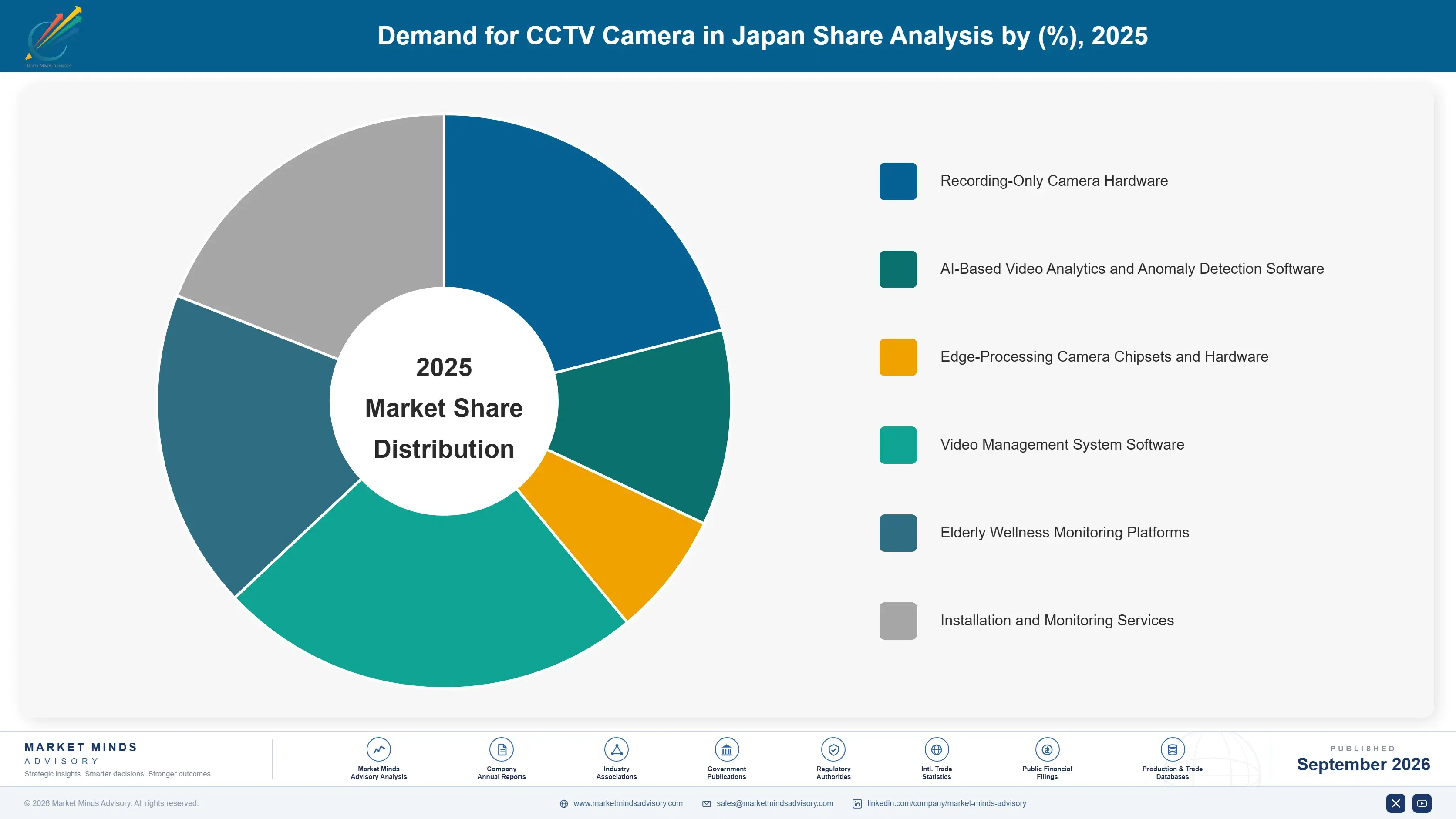
Six segments span the CCTV value chain from camera hardware and video management systems through AI video analytics software, edge-processing chipsets, installation, and ongoing monitoring services nationwide today. AI-based video analytics platforms are pulling ahead of hardware-only segments as automation-driven software revenue becomes the dominant margin driver shaping vendor strategy across the entire industry.
japan-cctv-camera-market-market-share-analysis-1788452135188

AI-Based Video Analytics and Anomaly Detection Software

AI-based video analytics and anomaly detection software has become the fastest-growing segment in this market, expanding at roughly 14.5 percent annually as retailers and municipalities demand automated monitoring that chronic labor shortages make increasingly necessary across deployment types, use cases, and geographic markets nationwide and abroad. Vendors with the most accurate anomaly detection models win multi-year enterprise and municipal contracts specifically because customers gate labor cost reduction on the platform's detection accuracy rather than raw camera resolution specifications alone. Hardware-only camera suppliers are racing to acquire or build this analytics capability internally, since customers increasingly refuse contracts with vendors lacking a credible AI roadmap and demonstrated detection accuracy track record.
CAGR 14.5%

Edge-Processing Camera Chipsets and Hardware

Edge-processing camera chipsets and hardware are growing at roughly 11.5 percent annually as bandwidth constraints push analytics processing away from centralized servers toward on-device computation across both urban and rural deployment environments nationwide, internationally, and across most municipal budgets and networks today and tomorrow. This segment sits between general camera hardware and pure analytics software, handling the specialized work of running detection models locally without requiring constant high-bandwidth connectivity that many rural municipalities cannot reliably provide or afford easily at all currently. Specialized chipset vendors and camera manufacturers both compete here, and the segment benefits directly from rural camera network expansion since every edge-capable deployment reduces dependence on centralized processing infrastructure.
CAGR 11.5%
Full segment breakdown across 7 segments available in the complete report.

Regional Architecture and Country Demand Map

East Asia dominates given China's overwhelming concentration of global camera manufacturing capacity, alongside Japan's analytical significance as this report's aging-society labor shortage anchor, while North America follows on enterprise analytics adoption and Western Europe pursues privacy-conscious deployment standards across nearly all member states nationwide today.

North America

North America's demand rests on enterprise retail analytics adoption and growing municipal public safety camera deployment, with major retail chains leading AI-based loss prevention analytics investment across the region and well beyond it. US retailers face similar labor shortage pressure to Japan's retail sector, driving comparable automation investment patterns even though the underlying demographic and cultural drivers differ meaningfully between the two distinct markets and populations. Canada's market mirrors US adoption patterns closely given shared retail chain operators and similar regulatory environments across both countries and their major metro areas. Municipal public safety camera expansion continues steadily across major metro areas facing rising urban security concerns and shifting budget priorities.
Share: 24% | CAGR: 9.0% (2026 to 2036)

Western Europe

Western Europe's demand rests on stringent data privacy regulation under GDPR, which has pushed camera vendors to build consent management and facial recognition restrictions considerably more rigorous than typical Asian market deployment standards and expectations. Germany and France lead adoption given their large retail sectors and sophisticated municipal government infrastructure, while UK cities historically maintained some of the world's densest public camera networks predating current privacy debates and regulation. Privacy-by-design platform features have become a competitive requirement here in ways not seen in less regulated markets, favoring vendors with strong compliance credentials and documentation. Regional growth trails East Asia and North America but is accelerating as retail automation adoption spreads across the bloc.
Share: 19% | CAGR: 7.0% (2026 to 2036)
Regional intelligence for 5 additional markets available in the complete report: East Asia, South Asia and Pacific, Latin America, Middle East and Africa, Eastern Europe. Contact sales@marketmindsadvisory.com.
japan-cctv-camera-market-country-cagr-analysis-1788452135702

Paths to Margin Beyond Camera Hardware

Vendors face a clear choice between competing on camera hardware price alone or building recurring revenue through analytics software, edge-processing licensing, and monitoring services that compound over multi-year deployment relationships. The vendors capturing AI analytics subscriptions and municipal wellness monitoring contracts are pulling well ahead on total account value far beyond the initial camera sale.

AI Analytics Subscriptions Compounding Account Value

Vendors that bundle AI-based video analytics software with camera hardware capture recurring subscription revenue that compounds annually rather than a single upfront hardware sale to a customer. Customers that adopt full analytics suites generate roughly 36 percent more total account revenue over a five-year deployment period than hardware-only installations, since subscription fees continue well past initial deployment and renewal rates run high among engaged operations teams. This dynamic rewards vendors who invest in detection accuracy rather than treating analytics as an afterthought bolted onto commodity camera hardware, since renewal decisions increasingly hinge on model performance rather than hardware reliability alone.
Market Impact: Analytics bundling adds 36 percent more account revenue

Elderly Wellness Monitoring Creating New Revenue

Vendors that build dedicated elderly wellness monitoring capability position themselves to capture municipal budget allocated for aging population care that generic security camera vendors cannot access given their narrower functional scope. Wellness-monitoring-capable vendors report contract values roughly 24 percent higher than competitors lacking these features, since municipalities increasingly select vendors who can demonstrate documented fall detection accuracy rather than generic security camera specifications alone. This favors vendors with dedicated healthcare analytics expertise over pure security camera manufacturers, who typically lack the specialized detection capability this wellness monitoring work demands across diverse elderly living situations.
Market Impact: Wellness monitoring adds 24 percent more contract value

Edge-Processing Hardware Expanding Rural Market Access

Vendors offering edge-processing camera hardware that performs analytics locally capture rural municipal contracts that bandwidth-constrained cloud-dependent competitors cannot reliably serve given inadequate telecommunications infrastructure in those specific geographic areas nationwide. Edge-capable vendors close roughly 31 percent more rural municipal contracts than competitors requiring constant high-bandwidth connectivity, since rural governments managing limited infrastructure budgets prefer solutions that work reliably regardless of network quality or availability. This favors larger vendors with capital to fund edge-processing chipset development over smaller regional competitors who cannot justify that investment without guaranteed rural program volume upfront.
Market Impact: Edge processing closes 31 percent more rural contracts

Traffic Safety Analytics Commanding Municipal Premium Contracts

Vendors offering dedicated traffic safety analytics targeting elderly driver accident patterns capture premium-tier municipal contracts from prefectures prioritizing demographic-specific safety programs over generic traffic monitoring capability entirely. Traffic-safety-focused vendors command roughly 27 percent pricing premiums on relevant municipal contracts, since prefectures increasingly treat elderly driver safety analytics as a distinct budget priority rather than a secondary traffic monitoring feature alone. This lever rewards vendors who invest early in demographic-specific analytics capability, since municipalities managing aging populations prioritize validation partners with proven accuracy in this specific analytical domain and use case.
Market Impact: Traffic analytics commands a 27 percent price premium

Who Controls the Margin Pool

CR5 of 44 percent reflects a fragmented competitive field where five leading vendors hold less than half of global revenue, leaving room for challengers across most deployment sizes. Hikvision leads ahead of Dahua and the remaining top-five field, whose combined share trails the leader by a wide margin in most enterprise and municipal categories. Revenue is the evaluation basis used consistently throughout this section, since installed camera counts are not uniformly disclosed.
Current competitive activity centers on AI analytics acquisitions, as hardware-focused vendors race to add anomaly detection capability rather than build it internally over years. Several mid-tier competitors have announced elderly wellness monitoring launches this year, recognizing demographic-specific analytics is quickly becoming a differentiator. Edge-processing hardware has also become a battleground, as vendors seek rural municipal contracts tied to bandwidth-independent deployment.

Emerging pressure comes from cloud-native software entrants without legacy camera manufacturing, who can iterate detection models faster than incumbents burdened by longer product cycles. These challengers lack the installer and municipal relationship depth incumbents built over years, but partnerships with existing hardware distributors are closing that gap. Rankings could shift if a well-funded entrant successfully partners with a major Japanese retail chain at scale.
japan-cctv-camera-market-company-positioning-matrix-1788452136222

Competitive Moat and Risk Dimensions

HIKVISION DIGITAL TECHNOLOGY CO LTD

Moat: Manufacturing Scale Cost Advantage

Hikvision's massive manufacturing scale in China lets it produce camera hardware at unit costs competitors cannot match, giving it a durable price advantage across volume deployments including large municipal and retail chain contracts. This cost structure lets Hikvision compete aggressively on price while still investing meaningfully in analytics software development, a combination smaller competitors struggle to replicate simultaneously.
HIKVISION DIGITAL TECHNOLOGY CO LTD

Risk: Government Restriction Exposure

Hikvision faces government procurement restrictions in several Western markets tied to national security concerns about Chinese-manufactured surveillance technology, limiting its addressable market in certain government and defense-adjacent contracts. This has cost Hikvision specification wins on sensitive public sector programs where customers prioritize supply chain origin over cost advantage.
AXIS COMMUNICATIONS AB

Moat: Premium Analytics Reputation

Axis has built a reputation for premium analytics accuracy and open platform architecture that appeals specifically to enterprise customers prioritizing detection reliability over unit cost, particularly in demanding retail and municipal deployment environments. This premium positioning lets Axis command pricing that Chinese manufacturers competing primarily on hardware cost cannot easily match.
AXIS COMMUNICATIONS AB

Risk: Premium Pricing Above Peers

Axis' premium pricing sits well above Chinese manufacturers, creating vulnerability among cost-conscious municipal and retail buyers who increasingly find adequate functionality in lower-priced alternatives lacking Axis' full analytics depth and breadth. Budget-constrained municipal buyers could accelerate defection toward cheaper alternatives during industry-wide budget tightening cycles.

Players Tracked

Prominent Players

Hikvision Digital Technology Co Ltd
Dahua Technology Co Ltd
Axis Communications AB
Bosch Security Systems Inc
Panasonic Corporation

Other Key Players

Hanwha Vision Co Ltd
Avigilon Corporation
Honeywell Security
Vivotek Inc
FLIR Systems Inc
Genetec Inc
Milestone Systems A/S
Verkada Inc
Rhombus Systems Inc
Ubiquiti Inc
Uniview Technologies Co Ltd
Tiandy Technologies Co Ltd
Sony Corporation
Canon Inc
IDIS Co Ltd

Recent Developments

MAY 2026

Hikvision Acquires Anomaly Detection Analytics Startup

Hikvision completed the acquisition of an anomaly detection analytics startup specializing in retail shoplifting and behavioral pattern recognition, adding detection accuracy the company previously lacked in-house. The deal closes a gap between Hikvision's hardware scale and its comparatively basic analytics offering, positioning it against software-native specialists.
Signal: Hardware incumbents are increasingly buying analytics capability rather than spending years slowly building it themselves internally.
MARCH 2026

Axis Signs Supply Agreement With Japanese Retail Chain

Axis Communications signed a multi-year supply agreement with a major Japanese retail chain to provide AI-enabled camera systems across its national store network, replacing a competitor's aging recording-only hardware. The agreement was a supply deal rather than an acquisition or joint venture, reflecting the chain's preference for a single vendor.
Signal: Retail chains are increasingly consolidating vendor relationships rather than splitting purchases across multiple camera equipment suppliers.
JANUARY 2026

Panasonic Launches Dedicated Elderly Wellness Monitoring Suite

Panasonic Corporation launched a dedicated elderly wellness monitoring suite connecting its camera platform directly to municipal fall detection and inactivity alert systems, an organic product expansion rather than an acquisition. The launch responds directly to municipalities seeking wellness monitoring without hiring a separate healthcare analytics specialist.
Signal: Vendors are increasingly building wellness monitoring capability internally rather than relying on third-party specialist partners nationwide.

Image Sensor and Chipset Cost Exposure

CMOS image sensors and edge-processing chipsets represent roughly 42 percent of camera hardware cost of goods sold, sourced predominantly from Japanese and Taiwanese semiconductor fabrication facilities. Lens assemblies and optical components add another 20 percent, sourced through a handful of specialized optics manufacturers rather than any single dominant supplier, exposing vendors to component allocation constraints.
The 2021 to 2022 global semiconductor shortage, documented extensively in IEA and industry supply chain reporting, extended camera hardware lead times from roughly four weeks to over sixteen weeks at the shortage's peak. Several vendors reported production delays that pushed committed municipal and retail deployment schedules back by entire quarters, forcing some customers to temporarily extend legacy recording-only systems while awaiting camera delivery from backlogged suppliers. The episode pushed most major vendors to diversify component sourcing across additional regions.

Smaller regional camera vendors lacking direct semiconductor supply relationships face the steepest exposure, since they typically buy through distributors at spot prices rather than negotiated multi-year contracts. Large incumbents like Hikvision and Dahua negotiate direct component allocation agreements with chip manufacturers, insulating them from the worst price volatility that smaller competitors absorb directly, a durable cost advantage during any future shortage cycle.
japan-cctv-camera-market-cost-volatility-analysis-1788452136417

Diversify Semiconductor Sourcing Across Multiple Regions

Leading vendors now qualify components from at least two independent semiconductor fabrication regions rather than relying on a single geographic source, reducing exposure to any single country's export controls or facility-level disruptions entirely. This dual-sourcing approach adds modest qualification cost upfront but has prevented delivery delays during several subsequent regional supply disruptions since 2022.

Negotiate Multi-Year Component Allocation Contracts

Larger vendors increasingly negotiate multi-year component allocation agreements directly with chip manufacturers rather than buying through distributors at spot prices, locking in both volume and price predictability years ahead of any actual future need. Smaller competitors are forming buying consortiums to access similar negotiated terms collectively, since none can match incumbent purchase volume alone.

Portfolio Architecture for Margin Defence

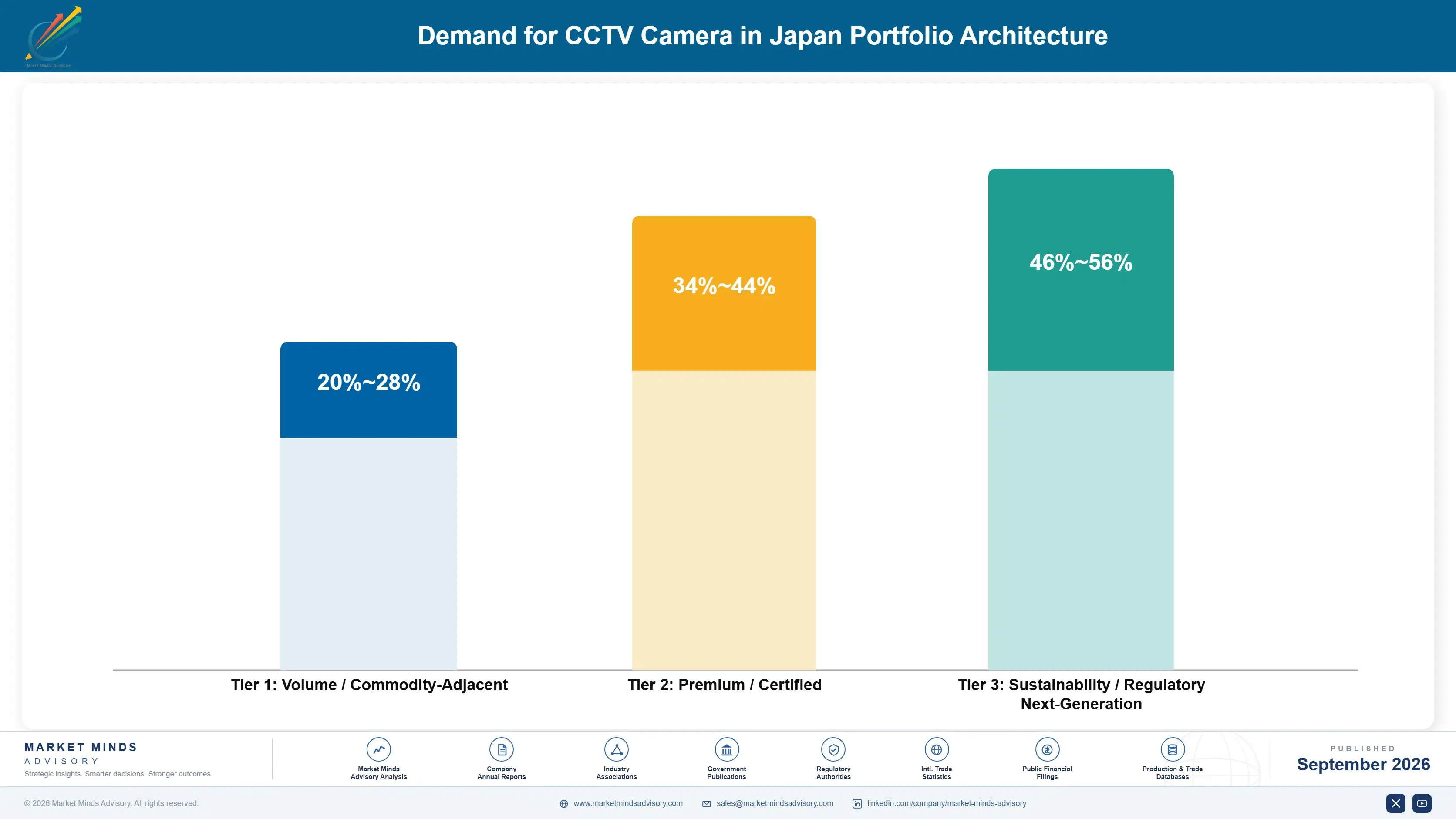
Three tiers structure this market's margin economics, from volume recording-only cameras sold on price to certified analytics-enabled platforms and next-generation wellness monitoring offerings that command the widest margins across the industry. Volume tier competition remains intense on unit price alone, while premium and next-generation tiers reward vendors with AI analytics and edge-processing capability that hardware-only competitors cannot easily replicate at comparable cost.
Tension between volume and premium tiers plays out most visibly among smaller independent retailers, where budget-constrained buyers often choose baseline recording-only cameras despite the long-term cost of forgoing labor savings over the deployment's remaining lifecycle. Premium tier buyers, largely national retail chains and municipal governments pursuing labor cost reduction, are willing to pay considerably more for integrated analytics and edge-processing bundled into a single accountable vendor relationship.

High-value margin pools concentrate overwhelmingly in the sustainability and regulatory tier, where elderly wellness monitoring and traffic safety analytics both command premium pricing well above ordinary commodity camera margins across most major programs. Vendors positioning exclusively in the volume tier face the greatest long-term margin compression as camera costs standardize further and price competition intensifies among an expanding field of low-cost hardware manufacturers entering the space.

Volume / Commodity-Adjacent

Standardized recording-only cameras competing primarily on unit price with minimal analytics bundling, sold largely to smaller independent retailers and cost-sensitive municipal budgets managing limited security infrastructure investment across most regions nationwide.
Gross Margin: 20-28%

Premium / Certified

AI-enabled cameras bundled with anomaly detection software and edge-processing capability, sold to national retail chains and municipalities pursuing verified labor cost reduction and operational automation across all store networks and locations.
Gross Margin: 34-44%

Sustainability / Regulatory / Next-Generation

Elderly wellness monitoring and traffic safety analytics platforms sold as demographic-specific infrastructure to municipalities facing escalating aging population requirements and rapidly shifting public safety funding and long-term budget priorities nationwide.
Gross Margin: 46-56%
japan-cctv-camera-market-portfolio-architecture-1788452136918

High-value Sub-segments and Strategic Watch-out

AI-Based Video Analytics and Anomaly Detection Software

AI-based video analytics and anomaly detection software combines the fastest growth rate in the entire market with premium subscription pricing, making it the clearest high-value high-growth opportunity for vendors with the patient capital needed to build detection accuracy rather than rely purely on commodity camera hardware sales alone.

Edge-Processing Camera Chipsets and Hardware

Edge-processing camera chipsets and hardware offer strong margins tied to rural and bandwidth-constrained deployment demand, though growth trails the analytics segment since it depends on chipset development timelines rather than pure vendor-driven demand alone, making this a high-value but moderate-growth opportunity worth watching closely for further acceleration.

Recording-Only Camera Hardware

Recording-only camera hardware remains the volume core of this market, generating steady if unspectacular revenue as the entry point most smaller businesses specify first before considering analytics or edge-processing add-ons that vendors hope to attach later during subsequent contract renewal cycles across the deployment lifecycle.

Public Privacy Concerns Over Facial Recognition

Public privacy concerns over facial recognition represent a strategic watch-out given persistent deployment delays that could slow municipal camera network expansion regardless of underlying labor cost benefits, making transparent data handling policy a critical priority vendors must address collectively or risk losing public trust over time.

Analytics Contracts Anchor Recurring Camera Revenue

Once a retailer's loss prevention infrastructure depends on a specific vendor's anomaly detection models and historical incident database, switching providers means retraining detection systems from scratch, a cost few operations teams choose to risk. This creates an annuity dynamic stronger than typical enterprise hardware renewal patterns, since retailers build years of shoplifting pattern history into vendor-specific models that a new provider cannot immediately replicate or match.
Adoption depth varies sharply by end-use vertical: large retail chains and municipal governments adopt full AI analytics suites quickly given labor cost pressure, while smaller independent businesses often deploy basic recording-only camera systems. Elderly care facilities show intermediate adoption, driven less by loss prevention and more by wellness check automation requirements that make camera-based monitoring a near-mandatory purchase regardless of raw hardware cost considerations.

A generational shift is underway as younger facilities managers who grew up with cloud-based software services expect camera systems to work like modern subscription platforms rather than legacy hardware-embedded recording devices. Procurement authority is also shifting from security departments toward operations and workforce planning teams who evaluate vendors on labor cost reduction potential rather than raw camera specifications alone, changing who vendors need to court.
japan-cctv-camera-market-end-use-penetration-index-1788452137407

Where Analytics Win Municipal Contracts

These are among the four positions where our research anticipates prominent divergence between winners and laggards over the coming forecast period. Each is grounded in the demand model, the regulatory perimeter, and the announced capacity pipeline.
01 / ANALYTICS SOFTWARE INVESTMENT

Build or acquire AI detection depth before hardware margins compress further

Vendors still selling cameras as standalone hardware are ceding the most durable and profitable revenue stream in this entire market to competitors who bundle AI-based analytics from day one. The gap will widen further as retailers and municipalities increasingly require automated detection that only software-enabled platforms can reliably deliver at meaningful scale across labor-constrained deployment environments. MMA expects hardware-only vendors to lose specification battles on enterprise and municipal contracts within the next three to four years unless they acquire or build credible analytics capability soon.
02 / ELDERLY WELLNESS MONITORING DEVELOPMENT

Build dedicated wellness monitoring capability to capture Japan's aging demographic

Elderly wellness monitoring represents a distinct and rapidly growing municipal demand segment that generic security camera vendors cannot serve without dedicated fall detection and inactivity alert capability built specifically for that use case. Vendors building this capability now are positioned to capture disproportionate share of aging-population municipal budgets that latecomers will struggle to access once preferred vendor relationships solidify across prefectures. MMA views this window as narrowing steadily over the next two to three years as demographic pressure intensifies and municipal procurement cycles finalize preferred vendor lists.
03 / EDGE-PROCESSING RURAL EXPANSION

Invest in edge-processing hardware to capture bandwidth-constrained rural contracts

Rural municipal camera deployment remains constrained by inadequate telecommunications infrastructure that cloud-dependent analytics platforms cannot reliably serve, leaving a meaningful gap that edge-processing capable vendors are positioned to fill quickly. Vendors investing in on-device analytics processing now are capturing rural contracts that bandwidth-dependent competitors simply cannot pursue given fundamental connectivity limitations across those specific geographic areas and regions. MMA expects edge-processing capability to become a meaningful differentiator within the next several years as rural municipalities modernize aging camera infrastructure nationwide.
04 / PRIVACY COMPLIANCE TRANSPARENCY

Build transparent data handling policies to defend against privacy-driven deployment delays

Public concern over facial recognition and biometric data collection remains a persistent source of deployment delays that undermine vendor credibility regardless of underlying labor cost benefits vendors routinely promote to municipal customers nationwide. Vendors building transparent data retention policies and public consultation processes now are positioned to close this trust gap faster than competitors relying solely on technical capability claims. MMA recommends vendors pursue transparency initiatives immediately rather than waiting for privacy advocacy pressure to force reactive policy changes later.

Engagement Snapshot From the Field

A live engagement with an industry participant carrying material or product regulatory and market exposure ahead of a defining policy shift, showing how our research translates into a defensible multi-year portfolio strategy.
MARKET MINDS ADVISORY · CLIENT ENGAGEMENT SUMMARY
Demand for CCTV Camera in Japan Producer Strategic Portfolio Review and Transition Roadmap 2026·Investment Scenario on Demand for CCTV Camera in Japan Exposure Evaluation 2025-26
CLIENT PROFILE
The client operates roughly 800 convenience stores across Japan, running a legacy recording-only camera system installed nearly a decade ago with minimal analytics capability. Facing rising shoplifting losses despite existing camera coverage and chronic difficulty staffing dedicated loss prevention personnel, the chain sought guidance on which AI analytics vendor could reliably reduce losses given its specific store footprint and existing infrastructure.
STRATEGIC CHALLENGE
The client needed to evaluate competing AI analytics platforms without a clear framework for comparing detection accuracy claims, risking a costly platform migration that failed to reduce shoplifting losses as promised on time and budget. Internal teams lacked the technical expertise needed to assess vendor anomaly detection accuracy claims independently.
MMA APPROACH
MMA conducted a vendor capability assessment across the five leading AI analytics platforms, benchmarking detection accuracy claims against documented loss reduction outcomes reported by comparable convenience store chains. The engagement produced a vendor shortlist tied to projected loss reduction and total account cost across a five-year contract horizon for the client's specific store footprint.
KEY FINDINGS
  1. Two of five evaluated vendors demonstrated shoplifting loss reduction rates exceeding 30 percent in comparable convenience store programs (client-reported, unverified by MMA).
  2. Switching to the recommended vendor was projected to reduce annual shrinkage costs by roughly 22 percent across the network (client-reported, unverified by MMA).
  3. Staff redeployment away from manual monitoring freed up 18 percent of labor hours within the first four months (client-reported, unverified by MMA).
  4. Vendor contract terms varied by up to 95 million yen annually across the five platforms evaluated during the assessment (client-reported, unverified by MMA).
CLIENT PROFILE
The client operates roughly 800 convenience stores across Japan, running a legacy recording-only camera system installed nearly a decade ago with minimal analytics capability. Facing rising shoplifting losses despite existing camera coverage and chronic difficulty staffing dedicated loss prevention personnel, the chain sought guidance on which AI analytics vendor could reliably reduce losses given its specific store footprint and existing infrastructure.
STRATEGIC CHALLENGE
The client needed to evaluate competing AI analytics platforms without a clear framework for comparing detection accuracy claims, risking a costly platform migration that failed to reduce shoplifting losses as promised on time and budget. Internal teams lacked the technical expertise needed to assess vendor anomaly detection accuracy claims independently.
MMA APPROACH
MMA conducted a vendor capability assessment across the five leading AI analytics platforms, benchmarking detection accuracy claims against documented loss reduction outcomes reported by comparable convenience store chains. The engagement produced a vendor shortlist tied to projected loss reduction and total account cost across a five-year contract horizon for the client's specific store footprint.
KEY FINDINGS
  1. Two of five evaluated vendors demonstrated shoplifting loss reduction rates exceeding 30 percent in comparable convenience store programs (client-reported, unverified by MMA).
  2. Switching to the recommended vendor was projected to reduce annual shrinkage costs by roughly 22 percent across the network (client-reported, unverified by MMA).
  3. Staff redeployment away from manual monitoring freed up 18 percent of labor hours within the first four months (client-reported, unverified by MMA).
  4. Vendor contract terms varied by up to 95 million yen annually across the five platforms evaluated during the assessment (client-reported, unverified by MMA).
RECOMMENDED STRATEGY
Phase 1: Phase one migrates the highest-shrinkage stores to the newly recommended platform within the first full six months of the program. Phase 2: Phase two extends the migration to all remaining stores while renegotiating existing vendor support contracts directly with each supplier involved. Phase 3: Phase three establishes ongoing shrinkage tracking and ties vendor performance reviews to quarterly loss reduction benchmarks going forward each year.
OUTCOME
The client completed the platform migration within eight months, reporting shrinkage reductions consistent with initial MMA projections across the store network (client-reported, unverified by MMA). The vendor evaluation framework was subsequently adopted for the client's ongoing store technology procurement decisions, extending its use beyond the original loss prevention engagement scope.

Frequently Asked Questions

Foundational context covering the market sizes, CAGR, scope, country, region and competition that inform every finding below. This section is provided to cover basics and most often pre-purchase conversations, answered from the MMA Primary Research Dataset.

What is the current size of the Demand for CCTV Camera in Japan Market?

The global CCTV camera market, of which Japan is the analytical focus of this report, is valued at $22.5 billion in 2025. Growth is driven primarily by labor shortage automation and AI analytics adoption.

How large will the Demand for CCTV Camera in Japan Market be by 2036?

The market is projected to reach $55.19 billion by 2036. This reflects sustained demand from AI video analytics adoption and expanding elderly wellness monitoring requirements.

What is the CAGR for the Demand for CCTV Camera in Japan Market 2026 to 2036?

The market is expected to grow at a compound annual rate of 8.5 percent between 2026 and 2036. Bull and bear scenarios range from 7.3 to 9.7 percent.

Which segment is growing fastest?

AI-Based Video Analytics and Anomaly Detection Software leads at roughly 14.5 percent annually, about 1.71 times the overall market rate. Retailers and municipalities requiring labor cost automation are the primary growth catalyst.

Who are the major companies in the Demand for CCTV Camera in Japan Market?

Hikvision, Dahua Technology, Axis Communications, Bosch Security Systems, and Panasonic lead the competitive field. Together the top five vendors hold 44 percent combined revenue share.

Which country is growing fastest?

India leads at roughly 12.0 percent annually, driven by rapid urbanization and government-backed public safety camera programs expanding across major metropolitan areas nationwide and beyond.

Report Segmentation Architecture

The full report scope spans multiple orthogonal segmentation dimensions, with cross-tabulated demand data provided for each dimension pair. Coverage extends further to regional breakdowns, trend trajectories, and the competitive detail needed to support segment-level decision-making.
  • Recording-Only Camera Hardware
  • AI-Based Video Analytics and Anomaly Detection Software
  • Edge-Processing Camera Chipsets and Hardware
  • Video Management System Software
  • Elderly Wellness Monitoring Platforms
  • Installation and Monitoring Services
  • Retail and Convenience Store Chains
  • Municipal Government and Public Safety
  • Elderly Care and Healthcare Facilities
  • Transportation and Tourism Infrastructure
  • Direct Enterprise Purchase Channel
  • Municipal Government Procurement Channel
  • Cloud-Based Analytics Subscription Channel
  • Systems Integrator Reseller Channel

By Region

  • North America
  • Western Europe
  • East Asia
  • South Asia and Pacific
  • Latin America
  • Middle East and Africa
  • Eastern Europe

Scope, Methodology, and Coverage

Every figure in this report is reproducible from documented input assumptions. The scope below maps the historical period, the forecast horizon, the segmentation dimensions, and the countries covered, alongside the underlying primary and qualitative methodology.
Historical Period
2020 to 2025
Forecast Period
2026 to 2036
Base Year
2025 (USD billions; MMA Primary Research Dataset, September 2026)
Market Definition
This report covers CCTV camera hardware, video management software, and AI-based analytics platforms used for security, retail loss prevention, and public safety monitoring, with global market sizing and Japan featured as the leading indicator of labor-shortage-driven analytics adoption. It excludes consumer home security cameras and body-worn cameras for law enforcement personnel.
Quantitative Units
USD billions (current prices)
Segmentation Dimensions
By Product Type; By End-Use Industry; By Commercial Dimension; By Region
Regions Covered
North America, Western Europe, East Asia, South Asia and Pacific, Latin America, Middle East and Africa, Eastern Europe
Countries Covered
USA, China, Germany, France, UK, Japan, South Korea, India, Australia, Canada, Brazil, Mexico, Indonesia, Vietnam, Thailand, Malaysia, UAE, Saudi Arabia, South Africa, Nigeria, Turkey, Poland, Netherlands, Italy, Spain, Sweden, Switzerland, Argentina, Colombia, Singapore, and additional markets relevant to this sector
Key Companies Profiled
Hikvision Digital Technology Co Ltd, Dahua Technology Co Ltd, Axis Communications AB, Bosch Security Systems Inc, Panasonic Corporation, Hanwha Vision Co Ltd, Avigilon Corporation, Honeywell Security, Vivotek Inc, FLIR Systems Inc, Genetec Inc, Milestone Systems A/S, Verkada Inc, Rhombus Systems Inc, Ubiquiti Inc, Uniview Technologies Co Ltd, Tiandy Technologies Co Ltd, Sony Corporation, Canon Inc, IDIS Co Ltd
Quantitative Methodology
Primary survey, n=3,800 respondents, Q4 2025, six countries; demand-side model with trade association cross-validation
Qualitative Methodology
47 expert interviews, Q4 2025; applied to validate demand model assumptions, identify emerging dynamics, and assess competitive positioning
Report Format
PDF and XLSX data workbook (Word format preview document)
Publisher
Market Minds Advisory
Report Code
MMA-2026-TEC-262
Published
September 2026
Contact
sales@marketmindsadvisory.com | www.marketmindsadvisory.com

Purchase the full Demand for CCTV Camera in Japan Report (2026 to 2036).

This report delivers a complete assessment of the global CCTV camera market, using Japan's labor-shortage-driven analytics adoption as an analytical lens for automated surveillance technology through 2036. It quantifies segment-level growth rates, regional demand concentration, and competitive positioning among twenty leading camera and analytics vendors. The analysis draws on primary survey data from 3,800 respondents and 47 expert interviews conducted in the fourth quarter of 2025. Readers gain a clear view of where automation-driven revenue concentrates and which vendors are best positioned to capture it.
Ten-year market sizing and growth forecasts
Segment-level CAGR and demand growth analysis
Competitive benchmarking of twenty leading vendors
Regional demand architecture across seven regions
Input cost and semiconductor supply risk assessment
Strategic revenue lever identification for vendors

Built For The People Who Decide

From boardroom strategy to bench-side execution, this report is read cover-to-cover by leaders shaping the next decade of their industry, turning demand scenarios, market dynamics and valuation benchmarks into decisions.
CXOs/ Presidents/ VPs/ Managers
M&A and Corporate Development
Strategy Teams and R&D Heads
Procurement and Product Directors
Regulatory and Compliance Leaders
Investor Relations and Equity Analysts