

Market Minds Advisory
Japan Boat Trailer Market

Japan Boat Trailer Market: Ramp infrastructure limits, towing regulation and export manufacture to 2036

Japan builds boats for markets where people tow them and berths its own in marinas, because there is almost nowhere to launch a trailered boat and the towing licence rules discourage anybody from trying.

Lead Analyst

David Horsley

Published

September 2026

Make Smarter Decisions with Customized Research Insights

Request a free sample report and evaluate market opportunities, growth trends, and competitive dynamics relevant to your business needs.

2025 MARKET VALUE$1.3BMarket Size 2025
2036 FORECAST VALUE$2.0BBase Case , 2026 to 2036
CAGR 2026 TO 20364.0 %Bull 5.2% / Bear 2.8%
INCREMENTAL OPPORTUNITY$0.7BNet 10- year value creation
EXPANSION MULTIPLE1.48x2036 value over 2026 base
Strategic Levers
M&A Pipeline
Regional Outlook
Country Rankings
Competitive Intelligence
Segmental Deep-dive
Call-Us : 91 93563 13602

Executive Snapshot and Market Trajectory

Trailer boating is a North American habit that most of the world never adopted, and Japan shows why. Launch ramp density along usable Japanese coastline runs a fraction of American levels, towing requires licence categories most drivers do not hold, and boating built itself around marina berths instead.
Aluminium trailers grow at 6.0%, half again the market rate of 4.0%, because saltwater destroys steel and owners eventually work that out. North America holds 38% of value, well above any normal regional band, for the straightforward reason that roughly 79% of registered American recreational boats sit on trailers rather than in water. East Asia holds only 15% despite building a large share of the world's boats. Manufacture and use have separated almost completely here.
Five manufacturers hold 43% of supply and the concentration sits almost entirely in North America, since that is where the volume is. The commercially interesting question for Japan is not domestic demand, which infrastructure caps, but whether Japanese boat manufacture for export markets pulls trailer supply along with it. So far it has not, and the trailers get sourced in the destination market instead.
Market Definition
This report covers trailers designed to transport and launch recreational and light commercial watercraft, spanning galvanised steel, aluminium, painted and powder-coated steel, composite and hybrid frame, stainless-componented and marine-coated steel constructions. Value is measured at trailer manufacturer level, with Japan treated as the analytical centre throughout. Excluded are commercial heavy haulage trailers, yacht transport cradles, marina handling equipment, boat lifts and davits, and the watercraft themselves.
Base Year Value
$1.3B in 2025 (MMA Primary Research Dataset, August 2026)
Forecast Period
2026 to 2036, eleven discrete annual values
CAGR
4.0% base case. Bull 5.2%. Bear 2.8%.
Fastest Growth Segment
Aluminium Trailers: 6.0% CAGR
Fastest Growth Country
Australia: 6.6% CAGR
Fastest Growth Region
South Asia and Pacific: 6.2% CAGR
Largest Region
North America: 38% of 2025 global value
Market Leaders
Load Rite Trailers, EZ Loader Boat Trailers, Karavan Trailers, Magic Tilt Trailers and ShoreLand'r lead the market. Source: MMA Primary Research Dataset, July 2026.
Primary Survey
n=3,800 procurement and R&D decision-makers, Q4 2025, six countries
Methodology
Demand-side build-up, cross-validated against public data, 47 expert interviews

Japan Boat Trailer Market Forecast Scenarios

japan-boat-trailer-industry-trends-size-forecast-scenario-1787553449795
Growth ran at 3.4% between 2020 and 2025 and the pandemic distorted it more than any structure did. Recreational boat sales surged through 2020 and 2021 as people looked for outdoor activity, and trailer demand followed directly since most of those boats went home on one. The correction arrived in 2023 and the installed trailer base is now considerably younger than it was, which suppresses replacement demand for several years.
The 4.0% base case rests on three mechanisms. Aluminium keeps displacing galvanised steel at 6.0% on corrosion grounds, which raises unit value regardless of what happens to unit volume. Australian and New Zealand trailer boating keeps expanding on a culture closer to the American one than anywhere else in Asia Pacific. And the replacement cycle at roughly 14 years brings the pandemic-era boats back for trailer replacement from around 2034 onward.
The 5.2% bull case is Japanese and Southeast Asian ramp infrastructure investment, which would create trailer demand where none currently exists. The 2.8% bear case is electric tow vehicles: towing a loaded boat trailer cuts electric vehicle range by roughly 47%, and as tow vehicle fleets electrify that penalty makes a day at the lake genuinely difficult to plan.

Why Japan Berths Instead Of Towing

A boat trailer is not really a product decision, it is an infrastructure one. Around 79% of registered American recreational boats sit on trailers because launch ramps are everywhere, towing a boat requires no special licence and a garage is cheaper than a berth. Japan inverted every one of those conditions. Launch ramp density along usable coastline runs at roughly a thirtieth of American levels, towing categories require licence classes most drivers never obtain, and marina berths, while expensive, are what actually exists.
TOP-FIVE CONCENTRATION43%Combined position across boat trailer supply held by leaders
TRAILERED BOAT SHARE79%Portion of registered American recreational boats stored on trailers
ELECTRIC TOW RANGE PENALTY47%Reduction in vehicle range while towing a loaded boat trailer
JAPANESE RAMP DENSITY0.03 per kmPublic launch ramps along each kilometre of usable Japanese coastline
GALVANISING COST SHARE18%Portion of steel trailer cost attributable to corrosion protection
TRAILER REPLACEMENT INTERVAL14 yearsTypical service life before a boat trailer is replaced
The consequence is a domestic market concentrated almost entirely in personal watercraft, which are light enough to tow on an ordinary licence and small enough to launch from the handful of facilities available. Everything larger stays in the water. Japanese boat manufacturers meanwhile build in volume for export markets where trailering is normal, which means the country manufactures for a habit it does not practise.
Material choice is the one genuinely technical question here. Saltwater destroys steel and galvanising adds around 18% to trailer cost without solving it permanently, which is why aluminium keeps taking share from owners who have replaced one rusted frame already.
"Every forecast for Japanese trailer demand assumes the infrastructure eventually arrives and none of them explains who would build it. The interesting Japanese question is whether the boat manufacturers ever decide that shipping a trailer with the boat is worth doing."
Principal, Marine Leisure and Towed Equipment Practice · MMA Automotive Practice · August 2026

Market Trends

Aluminium keeps taking share from galvanised steel

Saltwater immersion is the defining condition of this product and steel loses that argument eventually regardless of how it is protected. Galvanising adds around 18% to trailer cost and delays corrosion rather than preventing it, which owners discover somewhere around year eight. Aluminium costs more upfront, weighs less, tows better behind a smaller vehicle and does not rust at all. Growth at 6.0% follows repeat buyers rather than first-time ones, since the argument only becomes obvious once somebody has replaced a rusted frame. Manufacturers who invested in aluminium fabrication early are collecting on that now.
Market Impact: Serves 79% of American boats

Electric tow vehicles impose a range penalty owners notice

Towing a loaded boat trailer cuts electric vehicle range by roughly 47%, which turns a comfortable day trip into a charging problem nobody wants on a Saturday morning. The physics is aerodynamic drag and mass and no battery improvement removes it. As tow vehicle fleets electrify across North America and Europe, that penalty reaches exactly the buyers who tow boats. Lighter aluminium trailers help marginally and do not solve it. This is the clearest medium-term threat to trailer boating anywhere and the industry has been notably quiet about discussing it publicly.
Market Impact: Grows at 6.6% in Australia

Market Opportunities and Growth Drivers

Trailer storage remains far cheaper than marina berthing

A marina berth costs money every month whether the boat moves or not, and a trailer costs once and sits on a driveway. That comparison is what built American trailer boating and it holds anywhere the infrastructure permits it, which is why around 79% of registered American recreational boats live on trailers. Rising berth costs across crowded coastlines strengthen the argument each year. The constraint everywhere else is launch access rather than economics, since a trailer without a ramp within reasonable driving distance solves nothing at all for the owner.
Market Impact: Limits Japan to 0.03 ramps

Australian and New Zealand boating culture mirrors the American pattern

Australia has boat ownership rates close to American levels, an enormous usable coastline, public ramp infrastructure that actually exists and towing rules that permit ordinary drivers to use it. That combination makes it the only market outside North America where trailer boating is genuinely normal rather than niche. Growth at 6.6% is the fastest of any country in this analysis. Australian conditions also punish steel harder than most, since the water is warm and salty and boats get used year round, which pulls aluminium adoption ahead of anywhere except the American saltwater states.
Market Impact: Restricts 90% of drivers

Market Restraints and Challenges

Launch infrastructure caps demand outside a few countries

A boat trailer is useless without somewhere to launch, and public ramp provision is a municipal investment decision that most coastal countries never made. Japanese ramp density runs around 0.03 facilities per kilometre of usable coastline against American levels many times higher. The root cause is that coastal land is scarce, fishing ports have priority and recreational boating never developed the political constituency to compete for space. Commercially this caps Japanese and most Asian demand regardless of income or boat ownership. Nothing a trailer manufacturer does changes it, and the only realistic path runs through municipal investment nobody is proposing.
Market Impact: Segment growing at 6.0% annually

Towing licence rules exclude most drivers from the market

Japanese licence categories restrict what an ordinary driver may tow, and the additional category required for anything beyond a light trailer is obtained by a small minority. The root problem is that towing regulation was written for commercial haulage rather than for recreation, and nobody has revisited it because the constituency asking is tiny. Commercially this confines Japanese demand to personal watercraft and the very lightest boats. Industry bodies have raised it periodically without progress, and manufacturers have adapted by designing to the light threshold rather than by lobbying for a change nobody expects.
Market Impact: Cuts towing range by 47%
3 additional market trends, 4 additional growth drivers, and 2 additional restraints and challenges are covered in the full report. Contact sales@marketmindsadvisory.com to access the complete intelligence.

Segment CAGR and Growth Architecture

Trailers are classified here by frame material and corrosion protection, since that determines cost, weight, service life and how the product survives the saltwater immersion that defines its working life. Capacity class, support system and sales channel are handled separately in the framework, because a single material serves every size of boat with the same fabrication behind it.
japan-boat-trailer-industry-trends-market-share-analysis-1787553450323

Aluminium Trailers

Growing at 6.0%, half again the market rate, aluminium wins the argument that saltwater eventually settles for everybody. It does not rust, weighs meaningfully less than an equivalent steel frame and therefore tows behind a smaller vehicle, and it costs considerably more at purchase. That price gap is why adoption follows repeat buyers rather than first-time ones: somebody replacing a corroded galvanised frame after eight years understands the comparison in a way a first purchase never does. Australian and American saltwater markets lead adoption. The fabrication requirement is genuinely different from steel work, which is why several established steel trailer builders have simply not entered the segment at all. That gap is widening rather than closing.
CAGR 6.0%

Composite and Hybrid Frame Trailers

This segment is small, growing at 5.4% and interesting mainly for what it is trying to solve. Combining aluminium or composite frame members with steel where load demands it produces something lighter than steel and cheaper than full aluminium, which is exactly the gap the market has. Electric tow vehicles make the weight argument considerably more pressing, since every kilogramme removed recovers a little of the 47% range penalty that towing imposes. The obstacle is manufacturing complexity: joining dissimilar materials that sit in saltwater invites galvanic corrosion, and getting that right takes engineering most trailer builders have never needed to do before. Very few builders have attempted it seriously at all.
CAGR 5.4%
Full segment breakdown across 6 segments available in the complete report.

Regional Architecture and Country Demand Map

North America holds 38% of value, well outside any normal band, because trailer boating is an American habit that most countries never adopted. East Asia holds only 15% despite building a large share of the world's boats. Infrastructure rather than income explains this map. Nothing about income predicts it.

North America

This region holds 38% of value against a normal band of 22 to 32%, and the exception is justified because trailer boating is a North American cultural pattern with no equivalent elsewhere. Around 79% of registered American recreational boats sit on trailers rather than in water, launch ramps are municipal infrastructure in every lakeside town, and towing a boat requires no additional licence category. Storage economics do the rest, since a driveway costs nothing and a berth costs monthly. Growth at 3.4% is modest because the market is saturated and the installed base was renewed heavily during the pandemic surge. Replacement demand returns from the mid 2030s. That renewal cycle is worth planning around.
Share: 38% | CAGR: 3.4% (2026 to 2036)

Western Europe

Nordic and Dutch boating combines trailerable boat sizes with lake and coastal access that actually permits launching, which sustains most of the regional demand. Mediterranean boating runs on marina berths almost entirely, since the boats are larger and the coastline is developed for tourism rather than for launching. British trailer boating exists at modest scale on the same infrastructure argument that constrains Japan. Towing regulation across the region is more permissive than Japanese rules and less so than American ones. Growth at 2.8% is the weakest of the seven regions and reflects a mature market with limited infrastructure expansion in prospect anywhere. Infrastructure decides this region as much as it decides Japan.
Share: 20% | CAGR: 2.8% (2026 to 2036)
Regional intelligence for 5 additional markets available in the complete report: East Asia, South Asia and Pacific, Latin America, Middle East and Africa, Eastern Europe. Contact sales@marketmindsadvisory.com.
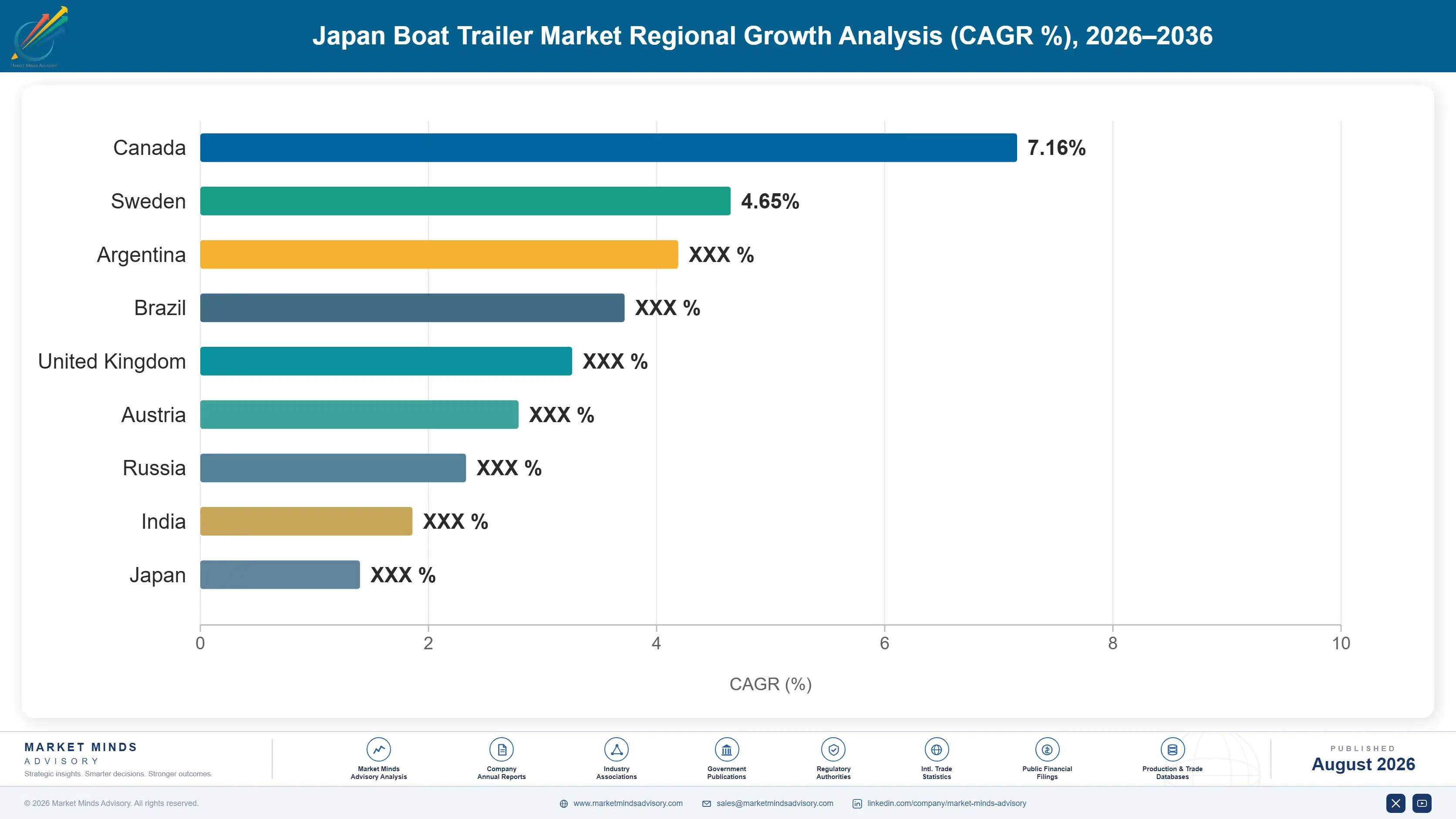
japan-boat-trailer-industry-trends-country-cagr-analysis-1787553450831

Where Trailer Margin Actually Sits

Four moves matter in a business where infrastructure decides the addressable market and freight decides who can serve it. Two are about the material transition that saltwater guarantees, and two are about the markets where trailering could exist and currently does not. Competing on steel price is not among them. Steel price arguments were lost long ago.

Build aluminium fabrication before the transition completes

Aluminium compounds at 6.0% because saltwater settles the argument for every repeat buyer eventually, and galvanising adds 18% to steel trailer cost while only delaying the outcome. Aluminium fabrication is genuinely different work from steel, which is why several established builders have not entered the segment and cannot quickly. Building that capability now captures repeat buyers who have already replaced one corroded frame and will not buy steel again. Waiting means competing for the first-time buyers who choose on price and generally come back angry eight years later. That transition finishes within a decade.
Market Impact: Enters a segment compounding at 6.0% every year

Design for the electric tow vehicle range penalty

Towing cuts electric vehicle range by roughly 47% and nothing removes that, but every kilogramme of trailer weight recovers a little of it. As tow fleets electrify, weight becomes a purchasing criterion rather than a specification detail, and the manufacturer with the lightest compliant trailer in each capacity class wins on an argument nobody was making five years ago. Aluminium and hybrid frames both help. Manufacturers still competing on steel gauge and price are optimising against a comparison their customers are about to stop making entirely. The comparison is changing underneath them.
Market Impact: Recovers part of a 47% towing range penalty

Ship the trailer with the exported boat

Japanese and Korean builders export substantial boat volume into markets where trailering is normal, and the trailer gets sourced separately in the destination market by a dealer. That is revenue leaving the manufacturer for no particular reason. Supplying a matched trailer with the boat improves the dealer proposition, guarantees fitment and captures value currently going elsewhere entirely. The obstacle is freight relative to trailer value, which means this works on high-value boats and not volume ones. East Asia holds 15% of market value and captures almost none of the trailer revenue behind it.
Market Impact: Captures the full 15% of regional manufacture value

Serve the repeat buyer, not the first purchase

A trailer lasts around 14 years and the buyer who has owned one already understands corrosion, towing weight and ramp handling in a way a first-time purchaser cannot. That second purchase is where aluminium wins, where specification rises and where price sensitivity drops noticeably. Manufacturers selling through dealers into first purchases compete entirely on price against every other steel builder in the delivery radius. Reaching repeat buyers means owner communities, marina noticeboards and boat clubs rather than dealer showrooms, which is a channel almost nobody in this industry has built.
Market Impact: Targets the whole 14 year replacement cycle properly

Who Controls the Margin Pool

Five manufacturers hold 43% of boat trailer supply, measured on trailer unit revenue at manufacturer level, the basis used throughout this section. That concentration sits almost entirely in North America, which is where the volume is, and describes little about competitive conditions elsewhere. Freight on a trailer is expensive relative to its value, which keeps manufacture regional and means a builder in one market rarely competes with one in another at all.
Competition runs on three dimensions. Material capability, particularly whether a builder can fabricate aluminium as well as steel. Dealer network reach, since most first purchases happen alongside a boat. And weight in each capacity class, which mattered little until tow vehicles started electrifying and now matters increasingly. Price competes hardest in galvanised steel, which is the declining part of the market.

Rankings shift on the material transition rather than on any competitive action, since builders without aluminium capability lose repeat buyers steadily and cannot recover them. Regional positions hold because freight protects them. The Japanese question is different entirely: domestic competition barely exists because domestic demand barely exists, and any change would come from infrastructure rather than from anybody's commercial effort.
japan-boat-trailer-industry-trends-company-positioning-matrix-1787553451346

Competitive Moat and Risk Dimensions

LOAD RITE TRAILERS

Moat: Dealer network depth

Load Rite holds dealer relationships across the American boating markets that put its trailers alongside boats at the point of first purchase, which is where most trailer decisions actually get made. That network took decades to build and a competitor cannot assemble one quickly, because dealers carry limited trailer lines and changing means displacing an incumbent relationship.
LOAD RITE TRAILERS

Risk: Steel-weighted product range

A large part of the range remains galvanised steel in a market where aluminium keeps taking repeat buyers on corrosion grounds. Every owner replacing a rusted frame is a customer choosing on different criteria than they used first time. Competitors built around aluminium fabrication face the transition from the correct side of it.
EZ LOADER BOAT TRAILERS

Moat: Custom configuration capability

EZ Loader builds trailers configured to specific hull shapes rather than to generic capacity classes, which matters because a badly matched trailer damages a boat over time and owners eventually learn that. Configuration capability requires engineering and manufacturing flexibility that volume producers optimising for throughput generally sacrifice deliberately.
EZ LOADER BOAT TRAILERS

Risk: Configuration limits throughput

Building to specific hulls constrains production efficiency against competitors running standardised capacity classes at higher volumes and lower unit cost. In first-purchase decisions made on price at a dealer counter, that difference shows immediately. The configuration argument only pays with buyers who already understand why it matters.

Players Tracked

Prominent Players

Load Rite Trailers
EZ Loader Boat Trailers
Karavan Trailers
Magic Tilt Trailers
ShoreLand'r

Other Key Players

Venture Trailers
Continental Trailers
McClain Trailers
Yacht Club Trailers
Brenderup
Harbeck Bootstrailer
Vanclaes
Dunbier Marine
Redco Trailers
Balco Trailers
Rolco
Pega Trailer
Sorensen Trailers
Toyo Trailer
Sanshin Marine

Recent Developments

APRIL 2025

Karavan Trailers expanded aluminium trailer production capacity

Karavan Trailers commissioned additional aluminium fabrication capacity at a North American site, responding to repeat buyers moving away from galvanised steel on corrosion grounds. The investment was organic and funded internally, with no partner or acquisition involved, and the existing steel lines continue at reduced share.
Signal: Fabrication capital is moving toward aluminium, which confirms builders expect the material transition to continue rather than stall
SEPTEMBER 2025

Dunbier Marine extended lightweight trailer range for electric tow vehicles

Dunbier Marine introduced lighter trailer configurations across several capacity classes aimed at owners towing with electric vehicles facing significant range penalties. This was an organic product development rather than any transaction, and it responds to a purchasing criterion that barely existed five years ago. Range anxiety reached the boat ramp.
Signal: Weight is becoming a stated purchasing criterion rather than a specification detail, which changes what a builder optimises for
FEBRUARY 2026

A Japanese boat manufacturer began supplying matched trailers with export models

A Japanese recreational boat manufacturer started offering factory-matched trailers alongside selected export models into Australian and North American markets. The arrangement is direct manufacture and supply rather than any partnership, and it targets value currently captured by destination market trailer builders. Fitment problems drove the decision entirely.
Signal: Boat manufacturers are testing whether trailer supply travels with the hull, which would change regional supply patterns considerably

What Moves Trailer Cost

Steel or aluminium accounts for around 41% of trailer cost of goods, with axles, hubs, springs, lighting, galvanising where applied and assembly labour making up the balance. Galvanising alone adds roughly 18% to a steel trailer. Axles and running gear come from a small number of specialist producers. Aluminium extrusion comes from regional suppliers at prices set on global exchanges.
Steel and aluminium prices both moved sharply through 2021 and again during 2022, and European energy costs raised galvanising expense simultaneously since the process is furnace-based and continuous. IEA data show European industrial gas running well above American levels then. Manufacturers on dealer price lists absorbed most of the movement, because a published trailer price cannot be changed mid-season without losing every comparison a customer runs.

Published seasonal pricing is what makes this exposure awkward. A manufacturer sets prices before a boating season and delivers through it against a metal cost base that may move considerably. Aluminium builders carry exchange-linked exposure that steel builders do not. Manufacturers with captive galvanising avoid a cost line that outsourced competitors cannot control at all. Nobody in this industry hedges metal the way an automotive supplier would.
japan-boat-trailer-industry-trends-cost-volatility-analysis-1787553451542

Index dealer pricing to published metal benchmarks

Setting a season price against unknown metal costs transfers volatility to the manufacturer across months nobody can forecast. Indexing to published steel and aluminium benchmarks with a mid-season reset removes the exposure, and dealers accept it once they understand the alternative is a padded season price. Resistance comes from dealer expectations rather than from anything commercial.

Bring galvanising in-house where volume justifies it

Galvanising adds roughly 18% to steel trailer cost and outsourcing it puts a large cost line outside any manufacturer's control. Captive capacity converts that into a fixed asset with known operating cost, which works where volume is committed and fails where it is not. The judgement is entirely about volume certainty rather than about the process itself.

Hedge aluminium exposure across the season pricing horizon

Aluminium trades on exchanges with real volatility and a builder setting season prices carries that risk unhedged across several months. Steel builders face a slower moving cost base and generally ignore hedging entirely. As aluminium share rises at 6.0%, the exposure grows with it and the habit of ignoring it becomes considerably more expensive each year.

Portfolio Architecture for Margin Defence

Margin in boat trailers tracks material capability and configuration rather than manufacturing scale, since welding a steel frame is not difficult and many regional builders do it adequately. Galvanised steel trailers run at gross margins in the mid teens, competing on price against anybody inside the delivery radius. Aluminium trailers run considerably higher, because fabrication capability is scarcer and the buyer choosing aluminium has already decided price is not the criterion. Custom-configured trailers run higher again where the customer understands why configuration matters.
The tension is that steel volume fills the welding lines and aluminium earns the return, and the two require different fabrication capability rather than merely different material. A shop tooled and staffed for steel does aluminium work badly, and the welding skills genuinely do not transfer. Manufacturers running both have generally found the steel volume consuming the capacity that aluminium demand needed, which is a capital allocation problem disguised as a scheduling one.

High-value pools sit in aluminium fabrication, lightweight designs for electric tow vehicles and configuration capability sold to repeat buyers. None of the three is where the current unit volume is. Welding capacity by itself defends nothing at all in this market.

Volume / Commodity-Adjacent

Galvanised and painted steel trailers in standard capacity classes sold through dealers on price against every regional builder inside the delivery radius. The seven-point range separates manufacturers with captive galvanising from those outsourcing a cost line worth roughly a fifth of the product.
Gross Margin: 14%-21%

Premium / Certified

Aluminium trailers and stainless-componented steel constructions sold on corrosion performance to buyers who have generally owned a trailer before. The eight-point spread reflects fabrication capability, which is scarcer than steel welding and cannot be added quickly by anybody.
Gross Margin: 25%-33%

Sustainability / Regulatory / Next-Generation

Hybrid frame constructions, lightweight designs for electric tow vehicles and hull-specific custom configurations. The twelve-point range is wide because pricing reflects engineering scarcity and buyer understanding rather than any material cost a customer could benchmark.
Gross Margin: 32%-44%
japan-boat-trailer-industry-trends-portfolio-architecture-1787553452032

High-value Sub-segments and Strategic Watch-out

Aluminium Fabrication Capability

Compounding at 6.0% because saltwater settles the argument for every repeat buyer eventually, and defended by fabrication skills that do not transfer from steel welding. Several established builders have not entered and now cannot quickly. That gap keeps widening every year. Entry is getting harder each year.
Gross Margin: 26%-34%

Lightweight Electric Tow Designs

Towing cuts electric vehicle range by 47% and every kilogramme removed recovers part of it, which turns weight into a purchasing criterion nobody used five years ago. The lightest compliant trailer in each class wins on a new argument. Very few builders have noticed. Most are still optimising steel gauge.
Gross Margin: 32%-44%

Galvanised Steel Volume

The volume that fills welding lines and reaches first-time buyers through dealers, growing under 3% and losing repeat purchasers steadily on corrosion. Anybody inside the radius can build it and most do. Manage it for utilisation rather than for margin anywhere. The decline is steady and permanent.
Gross Margin: 14%-21%

Repeat Buyer Channel

A trailer lasts 14 years and the second purchase is where aluminium wins, specification rises and price sensitivity falls noticeably. Reaching those buyers means owner communities and boat clubs rather than dealer showrooms. Almost nobody has built that channel at all. It is the obvious unclaimed position.
Gross Margin: 26%-40%

How Trailer Demand Renews

Trailer demand renews on two clocks. New boat sales bring a trailer with them for most trailerable hulls, which ties that half of demand to marine retail and to the economic conditions that drive discretionary purchases. Replacement runs on a roughly 14 year service life and behaves quite differently, arriving whether or not anybody is buying boats. The pandemic surge renewed the installed base heavily, which suppresses replacement into the early 2030s.
Stickiness is weak and geography does most of the work. A buyer takes whichever builder the dealer carries, which makes the dealer relationship the whole competitive position for first purchases. Repeat buyers behave completely differently, choosing on corrosion experience and towing weight rather than on availability. Custom-configured trailers are stickier still, since the fit was engineered to a specific hull.

The buyer has changed only for repeat purchases and manufacturers mostly still sell to first-time ones. Trailer choice at first purchase sits with a boat dealer bundling whatever line they stock. At replacement it sits with an owner who has spent eight years watching a frame corrode and now cares about material, weight and hull fit. Those are two different customers reached through two different channels.
japan-boat-trailer-industry-trends-end-use-penetration-index-1787553452519

Where To Place The Bet

These are among the four positions where our research anticipates prominent divergence between winners and laggards over the coming forecast period. Each is grounded in the demand model, the regulatory perimeter, and the announced capacity pipeline.
01 / ALUMINIUM CAPABILITY BUILD

Fabricate aluminium before the transition finishes

Aluminium compounds at 6.0% because saltwater settles the corrosion argument for every repeat buyer eventually, and galvanising adds roughly 18% to steel trailer cost while only delaying the outcome rather than preventing it. Aluminium fabrication is genuinely different work and the welding skills do not transfer, which is why several established steel builders have not entered the segment and cannot enter it quickly now. Building that capability captures buyers who have replaced one corroded frame and will never buy steel again.
02 / WEIGHT DESIGN PRIORITY

Optimise for the electric tow range penalty

Towing a loaded boat trailer cuts electric vehicle range by roughly 47% and no battery development removes an aerodynamic and mass penalty of that kind at all. Every kilogramme of trailer weight recovers a little of it, which turns weight into a stated purchasing criterion for buyers who never asked about it before tow fleets began electrifying. The manufacturer holding the lightest compliant trailer in each capacity class wins on an argument that simply did not exist five years ago.
03 / EXPORT TRAILER ATTACHMENT

Send a trailer with every exported hull

Japanese and Korean builders export substantial boat volume into markets where trailering is entirely normal, and the trailer gets sourced separately by a dealer in the destination market instead. That is manufacturer revenue leaving for no particular reason beyond habit and freight assumptions nobody has tested properly. Supplying a factory-matched trailer improves the dealer proposition, guarantees fitment and captures value going elsewhere, and it works cleanly on higher-value hulls where trailer freight is a considerably smaller proportion of shipped value.
04 / REPEAT BUYER CHANNEL

Reach the owner, not the boat dealer

A trailer lasts around 14 years and the buyer replacing one understands corrosion, towing weight and hull fit in a way that no first-time purchaser at a dealer counter possibly can. That second purchase is where aluminium wins, specification rises and price sensitivity drops away noticeably from the first transaction. Reaching those buyers means owner communities, marina noticeboards and boat clubs rather than dealer showrooms, and almost nobody in this industry has ever seriously attempted to build that particular channel.

Engagement Snapshot From the Field

A live engagement with an industry participant carrying material or product regulatory and market exposure ahead of a defining policy shift, showing how our research translates into a defensible multi-year portfolio strategy.
MARKET MINDS ADVISORY · CLIENT ENGAGEMENT SUMMARY
Japan Boat Trailer Producer Strategic Portfolio Review and Transition Roadmap 2026·Investment Scenario on Japan Boat Trailer Exposure Evaluation 2025-26
CLIENT PROFILE
A Japanese recreational boat manufacturer with annual revenue around JPY 96 billion (client-reported, unverified by MMA), exporting a substantial share of production into North American, Australian and European markets. Trailers were sourced by dealers in each destination market with no involvement from the manufacturer. Domestic sales ran almost entirely to marina-berthed customers who never needed one.
STRATEGIC CHALLENGE
Dealer feedback across Australia and North America reported recurring fitment problems where locally sourced trailers matched hull shapes poorly, generating warranty claims the client absorbed (client-reported, unverified by MMA). The commercial team had raised supplying matched trailers and freight assumptions had killed the discussion. Nobody had actually modelled the freight against boat value.
MMA APPROACH
MMA modelled trailer freight cost against hull value by model rather than treating export shipping as a single number, establishing where attachment works and where it does not. Warranty claims attributable to trailer fitment were quantified across three years of dealer records. Destination market trailer manufacture and dealer purchasing practice were reviewed through the expert interview programme in both target markets.
KEY FINDINGS
  1. Freight on a trailer was a small proportion of shipped value on the top four hull models and prohibitive on the entry range, which nobody had separated before.
  2. Fitment-related warranty claims across three years exceeded the estimated cost of supplying matched trailers on the affected models by a considerable margin.
  3. Australian dealers were substantially more receptive to factory-matched trailers than American ones, where established trailer dealer relationships are considerably deeper and older.
  4. Domestic Japanese demand for trailers remained negligible and infrastructure constraints made any change there unlikely within any reasonable planning horizon at all.
CLIENT PROFILE
A Japanese recreational boat manufacturer with annual revenue around JPY 96 billion (client-reported, unverified by MMA), exporting a substantial share of production into North American, Australian and European markets. Trailers were sourced by dealers in each destination market with no involvement from the manufacturer. Domestic sales ran almost entirely to marina-berthed customers who never needed one.
STRATEGIC CHALLENGE
Dealer feedback across Australia and North America reported recurring fitment problems where locally sourced trailers matched hull shapes poorly, generating warranty claims the client absorbed (client-reported, unverified by MMA). The commercial team had raised supplying matched trailers and freight assumptions had killed the discussion. Nobody had actually modelled the freight against boat value.
MMA APPROACH
MMA modelled trailer freight cost against hull value by model rather than treating export shipping as a single number, establishing where attachment works and where it does not. Warranty claims attributable to trailer fitment were quantified across three years of dealer records. Destination market trailer manufacture and dealer purchasing practice were reviewed through the expert interview programme in both target markets.
KEY FINDINGS
  1. Freight on a trailer was a small proportion of shipped value on the top four hull models and prohibitive on the entry range, which nobody had separated before.
  2. Fitment-related warranty claims across three years exceeded the estimated cost of supplying matched trailers on the affected models by a considerable margin.
  3. Australian dealers were substantially more receptive to factory-matched trailers than American ones, where established trailer dealer relationships are considerably deeper and older.
  4. Domestic Japanese demand for trailers remained negligible and infrastructure constraints made any change there unlikely within any reasonable planning horizon at all.
RECOMMENDED STRATEGY
Phase 1: Phase one: supply factory-matched trailers on the top four hull models into Australia only, where dealer receptiveness and freight economics both work. Phase 2: Phase two: measure warranty claim reduction against the attachment cost over two full seasons before extending the programme anywhere else at all. Phase 3: Phase three: leave domestic trailer supply entirely alone, since infrastructure rather than product availability constrains that particular market almost entirely.
OUTCOME
Factory-matched trailers now ship with the four selected models into Australia and dealer response has been positive. Fitment warranty claims on those models have fallen. The client reports the programme is running roughly at breakeven on direct cost with the warranty saving making it clearly positive overall (client-reported, unverified by MMA).

Frequently Asked Questions

Foundational context covering the market sizes, CAGR, scope, country, region and competition that inform every finding below. This section is provided to cover basics and most often pre-purchase conversations, answered from the MMA Primary Research Dataset.

What is the current size of the Japan Boat Trailer Market?

The global market was valued at USD 1.3 billion in 2025, rising to an estimated USD 1.35 billion in 2026. North America holds the largest regional share at 38% of value.

How large will the Japan Boat Trailer Market be by 2036?

MMA forecasts USD 2.00 billion by 2036 under the base case, an expansion multiple of 1.48 times the 2026 value. That represents USD 0.65 billion of incremental value.

What is the CAGR for the Japan Boat Trailer Market 2026 to 2036?

The base case runs at 4.0% compound annual growth between 2026 and 2036, with a bull case at 5.2% and a bear case at 2.8%. Historical growth from 2020 to 2025 was 3.4%.

Which segment is growing fastest?

Aluminium trailers lead at 6.0%, half again the market rate, because saltwater corrodes steel and repeat buyers eventually stop buying it. Composite and hybrid frames follow at 5.4%.

Who are the major companies in the Japan Boat Trailer Market?

Load Rite Trailers, EZ Loader Boat Trailers, Karavan Trailers, Magic Tilt Trailers and ShoreLand'r hold 43% between them. Dealer network reach and material capability sustain those positions.

Which country is growing fastest?

Australia leads at 6.6%, the only market outside North America where trailer boating is genuinely mainstream, because ramp infrastructure and towing rules both permit it.

Report Segmentation Architecture

The full report scope spans multiple orthogonal segmentation dimensions, with cross-tabulated demand data provided for each dimension pair. Coverage extends further to regional breakdowns, trend trajectories, and the competitive detail needed to support segment-level decision-making.

By Frame Material

  • Galvanised Steel Trailers
  • Aluminium Trailers
  • Painted and Powder-Coated Steel Trailers
  • Composite and Hybrid Frame Trailers
  • Stainless-Componented Steel Trailers
  • Marine-Coated Steel Trailers

By End-Use Industry

  • Recreational Powerboats
  • Personal Watercraft
  • Sailing Dinghies and Small Keelboats
  • Commercial Fishing and Workboats
  • Marina and Dealer Handling
  • Rescue and Government Craft

By Sales Channel

  • Boat Dealer Bundled Supply
  • Independent Trailer Dealer
  • Direct Manufacturer Supply
  • Marine Accessory Retail
  • Fleet and Government Tender

By Region

  • North America
  • Western Europe
  • East Asia
  • South Asia and Pacific
  • Latin America
  • Middle East and Africa
  • Eastern Europe

Scope, Methodology, and Coverage

Every figure in this report is reproducible from documented input assumptions. The scope below maps the historical period, the forecast horizon, the segmentation dimensions, and the countries covered, alongside the underlying primary and qualitative methodology.
Historical Period
2020 to 2025
Forecast Period
2026 to 2036
Base Year
2025 (USD billions; MMA Primary Research Dataset, August 2026)
Market Definition
The market comprises road-legal trailers designed to transport and launch recreational and light commercial watercraft, covering galvanised steel, aluminium, painted and powder-coated steel, composite and hybrid frame, stainless-componented and marine-coated steel constructions across all capacity classes. Value is measured at trailer manufacturer level, with Japan treated as the analytical centre throughout the analysis. Commercial heavy haulage trailers, yacht transport cradles, marina handling and hydraulic trailers, boat lifts and davits, towing vehicles, and the watercraft themselves fall outside scope.
Quantitative Units
USD billions (current prices); thousand trailer units shipped annually; USD per unit by frame material and capacity class
Segmentation Dimensions
By Frame Material; By End-Use Industry; By Sales Channel; By Region
Regions Covered
North America, Western Europe, East Asia, South Asia and Pacific, Latin America, Middle East and Africa, Eastern Europe
Countries Covered
Japan, South Korea, China, Taiwan, Australia, New Zealand, Thailand, Indonesia, Malaysia, United States, Canada, Mexico, Norway, Sweden, Finland, Denmark, Netherlands, Germany, United Kingdom, France, Italy, Spain, Poland, Croatia, Czechia, Brazil, Argentina, Chile, United Arab Emirates, South Africa
Key Companies Profiled
Load Rite Trailers, EZ Loader Boat Trailers, Karavan Trailers, Magic Tilt Trailers, ShoreLand'r, Venture Trailers, Continental Trailers, McClain Trailers, Yacht Club Trailers, Brenderup, Harbeck Bootstrailer, Vanclaes, Dunbier Marine, Redco Trailers, Balco Trailers, Rolco, Pega Trailer, Sorensen Trailers, Toyo Trailer, Sanshin Marine
Quantitative Methodology
Primary survey, n=3,800 respondents, Q4 2025, six countries; demand-side model with trade association cross-validation
Qualitative Methodology
47 expert interviews, Q4 2025; applied to validate demand model assumptions, identify emerging dynamics, and assess competitive positioning
Report Format
PDF and XLSX data workbook (Word format preview document)
Publisher
Market Minds Advisory
Report Code
MMA-2026-AUT-303
Published
August 2026
Contact
sales@marketmindsadvisory.com | www.marketmindsadvisory.com

Purchase the full Japan Boat Trailer Market Report (2026 to 2036).

The full report sizes the global boat trailer market to 2036 across six frame materials and seven regions, with Japan treated as the analytical centre and its infrastructure constraints quantified against comparable markets. It explains why trailer boating concentrates in North America and Australia, and models ramp provision and towing regulation as the variables governing demand. Competitive analysis covers 20 participants evaluated on trailer unit revenue, with moat and risk assessment for the two leaders. The electric tow vehicle range penalty is quantified by capacity class, and input cost exposure runs from metal pricing to seasonal dealer price lists. Four quantified revenue levers close the analysis.
Six-material segment sizing with segment-level growth rates
Seven-region share and growth breakdown to 2036
Twenty-participant competitive map on one revenue basis
Launch infrastructure and towing regulation compared across markets
Input cost exposure traced to steel, aluminium and galvanising
Four quantified revenue levers with commercial impact ranges

Built For The People Who Decide

From boardroom strategy to bench-side execution, this report is read cover-to-cover by leaders shaping the next decade of their industry, turning demand scenarios, market dynamics and valuation benchmarks into decisions.
CXOs/ Presidents/ VPs/ Managers
M&A and Corporate Development
Strategy Teams and R&D Heads
Procurement and Product Directors
Regulatory and Compliance Leaders
Investor Relations and Equity Analysts