Market Minds Advisory
Demand for Bakery Enzymes in Japan

Demand for Bakery Enzymes in Japan: Demand for Bakery Enzymes in Japan. Clean Label Dough Conditioning Technology Through 2036

Japanese bakeries and industrial bread producers are replacing chemical dough conditioners with enzyme systems as clean-label consumer pressure spreads from Europe into Asia, betting biological solutions can match performance without additive labels shoppers now avoid.

Lead Analyst

Published

September 2026

Make Smarter Decisions with Customized Research Insights

Request a free sample report and evaluate market opportunities, growth trends, and competitive dynamics relevant to your business needs.

2025 MARKET VALUE$1.6BMarket Size 2025
2036 FORECAST VALUE$3.2BBase Case , 2026 to 2036
CAGR 2026 TO 20366.5 %Bull 7.8% / Bear 5.2%
INCREMENTAL OPPORTUNITY$1.5BNet 10- year value creation
EXPANSION MULTIPLE1.88x2036 value over 2026 base
Strategic Levers
M&A Pipeline
Regional Outlook
Country Rankings
Competitive Intelligence
Segmental Deep-dive
Call-Us : 91 93563 13602

Executive Snapshot and Market Trajectory.

Bakery enzyme demand in Japan is accelerating as convenience store and industrial bakery chains replace chemical dough conditioners and emulsifiers with enzyme-based alternatives to satisfy clean-label consumer expectations that have spread rapidly across the entire domestic packaged bread and pastry category in recent years and continue accelerating.
Xylanase and custom enzyme blend formulations are capturing outsized growth as Japanese industrial bakeries seek dough conditioning performance that matches synthetic additives without triggering ingredient label concerns among health-conscious consumers. East Asia holds the largest global share given Japan's advanced convenience store bakery culture and China's rapidly westernizing bread consumption patterns, while amylases remain the largest deployed enzyme category by volume across commercial baking worldwide today.
Competition splits between diversified global enzyme producers offering broad bakery formulation portfolios and specialized Japanese and regional manufacturers competing on application-specific technical support and rapid custom blend development for individual bakery customers across the country and wider region. Regulatory pressure around food additive labeling in Japan is reshaping ingredient specification decisions, forcing bakeries to document enzyme sourcing and processing aid status well beyond what chemical additive declarations ever required across the industry.
Market Definition
The bakery enzymes market covers amylases, xylanases, lipases, proteases, oxidases, and custom multi-enzyme blends used as processing aids in bread, roll, and pastry manufacturing, with this study emphasizing demand patterns and adoption intensity in Japan specifically. It excludes non-enzymatic dough conditioners, yeast and other fermentation organisms, and enzymes used outside bakery applications such as dairy or brewing processing.
Base Year Value
$1.6B in 2025 (MMA Primary Research Dataset, September 2026)
Forecast Period
2026 to 2036, eleven discrete annual values
CAGR
6.5% base case. Bull 7.8%. Bear 5.2%.
Fastest Growth Segment
Custom Multi-Enzyme Blends: 9.5% CAGR
Fastest Growth Country
Japan: 7.5% CAGR
Fastest Growth Region
South Asia and Pacific: 8.5% CAGR
Largest Region
East Asia: 29% of 2025 global value
Market Leaders
[object Object]
Primary Survey
n=3,800 procurement and R&D decision-makers, Q4 2025, six countries
Methodology
Demand-side build-up, cross-validated against public data, 47 expert interviews

Demand for Bakery Enzymes in Japan Market Forecast Scenarios

japan-bakery-enzymes-market-size-forecast-scenario-1790014669944
Between 2020 and 2025 bakery enzyme adoption in Japan accelerated as major convenience store chains and industrial bakeries reformulated products to remove synthetic emulsifiers following sustained consumer pressure for simpler ingredient labels nationwide. Historical annual growth ran near 5.5 percent as enzyme suppliers expanded technical support teams to help bakeries navigate reformulation projects across the country.
The base case assumes 6.5 percent annual growth through 2036, driven by three mechanisms: continued clean-label reformulation across convenience store and industrial bakery product lines replacing chemical dough conditioners with enzyme alternatives, rising demand for extended shelf-life bakery products as Japan's aging population shops less frequently and expects longer freshness windows, and expanding custom enzyme blend adoption as bakeries seek differentiated texture and crumb characteristics that competitors cannot easily replicate at scale.
A bull scenario centers on major convenience store chains mandating enzyme-only dough conditioning across their entire private label bakery portfolio faster than currently planned reformulation timelines across the broader baking industry. The bear risk is prolonged wheat import cost volatility forcing bakeries to prioritize raw material cost reduction over premium enzyme formulation investment across cost-sensitive operators nationwide.

Clean Label Reformulation Replaces Chemical Dough Conditioners

Fermentation feedstock and enzyme purification processing together represent the largest share of production cost for bakery enzyme manufacturers, since enzyme activity and purity both depend heavily on microbial strain performance and downstream processing steps performed at specialized fermentation facilities concentrated in Japan, Europe, and North America overall.
MARKET CONCENTRATIONCR5 48%Top five producers hold a fairly high market presence overall
SUPPLY RELATIONSHIP LENGTH5-8 yearsSupply relationships keep spanning many years before major renewal
TOP PRODUCING COUNTRYDenmark 22%One country generates a large share of enzyme consumption
FERMENTATION UTILISATION75%Fermentation facilities keep running below theoretical maximum output capacity
TRADE INTENSITYModerateImport and export activity remains moderate across this category
FEEDSTOCK COST SHARE42% of COGSFermentation feedstock represents the single largest producer cost component
Japanese bakery customers increasingly differentiate suppliers by technical application support and formulation customization speed rather than enzyme activity specifications alone. Companies comparing suppliers now weigh on-site trial support and rapid reformulation turnaround as heavily as price, narrowing the room for suppliers offering only standard catalog enzyme products without dedicated technical service and formulation expertise. Non-genetically-modified sourcing certification has also become a meaningful differentiator as retailers face growing consumer scrutiny.
Supply relationships between enzyme producers and major Japanese bakery customers typically span five to eight years once a formulation is qualified into production, giving incumbent suppliers with existing technical relationships a durable advantage over new entrants lacking comparable formulation history and proven reliability. That dynamic keeps switching costs meaningfully high for bakeries evaluating alternative suppliers during scheduled product reformulation cycles and new product launches across the broader product line.
"A shopper reading a bread label in Tokyo today expects to recognize every ingredient on it, and enzymes disappear from that label entirely once they finish their job. That single fact explains why chemical dough conditioners are losing shelf space one reformulation at a time."
Principal Analyst, Food Ingredients and Processing Enzymes Practice · MMA Chemicals and Materials: Food Processing Enzymes Practice · September 2026

Market Trends

Clean Label Reformulation Accelerates Across Convenience Store Bakeries

Major Japanese convenience store chains are systematically reformulating their private label bread and pastry lines to remove synthetic emulsifiers and chemical dough conditioners, replacing them with enzyme systems that deliver comparable dough handling and shelf-life performance without triggering ingredient label concerns among increasingly label-conscious shoppers. This reformulation wave has moved well beyond flagship premium products into everyday mainstream bread lines that represent the overwhelming majority of convenience store bakery sales volume nationwide. Enzyme suppliers that developed proven drop-in replacement formulations early are capturing disproportionate share of these large reformulation contracts, since bakeries rarely revisit an approved formulation once production stabilizes.
Market Impact: Extends shelf life by 40 percent
Custom Enzyme Blends Enable Differentiated Texture Positioning

Japanese bakeries increasingly commission custom multi-enzyme blend formulations tailored to achieve specific crumb texture, crust characteristics, and freshness duration that generic single-enzyme products cannot deliver, turning formulation into a genuine product differentiation tool rather than a purely functional ingredient decision. This shift has become a standard specification requirement in competitive premium bakery procurement, particularly among chains competing on artisan-style product positioning. Suppliers lacking dedicated application laboratories and rapid custom formulation capability are increasingly losing competitive contracts to rivals offering faster turnaround on bespoke blend development, reshaping near-term investment priorities across the enzyme supplier industry broadly.
Market Impact: Improves dough yield by 8 percent

Market Opportunities and Growth Drivers

Aging Population Drives Extended Shelf Life Bakery Demand

Japan's aging population shops less frequently and increasingly expects packaged bakery products to remain fresh for extended periods between shopping trips, pushing manufacturers toward anti-staling enzyme formulations that extend usable shelf life well beyond what conventional recipes achieve. Bakeries calculate return on investment against actual realized product waste reduction and extended retail sell-through window rather than theoretical freshness estimates, strengthening the business case considerably across nearly every packaged bread category studied closely. Retailers with the oldest average customer base report the strongest demand for extended shelf-life formulations and the fastest enzyme adoption payback periods.
Market Impact: Excludes suppliers from 25 percent

Wheat Import Cost Pressure Sustains Yield Optimization Demand

Japan imports the overwhelming majority of its wheat supply, making bakery producers highly sensitive to global wheat price volatility and sustaining demand for enzymes that improve dough yield and reduce ingredient waste during production regardless of near-term economic conditions elsewhere in the business. Bakeries calculate return on investment against actual realized flour cost savings and production yield improvement rather than theoretical efficiency estimates, strengthening the business case considerably across nearly every industrial bakery operation studied closely. Operations with the highest wheat cost exposure report the fastest enzyme adoption payback periods and the strongest appetite for continued expansion.
Market Impact: Degrades activity above 40 degrees

Market Restraints and Challenges

Enzyme Sourcing From Genetically Modified Organisms Raises Concerns

A meaningful share of commercial food enzymes are produced using genetically modified microbial strains, creating labeling and consumer acceptance complications in Japan where genetically modified ingredient sourcing faces heightened scrutiny compared to many other developed markets. The root cause is that genetically modified strains typically achieve higher yields and lower production costs than conventional strains, creating cost pressure that pushes some suppliers toward genetically modified sourcing despite consumer sensitivity. The commercial impact falls hardest on suppliers unable to offer verified alternatives, facing exclusion from retailers with strict sourcing policies. Several suppliers now offer certified alternative lines as a mitigation approach.
Market Impact: Reformulates 60 percent of bread lines

Temperature Sensitivity Complicates Enzyme Storage and Transport

Bakery enzymes require careful temperature-controlled storage and transport to maintain activity levels, since enzyme degradation accelerates meaningfully at elevated temperatures common during Japan's humid summer months, creating logistics complexity that dry chemical additives never presented. The root cause is the fundamental protein chemistry underlying enzyme function, which denatures irreversibly outside narrow temperature ranges regardless of formulation sophistication. The commercial impact falls hardest on smaller bakeries lacking dedicated cold chain infrastructure, facing inconsistent product performance and occasional formulation failures. Several suppliers now offer heat-stable enzyme variants as a mitigation approach for challenging storage conditions.
Market Impact: Extends shelf life by 5 days
3 additional market trends, 4 additional growth drivers, and 2 additional restraints and challenges are covered in the full report. Contact sales@marketmindsadvisory.com to access the complete intelligence.

Segment CAGR and Growth Architecture

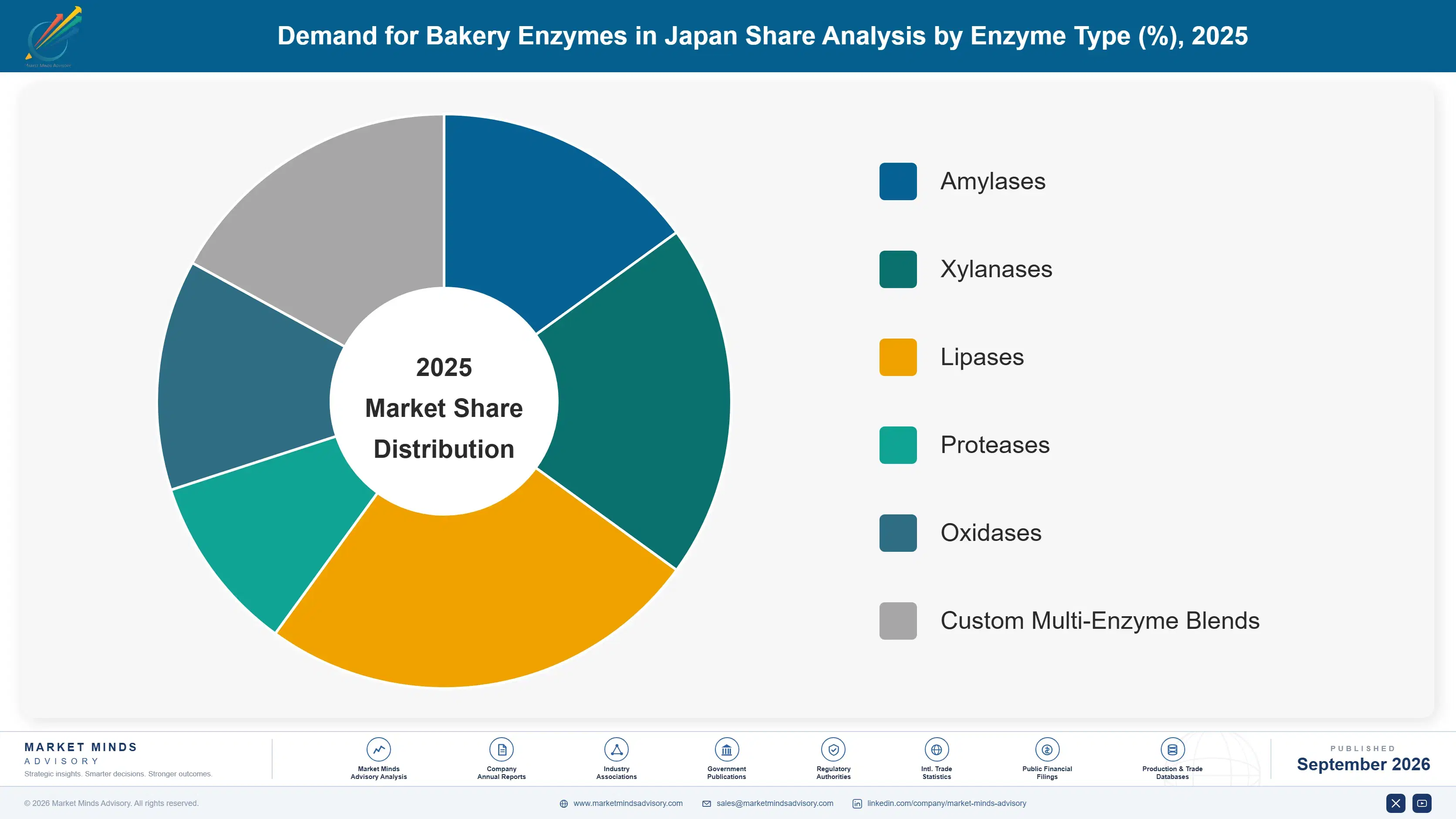
Bakery enzymes segment by core catalytic function, spanning amylases and xylanases through lipases, proteases, oxidases, and custom multi-enzyme blends formulated for specific bakery applications across the entire wider baking value chain and product portfolio. Custom enzyme blends and xylanases lead growth as Japanese bakeries pursue differentiated texture and clean-label dough conditioning performance nationwide today.
japan-bakery-enzymes-market-market-share-analysis-1790014670511

Custom Multi-Enzyme Blends

Custom multi-enzyme blend formulations combine two or more enzyme types into a single tailored product engineered to achieve a specific bakery customer's crumb texture, shelf-life, and dough handling requirements simultaneously, rather than requiring the bakery to source and balance multiple single-function enzymes independently. Demand concentrates among large convenience store and industrial bakery chains seeking differentiated product positioning that generic standard enzyme products cannot deliver. Bakeries increasingly commission custom blends as a core product development strategy rather than an occasional special project, pushing suppliers to build dedicated application laboratories capable of rapid formulation iteration. Deployment complexity remains higher than standard single-enzyme products given the collaborative development work required, but established suppliers have simplified this process considerably.
CAGR 9.5%

Xylanases

Xylanases break down non-starch polysaccharides in wheat flour to improve dough extensibility and gas retention during proofing, delivering larger bread volume and finer, more consistent crumb structure than unmodified dough achieves naturally. Demand spans industrial bread, roll, and pastry manufacturers seeking to replace chemical dough conditioners like potassium bromate and azodicarbonamide that face increasing regulatory and consumer scrutiny worldwide. This segment commands premium pricing tied to dough performance consistency and clean-label positioning rather than simple unit cost, creating a meaningfully different competitive dynamic than basic amylase products. Suppliers compete heavily on enzyme specificity and dosage precision, since overdosing xylanase can produce excessively sticky dough that damages production line throughput considerably.
CAGR 8.5%
Full segment breakdown across 6 segments available in the complete report.

Regional Architecture and Country Demand Map

Regional demand tracks bakery industrialization, clean-label regulatory pressure, and per-capita bread consumption trends, with East Asia leading given Japan's advanced convenience store bakery culture and China's rapidly westernizing consumption patterns across the entire wider global region and industry overall today and well into going forward.

North America

The United States drives the overwhelming majority of North American demand, where large industrial bakery chains lead early adoption of clean-label enzyme reformulation across packaged bread and pastry categories nationwide today already. Canada contributes a smaller but steadily growing share, tied to its own industrial baking sector concentrated near major population centers overall today already now. Consumer advocacy pressure around synthetic additives continues pushing major retailers toward documented clean-label sourcing requirements, favoring suppliers with established formulation history over smaller entrants lacking comparable reformulation track records. Commercial bakery enzyme adoption remains broadly mature across most major product categories in this market, reflecting the depth of the domestic customer base overall today.
Share: 24% | CAGR: 6.0% (2026 to 2036)

Western Europe

Germany and France lead regional adoption, where strict European Union food additive regulation has driven enzyme-based reformulation across industrial bakeries for well over a decade, making Western Europe the original proving ground for clean-label bakery enzyme technology that has since spread to Japan and other developed markets worldwide today already. The United Kingdom maintains meaningful demand tied to its own large packaged bread sector despite operating under a separate post-Brexit regulatory framework from continental partners overall today already. Growth trails East Asia somewhat since most Western European reformulation has already occurred, limiting demand primarily to incremental optimization rather than the wholesale reformulation still underway in newer adopter markets today already.
Share: 23% | CAGR: 5.0% (2026 to 2036)
Regional intelligence for 5 additional markets available in the complete report: East Asia, South Asia and Pacific, Latin America, Middle East and Africa, Eastern Europe. Contact sales@marketmindsadvisory.com.
japan-bakery-enzymes-market-country-cagr-analysis-1790014671024

Monetizing Custom Formulation and Technical Service

Bakery enzyme margins increasingly depend on custom formulation depth and technical application support rather than standard catalog enzyme pricing alone. Suppliers that build deep bakery-specific formulation expertise capture disproportionate lifetime value from every customer relationship across successive product generations and reformulation cycles spanning many years of continuous production support, technical collaboration, and shared testing.

Custom Formulation Development Premium Pricing Model

Charging a premium for dedicated custom enzyme blend development converts a standard catalog sale into a higher-margin bespoke relationship that competitors selling only off-the-shelf enzymes cannot easily replicate at comparable speed or depth. Suppliers report custom formulation work increases average deal value by roughly 35 percent compared to standard catalog enzyme sales, since the collaborative development investment creates genuine switching cost once a formulation is validated in production. Customers accept this premium because it delivers texture and shelf-life characteristics that differentiate their product from competitors using generic ingredients across the market.
Market Impact: Raises average deal value by 35 percent overall

Technical Application Support Retainer Pricing Model

Bundling ongoing technical application support and troubleshooting into an annual retainer fee lets suppliers capture recurring revenue from customers who previously called on suppliers only during occasional formulation projects across the entire calendar year. This retainer model now represents close to 20 percent of total revenue for suppliers with strong technical service reputations, reflecting genuine value bakeries place on rapid troubleshooting during production issues. Suppliers favor this approach since it deepens the customer relationship and creates a natural upsell path toward additional formulation projects over time and across product categories.
Market Impact: Generates roughly 20 percent of all annual revenue

Certified Non GMO Sourcing Premium Strategy

Offering certified non-genetically-modified enzyme sourcing lets suppliers capture a premium from bakery customers facing consumer and retailer scrutiny around genetically modified ingredients, particularly in the Japanese market where such sourcing concerns run considerably higher than in many other developed markets worldwide today. This certified sourcing premium typically commands 15 percent above standard genetically modified equivalent pricing, reflecting the additional strain development and supply chain verification investment required. Customers increasingly view certified sourcing as a standard procurement requirement for retail private label programs rather than an optional enhancement across the industry.
Market Impact: Commands roughly a 15 percent sourcing price premium

Who Controls the Margin Pool

Concentration is moderate to high, with the top five producers by annual enzyme shipment revenue holding roughly 48 percent combined share of a market split between diversified global enzyme giants and specialized Japanese formulation houses. Novozymes leads by a meaningful margin over the next closest challenger, built on decades of enzyme production scale and bakery application expertise worldwide that newer entrants struggle to match at comparable breadth.
Current competitive activity centers on custom blend formulation expansion, non-genetically-modified sourcing certification, and technical service retainer bundling across nearly every producer product roadmap tracked in this analysis today. Diversified global enzyme giants continue expanding bakery-specific application laboratories, while specialized Japanese manufacturers compete on rapid custom formulation turnaround for regulated buyers evaluating multiple competing proposals simultaneously.

Emerging pressure comes from Chinese domestic enzyme manufacturers expanding into Japan and broader East Asia, threatening to reshape competitive dynamics beyond their traditional commodity segment stronghold within the next several years across the industry. Rankings could shift meaningfully if any top-five producer secures a dominant formulation win with a major convenience store bakery chain or suffers a significant quality incident that damages customer trust considerably.
japan-bakery-enzymes-market-company-positioning-matrix-1790014671557

Competitive Moat and Risk Dimensions

NOVOZYMES

Moat: Broad enzyme portfolio manufacturing scale

Novozymes benefits from decades of enzyme production scale and the industry's broadest bakery application portfolio, giving it distribution reach and formulation library depth that specialized Japanese manufacturers cannot match without years of comparable research investment. That existing footprint means many bakeries default to Novozymes for new formulation projects without formally evaluating competing suppliers during routine ingredient procurement.
NOVOZYMES

Risk: Slower local Japanese responsiveness

Novozymes moves more cautiously on Japan-specific formulation requests than smaller domestic specialist manufacturers solely focused on the Japanese bakery market, since its global structure spreads application engineering resources across many regional markets simultaneously. If nimble domestic competitors continue capturing custom formulation wins through faster local technical response, Novozymes could lose share in Japan's fastest-growing custom blend segment.
AMANO ENZYME

Moat: Deep Japanese bakery market expertise

Amano Enzyme built its reputation through decades of specialized expertise serving the Japanese food and bakery industry directly, giving it an advantage with domestic customers requiring rapid, culturally attuned technical support that global suppliers headquartered abroad cannot always match quickly. That specialization attracts Japanese bakeries who specifically prioritize local formulation responsiveness over the broader product breadth of larger global competitors.
AMANO ENZYME

Risk: Limited scale outside Japan

Amano Enzyme's concentrated focus on the Japanese market leaves it with comparatively limited manufacturing scale and distribution reach outside Japan, making it a harder choice for multinational bakery customers seeking a single global supplier relationship across many countries. If larger global competitors continue expanding localized Japanese technical support while offering broader coverage, Amano Enzyme could face pressure from consolidating customers.

Players Tracked

Prominent Players

Novozymes
DSM-Firmenich
AB Enzymes
Amano Enzyme
Advanced Enzyme Technologies

Other Key Players

BASF
DuPont
Puratos
Lesaffre
Enzyme Development Corporation
Aumgene Biosciences
Sunson Industry Group
Jiangsu Boli Bioproducts
Longda Bio-products
Specialty Enzymes and Biotechnologies
Biocatalysts
MetGen
Novus International
Kerry Group
Chr. Hansen

Recent Developments

FEBRUARY 2026

Novozymes: product launch

Novozymes announced an expanded xylanase product line optimized for Japanese wheat flour characteristics, offering improved dough conditioning performance compatible with domestic bakery production equipment without requiring separate reformulation work across the entire product line. The launch targets convenience store bakery chains seeking incremental clean-label improvements.
Signal: Signals global enzyme producers racing to localize formulations for Japanese wheat flour characteristics very quickly now
MAY 2026

Amano Enzyme: product launch

Amano Enzyme launched a certified non-genetically-modified enzyme blend line targeting retailers with strict ingredient sourcing policies, expanding its addressable market considerably beyond standard genetically modified enzyme products across the entire industry. The launch responds directly to accelerating retailer demand for verified non-genetically-modified ingredient sourcing documentation.
Signal: Signals domestic Japanese producers racing to certify non-genetically-modified sourcing well ahead of growing retailer demand today
SEPTEMBER 2026

DSM-Firmenich: acquisition

DSM-Firmenich acquired a smaller Japanese enzyme formulation firm to add localized bakery application expertise to its existing global portfolio for customers managing increasingly complex reformulation requirements. The deal accelerates DSM-Firmenich entry into the fast-growing Japanese custom blend segment without years of internal market development work.
Signal: Signals established global enzyme vendors acquiring local formulation specialists quickly to capture growing Japanese market demand

Fermentation Feedstock Cost Exposure

Fermentation feedstock including corn starch and soybean meal together represent roughly 42 percent of enzyme production cost of goods sold, sourced predominantly from major agricultural commodity markets concentrated in North America and East Asia. Purification, stabilization, and quality testing labor make up most of the remaining structured cost base for a typical bakery enzyme product.
Corn and soybean feedstock prices spiked meaningfully during 2021 and 2022 as global agricultural commodity markets tightened following weather disruptions and supply chain constraints, according to a Novozymes annual report, squeezing margins for enzyme manufacturers without long-term feedstock supply agreements locked in advance. Smaller manufacturers renegotiating feedstock contracts during that period faced cost increases exceeding 20 percent, forcing several to delay planned capacity expansion projects.

Scaled manufacturers with direct agricultural commodity purchasing relationships absorbed that disruption with far less margin compression than smaller competitors buying feedstock through general commodity brokers at marked-up prices. This exposure gap compounds further since large diversified enzyme producers can shift feedstock sourcing across multiple regions and crop types more easily than specialized manufacturers dependent on a single feedstock supply chain for their entire production base.
japan-bakery-enzymes-market-cost-volatility-analysis-1790014671753

Long Term Feedstock Supply Agreements

Locking in agricultural feedstock pricing through multi-year supply agreements with commodity producers shields larger enzyme manufacturers from spot market volatility, though it requires forecasting production volume years in advance and carries meaningful penalty exposure if actual order volume falls well short of contracted minimums during an unexpected sudden industry-wide demand slowdown or shift in orders.

Feedstock Sourcing Diversification Strategy

Diversifying feedstock sourcing across multiple crop types and geographic regions reduces single-source dependency risk, though it requires additional fermentation process validation to confirm enzyme yield consistency across different feedstock inputs and formulations. Manufacturers that diversified feedstock sourcing before the last commodity price spike recovered margin considerably faster than single-source competitors still relying on one region.

Vertical Integration Of Feedstock Supply

Securing direct ownership stakes in agricultural feedstock supply rather than relying entirely on open commodity markets reduces price volatility exposure, though it requires substantial upfront capital investment that only the largest manufacturers can justify economically. Manufacturers with direct feedstock supply relationships absorbed the last commodity price spike considerably better than competitors dependent entirely on spot market purchasing.

Portfolio Architecture for Margin Defence

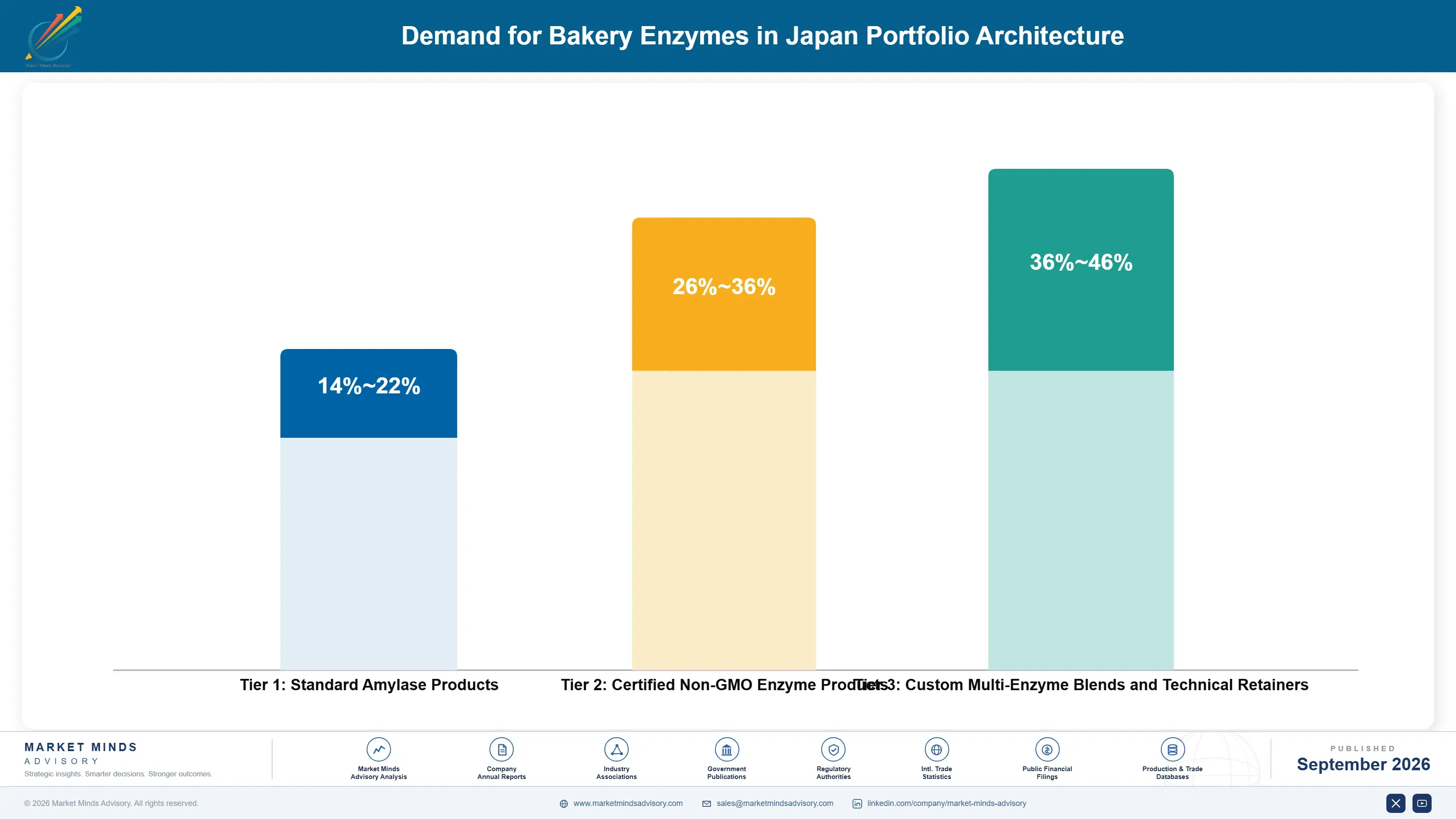
Gross margins vary meaningfully across the bakery enzyme portfolio, from thin margins on basic standard amylase products up to strong margins on custom multi-enzyme blends and certified non-genetically-modified formulations sold to convenience store and industrial bakery customers worldwide. Volume sits overwhelmingly in the commodity-adjacent standard enzyme tier, but value concentrates in the smaller custom blend and certified tiers instead, across nearly every regional market this study tracks in fine detail.
The tension between chasing enzyme volume and protecting margin plays out visibly in supplier sales strategy, where companies must decide how much to discount standard catalog enzymes to win large industrial accounts against how much to recoup through custom formulation and technical retainer design wins that actually drive long-term profit across the full multi-year customer relationship each supplier maintains with its largest accounts.

High-value pools concentrate in custom multi-enzyme blends, certified non-genetically-modified formulations, and technical service retainers, where customers pay for measurable texture differentiation and sourcing assurance rather than raw enzyme activity alone. That is where most suppliers are now directing new product development spend, well ahead of any planned expansion in commodity-tier standard amylase functionality currently under consideration at most manufacturers today.

Standard Amylase Products

Thin margin standard amylase and single-function enzyme products sold primarily on price through ingredient distribution channels, competing almost entirely on unit cost rather than formulation customization or technical service support.
Gross Margin: 14-22%

Certified Non-GMO Enzyme Products

Certified non-genetically-modified enzyme products carrying proven sourcing documentation and traceability certification, sold through direct sales relationships at a meaningful premium over standard genetically modified alternatives and various unproven market suppliers.
Gross Margin: 26-36%

Custom Multi-Enzyme Blends and Technical Retainers

Advanced custom multi-enzyme blends and technical service retainer programs built around bespoke formulation and rapid application support, targeting customers willing to pay a premium for measurable texture differentiation and shelf-life extension.
Gross Margin: 36-46%
japan-bakery-enzymes-market-portfolio-architecture-1790014672261

High-value Sub-segments and Strategic Watch-out

Custom Multi-Enzyme Blends

Custom multi-enzyme blends represent the highest value, fastest growing pocket of the market, driven by texture differentiation demand and recurring reorder revenue that extends supplier lifetime value considerably across every formulation win and production cycle for years to come across the entire wider industry overall.
Gross Margin: 36-46%

Xylanases

Xylanases are a high-value, moderate-growth pocket where dough conditioning performance and clean-label positioning support durable pricing power even as unit growth moderates relative to newer custom blend categories gaining share steadily across nearly every industrial bakery vertical tracked worldwide over the entire coming decade ahead.
Gross Margin: 26-36%

Amylases

Amylases remain the volume core of the market, competing largely on price and basic performance through ingredient distribution channels, generating thinner margins but still sustaining the largest absolute deployment base across nearly every bakery segment tracked globally each and every single year without any exception.
Gross Margin: 14-22%

Genetically Modified Sourcing Concerns

Genetically modified sourcing concerns are a strategic watch-out rather than a true revenue segment today, where suppliers lacking certified non-genetically-modified alternatives risk exclusion from retailers with strict ingredient sourcing policies as consumer scrutiny keeps intensifying across the entire industry and marketplace overall each passing year.
Gross Margin: n/a

Recurring Formulation and Reorder Revenue

Bakery enzyme revenue increasingly resembles annuity revenue once a formulation is qualified into a bakery's production line, since enzyme suppliers then capture recurring reorder volume tied directly to that customer's ongoing production output rather than a one-time ingredient sale. Suppliers that win formulation approval with a major convenience store bakery chain typically capture repeat orders across every subsequent production run for years, creating a durable revenue tail extending well beyond the initial sale.
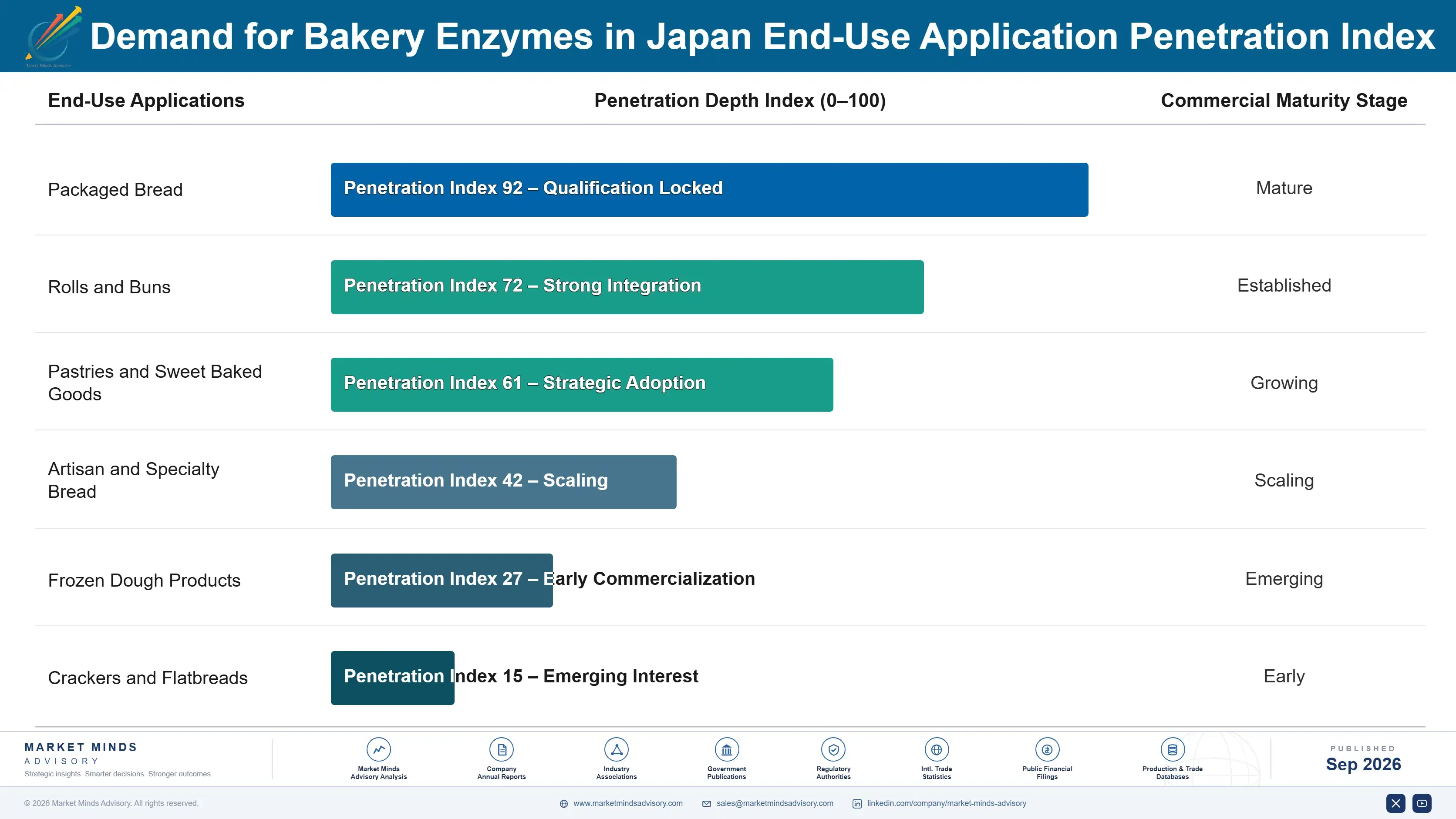
Adoption depth varies sharply by end-use vertical. Large convenience store and industrial bakery chains adopt custom enzyme blends aggressively given strict shelf-life and texture consistency requirements across thousands of retail locations, while small independent bakeries prioritize simpler standard enzyme products over customized formulations, creating a meaningfully different specification profile within each specific channel entirely across the wider market.

Buyer profiles are shifting as younger product development managers at Japanese bakeries increasingly treat enzyme-based clean-label reformulation as standard practice rather than an experimental technology pilot requiring extensive internal justification, broadening the addressable buyer base considerably beyond flagship product lines toward much more mainstream everyday bread and pastry categories sold nationwide today already now.
japan-bakery-enzymes-market-end-use-penetration-index-1790014672754

Where Bakery Enzyme Value Concentrates

These are among the four positions where our research anticipates prominent divergence between winners and laggards over the coming forecast period. Each is grounded in the demand model, the regulatory perimeter, and the announced capacity pipeline.
01 / CUSTOM FORMULATION INVESTMENT STRATEGY

Formulation depth separates durable suppliers from commodity enzyme vendors

Suppliers that build deep custom formulation and technical application capability capture disproportionate lifetime value that competitors selling only standard catalog enzymes cannot easily match at comparable price or speed. That advantage compounds as Japanese bakeries keep favoring suppliers with proven formulation depth over vendors offering only basic single-function enzymes across nearly every product category tracked. Suppliers treating custom formulation as optional will find their addressable customer base shrinking steadily as texture differentiation requirements keep rising across nearly every regulated sector this study tracks closely.
02 / NON-GMO SOURCING CERTIFICATION STRATEGY

Non-GMO certification becomes the new retail procurement baseline requirement

Non-genetically-modified enzyme sourcing is shifting from niche premium option to baseline procurement requirement faster than most supplier roadmaps anticipated just a few years ago at this exact point. Suppliers committing engineering resources to certified sourcing now will capture disproportionate share of new retailer contracts through 2036 as buyers increasingly treat genetically modified ingredient exposure as an unacceptable reputational liability across nearly every retail channel. Competitors relying solely on standard genetically modified sourcing risk losing customers to whichever supplier certifies first.
03 / FEEDSTOCK SOURCING DIVERSIFICATION STRATEGY

Sourcing diversification reduces supplier cost and margin exposure meaningfully

Suppliers that diversify feedstock sourcing beyond a single commodity region reduce cost and margin exposure that competitors relying on one region cannot absorb as easily during periods of real agricultural commodity stress or pricing disruption. The 2021 feedstock price spike demonstrated how quickly margin compression can spread for manufacturers lacking diversified sourcing relationships across multiple regions and crop types worldwide already operating at scale. Suppliers that diversify sourcing earliest will hold a meaningful cost and resilience advantage over slower-moving rivals for years ahead.
04 / TECHNICAL RETAINER SERVICE STRATEGY

Technical retainers become the next bakery enzyme competitive battleground

Diversified global enzyme giants and specialized Japanese formulation houses are converging on technical service retainer models as the next major competitive battleground across the entire bakery enzyme industry today. Suppliers investing in dedicated application laboratories and rapid formulation turnaround now will protect customer contracts that competitors relying on standalone product sales risk losing entirely as buyer expectations keep rising steadily across every regulated sector. This protection becomes more valuable as clean-label reformulation keeps intensifying across every major bakery category tracked in this analysis.

Engagement Snapshot From the Field

A live engagement with an industry participant carrying material or product regulatory and market exposure ahead of a defining policy shift, showing how our research translates into a defensible multi-year portfolio strategy.
MARKET MINDS ADVISORY · CLIENT ENGAGEMENT SUMMARY
Demand for Bakery Enzymes in Japan Producer Strategic Portfolio Review and Transition Roadmap 2026·Investment Scenario on Demand for Bakery Enzymes in Japan Exposure Evaluation 2025-26
CLIENT PROFILE
The client is a mid-size Japanese convenience store chain operating 3,200 stores nationwide with an in-house bakery product line, facing declining sales in its packaged bread category as consumers increasingly scrutinized ingredient labels for synthetic additives. Annual packaged bread category revenue was approximately 40 million dollars (client-reported, unverified by MMA) prior to the engagement, formulated entirely with chemical dough conditioners.
STRATEGIC CHALLENGE
The client faced declining packaged bread sales tied to consumer label concerns, but leadership remained uncertain whether enzyme-based reformulation could reliably replicate existing dough handling performance without disrupting high-volume production line throughput across its several central bakery facilities nationwide. Leadership needed a credible reformulation evaluation framework before committing significant capital.
MMA APPROACH
MMA conducted primary interviews with bakery enzyme suppliers and comparable convenience store chains already running enzyme-based reformulation programs, benchmarked dough handling performance and shelf-life outcomes across multiple supplier proposals, and modeled financial outcomes across three reformulation scenarios ranging from a single product line pilot to full category-wide conversion and beyond.
KEY FINDINGS
  1. Product lines with the highest consumer complaint volume around ingredient labels showed the strongest projected sales lift from enzyme-based reformulation efforts overall.
  2. Comparable convenience store chains running mature enzyme-based bread lines reported sales volume recovery exceeding 15 percent within just one full calendar year.
  3. Dough handling performance with the recommended xylanase blend matched existing chemical conditioner performance closely enough to avoid any noticeable line speed reductions.
  4. Phased product-by-product reformulation sequencing tested better than simultaneous full category conversion, preserving overall production stability while still capturing meaningful sales volume gains.
CLIENT PROFILE
The client is a mid-size Japanese convenience store chain operating 3,200 stores nationwide with an in-house bakery product line, facing declining sales in its packaged bread category as consumers increasingly scrutinized ingredient labels for synthetic additives. Annual packaged bread category revenue was approximately 40 million dollars (client-reported, unverified by MMA) prior to the engagement, formulated entirely with chemical dough conditioners.
STRATEGIC CHALLENGE
The client faced declining packaged bread sales tied to consumer label concerns, but leadership remained uncertain whether enzyme-based reformulation could reliably replicate existing dough handling performance without disrupting high-volume production line throughput across its several central bakery facilities nationwide. Leadership needed a credible reformulation evaluation framework before committing significant capital.
MMA APPROACH
MMA conducted primary interviews with bakery enzyme suppliers and comparable convenience store chains already running enzyme-based reformulation programs, benchmarked dough handling performance and shelf-life outcomes across multiple supplier proposals, and modeled financial outcomes across three reformulation scenarios ranging from a single product line pilot to full category-wide conversion and beyond.
KEY FINDINGS
  1. Product lines with the highest consumer complaint volume around ingredient labels showed the strongest projected sales lift from enzyme-based reformulation efforts overall.
  2. Comparable convenience store chains running mature enzyme-based bread lines reported sales volume recovery exceeding 15 percent within just one full calendar year.
  3. Dough handling performance with the recommended xylanase blend matched existing chemical conditioner performance closely enough to avoid any noticeable line speed reductions.
  4. Phased product-by-product reformulation sequencing tested better than simultaneous full category conversion, preserving overall production stability while still capturing meaningful sales volume gains.
RECOMMENDED STRATEGY
Phase 1: Phase one: reformulate the highest complaint volume bread product using the recommended enzyme blend within the very first four months. Phase 2: Phase two: expand reformulation to the remaining core bread lineup based on phase one sales and production test results overall. Phase 3: Phase three: evaluate full pastry category reformulation based on financial and consumer response performance across all reformulated bread product lines.
OUTCOME
Within one full year of initial reformulation, the client reported a 17 percent recovery in packaged bread sales volume across the reformulated product line and secured executive approval for full category-wide enzyme conversion (client-reported, unverified by MMA), well ahead of the original two-year reformulation timeline.

Frequently Asked Questions

Foundational context covering the market sizes, CAGR, scope, country, region and competition that inform every finding below. This section is provided to cover basics and most often pre-purchase conversations, answered from the MMA Primary Research Dataset.

What is the current size of the Demand for Bakery Enzymes in Japan?

The global bakery enzymes market, with Japan as a leading adoption market, was valued at approximately 1.6 billion dollars in 2025, covering amylases, xylanases, lipases, proteases, oxidases, and custom multi-enzyme blends.

How large will the Demand for Bakery Enzymes in Japan be by 2036?

The market is projected to reach approximately 3.19 billion dollars by 2036, up from 1.7 billion dollars in 2026, an incremental gain of roughly 1.49 billion dollars over the forecast period.

What is the CAGR for the Demand for Bakery Enzymes in Japan 2026 to 2036?

The market is expected to grow at a compound annual rate of 6.5 percent between 2026 and 2036, with a bull case near 7.8 percent and a bear case near 5.2 percent annually.

Which segment is growing fastest?

Custom multi-enzyme blends lead segment growth at 9.5 percent annually, roughly 1.46 times the overall market rate, as Japanese bakeries pursue differentiated texture positioning nationwide.

Who are the major companies in the Demand for Bakery Enzymes in Japan?

Novozymes, DSM-Firmenich, AB Enzymes, Amano Enzyme, and Advanced Enzyme Technologies lead the market on annual shipment revenue, together holding roughly 48 percent of combined global share.

Which country is growing fastest?

Japan leads adoption intensity given its exceptionally sophisticated convenience store bakery culture and among the highest per-capita enzyme usage rates in commercial baking worldwide today.

Report Segmentation Architecture

The full report scope spans multiple orthogonal segmentation dimensions, with cross-tabulated demand data provided for each dimension pair. Coverage extends further to regional breakdowns, trend trajectories, and the competitive detail needed to support segment-level decision-making.

By Enzyme Type

  • Amylases
  • Xylanases
  • Lipases
  • Proteases
  • Oxidases
  • Custom Multi-Enzyme Blends

By End-Use Application

  • Packaged Bread
  • Rolls and Buns
  • Pastries and Sweet Baked Goods
  • Artisan and Specialty Bread
  • Frozen Dough Products
  • Crackers and Flatbreads

By Commercial Dimension

  • Direct Industrial Bakery Sales
  • Ingredient Distributor Channel
  • Custom Formulation Contracts
  • Technical Service Retainer Agreements

By Region

  • North America
  • Western Europe
  • East Asia
  • South Asia and Pacific
  • Latin America
  • Middle East and Africa
  • Eastern Europe

Scope, Methodology, and Coverage

Every figure in this report is reproducible from documented input assumptions. The scope below maps the historical period, the forecast horizon, the segmentation dimensions, and the countries covered, alongside the underlying primary and qualitative methodology.
Historical Period
2020 to 2025
Forecast Period
2026 to 2036
Base Year
2025 (USD billions; MMA Primary Research Dataset, September 2026)
Market Definition
The bakery enzymes market covers amylases, xylanases, lipases, proteases, oxidases, and custom multi-enzyme blends used as processing aids in bread, roll, and pastry manufacturing, with this study emphasizing demand patterns and adoption intensity in Japan specifically. It excludes non-enzymatic dough conditioners, yeast and other fermentation organisms, and enzymes used outside bakery applications such as dairy or brewing processing.
Quantitative Units
USD Billion, CAGR (%) 2026-2036
Segmentation Dimensions
Enzyme Type, End-Use Application, Commercial Dimension, Region
Regions Covered
North America, Western Europe, East Asia, South Asia and Pacific, Latin America, Middle East and Africa, Eastern Europe
Countries Covered
Japan, US, Canada, Germany, France, UK, China, South Korea, India, Australia, Brazil, Mexico, Saudi Arabia, UAE, South Africa
Key Companies Profiled
20
Quantitative Methodology
Primary survey, n=3,800 respondents, Q4 2025, six countries; demand-side model with trade association cross-validation
Qualitative Methodology
47 expert interviews, Q4 2025; applied to validate demand model assumptions, identify emerging dynamics, and assess competitive positioning
Report Format
PDF and XLSX data workbook (Word format preview document)
Publisher
Market Minds Advisory
Report Code
MMA-2026-CHM-701
Published
September 2026
Contact
sales@marketmindsadvisory.com | www.marketmindsadvisory.com

Purchase the full Demand for Bakery Enzymes in Japan Report (2026 to 2036).

The full report delivers a complete strategic assessment of the bakery enzymes market, spanning detailed segment-level forecasts, regional demand modeling, and competitive benchmarking across the top twenty market participants, with particular emphasis on Japan's advanced adoption patterns. It includes proprietary primary survey data covering three thousand eight hundred respondents and forty-seven expert interviews conducted in the fourth quarter of 2025. Buyers receive access to editable data tables alongside the narrative analysis for internal strategic planning use across procurement, product development, and quality teams. The analysis is designed to support decisions on supplier selection over the coming decade.
Segment level revenue forecasts through the year 2036
Regional market sizing across seven world regions
Competitive benchmarking of twenty key market participants
Editable data tables for internal strategic planning
Primary survey data from 3,800 global respondents
Expert interview insights from 47 industry practitioners

Built For The People Who Decide

From boardroom strategy to bench-side execution, this report is read cover-to-cover by leaders shaping the next decade of their industry, turning demand scenarios, market dynamics and valuation benchmarks into decisions.
CXOs/ Presidents/ VPs/ Managers
M&A and Corporate Development
Strategy Teams and R&D Heads
Procurement and Product Directors
Regulatory and Compliance Leaders
Investor Relations and Equity Analysts