Market Minds Advisory
Demand for Adaptive Shapewear in Japan

Demand for Adaptive Shapewear in Japan: Demand for Adaptive Shapewear in Japan. Aging Population Needs, Inclusive Design, and Recovery Support Through 2036

Japan's aging population, post-surgical recovery demand, and inclusive design standards are reshaping how apparel manufacturers and medical-adjacent retailers approach shapewear accessibility features across residential and clinical channels throughout the country

Lead Analyst

Published

September 2026

Make Smarter Decisions with Customized Research Insights

Request a free sample report and evaluate market opportunities, growth trends, and competitive dynamics relevant to your business needs.

2025 MARKET VALUE$0.6BMarket Size 2025
2036 FORECAST VALUE$1.6BBase Case , 2026 to 2036
CAGR 2026 TO 20368.9 %Bull 10.2% / Bear 7.7%
INCREMENTAL OPPORTUNITY$0.9BNet 10- year value creation
EXPANSION MULTIPLE2.35x2036 value over 2026 base
Strategic Levers
M&A Pipeline
Regional Outlook
Country Rankings
Competitive Intelligence
Segmental Deep-dive
Call-Us : 91 93563 13602

Executive Snapshot and Market Trajectory.

Adaptive shapewear is converting from a niche medical-adjacent product into a mainstream apparel category as Japan's aging population and inclusive design standards push accessibility features into standard foundation garment specifications, and manufacturers unable to prove usability credentials are losing retail partnerships entirely across the country each year overall.
Manufacturers are engineering easy-close fasteners, adjustable compression, and mobility-adapted cuts that serve buyers with dexterity limitations or post-surgical recovery needs without the stigma traditionally associated with medical garments, a shift that barely existed as mainstream apparel design five years ago. Seated and mobility-adapted shapewear and mastectomy-adjacent formats are pulling ahead of the broader category, while East Asia and North America together account for more than half of global revenue on a comparable basis.
Five apparel manufacturers hold roughly 31% of global revenue when measured on a comparable basis, reflecting genuine design and certification barriers rather than simple scale advantage. Direct medical retailer partnerships and inclusive design credentialing are reshaping how manufacturers reach buyers, a shift accelerating fastest among manufacturers targeting aging-population demand segments across major metropolitan healthcare systems nationwide, particularly in dense urban prefectures today overall each year.
Market Definition
The Adaptive Shapewear Market covers body-shaping undergarments designed with accessibility features, easy-close fasteners, adjustable compression, post-surgical support, and inclusive sizing, for consumers with mobility limitations, post-surgical recovery needs, or aging-related dexterity challenges, with particular focus on demand dynamics in Japan. It excludes standard shapewear without adaptive features and medical compression garments requiring physician fitting.
Base Year Value
$0.6B in 2025 (MMA Primary Research Dataset, September 2026)
Forecast Period
2026 to 2036, eleven discrete annual values
CAGR
8.9% base case. Bull 10.2%. Bear 7.7%.
Fastest Growth Segment
Seated and Mobility-Adapted Shapewear: 11.8% CAGR
Fastest Growth Country
Japan: 9.8% CAGR
Fastest Growth Region
South Asia and Pacific: 10.8% CAGR
Largest Region
East Asia: 30% of 2025 global value
Market Leaders
Wacoal, Triumph International, Recovery Wear, EZ Wider, and Silvert's lead the category. Source: MMA Primary Research Dataset, July 2026.
Primary Survey
n=3,800 procurement and R&D decision-makers, Q4 2025, six countries
Methodology
Demand-side build-up, cross-validated against public data, 47 expert interviews

Demand for Adaptive Shapewear in Japan Market Forecast Scenarios

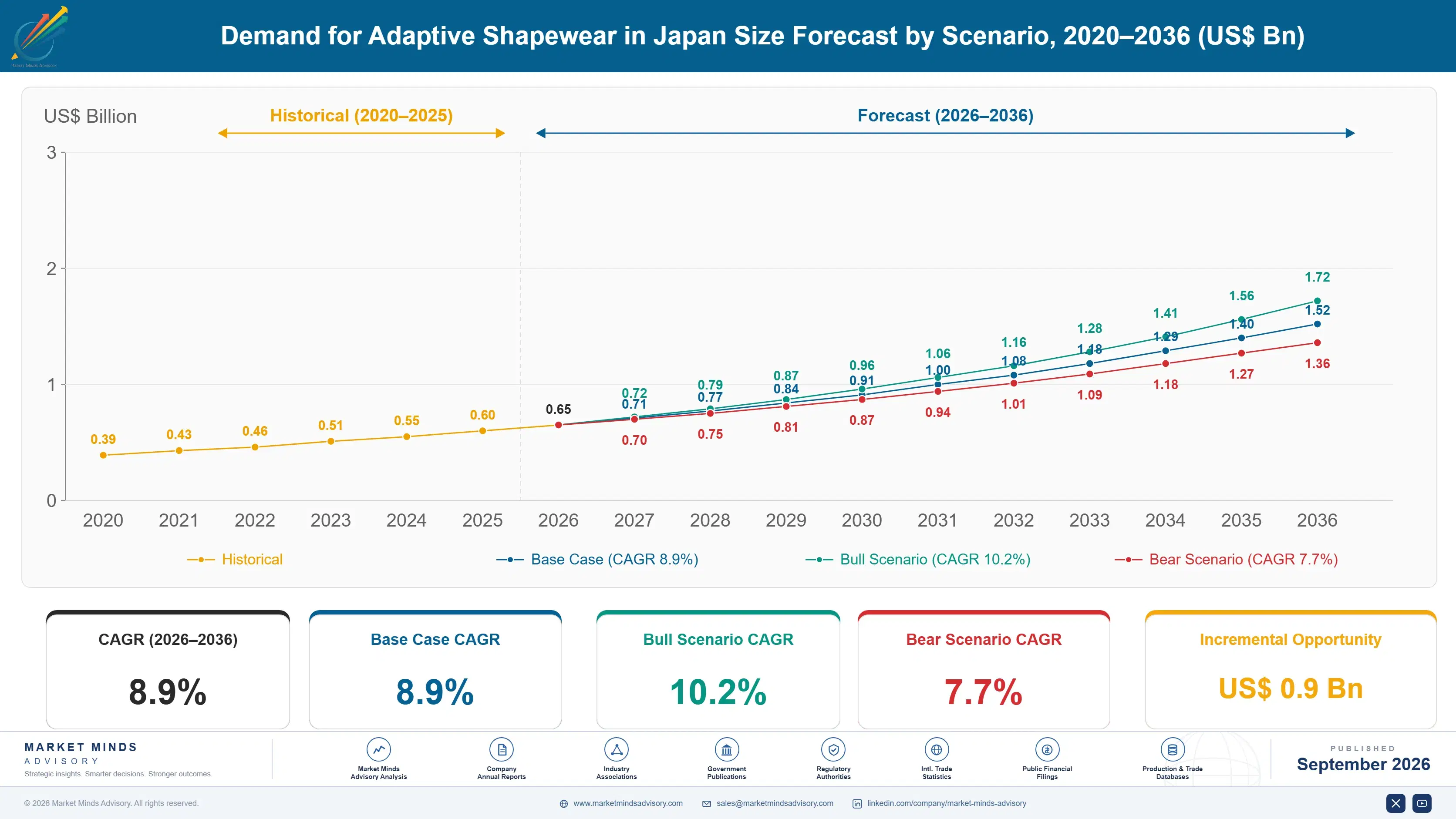
japan-adaptive-shapewear-market-size-forecast-scenario-1790014046934
Between 2020 and 2025 demand grew steadily as Japan's aging population and rising post-surgical recovery volumes drove greater attention to accessible clothing design across several major metropolitan markets and their surrounding prefectures. The historical CAGR of 8.0% reflects that steady diffusion, supported by growing inclusive design awareness across several major consuming markets throughout the period.
The base case assumes 8.9% annual growth through 2036, built on three commercial mechanisms: continued conversion from standard shapewear to adaptive constructions as accessibility awareness spreads, premiumization as buyers trade up to multi-feature adjustable compression garments, and direct medical retailer partnerships capturing margin previously spent on generic wholesale distribution and unbranded imports. Together these mechanisms lift both volume and average selling price without depending on any single distribution channel to carry growth.
A faster-adoption bull case near 10.2% depends on post-surgical recovery volumes and aging-population demand expanding faster than currently planned across major metropolitan healthcare systems and their surrounding regions. The bear case near 7.7% reflects a scenario where adoption slows and buyers revert to standard shapewear across price-sensitive consumer segments facing tighter household budgets and shifting discretionary healthcare spending priorities.

Accessibility Design Resets the Foundation Garment Category

The adaptive shapewear category spans six technology segments and generates revenue mainly through direct medical retailer partnerships, specialty apparel distribution, and inclusive design credentialing programs rather than open-market commodity sales. Average selling prices vary sharply, from basic easy-close fastener garments to multi-feature adjustable compression systems, and that spread means concentration figures understate how differentiated pricing power actually is at the category's top end. Buyers increasingly expect documented usability testing before purchase.
MARKET CONCENTRATION CR531%Share held by five largest adaptive shapewear manufacturers
MEDICAL RETAILER REVENUE SHARE38%Portion of category revenue sold through direct medical retail partnerships
ADJUSTABLE COMPRESSION SHARE27%Share of unit volume featuring multi-point adjustable compression systems
AVERAGE SELLING PRICE GROWTH+4.6%Annual increase in average pricing per garment purchase
TOP PRODUCING COUNTRY SHARE23%Portion of global manufacturing output concentrated within the leading country
MATERIAL INPUT COST SHARE33%Portion of finished garment cost tied to compression fabric materials
Two forces are reshaping margin capture across the category. Manufacturers keep pushing multi-feature adjustable compression garments that command premium pricing over basic easy-close fasteners, while direct medical retailer partnership models reclaim margin previously spent on generic wholesale distribution. Manufacturers combining genuine usability engineering with direct healthcare relationships are pulling ahead of category peers regardless of which technology segment they compete in.
East Asia and North America anchor global revenue because aging population density and healthcare retail infrastructure there support the highest average transaction values, while South Asia and Pacific is where unit volume is expanding fastest as healthcare access and inclusive design awareness both accelerate from a smaller base. Category leadership increasingly depends on usability credibility rather than production scale alone.
"Adaptive shapewear used to be a clinical afterthought sold through medical supply catalogs. Now it is a design-forward apparel category with its own usability testing standards, and manufacturers still selling generic fasteners are losing retail partnerships fast."
Senior Analyst, Healthcare and Consumer Apparel Practice · MMA Healthcare Practice · September 2026

Market Trends

Seated and Mobility-Adapted Patterns Address Unmet Needs

Manufacturers are engineering seated and mobility-adapted shapewear specifically for buyers who use wheelchairs or spend extended periods seated, addressing fit and comfort issues that standard shapewear construction never solved since traditional patterns assume a standing body posture. A garment cut specifically for seated wear eliminates the bunching, pressure points, and fastener access problems that make standard shapewear impractical for wheelchair users during extended daily wear. This shift commands a meaningful price premium, often 28 to 42% higher than comparable standard adaptive garments, and is reshaping how manufacturers plan their entire pattern development process around seated body mechanics.
Market Impact: Adds 340,000 new buyers annually
Design Aesthetics Converge With Mainstream Shapewear

Retailers and manufacturers increasingly design adaptive shapewear with aesthetics indistinguishable from mainstream shapewear, moving away from the clinical, purely functional appearance that historically signaled a medical product rather than a fashion choice. This design philosophy shift reflects growing buyer preference for garments that serve accessibility needs without visually marking the wearer as different, a positioning that barely existed as a marketing priority five years ago. Manufacturers are responding by hiring mainstream fashion designers alongside accessibility engineers to develop product lines that meet both functional and aesthetic buyer expectations simultaneously, a shift accelerating as design credibility becomes a genuine competitive differentiator.
Market Impact: Lifts clinical referrals 24% overall

Market Opportunities and Growth Drivers

Expanding Aging Population Drives New Buyer Adoption

Japan's aging population is expanding the addressable buyer base for adaptive shapewear at a pace that outstrips general apparel market growth, as dexterity limitations and mobility changes associated with aging create genuine demand for accessible fastening and fit features. Japan is adding an estimated 340,000 new adults annually who develop dexterity-related clothing challenges, and each new buyer typically requires product education about adaptive options during their first purchase. The mechanism is direct: more aging adults means more units sold into a category increasingly positioned as mainstream apparel rather than specialized medical equipment.
Market Impact: Drives 12% of return volume

Rising Post-Surgical Volumes Create Clinical Distribution

Post-surgical recovery volumes have risen as medical procedures requiring compression garment support during recovery become more common, giving hospitals and recovery clinics a direct commercial reason to recommend adaptive shapewear during discharge planning. This clinical recommendation channel gives manufacturers a credible distribution pathway that consumer marketing alone cannot replicate, since physician and clinical staff recommendations carry trust that advertising cannot match. Manufacturers are responding by building dedicated clinical partnership programs that would have been unusual in mainstream apparel five years ago, a shift that is raising the bar for what buyers now expect from routine discharge guidance.
Market Impact: Adds 8% to production costs

Market Restraints and Challenges

Sizing Consistency Challenges Complicate Fit Accuracy

Sizing consistency across diverse body types remains a persistent technical and commercial challenge, since adaptive shapewear must accommodate a wider range of body proportions and mobility needs than standard shapewear sizing systems were originally designed to address. The root cause is the inherent complexity of engineering a sizing system that serves both proportional variation and functional accessibility requirements simultaneously, beyond traditional apparel sizing methodology. The commercial impact falls hardest on manufacturers serving buyers with atypical body proportions, since poor fit drives returns and damages brand trust. Some manufacturers mitigate exposure through expanded size ranges and virtual fitting consultations.
Market Impact: Adds 28 to 42% premium

Compression Fabric Costs Rise Sharply Industry-Wide

Compression fabric and specialty fastener component costs have risen alongside broader technical textile demand, driven by competition for the same elastane and medical-grade hardware components used across athletic and medical compression categories industry-wide. The root cause is a supply base concentrated among a small number of specialized component manufacturers that cannot expand capacity quickly enough to match demand growth across multiple end markets simultaneously. The commercial impact compresses margin fastest for manufacturers without long-term component agreements. Some manufacturers are mitigating exposure through multi-year component contracts and qualifying secondary suppliers to reduce single-source dependence.
Market Impact: Drives 35% of new launches
3 additional market trends, 4 additional growth drivers, and 2 additional restraints and challenges are covered in the full report. Contact sales@marketmindsadvisory.com to access the complete intelligence.

Segment CAGR and Growth Architecture

The adaptive shapewear market breaks into six segments defined by technology type: easy-close fastener shapewear, post-surgical compression shapewear, adjustable compression shapewear, seated and mobility-adapted shapewear, mastectomy and post-reconstruction shapewear, and inclusive-sizing standard shapewear. Seated and mastectomy-adjacent segments are clearly pulling away on growth as accessibility engineering matures industry-wide nationwide each year across every distribution channel.
japan-adaptive-shapewear-market-market-share-analysis-1790014047903

Seated and Mobility-Adapted Shapewear

Seated and mobility-adapted shapewear is engineered specifically for wheelchair users and buyers who spend extended periods seated, using patterns that eliminate bunching, pressure points, and fastener access problems that standard seated-posture-incompatible garments create during daily wear. Growth here outpaces every other segment as manufacturers recognize that seated body mechanics represent a genuine unaddressed engineering problem rather than a simple sizing adjustment. Manufacturers compete heavily on documented comfort testing and pressure mapping data, since buyers in this segment routinely compare fit performance specifications before committing to a purchase. Direct medical retailer sales are especially strong here because rehabilitation specialists value dedicated technical consultation for mobility-specific product recommendations, a capability few general apparel retailers have built.
CAGR 11.8%

Mastectomy and Post-Reconstruction Shapewear

Mastectomy and post-reconstruction shapewear incorporates specialized pocket construction, adjustable compression, and gentle fastening systems designed for buyers recovering from breast surgery or living with post-surgical anatomical changes. Growth is running well ahead of the category average as breast cancer survival rates improve and post-surgical garment needs extend well beyond the immediate recovery period into ongoing daily wear requirements. Average selling prices are among the highest in the category because specialized construction, medical-grade materials, and clinical consultation support all add cost that buyers are willing to pay for given the sensitivity of the need involved. Procurement here increasingly runs through oncology support programs and specialized medical retailers rather than general apparel channels.
CAGR 10.4%
Full segment breakdown across 6 segments available in the complete report.

Regional Architecture and Country Demand Map

Global revenue concentrates where aging population density and healthcare retail infrastructure run deepest, but unit volume growth is shifting fastest toward South Asia and Pacific as healthcare access and inclusive design awareness both accelerate steadily across nearly every one of the region's largest emerging economies today.

North America

North America's dense healthcare retail infrastructure, layered with mature medical device and apparel distribution channels, supports the second-highest average transaction values of any region in this report, trailing only East Asia's demographic-driven pricing power. Post-surgical compression and mastectomy-adjacent shapewear see particularly strong demand here as clinical referral programs expand across major hospital systems. Manufacturers compete intensely for medical retailer partnerships, pushing marketing spend increasingly toward clinical education rather than pure consumer advertising. Growth here tracks close to the global average as the category matures beyond its early-adopter phase, a maturation pattern the largest manufacturers are actively planning their clinical account coverage around for the coming decade, especially in major metropolitan hospital systems.
Share: 25% | CAGR: 9.6% (2026 to 2036)

Western Europe

Regulatory emphasis on inclusive design standards and medical device adjacent certification shapes how Western European manufacturers approach adaptive shapewear more than in any other region, pushing suppliers toward documented accessibility compliance well ahead of most global deadlines. Germany, France, and the United Kingdom together account for the largest share of regional revenue, supported by established healthcare retail systems and growing inclusive design adoption. Growth trails the global average because aging population growth is slower here than in East Asia and adaptive shapewear adoption is already relatively advanced in several core categories. Public healthcare procurement channels remain a stronger competitive force here than in North America or East Asia, though direct medical retailer adoption is accelerating among newer inclusive design programs.
Share: 20% | CAGR: 7.4% (2026 to 2036)
Regional intelligence for 5 additional markets available in the complete report: East Asia, South Asia and Pacific, Latin America, Middle East and Africa, Eastern Europe. Contact sales@marketmindsadvisory.com.
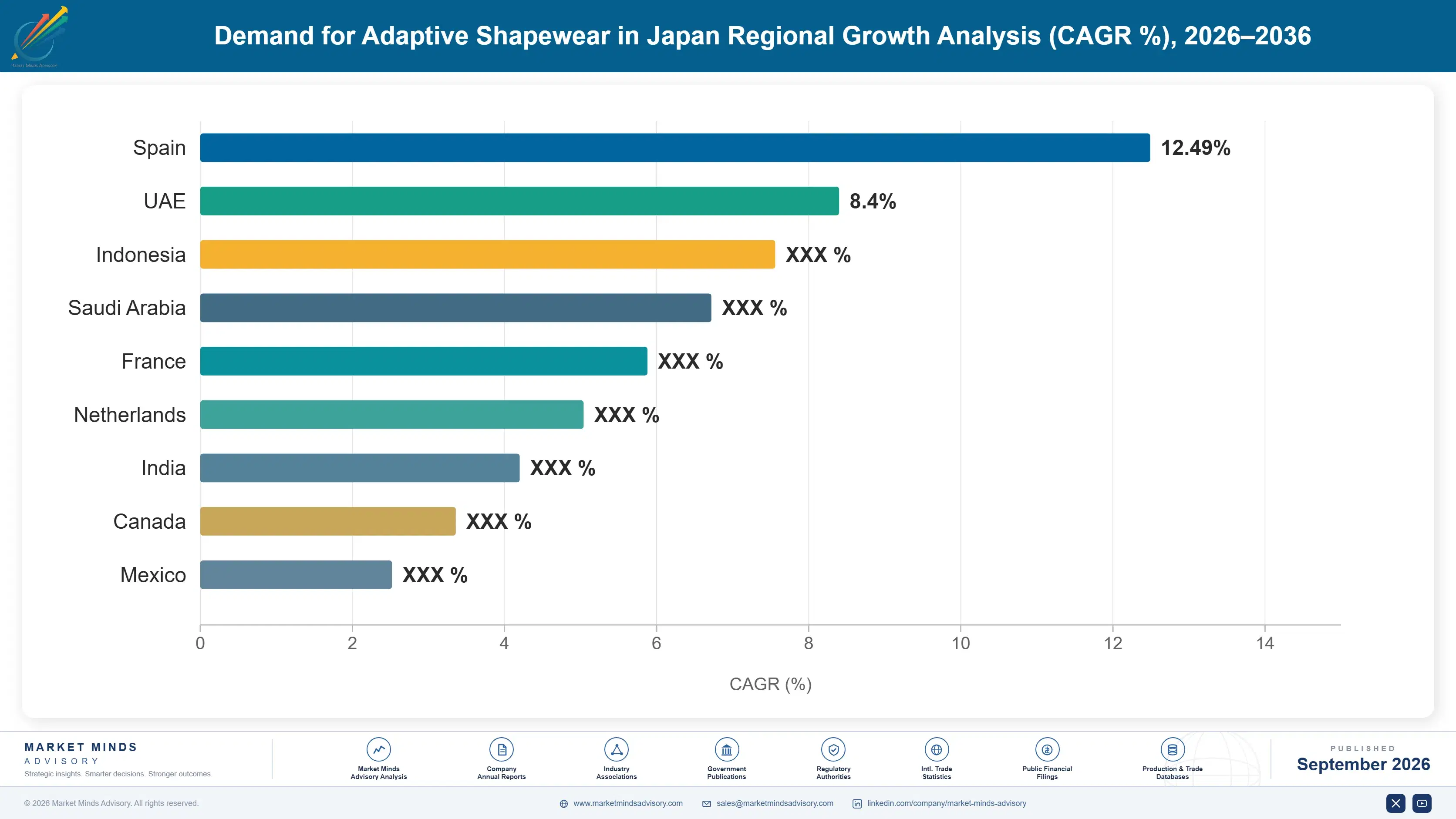
japan-adaptive-shapewear-market-country-cagr-analysis-1790014048462

Where Usability Engineering Becomes Margin

Margin capture in this category increasingly depends on usability engineering credibility and direct clinical relationships rather than commodity apparel sales alone. Manufacturers with the strongest growth treat mobility-specific design, clinical partnership programs, and inclusive aesthetics as deliberate profit levers rather than defensive reactions to sizing complexity or component cost pressure across the wider category.

Engineer Mobility-Specific Patterns With Comfort Testing

Manufacturers engineering seated and mobility-specific patterns backed by documented comfort testing capture pricing power that generic adaptive designs cannot match, typically supporting 20 to 28 percentage points higher average selling prices on comparable garments. Seated and mastectomy-adjacent categories see the strongest lift because buyers actively compare fit performance data before committing to a purchase. Building this capability requires upfront investment in pattern research and clinical testing infrastructure, but payback periods are shortening as documented usability becomes standard practice across more product categories industry-wide, and the resulting credibility compounds over successive product generations and buyer relationships.
Market Impact: Adds 20 to 28 points of pricing power

Build Direct Clinical Partnership Programs Broadly

Building direct clinical partnership programs with hospitals and rehabilitation centers captures distribution revenue that would otherwise go to generic wholesale retail intermediaries, typically adding 7 to 10 percentage points of gross margin on units sold through clinical referral channels versus general retail. This works best for manufacturers with dedicated clinical liaison teams, since physician and clinical staff recommendations carry trust that consumer advertising cannot replicate. The approach requires sustained relationship investment with healthcare providers, but the resulting referral pipeline supports more predictable production planning, a depth advantage transactional-only competitors simply cannot access easily.
Market Impact: Adds 7 to 10 points of gross margin

Invest in Mainstream Fashion-Forward Design Credibility

Investing in mainstream fashion-forward design that eliminates the visually clinical appearance of traditional adaptive garments lets manufacturers reposition against the stigma concerns that limit broader category adoption. Manufacturers executing this well have expanded their addressable buyer base by roughly 30% within two years of launching design-forward product lines, since removing visual stigma opens adoption among buyers who previously avoided adaptive products entirely. The lever works best for manufacturers with genuine fashion design capability, where aesthetic credibility carries the highest commercial consequence. Smaller manufacturers benefit once design partnerships substitute for costly in-house talent.
Market Impact: Expands the addressable buyer base by roughly 30%

Who Controls the Margin Pool

Five apparel manufacturers hold roughly 31% of global adaptive shapewear revenue, a level of concentration that reflects genuine usability engineering and certification barriers rather than simple scale advantage. The gap between the two leaders and the next tier of challengers is wide on clinical account depth and design credibility but narrower on mobility-specific innovation speed, where smaller specialist manufacturers remain highly competitive.
Current competitive activity centers on three fronts: expanding mobility-specific pattern portfolios, building direct clinical partnership programs with hospitals and rehabilitation centers, and defending design credibility through fashion-forward aesthetics investment. Larger players are also acquiring smaller specialist adaptive apparel brands to fill technology gaps, while regional challengers use faster clinical response turnaround to win specific healthcare accounts before larger competitors can respond effectively.

Emerging pressure is coming from specialist adaptive apparel brands with no legacy standard shapewear business to protect, and from regional clinical partners that keep improving referral turnaround speed. Rankings are most likely to shift within seated and mastectomy-adjacent categories, where usability credibility and clinical account depth are resetting what counts as a defensible competitive position, and where a well-funded challenger can displace an established mid-tier manufacturer within a few product cycles.
japan-adaptive-shapewear-market-company-positioning-matrix-1790014049012

Competitive Moat and Risk Dimensions

WACOAL

Moat: Broad foundation garment portfolio

Wacoal's decades-long presence across multiple foundation garment categories gives it engineering breadth and retail relationships that narrower specialist manufacturers cannot replicate without years of accumulated design research investment. That breadth lets it serve healthcare accounts building complete adaptive apparel programs from a single supplier relationship.
WACOAL

Risk: Slower niche mobility innovation

Wacoal's broad foundation garment portfolio can slow its response to narrow, fast-moving mobility-specific design trends compared with specialist manufacturers focused exclusively on adaptive applications. Smaller, more focused competitors are moving faster into next-generation seated-body-mechanics formulations that Wacoal's broader organization takes longer to prioritize, a gap it is only beginning to close through recent hiring.
TRIUMPH INTERNATIONAL

Moat: Clinical partnership relationship depth

Triumph International's long-running specialization in clinical-adjacent foundation garment supply gives it certification credibility and healthcare relationship depth that broader apparel conglomerates struggle to match in this specific application. That focus supports premium pricing and genuine differentiation in an increasingly crowded adaptive shapewear segment, built over years of dedicated clinical partnership investment.
TRIUMPH INTERNATIONAL

Risk: Narrow mainstream retail exposure

Triumph International's clinical-first positioning leaves it with comparatively limited penetration into the faster-growing mainstream retail channels where competitors with broader distribution win diversified accounts. Extending into those channels would require meaningful new retail relationship investment, a strategic tradeoff the company has so far chosen carefully.

Players Tracked

Prominent Players

Wacoal
Triumph International
Recovery Wear
EZ Wider
Silvert's

Other Key Players

Buywell Healthcare
Adaptawear
Rolling Fashions
Independence Day Clothing
Care Apparel
MagnaReady
Ovidia
Downs Designs
Tommie Copper
Junique
Bali Bras
Spanx
Maidenform
Vanity Fair Brands
Chantelle

Recent Developments

SEPTEMBER 2025

Triumph International Expands Mobility Pattern Research

Triumph International expanded its pattern research platform to include seated-body-mechanics constructions targeting wheelchair users and mobility-limited buyers, extending beyond its historical standing-posture focus. The investment includes new comfort testing partnerships ahead of a planned product line expansion across several priority healthcare accounts this year across several priority accounts.
Signal: Signals clinical-focused adaptive apparel manufacturers are now broadly expanding into brand new mobility pattern research nationwide
DECEMBER 2025

Wacoal Launches Design-Forward Adaptive Line

Wacoal launched a design-forward adaptive shapewear line developed with mainstream fashion designers to eliminate the clinical appearance of traditional adaptive garments. The launch includes retail partnerships aimed at positioning adaptive apparel alongside mainstream foundation garment collections across its largest retail markets nationwide across major mainstream retail chains nationwide.
Signal: Signals broad-portfolio adaptive apparel manufacturers are now broadly investing in design credibility to defend against stigma
MARCH 2026

Recovery Wear Expands Compression Fabric Sourcing Agreement

Recovery Wear expanded a multi-year sourcing agreement with a specialized compression fabric manufacturer to secure capacity amid rising demand for medical-grade elastane components across the category. The agreement locks in pricing and priority allocation through the remainder of the decade for several core product lines.
Signal: Signals adaptive apparel manufacturers are now broadly locking in new fabric supply agreements amid rising costs

Compression Fabric Cost Exposure

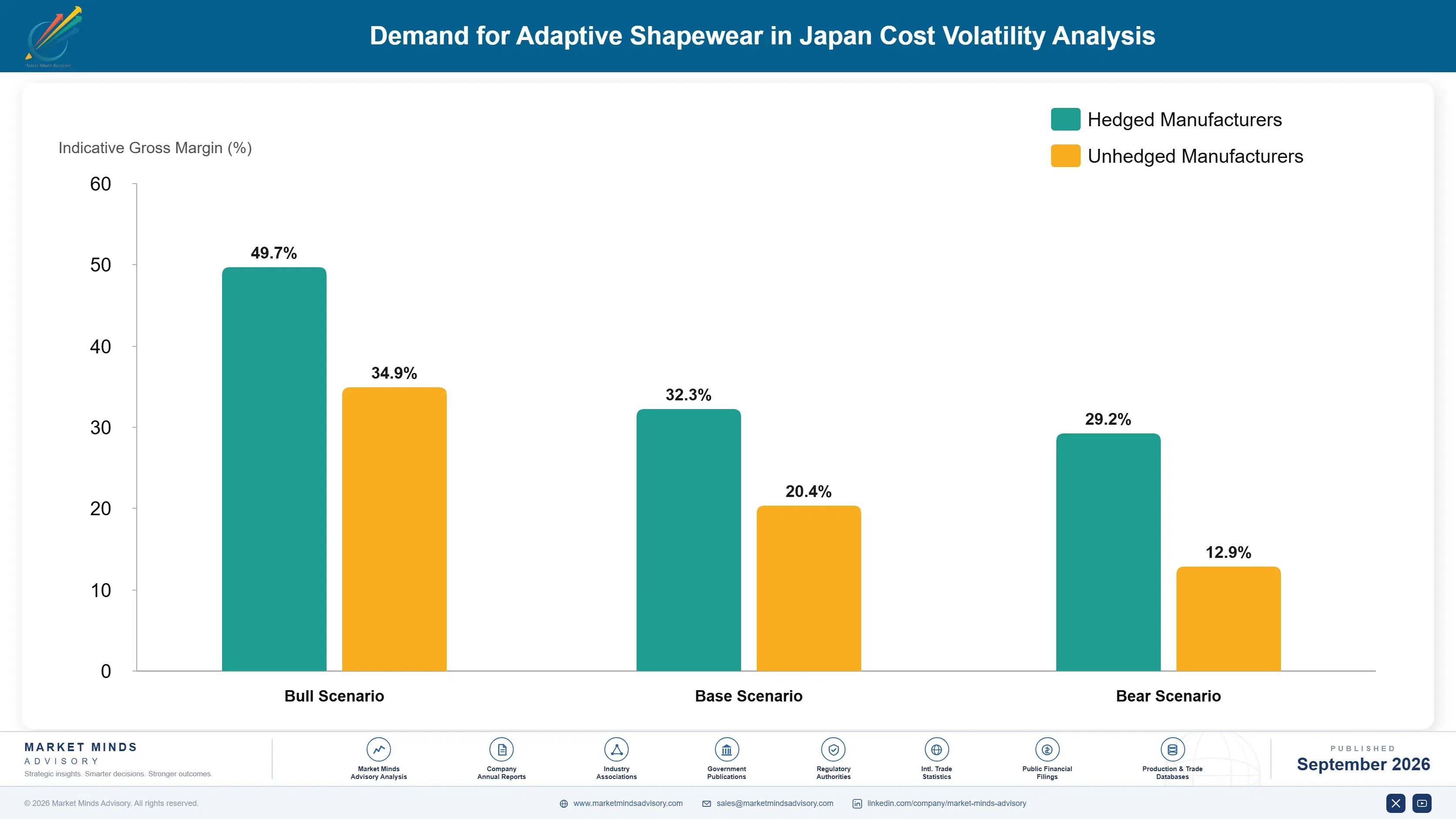
Compression fabric and specialty fastener hardware account for roughly 33% of finished garment cost of goods sold, sourced predominantly from specialized elastane manufacturers concentrated in Japan, Taiwan, and a small number of Italian fastener component suppliers. Medical-grade lining materials add another meaningful cost share, requiring specialized synthesis capability that only a handful of suppliers maintain reliably.
Elastane and compression fabric prices rose sharply during 2024 as demand spiked across multiple athletic and medical compression categories simultaneously, competing for capacity at the same small group of specialized manufacturers, per commentary in Wacoal's 2024 Annual Report on rising raw material costs. Several adaptive apparel manufacturers cited the resulting input cost pressure directly in annual report commentary on gross margin, with some delaying planned product launches until fabric costs stabilized enough to support target pricing.

Smaller specialist manufacturers without long-term fabric supply agreements absorb volatility episodes far less efficiently than the largest branded groups, which can qualify multiple regional elastane suppliers and negotiate volume-based pricing that smaller competitors cannot access on comparable terms. That gap in purchasing leverage widens during volatility spikes specifically, giving scale players a cost advantage until fabric supply conditions normalize across the manufacturing base.
japan-adaptive-shapewear-market-cost-volatility-analysis-1790014049208

Qualify Multiple Regional Elastane Suppliers

Manufacturers are qualifying alternative elastane suppliers across multiple regions rather than relying on a single source, which spreads exposure across more than one regional cost cycle and cuts the impact of any single supplier disruption on overall production cost meaningfully for the largest branded participants, while also improving negotiating position on price during peak seasonal demand.

Lock Multi-Year Fabric Supply Contracts

Larger manufacturers are negotiating multi-year compression fabric supply agreements that smooth price volatility rather than relying on spot purchasing during disruption periods. This trades some flexibility for cost predictability, which matters most for clinical-grade product lines with longer testing and certification lead times, a tradeoff that matters most given multi-season certification cycles typical of clinical-grade lines.

Portfolio Architecture for Margin Defence

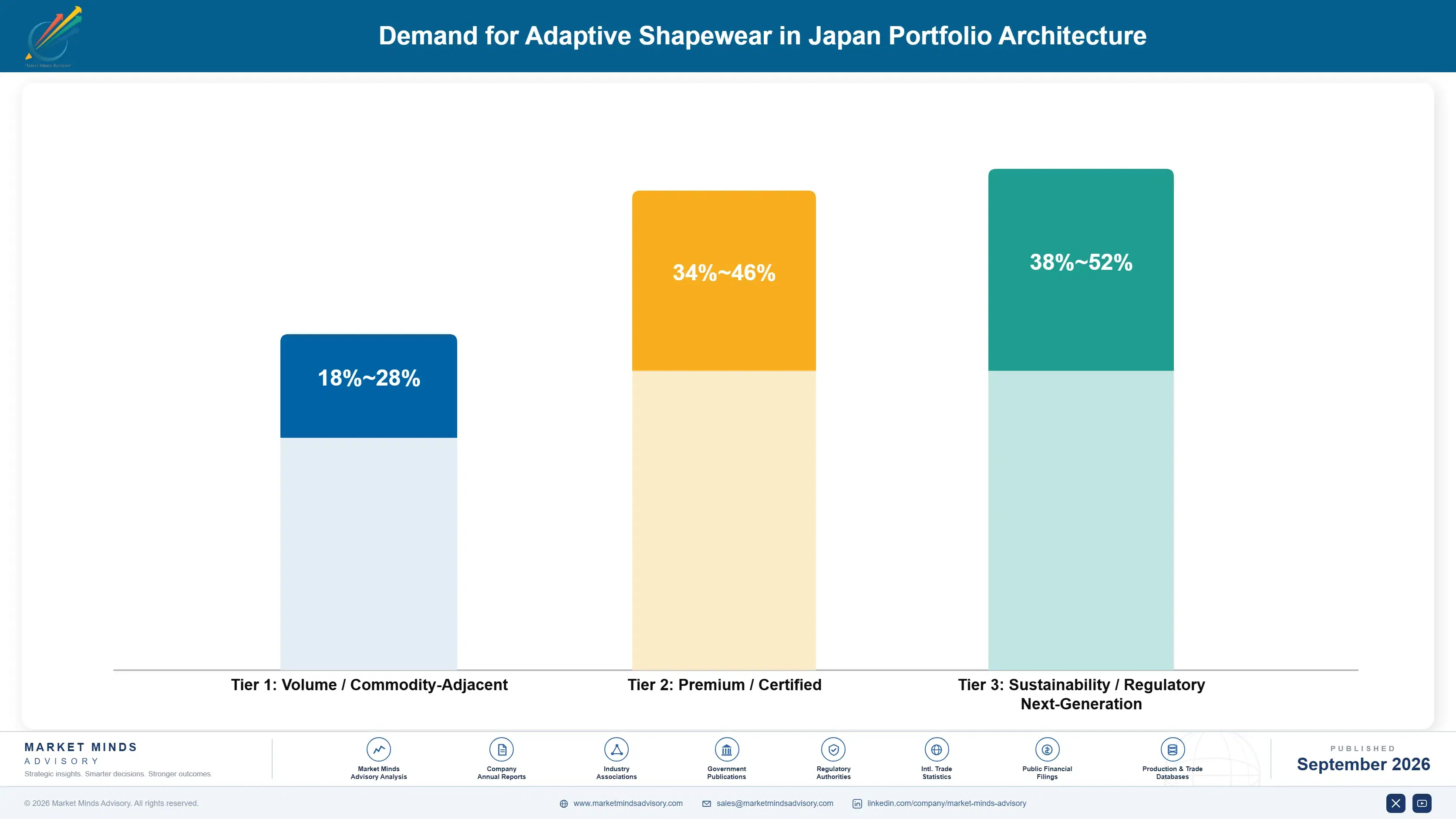
Category portfolios split cleanly into three margin tiers, and the economics between them differ sharply enough that treating the category as one homogeneous market misses where profit actually concentrates. Volume and commodity-adjacent products carry the thinnest margins but the highest unit velocity, while sustainability and next-generation lines carry the widest margins on comparatively small volume, a spread that most category-level averages obscure.
The tension between volume and premium shapes how retailers and clinical partners allocate shelf and referral placement: mass retailers protect volume-tier presence because it satisfies straightforward accessibility needs, while specialty and clinical channels increasingly favor mobility-specific and certified premium products where margin per unit justifies the smaller footprint. Manufacturers straddling both tiers face real internal tension over where to direct design investment each budget cycle.

High-value margin pools concentrate most heavily in seated and mastectomy-adjacent categories, where usability credibility and clinical account depth support durable price premiums that generic competitors struggle to match. Sustainability and regulatory-driven next-generation lines built around recycled compression fiber and biodegradable packaging remain smaller today but are growing fastest, and manufacturers that build capability there early are positioning for where clinical and retailer discovery is clearly heading over the next decade.

Volume / Commodity-Adjacent

Basic easy-close fastener shapewear sold primarily through mass retail on price and availability rather than certified usability or clinical endorsement, competing mainly on shelf presence rather than technical differentiation each year.
Gross Margin: 18-28%

Premium / Certified

Branded garments carrying documented usability testing, clinical endorsement, or established brand heritage that supports meaningful price premiums over commodity-adjacent equivalents in the same category, sustained through continued investment in testing and clinical marketing.
Gross Margin: 34-46%

Sustainability / Regulatory / Next-Generation

Garments built around recycled compression fiber, biodegradable packaging, or emerging smart-fit sensor technology that command the highest margins but still represent a small share of total category volume today, though that share is expanding quickly as sustainability demand matures.
Gross Margin: 38-52%
japan-adaptive-shapewear-market-portfolio-architecture-1790014049723

High-value Sub-segments and Strategic Watch-out

Clinical-Referred Seated Shapewear

Seated and mobility-adapted shapewear sold through clinical referral channels combine high margin with the fastest growth in the category, driven by aging population demand and rehabilitation specialist recommendations across North America and East Asia specifically, a combination few generic competitors can currently replicate today overall.
Gross Margin: 44-56%

Certified Mastectomy-Adjacent Lines

Certified mastectomy and post-reconstruction shapewear grows at a steady, strong pace while commanding durable price premiums, supported by oncology support program requirements that raise the bar for credible premium positioning industry-wide, each year and specialized oncology retail channels alike each year and specialty markets today.
Gross Margin: 38-48%

Mass Easy-Close Fastener Lines

Everyday easy-close fastener shapewear remains the largest volume base in the category, generating steady cash flow with thin margins that depend heavily on manufacturing scale and tight component cost control across every region, each year, leaving very little room for pricing error at scale overall.
Gross Margin: 18-24%

Sizing-Exposed Standard Lines

Standard adaptive lines facing the heaviest sizing-inconsistency complaint risk represent a genuine strategic watch-out, since certified competitors now win buyer trust at meaningfully higher rates across major healthcare retail channels, squeezing standard manufacturers on trust and margin alike each year across every channel overall today.
Gross Margin: 14-22%

Clinical Trust and Loyalty Economics

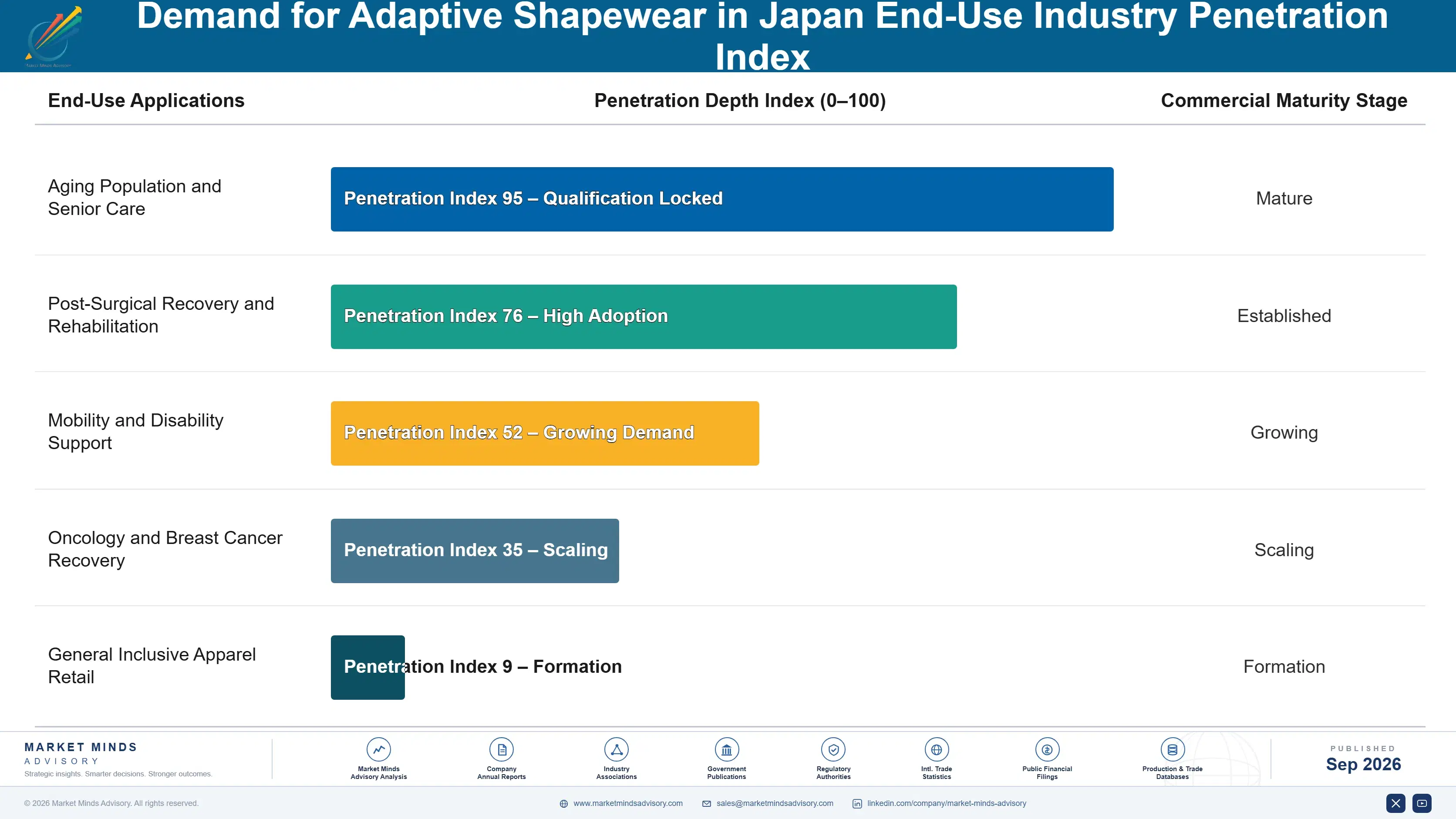
Clinical and retail relationships in this category behave closer to an annuity than a one-time sale, since buyers replace adaptive garments on a predictable cycle once a brand earns trust through reliable fit and durability. That repeat-purchase economics is exactly why manufacturers with strong clinical referral relationships command such a premium valuation relative to one-time discretionary apparel purchases, far more durable than a single discretionary consumer purchase.
Stickiness varies sharply by end-use vertical. Post-surgical and mastectomy-adjacent buyers show the deepest habitual loyalty because switching carries real perceived risk to comfort and healing outcomes, while general aging-population buyers see far more brand-switching driven by price promotions and retail availability. Seated and mobility-adapted buyers sit in between, sticky once a fit is established but slower to adopt new brands in the first place.

Generational buyer profiles are shifting who drives category decisions. Younger buyers with disabilities research extensively online before purchasing and expect design-forward aesthetics as a baseline rather than a differentiator, while older buyers still weight brand heritage and clinical recommendations more heavily. That generational split is forcing manufacturers to run genuinely different marketing and channel strategies within the same product line simultaneously.
japan-adaptive-shapewear-market-end-use-penetration-index-1790014050250

Where Category Leadership Gets Decided

These are among the four positions where our research anticipates prominent divergence between winners and laggards over the coming forecast period. Each is grounded in the demand model, the regulatory perimeter, and the announced capacity pipeline.
01 / MOBILITY ENGINEERING DISCIPLINE

Build mobility-specific pattern capability before competitors force the issue

Manufacturers still selling generic easy-close fasteners without mobility-specific engineering are losing ground fastest, since buyers across every technology segment now expect documented usability testing before they will pay a premium price. Building genuine mobility-specific pattern engineering, not just marketing a single fastener as versatile, is no longer optional for manufacturers that want to retain pricing power over the next decade. The manufacturers investing in that capability now are the ones best positioned to own their category outright, rather than compete purely on price alone.
02 / CLINICAL PARTNERSHIP CAPTURE

Build clinical partnership relationships before referral advantage disappears

Direct clinical partnership programs are the clearest path to durable, recurring revenue available in this category right now, particularly given how physician and clinical staff recommendations carry trust that consumer advertising cannot replicate at any spending level. Manufacturers without dedicated clinical liaison capability are ceding this channel entirely to competitors willing to invest in healthcare provider relationships over multiple years. Manufacturers building that capability now will own the referral advantage for years once clinical relationships compound across a growing base of healthcare accounts.
03 / DESIGN CREDIBILITY DISCIPLINE

Treat design stigma as a permanent revenue protection program

Design stigma is not a minor branding detail that adaptive buyers will eventually tolerate; it is now a persistent feature of purchasing decisions that separates disciplined design programs from reactive ones across every technology segment this market covers. Manufacturers investing in fashion-forward aesthetics and mainstream design credibility are protecting real revenue, not just brand reputation in the abstract sense that most competitors still treat it as. That protection is becoming a genuine and durable competitive advantage on its own terms.
04 / DEMOGRAPHIC ADAPTATION APPROACH

Localize garment configurations for Japan's aging population specifically

Japan's demographic urgency requires garment configurations and clinical partnership models built specifically for its aging population and dense healthcare system, not repurposed global apparel tiers sold with a simply translated label and generic sizing charts. Manufacturers exporting standard adaptive configurations into Japan unchanged are steadily losing share to domestic competitors adapting deliberately to local sizing standards and clinical referral patterns that differ meaningfully from mature markets. The fastest-growing opportunity in this entire category consistently rewards deep local investment over speed of entry alone.

Engagement Snapshot From the Field

A live engagement with an industry participant carrying material or product regulatory and market exposure ahead of a defining policy shift, showing how our research translates into a defensible multi-year portfolio strategy.
MARKET MINDS ADVISORY · CLIENT ENGAGEMENT SUMMARY
Demand for Adaptive Shapewear in Japan Producer Strategic Portfolio Review and Transition Roadmap 2026·Investment Scenario on Demand for Adaptive Shapewear in Japan Exposure Evaluation 2025-26
CLIENT PROFILE
A mid-size foundation garment manufacturer with roughly $55 million in annual revenue (client-reported, unverified by MMA) approached MMA in early 2025 after watching a newer specialist competitor gain disproportionate market share in seated and mobility-adapted shapewear despite a smaller overall marketing budget. The client's core standard adaptive line remained profitable but was losing share in the fastest-growing segment.
STRATEGIC CHALLENGE
The client had lost an estimated 14 percentage points of category share among mobility-limited buyers within eighteen months (client-reported, unverified by MMA), concentrated almost entirely around the competitor's seated-body-mechanics pattern engineering. Leadership needed to determine whether a full pattern redesign or a more targeted product line extension would better recover the lost buyer segment.
MMA APPROACH
MMA combined primary survey data on mobility-limited buyer fit preferences with a review of the client's existing pattern engineering and the competitor's seated-design claims. The team benchmarked the investment required for full seated-pattern redevelopment against a targeted extension using existing manufacturing capacity, modeling payback timeline against the client's addressable mobility-limited buyer pipeline.
KEY FINDINGS
  1. Lost buyers cited seated-body-mechanics pattern fit specifically, rather than any price or fabric quality concern with the client's own existing product lineup.
  2. The competitor gaining share had invested disproportionately in wheelchair-user comfort testing roughly a year before its product line reached broad retail distribution.
  3. The client's existing manufacturing lines could accommodate a targeted seated-pattern extension without requiring a full production line redesign or costly retooling investment.
  4. Mobility-limited buyers that had switched away expressed genuine willingness to reconsider the client once seated fit closely matched competitor specifications overall closely.
CLIENT PROFILE
A mid-size foundation garment manufacturer with roughly $55 million in annual revenue (client-reported, unverified by MMA) approached MMA in early 2025 after watching a newer specialist competitor gain disproportionate market share in seated and mobility-adapted shapewear despite a smaller overall marketing budget. The client's core standard adaptive line remained profitable but was losing share in the fastest-growing segment.
STRATEGIC CHALLENGE
The client had lost an estimated 14 percentage points of category share among mobility-limited buyers within eighteen months (client-reported, unverified by MMA), concentrated almost entirely around the competitor's seated-body-mechanics pattern engineering. Leadership needed to determine whether a full pattern redesign or a more targeted product line extension would better recover the lost buyer segment.
MMA APPROACH
MMA combined primary survey data on mobility-limited buyer fit preferences with a review of the client's existing pattern engineering and the competitor's seated-design claims. The team benchmarked the investment required for full seated-pattern redevelopment against a targeted extension using existing manufacturing capacity, modeling payback timeline against the client's addressable mobility-limited buyer pipeline.
KEY FINDINGS
  1. Lost buyers cited seated-body-mechanics pattern fit specifically, rather than any price or fabric quality concern with the client's own existing product lineup.
  2. The competitor gaining share had invested disproportionately in wheelchair-user comfort testing roughly a year before its product line reached broad retail distribution.
  3. The client's existing manufacturing lines could accommodate a targeted seated-pattern extension without requiring a full production line redesign or costly retooling investment.
  4. Mobility-limited buyers that had switched away expressed genuine willingness to reconsider the client once seated fit closely matched competitor specifications overall closely.
RECOMMENDED STRATEGY
Phase 1: Phase one: develop a targeted seated-pattern product extension using existing manufacturing capacity within the first full six months of the engagement. Phase 2: Phase two: launch the extension through existing retail relationships with dedicated comfort-testing documentation prepared specifically for all buyers and clinicians. Phase 3: Phase three: track mobility-limited buyer share recovery and conversion rates very closely across all retail channels every single quarter thereafter.
OUTCOME
Within twelve months of the extension launch, the client recovered roughly 9 of the 14 percentage points of lost category share among mobility-limited buyers (client-reported, unverified by MMA). The extension also opened new retail relationships with specialty medical apparel retailers that had not previously considered the client.

Frequently Asked Questions

Foundational context covering the market sizes, CAGR, scope, country, region and competition that inform every finding below. This section is provided to cover basics and most often pre-purchase conversations, answered from the MMA Primary Research Dataset.

What is the current size of the adaptive shapewear market relevant to Japan?

The adaptive shapewear market was valued at $0.62 billion globally in 2025. It spans easy-close, compression, and mobility-adapted garments serving Japan and other major markets.

How large will the adaptive shapewear market be by 2036?

The market is projected to reach $1.6 billion by 2036, roughly 2.35 times its 2026 value. Growth is led by mobility-specific engineering and aging population demand.

What is the CAGR for the adaptive shapewear market 2026 to 2036?

The base case CAGR is 8.9% annually between 2026 and 2036. Bull and bear scenarios range from 7.7% to 10.2%, depending on healthcare adoption pace overall.

Which segment is growing fastest?

Seated and Mobility-Adapted Shapewear is growing fastest at 11.8% CAGR, roughly 1.33 times the overall market rate. Mastectomy and Post-Reconstruction Shapewear follows at 10.4% CAGR.

Who are the major companies in the adaptive shapewear market?

Wacoal, Triumph International, Recovery Wear, EZ Wider, and Silvert's lead the category overall. Together the top five hold roughly 31% of global revenue on a comparable basis.

Which country is growing fastest?

Japan is growing fastest at 9.8% CAGR, driven by its rapidly aging population and dense healthcare retail infrastructure nationwide. That pace outstrips most comparable markets.

Report Segmentation Architecture

The full report scope spans multiple orthogonal segmentation dimensions, with cross-tabulated demand data provided for each dimension pair. Coverage extends further to regional breakdowns, trend trajectories, and the competitive detail needed to support segment-level decision-making.

By Primary Market Dimension

  • Easy-Close Fastener Shapewear
  • Post-Surgical Compression Shapewear
  • Adjustable Compression Shapewear
  • Seated and Mobility-Adapted Shapewear
  • Mastectomy and Post-Reconstruction Shapewear
  • Inclusive-Sizing Standard Shapewear

By End-Use Industry

  • Aging Population and Senior Care
  • Post-Surgical Recovery and Rehabilitation
  • Mobility and Disability Support
  • Oncology and Breast Cancer Recovery
  • General Inclusive Apparel Retail

By Commercial Dimension

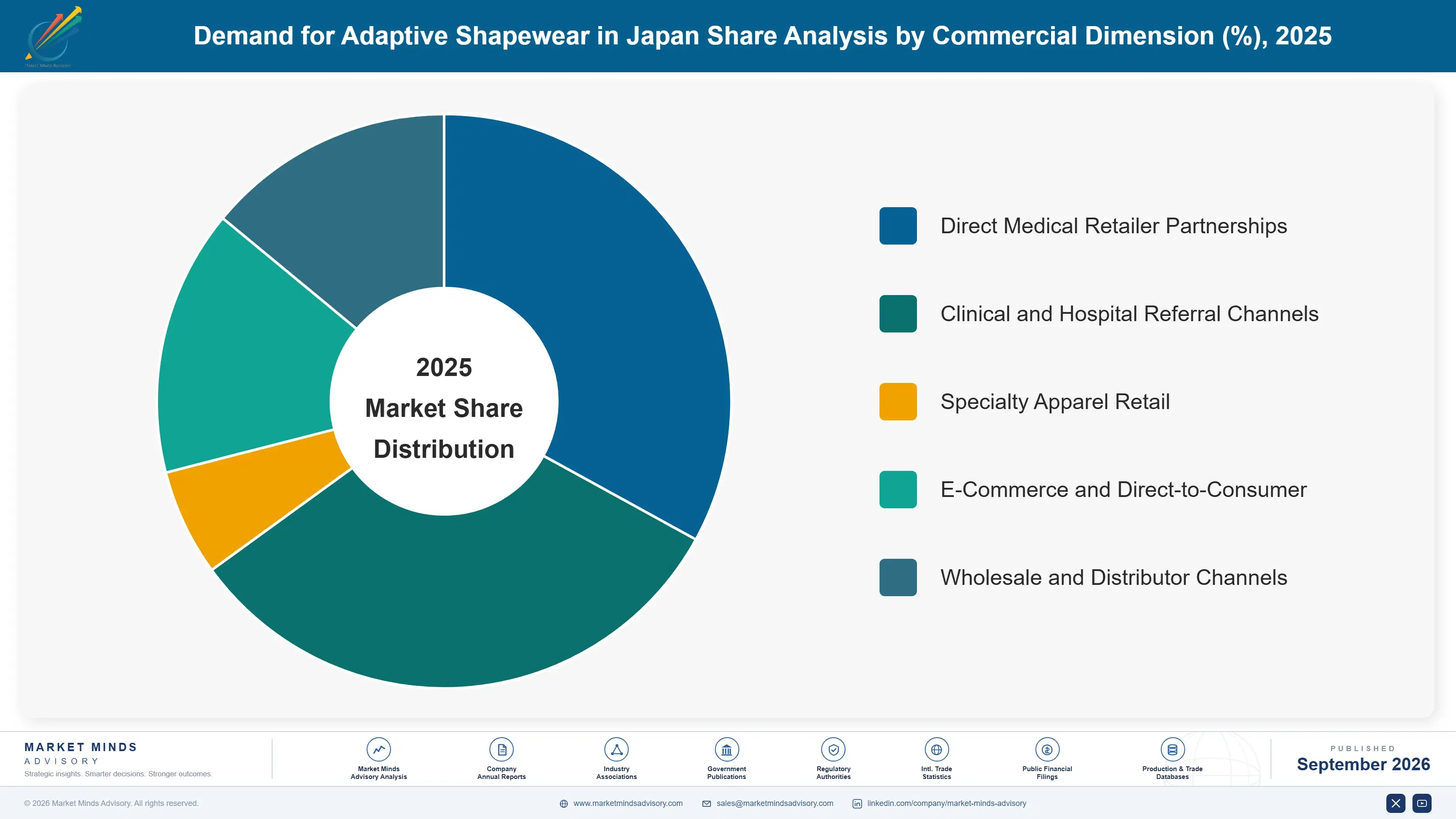
  • Direct Medical Retailer Partnerships
  • Clinical and Hospital Referral Channels
  • Specialty Apparel Retail
  • E-Commerce and Direct-to-Consumer
  • Wholesale and Distributor Channels

By Region

  • North America
  • Western Europe
  • East Asia
  • South Asia and Pacific
  • Latin America
  • Middle East and Africa
  • Eastern Europe

Scope, Methodology, and Coverage

Every figure in this report is reproducible from documented input assumptions. The scope below maps the historical period, the forecast horizon, the segmentation dimensions, and the countries covered, alongside the underlying primary and qualitative methodology.
Historical Period
2020 to 2025
Forecast Period
2026 to 2036
Base Year
2025 (USD billions; MMA Primary Research Dataset, September 2026)
Market Definition
The Adaptive Shapewear Market covers body-shaping undergarments designed with accessibility features, easy-close fasteners, adjustable compression, post-surgical support, and inclusive sizing, for consumers with mobility limitations, post-surgical recovery needs, or aging-related dexterity challenges, with particular focus on demand dynamics in Japan. It excludes standard shapewear without adaptive features and medical compression garments requiring physician fitting.
Quantitative Units
USD Billion; unit volume in million garments where category-relevant
Segmentation Dimensions
By technology type, by end-use industry, and by commercial distribution channel
Regions Covered
North America, Western Europe, East Asia, South Asia and Pacific, Latin America, Middle East and Africa, Eastern Europe
Countries Covered
40+ countries across seven regions, with detailed Japan-specific analysis
Key Companies Profiled
20 companies profiled, including 5 key players and 15 additional participants
Quantitative Methodology
Primary survey, n=3,800 respondents, Q4 2025, six countries; demand-side model with trade association cross-validation
Qualitative Methodology
47 expert interviews, Q4 2025; applied to validate demand model assumptions, identify emerging dynamics, and assess competitive positioning
Report Format
PDF and XLSX data workbook (Word format preview document)
Publisher
Market Minds Advisory
Report Code
MMA-2026-HLT-358
Published
September 2026
Contact
sales@marketmindsadvisory.com | www.marketmindsadvisory.com

Purchase the full Demand for Adaptive Shapewear in Japan Report (2026 to 2036).

This report gives category leaders, medical retailer procurement teams, and investors a comparable read on where adaptive shapewear revenue and margin are actually concentrating, with particular attention to Japan's aging-population demand. Coverage spans seven regions and six technology segments, from easy-close fasteners through seated and mastectomy-adjacent constructions. The analysis combines primary survey data from 3,800 respondents across six countries with 47 expert interviews, separating durable demand shifts from short-term promotional noise. It is built for teams making product, channel, and pricing decisions over a multi-year horizon, not a single planning cycle.
Segment-level CAGR and margin benchmarking data
Seven-region demand and share breakdown analysis
Competitive positioning across twenty profiled companies
Input cost exposure and mitigation pathways
Portfolio tier and margin architecture mapping
Anonymized client case study with outcomes

Built For The People Who Decide

From boardroom strategy to bench-side execution, this report is read cover-to-cover by leaders shaping the next decade of their industry, turning demand scenarios, market dynamics and valuation benchmarks into decisions.
CXOs/ Presidents/ VPs/ Managers
M&A and Corporate Development
Strategy Teams and R&D Heads
Procurement and Product Directors
Regulatory and Compliance Leaders
Investor Relations and Equity Analysts