Market Minds Advisory
IT Asset Disposition Market

IT Asset Disposition Market: IT Asset Disposition Market. Trends and Forecast 2026 to 2036

Cloud migration is emptying corporate data centers faster than most enterprises can responsibly retire the hardware inside them, pulling data destruction certification and circular economy resale value squarely into board-level risk conversations.

Lead Analyst

Published

September 2026

Make Smarter Decisions with Customized Research Insights

Request a free sample report and evaluate market opportunities, growth trends, and competitive dynamics relevant to your business needs.

2025 MARKET VALUE$11.5BMarket Size 2025
2036 FORECAST VALUE$24.2BBase Case , 2026 to 2036
CAGR 2026 TO 20367.0 %Bull 8.2% / Bear 5.8%
INCREMENTAL OPPORTUNITY$11.9BNet 10- year value creation
EXPANSION MULTIPLE1.97x2036 value over 2026 base
Strategic Levers
M&A Pipeline
Regional Outlook
Country Rankings
Competitive Intelligence
Segmental Deep-dive
Call-Us : 91 93563 13602

Executive Snapshot and Market Trajectory.

Enterprises retiring on-premises data centers for cloud infrastructure are generating unprecedented volumes of decommissioned hardware, forcing IT asset disposition providers to scale certified data destruction capacity considerably faster than historical growth patterns anticipated across most enterprise segments and industries worldwide and quite consistently.
Data center decommissioning has become the fastest-growing service category as enterprises accelerate cloud migration, creating volume that traditional office equipment refresh cycles never generated at comparable scale or urgency previously seen across the industry and most enterprise segments. Data privacy regulation across multiple jurisdictions has elevated certified data destruction from a compliance afterthought into a genuine board-level risk management priority that enterprises can no longer delegate to lowest-cost vendors without proper documented certification.
Iron Mountain and Sims Lifecycle Services lead through established enterprise relationships and comprehensive certification capability, while specialized providers like ERI compete on recycling and material recovery expertise for end-of-life equipment lacking meaningful resale value entirely today. Arrow Electronics uses its broader electronics distribution relationships to capture asset disposition business as a natural extension of existing enterprise technology procurement relationships already established over many years of accumulated trust and reliability.
Market Definition
The IT Asset Disposition Market covers services that securely decommission, data-sanitize, refurbish, resell, and recycle retired enterprise information technology equipment, measured by service and material recovery revenue. It excludes new IT equipment sales and general electronic waste recycling unrelated to enterprise information technology asset lifecycle management.
Base Year Value
$11.5B in 2025 (MMA Primary Research Dataset, September 2026)
Forecast Period
2026 to 2036, eleven discrete annual values
CAGR
7.0% base case. Bull 8.2%. Bear 5.8%.
Fastest Growth Segment
Data Center Decommissioning Services: 9.5% CAGR
Fastest Growth Country
India: 9.0% CAGR
Fastest Growth Region
South Asia and Pacific: 8.5% CAGR
Largest Region
North America: 32% of 2025 global value
Market Leaders
Leading participants include Iron Mountain, Sims Lifecycle Services, ERI, Arrow Electronics, and TES-AMM.
Primary Survey
n=3,800 procurement and R&D decision-makers, Q4 2025, six countries
Methodology
Demand-side build-up, cross-validated against public data, 47 expert interviews

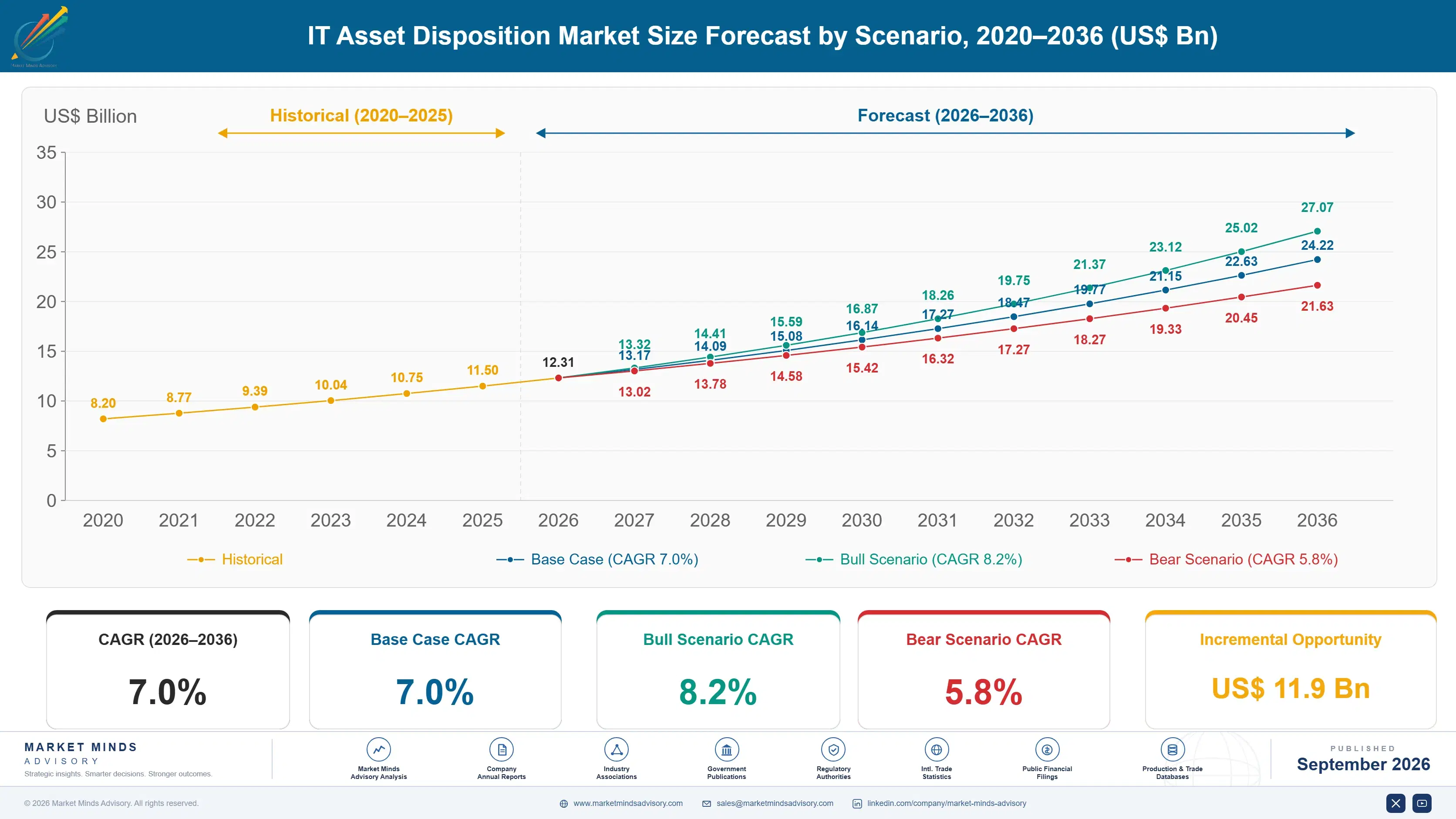
IT Asset Disposition Market Forecast Scenarios

it-asset-disposition-market-size-forecast-scenario-1788417383847
IT asset disposition demand grew steadily through the historical period as enterprise data privacy regulation tightened and equipment refresh cycles continued across most corporate technology environments and industries worldwide and quite consistently over time. The 6.0% historical growth rate reflects gradual compliance-driven adoption rather than any single disruptive event transforming the category entirely and immediately.
The base case assumes continued cloud migration driving data center decommissioning volume, expanding data privacy regulation requiring certified destruction documentation across more jurisdictions worldwide, and growing circular economy pressure pushing enterprises toward refurbishment and resale rather than pure recycling disposal alone. These three mechanisms support 7.0% compound annual growth through 2036, with data center decommissioning and compliance certification services outpacing traditional office equipment disposition as enterprises prioritize documented risk management.
A bull case turns on additional major economies adopting comprehensive data privacy legislation comparable to existing European and American frameworks, mandating certified destruction documentation industry-wide across most sectors and jurisdictions. A bear case centers on extended equipment refresh cycles as enterprises delay hardware replacement amid economic uncertainty, since disposition volume depends directly on how frequently enterprises retire equipment across their fleets.

The Data Privacy Risk Behind Every Retired Server

Pricing varies considerably by service type and equipment category, with certified data destruction and compliance documentation commanding premium pricing given the liability protection enterprises require, while bulk recycling of end-of-life equipment lacking resale value generates comparatively modest per-unit revenue across most categories tracked. Refurbishment and resale services capture the highest margins when equipment retains meaningful secondary market value and demand.
MARKET CONCENTRATION38% CR5top five providers hold a moderate combined revenue share
AVERAGE RECOVERY VALUE18% of original costtypical resale recovery percentage for refurbished enterprise hardware
TOP PRODUCING COUNTRY34% United Statesshare of global IT asset disposition revenue captured domestically
DATA CENTER GROWTH RATE9.5% annuallyexpansion pace of decommissioning services tied to cloud migration
CERTIFIED DESTRUCTION SHARE62% of revenueproportion of industry revenue tied to compliance documentation
EQUIPMENT REFRESH CYCLE3 to 5 yearstypical interval before enterprises replace core computing hardware
Certified destruction and compliance documentation now generate roughly 62% of total industry revenue, reflecting how thoroughly data privacy regulation has reshaped enterprise procurement priorities away from lowest-cost disposal toward documented, auditable destruction processes across most industries and jurisdictions worldwide today. This shift has meaningfully favored established providers with comprehensive certification credentials over smaller, less formally accredited regional competitors lacking equivalent documentation capability.
Data center decommissioning has emerged as the fastest-growing service category, expanding at roughly 9.5% annually as enterprises accelerate cloud migration and retire on-premises server infrastructure at a pace traditional office equipment refresh cycles never generated historically across most corporate environments and industries. This volume shift is reshaping provider capacity planning and specialized logistics investment considerably across the industry and its many service providers.
"Nobody used to think about what happened to a server after it left the data center. Now it's a board-level question, because the wrong answer means a data breach headline with your company's name attached to it."
Senior Analyst, IT Lifecycle and Data Security Practice · MMA Technology Practice · September 2026

Market Trends

Data Center Decommissioning Volume Accelerates With Cloud Migration

Enterprises retiring on-premises data center infrastructure for cloud computing platforms are generating decommissioning volume that traditional office equipment refresh cycles never produced, forcing IT asset disposition providers to scale specialized logistics and data destruction capacity considerably faster than historical growth patterns anticipated. This volume shift concentrates among server and storage hardware carrying particularly sensitive enterprise data, requiring more rigorous destruction documentation than typical laptop or desktop equipment retirement previously demanded. Data center decommissioning services are expanding at roughly 9.5% annually, the fastest growth of any service category tracked in this report.
Market Impact: Compliance-driven revenue reached 62% of total
Certified Destruction Documentation Becomes Board-Level Priority

Data privacy regulation across multiple jurisdictions has elevated certified data destruction from a routine compliance afterthought into a genuine board-level risk management priority that enterprises can no longer delegate to lowest-cost vendors without documented certification proving proper handling occurred throughout the disposition process. This shift reflects mounting regulatory penalty exposure and reputational risk following several high-profile data breach incidents traced directly back to improperly disposed enterprise hardware still containing recoverable sensitive information. Certified destruction and compliance documentation now generate roughly 62% of total industry revenue, up meaningfully from a smaller base in previous years.
Market Impact: Refurbishment recovers 18% of original cost

Market Opportunities and Growth Drivers

Expanding Data Privacy Regulation Drives Compliance Spending

Data privacy regulation, expanding across more jurisdictions and covering broader categories of sensitive information, requires enterprises to demonstrate documented, auditable data destruction processes rather than simply discarding retired equipment through informal disposal channels lacking any real verification whatsoever or oversight. This regulatory expansion sustains continuous demand for certified disposition services that would otherwise not exist absent this compliance obligation forcing enterprises toward more rigorous, better-documented hardware retirement practices. Certified destruction and compliance documentation now generate roughly 62% of total industry revenue, reflecting this sustained regulatory pressure across most developed markets.
Market Impact: Extended cycles delay disposition 2 years

Circular Economy Pressure Favors Refurbishment Over Recycling

Corporate sustainability commitments and circular economy pressure increasingly push enterprises toward equipment refurbishment and resale rather than pure material recycling, since extending hardware lifecycle through resale generates measurably better environmental outcomes than immediate material recovery and disposal alone at the end of use. This driver reflects genuine corporate sustainability reporting requirements that increasingly track equipment lifecycle extension as a measurable environmental performance metric investors and stakeholders now scrutinize closely. Refurbished equipment typically recovers roughly 18% of original purchase cost, providing enterprises meaningful residual value previously captured entirely by disposal vendors.
Market Impact: Compliance complexity spans over 40 jurisdictions

Market Restraints and Challenges

Extended Equipment Refresh Cycles Limit Disposition Volume

Enterprises facing economic uncertainty increasingly extend equipment refresh cycles beyond the typical 3 to 5 year replacement schedule, directly reducing disposition volume available to service providers regardless of underlying data privacy or sustainability pressure encouraging more frequent hardware turnover across the enterprise. This restraint stems from capital budget constraints that make deferring hardware replacement an attractive short-term cost-saving measure during periods of broader economic caution across most industries. Providers are responding by expanding service offerings toward maintenance and lifecycle extension services that generate revenue independent of actual disposition volume timing.
Market Impact: Data center decommissioning expanded 9.5% annually

Fragmented Regional Compliance Standards Complicate Operations

IT asset disposition providers operating across multiple countries face genuinely fragmented data privacy and environmental compliance standards that require maintaining separate certification credentials and documentation processes for each distinct regulatory jurisdiction served, adding meaningful operational complexity and cost across the business. This restraint stems from the lack of a unified global data destruction and e-waste disposal standard, unlike more mature regulatory frameworks that exist in other established industries operating internationally. Providers are responding by investing in compliance management systems capable of tracking multiple simultaneous jurisdictional requirements across their entire operating footprint.
Market Impact: Certified destruction reached 62% of revenue
3 additional market trends, 4 additional growth drivers, and 2 additional restraints and challenges are covered in the full report. Contact sales@marketmindsadvisory.com to access the complete intelligence.

Segment CAGR and Growth Architecture

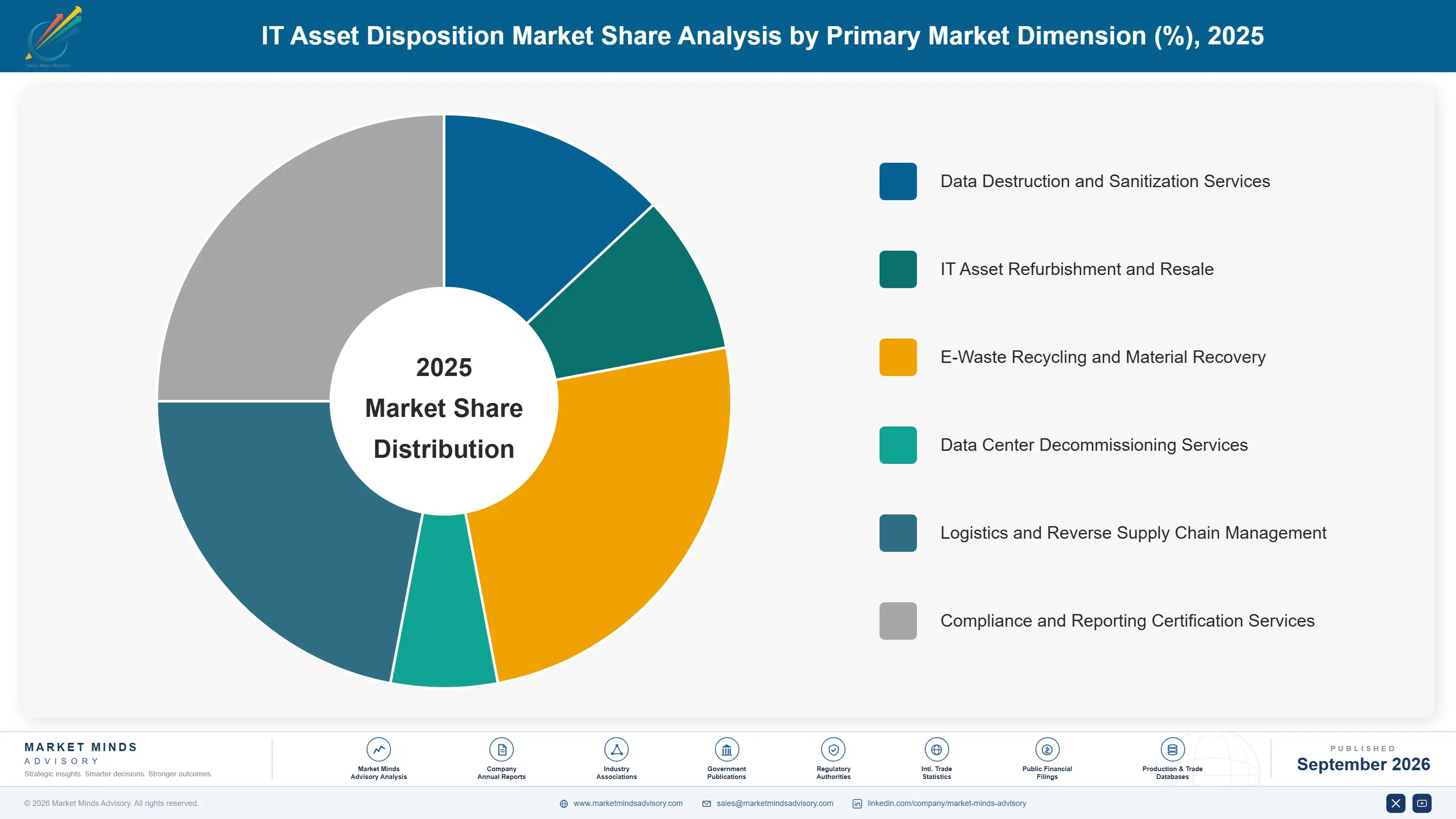
The IT Asset Disposition Market segments by service type, spanning data destruction and sanitization through refurbishment, recycling, data center decommissioning, and supporting logistics and compliance services serving enterprise, government, and financial services buyers worldwide today. Data center decommissioning and compliance certification services are pulling ahead of traditional disposal as enterprises prioritize documented risk management.
it-asset-disposition-market-market-share-analysis-1788417384379

Data Center Decommissioning Services

Data center decommissioning services represent the fastest-growing segment, expanding at 9.5% annually as enterprises accelerate cloud migration and retire on-premises server and storage infrastructure at a pace traditional office equipment refresh cycles never generated historically across most corporate technology environments and industries nationwide and internationally. This segment benefits directly from the specialized logistics and data destruction requirements server-grade hardware demands, since data centers concentrate far more sensitive enterprise data per physical unit than typical laptop or desktop equipment previously handled routinely. Adoption concentrates among large enterprises and hyperscale cloud providers undergoing genuine infrastructure transformation, a customer base expanding rapidly as cloud migration accelerates across most industries and company sizes globally today.
CAGR 9.5%

Compliance and Reporting Certification Services

Compliance and reporting certification services form the second-fastest segment, growing at 8.5% annually as data privacy regulation across multiple jurisdictions requires enterprises to demonstrate documented, auditable destruction processes rather than relying on informal disposal arrangements lacking any verification whatsoever or meaningful oversight of any kind. This segment benefits from genuine regulatory tailwinds that show no sign of reversing, since data privacy legislation continues expanding into additional jurisdictions and covering broader categories of sensitive information requiring documented protection throughout the disposition process. Demand concentrates among regulated industries including financial services, healthcare, and government agencies facing the most stringent documentation and audit trail requirements currently enforced by regulators worldwide, consistently, and comprehensively.
CAGR 8.5%
Full segment breakdown across 6 segments available in the complete report.

Regional Architecture and Country Demand Map

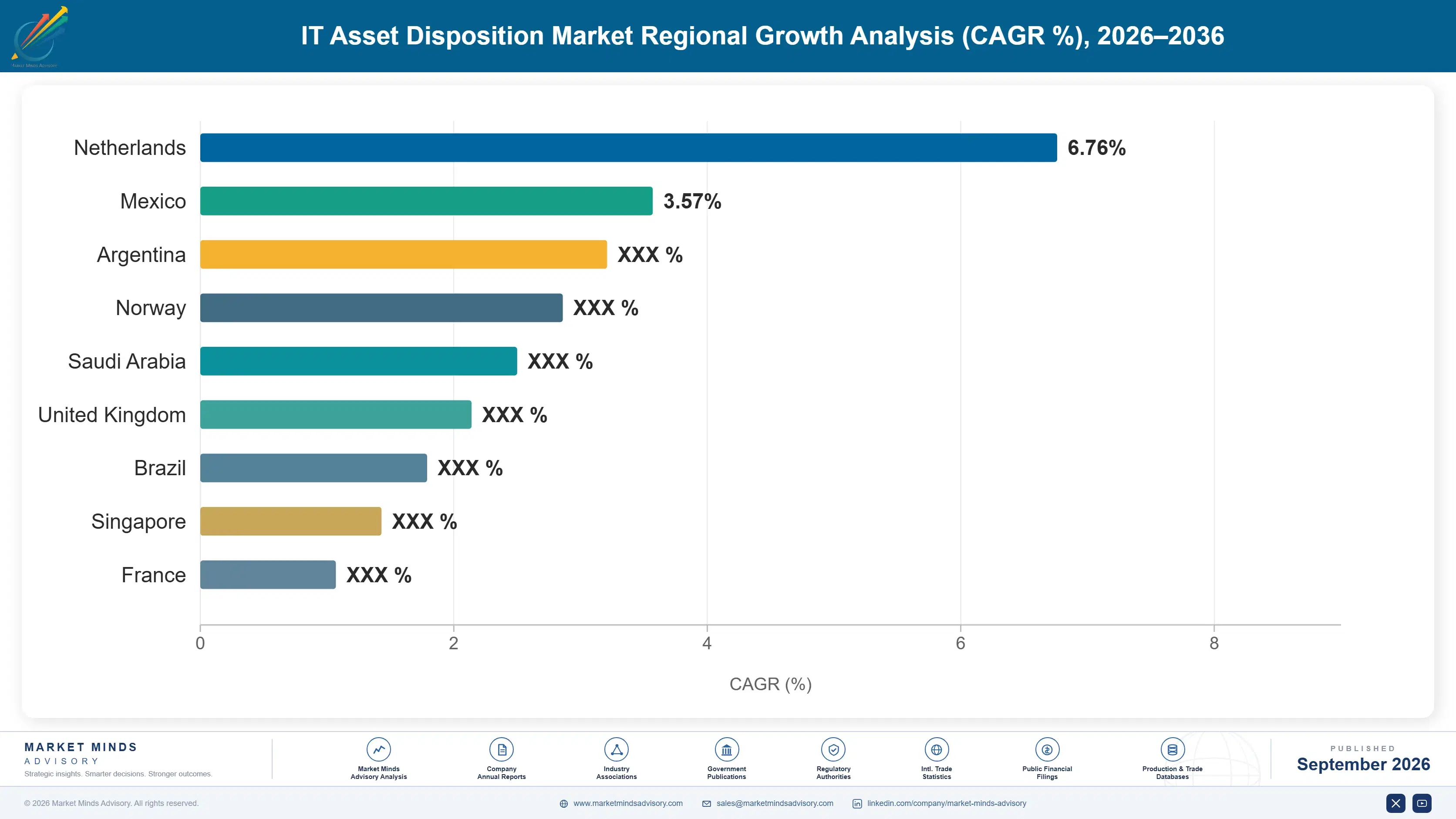
North America leads the IT Asset Disposition Market given its dense concentration of major service providers and the world's largest enterprise IT fleet base found consistently domestically today, while Western Europe follows closely behind through stringent data privacy and e-waste regulation frameworks enforced consistently there.

North America

The United States hosts Iron Mountain, ERI, Arrow Electronics, and Apto Solutions, giving domestic providers direct access to the world's largest enterprise IT fleet base and the substantial hyperscale cloud data center infrastructure driving decommissioning volume. American data privacy regulation, though less comprehensive than European frameworks, continues expanding at the state level, creating meaningful compliance-driven demand for certified destruction documentation across most regulated industries. Canada contributes a smaller but growing base of demand tied to both enterprise IT lifecycle management and its own domestic data privacy legislation requirements. This concentration explains why roughly 34% of global IT asset disposition revenue originates from United States-headquartered operators specifically, well above the country's overall share of global IT spending.
Share: 32% | CAGR: 7.5% (2026 to 2036)

Western Europe

The European Union's General Data Protection Regulation and WEEE electronic waste directive together create the world's most comprehensive regulatory framework governing enterprise IT asset disposition, forcing enterprises across Germany, France, and the United Kingdom to demand rigorously documented destruction and recycling processes. Germany hosts substantial e-waste recycling and refurbishment infrastructure tied to its broader circular economy policy leadership within the European Union specifically. The United Kingdom contributes meaningful demand tied to its own data protection legislation, which largely mirrors European Union requirements despite Brexit-related regulatory divergence in other policy areas. Growth here trails North America somewhat given a smaller overall enterprise IT fleet base relative to American corporate technology spending levels.
Share: 24% | CAGR: 6.0% (2026 to 2036)
Regional intelligence for 5 additional markets available in the complete report: East Asia, South Asia and Pacific, Latin America, Middle East and Africa, Eastern Europe. Contact sales@marketmindsadvisory.com.
it-asset-disposition-market-country-cagr-analysis-1788417384903

How Providers Extract Value Beyond Basic Disposal

Providers expand revenue beyond basic disposal fees by pricing certified destruction documentation at premium rates, bundling asset tracking software with physical logistics services, licensing compliance management platforms to a broader base of smaller regional competitors, and selling refurbished equipment resale services directly to secondary market buyers specifically at each full annual contract renewal cycle.

Certified Destruction Documentation Premium Pricing Model

Providers increasingly price certified data destruction documentation at premium rates over basic disposal, since enterprises facing genuine regulatory liability exposure value auditable proof of proper handling far more than marginal cost savings from less rigorously documented competitors lacking comparable certification credentials and accreditation history built over many years of effort. These certified documentation contracts typically carry pricing 30% above basic disposal service rates, reflecting the liability protection value enterprises place on defensible compliance records during regulatory audits. This premium tier now anchors baseline revenue for providers with established certification credentials specifically.
Market Impact: Certified documentation contracts price 30% above basic rates

Asset Tracking Software Bundling With Logistics Services

Providers increasingly bundle real-time asset tracking software directly with physical collection and logistics services, letting enterprises monitor chain-of-custody status for retired equipment throughout the entire disposition process rather than relying on periodic manual reporting alone or outdated spreadsheets and paper records maintained manually by dedicated internal staff. This bundled approach has lifted average contract value by roughly 22% compared to logistics-only arrangements, since enterprises value continuous visibility into asset status that directly supports internal compliance and audit documentation requirements. Adoption concentrates among large enterprises managing disposition across many facilities simultaneously.
Market Impact: Tracking software bundling lifts contract value 22% overall

Compliance Platform Licensing to Regional Competitors

Established providers increasingly license their proprietary compliance management software platforms to smaller regional competitors seeking to offer comparable documentation capability without matching the multi-year software development investment required to build equivalent systems independently from scratch themselves and their own dedicated engineering, product, and specialized development teams. This licensing arrangement lets technology leaders monetize accumulated compliance software development investment well beyond direct disposition services alone, generating revenue from smaller competitors who lack comparable in-house software engineering capability. Platform licensing revenue already represents roughly 5% of total industry revenue currently reported industry-wide.
Market Impact: Platform licensing already adds roughly 5% of revenue

Refurbished Equipment Resale to Secondary Market Buyers

Providers sell refurbished enterprise equipment directly to secondary market buyers including smaller businesses and educational institutions, capturing resale value that would otherwise be lost entirely if equipment moved straight to material recycling without any refurbishment or resale consideration whatsoever or careful evaluation beforehand by trained staff. These resale transactions typically carry gross margins roughly 3 times higher than pure recycling services, since refurbished equipment commands meaningful secondary market pricing that recycled raw materials alone cannot generate at comparable per-unit value. Adoption concentrates among providers with established refurbishment facilities and secondary market distribution relationships.
Market Impact: Resale margins run roughly 3x recycling revenue overall

Who Controls the Margin Pool

Iron Mountain, Sims Lifecycle Services, ERI, Arrow Electronics, and TES-AMM together hold an estimated 38% combined share of tracked revenue, a moderate concentration reflecting the category's continued fragmentation across many regional and specialty providers. Iron Mountain leads through established enterprise records management relationships that extend naturally into IT asset disposition, while Sims Lifecycle Services competes on comprehensive global certification capability spanning multiple regulatory jurisdictions simultaneously.
Competitive activity centers on certification credential depth and data center decommissioning capability, since enterprises increasingly evaluate providers on documented compliance track record rather than on basic disposal pricing alone. Providers are racing to expand specialized data center logistics and destruction capacity, and several have begun forming partnerships with cloud infrastructure providers to capture decommissioning volume directly at the source.

Pressure is building from smaller regional providers with lower overhead cost structures, who threaten established incumbents in price-sensitive segments where certification requirements matter less than basic disposal economics. Rankings could shift meaningfully if data center decommissioning volume growth continues outpacing traditional office equipment disposition, since this segment increasingly rewards specialized logistics capability that not every incumbent provider has developed at comparable scale.
it-asset-disposition-market-company-positioning-matrix-1788417385418

Competitive Moat and Risk Dimensions

IRON MOUNTAIN

Moat: Enterprise Records Management Relationships

Iron Mountain's decades-long enterprise records management relationships give it direct access to corporate procurement decision-makers who already trust the company with sensitive information handling, creating a cross-selling pathway into IT asset disposition services. This advantage lets Iron Mountain win disposition contracts through expanded scope with existing customers rather than competing purely on price against newer, specialized competitors entering the category.
IRON MOUNTAIN

Risk: Limited Data Center Specialization

Iron Mountain's broader records management focus means it has historically invested less in specialized data center decommissioning logistics capability than competitors purpose-built for this fastest-growing service category currently reshaping industry revenue. If data center decommissioning continues outpacing traditional office equipment disposition growth, Iron Mountain risks losing share to more specialized competitors in this specific high-growth segment.
SIMS LIFECYCLE SERVICES

Moat: Comprehensive Global Certification Coverage

Sims Lifecycle Services maintains certification credentials across an unusually broad range of international regulatory jurisdictions, giving it a genuine advantage serving multinational enterprise customers who need consistent compliance documentation across every country where they operate simultaneously. This certification breadth lets Sims win large multinational contracts that smaller, single-jurisdiction competitors cannot credibly pursue independently.
SIMS LIFECYCLE SERVICES

Risk: Higher Cost Than Rivals

Sims Lifecycle Services' comprehensive global certification infrastructure carries meaningfully higher overhead cost than smaller regional competitors who serve single markets without comparable multi-jurisdictional compliance investment, limiting Sims' price competitiveness in cost-sensitive, single-country disposition contracts. This cost disadvantage matters most when competing against regional specialists for smaller enterprise customers lacking genuine multinational compliance requirements.

Players Tracked

Prominent Players

Iron Mountain
Sims Lifecycle Services
ERI
Arrow Electronics
TES-AMM

Other Key Players

Apto Solutions
CompuCycle
Cascade Asset Management
Global Electric Electronic Processing
Dell Technologies Asset Recovery Services
HPE Financial Services
Ingram Micro CE Lifecycle Services
Blancco Technology Group
Retire-IT
Synetic Technologies
ITRenew
Redwood Global
Comprenew
Sage Sustainable Electronics
WEEE World

Recent Developments

MARCH 2025

Iron Mountain announced a strategic partnership with a major hyperscale cloud provider to handle data center decommissioning volume as the provider retires legacy infrastructure while expanding newer facility capacity across multiple regions. The partnership reflects growing provider focus on capturing decommissioning volume directly from cloud infrastructure operators.
Signal: Confirms established providers are increasingly pursuing direct partnerships with hyperscale cloud infrastructure operators more broadly today.
JULY 2025

Sims Lifecycle Services expanded its certified destruction and refurbishment capacity across multiple international facilities to accommodate growing enterprise demand for documented compliance services amid tightening global data privacy regulation worldwide and continuously. The expansion strengthens the company's ability to serve multinational enterprise customers across additional jurisdictions.
Signal: Reflects continued capacity investment responding to expanding global data privacy regulation across most markets and jurisdictions.
NOVEMBER 2025

ERI acquired a smaller regional refurbishment and resale specialist to expand its secondary market distribution capability beyond its traditional recycling and material recovery core business operations nationwide, internationally, and across multiple channels. The acquisition reflects growing industry-wide emphasis on refurbishment revenue over pure material recycling disposal.
Signal: Signals recycling specialists are expanding into higher-margin refurbishment and resale services more directly and broadly today.

Certification and Compliance Cost Exposure

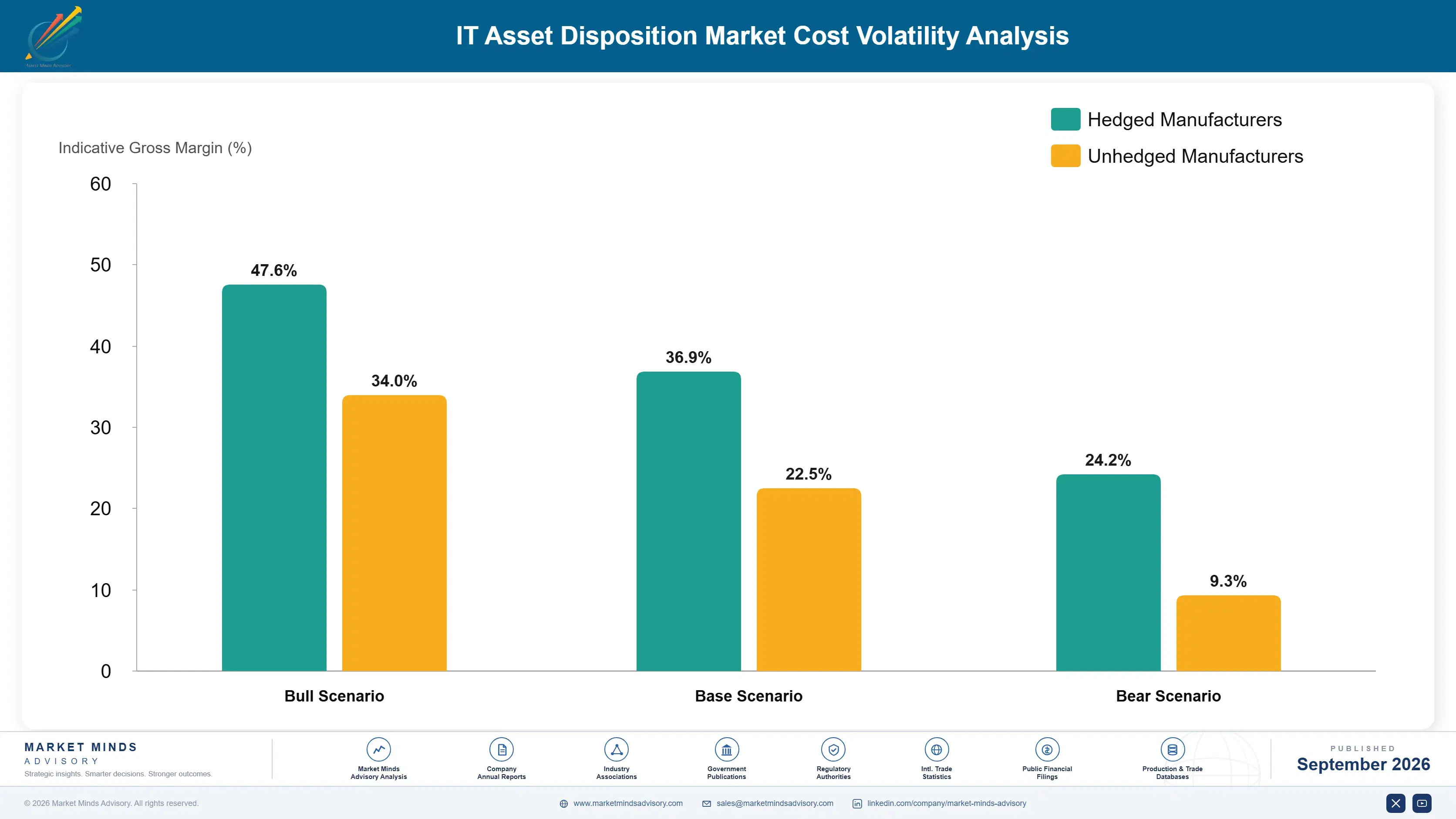
IT asset disposition providers carry a labor and logistics-intensive cost structure, with skilled data destruction and certification labor representing roughly 30% to 40% of service delivery cost, alongside specialized transportation, secure facility infrastructure, ongoing regulatory compliance, continuous certification maintenance expense, and periodic third-party auditing costs incurred quite regularly across every single operating region worldwide today.
Regulatory certification maintenance cost, documented across company annual reports and industry trade association publications, has risen considerably as data privacy regulation expands into more jurisdictions requiring providers to maintain separate certification credentials for each distinct regulatory framework served. One provider disclosed compliance-related operating cost increasing by roughly 25% over three years as additional jurisdictional certification requirements accumulated, a cost that smaller regional providers without comparable compliance scale struggle to absorb profitably while remaining price-competitive.

Smaller regional providers without established certification infrastructure or specialized data center logistics capability face a durable cost disadvantage against larger incumbents like Iron Mountain and Sims who spread compliance and certification investment across a much broader revenue base. This dynamic concentrates competitive advantage among providers with the scale to justify sustained compliance infrastructure investment regardless of periodic regulatory expansion into additional jurisdictions.
it-asset-disposition-market-cost-volatility-analysis-1788417385613

Shared Compliance Infrastructure Across Regions

Providers increasingly build compliance management systems capable of serving multiple regulatory jurisdictions from shared infrastructure rather than developing separate systems for each individual market, letting them spread certification investment across a broader operational footprint and customer base. This approach favors providers with genuine multinational operations over single-market regional specialists lacking comparable scale to justify the investment.

Automated Data Destruction Verification Systems

Providers increasingly deploy automated data destruction verification and documentation systems rather than relying entirely on manual certification processes, reducing skilled labor cost while improving documentation consistency and audit trail reliability across large disposition volumes handled daily across facilities. This approach requires meaningful upfront technology investment but reduces variable labor cost considerably over time and scale.

Portfolio Architecture for Margin Defence

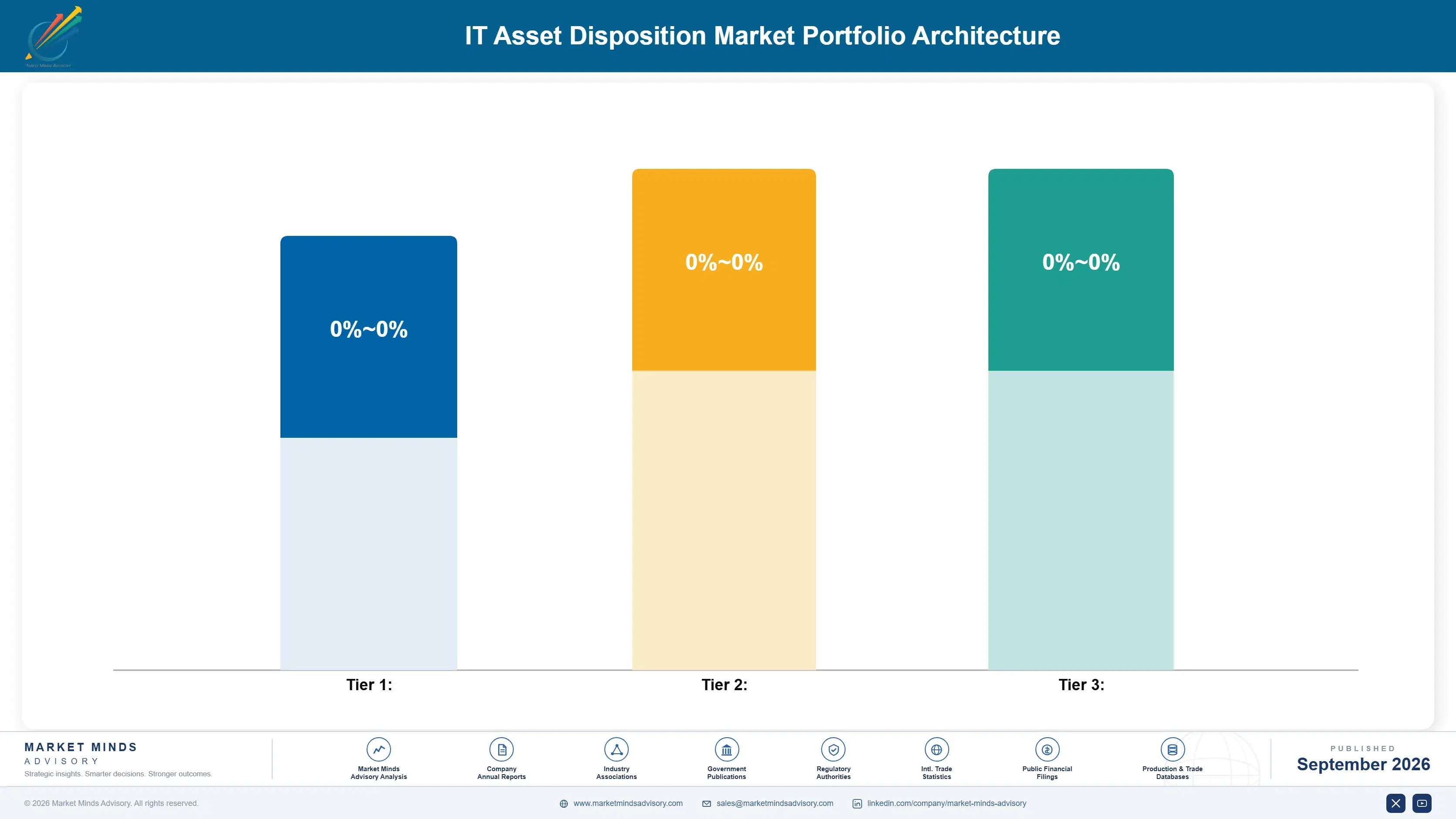
IT asset disposition revenue organizes into three commercially distinct tiers separated by documentation rigor and service sophistication rather than by provider size alone. Volume tiers cover basic recycling and disposal sold to cost-sensitive commercial buyers, while premium tiers add certified data destruction serving regulated enterprises. The newest tier bundles asset tracking software and compliance platform licensing commanding the steepest margins.
Gross margins vary considerably across tiers because basic recycling faces price competition from an expanding pool of regional providers, while certified destruction and software-enabled services carry differentiated compliance capability that commands durable premium pricing from regulated enterprise customers. Premium and next-generation tiers therefore capture disproportionate profit relative to their share of total equipment volume processed each year.

High-value pools concentrate overwhelmingly in certified destruction contracts and compliance software licensing rather than in commodity recycling, which faces mounting price pressure from expanding regional provider competition entering cost-sensitive segments across multiple markets. The volume tier remains essential for maintaining overall processing scale and material recovery relationships, but incremental profit growth increasingly comes from premium tier expansion and data center decommissioning demand rather than additional basic disposal sales alone.

Basic recycling and material recovery sold to cost-sensitive commercial buyers facing intensifying regional provider competition nationwide and internationally, priced with gross margins in the 15% to 25% range typically achieved today.
Gross Margin

Certified data destruction and compliance documentation sold to regulated enterprises under multi-year contracts, carrying gross margins between 35% and 45% as liability protection commands genuine premium pricing consistently across most industries today.
Gross Margin

Asset tracking software bundles and compliance platform licensing commanding gross margins above 50% because software and platform components carry favorable, scalable cost economics once fully established, validated, deployed, and scaled.
Gross Margin
it-asset-disposition-market-portfolio-architecture-1788417386111

High-value Sub-segments and Strategic Watch-out

Data Center Decommissioning Services

High-value and high-growth, this segment combines the fastest expansion rate in the market as enterprises accelerate cloud migration and retire on-premises server infrastructure at unprecedented volume nationwide, internationally, and quite consistently each passing year and business cycle tracked closely across most industries, geographies, and market segments.

Compliance and Reporting Certification Services

High-value with strong growth, compliance services capture meaningful premiums through regulatory documentation even though adoption trails the fastest data center segment considerably across most tracked application categories currently evaluated closely in this full report, study, detailed analysis, industry summary, and comprehensive market overview provided here.

E-Waste Recycling and Material Recovery

Volume core of the market, recycling remains the largest segment by equipment volume and the primary entry point for cost-sensitive buyers, though pricing power here continues eroding steadily each passing year, cycle, quarter, budget period, fiscal calendar, and full reporting window tracked closely and consistently.

IT Asset Refurbishment and Resale

Strategic watch-out segment, growing steadily as circular economy pressure favors equipment lifecycle extension, but facing uncertain long-term differentiation as secondary market pricing fluctuates with broader used electronics demand significantly over time, geography, market cycle, category, buyer segment, and pricing tier tracked quite closely and consistently.

The Recurring Value of Compliance Contracts

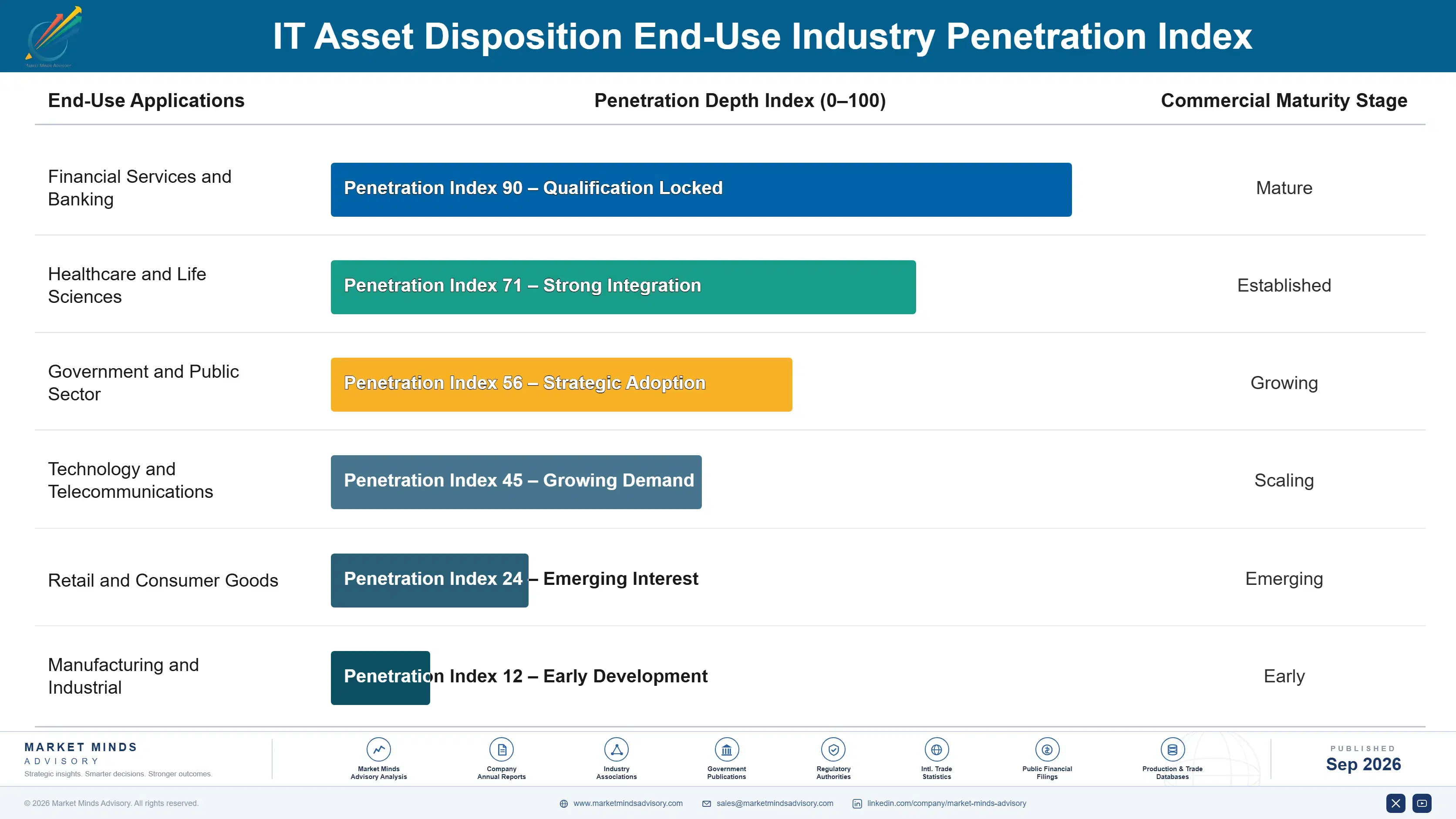
IT asset disposition revenue increasingly behaves like an annuity once multi-year enterprise disposition contracts are established, since switching providers requires revalidating certification credentials and rebuilding documented compliance history that regulated enterprises cannot easily justify absent a genuine service failure or breach. Contract renewal rates already exceed 70% at expiration, reflecting how deeply these relationships embed into enterprise compliance and vendor management infrastructure and processes.
Adoption stickiness varies considerably by industry vertical across the entire enterprise customer base and its many distinct buyer segments worldwide. Financial services and healthcare customers show the deepest dependency given stringent regulatory documentation requirements and extensive vendor vetting processes that discourage frequent switching, while smaller commercial buyers show more price-sensitive, easily switched engagement given fewer institutional compliance barriers and lower switching costs overall.

A generational shift is underway in who manages these vendor relationships internally. IT asset disposition procurement increasingly involves dedicated data security and compliance specialists rather than general facilities or procurement staff alone, reflecting the category's evolution into a genuine risk management discipline. Younger sustainability and ESG-focused executives now evaluate providers on circular economy metrics alongside traditional compliance criteria, reshaping vendor selection processes.
it-asset-disposition-market-end-use-penetration-index-1788417386590

Where Providers Should Focus Investment

These are among the four positions where our research anticipates prominent divergence between winners and laggards over the coming forecast period. Each is grounded in the demand model, the regulatory perimeter, and the announced capacity pipeline.
01 / DATA CENTER CAPACITY INVESTMENT

Build specialized data center decommissioning capacity ahead of demand

Data center decommissioning services are expanding at 9.5% annually, the fastest growth of any service category tracked, as cloud migration generates volume that traditional office equipment refresh cycles never produced historically at comparable scale. Providers should invest now in specialized logistics and destruction capacity purpose-built for server-grade hardware, since this segment increasingly rewards providers with dedicated capability over generalist competitors lacking comparable infrastructure investment. This positioning matters most for providers seeking to capture hyperscale cloud provider decommissioning contracts specifically and directly.
02 / CERTIFICATION CREDENTIAL DEPTH

Expand certification coverage ahead of regulatory expansion

Certified destruction and compliance documentation already generate roughly 62% of total industry revenue, reflecting how thoroughly data privacy regulation has reshaped enterprise procurement priorities toward documented, auditable processes over lowest-cost disposal alternatives previously favored by many buyers. Providers should expand certification credential coverage into additional jurisdictions proactively, before regulatory expansion forces reactive scrambling that competitors with broader existing certification already possess and maintain. This investment protects against losing multinational enterprise contracts requiring consistent cross-jurisdictional compliance documentation across every operating market.
03 / REFURBISHMENT CAPABILITY BUILDING

Build refurbishment infrastructure to capture circular economy value

Refurbished equipment typically recovers roughly 18% of original purchase cost, providing enterprises meaningful residual value that pure recycling and material recovery cannot generate at comparable per-unit economics for either the provider or the customer involved. Providers without established refurbishment and secondary market distribution capability should build this infrastructure now, since circular economy pressure and enterprise sustainability reporting requirements continue favoring lifecycle extension over immediate disposal alternatives. This capability also differentiates providers competing primarily on basic recycling services alone in the market.
04 / SOFTWARE PLATFORM DEVELOPMENT

Develop asset tracking software as a genuine differentiator

Asset tracking software bundling has already lifted average contract value by roughly 22% compared to logistics-only arrangements, reflecting genuine enterprise demand for continuous chain-of-custody visibility throughout the entire disposition process rather than periodic manual reporting done alone. Providers should prioritize software platform development now, before competitors establish comparable bundled offerings that enterprises increasingly expect as standard rather than premium add-on capability going forward into future contracts. This investment matters most for providers still relying entirely on manual compliance reporting today.

Engagement Snapshot From the Field

A live engagement with an industry participant carrying material or product regulatory and market exposure ahead of a defining policy shift, showing how our research translates into a defensible multi-year portfolio strategy.
MARKET MINDS ADVISORY · CLIENT ENGAGEMENT SUMMARY
IT Asset Disposition Producer Strategic Portfolio Review and Transition Roadmap 2026·Investment Scenario on IT Asset Disposition Exposure Evaluation 2025-26
CLIENT PROFILE
A regional banking institution operating three legacy data centers had committed to a multi-year cloud migration strategy, facing the prospect of decommissioning several thousand servers and storage devices containing highly sensitive customer financial data requiring rigorous, documented destruction protocols exceeding standard commercial disposal practices used elsewhere across the entire, much broader financial services industry today.
STRATEGIC CHALLENGE
Leadership needed to select a disposition provider capable of handling decommissioning volume at the pace cloud migration required while providing documentation sufficient to satisfy banking regulators, and faced internal pressure to complete migration quickly without compromising data security protocols during the sensitive transition period ahead of the planned schedule deadline.
MMA APPROACH
MMA benchmarked four candidate providers against the institution's specific requirements for banking-grade certification credentials, decommissioning logistics capacity, and documentation format compatibility with regulatory examiners, then carefully modeled the fully expected timeline and compliance risk across a full, complete, phased eighteen-month migration and decommissioning scenario spanning every single bank facility involved.
KEY FINDINGS
  1. Provider certification depth varied considerably, with only two of four candidates holding banking-specific compliance credentials regulators required (client-reported, unverified by MMA) explicitly.
  2. Decommissioning logistics capacity constraints meant the selected provider needed advance scheduling to accommodate the institution's specific migration timeline (client-reported, unverified by MMA) precisely.
  3. Documentation format standardization proved critical, since regulatory examiners required specific reporting structures the institution's internal audit team had already established (client-reported, unverified by MMA) previously.
  4. Refurbishment and resale value from decommissioned equipment offset a meaningful portion of the overall migration project cost (client-reported, unverified by MMA) considerably.
CLIENT PROFILE
A regional banking institution operating three legacy data centers had committed to a multi-year cloud migration strategy, facing the prospect of decommissioning several thousand servers and storage devices containing highly sensitive customer financial data requiring rigorous, documented destruction protocols exceeding standard commercial disposal practices used elsewhere across the entire, much broader financial services industry today.
STRATEGIC CHALLENGE
Leadership needed to select a disposition provider capable of handling decommissioning volume at the pace cloud migration required while providing documentation sufficient to satisfy banking regulators, and faced internal pressure to complete migration quickly without compromising data security protocols during the sensitive transition period ahead of the planned schedule deadline.
MMA APPROACH
MMA benchmarked four candidate providers against the institution's specific requirements for banking-grade certification credentials, decommissioning logistics capacity, and documentation format compatibility with regulatory examiners, then carefully modeled the fully expected timeline and compliance risk across a full, complete, phased eighteen-month migration and decommissioning scenario spanning every single bank facility involved.
KEY FINDINGS
  1. Provider certification depth varied considerably, with only two of four candidates holding banking-specific compliance credentials regulators required (client-reported, unverified by MMA) explicitly.
  2. Decommissioning logistics capacity constraints meant the selected provider needed advance scheduling to accommodate the institution's specific migration timeline (client-reported, unverified by MMA) precisely.
  3. Documentation format standardization proved critical, since regulatory examiners required specific reporting structures the institution's internal audit team had already established (client-reported, unverified by MMA) previously.
  4. Refurbishment and resale value from decommissioned equipment offset a meaningful portion of the overall migration project cost (client-reported, unverified by MMA) considerably.
RECOMMENDED STRATEGY
Phase 1: Phase one selected a provider holding banking-specific certification credentials and demonstrated decommissioning logistics capacity at the required scale quite immediately. Phase 2: Phase two established documentation reporting formats matching the institution's existing regulatory audit and examination requirements precisely from the very start. Phase 3: Phase three executed phased decommissioning aligned with the broader cloud migration timeline across all three legacy data center facilities fully.
OUTCOME
The banking institution completed its data center decommissioning on schedule alongside its broader cloud migration and passed subsequent regulatory examination without any documentation issues whatsoever, overall, and quite consistently indeed (client-reported, unverified by MMA), while recovering meaningful refurbishment value that offset overall migration project cost.

Frequently Asked Questions

Foundational context covering the market sizes, CAGR, scope, country, region and competition that inform every finding below. This section is provided to cover basics and most often pre-purchase conversations, answered from the MMA Primary Research Dataset.

What is the current size of the IT Asset Disposition Market?

The IT Asset Disposition Market reached an estimated $11.5 billion in global revenue in 2025. This figure covers certified data destruction, refurbishment, recycling, and data center decommissioning services for enterprise IT equipment.

How large will the IT Asset Disposition Market be by 2036?

MMA projects the market will reach approximately $24.21 billion by 2036, driven mainly by data center decommissioning volume and expanding data privacy regulation. That represents roughly a 1.97 fold expansion from 2026 levels.

What is the CAGR for the IT Asset Disposition Market 2026 to 2036?

The market is forecast to grow at a 7.0% compound annual rate between 2026 and 2036. Bull and bear scenarios range between roughly 5.8% and 8.2% depending on regulatory expansion pace.

Which segment is growing fastest?

Data center decommissioning services lead all segments, expanding at an estimated 9.5% annually. That is well above the overall market's 7.0% average growth rate through the forecast period to 2036.

Who are the major companies in the IT Asset Disposition Market?

Iron Mountain, Sims Lifecycle Services, ERI, Arrow Electronics, and TES-AMM form the five leading providers tracked in this report. Together they hold an estimated 38% combined share of tracked revenue.

Which country is growing fastest?

India posts the fastest national growth rate in the study, expanding at an estimated 9.0% annually. Its rapidly expanding enterprise technology sector and IT services outsourcing hub drive unusually rapid demand there.

Report Segmentation Architecture

The full report scope spans multiple orthogonal segmentation dimensions, with cross-tabulated demand data provided for each dimension pair. Coverage extends further to regional breakdowns, trend trajectories, and the competitive detail needed to support segment-level decision-making.

By Primary Market Dimension

  • Data Destruction and Sanitization Services
  • IT Asset Refurbishment and Resale
  • E-Waste Recycling and Material Recovery
  • Data Center Decommissioning Services
  • Logistics and Reverse Supply Chain Management
  • Compliance and Reporting Certification Services

By End-Use Industry

  • Financial Services and Banking
  • Healthcare and Life Sciences
  • Government and Public Sector
  • Technology and Telecommunications
  • Retail and Consumer Goods
  • Manufacturing and Industrial

By Commercial Dimension

  • Direct Enterprise Procurement
  • Managed Service Provider Contracts
  • Government Contract Procurement
  • Third-Party Logistics Partnerships

By Region

  • North America
  • Western Europe
  • East Asia
  • South Asia and Pacific
  • Latin America
  • Middle East and Africa
  • Eastern Europe

Scope, Methodology, and Coverage

Every figure in this report is reproducible from documented input assumptions. The scope below maps the historical period, the forecast horizon, the segmentation dimensions, and the countries covered, alongside the underlying primary and qualitative methodology.
Historical Period
2020 to 2025
Forecast Period
2026 to 2036
Base Year
2025 (USD billions; MMA Primary Research Dataset, September 2026)
Market Definition
The IT Asset Disposition Market covers services that securely decommission, data-sanitize, refurbish, resell, and recycle retired enterprise information technology equipment, measured by service and material recovery revenue. It excludes new IT equipment sales and general electronic waste recycling unrelated to enterprise information technology asset lifecycle management.
Quantitative Units
USD Billion, CAGR (%), Share (%), 2020 to 2036
Segmentation Dimensions
By Primary Market Dimension; By End-Use Industry; By Commercial Dimension; By Region
Regions Covered
North America, Western Europe, East Asia, South Asia and Pacific, Latin America, Middle East and Africa, Eastern Europe
Countries Covered
United States, Canada, Germany, France, United Kingdom, Japan, China, South Korea, India, Australia, Singapore, Brazil, Mexico, Argentina, United Arab Emirates, Saudi Arabia, Israel, South Africa, Poland, Russia, Ukraine, and additional markets relevant to this sector.
Key Companies Profiled
Iron Mountain, Sims Lifecycle Services, ERI, Arrow Electronics, TES-AMM, Apto Solutions, CompuCycle, Cascade Asset Management, Global Electric Electronic Processing, Dell Technologies Asset Recovery Services, HPE Financial Services, Ingram Micro CE Lifecycle Services, Blancco Technology Group, Retire-IT, Synetic Technologies, ITRenew, Redwood Global, Comprenew, Sage Sustainable Electronics, WEEE World
Quantitative Methodology
Primary survey, n=3,800 respondents, Q4 2025, six countries; demand-side model with trade association cross-validation
Qualitative Methodology
47 expert interviews, Q4 2025; applied to validate demand model assumptions, identify emerging dynamics, and assess competitive positioning
Report Format
PDF and XLSX data workbook (Word format preview document)
Publisher
Market Minds Advisory
Report Code
MMA-2026-TEC-613
Published
September 2026
Contact
sales@marketmindsadvisory.com | www.marketmindsadvisory.com

Purchase the full IT Asset Disposition Market Report (2026 to 2036).

This report delivers a comprehensive assessment of the global IT Asset Disposition Market, covering sizing, segmentation, and competitive dynamics across data destruction, refurbishment, and decommissioning service categories found worldwide. It examines regional provider concentration, revenue diversification strategies, and certification cost exposure shaping provider profitability through 2036 in considerable detail. The analysis draws on primary survey data, expert interviews, and company disclosures to size the opportunity precisely and rigorously. Buyers gain a structured view of where competitive advantage concentrates as cloud migration reshapes decommissioning volume today.
Ten-year market sizing and forecast model through 2036
Six-segment service-type-based market breakdown and analysis
Seven-region provider and demand concentration analysis
Competitive benchmarking of twenty tracked disposition providers
Certification and compliance cost exposure and mitigation assessment
Anonymized regional banking institution client engagement case study

Built For The People Who Decide

From boardroom strategy to bench-side execution, this report is read cover-to-cover by leaders shaping the next decade of their industry, turning demand scenarios, market dynamics and valuation benchmarks into decisions.
CXOs/ Presidents/ VPs/ Managers
M&A and Corporate Development
Strategy Teams and R&D Heads
Procurement and Product Directors
Regulatory and Compliance Leaders
Investor Relations and Equity Analysts