Market Minds Advisory
Isocitrate Dehydrogenase (IDH) Inhibitors Market

Isocitrate Dehydrogenase (IDH) Inhibitors Market: IDH Inhibitors: A Leukaemia Drug That Became A Chronic Glioma Therapy

For seven years this was a salvage therapy for a few thousand leukaemia patients. Approval in low-grade glioma moved it to young patients who stay on treatment for years, which changes everything commercially.

Lead Analyst

Alice Ballenger

Published

September 2026

Make Smarter Decisions with Customized Research Insights

Request a free sample report and evaluate market opportunities, growth trends, and competitive dynamics relevant to your business needs.

2025 MARKET VALUE$1.1BMarket Size 2025
2036 FORECAST VALUE$5.0BBase Case , 2026 to 2036
CAGR 2026 TO 203614.2 %Bull 15.5% / Bear 12.9%
INCREMENTAL OPPORTUNITY$3.6BNet 10- year value creation
EXPANSION MULTIPLE3.77x2036 value over 2026 base
Strategic Levers
M&A Pipeline
Regional Outlook
Country Rankings
Competitive Intelligence
Segmental Deep-dive
Call-Us : 91 93563 13602

Executive Snapshot and Market Trajectory

Until 2024 this was a salvage drug for a few thousand leukaemia patients with very short remaining survival. Approval in grade 2 glioma changed the population entirely: young patients, disease measured in years, continuous oral therapy. The market reaches USD 1.15 billion in 2025 and compounds at 14.2%.
Low-grade glioma grows fastest at 21.3%, exactly 1.50 times the market rate, because roughly 80% of these tumours carry a targetable mutation and patients remain on treatment for years rather than for months. North America holds 44% of value, far above the band this framework applies, on oncology pricing that no other region comes close to matching. East Asia takes 18% of value on cholangiocarcinoma burden alone.
Concentration reaches 94% across the top five, which actually understates it, since one originator holds nearly the whole approved class across all three of the main tumour types. Competition currently happens between indications and between treatment lines rather than between companies. The binding constraint here is diagnostic: only around 62% of eligible patients are genotyped before treatment decisions get made, and a drug cannot be prescribed to a patient that nobody ever tested.
Market Definition
The isocitrate dehydrogenase inhibitors market covers small molecule therapies targeting mutant IDH1 and IDH2 enzymes across oncology indications, spanning low-grade glioma, cholangiocarcinoma, acute myeloid leukaemia, myelodysplastic syndromes, and chondrosarcoma and other solid tumours. Companion diagnostic tests and sequencing panels, chemotherapy and radiotherapy given alongside, other targeted oncology classes, supportive care medicines, and surgical intervention are excluded.
Base Year Value
$1.1B in 2025 (MMA Primary Research Dataset, August 2026)
Forecast Period
2026 to 2036, eleven discrete annual values
CAGR
14.2% base case. Bull 15.5%. Bear 12.9%.
Fastest Growth Segment
Low-Grade Glioma: 21.3% CAGR
Fastest Growth Country
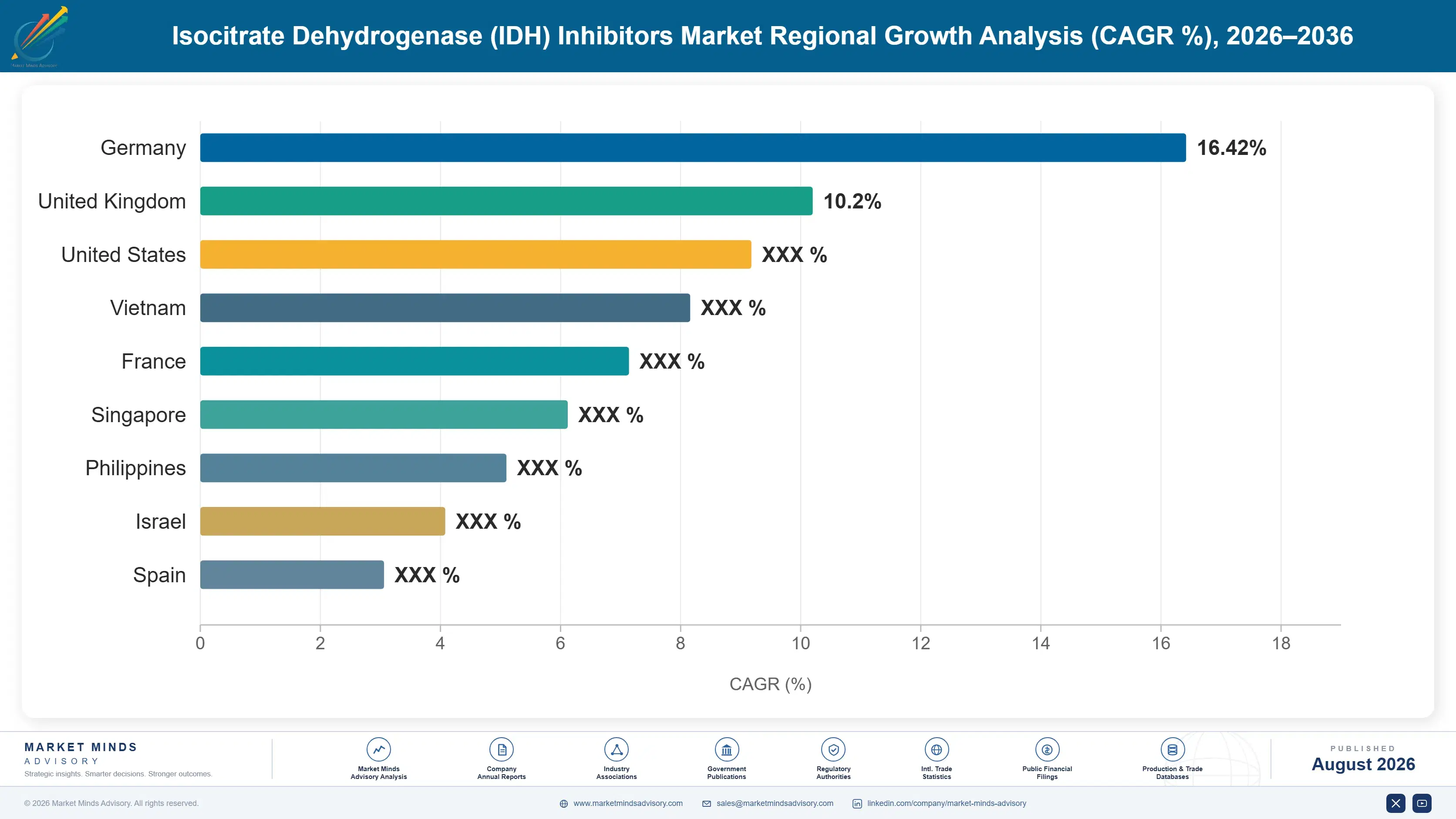
China: 17.8% CAGR
Fastest Growth Region
South Asia and Pacific: 16.2% CAGR
Largest Region
North America: 44% of 2025 global value
Market Leaders
Servier, Rigel Pharmaceuticals, Bristol Myers Squibb, Daiichi Sankyo, HUTCHMED. Source: MMA Primary Research Dataset, July 2026.
Primary Survey
n=3,800 procurement and R&D decision-makers, Q4 2025, six countries
Methodology
Demand-side build-up, cross-validated against public data, 47 expert interviews

Isocitrate Dehydrogenase (IDH) Inhibitors Market Forecast Scenarios

isocitrate-dehydrogenase-idh-inhibitors-market-size-forecast-scenario-1787297667976
Between 2020 and 2025 this class was quietly waiting for one trial to read out. Ivosidenib and enasidenib served small leukaemia populations with modest revenue, cholangiocarcinoma added incremental volume, and nobody expected the category to become substantial. Vorasidenib's approval in grade 2 glioma from August 2024 changed the addressable population by an order of magnitude. A 12.8% historical CAGR describes the period before that.
Three mechanisms carry the 14.2% base case. Glioma uptake is the largest, since a young patient population on continuous therapy generates duration that leukaemia indications never could. Molecular testing rates in neuro-oncology are the second, because every percentage point of genotyping directly converts into eligible prescriptions. And international launch sequencing is the third, with reimbursement decisions in Europe and Asia arriving years behind American approval. Price is already fixed at whatever payers will tolerate.
The 15.5% bull case rests on earlier-line glioma use, since treating at diagnosis rather than after progression would enlarge both the population and the treatment duration substantially. The 12.9% bear case is payer resistance in Europe, where a drug improving progression-free survival without mature overall survival data in a young population invites exactly the cost-effectiveness scrutiny that delays or restricts reimbursement.

One Approval Changed The Whole Class

Mutant IDH enzymes produce a metabolite that blocks cell differentiation, and inhibiting them lets cancer cells mature rather than proliferate. That mechanism worked first in acute myeloid leukaemia, where the mutation appears in a modest fraction of patients and survival is measured in months. It made for interesting biology and a small commercial proposition, which is what this class was for seven years.
TOP FIVE CONCENTRATION94%A single originator holds nearly the whole approved product class
MUTATION PREVALENCE80%Share of low-grade gliomas carrying a targetable enzyme mutation
ANNUAL THERAPY COSTUSD 240,000List price for a year of continuous oral targeted treatment
PROGRESSION-FREE EXTENSION17 monthsAdditional time before disease progression against a placebo control
TESTING RATE62%Eligible patients genotyped before any treatment decision is made
TREATMENT DURATION22 monthsPeriod a patient typically remains on continuous oral therapy
Grade 2 glioma is a completely different disease and a completely different business. Around 80% of these tumours carry an IDH mutation, patients are typically diagnosed in their thirties, and the tumour progresses across years rather than weeks. Delaying progression by seventeen months in that setting matters enormously to the patient and produces treatment durations that no leukaemia indication ever generated.
The constraint now is diagnostic rather than therapeutic. Molecular testing at diagnosis is routine in lung and breast cancer and considerably less so in neuro-oncology, where the tissue is precious, the pathology is complex, and testing rates sit near 62%. Every untested patient is a prescription that cannot happen, and the manufacturer has no direct way to fix that on its own.
"For years this was the drug class that proved cancer metabolism could be targeted and never made anybody much money. Then one glioma trial read out and suddenly the question is whether pathology labs can genotype fast enough to keep up."
Director, Oncology Therapeutics Practice · MMA Healthcare Practice ·

Market Trends

Glioma Approval Converted The Class To Chronic Therapy

Acute myeloid leukaemia patients receiving these drugs are typically older, heavily pre-treated, and have limited remaining survival, which caps treatment duration whatever the response. Grade 2 glioma patients are frequently diagnosed in their thirties with a tumour that progresses over years, and they stay on oral therapy for as long as it works. That converts a short salvage course into continuous treatment measured in years and changes lifetime revenue per patient by an order of magnitude. The molecule did not change. The population did. Lifetime revenue per patient shifted by an order of magnitude.
Market Impact: Diagnosis peaks between 20 and 40
Molecular Testing Rates Cap Everything Downstream

A patient who is never genotyped cannot receive a targeted therapy regardless of how well it works or how comprehensively it is reimbursed. Testing at diagnosis is embedded in lung and breast cancer pathways and considerably less so in neuro-oncology, where biopsy tissue is limited, molecular pathology is not universally available, and roughly 62% of eligible patients are tested. Manufacturers have begun funding testing programmes directly, which is unusual and reflects how completely the commercial opportunity depends on somebody else's laboratory. Every untested patient is simply a prescription that never happens. No promotional activity addresses that at all.
Market Impact: Mutations appear in 13% of tumours

Market Opportunities and Growth Drivers

Young Patient Population Extends Treatment Horizons

Grade 2 glioma is diagnosed most often between the ages of twenty and forty, which is unusual in oncology and consequential commercially. A patient starting continuous oral therapy at thirty-five may remain on it for years, and the historic alternative was watchful waiting punctuated by radiotherapy and chemotherapy with their own long-term consequences. Delaying that for a young adult with decades ahead carries weight in treatment decisions that a marginal survival gain in an elderly population never would. Duration rather than price drives the value here. Neuro-oncologists weigh this against delaying radiotherapy for decades.
Market Impact: Survival data needs 10 years

Cholangiocarcinoma Burden Concentrates Across Asian Populations

Intrahepatic cholangiocarcinoma incidence is several times higher across China, Thailand, and parts of Southeast Asia than in Western populations, driven by liver fluke infection, hepatitis, and other regional risk factors. Roughly one in eight of these tumours carries an IDH1 mutation, which makes the eligible population in Asia considerably larger than the revenue currently generated there. Access, reimbursement, and testing rather than biology explain that gap. It is the clearest example in this class of burden and value sitting in different places. Reimbursement and testing rather than biology explain the whole gap.
Market Impact: Annual cost reaches 240,000 dollars

Market Restraints and Challenges

Progression-Free Benefit Without Mature Survival Data

Regulatory approval in glioma rested on delayed progression rather than demonstrated overall survival, which is defensible given how slowly this disease behaves and awkward for payers who fund against survival gains. The root cause is that a trial powered for overall survival in a young population with a decade-long disease course would take many years to read out. Commercially this invites cost-effectiveness scrutiny and reimbursement delay outside the United States. Participants are mitigating through registry follow-up, quality of life evidence, and outcome-based agreements that share the uncertainty with payers. Waiting a decade for the data is not an option.
Market Impact: Duration extends past 22 months

Pricing Invites Restriction Outside The United States

Annual therapy at list prices near USD 240,000 applied to a young population treated for years produces a lifetime cost per patient that most single-payer systems will not absorb without negotiation. The root cause is that duration multiplies price in a way short-course oncology never did. Commercially it means European and Asian reimbursement arrives late, restricted, or at heavily confidential discounts. Mitigation runs toward staged launches, managed entry agreements, and pricing that reflects treatment duration rather than applying a per-year figure indefinitely. A short-course oncology price applied for years produces something payers refuse.
Market Impact: Only 62% receive genotyping
3 additional market trends, 2 additional growth drivers, and 4 additional restraints and challenges are covered in the full report. Contact sales@marketmindsadvisory.com to access the complete intelligence.

Segment CAGR and Growth Architecture

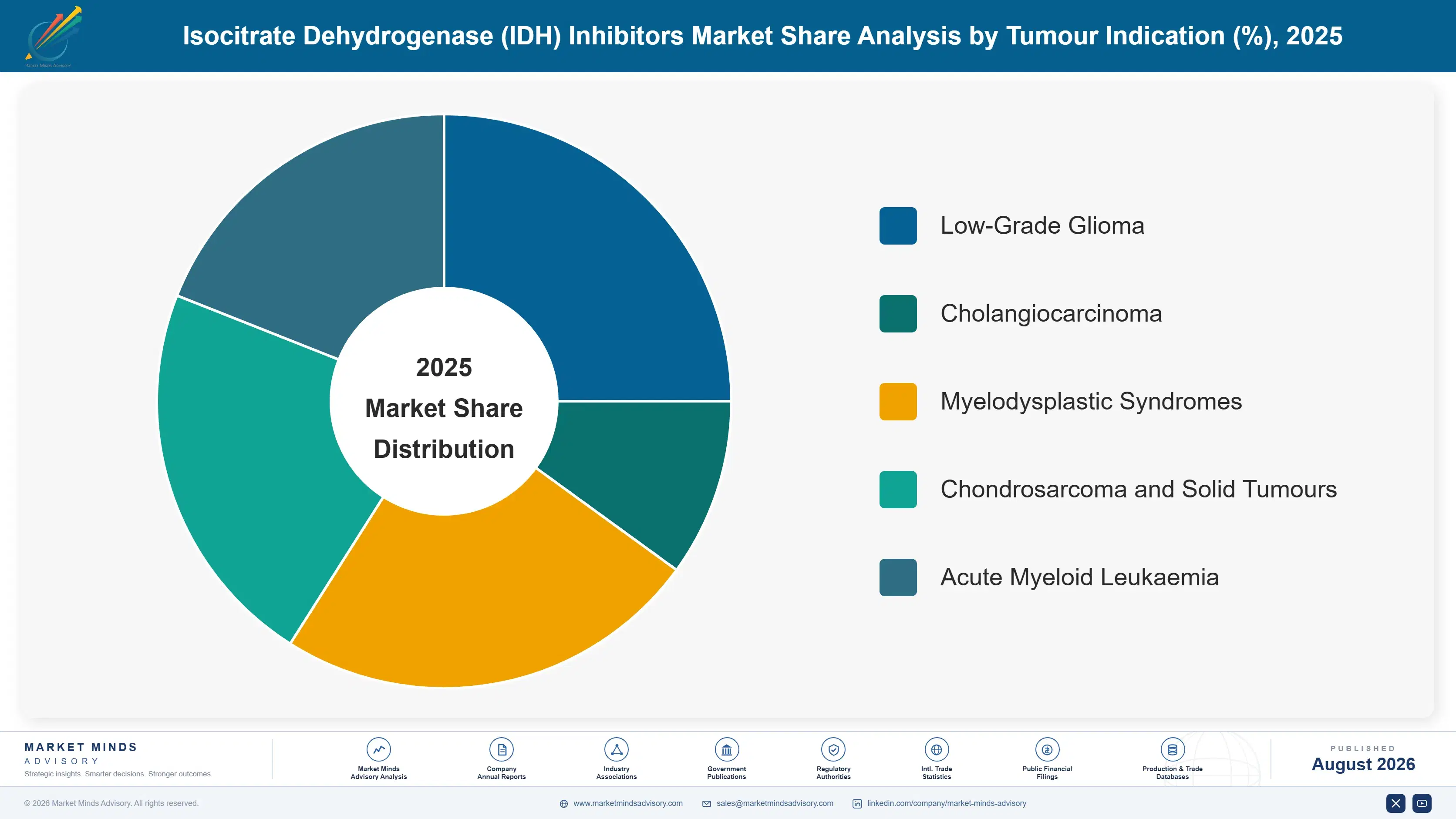
Segmentation follows the tumour indication, because the disease itself determines how long a patient stays on therapy, which is what decides revenue per patient in a class where the molecules are broadly interchangeable. Mutation subtype, treatment line, and care setting are handled in the framework and commentary rather than being treated as segments here.
isocitrate-dehydrogenase-idh-inhibitors-market-market-share-analysis-1787297668514

Low-Grade Glioma

Low-grade glioma grows fastest at 21.3%, exactly 1.50 times the market rate, and it is the indication that turned this class from a curiosity into a business. Roughly 80% of grade 2 gliomas carry an IDH mutation, patients are frequently diagnosed between twenty and forty, and the tumour progresses across years rather than weeks. Delaying progression by seventeen months in a thirty-five-year-old carries clinical weight that a marginal gain in elderly leukaemia never did. Treatment continues for as long as it works, which produces duration no other indication in this class approaches. Testing rates in neuro-oncology remain the binding constraint on uptake. Nothing else in oncology converted this dramatically from one trial readout.
CAGR 21.3%

Cholangiocarcinoma

Cholangiocarcinoma grows at 13.6%, with roughly one in eight intrahepatic tumours carrying an IDH1 mutation and very few alternative targeted options available once first-line chemotherapy fails. Prognosis is poor and treatment duration correspondingly short, which caps revenue per patient well below what glioma generates. The interesting feature is geographic: incidence across China, Thailand, and parts of Southeast Asia runs several times higher than in Western populations, so the eligible patient count sits substantially away from where the revenue currently does. Access and testing rather than biology explain that gap entirely. Chinese national reimbursement pricing means the revenue will never match the patient numbers. A fraction of a very large number still exceeds nothing at all.
CAGR 13.6%
Full segment breakdown across 5 segments available in the complete report.

Regional Architecture and Country Demand Map

Novel patented oncology concentrates value in a way that this framework's bands do not anticipate at all, so most figures below sit outside them. American pricing and rapid access dominate revenue while the patient burden distributes quite differently. Each out-of-band figure is explained in its own paragraph.

North America

North America holds 44% of value against a 32% ceiling in this framework, and drug pricing rather than patient numbers explains the entire breach. American list prices for novel oncology run well above any other market, reimbursement follows approval within months rather than years, and neuro-oncology molecular testing is more routinely performed than almost anywhere else. Grade 2 glioma incidence here is no higher than in Europe, yet revenue per patient is several times greater. Growth at 13.2% trails the global rate slightly, because the American population has already been reached and further expansion depends on testing rates rather than access. Testing capacity rather than access is the remaining constraint here.
Share: 44% | CAGR: 13.2% (2026 to 2036)

East Asia

East Asia records 18% of value against a 22% floor in this framework, and reimbursement timing rather than disease burden explains the shortfall. Intrahepatic cholangiocarcinoma incidence across China and neighbouring countries is several times Western levels, which makes the eligible population here considerably larger than the revenue suggests. Chinese national reimbursement negotiation reduces prices sharply in exchange for volume, and inclusion typically arrives well after approval elsewhere. Japanese and Korean access is faster and better funded on much smaller populations. Growth at 15.4% exceeds the global rate as reimbursement widens against a large untreated pool. Burden and revenue sit further apart here than anywhere. Volume-based pricing is the trade being made.
Share: 18% | CAGR: 15.4% (2026 to 2036)
Regional intelligence for 5 additional markets available in the complete report: Western Europe, South Asia and Pacific, Latin America, Middle East and Africa, Eastern Europe. Contact sales@marketmindsadvisory.com.
isocitrate-dehydrogenase-idh-inhibitors-market-country-cagr-analysis-1787297669029

Where IDH Inhibitor Value Actually Comes From

Price per year is already at the ceiling any payer will tolerate, so the remaining levers are all about how many eligible patients get found and how long each stays on therapy. Both of those depend on somebody else's laboratory and somebody else's treatment sequencing decision, which is an unusual position for an originator to be in.

Fund The Genotyping That Finds Eligible Patients

Only around 62% of eligible patients are genotyped before treatment decisions, which means roughly a third of the addressable population is invisible to a drug that would work for them. Manufacturer-funded testing programmes cost USD 400 to USD 900 per patient tested and convert directly into prescriptions at USD 240,000 a year. No conventional promotional spend approaches that return. It also builds relationships with pathology departments that competitors entering later will find already occupied. Pathology departments are the audience nobody in commercial usually calls on. That is where the addressable population is decided.
Market Impact: Testing costs 400 to 900 dollars per patient

Push Treatment Earlier In The Disease Course

Treating grade 2 glioma after progression rather than at diagnosis shortens the treatment window substantially, and current practice varies widely on when to start. Evidence supporting earlier initiation extends duration per patient by years in a population already measured in decades, which multiplies lifetime value without touching price. It requires investigator-led studies and guideline engagement rather than commercial promotion. The clinical argument about delaying radiotherapy in young adults is genuinely strong and under-made. Guideline engagement rather than promotion is the route. Investigator-led evidence carries the argument. Current practice varies widely on timing.
Market Impact: Earlier start adds 3 years of continuous therapy

Negotiate Duration-Adjusted Pricing Outside The United States

Applying an American annual price to a young patient treated for years produces a lifetime cost that European and Asian payers will simply refuse, which delays access and forfeits revenue entirely. Duration-adjusted structures, capped annual spend, or outcome-linked agreements convert refusal into access at 40% to 60% of list. Revenue arriving three years earlier at a discount comfortably exceeds full price arriving late or never at all, and several payers have signalled willingness to discuss exactly this. Delay in a young population forfeits duration that never comes back. Several payers have signalled willingness already.
Market Impact: Managed access recovers 40 to 60 percent of list

Who Controls the Margin Pool

Concentration reaches 94% across the top five measured on IDH inhibitor revenue, and even that understates the position, since one originator holds nearly the entire approved class across leukaemia, cholangiocarcinoma, and glioma. Servier acquired the portfolio and then delivered the glioma approval that transformed it. Rigel supplies a second IDH1 inhibitor in leukaemia, and Bristol Myers Squibb retains a commercial interest in enasidenib.
Competition currently happens between indications and between treatment lines rather than between companies, which is unusual and will certainly not persist. Daiichi Sankyo, HUTCHMED, and Eli Lilly all have candidates in development, and Chinese developers are working on dual inhibitors aimed squarely at their own cholangiocarcinoma population. Nothing yet challenges the incumbent on any approved indication anywhere.

Pressure will come first from Chinese domestic developers targeting a large local population that national reimbursement pricing makes difficult for an originator to serve profitably. Patent expiry sits far enough away to be irrelevant to any current planning. Rankings will be decided by which company reaches glioma patients earlier in the disease course, because duration rather than share is what determines value in this class.
isocitrate-dehydrogenase-idh-inhibitors-market-company-positioning-matrix-1787297669558

Competitive Moat and Risk Dimensions

SERVIER

Moat: Whole class ownership across indications

Servier holds approved IDH inhibitors across acute myeloid leukaemia, cholangiocarcinoma, and grade 2 glioma, which gives it every treating specialty, every eligible patient population, and the accumulated safety database that new entrants must match. Having funded the glioma trial that created the opportunity, it also holds the clinical relationships and the evidence base that guidelines now reference directly.
SERVIER

Risk: Single class dependency in oncology

An oncology franchise resting almost entirely on one target and one mechanism carries concentration risk that a broader portfolio absorbs comfortably. Any safety signal emerging in long-term glioma follow-up, or any competitor demonstrating superior differentiation, hits the whole business rather than one product line, and the young treated population means follow-up will run for decades.
RIGEL PHARMACEUTICALS

Moat: Established leukaemia commercial infrastructure

Rigel already sells into American haematology through an existing commercial organisation, which let it launch an IDH1 inhibitor in leukaemia without building infrastructure from nothing. That footprint reaches the treating physicians directly and supports a portfolio approach in a specialty where prescriber numbers are small and relationships matter more than reach.
RIGEL PHARMACEUTICALS

Risk: Limited to leukaemia indication

Rigel's product is approved only in acute myeloid leukaemia, which is the smallest and shortest-duration indication in this class and precisely the part of it that glioma has now dwarfed. Expanding into solid tumours would require trials on a scale the company has not undertaken, and the incumbent already holds those indications with data nobody can quickly replicate.

Players Tracked

Prominent Players

Servier
Rigel Pharmaceuticals
Bristol Myers Squibb
Daiichi Sankyo
HUTCHMED

Other Key Players

Eli Lilly
Agios Pharmaceuticals
Novo Nordisk
Bayer
Novartis
AstraZeneca
Johnson and Johnson
Jiangsu Hengrui Pharmaceuticals
BeiGene
Innovent Biologics
Shanghai Fosun Pharmaceutical
Sun Pharmaceutical Industries
Dr Reddys Laboratories
Natco Pharma
Zai Lab

Recent Developments

JANUARY 2025

Glioma uptake outpaced launch forecasts across American centres

Prescribing in grade 2 glioma exceeded launch expectations at major American neuro-oncology centres across the first full year, with treatment initiation concentrated among younger patients who had previously been managed by observation alone. Molecular testing capacity at referring centres emerged quickly as the practical limiting factor.
Signal: Testing capacity rather than any clinical enthusiasm is what actually limits uptake in this particular indication.
JULY 2024

Regulator approved first targeted therapy for grade 2 glioma

A regulator approved an IDH inhibitor for grade 2 astrocytoma and oligodendroglioma following trial results showing substantially delayed progression against a placebo. It was the first targeted therapy ever approved in this tumour type, where treatment had consisted only of surgery, radiotherapy, and watchful waiting.
Signal: An approval in a slow-progressing tumour converts a salvage drug into a chronic therapy more or less overnight.
OCTOBER 2024

Manufacturer funded molecular testing programme for neuro-oncology

A manufacturer began funding IDH mutation testing at neuro-oncology centres where molecular pathology capacity was limited, absorbing the cost directly rather than waiting for testing rates to improve. Roughly a third of eligible patients had been going untested and were therefore invisible to any targeted therapy.
Signal: Manufacturers funding diagnostics directly shows how completely revenue in this class depends on somebody else's laboratory.

Synthesis, Trials, And Market Access

Active ingredient synthesis and formulation carry a very small share of cost in this class, typically under 6% of revenue, because these are orally bioavailable small molecules made at modest scale. Clinical development dominates instead, with the glioma programme alone running years and enrolling several hundred patients. Market access, health technology assessment submissions, and post-approval registry commitments account for a substantial and rising share of the remainder.
Contract research and clinical trial site costs rose sharply through 2021 and 2022 as trial activity rebounded and site capacity stayed constrained, and specialty chemical intermediate pricing followed the wider input inflation. European Commission energy statistics record industrial electricity roughly doubling at the 2022 peak. Servier and Rigel both noted development and commercialisation cost pressure across that period, though neither is exposed the way a manufacturing-intensive business would be.

Exposure divides by portfolio breadth rather than by geography. A company with one class and one target carries its whole development and access cost against a single mechanism, and every setback lands undiluted. Broader oncology portfolios spread market access infrastructure across many products. Manufacturing cost is genuinely immaterial here, which means conventional input cost analysis matters far less than access spend does.
isocitrate-dehydrogenase-idh-inhibitors-market-cost-volatility-analysis-1787297669755

Spread market access cost across multiple indications

Health technology assessment submissions, registry commitments, and payer negotiations are largely fixed per country rather than per indication, so a class approved in three tumour types carries that cost once across all of them. Sequencing submissions to reuse evidence lowers cost per indication considerably. Filing strategy has to be planned across the portfolio. Product by product filing wastes the overlap.

Use registry evidence to answer survival uncertainty

Payers withholding reimbursement over immature survival data will not wait a decade for a trial to read out, and neither can the manufacturer. Prospective registries capturing real-world progression build the evidence at a fraction of trial cost. Assessment bodies discount registry data unless it is designed with them in advance. Designing it retrospectively wastes the whole effort.

Contract trial capacity ahead of competitive demand

Neuro-oncology trial sites are few and increasingly contested as other developers move into the same tumour types. Multi-year site agreements secure enrolment capacity and shorten timelines that would otherwise slip. It costs commitment before the protocol is finalised, which finance functions resist until a competitor takes the capacity first. A competitor taking the capacity settles the argument quickly.

Portfolio Architecture for Margin Defence

Margin in this class is unusually insensitive to cost, because manufacturing is trivial and the entire economics sit in how many patients get identified and how long each one is treated. A leukaemia patient on therapy for six months and a glioma patient on therapy for four years take the same tablet at the same price, and generate completely different value. Duration is the product being sold here.
The volume tension is between reaching patients quickly and pricing sustainably. American access came fast at full list price and generates most of the revenue today. European and Asian access requires accepting substantial discounts or waiting years, and waiting forfeits treatment duration in a young population where every year of delay is a year of therapy never delivered. Neither pure discipline nor pure concession is right.

High-value pools sit in three places. Glioma treated earlier in the disease course, where duration extends by years without any price change. Molecular testing programmes that convert invisible patients into eligible ones. And Asian cholangiocarcinoma access, where the eligible population is far larger than the revenue and reimbursement is the only obstacle.

Volume / Commodity-Adjacent Tier

Acute myeloid leukaemia and myelodysplastic indications where treatment duration is short and competing options exist. Margins remain high in absolute terms and the revenue per patient is a fraction of what solid tumour use generates.
Gross Margin: 72-80%

Premium / Certified Tier

Cholangiocarcinoma and later-line solid tumour use where few alternatives exist and pricing holds firm. Clinical necessity rather than any manufacturing difference sustains the margin, and duration remains limited by prognosis.
Gross Margin: 84-90%

Sustainability / Regulatory / Next-Generation Tier

Grade 2 glioma in young patients on continuous multi-year therapy, particularly where treatment starts early. The range reflects differences between full-price American access and heavily negotiated international agreements on the same product.
Gross Margin: 88-94%
isocitrate-dehydrogenase-idh-inhibitors-market-portfolio-architecture-1787297670259

High-value Sub-segments and Strategic Watch-out

Early-Line Glioma Treatment

Starting therapy at diagnosis rather than after progression extends duration by years in patients already measured in decades. Nothing else in this class multiplies lifetime value without touching price, and current practice varies widely on timing. Guideline engagement is the mechanism, not promotion. Price never enters it.
Gross Margin: 88-94%

Manufacturer-Funded Testing Programmes

Roughly a third of eligible patients are never genotyped and are therefore invisible to a therapy that would work for them. Testing costs a few hundred dollars and converts directly into treatment worth hundreds of thousands annually. No conventional promotional spend approaches that return. Pathology relationships come free with it.
Gross Margin: 84-92%

Acute Myeloid Leukaemia Indications

The original indication and now the smallest part of the class by value, with short treatment duration in a heavily pre-treated elderly population. It established the safety database that every subsequent indication was built upon. Its safety database underpins everything that followed. Duration caps the value here.
Gross Margin: 72-80%

Asian Cholangiocarcinoma Access

Incidence across China and Southeast Asia runs several times Western levels while treated patients remain few. The watch-out is that access at Chinese national reimbursement prices arrives at a fraction of the margin available elsewhere. Volume rather than price is the whole argument there. Testing is the other obstacle.
Gross Margin: 64-78%

What Determines Value Per Patient

Revenue in this class is duration multiplied by price, and price is already fixed at whatever a payer will tolerate. A leukaemia patient treated for six months and a glioma patient treated for four years generate an eightfold difference in lifetime value from the identical tablet. That makes every decision about when treatment starts and how long it continues more commercially consequential than anything happening in manufacturing or pricing.
Stickiness is effectively absolute while a patient responds. There is no competing IDH inhibitor approved in glioma, switching within the class serves no clinical purpose, and stopping a therapy that is holding progression in a thirty-five-year-old is not a decision anybody takes lightly. Patients remain until progression or intolerance. The commercial risk is entirely about patients never starting rather than about patients leaving.

Buyer profiles differ sharply by indication. Haematologists treating leukaemia decide quickly within established protocols. Neuro-oncologists managing grade 2 glioma make a decision about a young patient facing decades, weigh it against delaying radiotherapy, and take considerably longer. Payers are the third audience and increasingly the binding one, since a therapy priced annually and taken for years produces a lifetime cost that assessment bodies scrutinise heavily.
isocitrate-dehydrogenase-idh-inhibitors-market-end-use-penetration-index-1787297670752

Where To Compete Here

These are among the four positions where our research anticipates prominent divergence between winners and laggards over the coming forecast period. Each is grounded in the demand model, the regulatory perimeter, and the announced capacity pipeline.
01 / DIAGNOSTIC PATHWAY INVESTMENT

Fund the testing that finds your patients

Only around 62% of eligible patients are genotyped before treatment decisions are made, which leaves roughly a third of the addressable population entirely invisible to a therapy that would work for them. Manufacturer-funded testing costs only a few hundred dollars per patient tested and converts directly into treatment worth hundreds of thousands annually, a return no promotional spending has ever come close to approaching. It also builds relationships with pathology departments that any competitor arriving later will find already comfortably occupied.
02 / TREATMENT TIMING EVIDENCE

Earlier initiation is worth more than any price rise

Treating grade 2 glioma at diagnosis rather than waiting for progression extends therapy by years in a population already measured in decades, and current clinical practice varies very widely on exactly when to start. Every additional year of treatment duration multiplies lifetime value per patient without touching a price that payers already consider very high. Building that evidence requires investigator-led studies and guideline engagement rather than any commercial promotion, and the clinical argument about delaying radiotherapy in young adults is genuinely strong.
03 / DURATION ADJUSTED PRICING

Trade list price for access arriving years earlier

Applying an American annual price to a young patient treated for years produces a lifetime cost that European and Asian payers will refuse outright, which delays access and forfeits treatment duration that never gets recovered afterwards. Duration-adjusted structures, capped annual spend, or outcome-linked agreements convert refusal into access at roughly half of list price. Revenue arriving three years earlier at a discount comfortably exceeds full price arriving late or never, and several payers have already signalled willingness to discuss precisely this.
04 / ASIAN BURDEN CONVERSION

The patients are there and the revenue is not

Intrahepatic cholangiocarcinoma incidence across China, Thailand, and Southeast Asia runs several times Western levels, and roughly one in eight of those tumours carries a targetable mutation that this class addresses. Almost none of that eligible population currently receives any treatment, and the obstacles are reimbursement and molecular testing rather than anything biological at all. Chinese national reimbursement means accepting a fraction of Western pricing, and a fraction of a very large number still remains considerably better than nothing at all.

Engagement Snapshot From the Field

A live engagement with an industry participant carrying material or product regulatory and market exposure ahead of a defining policy shift, showing how our research translates into a defensible multi-year portfolio strategy.
MARKET MINDS ADVISORY · CLIENT ENGAGEMENT SUMMARY
Isocitrate Dehydrogenase (IDH) Inhibitors Producer Strategic Portfolio Review and Transition Roadmap 2026·Investment Scenario on Isocitrate Dehydrogenase (IDH) Inhibitors Exposure Evaluation 2025-26
CLIENT PROFILE
An oncology company preparing international launches for a targeted therapy already approved and reimbursed in the United States, with global peak sales projected above USD 1.5 billion (client-reported, unverified by MMA). The therapy treats a young patient population continuously, which produced lifetime cost figures that several health technology assessment bodies had flagged during early engagement.
STRATEGIC CHALLENGE
The commercial plan assumed holding close to American pricing across all major markets and accepting whatever delay that produced. Market access colleagues believed several countries would refuse entirely at that level, and nobody had quantified what the delay actually cost in a disease where every year without access is a year of treatment duration permanently lost.
MMA APPROACH
MMA modelled revenue under price-holding and duration-adjusted scenarios across eight markets, incorporating realistic assessment timelines for each and the treatment duration forgone during any delay. Payer willingness to consider capped or outcome-linked structures was tested through structured interviews. Reference pricing spillover risk arising from early discounting was then assessed entirely separately.
KEY FINDINGS
  1. Holding price would have delayed reimbursement in five of the eight markets by between two and four years (client-reported, unverified by MMA).
  2. Treatment duration forgone during each of those delays exceeded the revenue protected by the higher price in every single market modelled except one.
  3. Three of the payers indicated willingness to discuss capped annual spend or outcome-linked agreements that had never been formally proposed to them.
  4. Confidential net pricing meant reference spillover risk was materially lower than the commercial team had assumed when it argued against any discounting.
CLIENT PROFILE
An oncology company preparing international launches for a targeted therapy already approved and reimbursed in the United States, with global peak sales projected above USD 1.5 billion (client-reported, unverified by MMA). The therapy treats a young patient population continuously, which produced lifetime cost figures that several health technology assessment bodies had flagged during early engagement.
STRATEGIC CHALLENGE
The commercial plan assumed holding close to American pricing across all major markets and accepting whatever delay that produced. Market access colleagues believed several countries would refuse entirely at that level, and nobody had quantified what the delay actually cost in a disease where every year without access is a year of treatment duration permanently lost.
MMA APPROACH
MMA modelled revenue under price-holding and duration-adjusted scenarios across eight markets, incorporating realistic assessment timelines for each and the treatment duration forgone during any delay. Payer willingness to consider capped or outcome-linked structures was tested through structured interviews. Reference pricing spillover risk arising from early discounting was then assessed entirely separately.
KEY FINDINGS
  1. Holding price would have delayed reimbursement in five of the eight markets by between two and four years (client-reported, unverified by MMA).
  2. Treatment duration forgone during each of those delays exceeded the revenue protected by the higher price in every single market modelled except one.
  3. Three of the payers indicated willingness to discuss capped annual spend or outcome-linked agreements that had never been formally proposed to them.
  4. Confidential net pricing meant reference spillover risk was materially lower than the commercial team had assumed when it argued against any discounting.
RECOMMENDED STRATEGY
Phase 1: Phase one: open managed entry discussions in the three markets that signalled willingness, rather than waiting for standard assessment to conclude against the client. Phase 2: Phase two: build a prospective registry designed with assessment bodies in advance, so real-world evidence would be accepted rather than discounted later. Phase 3: Phase three: hold list pricing in markets where reference spillover is genuinely material, and concede on net price everywhere else.
OUTCOME
The client opened managed entry negotiations in three markets and secured reimbursement roughly two years earlier than the price-holding plan projected, at net prices well below list (client-reported, unverified by MMA). Cumulative revenue across the modelled period exceeded the original plan despite lower realised pricing, because treated patient duration started accumulating far sooner.

Frequently Asked Questions

Foundational context covering the market sizes, CAGR, scope, country, region and competition that inform every finding below. This section is provided to cover basics and most often pre-purchase conversations, answered from the MMA Primary Research Dataset.

What is the current size of the Isocitrate Dehydrogenase (IDH) Inhibitors Market?

The market reached USD 1.15 billion in 2025 and is forecast at USD 1.31 billion for 2026. Approval in grade 2 glioma from 2024 transformed the addressable population.

How large will the Isocitrate Dehydrogenase (IDH) Inhibitors Market be by 2036?

MMA forecasts USD 4.95 billion by 2036, an increase of USD 3.64 billion over 2026. That represents an expansion multiple of 3.77 times across the forecast period.

What is the CAGR for the Isocitrate Dehydrogenase (IDH) Inhibitors Market 2026 to 2036?

The base case CAGR is 14.2%, with a bull case at 15.5% and a bear case at 12.9%. The bear case reflects European payer resistance to progression endpoints without mature survival data.

Which segment is growing fastest?

Low-grade glioma grows fastest at 21.3%, exactly 1.50 times the market rate. Around 80% of these tumours carry a targetable mutation and patients remain on therapy for years.

Who are the major companies in the Isocitrate Dehydrogenase (IDH) Inhibitors Market?

Servier, Rigel Pharmaceuticals, Bristol Myers Squibb, Daiichi Sankyo, and HUTCHMED participate in this class. The top five hold roughly 94% of revenue, with one originator holding nearly the entire approved portfolio.

Which country is growing fastest?

China grows fastest at 17.8%, driven by cholangiocarcinoma incidence several times Western levels alongside national reimbursement gradually widening access. Almost none of that eligible population is currently treated.

Report Segmentation Architecture

The full report scope spans multiple orthogonal segmentation dimensions, with cross-tabulated demand data provided for each dimension pair. Coverage extends further to regional breakdowns, trend trajectories, and the competitive detail needed to support segment-level decision-making.

By Tumour Indication

  • Low-Grade Glioma
  • Cholangiocarcinoma
  • Myelodysplastic Syndromes
  • Chondrosarcoma and Solid Tumours
  • Acute Myeloid Leukaemia

By End-Use Industry

  • Academic Neuro-Oncology Centres
  • Comprehensive Cancer Centres
  • Community Oncology Practices
  • Haematology Services
  • Specialty Pharmacy Distribution

By Commercial Dimension

  • Full Price Reimbursed Markets
  • Managed Entry Agreements
  • National Reimbursement Negotiation
  • Private and Self-Pay Access
  • Named Patient and Compassionate Supply

By Region

  • North America
  • East Asia
  • Western Europe
  • South Asia and Pacific
  • Latin America
  • Middle East and Africa
  • Eastern Europe

Scope, Methodology, and Coverage

Every figure in this report is reproducible from documented input assumptions. The scope below maps the historical period, the forecast horizon, the segmentation dimensions, and the countries covered, alongside the underlying primary and qualitative methodology.
Historical Period
2020 to 2025
Forecast Period
2026 to 2036
Base Year
2025 (USD billions; MMA Primary Research Dataset, August 2026)
Market Definition
The isocitrate dehydrogenase inhibitors market comprises small molecule therapies inhibiting mutant IDH1 and IDH2 enzymes for oncology treatment, valued at manufacturer net revenue across academic neuro-oncology centres, comprehensive cancer centres, community oncology practices, haematology services, and specialty pharmacy channels. It spans approved and late-stage products across low-grade glioma, cholangiocarcinoma, acute myeloid leukaemia, myelodysplastic syndromes, and chondrosarcoma and other solid tumours, together with the patient support, testing support, and managed access programmes attached to them. Companion diagnostic assays and sequencing panels, chemotherapy, radiotherapy, and surgery given alongside, other targeted oncology and immunotherapy classes, supportive care medicines, and IDH inhibitors developed for non-oncology indications are excluded.
Quantitative Units
USD billions (current prices); volume in patients treated annually
Segmentation Dimensions
By Tumour Indication; By End-Use Industry; By Commercial Dimension; By Region
Regions Covered
North America, East Asia, Western Europe, South Asia and Pacific, Latin America, Middle East and Africa, Eastern Europe
Countries Covered
USA, Canada, Mexico, Brazil, Argentina, Chile, China, Japan, South Korea, Taiwan, Thailand, India, Australia, Singapore, Malaysia, Germany, France, UK, Italy, Spain, Netherlands, Belgium, Switzerland, Sweden, Denmark, Austria, Poland, Czechia, Hungary, Romania, Saudi Arabia, United Arab Emirates, Israel, South Africa, and additional markets relevant to this sector
Key Companies Profiled
Servier, Rigel Pharmaceuticals, Bristol Myers Squibb, Daiichi Sankyo, HUTCHMED, Eli Lilly, Agios Pharmaceuticals, Novo Nordisk, Bayer, Novartis, AstraZeneca, Johnson and Johnson, Jiangsu Hengrui Pharmaceuticals, BeiGene, Innovent Biologics, Shanghai Fosun Pharmaceutical, Sun Pharmaceutical Industries, Dr Reddys Laboratories, Natco Pharma, Zai Lab
Quantitative Methodology
Primary survey, n=3,800 respondents, Q4 2025, six countries; demand-side model with trade association cross-validation
Qualitative Methodology
47 expert interviews, Q4 2025; applied to validate demand model assumptions, identify emerging dynamics, and assess competitive positioning
Report Format
PDF and XLSX data workbook (Word format preview document)
Publisher
Market Minds Advisory
Report Code
MMA-2026-HLT-722
Published
August 2026
Contact
sales@marketmindsadvisory.com | www.marketmindsadvisory.com

Purchase the full Isocitrate Dehydrogenase (IDH) Inhibitors Market Report (2026 to 2036).

The full report examines IDH inhibitor demand across seven regions and five tumour indications, with particular attention to how approval in grade 2 glioma converted a short-duration salvage therapy into chronic treatment for a young population. It quantifies the molecular testing gap that leaves a third of eligible patients invisible and models what earlier treatment initiation is worth in duration terms. Competitive analysis covers twenty participants assessed on IDH inhibitor revenue and development position, including where Chinese developers are targeting local cholangiocarcinoma burden. Regional chapters separate patient burden from realised revenue.
Seven-region access and reimbursement timing analysis
Five indication segmentation with growth rates
Twenty participant competitive and pipeline assessment
Molecular testing gap sizing across neuro-oncology centres
Treatment duration modelling by indication and initiation timing
Managed entry pricing structures across major payer systems

Built For The People Who Decide

From boardroom strategy to bench-side execution, this report is read cover-to-cover by leaders shaping the next decade of their industry, turning demand scenarios, market dynamics and valuation benchmarks into decisions.
CXOs/ Presidents/ VPs/ Managers
M&A and Corporate Development
Strategy Teams and R&D Heads
Procurement and Product Directors
Regulatory and Compliance Leaders
Investor Relations and Equity Analysts