

Market Minds Advisory
IQF Vegetables Market

IQF Vegetables Market: Freezing Windows, Cold Chain Cost And Prepared Blends That Sell Labour Rather Than Produce

A freezing line runs hard for a few weeks each year and then sits idle, which makes crop timing and capacity utilisation matter more to a processor's returns than anything happening at retail.

Lead Analyst

Lisa Gevelber

Published

September 2026

Make Smarter Decisions with Customized Research Insights

Request a free sample report and evaluate market opportunities, growth trends, and competitive dynamics relevant to your business needs.

2025 MARKET VALUE$24.0BMarket Size 2025
2036 FORECAST VALUE$44.6BBase Case , 2026 to 2036
CAGR 2026 TO 20365.8 %Bull 7.0% / Bear 4.6%
INCREMENTAL OPPORTUNITY$19.2BNet 10- year value creation
EXPANSION MULTIPLE1.76x2036 value over 2026 base
Strategic Levers
M&A Pipeline
Regional Outlook
Country Rankings
Competitive Intelligence
Segmental Deep-dive
Call-Us : 91 93563 13602

Executive Snapshot and Market Trajectory

A vegetable freezing line runs hard for a few weeks when the crop comes in and then sits idle for most of the year. That single operational fact shapes returns in this business more than anything happening at a retail shelf does. Retailers negotiate annually; growers contracted earlier.
Prepared blends carry the growth because the processor sells labour rather than produce, and cutting, blending and portioning transfer work a household would otherwise do. Foodservice and industrial supply grows nearly as fast on specification and year-round availability that fresh produce cannot match. East Asia holds the largest share on Chinese growing, processing and export capacity that supplies a great deal of the world. Foodservice contracts behave nothing like retail promotional cycles do.
Concentration reads at 33% for the top five, low because vegetable freezing sits close to where crops grow and that is a dispersed activity by nature. Cold chain runs from field to freezer to shelf without a break, and any failure anywhere in it destroys product quality in ways a consumer notices immediately and then remembers for a long time afterwards. Retailers negotiate annually regardless.
Market Definition
This market covers individually quick frozen vegetables, spanning prepared vegetable blends and mixes, foodservice and industrial supply grades, single-vegetable retail packs, organic certified IQF vegetables, and IQF vegetable ingredients for further processing. Block-frozen and plate-frozen vegetables, canned and jarred vegetables, fresh produce, frozen potato products including chips and fries, and frozen prepared meals are excluded.
Base Year Value
$24.0B in 2025 (MMA Primary Research Dataset, August 2026)
Forecast Period
2026 to 2036, eleven discrete annual values
CAGR
5.8% base case. Bull 7.0%. Bear 4.6%.
Fastest Growth Segment
Prepared Vegetable Blends And Mixes: 8.7% CAGR
Fastest Growth Country
India: 9.4% CAGR
Fastest Growth Region
South Asia and Pacific: 8.1% CAGR
Largest Region
East Asia: 29% of 2025 global value
Market Leaders
Ardo, Greenyard, Bonduelle, Simplot and Dole Food Company lead on IQF vegetable revenue. Source: MMA Primary Research Dataset, July 2026.
Primary Survey
n=3,800 procurement and R&D decision-makers, Q4 2025, six countries
Methodology
Demand-side build-up, cross-validated against public data, 47 expert interviews

IQF Vegetables Market Forecast Scenarios

iqf-vegetables-market-trends-growth-size-forecast-scenario-1787460194165
Growth ran at 4.8% annually between 2020 and 2025, and the pandemic distorted the middle of it badly. Household frozen vegetable purchasing rose sharply during lockdowns and then partly retreated, while foodservice collapsed and recovered unevenly. Underneath that noise, prepared blends kept taking share from single-vegetable packs steadily and the shift did not reverse when normal purchasing resumed.
The base case at 5.8% rests on three mechanisms. Prepared blends keep converting the category from produce sales into labour sales, which carries better value per tonne and holds up against food inflation. Foodservice and industrial demand grows on specification consistency that fresh produce cannot deliver year-round. And Indian and Southeast Asian demand expands as cold chain retail infrastructure reaches further into urban markets that previously had none. None of the three requires a consumer preference to shift.
The bull case at 7.0% turns on cold chain infrastructure reaching secondary cities across Asia faster than expected, which would open retail that frozen product simply cannot serve today. The bear case at 4.6% reflects energy costs staying elevated, since freezing and frozen storage are both energy-intensive and processors have limited ability to pass that through to retailers.

Freezing Windows Decide Processing Economics

Peas are frozen within a few hours of picking or they are not worth freezing, which is why processing plants sit inside growing areas rather than near consumers. The freezing window governs everything upstream: planting schedules, harvest sequencing, plant siting and the contracts a processor signs with growers years before anything is picked. Plant siting follows crop geography exactly rather than following consumers.
TOP FIVE CONCENTRATION33%Low, since freezing sits close to dispersed vegetable growing areas
ANNUAL LINE UTILISATION31%Typical freezing capacity used across a full processing year
PREPARED BLEND PREMIUM58%Value per tonne advantage over comparable single-vegetable frozen packs
ENERGY COST SHARE26% of COGSFreezing and frozen storage contribution to manufactured cost
FOODSERVICE VALUE SHARE41%Portion of value supplied to foodservice and food manufacturing
FIELD TO FREEZER WINDOW4 hoursTypical maximum interval between harvest and freezing for quality
The consequence is capacity that runs hard for a few weeks and then sits. Annual line utilisation near 31% is normal in this business, which means fixed cost recovery depends on how much value is extracted during the window rather than on running more hours. Prepared blends help considerably, since blending several crops across a season spreads utilisation and raises value per tonne by roughly 58%.
Energy is the other governing cost at around 26% of manufactured cost, split between the freezing itself and frozen storage that continues for months afterwards. Processors have limited ability to pass energy inflation through to retailers who buy on annual contracts, which is why the 2022 energy period damaged margins across this industry more than any agricultural event in recent memory did.
"Retailers negotiate frozen vegetables as though they were a commodity bought and sold weekly. The processor signed the grower contract eighteen months earlier and runs the line for six weeks. Those are two entirely different businesses meeting at one price."
Director, Frozen Food and Agricultural Processing Practice · MMA Frozen Food Practice · August 2026

Market Trends

Prepared Blends Convert Produce Sales Into Labour Sales

Cutting, blending and portioning transfer work a household or a commercial kitchen would otherwise do, and buyers pay for that transfer far more readily than they pay for better vegetables. Value per tonne runs roughly 58% above single-vegetable packs and the proposition holds up against food inflation better than most premium positioning does. Blending several crops across a season also spreads freezing line utilisation, which improves fixed cost recovery in a business where capacity sits idle most of the year. Capacity sits idle for most of the year in this business.
Market Impact: India grows at 9.4% annually

Foodservice Specification Demand Grows Faster Than Retail

Commercial kitchens value portion control and zero preparation waste in ways households simply do not, and food manufacturers value a specification that fresh produce cannot reliably deliver across a full year. Foodservice and industrial supply now carries roughly 41% of category value on contracts running annually or longer with predictable volumes. That predictability suits a processing business with seasonal capacity and considerable fixed cost, which retail promotional cycles never do. Retail promotional cycles arrive without warning and disappear exactly the same way, which no processor with fixed cost welcomes. Contract volume behaves nothing like that.
Market Impact: Cuts preparation waste by 30%

Market Opportunities and Growth Drivers

Cold Chain Extension Opens Asian Retail That Never Existed

Frozen food needs a continuous cold chain from processor to household freezer, and much of urban Asia simply did not have one a decade ago in the retail formats where most people shop. That infrastructure is now extending into secondary cities across India and Southeast Asia, opening retail that frozen vegetables could not previously serve at all. Indian demand grows near 9.4% annually as a result, and household freezer ownership rises alongside it. Household freezer ownership is rising alongside modern retail development everywhere. Retail that frozen simply could not serve is opening.
Market Impact: Energy is 26% of manufactured cost

Year-Round Specification Beats Fresh Produce Variability Decisively

Fresh vegetables vary by season, origin and weather in ways that food manufacturers formulating a product genuinely cannot accommodate, while frozen product delivers the same piece size, moisture and quality in February as in August. That reliability is why industrial demand keeps growing regardless of any consumer sentiment about fresh versus frozen. Manufacturers also avoid the preparation waste and labour that fresh produce carries into a factory, which is a considerable cost. Consumer sentiment about fresh versus frozen barely enters an industrial buying decision. Preparation labour and waste both leave the factory too.
Market Impact: Utilisation runs at 31% annually

Market Restraints and Challenges

Energy Costs Cannot Be Passed Through To Annual Contracts

Freezing and frozen storage together account for roughly 26% of manufactured cost, and processors sell into retail contracts negotiated annually that leave no mechanism for recovering a mid-year energy movement. The root cause is that this industry is energy-intensive by physics rather than by inefficiency. Commercially the 2022 period damaged margins across the sector more than any agricultural event in recent memory. Participants are responding with efficiency investment, energy hedging and contract indexation where retailers accept it. Indexation is accepted by foodservice buyers and refused by retailers. Physics rather than inefficiency drives it.
Market Impact: Adds 58% value per tonne

Seasonal Capacity Utilisation Leaves Fixed Cost Poorly Covered

A freezing line runs hard for a few weeks when the crop arrives and sits idle for most of the year, producing annual utilisation near 31% that would be unacceptable in almost any other manufacturing business. The root cause is agricultural rather than commercial and cannot be engineered away. Commercially this means fixed cost recovery depends entirely on value extracted during the window. Participants are responding with crop sequencing, blending across seasons and contract processing for third parties. Contract processing for third parties fills some of the remaining gaps. It cannot be engineered away.
Market Impact: Carries 41% of category value
4 additional market trends, 2 additional growth drivers, and 3 additional restraints and challenges are covered in the full report. Contact sales@marketmindsadvisory.com to access the complete intelligence.

Segment CAGR and Growth Architecture

Five product categories divide this market on how much processing value has been added and which buyer it serves rather than on the vegetables themselves. That reflects where commercial difference genuinely sits, since a blend and a single-vegetable pack may contain identical produce while carrying entirely different value per tonne and buyer relationships. Buyer type decides the rest.
iqf-vegetables-market-trends-growth-market-share-analysis-1787460194696

Prepared Vegetable Blends And Mixes

Growing at 8.7% and the fastest part of this market. Prepared vegetable blends and stir-fry mixes carry considerably more value per tonne than single-vegetable packs because the processor has done the cutting, blending and portioning that a household or a kitchen would otherwise have to do. That labour transfer is the whole commercial argument, and it holds up better against food inflation than most premium propositions do. Blending also lets a processor use several crops from one freezing line and balance yield across a harvest, which improves capacity utilisation in a business where the equipment runs hard for a few weeks and then sits. Capacity utilisation improves alongside the value per tonne.
CAGR 8.7%

Foodservice And Industrial Supply Grades

Growing at 7.4% on individually quick frozen vegetables supplied into foodservice and food manufacturing rather than retail, where the buyer specifies piece size, moisture and blanching consistency rather than looking at a pack. Foodservice values portion control and zero preparation waste, which matters more to a commercial kitchen than to a household. Food manufacturers value year-round supply at a specification that fresh produce cannot reliably deliver. Contracts run annually or longer and volumes are predictable, which suits a processing business with seasonal capacity and considerable fixed cost to cover across the year. Predictable volume suits a business carrying considerable fixed cost. Buyers specify rather than browse. Preparation waste is eliminated entirely for the kitchen.
CAGR 7.4%
Full segment breakdown across 5 segments available in the complete report.

Regional Architecture and Country Demand Map

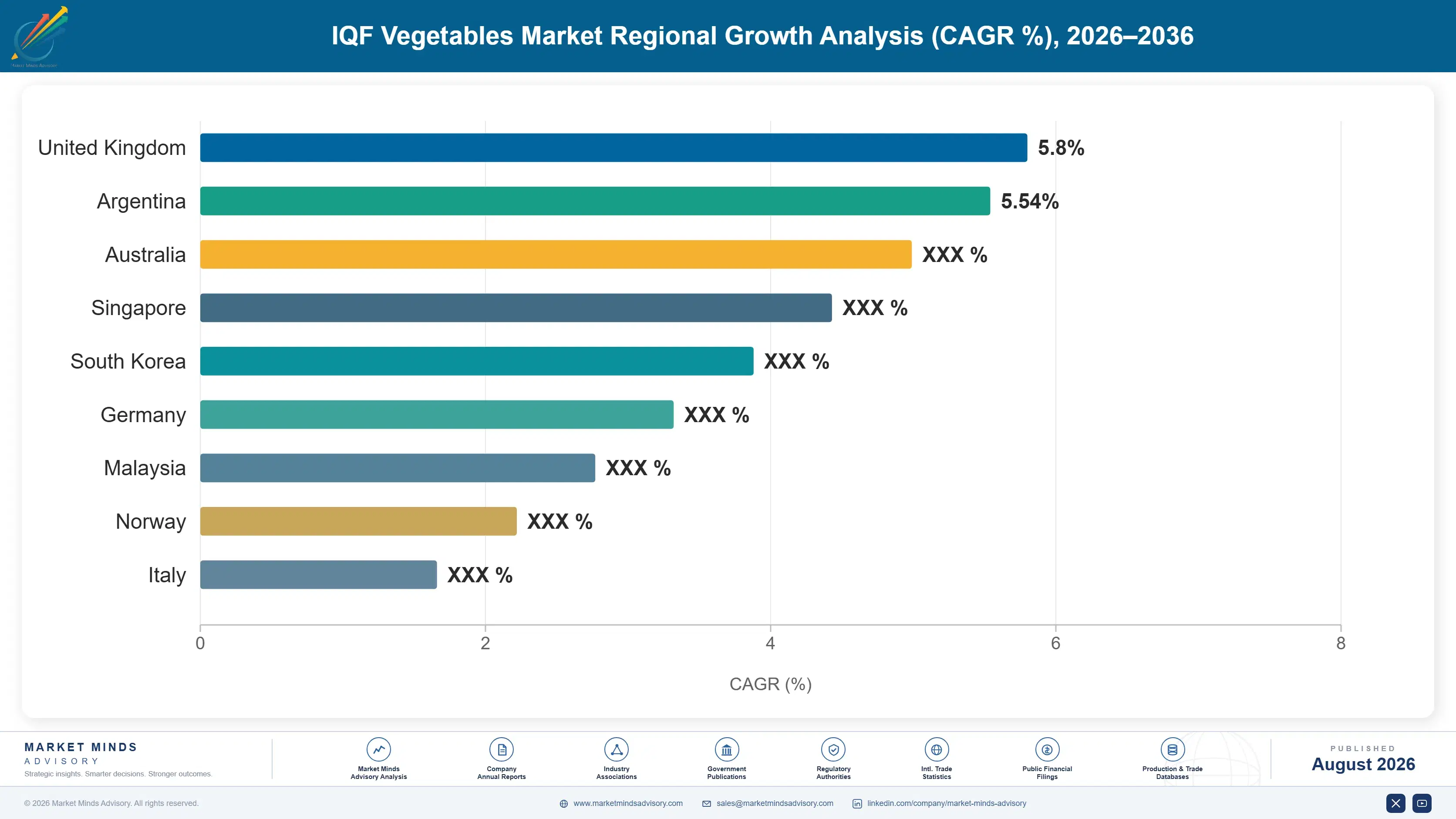
East Asia holds 29% of global value on Chinese growing, processing and export capacity that supplies a great deal of the world's IQF vegetables. Western Europe follows at 23% on consumption and processing depth, while South Asia and Pacific grows fastest on cold chain extension.

East Asia

Chinese growing and freezing capacity supplies a great deal of the world's IQF vegetables, particularly across broccoli, edamame, spinach and mixed Asian vegetables where scale and labour cost combine to produce delivered pricing no other origin matches. Export volume into Europe, North America and Japan is enormous. Domestic Chinese consumption is also growing as urban households acquire freezers and modern retail extends. Japanese demand is mature and quality expectations are exacting, with buyers specifying piece size and blanching tolerances that many origins struggle to hold. Korean consumption is smaller and heavily weighted toward prepared blends and convenience formats. Export volume into Europe, North America and Japan is genuinely enormous. Freezer ownership is rising domestically.
Share: 29% | CAGR: 6.7% (2026 to 2036)

Western Europe

Consumption per capita is among the highest anywhere and the processing base sits close to growing areas across Belgium, the Netherlands, France and Spain, which is why Ardo, Greenyard and Bonduelle all emerged here rather than elsewhere. Pea and bean freezing in particular is highly developed and technically sophisticated. Energy costs hit this region harder than any other through 2022 and margins have not fully recovered. Retail is consolidated and negotiates hard on annual contracts. Prepared blends have taken considerable share from single-vegetable packs, and organic certified IQF vegetables hold a meaningful position that most other regions have not developed. Retail is consolidated and negotiates hard on annual contract terms.
Share: 23% | CAGR: 4.3% (2026 to 2036)
Regional intelligence for 5 additional markets available in the complete report: North America, South Asia and Pacific, Latin America, Middle East and Africa, Eastern Europe. Contact sales@marketmindsadvisory.com.
iqf-vegetables-market-trends-growth-country-cagr-analysis-1787460195210

Where Vegetable Freezing Returns Are Made

Four positions separate processors earning real returns from those selling frozen produce by the tonne: shifting mix toward prepared blends, winning foodservice and industrial contracts, extending freezing line utilisation across more of the year, and investing in energy efficiency against contracts that cannot absorb a mid-year movement. Only the last requires meaningful capital. The rest are choices.

Shift Mix Toward Prepared Blends And Portions

Cutting, blending and portioning transfer work a household or a commercial kitchen would otherwise do, and buyers pay for that transfer far more readily than for better produce. Value per tonne runs roughly 58% above single-vegetable packs, and the proposition holds against food inflation better than most premium positioning. Blending several crops across a season also spreads freezing line utilisation, which improves fixed cost recovery in a business where capacity sits idle for most of the year. Better produce earns very little by comparison. Food inflation barely dents this proposition.
Market Impact: Adds roughly 58% more value per tonne processed

Win Foodservice And Industrial Contract Volume

Commercial kitchens value portion control and zero preparation waste in ways households never will, and manufacturers value a specification fresh produce cannot deliver year-round. That business carries roughly 41% of category value on contracts running annually or longer with predictable volume behind them. Predictability suits a processor with seasonal capacity and heavy fixed cost far better than retail promotional cycles, which arrive without warning and disappear the same way. Specification rather than packaging is what these buyers examine. Requalifying a formulation is expensive enough that positions hold for years. Households never think this way.
Market Impact: Reaches the 41% of category value under contract

Extend Freezing Line Utilisation Across The Year

Annual utilisation near 31% would be unacceptable in almost any other manufacturing business, and it is agricultural rather than commercial in origin so it cannot be engineered away entirely. Crop sequencing, blending across seasons and contract processing for third parties lift utilisation by 8 to 14 points, which improves fixed cost recovery directly. Each point matters more here than in industries where the equipment runs continuously and utilisation is a marginal consideration. Crops arrive when they arrive and cannot be scheduled. Sequencing manages the problem rather than solving it entirely. Third-party processing fills further gaps.
Market Impact: Lifts annual utilisation by up to 14 points

Invest In Energy Efficiency Against Fixed Contracts

Freezing and frozen storage together run roughly 26% of manufactured cost, and retail contracts negotiated annually leave no mechanism for recovering a mid-year energy movement at all. Efficiency investment in refrigeration plant, cold store insulation and heat recovery cuts consumption by 15% to 22% and is the only lever a processor genuinely controls. The 2022 period demonstrated exactly how exposed unhedged and inefficient operations become when energy moves sharply. Retailers refuse indexation almost without exception anywhere. Refrigeration plant, insulation and heat recovery are the three routes available. Payback runs several years at current pricing.
Market Impact: Cuts energy consumption by as much as 22%

Who Controls the Margin Pool

Concentration reads at 33% for the top five measured on IQF vegetable revenue, the basis used throughout this section, and it is low because freezing sits close to dispersed growing areas rather than in a few large plants. Ardo and Greenyard hold the deepest European positions. Bonduelle brings brand and retail reach, Simplot North American scale, and Dole breadth across produce categories.
Competition runs on three fronts. Prepared blend capability is the first and it determines value per tonne more than produce quality does. Foodservice and industrial contract access is the second, since that volume is predictable in a way retail never is. Energy efficiency is the third, and it decides margin when contracts cannot absorb a cost movement. None of the three is a produce quality argument.

Pressure arrives from two directions. Chinese and Egyptian processing supplies Western markets at delivered costs European and North American plants cannot match on commodity lines. Separately, retailer private label has taken considerable share across most developed markets. Rankings will shift toward processors holding prepared blend capability and industrial contracts rather than those defending branded retail volume alone. Branded retail volume alone no longer carries a business.
iqf-vegetables-market-trends-growth-company-positioning-matrix-1787460195729

Competitive Moat and Risk Dimensions

ARDO

Moat: Grower relationships and plant siting

Plants sited inside growing areas across Europe with grower contracts running years ahead of harvest give the business supply security and freezing window control that a processor buying on spot markets cannot approach. Breadth across vegetables and blends also spreads freezing line utilisation across a longer season than a single-crop operation manages.
ARDO

Risk: European energy cost exposure

Freezing and frozen storage are energy-intensive and European costs have stayed elevated, which weighs heavily on a business whose retail contracts are negotiated annually with no mechanism for mid-year recovery. Chinese and Egyptian processing also competes on delivered cost into European retail across commodity lines where technical capability earns very little.
SIMPLOT

Moat: North American scale and foodservice

Scale across North American growing and processing combined with deep foodservice relationships gives the business contract volume that is predictable in a way retail never is, which matters enormously when fixed cost recovery depends on a short freezing window. Breadth across potato and vegetable processing also spreads plant and logistics cost considerably.
SIMPLOT

Risk: Retail private label pressure

Retailer private label has taken considerable share across North American frozen vegetables, compressing branded pricing in a category where consumers struggle to identify meaningful product differences. Mexican and Chinese imported volume also competes on delivered cost in commodity lines where domestic growing and processing carry no particular advantage.

Players Tracked

Prominent Players

Ardo
Greenyard
Bonduelle
Simplot
Dole Food Company

Other Key Players

Conagra Brands
B and G Foods
McCain Foods
Lamb Weston
Findus Group
Iglo Group
Pinguin Foods
Agrofusion
Hanover Foods
Seneca Foods
Uren Food Group
Dujardin Foods
Oerlemans Foods
Unifrost
Fresh Del Monte Produce

Recent Developments

JANUARY 2025

Refrigeration efficiency investment completed across processing network

A frozen vegetable processor completed refrigeration plant and cold store insulation upgrades across several sites, cutting energy consumption materially against costs that annual retail contracts provide no mechanism for recovering mid-year. Consumption fell materially against a baseline that annual contracts had left entirely exposed. Payback runs several years.
Signal: Efficiency is the only energy lever a processor genuinely controls when contracts cannot absorb any movement
MAY 2025

Contract processing agreement extends freezing line utilisation

A vegetable processor signed a contract processing agreement to freeze third-party crops outside its own harvest window, lifting annual line utilisation from a base that would be unacceptable in almost any other manufacturing business. Neighbouring growers supplied the crop and the arrangement required no capital investment.
Signal: Utilisation improvement matters far more here than it does in any industry where equipment runs continuously
SEPTEMBER 2025

Prepared blend capacity expanded as single-vegetable packs decline

A processor expanded prepared blend and portioning capacity while reducing single-vegetable pack lines, following a shift in demand toward products that carry considerably more value per tonne and spread freezing utilisation across more crops. Value per tonne rose materially on the same crop input as before.
Signal: Buyers pay for transferred labour far more readily than they will ever pay for better produce

What Drives Frozen Vegetable Cost

Raw vegetables account for roughly 34% of manufactured cost and are contracted with growers well before harvest, which fixes that exposure early. Freezing and frozen storage energy contributes around 26%. Packaging adds about 12%, labour for sorting, cutting and blending roughly 15%, and frozen distribution close to 13% given that cold chain must hold continuously from plant to shelf without interruption.
European industrial energy pricing rose sharply through 2022 and has stayed above the previous decade's baseline according to International Energy Agency data, which hit this sector particularly hard given how energy-intensive freezing genuinely is. Vegetable input costs moved separately on growing conditions and labour availability tracked in United States Department of Agriculture and national statistical office data. Processors absorbed the majority of both movements without recovery.

The disadvantage mechanism is energy exposure against annual contracts, and it falls on processors selling into consolidated retail. A retailer negotiating an annual price provides no mechanism for recovering a mid-year energy movement, so the whole increase lands on processor margin. Exposure varies by channel, since foodservice and industrial contracts more frequently carry indexation provisions that retail buyers refuse to accept. Channel mix is therefore part of the energy question.
iqf-vegetables-market-trends-growth-cost-volatility-analysis-1787460195925

Invest in refrigeration efficiency and cold store insulation

Freezing and storage are over a quarter of manufactured cost and annual contracts provide no route to recover a mid-year energy movement, which makes efficiency the only lever a processor controls. Refrigeration upgrades, insulation and heat recovery cut consumption materially. Payback runs several years at current energy pricing, and processors who invested before 2022 came through that period considerably better.

Negotiate energy indexation into contracts where possible

Foodservice and industrial buyers accept indexation provisions considerably more readily than consolidated retail does, which makes channel mix part of the energy exposure question rather than separate from it. Building indexation in at negotiation converts a margin risk into a mechanic. Retailers resist it firmly, so the argument has to be made where it can actually be won.

Sequence crops to extend the freezing window

Annual line utilisation near 31% means fixed cost recovery depends entirely on the weeks the plant actually runs, and crop sequencing across varieties and geographies extends that window meaningfully. Contract processing for third parties fills further gaps. The constraint is that crops arrive when they arrive, so sequencing manages the problem rather than solving it in any complete sense.

Portfolio Architecture for Margin Defence

Portfolio economics here divide on processing value added and buyer type rather than on which vegetables are in the bag. Commodity single-vegetable retail packs compete against private label and imported product on shelf price, carry the thinnest margin in the category, and offer a consumer nothing to distinguish one from another. Nothing about that position rewards capability.
The middle tier is foodservice and industrial supply. Buyers specify piece size, moisture and blanching rather than looking at packaging, contracts run annually or longer with predictable volume, and that predictability suits a processor with seasonal capacity. Margins reach the high twenties and the relationship survives promotional cycles that constantly disrupt retail. Requalification costs are what hold it. Promotional cycles disrupt retail constantly.

Above both sit prepared blends and portioned formats. The processor sells transferred labour rather than produce, value per tonne runs roughly 58% above single-vegetable packs, and blending spreads freezing utilisation across more crops. Margins reach the low forties. Building it requires cutting, blending and portioning capability alongside the freezing line, which not every processor has invested in. Not every processor invested in that capability. Freezing capacity alone is not enough.

Volume / Commodity-Adjacent

Commodity single-vegetable retail packs competing against private label and imports. The range reflects crop cost and energy position rather than commercial skill, and consumers cannot distinguish between products. Imports undercut delivered cost.
Gross Margin: 11 to 18%

Premium / Certified

Foodservice and industrial supply against buyer specification. The range reflects contract terms and whether energy indexation was negotiated, which these buyers accept more readily than retailers do. Volume is genuinely predictable.
Gross Margin: 24 to 32%

Sustainability / Regulatory / Next-Generation

Prepared blends and portioned formats selling transferred labour rather than produce. The wide range reflects blending complexity and how far the format spreads freezing line utilisation across a season. Blending capability is required.
Gross Margin: 36 to 46%
iqf-vegetables-market-trends-growth-portfolio-architecture-1787460196418

High-value Sub-segments and Strategic Watch-out

Prepared Blends And Portioned Formats

High value and high growth together, selling transferred labour rather than produce at considerably better value per tonne. The wide range reflects blending complexity and how far the format spreads freezing line utilisation across a whole season. Blending capacity is the requirement. Utilisation improves alongside it.
Gross Margin: 36 to 46%

Foodservice Contract Supply

High value on steady growth with predictable contracted volume that suits seasonal capacity well. The range reflects contract terms and whether energy indexation was secured, which these buyers accept far more readily than retailers. Requalification costs hold these positions. Indexation reduces energy exposure. Volume is genuinely predictable.
Gross Margin: 27 to 35%

Organic Certified IQF Volume

A genuinely premium pool concentrated in Western European and North American retail where certification is recognised and valued. The range reflects certified crop availability, which constrains volume more than any processing capability does. Certified crop supply is the constraint. Recognition varies sharply by market. Processing capability is not the limit.
Gross Margin: 30 to 39%

Commodity Single-Vegetable Packs

The strategic watch-out. Volumes are large but private label matches the product exactly, imported supply undercuts delivered cost, and nothing distinguishes one pack from another. The range reflects crop and energy cost alone. Private label matches it exactly. Consumers see no difference. Imports undercut delivered cost.
Gross Margin: 11 to 18%

How Frozen Vegetable Demand Repeats

Repeat behaviour divides sharply between the two halves of this market. Foodservice and industrial contracts repeat as committed volume for as long as the specification holds, which is typically years, because a manufacturer that has built a product around a piece size and moisture level does not casually change supplier. Retail purchase repeats on household habit, which is durable but promotionally sensitive. Promotional pressure moves it more than preference does.
Stickiness varies by what secured the position. Industrial specification positions hold best, since changing supplier means requalifying a product formulation. Foodservice contracts hold well on service reliability and consistency. Prepared blend retail holds moderately, because the format itself is what the household wanted. Commodity single-vegetable packs hold worst of all, switching to private label on price without any hesitation.

The buyer profile has shifted considerably. Frozen vegetables were once bought mainly as a cheap staple by price-driven households, and that purchase still exists. Growth now comes from buyers valuing convenience and waste reduction rather than economy, from commercial kitchens managing portion cost and labour, and from manufacturers who need a specification that fresh produce cannot deliver reliably.
iqf-vegetables-market-trends-growth-end-use-penetration-index-1787460196906

Where To Compete And Why

These are among the four positions where our research anticipates prominent divergence between winners and laggards over the coming forecast period. Each is grounded in the demand model, the regulatory perimeter, and the announced capacity pipeline.
01 / PREPARED BLEND MIX SHIFT

Sell the labour, not the vegetables

Cutting, blending and portioning transfer work a household or a commercial kitchen would otherwise have to do themselves, and buyers pay for that transfer far more readily than they pay for better produce. Value per tonne runs roughly 58% above single-vegetable packs and holds against food inflation better than most premium positioning does. Blending several crops also spreads freezing line utilisation across a season, which improves fixed cost recovery directly in a business where capacity sits idle most of the year.
02 / INDUSTRIAL CONTRACT BUILDING

Predictable volume suits seasonal capacity

Commercial kitchens value portion control and zero preparation waste in ways households never will, and manufacturers value a specification that fresh produce genuinely cannot deliver across a full year. That business carries roughly 41% of category value on contracts running annually or longer with predictable volume behind them. Predictability suits a processor with heavy fixed cost far better than retail promotional cycles that arrive and then vanish again without any warning at all to the processor carrying the fixed cost.
03 / UTILISATION WINDOW EXTENSION

Lines sit idle most of the year

Annual utilisation near 31% would be unacceptable in almost any other manufacturing business, and its cause is agricultural rather than commercial so it cannot simply be engineered away. Crop sequencing, blending across seasons and contract processing for third parties lift utilisation by 8 to 14 points and improve fixed cost recovery directly. Each point matters more here than in industries where the equipment runs continuously all year round and utilisation is treated as a marginal consideration rather than a governing one.
04 / ENERGY EFFICIENCY INVESTMENT

Contracts cannot absorb mid-year movement

Freezing and frozen storage run roughly 26% of manufactured cost while retail contracts negotiated annually provide no mechanism at all for recovering any energy movement partway through the year. Efficiency investment across refrigeration plant, insulation and heat recovery cuts consumption by 15% to 22% and is genuinely the only lever a processor controls. The 2022 period showed exactly how exposed unhedged and inefficient operations become when energy prices move sharply against contracts that have already been signed and cannot be reopened.

Engagement Snapshot From the Field

A live engagement with an industry participant carrying material or product regulatory and market exposure ahead of a defining policy shift, showing how our research translates into a defensible multi-year portfolio strategy.
MARKET MINDS ADVISORY · CLIENT ENGAGEMENT SUMMARY
IQF Vegetables Producer Strategic Portfolio Review and Transition Roadmap 2026·Investment Scenario on IQF Vegetables Exposure Evaluation 2025-26
CLIENT PROFILE
A European vegetable freezing business with annual revenue near $340 million (client-reported, unverified by MMA), operating four plants sited inside growing areas across two countries. Roughly 71% of volume was single-vegetable retail packs sold through consolidated grocery, with limited prepared blend capability and annual freezing line utilisation running below the wider sector average throughout that period.
STRATEGIC CHALLENGE
Energy costs had compressed margins across two years with no mechanism to recover them from annual retail contracts, while private label and imported product competed hard on the commodity lines carrying most volume. Management needed to decide between defending retail share, investing in prepared blend capability, or pursuing foodservice and industrial contracts.
MMA APPROACH
MMA modelled contribution by product type and channel across four years of the client's own data, benchmarked line utilisation and energy consumption against sector comparators, and assessed blending capacity investment against foodservice contract opportunities. Twenty-two expert interviews with retail buyers, foodservice distributors and food manufacturers tested each of the routes available to the business.
KEY FINDINGS
  1. Single-vegetable retail packs delivered negative contribution across two of four plants after energy costs rose, and the client had continued producing them purely to fill freezing capacity.
  2. Prepared blends realised roughly 54% more value per tonne on comparable crop input, and the client's limited blending capacity had never been sized against that opportunity properly.
  3. Foodservice and industrial buyers accepted energy indexation in contracts that retailers had refused outright, which changed the exposure calculation on that channel considerably.
  4. Line utilisation ran nine points below sector comparators, and contract processing for two neighbouring growers could have closed most of that gap without capital investment.
CLIENT PROFILE
A European vegetable freezing business with annual revenue near $340 million (client-reported, unverified by MMA), operating four plants sited inside growing areas across two countries. Roughly 71% of volume was single-vegetable retail packs sold through consolidated grocery, with limited prepared blend capability and annual freezing line utilisation running below the wider sector average throughout that period.
STRATEGIC CHALLENGE
Energy costs had compressed margins across two years with no mechanism to recover them from annual retail contracts, while private label and imported product competed hard on the commodity lines carrying most volume. Management needed to decide between defending retail share, investing in prepared blend capability, or pursuing foodservice and industrial contracts.
MMA APPROACH
MMA modelled contribution by product type and channel across four years of the client's own data, benchmarked line utilisation and energy consumption against sector comparators, and assessed blending capacity investment against foodservice contract opportunities. Twenty-two expert interviews with retail buyers, foodservice distributors and food manufacturers tested each of the routes available to the business.
KEY FINDINGS
  1. Single-vegetable retail packs delivered negative contribution across two of four plants after energy costs rose, and the client had continued producing them purely to fill freezing capacity.
  2. Prepared blends realised roughly 54% more value per tonne on comparable crop input, and the client's limited blending capacity had never been sized against that opportunity properly.
  3. Foodservice and industrial buyers accepted energy indexation in contracts that retailers had refused outright, which changed the exposure calculation on that channel considerably.
  4. Line utilisation ran nine points below sector comparators, and contract processing for two neighbouring growers could have closed most of that gap without capital investment.
RECOMMENDED STRATEGY
Phase 1: Phase one: pursue contract processing to lift line utilisation, since this requires no capital and directly improves fixed cost recovery across the existing plant base. Phase 2: Phase two: invest in blending and portioning capacity, moving mix toward products carrying materially more value per tonne on the same crop input. Phase 3: Phase three: build foodservice and industrial contract volume where energy indexation is accepted, reducing exposure that retail contracts leave entirely uncovered.
OUTCOME
The client lifted line utilisation by seven points within one season and moved prepared blends from 12% to 34% of volume across eighteen months (client-reported, unverified by MMA). Foodservice reached 26% of revenue with indexation on most contracts, blended gross margin improved by roughly eight points, and two commodity retail lines were discontinued.

Frequently Asked Questions

Foundational context covering the market sizes, CAGR, scope, country, region and competition that inform every finding below. This section is provided to cover basics and most often pre-purchase conversations, answered from the MMA Primary Research Dataset.

What is the current size of the IQF Vegetables Market?

The global IQF vegetables market was valued at $24.00 billion in 2025, reaching an estimated $25.39 billion in 2026. That covers individually quick frozen vegetables across retail, foodservice and industrial channels.

How large will the IQF Vegetables Market be by 2036?

MMA forecasts the market reaching $44.62 billion by 2036, an increase of $19.23 billion over the 2026 base. That represents an expansion multiple of 1.76 times across the forecast period.

What is the CAGR for the IQF Vegetables Market 2026 to 2036?

The base case compound annual growth rate is 5.8%, with a bull case of 7.0% and a bear case of 4.6%. Historical growth between 2020 and 2025 ran at 4.8% annually.

Which segment is growing fastest?

Prepared vegetable blends and mixes grow at 8.7%, a full 1.50 times the market rate, because the processor sells transferred labour rather than produce. Foodservice grades follow at 7.4%.

Who are the major companies in the IQF Vegetables Market?

Ardo, Greenyard, Bonduelle, Simplot and Dole Food Company lead on IQF vegetable revenue. Together they account for roughly 33%, low because freezing sits near dispersed growing areas.

Which country is growing fastest?

India grows fastest at 9.4% annually as cold chain infrastructure extends into secondary cities and household freezer ownership rises alongside modern retail. Vietnam follows on export processing.

Report Segmentation Architecture

The full report scope spans multiple orthogonal segmentation dimensions, with cross-tabulated demand data provided for each dimension pair. Coverage extends further to regional breakdowns, trend trajectories, and the competitive detail needed to support segment-level decision-making.

By Product Category

  • Prepared Vegetable Blends And Mixes
  • Foodservice And Industrial Supply Grades
  • Single-Vegetable Retail Packs
  • Organic Certified IQF Vegetables
  • IQF Vegetable Ingredients For Further Processing

By End-Use Industry

  • Grocery And Supermarket Retail
  • Restaurants And Casual Dining
  • Institutional And Contract Catering
  • Prepared Meal Manufacturing
  • Soup, Sauce And Ready Meal Production
  • Quick Service And Fast Casual Restaurants

By Commercial Dimension

  • Branded Retail Distribution
  • Retailer Private Label Supply
  • Foodservice Distributor Channel
  • Direct Industrial Contract Supply
  • Contract Freezing And Toll Processing

By Region

  • North America
  • Western Europe
  • East Asia
  • South Asia and Pacific
  • Latin America
  • Middle East and Africa
  • Eastern Europe

Scope, Methodology, and Coverage

Every figure in this report is reproducible from documented input assumptions. The scope below maps the historical period, the forecast horizon, the segmentation dimensions, and the countries covered, alongside the underlying primary and qualitative methodology.
Historical Period
2020 to 2025
Forecast Period
2026 to 2036
Base Year
2025 (USD billions; MMA Primary Research Dataset, August 2026)
Market Definition
This report covers individually quick frozen vegetables, spanning prepared vegetable blends and mixes, foodservice and industrial supply grades, single-vegetable retail packs, organic certified IQF vegetables, and IQF vegetable ingredients for further processing, across branded retail, private label, foodservice distribution, direct industrial and contract freezing channels. Block-frozen and plate-frozen vegetables, canned and jarred vegetables, fresh and chilled produce, frozen potato products including chips and fries, frozen fruit, and frozen prepared meals are excluded from the sizing.
Quantitative Units
USD billions at processor realised value; volume in million tonnes; realised pricing in USD per tonne.
Segmentation Dimensions
By product category; by end-use industry; by commercial dimension; by region.
Regions Covered
North America, Western Europe, East Asia, South Asia and Pacific, Latin America, Middle East and Africa, Eastern Europe
Countries Covered
China, Japan, South Korea, India, Vietnam, Thailand, Australia, United States, Canada, Mexico, Guatemala, Peru, Brazil, Belgium, Netherlands, France, Spain, Poland, Egypt, Morocco.
Key Companies Profiled
Ardo, Greenyard, Bonduelle, Simplot, Dole Food Company, Conagra Brands, McCain Foods, Lamb Weston, Findus Group, Pinguin Foods, Hanover Foods, Seneca Foods, Oerlemans Foods, Fresh Del Monte Produce and others.
Quantitative Methodology
Primary survey, n=3,800 respondents, Q4 2025, six countries; demand-side model with trade association cross-validation
Qualitative Methodology
47 expert interviews, Q4 2025; applied to validate demand model assumptions, identify emerging dynamics, and assess competitive positioning
Report Format
PDF and XLSX data workbook (Word format preview document)
Publisher
Market Minds Advisory
Report Code
MMA-2026-AGR-250
Published
August 2026
Contact
sales@marketmindsadvisory.com | www.marketmindsadvisory.com

Purchase the full IQF Vegetables Market Report (2026 to 2036).

The full report sizes the IQF vegetables market across five product categories, six end-use channels and seven regions, with tonnage and per tonne pricing detail behind every value estimate. It profiles twenty companies on blending capability, foodservice access and energy efficiency position. Regional chapters cover growing geography, processing capacity and cold chain reach by market. Cost analysis quantifies crop, freezing energy and distribution exposure by product type. Utilisation analysis measures freezing line usage across the year and what genuinely extends the operating window in practice.
Tonnage and per tonne pricing by product category
Freezing line utilisation measured across processing regions
Energy cost exposure and contract indexation practice compared
Prepared blend value per tonne against single-vegetable packs
Competitive position assessments across twenty companies
Cold chain infrastructure reach and retail development by market

Built For The People Who Decide

From boardroom strategy to bench-side execution, this report is read cover-to-cover by leaders shaping the next decade of their industry, turning demand scenarios, market dynamics and valuation benchmarks into decisions.
CXOs/ Presidents/ VPs/ Managers
M&A and Corporate Development
Strategy Teams and R&D Heads
Procurement and Product Directors
Regulatory and Compliance Leaders
Investor Relations and Equity Analysts