Market Minds Advisory
IoT Processor Market

IoT Processor Market: IoT Processor Market. Edge AI Inference Reshapes Silicon Design Priorities

Device makers are demanding on-chip AI inference rather than cloud-dependent processing as connectivity costs and latency concerns mount, pushing processor vendors to embed neural accelerators directly into microcontroller-class silicon at scale.

Lead Analyst

Published

September 2026

Make Smarter Decisions with Customized Research Insights

Request a free sample report and evaluate market opportunities, growth trends, and competitive dynamics relevant to your business needs.

2025 MARKET VALUE$9.8BMarket Size 2025
2036 FORECAST VALUE$32.5BBase Case , 2026 to 2036
CAGR 2026 TO 203611.5 %Bull 12.8% / Bear 10.2%
INCREMENTAL OPPORTUNITY$21.5BNet 10- year value creation
EXPANSION MULTIPLE2.97x2036 value over 2026 base
Strategic Levers
M&A Pipeline
Regional Outlook
Country Rankings
Competitive Intelligence
Segmental Deep-dive
Call-Us : 91 93563 13602

Executive Snapshot and Market Trajectory.

Device makers are finally moving AI inference onto the chip itself rather than routing every sensor reading to the cloud for processing, since connectivity costs and latency concerns increasingly make cloud-dependent architectures commercially impractical at meaningful device fleet scale across most industries today.
Edge AI and sensor fusion processors drive fastest adoption, since embedding neural inference directly into microcontroller-class silicon meaningfully cuts the bandwidth and cloud compute costs that scaled poorly as device fleets grew into the billions of connected units. East Asia leads deployment given concentrated semiconductor fabrication capacity, while wireless connectivity SoCs increasingly extend beyond simple radio functions into integrated security and power management that discrete component designs could never match on cost or board space.
A moderately concentrated group of established semiconductor vendors competes alongside specialized IoT silicon startups, with software development tooling depth increasingly separating winners from chip vendors offering raw silicon performance without adequate developer tooling support and documentation. Supply chain resilience requirements across jurisdictions continue to reshape which vendors can guarantee consistent fabrication capacity across multi-year design-in commitments without extensive dual-sourcing arrangements, contingency planning, and meaningful inventory buffer investment.
Market Definition
The IoT processor market covers specialized semiconductor processors and systems-on-chip purpose-built for connected devices, including edge AI accelerators, sensor-hub microcontrollers, and wireless connectivity SoCs. It excludes general-purpose CPUs and GPUs designed primarily for personal computers, servers, or smartphone application processors.
Base Year Value
$9.8B in 2025 (MMA Primary Research Dataset, September 2026)
Forecast Period
2026 to 2036, eleven discrete annual values
CAGR
11.5% base case. Bull 12.8%. Bear 10.2%.
Fastest Growth Segment
Edge AI and Inference IoT Processors: 16.0% CAGR
Fastest Growth Country
India: 14.5% CAGR
Fastest Growth Region
South Asia and Pacific: 14.0% CAGR
Largest Region
East Asia: 30% of 2025 global value
Market Leaders
NXP Semiconductors, STMicroelectronics, Qualcomm, Texas Instruments, Renesas Electronics
Primary Survey
n=3,800 procurement and R&D decision-makers, Q4 2025, six countries
Methodology
Demand-side build-up, cross-validated against public data, 47 expert interviews

IoT Processor Market Forecast Scenarios

iot-processor-market-size-forecast-scenario-1789988057252
IoT processor demand grew steadily through 2020 to 2023 as connected device deployment accelerated across industrial and consumer categories despite persistent semiconductor supply constraints, then continued expanding from 2024 as edge AI capability moved from experimental pilot programs into mainstream production designs, lifting the historical growth rate to roughly 10.5 percent annually across the category.
Base case growth to 2036 rests on three commercial mechanisms: connected device manufacturers consolidating fragmented sensor and connectivity chips onto unified processors that reduce bill-of-materials cost and board complexity, edge AI capability maturing enough to displace cloud-dependent architectures across an expanding range of latency-sensitive applications, and wireless standards proliferation driving demand for processors supporting multiple concurrent connectivity protocols simultaneously. These mechanisms reinforce each other across different device categories, sustaining above-average growth without depending on any single dominant catalyst.
A bull scenario centers on a major automotive or industrial standard mandating edge AI processing for safety-critical applications, which would compress design cycles across the industry within a single product generation. The bear risk is a prolonged semiconductor oversupply cycle depressing average selling prices, which has historically compressed processor vendor margins industry-wide for a year or more.

Where On-Chip Inference Determines Design Wins

Software tooling depth has become the primary purchasing criterion, since device makers cannot justify switching processor vendors when doing so requires rewriting firmware and rebuilding development tooling relationships accumulated over years of prior design work. Vendors that once competed narrowly on raw processing speed now compete on development environment maturity and community support, which shifts engineering investment toward tooling rather than silicon performance alone.
MARKET CONCENTRATIONCR5 42%a moderately concentrated base of established semiconductor vendors
AVERAGE SELLING PRICE$3.80 per processor unitblended average selling price across the entire IoT processor category
TOP FABRICATION COUNTRY SHARETaiwan 38%concentrated semiconductor fabrication capacity supporting global processor production
EDGE AI ATTACH RATE34% of new designsnew processor designs now incorporating dedicated neural inference acceleration
DESIGN CYCLE LENGTH18-24 months typicalaverage timeline from processor selection to mass production deployment
SOFTWARE COST SHARE22% of total spenddevelopment tooling and firmware support versus raw silicon fabrication cost
Edge AI capability remains a significant differentiator, with dedicated neural inference acceleration increasingly expected in new processor designs across categories that previously relied entirely on cloud-based analysis for even basic pattern recognition tasks. Design cycle length remains lengthy, often exceeding eighteen months from processor selection to mass production, which keeps switching costs high and rewards vendors with established design-in relationships over new market entrants lacking comparable customer history.
Multi-protocol wireless connectivity integration is becoming a baseline expectation rather than a differentiator, concentrating advantage among vendors who can demonstrate reliable simultaneous support for multiple concurrent wireless standards within a single chip. Meanwhile several vendors are extending edge AI capability into predictive maintenance and anomaly detection use cases, which could meaningfully expand the addressable industrial IoT processor opportunity within the next several product cycles.
"Every processor vendor claims edge AI support now; half of them mean a single multiply-accumulate instruction bolted onto an old core. The ones actually winning design sockets are the ones whose tooling lets an engineer ship a working model in a week, not a quarter."
Director, Semiconductor and Embedded Systems Practice · MMA Specialized Semiconductor Processors and Systems-on-Chip for Connected Devices Practice · September 2026

Market Trends

Neural Inference Moves From Cloud to Silicon

Device makers are increasingly demanding dedicated neural inference acceleration built directly into microcontroller-class processors rather than routing sensor data to cloud servers for analysis, since round-trip latency and connectivity costs make cloud-dependent architectures impractical for real-time applications like predictive maintenance and safety monitoring. This shift has pushed edge AI attach rates to roughly 34 percent of new processor designs, up sharply from a much smaller share just three years earlier when dedicated neural acceleration remained largely experimental. Processor vendors lacking competitive inference capability are increasingly losing design sockets to competitors offering integrated acceleration at comparable price points.
Market Impact: 20%+ downtime reduction reported
Multi-Protocol Wireless Integration Consolidates Chip Count

Device manufacturers are consolidating what previously required separate Wi-Fi, Bluetooth, and low-power wide-area network chips onto single processors supporting multiple concurrent wireless protocols, meaningfully reducing bill-of-materials cost and board space requirements across compact connected device form factors, enclosures, and industrial designs. This consolidation trend is particularly pronounced in wearable and smart home categories, where board space constraints make discrete multi-chip architectures increasingly impractical compared to integrated alternatives. Roughly 48 percent of new connected device designs now specify multi-protocol integrated processors, up meaningfully from a much smaller share several years earlier.
Market Impact: 40% of designs prioritize edge processing

Market Opportunities and Growth Drivers

Industrial Predictive Maintenance Demands Real-Time Processing

Manufacturing facilities deploying predictive maintenance sensors increasingly require real-time anomaly detection at the equipment level rather than transmitting continuous vibration and temperature data to centralized systems that introduce unacceptable latency for safety-critical intervention decisions. Edge processors with dedicated inference capability let facilities detect developing equipment failures within milliseconds rather than the seconds or minutes cloud round-trip processing typically requires, directly preventing costly unplanned downtime events. Manufacturers report that edge-based predictive maintenance systems can reduce unplanned downtime by a meaningful percentage annually once fully deployed across a facility's equipment base, driving sustained processor demand.
Market Impact: Delays add 3-6 months

Connectivity Cost Pressure Favors On-Device Processing

Rising cellular and satellite connectivity costs for remote IoT deployments, particularly in agricultural and industrial monitoring applications, are pushing device makers toward processors that minimize data transmission volume by performing analysis locally before sending only actionable conclusions rather than raw sensor streams. This shift meaningfully reduces ongoing connectivity subscription costs that scale directly with data volume transmitted across cellular or satellite networks charging by the byte. Roughly 40 percent of new remote monitoring device designs now prioritize on-device processing specifically to minimize connectivity costs, up sharply from a much smaller share previously.
Market Impact: Switching adds 4-8 months of rework

Market Restraints and Challenges

Semiconductor Supply Volatility Disrupts Design Planning

Device makers designing new IoT products face persistent uncertainty around processor availability and lead times, since fabrication capacity remains concentrated among a small number of foundries whose allocation decisions can shift with little notice during periods of industry-wide demand surges. The root cause is that IoT processor volumes, while large in aggregate, often represent lower fabrication priority than automotive or smartphone chips competing for the same capacity. The commercial impact is delayed product launches when committed allocations fail to materialize on schedule. Vendors mitigate this by qualifying multiple processor sources during initial design phases rather than single-sourcing critical components.
Market Impact: 34% of new designs now AI-enabled

Fragmented Software Toolchains Slow Development Cycles

Device developers working across multiple processor architectures and vendor-specific development environments face significant productivity friction, since firmware, driver, and toolchain compatibility rarely transfers cleanly between different vendors' silicon even when underlying processor cores share similar architectural foundations. The root cause is that each vendor has historically built proprietary development toolchains rather than converging on shared open standards across the industry. This has caused many development teams to standardize on a single vendor's toolchain even when a competitor's silicon might otherwise offer better price or performance. Vendors are mitigating this by increasingly supporting open-source development frameworks that reduce switching costs.
Market Impact: 48% of designs now multi-protocol
3 additional market trends, 4 additional growth drivers, and 3 additional restraints and challenges are covered in the full report. Contact sales@marketmindsadvisory.com to access the complete intelligence.

Segment CAGR and Growth Architecture

Segmentation follows processor function within connected device architecture, spanning edge AI and inference processors, sensor fusion and hub processors, wireless connectivity SoCs, low-power microcontroller processors, and IoT gateway processors, each addressing a genuinely distinct architectural role rather than overlapping customer type, device category, power budget, or pricing tier segments within this broader semiconductor market.
iot-processor-market-market-share-analysis-1789988057812

Edge AI and Inference IoT Processors

Edge AI and inference processors lead growth as device makers finally have silicon capable of running meaningful neural network models directly on constrained microcontroller-class hardware rather than requiring a full application processor or cloud round-trip for every inference decision. These processors combine dedicated neural accelerator cores with traditional microcontroller functions, letting a single chip handle sensor data collection, model inference, and actuator control without separate discrete components adding cost and board space. Industrial and automotive applications are adopting this segment fastest, since safety-critical real-time decision requirements make cloud-dependent architectures commercially and technically unacceptable for applications demanding millisecond-level response guarantees. Vendors combining silicon design with mature model deployment tooling are capturing disproportionate share of this expanding investment category.
CAGR 16.0%

Sensor Fusion and Hub Processors

Sensor fusion and hub processors are the second-fastest growing segment, driven by device makers consolidating what previously required separate accelerometer, gyroscope, and environmental sensor processing chips onto a single hub processor that aggregates and interprets multiple sensor streams simultaneously. These processors increasingly incorporate basic AI capability to distinguish meaningful sensor patterns from noise before passing conclusions to the main application processor, reducing overall system power consumption considerably. Wearable and consumer electronics device makers are adopting this segment fastest, since battery life constraints make efficient sensor fusion processing considerably more valuable than for mains-powered industrial equipment with less demanding power budgets. Vendors offering the lowest active power draw are winning design sockets fastest across battery-constrained device categories.
CAGR 14.0%
Full segment breakdown across 5 segments available in the complete report.

Regional Architecture and Country Demand Map

East Asia leads today on concentrated semiconductor fabrication capacity and device manufacturing scale, while North America follows closely behind on chip design headquarters concentration, and South Asia and Pacific posts the fastest overall regional growth on rapidly expanding domestic electronics manufacturing across the entire region.

East Asia

Taiwan's concentrated advanced semiconductor fabrication capacity, anchored by TSMC and other major foundries, gives the region a durable manufacturing advantage that processor vendors headquartered elsewhere still depend upon for production regardless of design origin. China's massive domestic device manufacturing base drives substantial processor consumption, though data sovereignty and trade policy considerations increasingly favor domestic processor vendors for certain government and infrastructure applications specifically. Japan and South Korea maintain strong positions in sensor and memory technology that complement processor supply chains across the region's integrated electronics manufacturing base. Component supply chain proximity gives regional device manufacturers meaningful cost and lead-time advantages over international competitors. South Korean memory manufacturers are following a similar processor integration trajectory as adoption expands.
Share: 30% | CAGR: 12.5% (2026 to 2036)

North America

US semiconductor companies maintain the deepest processor architecture and software tooling development capability of any region, giving domestic vendors including Qualcomm and Texas Instruments continued design leadership despite manufacturing occurring predominantly overseas. Recent government incentives supporting domestic semiconductor fabrication investment are gradually expanding onshore manufacturing capacity, though meaningful production volume remains years away from full realization. Canadian technology companies are following a similar processor adoption trajectory under comparable industrial policy priorities. Industrial and automotive device makers headquartered domestically continue driving a substantial share of near-term edge AI processor demand as they modernize equipment fleets. Large industrial equipment makers headquartered domestically continue driving substantial near-term edge AI processor demand across expanding fleets and facilities nationwide.
Share: 26% | CAGR: 11.5% (2026 to 2036)
Regional intelligence for 5 additional markets available in the complete report: Western Europe, South Asia and Pacific, Latin America, Middle East and Africa, Eastern Europe. Contact sales@marketmindsadvisory.com.
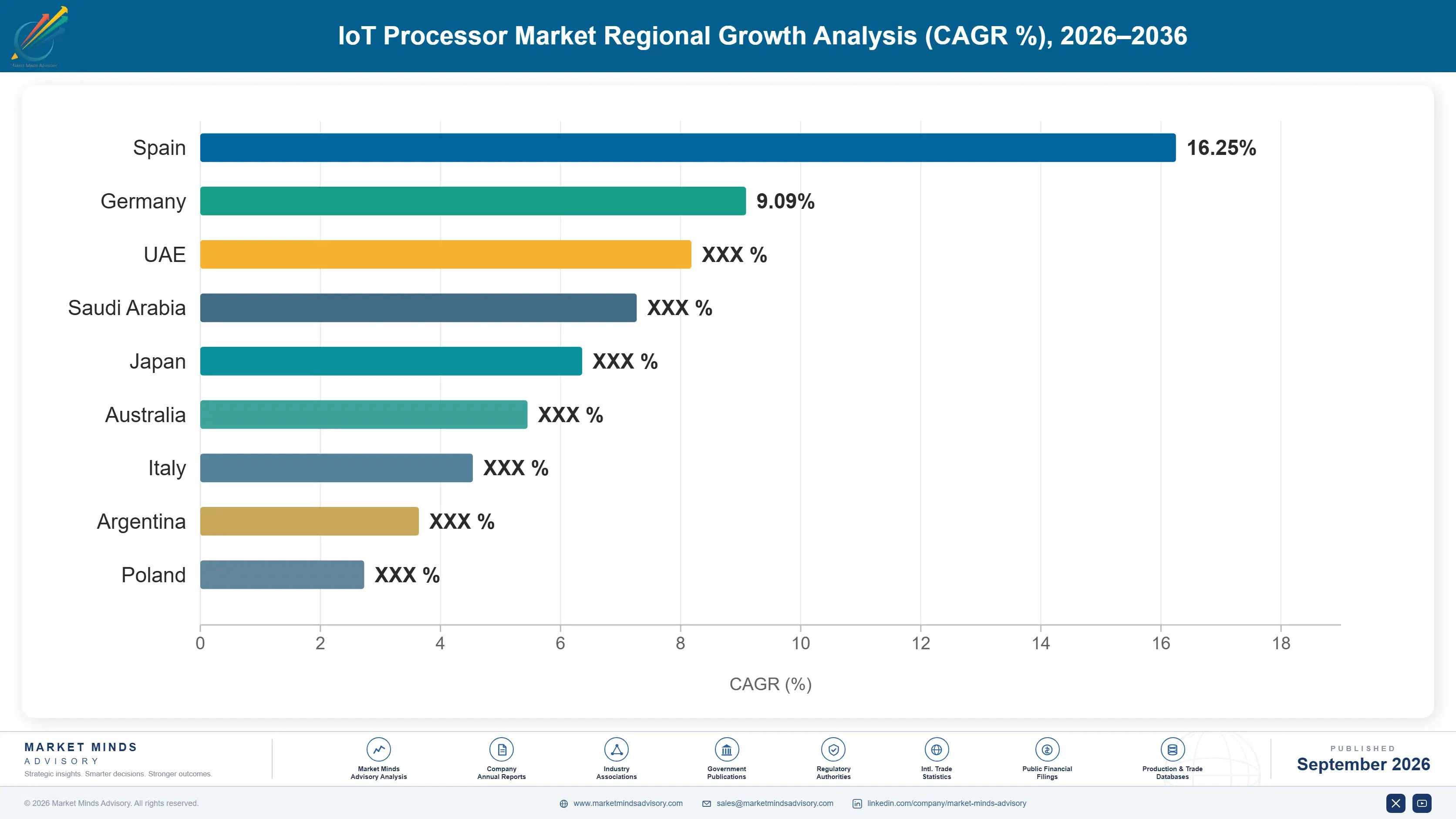
iot-processor-market-country-cagr-analysis-1789988058328

Where IoT Processor Vendors Should Expand Next

Beyond core silicon sales, vendors are building adjacent commercial layers around software development platform licensing, pre-trained model libraries, extended design support services, and long-term supply commitment contracts, each extending overall contract value well past the initial chip sale into sustained multi-year customer relationships across large and mid-sized device manufacturers operating across every region worldwide.

Software Development Platform Tooling Licensing Programs

Vendors are commercializing software development platforms and IDE tooling as paid tiers layered on top of core silicon sales, since device makers increasingly value integrated development environments that meaningfully reduce firmware development time compared to generic toolchains lacking vendor-specific optimization. This tooling layer now generates roughly 14 percent of total revenue at several leading vendors, well above the negligible share tooling represented when free basic development kits dominated the category. Customers accept this premium since faster development cycles clearly justify the additional tooling investment relative to competitor offerings lacking comparable integration depth.
Market Impact: 14% of revenue now from tooling licensing today

Pre-Trained AI Model Library Licensing Programs

Pre-trained AI model libraries optimized for specific processor architectures are commanding premium licensing fees beyond base silicon pricing, since device makers increasingly want validated, ready-to-deploy models rather than building and training inference models entirely from scratch for common use cases like anomaly detection and voice recognition. Attach rates for at least one licensed model now exceed 38 percent among edge AI processor customers, up sharply from a negligible share when these libraries first launched as standalone offerings. Vendors bundling models into tiered packages are seeing measurably longer customer relationships than those selling bare silicon alone.
Market Impact: 38% attach rate on model library licensing now

Extended Design Support Service Program Structures

Extended design support services helping device makers navigate complex multi-protocol wireless integration and power optimization challenges are generating meaningful incremental revenue beyond component sales, since customers consistently underestimate the engineering complexity required to properly implement advanced processor capability in production designs and manufacturing processes. These services now represent roughly 22 percent of first-year contract value at several leading vendors, reflecting genuine willingness to pay for faster, lower-risk product development. Vendors offering this service report meaningfully higher design-in win rates than those leaving customers entirely on their own without dedicated support.
Market Impact: 22% of first-year value from design support work

Long-Term Supply Commitment Contract Structures Overall

Long-term supply commitment contracts guaranteeing processor availability across multi-year production runs are commanding premium pricing over spot-market purchasing, since device makers increasingly prioritize supply certainty following recent semiconductor shortage disruptions that damaged production schedules across the industry broadly. These committed-supply arrangements have expanded average contract value by roughly 26 percent for vendors pursuing this model, reflecting genuine customer willingness to pay for guaranteed allocation during future capacity constraints. Vendors lacking committed-supply programs increasingly struggle to win the largest design contracts against competitors offering demonstrated supply chain reliability already. This positioning has become a meaningful differentiator during competitive procurement evaluations.
Market Impact: 26% larger contracts via supply guarantee programs now

Who Controls the Margin Pool

IoT processors remain moderately concentrated, with the top five vendors holding an estimated 42 percent of the market on a shipped-unit-volume basis. NXP Semiconductors and STMicroelectronics lead on breadth across microcontroller and connectivity product lines, while a meaningful gap separates them from smaller specialist challengers competing mainly on niche performance rather than broad platform scale.
Current competitive activity centers on three fronts: vendors racing to embed dedicated neural inference acceleration into microcontroller architectures to close the edge AI capability gap, larger semiconductor companies acquiring specialized AI silicon startups rather than building comparable capability internally, and several vendors expanding multi-protocol wireless integration to reduce customer bill-of-materials cost. Pricing pressure has intensified modestly among mid-tier vendors competing for cost-sensitive consumer accounts larger vendors consider too small to prioritize.

Emerging pressure comes from fabless AI chip startups entering the IoT processor market through specialized inference accelerators rather than general-purpose microcontroller architecture, betting dedicated silicon can substitute for the broad platform breadth established vendors have built over decades. Rankings could shift meaningfully if a major cloud provider bundles its own edge AI silicon directly with device software platforms, since that would compress the addressable market for standalone processor vendors currently commanding premium design-in relationships.
iot-processor-market-company-positioning-matrix-1789988058853

Competitive Moat and Risk Dimensions

NXP SEMICONDUCTORS

Moat: Broadest automotive and industrial portfolio

NXP's decades of automotive and industrial microcontroller experience across nearly every processor performance tier give it design relationships and application-specific certification credentials that specialized startups take years to replicate, letting it win the largest fleet-wide design contracts spanning multiple product generations and vehicle platforms globally.
NXP SEMICONDUCTORS

Risk: Slower edge AI iteration pace

As a large diversified semiconductor company, NXP's edge AI silicon roadmap iterates more slowly than venture-backed specialists focused purely on neural accelerator performance, risking share loss among device makers prioritizing the most advanced inference benchmarks over established automotive and industrial certification credentials built over many decades.
STMICROELECTRONICS

Moat: Strong developer tooling breadth

STMicroelectronics maintains one of the broadest developer tool suites in the microcontroller industry, with extensive reference designs and community support that meaningfully reduce time-to-market for device makers, letting it win price-sensitive design contracts where development speed matters as much as raw silicon specifications and performance.
STMICROELECTRONICS

Risk: Limited premium AI silicon depth

STMicroelectronics has been slower than some competitors to introduce genuinely differentiated high-performance edge AI silicon, risking share loss among device makers prioritizing the most advanced inference capability over established developer tooling breadth and the extensive reference design library the company has built over many years.

Players Tracked

Prominent Players

NXP Semiconductors
STMicroelectronics
Qualcomm
Texas Instruments
Renesas Electronics

Other Key Players

Microchip Technology
Infineon Technologies
Silicon Labs
Espressif Systems
Nordic Semiconductor
MediaTek
Broadcom
Analog Devices
onsemi
Ambiq Micro
GigaDevice Semiconductor
Realtek Semiconductor
Marvell Technology
Qorvo
Winbond Electronics

Recent Developments

MARCH 2026

NXP Semiconductors Acquires Edge AI Startup

NXP Semiconductors acquired a small edge AI silicon startup specializing in ultra-low-power neural inference accelerators for battery-powered sensor applications, folding the technology directly into its microcontroller portfolio rather than continuing to rely on third-party AI IP licensing partners for advanced inference capability across its product lines.
Signal: Large processor vendors are increasingly securing edge AI capability through targeted acquisition rather than IP licensing.
NOVEMBER 2025

STMicroelectronics Signs Foundry Capacity Agreement

STMicroelectronics signed a multi-year capacity agreement with a major Asian foundry to secure guaranteed wafer allocation for its IoT processor lines, replacing a previously spot-market-dependent sourcing arrangement that had exposed the company to allocation shortfalls during recent industry-wide semiconductor demand surges and prolonged shortage periods.
Signal: Processor vendors are increasingly locking in long-term fabrication capacity to avoid all future allocation shortfalls entirely.
JUNE 2025

Qualcomm Expands Multi-Protocol Wireless SoC Line

Qualcomm announced an expanded multi-protocol wireless system-on-chip line supporting simultaneous Wi-Fi, Bluetooth, and Thread connectivity within a single processor, aimed at reducing bill-of-materials cost for smart home device makers previously requiring separate discrete radio chips for each individual wireless connectivity standard supported across every design.
Signal: Vendors are increasingly consolidating wireless protocols onto single chips to directly reduce overall customer component costs.

Fabrication Capacity Costs Shape Vendor Margins

Wafer fabrication and packaging costs together represent roughly 56 percent of cost of goods sold for IoT processor vendors, notably higher than the software-heavy cost structures typical of fabless application-layer technology companies. Fabrication capacity reservation fees alone account for close to 32 percent, reflecting the premium vendors pay to secure guaranteed allocation during periods of industry-wide demand.
Foundry wafer pricing rose sharply during 2022 and 2023, following surging semiconductor demand across automotive, consumer electronics, and industrial categories all simultaneously, as documented in major foundry quarterly earnings disclosures published across the global industry during that period. Vendors serving high-volume IoT customer programs absorbed meaningfully higher fabrication costs for several consecutive quarters before securing improved long-term capacity agreements at more predictable pricing terms overall.

Smaller fabless processor vendors lacking scale to negotiate favorable foundry allocation terms face a real cost disadvantage against larger vendors like NXP, who can spread fabrication reservation costs across a broader product portfolio and negotiate volume discounts unavailable to smaller specialists. This dynamic increasingly pushes smaller vendors toward niche processor categories where larger vendors see insufficient contract value to compete aggressively on price alone.
iot-processor-market-cost-volatility-analysis-1789988059051

Multi-Foundry Capacity Diversification

Vendors are qualifying multiple foundry partners across different geographies to reduce dependence on any single fabrication source, using competitive allocation negotiations among qualified foundries to keep wafer cost growth below customer contract price escalators during periods of industry-wide supply tightness, constraint, and unexpected demand surges across every major process node, packaging option, and test facility.

Long-Term Capacity Reservation Agreements

Larger vendors are negotiating multi-year capacity reservation agreements with committed wafer volume commitments in exchange for meaningfully lower per-unit fabrication pricing, locking in favorable rates before anticipated future price increases across the foundry industry broadly, comprehensively, and across every major manufacturing node, packaging technology, testing service, logistics arrangement, and quality certification available anywhere today.

Process Node Migration Planning

Vendors are strategically timing migration to newer, more cost-efficient process nodes to balance fabrication cost reduction against the engineering investment and qualification risk that switching manufacturing processes introduces, avoiding premature migration that could disrupt production continuity for existing customers and their long-term multi-year program commitments, roadmaps, delivery schedules, future forecasts, and inventory planning entirely.

Portfolio Architecture for Margin Defence

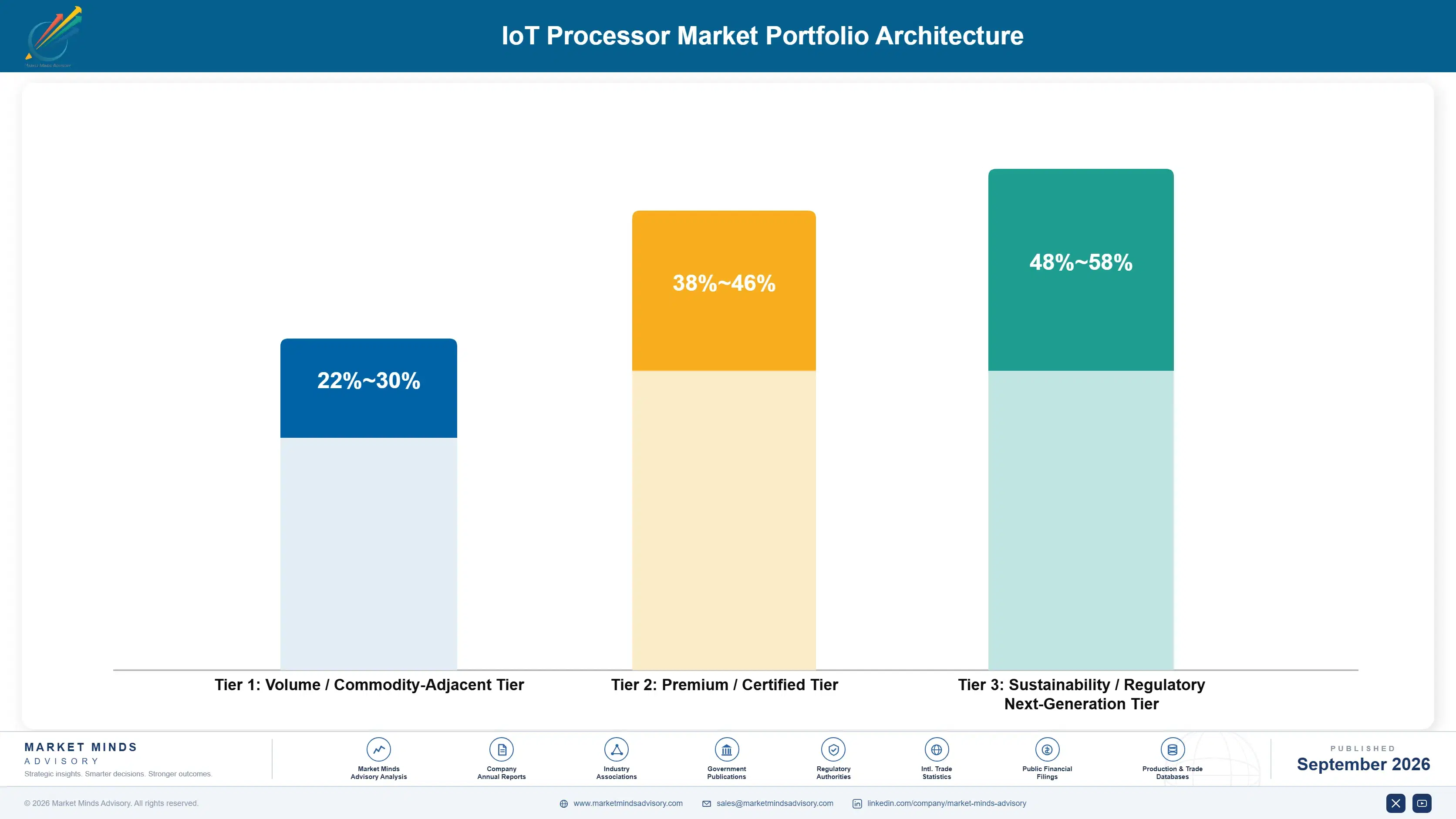
IoT processors span three commercial tiers: basic microcontroller processors at the volume end, certified wireless connectivity SoCs meeting multi-protocol benchmarks in the middle, and integrated edge AI inference processors at the premium top, with gross margins expanding meaningfully from the commodity tier through to next-generation processors that command significantly higher recurring revenue per design-in relationship.
Volume-tier microcontroller processors face persistent price pressure from device makers treating basic control functions as commoditized silicon, while premium edge AI processors increasingly capture disproportionate margin as customers pay for inference capability rather than raw processing cycles alone. Vendors straddling both tiers face internal tension allocating engineering resources between defending existing microcontroller accounts and building the next-generation AI capability premium customers now demand.

High-value margin pools concentrate heavily around edge AI inference and multi-protocol connectivity processors, where large device manufacturers pay meaningfully more for measurable reductions in cloud compute cost and bill-of-materials complexity. Smaller vendors without AI silicon depth remain confined to lower-margin microcontroller work, ceding the fastest-growing and most profitable segment entirely to larger, better-capitalized competitors with deeper research and fabrication capacity budgets. This margin gap widens further each year.

Volume / Commodity-Adjacent Tier

Basic microcontroller processors serving cost-sensitive device categories with minimal wireless or AI capability beyond simple control logic and basic sensor reading and actuator functions without any deeper processing capability whatsoever.
Gross Margin: 22-30%

Premium / Certified Tier

Certified wireless connectivity SoCs meeting multi-protocol benchmarks, offering integrated radio and security capability that meaningfully reduces discrete component count and board complexity across most compact connected device designs today and going forward.
Gross Margin: 38-46%

Sustainability / Regulatory / Next-Generation Tier

Integrated edge AI inference processors combining neural acceleration, sensor fusion, and connectivity into a single chip, commanding the highest per-unit pricing among large global device manufacturers and OEM customers worldwide.
Gross Margin: 48-58%
iot-processor-market-portfolio-architecture-1789988059553

High-value Sub-segments and Strategic Watch-out

Edge AI and Inference IoT Processors

This segment combines the fastest unit growth in the market with the highest per-unit pricing, as device makers pay premium rates for inference capability that eliminates cloud round-trip latency and cost, making it the clearest priority for vendor R&D investment over the next several years across accounts.
Gross Margin: 52-62%

Sensor Fusion and Hub Processors

Growing quickly on device makers consolidating multi-sensor processing, this segment carries strong margins though slightly below the edge AI leader, as vendors increasingly bundle fusion capability with basic AI to justify premium pricing over standalone sensor chips sold today, quite consistently, reliably, and predictably overall.
Gross Margin: 42-50%

Wireless Connectivity SoCs

A large installed-base segment growing at a moderate pace, this connectivity category remains the anchor product most device makers purchase first before considering broader processing investment, anchoring overall category volume even as growth increasingly shifts toward AI-enabled products each and every year consistently and reliably today.
Gross Margin: 32-40%

Low-Power Microcontroller Processors

Growth here trails the fastest segments today, and vendors risk this category commoditizing further as basic control functions become a standard feature bundled into broader connectivity chips rather than sold separately as a distinct standalone product for most device makers today and going forward too.
Gross Margin: 20-28%

Why Design Wins Compound Over Time

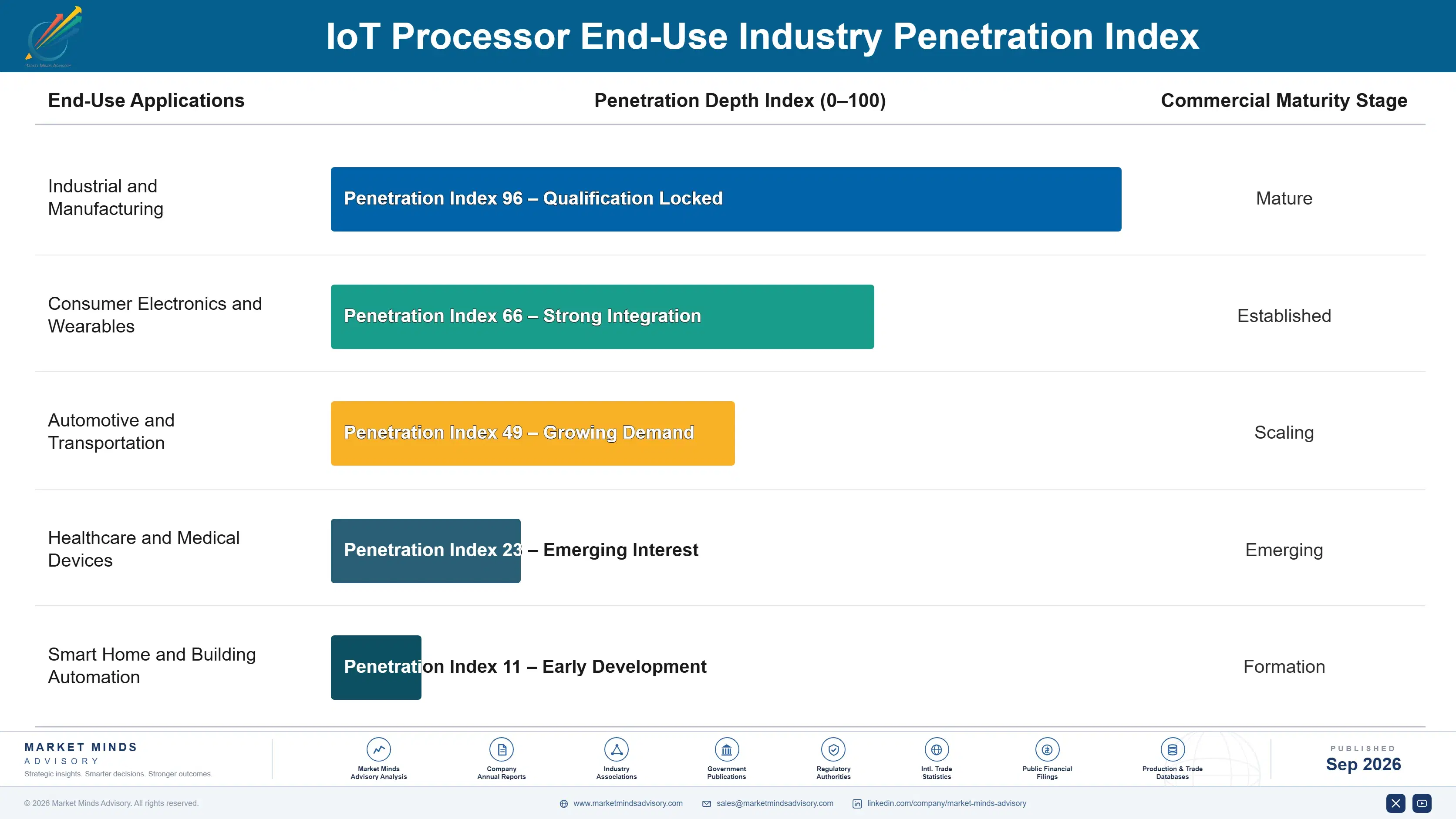
IoT processor design wins increasingly function as annuity relationships rather than one-time component sales, since software tooling licenses, model library subscriptions, and supply commitment premiums attach to the initial design-in and recur across a device's typical five to seven year production run. Vendors capturing this attached recurring revenue build customer lifetime value multiples well above the original processor unit price.
Adoption depth varies meaningfully by device category: consumer electronics adopt shallowly, treating processor selection primarily as a component sourcing decision without deep ongoing vendor engagement, while industrial and automotive customers integrate processor vendor relationships deeply into safety certification, long-term supply planning, and firmware support workflows, creating switching costs that keep those customers within a single vendor's product family across multiple product generations and platform refresh cycles.

Buyer profiles are shifting generationally as device makers increasingly include dedicated embedded AI and firmware architecture leads who evaluate vendor selection through inference performance and tooling maturity criteria rather than pure unit price comparisons alone. Younger engineering leaders entering these roles expect measurable proof of development velocity and inference accuracy before committing to a design, favoring vendors who can demonstrate quantified outcomes over long-standing incumbent relationships built on legacy component familiarity.
iot-processor-market-end-use-penetration-index-1789988060045

Priorities for IoT Processor Vendors

These are among the four positions where our research anticipates prominent divergence between winners and laggards over the coming forecast period. Each is grounded in the demand model, the regulatory perimeter, and the announced capacity pipeline.
01 / EDGE AI SILICON INVESTMENT

Build Genuine Inference Capability, Not Marketing Claims

Device makers increasingly evaluate processors on measured inference benchmarks and real-world model deployment ease rather than accepting vendor claims about edge AI capability at face value, and vendors who lead with documented performance data during procurement evaluations close larger design contracts meaningfully faster than those emphasizing marketing language over technical substance and proof. Genuine silicon capability, not feature checklists, wins the largest design sockets today. Vendors treating edge AI as a checkbox rather than a core competency are losing ground steadily.
02 / DEVELOPER TOOLING INVESTMENT

Build Tooling Before Competitors Lock In Developers

Firmware and toolchain switching costs keep customers locked into a single vendor's development environment for years once a design commitment is made, making early developer mindshare and tooling maturity investment a durable competitive moat that compounds meaningfully over successive product generations and design cycles across the industry. Vendors that build superior development environments early capture disproportionate long-term design-in share relative to competitors offering comparable silicon with weaker tooling support. Software investment is becoming as commercially valuable as silicon performance itself.
03 / SUPPLY CHAIN RESILIENCE

Secure Foundry Capacity Ahead of the Next Shortage

Semiconductor supply volatility has already disrupted device maker production schedules once, and vendors lacking diversified, committed fabrication capacity will increasingly lose design wins to competitors who can credibly guarantee multi-year supply continuity regardless of broader industry demand fluctuations affecting the entire foundry supply chain and its capacity constraints across every region. Vendors securing long-term capacity agreements now will avoid the allocation shortfalls that damaged customer trust during the last shortage cycle. This is an operational priority, not a distant contingency plan.
04 / MULTI-PROTOCOL INTEGRATION FOCUS

Consolidate Wireless Protocols Before Rivals Do

Device makers increasingly prefer single-chip solutions supporting multiple concurrent wireless standards over discrete multi-chip architectures that add cost and board space, and vendors lacking genuine multi-protocol integration capability will increasingly lose design wins in space-constrained consumer and wearable device categories regardless of underlying processor performance credentials already established and repeatedly proven in the field. Building this capability now positions vendors ahead of the consolidation trend that shows no signs of reversing across the industry. Integration depth is becoming a genuine competitive differentiator.

Engagement Snapshot From the Field

A live engagement with an industry participant carrying material or product regulatory and market exposure ahead of a defining policy shift, showing how our research translates into a defensible multi-year portfolio strategy.
MARKET MINDS ADVISORY · CLIENT ENGAGEMENT SUMMARY
IoT Processor Producer Strategic Portfolio Review and Transition Roadmap 2026·Investment Scenario on IoT Processor Exposure Evaluation 2025-26
CLIENT PROFILE
The client is a mid-size industrial equipment manufacturer producing roughly 60,000 connected units annually, with an aging microcontroller platform lacking any edge AI inference capability whatsoever. Annual cloud compute costs for processing sensor data collected from fielded equipment exceeded $4.2 million (client-reported, unverified by MMA), a cost growing faster than the fielded unit count itself.
STRATEGIC CHALLENGE
The manufacturer's cloud-dependent architecture could not deliver the real-time anomaly detection that customers increasingly demanded for predictive maintenance applications, since round-trip latency made timely intervention impossible for fast-developing equipment failures. Leadership needed a processor migration strategy that would introduce edge AI capability without requiring a complete architectural redesign across the company's existing product line.
MMA APPROACH
MMA benchmarked the manufacturer's cloud compute costs and latency requirements against three edge AI processor vendors, modeling expected cost savings and detection speed improvement under each option. The engagement combined vendor technical evaluation of inference accuracy with a phased migration strategy that preserved existing sensor and mechanical interfaces to minimize redesign scope.
KEY FINDINGS
  1. Cloud compute costs for sensor data processing had grown considerably faster than the fielded unit count, indicating an unsustainable long-term cost trajectory.
  2. Edge AI processors could detect developing equipment failures within milliseconds compared to the several-second latency the previous cloud-dependent architecture required for equivalent detection.
  3. Preserving existing sensor and mechanical interfaces reduced projected redesign scope substantially compared to a complete architectural overhaul of the entire product line.
  4. The selected processor vendor's pre-trained anomaly detection models required minimal customization, meaningfully accelerating the manufacturer's overall development timeline and reducing engineering costs.
CLIENT PROFILE
The client is a mid-size industrial equipment manufacturer producing roughly 60,000 connected units annually, with an aging microcontroller platform lacking any edge AI inference capability whatsoever. Annual cloud compute costs for processing sensor data collected from fielded equipment exceeded $4.2 million (client-reported, unverified by MMA), a cost growing faster than the fielded unit count itself.
STRATEGIC CHALLENGE
The manufacturer's cloud-dependent architecture could not deliver the real-time anomaly detection that customers increasingly demanded for predictive maintenance applications, since round-trip latency made timely intervention impossible for fast-developing equipment failures. Leadership needed a processor migration strategy that would introduce edge AI capability without requiring a complete architectural redesign across the company's existing product line.
MMA APPROACH
MMA benchmarked the manufacturer's cloud compute costs and latency requirements against three edge AI processor vendors, modeling expected cost savings and detection speed improvement under each option. The engagement combined vendor technical evaluation of inference accuracy with a phased migration strategy that preserved existing sensor and mechanical interfaces to minimize redesign scope.
KEY FINDINGS
  1. Cloud compute costs for sensor data processing had grown considerably faster than the fielded unit count, indicating an unsustainable long-term cost trajectory.
  2. Edge AI processors could detect developing equipment failures within milliseconds compared to the several-second latency the previous cloud-dependent architecture required for equivalent detection.
  3. Preserving existing sensor and mechanical interfaces reduced projected redesign scope substantially compared to a complete architectural overhaul of the entire product line.
  4. The selected processor vendor's pre-trained anomaly detection models required minimal customization, meaningfully accelerating the manufacturer's overall development timeline and reducing engineering costs.
RECOMMENDED STRATEGY
Phase 1: Phase 1 (Months 1-3): Validate edge AI processor performance against historical failure data collected from the entire fielded equipment base. Phase 2: Phase 2 (Months 4-8): Integrate the new processor into existing product designs while carefully preserving all sensor and mechanical interfaces. Phase 3: Phase 3 (Months 9-12): Deploy updated units to the field and begin phasing out cloud-dependent processing entirely across the fleet.
OUTCOME
Within twelve months of completing the processor migration, the manufacturer reported cloud compute costs declining by roughly 62 percent (client-reported, unverified by MMA), alongside equipment failure detection time improving from several seconds to under 50 milliseconds on average across its entire fielded fleet and product line.

Frequently Asked Questions

Foundational context covering the market sizes, CAGR, scope, country, region and competition that inform every finding below. This section is provided to cover basics and most often pre-purchase conversations, answered from the MMA Primary Research Dataset.

What is the current size of the IoT Processor Market?

The IoT processor market was valued at $9.8 billion in 2025. It is projected to reach $10.93 billion in 2026 as edge AI adoption accelerates.

How large will the IoT Processor Market be by 2036?

The market is projected to reach $32.46 billion by 2036, up from $10.93 billion in 2026. That represents a 2.97 times expansion over the forecast decade.

What is the CAGR for the IoT Processor Market 2026 to 2036?

The market is projected to grow at an 11.5 percent CAGR between 2026 and 2036. This is up from a historical CAGR of roughly 10.5 percent between 2020 and 2025.

Which segment is growing fastest?

Edge AI and inference IoT processors lead growth at a 16.0 percent CAGR, roughly 1.39 times the overall market rate. Device makers finally have silicon capable of running meaningful neural models on-chip.

Who are the major companies in the IoT Processor Market?

NXP Semiconductors, STMicroelectronics, Qualcomm, Texas Instruments, and Renesas Electronics are the five largest participants by shipped-unit-volume basis. Together they hold an estimated 42 percent of the global market.

Which country is growing fastest?

India is the fastest-growing country at a 14.5 percent CAGR, driven by expanding domestic electronics manufacturing and government production-linked incentive programs. Rising software engineering talent reinforces this trajectory further.

Report Segmentation Architecture

The full report scope spans multiple orthogonal segmentation dimensions, with cross-tabulated demand data provided for each dimension pair. Coverage extends further to regional breakdowns, trend trajectories, and the competitive detail needed to support segment-level decision-making.

By Processor Function Type

  • Edge AI and Inference IoT Processors
  • Sensor Fusion and Hub Processors
  • Wireless Connectivity SoCs
  • Low-Power Microcontroller Processors
  • IoT Gateway and Edge Server Processors
  • Security and Cryptographic Co-Processors

By End-Use Industry

  • Industrial and Manufacturing
  • Consumer Electronics and Wearables
  • Automotive and Transportation
  • Healthcare and Medical Devices
  • Smart Home and Building Automation

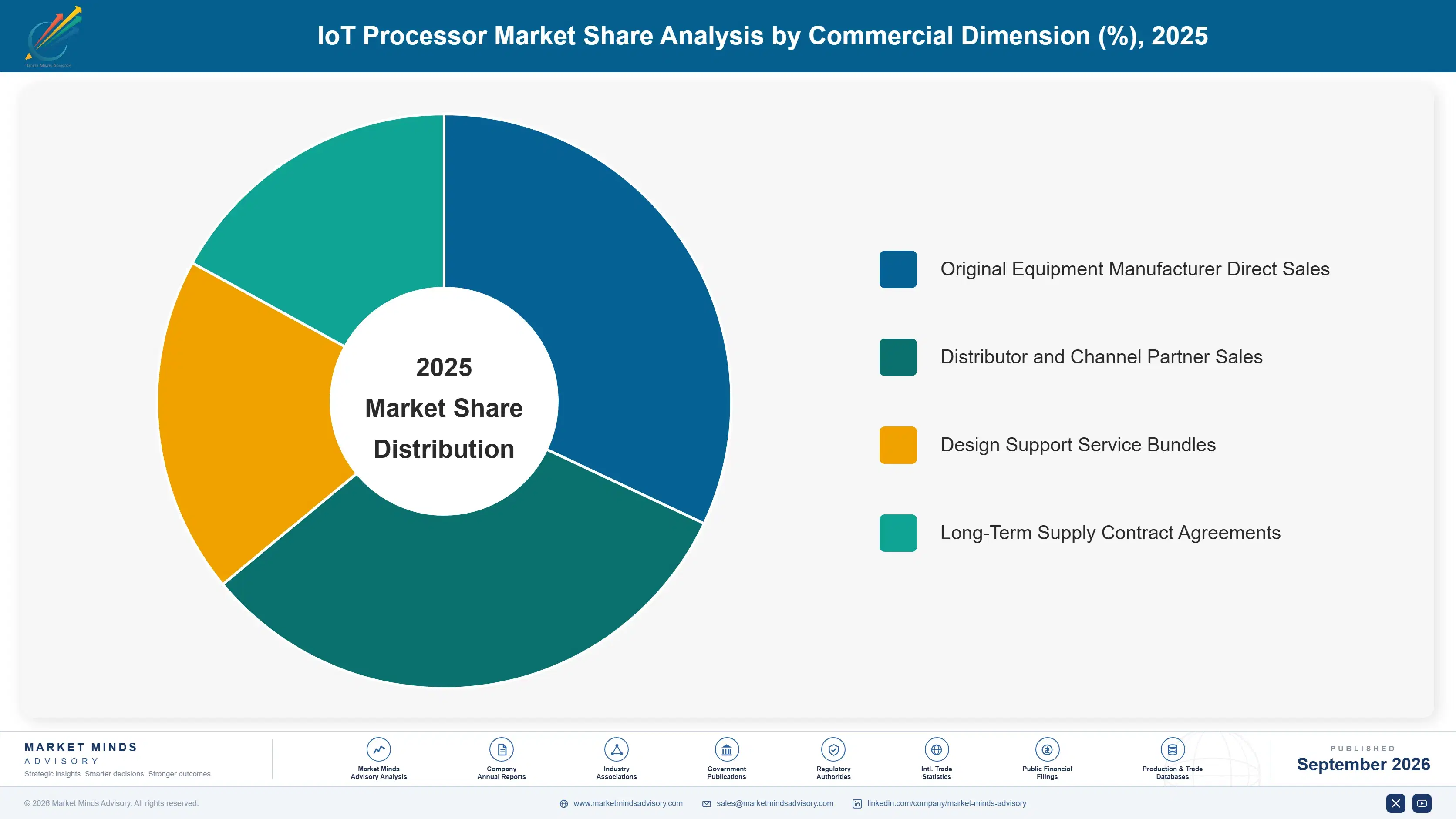
By Commercial Dimension

  • Original Equipment Manufacturer Direct Sales
  • Distributor and Channel Partner Sales
  • Design Support Service Bundles
  • Long-Term Supply Contract Agreements

By Region

  • North America
  • Western Europe
  • East Asia
  • South Asia and Pacific
  • Latin America
  • Middle East and Africa
  • Eastern Europe

Scope, Methodology, and Coverage

Every figure in this report is reproducible from documented input assumptions. The scope below maps the historical period, the forecast horizon, the segmentation dimensions, and the countries covered, alongside the underlying primary and qualitative methodology.
Historical Period
2020 to 2025
Forecast Period
2026 to 2036
Base Year
2025 (USD billions; MMA Primary Research Dataset, September 2026)
Market Definition
The IoT processor market covers specialized semiconductor processors and systems-on-chip purpose-built for connected devices, including edge AI accelerators, sensor-hub microcontrollers, and wireless connectivity SoCs. It excludes general-purpose CPUs and GPUs designed primarily for personal computers, servers, or smartphone application processors.
Quantitative Units
USD billions (current prices); shipped unit volume where applicable
Segmentation Dimensions
By Processor Function Type; By End-Use Industry; By Commercial Dimension; By Region
Regions Covered
North America, Western Europe, East Asia, South Asia and Pacific, Latin America, Middle East and Africa, Eastern Europe
Countries Covered
USA, China, Germany, France, UK, Japan, South Korea, India, Australia, Canada, Brazil, Mexico, Indonesia, Vietnam, Thailand, Malaysia, UAE, Saudi Arabia, South Africa, Nigeria, Turkey, Poland, Netherlands, Italy, Spain, Sweden, Switzerland, Argentina, Colombia, Singapore, and additional markets relevant to this sector
Key Companies Profiled
NXP Semiconductors, STMicroelectronics, Qualcomm, Texas Instruments, Renesas Electronics, Microchip Technology, Infineon Technologies, Silicon Labs, Espressif Systems, Nordic Semiconductor, MediaTek, Broadcom, Analog Devices, onsemi, Ambiq Micro, GigaDevice Semiconductor, Realtek Semiconductor, Marvell Technology, Qorvo, Winbond Electronics
Quantitative Methodology
Primary survey, n=3,800 respondents, Q4 2025, six countries; demand-side model with trade association cross-validation
Qualitative Methodology
47 expert interviews, Q4 2025; applied to validate demand model assumptions, identify emerging dynamics, and assess competitive positioning
Report Format
PDF and XLSX data workbook (Word format preview document)
Publisher
Market Minds Advisory
Report Code
MMA-2026-TEC-192
Published
September 2026
Contact
sales@marketmindsadvisory.com | www.marketmindsadvisory.com

Purchase the full IoT Processor Market Report (2026 to 2036).

This report delivers a comprehensive analysis of the global IoT processor market, spanning processor function segmentation, regional demand dynamics, and competitive positioning across twenty profiled companies worldwide. It includes ten-year forecasts through 2036, detailed input cost and margin analysis across three commercial tiers, and revenue diversification strategies for vendors navigating the shift toward on-chip edge AI inference. The analysis draws on primary survey data, expert interviews, and company disclosures to support procurement, investment, and product strategy decisions. It closes with an anonymized client migration case study illustrating measured cost and performance outcomes.
Processor function segmentation with detailed growth forecasts
Seven-region demand analysis through the 2036 forecast
Competitive benchmarking of twenty profiled global vendors
Input cost and gross margin tier breakdown analysis
Revenue diversification and recurring pricing lever analysis
Anonymized client migration case study with outcomes

Built For The People Who Decide

From boardroom strategy to bench-side execution, this report is read cover-to-cover by leaders shaping the next decade of their industry, turning demand scenarios, market dynamics and valuation benchmarks into decisions.
CXOs/ Presidents/ VPs/ Managers
M&A and Corporate Development
Strategy Teams and R&D Heads
Procurement and Product Directors
Regulatory and Compliance Leaders
Investor Relations and Equity Analysts