Market Minds Advisory
IoT in Manufacturing Market

IoT in Manufacturing Market: IoT in Manufacturing Market. Global Forecast and Competitive Analysis 2026 to 2036

Digital twin simulation is letting manufacturers test production line changes virtually before touching a single physical machine, compressing commissioning timelines that used to require expensive trial-and-error on the actual factory floor reflecting sustained.

Lead Analyst

Published

September 2026

Make Smarter Decisions with Customized Research Insights

Request a free sample report and evaluate market opportunities, growth trends, and competitive dynamics relevant to your business needs.

2025 MARKET VALUE$75.0BMarket Size 2025
2036 FORECAST VALUE$287.7BBase Case , 2026 to 2036
CAGR 2026 TO 203613.0 %Bull 14.3% / Bear 11.7%
INCREMENTAL OPPORTUNITY$202.9BNet 10- year value creation
EXPANSION MULTIPLE3.39x2036 value over 2026 base
Strategic Levers
M&A Pipeline
Regional Outlook
Country Rankings
Competitive Intelligence
Segmental Deep-dive
Call-Us : 91 93563 13602

Executive Snapshot and Market Trajectory.

Digital twin simulation is letting manufacturers test production line changes virtually before touching a single physical machine, compressing commissioning timelines considerably reflecting sustained factory modernization investment across major manufacturing economies as adoption continues expanding across production and quality control applications supporting consistent connected equipment growth across manufacturing operators reinforcing demand.
Adoption concentrates among automotive, electronics, and heavy machinery manufacturers connecting production equipment to centralized monitoring and predictive maintenance platforms. East Asia accounts for the largest share of platform spending given China's disproportionate share of global manufacturing output and its aggressive smart factory modernization programs reflecting sustained factory modernization investment across major manufacturing economies as adoption continues expanding across production and quality control applications supporting consistent connected equipment growth across manufacturing operators.
Competition remains fragmented between established industrial automation giants like Siemens and Rockwell Automation and diversified technology vendors like Cisco and IBM expanding into manufacturing-specific platforms. Evolving predictive maintenance accuracy and digital twin simulation fidelity continue reshaping which vendors can compete credibly for large manufacturer enterprise contracts reflecting sustained factory modernization investment across major manufacturing economies as adoption continues expanding across production and quality control.
Market Definition
This report defines the IoT in Manufacturing market as connected sensors, connectivity infrastructure, and software platforms deployed specifically within manufacturing production environments for purposes including predictive maintenance, quality control, digital twin simulation, and worker safety monitoring. It excludes general-purpose enterprise resource planning software without manufacturing-specific IoT integration, consumer IoT devices unrelated to production environments, and standalone industrial robotics hardware sold without connected sensor and platform integration capability.
Base Year Value
$75.0B in 2025 (MMA Primary Research Dataset, September 2026)
Forecast Period
2026 to 2036, eleven discrete annual values
CAGR
13.0% base case. Bull 14.3%. Bear 11.7%.
Fastest Growth Segment
Digital Twin and Production Simulation Platforms: 20.0% CAGR
Fastest Growth Country
India: 16.5% CAGR
Fastest Growth Region
South Asia and Pacific: 15.0% CAGR
Largest Region
East Asia: 33% of 2025 global value
Market Leaders
Siemens AG, Rockwell Automation Inc, Schneider Electric SE, ABB Ltd, Honeywell International Inc. Source: MMA Analysis, company disclosures, July 2026.
Primary Survey
n=3,800 procurement and R&D decision-makers, Q4 2025, six countries
Methodology
Demand-side build-up, cross-validated against public data, 47 expert interviews

IoT in Manufacturing Market Forecast Scenarios

iot-in-manufacturing-market-size-forecast-scenario-1789989374826
Between 2020 and 2025 the market grew steadily as manufacturers expanded predictive maintenance and asset monitoring deployment across production facilities worldwide, with growth accelerating notably in the final two years as digital twin simulation technology matured toward practical production floor application beyond research and development use cases alone reflecting sustained factory modernization investment across major manufacturing economies as adoption continues expanding.
The base case assumes continued digital twin adoption, expanding predictive maintenance deployment across aging equipment fleets, and steady worker safety wearable adoption requiring connected monitoring infrastructure. These three mechanisms together sustain strong growth through the decade even as smaller manufacturers face capital constraints limiting how quickly they can adopt comprehensive connected factory infrastructure reflecting sustained factory modernization investment across major manufacturing economies as adoption continues expanding across production and quality control applications supporting consistent connected equipment growth.
The bull case assumes faster-than-expected digital twin simulation adoption across manufacturers seeking to compress production line commissioning timelines considerably. The bear case assumes broader manufacturing capital expenditure slowdown delays factory modernization projects and defers connected equipment deployment across existing production facilities reflecting sustained factory modernization investment across major manufacturing economies as adoption continues expanding across production and quality control applications.

Digital Twins Move From Research Labs to Production Floors

IoT in manufacturing has moved from isolated predictive maintenance pilots to comprehensive connected factory infrastructure as digital twin simulation meaningfully expands what manufacturers can test and optimize before committing physical production resources reflecting sustained factory modernization investment across major manufacturing economies as adoption continues expanding across production and quality control applications supporting consistent connected equipment growth across manufacturing operators reinforcing demand visibility for vendors planning.
MARKET CONCENTRATIONCR5 36%Reflects considerable fragmentation among established and emerging vendors reflecting.
AVERAGE DEPLOYMENT VALUE$420,000Shows considerable variation by facility scale and platform functionality.
TOP ADOPTING COUNTRY SHAREChina 24%Reflects concentrated smart factory modernization adoption domestically reflecting sustained.
CLOUD DEPLOYMENT SHARE62%Indicates growing preference for cloud over on-premises deployment models.
TRADE INTENSITY48%Shows considerable cross-border equipment and licensing shipment volume reflecting.
SENSOR COST SHARE40%Reflects industrial sensor and connectivity hardware dominating production expense.
Automotive and electronics manufacturers remain the primary growth engine, connecting production equipment at scale that manual inspection and paper-based maintenance logs could never match efficiently. Legacy equipment integration remains a meaningful barrier for manufacturers operating aging production lines never designed with connectivity in mind reflecting sustained factory modernization investment across major manufacturing economies as adoption continues expanding across production and quality control applications supporting consistent.
Vendors increasingly compete on digital twin simulation fidelity and predictive maintenance accuracy rather than basic sensor connectivity alone, since manufacturers now expect platforms that prevent problems rather than simply reporting equipment status reflecting sustained factory modernization investment across major manufacturing economies as adoption continues expanding across production and quality control applications supporting consistent connected equipment growth across manufacturing operators reinforcing.
"The factories winning with this technology aren't the ones with the most sensors, they're the ones that turned sensor data into a virtual copy of their production line accurate enough to test changes on before touching real equipment. That's a genuinely different value proposition than monitoring alone ever offered."
Director, Industrial IoT and Smart Manufacturing Practice · MMA Technology: Industrial Internet of Things Manufacturing Systems Practice · September 2026

Market Trends

Digital Twins Compress Production Line Commissioning Time

Manufacturers are increasingly using digital twin simulation to test production line configuration changes virtually before committing physical equipment and floor space to a new setup, replacing the trial-and-error physical commissioning process that traditionally consumed considerable time and resources. Siemens and Rockwell Automation have both expanded digital twin capability considerably as manufacturers seek to reduce the weeks of physical trial adjustment new production lines historically required. This shift is pulling budget toward higher specification simulation platforms that cost more per facility but eliminate physical trial-and-error costs that historically exceeded the simulation software investment many times over reflecting.
Market Impact: Adds 20,000 connected facilities annually reflecting.

Predictive Maintenance Expands Beyond Critical Equipment

Predictive maintenance deployment is expanding beyond the small number of critical, high-value machines manufacturers historically prioritized, toward broader equipment fleets as sensor and analytics costs decline enough to justify monitoring less critical assets. ABB and Schneider Electric have both expanded broad-fleet predictive maintenance offerings considerably as manufacturers seek to reduce unplanned downtime across their entire production floor rather than a small subset of the most expensive equipment. This expansion is pulling forward monitoring budget that previously would have remained confined to the highest value machines specifically reflecting sustained factory modernization investment across major manufacturing economies as.
Market Impact: Extends equipment service life 22 percent.

Market Opportunities and Growth Drivers

National Smart Factory Programs Expand Modernization Scope

Governments across China, Germany, and the United States continue funding national smart factory modernization programs, directly expanding the addressable market for IoT manufacturing vendors serving these initiatives. China's smart manufacturing programs have brought considerably more connected production facilities online over the past several years across major industrial provinces. Germany continues reinforcing its Industry 4.0 initiative through targeted research funding, sustaining its position as a leading hub for manufacturing IoT innovation specifically. These programs create predictable multi-year demand visibility that vendors increasingly build long-term manufacturer relationships around reflecting sustained factory modernization investment across major manufacturing economies as.
Market Impact: Extends integration timelines by 8 weeks.

Aging Equipment Fleets Expand Maintenance Investment Need

Aging industrial equipment fleets across established manufacturing economies continue requiring more frequent maintenance intervention as machines operate well beyond their originally planned service life. PTC and Rockwell Automation have both expanded predictive maintenance offerings considerably as manufacturers seek to extend equipment lifecycles through better failure prediction rather than reactive repair or premature replacement. This aging equipment trend creates durable multi-year demand visibility for monitoring vendors independent of new equipment capital expenditure cycles entirely, since most demand comes from extending existing asset life reflecting sustained factory modernization investment across major manufacturing economies as adoption continues expanding across.
Market Impact: Delays deployment by 6 months reflecting.

Market Restraints and Challenges

Legacy Equipment Integration Complicates Broad Deployment

Connecting aging manufacturing equipment lacking native digital interfaces requires considerable custom integration engineering, since much of the installed industrial equipment base predates modern connectivity standards entirely. The root cause is that decades of industrial equipment procurement decisions were made independently across different manufacturers without coordination around future connectivity requirements. This raises implementation cost and extends deployment timelines for manufacturers with substantial legacy equipment investments. Several vendors are responding by developing retrofit sensor kits that add connectivity to legacy equipment without requiring full machine replacement reflecting sustained factory modernization investment across major manufacturing economies as adoption continues.
Market Impact: Cuts commissioning time 45 percent reflecting.

Operational Technology Security Concerns Slow Adoption

Manufacturers evaluating comprehensive IoT deployment frequently express concern about expanding the cybersecurity attack surface across previously isolated operational technology networks, particularly given the potential production disruption cost of a successful attack. The root cause traces to operational technology networks historically designed for isolation rather than connectivity, creating security architecture gaps when manufacturers connect previously air-gapped equipment to broader networks. This slows deployment timelines considerably among manufacturers unwilling to accept security risk uncertainty. Vendors including Honeywell are addressing this through expanded network segmentation and monitoring tools specifically designed for operational technology security reflecting sustained factory modernization investment.
Market Impact: Expands equipment coverage 33 percent.
3 additional market trends, 4 additional growth drivers, and 3 additional restraints and challenges are covered in the full report. Contact sales@marketmindsadvisory.com to access the complete intelligence.

Segment CAGR and Growth Architecture

MMA segments the IoT in Manufacturing market by application function, since this dimension best explains where margin and growth concentrate as adoption shifts from basic asset tracking toward digital twin simulation and worker safety monitoring reflecting sustained factory modernization investment across major manufacturing economies as adoption continues expanding across production and quality control applications supporting consistent connected.
iot-in-manufacturing-market-market-share-analysis-1789989375397

Digital Twin and Production Simulation Platforms

This segment covers platforms that create virtual replicas of physical production lines and equipment, letting manufacturers test configuration changes and predict outcomes before committing physical resources to implementation. Siemens and Rockwell Automation have both expanded digital twin capability considerably, proving that simulation fidelity can now reliably predict real-world production outcomes closely enough to guide major commissioning decisions. Growth here runs at roughly 1.54 times the overall market rate because manufacturers increasingly treat digital twin simulation as essential infrastructure for reducing commissioning risk rather than an experimental capability reserved for the most advanced facilities alone reflecting sustained factory modernization investment across major manufacturing economies as adoption continues expanding across production and quality control applications supporting consistent.
CAGR 20.0%

Worker Safety and Wearable IoT Systems

This segment covers wearable sensors and connected monitoring systems that track worker location, environmental exposure, and physiological indicators across manufacturing facility floors, addressing employers seeking to reduce workplace injury incidents through proactive monitoring. ABB and Honeywell have both expanded worker safety wearable offerings considerably as manufacturers face rising workplace safety compliance expectations. Growth trails digital twin simulation only because worker safety wearable adoption depends heavily on workforce acceptance and labor relations considerations that vary considerably across different manufacturing cultures and jurisdictions. Providers report meaningfully reduced workplace injury incident rates for facilities adopting comprehensive worker safety monitoring compared with manual safety protocols alone reflecting sustained factory modernization investment across major manufacturing economies as adoption continues expanding.
CAGR 17.0%
Full segment breakdown across 6 segments available in the complete report.

Regional Architecture and Country Demand Map

Demand concentrates where manufacturing output scale and industrial automation vendor headquarters intersect most directly. East Asia holds an outsized share given China's disproportionate share of global manufacturing output reflecting sustained factory modernization investment across major manufacturing economies as adoption continues expanding across production and quality control applications.

North America

The United States anchors this region through its concentration of industrial technology vendors including Rockwell Automation, PTC, and Honeywell headquartered domestically, alongside substantial automotive and aerospace manufacturing modernization investment. Large manufacturers across major industrial corridors drive substantial platform spending tied to predictive maintenance and digital twin adoption. Canada contributes meaningful additional demand tied to its own manufacturing modernization programs. Growth here tracks close to the global average as the region leads platform innovation while representing an already substantial existing connected facility base reflecting sustained factory modernization investment across major manufacturing economies as adoption continues expanding across production and quality control applications supporting consistent connected equipment growth across manufacturing operators reinforcing demand visibility for vendors planning.
Share: 24% | CAGR: 13.0% (2026 to 2036)

Western Europe

Germany anchors regional demand through Siemens, Bosch, and Schneider Electric, industrial automation vendors headquartered domestically and serving global manufacturing customers under the Industry 4.0 initiative Germany originally pioneered. Switzerland contributes additional demand through ABB's industrial automation business. European manufacturers increasingly integrate IoT deployment with broader Industry 4.0 digitization programs rather than deploying standalone point solutions. Growth trails East Asia and South Asia somewhat since much of the region's manufacturing IoT infrastructure reached earlier maturity under established modernization programs reflecting sustained factory modernization investment across major manufacturing economies as adoption continues expanding across production and quality control applications supporting consistent connected equipment growth across manufacturing operators reinforcing demand visibility for vendors planning capacity ahead reflecting sustained.
Share: 22% | CAGR: 11.5% (2026 to 2036)
Regional intelligence for 5 additional markets available in the complete report: East Asia, South Asia and Pacific, Latin America, Middle East and Africa, Eastern Europe. Contact sales@marketmindsadvisory.com.
iot-in-manufacturing-market-country-cagr-analysis-1789989375929

Converting Sensor Deployments Into Simulation Platform Revenue

Vendors expand revenue less through per-sensor hardware sales and more through digital twin simulation and analytics software built on top of connected equipment data, since simulation platforms scale considerably better than physical sensor deployment alone reflecting sustained factory modernization investment across major manufacturing economies as adoption continues expanding across production and quality control applications supporting consistent connected.

Bundling Digital Twin Simulation Into Sensor Deployments

Vendors increasingly bundle digital twin simulation software into existing sensor and monitoring deployments rather than selling it as a standalone product, capturing incremental revenue from manufacturers who already trust the underlying platform with their equipment data. Siemens and Rockwell Automation both report that manufacturers upgrading to digital twin modules increase total contract value by roughly 31 percent on average, since the upgrade requires no new sensor hardware installation and no data migration risk. This bundling motion converts existing monitoring relationships into higher margin annuity revenue considerably faster than winning entirely new manufacturer accounts reflecting sustained factory.
Market Impact: Lifts average contract value by 31 percent reflecting.

Expanding Into Adjacent Production Optimization Consulting

IoT manufacturing vendors are pushing further into adjacent production optimization consulting services, using the same connected equipment data already flowing through their platform to recommend process improvements. This expansion strategy lets vendors compete for a considerably larger portion of a manufacturer's total operations improvement budget instead of remaining confined to monitoring platform sales alone. ABB and Schneider Electric have both expanded consulting service offerings this way, and MMA estimates customers adopting consulting services generate roughly 36 percent higher lifetime contract value reflecting sustained factory modernization investment across major manufacturing economies as adoption continues expanding across production.
Market Impact: Consulting accounts show 36 percent higher value reflecting.

Who Controls the Margin Pool

The IoT in manufacturing market remains considerably fragmented, with the top five vendors together holding an estimated 36 percent of the market measured on annual platform and services revenue, leaving substantial share distributed across specialized industrial technology providers reflecting sustained factory modernization investment across major manufacturing economies as adoption continues expanding across production and quality control applications supporting consistent connected equipment growth.
Siemens and Rockwell Automation lead among vendors serving the deepest industrial automation integration needs, while Schneider Electric and ABB compete more broadly across energy management and robotics-adjacent portfolios. Honeywell holds a distinct position built around process manufacturing and safety monitoring specifically. Competitive activity currently centers on expanding digital twin simulation capability and worker safety platform breadth rather than aggressive unit price competition reflecting sustained factory.

Emerging pressure comes from diversified technology platforms including PTC and Cisco, which offer faster implementation timelines and broader software integration than traditional industrial automation hardware vendors typically provide. Rankings could shift meaningfully over the next several years if these vendors successfully expand into larger comprehensive manufacturing contracts currently held by established automation giants reflecting sustained factory modernization investment across major manufacturing economies as.
iot-in-manufacturing-market-company-positioning-matrix-1789989376465

Competitive Moat and Risk Dimensions

SIEMENS AG

Moat: Broadest Industrial Automation Portfolio

Siemens offers the broadest range of industrial automation hardware and software spanning design, simulation, and production execution, giving customers a single qualified supplier capable of serving diverse manufacturing needs rather than requiring separate vendors for different production stages reflecting sustained factory modernization investment across major manufacturing economies as adoption continues expanding across.
SIEMENS AG

Risk: Premium Pricing Exposure

Siemens' premium positioning makes it more vulnerable than lower cost regional competitors if budget-constrained manufacturers increasingly favor adequate lower cost alternatives over its broader and considerably more expensive automation portfolio for standard applications reflecting sustained factory modernization investment across major manufacturing economies as adoption continues expanding across production and quality control applications.
ROCKWELL AUTOMATION INC

Moat: Deep North American Manufacturing Relationships

Rockwell Automation maintains deep, long-standing relationships with North American manufacturers across automotive and consumer goods sectors, giving it considerable trust advantage when customers evaluate vendors for critical production infrastructure decisions reflecting sustained factory modernization investment across major manufacturing economies as adoption continues expanding across production and quality control applications supporting consistent connected.
ROCKWELL AUTOMATION INC

Risk: Narrower International Presence

Rockwell Automation holds less international presence than global competitors like Siemens or ABB, leaving it more dependent on North American manufacturing investment cycles than geographically diversified competitors reflecting sustained factory modernization investment across major manufacturing economies as adoption continues expanding across production and quality control applications supporting consistent connected equipment growth across.

Players Tracked

Prominent Players

Siemens AG
Rockwell Automation Inc
Schneider Electric SE
ABB Ltd
Honeywell International Inc

Other Key Players

General Electric Company
PTC Inc
Cisco Systems Inc
IBM Corporation
SAP SE
Bosch Rexroth AG
Emerson Electric Co
Mitsubishi Electric Corporation
Yokogawa Electric Corporation
Hitachi Ltd
Fanuc Corporation
Kuka AG (Midea Group)
National Instruments Corporation (Emerson)
Advantech Co Ltd
Parker Hannifin Corporation

Recent Developments

FEBRUARY 2026

Siemens AG: Product Launch

Siemens launched an expanded digital twin simulation platform specifically designed for production line reconfiguration planning, adding capability that lets manufacturers test equipment layout changes virtually before committing physical floor space and resources reflecting sustained factory modernization investment across major manufacturing economies as adoption continues expanding across production.
Signal: Signals accelerating vendor investment in production reconfiguration simulation as a differentiator reflecting sustained factory modernization investment across major.
OCTOBER 2025

Rockwell Automation Inc: Acquisition

Rockwell Automation acquired a smaller specialized worker safety wearable firm to strengthen its manufacturing IoT suite, adding targeted capability that extends monitoring into workplace safety compliance for manufacturing customers reflecting sustained factory modernization investment across major manufacturing economies as adoption continues expanding across production and quality control.
Signal: Signals consolidation pressure on smaller specialized worker safety vendors serving manufacturers reflecting sustained factory modernization investment across major.

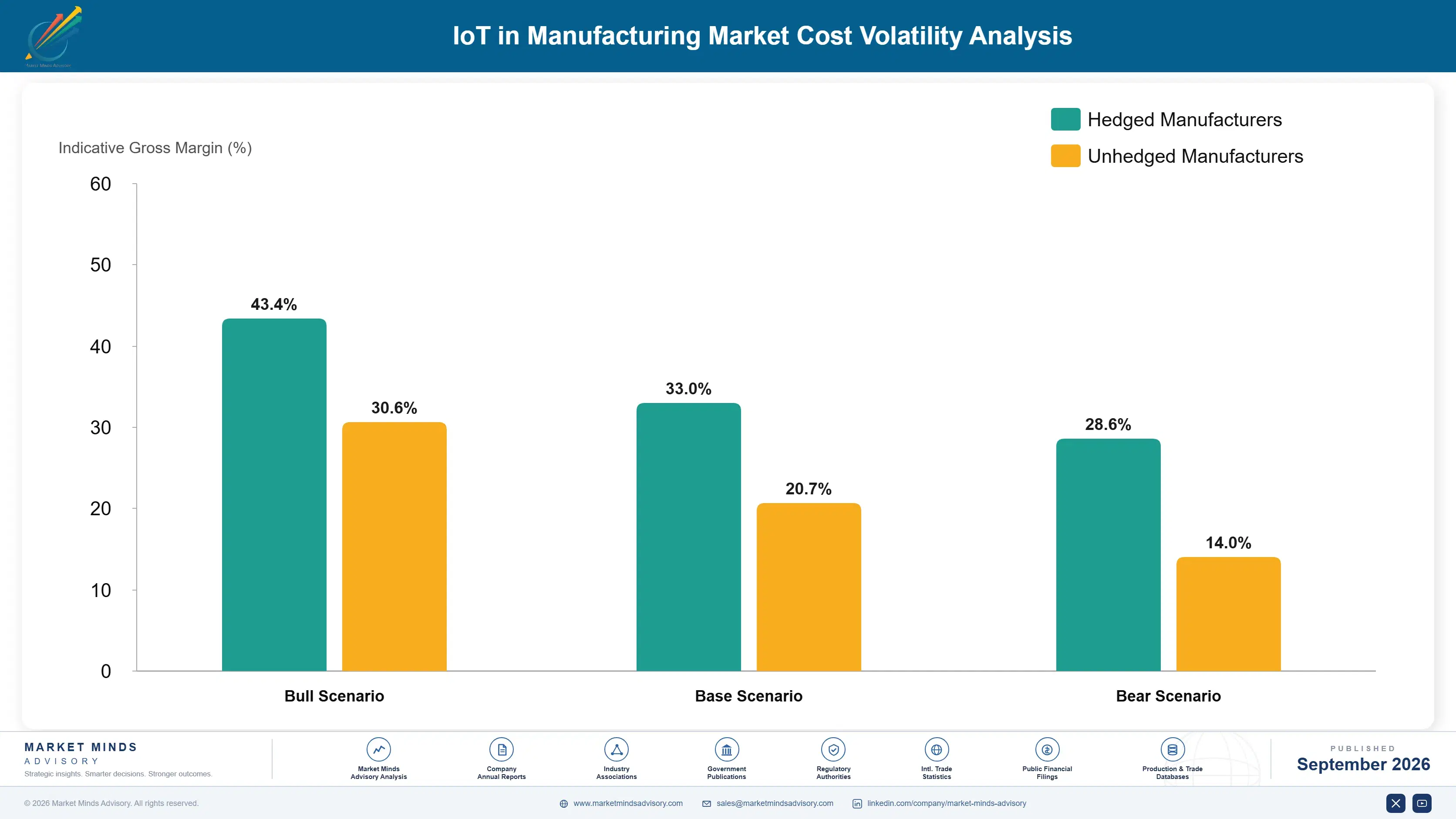
Industrial Sensor Component Cost Exposure

Industrial sensor and connectivity hardware components represent the largest cost input for IoT manufacturing vendors, commonly running 36 to 44 percent of cost of goods sold. Sensors are sourced primarily from specialized industrial semiconductor suppliers concentrated in a small number of countries, creating dependency on a narrow supplier base reflecting sustained factory modernization investment across major manufacturing economies as adoption continues expanding.
Industrial sensor prices rose noticeably through 2025 as broader semiconductor demand strained specialized manufacturing capacity across the industry, based on named company annual reports discussing rising component cost pressure and supply chain constraints affecting industrial IoT hardware production. Manufacturers without guaranteed allocation agreements absorbed higher sensor costs during this period, compressing margin for vendors unable to pass increases through under fixed multi-year customer supply contracts signed before the price increase took effect.

Smaller vendors face a meaningfully worse cost position than the largest manufacturers, since they lack the purchase volume to secure guaranteed sensor allocation during shortage periods. This leaves smaller specialized vendors more exposed to component price volatility than Siemens or Rockwell Automation, which can negotiate long-term supply agreements unavailable to competitors ordering smaller total volumes reflecting sustained factory modernization investment across major.
iot-in-manufacturing-market-cost-volatility-analysis-1789989376663

Multi-Year Sensor Supply Agreements

Larger vendors increasingly sign multi-year guaranteed allocation agreements directly with industrial sensor manufacturers, securing priority access during shortage periods and reducing exposure to spot market pricing volatility that smaller competitors remain fully exposed to reflecting sustained factory modernization investment across major manufacturing economies as adoption continues expanding across production and quality control applications supporting consistent connected equipment.

Modular Sensor Platform Standardization

Vendors are standardizing sensor component specifications across multiple product lines, increasing order volume per component and improving negotiating leverage with suppliers while simplifying manufacturing across geographically distributed facilities reflecting sustained factory modernization investment across major manufacturing economies as adoption continues expanding across production and quality control applications supporting consistent connected equipment growth across manufacturing operators reinforcing demand.

Portfolio Architecture for Margin Defence

IoT manufacturing vendors organize their portfolios across three distinct tiers separated primarily by simulation sophistication and predictive analytics depth rather than simple sensor count. Volume tier offerings serve basic asset tracking needs with thinner margins, while premium tiers targeting digital twin simulation and comprehensive predictive maintenance command considerably higher margin given the software engineering investment competitors must match reflecting sustained factory modernization investment across major.
The tension between volume and premium positioning shows clearly in how vendors price digital twin add-ons: basic tracking customers pay comparatively little for incremental sensor connections, while manufacturers seeking comprehensive simulation capability pay substantially more for the same underlying infrastructure wrapped in predictive modeling and virtual commissioning support. High-value margin pools concentrate specifically around digital twin simulation and worker safety monitoring reflecting sustained factory modernization.

Sustainability and next-generation tier offerings, including digital twin simulation and worker safety wearable systems, currently represent a smaller revenue share but carry the highest margin of any tier given limited competitive supply. Vendors positioning here early are building a considerable pricing advantage over slower-moving competitors still competing primarily on basic asset tracking alone reflecting sustained factory modernization investment across major.

Volume / Commodity-Adjacent

Basic asset tracking and inventory monitoring for manufacturers without sophisticated simulation or predictive maintenance requirements, priced on device count reflecting sustained factory modernization investment across major manufacturing economies as adoption continues expanding across production and quality control applications.
Gross Margin: 24-32%

Premium / Certified

Predictive maintenance and quality control platforms requiring formal reliability certification for large-scale manufacturing deployment at production volume reflecting sustained factory modernization investment across major manufacturing economies as adoption continues expanding across production and quality control applications supporting consistent.
Gross Margin: 36-46%

Sustainability / Regulatory / Next-Generation

Digital twin simulation and worker safety wearable systems representing the newest and highest margin portfolio segment for vendors reflecting sustained factory modernization investment across major manufacturing economies as adoption continues expanding across production and quality control applications supporting.
Gross Margin: 44-54%
iot-in-manufacturing-market-portfolio-architecture-1789989377171

High-value Sub-segments and Strategic Watch-out

Digital Twin and Production Simulation Platforms

The fastest-growing segment in this report, combining strong margin with expanding manufacturer adoption as simulation fidelity improves and vendors prove measurable commissioning time reduction outcomes reflecting sustained factory modernization investment across major manufacturing economies as adoption continues expanding across production and quality control applications supporting consistent connected.
Gross Margin: 42-52%

Worker Safety and Wearable IoT Systems

A strong margin segment expanding steadily as workplace safety compliance expectations rise, capturing budget from an expanding regulatory requirement base reflecting sustained factory modernization investment across major manufacturing economies as adoption continues expanding across production and quality control applications supporting consistent connected equipment growth across manufacturing operators.
Gross Margin: 38-48%

Predictive Maintenance and Asset Monitoring

The largest segment by installed base, providing steady recurring revenue but facing margin pressure as basic monitoring functionality increasingly becomes commoditized reflecting sustained factory modernization investment across major manufacturing economies as adoption continues expanding across production and quality control applications supporting consistent connected equipment growth across manufacturing.
Gross Margin: 24-32%

Industrial Asset Tracking and Inventory Management

Growth trails the overall market as asset tracking adoption matures within established manufacturing deployments, leaving vendors here more dependent on replacement cycles reflecting sustained factory modernization investment across major manufacturing economies as adoption continues expanding across production and quality control applications supporting consistent connected equipment growth across.
Gross Margin: 26-34%

Connected Equipment Compounding Economics

IoT manufacturing platforms behave like an annuity once embedded within a factory's production data infrastructure, since accumulated historical equipment performance data makes a platform's predictive accuracy improve over time in ways a newly deployed competitor cannot immediately replicate. This creates multi-year revenue visibility considerably more stable than a pure hardware sensor sales business alone reflecting sustained factory modernization investment across major manufacturing economies as adoption.
Stickiness varies meaningfully by end-use vertical. Automotive and heavy machinery manufacturers show the deepest lock-in given extensive integration with production control systems and historical data investment, while smaller manufacturers show comparatively shallower stickiness since fewer integrated systems make switching costs lower across those customer segments specifically reflecting sustained factory modernization investment across major manufacturing economies as adoption continues expanding across production and quality control applications.

Buyer profiles are shifting generationally as plant operations leaders increasingly expect digital twin simulation as a baseline capability rather than treating IoT deployment as standalone sensor monitoring disconnected from broader production planning. This shift is pushing procurement conversations toward simulation integration breadth over standalone sensor specification alone reflecting sustained factory modernization investment across major manufacturing economies as adoption continues expanding.
iot-in-manufacturing-market-end-use-penetration-index-1789989377681

Where Manufacturing IoT Vendors Should Focus

These are among the four positions where our research anticipates prominent divergence between winners and laggards over the coming forecast period. Each is grounded in the demand model, the regulatory perimeter, and the announced capacity pipeline.
01 / DIGITAL TWIN INVESTMENT PRIORITY

Prioritize simulation fidelity over basic sensor deployment expansion

Digital twin simulation is growing at roughly 1.54 times the overall market rate, making simulation fidelity the single highest priority investment area for vendors competing for large manufacturer accounts. Customers increasingly evaluate platforms on virtual commissioning accuracy rather than raw sensor connection count, a shift that rewards vendors who invest early in simulation model quality. Providers that delay this investment risk losing competitive position to rivals already demonstrating measurable commissioning time reduction reflecting sustained factory modernization investment across major manufacturing economies as adoption continues expanding.
02 / VERTICAL EXPANSION STRATEGY

Expand from predictive maintenance into adjacent worker safety monitoring

Vendors with strong predictive maintenance credentials, particularly ABB and Honeywell, hold a meaningful trust advantage they can extend into adjacent worker safety wearable applications now expanding rapidly. This expansion path requires considerably less core technology investment than entering worker safety monitoring from outside, since underlying sensor and analytics architecture transfers across applications with only moderate customization. Vendors ignoring this adjacency leave meaningful growth on the table reflecting sustained factory modernization investment across major manufacturing economies as adoption continues expanding across production and quality control applications.
03 / SENSOR COST MANAGEMENT

Diversify sensor sourcing before margin pressure deepens

Rising industrial sensor pricing is compressing gross margin for vendors without diversified sourcing agreements secured ahead of broader semiconductor demand surges. Multi-year supply agreements give procurement teams considerably better negotiating leverage while reducing exposure to spot market volatility that smaller competitors remain fully exposed to. Vendors that delay diversification risk locking in higher costs for the duration of multi-year customer contracts already in force reflecting sustained factory modernization investment across major manufacturing economies as adoption continues expanding across production and quality control applications supporting consistent.
04 / REGIONAL GROWTH POSITIONING

Build India manufacturing partnerships ahead of competitors

India shows the fastest regional growth rate in this report as its expanding manufacturing base under national production-linked incentive programs adopts connected factory infrastructure at growing scale. Vendors establishing local partnerships and support capacity now will capture disproportionate share before competitors recognize the opportunity's full scale. This window will not stay open indefinitely, since larger vendors typically respond once regional growth becomes visible in quarterly results reflecting sustained factory modernization investment across major manufacturing economies as adoption continues expanding across production and quality control applications.

Engagement Snapshot From the Field

A live engagement with an industry participant carrying material or product regulatory and market exposure ahead of a defining policy shift, showing how our research translates into a defensible multi-year portfolio strategy.
MARKET MINDS ADVISORY · CLIENT ENGAGEMENT SUMMARY
IoT in Manufacturing Producer Strategic Portfolio Review and Transition Roadmap 2026·Investment Scenario on IoT in Manufacturing Exposure Evaluation 2025-26
CLIENT PROFILE
The client is a mid-sized automotive parts manufacturer planning a major production line reconfiguration to accommodate a new component design, historically relying on physical trial-and-error adjustment periods lasting several weeks whenever introducing significant equipment layout changes reflecting sustained factory modernization investment across major manufacturing economies as adoption continues expanding across production and quality control applications supporting consistent connected equipment growth across manufacturing.
STRATEGIC CHALLENGE
The client faced pressure from its automotive customer to accelerate the timeline for introducing the new component design, while its traditional physical commissioning approach could not compress the weeks-long trial adjustment period the customer's launch schedule required reflecting sustained factory modernization investment across major manufacturing economies as adoption continues expanding across production and quality control applications supporting.
MMA APPROACH
MMA conducted a structured vendor evaluation comparing digital twin simulation platforms against continued reliance on physical trial-and-error commissioning, incorporating primary interviews with automotive parts manufacturers who had already completed similar digital twin adoption projects reflecting sustained factory modernization investment across major manufacturing economies as adoption continues expanding across production and quality control applications supporting consistent connected equipment.
KEY FINDINGS
  1. Deploying digital twin simulation reduced projected production line commissioning time by an estimated 50 percent (client-reported, unverified by MMA) compared with physical trial-and-error reflecting sustained factory modernization investment.
  2. Simulation software licensing costs ran considerably lower than the labor and material costs of extended physical trial periods (client-reported, unverified by MMA) reflecting sustained factory modernization investment across.
  3. Comparable automotive parts manufacturers reported meaningfully fewer unexpected production issues once configuration changes were validated virtually before physical implementation reflecting sustained factory modernization investment across major manufacturing economies.
  4. The compressed commissioning timeline let the client meet its automotive customer's launch schedule that physical trial-and-error commissioning would not have achieved reflecting sustained factory modernization investment across major.
CLIENT PROFILE
The client is a mid-sized automotive parts manufacturer planning a major production line reconfiguration to accommodate a new component design, historically relying on physical trial-and-error adjustment periods lasting several weeks whenever introducing significant equipment layout changes reflecting sustained factory modernization investment across major manufacturing economies as adoption continues expanding across production and quality control applications supporting consistent connected equipment growth across manufacturing.
STRATEGIC CHALLENGE
The client faced pressure from its automotive customer to accelerate the timeline for introducing the new component design, while its traditional physical commissioning approach could not compress the weeks-long trial adjustment period the customer's launch schedule required reflecting sustained factory modernization investment across major manufacturing economies as adoption continues expanding across production and quality control applications supporting.
MMA APPROACH
MMA conducted a structured vendor evaluation comparing digital twin simulation platforms against continued reliance on physical trial-and-error commissioning, incorporating primary interviews with automotive parts manufacturers who had already completed similar digital twin adoption projects reflecting sustained factory modernization investment across major manufacturing economies as adoption continues expanding across production and quality control applications supporting consistent connected equipment.
KEY FINDINGS
  1. Deploying digital twin simulation reduced projected production line commissioning time by an estimated 50 percent (client-reported, unverified by MMA) compared with physical trial-and-error reflecting sustained factory modernization investment.
  2. Simulation software licensing costs ran considerably lower than the labor and material costs of extended physical trial periods (client-reported, unverified by MMA) reflecting sustained factory modernization investment across.
  3. Comparable automotive parts manufacturers reported meaningfully fewer unexpected production issues once configuration changes were validated virtually before physical implementation reflecting sustained factory modernization investment across major manufacturing economies.
  4. The compressed commissioning timeline let the client meet its automotive customer's launch schedule that physical trial-and-error commissioning would not have achieved reflecting sustained factory modernization investment across major.
RECOMMENDED STRATEGY
Phase 1: Phase one involved selecting a digital twin platform vendor and building an accurate virtual model of the existing production line reflecting sustained factory modernization. Phase 2: Phase two simulated the planned configuration changes virtually, identifying and resolving issues before physical implementation began reflecting sustained factory modernization investment across major manufacturing. Phase 3: Phase three implemented the validated configuration physically, using simulation results to guide the commissioning process reflecting sustained factory modernization investment across major manufacturing economies.
OUTCOME
The client completed its production line reconfiguration within the compressed timeline its automotive customer required, reporting meaningfully reduced commissioning time and fewer unexpected production issues (client-reported, unverified by MMA) compared with its prior physical trial-and-error approach, while meeting its customer's launch schedule successfully reflecting sustained factory modernization investment across major manufacturing economies.

Frequently Asked Questions

Foundational context covering the market sizes, CAGR, scope, country, region and competition that inform every finding below. This section is provided to cover basics and most often pre-purchase conversations, answered from the MMA Primary Research Dataset.

What is the current size of the IoT in Manufacturing Market?

The IoT in Manufacturing market is valued at approximately 75 billion dollars in 2025. This reflects steady demand from manufacturers connecting production equipment across major industrial economies reflecting sustained factory modernization investment.

How large will the IoT in Manufacturing Market be by 2036?

MMA projects the market will reach approximately 287.69 billion dollars by 2036. This growth reflects sustained digital twin adoption and expanding predictive maintenance deployment across multiple manufacturing verticals worldwide reflecting sustained factory.

What is the CAGR for the IoT in Manufacturing Market 2026 to 2036?

The market is projected to grow at a compound annual growth rate of 13.0 percent between 2026 and 2036. Bull and bear scenarios range from roughly 11.7 to 14.3 percent depending on.

Which segment is growing fastest?

Digital Twin and Production Simulation Platforms is the fastest-growing segment, expanding at roughly 1.54 times the overall market rate as commissioning time reduction drives adoption reflecting sustained factory modernization investment across major.

Who are the major companies in the IoT in Manufacturing Market?

Leading vendors include Siemens, Rockwell Automation, Schneider Electric, ABB, and Honeywell. Together these five companies hold an estimated 36 percent of the market on a revenue basis reflecting sustained factory modernization investment.

Which country is growing fastest?

India shows the fastest national growth rate as its expanding manufacturing base under national production-linked incentive programs adopts connected factory infrastructure reflecting sustained factory modernization investment across major manufacturing economies as adoption.

Report Segmentation Architecture

The full report scope spans multiple orthogonal segmentation dimensions, with cross-tabulated demand data provided for each dimension pair. Coverage extends further to regional breakdowns, trend trajectories, and the competitive detail needed to support segment-level decision-making.

By Application Function

  • Predictive Maintenance and Asset Monitoring
  • Industrial Asset Tracking and Inventory Management
  • Quality Control and Defect Detection IoT Systems
  • Digital Twin and Production Simulation Platforms
  • Energy Management and Sustainability IoT Systems
  • Worker Safety and Wearable IoT Systems

By End-Use Industry

  • Automotive
  • Electronics and Semiconductors
  • Heavy Machinery and Equipment
  • Food and Beverage
  • Pharmaceutical and Chemical Manufacturing

By Commercial Dimension

  • Direct Manufacturer Sales
  • Systems Integrator Channel
  • Cloud Subscription Deployment
  • Managed Production Optimization Services

By Region

  • North America
  • Western Europe
  • East Asia
  • South Asia and Pacific
  • Latin America
  • Middle East and Africa
  • Eastern Europe

Scope, Methodology, and Coverage

Every figure in this report is reproducible from documented input assumptions. The scope below maps the historical period, the forecast horizon, the segmentation dimensions, and the countries covered, alongside the underlying primary and qualitative methodology.
Historical Period
2020 to 2025
Forecast Period
2026 to 2036
Base Year
2025 (USD billions; MMA Primary Research Dataset, September 2026)
Market Definition
This report defines the IoT in Manufacturing market as connected sensors, connectivity infrastructure, and software platforms deployed specifically within manufacturing production environments for purposes including predictive maintenance, quality control, digital twin simulation, and worker safety monitoring. It excludes general-purpose enterprise resource planning software without manufacturing-specific IoT integration, consumer IoT devices unrelated to production environments, and standalone industrial robotics hardware sold without connected sensor and platform integration capability.
Quantitative Units
USD billions (current prices); connected equipment volume where applicable
Segmentation Dimensions
By Application Function; By End-Use Industry; By Commercial Dimension; By Region
Regions Covered
North America, Western Europe, East Asia, South Asia and Pacific, Latin America, Middle East and Africa, Eastern Europe
Countries Covered
USA, China, Germany, France, UK, Japan, South Korea, India, Australia, Canada, Brazil, Mexico, Indonesia, Vietnam, Thailand, Malaysia, UAE, Saudi Arabia, South Africa, Nigeria, Turkey, Poland, Netherlands, Italy, Spain, Sweden, Switzerland, Argentina, Colombia, Singapore, and additional markets relevant to this sector
Key Companies Profiled
Siemens AG, Rockwell Automation Inc, Schneider Electric SE, ABB Ltd, Honeywell International Inc, General Electric Company, PTC Inc, Cisco Systems Inc, IBM Corporation, SAP SE, Bosch Rexroth AG, Emerson Electric Co, Mitsubishi Electric Corporation, Yokogawa Electric Corporation, Hitachi Ltd, Fanuc Corporation, Kuka AG (Midea Group), National Instruments Corporation (Emerson), Advantech Co Ltd, Parker Hannifin Corporation
Quantitative Methodology
Primary survey, n=3,800 respondents, Q4 2025, six countries; demand-side model with trade association cross-validation
Qualitative Methodology
47 expert interviews, Q4 2025; applied to validate demand model assumptions, identify emerging dynamics, and assess competitive positioning
Report Format
PDF and XLSX data workbook (Word format preview document)
Publisher
Market Minds Advisory
Report Code
MMA-2026-TEC-526
Published
September 2026
Contact
sales@marketmindsadvisory.com | www.marketmindsadvisory.com

Purchase the full IoT in Manufacturing Market Report (2026 to 2036).

The complete IoT in Manufacturing report provides detailed segment-level forecasts, regional breakdowns across all seven regions, and in-depth competitive profiles covering pricing strategy, product roadmap, and deployment credentials for every major vendor. It includes primary survey data from three thousand eight hundred respondents alongside forty-seven expert interviews conducted across six countries. Subscribers receive full access to underlying data tables and detailed methodology notes covering every stage of the research process. Quarterly market updates continue through the full forecast period covered by this analysis, keeping subscribers current as conditions evolve reflecting sustained factory modernization investment across.
Full segment and regional forecast tables
Detailed competitive vendor profiles for every player
Primary survey and interview data access
Quarterly market update subscription included throughout
Methodology and derivation notes fully provided
Custom data cuts available on request

Built For The People Who Decide

From boardroom strategy to bench-side execution, this report is read cover-to-cover by leaders shaping the next decade of their industry, turning demand scenarios, market dynamics and valuation benchmarks into decisions.
CXOs/ Presidents/ VPs/ Managers
M&A and Corporate Development
Strategy Teams and R&D Heads
Procurement and Product Directors
Regulatory and Compliance Leaders
Investor Relations and Equity Analysts