Market Minds Advisory
IoT Development Kit Market

IoT Development Kit Market: IoT Development Kit Market. Cellular-Native Boards Compress the Path From Prototype to Production

Engineers used to spend months wiring sensors and cellular modems before writing a line of code, but development kits with connectivity built in compress that timeline to days, reshaping how fast hardware startups reach production.

Lead Analyst

Published

September 2026

Make Smarter Decisions with Customized Research Insights

Request a free sample report and evaluate market opportunities, growth trends, and competitive dynamics relevant to your business needs.

2025 MARKET VALUE$2.9BMarket Size 2025
2036 FORECAST VALUE$9.7BBase Case , 2026 to 2036
CAGR 2026 TO 203611.6 %Bull 12.9% / Bear 10.3%
INCREMENTAL OPPORTUNITY$6.5BNet 10- year value creation
EXPANSION MULTIPLE3.00x2036 value over 2026 base
Strategic Levers
M&A Pipeline
Regional Outlook
Country Rankings
Competitive Intelligence
Segmental Deep-dive
Call-Us : 91 93563 13602

Executive Snapshot and Market Trajectory.

IoT development kits have moved from hobbyist prototyping tools to production-adjacent platforms, as cellular connectivity and edge AI capability arrive pre-integrated rather than requiring engineers to build custom hardware from scratch across nearly every application category served by developers today. No team wants to reinvent basic connectivity infrastructure.
Cellular-native boards are pulling capital fastest among industrial and asset-tracking developers who need built-in connectivity without separate modem integration work, while traditional microcontroller kit vendors race to add connectivity modules before losing design wins entirely to more integrated rivals. Demand is concentrated heavily among hardware startups and industrial engineering teams across East Asia and increasingly across fast-growing South Asian electronics development hubs. Order volume for cellular-native boards keeps climbing steadily each quarter.
Competitive intensity centers on a moderately fragmented field of semiconductor and board vendors rather than a handful of dominant incumbents, since developer community size and software tooling quality matter as much as raw hardware specifications in winning design wins across the industry. Export control policy affecting semiconductor components is reshaping where vendors can source chips for development board production. Rankings could shift as sourcing constraints continue intensifying.
Market Definition
This report defines the IoT Development Kit Market as hardware boards and accompanying software toolkits used by engineers to prototype and develop connected device applications, including microcontroller boards, cellular-native modules, and single-board computers. It excludes finished consumer IoT products, industrial PLCs, and general-purpose computing hardware without IoT-specific connectivity features.
Base Year Value
$2.9B in 2025 (MMA Primary Research Dataset, September 2026)
Forecast Period
2026 to 2036, eleven discrete annual values
CAGR
11.6% base case. Bull 12.9%. Bear 10.3%.
Fastest Growth Segment
Cellular-Native IoT Development Boards: 18.0% CAGR
Fastest Growth Country
India: 15.5% CAGR
Fastest Growth Region
South Asia and Pacific: 13.6% CAGR
Largest Region
East Asia: 29% of 2025 global value
Market Leaders
Espressif Systems, Raspberry Pi Foundation, Arduino, STMicroelectronics, and Particle. Source: MMA Analysis based on company disclosures and unit shipment estimates.
Primary Survey
n=3,800 procurement and R&D decision-makers, Q4 2025, six countries
Methodology
Demand-side build-up, cross-validated against public data, 47 expert interviews

IoT Development Kit Market Forecast Scenarios

iot-development-kit-market-size-forecast-scenario-1789996340482
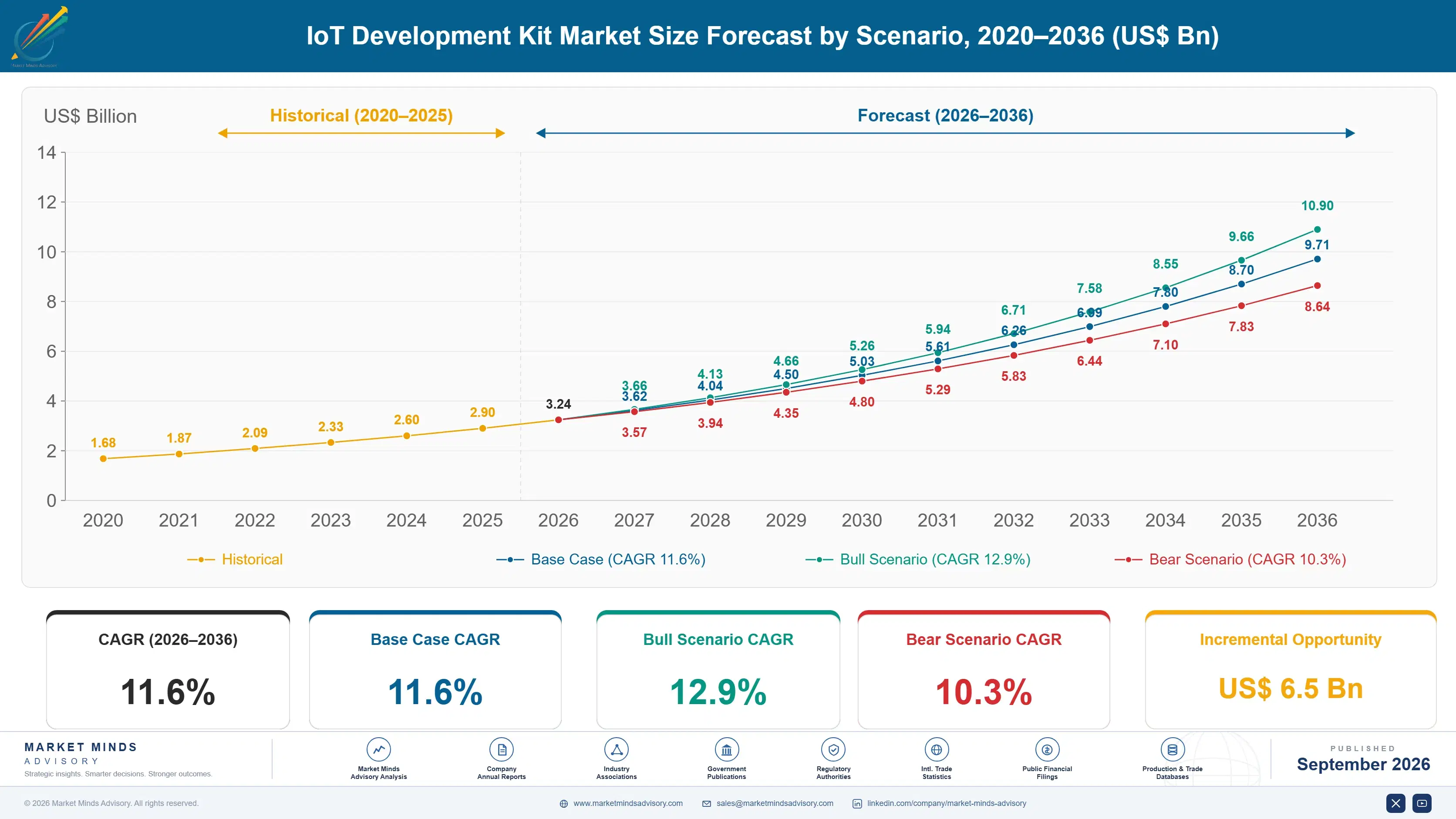
Between 2020 and 2025, IoT development kit demand grew steadily as hobbyist and educational adoption expanded alongside early industrial prototyping activity across multiple developer communities worldwide, though most kits still required separate connectivity modules. The category posted a historical CAGR of roughly 10.6% as cellular-native integration remained uncommon across most mainstream development boards sold to developers.
The base case rests on three commercial mechanisms: hardware startups adopting cellular-native boards to compress prototype-to-production timelines, industrial engineering teams standardizing on development kits with built-in asset-tracking connectivity, and semiconductor vendors bundling edge AI capability into boards previously limited to basic microcontroller functions. Together these mechanisms support a forecast CAGR of 11.6% through 2036, with cellular-native boards growing considerably faster than traditional Wi-Fi-only kits. Adoption is accelerating fastest among teams building asset-tracking hardware.
The bull case centers on accelerated industrial IoT deployment that pulls forward cellular-native board adoption across multiple asset-tracking and monitoring applications simultaneously and well ahead of current planning assumptions. The bear case centers on semiconductor export restrictions that could disrupt component sourcing for board manufacturers, compressing supply even as underlying developer demand continues expanding steadily across the industry.

From Hobbyist Boards to Production-Ready Platforms

IoT development kits have moved from bare-bones microcontroller boards requiring extensive manual integration to production-ready platforms where connectivity, security, and edge AI capability arrive pre-configured out of the box for engineers across nearly every hardware development team today. No engineering team wants to spend budget reinventing basic connectivity infrastructure.
MARKET CONCENTRATION44% CR5Top five vendors hold combined global unit shipment share
AVERAGE BOARD PRICE$34 per unitBlended price across microcontroller and cellular-native board tiers
TOP PRODUCING COUNTRY SHARE27%China share of global development board manufacturing output
CELLULAR-NATIVE ADOPTION RATE23%Share of new boards shipping with built-in cellular connectivity
DEVELOPER COMMUNITY SIZE4.2 million usersEstimated active developers across major platform communities tracked
SEMICONDUCTOR COST SHARE41% of COGSShare of board manufacturing cost tied to chipset components
Developer community size and software tooling quality have become primary competitive differentiators alongside raw hardware specifications, since engineers increasingly choose platforms based on available libraries and community support rather than component cost alone. Vendors lacking active developer communities are steadily losing design wins to platforms with richer software libraries and documentation. That gap keeps widening every fiscal quarter across the vendor landscape. Order volume for cellular-native boards keeps climbing steadily.
Semiconductor sourcing has become the primary constraint on supply availability, since export control policy affecting advanced chip components is reshaping where board manufacturers can source parts for continued production. That constraint is reinforcing demand for vendors with diversified, multi-region component sourcing relationships. Few smaller vendors can realistically close that sourcing gap quickly. That gap keeps widening every fiscal quarter across the manufacturer landscape. Few vendors can close it quickly.
"Ten years ago a hardware prototype meant weeks of soldering and debugging modem firmware. Now the winning boards ship with connectivity already working, and the vendors capturing design wins are the ones who made that first hour of unboxing feel effortless."
Director, Embedded Systems and IoT Hardware Practice · MMA Technology Practice · September 2026

Market Trends

Cellular-Native Boards Become Standard for Industrial Applications

Industrial and asset-tracking developers are increasingly specifying cellular-native development boards rather than adding separate modem modules, treating built-in connectivity as a baseline requirement rather than an advanced feature. Roughly 23% of new development boards now ship with cellular connectivity integrated, up sharply from a low single-digit share just three years ago, and vendor lead times have extended past several months as demand continues outpacing chipset supply across the category. Vendors that built adequate chipset supply early now hold a meaningful advantage over slower-moving competitors still expanding manufacturing capacity. That advantage compounds every quarter chipset shortages persist.
Market Impact: production-track board purchases grew 27%
Edge AI Capability Moves Onto Mainstream Development Boards

Semiconductor vendors are integrating dedicated edge AI processing capability directly into mainstream development boards previously limited to basic microcontroller functions, letting developers run inference workloads without additional hardware. This shift has pulled roughly 19% of new industrial prototyping projects into edge AI-enabled board categories over the past two years, reshaping how developers select boards for computer vision and predictive maintenance applications. Vendors offering the most accessible edge AI development tooling are capturing disproportionate share of this shift as computer vision applications multiply across industries. That trend is expected to continue as inference workloads keep expanding.
Market Impact: asset tracking board purchases grew 22%

Market Opportunities and Growth Drivers

Hardware Startups Compress Prototype-to-Production Timelines Overall

Hardware startups facing intense competitive pressure to reach production faster are adopting cellular-native development boards that eliminate months of separate modem integration work previously required before a working prototype existed. Development boards purchased for production-track projects grew roughly 27% year over year as startups concluded that faster time to market justified premium board pricing over cheaper alternatives requiring additional integration effort across every project phase. That trajectory is expected to continue as competitive pressure remains elevated across multiple hardware categories over the coming several years ahead for most startups. Margins for premium boards remain elevated.
Market Impact: extends lead times by 5 months

Industrial Asset Tracking Demand Expands Board Adoption

Manufacturing and logistics companies deploying asset tracking programs across expanding equipment fleets are driving substantial demand for cellular-native development boards used in early-stage tracking device prototyping before mass production begins. Asset tracking-related board purchases grew roughly 22% year over year as companies expanded pilot programs into full fleet deployments across warehouses, vehicles, and industrial equipment tracked nationwide. Vendors offering the most rugged, industrial-grade boards are capturing disproportionate share of this expansion-driven demand as fleet sizes continue growing across every region. That competitive gap continues widening every fiscal quarter across the industry.
Market Impact: adds 3 weeks to porting time

Market Restraints and Challenges

Semiconductor Export Restrictions Complicate Board Sourcing

The core friction point is that export restrictions on advanced semiconductor components are complicating where board manufacturers can source chips for continued production, a constraint rooted in ongoing geopolitical tension between major manufacturing regions. The commercial impact is direct: manufacturers face allocation constraints and extended lead times even when willing to pay premium pricing for guaranteed supply. Several vendors are responding by qualifying alternative chip suppliers as a mitigation pathway that reduces single-source dependency. Smaller manufacturers without existing diversified supplier relationships find themselves further back in the allocation queue, widening the gap with larger, better-connected competitors.
Market Impact: 23% of boards ship with cellular

Fragmented Software Tooling Slows Cross-Platform Development

The core friction point is that development boards from different vendors rely on incompatible software toolchains and programming environments, rooted in the absence of industry-wide standardization across the fragmented board market. The commercial impact falls hardest on developers building products that span multiple board platforms simultaneously, since porting code between platforms consumes meaningful engineering time. Several vendors are mitigating exposure by supporting open standards and common development frameworks across their board lines. This standardization effort adds meaningful engineering investment but has proven effective at attracting developers who value long-term platform flexibility over vendor lock-in.
Market Impact: 19% of projects use edge AI
4 additional market trends, 4 additional growth drivers, and 3 additional restraints and challenges are covered in the full report. Contact sales@marketmindsadvisory.com to access the complete intelligence.

Segment CAGR and Growth Architecture

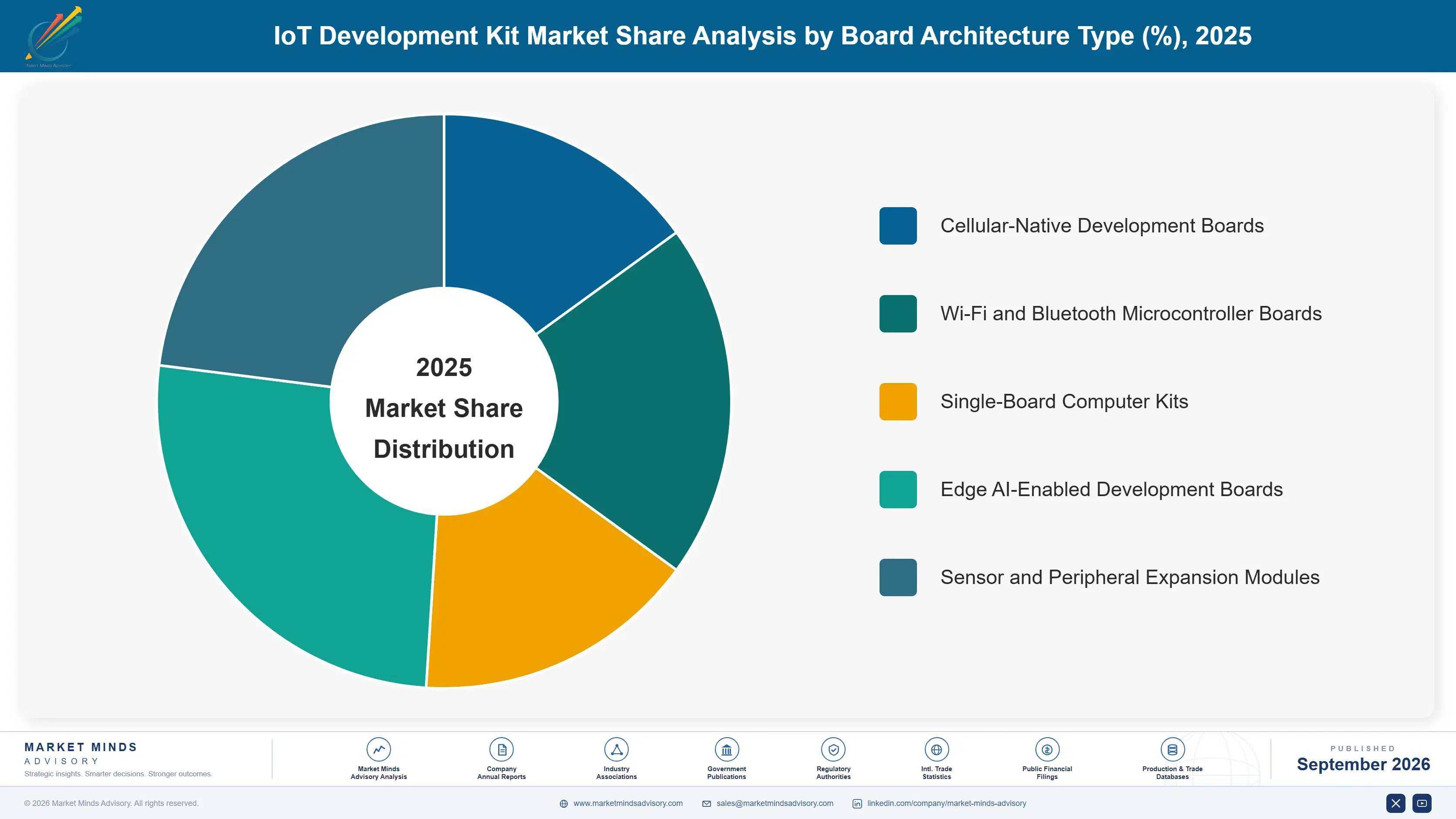
IoT development kits segment by core connectivity and processing architecture rather than by end application, since the same underlying board designs serve hobbyist, educational, and industrial prototyping customers with comparable microcontroller, connectivity, and software toolkit requirements regardless of which specific developer segment, geographic region, or overall company size ultimately chooses to purchase them today.
iot-development-kit-market-market-share-analysis-1789996341071

Cellular-Native IoT Development Boards

Cellular-native IoT development boards integrate built-in modem and SIM connectivity directly onto the board, eliminating the separate integration work that traditional Wi-Fi or Bluetooth-only kits require before a device can communicate over wide-area networks. Demand is concentrated among industrial and asset-tracking developers who need immediate wide-area connectivity without building custom cellular integration from component parts. Growth here runs meaningfully ahead of the broader market as developers increasingly view built-in cellular connectivity as a baseline requirement rather than an advanced feature reserved for specialized applications. Vendors offering the broadest cellular carrier certification coverage are winning the largest industrial contracts as this segment continues to outgrow the broader development board category considerably.
CAGR 18.0%

Standard Microcontroller and Single-Board Computer Kits

Standard microcontroller and single-board computer kits provide general-purpose processing capability without integrated wide-area connectivity, serving hobbyist, educational, and early-stage prototyping use cases where developers add connectivity modules separately as needed. Demand is concentrated among educational institutions and hobbyist developers who prioritize affordability and software flexibility over built-in feature completeness. Vendors offering the richest software libraries and documentation are capturing disproportionate share of this large but slower-growing segment of the market. That affordability advantage compounds as manufacturing scale continues improving generation over generation across the broader industry. Developers switching to these affordable kits report meaningfully lower total prototyping cost than those starting with premium cellular-native boards for early-stage experimentation. Margins there remain thinner too.
CAGR 8.6%
Full segment breakdown across 7 segments available in the complete report.

Regional Architecture and Country Demand Map

Manufacturing and design activity concentrates where semiconductor production and hardware engineering talent are deepest, favoring East Asia, followed closely by North American and South Asian markets scaling their own developer infrastructure and component manufacturing base across expanding technology corridors and secondary supply hubs both nationwide.

East Asia

China anchors regional demand through Espressif Systems' dominant position in low-cost microcontroller and Wi-Fi module manufacturing, alongside a broader network of board assembly facilities serving global developer demand. Taiwan's advanced semiconductor foundry base provides critical chip manufacturing support for board vendors across the region. Japan and South Korea favor established industrial-grade board vendors given their mature manufacturing sectors and existing supplier relationships built over decades. South Korea's chaebol-backed electronics arms are building proprietary board designs rather than relying entirely on third-party manufacturers. Order backlogs for top-tier cellular-native boards there now extend several months given surging industrial demand. That proprietary approach limits third-party vendor penetration somewhat. Order backlogs continue extending well past several months.
Share: 29% | CAGR: 12.7% (2026 to 2036)

North America

The United States anchors North American demand through its concentration of hardware startups and the headquarters of vendors like Particle and Raspberry Pi Foundation's commercial operations. Canada contributes a smaller but growing share as domestic hardware engineering talent expands across its technology sector. Competition here centers heavily on software tooling quality and developer community support rather than raw component pricing alone. Mexico's growing hardware assembly sector is beginning to serve nearshoring-driven prototyping demand from American startups. Regulatory pressure around domestic semiconductor sourcing is pushing some manufacturers toward reshoring board assembly operations. Vendors offering built-in compliance tooling are gaining a meaningful competitive edge. Vendor consolidation through acquisition remains an active theme.
Share: 27% | CAGR: 11.9% (2026 to 2036)
Regional intelligence for 5 additional markets available in the complete report: Western Europe, South Asia and Pacific, Latin America, Middle East and Africa, Eastern Europe. Contact sales@marketmindsadvisory.com.
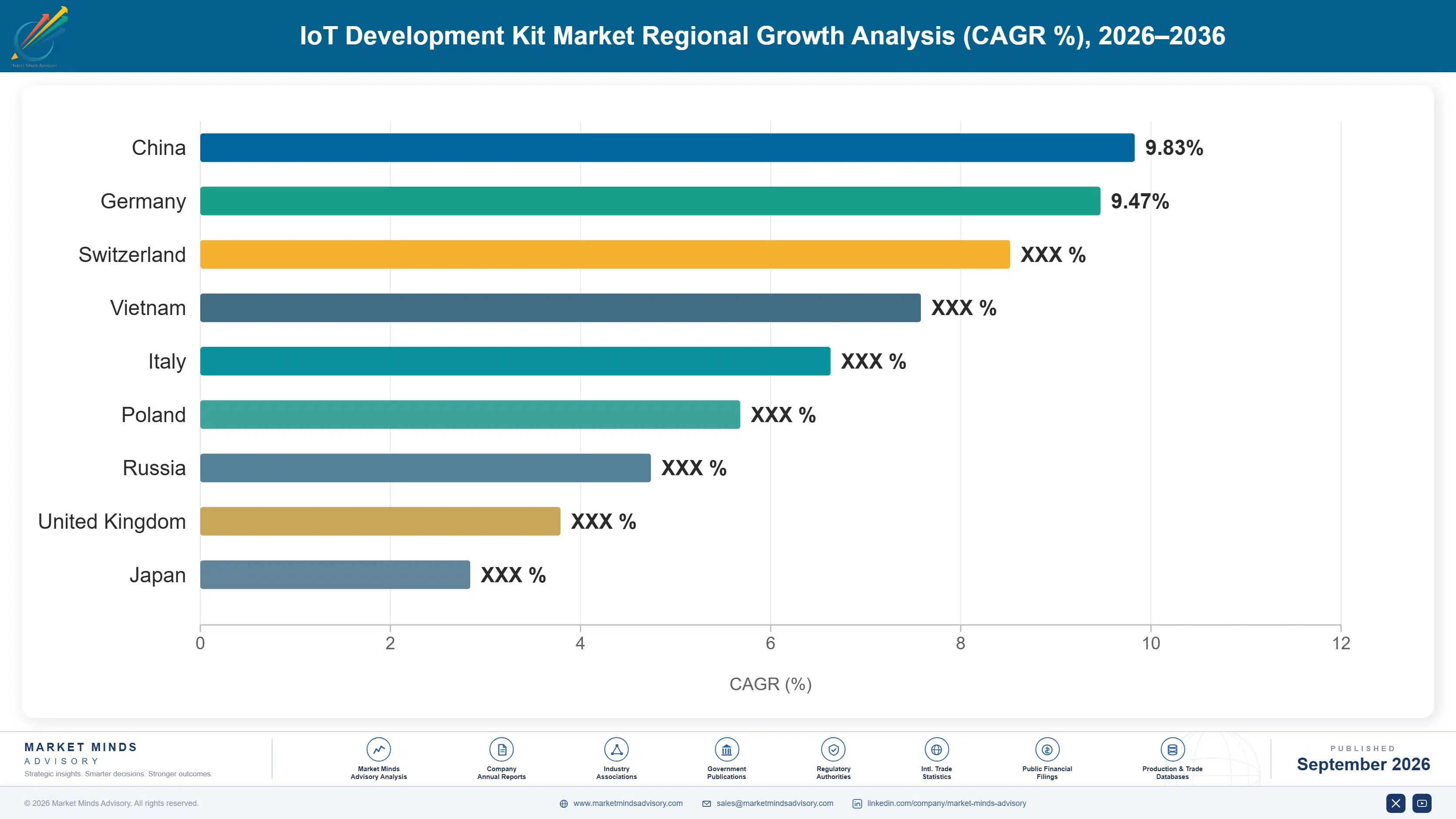
iot-development-kit-market-country-cagr-analysis-1789996341591

Where Board Vendors Capture More Design Win Revenue

Vendors capture disproportionate margin where cellular integration eliminates costly custom engineering and where rich software tooling creates durable developer loyalty that thinner, less-supported competitors cannot replicate across the broader prototyping market today, tomorrow, and well into the several years ahead for most competing vendors currently operating across the entire global industry landscape right now.

Cellular Connectivity Bundled Data Plan Programs

Vendors that bundle cellular data plans alongside connectivity-enabled boards are capturing recurring subscription revenue that extends well beyond the initial hardware sale, since developers increasingly prefer a single vendor relationship for both hardware and connectivity. Bundled connectivity programs now generate roughly 29% higher lifetime revenue per board than hardware-only sales, and demand for this bundled model continues growing as developers seek simplified vendor management across their prototyping and production programs. Vendors without this bundling capability increasingly find themselves competing on price alone within the shrinking hardware-only segment of the market.
Market Impact: bundled connectivity now earns roughly 29% more value

Production Volume Licensing Conversion Programs Overall

Vendors that convert prototyping customers into production volume component buyers are capturing considerably larger long-term revenue than vendors focused purely on one-time development kit sales. Conversion programs that guide developers from prototype boards to production-scale component purchasing now generate roughly 34% higher customer lifetime value, and vendors continue investing in dedicated production transition support teams to protect this pipeline. Smaller vendors without dedicated production transition support increasingly find themselves excluded from these larger, more lucrative volume opportunities entirely. That competitive dynamic keeps widening every fiscal quarter across the industry. Margins there remain solid.
Market Impact: conversion programs now generate roughly 34% more value

Premium Software Toolkit Subscription Programs Overall

Vendors offering premium software development toolkits, cloud device management, and advanced debugging capability as paid subscriptions are capturing recurring revenue that extends meaningfully beyond hardware margins alone. Premium toolkit subscriptions now generate roughly 24% higher blended margin than hardware-only sales, and adoption continues growing as developers value integrated tooling over piecing together open-source alternatives independently. Several vendors now treat this toolkit as central to long-term developer retention rather than a secondary feature bundled with hardware sales. Contract renewal rates for subscription customers run considerably higher than for hardware-only accounts. Retention improves steadily.
Market Impact: premium toolkits now generate roughly 24% more value

Multi-Year Enterprise Component Supply Programs Overall

Vendors that negotiate multi-year component supply agreements with enterprise hardware customers are securing considerably more predictable recurring revenue than vendors relying on one-time transactional board sales subject to competitive rebidding each cycle. Multi-year supply agreements increase average customer lifetime value by roughly 31% relative to comparable transactional arrangements, giving vendors meaningfully better visibility into future manufacturing capacity planning needs. Vendors without the relationship depth to negotiate multi-year terms increasingly find themselves losing enterprise accounts to competitors offering greater pricing certainty. That certainty has become genuinely valuable enough to justify meaningfully higher unit pricing across the board.
Market Impact: multi-year supply now adds roughly 31% more value

Who Controls the Margin Pool

The IoT Development Kit Market is moderately fragmented, with a CR5 of 44% reflecting unit shipment share among the top five board vendors. Espressif Systems holds a leading position given its dominant low-cost Wi-Fi and cellular module manufacturing scale, and the gap between it and mid-tier challengers has widened as semiconductor sourcing complexity raises the bar for smaller vendors attempting to compete at meaningful production volume. Only a handful of vendors can realistically match that manufacturing depth.
Current competitive activity centers on cellular connectivity expansion and software tooling investment rather than pricing alone, since developer community strength increasingly determines which vendors win design wins. Leading vendors are pursuing partnerships with cellular carriers to secure preferential data pricing while simultaneously acquiring smaller specialized software tooling firms to fill capability gaps faster than internal development would allow.

Emerging pressure is coming from vertically integrated hardware startups building custom boards optimized entirely for their own product lines rather than purchasing general-purpose development kits, threatening to bypass established vendors for high-volume production runs. Rankings could shift meaningfully if enough startups continue this vertical integration trend, since it removes them from the addressable development kit market entirely once production scales.
iot-development-kit-market-company-positioning-matrix-1789996342148

Competitive Moat and Risk Dimensions

ESPRESSIF SYSTEMS

Moat: Low-Cost Manufacturing Scale Advantage

Espressif's massive manufacturing scale for Wi-Fi and cellular modules gives it cost advantages that smaller board vendors cannot match, since component purchasing volume directly reduces per-unit chip costs. That scale advantage compounds as developers increasingly standardize on Espressif's widely supported chipset architecture. Competitors attempting to replicate this scale would need years of accumulated manufacturing volume.
ESPRESSIF SYSTEMS

Risk: Chinese Sourcing Concentration Risk

Espressif's manufacturing concentration in China exposes it to export control policy risk that diversified competitors sourcing from multiple regions do not face as acutely. If geopolitical tension between major manufacturing regions intensifies further, Espressif risks losing customers seeking supply chain diversification away from single-country dependency.
RASPBERRY PI FOUNDATION

Moat: Educational Community Loyalty Advantage

Raspberry Pi's deep educational and hobbyist community loyalty, built over more than a decade, gives it brand recognition that newer entrants cannot easily replicate, since generations of developers learned embedded programming on its boards specifically. That community advantage translates into steady demand across educational procurement cycles.
RASPBERRY PI FOUNDATION

Risk: Limited Industrial-Grade Positioning

Raspberry Pi's origins in education and hobbyist markets mean its industrial-grade certification and ruggedization capability remain less developed than specialists built industrial-first. Closing that gap requires sustained investment that competes with Raspberry Pi's core educational mission priorities. Until that gap closes, Raspberry Pi remains a strong educational partner rather than the preferred industrial specialist.

Players Tracked

Prominent Players

Espressif Systems
Raspberry Pi Foundation
Arduino
STMicroelectronics
Particle

Other Key Players

Nordic Semiconductor
Silicon Labs
Adafruit Industries
SparkFun Electronics
Seeed Studio
BeagleBoard.org
Microchip Technology
Texas Instruments
NXP Semiconductors
Sixfab
Blues Wireless
Sequans Communications
u-blox
Digi International
Sierra Wireless

Recent Developments

JANUARY 2026

Espressif Systems expanded its cellular module manufacturing capacity through an organic facility expansion in China aimed at reducing lead times for industrial customers facing mounting delivery pressure. The expansion adds meaningful annual production capacity once fully operational next year. The company plans further capacity expansion into additional facilities next year.
Signal: Signals Espressif is now prioritizing cellular capacity investment given a stronger margin and demand outlook there.
SEPTEMBER 2025

Particle signed a multi-year data partnership agreement with a major cellular carrier to provide bundled connectivity plans across its entire cellular-native board lineup. The agreement includes preferential data pricing reserved specifically for Particle's enterprise customer base. Terms of the partnership were not fully disclosed publicly.
Signal: Signals board vendors are locking in carrier partnerships years ahead of need given growing bundled connectivity demand.
MAY 2025

Arduino acquired a smaller specialized edge AI software startup to accelerate its machine learning tooling roadmap for mainstream development boards facing rising developer demand. The acquisition brings proprietary inference optimization technology and an engineering team with relevant experience. Terms of the acquisition were not fully disclosed.
Signal: Signals mid-tier vendors are pursuing acquisitions to add edge AI capability faster than internal development alone.

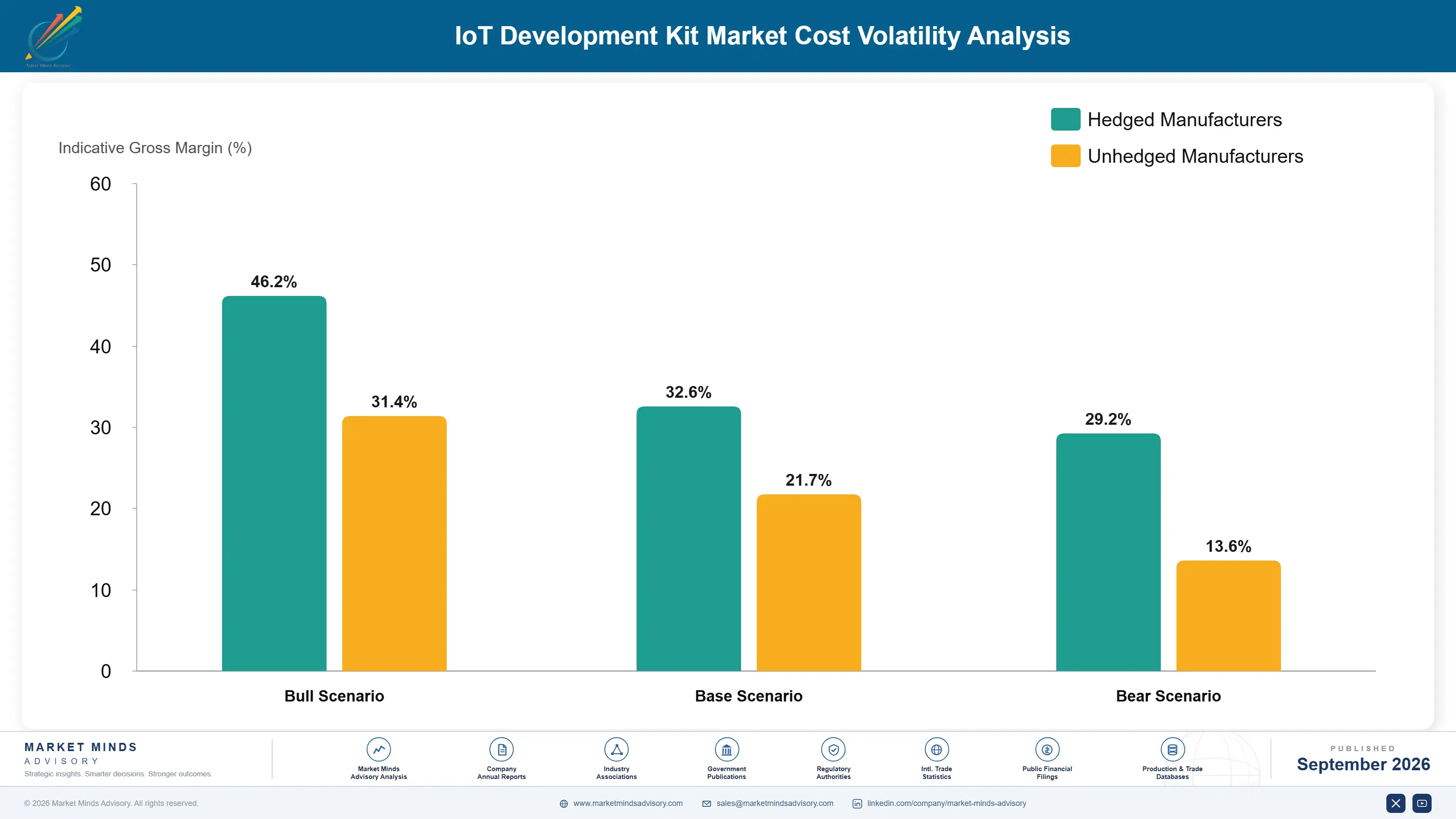
Semiconductor and Cellular Module Cost Exposure

Semiconductor chipsets and cellular modem modules together represent roughly 41% of board manufacturing cost of goods sold, with advanced chipsets sourced primarily from Taiwanese and South Korean foundries while cellular modem components depend on a small number of specialty suppliers concentrated in China and Europe's industrial base. Rare earth materials used in RF components add a further layer of geographic supply concentration.
Semiconductor chipset prices rose meaningfully through 2025 as development board demand competed with automotive and consumer electronics production for the same constrained global wafer supply, according to disclosures in TSMC's FY2025 Annual Report. Several board vendors reported margin compression in quarterly filings tied directly to rising chipset input costs during that period of sustained industry-wide demand, with some citing double-digit percentage cost increases. on their newest cellular product lines.

Smaller regional vendors lacking long-term chipset supply agreements face a genuine competitive disadvantage against larger vendors like Espressif and STMicroelectronics, which can secure priority allocation through scale purchasing relationships with foundries. This exposure varies by geography too, since vendors manufacturing in East Asia maintain closer supplier proximity than competitors based in other regions entirely. That gap continues widening steadily.
iot-development-kit-market-cost-volatility-analysis-1789996342346

Long-Term Chipset Supply Purchase Agreements

Leading vendors are securing multi-year chipset purchase agreements directly with foundries to guarantee priority allocation during periods of tight global supply. This approach has measurably reduced input cost variance for vendors with the purchasing scale to negotiate favorable long-term terms. Several vendors have extended these agreements to cover multiple years, locking in predictable input costs across successive product generations.

Dual-Source Chipset Supplier Diversification

Several vendors are qualifying chipsets from multiple semiconductor suppliers to reduce dependence on any single source, insulating margins from volatility that smaller competitors lacking this leverage cannot access as easily given limited engineering resources. Several now maintain active relationships with at least two suppliers. That redundancy proved valuable during recent industry-wide supply disruptions and shortages.

Vertical Integration Into Module Assembly

Some of the largest vendors are investing directly in cellular module assembly capacity to reduce dependence on external suppliers entirely, insulating themselves from price volatility that smaller competitors face. This investment requires substantial upfront capital commitment. Several vendors now source a meaningful share of their own module needs internally rather than relying entirely on third-party assembly.

Portfolio Architecture for Margin Defence

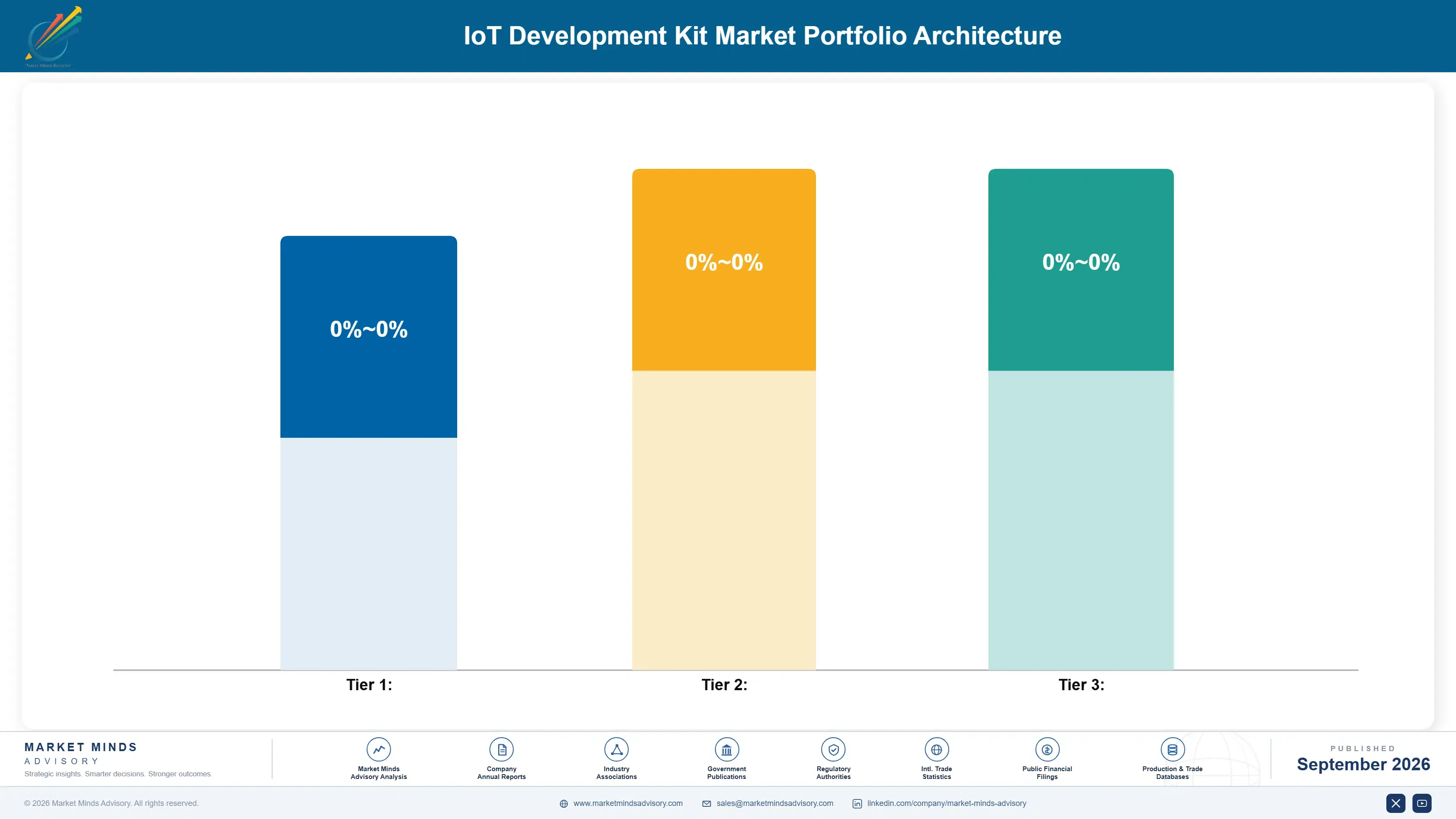
Development board economics split sharply between standard microcontroller kits with margins in the mid-twenties percent range and cellular-native boards commanding margins well above forty percent given engineering complexity and constrained chipset supply. That gap continues widening as industrial developers pay premiums for built-in connectivity. Vendors unable to differentiate beyond standard boards face persistently lower long-term returns. Margins there keep rising steadily.
The tension between volume and premium runs through nearly every vendor's product roadmap right now, since educational and hobbyist customers still need affordable standard boards even as the fastest-growing revenue pool sits squarely in cellular-native industrial applications. Vendors that chase educational volume exclusively risk ceding the higher-margin segment entirely to focused specialists. That risk compounds each year cellular connectivity continues becoming standard.

High-value pools concentrate around cellular-native connectivity, premium software toolkits, and production volume conversion programs, all of which carry meaningfully better margins than standard board sales. Vendors positioning early in these pools are capturing outsized profitability relative to their unit volume, a pattern MMA expects to persist through the current industrial IoT adoption cycle. Watch this dynamic closely over the coming several years.

Standard microcontroller and single-board computer kits sold largely on price and community support, carrying margins in the mid-twenties percent range across most vendors. Renewal decisions here typically depend on price competition rather than connectivity differentiation.
Gross Margin

Cellular-native development boards engineered for industrial and asset-tracking applications, commanding margins above forty percent given engineering complexity and constrained supply. Contract commitments here typically span multiple years of industrial customer relationship depth.
Gross Margin

Edge AI-enabled boards and premium software toolkit subscriptions carrying the highest margins but still limited adoption scale relative to standard boards. Adoption is expanding steadily as vendors add new inference capability to their platforms.
Gross Margin
iot-development-kit-market-portfolio-architecture-1789996342872

High-value Sub-segments and Strategic Watch-out

Cellular-Native IoT Development Boards

High-value, high-growth segment where demand consistently outpaces chipset supply, commanding premium pricing and the fastest revenue growth of any category tracked in this report. Order backlogs continue extending well past several months for most leading vendors. Capacity remains the binding constraint on further growth. Margins remain solid.

Standard Microcontroller and Single-Board Computer Kits

Volume core segment generating steady, predictable revenue across nearly every educational and hobbyist account, though growth trails cellular-native boards given a larger installed base. Margins there remain thinner than in cellular-native categories. Price competition here remains intense across nearly every vendor segment. Volume remains stable.

Edge AI-Enabled Development Boards

High-value, moderate-growth segment benefiting from steady computer vision adoption, though growth trails cellular connectivity given a smaller current customer base overall. Vendors here increasingly bundle inference tooling to defend against slower relative growth. Diversification demand keeps growing steadily each quarter here. Rankings could shift meaningfully.

Vertically Integrated Hardware Startup Manufacturing

Strategic watch-out segment where startups building custom boards in-house are bypassing established vendors entirely, a shift that could reshape competitive rankings over time. Established vendors increasingly acquire these entrants for this exact reason. Watch this competitive dynamic closely over coming years. Rankings could shift meaningfully.

Boards as a Production Pipeline Annuity

Development board relationships behave like annuities once a prototype moves toward production, since firmware, software libraries, and hardware footprint decisions made during prototyping carry directly into manufacturing specifications. Switching board vendors mid-project means rewriting firmware and reworking hardware layouts from scratch, a cost that keeps developers committed to their initial vendor choice through production even when competitors offer meaningfully lower component pricing later.
Adoption depth varies considerably by end-use vertical. Industrial and asset-tracking developers show the deepest platform dependency, since their production volumes justify custom firmware and hardware partnerships that hobbyist developers cannot access. Educational and hobbyist customers adopt more casually but at meaningful volume once community libraries prove reliable, where documentation quality matters more than raw specifications, giving vendors a long runway of incremental developer loyalty over successive product generations.

Buyer profiles are shifting generationally as hardware engineers who once treated connectivity as a separate integration project give way to a cohort that expects built-in cellular capability from the start of their careers designing connected products. That newer generation increasingly evaluates board vendors more like strategic manufacturing partners than component suppliers, weighing software tooling depth and production support alongside traditional cost criteria.
iot-development-kit-market-end-use-penetration-index-1789996343359

Where MMA Sees the Advantage

These are among the four positions where our research anticipates prominent divergence between winners and laggards over the coming forecast period. Each is grounded in the demand model, the regulatory perimeter, and the announced capacity pipeline.
01 / CELLULAR INTEGRATION INVESTMENT

Build built-in cellular connectivity before rivals catch up

Vendors that invest early in built-in cellular connectivity hold a durable edge as industrial developers increasingly treat wide-area connectivity as a baseline requirement rather than a separate integration project across nearly every application. This capability is genuinely difficult to build quickly, which is exactly why vendors without it are steadily losing design wins to more integrated competitors today. MMA expects this gap to widen considerably further before it narrows meaningfully, rewarding vendors willing to invest in cellular integration now rather than waiting.
02 / PRODUCTION CONVERSION PACKAGING

Bundle production volume conversion pathways as a service

Hardware customers pay considerably more for vendors that provide a clear pathway from prototype boards to production-scale component purchasing than for vendors offering prototyping hardware alone, and that opportunity gap is only growing wider with each passing quarter. That willingness to pay is not yet fully captured by most vendors' current business models across the category today. Real margin is being left squarely on the table for any vendor willing to formalize this conversion pathway into a distinct, clearly marketed program.
03 / SOFTWARE TOOLKIT EXPANSION

Bundle premium software tooling into every hardware sale

Premium software toolkit subscriptions carry meaningfully higher margin than the hardware sales they attach to, and attach rates remain well below what mature markets eventually reach once developers recognize the value clearly across their entire project pipeline and product lifecycle. That gap represents real margin being left on the table by vendors still treating software as a secondary afterthought rather than a core revenue stream today. MMA sees considerable room for vendors formalizing this attachment into every sale going forward.
04 / VERTICAL INTEGRATION RISK

Watch hardware startups bypass vendors through in-house builds

Vertically integrated hardware startups building custom boards entirely in-house pose the clearest competitive threat to vendors relying on prototype-to-production conversion as a durable revenue pathway across their existing customer base and broader pipeline. Vendors that fail to keep prototyping customers engaged through production risk losing exactly the highest-volume accounts that fund considerable revenue growth today and well into the future ahead. MMA expects this competitive pressure to intensify rather than fade anytime soon across most major global markets nationwide and abroad.

Engagement Snapshot From the Field

A live engagement with an industry participant carrying material or product regulatory and market exposure ahead of a defining policy shift, showing how our research translates into a defensible multi-year portfolio strategy.
MARKET MINDS ADVISORY · CLIENT ENGAGEMENT SUMMARY
IoT Development Kit Producer Strategic Portfolio Review and Transition Roadmap 2026·Investment Scenario on IoT Development Kit Exposure Evaluation 2025-26
CLIENT PROFILE
The client is a venture-backed industrial asset tracking startup developing a cellular-connected sensor tag for monitoring shipping containers and heavy equipment across construction sites. Approaching a critical hardware finalization milestone ahead of its planned production run of fifty thousand units, leadership sought an independent assessment of which development board platform would best support the transition from prototype to manufacturing scale.
STRATEGIC CHALLENGE
The client's engineering team had prototyped on three different cellular-native board platforms without a clear framework for evaluating which offered the most reliable path to production given the specific ruggedization and battery life requirements of outdoor asset tracking. Internal stakeholders disagreed on whether to prioritize the board with the largest existing developer community or the one with the best power efficiency specifications.
MMA APPROACH
MMA benchmarked three cellular-native board platforms against the client's specific ruggedization, battery life, and production supply chain requirements, evaluating each vendor's track record on manufacturing scale-up support and long-term product reliability standards. The engagement combined vendor technical assessments, reference customer interviews, and power consumption testing under simulated outdoor operating conditions.
KEY FINDINGS
  1. The board with the largest developer community showed meaningfully worse battery life under the client's specific outdoor operating conditions than the two alternatives, a gap not evident in vendor marketing materials.
  2. The vendor offering the best power efficiency lacked established manufacturing scale-up support for production runs beyond ten thousand units, creating meaningful risk for the client's planned volume.
  3. A third vendor balanced power efficiency and manufacturing support adequately, though its smaller developer community meant less available third-party documentation for edge cases.
  4. Component lead times for the recommended vendor's chosen chipset were meaningfully shorter than alternatives, reducing production schedule risk for the client's planned launch timeline.
CLIENT PROFILE
The client is a venture-backed industrial asset tracking startup developing a cellular-connected sensor tag for monitoring shipping containers and heavy equipment across construction sites. Approaching a critical hardware finalization milestone ahead of its planned production run of fifty thousand units, leadership sought an independent assessment of which development board platform would best support the transition from prototype to manufacturing scale.
STRATEGIC CHALLENGE
The client's engineering team had prototyped on three different cellular-native board platforms without a clear framework for evaluating which offered the most reliable path to production given the specific ruggedization and battery life requirements of outdoor asset tracking. Internal stakeholders disagreed on whether to prioritize the board with the largest existing developer community or the one with the best power efficiency specifications.
MMA APPROACH
MMA benchmarked three cellular-native board platforms against the client's specific ruggedization, battery life, and production supply chain requirements, evaluating each vendor's track record on manufacturing scale-up support and long-term product reliability standards. The engagement combined vendor technical assessments, reference customer interviews, and power consumption testing under simulated outdoor operating conditions.
KEY FINDINGS
  1. The board with the largest developer community showed meaningfully worse battery life under the client's specific outdoor operating conditions than the two alternatives, a gap not evident in vendor marketing materials.
  2. The vendor offering the best power efficiency lacked established manufacturing scale-up support for production runs beyond ten thousand units, creating meaningful risk for the client's planned volume.
  3. A third vendor balanced power efficiency and manufacturing support adequately, though its smaller developer community meant less available third-party documentation for edge cases.
  4. Component lead times for the recommended vendor's chosen chipset were meaningfully shorter than alternatives, reducing production schedule risk for the client's planned launch timeline.
RECOMMENDED STRATEGY
Phase 1: Phase one finalizes hardware design around the recommended vendor's platform, prioritizing battery life validation under real-world outdoor conditions. and outdoor durability requirements. Phase 2: Phase two engages the vendor's manufacturing scale-up support team early to validate production readiness before committing to the full fifty-thousand-unit run. Phase 3: Phase three establishes a secondary chipset source as a contingency against potential component lead time disruptions during production. if pricing or delivery issues emerge.
OUTCOME
The client selected the recommended board platform and proceeded with hardware finalization on schedule, avoiding an estimated four-month production delay (client-reported, unverified by MMA) that the battery life issue would have caused post-launch. Internal reporting credited the standardized evaluation framework with surfacing the manufacturing scale-up risk before it became costly.

Frequently Asked Questions

Foundational context covering the market sizes, CAGR, scope, country, region and competition that inform every finding below. This section is provided to cover basics and most often pre-purchase conversations, answered from the MMA Primary Research Dataset.

What is the current size of the IoT Development Kit Market?

The IoT Development Kit Market was valued at approximately $2.9 billion in 2025. That figure covers development boards and toolkits for connected device prototyping, excluding finished consumer IoT products.

How large will the IoT Development Kit Market be by 2036?

MMA projects the market will reach approximately $9.7 billion by 2036. Growth is driven primarily by cellular-native board adoption and hardware startups compressing production timelines.

What is the CAGR for the IoT Development Kit Market 2026 to 2036?

The market is forecast to grow at an 11.6% compound annual rate between 2026 and 2036. Bull and bear scenarios range from 12.9% down to 10.3% depending on semiconductor sourcing pace.

Which segment is growing fastest?

Cellular-Native IoT Development Boards is the fastest-growing segment, expanding at roughly 18.0% annually, about 1.55 times the overall market rate. Built-in connectivity demand is the primary driver.

Who are the major companies in the IoT Development Kit Market?

Espressif Systems, Raspberry Pi Foundation, Arduino, STMicroelectronics, and Particle lead the category on disclosed unit shipment estimates. Combined, the top five hold roughly 44% of the market.

Which country is growing fastest?

India is the fastest-growing country at approximately 15.5% annually, ahead of the broader South Asia and Pacific region. Expanding hardware engineering talent is the primary factor behind that pace.

Report Segmentation Architecture

The full report scope spans multiple orthogonal segmentation dimensions, with cross-tabulated demand data provided for each dimension pair. Coverage extends further to regional breakdowns, trend trajectories, and the competitive detail needed to support segment-level decision-making.

By Board Architecture Type

  • Cellular-Native Development Boards
  • Wi-Fi and Bluetooth Microcontroller Boards
  • Single-Board Computer Kits
  • Edge AI-Enabled Development Boards
  • Sensor and Peripheral Expansion Modules

By End-Use Industry

  • Industrial and Asset Tracking
  • Educational and Hobbyist
  • Consumer Electronics Prototyping
  • Healthcare and Medical Device Prototyping

By Commercial Dimension

  • Direct Vendor Sales
  • Distributor and Retail Channels
  • Bundled Connectivity Data Plans
  • Production Volume Component Contracts

By Region

  • East Asia
  • North America
  • Western Europe
  • South Asia and Pacific
  • Latin America
  • Middle East and Africa
  • Eastern Europe

Scope, Methodology, and Coverage

Every figure in this report is reproducible from documented input assumptions. The scope below maps the historical period, the forecast horizon, the segmentation dimensions, and the countries covered, alongside the underlying primary and qualitative methodology.
Historical Period
2020 to 2025
Forecast Period
2026 to 2036
Base Year
2025 (USD billions; MMA Primary Research Dataset, September 2026)
Market Definition
This report defines the IoT Development Kit Market as hardware boards and accompanying software toolkits used by engineers to prototype and develop connected device applications, including microcontroller boards, cellular-native modules, and single-board computers. It excludes finished consumer IoT products, industrial PLCs, and general-purpose computing hardware without IoT-specific connectivity features.
Quantitative Units
USD Billion, CAGR (%), Unit Shipments
Segmentation Dimensions
Board Architecture Type, End-Use Industry, Commercial Dimension, Region
Regions Covered
East Asia, North America, Western Europe, South Asia and Pacific, Latin America, Middle East and Africa, Eastern Europe
Countries Covered
China, United States, Germany, India, Japan, Brazil, United Kingdom, and 13 additional countries
Key Companies Profiled
Espressif Systems, Raspberry Pi Foundation, Arduino, STMicroelectronics, Particle, and 15 additional companies
Quantitative Methodology
Primary survey, n=3,800 respondents, Q4 2025, six countries; demand-side model with trade association cross-validation
Qualitative Methodology
47 expert interviews, Q4 2025; applied to validate demand model assumptions, identify emerging dynamics, and assess competitive positioning
Report Format
PDF and XLSX data workbook (Word format preview document)
Publisher
Market Minds Advisory
Report Code
MMA-2026-TEC-257
Published
September 2026
Contact
sales@marketmindsadvisory.com | www.marketmindsadvisory.com

Purchase the full IoT Development Kit Market Report (2026 to 2036).

The full IoT Development Kit Market report delivers a complete analysis of segment-level growth, regional demand patterns, and competitive positioning across all major board vendors worldwide. It includes detailed profiles of the twenty leading companies, quantified trend and driver analysis, and a full regional breakdown across all seven world regions with country-level detail where relevant. Buyers receive input cost exposure modeling and portfolio margin benchmarking that go well beyond what the executive summary alone can provide. The report also includes a proprietary MMA revenue-lever framework identifying where vendors can capture incremental margin.
Full seven-region demand and pricing breakdown
Twenty-company competitive profiles and moat analysis
Segment-level CAGR and market share detail
Input cost exposure and mitigation strategy analysis
Portfolio margin tiering across product categories
Primary survey and expert interview data tables

Built For The People Who Decide

From boardroom strategy to bench-side execution, this report is read cover-to-cover by leaders shaping the next decade of their industry, turning demand scenarios, market dynamics and valuation benchmarks into decisions.
CXOs/ Presidents/ VPs/ Managers
M&A and Corporate Development
Strategy Teams and R&D Heads
Procurement and Product Directors
Regulatory and Compliance Leaders
Investor Relations and Equity Analysts